Lebanon: The Fate of The Indictment Under a Caretaker Government
Al-Manar – 13/01/2011
Lebanon entered a transitional stage Thursday, only a few hours after the collapse of PM Saad Hariri’s government, as President Michel Sleiman declared the government in caretaker capacity pending the formation of a new government. On Wednesday, 11 ministers resigned from Hariri’s government in protest at his refusal to convene the Cabinet to discuss the Special Tribunal for Lebanon especially after the Saudi- Syrian effort to defuse the STL crisis was presumed dead.
It is the first time in Lebanon’s history that a government is toppled by the resignation of more than a third of its members, but it’s not the first time a government continues functioning in a caretaker capacity. Only this time, there is a slight difference with the STL expected to issue an indictment regarding the 2005 assassination of former Prime Minister Martyr Rafiq Hariri, and no official authority to receive it. The indictment is expected to implicate Hezbollah in the murder; a move widely seen as politicized serving US and Israeli interests in Lebanon and the region.
CARETAKER GOVERNMENT HAS NO DIRECT MANDATE
According to former minister and lawyer Issam Naaman, the Lebanese Constitution states that there are only three cases in which the government is considered resigned: the resignation or death of the Prime Minister, the end of the parliamentary cycle (i.e. parliamentary elections), in addition to the resignation of more than one third of the government’s members.
Naaman told Al-Manar website that in any of these cases, the president should call for parliamentary consultations to appoint a new prime minister. He noted that pending the formation of the new government, the resigned one functions in caretaker capacity and therefore, its ministers are required to act in this capacity.
The former minister defined the principle of “caretaker government as a task to manage the simple, routine and daily operations which do not require endorsement or Cabinet approval. “However, the caretaker government does not have the mandate to take decisive decisions that usually require a Cabinet meeting,” he explained.
Asked whether there were exceptional cases in which the caretaker government could take decisive resolutions, Naaman said that only in urgent cases such as catastrophes, the concerned minister has the right to take specific measures such as spending money without credence.
Naaman, meanwhile, pointed out that there was no specific constitutional deadline for the formation of a new government following any government resignation. “Customs stipulate, however, that parliamentary consultations, appointment of a prime minister and the formation of a new government take place without delay,” he said. “Yet, there are some cases where the country is severely divided, that the process extends to a relatively unlimited time” he added.
GOVERNMENT COLLAPSED WITH RESIGNATION OF 11th MINISTER
For his part, veteran legal expert and former head of the State Consultative Council, Yusuf Saadallah Khoury said the government collapsed the moment the 11th minister tendered his resignation. According to the constitution, more than one third of the ministers should resign to topple the government. In this case of a 30-member Cabinet, 11 ministers were required to withdraw.
“The constitution stipulates that the president then calls for binding parliamentary consultations to appoint a new prime minister. After that, the president, alone, issues a decree mandating the appointed PM to form the new government, and when the government is formed, the president releases a second decree” for the government take the oath and start functioning officially.
Like Naaman, Khoury stressed the caretaker government doesn’t have the direct mandate or the moral authority to take crucial decisions. “In case it adopts any resolution with relation to fateful events, it would be in violation of the law and should be penalized,” he explained. “The government has resigned and therefore its task is limited to taking care of necessary operations and transactions,” he elaborated.
The former head of the State Consultative Council also stated that the constitution has not specified any time limit for the President to issue the decree calling for parliamentary consultations. “The President is not obligated by any time limit in this regard. He can take the political circumstances into consideration before releasing it,” he said, stressing at the same time that the parliamentary consultations to appoint a new Prime Minister are mandatory.
The Lebanese are already divided over the legal and structural aspects of the STL, which the opposition regards as another political tool in US and Israeli hands to target the country and the resistance, yet the resignation of the government raises question marks on the fate of the international tribunal and the indictment which, if issued now, will find no official authority to receive it.
“Following the government’s resignation, the expected indictment will have absolutely no impact on Lebanon at any level,” former minister Issam Naaman told Al-Manar website, adding that the tribunal officials are aware that the STL wouldn’t be able to execute its indictment, especially after the speeches of Hezbollah Secretary General Sayyed Hasan Nasrallah who called for boycotting the illegal and unconstitutional tribunal. He recalled that the national opposition has rejected the agreement of coordination with the STL, which was adopted by the unconstitutional government of Fouad Saniora January 23, 2007, in violation of the Constitution and all laws,” reminding that then President Emil Lahoud didn’t sign it and the parliament did not endorse it.
For his part, Khoury ruled out any possibility of forcing Lebanon into dealing with the tribunal, which is subject to the United Nations Security Council’s Chapter 7 of the UN Charter, which allows the UNSC to resort to military interference and imposing sanctions. “This is not applicable at all,” Khoury told Al-Manar. He explained that the United Nations is powerless in this regard, especially with a caretaker government, given that the Security Council has the power to militarily interfere only in exceptional cases such as war, which is not the case in Lebanon.
OPPOSITION WILL NOT RE-APPOINT HARIRI…
Naaman explained the circumstances that led to the Saudi-Syrian initiative before being obstructed by the United States. “The Saudi-Syrian initiative was built on three main pillars: suspending financial aid, withdrawing Lebanese judges and transferring the issue of the false witnesses to the Lebanese Judicial Council. The US administration has rejected the settlement and exerted pressure on former PM Saad Hariri and Riyadh to foil it.”
“That’s why the national opposition decided to put an end to the whole game and chose to consult with President Michel Sleiman and convince him to influence Hariri to call for an immediate Cabinet session. But Hariri didn’t, turned down the opposition’s demand, leaving the opposition with no choice but resignation,” Naaman noted.
He expected that the formation of a new government would not take place very soon, adding that the opposition has basically decided not to re-appoint Saad Hariri as Prime Minister and seek other national figures suitable for the position of PM.
By its resignation from the government, the national opposition launched an era of democratic change; a sensitive transitional stage that will define the shape of the country for at least the 20 months left for the president’s tenure.
PALESTINIANS: LIVING UNDER THE OCCUPATION AND LOVING IT
Steve Amsel | Desert Peace | January 13, 2011
And what’s not to love? They are separated from their families and loved ones by a concrete wall making visits difficult, or impossible. Access to mosques is forbidden during Holy Days. Their children are accosted daily by Israeli soldiers on their way to and from school …. often imprisoned or murdered just for the fun of it.
And the great outdoors….. where else but in Occupied Jerusalem can a family be evicted from its home to make room for illegal Jewish settlers…. sanctioned by a court order?
Just think of the money these Palestinians can save by not having to bring gifts to loved ones they cannot visit … or contributions to their mosques that they are forbidden to go to … or having to feed an imprisoned or murdered child … or the city taxes they no longer have to pay as living in a tent is tax free.
Just think about those things so you won’t be surprised at the results of a Poll just held in Occupied East Jerusalem. I’m sure ever Jew living there was questioned as the results are definitely not a reflection of what any Palestinian is thinking.
Reading the Israeli press lately has become like reading America’s satirical newspaper ‘The Onion’…. it’s just not real. Case in point is the following;
Poll: Jerusalem Arabs prefer Israel
US poll: 39% of east Jerusalem Arabs prefer to live under Israeli sovereignty; 30% didn’t answer
WASHINGTON – The future of Jerusalem is considered one of the core issues in Israeli-Palestinian negotiations and one of the most significant obstacles to a permanent agreement between the two sides. However, it appears that on the Palestinian side, those who live in Jerusalem have already made their decision on the matter – and the Palestinian Authority leadership in Ramallah may not like it. …
Book review: Arafat’s ghost and the Palestinian national movement
Osamah Khalil, The Electronic Intifada, 13 January 2011
 |
November 2010 marked the sixth anniversary of the death of Palestinian Authority President Yasser Arafat. For the last two years of his life, the once peripatetic leader who was a constant fixture on the world stage for almost four decades, was reduced to living in a small compound-cum-prison. Only after he became gravely ill did Israel permit Arafat to leave for medical treatment in France. Less than three weeks later, he returned to Ramallah in a coffin and was buried in a chaotic funeral. While the circumstances surrounding his death remain shrouded in controversy, its impact on the Palestinian national movement is indisputable.
Although As’ad Ghanem’s new book Palestinian Politics after Arafat: A Failed National Movement focuses on the post-Arafat era, the dead leader permeates the pages and his legacy hangs like a specter over the Palestinian body politic. As Ghanem documents, Arafat’s actions and decisions as chairman of the Executive Committee of the Palestine Liberation Organization (PLO) (1969-2004) and as president of the Palestinian Authority (1996-2004) served not only to consolidate his rule, but were directly responsible for the current crisis in the Palestinian national movement and its inability to achieve its goals.
A senior lecturer in the School of Political Science at the University of Haifa, Ghanem is unsparing in his assessment of the current state of Palestinian politics and unsentimental in his analysis. The Palestinian national movement has not only failed as the book’s subtitle declares, but is “disintegrating.” What follows, Ghanem argues, is fratricidal chaos.
Ghanem’s main argument is bleak. “The crisis among the Palestinians is so severe,” he writes, “that the street fighting and confrontations covered by the media barely scratch the surface” (p. x). He adds that “the Palestinians have actually lost the ability to function efficiently, internally or externally, as a single national group” (p. 173).
Drawing on primary and secondary sources in English and Arabic, Ghanem identifies three internal and external indicators that demonstrate that the Palestinian movement has failed. Internally, he argues, the movement has descended into “internecine struggle and internal collapse” (p. 18). More importantly, he contends that the movement has not achieved a single goal in its conflict with Zionism: it has not liberated Palestine, established an independent state, or even achieved a stable peace with Israel. Nor has Zionism been rejected internationally as a colonial movement. Finally, the stature of the Palestinian national movement in the Arab and international arenas has “plummeted” (p. 18).
What is the cause of this failure? Ghanem argues that the seeds were planted during the Oslo period (1993-2000). He asserts that a combination of factors have led to the “political bankruptcy” of the PA and the PLO (p. 12). These include the PLO’s shift from pursuing a comprehensive solution to a partial resolution of the Palestinian-Israeli conflict as embodied by the Oslo accords, Arafat’s dominance over the national movement and the increased corruption under his leadership.
Palestinian Politics after Arafat picks up where works by Yezid Sayigh and Rashid Khalidi left off. But while Ghanem cites and references Sayigh’s Armed Struggle and the Search for State (1997), Khalidi’s The Iron Cage (2007) is notably absent. Ghanem also benefits from and draws upon his earlier critical examination of the Palestinian national movement and the PA in The Palestinian Regime (2001). In both books Ghanem’s analysis echoes many of Edward Said’s criticisms of Arafat and the PA, particularly those discussed in his edited volumes Peace and its Discontents (1996), The End of the Peace Process (2001), and From Oslo to Iraq and the Road Map (2005). Indeed, Ghanem substantiates many of Said’s claims of the cronyism, corruption and authoritarianism that pervaded the PA and became synonymous with Arafat’s regime.
In chapter 1, Ghanem addresses the influence of external factors on the Palestinian national movement, offering a compelling analysis of Israel’s “post-Oslo strategy.” Adopted in the wake of the failed Camp David Summit in 2000, he argues that Israeli policy toward the Palestinians under Prime Minister Ariel Sharon shifted from conflict resolution to conflict management. The key element of this strategy was the separation of the two populations through the unilateral withdrawal from the Gaza Strip and the construction of Israel’s “separation wall” in the occupied West Bank, including East Jerusalem. Meanwhile, the existence of the PA allowed Palestinians to retain some measure of limited self-governance. Ghanem convincingly demonstrates that Israel’s goal was the establishment of a “Palestinian entity,” offering “more than autonomy and less than a state” (p. 36).
The reorientation of Israeli policy was driven by two related factors: first, Israel’s preoccupation with the “demographic threat” — in other words, that Palestinians will become the majority within the boundaries of historic Palestine. And second, the fear that Israel will be transformed into a binational state. Ghanem argues that in spite of Israeli efforts to ensure a Jewish majority, the higher birth rate of Palestinians portends the opposite, creating a constant source of “concern among Jewish politicians and academics interested in the character and identity of the state, prompting many of them to seek new ways of guaranteeing a Jewish majority” (p. 23). He demonstrates that Israeli academia, think tanks and the government often worked closely in researching and assessing strategies to deal with this issue. However, Israel’s post-Oslo strategy has been complicated by the parallel policies of increased settlement activity and the annexation of the Jordan River Valley. As a result, Israel’s goal of separation from the Palestinians is undermined by the greater desire for Palestinian land and resources.
In chapter 2, Ghanem discusses recent Israeli public opinion polls to demonstrate that the shift in Israeli policy has benefited from broad-based support. More importantly, these polls reveal that the maximum the Israeli public would be willing to concede in any peace agreement does not meet the minimum of Palestinian demands or fulfill their rights under international law. Thus, barring a dramatic shift in Israeli public opinion, the strategy adopted by the Palestinian leadership of negotiations accompanied by attempts to convince Israelis of their willingness to achieve peace is bound to fail.
The core of Palestinian Politics after Arafat focuses on the internal causes for the current state of affairs and their implications. In chapter 3, Ghanem analyzes Arafat’s successful effort to consolidate power first within the PLO and then the PA. He convincingly argues that the failures of the PA were rooted in the structure of the PLO and Arafat’s leadership of the organization, which “provide a partial explanation for both Palestinian achievements since the 1950s and also for the Palestinians’ failure to attain their national goals” (p. 71). Indeed, as Sayigh demonstrates, after the assassinations of Fatah’s cofounders and his closest advisors, Khalil al-Wazir (Abu Jihad) and Salah Khalaf (Abu Iyad) in 1988 and 1991, respectively, Arafat had few rivals within Fatah or the PLO with the authority to challenge his decision-making. Therefore, with the decline of the leftist wing of the PLO by the end of the Cold War and the predominance of Fatah within the organization, Arafat was able to consolidate his rule over both.
Building on Sayigh’s Armed Struggle and the Search for State, Ghanem demonstrates that the Oslo accords and creation of the PA represented the logical conclusion of Arafat’s leadership of the PLO. In other words, the agreement could not have been signed if the PLO were truly a democratic and representative organization with a leadership that was elected by and responsive to its constituency or with functional independent institutions. Instead, the PLO’s quota system was exploited by Arafat “to guarantee passage of the decisions he supported and the selection of his confidants to important posts” (p. 72). Meanwhile, it allowed for representation of the different Palestinian political groups and “independents” in the Palestinian National Council (i.e., the Palestinians’ “parliament in exile”) and the PLO’s Central and Executive Committees based largely on their size. In reality, the independents were largely aligned with Fatah, further bolstering its weight within the PLO and enhancing Arafat’s power. The end result was that the PLO’s different legislative and executive organs “had no real power, a vacuum was created at the top of the power structure — a vacuum that was filled by one man, a single individual who had replaced the institution” (p. 73).
The implications of Arafat’s control over the national movement were evidenced after his death with the scission of the Palestinian body politic. While the election of Mahmoud Abbas as Arafat’s successor in 2005 appeared to ensure Fatah’s hold on power, Hamas’s victory under a banner of “Reform and Change” in the parliamentary elections a year later represented the most significant threat to Fatah’s nearly forty years of dominance over the national movement. The ensuing clashes led to a rift between the two organizations as well as between the West Bank and the Gaza Strip that has yet to be resolved. Ghanem asserts that the conflict between Fatah and Hamas is “substantial in every respect” and that it “relates to deep and fundamental political, social and cultural differences in approach between the two movements.” Overcoming these differences, he argues, will require “great effort” to resolve the conflict between the two organizations based on their mutual embrace of “democratic principles” (p. 143-144).
However, Ghanem is pessimistic that such a rapprochement is possible. He concludes that “new thinking” is required by Palestinians “about all of the options available to them in their internal affairs and their relations with Israel, the West and the Arab world” (p. 182). While the current crisis in the national movement can be directly attributed to the “choice of Arafat and the PLO to guide Palestinian affairs,” Ghanem opines that “it is hard to envision the various factions and currents in the Palestinian national movement taking a consensual and logical step in this direction, and therefore it is improbable that it can extricate itself from the crisis” (p. 183).
Palestinian Politics after Arafat is a welcome addition to the literature on the Palestinian national movement, the Palestinian-Israeli conflict and the Middle East peace process. It is written in a clear style that makes it accessible to both specialized and general audiences. Although the text does suffer from repetition and would have benefited from closer and more thorough editing, these minor flaws do not diminish the overall work. It is highly recommended for readers seeking a better understanding of the history and current state of Palestinian politics.
Six years after his death, Arafat’s ghost still haunts the Palestinian national movement. From the cult of personality he constructed to the institutions he established and the agreements he signed, Arafat’s influence was not only profound but enduring. Indeed, the politics of divide and rule, and governance through intimidation, wasteful duplication and destructive rivalries that Ghanem describes have been adopted by Arafat’s children — his former supporters and associates who are ubiquitous inside and outside of government and who have chosen to mimic his style of leadership. Thus, Arafat’s specter is likely to hang over yet another generation of Palestinians. If Palestinians are to find a way out of this crisis, they must begin not by glorifying the national movement but by demystifying and demythologizing its history, and conducting a frank assessment of its successes and failures. Palestinian Politics after Arafat is an important step in that direction.
Osamah Khalil is a PhD candidate in US & Middle East History at the University of California, Berkeley. This essay was originally published by H-Net Reviews and is republished with the author’s permission.
Related Links
Clinton: US “Can’t Stop” Israel From Settling
 US Secretary of State Hilary Clinton (PNN Images)

PNN | January 13, 2011
Doha – At a press conference in Doha, Qatar, US Secretary of State Hilary Clinton said the power of American foreign policy was inherently limited when it came to pressuring Israel.
Asked by an al-Jazeera reporter why Arab countries should take US advice when US pressure on Israel proved ineffectual, Clinton explained, “Israel is a sovereign country and it makes its own decisions. [The US] can’t stop a lot of countries from doing things that we disagree and we speak out against. I wish there was a way we could tell a lot of countries what they should do because there are a lot of countries doing things that are not in the best interests of their own people, their neighbors, or the world.”
American pressure on Israel’s illegal settlement policies has amounted, in the past months since Israeli-Palestinian peace talks were derailed over the issue of settlements, to statements of disappointment and discouragement. Most recently, Clinton called the demolition of the historic Shepherd Hotel in East Jerusalem a “disturbing development.”
However, neither Clinton nor US President Barack Obama has been able to enforce any kind of settlement freeze in the Palestinian territories. Clinton speculated that Israel’s intransigence was due to caution over possible new violence in the West Bank.
“You often make decisions based on your own experience and history,” said Clinton. “And when the Israelis pulled out of Lebanon they got Hezbollah and 40,000 rockets and when they pulled out of Gaza they got Hamas and 20,000 rockets.”
Secretary Clinton was in Doha for a regional development conference.
Canada’s double standards
Yves Engler, The Electronic Intifada, 13 January 2011
Canada’s tax system currently subsidizes Israeli settlements that Ottawa deems illegal, however, the Conservative government says there’s nothing that can be done about it.
In June of last year, Guelph activist Dan Maitland emailed Foreign Affairs Minister Lawrence Cannon concerning Canada Park, a Jewish National Fund of Canada initiative built on land Israel occupied after the June 1967 War. Three Palestinian villages (Beit Nuba, Imwas and Yalu) were demolished to make way for the park.
A few weeks ago Maitland received a reply from Keith Ashfield, Minister of National Revenue, who refused to discuss the particulars of the case but provided “general information about registered charities and the occupied territories.” Ashfield wrote that “the fact that charitable activities take place in the occupied territories is not a barrier to acquiring or maintaining charitable status.”
This means Canadian organizations can openly fundraise for settlements Ottawa (officially) deems illegal under international law and get the government to pay up to a third of the cost through tax credits for donations. To justify the government’s position, Ashfield cited a September 2002 Federal Court of Appeal case (Canadian Magen David Adom for Israel v. Minister of National Revenue), which reversed the Canadian Revenue Agency’s previous position.
The exact amount is not known but it’s safe to assume that millions of Canadian dollars make their way to Israeli settlements every year. In 1997, when it was more of a legal grey area, tax lawyer David Drache claimed that “there are hundreds of [Canadian] organizations … supporting organizations directly or indirectly beyond the Green Line,” referring to the internationally-recognized armistice line between Israel and the occupied West Bank.
In the late 1990s, Israel’s largest settler group, Yesha, raised more than $700,000 a year in Canada. When former Israeli Prime Minister Ariel Sharon visited in the mid-1990s, the Canadian Arab Federation’s Jehad Aliweiwi said he “left with more than $1 million in tax-deductible funds, with no secret as to the destination.” Through the 1990s the Press Foundation was probably the largest known source of funds for settlements, raising as much as $5 million annually for settlers in the occupied West Bank town of Hebron and in the occupied Golan Heights, which was captured from Syria in 1967.
Illegal settlements are not the only questionable activities in Israel that Canadians subsidize through their tax system. A mid-1990s survey found more than 300 registered Canadian charities with ties to Israel, a relatively wealthy country. Every year Canadians send a few hundred million dollars worth of tax-deductible donations to Israeli universities, parks, immigration initiatives and, more controversially, “charities” that aid the Israeli army in one way or another.
One example is Aid to Disabled Veterans of Israel or Beit Halochem (Canada), which brings soldiers singled out as heroes by the Israeli military on trips to Canada. Many Canadians, including the Charles R. Bronfman Foundation, support the Libi Fund — “The Fund For Strengthening Israel’s Defense.” In early 2008, Major Gil Chemke, a member of the Israel’s elite search and rescue team, toured the country on behalf of the Canadian Magen David Adom for Israel (CMDAI), which operates in the occupied West Bank. Established to assist wounded soldiers and the population during disasters, CMDAI has raised millions of dollars. Chemke drummed up financial contributions for CMDAI by showing “behind-the-scenes video footage of a rescue operation in Lebanon for a female air crew member whose helicopter was shot down by Hizballah” during Israel’s 2006 invasion of Lebanon.
Established in 1971, the Association for the Soldiers of Israel in Canada (ASI) provides financial and moral support to active duty soldiers. In 2009, ASI (Canada) — which provides tax receipts through the Canadian Zionist Cultural Association — and El Al airlines granted a 50 percent discount on flights to Israel from Canada for families of “lone soldiers” who join the Israeli military.
While it’s legal — and government will foot part of the bill — to finance charities linked to a foreign army responsible for numerous war crimes and settlements that contravene international law, Ottawa has made it illegal for Canadians to aid a hospital operated by the elected Hamas government.
Ottawa’s post-11 September 2001 terrorist list makes it illegal to financially assist Hamas, the Popular Front for the Liberation of Palestine, the al-Aqsa Martyrs’ Brigade, the Abu Nidal Organization, the Popular Front for the Liberation of Palestine-General Command, the Palestine Liberation Front, the Palestinian Islamic Jihad and groups associated with these organizations. Only one Israeli group, the marginal Kahane Chai, is on the list.
On 25 December, Hamas criticized Canada for re-listing it a “terrorist” entity. “The decision is a clear bias to Israel,” Hamas spokesman Fawzi Barhoum told Xinhua. “This encourages Israel to commit more crimes against the Palestinian people.”
Ottawa makes it difficult for Canadians to support many Palestinian groups all the while subsidizing expansionist and militaristic Israeli institutions. Canadians of good conscience should protest and demand change.
Yves Engler’s most recent book is Canada and Israel: Building Apartheid.
Israeli Government Allocates $100M to Birthright, Educational Zionist Trip
IMEMC and Agencies | January 12, 2011
Israel increases funding for Birthright, a 10-day free educational trip to Israel, which aims to bring 51,000 Jewish young adults to Israel annually by 2013
According to Ynetnews, last week, Prime Minister Benjamin Netanyahu announced that the government has approved $100 million in funding for Taglit-Birthright Israel over the next three years.
The goal of the funding increase is to enable Taglit-Birthright Israel to bring 51,000 young Jewish adults annually on the 10-day free educational trip by 2013, which would mean that one in every two Jewish young adults worldwide will have gone to Israel on a Birthright trip.
The 10 day trip takes participants to tourist sites only within Israel. Participants are not taken to areas where Arab Israelis reside, nor are they encouraged to visit occupied East Jerusalem or the West Bank.
In 2010, 30,000 young adults participated in Birthright Israel trips, while some 30,000 others were waitlisted due to lack of funding capacity.
“I am proud that I was the first Israeli prime minister who supported the Birthright Israel project. This bold idea is a great success. Today it is the way tens of thousands of young Jews from around the world strengthen their connection to Judaism and Israel,” said Netanyahu.
Since it began in 2000, over a quarter million young adults from more than 53 countries have participated in the free educational trip to Israel. They have been accompanied by some 50,000 Israeli young adults, most of them in the army.
Over 70% of participants cite it as a “life-changing experience.”
“Taglit-Birthright Israel began as a vision of the Israeli government, philanthropists and Jewish communities, and in the course of the decade, it has become the most successful Zionist project in the Jewish world,” said Gidi Mark, CEO of Taglit-Birthright Israel.
Thirteen homes and three school buildings destroyed by Israeli forces
 Dkaika children outside their destroyed classroom
More than 13 homes and three school buildings were bulldozed this morning by occupation forces in the small Bedouin village of Dkaika near Yatta south of Hebron. One eye witness – an English teacher at the school – said “the Israeli army arrived at the village at around 7:30am with over fifty military vehicles and at least six bulldozers before forcibly removing the children from the school and destroying three classrooms.” He went on, “the children, some of whom are as young as seven years old, were crying and shouting at the soldiers to stop.”
In addition to the destruction wrought upon the school, ISM representatives were led by the crushed earthen tracks and violent gouge marks left by bulldozers to the tell tale piles of rubble and twisted steel which littered the surrounding area. If there had been any doubt that each had once been a home, then the hurriedly assembled mounds of personal possessions, furniture, and children’s toys which accompanied each pile of rubble surely testified to the fact that these were dwellings.

Furniture from the destroyed classrom in front of a crushed building
As it was, there were plenty of family members eager to testify themselves, and in the moments following the re-opening of the village’s only road, EAPPI and ISM members– who had been prevented by road blocks from accessing the scene – moved in to speak to those left homeless by the action.
When asked what reason was given for the demolition, the above witness, visibly upset, replied “they do not want us to live here, that is the reason. I would like to tell you that this community has been here since before the establishment of the Israeli [state]. They took most of our land during the Nakba and they would like to dismiss us from here completely”.
Israeli troops cross into Lebanon
Press TV – January 12, 2011
Lebanon’s army say Israeli troops have once again breached the country’s sovereignty, crossing into the Lebanese territory and kidnapping a civilian.
A statement released by the Lebanese army on Wednesday said that an Israeli patrol has crossed into the southern village of Rmeish and abducted a Lebanese shepherd.
“In a flagrant assault on residents of southern Lebanon, enemy troops crossed the technical fence south of the village of Rmeish and kidnapped a Lebanese man, whom they took back into the occupied territories,” the statement said.
The army says it has contacted the UN Interim Force in Lebanon (UNIFIL), which is tasked with monitoring the disputed Lebanon-Israel border, to free the Lebanese national identified as Sharbel Khoury, AFP reported.
The Israeli military, which frequently violates Lebanon’s airspace, territorial waters and border, has not yet commented on the incident.
The violations contravene United Nations Security Council Resolution 1701, which ended the Israeli war on Lebanon in 2006.
The Lebanese government has submitted documentation to the UN proving that Israel has breached the provisions of the resolution on more than 7,000 occasions.
Obama’s Comfort Zone: King of Collaboration
By Glen Ford | Black Agenda Report | January 12, 2011
No matter what Barack Obama says in his State of the Union Address later this month, it is clear where he is headed: ever rightward. His appointments tell the tale. Obama also gave the game away – that he would govern from the center-right and attempt a grand consensus with the GOP – in the weeks before he was first sworn into office, January 20, 2009. That is, his appointments of Bill Clinton’s Wall Street deregulation crowd to head economic policy and his retention of George Bush’s Secretary of Defense to guard and expand the empire, should have signaled to every sober observer that Obama’s political orientation might differ dramatically from his predecessor’s in tone, but not in substance. The problem was, there were very few sober Left political observers around two years ago, and nearly all Black folks were falling down drunk on ObamaL’aid – a brain-softening condition that persists among many, to this day.
In the intervening 24 months, the Right has achieved a near-miraculous comeback, a reversal of fortune that could not have happened without considerable assistance from Mr. Obama. By positioning his administration to the Right of center from the vey beginning, becoming more intimately identified with Wall Street bankers even than Bush, and waging relentless war on the Left half of his party, Obama reduced fellow Democrats to a state of demoralized confusion, leading to catastrophic defeat. Defeat, that is, for the party, but not for the president, who has at last arrived in his comfort zone.
Indeed, in order for Obama to reach his comfort zone, it was necessary that the Democrats be defeated. Only then could New Democrat Obama’s collaboration with the GOP in furtherance of corporate rule appear to be an act of statesmanship, a grand compromise (as the tax deal was pitched) in the interest of orderly government by the “grownups.”
With Obama’s appointment of JP Morgan Chase executive William Daley as his chief of staff and Gene Sperling to head the National Economic Council, the White House is tooled to coordinate even more seamlessly with Wall Street. Both are seasoned operatives in subverting government to private purposes, having made their bones in Bill Clinton’s administration, where Daley was the indispensable man in passing the Clinton/Republican NAFTA bill despite the opposition of 60 percent of Democrats in the House. Both are now rich banksters specializing in moving effortlessly from the boardroom to wherever the public’s money is kept.
Economist Dean Baker, of the Center for Economic and Policy Research, doesn’t mind the money Sperling made from Goldman Sachs. His problem with Obama’s new top economic advisor is:
“Sperling saw nothing wrong with the stock market bubble that laid the basis for the 2001 recession. The economy did not begin to create jobs again until two and a half years after the beginning of this recession and even then it was only due to the growth of the housing bubble. Gene Sperling also saw nothing wrong with the growth of that bubble. Gene Sperling also saw nothing wrong with the financial deregulation of the Clinton years which, by the way, helped make Goldman Sachs lots of money. And, he saw nothing wrong with the over-valued dollar which gave the United States an enormous trade deficit. This trade deficit undermined the bargaining power of manufacturing workers and helped to redistribute income upward.
“In short, Sperling has a horrible track record of supporting policies that were bad for the country and good for Wall Street.”
Which makes him perfect for Barack Obama, who is Wall Street’s guy by choice, and always has been. In fact, it is disrespectful to Obama to argue that his consistent appointment of Clinton’s clique of deregulating Wall Street warriors as his economic generals is not reflective of the president’s own worldview. Either Obama is his own man, or he is a hireling, a whore, and a mere figurehead.
I operate on the assumption that Obama is a purposeful, talented, and extremely effective center-right politician straight out of the Clinton Democratic Leadership Council mold who is determined to shape all of the public sector to finance capital’s advantage. He has chosen the best men for the damnable job.
With Wall Street’s hegemony at the commanding heights of the world’s sole superpower unchallenged, the crisis of finance capital has become a crisis of the U.S. state and a threat to every other capitalist economy and state on the planet. But of course, Wall Street calls that an opportunity. Not an opportunity, mind you, to invest in anything remotely productive. The team that brought us NAFTA in order to export the U.S. manufacturing sector, and destroyed the financial regulatory infrastructure of the New Deal so that Wall Street could dominate every aspect of American economic and political life, has no interest in productive enterprise or good jobs creation.
And neither does Barack Obama – or else he wouldn’t have appointed Daley and Sperling or the 2009 crew. All of which should be perfectly obvious, except to the mush-brains who are still sipping from vinegary old bottles of ObamaL’aid.
BAR executive editor Glen Ford can be contacted at Glen.Ford@BlackAgendaReport.com
Featured Video
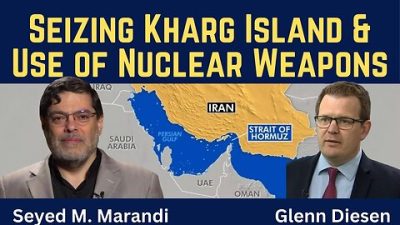
Marandi: Threat of Seizing Kharg Island & the Use of Nuclear Weapons
or go to
Aletho News Archives – Video-Images
Frlom the Archives
Iran War: United States Military Versus Israel Firsters
By James Petras | November 27, 2007
Why must Jewish organizations be and be seen as the loudest drum-beaters of all? Why can we not bring ourselves to say that military intervention is not on the table at all? Why not stash it under the table, out of sight and mount instead a diplomatic assault? – Leonard Fein, Forward
Introduction
As the White House and Congress escalate their economic sanctions and military threats against Iran, top military commanders and Pentagon officials have launched a counter-offensive, opposing a new Middle East War. While some commentators and journalists, like Chris Hedges (Truthdig, November 13, 2007), privy to this high stakes inter-elite conflict, attribute this to a White House cabal led by Vice President Cheney, a more stringent and accurate assessment puts the Zionist Power Configuration (ZPC) in the center of the Iran war debate.
There is a great deal riding in this conflict – the future of the American empire as well as the balance of power in the Middle East. Equally important is the future of the US military and our already heavily constrained democratic freedoms. The outcome of the continuous and deepening confrontation between top US military officials and the Israel Firsters over US foreign policy in the Middle East has raised fundamental questions over self-determination, colonization, civilian primacy and military political intervention, empire or republic. These and related issues are far from being of academic interest only; they concern the future of the United States. … continue
Blog Roll
 Aletho News
- Iran warns it may target US missile launch sites in UAE cities
- American Military Failure in Afghanistan
- Friendly Skies of Georgia: Are Israeli-Linked Drones Launching False Flags from Georgian Territory?
- The Three Big Lies about Mammography Screening
- Ukrainian Embassy in Beirut sheltering top Mossad agent
- Palestinian family displaced after settlers violently attack them in Humsa, Jordan Valley
- The EU never learns – except for the wrong lessons
- Iran attacks on UAE leaves RSF militia high and dry
- Hosting Washington’s war: Bahrain faces the consequences
- The US fell for its own Iran propaganda
- If Americans Knew
- ‘Of Course’: IDF Drops Case Against Soldiers Accused of Raping Palestinian Prisoner
- Don’t Fall for the Regime Change Talk. Israel Is ‘Mowing the Lawn’ in Iran
- Will Israel and the US wreck the Gulf States along with Iran?
- US so far burned through ‘years’ of munitions in Iran war: Report
- How the Israeli Tail Wags the American Dog
- Outdated intel likely led to deadly U.S. strike on Iranian elementary school, sources say
- Pentagon insider says high U.S official Douglas Feith reported to Netanyahu
- In fond memory of Walid Khalidi, the historian of Palestine
- 6 more Americans killed, as Israel ‘mows the lawn’ in Iran – Not a ceasefire Day 154
- Are we on the precipice of World War III?
- No Tricks Zone
- New Studies: UK Sea Levels Were 4 Meters Higher Than Today During The Mid-Holocene
- Destructive Green New Deal: German Energy And Metal Group Warns Of Drastic Crisis
- New Study Documents A 20-Year Pause In Arctic Sea Ice Decline – Driven By Internal Variability
- Wake-up Call: Survey Shows Majority Of Germans Now Favor Postponing Climate Targets!
- Televised! Leading German Political Candidate Tells Schoolchildren CO2 Makes Sun Hotter!
- New Study: A Century Warming Of 1.1°C Is ‘Commonplace’ And ‘Not Unusual’ During This Interglacial
- New Study: ‘Internal Noise’ And Volcanic Forcing Can Trigger 10-15°C Warming Within Decades
- Glaciers Worldwide Are Suddendly Surging, Experts Blame Warming!
- Surprising Discovery: Sahara Is Greening…Billions Of Trees Where Once Thought To Be Barren
- New Research Reaffirms Clouds, Aerosols, And Surface Solar Radiation Are ‘Driving The Climate System’
 Aletho News