Over 500 activists detained in Bahrain
Press TV – April 8, 2011
The Bahraini Center for Human Rights (BCHR) has announced that the number of detained opposition activists in the Persian Gulf state has exceeded 500.
According to BCHR, 17 women are also among the detainees and 18 other activists are reportedly missing, a Press TV correspondent reported.
Since the beginning of the uprising in Bahrain dozens of anti-government protesters have been killed and many others have gone missing. The bodies of the missing are frequently found days after.
The head of BCHR, Nabeel Rajab, says now one in every 1,000 Bahraini is in detention for political reasons.
Witnesses say regime forces are conducting house to house searches to detain opposition activists.
Six opposition leaders have also been arrested and the Manama government has so far refused to provide any information on their fate.
The opposition leaders, five Shia and one Sunni, were rounded up on March 17.
Among the opposition leaders is Hassan Mushaima, the head of the Haq party, who returned to Bahrain from Britain in mid-February after Manama dropped charges against him.
His family members say Saudi troops were among Bahraini forces taking part in the arrest operation.
Reports coming from Bahrain suggest that regime forces backed by Saudi troops have intensified their crackdown on opposition figures and anti-government protesters.
The Theory That’s Killing America’s Economy—and Why It’s Wrong
By Ian Fletcher | April 8, 2011
I wrote in a previous article how America’s disastrous embrace of free trade is ultimately based on a false theory of how the global economy works: the so-called Theory of Comparative Advantage. This is what economists, from the government on down, believe in. This matters.
But I didn’t explain why the theory is wrong—which it is. Understanding its flaws is the price of admission to serious criticism of free trade, so it’s well worth getting a grasp on them. Economic theory can be a tough chew, but it’s worth the effort, if only to gain the intellectual confidence not to be intimidated by the so-called experts. So… let’s take a look at some of that machinery behind the wizard’s curtain, shall we?
The theory’s flaws, which are fairly well known to economists but mostly ignored, consist of a number of dubious assumptions upon which the theory depends. To wit:
Dubious Assumption #1: Trade is sustainable.
The problem here is that the theory of comparative advantage pays no attention to the long term. So it can quite easily recommend a trade policy that gives us the highest possible living standard in the short run—but by way of selling off our country out from under us.
This is what happens when a nation runs a trade deficit, which necessarily means that it’s either sinking into debt to foreigners or selling off its existing assets to them.
The theory of comparative advantage is blind to this problem because it treats people’s time horizons as a given. So if a nation wants a short-term consumption binge followed by long-term decline, the theory says “OK, no problem. You wanted it, you got it, what’s not to like?”
A saner theory of trade (and of economics generally) would advise people that it’s not a good idea to engage in decadent binges, regardless of how good it feels right now. It would recommend protectionist restraints on imports to force trade into balance, not free trade.
–Dubious Assumption #2: There are no externalities.
An externality is a missing price tag. More precisely, it is the economists’ term for when the price of a product does not reflect its true economic cost or value.
The classic negative externality is environmental damage, which reduces the value of natural resources without raising the price of the product that harmed them. The classic positive externality is technological spillover, where one company’s inventing a product enables others to copy or build upon it, generating wealth that the original company can’t capture.
If prices are wrong due to positive or negative externalities, free trade will produce suboptimal results.
For example, goods from a nation with lax pollution standards will be too cheap. So its trading partners will import too much of them. And the exporting nation will export too much of them, overconcentrating its economy in industries that are not really as profitable as they seem, due to ignoring pollution damage.
Positive externalities are also a problem. If an industry generates technological spillovers for the rest of the economy, then free trade can let that industry be wiped out by foreign competition because the economy ignored its hidden value. Some industries spawn new technologies, fertilize improvements in other industries, and drive economy-wide technological advance; losing these industries means losing all the industries that would have flowed from them in the future.
Dubious Assumption #3: Productive resources move easily between industries.
As noted in my original article, the theory of comparative advantage is about switching productive resources from less-valuable to more-valuable uses. It’s about putting our economy to its own best use.
But this assumes that the productive resources used to produce one product can switch to producing another. Because if they can’t, then imports won’t push our economy into industries better suited to its comparative advantage. Imports will just kill off our existing industries and leave nothing in their place.
When workers, for example, can’t move between industries—usually because they don’t have the right skills or don’t live in the right place—shifts in an economy’s comparative advantage won’t move them into a more appropriate industry, but into unemployment.
In the United States, because of our relatively low minimum wage and hire-and-fire labor laws, this problem tends to take the form of underemployment, rather than unemployment per se. So $28 an hour ex-autoworkers go work at the video rental store for eight dollars an hour.
The same goes for other inflexible factors of production, like real estate. That’s why the shuttered factory rivals the unemployment line as a visual image of trade problems.
Dubious Assumption #4: Trade does not raise income inequality.
Even if free trade expands the economy overall (dubious), it can tilt the distribution of income so much that ordinary people see little or none of the gains.
For example, suppose that opening up a nation to freer trade means that it starts exporting more airplanes and importing more clothes than before. Because the nation gets to expand an industry better suited to its comparative advantage and contract one less suited, it becomes more productive and its GDP goes up.
So far, so good.
Here’s the rub: suppose that a million dollars’ worth of clothes production requires one white-collar worker and nine blue-collar workers, while a million dollars of airplane production requires three white-collar workers and seven blue-collar workers. So for every million dollars’ change in what gets produced, there is a demand for two more white-collar workers and two fewer blue-collar workers. Because demand for white-collar workers goes up and demand for blue-collar workers goes down, the wages of white-collar workers go up and those of blue-collar workers go down.
But most workers are blue-collar workers—so free trade has lowered wages for most workers in the economy!
This is not a trivial problem: Dani Rodrik of Harvard estimates that freeing up trade reshuffles five dollars of income between different groups of people domestically for every one dollar of net gain it brings to the economy as a whole.
Dubious Assumption #5: Capital is not internationally mobile.
The theory of comparative advantage is about the best uses to which America can put its productive resources, what economists call “factors of production.” We have certain cards in hand, so to speak, the other players have certain cards, and the theory tells us the best way to play the hand we’ve been dealt. Or more precisely, it tells us to let the free market play our hand for us, so market forces can drive all our factors to their best uses in our economy.
Unfortunately, this relies upon the impossibility of these same market forces driving these factors right out of our economy. If that happens, all bets are off about driving these factors to their most productive use in our economy. Their most productive use may well be in another country, and if they are internationally mobile, then free trade will cause them to migrate there.
This will benefit the world economy as a whole, and the nation they migrate to, but it will not necessarily benefit us.
This problem applies to all factors of production, but the crux of the problem is capital. Capital mobility replaces comparative advantage, which applies when capital is forced to choose between alternative uses within a single national economy, with absolute advantage. And absolute advantage contains no guarantees whatsoever about the results being good for both trading partners.
Capital immobility doesn’t have to be absolute, but it has to be significant and as it melts away, trade shifts from a guarantee of win-win relations to a possibility of win-lose relations.
David Ricardo, the British economist who invented the theory of comparative advantage in 1817, actually knew about this problem perfectly well, and wrote about it in his book on the subject. So there’s no excuse for modern economists to ignore it.
Dubious Assumption #6: Short-term efficiency causes long-term growth.
The theory of comparative advantage is what economists call “static” analysis. That is, it looks at the facts of a single instant in time and determines the best response to those facts at that instant. But it says nothing about how today’s facts may change tomorrow. More importantly, it says nothing about how one might cause them to change in one’s favor.
So even if the theory of comparative advantage tells us our best move today, given our productivities in various industries, it doesn’t tell us the best way to raise those productivities tomorrow. That, however, is the essence of economic growth, and in the long run much more important than squeezing every last drop of advantage from the productivities we have today. Economic growth is ultimately less about using one’s factors of production than about transforming them—into more productive factors tomorrow.
The theory of comparative advantage is not so much wrong about long-term growth as simply silent.
Analogously, it is a valid application of personal comparative advantage for someone with secretarial skills to work as a secretary and someone with banking skills to work as a banker. In the short run, it is efficient for them both, as it results in both being better paid than if they tried to swap roles. (They would both be fired for inability to do their jobs and earn zero.) But the path to personal success doesn’t consist in being the best possible secretary forever; it consists in upgrading one’s skills to better-paid occupations, like banker. And there is very little about being the best possible secretary that tells one how to do this.
Dubious Assumption #7: Trade does not induce adverse productivity growth abroad.
When we trade with a foreign nation, this will generally build up that nation’s industries, i.e. raise its productivity in them. Now it would be nice to assume that this productivity growth in our trading partners can only make them ever more efficient at supplying the things we want, and we will just get ever cheaper foreign goods in exchange for our own exports, right?
Wrong. Consider our present trade with China. Despite all the problems this trade causes us, we do get compensation in the form of some very cheap goods, thanks mainly to China’s very cheap labor. The same goes for other poor countries we import from. But labor is cheap in poor countries because it has poor alternative employment opportunities. What if these opportunities improve? Then this labor may cease to be so cheap, and our supply of cheap goods may dry up.
This is actually what happened in Japan from the 1960s to the 1980s, as Japan’s economy transitioned from primitive to sophisticated manufacturing and the cheap merchandise readers over 40 will remember (the same things stamped “Made in China” today) disappeared from America’s stores. Did this reduce the pressure of cheap Japanese labor on American workers? It did. But it also deprived us of some very cheap goods we used to get.
And it’s not like Japan stopped pressing us, either, as it moved upmarket and started competing in more sophisticated industries.
Oops!
When Nobel laureate Paul Samuelson— author of the best-selling economics textbook in history—reminded economists of this problem in a (quite accessible) 2004 article, he drew scandalized gasps from one end of the discipline to the other. But nobody was able to explain why he was wrong.
They still haven’t.
I don’t expect most readers to get all the above analysis the first time through. But I do hope that everyone who’s read this far now understands that there is no good reason—regardless of what most economists say—to assume that free trade is necessarily best. The economic logic of those who say it is, is riddled with enough holes to sink a container ship.
Israeli army strikes Gaza after school bus hit – Deconstructed
Associated Press Deconstructed | April 8, 2011
First, let’s look at what has happened in Gaza in the past week:
- On Friday, April 1, Israeli forces assassinated a 24-year-old member of a Palestinian resistance group in Gaza.
- On Saturday, April 2, the Israeli air force assassinated three members of the group.
- On Tuesday, April 5, Israeli forces shot dead a Palestinian in northern Gaza, reportedly unarmed and not part of any resistance groups.
- On Wednesday, April 6, at dawn Israeli forces bombarded Gaza in three air strikes, injuring four people, including two women (one of them pregnant) and a child.
- On Wednesday afternoon hundreds of children in Gaza participated in a march asking the international community to protect them against ongoing Israeli raids and attacks.
- On Wednesday night the Israeli Air Force bombarded several areas of Gaza, causing extensive damage; at least one resident was injured.
- On Thursday morning, April 7, the resistance group that had suffered four assassinations fired mortars at a nearby Israeli town, which injured two people on an almost empty school bus, the bus driver and the one student (16) who hadn’t already been dropped off.
- Thursday at noon Israeli forces bombarded Gaza, killing five people and injuring over 40.
- Thusday evening Palestinian resistance forces all agreed to a ceasefire to try to prevent the violence from increasing.
- Israel ignored this and continued its air strikes against Gaza, killing still more Gazans.
- In all, Israeli forces killed 14 people within 24 hours and injured dozens.
- Among those killed were a mother, her young daughter, and an elderly man.
Following is how AP reported on this. This story is on hundreds of newspaper websites around the country:
Israeli army strikes Gaza after school bus hit
By MATTI FRIEDMAN
JERUSALEM (AP) — Israeli aircraft and ground forces struck Gaza on Friday, killing two Hamas gunmen and three civilians
No mention in either the headline or the lead paragraph that Israeli forces killed a total of 14 people in the past 24 hours, including a mother, her young daughter (injured another of her children), and an elderly man, and that they injured dozens of others.
in a surge of fighting sparked by a Palestinian rocket attack on an Israeli school bus the day before.
No mention that this rocket attack was sparked by Israeli forces killing five Gazans in the preceding few days.
Just over two years after rocket fire from Gaza triggered
Israel had already broken the cease fire three times, killing seven Palestinian, which is what triggered the rock fire.
a devastating Israeli military offensive in the territory,
which killed approximately 1400 Palestinians, at least 773 of them civilians – hundreds of them children.
Israel and Gaza’s Hamas rulers seemed on the brink of another round of intense violence.
AP still chooses not to mention the five Palestinians in Gaza that Israeli forces had killed in preceding days.
In Thursday’s attack, Gaza militants hit an Israeli school bus near the border with a guided anti-tank missile, injuring the driver and badly wounding a 16-year-old boy. Most of the schoolchildren on the bus got off shortly before the attack.
By Friday morning, Israel’s ongoing retaliation
AP calls the Israeli action retaliation (for two injured, one with minor injuries) but fails to calls that the rocket attack retaliation (for the killing of five people).
had killed 10 Gazans – five militants, a policeman and four civilians – and wounded 45. The dead Friday included three civilians killed by Israeli tank fire and two militants killed in an air strike, both near the southern Gaza town of Khan Younis.
Still no mention of the mother and children.
Hamas, which had largely held its fire since Israel’s last major offensive, claimed responsibility for the bus attack.
Had the bus been full, broader Israeli retaliation would have been all but inevitable and the region – already destabilized by the popular revolts sweeping the Arab world – could have been drawn into another war.
It’s odd to put such speculation in a news article, especially when AP left out so many newsworthy facts.
It is unclear if Hamas was trying to provoke a new conflagration, if it was not fully in control of all of its fighters, or if it believes Israel would pull back before invading Gaza again.
Again, it’s odd to put such speculation and commentary in a news article, especially when AP left out so many newsworthy facts.
Israel was condemned internationally after the last incursion.
“Incursion” is an odd word for the massive invasion by Israeli forces that was condemned in detailed reports issued by numerous highly respected international organizations.
Hamas said the rocket attack was in retaliation for the killing of three fighters in an airstrike earlier in the week. At around midnight Thursday, with Gaza rocked by explosions, the organization announced a cease-fire.
This was actually announced earlier and included all sectors of the Gazan resistance. The announcement about this also spoke of the 21-year-old killed on Tuesday, whom AP never mentions in the report.
But the Israeli strikes continued, hitting Hamas facilities and smuggling tunnels.
And many other facilities. AP also fails to mention that the tunnels are a response to Israel’s suffocating siege of Gaza, noted by groups such as Christian Aid.
Electricity lines and transformers were damaged, causing power blackouts in some parts of the territory, according to Jamal Dardsawi, a spokesman for Gaza’s Electric Distribution Company.
While AP speculated about what would have happened if the nearly empty Israeli bus had been full, there is no mention here about what electricity blackouts are actually doing to Gazan patients on respirators, in hospital operating rooms, etc.
In Israel, studies at some schools near Gaza were canceled Friday because of concerns for the students’ safety.
No mention of schools in Gaza, whose students have been injured, one killed, and parents killed and injured.
Palestinian militants launched nine mortars and rockets into Israel, causing damage to at least one building, the military said. Israeli casualties have been kept low thanks to reinforced rooms and early warning systems.
and the fact that the Israeli military, thanks to Americans’ $8 million per day to Israel, is the fourth or fifth most powerful military in the world.
Matan Vilnai, the Israeli Cabinet minister in charge of the home front, told Army Radio that Israel was acting to deter attacks. “We are acting as we see fit so that this type of fire will not continue, and so that the people behind the fire will regret it,” Vilnai said.
Israel’s education minister, Gideon Saar, said in a briefing with reporters that any civilian casualties in Gaza were unintentional and that Israel did not target “anyone except the terrorists.”
AP fails to report that numerous international investigations have found evidence indicating that Israel has often targeted civilians.
U.N. Secretary-General Ban Ki-moon on Friday condemned the bus attack and expressed concern over civilian casualties in Israel’s strikes. He called for “de-escalation and calm to prevent any further bloodshed.”
Thousands of rockets from Gaza have hit Israeli towns and cities since 2001.
AP fails to mention that these have killed a total of approximately 20 Israelis. AP also fails to mention that during the same period Israeli forces have killed thousands of Gazans, including numerous children.
Israel’s attempts to stop the rockets have included military incursions and covert operations abroad aimed at disrupting Hamas’ efforts to procure arms.
AP again gives the Israeli narrative. It fails to report that Israeli military incursions and covert operations preceded Gazan rockets.
In February, a Palestinian engineer was seized from a sleeper train in Ukraine and showed up several days later in Israel,
The normal way to report this would be to state that Israel kidnapped a Palestinian engineer in the Ukraine.
where he has been charged with masterminding Hamas’ rocket program.
Once again, AP emphasizes Israeli claims without including countering claims.
Last year a Hamas operative was assassinated in Dubai, and Israeli agents are widely assumed to have been responsible. Israel identified the man as a Hamas agent responsible for obtaining weaponry from Iran.
Again, we get the Israeli narrative, and only the Israeli narrative.
This week, Sudan accused Israel of being behind an explosion that killed two in Port Sudan. The blast was thought to be linked to arms smuggling to Gaza. Israel would not comment.
AP doesn’t bother supplying any information about the two human beings in Port Sudan who were just killed.
——
Ibrahim Barzak contributed reporting from Gaza City, Gaza Strip.
Yet, the story was written and edited in Israel by Matti Friedman, a journalist who may have family ties to the Israeli military.
#
In case anyone is curious about what occurred before this period, March had seen increased Israeli hostilities, including tightening the siege and a gradual escalation of Israeli military attacks that killed at least 11 Palestinians and injured over 40.
Corrie lawsuit challenging Israeli impunity
Nora Barrows-Friedman, The Electronic Intifada, 8 April 2011
Several Israeli soldiers testified at the witness stand in the Haifa district court earlier this week, as trial hearings continued in the case of Corrie vs. the State of Israel. As the trial drags on, years after Rachel Corrie’s killing, Israel’s impunity is being challenged and carefully cross-examined.
Eight years ago last month, 23-year-old American solidarity activist Rachel Corrie was crushed to death by an armored US-made Caterpillar D9 bulldozer in Rafah, at the southern edge of the occupied Gaza Strip.
Wearing a fluorescent orange vest and wielding a bullhorn, Corrie attempted to defend the demolition of a Palestinian family’s home by the Israeli military along the Philadelphi corridor, a wide swath of land in Rafah at the border with Egypt in which hundreds of homes were demolished from 2002-2004, according to field reports from Human Rights Watch.
After years of legal proceedings, Rachel Corrie’s parents, Cindy and Craig, were able to bring soldiers who were on duty that day in Rafah into the Haifa district court. Hearings began in March 2010 and continued in September, November and earlier this week.
The Corries are suing the Israeli military for one dollar in damages, but, more significantly, are charging those responsible with the wrongful death of their daughter and criminal negligence.
Eyewitness testimony from fellow International Solidarity Movement (ISM) activists, supported by photographic evidence, shows that Rachel was crushed underneath the massive blade of a bulldozer and died shortly afterwards. The Israeli military and its defense team argues that Rachel’s death was an accident, that the bulldozer driver didn’t see her and that it was not the blade that killed her but perhaps a pile of rubble that was dropped on her body by the bulldozer as it was razing the land.
Saturated throughout the soldiers’ testimonies is the unwavering argument that all Palestinians in that area were considered armed and a danger to the military unit, and that the military orders had a strict shoot-to-kill policy as they demolished homes. They infer that because this was a closed military zone, Rachel and the other activists with the ISM put themselves at risk and therefore the soldiers and their commanders cannot be responsible for her killing.
But what fails to be addressed by the judge is how and why the soldiers and their armored bulldozers were there in the first place. The soldiers driving the bulldozers and their commanders operated from orders to destroy houses along the Philadelphi corridor — the name Israel gives to the strip of land it has used as a buffer zone– starting in 2002 and continuing throughout the next two years, displacing thousands of residents. Human Rights Watch reported that after the homes were demolished, a steel wall was constructed along the Philadelphi corridor (“Razing Rafah,” 17 October 2004). The demolition of Palestinian homes is a violation of Article 53 of the Fourth Geneva Convention, which states that “Any destruction by the Occupying Power of real or personal property belonging individually or collectively to private persons … is prohibited, except where such destruction is rendered absolutely necessary by military operations.”
Israel, which is a signatory to the convention, contends that the law “does not apply to its occupation of the West Bank and Gaza Strip,” according to a detailed report by Amnesty International (“Document – Israel and the Occupied Territories: Under the rubble: House demolition and destruction of land and property,” 17 May 2004).
Amnesty International adds “Whether it justifies such action on grounds of ‘military/security needs’ or whether such action is imposed as a form of collective punishment, or whether carried out in enforcement of planning regulations such large-scale forced evictions are inconsistent with the realization of the right to adequate housing. The obligation of the state under international law is that it must refrain from forced evictions.”
The occupying forces had been willingly engaged in layered violations of international law — violations that Rachel Corrie and her fellow activists attempted to confront and remediate.
S.R., a unit commander in the Israeli army who gave his testimony on Wednesday and was obscured by screens so the Corries could not see his face, stated that “none of the houses [in the area being razed] had anyone living inside … They were all being used as positions for terror activities.”
This blanket statement is untrue; the home that Rachel died trying to protect was inhabited by the Nasrallah family. Neither Dr. Samir Nasrallah, a pharmacist, nor his family members living in the home, were ever charged by the Israeli military with “terror activities.” Dr. Nasrallah was obviously never a threat to the Israeli military or its government, as Israel even allowed him to travel to the United States on a speaking tour with the Corries — something that would never be allowed for any Palestinian accused of being linked with such activities.
When I attended a round of hearings last September, another military training leader brazenly stated to the courtroom that “during war, there are no civilians.” Craig Corrie told me then that this admission was a shock to the family and to their supporters in the courtroom, but not a surprise given the attitude of the Israeli military since its inception.
This was not a war in Gaza; this was — and still is — an aggressive, lethal and unequal military occupation meted out against Gaza’s 1.5 million residents.
Human Rights Watch states that more than 2,500 homes were destroyed in Gaza from 2000-2004, as the Israeli military implemented its so-called “buffer zone” policies after the breakout of the second intifada. The buffer zone is a 300-meter-wide militarized no-go area near the boundary with Israel which has since taken 35 percent of Gaza’s total agricultural land — and the lives of more than 100 Palestinians who have been shot and killed since March 2010.
Attending this week’s hearing were members of the Corrie family, activists, journalists and legal observers from the the US embassy, the National Lawyers Guild, Human Rights Watch, Al-Haq, Avocats Sans Frontieres, Amnesty International, Yesh Din and other Palestinian, Israeli and international human and civil rights organizations.
In a press release, Zaha Hassan of the National Lawyers Guild stated that “[i]t has been eight years now and Rachel’s family and all of us who are attending the trial in support have been waiting for an answer to the question of why the unit commander ordered the bulldozer driver to move forward directly over the location where Rachel stood yelling into a blow-horn” (“National Lawyers Guild Free Palestine Subcommittee to Observe Resumption of Trial Brought by Family of Slain Peace Activist Rachel Corrie,” 4 April 2011).
Hassan added: “Justice demands that these questions be answered and that those responsible for her death be held to account.”
The judge, Oded Gershon, admitted proudly in court on Wednesday that he had been a military judge earlier in his career. It remains to be seen whether his potential proclivity toward defense of military policies will influence the final decision in the Corrie case, but the entire process sets an incredibly important precedent.
Israeli soldiers responsible for the demolition of homes and the killing of Palestinians and internationals are now being brought inside courtrooms. Military mandates are being meticulously scrutinized. Cracks in the solidified Israeli military system of impunity are starting to appear, and the Corries are determined to widen those cracks so that other bereaved families can seek justice, too.
The next round of hearings begins on 22 May, and the courtroom will once again be packed. For the Corries, and the family members of countless Palestinians awaiting true justice from the occupier state since 1948, the legal process may be tedious and excruciating but it is vital. And long overdue.
~
Nora Barrows-Friedman is an award-winning independent journalist, writing for The Electronic Intifada, Inter Press Service, Al-Jazeera, Truthout and other outlets. She regularly reports from Palestine.
For summaries of the hearings, and for more information, visit the Rachel Corrie Foundation website at rachelcorriefoundation.org.
Italian activists call on company to withdraw from Israeli railway project in the occupied territories
By Stephanie Westbrook | Mondoweiss | April 8, 2011
In Italy, “Stop That Train” launches a campaign calling on Pizzarotti & C. SpA to withdraw from the construction of the Israeli high-speed railway crossing the occupied Palestinian territories. The German Ministry of Transport defines the project as “potentially in violation of international law.”
The Italian Coalition “Stop That Train” recently met with Pizzarotti & C. SpA, a private company from Parma involved in the construction of a new Israeli railway that would allow Israeli commuters to travel from Jerusalem to Tel Aviv in just 28 minutes. In particular, Pizzarotti is involved in Section C, which crosses the internationally recognized borders of Israel and penetrates the occupied Palestinian territories in the West Bank.
The A1 railway is the largest infrastructure project the Israeli government has undertaken in the last ten years and for 6.5 km cuts through the occupied Palestinian territories, resulting in further confiscation of land and putting at least three communities at risk, including the villages of Beit Surik and Beit Iksa.
The call to action of the Italian Coalition “Stop That Train” has already been endorsed by more than 60 national and international organizations, including Israeli, as well as local groups throughout Italy. The coalition calls on Pizzarotti to withdraw from the project, which constitutes a flagrant violation of International Law, in contravention of international norms on human rights, including the Fourth Geneva Convention prohibiting exploitation of land by an occupying power.
During the meeting with “Stop That Train,” Pizzarotti representatives reiterated what had already been declared in a statement issued by the company on March 17. “Pizzarotti has never played and does not currently play a decision-making role in the planning and design of the railway” and the company is involved exclusively in the construction of a tunnel (T3) for the area “which is fully located within the boundary marked by the Green Line.”
The Italian Coalition “Stop That Train” maintains that regardless of Pizzarotti’s involvement or not in the design of the A1 line, the company has an obligation to verify that projects in which it is involved are in accordance with human rights and international law. This is particularly true in areas of conflict such as Israel and Palestine.
The Israeli feminist organization, the Coalition of Women for Peace (CWP), which authored a 28-page dossier on the project, stresses that Pizzarotti, through a joint venture with the Israeli Shapir Civil and Marine Engineering, “signed a contract to construct the entire T3 tunnel. Nowhere in the contract signed by Pizzarotti does it state that the company is not involved or not responsible for the section of the tunnel that is located in the West Bank. … Stating, as Pizzarotti does, that it is not responsible for the eastern portal of the tunnel and that it will not carry out the excavation of the section that crosses the West Bank is, therefore, simply a way of evading the issues and an attempt to dodge its responsibilities.”
The project also includes involvement of DB International, a company fully owned by the German government, which has a contract with the Israeli Railways to provide engineering expertise for the electrification of the rail line. In a letter dated March 14, 2011, the German Minister of Transport defined the project for the A1 railway as “problematic for foreign policy and potentially in violation of international law”, indicating that DB International has confirmed in writing that it will cease all activities in the project.
The Italian Coalition “Stop That Train” is committed to continue the campaign with determination, calling on Pizzarotti to withdraw from the project. A new web site for the campaign was recently launched (www.stopthattrain.org) and on April 9 a demonstration will be held at Pizzarotti headquarters in Parma. In addition, actions similar to those used against Veolia, a French company forced to announce its withdrawal from the light rail construction project in occupied East Jerusalem, are currently being planned.
The Italian Coalition Stop That TrainFor more information or to endorse the campaign: fermarequeltreno@gmail.com
Showdown in Iceland
Will Iceland Vote No or Commit Financial Suicide
By MICHAEL HUDSON | CounterPunch | April 8, 2011
A landmark fight is occurring this Saturday, April 9. Icelanders will vote on whether to subject their economy to decades of poverty, bankruptcy and emigration of their work force. At least, that is the program supported by the existing Social Democratic-Green coalition government in urging a “Yes” vote on the Icesave bailout. Their financial surrender policy endorses the European Central Bank’s lobbying for the neoliberal deregulation that led to the real estate bubble and debt leveraging, as if it were a success story rather than the road to national debt peonage. The reality was an enormous banking fraud, an orgy of insider dealing as bank managers lent the money to themselves, leaving an empty shell – and then saying that this was all how “free markets” operate. Running into debt was commended as the way to get rich. But the price to Iceland was for housing prices to plunge 70 per cent (in a country where mortgage debtors are personally liable for their negative equity), a falling GDP, rising unemployment, defaults and foreclosures.
To put Saturday’s vote in perspective, it is helpful to see what has occurred in the past year along remarkably similar lines throughout Europe. For starters, the year has seen a new acronym: PIIGS, for Portugal, Ireland, Italy, Greece and Spain.
The eruption started in Greece. One legacy of the colonels’ regime was tax evasion by the rich. This led to budget deficits, and Wall Street banks helped the government conceal its public debt in “free enterprise” junk accounting. German and French creditors then made a fortune jacking up the interest rate that Greece had to pay for its increasing credit risk.
Greece was told to make up the tax shortfall by taxing labor and charging more for public services. This increases the cost of living and doing business, making the economy less competitive. That is the textbook neoliberal response: to turn the economy into a giant set of tollbooths. The idea is to slash government employment, lowering public-sector salaries to lead private-sector wages downward, while sharply cutting back social services and raising the cost of living with tollbooth charges on highways and other basic infrastructure.
The Baltic Tigers had led the way, and should have stood as a warning to the rest of Europe. Latvia set a record in 2008-09 by obeying EU Economics and Currency Commissioner Joaquin Almunia’s dictates and slashing its GDP by over 25 per cent and public-sector wages by 30 per cent. Latvia will not recover even its 2007 pre-crisis GDP peak until 2016 – an entire lost decade spent in financial penance for believing neoliberal promises that its real estate bubble was a success story.
In autumn 2009, Socialist premier George Papandreou promised an EU summit that Greece would not default on its €298bn debt, but warned: “We did not come to power to tear down the social state. Salaried workers will not pay for this situation: we will not proceed with wage freezes or cuts.” But that seems to be what socialist and social democratic parties are for these days: to tighten the screws to a degree that conservative parties cannot get away with. Wage deflation is to go hand in hand with debt deflation and tax increases to shrink the economy.
The EU and IMF program inspired the modern version of Latin America’s “IMF riots” familiar from the 1970s and 80s. Almunia, the butcher of Latvia’s economy, demanded reforms in the form of cutbacks in health care, pensions and public employment, coupled with a proliferation of taxes, fees and tolls from roads to other basic infrastructure.
The word “reform” has been turned into a euphemism for downsizing the public sector and privatization sell-offs to creditors at giveaway prices. In Greece this policy inspired an “I won’t pay” civil disobedience revolt that grew quickly into “a nationwide anti-austerity movement. The movement’s supporters refuse to pay highway tolls. In Athens they ride buses and the metro without tickets to protest against an ’unfair’ 40 per cent increase in fares.” (Kerin Hope, “Greeks adopt ‘won’t pay’ attitude,” Financial Times, March 10, 2011.) The police evidently are sympathetic enough to refrain from fining most protesters.
A Le Monde article accused the EU-IMF plan of riding “roughshod over the most elementary rules of democracy. If this plan is implemented, it will result in a collapse of the economy and of peoples’ incomes without precedent in Europe since the 1930s. Equally glaring is the collusion of markets, central banks and governments to make the people pay the bill for the arbitrary caprice of the system.”
Ireland is the hardest-hit Eurozone economy. Its long-term ruling Fianna Fail party agreed to take bank losses onto the public balance sheet, imposing what looks like decades of austerity – and the largest forced emigration since the Potato Famine of the mid-19th century. Voters responded by throwing the party out of office (it lost two-thirds of its seats in Parliament) when the opposition Fine Gael party promised to renegotiate last November’s $115-billion EU-IMF bailout loan and its accompanying austerity program.
A Financial Times editorial referred to the “rescue” package (a euphemism for financial destruction) as turning the nation into “Europe’s indentured slave.” EU bureaucrats “want Irish taxpayers to throw more money into holes dug by private banks. As part of the rescue, Dublin must run down a pension fund built up when Berlin and Paris were violating the Maastricht rules … so long as senior bondholders are seen as sacrosanct, fire sales of assets carry a risk of even greater losses to be billed to taxpayers.” EU promises to renegotiate the deal augur only token concessions that fail to rescue Ireland from making labor and industry pay for the nation’s reckless bank loans. Ireland’s choice is thus between rejection of or submission to EU demands to “make bankers whole” at the expense of labor and industry. It is reminiscent of when the economist William Nassau Senior (who took over Thomas Malthus’s position at the East India College) was told that a million people had died in Ireland’s potato famine. He remarked succinctly: “It is not enough.” So neoliberal junk economics has a long pedigree.
The result has radically reshaped the idea of national sovereignty and even the basic assumption underlying all political theory: the premise that governments act in the national interest.
The Irish government’s €10 billion interest payments are projected to absorb 80 per cent of the government’s 2010 income tax revenue. This is beyond the ability of any national government or economy to survive. It means that all growth must be paid as tribute to the EU for having bailed out reckless bankers in Germany and other countries that failed to realize the seemingly obvious fact that debts that can’t be paid won’t be. The problem is that during the interim it takes to realize this, economies will be destroyed, assets stripped, capital depleted and labor obliged to emigrate. Latvia is the poster child for this, with a third of its population between 20 and 40 years old already having emigrated or reported to be planning to leave the country within the next few years.
The EU’s nightmare is that voters may wake up in the same way that Argentina finally did when it announced that the neoliberal advice it had taken from U.S. and IMF advisors had destroyed the economy. Debt repayment was impossible. As matters turned out, it had little trouble in imposing a 70 per cent write-down on foreign creditors. Its economy is now booming – because it became credit-worthy again, once it freed itself from its financial albatross!
Much the same occurred in Latin America and other Third World countries after Mexico announced that it could not pay its foreign debts in 1982. A wave of defaults spread – inspiring negotiated debt write-downs in the form of Brady Bonds. U.S. and other creditors calculated what debtors realistically could pay, and replaced the old irresponsible bank loans with new bonds. The United States and IMF members applauded the write-downs as a success story.
But Ireland, Greece and Iceland are now being told horror stories about what might happen if their governments do not commit financial suicide. The fear is that debtors may revolt, leading the Eurozone to break up over demands that financialized economies turn over their entire surplus to creditors for as many years as the eye of forecasters can see, acquiescing to bank demands that they subject themselves to a generation of austerity, shrinkage and emigration.
That is the issue in Iceland’s election this Saturday. It is the issue now facing European voters as a whole: Are today’s economies to be run for the banks, bailing them out of reckless loans at public expense? Or, will the financial system be reined in to serve the economy and raise wage levels instead of imposing austerity.
It seems ironic that the Socialist parties (Spain and Greece), the British Labour Party and various Social Democratic parties have moved to the pro-banker right wing of the political spectrum, committed to imposing anti-labor austerity not only in Europe, but also in New Zealand (the 1990s poster child for Thatcherite privatization) and even Australia. Their policy of downsizing public social services and embrace of privatization is the opposite of their position a century ago. How did they become so decoupled from their original labor constituencies? It seems as if their function is to impose whatever right-wing agenda the Conservative parties cannot get away with – not unlike Obama neutering possible Democratic Party alternatives to Republican lobbying for more Rubinomics.
Is it simply gullibility? That may have been the case in Russia, whose leaders seemed to have little idea of how to fend off destructive advice from the Harvard Boys and Jeffrey Sachs. But something more deliberate plagues Britain’s own Labour Party in out-Thatchering the Conservatives in privatizing the railroads and other key economic infrastructure with their Public-Private Partnership. It is the attitude that led Gordon Brown to threaten to blackball Icelandic membership in the EU if its voters oppose bailing out the failure of Britain’s own neoliberal bank insurance agency to prevent banksters from emptying out Icesave. Last weekend half a million British citizens marched in London to protest the threatened cutbacks in social services, education and transportation, and tax increases to pay for Gordon Brown’s bailout of Northern Rock and the Royal Bank of Scotland. The burden is to fall on labor and industry, not Britain’s financial class. The Daily Express, a traditionally campaigning national paper, is now running a full throttle campaign for Britain to leave the EU, on much the same ground that Britain has long rejected joining the euro.
What is the rationale of Iceland and other debtor countries paying, especially at this time? The proposed agreements would give Britain and Holland more than EU directives would. Iceland has a strong legal case. Social Democratic warnings about the EU seem so overblown that one wonders whether the Althing members are simply hoping to avoid an investigation as to what actually happened to Landsbanki’s Icesave deposits. Britain’s Serious Fraud Office recently became more serious in investigating what happened to the money, and has begun to arrest former directors. So this is a strange time indeed for Iceland’s government to agree to take bad bank debts onto its own balance sheet.
The problem is that the more Iceland’s economy shrinks, the more impossible it becomes to pay foreign debts. Iceland’s government is desperately begging to join Europe without asking just what the cost will be. It would plunge the krona’s exchange rate, shrink the economy, drive young workers to emigrate to find jobs and to avoid the bankruptcy foreclosures that would result from subjecting the nation to austerity.
Nobody really knows just how deep the hole is. Iceland’s government has not made a serious attempt to make a risk analysis. What is clear is that the EU and IMF have been irresponsibly optimistic. Each new statistical report is “surprising” and “unexpected.” On the basis of the IMF’s working assumption about the króna’s exchange rate at end-2009, for example, the IMF staff projected that gross external debt would be 160 per cent of GDP. To be sure, they added that a further depreciation of the exchange rate of 30 percent would cause a precipitous rise in the debt ratio. This indeed has occurred. Back in November 2008, the IMF warned that the foreign debt it projected by year end 2009 might reach 240 per cent of GDP, a level it called “clearly unsustainable.” But today’s debt level has been estimated to stand at 260 per cent of Icelandic GDP – even without including the government-sponsored Icesave debt and some other debt categories.
Creditors lose nothing by providing junk-economic advice. They have shown themselves quite willing to encourage economies to destroy themselves in the process of trying to pay – something like applauding nuclear power plant workers for walking into radiation to help put out a fire. For Ireland, the EU pressed the government to take responsibility for bank loans that turned out to be only about 30 per cent (not a misprint!) of estimated market price. It said that this could “easily” be done. Ireland’s government agreed, at the cost of condemning the economy to two or more decades of poverty, emigration and bankruptcy.
What makes the problem worse is that foreign-currency debt is not paid out of GDP (whose transactions are in domestic currency), but out of net export earnings – plus whatever the government can be persuaded to sell off to private buyers. For Iceland, the question would become one of how many of its products and services – and natural resources and companies – Britain and the Netherlands would buy.
It is supposed to be the creditor’s responsibility to work with debtors and negotiate payment in exports. Instead of doing this, today’s creditors simply demand that governments sell off their land, mineral resources, basic infrastructure and natural monopolies to pay foreign creditors. These assets are forfeited in what is, in effect, a pre-bankruptcy proceeding. The new buyers then turn the economy into a set of tollbooths by raising access fees to transportation, phone service and other privatized sectors.
One would think that the normal response of a government in this kind of foreign debt negotiation would be to appoint a Group of Experts to lay out the economy’s position so as to evaluate the ability to pay foreign debts – and to structure the deal around the ability to pay. But there has been no risk assessment. The Althing has simply accepted the demands of the UK and Holland without any negotiation. It has not even protested the fact that Britain and Holland are still running up the interest clock on the charges they are demanding.
Why doesn’t Iceland’s population say to Europe’s financial negotiators: “Nice try! But we’re not falling for it. Your creditor game is over! No nation can be expected to keep committing financial suicide Ireland-style, imposing economic depression and forcing a large portion of the labor force to emigrate, simply to pay bank depositors for the crimes or negligence of bankers.”
The credit rating agencies have tried to reinforce the Althing’s attempt to panic the population into a “Yes” vote. On February 23, Moody’s threatened: “If the agreement is rejected, we would likely downgrade Iceland’s ratings to Ba1 or below.” If voters approve the agreement, however, “we would likely change the outlook on the government’s current Baa3 ratings to stable from negative,” in view of a likely “cut-off in the remaining US$1.1 billion committed by the other Nordic countries and probably also to delays in Iceland’s IMF program.”
Perhaps not many Icelanders realize that credit ratings agencies are, in effect, lobbyists for their clients, the financial sector. One would think that they had utterly lost their reputation for honesty – not to mention competence – by pasting AAA ratings on junk mortgages as prime enablers of the present global financial crash. The explanation is, they did it all for money. They are no more honest than was Arthur Andersen in approving Enron’s junk accounting.
My own view of ratings agencies is based in no small part on the story that Dennis Kucinich told me about the time when he was mayor of Cleveland, Ohio. The banks and some of their leading clients had set their eyes on privatizing the city’s publicly owned electric company. The privatizers wanted buy it on credit (with the tax-deductible interest charges depriving the government of collecting income tax on their takings), and sharply raise prices to pay for exorbitant executive salaries, outrageous underwriting fees to the banks, stock options for the big raiders, heavy interest charges to the banks and a nice free lunch to the ratings agencies. The banks asked Mayor Kucinich to sell them the bank, promising to help him be governor if he would sell out his constituency.
Kucinich said “No.” So the banks brought in their bullyboys, the ratings agencies. They threatened to downgrade Cleveland’s rating, so that it could not roll over the loan balances that it ran as a normal course with the banks. “Let us take your power company or we will wreck your city’s finances,” they said in effect.
Kucinich again said no. The banks carried out their threat – but the mayor had saved the city from having its incomes squeezed by predatory privatization charges. In due course its voters sent Kucinich to Congress, where he subsequently became a presidential candidate.
So, returning to the problem of the credit rating agencies, how can anyone believe that agreeing to pay an unpayably high debt would improve Iceland’s credit rating? Investors have learned to depend on their own common sense since losing hundreds of billions of dollars on the ratings agencies’ reckless estimates. The agencies managed to avoid criminal prosecution by noting that the small print of their contracts said that they were only providing an “opinion,” not a realistic analysis for which they could be expected to take any honest professional responsibility!
Argentina’s experience should provide the model for how writing off a significant portion of foreign debt makes the economy more creditworthy, not less. And as far as possible lawsuits are concerned, it is a central assumption of international law that no sovereign country should be forced to commit economic suicide by imposing financial austerity to the point of forcing emigration and demographic shrinkage. Nations are sovereign entities.
It thus would be legally as well as morally wrong for Iceland’s citizens to spend the rest of their lives paying off debts owed for money that should rather be an issue between Britain’s Serious Fraud Office and the British bank insurance agencies. Overarching the vote is how high a price Iceland is willing to pay to join the EU. In fact, as the Eurozone faces a crisis from the PIIGS debtors, what kind of EU is going to emerge from today’s conflict between creditors and debtors. Fears have been growing that the euro-zone may break up in any case. So Iceland’s Social Democratic government may be trying to join an illusion – one that now seems to be breaking up, at least as far as its neoliberal extremism is concerned. Just yesterday (Thursday, April 7) a Financial Times editorial commented on what it deemed to be Portugal’s premature cave-in to EU demands:
“Another eurozone country has been humbled by its banks. Earlier this week, Portugal’s banks were threatening a bond-buyers’ go-slow unless the caretaker government sought financial help from other European Union countries. … Lisbon should have stuck to its position. … it should still resist doing what the banks demanded: seeking an immediate bridging loan. … By jumping the gun, the government risks having scared markets away entirely. That may prejudice the outcome of negotiations about the longer-term facility.
“The caretaker government has neither the moral nor the political authority to determine Portugal’s future in this way. It should not precipitately abandon the markets. That may mean paying high yields on debt issues in coming months – higher than they might have been had the government not folded its hand too soon. … The right time to opt for an external rescue would have been at the end of a national debate.”
The same should be true for Iceland. Looking over the past year, it seems that the island nation has been used as a target for a psychological and political experiment – a cruel one – to see how much a population will be willing to pay that it does not really owe for what bank insiders have stolen or lent to themselves.
Iceland’s government seems to have become decoupled from what is good for voters and for the very survival of Iceland’s economy. It thus challenges the assumption that underlies all social science and economics: that nations will act in their own self-interest. This is the assumption that underlies democracy: that voters will realize their self-interest and elect representatives to apply such policies. For the political scientist this is an anomaly. How does one explain why a national parliament is acting on behalf of Britain and the Dutch as creditors, rather than in the interest of their own country accused of owing debts that voters in other countries have removed their governments for agreeing to?
~
Michael Hudson is a former Wall Street economist. A Distinguished Research Professor at University of Missouri, Kansas City (UMKC), he is the author of many books, including Super Imperialism: The Economic Strategy of American Empire (new ed., Pluto Press, 2002) and Trade, Development and Foreign Debt: A History of Theories of Polarization v. Convergence in the World Economy. He can be reached at mh@michael-hudson.com
Family denies assassination of key Hamas figure in Sudan
Ma’an – 08/04/2011

Abdul Latif Al-Ashqar [MaanImages]
GAZA — The family of a senior Hamas figure reported killed in an alleged Israeli strike in Sudan, said on Friday that the man had not in fact been killed.
Palestinian security officials said Monday that Abdul Latif Al-Ashqar was the target of a strike which hit a car on Sudan’s Red Sea coast near the main port killing two on Tuesday.
On Wednesday, Sudanese Foreign Minister Ali Ahmad Karti accused Israel of carrying out the attack.
Arab media quoted ‘Israeli sources’ saying the assassination was executed by a special unit that entered Sudanese territory from the sea and fired on the car with a ground-to-ground missile.
Al-Ashqar’s uncle, senior Hamas figure Ismail Al-Ashqar, told Ma’an that Abdul Latif was well, having been the subject of several Israeli assassination attempts in the past, and been tracked by Israeli forces for many years.
Hamas Deputy Politburo Chief Moussa Abu Marzouq, told the Jerusalem-based daily Al-Quds Al-Arabi newspaper that the two “were not Palestinian and had no connection to Hamas.”
There were conflicting media reports, with Sudanese media claiming both victims were nationals of the country, while daily London-based Arabic newspaper Al-Arabiya said one of the victims was a national of an Arab country, and said the man was involved in arms smuggling for Hamas.
Israeli newspapers also reported the strike, with one running the headline “IDF carried out attack on Sudan,” but the Israeli military and foreign ministry both declined to comment.
Abdul Latif Al-Ashqar, a senior member of Hamas’ military wing, is said to have taken over the role of weapons gathering formerly carried out by Mahmoud Mabhouh, who was assassinated in a Dubai hotel room last year.
In his 40s, Al-Ashqar was born in the Jabaliya refugee camp in the Gaza Strip and was arrested by Israel during the First Intifada.
He was a founder of Hamas’ “aid and logistics department,” which coordinated weapons smuggling to the Gaza Strip. It is not known when he arrived in Sudan, or how long he resided there.
Despite Ceasefire Declared by Palestinian Factions, Israel Bombards More Areas In Gaza
By Saed Bannoura – IMEMC & Agencies – April 08, 2011

Despite the fact that the Palestinian factions, including the Hamas movement, in Gaza declared a ceasefire with Israel starting Thursday midnight, the Israeli army bombarded several areas, and carried out a number of aerial attacks in Gaza.
The decision was made following talks between different Palestinian factions in the Gaza Strip, and talks held by the Hamas-led government in Gaza with a number of Arab and international parties.
The ministry of interior in Gaza said that the decision was made to curb any future Israeli assaults against Gaza.
The Israeli strikes had resumed on Thursday afternoon after a Palestinian shell hit a bus in southern Israel seriously wounding one student.
The al-Qassam Brigades of Hamas claimed responsibility for the attack and stated that it came in retaliation to the assassination of three Qassam leaders identified as Ismail Lubbad, Abdullah Lubbad, and Mohammad al-Dahya.
The three were killed in an Israeli Air Strike in Khan Younis in the southern part of the Gaza Strip.
On Thursday, the Israeli army killed three Palestinians in Gaza and wounded more than 40 others, including children.
Nabil Abu Rodeina, spokesperson of President Mahmoud Abbas, said that the escalation against Gaza is unjustified and that Abbas contacted several world leaders urging them to intervene.
Featured Video
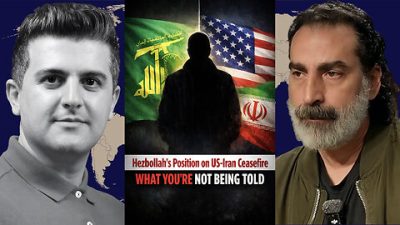
Laith Marouf: Hezbollah’s position on US-Iran ceasefire
or go to
Aletho News Archives – Video-Images
From the Archives
The Dirty Little Secret behind the “Global Terrorism Index”
The Omission of Israeli Terrorism in the Occupied Palestinian Territories
By Karin Brothers | Global Research | December 6, 2014
… The Israeli settlements — all of which are illegal – have been identified as a major impediment to peace. The refusal of a major “global” terrorism report to name the Israeli settlers as one of the groups most responsible for terrorism not only misrepresents a major source of regional violence but exposes the Global Terrorism Index as a propaganda tool that supports a U.S. agenda.
In recent years, governments have been attempting to thwart terrorism by blocking supportive fund-raising. When it comes to Israeli settlements, however, the US and Canada actually encourage fund-raising by giving organizations (such as Christian Friends of Israeli Communities (CFOIC) and the Jewish National Fund) financial support in the form of donor tax-deductions.
Charities which provide funds for the Israeli settlements should be regarded as terror-financing organizations. They should not only lose their tax-deductible status, but they should be banned because they support the violation of international humanitarian law. The terror-financing laws that are being strictly enforced for Muslim charities should be applied to Christian and Jewish charities as well. … Read full article
Blog Roll
 Aletho News
- The Black Cube Files: How Former Mossad Operatives Flipped a Nation
- Laith Marouf: Hezbollah’s position on US-Iran ceasefire: What you’re not being told
- Israel’s priority lies in destroying chances of peace between Iran, US: Ex-UN nuclear chief
- Ceasefire for all or for none: Iran shuts Hormuz over Lebanon attacks
- Strait of Hormuz is Iran’s ‘nuclear weapon’ that forced US retreat: Medvedev
- Energy crisis will last for months – Kremlin envoy
- Europe’s quiet role in the war on Iran
- Forty days that shook the Empire: How Iran turned the tables on US and prevailed
- Netanyahu unilaterally declares Lebanon outside of ceasefire deal
- Israeli leaders: ‘Not a single goal’ achieved in war with Iran
- If Americans Knew
- Gazans face a triple crisis: severe shortages of water and bread, healthcare in tatters
- NY Times reports how Netanyahu took the US into Iran War
- A sigh of relief over Iran, but Gaza and Lebanon in dire straits – Daily Update
- Thousands dead and neighborhoods razed to the ground: Aid agencies fear southern Lebanon is becoming the new Gaza
- The war the US is fighting for Israel could cost trillions
- ‘Cigarette Burns, Nail Wounds’: Toddler Tortured in Gaza to Coerce Father
- Trump Says US Sent ‘a Lot of Guns’ to Protesters in Iran
- Israeli forces destroy 17 UN peacekeeper cameras in south Lebanon
- US-Israeli strikes ‘completely destroy’ synagogue in Tehran
- Archbishop for US Military Says Iran War Is Unjust Under Catholic Teaching
- No Tricks Zone
- An Inconvenient Tree: Uncovered In Alps… Europe Much Warmer Than Today 6000 Years Ago
- New Study Reports A 60% Slowdown In Greenland’s Ice Loss Rate In The Last Decade
- Low Intensity Tornado Wrecks Major Solar Farm, Creating A Potential Toxic Dump
- New Study Finds Warming Saves Lives…Cold Temperatures 12 Times More Deadly Than Excess Heat
- German Science Blog Accuses PIK Climate Institute Of Hallucinating Climate Tipping Points
- Devastating Assessment Of Comirnaty Vaccine By Former Senior Pfizer Europe Toxicologist
- New Study: CO2 Is ‘Effectively Negligible’ As An Explanatory Climate Change Factor Since 2000
- Former Pfizer Toxicologist Dr. Helmut Sterz Tells Bundestag Hearing Pfizer Vaccine Should Have Never Been Approved
- Energy Expert: Germany’s Nuclear Phaseout Was A “500 Billion Euro Mistake”
- New Research: South Australia’s Mid-Holocene Sea Surface Temperatures Were 4°C Warmer Than Today
 Aletho News