Remembering Palestinian prisoners, renewing our struggle
Ameer Makhoul | The Electronic Intifada | 27 April 2011
Palestinian Prisoners Day was marked on 17 April, an annual day to contemplate the individual and collective suffering and impossible pain of political prisoners and their families. It is also a day to recommit to our struggle for liberation and human dignity.
I feel like I am engaged in “collaboration” of sorts with an unfair narrative when I use the terminology of numbers or statistics to relate to more than 7,000 Palestinian prisoners in Israeli prisons.
In so much international discussion and media, each of these thousands of Palestinian prisoners is considered just a number while an Israeli occupation soldier held as a prisoner by Palestinians is portrayed as a story representing the whole of humanity.
Even “equal” or “neutral” language and descriptions end up favoring the occupier when there is no equality in the real situation. Palestinian prisoners are not prisoners of war, but prisoners of a liberation struggle. Palestinian prisoners are victims of reality of occupation, colonialism, racism, ethic cleansing and political persecution.
We should look always to the root causes of conflict, not just at the superficial aspects. Colonialists all over the world throughout history damaged their own human values, and imposed real damage to their victims whenever these victims became passive toward their human duty to struggle for liberation.
So I look at all the solidarity groups, movements and people all over the world — you are doing great work. You are all people who will never accept injustice to be the norm. I call on all of you as partners in the struggle for rights to continue to view the Palestine liberation struggle as one struggle. Don’t play within the oppressors’ game of allowing the Palestinian cause to be fragmented.
Fragmentation means allowing fundamental rights to be subordinated to the balance of power. We must always place our commitment to rights and justice at the center of our ethics and our struggle.
The new wave of international solidarity movements is doing this by placing Palestinian rights at the center, and recognizing that it is the denial of these rights that is the root cause of conflict in Palestine.
This movement is motivated by universal values and human rights, but it also links the main demands of the Palestinian people: the right of return, an end to the occupation, the end of siege and blockade, and the end of the colonial and racist system that is the essence of Israel and stands in the way of liberation and self-determination.
Freedom for the 7,000 Palestinian prisoners of the liberation struggle will never be granted by Israeli courts. The legal system of the colonial racist oppressor is a mechanism and guarantor of oppression, not justice and liberation.
Only Palestinian struggle, supported by international solidarity, can free these prisoners and free all Palestinians. We will continue our role of steadfastness and struggle. But we are counting on our friends’ solidarity too. Together we shall overcome.
Ameer Makhoul is a civil society leader and political prisoner at Gilboa prison.
Germans demand nuclear plant closures
Press TV – April 27, 2011
Tens of thousands of protesters in Germany have gathered near twelve of the country’s nuclear plants, demanding an end to the use of nuclear power.
On Monday, over 120,000 protesters met at 12 of the country’s 17 nuclear plants, calling for German Chancellor Angela Merkel’s government to immediately close all plants, AP reported.
The protesters brought the officials’ attention to the Chernobyl nuclear plant accident in Ukraine, which occurred 25 year ago, as well as the Fukushima power plant incident in Japan last March.
According to the protest organizer, Peter Dickel, the German state of Lower Saxony has witnessed some of the country’s greatest demonstrations with over 20,000 individuals participating.
Some 17,000 protesters turned out at the Krummel nuclear plant in the northern state of Schleswig-Holstein, while over 15,000 others congregated near the Grafenrheinfeld plant in Bavaria.
Calls for an end to NATO’s presence in Afghanistan were also among the anti-nuclear slogans in the nation-wide demonstrations.
The protests came after Merkel imposed a moratorium on the construction of new nuclear plants last month.
Following the Fukushima nuclear crisis in Japan, seven of the country’s oldest plants have been temporarily shut. The security levels of the remaining 10 plants are currently being monitored.
Whither Now Egypt?
By Joseph M. Cachia | Palestine Chronicle | April 27, 2011
For those who thought the Egyptian revolution is done and past, think again. The Egyptians did not go home. They are out there again if things do not turn out the way they had hoped.
There’s no question that the unrest in Egypt is of paramount world concern. Opinions vary about how this situation will work out, but many analysts think, or rather hope, that this situation could actually have a positive outcome for Egypt.
One must keep in mind that Egypt’s standing in the Arab and Islamic world is partly linked to its role as a patron of the Palestinian cause in the era of Nasser.
There is talk about America’s worries that a government less friendly to the USA will be installed. That is secondary, as long as it is a government that cares for its own people. And maybe if the US doesn’t interfere, there is a chance of that happening. Hopefully the Egyptians would not swallow the bait of falling in the same gutter that they managed to escape from, enticed by the hypocritical words of Obama; “We stand ready to provide assistance that is necessary to help the Egyptian people as they manage the aftermath of these protests.” In her statement, U.S. Secretary of State Hilary Clinton claimed that Washington’s concern in relation to Egypt was to bring about a “real democracy” and not a “so-called democracy that then leads to what we saw in Iran.” Sometimes the argument comes in the form of “I support democracy, but only if I agree with the results.” In other words, her sole criterion for a democracy is not the will of the people, but subordination to US interests or perhaps an imperialist ‘pax americana’.
The fear really is an Egypt that no one can predict. Will it continue in its former alliances? What good are its former alliances if they have to be maintained by a brutal and corrupt police force in the streets of Cairo?
The young activists who had organised the protests are still very optimistic but would not give up the pressure on the army to fulfil all its reform pledges, including the release of thousands of political prisoners. The leadership of the Coalition for change is still divided over the extent to which the army can be trusted.
If the Egyptian masses were allowed to express their genuine aspirations at the ballot box it would spell an end to the country’s role as a servile client of Washington and Israel. The issue that worries the US is that when people are free, they try to be independent. They will not accept living in the custody of the US.
Many western leaders are worried that the failure of the Egyptian regime could see the Muslim Brotherhood, the most well-organised opposition party, take control. The Mubarak regime has historically used the Muslim Brotherhood as a bogeyman to frighten the people and the Western countries. However, it’s not radical Islam that worries the US – it’s the independence. The nature of any regime it backs in the Arab world is secondary to control. Subjects are ignored until they break their chains. The US and its allies have regularly supported radical Islamists, sometimes to prevent the threat of secular nationalism.
There was a sense among reformists in Cairo that the army has been true to its word so far. Indeed, the Army has unequivocally stated that “it will not be an alternative to the legitimacy approved by the people”. But concerns have mounted in the last days. Secular democratic parties are not involved in the dialogue the Army currently has with the Muslim Brotherhood. The process for reforming the constitution is far too quick and is not inclusive. Representatives of the old regime are there but there are no women. The question here is this: ‘Is the army more representative of the people, or more representative of the old status quo?’ It boggles the mind to think that, after all the sacrifices the country made to unseat a dictatorship, a new one seems to lurk in the shadows of this promising new era.
The pledge that elections would take place within six months was welcomed, but a faster timetable was then introduced, making it impossible for the impoverished liberal parties like Wafd (‘Delegation’) or El Ghad (‘Tomorrow) to organise. The Muslim Brotherhood gets huge financial support from the Gulf States and is experienced in fighting elections. While the Brotherhood will not put up a presidential candidate, it will fight across the country for parliamentary seats. Alternatively, the hugely-popular Wael Ghoneim – a Google manager who was held and beaten up during the recent violence – has already been drawn into talks with the administration. Political groups would be able to accept unlimited funding from individuals, corporations or even foreign powers interested in influencing the presidential elections. This will leave the Egyptian political system ripe for corruption.
The young demonstrators are determined that the future political make-up of Egypt should reflect their role in the revolution. Nevertheless, getting rid of the dictators was only the first step of a process in which ordinary people will fight for their rights, notably better wages and public services. In a country of 80 million with 40% that live below the World Bank poverty level of $2 a day, it’s doubtful that the ‘youth element’ would hold the voting majority.
“All Egyptians now think they are Che Guevara, Castro or something,” says Essam el-Erian, a senior leader of the Muslim Brotherhood, bursting into laughter. “This is democracy.”
Foreign governments, especially those in Europe and the US, have to make major reassessments as the Arab world makes up its own mind at last.
– Joseph M. Cachia lives in Vittoriosa, Malta.
Armed Jewish settlers burn commercial stores in Al-Khalil old city
Palestine Information Center – 27/04/2011
Al-KHALIL — Armed Jewish settlers attacked Palestinian commercial stores with Molotov cocktails in Kazazeen souk (market) in the old city of Al-Khalil at dawn Tuesday burning down four of them and all goods inside them.
Owners of these stores are Shaban Hashlamoun, Mohamed Al-Shalloudi, Atta Al-Shweiki and Abdelhameed Al-Natsha.
Firefighters from Al-Khalil municipal council tried to enter the old city to extinguish the fire, but the Israeli occupation forces (IOF) blocked their way at the pretext the area was a closed military zone.
Eyewitnesses said they saw armed Jewish settlers in Kazazeen souk dancing in circles, singing and shouting racist chants against Arabs before culminating their revelry with an arson attack on the stores.
“We know the settlers torched our stores in order to expel us from our old city and fully take it over, but they can never achieve that and we are staying in the city even if we get killed,” one of the Palestinian store owners said.
“They offered us huge amounts of money to sell our stores, and one of their leaders told us, ‘You have an open check,’ but we kicked them out and we told them to leave along with their lackeys because our [Palestinian] land is more precious than our blood and they cannot take a grain of its soil,” he added.
AU: Military Action Targeting Libyan Officials should End
Al-Manar | April 27, 2011
The African Union urged an end to military actions targeting senior Libyan officials and key infrastructure, a statement said Wednesday.
“Council urges all involved to refrain from actions, including military operations targeting Libyan senior officials and socio-economic infrastructure, that would further compound the situation and make it more difficult to achieve international consensus on the best way forward,” the AU said.
The pan-African body stressed the need for all the parties involved in the implementation of UN resolution 1973 on Libya “to act in a manner fully consistent with international legality and the resolution’s provisions, whose objective is solely to ensure the protection of the civilian population.”
On Monday allied warplanes struck Moamer Kadhafi’s compound in Tripoli. US and British defence chiefs Robert Gates and Liam Fox at a joint press conference Tuesday said the choice of target was legitimate.
The AU statement said the body would look into convening an extraordinary meeting in May “to review the state of peace and security on the continent, in light of the new crises and threats to peace and security in Africa.”
Libya’s foreign minister on Tuesday asked the AU Peace and Security Council to convene an extraordinary summit to find ways for the continent to fight “external forces”.
Netanyahu: Israel won’t be center of WikiLeaks release
AFP – 29/11/2010
JERUSALEM — Israel will not be at the center of the expected release of classified US documents by WikiLeaks, Prime Minister Benjamin Netanyahu said on Sunday.
The whistle-blower website was reportedly hours away from releasing hundreds of thousands of confidential US diplomatic cables, with several governments fearing damaging revelations.
But Netanyahu said that Israel, a close US ally, would not be “the center of international attention.” … Full article
Israeli Occupation Forces Arrest Palestinian Writer Ahmad Qatamesh
Addameer Prisoner Support and Human Right Association | April 26, 2011
In the early hours of dawn on Thursday, 21 April 2011, a large force of Israeli soldiers and intelligence officers raided the home of the prominent Palestinian writer and academic Dr. Ahmad Qatamesh (1) in Al-Bireh and arrested him.
An hour earlier, Qatamesh’s wife, 22-year-old daughter and two other female relatives, including a 14-year-old child, were taken hostage by Israeli troops in another apartment to compel him to surrender himself. He was led to “Ofer” detention center in Beitunia.
Ahmad Qatamesh was born in 1950 in a cave in Bethlehem to a refugee family expelled during the Nakba from the village of Al-Malihah, near Jerusalem. Qatamesh earned his diploma in Arabic literature from the UNRWA-run Teacher Training Center in Ramallah.
In 1992, he was arrested by a massive Israeli force in the presence of his then 3-year-old daughter. Accusing him of being a particularly “dangerous” national leader, the Israeli Shabak tortured and ill-treated him (2) for a hundred days, an experience that he articulately exposed in his well-read prison notes titled I Shall not Wear Your Tarboush (fez). After the Shabak failed to produce incriminating evidence, however, an Israeli military court issued an “administrative detention” order against him, in accordance with an emergency law that allows Israel to detain for renewable terms anyone under its jurisdiction without charges, trial or access to the charges against him/her. This unjust procedure was repeatedly condemned as a violation of internationally accepted standards of justice by leading human rights organizations, including Amnesty International. (3)
Qatamesh’s detention was renewed continuously for almost six years, making him the longest serving administrative detainee ever. In April 1998, after a persistent public pressure campaign by Palestinian, Israeli and international human rights activists and organizations, Qatamesh was finally released. (4)
Ahmad Qatamesh earned his master’s degree and later his PhD in political science from a Dutch university through distance learning, as he was under a travel ban by the Israeli occupation.
He then became a thesis supervisor for several Palestinian graduate students of the same university. He authored several books on diverse literary, political and philosophical topics, and he was a sought-after speaker in local universities and research centers. In 2010, he taught a course in the School of Humanities at Al-Quds University.
Qatamesh’s wife, Suha Barghouti, who is a board member of Addameer Prisoner Support and Human Rights Organization and of the Palestinian Red Crescent Society, as well as a Steering Committee member of the Palestinian NGO Network (PNGO), considered his arrest “an attempt to silence his critical voice and prevent his compelling vision for emancipation and self determination from spreading further in the Palestinian public.” She called on human rights organizations to pressure the Israeli authorities for his immediate release and held those authorities fully responsible for his safety and well being.
His daughter, Haneen, who is on a short break from her studies at the American University of Cairo, commented on her traumatizing experience of being held hostage by Israeli soldiers saying: “They tried to intimidate me by exploiting my deep agony over the idea of being denied my father again, but I firmly confronted them and reminded them of the fate of all colonial powers on our land. In response, their commander shouted that I was as ‘obstinate’ as my father.”
Gerarda Ventura, Vice President of the Euromed Platform of NGOs, expressed deep solidarity of European civil society with Palestinians like Ahmad Qatamesh, whom she called “one of the most sensitive and intellectual people I have ever met,” in their civil struggle for “freedom, justice and peace.”
The Addameer-appointed lawyer who visited Qatamesh the day after his arrest stated that he was not interrogated and that he was informed instead that he would get an administrative detention order. This indicates that the Shabak, again, lack any evidence to build a case against him and proves that he was arrested indeed for his writings and peaceful activism and not any “security” reasons as was claimed by the Israeli authorities.
Praising Ahmad Qatamesh as “an excellent writer, principled researcher and devoted human rights advocate … struggling for freedom and respect of fundamental rights,” Palestinian Legislative Council member Dr. Mustafa Barghouti condemned his arrest by Israel as “a shameless attempt at muzzling him in an unjustifiable attack on his freedom of expression.”
Ahmad Qatamesh’s family has appealed to international agencies and human rights organizations to work for releasing him and all the other Palestinian prisoners of conscience. They also called for ending the draconian policy of administrative detention, which is based on emergency regulations from the era of the British Mandate, as a blatant violation of freedoms and human rights, in particular the right to a fair and just due process.
1. Also spelled “Katamesh” and “Qatamish.”
2. http://www.amnesty.org/en/library/asset/MDE02/004/1998/en/7090ae54-d9de-11dd-af2bb1f6023af0c5/mde020041998en.pdf
3. Ibid.
4. http://articles.latimes.com/1998/apr/16/news/mn-39885/3authorities.
Modes of Control: Easter at Qalandiya

At Qalandiya: ‘No, you cannot pass.’ (Mahfouz Abu Turk)
By Lauren Banko | Palestine Chronicle | April 26, 2011
When Tamar, one of the Israeli women of the human rights observation and documentation group Machsom Watch (machsom translates to ‘checkpoint’ in English) first telephoned me a few days before we were to meet for me to join her shift at Qalandiya checkpoint in the Palestinian West Bank, she asked me where we could meet. We had planned to meet during the afternoon of Easter Sunday so that she could answer some of my questions about access for foreigners and of rights, if any, at the over five hundred illegal Israeli checkpoints between the occupied West Bank and both occupied East Jerusalem and Israel proper.
“Shall we meet in Beit Hanina or at Qalandiya?” Tamar asked me. Any other Sunday, I may not have had a problem with either spot, but Easter Sunday fell during the Jewish holiday of Passover, and for the entire week of Passover, plus two extra days, we in the West Bank were under military closure. Beit Hanina is a small village in East Jerusalem which borders on the illegal Israeli separation wall, and is within the green line established in 1967. Legally under international law, Beit Hanina and all of East Jerusalem should be under Palestinian control, but these areas are instead entering the forty-fourth year of Israeli occupation.
Hence, to reach Beit Hanina from the West Bank, Palestinians must either be residents of Jerusalem, or have received a military permit to cross the checkpoint (or several checkpoints) that separate them from Jerusalem. Military permits, as one might expect, are not easy to get and are usually issued for sick individuals only to visit hospitals in Jerusalem for a short period of time—often valid for only a few hours. Students and workers can apply for temporary academic or work permits to be in Jerusalem but the Israeli military often does not renew them once they expire, or their holders are forced to enter a lengthy process of renewal, during which they are denied access into Jerusalem. To get any type of permit to cross into Jerusalem, even for Palestinians whose families, villages, and even streets are cut off from their neighbors by the separation wall, the applicant must meet age qualifications. Once a Palestinian child from the West Bank turns twelve years of age, he will be given a blue West Bank identity card and is banned from entering Jerusalem, even with his parents. Those West Bank Palestinians who do have permission to enter Jerusalem are not allowed further than Jerusalem into the 1948 borders of Israel.
I am currently living in the town of Birzeit, close to the de facto Palestinian Authority capital of Ramallah and about twenty-two kilometers from Jerusalem, and as an American, I hold an Israeli tourist visa. As a foreigner with an Israeli visa, I usually do not have problems passing through Qalandiya checkpoint—besides the usual being treated as less than a human, or as part of a herd of cattle along with the Palestinians.
“Well, I don’t know if I can get to Beit Hanina on time, you know, I have to pass through the checkpoint and it is…” I began saying to Tamar.
“Oh right, I know, there is a closure. We’ll meet at Qalandiya, on the Palestinian side, next to the wall,” she answered, knowing quite well that because of the Jewish holiday, the entire West Bank was closed in. Even those with normal permits for school and work would face the threat of not being allowed through the checkpoints, and many checkpoints through the West Bank were simply closed for the entire period. Although Qalandiya would remain open, as it is the main checkpoint between the city of Ramallah and Jerusalem, it would take quite some time to pass through it. Two days before speaking to Tamar, I had gone to Jerusalem on the first day of the closure. Only one lane out of several was open to filter Palestinians and visa-holders through the checkpoint and the wait at that particular time of the day was over one hour. On a normal day, nearly forty thousand people pass through Qalandiya checkpoint. Despite the seventy-five degree heat and the screaming of the female soldiers for people to stay in a line and only pass through the turnstiles one-by-one, it could have been worse. It always can be worse.
Tamar informed me that if we did not spot each other on Sunday afternoon, I could ask anyone around if she was there. Anyone will know you? I asked. “Well yes, after being there eight years, you know…” she replied. And so it was set. I would spend my Easter Sunday afternoon at Qalandiya checkpoint.
I arrived in the West Bank early in January to carry out eight to nine months of research for my doctoral thesis. My field is history, and specifically, the history of the Palestine Mandate. My main reason for being in Palestine then, is not the same as that of many other foreigners who are here as solidarity activists or working or volunteering for NGOs in the West Bank and particularly in Ramallah. I had heard about Machsom Watch some years before, and have high respect for their work: they are a group of Israeli women who since 2001 have taken it upon themselves to bear witness to the injustices and abuses, as well as the system of apartheid and control, that take place at both the hundreds of Israeli checkpoints and military courts which try Palestinian men, women and children for various offenses. They document what they witness and publish it both on their website in great detail, with photos, and also send it to Israeli government officials and representatives. They consider themselves peace activists and against the occupation of Palestine. They are the only group who focuses on what goes on at the checkpoints, and the respect and trust they are held within by the Palestinians is very high. Understandably they are met with suspicion, hostility, offense, and even arrest by the young soldiers who man the checkpoints—for simply watching, documenting, and photographing the checkpoints.
My experiences in passing through the checkpoints are not positive, although as a white female with an American passport I do have some degree of preferential treatment. I would assume that most foreigners, even those who support Israel, have a very eye-opening experience when they pass through a checkpoint and are themselves humiliated or watch other human beings—including the elderly, pregnant women, children, and the sick—humiliated for simply committing the unforgivable sin of being a Palestinian who is attempting to use his denied-right to move about freely. I have certainly seen suffering at the Qalandiya checkpoint and heard innumerable horrible stories of it, since I pass through it every weekday to get to Jerusalem. To pass into Israeli controlled territory, one must use the terminal of Qalandiya, or other checkpoint inspections on foot or by vehicle. At Qalandiya, we can only get into the terminal through a narrow passageway, one-by-one, surrounded very closely on both sides by high metal bars. Then we must wait at first one, then another, then often another, turnstile. Movement through this is controlled by Israeli soldiers some distance ahead, in their offices behind bullet and soundproof glass. For fun or as collective punishment, the turnstiles are often locked for long periods of time as the queue to pass through them grows. If two people try to squeeze through one turn, the turnstile is often locked by the soldier, who screams over the loudspeaker at the offenders and everyone else. Without reason, some lanes of the checkpoint can be announced as closed and everyone standing in front of them must move to the next lane, extending the waiting time. Children are separated from parents in turnstiles and then the queues. When taking the Arab bus from Ramallah to Jerusalem, passengers who disembark at the checkpoint while the bus goes through its own lane, usually are not finished in time to get on the same bus and must wait for another.
The usual scene after I get through the waiting and reach final turnstile, pass through and place my belongings on the metal detector, is the following: I walk to the soundproof window to show my visa to the soldiers behind the glass. They are young, often in their late teens, and despite the fact that they have made us wait for long periods of time in queue, they are texting or on Facebook on their mobile phones, are listening to music in headphones, are napping with their feet on their desks, are eating or drinking, or are joking around. As an American, I am usually waved on through, but sometimes my passport number and details are recorded. The Palestinian ID cards all have electronic chips that correspond with their finger prints, ensuring that they cannot use another person’s ID to pass through checkpoints. I am supposed to be allowed through at all times with a visa, but I was once turned back, even after insisting having a visa means I am allowed in Israel without such checkpoint restrictions, and told that only West Bank ID holders were allowed into Jerusalem that day.
Foreigners and passport holders who entered Jerusalem from Ramallah on the Ramallah-Jerusalem bus were previously allowed to remain on the bus as it went through the bus lane. Those over age sixty-five or who are going to the hospital are also able to stay on the bus. Two soldiers board, often after long waits, and check each person’s ID, fingers on their rifle’s triggers. The soldiers, for any reason, can deny entry to any Palestinian or force them off the bus to walk through the checkpoint. Recently however, all foreigners are treated as Palestinians and are no longer allowed to remain on the bus. It is an interesting situation the Israelis are creating with this new ‘order’: the middle-aged or retired tourists from Midwest America or a small town in Britain who decided to visit Ramallah, or perhaps Bethlehem, for the day but who have no idea of the system of control of the occupation, are made to disembark from the bus on their return to Jerusalem and wait in queue at the checkpoint with the Palestinians. They will see, firsthand, what Israel does not want internationals to see: the humiliation and degradation that takes place at checkpoints. They will be treated as animals as well, pushed through the pen of the checkpoint and screamed at by soldiers over loudspeakers for touching the bars that surround the lanes, getting out of line, not moving fast enough, jamming the turnstiles, or not understanding what they are in fact saying in Hebrew.
The most demeaning thing I witnessed out of many occurred at Qalandiya. I travel in the mornings to Jerusalem, and this happens to also be the time many Palestinians are going to Jerusalem to reach the hospital. One morning while waiting in the bus to have my passport inspected, the soldiers approached a very elderly woman sitting at the front on the bus. I had seen her get onto the bus with great difficulty unaccompanied. She had a large patch over one eye. One soldier inspected her documents, as she had a permit to go to the hospital. He was not satisfied with the permit, and as she was a West Bank ID holder, he told her briskly to get off the bus and walk through the terminal for West Bank ID holders. As it happens, this terminal is a walk away from the bus lane, through several lanes of traffic and through a small opening in a metal fence. For an elderly woman, blind in one eye and by herself on the way to the hospital, making her walk all the way to the other terminal is a cruel injustice. She protested; the soldiers both insisted. She appealed to the bus driver. “Yalla hajji, yalla,” was his response, as there was nothing he could do to oppose the soldiers. She was forced off the bus with several shouts from the soldiers. In another example while waiting in the checkpoint line, a young man and his sister were in front of me and the young man was clearly disabled. His sister passed through the metal detector fine, but when he tried, the detector beeped. He tried again, same thing. The sister began to tell the soldiers behind glass that her brother has braces in his mouth, and this always happened, it was fine. The soldiers would hear nothing of it, and telling her to be quiet, began making the young man, disabled, remove first his coat, then shoes, then watch, then sweater…I was able to pass through as he was taking off articles of clothing and walking back and forth through the metal detector.
For the very ill who are transported to the checkpoint by a Palestinian ambulance, they face life-threatening waits. Palestinian vehicles, even ambulances from the Red Crescent, are not allowed into Israel although there are several Palestinian hospitals in Jerusalem. Instead, a victim of a sudden heart attack or stroke or an infant with sudden respiratory arrest who cannot be treated at a hospital in the West Bank, must somehow have had the foresight to predict their situation, and arrange for theirs and the ambulance’s papers to be sent to the checkpoint or at least presented in order when they arrive at Qalandiya. Obviously, this is impossible. The wait is often very long for ambulances to pass. It is the soldiers—the IDF who are clearly not trained doctors—to decide how dire a patient’s condition is. They need not let them pass even if the patient is near death if their papers are not in order. The job of the soldier is to only let ambulances pass once the vehicle’s and the patient’s papers are in order and the soldiers are assured the patient is not a security threat to the state of Israel. Family members of the patient who are West Bank ID holders—even mothers of infants—are not allowed to cross the check point with the ambulance and so the patient often goes alone. Once the ambulance is let through, it must park just outside the vehicle lane and back up to the awaiting Israeli-licensed ambulance. The patient is transferred from the Palestinian to the Israeli ambulance in order to be taken the rest of the way to the hospital in Jerusalem.
I arrived to Qalandiya on Easter with a good idea of what takes place at checkpoints—not only the insults but also violence and arrests at the hands of the soldiers. Meeting Tamar made this all the more clear, as she recounted stories from various checkpoint-watching in the past eight years of her service to Machsom Watch. Many of the vendors (often children) who make their living at Qalandiya selling water, soda, coffee and tea, sweets, produce, prayer cards and taxi rides to other checkpoints for those denied entry at this one, knew Tamar and spoke Hebrew with her. Others who had recognized her from other times at the checkpoint came to speak with her eagerly. As it was Easter, the terminal was quite full but two lanes were operating. The queue was nevertheless long. The bus lane had been closed all week and so everyone had to pass through these two lanes that day. Those who were allowed into Jerusalem for Easter—very few Palestinian Christians were issued permits to visit the holy city for their holiest of days—had passed through hours earlier. This afternoon, the soldiers allowed two or three people at a time through the first and second sets of turnstiles, with long periods of waiting in between. Some of Tamar’s friends shared their stories, and some were eager to know what her organization did, seeing her name-tag.
After a couple of hours at Qalandiya, I went with Tamar through two other checkpoints in close proximity: Al-Ram and Hizme, also entrances to Jerusalem. At al-Ram, soldiers stop only cars with yellow Israeli plates. This is an internal checkpoint, not on any border, and is set up so that Jews from the nearby settlement do not ‘accidentally’ take the wrong road and end up in Qalandiya refugee camp or checkpoint. If the cars’ occupants are Palestinians, they are allowed to continue on through, but settlers must turn around and take the Israeli-only road to their destination. Upon getting out of the car at the checkpoint with Tamar to observe, one of the soldiers approached us, his gun pointed right at me. Tamar asks him in Hebrew to please not point his gun in such a way. Another soldier, who knows her, comes over to speak with her for a bit and the first soldier turns and walks back to his post.
My Easter Sunday was well-spent—observing the modes of control at the checkpoints. Luckily, there were no incidents in our time at Qalandiya and the other two checkpoints outside of the normal denials of entry. We finished our day with kunefe, an Arabic pastry, at a sweets shop in East Jerusalem. Here, Tamar greeted the staff, all quite familiar with her, and told them she had heard from the soldiers at Qalandiya that the military closure for the Jewish holiday would be extended two extra days. Instead of closure being lifted by Monday morning, it would last until Tuesday night. The cashier shook his head and smiled. “We are waiting for you. Go on, we just keep waiting for you,” he said in reply.
Abbas: Obama behind failed peace talk conditions
Palestine Information Center – 26/04/2011
WEST BANK — Palestinian de facto president Mahmoud Abbas said in an interview with Newsweek on Monday that conditions he set for the recently failed peace talks with Israel were proposed by US President Barack Obama.
Abbas threatened then to walk out of resumed peace talks if Israel did not agree to curb settlement activity in the West Bank. He later fulfilled his vows after a settlement freeze expired as peace talks were heightening.
”It was Obama who suggested a full settlement freeze. I said O.K., I accept. We both went up the tree. After that, he came down with a ladder, and he removed the ladder and said to me, ‘jump.’ Three times, he did it,” Abbas said.
Abbas also criticized mediation efforts by US envoy to the Mideast George Mitchell, who made repeated visits to the region for more than two years before coming to a complete halt.
”Every visit by Mitchell, we talked to him and gave him some ideas. At the end, we discovered that he didn’t convey any of these ideas to the Israelis. What does it mean?”
Similarly, Abbas confessed he warned Obama of the dangers of forsaking ousted Egyptian president Hosni Mubarak.
He said how Obama dealt with Mubarak was not gracious, and that he wasn’t intelligent in dealing with the Egyptian revolutionaries.
Abbas added that he informed US Secretary of State Hillary Clinton during the Egyptian revolution that she did not comprehend the consequences of the fall of the then Egyptian regime.
‘Bahrain protesters face death penalty’
Press TV – April 26, 2011
The Bahraini regime is seeking the death penalty against a group of anti-government protesters at a martial court, says an opposition activist.
Seven protesters are accused of killing two security forces during the regime’s crackdown on the popular uprising, former lawmaker Matar Matar told AFP on Tuesday.
He added that the trial was being held in camera, and that lawyers were not given enough time to study the case.
The verdict is expected on Thursday and the prosecution has demanded death sentences, Matar noted.
The seven are Ali Abdullah Hassan, Qasim Hassan Mattar, Saeed Abdul Jalil Saeed, Issa Abdullah Kazem, Abdul Aziz Abdullah Ibrahim, Sadiq Ali Mahdi, and Hussein Jaafar Abdul Karim, according to ex-MP.
People in Bahrain have poured to the streets since February 14 to protest against the Al Khalifa dynasty.
In March, Saudi Arabia, the United Arab Emirates and Kuwait deployed their troops in the country to reinforce the brutal armed clampdown against the mass protests.
Security forces have arrested hundreds of people. Scores of protesters have also been killed and many others gone missing during the harsh Saudi-backed crackdown in the Persian Gulf state.
~
See also Anti-war.com:
Seven Face Death Over ‘Terrorism’ Allegations Related to Protests
By Jason Ditz | April 25, 2011
Seven of Bahrain’s Shi’ite protesters are to be sentenced to death, according to the nation’s state media, for their role in the protests and the deaths of two policemen. The regime claimed the protesters “committed their crime for terrorist reasons.”
Several hundred thousand protesters took to the streets over the past few months to demand democratic reforms and to complain about sectarian discrimination. A strong majority of Bahrain’s population is Shi’ite, but the ruling family is Sunni. The protests ended following the invasion of 1,500 GCC troops, led by Saudi Arabia, to help the government put down the demonstrations.
At least 13 protesters were slain during the rallies, and reports have a number of others dying in custody. The government also reported the deaths of four policemen. They did not indicate how the police were slain, but claimed to have “confessions” from the seven.
Bahrain had seldom used the death penalty over the past several years, and human rights groups had pushed them into a de facto moratorium. With the introduction of martial law to the tiny island nation, it seems this too may be changing.
Canada’s Massive Military Budget Off the Table in Federal Election
By Matthew Behrens – April 24, 2011
Among many substantive issues not discussed during campaign 2011 is the $23 billion Canada now spends on war, a massive investment that all three major federal parties will maintain if elected.
Add in the ongoing costs of the Afghanistan war plus undisclosed funding for Canada’s bombardment of Libya (well over 200 aerial bombing runs and aerial “sorties” to date), and the $23 billion figure may run higher.
To put this in perspective, slightly more than $63 million a day is spent on Canada’s war machine. That’s the daily equivalent of 420 affordable housing units or 3,000 four-year full-tuition grants for university students. Over the course of a month, that’s 13,000 affordable housing units and 90,000 students going to university without massive debt load.
It is in this context that politicians preaching fiscal restraint and support for burdened families continue proffering blind allegiance to a well-funded institution whose leadership, past and present, has always been clear: in the words of former General Rick Hillier, their role is to kill people.
While many young people join the military because they believe they’re contributing to society (in addition to those who simply need the income or an education), there are other ways for them to live out those aspirations without having to pick up a gun and face the choice of killing or being killed.
But those other choices are not part of the dominant parties’ platforms. (By contrast, the Green Party would reduce war spending to the then historically high 2005 levels, the Bloc has criticized high war spending but is not specific in its plans, and the Communist Party would reduce military spending by 75%)
In the case of the NDP, it’s likely that many supporters are unaware of their party’s willingness to choose guns over butter. After all, the NDP is traditionally seen as the place where anti-war activists park their vote, and the strongest anti-war statements usually come from its MPs, who often speak at peace rallies. But most NDP MPs have long accepted the framework of ever increasing amounts of war funding.
Why focus on the NDP when they are the party that appears closest to social movements? The answer would hopefully be self-evident, inasmuch as the party relies on them for election workers and funding, yet appears to ignore them by developing policy that’s aimed at some mythic “middle of the road Canada.”
This is not news to anyone who has followed the party’s growing acceptance of militarism, especially under Jack Layton’s leadership.
The NDP endorsed a 2002 Parliamentary Committee’s call for increasing military spending a full 50% (which would mean $28 billion per year by the end of 2010, and we’re almost there). That was the same year NDP MPs began joining their colleagues in a unique indoctrination program called the Canadian Forces Parliamentary Program, which “embeds” MPs in war training exercises where, according to a report in Canadian Parliamentary Review, they “learn how the equipment works, they train with the troops, and they deploy with their units on operations. Parliamentarians are integrated into the unit by wearing the same uniform, living on bases, eating in messes, using CF facilities and equipment.”
In May 2005, the NDP supported the Paul Martin 2005 Liberal budget. Hailed as Canada’s “First NDP budget,” it sported the largest military spending increase in 20 years, making Canada’s war budget higher than at any time since the end of World War II.
When the infamous NDP-Liberal-Bloc coalition came together in December 2008, the issue of withdrawal from Afghanistan was suddenly “off the table.” And as NATO generals recently called for increased bombing of Libya despite rising civilian casualties, there was silence from the campaign trail.
Shortly after my concerns were posted on Jack Layton’s facebook page, I received a phone call from the NDP’s Ottawa-based “war room,” a thoroughly insulting moniker to anyone who has actually experienced the horror of war as civilian or soldier (why not a “torture room” or a “pillage room” to make further light of those subjects?). A campaign worker, to his credit, wanted to dialogue, but noted that if Jack Layton were to discuss military cuts, he would be hurt in mainstream media coverage and by the perceptions of “average Canadians.”
While this line did not surprise me – it is used by every political party facing the choice of taking a principled stand or following backroom advisers wholly insulated from the electorate – it certainly is not in sync with this spring’s Leger Marketing report that revealed almost 60% of those polled declared “Canada should take a peace dividend and cut back on military spending to focus on other more pressing social issues at home.” Despite a decade of endless military propaganda, “Red Friday” support the troops rallies, yellow ribbons, and a seriously weak Canadian peace movement, such numbers are remarkable.
Those numbers have not changed substantively in over a decade: a 2000 Maclean’s poll found 75% of Canadians chose housing over updating the military, with only 19% favouring the latter. This followed the military’s mythic “decade of darkness,” the Chretien years of massive social program cuts that barely touched military spending, which never dipped below $10 billion. Indeed, the mid-1990s saw reports on military warehouses overflowing with weaponry, and between 1980 and 2000, Canada invested over a quarter of a trillion dollars in war.
As Canadian bombers prepared to unleash their fury on Yugoslavia in 1999, the Globe and Mail reported that “The Canadian Forces can hurl more raw firepower at a potential enemy today than they could during the Persian Gulf War…Since the gulf war, all three services have increased their ‘combat capability’ (the wherewithal to inflict heavy damage on the enemy), said Major-General Kenneth Pennie, director-general of strategic planning for the Canadian Forces. The equipment includes new frigates for the navy, armoured vehicles for the army and high-tech ‘smart’ bombs for the air force. Given the improved accuracy, Gen. Pennie said, ‘we find that some conventional weapons can be more useful than nuclear weapons.’”
At that time, homelessness had recently been declared a national emergency, and while then Liberal War Minister Art Eggleton was asked how Canada could afford the bombing of Yugoslavia, he replied “It’s obviously something that the government of Canada will cover.” Yet a week later, the Toronto Star reported “(Federal minister responsible for homelessness) Bradshaw’s spokesperson said yesterday there are no plans to put more money into affordable housing.”
This is a problem with historic roots: there’s always money for war, regardless of how bare the cupboard might be. The refusal to challenge a Canadian institution and ask fundamental questions about why it is needed, and how it fails to contribute to a civil society, is frustrating to say the least.
And so, despite the perception of the NDP as a natural choice for voters concerned about peace, the NDP simply proposes moving the chess pieces around without asking why we’re still playing the same old deadly game. Indeed, we are reassured that the NDP opposes the F-35 fighter jets. Fair enough. But that money would instead be spent on the navy’s warships, the same ones on which numerous NDP MPs have found themselves embedded over the past decade.
While this sounds like a benign alternative, it ignores the fact that Canadian warships have contributed more misery than the Canadian bombing missions of the past 25 years. Indeed, during the 1990s, Canada’s navy spent over $1 billion in the enforcement of devastating sanctions that killed over 1.5 million Iraqi people. In the 2003 invasion of Iraq that mythmakers have tried to convince us Canada was not involved in, the Canadian Navy played a key role in escorting the US warships launching cruise missiles and bombing runs. There are few clearer examples of aiding and abetting the murder of Iraqis than this.
Canadian warships are also dangerous. The HMCS Fredericton, for example, the “Stalker of the Seas,” boasts weapons which fire 4,500 rounds of ammunition a minute, Harpoon missiles that can “deliver” a 227 kg warhead to a range in excess of 130 km and a Bofors gun, “capable of firing 2.4 kg shells at a rate of 220 rounds/min at a range of more than 17 km.” Not most people’s idea of peaceful conflict resolution.
But pointing out such things fails to burst the NDP’s bubble. They would put the military to work on “peacekeeping” and humanitarian relief, helping after disasters, and flood cleanup. But those are all civilian functions that one need not have training in the art of killing to perform.
“We need to support our military,” my local NDP candidate pleads, a phrase used ad nauseum that reduces one of Canada’s best-funded federal programs to the status of a fragile flower whose petals could fall off at any moment. Can we not look forward to the day when “need to support” is used in support of daycare, women’s programs, education, an end to poverty?
While space does not allow an exploration of the myth of Canada’s potential for peacekeeping – something which was always a cleverly disguised bit of cover for the West’s cold war aims – it is important to point out as well that the NDP’s proposal to use the military to do the work that used to be handled in conflict zones by NGOs makes the latter’s work all the more difficult, since it blurs the distinction between armed parties and civil society, putting NGO workers at risk.
After pointing out all these reasons why I could not support the NDP, my friend at the NDP war room pleaded with me for my support. How can I vote for bloodshed and misery, I asked, whether it is delivered from the skies, from a warship, or through the hunger that millions will suffer to pay for all this?
Ultimately, it comes down to a choice: will we continue to choose the path of the gun, so successful that over 100 million lives were lost as a result during the 20th century (which excludes the millions who died because all the funds they needed to sustain life were sent to the war departments of the world)? Or will we seek another way? So far, those with any hope of forming the next government have made their unfortunate choices clear.
~
Matthew Behrens can be contacted by email via – tasc (at) web.ca
Featured Video
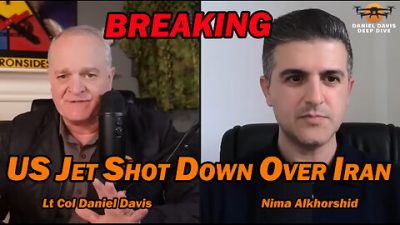
US JET SHOT DOWN OVER IRAN /Lt Col Daniel Davis & Nima Alkhorshid
or go to
Aletho News Archives – Video-Images
From the Archives
Experts Warned For Years That A War With Iran Would Happen This Way
By Caitlin Johnstone | April 3, 2026
… It’s so wild how we keep seeing reports that Iran’s retaliation caught the US off guard. For all the years I’ve been paying attention to this issue I’ve been reading experts and analysts saying if the US attacks Iran, Iran can close the Strait of Hormuz and strike US bases and the energy infrastructure of US allies in the region.
A few examples:
A 2006 Oxford Research Group paper titled “Iran: Consequences of a War” warned that Iran has numerous options at its disposal in the event of a US attack, and that the “most significant of these would be any possible retaliatory Iranian action to affect the transport of oil and liquefied natural gas through the Straits of Hormuz,” adding that stopping Iran from doing this “would be difficult if not impossible to achieve, leading to a fear of attack which alone would have a formidable impact on oil markets.”
A 2007 Cato Institute paper titled “The Iraq War and Iranian Power” warns that “Iran possesses the largest ballistic-missile inventory in the Persian Gulf — missiles which can reach Israel, Saudi Arabia and US military bases in Iraq,” and that “experts argue Iran could also use the ’oil weapon’: blocking the 34km-wide Strait of Hormuz and conducting submarine and anti-ship missile attacks against ports and oil facilities in Saudi Arabia, Kuwait and other Gulf Cooperation Council states.”
A 2012 NPR article titled “Can Iran Close The World’s Most Important Oil Route?” features then-chairman of the Joint Chiefs of Staff acknowledging that Iran absolutely can block the Strait of Hormuz, saying Tehran has “invested in capabilities” which specifically enable them to do so.
A paper from the Columbia Center on Global Energy Policy and the Center for a New American Security titled “IN DIRE STRAITS? IMPLICATIONS OF US-IRAN TENSIONS FOR THE GLOBAL OIL MARKET” warns of a potential scenario “that includes damage to Gulf oil infrastructure and a temporary closure of the Strait of Hormuz.”
These weren’t a bunch of keffiyeh-wearing peaceniks making these assessments, they were deeply entrenched swamp monsters entirely loyal to the US empire. They opposed war with Iran not because it would be an evil act of unforgivable mass murder, but because it would be bad for the imperial power structure. … Full article
Blog Roll
 Aletho News
- Al Mayadeen voices solidarity with Dr. Marandi amid death threats
- US dismantling international law in its war against Iran while claiming ‘false’ victory: Legal scholar
- One martyr, 5 injuries in US attack on Iraqi border crossing with Iran
- ‘This war is Israel’s war’: World facing ‘security breakdown’, says Qalibaf
- IRGC decries attack on US embassy in Riyadh, says executed by ‘Israel’
- Iran blasts EU hypocrisy as EU invokes international law over Hormuz
- There is no military solution to Strait of Hormuz
- NATO’s structural collapse – the outcome of deviation from reality
- Poll finds world views China better than US
- One Of America’s Leading Neo-Cons Has Turned Against The Iran War And Israel
- If Americans Knew
- US loses planes over Iran, Israel downgrades Lebanon war goals – Daily Update
- Israel Is Blocking Palestinians from Easter at Church Where Jesus Resurrected
- Plot to assassinate Palestinian activist follows harassment campaign promoted by Zionist groups and elected officials
- Prominent New York synagogue hosts presentation on why U.S. Jews should support the ethnic cleansing of Gaza
- Tapper vs. Piker: Is the CNN Anchor Auditioning for David Ellison?
- Shouldn’t Democrats Be Able to Condemn Genocide?
- Israel-US kill negotiators, destroy civilian structures, but Iran’s military capabilities still largely intact – Daily Update
- ‘War crime’: Global condemnation as Israeli ministers celebrate death penalty law targeting Palestinian prisoners
- 7 Ways Israel Is Turning Lebanon Into Gaza
- World’s Leading Football Bodies Under Fire Over Israel Policies
- No Tricks Zone
- New Study Reports A 60% Slowdown In Greenland’s Ice Loss Rate In The Last Decade
- Low Intensity Tornado Wrecks Major Solar Farm, Creating A Potential Toxic Dump
- New Study Finds Warming Saves Lives…Cold Temperatures 12 Times More Deadly Than Excess Heat
- German Science Blog Accuses PIK Climate Institute Of Hallucinating Climate Tipping Points
- Devastating Assessment Of Comirnaty Vaccine By Former Senior Pfizer Europe Toxicologist
- New Study: CO2 Is ‘Effectively Negligible’ As An Explanatory Climate Change Factor Since 2000
- Former Pfizer Toxicologist Dr. Helmut Sterz Tells Bundestag Hearing Pfizer Vaccine Should Have Never Been Approved
- Energy Expert: Germany’s Nuclear Phaseout Was A “500 Billion Euro Mistake”
- New Research: South Australia’s Mid-Holocene Sea Surface Temperatures Were 4°C Warmer Than Today
- Storing Green Energy To Last Germany 10 Days Would Require A 60-Million Tonne Battery
 Aletho News