Ex-Bahraini MP dies under detention
Press TV – May 5, 2011
A former Bahraini lawmaker and member of the country’s main opposition group has died in a hospital after being held in custody of the Manama regime.
Jawad Firouz who was a member of al-Wefaq political society, was recently arrested and detained by Bahraini police, local sources said on Thursday.
The development comes after rights group Amnesty International appealed to rulers in Manama on Wednesday to end the arrest of opposition members.
Manama regime has intensified its crackdown on the popular revolution against the decades-long ruling of al-Khalifa dynasty in the small Persian Gulf country, which has been continuing since Mid-February.
On Tuesday, the Bahraini parliament voted to extend the state of emergency for three more months, due to expire on June 15.
Human rights organizations have strongly criticized Saudi-backed Bahrain forces for their heavy-handed crackdown on peaceful protesters.
On March 13, Saudi-led forces were dispatched to the Persian Gulf island at Manama’s request to quell countrywide protests.
According to local sources, dozens of people have been killed and hundreds arrested so far during the government clampdown on peaceful demonstrations.
Bahrain is home to major military base of the US Navy Fifth Fleet.
Russia warns US, Romania over base
Press TV – May 5, 2011
Russia has issued a warning after Romania agreed to host the US missile system site at a Soviet-built base in the country’s southern town of Deveselu.
Moscow warned that the deployment of US interceptor missiles on Romanian territory comes without considering the talks between Moscow and Washington on the issue.
Earlier in the week, the US and Romania announced that elements of US missile system would be stationed at the former Romanian airbase of Deveselu.
Russia said that the planned missile system “may pose risks for Russian strategic nuclear deterrence forces in the future,” Russia Today reported on Wednesday.
“We regret to say that practical steps on building the European segment of the US global missile defense system are being made regardless of the Russian-US dialogue on missile-defense issues, which was launched under the initiative of President Dmitry Medvedev and President Barack Obama,” the Russian foreign ministry said in a statement.
It said Washington continues to implement “the phased adaptive approach” toward building a segment of the US global missile system in Europe.
Washington announced these plans back on September 17, 2009.
Russia had warned earlier that it would take “adequate measures” if the US and NATO choose to build the European missile system without Moscow’s participation.
US Undersecretary of State Ellen Tauscher, however, said on Wednesday that the missile system posed no threat to Russia.
“It is a system that will defend NATO and, if Russia chooses to work with us in a cooperative manner, the system will defend Russia, too,” she said.
“We have good relations with Russia. We have just ratified the New START treaty, we are working together on various other issues,” she told Romanian lawmakers.
Tauscher is scheduled to meet with Russian Deputy Foreign Minister Sergei Ryabkov on Thursday.
Russia was not the only one caught off-guard by the surprise announcement of the US-Romanian decision. Reports say that Romanian officials were also unaware of the decision and the Romanian media kept mum on the issue until President Traian Basescu announced it on Tuesday night.
The False Promise of Biomass
Blowing Smoke
By MATTHEW KOEHLER, IAN LANGE and JOHN SNIVELY | CounterPunch | May 5, 2011
Last fall news broke that the University of Montana was planning to construct a $16 million wood-burning biomass plant on campus next to the Aber Hall dormitory. UM officials claimed the biomass plant would save UM $1 million annually and protect Missoula’s air quality by reducing emissions over the existing natural gas heating system.
As interested citizens, we attended the university’s biomass “poster presentation” last December, which, unfortunately, raised more serious questions than it answered. So we continued to ask questions and research the proposal. In March, we even conducted an “open records” search of UM’s biomass project file, pouring over hundreds of documents and emails between UM officials and representatives of Nexterra, a Canadian biomass boiler manufacturer, and McKinstry, a Seattle energy services company. Suffice to say, our records search turned up even more troubling questions, especially related to costs, maintenance and emissions.
As the Missoulian reported last month, information in UM’s air quality permit application to the Missoula City-County Health Department showed that “Contrary to previous claims by UM administrators, the university’s proposed biomass boiler will not reduce emissions to levels below that of natural gas. In fact, UM’s proposed state-of-the-art biomass gasification plant will produce nearly twice as much nitrogen dioxide as its existing natural gas boilers – and in some cases, will release three times as much particulate matter.” The emissions are higher than what McKinstry’s feasibility study predicted.
Our records search also turned up a document showing that the biomass plant would also increase emissions of carbon dioxide, nitrogen oxides and volatile organic compounds by 40 percent or more over the existing natural gas system.
Obviously, Missoula is prone to severe inversions and air stagnation, especially during winter, when the greatest load would be on the biomass system. We found a UM biomass grant application that stated, “The Missoula Valley’s constrained topography presents ideal research conditions for long term analysis of environmental impacts of efficient woody biomass boiler combustion.” Do we really want to risk Missoula’s air quality for the sake of research?
It’s also been difficult to get an accurate assessment from UM of the biomass plant’s up-front and long-term costs, something all Montana taxpayers deserve. For starters, we noticed in the project file that in April 2010 the cost of the biomass plant was $10 million. By July, the cost went to $14 million. Now it sits at $16 million. UM’s financial pro forma also shows that during the first 20 years the biomass plant would need nearly $10 million for additional operation and maintenance expenses over the existing natural gas system.
The pro forma is also troubling in other aspects. It over-estimates the cost of natural gas, while under-estimating the cost of biomass fuel trucked to campus, especially given rising diesel costs. The pro forma also completely zeros out all natural gas expenses and maintenance costs, even though UM now admits that a natural gas boiler would be used during cold winter days to augment the biomass system, and also used from May to September, when the biomass system is too powerful to use.
Further complicating the picture, UM realized during the permitted process that its existing natural gas boilers are in violation of air pollution limits. The fix will cost around $500,000. And UM’s contract with McKinstry was amended recently, meaning that UM is already contractually committed to McKinstry for $532,000 just for project development.
It is our belief that all of these significant issues need to be fully analyzed and rechecked, not just by the biomass project’s supporters, but also by the Board of Regents, independent of McKinstry and UM. Guarantees of performance by McKinstry need to be carefully scrutinized, as other colleges have paid the price for poorly written contracts or poorly vetted companies.
At the end of the day, Montana taxpayers deserve to see accurate, updated financial information from UM concerning all aspects of the biomass plant, including the initial $16 million price tag and $10 million needed for additional operation and maintenance expenses. And Missoula’s citizens have a right to expect that the University of Montana would not risk Missoula’s fragile air quality by needlessly increasing emissions over present levels.
~
Matthew Koehler is executive director of the WildWest Institute; Ian M. Lange is a professor emeritus, Department of Geosciences at the University of Montana; and Dr. John Snively is a retired dentist. All three live in Missoula.
This column was originally published by The Missoulian.
The Agendas Behind the bin Laden News Event
Paul Craig Roberts | LewRockwell.com | May 5, 2011
The US government’s bin Laden story was so poorly crafted that it did not last 48 hours before being fundamentally altered. Indeed, the new story put out on Tuesday by White House press secretary Jay Carney bears little resemblance to the original Sunday evening story. The fierce firefight did not occur. Osama bin Laden did not hide behind a woman. Indeed, bin Laden, Carney said, “was not armed.”
The firefight story was instantly suspicious as not a single SEAL got a scratch, despite being up against al Qaeda, described by former Pentagon chief Donald Rumsfeld as “the most dangerous, best-trained, vicious killers on the face of the earth.”
Every original story detail has been changed. It wasn’t bin Laden’s wife who was murdered by the Navy SEALs , but the wife of an aide. It wasn’t bin Laden’s son, Khalid, who was murdered by the Navy SEALs, but son Hamza.
Carney blamed the changed story on “the fog of war.” But there was no firefight, so where did the “fog of war” come from?
The White House has also had to abandon the story that President Obama and his national security team watched tensely as events unfolded in real time (despite the White House having released photos of the team watching tensely), with the operation conveyed into the White House by cameras on the SEALs helmets. If Obama was watching the event as it happened, he would have noticed, one would hope, that there was no firefight and, thus, would not have told the public that bin Laden was killed in a firefight. Another reason the story had to be abandoned is that if the event was captured on video, every news service in the world would be asking for the video, but if the event was orchestrated theater, there would be no video.
No explanation has been provided for why an unarmed bin Laden, in the absence of a firefight, was murdered by the SEALs with a shot to the head. For those who believe the government’s story that “we got bin Laden,” the operation can only appear as the most botched operation in history. What kind of incompetence does it require to senselessly and needlessly kill the most valuable intelligence asset on the planet?
According to the US government, the terrorist movements of the world operated through bin Laden, “the mastermind.” Thanks to a trigger-happy stupid SEAL, a bullet destroyed the most valuable terrorist information on the planet. Perhaps the SEAL was thinking that he could put a notch on his gun and brag for the rest of his life about being the macho tough guy who killed Osama bin Laden, the most dangerous man on the planet, who outwitted the US and its European and Israeli allies and inflicted humiliation on the “world’s only superpower” on 9/11.
When such a foundational story as the demise of bin Laden cannot last 48 hours without acknowledged “discrepancies” that require fundamental alternations to the story, there are grounds for suspicion in addition to the suspicions arising from the absence of a dead body, from the absence of any evidence that bin Laden was killed in the raid or that a raid even took place. The entire episode could just be another event like the August 4, 1964, Gulf of Tonkin event that never happened but succeeded in launching open warfare against North Vietnam at a huge cost to Americans and Vietnamese and enormous profits to the military/security complex.
There is no doubt that the US is sufficiently incompetent to have needlessly killed bin Laden instead of capturing him. But who can believe that the US would quickly dispose of the evidence that bin Laden had been terminated? The government’s story is not believable that the government dumped the proof of its success into the ocean, but has some photos that might be released, someday.
As one reader put it in an email to me: “What is really alarming is the increasingly arrogant sloppiness of these lies, as though the government has become so profoundly confident of their ability to deceive people that they make virtually no effort to even appear credible.”
Governments have known from the beginning of time that they can always deceive citizens and subjects by playing the patriot card. “Remember the Maine,” the “Gulf of Tonkin,” “weapons of mass destruction,” “the Reichstag fire”–the staged events and bogus evidence are endless. If Americans knew any history, they would not be so gullible.
The real question before us is: What agenda or agendas is the “death of bin Laden” designed to further?
There are many answers to this question. Many have noticed that Obama was facing re-election with poor approval ratings. Is anyone surprised that the New York Times/CBS Poll finds a strong rise in Obama’s poll numbers after the bin Laden raid? As the New York Times reported, “the glow of national pride” rose “above partisan politics, as support for the president rose significantly among both Republicans and independents. In all, 57 percent said they now approved of the president’s job performance, up from 46 percent.”
In Washington-think, an 11% rise in approval rating justifies a staged event.
Another possibility is that Obama realized that the the budget deficit and the dollar’s rescue from collapse require the end of the expensive Afghan war and occupation and spillover war into Pakistan. As the purpose of the war was to get bin Laden, success in this objective allows the US to withdraw without loss of face, thus making it possible to reduce the US budget deficit by several hundred billion dollars annually–an easy way to have a major spending cut.
If this is the agenda, then more power to it. However, if this was Obama’s agenda, the military/security complex has quickly moved against it. CIA director Leon Panetta opened the door to false flag attacks to keep the war going by declaring that al Qaeda would avenge bin Laden’s killing. Secretary of State Clinton declared that success in killing bin Laden justified more war and more success. Homeland Security declared that the killing of bin Laden would motivate “homegrown violent extremists” into making terrorist attacks. “Homegrown violent extremists” is an undefined term, but this newly created bogyman seems to include environmentalists and war protesters. Like “suspect,” the term will include anyone the government wants to pick up.
Various parts of the government quickly seized on the success in killing bin Laden to defend and advance their own agendas, such as torture. Americans were told that bin Laden was found as a result of information gleaned from torturing detainees held in Eastern European CIA secret prisons years ago.
This listing of possible agendas and add-on agendas is far from complete, but for those capable of skepticism and independent thought, it can serve as a starting point. The agendas behind the theater will reveal themselves as time goes on. All you have to do is to pay attention and to realize that most of what you hear from the mainstream media is designed to advance the agendas.
Bedouin hamlet destroyed for 3rd time
Ma’an – 05/05/2011
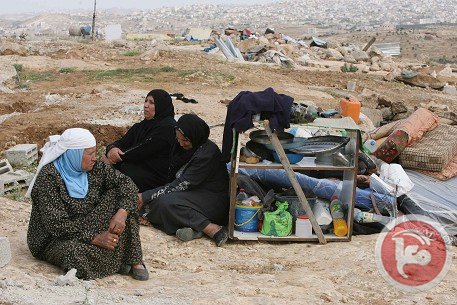
HEBRON — Women of the Bedouin herding hamlet of Khirbet Amniyr sat on the earth and watched Israeli forces demolish their 12 tent homes for the third time on Thursday morning.
The women said they were waiting for the soldiers to leave so they could rebuild their tent homes and once again re-establish their lives and livlihoods.
Amniyr, south of Yatta in the southern West Bank, is said to be located in an Israeli military zone.
Military zoning laws enforced by Israel’s Civil Administration, make up part of the 60 percent of the West Bank that is inaccessible to Palestinians.
As the troops left, the woman remained seated, surveying the destruction, as their tents and mattresses lay buried under a thin layer of dirt.
“I appeal to God to save us from the cruelty of the Israeli occupation,” said the hamlet’s matriarch, as she stood and began to collect her belongings from under the dust.
The hamlet has been taken down twice before, first on February 22 when the Israeli military buried homes and water wells, later preventing ICRC workers from delivering aid equipment.
On March 29, seven Bedouin were beaten by Israeli border police when the same 12 tents were taken down a second time.
The 12 families of Khirbet Amniyr were ordered out of their tent homes earlier in the year, but remained, saying they had little choice but to stay and had nowhere else to go.
The spokesman of Israel’s Civil Administration could not be reached by phone for comment on the latest demolition.
Amniyr is one of three Bedouin hamlets currently under Israeli evacuation orders, with a second in the south Hebron hills area, and a third in the northern West Bank district of Nablus which has been demolished six times.
In Israel’s Negev region, the Bedouin community in Al-Araqib have seen their homes taken down a total of 16 times, to make way for a park.
Setting The Record Straight On BDS
By Omar Barghouti | NewMatilda.com | May 2, 2011

As Marrickville Council’s BDS resolution was thrashed out in the media, misinformation about it abounded, writes Omar Barghouti, one of the founders of the global BDS movement
The Palestinian civil society campaign for boycott, divestment and sanctions (BDS) against Israel came under attack in recent weeks from Murdoch media outlets, politicians and various interest groups as Sydney’s Marrickville Council struggled to keep the BDS resolution that they had adopted in December last year. The wild distortions and outright fabrications against BDS and its supporters in Sydney peaked in an article by Leo Shanahan, “Greens’ boycott rebounds”, published in The Australian on the day of the Council meeting when the BDS motion was rescinded.
Marrickville Council has since reaffirmed its support for the principles of the BDS campaign by actually spelling out the three fundamental Palestinian rights that constitute the minimum requirements for the Palestinian people to exercise our right to self determination.
Although the Council, after months of unprecedented bullying, threats, smear campaigns, and intimidation orchestrated by well-oiled Israel lobby groups, felt compelled not to put that principled support into action in the form of specific BDS measures, the fact that it stood its ground defending these basic Palestinian rights, as outlined in the BDS Call, is praiseworthy and quite inspiring. BDS is about asserting our long forgotten rights, first and foremost. Action to achieve those rights can come later, when the ground is fertile enough and resistance to intellectual terror and misinformation is higher.
Regardless, the record needs to be set straight. Misrepresentations of the type that litters Shanahan’s article should not go unchallenged. As the great Palestinian thinker Edward Said once said, “[D]espite the abuse and vilification that any outspoken supporter of Palestinian rights and self determination earns for him or herself, the truth deserves to be spoken …”
Shanahan dismissively writes, “The BDS is a movement advocated by a multitude of left-wing political parties, universities, trade unions and other local governments throughout the world.” He writes this even though he admits just a few lines above that BDS is a Palestinian-led movement. In fact, BDS is called for by the largest and broadest coalition ever created of Palestinian civil society institutions, political parties, trade unions and NGO networks.
On 9 July 2005, the Palestinian BDS Call was issued, endorsed by more than 170 of the leading institutions in Palestinian society. It called for holding Israel to account for its three-tiered system of oppression, for its persistent violations of international law to compel it to end its 1967 occupation of all Arab lands, including East Jerusalem; its system of racial discrimination against its own Palestinian citizens which was described in the 2010 US Department of State human rights report as constituting “institutional, legal and societal discrimination”; and respecting the UN-sanctioned right of Palestinian refugees to return to their homes of origin, as stipulate in UN Resolution 194.
Shanahan quotes a member of the NSW Jewish Board of Deputies making a baseless claim about me. He claims that I had said that BDS aims at “getting a Palestine next to a Palestine rather than a Palestine next to Israel.” This is categorically false; I never made this statement.
Israel lobby propagandists have intentionally fabricated this claim by omitting its crucial context to insinuate that the BDS movement is bent on what they characterise as the “destruction of Israel”. The remark above was part of a quote that I cited in an article and several presentations; it was first stated by a prominent Palestinian academic who argued that the right of return of Palestinian refugees in accordance with international law would lead, from an Israeli perspective, to a Palestine next to a Palestine. The point he was making is that Israel would not allow this aspect of international law to be implemented in order to maintain its ethnocentric and exclusivist nature in a two-state settlement. In responding to his argument, I insisted that the right of refugees to return home is deeply enshrined in international law and that implementing it would not “destroy” anyone or any people; it would simply end Israel’s apartheid regime and pave the road to real justice and democracy. If an unjust version of the two-state settlement is conditioned upon giving up the right of return, I argued, then we can do without that solution, but we cannot possibly surrender the UN-sanctioned rights of the refugees who make up two thirds of the Palestinian people.
For more than 28 years, I have, in my personal capacity, consistently and openly advocated a secular democratic state in the entire area of historic Palestine, where everyone enjoys equal rights, irrespective of ethnicity, religion or any identity attribute. This, to my mind, is the most ethically consistent formula that can accommodate the inalienable right of Palestian people to self determination with the rights of all the inhabitants of the land to justice, peace, equality, and democratic rights.
But this is certainly not the position of the BDS movement. The movement has consistently advocated a rights-based approach, consistently refraining from endorsing either of the one-state or two-state solutions. Any review of the hundreds of statements and media interviews by the BDS National Committee (BNC), the massive Palestinian coalition leading the international BDS movement, will confirm this. The BNC’s vision is for freedom, justice, and equal rights for all, regardless of identity and no matter what political solution is reached. People’s rights must be protected and respected above everything else. Furthermore, as a movement anchored in the universal principle of equality of all humans, BDS is firmly opposed to all forms of racism, including anti-Semitism and Islamophobia.
This humanist platform is the essence of the BDS movement and the key behind its impressive growth. Many international trade union federations of the size of the Brazilian CUT (representing more than 20 million workers) and the British Trades Union Congress (TUC) and of the great symbolic significance of the South African COSATU and the Irish Congress of Trade Unions, have joined the BDS campaign, selecting diverse forms of implementing it. Faith-based groups, Jewish organisations, leading artists and music groups, and iconic moral leaders of the calibre of Archbishop Desmond Tutu also support the boycott of Israel, drawing parallels with the ultimately successful boycott and divestment campaign utilised in the strategy to end apartheid in South Africa.
In his article, Shanahan also unquestioningly repeats the inaccurate claim that implementation of BDS “would cost Marrickville ratepayers $3.7 million”, an assertion that lazily ignores the track record of local council implementation of BDS.
Scores of councils across Europe have, at no cost at all, heeded the BDS call by excluding the French company Veolia from bidding on contracts. Why? Due to its involvement in an Israeli rail system serving illegal settlements that has been criticised by the UN Human Rights Council. Veolia is now considering ending its involvement. Local councils in Spain voted to support BDS and implemented their policy simply by switching bottled water provider to one other than Eden Springs, an Israeli company that sources its water from the Israeli-Occupied Syrian Golan Heights. Whether it is local councils changing service providers, artists such as Pink Floyd’s Roger Waters and U2’s Bono refusing to play in Israel, or the University of Johannesburg severing its ties with an Israeli university complicit with violations of international law, standing up against Israeli spartheid needn’t cost a thing. It does, however, express a moral stand with the oppressed.
Finally, regarding the often discussed issue of violence and counter-violence, it is crucial to emphasise that Israel’s occupation, colonisation and denial of refugee rights are the roots of all violence. Israel’s illegal and patently immoral siege of Gaza, described recently by British Prime Minister David Cameron as a large “prison camp,” is the embodiment of violence. Israel’s gradual ethnic cleansing of Palestinians from occupied East Jerusalem is one of the cruelest manifestations of a policy of state violence aimed at further expulsion and dispossession of the indigenous Palestinians. To end all violence once must snuff out its causes: Israel’s decades-long, ruthless occupation and apartheid.
Those who truly care about all human life, as I do, and who think that any civilian life lost is a life too many should do their utmost to support the exceptionally effective, manifestly creative, morally consistent and impeccably non-violent BDS movement to end Israel’s impunity and violations of international law.
As Archbishop Tutu says :
Together with the peace-loving peoples of this Earth, I condemn any form of violence — but surely we must recognize that people caged in, starved and stripped of their essential material and political rights must resist their Pharaoh? Surely resistance also makes us human? Palestinians have chosen, like we did, the nonviolent tools of boycott, divestment and sanctions.
The Marrickville Council was on the right side of history when it first chose to endorse the global BDS campaign. It remains so by insisting on Palestinian rights, despite the tactical setback. Brave Australians had done the same when responding to the calls from the oppressed South African majority under apartheid. We expect no less from conscientious Australians today in response to our urgent appeal for effective solidarity. I have no doubt that one day commentators and activists will mark Marrickville’s decision as the true beginning of mainstreaming BDS in Australia and of finally standing up to Israel’s lobby and for the rights of Palestinians.
‘Sustainable Rural Cities’, a Nightmare Come True in Chiapas
Biofuel Company Towns
Written by Koman Ilel, Translation by Jessica Davies – Upside Down World – 04 May 2011

More than three years ago torrential rains flooded the northern and central regions of the state of Chiapas. The rain seriously affected more than 1,200 families in 34 municipalities. This disaster, coupled with the inept dredging strategies of the National Water Commission (Conagua) and the Federal Electrical Commission (CFE), kept 404 households in 33 villages and 960 hectares of productive land under water for more than three months.Of all those concerned, the community of Juan de Grijalva suffered the worst fate: it was buried by the breaking away of a hill in the town of Ostuacán, in northern Chiapas. Shortly after the tragedy, the government, in the guise of a ‘philanthropic organisation’, held out its hand in solidarity to the people of Juan de Grijalva. Two years later they erected the brand new city of Nuevo Juan de Grijalva, the first Sustainable Rural City (SRC) in the whole of Mexico.
From being a poor village, Juan de Grijalva had become a leading city that had all the services that any Mexican could wish for: decent housing and quality basic services; drinking water; a water purification plant; drainage and sewerage; a waste treatment plant; electricity and public lighting using solar voltaic cells; a communications tower for fixed and mobile telephones; access to the Internet and information networks; a comprehensive basic education centre equipped with advanced technology; kindergarten, elementary and secondary schools; and a Health Centre with expanded services in the area of telemedicine equipment and technology. In addition, the inhabitants of the newly developed city were provided with opportunities for decent and gainful employment. Projects were launched for intensive production such as: greenhouses, nurseries, packing stations for tomatoes, poultry farms and a dairy processing plant. They also started ‘productive reconversion’, which allows residents to keep their land by replacing traditional crops with others of high commercial value.
It all sounded too good to be true. And, indeed, the dream became a nightmare. The city was from the beginning doomed to failure. There was not even the will to make a decent project: the houses are mousetraps, the basic services are inadequate, the health centers do not even have doctors, etc. But beyond these ‘details’, the new town is part of a state-wide program to rearrange the scattered population. As if we were in the sixteenth century, the aim is to create ‘authentic Indian villages’.
An Imposed Project
Under the pretext that most of the villages of Chiapas are scattered and that this high dispersion makes the provision of services and the economic and social development of communities difficult, the Rural Cities Program aims to focus on rural people in small villages. The aim is twofold: firstly, to take the land away from the small farmers (campesinos) and exploit it (with the participation of large businesses) and secondly, to concentrate the inhabitants of several villages in one place to serve as an ‘industrial reserve army’.
The ‘Believing People’ (el Pueblo Creyente) from the parish of San Pedro Chenalhó expressed it in these terms: “We are concerned that the rural cities project has been imposed, and that the people in the communities have not been consulted as to whether they agree with it or not, and if they do consult them, the consultation is based on lies and omissions, the government does not say clearly what this mega project actually brings or whether it is for the good or ill of the people. For example, it does not explain what ‘productive reconversion’ means, or who will be the beneficiaries of this reconversion.
“Rural cities were not invented by the state and federal government of this administration, but have a very long history, going back, for example, to the colonization of Latin America. At that time they were not called ‘rural cities’ but were known as ‘reducciones’, with the aim of making control of the population easier and more efficient in order to collect taxes (tribute), to use the people as labour for mines, plantations (most frequently sugar cane), for the construction of cities for the Spanish, and, of course, for political and military control. It is also true that then, as now, they argued that there would be benefits for the population directly affected, that by concentrating a population they can be provided with access to basic services of potable water, education, health, etc..”

The Wider Context
To address the issue of fighting poverty here in Chiapas, we must analyze the Sustainable Rural Cities in a broader context. On the one hand, in 2008 the presidents of Colombia, Mexico and other Central American countries signed the trade agreement Plan Mesoamerica (a new version of the Plan Puebla Panama). The purpose of this plan is to create an infrastructure and trade corridor that connects Southern Mexico to Colombia, and this area is intended to serve big capital. On the other hand, the political and economic plan of the World Bank, outlined in their report entitled ‘New Economic Geography’, suggests that economic integration is the fundamental way to bring development to all corners of the world. This report emphasizes population density as a key factor for the economic development of any country.
The construction of Santiago El Pinar, the second SRC, clearly unveils another facet of the project: that of a counterinsurgency strategy devised by the Chiapas government against the Zapatista Army of National Liberation (EZLN). Located very close to the Zapatista autonomous municipalities of San Juan de la Libertad and San Andrés Sakamch’en, the ‘city’ breaks down the traditional ways of life, and forces people to enter the capitalist mode of production of small businesses oriented towards the external market. Clearly, the Sustainable Rural City is a challenge to the Zapatista caracoles, who have built true autonomous systems of health, education and production. It seems that the government forgets that it is dealing with the same people who took up arms in January 1994, a dignified people and one increasingly more aware.
As we said, so far they have established two Sustainable Rural Cities: Nuevo Juan Grijalva and Santiago El Pinar. There are three more under construction: Jaltenango, Ixhuatan and Emiliano Zapata (and a final one in the process of being built: Copainalá). It is obvious that private interests are a fundamental component of the Sustainable Rural Cities, so it does not take much imagination to realize who the real beneficiaries of this project are. Certain companies (among whom stand out Telmex, Fundación Azteca, BBVA Bancomer, Banamex, Grupo Carso, Farmacias del Ahorro and Coparmex) who operate through their ‘third level’ employees (the governor and his cronies), and certain university institutions (IPN and UNACH ) are the ones who have assessed, evaluated and supported with funding the construction of the ‘self-sustaining cities’. All these have a place of honor on the Advisory Council of the Sustainable Rural Cities.
With even more irony, these companies have their place within the very broad commercial corridors included in the plans of these ‘cities’, in places where little is known about money and where the people are still dying of curable diseases. Now, the residents will not only be free to sell their labour, but they will also be free to obtain un-repayable micro-loans, cell phones, domestic electrical appliances by means of small payments, and other ‘benefits’ that the modern world brings.
No Longer Slaves?
In fact, the two Sustainable Rural Cities are a disaster for their new inhabitants. The plan promoted by the government is solely focused on benefiting the companies involved in the construction of these cities. We all need to inform ourselves about these illusions and publicly denounce the government’s plans.
The Sustainable Rural Cities affect all the communities of Chiapas and are intended to alienate the people from their land, thus making the land available to large multinational corporations who focus on “cheap labour”, destroying ancient farming practices, imposing community development models and forcing the population into the financial circle of capitalism. We conclude with the words of the Civil Society organisation The Bees (Las Abejas):
“We are not the only ones who know that this project [of rural cities] is part of the Mesoamerica Project, previously Plan Puebla Panama. This plan did not start with the bad government of Calderon nor with that of Sabines, but with Salinas de Gortari when he signed NAFTA (the North Atlantic Free Trade Agreement) which caused the uprising of our Zapatista brothers and sisters in the year 1994.
[…] Now they say we are no longer slaves, but it is just the same to make us work in their Mesoamerica Project with its plans for mines, sweatshops and plantations, which explains the campaign that the bad government is starting. This campaign is to have what they call ‘productive restructuring’.
“They do not explain much what this means, but we understand that now they do not want us to sow our cornfields (milpa), and our other ancestral foods any longer. They tell us that it is better for us to sow African (oil) palm and pine nuts, the reason they give us for this is to prevent fires.
“But what we see is that with the corn and beans we nourish ourselves; with oil palms and pine nuts they plan to produce biofuels to feed the cars and trucks. Do cars have more right to the food of Mother Earth than we do?”
Article originally published in Spanish by Koman Ilel, 26th April 2011
http://komanilel.blogspot.com/2011/04/ciudades-rurales-sustentables-una_21.html
~
See also:
Progressive ‘Green’ Counterinsurgency
US not to publish dead bin Laden photos, Pakistanis doubt death account
Press TV – May 4, 2011

White House Press Secretary Jay Carney

The US administration says it will not release photos of Osama bin Laden’s corpse, deepening suspicions over Washington’s claim of killing the notorious terrorist.
In a prerecorded interview with CBS on Wednesday, US President Barack Obama said he has decided not to publish the disturbing images purportedly of al-Qaeda chief’s dead body, because of concerns that they might become “a propaganda tool”, AFP reported.
“I think that given the graphic nature of these photos, it would create some national security risk,” Obama stated.
“There is no doubt that bin Laden is dead. Certainly there is… no doubt among al-Qaeda members that he is dead. And so we don’t think that a photograph in and of itself is going to make any difference.” White House spokesman Jay Carney quoted Obama as saying, as he read an excerpt of the president’s interview to the reporters. […]
Obama’s decision not to offer any photographic evidence of the killing has thrown doubt on the reported US operation, with many analysts saying that that bin Laden is either still alive or had been dead several years ago. … Full article
Also from Press TV:
‘No trust in Osama death account’
The Pakistani people say they do not believe US reports that Osama bin Laden had lived in a compound near a Pakistani military base in Abbottabad since 2005. […]
Some analysts say there is a possibility that the al-Qaeda militants were living in the compound under the surveillance of ISI when the US military carried out the operation. They say the operation was a show prearranged between the US and ISI and that bin Laden was not in the house as he had already been killed. […]
Meanwhile, contradictory stories are emerging from the White House about the military operation. One of the contradictions includes comments that bin Laden was unarmed but put up resistance.
Many believe American Special Forces could have arrested the al-Qaeda leader without having to kill him and a question raised is why bin Laden’s body was buried at sea so soon after his death.
A US official says bin Laden’s body has been buried at sea, alleging that his hasty burial was in accordance with Islamic law, which requires burial within 24 hours of death. This while burial at sea is not an Islamic practice and Islam does not determine a time-frame for burial. – Full article
Featured Video
Laith Marouf: Hezbollah’s position on US-Iran ceasefire
or go to
Aletho News Archives – Video-Images
From the Archives
Is Israel to blame for the Iraq War?
American Goy | March 10, 2008
I am so tired of this old canard that “Israel had nothing to do with USA’s war with Iraq – in fact, it officially advised America against it”.
Bullshit. … continue
Blog Roll
 Aletho News
- Laith Marouf: Hezbollah’s position on US-Iran ceasefire: What you’re not being told
- Israel’s priority lies in destroying chances of peace between Iran, US: Ex-UN nuclear chief
- Ceasefire for all or for none: Iran shuts Hormuz over Lebanon attacks
- Strait of Hormuz is Iran’s ‘nuclear weapon’ that forced US retreat: Medvedev
- Energy crisis will last for months – Kremlin envoy
- Europe’s quiet role in the war on Iran
- Forty days that shook the Empire: How Iran turned the tables on US and prevailed
- Netanyahu unilaterally declares Lebanon outside of ceasefire deal
- Israeli leaders: ‘Not a single goal’ achieved in war with Iran
- What on earth just happened? Trump, Iran, and the unlikely ceasefire
- If Americans Knew
- Gazans face a triple crisis: severe shortages of water and bread, healthcare in tatters
- NY Times reports how Netanyahu took the US into Iran War
- A sigh of relief over Iran, but Gaza and Lebanon in dire straits – Daily Update
- Thousands dead and neighborhoods razed to the ground: Aid agencies fear southern Lebanon is becoming the new Gaza
- The war the US is fighting for Israel could cost trillions
- ‘Cigarette Burns, Nail Wounds’: Toddler Tortured in Gaza to Coerce Father
- Trump Says US Sent ‘a Lot of Guns’ to Protesters in Iran
- Israeli forces destroy 17 UN peacekeeper cameras in south Lebanon
- US-Israeli strikes ‘completely destroy’ synagogue in Tehran
- Archbishop for US Military Says Iran War Is Unjust Under Catholic Teaching
- No Tricks Zone
- An Inconvenient Tree: Uncovered In Alps… Europe Much Warmer Than Today 6000 Years Ago
- New Study Reports A 60% Slowdown In Greenland’s Ice Loss Rate In The Last Decade
- Low Intensity Tornado Wrecks Major Solar Farm, Creating A Potential Toxic Dump
- New Study Finds Warming Saves Lives…Cold Temperatures 12 Times More Deadly Than Excess Heat
- German Science Blog Accuses PIK Climate Institute Of Hallucinating Climate Tipping Points
- Devastating Assessment Of Comirnaty Vaccine By Former Senior Pfizer Europe Toxicologist
- New Study: CO2 Is ‘Effectively Negligible’ As An Explanatory Climate Change Factor Since 2000
- Former Pfizer Toxicologist Dr. Helmut Sterz Tells Bundestag Hearing Pfizer Vaccine Should Have Never Been Approved
- Energy Expert: Germany’s Nuclear Phaseout Was A “500 Billion Euro Mistake”
- New Research: South Australia’s Mid-Holocene Sea Surface Temperatures Were 4°C Warmer Than Today
 Aletho News