BBC hides royal wedding coverage costs
Press TV – June 7, 2011
The BBC has used a “controversial exemption” in Britain’s regulations to avoid revealing the astronomical costs of the royal wedding coverage and the number of complaints it received on the day.
British anti-monarchy campaign group Republic hit out at the broadcaster for resorting to the exception in the Freedom of Information Act saying it is going to appeal to the Information Commissioner’s Office to lift the exemption.
“The BBC has been widely criticised for misjudging the level of interest in the royal wedding and was predicted to receive an unprecedented number of complaints about its non-stop, wall-to-wall coverage,” Republic said on its website.
The group said the BBC allocated “vast sums of resources” to the royal wedding while “other areas of the corporation’s output had fallen victim to funding cuts”.
“Over a thousand staff were reportedly sent to cover the wedding, more than five times the number of commercial rival Sky,” Republic said.
The Freedom of Information Act allows the BBC to withhold information that is related to “journalism, art or literature” but the state broadcaster’s insistence on keeping the royal wedding costs secret has raised concerns that it has gone out of its way to accredit a monarchy many people do not bother about.
“The only conclusion we can draw is that the BBC has something very embarrassing to hide. There is a very significant public interest in knowing how licence fee-payers’ money is spent, particularly when it comes to highly controversial issues such as the monarchy,” Republic’s campaign manager Graham Smith said.
Smith also said the broadcaster’s royal wedding coverage is under question as its attitude toward the event has reportedly angered many of the people who pay license fees to keep the corporation running.
“An exemption introduced to protect the independence of the BBC was not intended to shield the corporation from legitimate scrutiny. The BBC must be seen to be impartial and must be seen to be making appropriate decisions based on viewer feedback. If tens of millions of pounds of licence fee payers’ money was spent on the wedding, if thousands of viewers lodged complaints about the BBC’s coverage, clearly the licence fee payer has the right to know,” he said.
Smith went on to attack the BBC for turning into the public relations apparatus for the monarchy.
“Throughout its royal wedding coverage the BBC let itself be co-opted into the Palace PR machine. It’s time for the BBC to come clean, admit its mistake and move toward more objective and proportionate coverage of royal events,” he added.
This comes as Republic had earlier warned in another article on its website that the BBC did not present an impartial picture of the event to the public.
“While we accept that the royal wedding is a news story that the BBC, and other broadcasters, need to report, we believe the degree, style and substance of the BBC’s coverage is biased in favour of the monarchy,” the campaign group said.
Former professors refute Israel’s indictment of kidnapped Gaza engineer
By Maureen Clare Murphy – 06/06/2011
Former professors of Dirar Abu Sisi, the engineer from Gaza who went missing during a train trip in Ukraine last February, refute allegations in Israel’s indictment that the man was taught weapons systems at university. The indictment also claims that one of Abu Sisi’s professors studied at a military engineering school in east Ukraine, though no such school exists, the Associated Press has found.
The Israeli daily Haaretz reported today:
Dirar Abu Sisi, 42, vanished from a train in Ukraine in February and resurfaced days later in an Israeli prison. Abu Sisi, who claims innocence, is to stand trial in coming weeks on hundreds of counts of attempted murder and conspiracy to commit murder.
Konstantin Petrovich Vlasov told The Associated Press that Abu Sisi was his doctoral student in civilian electricity systems at the Kharkiv National Academy of Municipal Services in the mid-1990s, but denies he was taught about weapons.
The indictment against him says Konstantin Petrovich, Abu Sisi’s professor at a civilian institute, also taught at an academy for military engineering in the eastern city of Kharkiv, although no such school exists.
The Israeli document claims the professor is an expert in Soviet-made Scud missile control systems. It alleges that Konstantin Petrovich arranged for Abu Sisi to attend classes at the military academy, where he gained knowledge that enabled him to modernize missiles launched by Palestinian militants into Israel.
Israel would not immediately comment on the incongruities concerning the professor’s name or the purported military academy.
Regarding Israel’s motivations for abducting Abu Sisi in Ukraine, The Electronic Intifada reported in March:
A few days after his disappearance, Abu Sisi’s wife, Veronika, a Ukrainian national, accused the Israeli spy agency Mossad of kidnapping him to extract information that could be used to disable Gaza’s power station in a future confrontation with the enclave’s Hamas rulers.
Israel bombed the plant during its three-week military assault, Operation Cast Lead, in winter 2008, causing blackouts across much of Gaza. Israel also targeted the power station in June 2006, cutting power to 700,000 Palestinians in Gaza for several months while it was fixed at a cost of more than $5 million.
Abu Sisi’s family suggested another reason why Israeli might consider him a high-value target. They say he had recently developed a method to reduce the plant’s dependency on high-grade diesel fuel, the flow of which Israel controls into Gaza.
In January Hamas officials announced that the station’s turbines had been modified to work on regular diesel, which is cheaper and can be smuggled in through tunnels from Egypt.
The Israeli media, on the other hand, have speculated that Abu Sisi must be a senior Hamas activist to have secured an important post at the plant. The family have denied the claim, saying he was not involved in any political faction and was appointed because of his skills as an engineer.
One of his Israeli lawyers, Smadar Ben Nathan, who met him for the first time at the court hearing on Sunday to lift the gag order, said she believed Israel had carried out the operation based on false information.
The Electronic Intifada correspondent Rami Almeghari interviewed Abu Sisi’s family in Gaza, meeting his children. Suzan Abu Sisi, the sister of Dirar, told The Electronic Intifada:
“I hold the Ukrainian authorities, topped by the president of Ukraine, responsible for the kidnapping of my brother by Israeli intelligence agents,” Suzan said. “How could such a kidnapping take place in a sovereign country?”
Healing the Trees in At Tuwani
By Carol Tyx – CPT – June 7, 2011

We start slowly, our delegation members, several men, a handful of women, a sprinkling of children. As we walk out of the Palestinian village of At-Tuwani the procession grows, women cutting across fields, children scrambling down hillsides. Some of the boys carry hoes; the women swing buckets; a young child waves a Palestinian flag. We are on our way to a small olive orchard in the valley to take part in a healing ritual, but the conversation, in Arabic, sounds chatty, neighbors exchanging the tidbits that make up daily life. A few of the children try to bring us into the loop with their schoolroom English; we try a few Arabic phrases. Broken branches are cleared and soil is re-cultivated and watered.
When we reach the orchard, we pause. I know in my head that Israeli settlers who live across the valley from At-Tuwani sometimes sneak down at night and chop down the villagers’ olive trees. But seeing the wounded trees myself cuts more deeply. The breaks are jagged, branches twisting off the trunk, the silver-green leaves curling in the dust. Ten trees have been hacked off, an attempt to chop down Palestinian life in the South Hebron Hills.
The settlements in the West Bank, built on Palestinian land, are largely populated by Israelis who believe all of this land should be part of Israel. They are squatters, protected by the Israeli military. We witness this as we approach the orchard; two, then three, then four military jeeps appear; soldiers carrying automatic weapons hop out. One person on the CPT team on alert for potential violence, positions himself between the villagers and the soldiers; a youthful Palestinian shoots video, part of a recent campaign to document the occupation.
We work together to stack the severed limbs. With the hoes, people etch trenches around the wounded stumps. A woman opens a nearby cistern and pulls up a bucket of water. The water flows into the trenches, nourishing the trees. Even though it will be at least five years before the trees can bear fruit again, I feel the healing beginning, in the trees and in the villagers. I am honored to be walking with this community on a hot May morning, a community with deep roots in this land, roots that sustain them in the daily struggle to maintain their homes and livelihoods.
Lebanese President: Israel committing genocide
Persia Herald Tribune | 07 June 2011
Lebanon has denounced as genocide Israel’s murder of over 20 people who were holding a protest march to mark the anniversary of Tel Aviv’s occupation of Arab lands.
On Monday, the office of Lebanese President Michel Sleiman issued a statement condemning “the genocide conducted by the Israel occupation forces in the Golan (Heights) that led to the killing of 23 unarmed martyrs,” Xinhua reported.
The fatalities, which included a woman and a child, occurred on Sunday when Israeli forces opened fire on protesters inside Syria as they were approaching the Syrian highlands.
The demonstrators were marching on the anniversary of the June 5, 1967 Naksa Day or Day of the Setback, when Tel Aviv occupied Syria’s Golan Heights region as well as the Palestinian territories of the Gaza Strip, the West Bank, and East al-Quds (Jerusalem).
The Israeli aggression also wounded 350 people.
Sleiman’s office also asserted that Israeli aggression will never coerce the Palestinian people and Arab states to stop calling for the observation of the full rights of the Palestinians, including the right to return to territories in their homeland that were occupied during the Six-Day War of 1967.
2008 estimates put the number of Palestinian refugees at over 4.6 million.
Israeli occupation forces arrest 72-year-old Hamas MP & lecturer
Palestine Information Center – 07/06/2011
NABLUS — Israeli occupation forces (IOF) raided the home of an elderly Hamas MP in the eastern suburb of Nablus city and detained him after blasting their way into his home.
The daughter of MP Ahmed Al-Haj, 72, told the PIC reporter, that the soldiers broke their apartment’s door in a pre dawn raid on Tuesday after encircling the building and took away her father.
She held the IOF responsible for the life of her father, who was previously held by the Israeli occupation authority on ten past occasions the latest in 2008 when he was held in administrative custody, without charge, for 15 months.
The occupation troops also arrested Hamas leader and university lecturer Dr. Mustafa Al-Shinar from his home west of Nablus city at the same time.
Shinar was frequently arrested by the IOF and was released from administrative detention in late 2009.
He wrote on his facebook page last night that reconciliation would not progress as long as political arrests continued in the West Bank. Shinar was kidnapped three times by the PA security, which negatively affected his health condition. He underwent cardiac catheterization.
In the same context, the website of Hebrew daily Yediot Ahronot said that IOF soldiers rounded up 13 Palestinians in the West Bank on Tuesday.
Jewish Settlers Torch Mosque Near Ramallah
By David Steele & Saed Bannoura | IMEMC News | June 07, 2011

Photo Credit – Ma’an Images
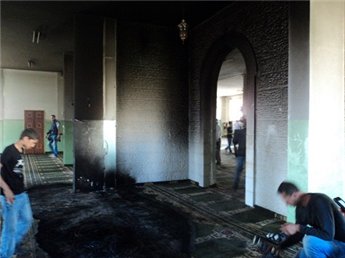
Local residents of Al Mughayyir village, near the central West Bank city of Ramallah, reported Tuesday at dawn that fundamentalist settlers set the local mosque ablaze, and wrote racist graffiti on it walls, the Palestine Today reported.
Witnesses stated that the Israeli settlers set fire to the mosque at approximately 3 A.M. on Wednesday, before daubing the remains with racist slogans.
The attack on the al-Mughayyir village’s mosque has drawn condemnation from a wide variety of groups in Palestinian civil society. This is the third mosque that has been torched in as many years.
The arson attack is thought to be a ‘price-tag’ attack, carried out by nearby settlers in response to the demolition of ‘Alei Ayin’ illegal outpost by Israeli police recently. One piece of graffiti explicitly stated ‘price tag’ followed by ‘Alei Ayin’ in Hebrew.
The settlers are believed to have come from the Adi Gilad illegal settlement built on private Palestinian lands only three kilometres away from the mosque.
Resident Jihad Al Na’san told France Press that the residents went to the mosque to perform dawn prayers to find it burning down while the flames were streaming out of its windows.
Al Na’san added that the settlers dumped tires in the mosque and torched them, and that the Israeli army and the police arrived at the scene later on as the area is under Israeli military and security control.
Al Na’san further stated that the residents found racist graffiti written in Hebrew stating “We will raze this village” among other racist slurs against the Arabs and the Palestinians.
Mahmoud al-Habbash, the Minister of Religious Affairs in the Palestinian Authority, stated that the arson “indicates the magnitude of the aggression settlers unleash on holy places”. Rebuilding of the mosque is expected to begin immediately.
The Grand Mufti of Jerusalem, Sheikh Mohammad Hussein, visited the site of the destroyed mosque and said that, “[T]he attack on this mosque is part of a systematic policy aiming to flame the conflict and show disrespect to the religious and human values of others.”
The National Christian Coalition in the Holy Land has also strongly condemned the arson attack. Its president, Dimitri Diliani blamed the ongoing occupation and lack of law enforcement against settlers, noting, “[O]ccupation commits limitless crimes using different means including extremist settlers who are protected by Israeli forces. They do not show any respect to morals, religions, or laws when it comes to attacks against the Palestinian people.”
A month ago, the settlers torched a mosque near the northern West Bank city of Ramallah.
Last year, a group of fundamentalist Israeli settlers broke into a mosque in Beit Fajjar, near Bethlehem, and set it ablaze. Settlers also torched the main mosque of the al-Lubban al-Sharqiyya village, south of the northern West Bank city of Nablus.
In 2009, settlers torched a mosque in Yasuf Palestinian village, near the central West Bank city of Salfit.
Featured Video
John Mearsheimer: US Already lost Iran war – No off-ramp in sight
or go to
Aletho News Archives – Video-Images
Frlom the Archives
70 Neocons Petition Congress To Effectively Allow Israel To Say When The US Should Attack Iran
By Damian Lataan | January 10, 2014
Seventy senior Israeli-centric neoconservatives have written an open letter to Congress imploring them to do more to ensure Iran complies with the conditions of any agreement finally reached with the P5+1 over Iran’s nuclear program.
While the neocons are ostensibly asking Congress to ensure compliance, it is clear that their real aim is to convince members of Congress to support the bill currently passing through the Senate which calls for tighter sanctions against Iran in the event of any waywardness on Iran’s part.
The neocons are eager to see the bill currently passing through the Senate with enough support to make it veto-proof, not so much because they are concerned about Iran’s so-called nuclear weapons program – there’s still not a skerrick of hard evidence that Iran has a nuclear weapons program – but, rather, because embedded within the bill is this clause:
… if the Government of Israel is compelled to take military action in legitimate self-defense against Iran’s nuclear weapon program, the United States Government should stand with Israel and provide, in accordance with the law of the United States and the constitutional responsibility of Congress to authorize the use of military force, diplomatic, military, and economic support to the Government of Israel in its defense of its territory, people, and existence…
Essentially, the clause is an automatic trigger for the US to attack Iran at any time the Israelis choose to launch a first strike – regardless of whether President Obama is in favour or not.
Partial list… continue
Blog Roll
 Aletho News
- John Mearsheimer: U.S. Already Lost Iran War – No Off-Ramp in Sight
- UK Parliament Plans ISP Blocking and Age Verification Powers
- World cannot remain silent as US and Israel attack ‘heritage of humankind’: Iran
- Emirati billionaire rebukes US senator over call for Gulf states to join war with Iran
- Op. True Promise 4: Iran’s missile blitzkrieg dismantles US war machine in West Asia
- Aramco CEO warns ‘catastrophe’ imminent if Strait of Hormuz remains shut
- What If Iran Says No?
- Trump Threatens to ‘Hit’ Iran ‘Twenty Times Harder’ Over Strait of Hormuz Oil Flows
- Spare the hypocrisy: Baghaei slams Ursula’s support for US
- Iran War Supporters Invent a New and Absurd Justification: It Is All About China
- If Americans Knew
- Israel Decided the War, But Trump’s America Fights and Pays the Bill
- Conscientious Objector Group: Phone ‘Ringing Off Hook’ As Huge Mobilization Underway
- U.S. support for Israel continues to plummet, despite media’s best efforts
- Threats and missiles fly, death tolls soar in Iran, Lebanon, Gaza – Not a ceasefire Day 151
- Lebanon: Israel’s White Phosphorous Use Risks Civilian Harm
- Corporate Media Go All Out To Support The US-Israeli War On Iran
- US-Israel war on Iran is creating a steady growing number of amputees
- Israel planned this war on Iran for 40 years. Everything else is a smoke screen
- The wrong question about the war in Iran
- ‘Your Tax Dollars Being Used to Raise Your Gas Prices’: US-Israel Bomb Major Iranian Oil Depots
- No Tricks Zone
- New Study Documents A 20-Year Pause In Arctic Sea Ice Decline – Driven By Internal Variability
- Wake-up Call: Survey Shows Majority Of Germans Now Favor Postponing Climate Targets!
- Televised! Leading German Political Candidate Tells Schoolchildren CO2 Makes Sun Hotter!
- New Study: A Century Warming Of 1.1°C Is ‘Commonplace’ And ‘Not Unusual’ During This Interglacial
- New Study: ‘Internal Noise’ And Volcanic Forcing Can Trigger 10-15°C Warming Within Decades
- Glaciers Worldwide Are Suddendly Surging, Experts Blame Warming!
- Surprising Discovery: Sahara Is Greening…Billions Of Trees Where Once Thought To Be Barren
- New Research Reaffirms Clouds, Aerosols, And Surface Solar Radiation Are ‘Driving The Climate System’
- Germany: Electric Car Catches Fire At Charging Station, Sets Off Local “Inferno”, Widespread Damage
- New Study: Canada’s New Brunswick Was 1°C Warmer Than Today During The Medieval Warm Period
 Aletho News