Greek unions plan two-day general strike
Press TV – June 28, 2011
Greek unions and protesters are planning another 48-hour general strike against new austerity measures imposed by the debt-ridden government.
As the Greek parliament is to vote on implementing harsh austerity measures to receive further International Monetary Fund and European Union funds, unions are planning a two-day general strike beginning on Tuesday, AFP reported.
Airlines, trams, buses, banks, and administration offices are to participate in the strike by reducing their services during peak hours. Hospitals have also announced that they will have limited staff.
The strike is to take place only days after Greek Prime Minister George Papandreou survived a confidence vote in the parliament.
Greece’s newly-approved austerity plan is worth some EUR 28 billion and includes a privatization program aimed at raising EUR 50 billion and further budget cuts as well as tax increases so that the government may receive further international financial assistance.
Greece has a debt of over EUR 300 billion, which is worth more than 150 percent of its annual economic output.
Anti-government demonstrations have turned violent at times, leaving scores of protesters and security forces injured. The turmoil ranged from nationwide strikes and fruitless negotiations on the formation of a national unity government to calls from opposition parties for snap elections.
Poll: Most French oppose free trade
Press TV – June 27, 2011
A majority of the French blame unemployment and low wages on free trade and open market, arguing that cheap Indian and Chinese goods have lowered demand for European products.
According to an IFOP poll commissioned by a group of economists, 84 percent of the French think international trade has killed jobs in France and 78 percent say it has reduced domestic salaries.
The survey also showed that 57 percent believe imports have led to higher prices for consumer goods while 65 percent want higher import duties.
IFOP, which conducted the poll, interviewed 1,012 people by telephone from May 17-19. No margin of error was given.
The survey comes amid growing discontent among the French people over rising unemployment levels and corruption.
Massive demonstrations were held in various French cities in late May, inspired by similar protests in Spain.
Challenging Racism by Israelis on Every Front
By Gulamhusein A. Abba / Dissident Voice / June 27, 2011
The pressure on Israel is building. Non violent protests by the Palestinians are increasing in numbers and size. As predicted by me in an earlier article, they will soon escalate and go one notch further, adopting Gandhi’s concept of not mere passive protest but active non-violent civil disobedience. It will not be long before thousands of Palestinians and their Israeli supporters will march to checkpoints and attempt to break through without waiting for “clearance” from young, arrogant Israeli soldiers manning them. Tunisian and type mass protests that are taking place all over the Middle East are bound to take place in Palestine also. No one need be surprised to see many Israelis joining them.
It is encouraging to see that while the international community represented in the UN seems paralyzed, the common, peace and justice loving people from around the world are ready to lend their support to the brave people of Palestine. They are beginning to say “enough is enough”. They are demanding that Israel comply with International law and human rights.
On July 8 hundreds of activists – about 500 estimated so far — from all over the world will converge on Tel Aviv’s Ben Gurion Airport, and this time they will not lie about their reason for being there. They will openly and truthfully declare to the Israeli security that they are there to go to the West Bank to help the people there and participate in nonviolent solidarity actions.
These solidarity actions are scheduled to take place from July 8-16 in coordination with 15 Palestinian civil resistance organizations in the occupied West Bank and East Jerusalem.
The purpose of these actions is to show that not only are the actions of Israel in Gaza reprehensible but that Israeli repression in the West Bank and Jerusalem is no less condemnable and is part of an attempt by Israel at ethnic cleansing and colonization.
I long to join them. Unfortunately, I do not have the money to go there. Also, my holding an Indian passport and living in the US makes getting the necessary paperwork done difficult – not to mention my 83 years and poor health.
Why are hundreds of internationals giving up the comforts of their homes to go to Ben Gurion Airport and subject themselves to the certain humiliations and invasive interrogations by the Israel security — and deportation that seems certain to follow?
Why are other internationals sailing in boasts to go to Gaza and risk being bombed by the Israelis?
Why do I long to go there?
Basically because having come to know of the injustice, hardships, trials and tribulations, deaths and tragedy on a vast scale being suffered by the Palestinians at the hands of the Israeli government, being quiet, saying nothing, doing nothing, is no longer an option. Silence, in such situations, is complicity.
For long we have agonized over our helplessness to help. For long we have wondered what we could do.
Michael Riordon in his book Our Way to Fight writes: “Yet in the face of overwhelming harm, the question arises: “What can I do?” The victims ask, our conscience asks. So does a shared interest in a livable world. What can I do?
“During Athens street protests in 2008, a Greek blogger answered, beautifully: “We have a duty to move here, there, anywhere except back to our couches as mere viewers of history, back home to the warmth that freezes our conscience.”
The convergence at the Ben Gurion Airport on July 8, the solidarity actions in Palestine from July 8 to 16, sailing on Flotilla II provide some opportunities to do something.
Israeli apartheid days are numbered, and now is the moment to challenge it on every front.
Action is the best antidote to despair. Besides, it bears repeating, silence is complicity.
Neoconservatism and American Foreign Policy: A Critical Analysis
By Stephen Sniegoski / My Catbird Seat / June 27, 2011
A number of books have come out recently dealing with the neoconservatives, which have been published by mainstream presses. It is significant that these works acknowledge some obvious truths that were denied and even largely taboo some time ago.
They admit, for example, that neoconservatives not only exist (something that was denied a few years ago, most especially by the neocons themselves), but that they have been influential in shaping American policy in the Middle East, a view that continues to be rejected even by many critics of American foreign policy—e.g., Noam Chomsky and his acolytes, who see American foreign policy shaped only by all-powerful corporate interests. What these books still conceal, however, is the fact that the neocons are motivated by their Jewish ethnicity and the interests of the state of Israel. Instead the neocons are made to appear as an ideological group loyal solely on what they believe is good for the US. Consequently, this approach, despite allowing for some elements of truth, distorts the overall picture in a serious way.
Neoconservatism: The Biography of a Movement (Cambridge, Mass.: Harvard University Press, 2010), by Justin Vaïsse, which I have reviewed last August, reflects this partial truth approach. The current essay will focus on another recent work of this genre, Neoconservatism and American Foreign Policy: A Critical Analysis (New York: Routledge, 2011), authored by Danny Cooper, who is a lecturer at Griffith University in Brisbane, Australia. [A subsequent review will be of Neoconservatism and the New American Century by Maria Ryan (New York: Palgrave MacMillan, 2010)]
THE TRANSPARENT CABAL
Of the recent books on this subject, Cooper’s is one of the more revealing in that it actually acknowledges the authors who have presented these taboo views and quotes them—allowing them to speak for themselves. And I must express my delight that Cooper even refers to The Transparent Cabal. It is this segment to which I will devote most of my attention in this essay. I do this largely because I have not been able to get hold of Cooper’s book but have had to read it on Google Books where only a small section of it is available. The book’s cost, exceeding one-hundred dollars from Amazon, is beyond my limited means, and the work is not available in the public and university libraries to which I have access. While I could only look at a small portion of the book, however, the part that I could see does seem to present the work’s fundamental thesis.
In discussing claims of the neocons’ ties to Israel, Cooper writes that “Mearsheimer and Walt were not the only scholars to discuss the influence of Israel on neoconservative thinking. Stephen Sniegoski’s The Transparent Cabal: The Neoconservative Agenda, War in the Middle East, and the National Interest of Israel (2008) is the most detailed and exhaustive attempt to link neoconservatives with the policies of Israel’s Likud Party.” After this favorable introduction, he then implies that my “loyalties” to the Palestinians are “taken to dangerous and irresponsible extremes,” asserting that “[o]ne does not have to be a ‘Likudnik’ to find Sniegoski’s unqualified reference to the ‘Palestinian resistance’ to be morally offensive . . . ” (p. 32) Presumably, I should have qualified this non-committal reference with some disparaging remarks about the Palestinians, since I was not expressing anything positive about them in referring to their “resistance.” Criminals, for example, are said to resist arrest. Perhaps Cooper believes that nothing has been done to the Palestinians that calls for any resistance and that they are instead engaging in aggressive violence. No matter what his specific intent, Cooper’s comment would seem to indicate a pro-Israel bias.
Cooper does acknowledge that the neocons are “strong defenders of the Jewish state” and that some authored the “Clean Break” report (p. 32) , though he fails to elucidate the full significance of this work. The “Clean Break” report, which was presented to incoming Prime Minister Netanyahu in 1996, advocated that Israel undertake a war policy to reconfigure the Middle East for the sole purpose of enhancing its own security. Moreover, the neocon authors of the report emphasized the need to justify these belligerent moves in terms of American ideals in order, as I stated in The Transparent Cabal “[t]o prevent the debilitating American criticism of Israeli policy that took place during Israel’s invasion of Lebanon in 1982.” (TC, p. 92). And the success of Israel’s belligerent activities would have the effect of freeing it from United States pressure. As pointed out in The Transparent Cabal : “It was highly noteworthy that Americans would advise the Israeli government how to induce the United States to support Israeli interests and how to avoid having to follow the policies of the United States government.” (TC, p. 93) Since the actual policy prescription of “Clean Break” was broadly similar to what the neoconservatives would later advocate for the United States during the Bush II administration, the neocons, in this latter case, were actually having the United States pursue policies that had originally been developed to advance Israeli interests. As reiterated throughout The Transparent Cabal, the neocons look at U.S. Middle East policy through the “lens of Israel interest.” (TC, pp. 4, 5, 7, 193, 211, 365, 366). To state otherwise is to ignore Occam’s razor.

When acknowledging the neocons’ obvious link to Israel, Cooper simultaneously downplays its role in shaping their views on Middle East policy. “The affection neoconservatives have for the state of Israel cannot be dismissed,” Cooper avers. “The authors who demonstrate the degree to which many neoconservatives identify with the Jewish state make a number of thoughtful arguments. Yet what they truly reveal about the neoconservative approach to American foreign policy is a little unclear. Even authors such as Sniegoski who aim to ‘expose’ the connections between segments of the hard right in Israel and neoconservatives often acknowledge the limitations of their studies.” (p. 32)
To support his contention that I acknowledge limitations in my study, Cooper then quotes me: “To state that neoconservatives viewed American foreign policy in the Middle East through the lens of Israeli interest – and that this was the basis of the neocon Middle East war agenda is not to say that their support for Israel has been the be-all and end-all of their foreign policy ideas.” (p. 32)
Cooper leaves out my ending “which encompass the entire world” (TC, p. 7), which served to underscore what I meant. I also elaborate on this issue on the same page in my book where I write: “Lest any reader misinterpret this work, it is necessary to further explain what the book is not. Since it is not an analysis of neoconservatism per se it does not claim that neoconservatism is simply a cover for the support of Israel. Undoubtedly, the overall neoconservative viewpoint does not revolve solely around the security needs of Israel, and the same is true even of the neocons’ positions on foreign policy and national-security policy.” (TC, p. 7)
As is apparent, I explain the limits, or scope, of my subject—it is about the neocon position on the Middle East (and how they influenced US Middle East policy); it is not about neoconservative foreign policy in general. That my subject does not encompass a broader subject does not mean that I acknowledge any “limitations” in my study. All historical works (works on anything for that matter, even for those physicists who claim to have a “theory of everything”) deal with particular subjects—as opposed to everything—but to admit “limitations,” the word used by Cooper, would seem to imply that there are weaknesses in dealing with the particular subject matter of the work.
Cooper, however, makes the claim that my “admission [of ‘limitations’] raises immediate questions. If neoconservative support for Israel is not the ‘be-all and end-all of their foreign policy ideas,’ then to what extent are studies such as Sniegoski’s truly capable of illuminating the neoconservative approach to foreign policy? Is it not possible that some of these other ideas that go unexamined in The Transparent Cabal may even strongly conflict with the those of the Israeli right?”
Cooper’s logic escapes me here unless his purpose is to place me in a no-win position. Obviously, if I had stated that support for Israel (or any other factor) explained the neocons’ entire foreign policy thinking, I could be faulted for that, too. The idea that one factor might explain part of a group’s or individual’s world view, but not the totality of that world view, would seem perfectly appropriate.
For Cooper to imply that my claim that the neocons’ Middle East policy position revolves around their concern for Israel is invalidated by my unwillingness to apply that same motive to their policies elsewhere—for instance, the neocons’ China policy–makes no sense. My arguments are based on inductive reasoning. I have provided extensive empirical evidence to prove the case regarding the Middle East (inductive reasoning can only lead to tentative proofs); but I have made no in-depth study of the neocons’‘ China policy so I cannot draw a comparable conclusion.
He then implies, or at least, seems to imply, that the allegation that the Israeli government backed the war on Iraq was false, citing the view of one international relations expert (Russell Walter Mead), who held that “the Israeli defense establishment was deeply skeptical of neoconservative hopes for a democratic renaissance in the Middle East following the removal of Saddam Hussein (2007).” From that he asks rhetorically: “Is it not possible, in other words, that there is something distinctly American about neoconservatism?” (p. 33)
Here Cooper describes an alleged neocon position never expressed by me, or strictly speaking, anyone one else, as far as I know. Since no one claims that the there was ever democracy in the Middle East, no one could expect a “renaissance,” which, of course, means rebirth. And it is probably true that there is no evidence that the Israeli defense establishment, or anyone else with expertise on the Middle East, actually believed that the elimination of Saddam Hussein would create democracy in Iraq. And in The Transparent Cabal, I questioned the idea that the neocons themselves actually believed that their policies would lead to democracy, as democracy is conventionally understood. But whatever their beliefs on the eventual social systems in the Middle East, the policies they prescribed dovetailed with those of the Israeli Likudniks, which were designed solely for the enhancement of the national interest of the state of Israel. And, as documented in The Transparent Cabal, the Sharon government did promote the war on Iraq. (TC, pp. 169-72)
Moreover, contrary to Cooper’s insinuation, I never denied that there was “something distinctly American about neoconservatism,” since, as I explained in the book, neoconservatism in general was not my topic. There could very well be “something distinctly American about neoconservatism” while, simultaneously, their view on Middle East policy was shaped by their identification with Israel security interests. The two beliefs are not mutually exclusive.
In an effort to counter the claim of neocon loyalty to Israel, Cooper holds that the neocons are “just as steadfast in their support for Taiwan as they are in their support for Israel.” (p. 33) This is based on an article by William Kristol and Robert Kagan stating that the US should defend Taiwan from China. Viewing this as the overall position of the neocons, Cooper attributes neocon support for Israel and Taiwan to their belief that the two countries are “endangered liberal democracies living in hostile regions.” (p. 33) Cooper next cites a general statement by Irving Kristol, that “Barring extraordinary events, the United States will always feel obliged to defend, if possible, a democratic nation under attack from non-democratic forces, external or internal (2003).” These statements allegedly provide sufficient evidence to prove that the neocons are “driven more by feelings of ideological solidarity than ethnic identification.” (p. 33-34)
There are a number of problems with this notion of neocon support for Taiwan and other democratic nations being comparable to their support for Israel. A simple statement of support for Taiwan if threatened with attack, or in Irving Kristol’s case, a claim that the US “if possible” would “feel obliged” to defend democratic countries is obviously not equivalent to launching aggressive wars to weaken or eliminate Israel’s enemies. Furthermore, the connection of the neocons to other democratic foreign countries is not in anyway equal to the deep personal loyalty and intimate connection the neocons have with the state of Israel, which is illustrated throughout The Transparent Cabal.
Neocons present Israel as a model democracy but this is hardly the case, as liberal democracy is generally defined today. Rather, Israel is a Jewish supremacist ethno-state that favors Jews over Palestinians, going to the extent of dispossessing them of their land on the West Bank for Jewish settlements. Instead of supporting measures by Jewish leftists and liberals to allow more rights for the Palestinians in order to move Israel in the direction of a typical liberal democracy, the neocons support the Likudnik (explicitly Jewish supremacist) hard-line anti-Palestinian position, which is anything but pro-liberal democracy. Their goal is to maintain Israel as an ethnically-Jewish state instead of creating a modern liberal democracy with equal rights for all people. That the neocons see this Jewish ethno-state as a model democracy would illustrate their ethnic bias, since they find no fault with the type of ethnic discrimination that Jews have historically railed against when applied against them in gentile countries.
It would seem that the predominantly Jewish composition of the core membership of neoconservatism, the latter’s close connection to and championing of Israel, and the fact that the neocons advocated that the US take militant positions against the enemies of Israel would, taken together, provide strong prima facie evidence that Jewish ethnicity shaped the neocons Middle East policy. As pointed out in The Transparent Cabal, the Jewish orientation of neoconservatism has been acknowledged by some close students of the movement, including those who happen to be Jewish. For example, Gal Beckerman wrote in the Jewish weekly newspaper Forward in January 2006: “[I]t is a fact that as a political philosophy, neoconservatism was born among the children of Jewish immigrants and is now largely the intellectual domain of those immigrants’ grandchildren.” In fact, Beckerman went so far as to maintain that “[i]f there is an intellectual movement in America to whose invention Jews can lay sole claim, neoconservatism is it.” (TC, p. 26) Murray Friedman wrote a favorable book about the neocons entitled The Neoconservative Revolution: Jewish Intellectuals and the Shaping of Public Policy, which stresses the significance of their Jewish ethnicity. In it he shows that the neocons explicitly mentioned their group loyalty: “A central element in [neocon godfather Norman] Podhoretz’s evolving views, which would soon become his and many of the neocons’ governing principle was the question, “Is It Good for the Jews,” the title of a February 1972 Commentary piece.” [quoted in TC, p. 27; Friedman, p. 147]
In the much reviewed The Fatal Embrace: Jews and the State (University of Chicago Press, 1993), noted political scientist (Johns Hopkins University) Benjamin Ginsberg writes: “One major factor that drew them [future Jewish neocons] inexorably to the right was their attachment to Israel and their growing frustration during the 1960s with a Democratic party that was becoming increasingly opposed to American military preparedness and increasingly enamored of Third World causes [e.g., Palestinian rights]. In the Reaganite right’s hard-line anti-communism, commitment to American military strength, and willingness to intervene politically and militarily in the affairs of other nations to promote democratic values (and American interests), neocons found a political movement that would guarantee Israel’s security.” (T.C., p. 26; Ginsberg, Fatal Embrace, p. 231)
The aforementioned illustrations of the neocons’ Jewish ethnicity shaping their policy positions represent cases where this issue was broached in the mainstream. However, the mainstream media has left out this ethnic reference when dealing with recent U.S. Middle East policy. For to include such a reference would imply that Jews are influential and exhibit “dual loyalty”– ideas that are taboo in the United States mainstream. It was these taboos that caused the whole idea of the neocons being the leading element for the war on Iraq to be blacked-out in mainstream presentations of the subject, a situation that recent works are only willing to change by discussing the role of the neoconservatives in a sanitized fashion, with the taboos expurgated or explained away.
However, there is nothing unusual in concluding that neocons would be motivated by ethnic loyalty to Israel. Historians and other commentators on American foreign policy have readily attributed ethnic loyalty as a fundamental factor in shaping the views of other groups – German-, Greek-, Polish-, Irish-, and Cuban-Americans. There is no reason to think that this interpretation would not also apply to the predominantly Jewish neoconservatives, especially since there is so much evidence of their close ties to the Jewish state.
That recent mainstream works on the neocons do everything possible to skirt their obviously ethnically-motivated concern for Israel represents not only a misinterpretation of a historical event, but has serious, negative ramifications for the understanding of ongoing U.S. Middle East policy. For neocons constitute only a more extreme element of the overall Israel lobby, which influences U.S. Middle East policy under both Democratic and Republican administrations. Without the willingness to recognize this major force behind America’s belligerent policy in the Middle East, it will not only be impossible to extricate the United States from the current Middle East morass, but there will be a strong possibility that the US will be involved in future wars in the region.
~
Dr. Stephen Sniegoski earned his Ph.D doctorate in American history,with a focus on American foreign policy, at the University of Maryland. His focus on the neoconservative involvement in American foreign policy antedates September 11, and his first major work on the subject, “The War on Iraq: Conceived in Israel” was published February 10, 2003, more than a month before the American attack. He is the author of “The Transparent Cabal: The Neoconservative Agenda, War in the Middle East, and the National Interest of Israel”.
GREEK PARLIAMENT MAY REJECT EU/IMF AUSTERITY MEASURES
Historic vote on Wednesday, euro hangs by a thread
By Jane Burgermeister | June 27, 2011
*Greek Prime Minister’s majority cut to one ahead of crucial IMF and EU austerity vote in parliament on Wednesday
*Rejection of austerity package will lead to a default by Greece and eurozone exit
*Greece is set to spend 131 billion euros on interest payments to banks between 2009 and 2014 according to IMF
*Germany’s Die Welt says Germans would rise up in rebellion if they had to accept equivalent austerity measures
*Protests and strikes intensify in Athens ahead of historical vote on Wednesday that could spell the end of the euro currency
Four Greek lawmakers from the ruling PASOK party have indicated they will vote against the new EU and IMF austerity package in parliament on Wednesday. If the Greek parliament votes against the legislation, it would pave the way for Greece to default on its debt to foreign banks and exit the eurozone in an historic victory for democracy.
http://www.ekathimerini.com/4dcgi/_w_articles_wsite1_4_26/06/2011_396030
Greece is set to pay a staggering €131bn in refinancing and interest payments to American, German and French banks between 2009 and 2014 , the IMF has estimated.
Prime Minister George Papandreou’s socialist PASOK party has a slim majority of only 155 deputies in the 300-member parliament. The defections of any more lawmakers may mean the government not be able to pass the new austerity measures and an implementation law on Wednesday and Thursday, which the EU, IMF and ECB are insisting on to enable the next interest payments to be made to banks on time.
The main opposition leader, Antonis Samaras, has said the austerity measures are a “medicine that is worse than the sickness they are meant to cure” and that he will not vote for them.
The draconian package of latest tax hikes and budget cuts include measures forcing people earning as little as 8000 euros a year to pay 10% in taxes to help the government meet the multi-billion euro interest payments to banks while universities close due to funding cuts.
“Crucially, bailout funds are not used to pay civil servants’ salaries and pensions, but to pay off debt held by German and French banks. According to IMF estimates, Greece will pay €131bn in refinancing and interest payments between 2009 and 2014, far more than the initial bailout loan of €110bn,” reports The Guardian.
The new austerity package is so harsh that if it were implemented in Germany, the people would rebell, Germany’s Die Welt newspaper admitted. The new Greek austerity measures would be the equivalent of German government cutting 117 billion euros from the budget and selling assets worth 555 billion worth of euros, estimated Die Welt.
http://www.welt.de/wirtschaft/article13451154/Wenn-Berlin-so-sparen-muesste-wie-Griechenland.html
Even the Greek Finance Minister Evangelos Venizelos said over the weekend that the measures were “hard and unfair.”
The austerity measures would drain the economy of the last of its liquidity and bust those businesses that are still solvent. Andrew Lilico points out that the Greek money supply has been falling at about 10 per cent a year.
The new IMF, EU, ECB austerity package comes on top of cuts that resulted in shrinkage in the economy and an increase in the country’s mountain of debt. Greece’s debt is set to rise to 170% of the GDP next year.
A 48-hour general strike is to be held in Athens tomorrow and Wednesday against the privatisations and austerity package.
Protesters outside the parliament in Syntagma Square, have said that they will block lawmakers from entering the building and voting on the austerity measures.
Greek lawmakers began debating the new austerity plans today.
If Greece does not pass the package, it will not receive a 12 billion euro installment of loans from its international bailout plan to make payments to banks in the USA, Germany and France forcing it into a disorderly default.
A recommendation by German economists to introduce an insolvency mechanism for the eurozone in autumn 2010 was buried by the German government.
The threat of a disorderly default and financial disaster is being used by banks and eurozone officials to pressure the Greeks to accept the transfer of wealth to the banks and acceopt the loss of their sovereignty.
A disorderly default would, however, pave the way for a rapid recovery of Greece’s economy outside the eurozone.
Papandreou faced down a rebellion by lawmakers this month after making a cabinet reshuffle and changing his finance minister, but the protests by people are continuing to put pressure on parliamentarians.
Even Überbankster George Soros — who has held regular private meetings with Papandreou and who called on eurozone governments and continue to loot the tax payers to save the banks in an article in the Financial Times — was forced to admit at a discussion yesterday in Vienna that the collapse of the euro currency is likely.
The euro collapse will spell the end of the bankster’s financial eurozone empire and ambitions to loot the assets and taxes of the 400 million people under the pretext of having to pay the debts of governments and banks that are actually insolvent and should have been put through insolvency mechanism long ago.
Journalists criticize Israel’s threats against media covering Gaza flotilla
Palestine Information Center – 27/06/2011
NAZARETH — Journalists say Israel’s fresh threats to take dire sanctions against media covering the upcoming Gaza flotilla raise “serious questions about Israel’s commitment” to press freedom.
The statement issued by the Foreign Press Association in Israel was in response to a letter by the Government Press Office threatening to bar journalists joining the flotilla from entering the 1948-occupied territories for ten years.
The FPA statement says the “threat to punish journalists covering the Gaza flotilla sends a chilling message to the international media and raises serious questions about Israel’s commitment to freedom of the press”.
“Journalists covering a legitimate news event should be allowed to do their jobs without threats and intimidation,” the statement adds.
More than forty Western and Arab media outlets are set to join the flotilla.
“The Israeli threats, which conflict with all standards of human values, will not deter the peace activists on board the ships from achieving their objective of reaching Gaza, and they will not stop journalists and media organizations from carrying out their professional role in covering the international event,” said Khadir al-Mashayikh, the media official of the ship from Jordan scheduled to join the flotilla.
He called the threats “further evidence of the falsehood of Tel Aviv’s democracy claims”.
The source recalled that one of those killed during Israel’s military raid of flotilla’s predecessor in 2010 was a Turkish journalist who was filming the attack. The military force also confiscated all of the cameras on board and cut the ship’s internet connection.
Soldiers order Palestinian farmers to stop work
Ma’an – 27/06/2011
NABLUS — Israeli forces on Monday stopped Palestinian farmers working on their land in villages in the northern West Bank, a local agricultural committee said.
Farmers were working in Jurish and Aqraba villages as part of a land reclamation project but soldiers said the farmland had been confiscated and now belonged to Israel, committee coordinator Yousif Deiriyya said.
Deiriyya added that forces confiscated a backhoe.
The committee for the union of agricultural workers said Friday that Israeli forces confiscated a vehicle from farmers and ordered them to stop work in the same area.
Land reclamation projects aim to improve the source of income for families which rely on agriculture and also serve to protect vulnerable land from Israeli confiscation.
The project is carried out by the committee for the union of agricultural workers in partnership with Palestinian non-governmental organizations under the management of agricultural relief committees. It is funded by the Dutch government.
Black Panther’s Posthumous Writings Cover Activism’s Risks, Rewards
By Eleanor J. Bader | Truthout | Book Review
“The War Before: The True Story of Becoming a Black Panther, Keeping the Faith in Prison & Fighting for Those Left Behind”
Safiya Bukhari
Feminist Press
New York, 2010
Everyone wants to leave a legacy, whether through procreation or by creating a tangible testament to their existence. For some, it’s art, music, storytelling or writing. For others it’s the founding of an organization or the creation of a product.
For Black Panther Safiya Bukhari, who died in 2003, the bequest included an ongoing community organization, the Jericho Movement to free US political prisoners; a daughter and grandchild; and an astute collection of essays written to encourage the always-uphill battle to win freedom and equality for the world’s disenfranchised and impoverished people.
In “The War Before,” a collection of 22 edited commentaries, Bukhari gives readers a sense of what it was like to be a Panther and captures the exhilaration of establishing free breakfast programs and health centers in low-income communities of color. She also explores Panther excesses, from rigid rules to over-the-top posturing and pontificating. At the same time, the anthology reminds would-be or burned-out activists of the sheer joy that comes from resisting civic wrongs.
It’s an important, inspiring book.
That said, there are small lapses in which rhetoric dominates, and some topics – such as the split between East Coast and West Coast Panthers that was fomented by the US counterintelligence program, or Cointelpro – could have been more fully discussed.
Still, “The War Before” is a fascinating look at the making of an activist, and it captures the spirit of a tumultuous era in which thousands joined Bukhari in believing that a domestic insurrection was not just possible, but imminent.
Editor and former political prisoner Laura Whitehorn’s introduction to the book gives readers a bit of the backstory. Among the tidbits presented are these: Bukhari – originally named Bernice Jones – was reared in the Bronx, one of ten children in a devoutly Christian, middle-class household. In college, she joined the Eta Alpha Mu sorority and, as part of her initiation, was required to travel to Harlem. There, she and several friends encountered a member of the Black Panther Party (BPP) selling newspapers, and learned of the feeding program that had been established. “The women went to the church where the breakfasts were offered, to see for themselves,” Whitehorn reports. “Safiya liked what she saw and kept coming back. It was at that time that she began to notice how badly the community was treated by the police.”
By early 1969, Jones/Bukhari was hooked. She dropped out of school and began working in the Harlem BPP office, immersing herself in the study of political theory and learning to do community organizing. She also got involved with comrade Robert Webb and gave birth to a daughter. “In those years,” Whitehorn writes, “revolutionaries usually saw ourselves as too busy making revolution to engage in standard family life.”
As the year progressed, the demands on the cadre became more intense, and after BPP members Fred Hampton and Mark Clark were murdered in December 1969 – killed by government agents hell-bent on destroying the BPP – many activists, including Bukhari, concluded that underground organizations were needed. Placing her daughter with her mother, Bukhari vanished. Whitehorn chronicles what happened next:
In December 1973, [Bukhari] was arrested and charged with plotting to break prisoners out of New York City jails…. The charges were soon dismissed. Then she was hit with a subpoena to testify before a grand jury that was preparing charges against other Black radicals. She couldn’t bring herself to testify against her political associates. Safiya left her family and friends to continue her work underground. She stayed under for almost two years, until 1975, when she was arrested at the scene of a grocery store shooting in Norfolk, Virginia.
Bukhari was ultimately convicted and sentenced to 40 years. While imprisoned, her health began to deteriorate, but her requests for medical care were ignored. She somehow escaped from the prison in late 1976. Although she got the health care she needed while on the lam, she was eventually recaptured, and spent the next four years in solitary confinement. Finally, after eight years and eight months, she was granted parole and released in 1983.
Bukhari’s attention subsequently turned to publicizing the existence of political prisoners here at home. She also worked to develop support networks for those locked inside. Her essays on this topic are searing.
So are her reflections on the BPP, written with the obvious benefit of hindsight. In “On The Question of Sexism Within the Black Panther Party,” she places male chauvinism in a wider context. “The destruction of our culture, which started with the stealing of our language, religion, and children, was completed when we began to measure our own worth by how many women the Black man could pleasure at a time and how many children we could have,” she writes. “Since Black men had been stripped of their manhood in every way but the ability to pleasure women and make babies, the sexual act soon became the standard by which the Black man measured his manhood. This is the root of the sexism that is plaguing our community.”
This is not to say that Bukhari condoned sexist behavior. She didn’t. Among the Party’s Eight Points of Attention, she continues, was the injunction that men should not “take liberties with women.” That this was part of the written mandate impressed Bukhari, and she notes that BPP women often worked “right alongside men, being assigned sections to organize just like the men, and receiving the same training as men.” Nonetheless, she recognized that many male Panthers “brought their sexist attitudes into the organization.” Worse, she was highly aware of the fact that they were rarely, if ever, ordered to change their ways.
While Bukhari did not consider herself a feminist, the presumption of male superiority rankled her, and she fought it at every turn. Then again, her standards for everyone – male and female – were extremely high, and when people failed to meet her expectations she sought to understand the psychological and material factors that made it difficult for them to do so.
In “We Too Are Veterans: Post-Traumatic Stress Disorder and the Black Panther Party,” she lambastes the government repression that not only left many Panthers dead, but also led to psychic trauma in those who survived. “We had not just mouthed the words ‘revolution in our lifetime,’ but had believed them,” she confesses. “We sincerely believed the Black Panther Party would lead us to victory.” Instead, activists like Clark and Hampton, Timothy “Red” Adams, Fred Bennett, Alprentice “Bunchy” Carter, John Huggins, Little Bobby Hutton, Twymon Myers, Sandra Pratt, Robert Webb, and Anthony “Kimu” White were murdered. This reality, in addition to “the constant shoot-outs, the infiltration and set-ups that left you leery of strangers or of anyone getting too close or acting too friendly,” took a terrible toll on the BPP members left to bear witness, Bukhari concludes.
“As I looked over the list of PTSD symptoms, I recognized myself,” she writes. “And the first step in resolving the problem is recognizing that it exists.”
Indeed. To her credit, Bukhari refused to wallow in bitterness and chose to focus her energies on the self-help that comes from fighting back. As the founder of the Jericho Movement , a coalition of religious and secular groups working to win amnesty for US political prisoners, Bukhari worked tirelessly to plan rallies, protests and speaking tours before her untimely death.
Mumia Abu-Jamal’s touching afterword posits Bukhari as someone who never lost sight of the big picture. She knew, he writes, that “it comes down to organizing. It comes down to the people.”
The Bukhari that Abu-Jamal recalls knew that the movement was bigger than any one person, but still understood that one person could get the ball rolling and make an impact. Those who knew her, he adds, frequently commented that she was the hardest-working person they’d ever met.
“The War Before” will remind Bukhari’s friends and family of what the planet lost when Safiya died eight years ago at age 53. Likewise, it is sure to stir those who are reading her words for the first time.
EPA Halted Extra Testing for Radiation From Japan Weeks Ago
By Mike Ludwig | Truthout | 23 June 2011
Radiation is expected to continue spewing for months from Japan’s Fukushima Daiichi nuclear power plant that suffered a meltdown following an earthquake and tsunami in March, but despite grim reports from Japan, the US Environmental Protection Agency (EPA) has quietly stopped running extra tests for radioactive material in America’s milk, rain and drinking water.
The EPA initially ramped up nationwide testing in the weeks following the disaster in Japan, and radioactive materials like cesium and iodine-131 were detected on US soil. Citing declining levels of radiation, the EPA has abandoned the extra tests, even as reports from Japan indicate that the Fukushima plant continues to emit radiation and the disaster is one of the worst in world history.
The EPA posted a statement online saying it would return to routine testing on May 3, but the agency did not send out a press release. The media widely ignored the change, even as Japanese officials admitted just weeks later that they were battling a full nuclear meltdown.
In March and April, samples of milk, rain and drinking water from across the country tested positive for radiation from the Fukushima plant. The radiation fell in rain across the US and was absorbed by plants and dairy cows.
The EPA insisted that the radiation levels were too low to cause public health concern, but Truthout identified gaps in the agency’s data and nuclear critics said the EPA has failed to acknowledge that even small amounts of radiation could be dangerous.
Now the EPA has returned to routine testing of milk and drinking water once every three months and testing rainwater once a month. The EPA continuously monitors background radiation with more than 100 air filter monitors, but nuclear critics say more testing should be done.
“The Fukushima disaster is unlike any nuclear accident we have ever had,” said Dan Hirsch of the nuclear watchdog group Committee to Bridge the Gap. “We haven’t had anything that has gone on for a year, and that is what the Japanese authorities are predicting – if they’re lucky. It might even take longer. The fuel has melted through, there are breaches at the containment structures, and there are constant radioactive releases.”
Radiation levels in the US have declined, according to the EPA, but the agency has not released data on samples taken after April 30, making the results nearly two months old, according to data sets made public by the agency.
The EPA typically releases test results two to four weeks after a sample is taken, and the EPA has not released new data on milk since May 24. On June 1, the EPA reported that the radionuclide cesium-137 was detected in one sample of drinking water, and two weeks later the same round of samples were clear of radiation.
“The easiest way to not have any concern over data is to have no data at all,” said Hirsch, who is critical of the cozy relationship between the US government and the domestic nuclear industry. “I think the system is there to say they have a system, but not to report any data that would undermine public support for nuclear power.”
The EPA says it’s prepared to accelerate its testing if necessary, but so far, its air monitoring system shows no cause for concern.
Hirsch wants the EPA to broaden its efforts and test food and agricultural products for any bioaccumulation of radioactive material in plants, animals and livestock. Hirsch also said that the EPA did little testing for strontium 90, a dangerous radionuclide with a 20-year half-life and the ability to mimic calcium and accumulate in bones.
The EPA claims that the levels of radiation it did detect in recent months were not high enough to raise public health concerns. But how high do radiation levels have to be before the government takes action?
For food products like milk, the EPA relies on Derived Intervention Levels (DIL) set by the Food and Drug Administration (FDA). DILs provide agencies with guidelines – not mandates – as to when the government should take action to keep food contaminated by radioactive material out of the hands of consumers.
A DIL “does not define a safe or unsafe level of exposure, but instead a level at which protective measures would be recommended to ensure that no one receives a significant dose,” according to the FDA web site. The DIL for iodine-131, one of the radioactive materials released from Japan, in food products like milk is set at 170 becquerels per kilogram. That number is 1,500 times higher than another government standard, the Maximum Containment Level for iodine-131 in drinking water, which is set by the Safe Drinking Water Act.
“[DILs are] a guidance as to when an emergency action should taken to intervene, but these are in no way to be considered safe levels,” Hirsch said.
Hirsch said that DILs are “very inflated” and meant for emergency situations like the detonation of a dirty bomb or a nuclear meltdown. DILs help officials with “triage” during an emergency, but according to the EPA, the only emergency is thousands of miles away in Japan.
Ethan Bronner’s ‘benign occupation’
By Ilene Cohen | Mondoweiss | June 26, 2011
Prior to the First Intifada in December 1987 Israelis used to boast about their “benign” occupation—indeed, the “most benign occupation” in the world. Following the outbreak of the First Intifada, that mantra disappeared from the discourse. But, when things are looking bad on the PR front and you’ve got nothing else to pull out of your hat, I guess it’s time to bring it back. The “benign occupation” trope (again, without using those words) has been a key Netanyahu talking point in discussing the “economic miracle” of the West Bank. They lapped it up in Congress last month.
Presumably even Ethan Bronner doesn’t have the chutzpah to use those words, but the meaning of his front page article in today’s New York Times is clear. Here is the opening:
GAZA — Two luxury hotels are opening in Gaza this month. Thousands of new cars are plying the roads. A second shopping mall — with escalators imported from Israel — will open next month. Hundreds of homes and two dozen schools are about to go up. AHamas-run farm where Jewish settlements once stood is producing enough fruit that Israeli imports are tapering off.
As pro-Palestinian activists prepare to set sail aboard a flotilla aimed at maintaining an international spotlight on Gaza and pressure on Israel, this isolated Palestinian coastal enclave is experiencing its first real period of economic growth since the siege they are protesting began in 2007.
“Things are better than a year ago,” said Jamal El-Khoudary, chairman of the board of the Islamic University, who has led Gaza’s Popular Committee Against the Siege. “The siege on goods is now 60 to 70 percent over.”
The article’s title in the paper I received this morning was “A Construction Boom in Gaza’s Lingering Ruins.” It now appears online as “Building Boom in Gaza’s Ruins Belies Misery That Remains.” Either way, the takeaway is the same – what is freedom or liberty or self-determination when you’re lucky enough to have Israel as your occupier/overlords?
11 Settlers Armed with Knives, Stones Attack Palestinian Shepherds in South Hebron Hills
26 June 2011 | Operation Dove, Christian Peacemaker Teams
Around 10 am on Saturday 25 June, Palestinian shepherds were grazing their sheep and goats in the Meshakha Valley when they were attacked by 11 settlers who came over the hill from the nearby illegal outpost of Havat Ma’on, armed with stones and knives.

Israeli soldiers watch as settlers attack Palestinian shepherds in the South Hebron Hills (photo: Operation Dove)
Some of the settlers were masked as they ran toward the shepherds throwing stones, yelling blasphemies against Islam and stating that internationals were now not present to protect them. According to Shaady from Maghayr al Abeed, a settler attacked his donkey with a knife, and when he attempted to stop the attacker and protect his donkey, he was then hit by stones in the back and torso. Blows that took his breath away. Shaady has a huge welt on his back and bruising as a result of the attack.
Sheep and goats were also pummeled with rocks and the shepherds were forced to run to protect their flock. The shepherds were chased for several hundred meters. According to the Palestinian shepherds the soldiers saw the incident and refused to get involved. After the attack, Israeli soldiers were seen greeting and shaking hands with the settlers as they walked back into the trees of the outpost of Havat Ma’on.
Shaady stated that “we need all the people of the world, Europe and America, to see who is the aggressor and how the Palestinians are being treated by the settlers.”
[Note: According to the Fourth Geneva Convention, the Hague Regulations, the International Court of Justice, and several United Nations resolutions, all Israeli settlements and outposts in the Occupied Palestinian Territories are illegal. Most settlement outposts, including Havat Ma’on (Hill 833), are considered illegal also under Israeli law.]
Operation Dove and Christian Peacemaker Teams have maintained an international presence in At-Tuwani and South Hebron Hills since 2004.
Featured Video
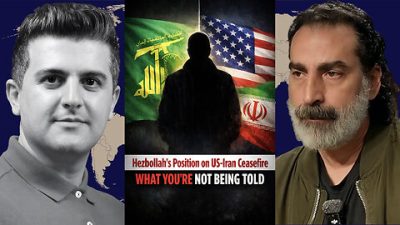
Laith Marouf: Hezbollah’s position on US-Iran ceasefire
or go to
Aletho News Archives – Video-Images
From the Archives
Is Israel to blame for the Iraq War?
American Goy | March 10, 2008
I am so tired of this old canard that “Israel had nothing to do with USA’s war with Iraq – in fact, it officially advised America against it”.
Bullshit. … continue
Blog Roll
 Aletho News
- Laith Marouf: Hezbollah’s position on US-Iran ceasefire: What you’re not being told
- Israel’s priority lies in destroying chances of peace between Iran, US: Ex-UN nuclear chief
- Ceasefire for all or for none: Iran shuts Hormuz over Lebanon attacks
- Strait of Hormuz is Iran’s ‘nuclear weapon’ that forced US retreat: Medvedev
- Energy crisis will last for months – Kremlin envoy
- Europe’s quiet role in the war on Iran
- Forty days that shook the Empire: How Iran turned the tables on US and prevailed
- Netanyahu unilaterally declares Lebanon outside of ceasefire deal
- Israeli leaders: ‘Not a single goal’ achieved in war with Iran
- What on earth just happened? Trump, Iran, and the unlikely ceasefire
- If Americans Knew
- Gazans face a triple crisis: severe shortages of water and bread, healthcare in tatters
- NY Times reports how Netanyahu took the US into Iran War
- A sigh of relief over Iran, but Gaza and Lebanon in dire straits – Daily Update
- Thousands dead and neighborhoods razed to the ground: Aid agencies fear southern Lebanon is becoming the new Gaza
- The war the US is fighting for Israel could cost trillions
- ‘Cigarette Burns, Nail Wounds’: Toddler Tortured in Gaza to Coerce Father
- Trump Says US Sent ‘a Lot of Guns’ to Protesters in Iran
- Israeli forces destroy 17 UN peacekeeper cameras in south Lebanon
- US-Israeli strikes ‘completely destroy’ synagogue in Tehran
- Archbishop for US Military Says Iran War Is Unjust Under Catholic Teaching
- No Tricks Zone
- An Inconvenient Tree: Uncovered In Alps… Europe Much Warmer Than Today 6000 Years Ago
- New Study Reports A 60% Slowdown In Greenland’s Ice Loss Rate In The Last Decade
- Low Intensity Tornado Wrecks Major Solar Farm, Creating A Potential Toxic Dump
- New Study Finds Warming Saves Lives…Cold Temperatures 12 Times More Deadly Than Excess Heat
- German Science Blog Accuses PIK Climate Institute Of Hallucinating Climate Tipping Points
- Devastating Assessment Of Comirnaty Vaccine By Former Senior Pfizer Europe Toxicologist
- New Study: CO2 Is ‘Effectively Negligible’ As An Explanatory Climate Change Factor Since 2000
- Former Pfizer Toxicologist Dr. Helmut Sterz Tells Bundestag Hearing Pfizer Vaccine Should Have Never Been Approved
- Energy Expert: Germany’s Nuclear Phaseout Was A “500 Billion Euro Mistake”
- New Research: South Australia’s Mid-Holocene Sea Surface Temperatures Were 4°C Warmer Than Today
 Aletho News