Frivolous Lawsuit Filed against Alternatives International for its Support of Freedom Flotilla
26 June 2011 | Alternatives International
A complaint has been filed in the Superior Court of Ontario (Canada) against Alternatives International by Ms Cherna Rosenberg on June 2nd, 2011, concerning our support to the Canadian Boat to Gaza where she claims over a million dollars in damages.

The claim alleges that the actions of Alternatives International «are a step in the chain of conduct that ultimately leads to the rocket attacks that have traumatized the Plaintiff and caused her much suffering and loss». It matters to recall what is the project.
Freedom Flotilla-II named “Stay Human”, includes one Canadian Boat named Tahrir. This initiative comes from global civil society organizations representing dozens of international coalitions. It is in the wake of continued inaction from many governments to stop Israel’s human rights abuses that they have launched this initiative. This is an extremely important pacifist and humanitarian initiative to help Gaza people. It is a step towards breaking the illegal and inhuman blockade of Gaza, entering its fifth year, imposed by Israel.
It should be noted that nearly two hundred organizations and trade unions from Canada are supporting this initiative both politically and financially. Amongst the supporters are major trade unions in Quebec and Canada, community organizations, First Nations groups, women’s organizations from all over the country. You can see the names of all the organizations and individuals that support the initiative on the website of CBG.
Regarding the lawsuit, we believe that this attack is political in nature in spite of it’s being in the form of legal documents. Says the lawyer of Alternatives International: “I believe that Cherna Rosenberg’s claim against Alternatives International has no merit whatsoever. First of all, when considering the admissibility of George Galloway to Canada last year, the Federal Court of Canada found that even contributing funds directly to Hamas for humanitarian reasons does not make the donor a party to any crime. Moreover, Alternatives International is not supplying the Hamas authorities, directly or otherwise. In my opinion, it is absurd for Ms Rosenberg to claim anything, much less over a million dollars, from Alternatives International and its co-defendant. I have advised Alternatives International of my view that they should continue their important humanitarian work and not be deterred by what I regard as a frivolous lawsuit.”
In our ongoing solidarity campaigns for Palestinian rights we reaffirm our strong support to the upcoming thematic forum “World Social Forum in Solidarity with Palestine” in November 2012 in Brazil. We are an active member of the international steering committee of this initiative and are working closely with Palestinian civil society organizations and Brazilian host organizations and other international solidarity groups. We appeal to all international solidarity organizations to support and actively work to make this a great success.
- Feroz Mehdi, General Secretary Alternatives International
- Ronald Cameron, President, Alternatives, Montreal
- Gustave Massiah, President, Le Réseau Initiatives Pour un Autre Monde (IPAM), Paris
- Dr. Naim Abu Teir, President, Alternative Information Center, Jerusalem
- Refaat Sabbah, Director, Teacher Creativity Center, Ramallah
- Vinod Raina, President, Alternatives Asia, New Delhi
- Moussa Tchangari, Director, Alternative Espaces Citoyens, Niamey
- Pedro Ivo Batista, President, Associação Civil Alternativa Terrazul, Fortaleza
- Kamal Lahbib, President, Forum des Alternatives Maroc (FMAS), Rabat
Israel Bulldozes Muslim Historic Cemetery To Construct Oxymoronic “Museum of Tolerance”
By Saed Bannoura | IMEMC & Agencies | June 26, 2011

Israeli bulldozers started on Saturday at night the destruction of the Ma’man Allah ancient Muslim cemetery, in occupied Jerusalem, as part of the Israeli plan to construct the so-called “Museum of Tolerance” on the cemetery ruins.
The Al Aqsa Foundation for Waqf and Foundation reported that the attack was initiated at 11 PM on Saturday at night when three huge bulldozers and two smaller ones, and twenty municipality workers, started the destruction of nearly 100 graves in the three remaining areas of the graveyard.
The destruction targeted the eastern side, the western side and the pool of Ma’man Allah, and aims at including the graveyard area, after its destruction, to be part of the so-called “Tolerance Museum” Israel is planning to build.
The work continued until dawn hours; the graves and the stones were loaded in trucks and were taken away.
The cemetery is in West Jerusalem and is considered one of the largest cemeteries in Jerusalem as it stands on an area of 200 Dunams (nearly 90 acres).
Representatives of the Al Aqsa Foundation went to the graveyard and documented the Israeli violation.
Several month ago, the Israeli District Court in Jerusalem, rejected an appeal filed by the foundation against the destruction of the graves.
In August of last year, Israel bulldozed nearly 300 graves after the foundation renovated nearly 1000 graves that were repeated attacked by extremist settlers.
Endemic pro-Israel bias in UK TV coverage, new book finds
Asa Winstanley – The Electronic Intifada – 25 June 2011
Glasgow University Media Group’s ambitious new study of British TV’s coverage of Israel and the Palestinians, More Bad News from Israel, is the second edition of 2004’s Bad News From Israel. Led by academics Greg Philo and Mike Berry, this work is precise, fair-minded and detailed. It constitutes irrefutable evidence of endemic pro-Israel bias.
Those of us regularly subjected to BBC and ITV news won’t exactly find this conclusion surprising but the importance of detailed documentary evidence like this book provides cannot be overstated.
The team had originally analyzed approximately 200 bulletins and questioned more than 800 persons. This new edition examines coverage from the past few years (369). Samples of coverage were taken from the main news bulletins on BBC and ITV (the most popular TV news programs in the UK). The authors identify key themes, such as coverage of casualties on “either side,” justifications for violence and “peace conferences” and international diplomacy. Audiences from a variety of socio-economic backgrounds were asked to complete a series of questionnaires and take part in focus groups. The vast majority reported that TV news was their primary source of information on Israel and the Palestinians.
The samples, taken from key moments in recent history, are well chosen. The focus of the initial study was coverage of the second Palestinian intifada’s outbreak in 2000 (in the first two weeks of which, Israel, by its own soldiers’ accounts, fired a million bullets at unarmed protesters). The next samples are taken from one year later (by which time Palestinian groups had started retaliatory bombings within Israel), and from coverage of the March and April 2002 Israeli re-invasions of the occupied West Bank.
The new chapters look at coverage of Israel’s 2008-09 winter assault on Gaza and the Israeli attack on the Gaza Freedom Flotilla a year ago (which was breaking news at the time the book was due to go to print).
Systematic preference for Israeli points of view
By fastidiously counting lines of transcript text, the authors identify a systematic preference for Israeli points of view. Israeli speakers were given twice as much space as Palestinians during the first few weeks of the intifada (215). Israeli casualties were disproportionately reported, accounting for approximately a third of the coverage, despite the actual ratio of 13 Palestinian deaths to one Israeli at that stage (223). After the Palestinian retaliatory bombing campaign began, this phenomenon worsened: “from October to December 2001 we found that there was significantly more coverage of Israeli casualties than Palestinian” even though the reality was actually still the opposite (259-60).
The study’s most telling findings concern the dominant explanatory framework and the lack of background or historical context in coverage. Even when individual journalists manage to make implicit criticisms of Israeli actions, such as on the killing of civilians, Israeli rationales were always reported — or even adopted by journalists themselves. “The journalists do not always sound happy about the Israeli rationales” but they were still included and “there is no comparable inclusion or discussion of the reasons for Palestinian action” (254).
The authors give many examples of this, including an ITV report from March 2002 that described Israeli collective punishment destroying civilian infrastructure around Bethlehem as “the ongoing fight against terror.” But there are “no commentaries such as ‘the Israeli attacks have reinforced the determination of Palestinian fighters to defend their land against Israeli terror’ [and] … we do not hear of Palestinian attacks as sending ‘a tough message to Israelis to end military rule’” (265). Such statements are unimaginable on British TV.
“All bang bang stuff”
One BBC journalist was told by his editor he wasn’t interested in “explainers” since “it’s all bang bang stuff” (180-1). But the audience studies here reveal “a strong feeling in the [focus] groups that the news should explain origins and causes” (315). This is unsurprising, considering that audiences questioned here often did not even know what nationality “settlers” were, or that there was a military occupation of the West Bank (400-1).
The two key historical events missing from the narrative of TV news are the Nakba (Arabic for “catastrophe”), what Palestinians call the ethnic cleansing and dispossession of their homeland in 1947-48, and the military occupation that started in 1967 (333). One student in a focus group said: “I didn’t realize they [Palestinians] had actually been driven out” (292). As the authors put it: “these absences in public knowledge very closely parallel the absence of such information on the TV news” (294).
The new audience studies for this second edition looked at whether anything has changed since 2004. The answer for the most part seems to be no. Coverage of Palestinian casualties seems to have increased, but Israeli casualties are still over-represented proportionate to the level of Palestinian deaths (363). Overall, the “most striking feature” of the new samples was “the dominance of the Israeli perspective” (340).
Has the tide turned on perceptions of Palestine?
Many of us who follow Western perceptions of Palestine have gained optimism by detecting a slow but positive shift in public opinion in support of Palestinians over the last couple of years. Perhaps that is still true, but the new findings here give pause for thought. The framework of assumptions is still overwhelmingly influenced by the Israeli version of events. In other words, Palestinian actions are always assumed to lead to Israeli “responses.”
The original study revealed that the “Israeli response to Palestinian violence” formula was so all-pervasive that the infamous Israeli killing of Gaza schoolboy Muhammad al-Dura in the first days of the intifada was understood by many as as “response” to a killing of two Israeli soldiers in Ramallah — even though the latter event actually took place afterwards (305). The updated audience studies here suggest that this malign phenomenon has not changed.
Palestinian rockets from Gaza were still seen by many as the main reason for Palestinian civilian deaths: “Palestinians are seen as initiating the violence … [so] it follows that Israel is ‘retaliating’” (378). On the BBC during the sample period 27 December 2008 to 17 January 2009, Israel’s November 2008 violation of the ceasefire with Hamas was mentioned in only 4.25 lines of transcript, compared with 249 lines of text that emphasized the firing of Palestinian rockets into southern Israel (419).
Suspected Israeli agents try to sabotage Freedom Flotilla II ship’s engine
Palestine Information Center – 25/06/2011
ATHENS — A group suspected of being linked with the Israeli foreign intelligence agency the Mossad was reported to have tried to thwart the sailing of a Greek ship slated to join the Gaza-bound Freedom Flotilla II due to set sail sometime next week.
The elements tried to sabotage the ship’s engine, but a crew discovered the men while checking the equipment, Quds Press said, quoting sources from the flotilla’s organizing body, on Saturday. The sources added that the men fled the scene.
Since the incident, participants have been taking turns watching guard in anticipation of another shot at foiling the mission to deliver much needed humanitarian aid to the Gaza Strip.
The flotilla, which will include some 15 ships and hundreds of notable passengers, has insisted on heading for the Strip despite Israel’s open threats to use military force to stop the ships short before landing at the said destination.
Meanwhile, the European campaign to end the siege on Gaza, one of the largest organizers of the flotilla, has announced that the first ship to join the flotilla has departed from France.
The ship, titled “Dignity”, has left the Corsica seaport in France and is on her way to the point where the rest of the ships will take off, said ECESG member Mazen Kahil in a press statement. He added that the ship will join another French ship docked in Greece.
He also announced that technical problems on some of the ships could cause delays in the scheduled departure next week.
Spanish protesters begin longest march yet
Press TV – June 25, 2011
 Anti-government protests in Barcelona, Spain on June 19, 2011

Spanish protesters have set off from Barcelona, marching toward the capital, Madrid, on their last and longest march against unemployment, welfare cuts and corruption.
The protesters, who currently number around 50, plan to campaign in every midway city to gather support for the Madrid rally, which is expected to take place on July 24, AFP reported.
The country has witnessed non-stop anti-government demonstrations since May 15.
“First we took to the streets, then the squares, and now the highways,” said Rafael de la Rubia, international coordinator of the movement World without War, who is among the demonstrators.
“After that, we will take Europe,” he asserted.
Spain is struggling to recover from nearly two years of recession triggered for the most part by the collapse of an overheated real estate sector.
The country’s unemployment rate has reportedly surpassed 21 percent in the first quarter of the year — the highest rate recorded for joblessness in the industrialized world.
Currently, some nine million people suffer from poverty across the country.
Last month, Amnesty International warned that hundreds of thousands of families in Spain are at the risk of losing their homes.
Protests are expected to continue as the Bank of Spain says the crippled economy will likely keep the recovery rate slow and the jobless figure will likely remain high for the foreseeable future.
Basra Provincial Council prevents US Forces from entering Basra
Al-Sumaria TV | June 23, 2011
Basra provincial council voted on a decision to prevent US Forces from entering the province, Al Sadr Front’s Ahrar Bloc said on Wednesday.
Basra provincial council called to withdraw US Forces from Basra International Airport and affirmed that the council’s decision stipulates compensating damaged citizens from US military operations.
“26 out of 35 members at Basra provincial council voted during its ordinary session held on Wednesday night on a draft resolution brought forth by Al Ahrar Bloc preventing US Forces from entering Basra City”, head of Al Ahrar Bloc in Basra Mazen Al Mazeni told Alsumarianews.
The draft resolution calls as well for the full withdrawal of US Forces from Basra International Airport, Al Mazeni added.
“The resolution includes a paragraph that stipulates compensations for damaged citizens from US military operations in Basra, head of the Information and Relations Department at Basra Provincial Council Hashem Luaibi told Alsumarianews.
“The Council has issued its decision based on the entitlements granted by the provincial council law number 21 for the year 2008”, he added.
US Forces in Basra Province, 590 kilometers southern Baghdad, are stationed mostly at the military wing of Basra International Airport, 14 kilometers northwestern Basra. Basra International Airport is divided into two wings, one civilian and another military. The civilian wing is under full control of US authorities while US Forces are stationed at a military base in the airport’s military wing. US and British Embassies are based at the airport as well. Before 2008, Basra airport’s military wing used to come under missile attacks. It was targeted this month several times.
Israel lobby group outlines dirty tricks against campus Palestine activists
By Ali Abunimah – Electronic Intifada – 06/24/2011
What is the best way to smear Palestinians and Palestine solidarity activists and get away with it?
That is the question David Bernstein, Executive Director of the pro-Israel propaganda group, The David Project, asks in a surprisingly frank article titled “How to ‘Name-And-Shame’ Without Looking Like a Jerk” posted on Israel Campus Beat, a website sponsored by the Conference of Presidents of Major American Jewish Organizations.
Bernstein writes:
One of the more controversial tactics in a growing effort to counter the delegitimization of Israel is to “name-and-shame” – to go after those who actively delegitimize Israel and seek to delegitimize them.
There are even those, such as British journalist Melanie Phillips, who argue that our entire strategy should be to relentlessly attack the other side and to cease “defending” Israel.
While name-and-shame tactics can be put to positive effect, they can also easily backfire and do more harm than good. We need to learn the art of being disagreeable in the most agreeable possible fashion.
Hiding vilification behind a veneer of “civility”
Bernstein offers advice on how to be as insincere as possible in order to undermine Palestine solidarity work, especially on college campuses:
- Start every critique with supportive words for peace or free discourse or both.
- Don’t accuse anti-Israel forces of anti-Semitism unless they openly vilify Jews; accuse them of being anti-peace for opposing Israel’s right to exist.
- On campuses and other places where anti-Israel groups act in a disruptive manner, write and promulgate civility petitions calling on all parties to engage in a respectful discussion. If the anti-Israel groups sign it, then they constrain their future actions; if they don’t, they can be accused of being uncivil.
- In taking on an anti-Israel professor on campus, don’t focus on the substantive arguments they make. That will make you look like you’re trying to stifle discourse. Instead, accuse them, in the words of Professor Gil Troy, of “academic malpractice” for propagandizing the classroom.
- When someone on campus justifies Hamas or Hezbollah, call them out by asking a question: Do you really support the Hamas charter’s call for killing Jews? Can that ever be justified?
- Avoid indictments against all Muslims or Islam; preface any criticism of a Muslim radical group with an acknowledgement of peaceful Muslims.
No one should be fooled by the mask of civility – Bernstein makes clear that the goal is to “delegitimize” and marginalize, not to actually engage in “civil” debate.
The David Project’s dirty tricks
The David Project has a long history of dirty tricks. Indeed, the group was a key actor in the slander and fabrication campaign against Columbia University Professor Joseph Massad, part of the unsuccessful effort to deny him tenure (Massad explains the background in a statement on his website after his list of publications).
More broadly, the effort to “name and shame” Palestine solidarity activists is part of the major “anti-delegitimization” efforts underway by American Zionist organizations at the suggestion of The Reut Institute, an Israeli think-tank which in 2010 called for a campaign of “sabotage and attack” on activists and organizations.
In October 2010, the Jewish Federations of North America – an umbrella for 157 major pro-Israel organisations – and the Jewish Council on Public Affairs launched a $6 million initiative called the “Israel Action Network” to fight “delegitimization” – a strategy that will undoubtedly include “name and shame.”
As I wrote for Aljazeera.net last December in “Defending Palestinian solidarity”:
I got a foretaste of what the Israel Action Network’s tactics will likely be when Sam Sokolove, the head of the Jewish Federation of New Mexico, launched a failed effort to get academic departments at the University of New Mexico in Albuquerque to withdraw their support for a lecture I gave in November. Sokolove’s campaign involved publicly vilifying me in the media, likening me to a member of the Ku Klux Klan. It is probably because of the publicity the Jewish Federation gave me that hundreds of people attended my talk.
We can thank Bernstein for his honesty in explaining to us what Israel lobby tactics amount to: personal vilification hiding behind a thin veneer of calls for “civility.” It’s a further sign of the bankruptcy of so much “pro-Israel activism.” It is not so much “pro-Israel” as anti-Palestinian. It has no positive message to offer whatsoever, certainly not one of peace.
Melanie Phillips named and shamed
One final note of irony. In his piece, Bernstein cites Melanie Phillips, a very prominent pro-Israel advocate in the UK who has routinely attacked and vilified many people who have spoken up for Palestinian rights.
Last week, Phillips left her position at The Spectator under a cloud: the publication was forced to make several high profile apologies for Phillips’ totally false attacks against several people and organizations for alleged anti-Semitism or criticism of Israel. Phillips has been particularly virulent in her Islamophobic attacks on British Muslims, as Mehdi Hasan of The New Statesman reports.
Israeli prosecutor bans academic travel of West Bank professor
Palestine Information Center – 25/06/2011
 NABLUS — The Israeli Public Prosecutor has informed the HaMoked rights group that a West Bank professor has been denied permission to leave the occupied Palestinian territories to join a media conference in Qatar.
Al-Najah University professor Dr. Farid Abu Dhaheir said in a statement after HaMoked informed him of the decision that he was said to have “posed a threat” to Israeli security, adding that the grounds for the decision were “laughable”.
The professor explained that he planned on traveling to Qatar to join a conference staged by UNESCO and the World Conference of Science Journalism on June 26 to share the Palestinians’ experience in science journalism.
Abu Dhaheir said he had previously taken part in several conferences and academic activities in several countries without being banned from travel.
In his statement, Abu Dhaheir denied having political ties and said the decision was one form of collective punishment that Israel uses against Palestinian civilians. He said that thousands of Palestinians are banned from traveling abroad in an attempt to suppress them.
He also highlighted that the decision conflicts with human rights and humanitarian law, which ensure the freedom of movement between countries. He called on the Palestinian Authority, which governs the West Bank, as well as Arab states and rights groups to pressure Israel into dealing with the Palestinians according to international law.
Last month Israeli forces intercepted Abu Dhaheir on a crossing on his way to Jordan where his son was supposed to undergo a surgery. He was turned back even though he obtained prior approval from Israeli officials. The Israeli prosecutor then claimed that he poses a threat to Israel because of his ties abroad, ties which Abu Dhaheir has denied altogether.
Israeli authorities have disallowed Dr. Abu Dhaheir from traveling abroad since 2006 on the same grounds.
The ethnic cleansing of Lyd, and how it continues today
By Rana | Mondoweiss | June 24, 2011
The Israeli organization Zochrot has published testimonies from two men, Fayeq Abu Mana and Aaraf Muharab, on the Israeli ethnic cleansing of Lyd, my parents’ hometown. Israelis raping Palestinian women, wide-scale pillaging of Palestinian belongings for resale, mass murders of Palestinians, burning bodies of murdered, a massive Israeli military operation on the ground, military planes air bombing Lyd/Lod, Palestinians forced into prison and work camps. This is how Israel was created: raping, pillaging, and murdering.
From the testimony of Fayeq Abu Mana:
Lod was a quiet city without war. There were only Arabs here, Christians and Muslims, no Jews at all. Ben Shemen was the neighboring Jewish village and we were their friends. The war started and there were battles and they came to occupy Lod. The Jewish soldiers came from the direction of Ben Shemen dressed as Arabs like the Jordanian army. There was a war and there were casualties everywhere in Lod. In the room next to here there were many dead. There were many bodies. They were buried not far from here, near the main road. They buried them in a pit, I mean a jama’a [mass grave], everyone. Down in the city there is another mosque. It has a room that people entered, about 75 people. Someone from Lod took grenades and threw them at the army and killed a few soldiers. One of the soldiers, his brother was killed. He went to the mosque and killed all the people in that room.
We sat at home and they told us to burn the corpses. We burned them on the spot. They said to go to the mosque and take the corpses out from there. How take them out? The hands of the dead were very swollen. We couldn’t lift the corpses by hand, we brought bags and put the corpses on the bags and we lifted them onto a truck. We gathered everyone in the cemetery. Among them was one woman and two children. They said burn. We burned everyone.
I want those who stand with Israel to tell me how they justify this?
This man’s testimony matches the experience of my own family testimonies. My grandmother clinging to her citrus trees, refusing to leave her home and land that she and my grandfather had sacrificed so much and worked so hard for. Where was my grandmother to go with 11 children? She finally fled when the planes came and started bombing her hometown.
Aaraf Muharab relates the history in 1948 to the situation today, where Israel is still trying to force Palestinians out of Lyd, or at least limit the population’s growth. He says:
I want to connect it to what is happening today in local problems. Sometimes it seems to me that people experienced more than one Nakba. Two days ago a house in Lod belonging to a woman with nine children was destroyed and now she is discarded. We made a decision to rebuild the house but it’s not certain that they wouldn’t try to destroy it again. Most of the crimes are committed in fact because there is order. No suffering can be used as a reason to cause suffering to another, otherwise there is no end to it. I don’t think that Zionism is totally evil but you have to recognize the injustice here. Jews here think, that they are continuing the path of Herzl and they don’t see a difference between the expulsion of 1948 and expulsion today. You’re talking here about a demographic problem and that is the basis of racism.
I don’t want to use the word ‘discrimination’ because discrimination means, say, that 80% is apportioned to one side and 20% to the other. But here they give zero percent to the Arab side. It’s not discrimination but hostility. Planning in Lod is carried out purely in favor of the Jews and the Arab areas are an obstacle to the plans and nothing more.
Palestinian Refugees: The Right to Remain, the Right to Return
By Samah Sabawi | Palestine Chronicle | June 24, 2011
I was 12 years old when for the first time in my life I became a citizen of a country – Australia. Before that, I was a stateless Palestinian refugee. There were two laments my parents always repeated whenever they spoke of their place of origin Palestine: if only we could have stayed and if only we could return.
According to the Office of the UN High Commissioner for Refugees (UNHCR), in 2009 there were more than 10 million refugees around the world in need of assistance. This number does not include the7 million Palestinian refugees, who make up the world’s largest refugee population and whose question is the longest standing at the UN.
The plight of Palestinian refugees began 63 years ago when they were forced out of their homes or fled in fear as the Israeli state established itself on the ruins of their villages and their towns and it has not ended. The fact their issue still stands today, unresolved, is a poignant reminder that states and governments will continue to fail the weak and disenfranchised for the sake of political gains and posturing.
Refugees are by definition powerless, in many cases they are either stateless or have lost the protection of their nation state. They depend on international bodies to rescue them. There are two norms which guide the way the international community deals with refugee issues under the UNHCR, the first is to provide protection and assistance to refugees, and the second is to not return individuals to their own countries against their will or if they are at risk of persecution. However, various human rights conventions have over the years created additional norms that work as guidelines to resolve refugee issues by providing preventative measures to make it possible for people to remain on their land and rather than focusing on resettlement alone, safeguarding the rights of refugees to return to their homes if they choose to.
The concept of ‘preventive protection’ is especially important in the case of Palestinian refugees. The right of individuals and communities to remain in their own country is a principle which rejects the expulsion of ethnic communities or what is now known as ‘ethnic cleansing.’ The U.N. Sub-Commission on Prevention of Discrimination and Protection of Minorities has affirmed “the right of persons to remain in peace in their own homes, on their own lands and in their own countries”. The Turku/Abo Declaration on Minimum Humanitarian Standards also provides in Article 7: 1 “All persons have right to remain in peace in their homes and their places of residence.”
Also Article 7 states : “No person shall be compelled to leave their own country”.
Some in Israel may argue that because Palestinian refugees are not citizens of the state, they have no right to refer to the land from which they come from as ‘their country’. This claim is refuted by a litany of legal and human rights experts, most important of all, it is refuted by the UNHCR which defines the Palestinian population as the indigenous people of the land.
Palestinians who live under Israeli occupation face severe measures aimed to uproot them. One example is the practice of revoking residency rights: Hamoked, an Israeli NGO filed a freedom of information request from the Israeli government and found that over 140,000 Palestinians who left to study or work had their residency rights revoked between 1967 and 1994. They wrote in a statement “The mass withdrawal of residency rights from tens of thousands of West Bank residents, tantamount to permanent exile from their homeland, remains an illegitimate demographic policy and a grave violation of international law.”
Another example of an Israeli policy that is at the heart of the creation of the Palestinian refugee crisis is that of house demolition. An Israeli human rights group called the Israeli Committee Against House Demolitions (ICAHD) estimates at least 24,813 homes were demolished in the West Bank, East Jerusalem, and Gaza since 1967, and that according to UN figures, during the 2009 Gaza bombing, more than 4,247 Palestinian homes were destroyed.
The United Nations Relief and Works Agency (UNRWA) reports that Israeli demolitions of Palestinian homes and other buildings reached a record high in March of this year. According to UNRWA, 76 buildings were demolished leading to the displacement of 158 people, including 64 children. UNRWA put the total number of displaced persons in the last six months alone to 333, including 175 children. UNRWA spokesman Chris Gunness described the policy as “discrimination against one ethnic group”. These actions are illegal under article 53 of the 4th Geneva Convention and have been roundly criticized by the UN and other international groups, as well as by human rights organisations.
There are various other policies that drive Palestinians out of their homes, especially in Jerusalem where Palestinian neighborhoods are targeted for evictions to make way for Jewish settlers to move in. Once exiled, Palestinians are denied the right to ever return. This is also illegal under international humanitarian law.
The right to return voluntarily and in safety to one’s country of origin or nationality is a right enshrined in the rules of traditional international law and also in Human rights law. The U.N. Security Council has affirmed “the right of refugees and displaced persons to return to their homes”. The Sub-Commission on Prevention of Discrimination and Protection of Minorities has affirmed “the right of refugees and displaced persons to return, in safety and dignity, to their country of origin and or within it, to their place of origin or choice”.
This right is a pillar of international humanitarian law simply because it acknowledges that human beings form attachments to their native land. This is not a case that is unique to Palestinian refugees; it is one shared by indigenous people everywhere. Attachment to the land of one’s origin is a natural human condition and is precisely why these sentiments and emotional ties are protected.
The Palestinian refugee population will continue to grow because we in the international community have failed to find informed appropriate responses to their cries for help. We must intensify our efforts to prevent the increase of the number of Palestinian refugees that Israel uproots from the land and to help the indigenous people maintain their right to remain on the land. We also need to pressure Israel to make a repatriation offer to all the Palestinian refugees and to allow them to practice the right to return to their homes should they so choose. Failing to do so will set a negative precedent and can have an adverse consequence for the millions of other refugees.
~
Samah Sabawi is a Palestinian Australian writer, author of Journey to Peace in Palestine and public advocate of Australians for Palestine. She is a policy advisor for Al-Shabaka, the Palestinian Policy Network. She took part in Refugee Week’s Hebron-Leichhardt Festival of Friendship in Sydney.
Featured Video
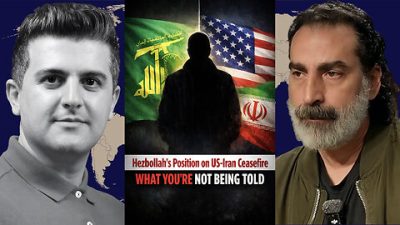
Laith Marouf: Hezbollah’s position on US-Iran ceasefire
or go to
Aletho News Archives – Video-Images
From the Archives
The Dirty Little Secret behind the “Global Terrorism Index”
The Omission of Israeli Terrorism in the Occupied Palestinian Territories
By Karin Brothers | Global Research | December 6, 2014
… The Israeli settlements — all of which are illegal – have been identified as a major impediment to peace. The refusal of a major “global” terrorism report to name the Israeli settlers as one of the groups most responsible for terrorism not only misrepresents a major source of regional violence but exposes the Global Terrorism Index as a propaganda tool that supports a U.S. agenda.
In recent years, governments have been attempting to thwart terrorism by blocking supportive fund-raising. When it comes to Israeli settlements, however, the US and Canada actually encourage fund-raising by giving organizations (such as Christian Friends of Israeli Communities (CFOIC) and the Jewish National Fund) financial support in the form of donor tax-deductions.
Charities which provide funds for the Israeli settlements should be regarded as terror-financing organizations. They should not only lose their tax-deductible status, but they should be banned because they support the violation of international humanitarian law. The terror-financing laws that are being strictly enforced for Muslim charities should be applied to Christian and Jewish charities as well. … Read full article
Blog Roll
 Aletho News
- The Black Cube Files: How Former Mossad Operatives Flipped a Nation
- Laith Marouf: Hezbollah’s position on US-Iran ceasefire: What you’re not being told
- Israel’s priority lies in destroying chances of peace between Iran, US: Ex-UN nuclear chief
- Ceasefire for all or for none: Iran shuts Hormuz over Lebanon attacks
- Strait of Hormuz is Iran’s ‘nuclear weapon’ that forced US retreat: Medvedev
- Energy crisis will last for months – Kremlin envoy
- Europe’s quiet role in the war on Iran
- Forty days that shook the Empire: How Iran turned the tables on US and prevailed
- Netanyahu unilaterally declares Lebanon outside of ceasefire deal
- Israeli leaders: ‘Not a single goal’ achieved in war with Iran
- If Americans Knew
- Gazans face a triple crisis: severe shortages of water and bread, healthcare in tatters
- NY Times reports how Netanyahu took the US into Iran War
- A sigh of relief over Iran, but Gaza and Lebanon in dire straits – Daily Update
- Thousands dead and neighborhoods razed to the ground: Aid agencies fear southern Lebanon is becoming the new Gaza
- The war the US is fighting for Israel could cost trillions
- ‘Cigarette Burns, Nail Wounds’: Toddler Tortured in Gaza to Coerce Father
- Trump Says US Sent ‘a Lot of Guns’ to Protesters in Iran
- Israeli forces destroy 17 UN peacekeeper cameras in south Lebanon
- US-Israeli strikes ‘completely destroy’ synagogue in Tehran
- Archbishop for US Military Says Iran War Is Unjust Under Catholic Teaching
- No Tricks Zone
- An Inconvenient Tree: Uncovered In Alps… Europe Much Warmer Than Today 6000 Years Ago
- New Study Reports A 60% Slowdown In Greenland’s Ice Loss Rate In The Last Decade
- Low Intensity Tornado Wrecks Major Solar Farm, Creating A Potential Toxic Dump
- New Study Finds Warming Saves Lives…Cold Temperatures 12 Times More Deadly Than Excess Heat
- German Science Blog Accuses PIK Climate Institute Of Hallucinating Climate Tipping Points
- Devastating Assessment Of Comirnaty Vaccine By Former Senior Pfizer Europe Toxicologist
- New Study: CO2 Is ‘Effectively Negligible’ As An Explanatory Climate Change Factor Since 2000
- Former Pfizer Toxicologist Dr. Helmut Sterz Tells Bundestag Hearing Pfizer Vaccine Should Have Never Been Approved
- Energy Expert: Germany’s Nuclear Phaseout Was A “500 Billion Euro Mistake”
- New Research: South Australia’s Mid-Holocene Sea Surface Temperatures Were 4°C Warmer Than Today
 Aletho News