Arab activists question Israel-linked GayMiddleEast.com
By Benjamin Doherty – Electronic Intifada – 06/23/2011
A group of Arab activists and human rights organizations have issued a statement about the Israeli-linked group GayMiddleEast.com. This organization was founded in 2003 by Shabi Assaf Gatenio, and has recently appeared in the media after the exposure of the Amina hoax presenting itself as the credible and authentic voice of LGBT Arabs.
Titled Que(e)rying the Israel-linked GayMiddleEast.com: a statement by Arab queers, the statement opens:
As queer Arab activists working on the ground in several countries in the Middle East, our initial disagreements with GayMiddleEast.com were political in nature. But rather than respond to them or engage in dialogue with us, GayMiddleEast.com resorted to playing the victim and shrugging off those concerns.
GayMiddleEast.com’s disingenuous response to what it sees as a “smear campaign” against it not only obfuscates the legitimate reasons many queer Arab activists take issue with its work, but also presents lies so blatant that a simple Google search is enough uncover the truth. It is duplicitous to claim that pointing out GayMiddleEast.com’s extensive ties to Israel is more dangerous than those ties themselves and its lack of transparency about them.
In the statement, which has been endorsed by a growing list of organizations across the Arab world and globally including MidEast Youth, Al-Qaws, Meem, Engender, Khomsa Network and Decolonize Queer, the authors take GayMiddleEast.com to task for four issues: unwelcome and unsolicited intervention; co-optation of Arab voices; pinkwashing Israel; and violations of the Palestinian civil society call for boycott, divestment and sanctions (BDS).
They also present compelling evidence that GayMiddleEast.com (GME) has systematically tried to conceal its founding in and extensive ties to Israel and that GME representatives Dan Littauer and Shabi Assaf Gatenio are not being honest about themselves.
Mounting criticism
GME has been the subject of mounting criticism from Arab and Palestine solidarity activists at least since last year (see #lgbtME: We Do Not Live in Vacuums! and GayMiddleEast.com’s Zionism). Most recently, Kaw at Mideast Youth posted Whose Gay Middle East(.com)? and asked three questions:
- Why are activists not fully informed of GayMiddleEast.com’s Israel connection, so as to make informed choices about whether or not to get involved with the organisation?
- Or better yet, why is the information not made publicly available on the website?
- While GayMiddleEast.com claims to oppose pinkwashing, why have the grassroots campaigns by Palestinian queer activists to counter Israel’s pinkwashing been neither highlighted, nor endorsed?
The people behind GME have tried to evade these questions about their origins, methods and standards and about the identities of their representatives in English-language and Israeli media.
On 19 June, GME responded to what it called a “smear campaign” saying:
- GME is not an Israeli organisation. Nor is it Zionist. It is not owned or run by an Israeli.
- The site’s executive editor is Dan Littauer, a German citizen (with only a German passport) who lives in London. …
- GME’s website was registered in Germany in 2003 by Shabi Gatenio, GME’s Israel Editor on behalf of a number of Arab LGBT activists.
GayMiddleEast.com’s history
In my own research on GayMiddleEast.com, I found the history of their so-called advocacy very troubling. Using the Internet Archive’s Wayback Machine, I reviewed the content produced by GME from 2003 through 2008. Some of the people currently or previously associated with the site–namely Dan Littauer, Avi Ozeri, and Scott Piro–have a background in the tourism industry and public relations, and until 2009, GME tried to be a tourism resource.
Before 2009, their site had a section about tourism to Arab countries with cruising tips. The site offered up coming out stories that were both implausible and prurient. They noted sodomy law and age of consent information for each country.
Sodomy laws and age of consent have been important indicators of sexual freedom and equality in many countries. In fact, the United States had sodomy laws until 2003 when the Supreme Court ruled that they were unconstitutional. In other countries, they are also a colonial legacy of laws authored by European powers which persisted after independence. With cruising tips, age of consent, sodomy law information and tourism advice, the GME project looks more like orientalist sex tourism rather than human rights advocacy. […]
Mainstream media role
In light of the activists’ latest statement, it is important to note the role of some prominent media in perpetuating these kind of shadowy organizations who ventriloquize Arabs. The Guardian for example avidly promoted the Amina hoax. After the Electronic Intifada exposed the Amina hoax, The Guardian rushed to feature the hoaxter on their front page, giving him more publicity and oxygen. It then published an article called “The real world of gay girls in Damascus” by a pseudonymous author who credited GME with helping to place it in the media. GME heavily promoted this article through Facebook and Twitter. GME used the Amina hoax to promote themselves as authentic authorities on Arab sexuality, but in fact, GME merely reproduces the main elements of the hoax: anonymous male authors speaking on behalf of unseen female native informants. Foreign Policy also published a version of the article.
While posing as liberatory, GME revels in voyeurism and titiliation about a supposedly sexually repressed orient – classic orientalist themes.
The statement from Arab organizations serves as a powerful antidote.
Viagra, Gay Bloggers and Phony News
By Margaret Kimberley | BAR | June 23, 2011
The corporate media continue to follow the dictates of people in power, ignoring their obligation to report factual information in as unbiased a way as possible. Instead they behave like scribes in a royal court, dutifully repeating the words of the king in hopes of currying favor and gaining access. Their shameless behavior is on view yet again as another president with imperial aspirations tells obvious lies in order to gain support for wars of aggression.
At the urging of the United States government and NATO, the International Criminal Court has piled on its anti-Muammar Qaddafi rhetoric. One prosecutor even claims that Qaddafi is giving his troops Viagra and using rape as a weapon of war. He has done so without presenting any evidence and even worse, the American media are repeating the assertions without investigation of any kind.
When George W. Bush made the case for invading Iraq, he too used rape as a rhetorical weapon of war, claiming that Saddam Hussein had “rape rooms” in his palaces that were used to assault dissidents. In 2003 as in 2011, the claim was reported without evidence.
The service to their masters takes on many forms. If a president lies about his reasons for killing people, the lie is never exposed. Sometimes the media are so eager for the story which won’t upset the powerful, that they will extend the parameters of their falsehoods.
Such was the case with “Amina,” a Syrian blogger and lesbian who wrote critically about the regime of President Assad. The blog “A Gay Girl in Damascus” was followed by incredulous people all over the world, but it turned out that Amina never existed. The blog and Amina were the creations of a heterosexual American man living in Scotland who wanted to hasten the end of Assad’s days in power. When the non-existent Amina was reported missing, an alleged kidnap victim of the Syrian police, even the state department grew alarmed and made inquiries as to her safety.
“The blog and Amina were the creations of a heterosexual American man living in Scotland who wanted to hasten the end of Assad’s days in power.”
The hypocrisy manifested on the part of the United States government is quite stunning. While denying or minimizing the loss of lives caused by its actions in Iraq, Pakistan, Afghanistan, Somalia, Haiti and on the part of any of its allies, the government was willing to use its power to ensure the safety of one person in Syria.
The government does not have a monopoly on these hypocritical expressions of outrage. Private citizens too, are moved to speak and act by a strange set of values. The phony blogger who created Amina knew what he was doing when he created a gay, female persona. Americans and Europeans are convinced of their own moral superiority vis a vis the Muslim world. They rarely say a word about when their governments kill Muslim women with their acts of war. They gasp in horror over the treatment of gay people in some societies, but they know or care little about how their governments’ actions create suffering for all people all over the globe.
We have a media that follows the dictates of government and sensational news items, that is to say sensationalism which proves racist notions of superiority and which don’t create any difficulties for the powerful. The bombing of a university in Tripoli, Libya ought to create a sensation, but that information never makes it onto the front pages.
The media scribes not only pick and choose what they do and don’t think worthy of their attention, but they are also unable to keep very simple facts straight. They are now repeating the Obama administration claim of a significant troop draw down in Afghanistan. The president will reportedly announce a withdrawal of somewhere between 5,000 and 30,000. However, even if he were to withdraw the higher number he would still leave 68,000 troops in Afghanistan, twice the number stationed there when he first took office. Simple arithmetic is yet another criteria that is too much to ask the members of the fourth estate.
Citizens who want to know what is happening in this country and around the world are at a great disadvantage. The old saw that it is unwise to believe everything we read should be modified. When it comes to the corporate media, perhaps we should believe nothing we read. We certainly would be no less knowledgeable of the truth.
~
Margaret Kimberley’s Freedom Rider column appears weekly in BAR. She maintains a frequently updated blog as well as at http://freedomrider.blogspot.com. Ms. Kimberley lives in New York City, and can be reached via e-Mail at Margaret.Kimberley(at)BlackAgandaReport.com.
Collective Apathy About Collective Punishment
By Meg Walsh for MIFTAH | June 22, 2011
It feels like my surroundings are rapidly closing in on me. The metal bars in which I am enclosed are ugly and the ground is littered with trash. Desperate children are trying to sell me gum and candy. Candy is the last thing I want right now; I want to escape. Bodies are pressing up against me as people struggle to make it through the revolving gate that only lets a few through at a time. If I am not aggressive, I will never get through. A teenage boy is getting yelled at by a soldier for some unknown reason, and a father is denied although his wife and children are granted passage. An old man in the car lane is taking out his groceries one by one from his trunk as a young soldier stands inspecting, finger on the trigger. Cars are backed up and people are getting impatient. I am angry.
I must pass through the checkpoint every time I wish to enter Jerusalem from Ramallah, even though east Jerusalem is Palestinian territory. I have to answer the familiar questions such as “What were you doing in the West Bank?” or “Do you have any Palestinian friends?” I hate being forced to lie. Having Palestinian friends should not be looked at as criminal. And I hate that they almost – almost make me feel that I am truly doing something wrong. Most of all, I hate the way the Palestinians are treated, and although I am uncomfortable, chances are I will get through without much problem. Their reality is much different. Any random checkpoint encounter could mean harassment, detainment, or worse. It seems to mostly depend on the mood of the soldier.
I had underestimated the anger and anxiety that I would feel in these scenarios. Some people around me appear visibly upset while others just look bored. Because of the freedom that I have enjoyed my entire life, I refuse to accept this dehumanizing process. As I stand there, I vow to never adjust, to never become desensitized to this. For me, that would signal complicity in the face of the injustice that is occurring: a complete domination of one group of people over another—a betrayal of humanity. Threat levels are determined by the color of your ID card and the language that you speak. I will not thank the soldiers when they return my passport. I will not grant legitimacy to their role by acting like they are doing me a favor. I will not be forced to equate human rights with privilege.
When they ask, I tell the interrogators that I have been in the city of Nablus, visiting Jacob’s Well, which is the biblical site where Jesus is believed to have had encountered a Samaritan woman. This falls in line with my Christian tourism story that most visitors have to use if they are planning on having any contact with Palestinians. Although with suspicious looks, I am allowed to pass through the gates with the others like herded animals.
When you witness the policies that are in place and the apartheid system that is occurring, it is hard to stay outside the cycle of hatred. It is hard to see the ‘other’, the one who is enforcing the rules, as human—they become robots, trapped inside a system that teaches you to follow orders, not to ask questions. It denies all natural laws of humanity, so the challenge then becomes to stay human in an inhuman situation. People are not meant to be kept in cages, both figuratively and literally, and race and religion should not be prioritized. The ironies are many in this ‘Holy Land’.
But how do I communicate to others what I have seen and felt when most people choose the comfort of ignorance over awareness in our unjust world? If words could accurately describe this oppression, I do not believe it would be allowed to continue unchecked. The gap between words and lived experience is vast, and those who may actually have the power to change things may never understand the reality—the reality of the nightmare that is occupation. It was only through my experience in this region that I was ultimately changed. It was from looking it in the eye, from feeling powerless, from experiencing a fear that the unexpected could happen at any given moment.
In Palestine, where most days I feel useless rather than useful, I still somehow feel that I have to be here no matter how outside of my comfort zone it lies. I cannot continue to be complicit or neutral, because I have seen what that means in this conflict and how collective apathy has embarrassingly allowed the occupation of Palestine to continue for 44 years. I am standing on a bridge between two worlds—one in which the powerful are silent, and the other in which the powerless are screaming, yet ignored. It is through this paradox that I am seeking answers. And some degree of hope.
~
Meg Walsh is a Writer for the Media and Information Department at the Palestinian Initiative for the Promotion of Global Dialogue and Democracy (MIFTAH). She can be contacted at mid@miftah.org.
Jordan Valley families left homeless
Ma’an – 23/06/2011

Ralia Saleh Yusuf Mahmoud Sharad sits on the rubble of her demolished home.
[MaanImages/Hilary Minch, EAPPI]
JERICHO — “The big soldier wouldn’t speak to me. He just said ‘This is my job, sit down and shut up’,” the newly homeless Ralia Darraghmeh, a diabetes sufferer in her sixties said of the one of the crew who had come to demolish her home Tuesday morning.
She was sitting alone, crying in Khirbet Yarza, a tiny Bedouin hamlet, as her tin home was taken down by order of Israel’s Civil Administration, which governs planning and permit issuing in the 60 percent of the West Bank categorized as Area C under the 1993 Oslo Accords.
According to an observer from the Ecumenical Accompaniment Program in Palestine and Israel, 30 people, including 8 children were affected by the demolitions.
The Darraghmeh family represent almost all of the residents of the hamlet. The eldest son of the group had planned to get married in July, but his brother said the goods and savings that would have supported the marriage were buried underneath the debris of their home.
“I really don’t care about my suffering, but what about the children?” asked another of the elder sons in the family as he surveyed the damage.

Israeli forces demolish homes in Khirbet Yarza. [MaanImages/Patricia Mercer, EAPPI]
With their belongings strewn in the rubble, the men, women and children of the hamlet began gathering up their goods, salvaging what was possible, and trying to decide where to go.
The family said they were warned by the army that the soldiers would return if the family remained in the area or received humanitarian assistance.
According to a report from the Israeli human rights group B’Tselem, home demolitions in the first six months of 2011 displaced 706 individuals, including 341 minors.
With reporting from Hilary Minch, an observer with EAPPI.
“Third Palestinian Intifada” Apple App Removed
By Katy Child | IMEMC & Agencies | June 23, 2011
The technology firm, Apple have removed an application called “The Third Palestinian Intifada” for purchase for Mac, and iPhone users.
The action was taken after Yuli-Yoel Edelstein, Israeli Minister for Public Affairs and Immigrant Absorption, mailed a letter to the Apple Corporation requesting the “immediate removal” of the application.
On Tuesday, Mac officials had decided to keep the app running despite Israeli pressures to take it down. However, CNN reported today that Mac corporations have removed the application for future purchase.
Edelstein wrote that the app was “anti-Israel and anti-Zionist” and calls for an immediate Palestinian uprising against the state of Israel.
The Arabic language app was developed in Dubai to update users on upcoming Palestinian protests and news articles critical of the Israeli regime.
“The Third Palestinian Intifada” was released June 15 and was free for download from App Store until Wednesday, June 22, 2011.
The app was removed for “being offensive to large groups of people,” an Apple spokesman told Haaretz.
In May, United States attorney Larry Klayman sued Mark Zuckerburg, founder of Facebook, for over one billion dollars for not removing the Facebook group “The Third Palestinian Intifada” soon enough. [The page had a fan-base of over 300,000]
Resistance: The First and Only Fisherwoman of Gaza

Madeleine Kulab and her boat. (GuerrillaRadio Blog)
By Vittorio Arrigoni | Palestine Chronicle
(This article was originally published at Vittorio Arrigoni’s blog Guerrilla Radio. Translated by Daniela Loffreda.)
Her eyes are as deep as unexplored oceans and her movements are done with the grace of waterfowl, as when a marine creature submerges itself below the surface of the water. Even the heavy weight of her clothing and veil seem to vanish, because by tradition, she must wear them while she swims.
Her name is Madeleine Kulab, she’s 16 years old, and she is the first and only female fisherwoman in Gaza.
Her father Momahed became paralyzed ten years earlier and therefore was forced to hang up his fishing nets and now, it is his daughter who has taken his place at sea.
“We come from a family of fisherman, for whom the passion for fishing has been passed down from generation to generation. Fishing was our livelihood before we were forced to leave, in 1948, what is known today as the port city Ashkelon” explains the father.
Today this livelihood barely allows us to survive, since the siege and the sailing limit imposed by Israel (not beyond 3 nautical miles from the coast) has significantly impoverished the Gaza fisherman. According to a recent Red Cross report, 90 percent of the 4000 or so fisherman in the Gaza Strip are living below the poverty level and their situation continues to deteriorate.
The usual UN aid offered to the Kulab family was just no longer sufficient, and so for the last three years. Madeleine has been waking up at 6am, one hour before the start of her school lessons, pushing the oars of her tiny boat out into the waters to a place where can throw in her nets. The ritual repeats itself in the afternoon shortly after the end of the school day. Madeleine not only has books in her knapsack, but also a change of clothing so that she can get wet again.
Here, human needs must prevail over tradition and courage has created a new profession for survival. This is a paradigm to the region and to Madeleine. However, her new role has earned her the respect from other Gazawi women and even notoriety beyond the open air prison which is Gaza.
The daily catch never goes beyond the weight of 3 chilos, and most of it is made up of sardines and crab, a gain which is not comparable to the daily risks which she faces. The last fisherman killed by Israeli machine guns was last September 24 2010 and it was exactly in the same area where Madeleine goes, opposite Sudaniya beach.
When I went to meet her at the beach, there were two Arab TV broadcasters filming her while she prepared to embark on her fishing, but Madeleine doesn’t let this go to her head, she remains the down to earth girl that she always has been. Her dreams are the same as any other teenage girl.
“I will never leave the sea, it’s my natural element, but I want to become as fashion designer one day,” Madeleine says.
Who knows, maybe in the future these same hands, so skilled at unraveling nets and freeing small, insignificant shellfish that end up in a pan, will one day embroider fine cloth that will embody the memories and tell the stories of a life and a sea under siege.
Restiamo Umani – Stay Human
Vittorio Arrigoni from Gaza City.
The Myth of Precision-Guided Coercion
By FRANKLIN C. SPINNEY | CounterPunch | June 22, 2011
At the end of May the British press was filled with stories headlined “Gaddafi to be told to stand down or face Apache attack.” As of this writing, the Apaches have attacked, but Gaddafi has not stood down.
The Apache threat is a case study in the sterile but financially lucrative marriage of coercive diplomacy to surgical strikes by precision guided weapons. What passes for a war strategy in Libya is now a comic opera starring NATO as an understrength, self-referencing techno bully, who acts as if he is now so fearsome that he does not even need a carrot to go with his stick.
In effect, the British press said NATO forces were telegraphing their punch. NATO was about to deploy eight attack helicopters, four British Apaches and four French Tigers, armed with Hellfire precision-guided missiles, like those fired from US Predator drones in Pakistan, Yemen, and Libya. The Hellfires were to be targeted against Qaddafi’s forces besieging the Libyan city of Misrata in a desperate hope that that Qaddafi’s forces would crumble or withdraw their support from him.
The psychology described in these reports was not an aberration; it reflects a techno-dependency that comes straight out of the US playbook. In fact, the US version of technological supremacy eliminates the need for cleverness in a military strategist. The mental labors of a Sun Tzu, Napoleon, Grant, or a Manstein are no longer needed, because they can be displaced by silver bullets spit out by machines. All that is needed in a ‘strategist’ is the ability to construct coarse threats, even when, as in the case of Libya, the bullies making those threats are manifestly out of altitude, airspeed, and ideas.
This kind of primitive thinking proves again the extent to which NATO has bought into the flawed US ideology that its technological advantage gives it the ability to coerce all opponents into doing their bidding, even though NATO’s European forces can not afford to waste money on a scale remotely approaching that of the US. You would think a European planner would understand this economic limitation, if not the fallacy of ideology itself. After all, the European planners in NATO have seen this nonsense before — in the Balkan Wars of the 1990s, not to mention Afghanistan and Pakistan.
The central idea in the compound theory of precision-guided coercion is a marriage of the military theory of techno-war, especially the use of high tech surveillance systems and precision-guided weapons, to the political theory of coercive diplomacy. This marriage is more a product of the Pentagon’s advocates of techno-war than the go-along bureaucrats in Foggy Bottom. The Pentagonians sold the succession of Presidents after 1990 on the idea of combining the cold-war inspired theory of the Revolution in Military Affairs (RMA) with post-cold war foreign policies. The RMA (not to mention the Apache attack helicopter) was originally conceived for fighting the tank-heavy forces of the Warsaw Pact on the North German plain, although the roots of using precision guided weapons and surgical strikes can be traced back to the disgraced theory of gradual escalation in Vietnam and the theory of daylight precision bombing in WWII.
Its contemporary reincarnation was spearheaded by William Perry over a twenty year period between the mid 70s and mid 90s. Perry, a quintessential military-industrial operator, equally at home in the Pentagon, the boardroom, or in the lecture halls at Stanford University, got the ball rolling during the height of the Cold War when he was Director of Defense Research and Engineering in the late 1970s during the Carter Administration, and then he sealed it into the post-cold war mindset when he was Deputy Secretary and Secretary of Defense during the Clinton Administration in the 1990s. The Reaganauts merely followed his script during the interregnum in the 1980s by blindly pouring money into high-cost programs he worked so hard to start during the 1970s.
In the 1990s, when the Soviet Union and the Warsaw Pact evaporated, the threat of a peace dividend terrified the Pentagon, the contractors, and their wholly owned subsidiaries in Congress. Perry helped save the day by twisting old cold-war ideas into their contemporary form by combining the military theory of precision strikes to the political theory of coercive diplomacy that had become so attractive to the self-styled foreign policy elite housed in think tanks and academia, awaiting their calls to government service. Most of these ‘elites’ are trained in political science (itself and oxymoron), have little or no military experience, are technological illiterates, and lust after the policy jobs in the Pentagon and Foggy Bottom — in short, they are perfect consumers of the fools gold produced by the technically savvy alchemists of the MICC, like Perry and his ilk.
Coercive diplomacy assumes that carefully calibrated doses of punishment (sticks that would sometimes be accompanied by carrots, but not necessarily) will ineluctably persuade an adversary to act in a way that we would deem acceptable. There is, for example, no carrot in the case of Qaddafi, where Nato is trying to coerce him into leaving office, so NATO can send him to the dock in the Hague to stand trial for crimes against humanity. Some choice! In theory, the precision guidance technologies give the military a capability to carefully calibrate the coercion by surgically striking selected targets with so-called precision-guided weapons, fired from a safe distance, with no friendly casualties, and little unintended damage. Hi-tech surveillance systems would enable target identification and selection and then monitor the effects of the surgical strikes — thus reducing strategy to a cybernetic negative feedback control system, a conception not unlike that of a common household thermostat.
This marriage of primitive pop psychology with the simplistic promises of hi-tech weapons makes war look easy, safe, and cheap — and therefore easy to sell to Presidents with little or no military experience but who are under political pressure to do something ‘decisive.’ These benefits quickly became evident in the United States’ increasing addiction to pointless drive-by shootings with cruise missiles and precision-guided bombs in the 1990s — e.g., bombing a pharmaceutical plant in the Sudan, or destroying an Al Qaeda obstacle course in Afghanistan, not to mention the endless attacks on Iraq’s air defense sites in the 1990s. This mode of thinking is now clearly evident in NATO’s operations against Qaddafi in Libya.
The military dimension of this theory was eagerly adopted by the US foreign policy elite during the 1980s and 1990s, because it mechanized their simplistic theories of coercion by giving them a tool to play their game. Madeline Albright, in particular, as Clinton’s Secretary of State, became addicted to coercive diplomacy in the Balkans, backed up by tit-for-tat surgical strikes. According to General Colin Powell’s memoirs, she once almost gave him an aneurism by demanding, “What’s the point of having this superb military you’re always talking about, if we can’t use it?” Albright and Perry got their first chance to strut their stuff in Operation Deliberate Force in Bosnia in September 1995. While they claimed it was a stunning success, and notwithstanding the uncritical acceptance of these claims by the mainstream media, the results were ambiguous, to put it charitably.
Some might argue I am being unfair. Surely, the damage done in 11 days by the 708 guided weapons striking 48 target complexes forced Slobodan Miloševic to the bargaining table at Dayton. Did that not prove, to paraphrase Richard Holbrooke’s remarks to the annual convention of the Air Force Association in 1996, that more bombing leads to better diplomacy?
That argument, however, ignores the decisive effects of Operation Storm, the August 1995 Croatian ground offensive that cleansed the Krajina of more than 200,000 Serbs and changed the situation on the ground in Bosnia by cutting the Bosnian Serb supply lines. It also fails to consider that all the belligerents were exhausted and needed a rest. Nevertheless, the lesson the marriage partners wanted to learn, namely that a weak-willed Miloševic would respond predictably to precision-guided coercion, did have one effect: It set the stage for the gross miscalculation at the so-called Rambouillet peace conference.
This can be seen in an intelligence analysis of Miloševic’s psychology in late 1998 and early 1999. A U.S. National Intelligence Estimate issued in November 1998 (quoted in the Washington Post of April 8,1999) said, “Miloševic is susceptible to outside pressure. He will eventually accept a number of outcomes [in Kosovo], from autonomy to provisional status with final resolution to be determined, as long as he remains the undisputed leader in Belgrade.” An interagency report coordinated by the Central Intelligence Agency in January 1999 (reported in the April 18, 1999 New York Times) went even further, saying “After enough of a defense to sustain his honor and assuage his backers [Miloševic] will quickly sue for peace.”
The Rambouillet “Accord” aimed to give Miloševic a chance to defend his honor. That NATO’s demands were unacceptable should be no surprise. Like the infamous Austro-Hungarian diktat to Serbia in 1914, they were blatant infringements on Serbia’s national sovereignty. The Accord’s military implementation annex (Appendix B) proposed to give NATO forces “free and unimpeded access throughout the FRY” [Federal Republic of Yugoslavia, i.e., Serbia, Montenegro, and Kosovo], immunity from “arrest, investigation or detention,” and authorized NATO to “detain” Serbian individuals and turn them over to unspecified “appropriate authorities.”
The plan backfired. Miloševic did not react predictably like a mechanical thermostat, but chose instead to escalate rapidly by unleashing his forces in Kosovo — whereupon the “carefully calibrated” limited bombing campaign aimed at changing one man’s behavior exploded into a general war against the Serbian people. NATO had expanded the target list to include the Serbian power grid and civilian infrastructure, the war settled into a grinding siege of attrition, and planners worried about running out of cruise missiles. The conduct of the bombing campaign was shaped more by the speed with which targets got through the approval cycle than by any strategy linking a particular target’s destruction to a desired tactical or strategic effect. As a result, NATO bombers effectively destroyed the economic infrastructure of a tiny nation with an economy smaller than that of Fairfax County, Virginia.
U.S. military planners had predicted that a “precision” bombing campaign would force the Serbs to capitulate in only two to three days, but the air campaign ground on for seventy-nine days. At war’s end, U.S. forces had flown only 15 per cent as many strike sorties as in Operation Desert Storm against Iraq in 1991, but had expended 72 per cent as many precision-guided munitions and 94 per cent as many cruise missiles.
When it was over, NATO intelligence determined that only minute quantities of Serbian tanks, armored personnel carriers, self-propelled artillery, and trucks—all high-priority targets—were destroyed, in part because the Serbs fooled our complex surveillance and precision guidance technologies with simple decoys. There are even reports that they used cheap microwave ovens as decoys to attract our enormously expensive radar homing missiles. Serbian troops marched out of Kosovo in good order, their fighting spirit intact, displaying clean equipment and crisp uniforms, and in larger numbers than planners said were in Kosovo to begin with. Moreover, the terms of Serb “surrender,” which the undefeated Serb military regarded as a sellout by Serbian president Miloševic, were the same as those the Serbs agreed to at the Rambouillet Conference, before U.S. negotiators led by Secretary of State Madeleine Albright inserted a poison pill (in the form of the military annex mentioned above) to queer the deal.
Of course, the weapons makers love the marriage of high-cost precision weapons to coercive diplomacy, because it generates an astronomical need for a never ending flow of money into their financial coffers with orders for new weapons, even when the quantity of those weapons decreases. Congressmen love it because the money and patronage continues to flow to their districts. So, the economic result is what we in the Pentagon used to call a self-licking ice cream cone. And the cone has become particularly tasty in the age of perpetual small wars we have created after the Cold War ended in 1991. [Readers interested in the domestic causes of this perpetual war are referred to my essay, The Domestic Roots of Perpetual War.]
Will precision guided coercion get lucky and eventually work for NATO in its pissant operation in Libya?
Perhaps. After all, Qaddafi’s forces are tiny, ill equipped and poorly trained. They can not possibly be compared in terms of effectiveness to the Serb Army in the 1990s. On the other hand, England and France cannot afford to waste money on the scale of the US. Moreover, it is by no means certain that the theory will work in Libya: it did not and has not worked in Iraq or Afghanistan, where the decapitations of Saddam and Osama were done the old fashioned way via lots of detective work coupled with by activities that looked more like those of a police SWAT team than a military combat operation. In any case, it is not at all clear that these decapitations are silver bullets that achieve anything beyond soothing our pride. The Pentagon and its wholly owned subsidiaries in Congress certainly do not want these decapitations to end the perpetual war. Indeed, Buck McKeon, Chairman of the House Armed Services Committee, is madly trying to legislate the idea that the terrorist threat posed by Al Qaeda has mutated and the long war will continue for the foreseeable future.
If the marriage of coercive diplomacy to surgical strikes succeeds in Libya, its proponents will trumpet it as a canonical proof of their theory. If it fails again like it did in Kosovo, it won’t matter. There will be no divorce in the US, and the union will live on and grow richer. The high-cost of precision guided coercion may bankrupt England and France and reduce the foreign market for US weapons, but that is a small price to pay. It will not affect the money flowing into the coffers of the US Military – Industrial – Congressional Complex. That is because new, more-expensive weapons are always on the drawing board to discount any failures in the present weapons. In this way, the promise of new technology repeatedly washes the inconvenient truth of history from what is left of the critical faculties of the mind.
No one will question what is a patently silly way of thinking, because, as the late American strategist Colonel John Boyd used to say, ‘the real strategy is don’t interrupt the money flow, add to it’ — and that always works like a charm in Versailles on the Potomac, if not Brussels.
~
Franklin “Chuck” Spinney is a former military analyst for the Pentagon. He currently lives on a sailboat in the Mediterranean and can be reached at chuck_spinney@mac.com
Two fishing boats shot off Gaza coast
21 June 2011 | International Solidarity Movement
At around 9am on June 21, two fishing boats were attacked by the Israeli Navy, with bullets piercing both engines, rendering them unusable.
The first boat was shot at in the motor, at the rear end and, when the 4-man crew took cover at the front of the boat, away from the shots directed at the motor, the front of the boat was fired upon.
Yaser Baker is one of the four fishermen who were aboard the first boat which was shot. “We were at around two and a half miles out to sea when they shot at our engine and it broke. We stopped the boat and all moved to the front, away from the engine so that we wouldn’t get hit. Then they shot at the front, right at us, the bullets just missing our bodies and one landed right by my leg.”
A second boat, manned by Mohammed Bakri Sabir came to assist the first, but was also attacked, both in the engine and the front of the boat, where the crew was taking cover.
Aboard the second boat were three fishermen and two of their children, aged nine and ten years old.
The boats managed to escape when around twenty other local fishing boats surrounded them and escorted them back to shore as the nine-year-old feigned an injury. “He had to play dead,” Baker explained, “it was the only way we could get them to stop firing.”
Which Bankrupt EU State Is the World’s Fourth Biggest Arms Importer?
By Steve McGiffen | Spectrezine | June 21st, 2011
Nothing exposes the hypocrisy of those currently running the EU and almost every one of its member states more than the recent discovery by French journalist Jean-Louis Denier that the Greek government is being encouraged to spend vast sums of money on a range of hardware which no-one needs and no sane person wants.
Having spent the last couple of years arguing that austerity is not the ‘necessary’ policy response demanded by the financial and economic crisis, I find that, behind the scenes, it isn’t in any real sense austerity which is happening at all.
It turns out that throughout this crisis of Greek public debt, and under the direction of the same international potentates who are imposing cuts in spending on welfare, pensions, health care, the public sector and all of the other usual targets, the country’s ‘socialist’ government has continued to spend vast sums on armaments.
The fact that the principal suppliers of these arms are two of ‘austerity’s’ biggest proponents, the USA and Germany, should not surprise us. We have moved beyond a situation in which lying by leaders is not so much accepted as expected, into one in which reality plays no role whatsoever in their discourse.
Greece may, in the estimation of politicians and the mass media, be a badly-governed, corrupt kleptocracy populated by robber barons and a lazy, feckless class of reluctant workers, but it is at least armed to the teeth. The immediate cause of Greece’s financial crisis was a doubling, from 2005 to 2008, of the value of loans from western banks to the country’s government. By the end of that period, these loans amounted to $160 billion.
At the same time, the ‘defence’ bill of this relatively small, relatively poor European Union member state was growing by a third in five years (to 2009) as it became the world’s fourth largest importer of armaments.
This is a country with fewer than 11 million people, one of the world’s lowest birth-rates, and a negative rate of growth. With a GDP close to that of Spain it isn’t as poor as sometimes assumed, but its wealth is unequally distributed and it spends only 4% of its annual budget on education, putting it 105th in a global league table. Within the EU, only Slovakia spends proportionally less on schooling its people.
The Greek ‘defence’ budget, moreover, is higher than this, at 4.3% of GDP. Such figures can be hard to credit.
It’s more than two thousand years since any part of Greece was a superpower, yet its leaders prefer bombs to books. It is thus clear that the ever-increasing bail-outs are in reality, directly or indirectly, consecrated to the purchase of arms. Year on year, Greece has been spending money it does not have on weapons it does not need.
According to a joint investigation by Greek and German justices, bribery of top Greek politicians, public officials and military leaders has been used to secure contracts. The money to purchase these weapons is supplied by bank loans which come from the same countries which are supplying the arms, including the US, Germany and France. About $3 billion on French combat helicopters; $2 billion on US fighter planes; roughly the same figure on French Mirage aircraft; almost three times that sum on German submarines; and a trifling half a million or so on French combat helicopters.
This presumably exempts Greece from recent criticism from outgoing US Defence Secretary Robert Gates that Europeans don’t spend enough on arming themselves. Just what Greece is expecting to defend itself from is unclear.
Its old enemy Turkey is in fact gradually reducing its arms purchases and last year proposed to Greece an accord under which each would cut its spending on weaponry by 20%. Despite its financial crisis, Greece refused to agree to this.
Only in 2009 did Athens start to experience difficulties in paying for imported arms, and at that point the EU began to show concern. When it could meet the bill for the astronomical sums spent on weaponry which, mercifully enough, is for the most part unlikely ever to be used, no-one had a problem.
This puts into a strange new context the recent spat between Germany and the European Central Bank as to how best to help Greece to pay its debts without destabilising markets. Every single aspect of this row serves merely to cover up the reality of a situation in which a middle-income country can no longer afford to provide the means whereby its people can lead decent, productive, satisfying lives, yet can spend billions and billions on instruments designed to bring other lives to a premature end.
Back in Greece, protests continue as a new round of cuts, amounting to €6.5 billion before the end of 2011, is debated in the Greek parliament. Deputies from the ruling former social-democratic PASOK are beginning to defect.
I was recently asked an interesting question by a young American woman who had been watching events unfolding in Spain. An uprising in a dictatorship has an easy solution, in a sense, she said: you can introduce parliamentary democracy and hope that this provides a platform for resolving grievances which everyone can respect. But what happens if you have an uprising in a parliamentary democracy?
I couldn’t answer. But I suspect we may soon find out.
Israel moves Muslim skeletons making way for hotel in Jaffa
Palestine Information Center – 20/06/2011
NAZARETH — The Israel Antiquities Authority has been working with a local company to build a tourist hotel on the ruins of a Muslim cemetery near the Grand Mosque in the Palestinian port city of Jaffa, Al-Aqsa Islamic heritage foundation said in a statement Sunday.
It said the IAA has gathered the remains of Muslims buried there in cardboard boxes placed in a bunker near the cemetery, making way to transport them covertly. Dozens more skeletons are scattered across the cemetery, Al-Aqsa Foundation said.
The group, which operates chiefly in Jerusalem, said Israeli authorities have been trying to bargain with Jaffa locals in a bid to get them to agree to the hotel construction, but local Palestinians have so far shown no sign of budging.
Al-Aqsa Foundation has filed a petition in the Israeli court objecting to the construction, but the petition was denied, and the company behind the project was given permission to continue working. The foundation used photos documenting violations taking place at the site.
Can Palestine be partitioned? Taking the discussion back to basics
By Ali Abunimah – Electronic Intifada – 06/20/2011
Anyone who follows developments related to Palestine will have heard countless times the lazy assertion that “everybody knows” what a final outcome will look like.
It is common refrain from a Middle East peace process industry that seeks to define the limits of permissible discussion about political outcomes. Anything that does not fit with Israel’s priority to remain a “Jewish” state is automatically deemed “not pragmatic” or “utopian” at best, or “extremist” and betraying a desire to “destroy Israel” at worst.
US President Barack Obama echoed this consensus in his recent Middle East speech when he said:
What America and the international community can do is to state frankly what everyone knows – a lasting peace will involve two states for two peoples: Israel as a Jewish state and the homeland for the Jewish people, and the state of Palestine as the homeland for the Palestinian people, each state enjoying self-determination, mutual recognition, and peace.
Of course that depends on what the meaning of “everyone” is. Nadim Rouhana, founding director of Mada al-Carmel, the Arab Centre for Applied Research in Haifa challenges this broken conventional wisdom in a new article: The Colonial Condition: Is Partition Possible in Palestine?.
Rouhana, a professor at Tufts University, and a drafter of the Haifa Declaration and the One-State Declaration takes on the very idea that partition (“the two-state solution”) is an appropriate framework for Palestine:
Proponents of partition argue therefore that resolving this conflict should simply be a matter of devising a well-designed internationally supported negotiation process, because the parameters of partition are all “well-known.”
But such an argument overlooks the practicalities of colonialism and the complex political and physical realities it has been producing on the ground for generations. The argument fails to notice the colonizers’ patterns of violent domination and ingrained sense of superiority that has to come with the process of colonization, the continuous dispossession and demographic control of the native population, and the epistemological and psychological systems that have emerged among the colonizing population to deny or justify dispossession and domination. It also fails to see why the colonized indigenous population cannot accept surrendering their homeland and/or renouncing their original belonging to it, why they resist, and why they withhold granting legitimacy from the colonial project. The partition argument also pays no heed to the historical evidence about resolving conflicts caused by settler colonialism.
Rouhana points out that, historically, conflicts that emerged in a context of settler colonialism have never been brought to an end with a stable partition between the indigenous people and the settlers. A two-state solution ignores the rights of Palestinians inside Israel, and in the context of Zionism’s explicit goal of creating an exclusively Jewish state, any partition that left a substantial minority of Palestinians inside the “Jewish” state’s borders “could lead under certain circumstances to further ethnic cleansing and war crimes.”
This is precisely the argument I have put forward in an article that will appear in the September issue of Ethnopolitics (my article is part of a “Symposium” which means the journal will publish critical responses to it from three other scholars).
The key point here is that Palestine has too often been analyzed as an exceptional case, without reference to either the broader literature and field of ethnic conflict, and without careful comparison to other cases.
Rouhana, who has said he plans to expand his paper into a longer article, reaches a conclusion that ought to be increasingly obvious to all except those to whom everything is already “well known”: Partition or not, Palestinians inside Israel are going to continue to press for their full national and political rights which will push Israel in the direction of “bi-nationalism.”
“If that is the direction anyway,” Rouhana asks, “why should Israelis and Palestinians not start thinking about alternatives to partition?”
As the growing discourse about a one-state solution demonstrates, they already are, and it is a debate that will only continue to grow as the mirage of a two-state solution recedes ever further from political feasibility and lived reality.
Featured Video
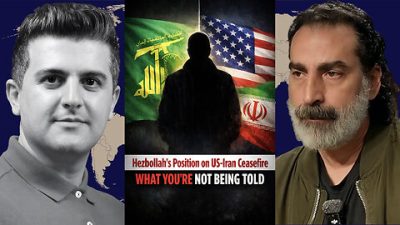
Laith Marouf: Hezbollah’s position on US-Iran ceasefire
or go to
Aletho News Archives – Video-Images
From the Archives
The Dirty Little Secret behind the “Global Terrorism Index”
The Omission of Israeli Terrorism in the Occupied Palestinian Territories
By Karin Brothers | Global Research | December 6, 2014
… The Israeli settlements — all of which are illegal – have been identified as a major impediment to peace. The refusal of a major “global” terrorism report to name the Israeli settlers as one of the groups most responsible for terrorism not only misrepresents a major source of regional violence but exposes the Global Terrorism Index as a propaganda tool that supports a U.S. agenda.
In recent years, governments have been attempting to thwart terrorism by blocking supportive fund-raising. When it comes to Israeli settlements, however, the US and Canada actually encourage fund-raising by giving organizations (such as Christian Friends of Israeli Communities (CFOIC) and the Jewish National Fund) financial support in the form of donor tax-deductions.
Charities which provide funds for the Israeli settlements should be regarded as terror-financing organizations. They should not only lose their tax-deductible status, but they should be banned because they support the violation of international humanitarian law. The terror-financing laws that are being strictly enforced for Muslim charities should be applied to Christian and Jewish charities as well. … Read full article
Blog Roll
 Aletho News
- How UK Regulator Ofcom Quietly Bypassed International Law to Police American Speech
- The Black Cube Files: How Former Mossad Operatives Flipped a Nation
- Laith Marouf: Hezbollah’s position on US-Iran ceasefire: What you’re not being told
- Israel’s priority lies in destroying chances of peace between Iran, US: Ex-UN nuclear chief
- Ceasefire for all or for none: Iran shuts Hormuz over Lebanon attacks
- Strait of Hormuz is Iran’s ‘nuclear weapon’ that forced US retreat: Medvedev
- Energy crisis will last for months – Kremlin envoy
- Europe’s quiet role in the war on Iran
- Forty days that shook the Empire: How Iran turned the tables on US and prevailed
- Netanyahu unilaterally declares Lebanon outside of ceasefire deal
- If Americans Knew
- This is ceasefire? Israel’s biggest massacre yet in Lebanon, another journalist killed in Gaza – Daily Update
- Tucker Carlson on Israel: This Is the Behavior of an Ally? Really?
- Gazans face a triple crisis: severe shortages of water and bread, healthcare in tatters
- NY Times reports how Netanyahu took the US into Iran War
- A sigh of relief over Iran, but Gaza and Lebanon in dire straits – Daily Update
- Thousands dead and neighborhoods razed to the ground: Aid agencies fear southern Lebanon is becoming the new Gaza
- The war the US is fighting for Israel could cost trillions
- ‘Cigarette Burns, Nail Wounds’: Toddler Tortured in Gaza to Coerce Father
- Trump Says US Sent ‘a Lot of Guns’ to Protesters in Iran
- Israeli forces destroy 17 UN peacekeeper cameras in south Lebanon
- No Tricks Zone
- An Inconvenient Tree: Uncovered In Alps… Europe Much Warmer Than Today 6000 Years Ago
- New Study Reports A 60% Slowdown In Greenland’s Ice Loss Rate In The Last Decade
- Low Intensity Tornado Wrecks Major Solar Farm, Creating A Potential Toxic Dump
- New Study Finds Warming Saves Lives…Cold Temperatures 12 Times More Deadly Than Excess Heat
- German Science Blog Accuses PIK Climate Institute Of Hallucinating Climate Tipping Points
- Devastating Assessment Of Comirnaty Vaccine By Former Senior Pfizer Europe Toxicologist
- New Study: CO2 Is ‘Effectively Negligible’ As An Explanatory Climate Change Factor Since 2000
- Former Pfizer Toxicologist Dr. Helmut Sterz Tells Bundestag Hearing Pfizer Vaccine Should Have Never Been Approved
- Energy Expert: Germany’s Nuclear Phaseout Was A “500 Billion Euro Mistake”
- New Research: South Australia’s Mid-Holocene Sea Surface Temperatures Were 4°C Warmer Than Today
 Aletho News