Hamas Perspectives on September, Unity Government: Interview with PLC Member Totah
Mark West for the Alternative Information Center | 17 July 2011
Negotiations for a Palestinian unity government are seemingly at an impasse and new questions rise daily concerning the “September initiative” to request full United Nations membership for Palestine. What are the perspectives of Hamas leadership concerning these issues, and possible developments in the Palestinian struggle for liberation? Mark West interviews Palestinian Legislative Council Member Mohammad Totah.
What are your thoughts on the Hamas-Fatah unity deal? What are the main points of disagreement between Fatah and Hamas concerning the agreement?
Totah: Hamas were hoping for a successful reconciliation as both sides are under occupation and will be more powerful when united. The central problem at the moment is Fatah’s choice of Salam Fayyad as the current Prime Minister. When we signed the reconciliation agreement with Fatah in Egypt, it was stated that both factions will agree on the PM and ministers of the government.
In fact, we agreed on two things: first of all, to rebuild Gaza and secondly, to prepare the ground for new elections. That means both sides had to agree on the PM and ministers. Unfortunately, Abbas wants to impose his decision to keep Salam Fayyad as PM, which does not adhere to the reconciliation agreement signed by both sides.
Fayyad’s main achievement has been to build institutions in Palestine. Nonetheless, while some institutions are ready for statehood, we are still under occupation. Hamas thinks that we have to achieve the freedom of our land and people before we build national institutions. Let me tell you, any country or people that is under occupation has to confront the occupation, to resist, until they get their freedom and then start building organizations. It is futile to construct organizations and institutions under occupation because the Israelis can come at any time and destroy everything that was built.
Last of all, two years ago, Fayyad promised that by September 2011 Palestinians would no longer need to depend financially on any external donor. Yet, the PLO is currently unable to pay its salaries because they are still dependent on foreign aid. How can you say you are ready to be a state when you cannot pay for that same state without foreign aid?
How do the methods of Hamas to resist occupation differ from Fatah? Do you think Hamas has a stronger hand in eventual negotiations with Israel?
Totah: Hamas and Fatah employ two innately different strategies. Fatah’s plan is to get peace for our people and land through negotiations and the renunciation of violence. However, over the last 20 years Fatah has continuously been negotiating with Israel, but on the ground nothing has changed, no rights have been gained. That can only mean their strategy has failed to return any rights to the Palestinian people.
Our approach differs fundamentally. Palestinians have the right, under international law, to resist the occupier by any means as an occupied people. As a result, Hamas keeps resisting the occupation in various forms, violent and non-violent. But resistance does not always mean the use of military force; there are many alternate means to resist occupation. My fellow parliamentary members and I who are residing in the ICRC tent while Israel wants to deport us are an example of an alternative method to resist the occupation.
Ultimately, Hamas prefers a peaceful solution: to live in our homes peacefully and freely. But when they occupy us, what should we do? Look at the history, all over the world those who lived under occupation have resisted by all means. Without resistance you will never attain the right to be free. What will force the occupier to listen when there is no resistance? If we don’t resist, the Israelis will live freely, and we will live like slaves. Instead, we refuse to be slaves of the occupation and we choose to live with dignity.
Last of all, let’s not forget that in 2006 the Palestinian people chose to give 59 percent of all parliamentary seats to Hamas because they realized Israelis are not going to give them their land peacefully.
If it disagrees fundamentally with Fatah’s strategy, will Hamas eventually engage in direct negotiations with Israel?
Totah: We are not against negotiations. If you want to achieve anything, you will have to negotiate. But there are two prerequisites: to negotiate, you need have good cards on the table, and secondly, Israel will have to agree on several fundamental Palestinian rights before any negotiations can take place.
In 2006, Hamas and other factions agreed on the borders of 1967 as the basis for negotiations, the right of return for Palestinian refugees, and a truce for ten to fifteen years. Before any negotiations can take place, Israel will have to agree on this framework and discuss how they will withdraw from the occupied territories and allow Palestinians to return to their land.
And if there are no strong cards to play, if you don’t have force in one hand and peace in the other, you will not be able to negotiate successfully. Our experience as Palestinians has shown that to be true.
Then what does Hamas think of plan to submit to the UN secretary general an official request for Palestine to be accepted as a full member of UN by the PLO?
Totah: Palestine already gained recognition in 1988, so the appeal for UN membership does not add anything new to the cause. But why not go for it? Why should Hamas create obstacles for Fatah to reach its goal to attain international recognition? If they want to go to the UN, let’s go, but we know the Palestinian people will not gain their sovereign rights this way. At the same time, Hamas also knows we have nothing left to lose, so let them go and we will see what happens. The good thing is that it will show the world what Israel stands for and that the Palestinians are fighting for their rights.
Did Fatah communicate their intentions to go to the UN during the Hamas-Fatah reconciliation talks?
Totah: During the reconciliation talks it was not mentioned by Fatah. But when they discussed it with Hamas at a later date, Hamas agreed not to block the procedure. At the same time, we made it clear that we are convinced the appeal for full UN membership will not return Palestinian rights to its people. But as we cannot see any negative consequences, we will do nothing to obstruct the move.
Some say that, in case the Palestinian people do not attain any actual gains through the UN process this September, there is a chance of a third Palestinian wave of resistance against Israel. What are your thoughts on that?
Totah: Fatah and Abbas believe in peace through negotiations, not resistance. After September, Fatah will continue with negotiations as usual, with no deadline in sight. Abbas has also stated that he will reject any form of violent intifada, and confront any instigator of violence. Hamas, on the other hand, does believe in resistance.
Everywhere in the world, people who are under occupation have other choices than negotiations. The truth is that if your only choice is peaceful negotiations, then the occupier does not care about your cause. But if we resist the occupation in other ways, then Israel knows we hold other cards. That’s when concessions can be made from both sides. But when only peaceful resistance is used, all concessions will be from our side and the occupation will never end.
In case a truly autonomous Palestinian state is declared in the coming years, what kind of political system does Hamas envision for Palestine?
Totah: Ultimately, we want to live peacefully in a democratic state with human rights and the rule of law. Look at me, as a member of the Palestinian parliament I have been in prison for three and a half years. Now I’ve been living in the ICRC compound for 1 year, a place from which I cannot leave because they want me to resign from parliament and revoke my residency.
The reason I refuse to leave is that I believe in democracy, and that only the Palestinian people have the right to ask me to resign, not the Israeli government.
No comments yet.
Featured Video
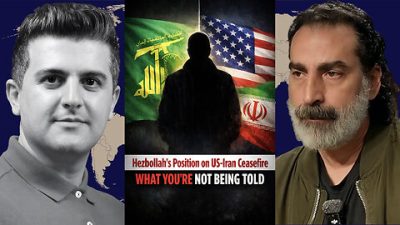
Laith Marouf: Hezbollah’s position on US-Iran ceasefire
or go to
Aletho News Archives – Video-Images
From the Archives
The Dirty Little Secret behind the “Global Terrorism Index”
The Omission of Israeli Terrorism in the Occupied Palestinian Territories
By Karin Brothers | Global Research | December 6, 2014
… The Israeli settlements — all of which are illegal – have been identified as a major impediment to peace. The refusal of a major “global” terrorism report to name the Israeli settlers as one of the groups most responsible for terrorism not only misrepresents a major source of regional violence but exposes the Global Terrorism Index as a propaganda tool that supports a U.S. agenda.
In recent years, governments have been attempting to thwart terrorism by blocking supportive fund-raising. When it comes to Israeli settlements, however, the US and Canada actually encourage fund-raising by giving organizations (such as Christian Friends of Israeli Communities (CFOIC) and the Jewish National Fund) financial support in the form of donor tax-deductions.
Charities which provide funds for the Israeli settlements should be regarded as terror-financing organizations. They should not only lose their tax-deductible status, but they should be banned because they support the violation of international humanitarian law. The terror-financing laws that are being strictly enforced for Muslim charities should be applied to Christian and Jewish charities as well. … Read full article
Blog Roll
 Aletho News
- The Black Cube Files: How Former Mossad Operatives Flipped a Nation
- Laith Marouf: Hezbollah’s position on US-Iran ceasefire: What you’re not being told
- Israel’s priority lies in destroying chances of peace between Iran, US: Ex-UN nuclear chief
- Ceasefire for all or for none: Iran shuts Hormuz over Lebanon attacks
- Strait of Hormuz is Iran’s ‘nuclear weapon’ that forced US retreat: Medvedev
- Energy crisis will last for months – Kremlin envoy
- Europe’s quiet role in the war on Iran
- Forty days that shook the Empire: How Iran turned the tables on US and prevailed
- Netanyahu unilaterally declares Lebanon outside of ceasefire deal
- Israeli leaders: ‘Not a single goal’ achieved in war with Iran
- If Americans Knew
- Gazans face a triple crisis: severe shortages of water and bread, healthcare in tatters
- NY Times reports how Netanyahu took the US into Iran War
- A sigh of relief over Iran, but Gaza and Lebanon in dire straits – Daily Update
- Thousands dead and neighborhoods razed to the ground: Aid agencies fear southern Lebanon is becoming the new Gaza
- The war the US is fighting for Israel could cost trillions
- ‘Cigarette Burns, Nail Wounds’: Toddler Tortured in Gaza to Coerce Father
- Trump Says US Sent ‘a Lot of Guns’ to Protesters in Iran
- Israeli forces destroy 17 UN peacekeeper cameras in south Lebanon
- US-Israeli strikes ‘completely destroy’ synagogue in Tehran
- Archbishop for US Military Says Iran War Is Unjust Under Catholic Teaching
- No Tricks Zone
- An Inconvenient Tree: Uncovered In Alps… Europe Much Warmer Than Today 6000 Years Ago
- New Study Reports A 60% Slowdown In Greenland’s Ice Loss Rate In The Last Decade
- Low Intensity Tornado Wrecks Major Solar Farm, Creating A Potential Toxic Dump
- New Study Finds Warming Saves Lives…Cold Temperatures 12 Times More Deadly Than Excess Heat
- German Science Blog Accuses PIK Climate Institute Of Hallucinating Climate Tipping Points
- Devastating Assessment Of Comirnaty Vaccine By Former Senior Pfizer Europe Toxicologist
- New Study: CO2 Is ‘Effectively Negligible’ As An Explanatory Climate Change Factor Since 2000
- Former Pfizer Toxicologist Dr. Helmut Sterz Tells Bundestag Hearing Pfizer Vaccine Should Have Never Been Approved
- Energy Expert: Germany’s Nuclear Phaseout Was A “500 Billion Euro Mistake”
- New Research: South Australia’s Mid-Holocene Sea Surface Temperatures Were 4°C Warmer Than Today
 Aletho News
Leave a comment