New York Times stands by Ethan Bronner’s Facebook fabrications
By Ali Abunimah – The Electronic Intifada – 07/13/2011

Ethan Bronner(Flickr)
The New York Times has told The Electronic Intifada it stands fully behind an article by its Jerusalem bureau chief Ethan Bronner despite compelling evidence that the article contains fabrications, misleading statements, and gross exaggerations.
In a series of emails between The Electronic Intifada and The New York Times foreign editor Susan Chira, the newspaper defended the article and denied that any corrections or clarifications were required. This is despite the fact that additional data presented by The Electronic Intifada shows that the central premise of the article is false.
In a 9 July article, Bronner profiled a Facebook page called YaLa – Young Leaders. The article suggested that an “enthusiastic” response to the page from thousands of people all over the Arab world indicated an upsurge of interest in coexistence with Israelis that brought to mind the “Facebook-driven revolutions in Tunisia and Egypt.”
On 10 July, The Electronic Intifada cast severe doubts on many aspects of Bronner’s story.
Not only is there no evidence of a groundswell of interest in online dialogue between Israelis and Arabs, there is substantial evidence to contradict Bronner’s narrative. Additional data collected by The Electronic Intifada and presented to The New York Times found that only a handful of Facebook users had anything more than a cursory relationship with the page before Bronner’s article appeared.
Moreover, The New York Times did not respond to a direct question as to whether it believed a key anecdote in Bronner’s story, after The Electronic Intifada published evidence suggesting it is false.
This post lays out the key issues we asked The New York Times about, analyzes its responses and presents new evidence contradicting Bronner’s central narrative.
How many “active users” does the YaLa – Young Leaders Facebook page have and what does that mean?
In his article, Bronner claimed that the YaLa – Young Leaders Facebook page:
has had 91,000 views in its first month. Of its 22,500 active users, 60 percent are Arabs – mostly Palestinians, followed by Egyptians, Jordanians, Tunisians, Moroccans, Lebanese and Saudis.
The Electronic Intifada asked The New York Times for the source of this information and to define what constituted an “active user.”
We also presented The New York Times with a study we did of every post and comment on the YaLa – Young Leaders page’s Wall from 4 May through 9 July (the full study is included at the end of this post).
The study found that in total there were 146 Facebook users who made a total of 519 posts/comments on the Wall. Eighty-six of these users (58%) made only a single post/comment and another 25 (17%) made 2 comments/posts. So 75% of active users made only 1 or 2 comments or posts.
The top ten most active commenters/posters accounted for 51% of the posts/comments (265 out of 519). The most active poster/commenter was the Yala – Young Leaders page owner, while Hamze Awawde and Moad Arqoub were the third and fourth most prolific. They, along with two other top ten users were quoted in Bronner’s article.
In contrast to the claims of broad participation from across the Arab world, we found only two Facebook users who identified themselves as coming from an Arab country other than Palestine – both from Egypt. One made a single comment, and the other a small handful. Neither were among the top ten users.
In response to these data, foreign editor Susan Chira wrote:
Despite your own study, we believe the article remains factually correct. You assert that the only way to participate in a Facebook page is to “like” it. However, Facebook users can engage with a page in multiple ways, including commenting on a status update, liking a post, and other ways without “liking” the page, according to Facebook and to my colleagues who have been administrators of Facebook pages. That activity is described in the article as monthly active users. Mr. Savir shared the Facebook data with us so we could verify it, and the data does in fact substantiate our description of the monthly active users. Your own research is predicated on the “like” metric, so it does not obviate the statistic we use.
Chira did not share with The Electronic Intifada the data she says was shown to The New York Times by Uri Savir, the former Israeli diplomat and director of the Peres Center for Peace who founded the page.
Chira’s claim that Facebook users can “engage with a page” without first “liking” it (becoming a fan) was simply incorrect.
This is important because on 9 July, the YaLa – Younger Leaders page had only about 3,000 fans. It has more than doubled since then as a result of publicity from Bronner’s article.
In a follow-up, Chira acknowledged that in fact a Facebook user must “like” a page before she can post/comment on the Wall. However, Chira insisted:
it is incorrect to say Facebook users cannot see a Wall without LIKING a page or other parts of the page, including applications. It is also incorrect to say users cannot comment or share posts from a Facebook page that they do not LIKE. Users can comment and share a status update/post from a Facebook page – onto their own Facebook page – without LIKING the page.
Can’t see the forest for the trees
At this point The New York Times has completely lost sight of the forest for the trees. Let’s remind ourselves of the main thrust of Bronner’s narrative:
over the past month, the Facebook page has surprised those involved by the enthusiasm it has generated, suggesting that the Facebook-driven revolutions in Tunisia and Egypt may offer guidance for coexistence efforts as well.
Called Facebook.com/yalaYL, the site, created by a former Israeli diplomat and unambiguous about its links to Israel, has had 91,000 views in its first month. Of its 22,500 active users, 60 percent are Arabs – mostly Palestinians, followed by Egyptians, Jordanians, Tunisians, Moroccans, Lebanese and Saudis.
What any reasonable person would understand from this is that the “enthusiasm” for the page is comparable in scope and significance to “the Facebook-driven revolutions in Tunisia and Egypt.”
But the only evidence cited for this is the “active user” number of 22,500 which any reasonable reader would understand to mean that thousands of people had flocked to the page to take part in the kind of discussions snippets of which Bronner quoted.
But that’s just not a true picture. An actual examination of the human interactions on the YaLa – Young Leaders Facebook page indicates that only a tiny handful of people have had anything more than a cursory interaction with the page.
Yet The New York Times insists that the fact that some Facebook users could have shared YouTube videos, photos or other innocuous posts of the kind that dominate the YaLa page to their own personal pages is sufficient to support the claim that there is a groundswell of Arab interest and participation in a project “unambiguous about its links to Israel” worthy of a full write-up on its august pages.
At the same time the newspaper ignores the actually observable human interactions that completely contradict this narrative.
Are Bronner’s lead paragraphs true?
In its original critique of Bronner’s article, this blog cast doubt on the story Bronner told in his lead:
RAMALLAH, West Bank — Moad Arqoub, a Palestinian graduate student, was bouncing around the Internet the other day and came across a site that surprised and attracted him. It was a Facebook page where Israelis and Palestinians and other Arabs were talking about everything at once: the prospects of peace, of course, but also soccer, photography and music.”
“I joined immediately because right now, without a peace process and with Israelis and Palestinians physically separated, it is really important for us to be interacting without barriers,” Mr. Arqoub said as he sat at an outdoor cafe in this Palestinian city.
The story is not credible because Arqoub was one of the earliest posters/commenters on the page soon after its official launch, and Arqoub already personally knew the other Palestinian closely involved in the site, Hamze Awawde. Both Arqoub and Awawde, as The Electronic Intifada reported, had met through their involvement an in Israeli organization called MEPEACE.
The Electronic Intifada asked The New York Times if Arqoub or Awawde were administrators or closely involved with the project, and this question:
Do you believe the story in Bronner’s lede that Arqoub was simply “bouncing around on the Internet the other day” and serendipitously happened upon this page?
Chira did not give a direct response to the latter question. However, she wrote:
On your … point about the origins and affiliations of the people Mr. Bronner quoted, I asked him to go back both to Mr. Savir and to each of the people he interviewed and check whether any of them were officially affiliated with the site or had any role in setting it up. The answer from all of them is no. The people interviewed are indeed active in interacting with the site, but they have no official role, according to Mr. Savir, Mr. Awade and Mr. Arqoub. Nor did the article state that Mr. Awade and Mr. Arqoub “were brought together by the page.” It said they are both Palestinians who have had an interest in coexistance efforts before.
Chira did not say if The New York Times examined the strong evidence that both Awawde and Arqoub were de facto administrators and representatives of the YaLa initiative in an “unofficial” capacity, nor what their relationship was with the page’s founders prior to its launch.
Nor do we know who actually administers the page if it is not Awawde or Arqoub. Savir, while the figurehead for the project, has no postings under his name.
Given the fact that the story about how Arqoub came across the site “the other day” is almost certainly false – and Chira would not stand by it – it seems extraordinary that The New York Times would rely on the word of the same sources and decline to carry out any fact-checking of its own.
Another important question Chira should ask Bronner – assuming she hasn’t: how did Bronner come upon this story? Who fed it to him?
Ignoring the grassroots, watering the astroturf
The Electronic Intifada asked in its initial posting on Bronner’s story and in the correspondence with Chira why Bronner would promote this marginal Facebook page with a small handful of active participants and ignore the real groundswell of Palestinians and Arabs who oppose “dialogue” initiatives aimed at normalizing Israel’s relations with the Arab world.
Just last week, for example, the Egyptian Independent Union Federation issued a statement of solidarity with the Palestinian people that pledged to “reject any form of normal relations” with Israel, including gas supply agreements, and confirmed the trade union federation’s support for the Palestinian-led campaign of boycott, divestment and sanctions (BDS).
Chira wrote:
in response to your objection that we failed to note the context that there are Palestinians who object to this kind of contact, the article does state, “At a time when Arabs generally shun contact with Israelis, those on the site speak openly about their desire to learn more about one another.”
Does Chira really think that noting in passing that “there are Palestinians” who object, while hyping and exaggerating a trivial dialogue initiative, substitutes for real reporting on why Palestinians overwhelmingly oppose such initiatives, and allowing them to explain their critiques and analyses?
Why does this matter?
The highly misleading narrative and dubious factual claims in Bronner’s article on the YaLa-Young Leaders Facebook page constitute serious journalistic malpractice. But instead of acknowledging this, The New York Times has dug in to defend this bogus story come what may.
Perhaps this is because acknowledging any error on the part of Bronner – or his editors – would force the newspaper to reckon with Bronner’s blatant and even more significant biases.
In January 2010, The Electronic Intifada revealed that Bronner had a serious conflict of interest: his son had enlisted in the Israeli army.
Clark Hoyt, the Public Editor of The New York Times at the time agreed with us and urged that Bronner be reassigned. The newspaper did not take their colleague’s advice.
Since then, Hoyt has sadly been proven right that the question of Palestine is simply “too close to home” for Bronner.
Last May, as Palestinians marked the 63rd anniversary of their expulsion from Palestine – the Nakba – Bronner presented a highly skewed version of history, a common Israeli propaganda refrain:
After Israel declared independence on May 15, 1948, armies from neighboring Arab states attacked the new nation; during the war that followed, hundreds of thousands of Palestinians fled or were driven from their homes by Israeli forces.
As The Electronic Intifada reported, Bronner omitted the crucial fact that hundreds of thousands of Palestinians were forced from their homes by Zionist militias in the months before 15 May 1948 and the intervention of Arab armies – a fact that completely changes many people’s understanding of what occurred.
In an important analysis, Youssef Munayyer, executive director of The Palestine Center, showed that Bronner’s skewed reporting about the Nakba contradicted even the Times’ own contemporaneous reports from 1948.
When the Jerusalem bureau chief was confronted about this by the current public editor, Arthur Brisbane, “Mr. Bronner responded that space was limited in a short story and he wasn’t trying to recite the full history.”
So Bronner’s idea of reporting is to make sure to fill up his word allotment with information that supports Israel’s official narrative while omitting facts that are central to Palestinian history and present-day claims.
Bronner’s latest piece of shoddy journalism not only reminds us of his own inability to see the situation from outside the cozy corner of West Jerusalem, ethnically-cleansed of Palestinians, that he inhabits, but indicates that he is aided and abetted by editors who will apparently put up with any absurd claim or outright falsehood.
Public Editor Arthur Brisbane revealed a truth when he wrote:
The Israeli-Palestinian conflict, in short, is the third rail of New York Times journalism. Touch it and burn.
Conclusion
We can conclude from this analysis that YaLa-Young Leaders was not a remarkably active or popular Facebook page.
The Electronic Intifada’s Facebook page (which has more than 13,000 fans), for example, has been as or much more active even without any celebrity endorsements of the kind this page received even prior to Bronner’s article. Moreover, interactions of the kind on the YaLa page show no remarkable level of dialogue or anything that deviates from the typical comments sections found on thousands of websites and Facebook pages (I would argue that the Wall of my personal Facebook account was probably a more active a forum for discussion including between Arabs and Israelis!).
Many of the posts on the page are messages of support/congratulations that appear to have been solicited from organizations and minor celebrities. All, except perhaps the one from Mahmoud Abbas, are Israeli. There’s no evidence of any Arab organizational buy-in.
There is nothing here that suggests thousands of “active users” nor anything that can be matched in reality to Bronner’s description which invokes the spirit of mass action of the Arab uprisings. Nor is there any evidence of participation or buy-in from beyond a small handful of Israelis and Palestinians.
Here’s what Bronner wrote:
“But over the past month, the Facebook page has surprised those involved by the enthusiasm it has generated, suggesting that the Facebook-driven revolutions in Tunisia and Egypt may offer guidance for coexistence efforts as well.”
“Called Facebook.com/yalaYL, the site, created by a former Israeli diplomat and unambiguous about its links to Israel, has had 91,000 views in its first month. Of its 22,500 active users, 60 percent are Arabs — mostly Palestinians, followed by Egyptians, Jordanians, Tunisians, Moroccans, Lebanese and Saudis.”
This is a completely misleading description, which has generated an entirely false public perception of this page.
Settlers torch Palestinian land near Nablus
Ma’an – 15/07/2011

NABLUS — Israeli settlers from the illegal settlement of Yizhar set fire to Palestinian land on Friday near the village of Burin, south of Nablus.
“A group of settlers from Yizhar had set fire to dozens of Dunams in that area,” a member of Burin’s agricultural committee, Belal Eid, told Ma’an Friday.
Residents of Burin and members from the Palestinian civil defense crew are reportedly still trying to extinguish the fire but settlers are preventing them from reaching the land, he added.
A report by the Palestinian Authority found that settler violence increased “dramatically” in June 2011, documenting 139 attacks on Palestinians in the West Bank and the destruction of over 3,600 olive trees and vineyards.
Annual figures compiled by Israeli rights group Yesh Din have repeatedly shown that nine out of 10 police investigations about settler crimes fail to lead to a prosecution.
No, Obama, We Don’t Need Free Trade Agreements with Panama, Colombia, and Korea
By Ian Fletcher – July 15, 2011
Obama is still pushing for free trade agreements with Panama, Colombia, and Korea, albeit with the thin fig leaf of demanding they be accompanied by money for so-called Trade Adjustment Assistance, a “painkiller” program designed to blunt the harm to laid-off workers.
The Republicans don’t like TAA, which has held up passage of these agreements momentarily, but both sides are still gunning to pass these agreements some time soon.
You think America has learned its lesson from NAFTA, which the Labor Department has estimated cost us 525,000 jobs? Think again.
Take the Korea agreement, for example. President Obama and the Republican leadership want it despite the fact that the Economic Policy Institute has estimated it will cost us 159,000 more jobs over the next five years.
Yes, you read that correctly. At a time when the president says that his number one economic priority is job creation, and has created an entire commission for that purpose, they’re going ahead with it anyway.
Even the official U.S. International Trade Commission has admitted that KORUS-FTA will cause significant job losses. And not just in low-end industries: the ITC foresees the electronic equipment manufacturing industry, with average wages of $30.38 in 2008, as a major victim.
The supposed logic of America swapping junk jobs for high-end jobs simply isn’t the way the economics really works out. Pace free-market mythology, there are actually well-understood reasons for this, if you dig a little into what economists already know.
Was this the Obama America voted for in 2008?
No. That Obama is at an undisclosed location somewhere. He campaigned against KORUS-FTA during the 2008 campaign. (It was originally negotiated, but not ratified by Congress, by Bush in 2007.) Among other things, that Obama said:
I strongly support the inclusion of meaningful, enforceable labor and environmental standards in all trade agreements. As president, I will work to ensure that the U.S. again leads the world in ensuring that consumer products produced across the world are done in a manner that supports workers, not undermines them.
Nice words. Unfortunately, none of them are reflected in KORUS-FTA, which contains no serious new provisions on these issues.
This agreement is essentially a NAFTA clone. It is, in fact, the biggest trade agreement since NAFTA, and the first since Canada with a developed country.
This agreement, like NAFTA and the dozen or so other free trade agreements America has signed since NAFTA, is fundamentally an offshoring agreement. That is, it is about making it easier for U.S.-based multinationals to move production overseas with confidence in the security of their investments in overseas plants.
The provisions to protect workers and consumers are unenforceable window dressing. (That’s why they’re allowed to be in there in the first place.)
Don’t be fooled by the fact that some unions, like the United Auto Workers (UAW), have endorsed the agreement. This is just a cynical ploy by the White House to split the trade union movement in order to keep the AFL-CIO neutral.
The UAW’s out-of-touch leadership is so punch-drunk from the 2008 collapse of the U.S. auto industry that it has lost touch not only with what is good for the American economy as a whole, but with what is good for rank-and-file auto workers. (There’s a rumor in circulation they did a deal with the White House in exchange for protecting pension and other obligations in the auto industry bailout. I can’t prove this, but it would certainly explain a few things.)
Don’t take my word for it, either: in the words of Al Benchich, retired president of UAW Local 909:
The UAW Administration Caucus is the one-party state that controls the UAW at the International level. Every International officer is a member of the Caucus, and they surround themselves with appointed international reps that unquestioningly do their bidding.
No wonder other, more democratic and more intelligent, unions, like Leo Gerard’s United Steelworkers, are criticizing the UAW for its decision to support KORUS-FTA.
Interestingly, the UAW’s past record of criticizing KORUS-FTA is more honest than anything they’re saying right now. For example, here’s what they originally said about this agreement:
KORUS-FTA has inadequate protections and enforcement mechanisms to enforce either the spirit or the letter of the law.
Precisely. And changes made since then are, as noted, minimal.
As an example of how one-sided the treaty is, consider that it now allows — to great rejoicing — America to export 75,000 cars a year to Korea. This translates to a measly 800 jobs. Korea’s exports of cars to the U.S. in 2009, on the other hand?
Try 476,833.
Furthermore, even if the U.S. does get to sell more cars in Korea, American companies will mostly not be making the steel, tires, and other components that go into them, because the agreement allows cars with 65 percent foreign content to count as “American.”
Worse, it allows goods with as much as 65 percent non-South-Korean content to count as “Korean,” opening the door not only to North Korea but to the whole of China. Talk about the camel’s nose in the tent!
Despite what the White House and the U.S. Chamber of Commerce are saying, this agreement makes no sense as a strategy to reduce our horrendous trade deficit. America’s trade deficits have a long record of going up, not down, when we sign trade agreements with other nations.
Paradoxically, trade agreements even seem to sabotage our own trade with foreign nations: according to an analysis by the group Public Citizen, in recent years our exports to nations we have free-trade agreements with have actually grown at less than half the pace of our exports to nations we don’t have these agreements with. So these agreements don’t hold water as trade-expanding measures.
Even leaving aside trade-balance issues, this agreement is a disaster, thanks to something called “investor-state arbitration.” Like NAFTA, it compromises American sovereignty and subjects American democracy to having its own laws overruled by foreign judges as interfering with trade. Under NAFTA to date, over $326 million in damages has been paid out by governments as a result of challenges to natural resource policies, environmental protection, and health and safety measures. There about 80 Korean corporations, with about 270 facilities around the U.S., that would acquire the right to challenge our laws under KORUS-FTA.
What kind of problems could this cause? The U.S. was forced in 1996 to weaken Clean Air Act rules on gasoline contaminants in response to a challenge by Venezuela and Brazil. In 1998, we were forced to weaken Endangered Species Act protections for sea turtles thanks to a challenge by India, Malaysia, Pakistan and Thailand concerning the shrimp industry. The EU today endures trade sanctions by the U.S. for not relaxing its ban on hormone-treated beef. In 1996, the WTO ruled against the EU’s Lome Convention, a preferential trading scheme for 71 former European colonies in the Third World. In 2003, the Bush administration sued the EU over its moratorium on genetically modified foods.
It gets worse. KORUS-FTA also signs away our right (and Korea’s, too, not that this makes it any better) to a wide range of financial regulations of the kind that might have helped avoid the crisis of 2008. For example, it forfeits our right to limit the size of financial institutions. It forfeits our right to place firewalls between different kinds of financial activities in order to prevent volatility in one market from collapsing another. It prevents us from limiting what financial services financial institutions may offer—Enron Savings & Mortgage, here we come… It bans regulation of derivatives. It ban limits on capital flows designed to tame volatile “hot money.”
Why is the U.S. flirting with making such an appalling mistake yet again? Because a) multinational corporations have bought our political system and b) because our government would rather play power politics than keep its own (declining) economic house in order.
Gaza Rejects Greek Government Charity
The following letter was delivered to the Greek Government on July 12, 2011 making it clear that the people of Gaza seek freedom and respect for their human rights, including their right to lead a dignified life, not charity. Seemingly deaf to their call, yesterday a spokesman for the Greek Ministry of Foreign Affairs, Mr. Delavekouras, repeated the Greek Government’s “generous offer” to deliver limited humanitarian aid to the people of Gaza – instead of helping them gain the freedom that Israel continues to deny them.
12 July 2011
Dear Prime Minister Papendreou,
Dear Foreign Minister Lambrinidis
We, members of Palestinian civil society in Gaza, have been watching the actions your government has taken to block Freedom Flotilla 2 from setting sail towards the biggest open air prison – the Gaza Strip – to challenge Israel’s criminal blockade. Israel’s closure of Gaza has deprived us of things that most people take for granted, first and foremost, our freedom of movement. We are not allowed to pursue adequate health care or educational opportunities because we cannot travel freely. We are cut off from our families in other parts of the occupied territory and abroad; and we are not allowed to invite people to visit us in Gaza. Now, you have imported this restriction on the people whose main mission is to stand in solidarity with us.
The people of Gaza are not only in need of humanitarian aid because we are prevented from building our economy. We are not allowed to import raw materials or to export; our fishermen and farmers get shot at when attempting to fish or to harvest their crops. As a result of deliberate Israeli policy, 80% of our people have become food aid dependent, our infrastructure is in shambles, and our children cannot imagine a day when they will know freedom.
Your offer to deliver the cargo of the Freedom Flotilla entrenches the notion that humanitarian aid will solve our problems and is a weak attempt to disguise your complicity in Israel’s blockade.
We are so sorry not to accept your charity. The organizers and participants of the Freedom Flotilla recognize that our plight is not about humanitarian aid; it is about our human rights. They carry with them something more important than aid; they carry hope, love, solidarity and respect. Your offer to collude with our oppressors to deliver aid to us is totally REJECTED.
While it is clear that you have been under enormous political pressure to comply with the will of the Israeli regime, to collaborate with Israel in violating international law and legitimizing the siege, we refuse to accept your breadcrumbs. We crave freedom, dignity and the ability to make choices in our daily lives. We urge you to immediately reconsider and to let the Freedom Flotilla sail.
Finally we recognize the historical relations between our people and your country’s support for our legitimate rights. With this history in mind and your previous acknowledgment of the freedoms denied to us, we are calling on you to allow the freedom flotilla boats to leave for Gaza, thus challenging Israel’s illegal blockade of the Gaza Strip and illegal occupation of Palestinian land.
Sincerely,
Palestinian Network of NGOs (PNGO)
Representing over 60 non-governmental organizations in Gaza
Palestinian International Campaign to End the Siege on Gaza
General Society for Rehabilitation
Deir Al-Balah Cultural Centre for Women and Children
Maghazi Cultural Centre for Children
Al-Sahel Centre for Women and Youth
Rachel Corrie Centre, Rafah
Rafah Olympia City Sisters
Al Awda Centre, Rafah
Al Awda Hospital, Jabaliya Camp
Ajyal Association, Gaza
Al Karmel Centre, Nuseirat
Local Initiative, Beit Hanoun
Beit Lahiya Cultural Centre
Al Awda Centre, Rafah
Middle East Children’s Alliance – Gaza office
Alshomoa Club for Women
General Union for Public Services Workers
General Union for Health Services Workers
General Union for Petrochemical and Gas Workers
General Union for Agricultural Workers
General Union of Palestinian Syndicates
General Union of Palestinian Women
Palestinian Congregation for Lawyers
Palestinian General Federation of Trade Unions (PGFTU)
Union of Health Work Committees
Union of Synergies—Women Unit
Union of Women’s Work Committees
Palestinian Association for Fishing and Maritime
Palestine Sailing Federation
Fishing and Marine Sports Association
Palestinian Women Committees
Progressive Students’ Union
Fundamentalist Israeli Minister Seeks Additional 6 Months Ban on Family Unification
By Saed Bannoura | IMEMC & Agencies | July 14, 2011
Israeli Interior Minister, member of the extremist Shas ultra-orthodox Jewish party, Eli Yishai, is demanding that the Israeli cabinet extend the ban on family unification for Arabs and Palestinians for additional six months.
The law itself does not affect spouses that are Jewish, but is mainly meant to prevent Arab citizens of Israel, married to Palestinians, from obtaining family unification documents to be able to live together with their spouses in Israel. It also targets hundreds of Bedouin families in the occupied Negev.
Arab member of Knesset of the United Arab List, Dr. Ahmad Tibi, voiced a strong criticism of the stances of Yishai, and stated that this order is a threat to civil liberties in the country and has nothing to do with security, but directly related to demography.
The ban openly suggests that “by law”, family unification between citizens of Israel and their Palestinian or Arab partners is not allowed, unless the male partner is at least 36 years old and the female partner is not below the age of 26.
Israeli daily, Haaretz, reported that when Yishai asked for an extension for the ban last time, the Israeli cabinet asked him to complete legislation of law contents to become a formal law, part of the comprehensive, so-called, Immigration Bill, that is allegedly meant to serve the “long-term national and security interests of the country”.
According to Haaretz, security officials in Tel Aviv fear that “terror organizations would smuggle members into Israel under family unification laws”.
Israel also claims that %14 of attacks carried out in Israel were conducted by persons who carried Israeli ID cards, obtained through family unification.
The bill itself is illegal under international law and is an open and clear racial discrimination and racial profiling targeting non-Jews in Israel, as Jewish citizens of the country, married to foreign spouses, are not subject to any of these restrictions, and can easily obtain legal documents for their partners.
Gaza blockade keeps Saleh away from sea
Rami Almeghari | The Electronic Intifada | 14 July 2011
For five years now, Saleh has only been able to sail for short distances. Most of the time, it sits idle in a parking lot for boats near a sea port to the west of Gaza City.
Saleh is the name of a large boat that belongs to Abu Ayman Kabaja, a 56-year-old fisherman and father of five children, all of whom have worked in Gaza’s fishing industry for many years.
On a Saturday around noon, Kabaja’s three sons — including his eldest, Ayman, a 34-year-old father of four daughters — are busy sticking sheets of fiberglass to Saleh’s body to help preserve the boat as it gets older. They are joined by two of Kabaja’s nephews.
“As you see, my children and my nephews are doing this in order to protect the boat from decaying because of heat from the sun,” Kabaja tells The Electronic Intifada. “This boat Saleh has stopped functioning for the past five years due to our inability to sail beyond the Israeli-enforced limit of three nautical miles. Our fishing work has been badly affected.”
Before Israel imposed its blockade, Saleh and hundreds of other fishing boats used to sail approximately 12 nautical miles off Gaza shores. Yet for the past four years such boats have been allowed to sail only a small distance offshore.
Under the Oslo accords, the US-sponsored peace process between Israel and the Palestine Liberation Organization in the mid-1990s, fishermen in Gaza were allotted access up to twenty nautical miles offshore. When Israel imposed the 2007 blockade, this access area was shrunk to just six nautical miles, and within the last year, Israel once again cut the distance to three nautical miles.
Saleh is one of about 25 similar boats in the area that used to sail from Gaza before Israel imposed the maritime blockade. These boats are all out of regular use as a result of the siege on Gaza.
“Saleh and boats like it used to bring large quantities of sardines to Gaza,” Kabaja says. “Sardines are the most popular and cheapest type of fish in the territory. I recall that prior to the maritime siege we used to catch three to five tons of this type of fish every work day and make a very good business out of it. I estimate our net profit every year at $15,000. Or even more, brother, even more.”
Debt still unpaid
Saleh, 16 meters long and 5.5 meters wide, was first used by Kabaja in 2005. He had to borrow thousands of dollars to buy it. Saleh cost him a total of $70,000, $15,000 of which he still owes to a friend.
“At this time of the year, from March through the beginning of July, we used to enjoy the blessings of God as this particular time period is the golden time for us fishermen,” Kabaja says. “Sardines used to be very much available along with some other kinds of fish.”
Kabaja says that in October of 2010, he was harassed by the Israeli navy while trying to earn a living as a fisherman.
“Some colleagues of mine have been frequently exposed to harassment by the Israeli naval vessels. Maybe you heard about the seizure by the Israeli navy of two fishing boats a few weeks ago. It has been even worse at times, to the extent of the Israeli forces firing live shorts against fishermen,” he adds.
According to Kabaja, Saleh now only sails along the port’s beach front. The boat’s short distance trip only takes place during three or four months of the year.
“To maintain Saleh we used to drag it in the water for three to four months in order not to allow the wooden bars and some of the metal, as well as the engine’s fan, to get rusty or broken,” he explains. “Then we would bring it back to the soil here for the rest of the year. We have got used to doing this for five years, since Israel has prevented Saleh and other boats from sailing into the sea.”
No jobs to be found
Kabaja’s son Ayman says the Israeli blockade has meant that there are few job opportunities in the fishing industry. One of the few sources of employment he has found was from the UN agency for Palestine refugees (UNRWA) but that was only on a temporary basis.
“Can you imagine?” Ayman asks, as he applies some glue to his boat. “Can a three-month temporary UNRWA-provided job opportunity ensure you a living? Absolutely not, absolutely not. I have already availed of that option and now there is nothing more, except what you see me doing, maintaining Saleh. [I wonder] whether Israeli fishermen or any other fisherman in the world would accept to sail for only two and a half nautical miles.”
Ayman’s uncle Abu Mohammad says that Saleh’s first voyages were during a prosperous time for Gaza’s fishermen. “Before the blockade was enforced, myself, my brother Abu Ayman and our own children — almost a total of forty people — used to rely so much on fishing as we used to build house and finance our children’s education and even marriages. But our incomes have sharply decreased,” he tells The Electronic Intifada.
Asked what other factors have caused their incomes to plummet, the fifty-year-old fisherman says: “Our inability to go further from Gaza’s shores has led many other fellow fishermen to try to bring large quantities of various types of fish from Egypt through underground tunnels and then sell them in the local market. You know why? In order for us to sail for almost 12 hours within such a limited distance of three nautical miles of the shores, we need fuel and other things. [It costs] $600 for each sailing but with no guarantees of catching fish. So bringing in Egyptian fish is less costly than sailing.”
Fishing is considered to be a main source of food for the Gaza Strip’s 1.6 million residents. According to statistics from the Palestinian Centre for Human Rights, there are approximately 8,200 fishermen and workers in the fishing sector in the Gaza Strip, who provide for approximately 50,000 dependents throughout Gaza (“Israeli attacks on Palestinian fishermen at Gaza sea,” 1 February 2011).
“You know, we have been maintaining Saleh for the past month and we have not sailed for fishing,” Ayman Kabaja says. “Why fish? Why? We had better maintain this boat, before Saleh is totally broken. Maybe one day Saleh will be back to normal activity after the Israeli blockade has been lifted once and for all.”
Rami Almeghari is a journalist and university lecturer based in the Gaza Strip.
Who might be wrongfully accusing ISI of killing journalist?
By Maidhc Ó Cathail | The Passionate Attachment | July 13, 2011
Writing in The National Interest, John R. Schmidt expresses some much-needed scepticism regarding the allegations that Pakistan’s military intelligence service was responsible for the murder of Pakistani journalist Saleem Shahzad:
If ISI was responsible for murdering Shahzad, it may well have been a first. … But why would ISI choose Shahzad as its first victim? He was not a big-name journalist, nor was he among those who raised embarrassing questions about ISI and the army over the Abbottabad raid on bin Laden. His Karachi-naval-base story did not accuse ISI of improper conduct, and it is not clear why it would have killed him over a story that, if it embarrassed anyone, would have embarrassed the Pakistani Navy, a relatively minor player in the nation’s military firmament. […]
But the fact remains that senior U.S. officials told the New York Times they had “reliable and conclusive” intelligence that ISI was responsible.
Schmidt might have asked who those “senior U.S. officials” are, and whether they might also have a motive for discrediting the ISI. As Justin Raimondo pointed out in a recent Antiwar.com piece,
While keeping the heat on for a direct attack on Iran, the powerful pro-Israel lobby — the driving force behind the anti-Iran crowd — is biding its time, confident they’ll win in the end. In the meantime, they are carefully building up momentum for the final push toward war, and a key part of that is agitating for a complete break in US-Pakistan relations.
The Lobby’s fingerprints are all over the latest anti-Pakistani agitprop. It was one Simon Henderson, described as the resident “expert” on Pakistan’s nuclear capabilities at the Washington Institute for Near East Policy (WINEP), who recently released an alleged letter from a top official of the North Korean regime “proving” Pakistan supplied Pyongyang with nuclear technology. WINEP was founded by Martin Indyk, former research director of the American-Israel Public Affairs Committee (AIPAC), as an “academic” adjunct to AIPAC, the primary conduit of pro-Israel propaganda in the US.
Considering such efforts by the Israel lobby to undermine US-Pakistan relations, isn’t it highly probable that the senior U.S. officials attempting to discredit the ISI also have close ties to Israel? It certainly wouldn’t be the first time that the New York Times has served as a conduit for “reliable and conclusive” intelligence from American officials with questionable loyalties that turned out to be false. If Pakistan is to avoid the fate of Iraq, it had better identify clearly the source of its rapidly deteriorating relationship with a United States that has proven itself prone to self-destructive deception from that same source — and take action accordingly.
Israeli propaganda festival finds few fans in Milan
Stephanie Westbrook | The Electronic Intifada | 14 July 2011
For ten days in June, Milan was the site of a promotional event aimed at presenting “the other side of Israel,” in the words of the Israeli Ambassador to Italy Gideon Meir. Known as “Unexpected Israel,” the event was sponsored by both the Italian and Israeli governments, along with local city and provincial authorities.
When details of the event were first announced in December 2010, it was projected to cost 2.5 million euros ($3.6 million US) and to include a 900-square-meter plexiglass pavilion featuring Israeli technological and cultural wonders in Piazza Duomo, Milan’s main square. In the end, Piazza Duomo hosted nothing more than a small multimedia installation: 15 amplified pedestals spouting classics of Israeli hasbara (propaganda) to the few visitors who dared enter the fenced-off, heavily guarded area.
A pedestal dedicated to agriculture boasted, “For thousands of years, this was an arid, barren land, mostly desert. In just sixty years, Israel transformed the desert into an agricultural miracle,” giving credence to the idea that no agriculture — and by implication, no people — existed in the land before the creation of the State of Israel.
The installation on water also talked of transforming “an arid land into a fertile paradise.” There was no mention that this transformation was made possible through water stolen from Palestinians or that Palestinian access to their own water supplies was severely restricted. In the water-rich West Bank region of the Jordan Valley, in what should be a “fertile paradise” for the Palestinians, the land is occupied by the Israeli military: 44 percent has been designated closed military zones and 50 percent has been appropriated by 37 illegal Israeli settlements and plantations, according to a report by the Ma’an Development Center (“Report: Eye on the Jordan Valley,” 2010 [PDF]).
The Ma’an Development Center released another report on the water crisis in the Jordan Valley. They state that since 1967, Israel has blocked Palestinian access to 162 water wells (“Report: Draining Away: The water and sanitation crisis in the Jordan Valley“ [PDF]).
This is happening while the approximately 9,000 settlers in the Jordan Valley consume one-quarter of the resources used annually by all 2.5 million Palestinians in the West Bank, according to statistics from Human Rights Watch (“Separate and Unequal,” 19 December 2010).
The tourism and Holy Land pedestal installations quietly ventured beyond Israel’s boundaries to include Bethlehem, Jericho and Qumran, without ever mentioning that these sites are in the occupied West Bank.
Celebrities used to sell Tel Aviv
Tel Aviv was presented as a non-stop, fun-loving, multicultural city with a “vibrant and classy” gay scene, a city “that loves you just as you are.” Video clips of performances in Tel Aviv by international stars such as Madonna and Paul McCartney were used to present Israel as a normal western-style country, confirming that artists who choose to ignore the Palestinian call for a cultural boycott of Israel become its unofficial ambassadors.
Representatives of nearly fifty Israeli companies, along with 150 Italian entrepreneurs, attended the Italian-Israeli Business Forum held at the Milan Stock Exchange, together with the Israeli minister of industry, the Italian undersecretary for economic development and the presidents of the Lombardy region and Milan province. More than 400 bilateral business-to-business meetings were organized in the afternoon, divided into four sectors: water technologies, security, medical and new media.
A look at some of the Israeli companies participating reveals direct ties with the occupation and violations of international law.
Triple-T Ltd provides wastewater treatment services to Israeli settlements built illegally in the West Bank (see “the company’s website”) and ARI Flow is based in the occupied Golan Heights.
According to Who Profits? — a project of the Coalition of Women for Peace in Israel — Magar S3 provides security systems along 150 kilometers of Israel’s wall in the West Bank as well as eight Israeli settlements (“Magal security systems”).
J Gordon Consulting Engineers designed the security systems for Nafha prison, where 94 percent of the incarcerated are Palestinian political prisoners (see its website, “Main activities, by region: Israel”).
Athena GS3 was founded by Shabtai Shavit, a former head of Mossad, the Israeli intelligence agency, and boasts a team of “security experts from the Israeli elite intervention units” such as commandos and Navy Seals. Naval commando units carried out the attacks on the Gaza Freedom Flotilla in May last year, killing nine activists, and have been trained to intercept the current second flotilla.
Netanyahu: Israel has no “better friend” than Berlusconi
As “Unexpected Israel” got underway in Milan, an Israeli-Italian intergovernmental summit was taking place in Rome. Prime Ministers Silvio Berlusconi and Benjamin Netanyahu, along with eight ministers from each country, signed nine bilateral agreements. In the joint statement, Berlusconi also reaffirmed “the Italian government’s firm opposition to any form of delegitimization or boycotts against Israel (“Vertice Intergovernativo Italo-Israeliano,” 13 June 2011).
Among the bilateral agreements, the ministries of foreign affairs from both countries undertook to evaluate exchange programs for young diplomats, public figures and journalists, as well as intensifying youth exchange programs “with the scope of creating friendships among the younger generations of both countries.”
The ministries of education agreed to create a teacher-training program in Holocaust education, with Italian high school teachers taking part in courses at Yad Vashem, the Holocaust memorial center in Jerusalem.
On 13 June, during a joint press conference in Rome, Berlusconi affirmed: “We have always been and will always be on your side because Israel is the only true democracy in the entire region.” Netanyahu, stating that Israel has “no better friend,” also noted that the bilateral agreements were “not merely technical agreements, they are a bond, a growing bond in modern times, in the beginning of the 21st century between the people of Italy and the people of Israel” (“Press Conference with PM Netanyahu and Italian PM Berlusconi,” Israeli Ministry of Foreign Affairs, 14 June 2011).
While Israel endeavored to salvage its image and bond with Italian private industry and public institutions, activists took to the streets in Milan to give visibility to what “Unexpected Israel” tried so desperately to conceal. As Piero Maestri of the campaign group No to the Israeli Occupation of Milan asked, “Would anyone have accepted an event called ‘Unexpected South Africa’ while [Nelson] Mandela was still in prison?”
On Friday, 11 June, just before the official events began, activists dressed in white marched to Piazza Duomo behind a banner that read “322 children killed: Unexpected Israel” and read aloud the names of each child killed in Gaza during Operation Cast Lead, Israel’s attacks on the Gaza Strip in the winter of 2008-09.
A daily presence was maintained at the entrance to the multimedia installation in Piazza Duomo, where an alternative version of “Unexpected Israel” postcards were distributed, including images of the Nakba (the forced expulsion of Palestinians from their homeland in 1948), racist t-shirts worn by Israeli soldiers, the destruction in Gaza and graffiti in the West Bank city of Hebron that reads “Arabs to the gas chambers.” Posters for the protests showing the Duomo — Milan’s cathedral — behind Israel’s wall were found throughout the city’s center.
Ambassador Meir soon learned he could not walk the streets of Milan without being challenged. As he walked from Piazza Duomo, surrounded by Italian police officers, an activist managed to slowly work her way into the crowd and confront Meir with photos of demolished houses in Silwan, occupied East Jerusalem. Another unfurled a banner reading “Stop Agrexco: Boycott the Fruit of Israeli Apartheid” behind Meir as he spoke to the television cameras inside the multimedia installation.
Unexpected gift for Agrexco
On Friday, 17 June, an “unexpected gift” was delivered to the Italian headquarters of the Israeli produce exporter Agrexco in Milan. Activists from the Stop Agrexco campaign, which calls for a boycott of the company, delivered baskets of rotten fruit symbolizing Palestinian agricultural products rotting at Israeli checkpoints in the West Bank (“VIDEO: BDS action against the Agrexco headquarters in Milan, Italy,” 25 June 2011).
On Saturday, 18 June, thousands filled the streets of Milan, arriving from Rome, Florence, Bologna and Turin, for a protest march followed by a concert by Gaza rappers DARG Team.
And as “Unexpected Israel” came to a close on 22 June, a replica of the Stefano Chiarini, the Italian boat that is taking part in the second Freedom Flotilla, arrived on the square. In the form of a child’s boat made of newspapers — fitting for the boat carrying the name of the late Italian journalist and Palestine solidarity activist — the three-meter replica “sailed” around the talking pedestals, the megaphone of the protesters drowning out the propaganda.
The ten-day event, while securing the support of Berlusconi’s government and those Italian firms willing to do business with an apartheid state, did little to win the hearts and minds of the people of Milan. Once again — in contrast to the cowardice of governments and institutions — it was a grassroots movement that mobilized to hold Israel accountable for its violations of human rights and international law.
Stephanie Westbrook is a US citizen who has been living in Rome, Italy since 1991. She is active in the peace and social justice movements in Italy. She can be reached at steph AT webfabbrica DOT com.
UNESCO criticized after declaring Jerusalem as Israeli capital
Palestine Information Center – 14/07/2011
CAIRO — The United Nations Educational, Scientific and Cultural Organization (UNESCO) has received strong criticism after naming Jerusalem the capital of Israel.
In closing statements, the administrators of Palestinian affairs conference in Cairo addressed UNESCO’s calling Jerusalem Israel’s capital on its website, declaring it a violation of international law and the UN General Assembly’s decision declaring the city a part of the occupied Palestinian territories.
The conference, which stretched over four days, recommended that the Arab League general secretariat follow the situation and try to reverse it. It suggested sending a letter to the UN general secretariat and UNESCO discussing the seriousness of the situation.
It also called for twinning Arab capitals with the holy city and called on educational and cultural organizations to twin with Jerusalem organizations to ensure support for the city and its Palestinian natives.
In addition, the conference called on the Arab League to continue discussing the possibility of prosecuting Israel in national and international courts for its violations against Jerusalem and its people.
The conference also made a focus of the affairs of Palestinian refugees and addressed the UN Relief Works Agency’s removal of the words “relief works” from its title. It said that recent calls for recognition of Israel as a Jewish state were aimed at relinquishing the refugees’ right of return.
The hosting Arab states called on donor states to fulfill obligations concerning UNRWA’s budget, emphasizing the need to cover the agency’s 2010-11 deficit to ensure that it can execute its programs according to previous budgets.
Israel navy attacks international boat in Gaza
Ma’an – 14/07/2011
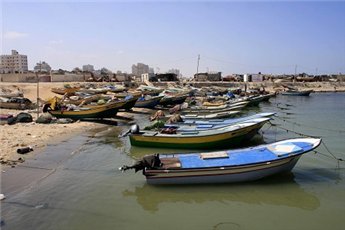
BETHLEHEM — Israeli naval forces attacked an international third party monitor on Wednesday in Gazan territorial waters.
Civil Peace Service Gaza works as part of a non-violent initiative to monitor human rights abuses in Gaza.
Israeli forces fired at the CPS Gaza monitoring boat, the Oliva, with water cannons on Wednesday at 12.05 p.m local time, a statement by the organization said.
There were four people aboard at the time, two CPS Gaza members, the captain and a journalist.
“We were fewer than two miles away from the Gaza coast when they fired at us. We saw them firing water at some fishing boats so we headed to the area. When we got close, the warships left the fishing boats, and turned on us.
“They attacked us for about ten minutes, following us as we tried to head to shore and eventually lagged when we reached about one mile off the Gaza coast,” British human rights worker Ruqaya Al-Samarrai said.
A fishing boat was also fired at and damaged with live rounds.
An Israeli army spokesman said he was unaware of the incident.
The Gazan fishing community is often similarly targeted and the fishing limit is enforced with comparable aggression, with boats shot at or rammed as near as 2 nautical miles to the coast by Israeli gunboats, CBS Gaza added.
A marine blockade imposed by Israel restricts Gazan fisherman from accessing eighty five percent of Gaza’s fishing waters as agreed upon under the Oslo agreements.
Following the capture of Israeli soldier Gilad Shalit in 2006 the Israeli navy imposed a complete sea blockade on the Gaza Strip for several months.
After Hamas took control of the coastal enclave in 2007, Israel limited fishing access to 3 nautical miles from the coast.
During the Oslo accords negotiators had agreed upon 20 nautical miles of fishing access along Gaza’s coastline.
Rights groups have condemned the blockade of Gaza as a form of collective punishment of the 1.6 million residents.
Arab poll: Obama worse than Bush, German poll: US bigger peace threat than Iran
Press TV – July 14, 2011
A recent survey conducted in Germany has revealed that the people of the European country perceive the United States as a more serious threat to global peace than Iran.
Results from the opinion poll carried out by the German social research and statistical analysis, Forsa, indicate that 45 percent of those surveyed believe that the US is a more serious threat to world peace than Iran.
Twenty-eight percent of the respondents deemed Iran a bigger threat than the US, with 27 percent unable to choose between the two.
The survey, which questioned 1,500 German adults on June 17-29, 2011, did not include other choices such as Israel, which analysts introduce as a better-known threat to peace in the world’s public opinion.
The results of the Forsa study come at a time when the US, the only country to have ever used nuclear bombs against another nation, is attempting to put mounting international pressure on Iran to force the Islamic Republic to halt its peaceful nuclear program.
Meanwhile, a new poll released on Wednesday cast light on the dissatisfaction of a vast majority of the people in the Arab world with US President Barack Obama and his administration’s policies in the Middle East.
The poll conducted by the Arab American Institute in the six Arab nations of Morocco, Egypt, Jordan, Saudi Arabia, Lebanon and the United Arab Emirates (UAE) demonstrated that the Obama administration is viewed less favorably in much of the Arab world today than that of his predecessor George W. Bush during his last year in office.
Only 5 percent of Egyptians surveyed said they have a favorable opinion of the US and its president. The same figure was 10 percent in Jordan and 12 percent in the UAE.
The poll also found that 88 percent of Moroccans think that Obama has not met the expectations laid out in his 2009 “Cairo speech.”
Disappointment with the US was highest in Lebanon, where 99 percent of the respondents disapproved of Obama’s policies. In Saudi Arabia, 77 percent of the respondents said they felt betrayed by the US.
Featured Video
Laith Marouf: Hezbollah’s position on US-Iran ceasefire
or go to
Aletho News Archives – Video-Images
From the Archives
The Dirty Little Secret behind the “Global Terrorism Index”
The Omission of Israeli Terrorism in the Occupied Palestinian Territories
By Karin Brothers | Global Research | December 6, 2014
… The Israeli settlements — all of which are illegal – have been identified as a major impediment to peace. The refusal of a major “global” terrorism report to name the Israeli settlers as one of the groups most responsible for terrorism not only misrepresents a major source of regional violence but exposes the Global Terrorism Index as a propaganda tool that supports a U.S. agenda.
In recent years, governments have been attempting to thwart terrorism by blocking supportive fund-raising. When it comes to Israeli settlements, however, the US and Canada actually encourage fund-raising by giving organizations (such as Christian Friends of Israeli Communities (CFOIC) and the Jewish National Fund) financial support in the form of donor tax-deductions.
Charities which provide funds for the Israeli settlements should be regarded as terror-financing organizations. They should not only lose their tax-deductible status, but they should be banned because they support the violation of international humanitarian law. The terror-financing laws that are being strictly enforced for Muslim charities should be applied to Christian and Jewish charities as well. … Read full article
Blog Roll
 Aletho News
- Trump Administration Moves To Automate U.S. Military Draft Registration
- Spain orders reopening of Tehran embassy, condemns Israel’s carpet bombing of Lebanon
- Israel faces ‘unsustainable’ strategic crisis following 40-day war against Iran: Analyst
- Iran restricts Hormuz access to 15 vessels per day under ceasefire terms: Report
- The ‘Opposition Party’ Has Done Nothing to Stop the Iran War and Much to Goad Trump Into Continuing It
- Moscow backs Tehran on status of Lebanon in US-Iran deal
- How UK Regulator Ofcom Quietly Bypassed International Law to Police American Speech
- The Black Cube Files: How Former Mossad Operatives Flipped a Nation
- Laith Marouf: Hezbollah’s position on US-Iran ceasefire: What you’re not being told
- Israel’s priority lies in destroying chances of peace between Iran, US: Ex-UN nuclear chief
- If Americans Knew
- The gallows law: Israel moves toward executing Palestinian children
- Tucker Carlson: The Path to Peace requires ending ‘special alliance’ with Israel
- This is ceasefire? Israel’s biggest massacre yet in Lebanon, another journalist killed in Gaza – Daily Update
- Tucker Carlson on Israel: This Is the Behavior of an Ally? Really?
- Gazans face a triple crisis: severe shortages of water and bread, healthcare in tatters
- NY Times reports how Netanyahu took the US into Iran War
- A sigh of relief over Iran, but Gaza and Lebanon in dire straits – Daily Update
- Thousands dead and neighborhoods razed to the ground: Aid agencies fear southern Lebanon is becoming the new Gaza
- The war the US is fighting for Israel could cost trillions
- ‘Cigarette Burns, Nail Wounds’: Toddler Tortured in Gaza to Coerce Father
- No Tricks Zone
- An Inconvenient Tree: Uncovered In Alps… Europe Much Warmer Than Today 6000 Years Ago
- New Study Reports A 60% Slowdown In Greenland’s Ice Loss Rate In The Last Decade
- Low Intensity Tornado Wrecks Major Solar Farm, Creating A Potential Toxic Dump
- New Study Finds Warming Saves Lives…Cold Temperatures 12 Times More Deadly Than Excess Heat
- German Science Blog Accuses PIK Climate Institute Of Hallucinating Climate Tipping Points
- Devastating Assessment Of Comirnaty Vaccine By Former Senior Pfizer Europe Toxicologist
- New Study: CO2 Is ‘Effectively Negligible’ As An Explanatory Climate Change Factor Since 2000
- Former Pfizer Toxicologist Dr. Helmut Sterz Tells Bundestag Hearing Pfizer Vaccine Should Have Never Been Approved
- Energy Expert: Germany’s Nuclear Phaseout Was A “500 Billion Euro Mistake”
- New Research: South Australia’s Mid-Holocene Sea Surface Temperatures Were 4°C Warmer Than Today
 Aletho News