Yet another program on “What Do White, Jewish Think-Tankers in D.C. Think the U.S. Should Do About Iran?”
By Nima Shirazi | Wide Asleep in America | July 21, 2011
During Bloggingheads‘ latest installment of “What Do White, Jewish Think-Tankers in Washington D.C. Think the U.S. Should Do About Iran?” , former AIPAC spokesman Josh Block, now a fellow at the bizarrely-named Progressive Policy Institute (given its penchant for espousing hawkish foreign policy views, especially on Iran), gave a veritable tutorial on how to cram every long-debunked fear-mongering talking point about the Islamic Republic into a mere 50-minute conversation. […]
In the course of his discussion with Joel Rubin, Director of Policy and Government Affairs at the Ploughshares Fund, Block repeated (among other things) the false claim that Obama “exposed” a secret Iranian nuclear enrichment at Fordow in September 2009, insisted that Iran seeks hegemony over the Middle East and is violently involved in Iraq, advocated forcefully for regime change (though he called it “democratic change”, and was oh so sincere about it), was adamant about Iran’s headlong pursuit of nuclear weapons (any other perspective, like one based evidence, was “nonsense”), said that the IAEA itself has said Iran has a nuclear weapons program, and even added a new mathematical assessment of Iran’s nuclear progress. He said that Iran’s mere capacity to enrich uranium up to 20% is “90%, if not more, of the ability to get to the fuel you need for a nuclear weapon.”
Despite Rubin’s efforts to infuse certain facts into the discussion (filtered, of course, through a significant amount of silliness of his own), Block remained a blowhard, a blabbermouth, and a liar. The best part, perhaps, was when Block, furrowed his brow, and said:
I’d like to see no war. I’d like to see peace! But I think the best chance to get there, the best chance to stop Iran from acquiring a nuclear weapon, which, by the way, it’s not just a question of them dropping a bomb on Israel. I mean, they went into the streets in 2009 and were brutal to their own people. They walk around saying Bahrain belongs to them. How will they act when they have a nuclear weapon? What kind of activity will we see then? Who will be able to stop them? How will they treat their people then?
Block advocated “more pressure” to “destabilize” the Iranian government in order to ensure his preferred outcome. He also refused to admit that Israeli and U.S. predictions about when Iran would obtain a nuclear weapon have been wrong for three decades. Rather, he credited sanctions for “working” over that time and then completely misrepresented the TRR nuclear deal between Iran, Brazil, and Turkey. […]
Block closed, predictably, by advocating a military attack on Iran by pretending to ask a rhetorical question.
The Pentagon & slave labor in U.S. prisons
June 14, 2011 | Kinetic Truth
Prisoners earning 23 cents an hour in U.S. federal prisons are manufacturing high-tech electronic components for Patriot Advanced Capability 3 missiles, launchers for TOW (Tube-launched, Optically tracked, Wire-guided) anti-tank missiles, and other guided missile systems. A March article by journalist and financial researcher Justin Rohrlich of World in Review is worth a closer look at the full implications of this ominous development. (minyanville.com)
The expanding use of prison industries, which pay slave wages, as a way to increase profits for giant military corporations is a frontal attack on the rights of all workers.
Prison labor — with no union protection, overtime pay, vacation days, pensions, benefits, health and safety protection, or Social Security withholding — also makes complex components for McDonnell Douglas/Boeing’s F-15 fighter aircraft, the General Dynamics/Lockheed Martin F-16, and Bell/Textron’s Cobra helicopter. Prison labor produces night-vision goggles, body armor, camouflage uniforms, radio and communication devices, and lighting systems and components for 30-mm to 300-mm battleship anti-aircraft guns, along with land mine sweepers and electro-optical equipment for the BAE Systems Bradley Fighting Vehicle’s laser rangefinder. Prisoners recycle toxic electronic equipment and overhaul military vehicles.
Labor in federal prisons is contracted out by UNICOR, previously known as Federal Prison Industries, a quasi-public, for-profit corporation run by the Bureau of Prisons. In 14 prison factories, more than 3,000 prisoners manufacture electronic equipment for land, sea and airborne communication. UNICOR is now the U.S. government’s 39th largest contractor, with 110 factories at 79 federal penitentiaries.
The majority of UNICOR’s products and services are on contract to orders from the Department of Defense. Giant multinational corporations purchase parts assembled at some of the lowest labor rates in the world, then resell the finished weapons components at the highest rates of profit. For example, Lockheed Martin and Raytheon Corporation subcontract components, then assemble and sell advanced weapons systems to the Pentagon.
Increased profits, unhealthy workplaces
However, the Pentagon is not the only buyer. U.S. corporations are the world’s largest arms dealers, while weapons and aircraft are the largest U.S. export. The U.S. State Department, Department of Defense and diplomats pressure NATO members and dependent countries around the world into multibillion-dollar weapons purchases that generate further corporate profits, often leaving many countries mired in enormous debt.
But the fact that the capitalist state has found yet another way to drastically undercut union workers’ wages and ensure still higher profits to military corporations — whose weapons wreak such havoc around the world — is an ominous development.
According to CNN Money, the U.S. highly skilled and well-paid “aerospace workforce has shrunk by 40 percent in the past 20 years. Like many other industries, the defense sector has been quietly outsourcing production (and jobs) to cheaper labor markets overseas.” (Feb. 24) It seems that with prison labor, these jobs are also being outsourced domestically.
Meanwhile, dividends and options to a handful of top stockholders and CEO compensation packages at top military corporations exceed the total payment of wages to the more than 23,000 imprisoned workers who produce UNICOR parts.
The prison work is often dangerous, toxic and unprotected. At FCC Victorville, a federal prison located at an old U.S. airbase, prisoners clean, overhaul and reassemble tanks and military vehicles returned from combat and coated in toxic spent ammunition, depleted uranium dust and chemicals.
A federal lawsuit by prisoners, food service workers and family members at FCI Marianna, a minimum security women’s prison in Florida, cited that toxic dust containing lead, cadmium, mercury and arsenic poisoned those who worked at UNICOR’s computer and electronic recycling factory.
Prisoners there worked covered in dust, without safety equipment, protective gear, air filtration or masks. The suit explained that the toxic dust caused severe damage to nervous and reproductive systems, lung damage, bone disease, kidney failure, blood clots, cancers, anxiety, headaches, fatigue, memory lapses, skin lesions, and circulatory and respiratory problems. This is one of eight federal prison recycling facilities — employing 1,200 prisoners — run by UNICOR.
After years of complaints the Justice Department’s Office of the Inspector General and the Federal Occupational Health Service concurred in October 2008 that UNICOR has jeopardized the lives and safety of untold numbers of prisoners and staff. (Prison Legal News, Feb. 17, 2009)
Racism & U.S. prisons
The U.S. imprisons more people per capita than any country in the world. With less than 5 percent of the world population, the U.S. imprisons more than 25 percent of all people imprisoned in the world.
There are more than 2.3 million prisoners in federal, state and local prisons in the U.S. Twice as many people are under probation and parole. Many tens of thousands of other prisoners include undocumented immigrants facing deportation, prisoners awaiting sentencing and youthful offenders in categories considered reform or detention.
The racism that pervades every aspect of life in capitalist society — from jobs, income and housing to education and opportunity — is most brutally reflected by who is caught up in the U.S. prison system.
More than 60 percent of U.S. prisoners are people of color. Seventy percent of those being sentenced under the three strikes law in California — which requires mandatory sentences of 25 years to life after three felony convictions — are people of color. Nationally, 39 percent of African-American men in their 20s are in prison, on probation or on parole. The U.S. imprisons more people than South Africa did under apartheid. (Linn Washington, “Incarceration Nation”)
The U.S. prison population is not only the largest in the world — it is relentlessly growing. The U.S. prison population is more than five times what it was 30 years ago.
In 1980, when Ronald Reagan became president, there were 400,000 prisoners in the U.S. Today the number exceeds 2.3 million. In California the prison population soared from 23,264 in 1980 to 170,000 in 2010. The Pennsylvania prison population climbed from 8,243 to 51,487 in those same years. There are now more African-American men in prison, on probation or on parole than were enslaved in 1850, before the Civil War began, according to Law Professor Michelle Alexander in the book “The New Jim Crow: Mass Incarceration in the Age of Colorblindness.”
Today a staggering 1-in-100 adults in the U.S. are living behind bars. But this crime, which breaks families and destroys lives, is not evenly distributed. In major urban areas one-half of Black men have criminal records. This means life-long, legalized discrimination in student loans, financial assistance, access to public housing, mortgages, the right to vote and, of course, the possibility of being hired for a job.
What Could Truly End the Space Program: a Nuclear Disaster Overhead
By KARL GROSSMAN | CounterPunch | July 22, 2011
What is NASA’s future now that Atlantis has landed and the shuttle program is over? If NASA persists in using nuclear power in space, the agency’s future is threatened.
Between November 25 and December 15 NASA plans to launch for use on Mars a rover fueled with 10.6 pounds of plutonium, more plutonium than ever used on a rover.
The mission has a huge cost: $2.5 billion.
But if there is an accident before the rover is well on its way to Mars, and plutonium is released on Earth, its cost stands to be yet more gargantuan.
NASA’s Final Environmental Impact Statement for what it calls its Mars Science Laboratory Mission says that if plutonium is released on Earth, the cost could be as high as $1.5 billion to decontaminate each square mile of “mixed-use urban areas” impacted.
What‘s the probability of an accident releasing plutonium? The NASA document says “the probability of an accident with a release of plutonium” is 1-in-220 “overall.”
If you knew your chance of not surviving an airplane flight—or just a drive in a car—was 1 in 220, would you take that trip?
And is this enormous risk necessary?
In two weeks, there will be a NASA mission demonstrating a clear alternative to atomic energy in space: solar power.
On August 5, NASA plans to launch a solar-powered space probe it’s named Juno to Jupiter. There’s no atomic energy involved, although NASA for decades has insisted that nuclear power is necessary for space devices beyond the orbit of Mars. With Juno, NASA will be showing it had that wrong.
“Juno will provide answers to critical science questions about Jupiter, as well as key information that will dramatically enhance present theories about the early formation of our own solar system,” says NASA on its website. “In 2016, the spinning, solar-powered Juno spacecraft will reach Jupiter.” It will be equipped with “instruments that can sense the hidden world beneath Jupiter’s colorful clouds” and make 33 passes of Jupiter.
As notes Aviation Week and Space Technology: “The unique spacecraft will set a record by running on solar power rather than nuclear radioisotope thermoelectric generators previously used to operate spacecraft that far from the Sun.”
The Mars rover to be launched, named Curiosity by NASA, will be equipped with these radioisotope thermoelectric generators using plutonium, the deadliest radioactive substance.
Juno, a large craft—66-feet wide—will be powered by solar panels built by a Boeing subsidiary, Spectrolab. The panels can convert 28 percent of the sunlight that them to electricity. They’ll also produce heat to keep Juno’s instruments warm. This mission’s cost is $1.1 billion.
In fact, Juno is not a wholly unique spacecraft. In 2004, the European Space Agency launched a space probe called Rosetta that is also solar-powered. Its mission is to orbit and land on a comet—beyond the orbit of Jupiter.
Moreover, there have been major developments in “solar sails” to propel spacecraft. Last year, the Japan Aerospace Exploration Agency launched its Ikaros spacecraft with solar sails taking it to Venus. In January, NASA itself launched its NanoSail-D spacecraft. The Planetary Society has been developing several spacecraft that will take advantage of photons emitted by the Sun to travel through the vacuum of space.
At no point will Juno (or the other solar spacecrafts) be a threat to life on Earth. This includes Juno posing no danger when in 2013 it makes a flyby of Earth. Such flybys making use of Earth’s gravity to increase a spacecraft’s velocity have constituted dangerous maneuvers when in recent years they’ve involved plutonium-powered space probes such as NASA’s Galileo and Cassini probes.
Curiosity is a return to nuclear danger.
NASA’s Final Environmental Impact statement admits that a large swath of Earth could be impacted by plutonium in an accident involving it. The document’s section on “Impacts of Radiological Releases” says “the affected environment” could include “the regional area near the Cape Canaveral Air Force Station and the global area.”
“Launch area accidents would initially release material into the regional area, defined…to be within …62 miles of the launch pad,” says the document. This is an area from Cape Canaveral west to Orlando.
But “since some of the accidents result in the release of very fine particles less than a micron in diameter, a portion of such releases could be transported beyond…62 miles,” it goes on. These particles could become “well-mixed in the troposphere”—the atmosphere five to nine miles high—“and have been assumed to potentially affect persons living within a latitude band from approximately 23-degrees north to 30-degrees north.” That’s a swath through the Caribbean, across North Africa and the Mideast, then India and China Hawaii and other Pacific islands, and Mexico and southern Texas.
Then, as the rocket carrying Curiosity up gains altitude, the impacts of an accident in which plutonium is released would be even broader. The plutonium could affect people “anywhere between 28-degrees north and 28-degrees south latitude,” says the NASA document. That’s a band around the mid-section of the Earth including much of South America, Africa and Australia.
Dr. Helen Caldicott, president emeritus of Physicians for Social Responsibility, has long emphasized that a pound of plutonium if uniformly distributed could hypothetically give a fatal dose of lung cancer to every person on Earth. A pound, even 10.6 pounds, could never be that uniformly distributed, of course. But an accident in which plutonium is released by a space device as tiny particles falling to Earth maximizes its lethality. A millionth of a gram of plutonium can be a fatal dose. The pathway of greatest concern is the breathing in plutonium particle..
As the NASA Environmental Impact Statement puts it: “Particles smaller than about 5 microns would be transported to and remain in the trachea, bronchi, or deep lung regions.” The plutonium particles “would continuously irradiate lung tissue.”
“A small fraction would be transported over time directly to the blood or to lymph nodes and then to the blood,” it continues. Once plutonium “has entered the blood via ingestion or inhalation, it would circulate and be deposited primarily in the liver and skeletal system.” Also, says the document, some of the plutonium would migrate to the testes or ovaries.
The cost of decontamination of areas affected by the plutonium could be, according to the NASA statement, $267 million for each square mile of farmland, $478 million for each square mile of forests and $1.5 billion for each square mile of “mixed-use urban areas.”
The NASA document lists “secondary social costs associated with the decontamination and mitigation activities” as: “Temporary or longer term relocation of residents; temporary or longer term loss of employment; destruction or quarantine of agricultural products including citrus crops; land use restrictions which could affect real estate values, tourism and recreational activities; restriction or bands on commercial fishing; and public health effects and medical care.”
As to why the use of a plutonium-powered rover on Mars—considering that NASA has successfully used solar-powered rovers on Mars—the NASA Environmental Impact Statement says that a “solar-powered rover…would not be capable of operating over the full range of scientifically desirable landing site latitudes” on this mission.
There’s more to it. For many decades there has been a marriage of nuclear power and space at NASA. The use of nuclear power on space missions has been heavily promoted by the U.S. Department of Energy and its predecessor agency, the U.S. Atomic Energy Commission, and the many DOE (previously AEC) national laboratories including Los Alamos and Oak Ridge. This provides work for these government entities. Also, the manufacturers of nuclear-powered space devices—General Electric was a pioneers in this—have pushed their products. Further, NAS has sought to coordinate its activities with the U.S. military. The military for decades has planned for the deployment of nuclear-powered weapons in space.
Personifying the NASA-military connection now is NASA Administrator Charles Bolden, a former NASA astronaut and Marine Corps major general. Appointed by President Barack Obama, he is a booster of radioisotope thermoelectric generators as well as rockets using nuclear power for propulsion. The U.S. has spent billions of dollars through the years on such rockets but none have ever taken off and the programs have all ended up cancelled largely out of concern about a nuclear-powered rocket blowing up on launch or falling back to Earth.
Accidents have happened in the U.S. space nuclear program. Of the 26 space missions that have used plutonium which are listed in the NASA Environmental Impact Statement for the Mars Science Laboratory Mission, three underwent accident causing, admits the document.
The worst occurred in 1964 and involved, it notes, the SNAP-9A plutonium system aboard a satellite that failed to achieve orbit and dropped to Earth, disintegrating as it fell. The 2.1 pounds of plutonium fuel dispersed widely over the Earth and Dr. John Gofman, professor of medical physics at the University of California at Berkeley, long linked this accident to an increase in global lung cancer. With the SNAP-9A accident, NASA switched to solar energy on satellites. Now all satellites—and the International Space Station—are solar-powered.
There was a near-miss involving a nuclear disaster and a space shuttle. The ill-fated Challenger’s next mission in 1986 was to loft a plutonium-powered space probe.
The NASA Environmental Impact Statement includes comments from people and organizations some highly critical of a plutonium-powered Mars Science Laboratory Mission.
Leah Karpen of Asheville, North Carolina says: “Every expansion of plutonium research, development and transportation of this deadly material increases the risk of nuclear accident or theft. In addition, plutonium production is expensive and diverts resources from the more important social needs of our society today, and in the future.” She urges NASA “to reconsider the use of nuclear” and go with solar instead.
Jeremy Maxand, executive director of the Idaho-based Snake River Alliance, calls on NASA and the Department of Energy to “take this opportunity to move space exploration in a sustainable direction with regard to power. Using solar rather than nuclear to power the Mars Science Laboratory Mission would keep the U.S. safe, advance energy technologies that are cleaner and more secure, be more fiscally responsible, and set a responsible example to other countries as they make decisions about their energy future.”
Ace Hoffman of Carlsbad, California speaks of “today’s nuclear NASA” and a “closed society of dangerous, closed-minded ‘scientists’ who are hoodwinking the American public and who are guilty of premeditated random murder.” He adds: “The media has a duty to learn the truth rather than parrot NASA’s blanketly-false assertions.”
NASA, in response to the criticisms, repeatedly states in the document: “NASA and the DOE take very seriously the possibility that an action they take could potentially result in harm to humans or the environment. Therefore, both agencies maintain vigorous processes to reduce the potential for such events.”
Involved in challenging the mission is the Global Network Against Weapons & Nuclear Power in Space (www.space4peace.org). Bruce Gagnon, coordinator of the Maine-based organization, says that “NASA sadly appears committed to maintaining their dangerous alliance with the nuclear industry. Both entities view space as a new market for the deadly plutonium fuel.” Says Gagnon: “The taxpayers are being asked once again to pay for nuclear missions that could endanger the life of all the people on the planet…Have we not learned anything from Chernobyl and Fukushima? We don’t need to be launching nukes into space. It’s not a gamble we can afford to take.”
With the return of Atlantis and end of the shuttle program, there are concerns about this being the “end” of the U.S. space program.
An accident if NASA continues to insist on mixing nuclear power and atomic energy—a nuclear disaster overhead—that, indeed, could end the space program.
~
Karl Grossman, professor of journalism at the State University of New York/College of New York, is the author of the book, The Wrong Stuff: The Space’s Program’s Nuclear Threat to Our Planet(Common Courage Press) and wrote and presented the TV program Nukes In Space: The Nuclearization and Weaponization of the Heavens (www.envirovideo.com).
Tortured Kenyans allowed to sue UK government
Press TV – July 22, 2011
Four Kenyans have been allowed to sue the British government over the atrocities committed by the UK army against the anti-colonial Mau Mau uprising in the 1950s.
The British Foreign and Commonwealth Office (FCO) had insisted that the British government would not answer for the abuses committed by the former British colony and that legal responsibility referred to the present Kenyan government.
The recent decision means that the UK government will face charges of torture, murder and sexual assault among other alleged crimes.
Around 17,000 documents were found in the British Foreign Office’s archives, seen by the ministers in 1950s and 60s, which revealed the details of the UK army’s harsh measures.
Four elderly Kenyans Ndiku Mutwiwa Mutua, Paulo Muoka Nzili, Wambugu Wa Nyingi and Jane Muthoni Mara stressed that the documents from a paper trail showed that the UK ministers had approved abuse in their detention camps.
Earlier this year, Mutua and Nzili told the British High Court that they had been castrated, Nyingi had been hit unconscious, and Mara had fallen the victim of sexual abuse.
High Court Justice McCombe said that the claimants have arguable cases, which were fit for trial.
“I emphasize that I have not found that there was systematic torture in the Kenyan camps nor that, if there was, the UK government is liable to detainees, such as the claimants, for what happened,” he said.
The Kenyans’ lawyer said the ruling that the UK government could be held responsible for the anti-human rights actions in the colonies was a “historic judgment,” adding in the past 50 years his clients suffered the worst torture at the hands of the British Colonial regime.
“Castration, abuse, severe beatings, were just some of what they had to endure as the British tried to prevent the advance of the Kenyan Independence movement…Our government has seemed hell-bent on preventing that happening,” the lawyer said.
Recalling his clients’ sufferings, the attorney called for “some sort of justice, an apology, some sort of money that would give them peace in their final years.”
Human rights lawyer Paul Muite said what British soldiers did in Kenya, a British colony at the time, was “shameless and immoral.”
“These were terrible atrocities committed by British soldiers, not by the government of Kenya,” he said, adding that, “These people were fighting for justice, liberty and their land.”
Settlers start fires across the West Bank
Ma’an – 22/07/2011

BETHLEHEM — Palestinian firefighters have been battling blazes across the West Bank as Israeli settlers set fire to land in multiple locations on Thursday night.
Reports earlier on Friday said that settlers had torched agricultural fields near the village of Burin in the West Bank city of Nablus.
“Some settlers from the Yizhar settlement adjacent to the village set fire to the area south of the village and fled the scene,” Head of Burin village council Ali Ead told Ma’an.
Hundreds of residents in the village arrived at the scene and helped extinguish the fire.
Reports also emerged that fires had been started by settlers in the districts of Nablus, Salfit, Tulkarem and north of Jerusalem.
After nine hours, firefighters finally managed to extinguish a blaze started by settlers in Al-Badhan village, north of Nablus, which destroyed 150 dunams of land and olive trees, the Palestinian Civil Defense said Friday.
Fires in other West Bank districts also reportedly destroyed hundreds of dunams of Palestinian land.
Residents in the village of Burin near Nablus had helped extinguish a fire set by settlers on Friday as 5,000 trees and 150 olive trees were destroyed.
Firefighters also rushed to a blaze in the village of Beit Iksa, north of Jerusalem after receiving information that Israeli soldiers had uprooted olive trees.
Fires were also put out in Salfit, after breaking out on 150 dunams of grass and destroying 90 olive trees.
In the Tulkarem district, fires destroyed at least 100 olive trees in an area between the villages of Izbat Shofa and Bala.
The latest attacks by settlers come amid a string of violent incidents in the occupied West Bank.
On Monday, settlers attacked a group of international observers near Hebron, the fifth such case of settler violence against internationals in the area over the last 30 days.
Also on Monday, settlers attacked three Palestinian shepherds near Jerusalem, causing serious injuries.
On Friday July 15, Israeli settlers from the illegal settlement of Yizhar set fire to Palestinian land near the village of Burin, south of Nablus.
Two days earlier, a Palestinian teenager sustained bruises after Israeli settlers pelted his car with stones near the site of the former Israeli settlement of Homesh, which was evacuated in 2005.
According to the Fourth Geneva Convention, the Hague Regulations, the International Court of Justice, and several United Nations resolutions, all Israeli settlements and outposts in the Occupied Palestinian Territories are illegal.
A report by the Palestinian Authority found that settler violence increased “dramatically” in June 2011, documenting 139 attacks on Palestinians in the West Bank and the destruction of over 3,600 olive trees and vineyards.
An Israeli army general recently warned that unchecked settler “terror” against Palestinians in the occupied West Bank threatens to plunge the territory into conflict, reports said.
The grumpy diplomats of the rogue state
By Ilan Pappe | The Electronic Intifada | 22 July 2011
The Israeli ambassador to Spain, Raphael Schutz, has just finished his term in Madrid. In an op-ed in Haaretz’s Hebrew edition he summarized what he termed as a very dismal stay and seemed genuinely relieved to leave.
This kind of complaint now seems to be the standard farewell letter of all Israeli ambassadors in Western Europe. Schutz was preceded by the Israeli ambassador to London, Ron Prosor, on his way to his new posting at the United Nations in New York, complaining very much in the same tone about his inability to speak in campuses in the United Kingdom and whining about the overall hostile atmosphere. Before him the ambassador in Dublin expressed similar relief when he ended his term in office in Ireland.
All three grumblers were pathetic but the last one from Spain topped them all. Like his colleagues in Dublin and in London he blamed his dismal time on local and ancient anti-Semitism. His two friends in the other capitals were very vague about the source of the new anti-Semitism as both in British and Irish history it is difficult to single out, after medieval times, a particular period of anti-Semitism.
But the ambassador in Madrid without any hesitation laid the blame for his trials and tribulations on the fifteenth century Spanish Inquisition. Thus the people of Spain (his article was entitled “Why the Spanish hate us”) are anti-Israeli because they are either unable to accept their responsibility for the Inquisition or they still endorse it by other means in our times.
This idea that young Spaniards should be moved by atrocities committed more than 500 years ago and not by criminal policies that take place today, or the notion that one could single out the Spanish Inquisition as sole explanation for the wide public support for the Palestinian cause in Spain, can only be articulated by desperate Israeli diplomats who have long ago lost the moral battle in Europe.
But this new complaint — and I am confident that there are more to come — exposes something far more important. The civil society struggle in support of Palestinian rights in key European countries has been successful. With few resources, sometimes dependent on the work of very small groups of committed individuals, and aided lately by its biggest asset — the present government of Israel – this campaign has indeed made life quite hellish for every Israeli diplomat in that part of the world.
So when we come and assess what is ahead of us, we who have been active in the West are entitled to a short moment of satisfaction at a job well done.
The three grumpy ambassadors are also right in sensing that not only has Israeli policy in the occupied West Bank and Gaza Strip come under attack, but also the very racist nature of the Jewish state has galvanized decent and conscientious citizens — many of them Jewish — around the campaign for peace and justice in Palestine.
Outside the realm of occupation and the daily reality of oppression all over Israel and Palestine, one can see more clearly that history’s greatest lesson will eventually reveal itself in Palestine as well: evil regimes do not survive forever and democracy, equality and peace will reach the Holy Land, as it will the rest of the Arab world.
But before this happens we have to extricate ourselves from the politicians’ grip on our lives. In particular we should not be misled by the power game of politicians. The move to declare Palestine, within 22 percent of its original being, as an independent state at the UN is a charade whether it succeeds or not.
A voluntary Palestinian appeal to the international community to recognize Palestine as a West Bank enclave and with a fraction of the Palestinian people in it, may intimidate a Likud-led Israeli government, but it does not constitute a defining moment in the struggle for the liberation of Palestine. It would either be a non-event or merely provide the Israelis a pretext for further annexation and dispossession.
This is another gambit in the power game politicians play which has led us nowhere. When Palestinians solve the issue of representation and the international community exposes Israel for what it is — namely the only racist country in the Middle East — then politics and reality can fuse again.
Slowly and surely we will be able to put back the pieces and create the jigsaw of reconciliation and truth. This must be based on the twofold recognition that a solution has to include all the Palestinians (in the occupied territories, in exile and inside Israel) and has to be based on the construction of a new regime for the whole land of historical Palestine, offering equality and prosperity for all the people who live there now or were expelled from it by force in the last 63 years of Israel’s existence.
The obvious discomfort the three diplomats felt and expressed is not due to any cold shoulder shown to them in local foreign ministries or governments. And therefore while many Europeans can make their lives miserable, their respective governments can still look the other way.
Whether it is financial desperation and external Israeli and American pressure that bought Greece’s collaboration against the Gaza Freedom Flotilla or it is the power of intimidation that silences even progressive newspapers like the Guardian in the West, Israel’s immunity is still granted despite its diplomats’ misery.
This is why we should ensure that not only Israeli ambassadors feel uncomfortable in European capitals, but also all those who support them or are too afraid to confront Israel and hold it to account.
Ilan Pappe is Professor of History and Director of the European Centre for Palestine Studies at the University of Exeter. His most recent book is Out of the Frame: The Struggle for Academic Freedom in Israel (Pluto Press, 2010).
‘Iran will deny UN rapporteur entrance’
Press TV – July 21, 2011
Iran’s Foreign Ministry Spokesman Ramin Mehmanparast says the Islamic Republic will not allow the UN special Rapporteur on human rights to enter the country.
“Appointing a UN special Rapporteur on human rights for Iran is a political and illegal move, and the Islamic Republic will not allow the envoy to enter the country under any circumstances,” Mehmanparast said on Thursday.
In a move spearheaded by the US, in June the UN Human Rights Council named former Maldivian Foreign Minister Ahmed Shaheed as its human rights investigator on Iran.
“Unfortunately the human rights issue is the political tool of certain Western countries which have serious problems with regards to human rights and are accused of many cases of violating human rights,” Mehmanparast added.
The Iranian official added that appointing the UN special Rapporteur on human rights for Iran aims at mounting political pressure on Tehran.
Tehran blames Western governments, the US administration in particular, for violating international laws, disregard for the basic rights of their citizens and support for violation of human rights across the globe.
A National Park for Nukes?
By DARWIN BOND-GRAHAM | CounterPunch | July 20, 2011
When the Truman administration dropped the atomic bomb on Japan in 1945, they not only initiated a Cold War struggle against the Soviet Union, they also began a struggle over the meaning of the atom bomb inside the United States.
It began slowly. Criticism of the bomb was at first strongly repressed by McCarthyism and other militaristic histrionics, but by the late 1950s hard questions about nuclear weapons were publicly being raised. By the late 1960s doubts and criticisms went mainstream. Disillusioned Americans wondered, had it been necessary to reduce two Japanese cities to dust, killing hundreds of thousands in mere seconds? Was it necessary to sacrifice vast zones of the American West to uranium mining, nuclear dumps, testing grounds, and weapons silos? Had the government acted in hasty ignorance, or in knowing neglect when it allowed miners and downwinders and soldiers to be poisoned with radioactive dust? Was there really a “missile gap”? Did atomic scientists actually purposefully expose their own children to radiation? Would it be possible to survive nuclear war, as the experts told us? What did the creators of the atom bomb really think about their “achievement”? What opportunity costs was our multi-trillion dollar investment in nukes imposing upon us as a country?
These and other questions about the nation’s commitment to nuclear weapons were intensely debated as the Vietnam war rose to a fever pitch. New evidence continually surfaced revealing that the federal government had often acted with malice and intentional deception throughout the Manhattan Project, through the 1950s, and beyond. Historians began to document the realities of the nuclear age, including willful poisonings, and experimental defilement of the people and ecosystems of North America, especially Nevada’s Great Basin, and also the South Pacific’s Marshall Islands, and other testing and nuclear dumping grounds where generations would suffer on lands poisoned for thousands of years.
Quickly much of the logic that had justified the dropping of the atomic bomb on Hiroshima and Nagasaki came apart, and newer, more informed histories were drafted, showing cynical US leaders bent on punishing Japan and thwarting Soviet occupation of that island, not quickly ending the war and saving US and Japanese life. Gar Alperovitz’s “The Decision to Use the Atomic Bomb” presented the bones of this argument. Tsuyoshi Hasegawa’s “Racing the Enemy” concluded the argument in extensively researched detail.
In other exposés of journalism and archival research the nuclear labs and testing grounds of America were exposed not as monuments to great achievements of science and national will, but rather as institutions of hubris and death, occupying stolen Indian lands, and dreaming up ever more deadly doomsday machines in the forms of thermonuclear weapons, MIRVed missiles, neutron bombs, and the Strategic Defense Initiative. The willingness of US leaders to threaten the use of nuclear weapons again and again against non-nuclear states was revealed, particularly after Vietnam.
The nation’s nuclear weapons program lost its early luster then as many Americans came to fully grasp the toxic legacy, and understand the antidemocratic tendencies inexorably tied to the bomb and the institutions that created it. The 1980s brought this awareness to a peak as public perceptions of the bomb and its creators congealed around condemnation and a desire to abolish nuclear weapons.
When the Cold War ended the toxic legacy of the Manhattan Project and the continuing US nuclear weapons program was subjected to its greatest scrutiny of all. Losing their mythical rival in the Soviet “evil empire,” the weapons labs entered a long decade of scandalous revelation; declining morale, accidents, corruption, theft, espionage, greed, incompetence. The 1990s and early 2000s brought repeated crises for the US nuclear establishment. ‘If only it were possible to bring back the good old days,’ thought the bewildered senior weaponeers. However, these good old days too were tarnished by the truth.
All the while, all through these eras of revelation and crisis, the weaponeers who dedicated their lives to the nuclear enterprise waged a battle of ideas to hide the ugly truths of the Manhattan Project’s historical legacy. These acolytes of nuclearism —old Cold Warriors retired from the weapons labs, the Department of Energy, the military, and the private sector corporations that have made billions from building the bomb and spoiling the land and water and DNA of large swaths of the earth— they organized their own effort to re-write history all over again, to recast nuclearism in the benevolent form it had lost. They sought to recapture former glories that had withered through decades of sobering reality. As public perceptions of the bomb and the nuclear labs further soured they stepped up their game, especially in the 1990s.
Their revisions began modestly enough, but quickly turned into a national institutionalized effort. Historical foundations were incorporated by DOE retirees and nuclear boosters around various Cold War nuclear weapons sites. Soon large sums of money were raised, and with the eager cooperation of the nuclear labs and military-industrial corporations still designing and building nuclear arms, museums were opened to the public. These museums grew into absurdly large and well financed propaganda pieces.
The Bradbury Museum in downtown Los Alamos, named after Norris Bradbury, the second Los Alamos Laboratory director, became a museum of “science,” not just of the lab, or simply the weapons it built, or merely the Cold War. No, it is “science.” This aspiration to educate the public about “general science” was reflected LANL’s intense effort in the 1990s and early 2000s to obscure its own core mission of nuclear weapons, constantly draping itself in the prestige of being a “national laboratory,” or as the lab still describes itself, “a premier national security research institution, delivering scientific and engineering solutions for the nation’s most crucial and complex problems.” The lab also launched its own history web site in the 2000s showing its preferred arc of development, from the Manhattan Project to “computing,” and “basic science,” even though the lab remained thoroughly a nuclear weapons facility, and today is in fact becoming more and more dedicated to weapons manufacturing.
Inside the Bradbury Museum is an entire history of LANL, the Manhattan Project, nuclear science, and a few exhibits extolling the lab’s supposedly non-nuclear contributions. Full scale nuclear missiles and bombs float on wires above and sit in displays within arms reach. You’re encouraged to touch the bomb. You’re told not to fear radiation. The Bradbury Museum, funded with federal dollars, became a key site of struggle over history in the 1990s as community groups battled the lab and DOE to include a different interpretation of the dropping of the atomic bombs on Japan, a narrative that didn’t claim it was a “necessity” to end the war and save lives, one that showed in images, and described through first hand accounts what the victims experienced. Parties without an agenda to promote nuclear weapons were, in other words, simply asking the Bradbury to present the history that most historians now acknowledge as most complete. In the end the lab and museum’s staff, composed of pro-nuclear managers, allowed an alternative display in a dark corner of the museum, completely marginalized from the rest of the lavish exhibits.
For about a decade the Bradbury Museum stood as the premier pro-nuclear weapons propaganda tool. Other sites within the weapons complex were busy building their own museums though. The Nevada Test Site opened the Atomic Testing Museum in Las Vegas in 2005 after a pro-nuclear weapons lobby, the Nevada Test Site Historical Foundation, raised enough money and convinced the Smithsonian Institute to join up.
It should be noted that the Nevada Test Site Historical Foundation, like the foundations that run or help support the Bradbury and other nuclear museums, is run by a roster of retired Test Site employees and contractors, all strong believers in nuclear weapons as forces of unquestionable good in the nation’s past and present. The NTSHF’s president Nick Aquilina, for example, was described in a tribute published in the Congressional Record in 1994 as a man who “characterizes the spirit and dedication of a generation of Americans who dedicated their lives to maintaining our nuclear deterrent”. Aquilina was a thirty-two year career DOE manager. The foundation’s chairman, Troy Wade, is head of the Nevada Alliance for Defense, Energy and Business, a lobby for the state’s military-industrial complex, and also a retired DOE manager. With or without the Smithsonian’s involvement it’s obvious what sort of historical narrative about nuclear weapons testing attendees will be exposed to.
In the Atomic Testing Museum one is subjected to an entire historical narrative emphasizing the race for the bomb between the USA and Germany, culminating in the “necessary” dropping of the bomb on Japan, and then describing decades of testing in the desert northwest of Vegas, emphasizing the greatness of nuclear weapons and the men who built and blew them up. It’s all packaged in a feel good, almost kitschy nostalgia. There’s even a theater where you can sit through a simulated nuclear blast in which air is blown into your face and the bench beneath you rumbles and shakes. The kids must love that.
The biggest museum contribution to the pro-nuclear weapons historical narrative to date, however, is the National Museum of Nuclear Science & History. Located in a hanger-sized building along a major boulevard in Albuquerque, New Mexico, just blocks from Sandia National Laboratories and Kirtland Air Force Base (where thousands of nuclear weapons are currently stockpiled) the National Museum of Nuclear Science & History is nothing less than a flattering shrine to nuclear weapons, replete with a seventy foot tall Redstone missile in the front parking lot. Like the Atomic Testing Museum, the National Museum of Nuclear Science and History is also a Smithsonian affiliate, but it casts its own role in much grander terms: according to the Museum’s web site, its “mission is to serve as America’s resource for nuclear history and science.” That’s “America’s resource” singular – a one stop oracle of truth.
Like Bradbury or the Atomic Testing Museum, the National Museum’s exhibits extoll the history of nuclear science, recounting a narrative filled with bravery and wonder regarding the Manhattan Project’s personalities. The dropping of the atomic bomb on Japan is predictably explained as a benevolent, if unfortunate necessity to save the lives of not only American GIs, but also Japanese women and children. The National Museum of Nuclear Science & History also has a backyard in which it displays decommissioned nuclear-capable aircraft, disassembled nuclear missiles, nuclear rocket launchers, and even a submarine. Like the other pro-nuclear museums everything is kid friendly. You can walk right up and rub your hand on the nose of a nuclear missile.
Apparently not satisfied with this now national network of pro-nuclear weapons museums, each with multi-million dollar budgets and tens of thousands of visitors (there’s another in TOak Ridge, Tennessee called the American Museum of Science and Energy, and the B Reactor Museum Association in Richland, Washington) the nuclear weaponeers have for years sought a more powerful medium through which to communicate their hagiography of nuclear weapons.
In 2004 they found it in a bill sponsored by New Mexicos’ Democratic Senator Jeff Bingaman (it was probably dreamed up and written by the same pro-nuclear weapons boosters who organized and built the atomic propaganda museums in Los Alamos and Albuquerque). Senator Bingaman, in partnership with his then senior colleague Senator Pete Dominici, and also the two Senators from Washington State, and Sen. Lamar Alexander of Tennessee, introduced the “Manhattan Project National Historical Park Study Act,” the first step in establishing a national park dedicated to nuclear weapons. Money for the study was initially hard to find, but eventually allocated. Completed recently, the Obama administration announced on the 13th of July its intention to embrace this project and create a national historic park in Los Alamos, New Mexico.
It would be a very strange national park. Los Alamos Laboratory was built on sacred lands filled with Native American ruins, existing and extensively used ceremonial sites, burial grounds, and other places of profound cultural significance to the Pueblo tribes of the Rio Grande Valley. Were it not a nuclear weapons lab, it is likely it would have long ago been deemed reservation land because of its true ownership, or a National Park because of its sublime beauty, or given some other dedication of preservation and reverence.
Pressing against LANL’s boundaries on three sides already is the Bandelier National Monument, created in 1916 by Congress, and containing tens of thousands of archaeological sites and 23,000 acres of wilderness. As a National Park Service property should be, Bandelier is dedicated to the high desert, to the western pine, juniper, and fir forests of the Southwest, and to a history of human habitation that is thousands of years old. When Los Alamos was built, it was on top of this one-of-a-kind landscape that Congress had previously recognized as nationally unique and worthy of preservation. The lab colonized this landscape and occupied it with gigantic industrial-nuclear manufacturing and testing facilities. The spotted owls, coyotes, and spirits of the land, one imagines, fled the fumes and noise.
The entire notion of creating a national park dedicated to the history of nuclear weapons seems completely out of sync with the purpose of parks. The National Parks Service, for example, explains in its own criteria for establishing national parks that, “hunting, mining, and other consumptive uses such as grazing are generally prohibited in National Parks”. Well what about nuclear weapons designing, nuclear waste dumping, high explosives testing, and biological warfare experimentation? What about planning for and manufacturing the weapons for the annihilation of entire ecosystems? Is that allowed in National Parks? It will be if this plan moves forward.
The National Parks Service has already had to defend this proposal from criticism leveled by myself and my colleague Greg Mello of the Los Alamos Study Group. According to a spokesperson for the NPS, the Manhattan Project’s sites “are significant parts of our national cultural history. And before they get bulldozed over, we are in favor of preserving these places so future generations can study these events, for good or bad.” This description all sounds very neutral and useful, but it’s not at all what’s happening.
The problem with this sort of thinking is that it completely ignores how the proposal to create a Manhattan Project National Historic Park came about, that it was the idea of pro-nuclear lobbyists who have already succeeded in creating a national network of taxpayer-funded, Smithsonian-affiliated museums dedicated to glorifying nuclear weapons. These parties are not interested in preserving places for unbiased reflection on the bomb’s creation. They are set on valorizing nuclear weapons, and they understand that a National Historic Park for the Manhattan Project would be the pinnacle.
And more than anything, they understand that reclaiming the past and re-polishing the bomb’s image by dedicating a National Park to it will serve their aims today, aims that include pushing ahead with highly controversial and historically unprecedented investments in new nuclear weapons.
Los Alamos is, after all, currently undertaking a construction program that is larger in dollar terms than the entire Manhattan Project in New Mexico, all to build a new plutonium bomb pit factory.
Darwin Bond-Graham is a sociologist who splits his time between New Orleans, Albuquerque, and Navarro, CA. He can be reached at: darwin@riseup.net
Rahm Emanuel: Chicago’s War Criminal/Anti-Labor Mayor
By Stephen Lendman | July 19, 2011
Except for Harold Washington’s 1983 – 1987 tenure until his untimely death, Chicago never had populist mayors, notably under father Richard J. (April 20, 1955 – December 20, 1976) and son Richard M. Daley (April 24, 1989 – May 16, 2011).
However, after two months in office, Emanuel looks likely to be Chicago’s worst, based on policy initiatives he supports.
As White House chief of staff, he was criminally part of Obama’s war cabinet. As Chicago’s mayor, he’s waging it against labor.
Candidate Emanuel, in fact, promised draconian anti-worker cuts “in attacking our budget deficit, (so) there must be no sacred cows…. Chicago will have to make tough choices, (forcing) more than $500 million in efficiencies” on the backs of working Chicagoans already struggling to get by when they need help, not greater sacrifices they can’t afford.
No matter, slash and burn now is policy, including layoffs, wage freezes, and benefit cuts, notably targeting healthcare and pensions. Then in June, Emanuel rescinded a contractual 4% raise owed 30,000 teachers, indicating the same policy would follow for other Chicago Public Schools (CPS) employees as part of his war on public education and Chicago workers.
In late June, it continued with 1,000 teachers fired, besides 4,000 since 2009, school closures, larger class sizes, and other draconian measures. Reassigned teachers retain salaries and benefits for one year as “interim” substitute staff. If not kept after 10 months, they’re “honorabl(y) terminated.”
In other words, fired, no matter their qualifications, tenure, or student needs. In fact, many other teachers were sacked without temporary pay or benefits, according to union officials, who have little to boast about after endorsing Illinois Senate Bill 7 (SB 7).
Its provisions include using standardized tests to fire teachers, regardless of seniority, tenure, qualifications, or how students respond to effective classroom practices, what rote memory tests can’t measure. It also lets school districts increase hours per day, and add extra school weeks, with no additional compensation. In addition, teacher strikes are prohibited until after four months of negotiations plus a special arbitration panel’s ruling.
Even then, the Chicago Teachers Union (CTU) must give 10 days notice backed by 75% of its members to approve a walkout. In other words, SB 7 empowers state and city authorities over their right to demand equity or walk out.
At the same time, CPS executives got salary increases up to 30% over their predecessors. Emanuel’s new CPS head, Jean-Claude Brizard, earns $250,000 plus a 15% incentive package. Earlier as Rochester, New York public schools superintendent, 95% of teachers deplored his policies in office.
Moreover, he’s named in two federal lawsuits regarding improper handling of budget cuts and school closures. Earlier, he attended the notorious Superintendents’ Academy of the Broad Center for the Management of School Systems, founded by corporate predator Eli Broad to train administrators on restructuring and privatizing public education at the expense of educating kids.
Nonetheless, Emanuel wants him to replicate what he did in Rochester. Elizabeth Swanson is his deputy chief of staff, formerly (billionaire Penny) Pritzker Traubert Family Foundation executive director.
It advocates merit pay, school privatizations, and other regressive policies supported by Arne Duncan, former CPS head. He’s now Obama’s Education Secretary, appointed to wreck public education nationwide through his Race to the Top scheme, linking federal funding to compliance with retrograde federal standards. They mandate:
— open-ended conversion of public schools to charter or for-profit ones;
— running them by marketplace rules;
— requiring state laws conform with federal ones;
— linking teacher pay to student achievement as determined by standardized tests that measure rote memory, not real learning or preparation for higher education;
— destroying unions and teacher benefits;
— empowering bureaucrats over parents to decide what’s best for their children;
— creating a two-tiered, class and income-based system, favoring affluent communities over poor ones, denying poor kids real education and a chance for a better future; and
— destroying public education by creating another business profit profit center.
Emanuel plans more of it for Chicago, including weakening collective bargaining and teachers’ right to strike, the same core issues Wisconsin state workers tried and so far failed to save, perhaps heading for the chopping block in Chicago.
In fact, Emanuel explained:
“As we (prohibit strikes by) police and firefighters, I would have it for teachers because they provide an essential service.”
Of course, so do all public and private workers, entitled to rights like everyone, including to bargain collectively and strike if treated inequitably.
Since taking office, however, Emanuel waged war on Chicago workers, implementing austerity like Obama’s doing nationally at a time massive stimulus is needed.
Sworn in on May 16, his 25-minute address mimicked Obama, calling for “shar(ing) the necessary sacrifices fairly and justly.” In other words, make working Chicagoans sacrifice so corporate interests and city elites share, the same cancer metastasizing across America, destroying an earlier time long gone.
Saying “Chicago is ready for change,” he omitted hard truths he began implementing on the backs of struggling working households. They need help, not greater hardships with lots more coming to close a $700 million budget gap and resolve $14.6 billion in underfunded pension liabilities perhaps by expunging them and cheating retirees.
While campaigning, in fact, he told city unions he planned pension cuts for all city employees, privatizations of many city services, selling Chicago incrementally to corporate favorites, and restructuring of revenue, finance, fleet management, and general service systems.
Prioritized is:
— downsizing government;
— slashing the city’s $6.15 billion budget;
— cutting management payrolls by 10% by merging departments;
— laying off city workers;
— privatizing city services, including public education more intensively;
— ending past social reforms;
— deregulation;
— encouraging private investment through tax breaks;
— getting tougher on crime by reassigning 1,000 police to city streets, including hundreds to poor neighborhoods to harass Blacks and Latinos;
— improving Chicago’s business climate in collaboration with complicit unions, betraying their rank and file for a seat at the table plus high salaries, excellent benefits, and generous perks.
On July 15, Emanuel announced laying off 625 city workers. Affected are custodians, water department call center operators, and transportation department seasonal workers.
He also announced new privatizations. In addition, cost-cutting work rules are being discussed with union bosses, including unpaid days off, paid holidays reduced from 12 to nine, and new hoisting engineer wage differentials, based on machines they operate.
Other work rules he wants implemented include:
— paying workers time-and-a-half for overtime instead of double;
— paying regular, not extra wages for prep time;
— a standard 40-hour week for all city employees, replacing 35 hours for some;
— regardless of union affiliation, workers doing the same job will get no wage differential;
— salaried employees will get the same number of sick days and holidays as hourly ones;
— rate differences for driving different vehicles or operating various non-vehicular equipment will be eliminated;
— workers alone on a truck paid no more than as part of a crew; and
— union apprenticeship cost saving programs will be enhanced.
Moreover, city workers no longer will provide airport and library custodial services. Private companies will replace them at greater cost.
In addition, seasonal transportation department workforces will be cut 75%. As a result, 61 fewer blocks of curb and gutter improvements will be made, as well as 76 fewer sidewalk blocks repaired.
Henceforth, a professional benefits management company, not public staff, will handle city benefit services at greater cost to the city and taxpayers.
Chicago’s water bill call center will also be privatized, again at greater cost.
Overall, hundreds of city workers will be sacked to allegedly save millions of dollars. In fact, costs will be increased, not cut, making Chicagoans pay for privatized services public workers can do as well cheaper.
According to American Federation of State, County and Municipal (AFSCME) Council 31 executive director Henry Bayer:
“Mayor Emanuel’s announced intention to lay off 625 employees will diminish the availability and quality of city services on which Chicago residents depend. It will also” increase already high city unemployment.
“We are surprised and disappointed at (his) scattershot approach to the city’s budget shortfall. We are particularly disappointed that most of his bullets are aimed at frontline employees who do the real work of city government.”
“Contrary to (his) claim, neither he nor his representatives have ever made any attempt to meet with our union to negotiate changes to work rules….If the mayor were serious about (instituting positive changes), he would have taken the appropriate measures to engage in such discussions.” Not doing so shows “blaming union work rules for (Chicago’s) massive deficit is mere public relations gimmickry.”
“In that spirit, we call on the Mayor to rescind his layoff threat and work collaboratively to reduce costs while protecting city services and jobs.”
In fact, AFSCME, CTU, and other city union bosses collaborate with city management, furthering their own interests over rank-and-file members they pretend to represent. As a result, Bayer’s statement rings hollow, common practice to make workers think he’s on their side when, in fact, he and other union heads fall short.
In Chicago, Illinois and across America, government and corrupted union bosses collaborate against workers, agreeing on wage freezes, benefit cuts, and layoffs, making already dire conditions worse.
As a result, harder than ever hard times deepen to assure corporate favorites and wealthy elites benefit at the expense of troubled working households being scammed.
Stephen Lendman lives in Chicago and can be reached at lendmanstephen@sbcglobal.net.
Also visit his blog site at sjlendman.blogspot.com
A Life Worth Less Than Train Fare
The Ongoing Struggle Against Police Violence
By MIKE KING | CounterPunch | July 20, 2011
Another young, unarmed black man, Kenneth Harding, has been gunned down, shot numerous times in the back as he fled, his empty hands in the air in broad daylight. His crime had been a simple train fare evasion for which San Francisco police executed him in the street. Dozens of witnesses saw a sight that has become commonplace in US cities, capturing images with cell phones of police surrounding the man and watching him struggle and writhe from a distance, in a swelling pool of his own blood. Without either offering the severely wounded man assistance, searching him, or otherwise looking for the supposed weapon, the police, most of whom had their backs turned to the suspect, would later try and say that he had fired at the them and randomly into the crowd that had assembled. No one in the crowd said anything about him having or firing a gun. Police would later say one had mysteriously appeared, via an informant. The police publicly named Harding as a “person of interest” in a Seattle killing, a day after he had been shot dead by police. They are using a criminal conviction to attempt to further devalue his life. This piece is not about previous convictions, or the “official story” which the police are constructing as I write, about post-mortem murder suspicions and mystery guns. One thing is clear, as far as police knew he was a simple fare evader. As far as multiple witnesses could see, Harding had no gun and the shots all went one way.
Whether BART police, Oakland PD, or SFPD, the stories have been very similar. Suspects are gunned down in the street, no weapon, usually shot in the back as they ran, almost all men of color, a homeless or mentally-ill white man here or there. We get a similar story each time. One that is weak, lacks probable cause for lethal force, and is based on the opinion of the offending officers whose word is unquestioned by superiors, city officials, or the corporate press. Unless there is a video. Mehserle, the cop who shot Oscar Grant, thought his glock was a lighter and larger and fluorescent tazer, though it had a completely different grip. An exception to the rule, Mehserle did time for his crime – a few paltry months. He was recently released. The OPD shot Derrick Jones in the back, he was carrying a scale. No charges were filed. Several killings of unarmed men of color in Oakland have yielded temporary suspensions, followed by reinstatement with back pay. Some acting, individual OPD officers have killed more than one unarmed man on separate occasions and still patrol the street, guns loaded, and ready to go.
The root causes of these murders by the police are multiple and far too complex to be fully discussed here: insulated and unaccountable police power committed to upholding a particular racial and economic order; psychological fear-turned-violence or plain hostility among the police; white supremacy at several levels of society from the motivations of suburban law-and-order voters to the historical legacies of the police in this country; to geographies of segregation, of which the Bayview is a prime example.
The result is a system of violence that is specifically targeted, on one level, and completely indiscriminate on another. Targeted in the sense that concentrated police presence, aggressive police tactics (profiling, checkpoints, not so random Muni train inspections for tickets, etc.), and police self-conceptions as occupiers of hostile territory are all almost entirely exclusive to poor, urban communities of color. The nature, logic, tactics and history of the police in communities of color is not a few bad apples, related to violent crime rates that have fallen, or a new phenomena. Within these targeted communities the violence of the police is often completely indiscriminate. A simple traffic stop, a response to a domestic argument, a skipped train fare. Case, after case, after case. Candlelight vigil, after community mural, after RIP rap, it is the same over and over. No gun. Hands up. Running away. Shot in the back. No accountability.
Some people use the words “police terrorism” to describe this reality. You don’t see this in the mainstream news, or on the lips of aspiring city council people, or from most non-profits in the community. Even people within movements against police violence get silenced for using this language by people who deem themselves more responsible or better educated. We have sketched the nature of the police in the city. What is the definition of terrorism? The US State Department defines terrorism as:
“Premeditated, politically motivated violence perpetrated against noncombatant targets… usually intended to influence an audience.”
The police in the Bayview or East Oakland understand themselves as occupiers of the community, a premeditated understanding, though not inaccurate, of an enemy relationship – not between cops and robbers, but between cops and communities of color. The political motivation is one of containment – containment of a community plagued by unemployment, failing schools, anger, hopelessness, drug abuse, and violence. Police respond to crimes to an extent, but their more general responsibility is to control space, maintain order, and intimidate. This process is one of dehumanization of communities through social and economic exclusion enforced through various forms of containment, of which the police are the most visible.
People not subjected to this reality have the luxury of imagining it as something other than it is. Many can blindly accept law enforcement arguments, however unlikely. Many can actively or tacitly support the social relationships that have one group of unaccountable, overpaid men with guns, who almost always live in some other community, containing and terrorizing neighborhoods because the people who live there are poor, and of color, and somehow still considered worth less – worth less than a train fare apparently.
For the police and the people of the Bayview / Hunter’s Point, naivete and rationalizations are hard to come by. There is a war going on. The police talk about a war on crime, a war on drugs, a war on gangs. People in the city talk about a war on the community, a war on the youth, a war on black men. The logic of occupation is the same in the Bay Area as it is in Baghdad or Afghanistan. The police and military cross train each other in counter-insurgency, police train soldiers headed to battle, soldiers return to train city police in urban battlefield tactics. Studies show that war, occupation, and Manichean frames invariable lead to dehumanization of generalized enemies, and that dehumanization increases the propensity for indiscriminate violence. This context of dehumanization and police violence in the Bayview is driven by age-old racism, and more recent economic restructuring (neoliberalism), along with efforts at gentrification, which have exacerbated racial inequalities from income to health to imprisonment. The State has relieved itself of the obligation to do anything about this reality except to respond with naked force. Couple this with shrinking budgets for schools, social programs and public assistance as police budgets swell, and you have an increase in inequality and potential unrest related to that inequality, which simply serves as a justification for more and more police and prisons under the existing political common sense of those in power.
The solution to an occupation is not kinder tools of occupation. The solution to war is not sensitivity training for soldiers. The solution to war, is a just peace. Who gets to kill with impunity, and who gets shot in their back for nothing and left for dead, is about power, about long histories of racial oppression and how they get played out day after day, year after year.
If the problem is inherently political than the solution is political as well. So long as the unemployment rate in Hunter’s Point is four times the city average, police will be concentrated there and will harness a disproportionate amount of community resources, leaving little behind for social programs. Schools stay below average at best, jobs are not created, unemployment remains high, more police are sent, and so on.
A vicious cycle of racialized poverty is interwoven with a vicious cycle of police occupation and terror. This is a war with several fronts of various direct and indirect forms of structural violence – schools, employment, housing, etc. – of which the police are the most visible and dramatic. The solution to this war is a just peace. A just peace is not possible without self-determination. Unarmed teenagers getting gunned down for not paying train fare is not a mistake, or an aberration, or “bad apples”, it is a discrete, everyday act of war, the inevitable outcome of every occupation. Enough innocent blood has been shed, it is upon us to not only bring an end to this ongoing madness, but to foster self-determined communities which unravel and dismantle the vicious cycles of violence of which the police are but the armed guardians.
Mike King is an East Bay activist and Ph. D. candidate in sociology at the University of California at Santa Cruz.
Featured Video
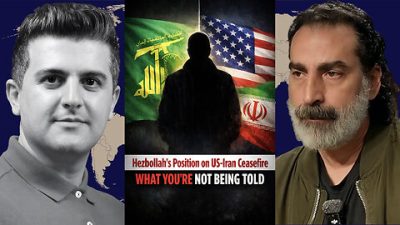
Laith Marouf: Hezbollah’s position on US-Iran ceasefire
or go to
Aletho News Archives – Video-Images
From the Archives
The Dirty Little Secret behind the “Global Terrorism Index”
The Omission of Israeli Terrorism in the Occupied Palestinian Territories
By Karin Brothers | Global Research | December 6, 2014
… The Israeli settlements — all of which are illegal – have been identified as a major impediment to peace. The refusal of a major “global” terrorism report to name the Israeli settlers as one of the groups most responsible for terrorism not only misrepresents a major source of regional violence but exposes the Global Terrorism Index as a propaganda tool that supports a U.S. agenda.
In recent years, governments have been attempting to thwart terrorism by blocking supportive fund-raising. When it comes to Israeli settlements, however, the US and Canada actually encourage fund-raising by giving organizations (such as Christian Friends of Israeli Communities (CFOIC) and the Jewish National Fund) financial support in the form of donor tax-deductions.
Charities which provide funds for the Israeli settlements should be regarded as terror-financing organizations. They should not only lose their tax-deductible status, but they should be banned because they support the violation of international humanitarian law. The terror-financing laws that are being strictly enforced for Muslim charities should be applied to Christian and Jewish charities as well. … Read full article
Blog Roll
 Aletho News
- The ‘Opposition Party’ Has Done Nothing to Stop the Iran War and Much to Goad Trump Into Continuing It
- Moscow backs Tehran on status of Lebanon in US-Iran deal
- How UK Regulator Ofcom Quietly Bypassed International Law to Police American Speech
- The Black Cube Files: How Former Mossad Operatives Flipped a Nation
- Laith Marouf: Hezbollah’s position on US-Iran ceasefire: What you’re not being told
- Israel’s priority lies in destroying chances of peace between Iran, US: Ex-UN nuclear chief
- Ceasefire for all or for none: Iran shuts Hormuz over Lebanon attacks
- Strait of Hormuz is Iran’s ‘nuclear weapon’ that forced US retreat: Medvedev
- Energy crisis will last for months – Kremlin envoy
- Europe’s quiet role in the war on Iran
- If Americans Knew
- This is ceasefire? Israel’s biggest massacre yet in Lebanon, another journalist killed in Gaza – Daily Update
- Tucker Carlson on Israel: This Is the Behavior of an Ally? Really?
- Gazans face a triple crisis: severe shortages of water and bread, healthcare in tatters
- NY Times reports how Netanyahu took the US into Iran War
- A sigh of relief over Iran, but Gaza and Lebanon in dire straits – Daily Update
- Thousands dead and neighborhoods razed to the ground: Aid agencies fear southern Lebanon is becoming the new Gaza
- The war the US is fighting for Israel could cost trillions
- ‘Cigarette Burns, Nail Wounds’: Toddler Tortured in Gaza to Coerce Father
- Trump Says US Sent ‘a Lot of Guns’ to Protesters in Iran
- Israeli forces destroy 17 UN peacekeeper cameras in south Lebanon
- No Tricks Zone
- An Inconvenient Tree: Uncovered In Alps… Europe Much Warmer Than Today 6000 Years Ago
- New Study Reports A 60% Slowdown In Greenland’s Ice Loss Rate In The Last Decade
- Low Intensity Tornado Wrecks Major Solar Farm, Creating A Potential Toxic Dump
- New Study Finds Warming Saves Lives…Cold Temperatures 12 Times More Deadly Than Excess Heat
- German Science Blog Accuses PIK Climate Institute Of Hallucinating Climate Tipping Points
- Devastating Assessment Of Comirnaty Vaccine By Former Senior Pfizer Europe Toxicologist
- New Study: CO2 Is ‘Effectively Negligible’ As An Explanatory Climate Change Factor Since 2000
- Former Pfizer Toxicologist Dr. Helmut Sterz Tells Bundestag Hearing Pfizer Vaccine Should Have Never Been Approved
- Energy Expert: Germany’s Nuclear Phaseout Was A “500 Billion Euro Mistake”
- New Research: South Australia’s Mid-Holocene Sea Surface Temperatures Were 4°C Warmer Than Today
 Aletho News