Occupation profiteer Ahava soaks up EU science grants
By David Cronin – The Electronic Intifada – 08/05/2011
Not for the first time, the European Union is in denial about how it is subsidizing Israel’s crimes.
Máire Geoghegan-Quinn, the EU’s commissioner for scientific research, recently acknowledged that the cosmetics-maker Ahava was allocated more than €1 million worth of innovation grants from the Union over a period stretching from 1998 to 2013. Giving even one cent to Ahava involves facilitating breaches of international law because of the firm’s unlawful activities in the West Bank.
As Geoghegan-Quinn doesn’t appear to recognize this problem, she would be well-advised to read a report, issued in May, by the human rights organization B’Tselem. It highlights how Ahava is partly owned by two Israeli settlements on occupied Palestinian land: Mitzpe Shalem and Qalya. Both of those settlements are illegal under the Fourth Geneva Convention of 1949, which forbids an occupying power from transferring its civilian population to the territory it occupies.
Responding to a parliamentary question, Geoghegan-Quinn effectively conceded that some of Ahava’s EU-funded research may have been undertaken in the West Bank. While Ahava is “formally established within the borders of the internationally recognized state of Israel”, she said, beneficiaries of EU grants are not required to carry out the related research in the place of establishment.
I would alert Geoghegan-Quinn to two salient facts:
- The rules covering EU science grants stipulate that projects which violate “fundamental ethical principles” are ineligible for funding. Carrying out research in one or more illegal settlements must surely violate such principles.
- Ahava may be able to give its offices in Holon or Airport City, industrial zones near Tel Aviv, as an address for its headquarters when applying for Euro-lolly. Yet its core manufacturing activities are conducted in Mitzpe Shalem. If Geoghegan-Quinn doesn’t believe me on this, I urge her to take a trip to the settlement, where she will no doubt be given a warm welcome to Ahava’s official visitors’ centre.
There are other questions about why any of my tax euros should be going to a private cosmetics firm. A glance at Cordis, the EU’s database on its science grants, shows that in one of the projects concerned, Ahava has teamed up with the US Department of the Interior. The objective of this scheme is to assess what impact tiny toxins (nanoparticles, as boffins call them) can have on the environment.
Correct me if I’m wrong but I never had the impression that the Department of the Interior spent too much time worrying about trees and dolphins. So what is the real agenda here?
Exactly How Big Is This So-Called Al Qaeda?
Sibel Edmonds | Boiling Frogs | August 5, 2011

Massive Perpetual Wars against Fantastical Terrorists
For almost 10 years we have been engaged in a massive and many-fronted war advertised as a war on terror-war on Al Qaeda. Recent reports put the total cost to America of this war on terror at around $3 trillion. This is not counting un-countable covert operations with secret budgets, and it does not include the war in Libya or covert wars elsewhere.
For the last 10 years of the Cold War, the period of our heightened expenditures against a war marketed as a war against communism, we reportedly spent slightly under $3 trillion.
For a moment let’s forget about the exaggerated and sometimes dubious Soviet threats that were being sold to our nation during the Cold-War, and assume all of them legitimate and warranted. Okay?
We had the Soviet military with over 5 million men. We were dealing with Long-Range Ballistic Missile capabilities. We had an empire with a declared arsenal of 39,967 tons of chemical weapons. We were faced with massive nuclear arsenals and warheads, sophisticated fighter aircraft, tanks… All that, and of course the added fear propaganda and jazzed up other threats to go with it. My point here is not how scary an adversary the USSR was to the United States. Here is what I want you to do:
Take into perspective and compare the size, budget, militaristic and technological capabilities, and the vast power of our former adversary, the USSR, to the current alleged terrorist adversary, Al Qaeda, whom we have supposedly been fighting for ten years.
Let’s first begin by engaging in a rational process of elimination, and take out the wars and targets that are not related to the 9/11 terrorists, the supposed Al-Qaeda. That will take out Iraq and Saddam Hussein, and also Libya and Gaddafi.
Next, we should take out Afghanistan as a terrorist nation state. Afghanistan has been under our occupation for almost ten years, and we have our puppet government installed there, and when it comes down to it, the Taliban does not equate to Al-Qaeda, it never did. The Taliban did not exercise terrorism in the United States or its Global territories.
We must also remove Pakistan as a terrorist country, thus a nation state target. If you remember, neither the quasi 9/11 Congressional Inquiry nor the quasi 9/11 Commission Report ever declared the Pakistani government/nation as terrorists or an Al-Qaeda member. Let us go with their official judgment. After all, haven’t we been giving Pakistan billions of dollars in US aid since 9/11 and continuing to date? Wouldn’t it be ridiculous to on one hand categorize our drone war there as war against Pakistan as a member of the Al-Qaeda terrorist network, and on the other hand support and finance them? Exactly; that eliminates Pakistan as an Al-Qaeda nation-government. Are you with me so far? What does this leave us with?
Our war on Al-Qaeda terror does not include a single nation state or organized state military. No military infrastructure or headquarters. No trained army-navy-air force. No tanks, warplanes, nuclear warheads, drones. No intelligence institutions or landmarks. No communication satellites. No technology. No borders. No GDP…
The supposed Al Qaeda’s top leadership was declared by our government to be Osama Bin Laden, aka Al Qaeda Commander in Chief; a sickly old man who was hooked to a dialysis machine; who supposedly lived and hid in caves, and later, in a mud house located in a remote third world village with chickens and goats. A man who sustained himself and his family by periodically selling his wives jewelry or bartering milk from his goats for occasional lamb chops. All this according to our own government; coming out in bits and pieces, and of course, sometimes in a totally contradictory fashion.
The supposed Al-Qaeda network’s communication and intelligence sharing infrastructure, according to our government, was kept very simple to evade our trillion-dollar intelligence institutions. The Al-Qaeda commander-in-Chief wrote down notes and instructions. He then waited for the courier to come and pick it up. The old man courier would hop on a donkey and travel from a bigger town to the Commander-in-Chief’s mud house in a third world village. This sometimes took several days. He’d take the note, then hop on his donkey, and go back to the town where he’d meet another intermediary courier. The intermediary courier would take the note to a nondescript little house, climb up to the roof where he kept trained courier pigeons and hawks, and based on the importance of the communication given to him, he’d either choose a hawk or pigeon to send the intelligence to the next courier. The next one used couriers who traveled to the remote deserts by camels, and so on and so forth.
How about the sophistication of weapons-methods used by our target terrorists, the ominous Al Qaeda? We are talking about a dozen or so pocket knives priced at approximately $4 a piece (probably made in China), and of course if bought in bulk, for a total under $40. That for the supposed execution of the massive terror plot over here, in the world’s super power nation. As for other worldwide terror incidents that have been placed under the ‘Al Qaeda Track Record,’ we are talking about rudimentary bomb-making ability paired up with ultra simple bombs created by ingredients such as fertilizer; we are talking a few loads of cow dung here; literally, that is.
What about the size of the manpower these terrorists, Al-Qaeda, possess? Interestingly no one in our government has ever touched upon any scientific or even commonsensical estimate as to the number of active-combative Al-Qaeda terrorists. Instead, our government, through their stenographers in the media and their marketing arm in the Hollywood filmmaking industry, has succeeded in forming this public perception of a massive number of boogieman-Al Qaeda-terrorists out there who are actively and constantly planning and executing terror plots against the West. Thus, to get a certain level of rational perception we must look at some factual indicators:
We have had this $3 trillion ‘War on Al Qaeda Terror’ for the last 10 years with nearly a quarter million military members, thousands and thousands of intelligence operatives and analysts, highly sophisticated and gigantic intelligence gathering tools (Think NSA, satellite technologies, wiretaps, spooks and snitches), mega rewards for turning in Al-Qaeda members …You’d think in ten years of these constant war and intelligence gathering operations we’d have tens of thousands of captured Al-Qaeda terrorists in our jails here and abroad. No?
Interestingly ‘No.’ Let’s take a look at the mother of all our captive top Al Qaeda terrorists detention center; Guantanamo Bay:
Since October 7, 2001, when began the war in Afghanistan, 775 detainees have been brought to Guantanamo. Of these, most have been released without charge or transferred to facilities in their home countries. The Department of Defense often referred to these prisoners as the “worst of the worst”, but a 2003 memo by then Secretary of Defense Donald Rumsfeld says, “We need to stop populating Guantanamo Bay (GTMO) with low-level enemy combatants … GTMO needs to serve as an [redacted] not a prison for Afghanistan.”
Currently we have less than 200 detainees at Guantanamo most of whom have not been proven guilty of being ‘Al Qaeda terrorists.’ Let’s be even more generous and count in those detained in other US military prisons like Bagram. Again, we are looking at 500 or so prisoners none of whom having ever been charged; none of whom legally found to be an Al Qaeda terrorist.
Now please put all these facts in perspective: Ten long years of continuous wars, trillions of dollars, 250,000 military personnel, billions of dollars worth of intelligence gathering institutions and capabilities, millions of dollars set in rewards for Al Qaeda terrorists, and a supposed network with supposed Al Qaeda active terrorist members in very large numbers. Yet we have less than 1000 detained who have been accused of being Al Qaeda terrorists, and none ever proven to be an active Al Qaeda terrorist member.
Does this make sense to you? Does it make sense as far as the trillions of dollars you have been made to pay for this? What are we talking about here? A massive never-ending war against a fantastical network of technologically and militaristically dwarfed terrorists whose proven guilty members we haven’t been able to catch or kill.
Everyone is busy arguing whether we should cut or add a few billion dollars to the several trillion dollars war on Al Qaeda. People keep talking about which country we should be getting out of, or, how many more countries we should get into to fight against terrorist Al Qaeda. No one is asking what Al Qaeda is or who really these supposed Al Qaeda terrorists are. The question that never seems to come up is exactly how big is this Al Qaeda we are spending trillions of dollars and thousands of lives fighting against. I mean no one.
BBC & Travel Channel show ‘staged, false, fabricated and distorted’
Survival International | August 2, 2011

Matsigenka girls, Peru © G Shepard/ Survival

A TV series about an Amazonian tribe has been slammed as ‘staged, false, fabricated and distorted’ by experts on the tribe.
‘Mark & Olly: Living with the Machigenga’ was shown on the Travel Channel in the US, and on the BBC last year. In the show Mark Anstice and Olly Steeds lived in a Matsigenka Indian village for several months to show the ‘reality’ of life among the tribe.
But now two experts on the tribe have gone public with a string of highly damaging accusations. Dr. Glenn Shepard is an anthropologist who has worked with the Matsigenka Indians for 25 years and speaks their language fluently. Ron Snell, the son of US missionaries, grew up with the tribe and and is also fluent in the Matsigenkas’ tongue.

A Matsigenka hunter returns with wild pig.© G Shepard/ Survival

Just some of Shepard’s accusations, published in the highly-respected journal Anthropology News, are:
• In order to present a ‘false and insulting’ portrayal of the tribe as sex-obsessed, mean and savage, many of the translations of what the Indians are saying are fabricated.
• Many events presented as real in the show must have been ‘staged’.
• A key scene in the show in which Olly is subjected to painful ant stings, since “according to Matsigenka tradition he must be cleansed” and “endure the ancient punishments” for buying deer meat is denounced by Shepard as ‘fabricated and [with] no basis in ethnography.’
Ron Snell, in an article on his blog, accused the film-makers of ‘paying the Machiguengas to perform for them, saying things the Machiguengas wouldn’t ordinarily say and doing things the Machiguengas wouldn’t normally do.’
After interviewing two of the Indians in the series, Snell reported, ‘Our suspicions were correct. They [Mark and Olly] entered the village on a well traveled path and only veered a few feet off the path to film themselves ‘hacking their way through the jungle.’ They contracted someone to make new cushmas [cotton tunics] so everyone would be wearing one. They staged the whole drama about one of the guys being accepted and the other treated as a lazy outsider…
‘The translator quickly became disillusioned with the whole thing, but kept going because of the money. He is ashamed and embarrassed that he had anything to do with it.’
The series was previously at the centre of a media storm when a scouting expedition for the show was accused in Peru of provoking a flu epidemic among isolated Indians which caused the deaths of four of them. The show was eventually filmed a short distance from this incident.

The Matsigenka were repeatedly mistranslated in the series © Cicada
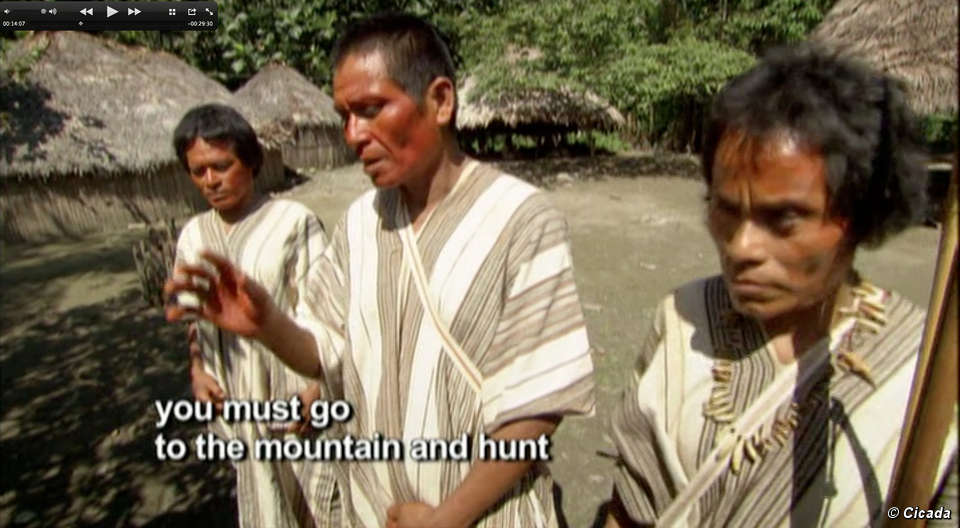
Cicada, the production company responsible for the series, has made no comment on the accusations.
Stephen Corry, Director of Survival, said, ‘‘Mark & Olly: Living with the Machigenga’ was a depressing example of the way tribal people are routinely portrayed on TV. One stereotype followed another, with the Matsigenka variously portrayed as callous, perverted, cruel, and savage. Is this what the film crew really thought of those whose guests they were? Broadcasters wouldn’t dare to make similarly false claims about other such minority groups: imagine the same descriptions applied to any ethnic minority in the industrialized world. Sadly this is all too common – TV is now getting away with portrayals which wouldn’t be out of place in the Victorian era.’
In response to a worrying trend to portray tribal peoples in a negative manner, Survival is drawing up a code of practice for documentary makers to follow when filming with them.
A background briefing with further examples of mistranslations and inaccuracies in the show is available to download here.
Note to Editors:
1. The tribe’s name is today usually spelt Matsigenka. Previously, Machiguenga was more common. Machigenga, as used in the Mark and Olly TV show, is incorrect.
2. Dr. Glenn Shepard is an ethnobotanist and medical anthropologist who specializes in the indigenous peoples of the Amazon. He has published more than 50 scientific papers and is currently a researcher in Indigenous Ethnology at the Museu Paraense Emilio Goeldi in Belém, Brazil.
3. Ron Snell grew up with the Matsigenka, where his parents were missionaries. He is the author of several books about his childhood there, and still visits the area regularly. He is now the director of a homeless people’s shelter in Nebraska, USA. His mother, who has also watched the series and corroborates the accusations, is the author of a 900-page Matsigenka dictionary.
4. A longer version of Dr. Shepard’s article can be found on his blog: ethnoground.blogspot.com
Related article
- ‘Noble Savages’: Chagnon’s new book triggers resignation and protests (alethonews.wordpress.com)
US troops kill Iraqi child and policeman
Press TV – August 5, 2011
Local officials in Iraq have said that US troops in the country have killed an Iraqi child as well as a policeman in the Salahuddin province north of Baghdad.
Officials say the two were killed during an apparent mistaken raid.
Reports on further causalities remain sketchy so far, Press TV reported.
The US-led military invasion in Iraq that began in 2003 has so far led to over a million ‘violent deaths’ among Iraqi citizens, according to a study by the British polling group, Opinion Research Business (ORB).
Further, Washington continues to exert pressure on Baghdad to extend US military presence in Iraq.
Some reports have suggested that senior Iraqi politicians have agreed to negotiate a US military training mission in an effort to extend their stay in the country beyond the 2011 deadline despite a surging public opposition.
Washington, however, is obligated to withdraw its forces by the end of 2011 in line with the 2008 US-Iraq Status of Forces Agreement (SOFA).
The agreement also forced Washington to end its combat operations in Iraq in August 2010.
Despite American insistence that it no longer engages in combat operations in Iraq, there have been numerous reports of US troop engagements in military actions in the war-torn country.
3 Palestinians, including a child wounded in Israeli occupation airstrikes
Palestine Information Center – 05/08/2011

GAZA — Three Palestinians, including a child, were wounded in one of five airstrikes carried out by the Israeli occupation airforce at dawn Friday against various targets in the Gaza Strip.
Adham Abu Selmeyyah, spokesman for the emergency services in Gaza said in a statement on Friday morning that three Palestinians, including a child were wounded when an Israeli occupation airstrike targeted an open area in Beit Lahia in the northern Gaza Strip.
He added that the three were taken to the Kamal Adwan hospital and that two of them lost lower limbs.
The Israeli occupation airforce carried out 4 other airstrikes against targets in the Deir al-Balah and Khan Younis in the central and southern Gaza Strip, but no casualties were reported.
Local sources told PIC correspondent that occupation aircraft fired two rockets at a chicken farm to the east of Deir al-Balah before targeting resistance training grounds to the west of the town.
Meanwhile, sources in Khan Younis said that occupation aircraft targeted a container used as mobile accommodation to the west of Asda’a Media City.
The sources added that occupation tanks fired artillery shells at agricultural fields to the east of Qara town, in Khan Younis district.
Abu Selmeyyah said in the statement that the airstrikes on Khan Younis and Deir al-Balah did not result in human casualties, adding that the air raids cause a lot of distress to the civilian population of the Gaza Strip.
British secret policy on torture unveiled
Press TV – August 5, 2011

Secret British policy discloses intelligence officers could get information from tortured prisoners.
A top-secret document has confirmed that British intelligence officers were allowed to get information from detainees who were being illegally tortured overseas.
The British government has been part of the torture policy for almost a decade, trying to repress the document, making a series of false statements. The document showed how the UK government allowed MI6 and MI5 to be involved in torture and then cover up that involvement.
The interrogation policy, which is claimed to be sensitive and therefore cannot be made public at the government inquiry into the UK’s role in torture and rendition, instructed high-ranking intelligence officers to “weigh the importance of the information being sought against the amount of pain they expected a prisoner to suffer,” the document read.
A copy of the secret policy demonstrated that British ministers and intelligence officers worried that the revelation of the secret document would put public safety at risk, adding the disclosure would also damage the reputation of the UK agencies.
“If the possibility exists that information will be or has been obtained through the mistreatment of detainees, the negative consequences may include any potential adverse effects on national security if the fact of the agency seeking or accepting information in those circumstances were to be publicly revealed.
“For instance, it is possible that in some circumstances such a revelation could result in further radicalisation, leading to an increase in the threat from terrorism,” one section read.
Human rights groups and lawyers have strongly opposed the decision that the interrogation of policy document and other similar secret papers would not be made public at the inquiry into the country’s involvement in torture and rendition.
Ten human rights groups, including Liberty, Reprieve, and Amnesty International expressed their refusal to give evidence or participate in the hearings, as the inquiry does not have “credibility or transparency,” and it’s arrangements are “secretive, unfair and deeply flawed.”
The inquiry led by Sir Peter Gibson, a retired judge, would begin after police investigation into torture accusations are completed.
This is while that, there is no evidence that the UK intelligence was directly involved in torturing the prisoners, because the intelligence officers left jails when the torture sessions began and returned only after the prisoners were physically abused.
In the case of Zeeshan Siddiqui, a British national suspected of having links with al-Qaeda who was captured by Pakistani officials in 2005, Human Rights Watch revealed that Siddiqui “reported being repeatedly beaten, chained, injected with drugs and threatened with further torture and sexual abuse.” He insisted that after being tortured, British intelligence officers began his investigation.
Human Rights Watch also takes the case of Salahuddin Amin as an example. Amin, also a British citizen, accused of plotting attacks on UK targets, was “repeatedly tortured by Pakistan’s notorious Inter-Services Intelligence Agency (ISI) and forced into a laundry list of false confessions”.
While he was being tortured he “was met by British intelligence officials on almost half a dozen occasions. He would be tortured, then forced back to his cell to do ‘homework,’ wherein he would provide a written confession at ISI instruction, then meet British interrogators the next day, who would ask questions on the same subjects. If the ISI felt his answers to the British agents were unsatisfactory, he would be told that he had embarrassed them ‘in front of our friends’ and be punished with further torture,” Amin said.
Veolia loses Ealing Council contract
Palestine Solidarity Campaign | August 3, 2011
In another victory for Palestinian rights, Ealing Council, in London , has failed to select Veolia for a comprehensive tender for its domestic refuse, street cleaning and parks maintenance contract. The contract is worth approx £300m in total over 15 years and one of Ealing Council’s largest single contracts. This is even more significant given the fact that Veolia had the previous parks maintenance contract.
Veolia remains involved in the building and future operation of a light-rail tramway linking Israel’s illegal settlements with West Jerusalem, facilitating Israel’s ‘grave breaches’ of the Fourth Geneva Convention. Veolia Transport Israel also runs two bus services serving the same function as the tramway: supporting and consolidating illegal settlements and tying them more closely into Israel.
Sarah Colborne, PSC Director, said: ‘Veolia’s loss of this contract, following its failure in a number of significant bids in Britain and internationally, is a clear sign that Veolia is paying a high price for its complicity in Israel’s occupation and violations of international law. West London PSC, together with other groups and individuals supporting Palestinian rights, wrote and met councillors from across the political spectrum and council officials, and submitted detailed factual and legal analysis. Veolia must realise that until it pulls out of all its activities serving Israel ’s illegal settlements, it will continue to be a target for the movement for boycott, divestment and sanctions (BDS). Through BDS, those committed to peace and justice are sending a message – we don’t buy into Israel ’s violations of Palestinian rights’.
~
- In April 2010 the UN Human Rights Council declared the tramway and its operation to be illegal (A/HRC/RES/13/7 of 14 April 2010). The resolution was passed 44 to 1, with the UK, France and all the EU members of the Council voting in favour. The operation of the tramway is precisely what Veolia has a contract to do.
- Veolia is trying to sell its shares in the tramway. But the deal would involve Veolia Transport Israel in providing technical assistance in running the tramway for 5 years.
- Through its subsidiary TMM, Veolia Transport Israel has also been operating the Tovlan landfill site in the occupied Jordan Valley for many years, supporting Israel’s illegal settlements in the West Bank by taking their refuse. There has also been a report of Tovlan receiving refuse from Israel itself, the occupier dumping its rubbish on the occupied. Veolia says that it is selling Tovlan to a local buyer and may have already done so, but far from ending Veolia’s complicity, the deal will compound it, for the intended sale is to Massu’a, the nearby illegal Israeli settlement. Moreover Veolia will continue its involvement by providing the settlement with advice concerning Tovlan.
Eyewitness to Judaization (I saw a soldier strike a young boy for walking on a road for Jews)
By Matt Berkman | U.S. Middle East Project | August 4, 2011
Matt Berkman recently returned from a a two-week delegation to Israel and the Occupied Palestinian Territories organized by Interfaith Peace-Builders. This is his account of what he saw.
JERUSALEM
Jerusalem effectively consists of two cities, one Jewish, one Arab. Whereas these cities were at one point geographically distinct—Jews living in West Jerusalem, Palestinians in East Jerusalem—the Palestinian half of the city has lately seen its ethnic homogeneity rent by the construction of Jewish settlements in East Jerusalem, a process ongoing since the city was conquered in 1967. These Jewish settlements—illegal under international law—are clean, affluent-looking housing complexes that are well serviced by the Greater Jerusalem municipality. The Palestinian neighborhoods whose physical and social contiguity the Jewish settlements fragment, on the other hand, are visibly under-serviced and neglected. Traveling through them, I found these areas to be overcrowded and littered with trash; the roads were unpaved, the schools few and derelict. A visual staple of the Arab neighborhoods was their black rooftop water tanks, used to offset the insufficient level of water pressure allotted them by the city.
The reason for the overcrowding in these neighborhoods is that it is nearly impossible for Palestinians to procure building permits anywhere in Jerusalem. Permits are arbitrarily denied or left indefinitely in bureaucratic limbo. Palestinian neighborhoods are also forbidden to expand beyond their present boundaries, which have been the same since 1967. The surrounding land (and this goes for all Arab villages and cities in Israel) was nationalized after 1948 and turned over to the dispensation of the Jewish National Fund, which does not sell or lease land to non-Jews. If a Palestinian family wants to expand their home or build a new one on a vacant lot, they must do so illegally, or not at all. If they build illegally, they risk having their homes demolished on short notice (often they are given ten minutes to vacate their possessions before the bulldozers arrive). That is why the landscape of East Jerusalem is riddled with the husks of demolished Arab homes. Jewish neighborhoods and settlements, on the other hand, have no problem purchasing land or receiving expedited permits.
This systematic discrimination, along with discrimination in the provision of municipal services, cannot be seen as other than a calculated policy of slow-motion ethnic cleansing. The goal is evidently to immiserate Arabs until they leave Jerusalem.
Although Israel formally annexed Jerusalem after 1967, the Palestinians that live there, unlike Palestinians residing within Israel’s internationally recognized borders, are not Israeli citizens. They have no citizenship. They are legally “residents” of Jerusalem, which entitles them to certain economic benefits like subsidized healthcare, but they cannot vote in Israel’s parliamentary elections nor do they have passports or other national identity documents. Traveling outside of Israel, except to the West Bank, is an arduous process for them that requires multiple authorizations. Moreover, their residency (and accompanying benefits) can be revoked if they are absent from Jerusalem for a period of three years. On our delegation, we heard reports of Arab Jerusalemites who have studied abroad only to come back and find that their right to live in the city of their birth has been revoked. The same goes for those caught residing in the suburbs beyond Jerusalem’s city limits, something Arab residents are often forced to do due to the overcrowding. The IDF launches periodic night raids in order to prove that these Palestinians are living outside the city, so that their residency can be revoked.
Although the notion of partitioning Jerusalem is likely defunct thanks to the proliferation of Jewish settlements, there do still remain small concentrations of Arab residents around the Old City that could potentially serve as a truncated Palestinian capital in the event of a two-state solution. For this reason, certain radical groups of settlers have been seizing or purchasing buildings in the heart of densely populated Arab neighborhoods in order to create a Jewish demographic foothold in these areas and, in this way, prevent partition. These settler dwellings are prominent for their Israeli flags and razor-wire ramparts. We saw several of them, and attended a weekly protest against one such cluster of settlements in the neighborhood of Sheikh Jarrah, where using Ottoman-era documents of dubious authenticity a settler group recently secured the legal eviction of several Palestinian families that had been living in homes there since the 1950s. These houses were given to the families by the United Nations and the Jordanian government in compensation for homes in West Jerusalem from which they had been expelled by Zionist militias in 1948. Recently, however, an Israeli court ruled in favor of a settler group that claimed to hold the original deeds to these homes. The state then evicted the Palestinian residents and the settlers moved in. Needless to say, Israeli courts would never entertain the congruent notion that these same evicted Arabs could reclaim the West Jerusalem properties stolen from them in 1948.
GALILEE
The other day we traveled to the Galilee area, which is inside Israel proper. In the not too distant past, the Galilee was majority Arab. Today, due to the success of Judaization policies (which have their own ministry in Israel’s government, the “Ministry of Development of the Negev and Galilee”), the number of Jews in the Galilee has surpassed the number of Arabs. The same discrimination in land and services that I described above applies equally to the Galilee. While Arab-majority cities of the Galilee have indigenous mayors, which should theoretically make the degree of discrimination in municipal services lower, the cities’ budgets are in fact determined by Jewish-controlled “regional councils” in conjunction with relevant state ministries (education, industry, infrastructure). According to an advocacy organization we met with, Israel’s Arab community, which currently stands at 20% of the total population but has needs disproportionate to its size, receives no more than 5% of any given ministry’s annual budget, and often less.
What we saw in the Galilee, however, was far more disturbing than these statistics. Our group toured a number of “unrecognized villages”—Arab and Bedouin shantytowns that existed before 1948 but were never recognized by Israel following the creation of the state. Because they were not recognized (for reasons unspecified), their land was declared state land by the government and their homes were summarily bulldozed. Instead of emigrating, however, many villagers rebuilt their homes after each demolition, evidently using industrial detritus. The situation today is that these villagers (or what remains of them) live in corrugated iron shacks, up to fifteen in a house, without electricity, running water, or indoor plumbing. Because they are unrecognized, the state refuses to hook them up to the electricity grid or sewage system. Meanwhile, many of them are located within clear view of fully-serviced Israeli cities, some built just a few years ago on land that was originally theirs. One village we visited was almost fully encircled by the Russian-Jewish settlement of Karmiel. The villagers live literally feet from this affluent suburb of sparkling white high-rises but lack paved roads, sewage, electricity, and schools (the children must drive or walk to a nearby village to attend class). According to another civil society advocate, there are more than 40 such villages in Israel, all of them Arab, and all of them facing possible demolition. Most notable among these is the village of al-Araqib in the Negev, which has now been demolished more than 20 times.
BI’LIN
So far I have been discussing what happens within what Israel considers to be its legitimate borders (despite East Jerusalem’s status as an occupied territory under international law). But nearly identical strategies of Judaization are also being applied in the West Bank, which has been under Israeli military occupation since 1967. Our delegation spent a night in the village of Bi’lin, which on a clear night is within view of Jerusalem and Tel Aviv, but located across the Green Line that demarcates the pre-1967 border. Bi’lin is an agricultural village whose farmers rely on their thousand-year-old olive trees to make ends meet. However, in 2002, under the pretext of security, Israel erected a wall in the West Bank that cut the villagers off from most of their agricultural lands, effectively annexing them for the expansion of nearby Israeli settlements, which at the time of our visit were undergoing further construction. The olive trees in the path of the wall were uprooted.
For the last few years, the residents of Bi’lin have mounted weekly non-violent protests against the wall. These protests have been brutally suppressed by Israel’s military. According to videos we screened, it appears that protesters are routinely fired upon with high-velocity tear gas canisters, rubber-coated steel bullets, and live ammunition—all of which can be fatal. We toured the site of the protests and discovered shell casings, spent tear gas grenades and even live bullets littering the ground. One large patch of earth emitted a foul, fecal odor that was the product of Israel’s latest crowd-control method: spraying protesters with what our guides described as “sewage water.” The spray was last deployed a month ago and the stench remains to this day.
There are also midnight kidnappings and imprisonment of protest leaders and participants by the IDF, including children. The twenty-year -old son of the family I stayed with was abducted from his home by soldiers in the middle of the night, dragged to a nearby olive grove, and nearly beaten to death. His brother, Abdullah, was still on the lam after being targeted for abduction. The charge against them was arranging non-violent demonstrations. In addition, several protesters and innocent bystanders have been killed by Israeli soldiers in Bi’lin, including a woman who recently died of respiratory problems after inhaling tear gas and sewage water. Our group screened a video of a soldier firing a tear gas canister directly into the chest of a local protest leader name Bassem, killing him instantly. He was unarmed.
In 2007, an Israeli court ruled that the wall should be moved back 500 meters. That decision was implemented only last month. In the process of moving the wall, the IDF set fire to much of the land being returned to Bi’lin, destroying a number of olive trees. The ground there is visibly charred. Either way, the 500 meter alteration in the wall’s path has not ended the protests, which continue to demand the dismantling of the wall altogether.
There are several others villages like Bi’lin, where the wall annexes agricultural lands and aquifers for the use of nearby settlements. But there are also other cities that have it worse. Qalqiliya, for example, is a West Bank city of 60,000 inhabitants that is entirely encircled by the wall. Gates in the wall open twice a day for two hours; otherwise, its residents are imprisoned. In the area of East Jerusalem, the wall cuts off certain Arab suburbs that once formed an organic part of the city, disrupting family, labor, and religious ties. According to a former IDF soldier, the thousands of Palestinian laborers who penetrate the wall each week in search of work belies its security justification as a bulwark against suicide terrorism. Its only ostensible purpose is land theft.
HEBRON
We also visited Hebron. Hebron is unique among West Bank cities. It has an Arab population of 250,000, and a Jewish population of around 800 armed, highly ideological settlers that have underhandedly purchased or seized homes in the heart of the city. According to locals and the testimony of a former IDF soldier stationed in Hebron, these settlers perpetually antagonize and attack the Arab population. What is more, they do so with near impunity due to the fact that they are protected by 1,200 IDF soldiers whose orders are to arrest or kill any Palestinian that defends him/herself against settler assaults. The Palestinians know this and are forced to passively absorb all measure of abuse. To illustrate this, the soldier we spoke with told the following story. Responding to cries, he entered a marketplace one day to find several settler women violently beating the shopkeepers with rolling pins. When he demanded to know what they were doing, one of them replied, “What does it look like? We’re beating the Arabs.” The soldier surmised they were doing this in order to provoke a violent reaction from the shopkeepers, which would oblige him (the soldier) to shoot or arrest them.
During our visit I personally witnessed a soldier striking a young boy because he was walking on a road accessible only to Jews and internationals. Our group also saw the mesh canopy that overhangs the Arab marketplace located below the settler houses. The canopy had caught cinder blocks, metal chairs, garbage, eggs, knives, and other objects thrown by the settlers onto the Arabs below. One of the overhangs had been eaten away by battery acid poured from above, and we heard reports of settlers urinating out of their windows onto the marketplace. All this, it appears, takes place in full view of an IDF watchtower. The soldiers do nothing to prevent settler rampages. It’s not part of their orders. On the contrary, many of them are subservient to the settlers. We witnessed one settler command an IDF soldier to arrest our Arab guide for walking on a street where Arabs were forbidden. The soldier, who had been ignoring us hitherto, quickly began to oblige (luckily we eluded him).
In order to hear the widest variety of perspectives on the situation in Hebron, we also met with a spokesperson for the settler community, a man named David Wilder. Wilder described a situation in which Jews, not Arabs, were the party facing ethnic discrimination in Israel and the West Bank. Jews, he said, were confined to 3% of the city, both by agreement with the Palestinian Authority and by the disinclination of local Arabs to sell them property. (In fact, Israel’s security control of Hebron, a city with 800 Jews, ranges over 30% of the city, including its holiest site, the Cave of the Patriarchs). He described what he considered Arab incitement—including the practice of shooting off fireworks to celebrate high school graduations—and cited instances of terrorism directed against Jews in Hebron during the Second Intifada. He denied the existence of premeditated settler violence, describing any attacks on the local population as the work of undisciplined youth reacting to Arab provocations. (Shortly after this meeting, our guide Issa, a local activist, recalled David Wilder holding a loaded pistol to his head as he attempted to videotape a settler pogrom.)
SOUTH HEBRON HILLS
After our delegation concluded, I joined a small group of Israeli activists called Ta’ayyush (“Coexistence”) in the South Hebron Hills, where they gather each Saturday to assist the local population with reconstruction and agricultural projects (at its request). As a group of Israelis and internationals, Ta’ayyush’s very presence also provides these Palestinians with a measure of protection from violent settlers and apathetic military personnel who together conspire to make their lives unlivable.
Upon arrival, we split into two groups. The first was to accompany local shepherds who had lately been assaulted by settlers as they tried to bring their flocks to pasture. The purpose of this activity was not only to protect the shepherds, but also to document settler rampages that would otherwise be ignored by the military. The second group (my group) drove to the encampment of Bir al-Id to help an older man named Hajj Ismail and his family clear rocks and debris from the ruin of their demolished home. Following a fruitless court battle, the military had carried out its demolition order a month earlier on the typical grounds of “illegal construction.”
Hajj Ismail and his family are members of the most neglected substratum of Palestinian society. They are of a class referred to by village- and town-dwelling Palestinians as “cave people,” for the fact that many of them inhabit (and have from time immemorial) relatively well-provisioned caves in the South Hebron Hills. In recent times, however, population growth has forced families like Hajj Ismail’s to leave their caves and establish hilltop encampments like Bir al-Id, which are then declared illegal by the occupation authorities and slated for demolition. Meanwhile, these same authorities actively facilitate the creation of new Jewish settlement outposts in the area (allegedly “illegal” under Israeli law) by provisioning racist bands of Israeli “hilltop youth” with water, electricity and security. One such “illegal” outpost, whose power lines and massive cisterns strike a familiar contrast with the makeshift structures of Bir al-Id, was perched less a kilometer from Hajj Ismail’s ramshackle tent.
After a few hours the two groups reunited to perform a “direct action” at the illegal outpost of Bat Maon, from which settler attacks on Palestinian schoolchildren had recently originated. (According to an Italian NGO worker who has been accompanying the children to class for several months, settlers from Bat Maon had only days earlier beaten two American activists with lead pipes as they attempted to film these attacks.) Camcorders in hand, our group circumnavigated Bat Maon in hopes of drawing the military’s attention to what was going on there. We were immediately encircled by armored vehicles and asked to leave. One of our activists demanded to know why so many soldiers had been dispatched to quell Ta’ayyush’s nonviolent action while none had been tasked with investigating the recent stabbing of a Palestinian by a masked settler. Such attempts to shame the military, he later told me, had in the past succeeded in achieving marginal improvements in the conditions of the local Palestinians.
Driving back to Jerusalem, I asked one long-time member of Ta’ayyush, a mathematician named Danny, how many leftists of his stripe he thought existed in Israel today. He guessed a couple of hundred. (Israel’s Jewish population currently stands at 5.8 million.)
This, in part, is the situation in Israel and the Occupied Territories as I have seen it and heard it described by those who live there. I leave it to the reader to draw from this testimony his/her own conclusions about the nature of the political system under which Israelis and Palestinians live, both within and beyond Israel’s recognized borders.
Wall Gate # 300
Alhaqhr | August 4, 2011
Protest Israel’s detention of Palestinian writer Ahmad Qatamesh
By Maureen Clare Murphy – The Electronic Intifada – 08/03/2011
The Palestinian human rights group Addameer issued an appeal today urging supporters to take action on the administrative detention of Palestinian political scientist and writer Ahmad Qatamesh.
Qatamesh has been held in administrative detention after he was arrested on 21 April in the middle of the night. Hanin Ahmad Qatamesh, the detained writer’s daughter, described in an article for The Electronic Intifada how Israeli soldiers invaded their family home in Ramallah. Hanin and other relatives in the home were held hostage as Israeli soldiers demanded the surrender of Ahmad, who was not at home at the time. The Electronic Intifada also interviewed Qatamesh’s wife, Suha Barghouti, a well-known human rights defender.
The full action appeal from Addameer follows:
As part of its recently launched Prisoners at Risk campaign, Addameer Prisoner Support and Human Rights Association demands the immediate release of Ahmad Qatamish, a well-known political scientist and writer currently held without charge or trial by Israel. The duration of his administrative detention has been set at 4 months, due to expire on 2 September 2011.
Addameer believes that the arrest and detention of Ahmad Qatamish has all the hallmarks of arbitrary detention and is aimed at silencing this prolific writer for his unbridled criticism of the Israeli occupation. Ahmad was arrested on 21 April 2011 in the middle of the night following a raid on his house whilst he was away, in which his wife, daughter, and two other relatives – including a 14-year-old girl – were held hostage by Israeli troops in order to compel him to surrender himself. Since then there has been a catalogue of serious errors and malpractice by the Israeli authorities. Ahmad was held for 13 days – during which time he was interrogated for only 10 minutes – before being informed on 3 May that he would be placed in administrative detention; despite the fact that both he and his lawyer had been told by the Military Court that he would be released that very day. Ahmad’s original administrative detention order was found to be flawed and had to be re-written twice, and even now the order is based on the vague accusation that he is an active member of the Popular Front for the Liberation of Palestine – a charge he has consistently and vehemently denied. As the order is based on a secret file which is not accessible to Ahmad or his lawyer, it is impossible for Ahmad to know how to defend himself against any possible charges.
This is not the first time Ahmad has been placed in administrative detention. In the 1990s, he was held for five-and-a-half years without charge or trial, making him one of the longest held administrative detainees in Israeli prisons. For more information about Ahmad’s case, you can read his profile here and follow updates on his detention on facebook.
The Prisoners at Risk campaign aims to highlight cases which raise grave concern and require urgent action. Without international pressure, there is the real risk that Ahmad’s administrative detention order will be renewed again in September. You can help stop this from happening by joining our campaign and doing one of the following:
– Use our template letter to the Israeli authorities to call for Ahmad’s immediate and unconditional release;
– Write to your own government and representatives to call on them to pressure Israel to release Ahmad (if you are a EU citizen, you can use our template letter to members of the European Parliament);
– Organize a vigil or a demonstration to call for Ahmad’s release;
– Write to Ahmad in prison (postal address: Ofer Prison, Givat Zeev, P.O. Box 3007, via Israel);
Featured Video

Chinese jet fuel and the myth of energy independence
or go to
Aletho News Archives – Video-Images
From the Archives
The Dirty Little Secret behind the “Global Terrorism Index”
The Omission of Israeli Terrorism in the Occupied Palestinian Territories
By Karin Brothers | Global Research | December 6, 2014
… The Israeli settlements — all of which are illegal – have been identified as a major impediment to peace. The refusal of a major “global” terrorism report to name the Israeli settlers as one of the groups most responsible for terrorism not only misrepresents a major source of regional violence but exposes the Global Terrorism Index as a propaganda tool that supports a U.S. agenda.
In recent years, governments have been attempting to thwart terrorism by blocking supportive fund-raising. When it comes to Israeli settlements, however, the US and Canada actually encourage fund-raising by giving organizations (such as Christian Friends of Israeli Communities (CFOIC) and the Jewish National Fund) financial support in the form of donor tax-deductions.
Charities which provide funds for the Israeli settlements should be regarded as terror-financing organizations. They should not only lose their tax-deductible status, but they should be banned because they support the violation of international humanitarian law. The terror-financing laws that are being strictly enforced for Muslim charities should be applied to Christian and Jewish charities as well. … Read full article
Blog Roll
 Aletho News
- Chinese jet fuel and the myth of energy independence
- Ukraine Sea Drone Fired From Libya Hit Russian Tanker in Mediterranean
- IRGC: Iranian forces launched no attacks during ceasefire hours
- Trump Administration Moves To Automate U.S. Military Draft Registration
- Spain orders reopening of Tehran embassy, condemns Israel’s carpet bombing of Lebanon
- Israel faces ‘unsustainable’ strategic crisis following 40-day war against Iran: Analyst
- Iran restricts Hormuz access to 15 vessels per day under ceasefire terms: Report
- The ‘Opposition Party’ Has Done Nothing to Stop the Iran War and Much to Goad Trump Into Continuing It
- Moscow backs Tehran on status of Lebanon in US-Iran deal
- How UK Regulator Ofcom Quietly Bypassed International Law to Police American Speech
- If Americans Knew
- Amnesty: Urgent – Protect Lebanese civilians from brutal escalation in Israeli attacks
- Is The War Against Iran Over?
- Inside the Israeli army’s propaganda wing
- Hundreds of Gaza Amputees Stranded in Legal Limbo
- The gallows law: Israel moves toward executing Palestinian children
- Tucker Carlson: The Path to Peace requires ending ‘special alliance’ with Israel
- This is ceasefire? Israel’s biggest massacre yet in Lebanon, another journalist killed in Gaza – Daily Update
- Tucker Carlson on Israel: This Is the Behavior of an Ally? Really?
- Gazans face a triple crisis: severe shortages of water and bread, healthcare in tatters
- NY Times reports how Netanyahu took the US into Iran War
- No Tricks Zone
- An Inconvenient Tree: Uncovered In Alps… Europe Much Warmer Than Today 6000 Years Ago
- New Study Reports A 60% Slowdown In Greenland’s Ice Loss Rate In The Last Decade
- Low Intensity Tornado Wrecks Major Solar Farm, Creating A Potential Toxic Dump
- New Study Finds Warming Saves Lives…Cold Temperatures 12 Times More Deadly Than Excess Heat
- German Science Blog Accuses PIK Climate Institute Of Hallucinating Climate Tipping Points
- Devastating Assessment Of Comirnaty Vaccine By Former Senior Pfizer Europe Toxicologist
- New Study: CO2 Is ‘Effectively Negligible’ As An Explanatory Climate Change Factor Since 2000
- Former Pfizer Toxicologist Dr. Helmut Sterz Tells Bundestag Hearing Pfizer Vaccine Should Have Never Been Approved
- Energy Expert: Germany’s Nuclear Phaseout Was A “500 Billion Euro Mistake”
- New Research: South Australia’s Mid-Holocene Sea Surface Temperatures Were 4°C Warmer Than Today
 Aletho News