Palestinian Children forced out of bed to be photographed by the Israeli army
By Mais Azza | IMEMC & Agencies | September 29, 2011
The British newspaper, The Guardian, reported on Thursday that Israeli troops recently invaded the village of an-Nabi Saleh, known for being a center of non-violent resistance, and went house-to-house forcing children out of bed in the middle of the night to photograph them.
The Guardian article also details some of the other mistreatment of Palestinian children by the Israeli military, referencing a recent report from Defence for Children International showing that eight recommendations made last year by the organization have not been carried out by the Israeli military and government.
These include detention of children without charge, forced interrogation of children with no lawyer or parent present, the failure to investigate reports of torture by Israeli forces against Palestinian children, the refusal to inform parents that their child has been detained and the holding of criminal proceedings against children in military courts, among others.
In the invasion of Nabi Saleh Wednesday night, residents reported that the soldiers said they plan to make a file of all the children in the village to use to identify any child that may later throw stones at the army.
The village of an-Nabi Saleh, home to around five hundred people, is one of several West Bank villages that hold weekly non-violent protests against the Israeli Annexation Wall that is being built on village land. At each protest, the Israeli army uses lethal and semi-lethal weapons to attack the non-violent demonstrators.
The inhabitants of the village say that they depend on international and Palestinian human rights organization to help document the illegal Israeli practices and violations of human rights by the Israeli military, in order to save their children from these practices.
The Guardian article also quotes a July 2011 report by Israeli human rights group B’Tselem which details the practice of photographing children in the night: “The photos were taken for what the army calls ‘mapping’: the army did not have any basis for suspecting any particular minor they awoke to photograph, but they wanted to build a reservoir of pictures they could later use for identification purposes, should the minor be involved in stone-throwing or other violent activity. In response to a report on the issue which was broadcast on Channel 10 News, the army said that ‘it uses a variety of means to maintain order and security’.”
Study: Occupation costs Palestinian economy $7 billion
Ma’an – 29/09/2011
BETHLEHEM — A Palestinian Authority ministry and national research institute released a joint study Thursday which estimates that the Israeli occupation cost the Palestinian economy around $7 billion in 2010.
“Without the occupation, the Palestinian economy would be almost twice as large as it is today,” the PA Ministry of National Economy and the Applied Research Institute of Jerusalem said in a statement.
Losses sustained due to Israel’s occupation are equivalent to 85 percent of Palestinian nominal GDP, the study found.
Without Israel’s control of resources and access to Palestinian territories, the economy “would run a ‘healthy’ fiscal surplus, ending its dependence on donors’ aid,” the report said.
The research quantified, for example, Israel’s ban on Palestinian access to the Jordan River, Dead Sea and groundwater aquifers in the West Bank, as costing Palestinians $1.9 billion in lost agriculture revenues, $1.2 billion in mineral resources and $143 million in Dead Sea tourism.
Israel’s blockade of the Gaza Strip cost the Palestinian economy $1.9 billion, and restrictions on water another $1.9 billion, the study said.
Israel earns around $900 million per year through control of West Bank mining and quarrying, the research authors estimated, and $150 million from commercial Dead Sea products.
ARIJ and the national economy ministry said they had to under-estimate the figures due to a lack of data, leaving out costs which they could not quantify.
Relating to the issues of trade access and resources, the authors of the study said that the “majority of these costs do not have any relationship with security concerns,” and were motivated by Israel’s wish to restrict the development of a competitive Palestinian economy.
Minister of National Economy in the Ramallah-based government Hasan Abu Libdeh said the report backed findings of the World Bank and International Monetary Fund, and demonstrated the case for taking Palestinian statehood to the UN through President Mahmoud Abbas’ membership bid, submitted Friday.
“No matter what the Palestinian people achieve by our own efforts, the occupation prevents us achieving our potential as a free people in our own country,” the minister said.
“It should be clear to the international community that one reason for Israel’s refusal to act in good faith as a partner for peace is the profits it makes as an occupying power.”
The PA will produce regular reports on the costs of Israeli restrictions on the Palestinian economy, the release said.
‘West created PJAK to destabilize Iran’
Press TV – September 29, 2011
A senior Iranian commander says enemies of the Islamic Republic have created and supported the terrorist group of the Party for Free Life of Kurdistan (PJAK) against Iran.
Enemies of the Islamic Republic, such as the US, UK and Israel created the PJAK to create insecurity in Iran, and on top of them Washington supports the terrorist group, Deputy Head of the Operations Department of the Iranian Armed Forces Brigadier General Ali Shademani said on Wednesday.
Shademani said that Western countries would throw their support behind the PJAK as long as it fights against Iran, but they would set up a new group or come up with a new scheme once the terrorist group failed to fulfill their objectives, IRNA reported.
Referring to wars waged by the global arrogance in the region, the Iranian commander said the enemies resort to military options whenever they can’t pursue their objectives through economic, political or cultural means.
Members of the PJAK terrorist group — an offshoot of the Kurdistan Workers’ Party (PKK) — regularly engage in armed clashes with Iranian security forces along the country’s western borders with Iraq’s semi-autonomous Kurdistan region.
The Ground Forces of Iran’s Islamic Revolution Guards Corps (IRGC) launched new operations against the Party for Free Life of Kurdistan (PJAK) earlier this month. The new operations came after the terrorist group refused to pull its forces out of Iran’s northwestern areas within a one-month grace period offered to the group by the IRGC.
The numerous operations by the IRGC inflicted heavy casualties on the group and forced its members to leave the country’s soil.
The IRGC deployed its forces on the zero points of the country’s northwestern border after clearing out terrorist groups from the border area.
Israeli forces hand Bethlehem village confiscation orders
Ma’an – 28/09/2011
BETHLEHEM — Israeli forces notified villagers near Bethlehem that their land will soon be confiscated, local residents said Wednesday.
Land owned by 40 families in Battir village — 148 dunams of vegetable, fruit and olive groves — is earmarked for confiscation, villagers told Ma’an.
According to the notices received by villagers, the area is close to the train line to Jerusalem and next to the East Jerusalem settlement of Gilo, in which Israeli authorities approved the building of 1,100 new homes on Tuesday, sparking international condemnation.
The notification of the Israeli Ministry of Finance’s intention to purchase the lands said the acquisition was for military and security purposes.
Battir resident Nidal al-Zaghir told Ma’an the land confiscation “will be a great loss for the village, as they will lose many of their houses, water wells and agricultural lands.”
Israeli Consul General wants to rescue US town from ‘foreign’ influence
By Phan Nguyen | Mondoweiss | September 28, 2011
A recent lawsuit against the Olympia Food Co-op for boycotting Israeli goods has strangely made Olympia, Washington, the site of the first anti-BDS lawsuit since the Israeli government passed its anti-BDS law.
Although the official plaintiffs of the lawsuit are five Olympia residents, investigations by Ali Abunimah (here) and Richard Silverstein (here and here) have uncovered evidence linking the lawsuit to Israeli Consul General Akiva Tor and the pro-Israel group StandWithUs.
On Nov. 4, 2010, Akiva Tor was interviewed on Seattle conservative talk radio. On the air, Tor accused the Olympia Food Co-op boycott of being the work of outsiders:
“I think that people [in Olympia] feel that a foreign agenda, an unfair agenda, a doctrinaire agenda, has been imposed on them from outside, and they’re suffering. They’re suffering through it, and it’s a terrible thing.”
Tor then explained that steps would be taken to fight back:
“It’s an awful thing, and when we find ourselves on the end of it, we have to respond….There is an organization, StandWithUs, which is very concerned and working hard on it.”
According to StandWithUs meeting minutes, Tor arrived in Olympia on March 10, 2011, where he gathered with StandWithUs co-chairs Rob Jacobs and Carolyn Hathaway, along with attorney Avi Lipman. None of these individuals lived in Olympia, but they had converged there to meet with unnamed “Olympia activists.” Meeting minutes state that a “legal presentation” was given at the meeting.
Lipman, who is one of the attorneys in the lawsuit, refused to tell Abunimah what occurred at the March 10 meeting, citing attorney-client privilege, and thus confirming that some of those unnamed “Olympia activists” were or would soon be his clients.
StandWithUs executive committee meeting minutes additionally refer to the “law suit [sic] against the Olympia Food Co-op” [sic] as a StandWithUs “project.”
And so it transpires: A representative of the Israeli government coordinates with an Israel advocacy group based in Seattle, and that leads to a lawsuit against Olympia’s only food cooperative—in order to save Olympia from a “foreign agenda…imposed on them from outside.”
Curiously, though, the defendants named in the lawsuit are local residents.
Extremist settler attacks shepherd and brutally abuses flock
28 September 2011 | International Solidarity Movement, West Bank
On the 17th of September Israeli colonists attacked a shepherd near Sha’ab el-Butom, resulting in several sheep injured and the arrest of the young shepherd.
Sha’ab el-Butom is a small Bedouin village in South Hebron Hills not even mentioned in most maps, a village that faces daily harassment from the surrounding illegal settlements and outposts composed by the most ideological settlers in the West Bank. On Saturday September 17th of September, Nahel Ahmed Mousa Aburem, a 23 year old shepherd, went as usual down the road with his sheep when one settler accompanied by a soldier from the illegal Abigail settlement approached him, shouting for him to come towards them.
“Why are you here?” they asked, and Ahmed simply answered “This is my land.”
“No! It’s a closed military area!”
Aburem then tried to explain to them that he had permission from the military and the police to stay there and go around with his sheep. It was not a good answer for the settler. With ideology based on extreme interpretation of Judaic law, his reaction was to start beating Ahmad’s sheep with stones and sticks.
3 sheep lost their eyes, one died, another one was pregnant but lost her kid, and four others tried desperately to escape. The soldier was just 10 metres away, and Ahmed asked him help to stop the settler but he didn’t react so he tried to reach the sheep and the settler threw stones at him too and tried to grab his head while Ahmed tried defend himself and pushed the settler away.
This was enough to make an Israeli army jeep arrive and bring Aburem to a military base near Susiya and then to the police station in Kiryat Arba where they told him that he wanted to shoot the settler. He had to spend 2 nights in the police station in Kiryat Arba, 2 nights in the detention centre in Jerusalem, referred to as The Russian Compound, 2 other nights in Ramla prison, and then finally one day in Ofer for the supposed court hearing where they actually just gave him conditions and a bill of 5000 shekels needed to be paid for his release. His family paid, while he must meet the condition of signing his name every Tuesday in the Kiryat Arba police station.
Aburem said that he is supposed to have a court hearing by the end of October, but speculated that precarious and manipulative court procedures would play with time and be at the whim of the court.
“In any case” he said “we want to make actions in cooperation with Israeli and International activists in order to resist and keep going back to our land.”
Israel closes West Bank crossings for Jewish holiday
Ma’an – 28/09/2011
BETHLEHEM — The Israeli army announced its closure of the West Bank from midnight Tuesday until midnight Saturday, a statement said late Tuesday.
The Allenby Crossing between the West Bank and Jordan will also operate under reduced hours on Wednesday and Thursday, as Israeli Jews celebrate Rosh Hashana, the Jewish New Year.
Israeli Minister of Defense Ehud Barak ordered the four-day closure of crossings bridging the West Bank to Israel and Jerusalem, the army statement said.
No Palestinians will be permitted to leave the West Bank during the holiday period, except patients cleared to receive medical care in Jerusalem or Israel, according to the release.
Humanitarian aid and passage of doctors and medical staff will be subject to the authorization of the Israeli military authorities in the West Bank, it added.
The sole access point for Palestinians traveling abroad, the Allenby terminal, will be opened from 8 a.m. to 4 p.m. on Wednesday and 8 a.m. to 8 p.m. on Thursday, before returning to normal operating hours, crossings authorities said.
American Jewish Committee behind “humanitarian intervention” in Libya
By Maidhc Ó Cathail | The Passionate Attachment | September 29, 2011
In his recent article, “Libya and the Big Lie: Using Human Rights Organizations to Launch Wars,” Mahdi Darius Nazemroaya writes:
One of the main sources for the claim that Qaddafi was killing his own people is the Libyan League for Human Rights (LLHR). The LLHR was actually pivotal to getting the U.N. involved through its specific claims in Geneva. On February 21, 2011 the LLHR got the 70 other non-governmental organizations (NGOs) to sent letters to the President Obama, E.U. High Representative Catherine Ashton., and the U.N. Secretary-General Ban-ki Moon demanding international action against Libya invoking the “Responsibility to Protect” doctrine.
According to the Jerusalem Post, however, the 70 “rights groups” were organised by UN Watch, whose executive director Hillel Neuer, was quoted as saying that:
“the muted response of the US and the EU to the Libyan atrocities is not only a let-down to the many Libyans risking their lives for freedom, but a shirking of their obligations, as members of the Security Council and the Human Rights Council, to protect peace and human rights and to prevent war crimes.”
The Post article does not mention, however, that UN Watch is affiliated with the American Jewish Committee, a key component of the Israel lobby.
Three confirmed dead in Gaza tunnel from Egyptian wastewater attack
Ma’an | September 27, 2011
GAZA CITY — Three Palestinians were pronounced dead on Tuesday morning after Egyptian authorities pumped sewage inside a smuggling tunnel under the Gaza border on Sunday.
The ambulance and emergency services committee in Gaza said the three victims were found alive inside the tunnel. They were evacuated to the Abu Yousef an-Najjar Hospital in Rafah but were pronounced dead 30 minutes after arrival.
Gaza medical spokesman Adham Abu Salmiya identified the victims as Fadi Mustafa Ash-Shaer, 20, Firas Ahmad, 18, and Anwar Abu Aradeh, 25.
They were all residents of al-Salam neighborhood in Rafah in southern Gaza, Abu Salmiya said.
Medics had said Sunday that one man was injured and two others were missing after Egyptian authorities pumped sewage inside a Rafah smuggling tunnel running underneath the border with the Gaza Strip.
Egyptian security officials said in early September that they were cracking down on the network of tunnels used by smugglers from the coastal enclave.
Including Tuesday’s victims, eight Palestinians have been killed while working in tunnels in September. Five Palestinians were killed in three separate tunnel collapses earlier this month.
Medics say over 160 Palestinians have died in the network of underground tunnels since Israel imposed a siege on the Gaza Strip in 2006.
Under Israel’s crippling blockade, the tunnels have provided a lifeline for residents of the coastal enclave.
Egypt opened the Rafah crossing in May, the only border terminal not controlled by Israel.
The opening allowed some residents to leave the coastal enclave for the first time in years, but the terminal is not equipped for the transfer of goods and it has had little impact on Israel’s siege.
How McChrystal and Petraeus Built an Indiscriminate “Killing Machine”
Gareth Porter | Truthout | 26 September 2011
Even if the rest of the US military effort in Afghanistan has been largely written off by the news media as a failure, the campaign of targeted raids against insurgents by commandoes under the Joint Special Operations Command (JSOC) has gotten a reputation for devastating effectiveness. As an Associated Press story in early September 2010 put it, the “mystique of elite, highly trained commandos swooping down on an unsuspecting Taliban leader in the dead of night plays well back home….”
Central to this larger-than-life image of the Special Ops night raids in Afghanistan is the assumption that their targeting has been highly accurate.
John Nagl, who was on Gen. David Petraeus’s staff in Iraq and now runs the pro-military think tank Center for New American Security, suggested in a PBS “Frontline” documentary on the targeted raids last January that the US military had gotten “so good at using electronic means of identifying, tracking and finding” insurgents that it had created an “industrial strength counterterrorism killing machine.”
The accumulated evidence that has now seeped through the cloak of secrecy surrounding Special Operations Forces (SOF) “kill/capture raids” tells a very different story, however. Although the raids have undoubtedly killed a large number of Taliban commanders and fighters, it is now clear that they also killed and incarcerated thousands of innocent civilians. The failure to discriminate between combatants and civilians flows directly from a targeting methodology that is incapable of such discrimination.
Creating Intelligence Without Human Vetting
The system of targeted raids now practiced in Afghanistan was first introduced by Gen. Stanley A. McChrystal in Iraq. In his book “The War Within,” Bob Woodward described how the JSOC under McChrystal had adopted “some of the most highly classified techniques” in the US government system of classification in Iraq in 2006 and 2007 to target and kill al-Qaeda and Shi’a militia fighters. Woodward contributed to the myth of all-knowing JSOC commanders by suggested that those techniques may have been the biggest factor in reducing the violence in Iraq. It is well documented, however, that Sunni and Shi’a insurgencies ended or tapered off because of broader political factors, not because of JSOC’s killing operations.
In fact, McChrystal’s operation relied on far more mundane technologies than Woodward’s sensational language suggested. In a new book, “Task Force Black,” by Mark Urban, the diplomatic editor at BBC’s “Newsnight,” reveals that McChrystal’s command gathered intelligence on al-Qaeda and Mahdi Army personnel from three well-known technologies: 24-hour surveillance by drone aircraft, monitoring of mobile phone traffic and pinpointing the physical location of the phones from their signals.
The key to JSOC definition of a given insurgent “network” was the decision to maintain long-term aerial surveillance of a particular location. McChrystal’s intelligence chief Col. Michael Flynn liked to call surveillance by drone aircraft “The Unblinking Eye” – an image suggesting a godlike power of observation. The implication of the new intelligence methodology developed by McChrystal and Flynn was that anyone who visited a location under surveillance or who communicated with a mobile phone associated with that location could be considered to be part of the insurgent network.
To convert the raw data obtained from drone surveillance and tracking mobile phone calls into intelligence on who to target, Flynn turned to a tool called “social network analysis.” In the wake of the 9/11 attacks, that technique had became almost overnight the favored tool for analyzing terrorist and insurgent networks. It provided a framework for construction of models of networks by measuring the number of direct interactions between individuals or “nodes.” With a quantitative tool called “link analysis” and accompanying software, intelligence analysts could see the raw data from drone surveillance and links among telephones transformed into a “map” of the insurgent “network” in each locality.
Traditional intelligence analysis of an insurgent network would have involved verifying the identities of those individuals who had visited the location or communicated with others associated with the network to assess the nature of the relationship. From the beginning of the new McChrystal-Flynn system, however, the emphasis was on speed of collection rather than on such careful analysis of the data. Urban recalls that McChrystal and Flynn introduced the concept of “F3EA” – “find, fix, finish, exploit, analyze.” That meant that they aimed at obtaining new data from each raid that could be used to add to the target list for future raids – often within hours of the previous one.
Scaling Up Raids in Afghanistan
In 2009, the whole system began to shift from Iraq to Afghanistan. McChrystal was chosen as the new commander of all US and NATO forces in Afghanistan and took Flynn with him. As the US began its drawdown in Iraq, thousands of SOF under JSOC command and most of the drones used in Iraq followed. Meanwhile, the focus of targeting of night raids in Afghanistan shifted from “high value targets” – high-level and mid-level al-Qaeda and Taliban officials – to anyone who was contributing to the Taliban war effort, whether in a military or civilian capacity.
These geographical and targeting shifts resulted in an exponential increase in the level of targeted raids in Afghanistan. In May 2009, before McChrystal arrived, US SOF were carrying out 20 raids per month. But by November, McChrystal had stepped up the pace to 90 per month, and by the following spring, he had increased the number again to nearly 250 a month – a 12.5-fold increase in one year.
Finally, during the transition from McChrystal to Gen. David Petraeus in the summer of 2010, the number increased to nearly 600 raids a month. In just two years, the monthly total of night raids had been expanded by a factor of 30. But in April 2011, a US military source told researchers for the Open Society Foundations and The Liaison Center that as many as 40 raids were being carried out every night – a rate of more than 1,000 raids per month.
Scaling up the system of targeted raids by orders of magnitude would have had far-reaching implications for the accuracy of the targeting regardless of the location. But it was especially dangerous to transfer it to Afghanistan. Michael Semple, former deputy to the European Union (EU) Special Representative to Afghanistan, who has had contacts with many local Taliban commanders over the years, told me that most Afghans in the Pashtun south and east “have a few Taliban commander numbers saved to their mobile phone contacts” as a “survival mechanism.”
That fact means that US intelligence analysts working on targeting for the SOF raids must be able to “distinguish pragmatic, innocent contacts from active involvement with the Taliban,” Semple told me. Unfortunately, the methods used by US intelligence to compile the list of supposed network members is not aimed at making such distinctions at all.
Targeting Phone Numbers, Not People
In October 2009, when JSOC was carrying roughly 90 raids per month, the target list for SOF night raids, called the Joint Prioritized Effects List (JPEL), included 2,058 names, according to one of the Afghan war logs documents released by WikiLeaks. A large proportion of the targets on the list were not identifiable individuals at all, but mobile phone numbers. “When you are relying on cell phones for intelligence, you don’t get the names of those targeted,” observes Matthew Hoh, who was briefed on the target list as the senior US civilian official in Zabel province before he quit in protest against US policy in September 2009.
The easiest way to scale up the JPEL to support 900 raids a month was to get more mobile phone call records linked to numbers already associated with insurgent networks. One obvious source is the population of roughly 3,300 suspected insurgents being held in the Afghan prison system, who are allowed to use mobile phones freely in their cells. Semple told this writer that access to cell phones by the Afghan prison population is the result of the connivance of the prison administration, in return for bribes from the prisoners. “I presume there are occasional searches to keep the price up,” Semple said.
But the population of the security wing at Pol-e-Charkhi, the main Afghan national prison, is probably the largest concentration of insurgent-related cell phone users in Afghanistan, according to Semple, and therefore intelligence agencies would naturally seek to exploit the phone contacts among prisoners and friends and families with varying degrees of ties to the insurgents.
Another knowledgeable source in Kabul confirmed to me that Afghan corrections officers in Pol-e-Charkhi as well as in five regional prisons carry out “shakedowns” in the cells of security prisoners every six months or so to confiscate “contraband” – meaning primarily their mobile phones. These “shakedowns” are done at the prompting of contract corrections advisers and trainers funded by the US government, the source told me, and the confiscated phones are turned over to US intelligence.
The phone numbers and call histories from those phones go into the database which is used to “map the networks.” But the link analysis methodology employed by intelligence analysis is incapable of qualitative distinctions among relationships depicted on their maps of links among “nodes.” It operates exclusively on quantitative data – in this case, the number of phone calls to or visits made to an existing JPEL target or to other numbers in touch with that target. The inevitable result is that more numbers of phones held by civilian noncombatants show up on the charts of insurgent networks. If the phone records show multiple links to numbers already on the “kill/capture” list, the individual is likely to be added to the list.
Kandahar and other provinces are rife with stories of people who were targeted by night raids because their cell phone number had been found in an insurgent’s cell phone. One Afghan told me about a friend whose brother had been seized and detained in a night raid and had been told by his interrogator that it was because of his cell phone calls to a known insurgent.
The US military’s obvious lack of concern about targeting noncombatants is due in large part to the assumption that civilians have knowledge of insurgents that can be usefully exploited if they are brought in for interrogation. That was the motive for US and Canadian troops to sweep large numbers of military age males in their large-scale operations in 2004 and 2005. “The detainees are detained for a reason,” said Canadian Brig. Gen. Jim Ferron, the intelligence chief for NATO’s International Security Assistance Force (ISAF) command in Afghanistan in May 2007. “They have information we need.”
The intelligence value of detaining large numbers of civilians with presumed knowledge of insurgents is now a motive for the intelligence analysts compiling the “kill/capture list” to catch civilians in the net. A new report on night raids by the Open Societies Foundation and The Liaison Center quotes a military officer telling the author privately, “If you can’t get the guy you want, you get the guy who knows him.” And even when they are not the targets of the raid, civilians are deliberately swept up in order to interrogate them for several days before releasing them.
“A Very Precisely Targeted Operation”
Some raids, however, are deliberately aimed at killing the target, and cell phone data are also used to determine who is to be killed, as is dramatically illustrated by the killing of Zabet Amanullah by an SOF unit in Takhar province on September 2, 2010. The incident itself and the US military response to criticism of the killing as an obvious mistake highlights the reality that the intelligence analysts mapping the insurgent “network” routinely fail to make any effort to distinguish between an insurgent and someone who is in tangential contact with an insurgent.
Amanullah was a former Taliban commander who had quit the organization in 2001 and had become a human rights activist. He worked with former EU official Semple from 2003 to 2007, documenting pre-2001 human rights abuses and helping Semple make contacts for his work on political reconciliation in Afghanistan. Amanullah had originally fled to Pakistan, according to Semple, because one of the warlords who rose to power after 2001, Qazi Kabeer, had been a personal rival. But Semple said Amanullah had suffered such “an horrendous stint in ISI [Inter-Services Intelligence] detention” in Pakistan that he returned to Afghanistan to live openly in Kabul with his wife and children, and was in contact with pro-regime political figures. He had been so “psychologically bruised” by the ISI experience that he was incapable of working covertly for the Taliban, according to Semple.
But former BBC correspondent Kate Clark, who also knew Amanullah personally, has documented in detail how US intelligence analysts had convinced themselves on the basis of their analysis of cell phone traffic that Amanullah and the actual shadow Taliban Gov. of Takhar, Muhammad Amin, were the one and the same man. They had concluded that the Taliban shadow province chief for Takhar, Muhammad Amin, must have taken the name “Zabet Amanullah” as his alias. The analysts had not even done the most elementary checking to see if there was an actual Zabet Amanullah.
What sealed Amanullah’s fate was that he was personally acquainted with Amin and had occasional phone contact with him. Semple, one of world’s most knowledgeable specialists on the Taliban movement, located Muhammad Amin in Pakistan and interviewed him six months after the Americans had supposedly killed him. Amin convinced Semple that he was indeed the former shadow governor of Takhar and even showed him his identification card. Amin confirmed to Simple that he had spoken with Amanullah roughly once a month by phone.
Amanullah had gone to Takhar to help his nephew’s parliamentary campaign. Nine other Afghans – all campaign workers for his nephew – were killed along with Amanullah in an SOF helicopter attack on two cars. He had cleared his visit to Takhar with the Shah Jehan, the police chief in Takhar, who was a personal acquaintance, according to Semple. A simple phone call to Jehan would have easily disabused the SOF of its assumption about Zabet Amanullah as the alias of the Taliban province chief.
The idea that the Taliban governor of Takhar would be riding along with the campaign staff of a candidate for the Afghan Parliament in broad daylight is so obviously implausible that it should have been a flashing red light for the operation. But Petraeus’s International Security Assistance Force (ISAF) was immune to such logic. It issued a statement more than a week after the attack that suggested those riding along with the man who was killed must also have been insurgents. “The question remains,” the statement said, “why an election official or candidate was travelling with a known terrorist.”
Even after Afghan government officials had unanimously condemned the killing of Amanullah as a horrible mistake, Petraeus told PBS “Frontline” at the end of January that the killing was “a very precisely targeted operation” and that “there is no question about who this individual was.” Petraeus was so confident that they had gotten the right man that he agreed to Clark’s request to meet with officers of the SOF unit involved in the murder of Amanullah.
It was apparently the first time that SOF personnel had ever talked about a specific raid with anyone outside the chain of command. The officers who met with Clark over dinner did not admit to having made a mistake in the killing, despite her presentation of all the evidence to the contrary. But when she pressed them about the evidence of the life and death of the actual Zabet Amanullah, they admitted something far more damning: that they had not been tracking Amanullah by name, but had only a cell phone number.
Guilt by Association
As for the nine campaign workers killed, one of the officers told Clark, “If someone is a targeted individual or someone with that person, they are unlawful combatants.” And a second officer said, “If we decide he’s a bad person, the people with him are also bad.” Such statements are clearly at odds with the criteria used in humanitarian law to distinguish between combatants and civilians. And they shed light on the criteria used by the SOF commanders in tallying the number of “insurgents” they claim to have killed or captured.
In December 2010, ISAF gave pro-war blogger Bill Roggio impressive figures suggesting that the Taliban had lost 4,100 through capture and 2,000 were killed in the previous six months. Similar figures were released to selected journalists every three months after that. But an investigation of those figures reveals that all but a very small proportion of the total of insurgents detained in targeted raids were actually innocent civilians.
The publicly announced US detention policy as of 2010 was that all Afghans picked up in the field by US troops must either be sent to the Parwan detention facility or be released within two weeks. An unclassified February 5, 2011, internal document of the Combined Joint Inter-Agency Task Force responsible for detention policy in Afghanistan, which this writer obtained last spring, showed that only 690 Afghans were admitted to the US detention facility at Parwan during that six-month period – just 17 percent of the 4,100 captured insurgents claimed. The remaining 83 percent of those said to have been captured “Taliban” had actually been released within a few days because there was no evidence that they were indeed insurgents.
The proportion of civilians in the 4,100 captured “Taliban” was actually even higher than that. The same inter-agency detainee task force document shows that 20 percent of all those detained in Parwan during the six-month period were released upon further review of their files. So, the maximum number of detainees for whom there was any real evidence of active involvement with the insurgents was actually 552, or 14 percent of the total 4,100 captured “insurgents” claimed.
Many of the thousands detained in JSOC targeted raids were picked up because they happened to be present in a house that had been targeted. But many others, like Amanullah, were targeted because their mobile phone number had shown up too many times on a “map” of an insurgent network. Innocent civilians are much less likely to resist violently when their houses are raided by SOF, so the proportion of those killed in night raids who are civilians is bound to be much lower than the proportion of civilians among those who are detained, at least temporarily.
Hiding Civilian Deaths in Night Raids
But that does not mean that civilians represent a small proportion of the deaths in night raids. SOF units have routinely hidden such civilian deaths by reporting them as insurgents – even when it was perfectly obvious that they could not have been combatants. A raid on a compound in Gardez on February 12, 2010, killed two men, one of whom was a local government prosecutor and the other a senior intelligence official in the Afghan national police, and three women, two of whom were pregnant. But the SOF unit reported to the headquarters of the US-NATO command in Kabul that the two men were insurgents and claimed that the women had been found tied up and gagged. McChrystal defended the unit against the charges by eyewitnesses that its members had tried to cover up the killings of the three women even after the head of the Afghan Interior Ministry investigation of the incident publicly called the eyewitness testimony credible. Meanwhile, the target of the raid, who turned himself in for questioning a few days after the raid, was released without charge, according to the brother of the two men killed in the raid.
The United Nations mission in Afghanistan issued a report last March offering the figure of 80 civilians killed in what it called “search and seizure operations” in 2010, but that was a figure that it knew was highly misleading. Nader Nadery, a commissioner of the Afghanistan Independent Human Rights Commission, told my Afghan colleague Noori Shah Noori that that figure represented only the number of civilian deaths from13 incidents that had been fully investigated. It excluded the deaths from 60 other incidents in which complaints had been received, but had not yet been thoroughly investigated.
Nadery has since estimated that the total civilian deaths for all 73 night raids about which it had complaints was 420. But the Afghan Independent Human Rights Commission (AIHRC) admits that it does not have access to most of the districts dominated by the Taliban and that people in those districts are not aware of the possibility of complaining to the Commission about night raids. So, neither the AIHRC nor the United Nations ever learn about a significant proportion – and very likely the majority – of night raids that end in civilian deaths. The implication of that fact is that the majority of the more than 2,000 Afghans said to have been killed by SOF raids in 2010 may well have been innocent civilians rather than insurgents.
Two senior US commanders freely admitted to The Washington Post’s Dana Priest and William Arkin that they had not targeted the right home or individual on more than “about 50 percent” of the raids. Given the tendency of commanders to overrate the success of their operations, that admission further underlines the vast human cost of the uncontrolled violence carried out by SOF units in Afghanistan.
Inviting Revenge for the Killing Machine
Afghanistan is the last place on earth the US military should be allowed to practice such indiscriminate killing. Afghans of every political stripe and at every level of society, from the Taliban fighters to President Hamid Karzai himself, have been warning the United States that the killing of innocent civilians in night raids provokes nearly universal hatred of Americans. And Pashtun culture is based on the necessity to take revenge against those who have harmed one’s friends or family – even if takes the rest of one’s lifetime.
Yet, the Obama administration, in seeming indifference to this well-established reality, is set to sign an agreement with the Karzai administration that will keep thousands of SOF in Afghanistan at least until 2014. Even worse, the program of targeted raids practiced in Afghanistan is now being touted as the military tactic of choice for future US wars. It is now clear that this “industrial strength killing machine” needs be brought under control and held accountable for the grave damage it has done to Afghans and to the interests of the United States.
Featured Video
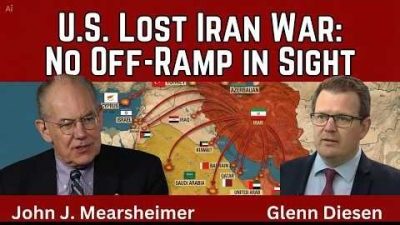
John Mearsheimer: US Already lost Iran war – No off-ramp in sight
or go to
Aletho News Archives – Video-Images
Frlom the Archives
With apparently fabricated nuclear documents, Netanyahu pushed the US towards war with Iran
By Gareth Porter | The Grayzone | April 29, 2020
President Donald Trump scrapped the nuclear deal with Iran and continued to risk war with Iran based on Israeli Prime Minister Benjamin Netanyahu’s claim to have proven definitively that Iran was determined to manufacture nuclear weapons. Netanyahu not only spun Trump but much of the corporate media as well, duping them with the public unveiling of what he claimed was the entire secret Iranian “nuclear archive.”
In early April 2018, Netanyahu briefed Trump privately on the supposed Iranian nuclear archive and secured his promise to leave the Joint Comprehensive Plan of Action (JCPOA). That April 30, Netanyahu took the briefing to the public in a characteristically dramatic live performance in which he claimed Israel’s Mossad intelligence services had stolen Iran’s entire nuclear archive from Tehran. “You may well know that Iran’s leaders repeatedly deny ever pursuing nuclear weapons…” Netanyahu declared. “Well, tonight, I’m here to tell you one thing: Iran lied. Big time.”
However, an investigation of the supposed Iranian nuclear documents by The Grayzone reveals them to be the product of an Israeli disinformation operation that helped trigger the most serious threat of war since the conflict with Iran began nearly four decades ago. This investigation found multiple indications that the story of Mossad’s heist of 50,000 pages of secret nuclear files from Tehran was very likely an elaborate fiction and that the documents were fabricated by the Mossad itself. … continue
Blog Roll
 Aletho News
- ‘We’ve Obliterated Their Missiles’
- Syrian president vows ‘absolute support’ to disarm Hezbollah
- Ukraine attacking Russian gas pipeline to stop deliveries to Europe – Defense Ministry
- ‘Heinous crime’: Iran denounces Israeli assassination of 4 Iranian diplomats in Lebanon
- John Mearsheimer: U.S. Already Lost Iran War – No Off-Ramp in Sight
- UK Parliament Plans ISP Blocking and Age Verification Powers
- World cannot remain silent as US and Israel attack ‘heritage of humankind’: Iran
- Emirati billionaire rebukes US senator over call for Gulf states to join war with Iran
- Op. True Promise 4: Iran’s missile blitzkrieg dismantles US war machine in West Asia
- Aramco CEO warns ‘catastrophe’ imminent if Strait of Hormuz remains shut
- If Americans Knew
- 97% of victims of war on Iran are Iranian, 98% of victims in war on Gaza are Gazans – Not a ceasefire Day 152
- Early Iran strikes cost $5.6 billion in munitions, Pentagon estimates
- Israel Decided the War, But Trump’s America Fights and Pays the Bill
- Conscientious Objector Group: Phone ‘Ringing Off Hook’ As Huge Mobilization Underway
- U.S. support for Israel continues to plummet, despite media’s best efforts
- Threats and missiles fly, death tolls soar in Iran, Lebanon, Gaza – Not a ceasefire Day 151
- Lebanon: Israel’s White Phosphorous Use Risks Civilian Harm
- Corporate Media Go All Out To Support The US-Israeli War On Iran
- US-Israel war on Iran is creating a steady growing number of amputees
- Israel planned this war on Iran for 40 years. Everything else is a smoke screen
- No Tricks Zone
- New Study Documents A 20-Year Pause In Arctic Sea Ice Decline – Driven By Internal Variability
- Wake-up Call: Survey Shows Majority Of Germans Now Favor Postponing Climate Targets!
- Televised! Leading German Political Candidate Tells Schoolchildren CO2 Makes Sun Hotter!
- New Study: A Century Warming Of 1.1°C Is ‘Commonplace’ And ‘Not Unusual’ During This Interglacial
- New Study: ‘Internal Noise’ And Volcanic Forcing Can Trigger 10-15°C Warming Within Decades
- Glaciers Worldwide Are Suddendly Surging, Experts Blame Warming!
- Surprising Discovery: Sahara Is Greening…Billions Of Trees Where Once Thought To Be Barren
- New Research Reaffirms Clouds, Aerosols, And Surface Solar Radiation Are ‘Driving The Climate System’
- Germany: Electric Car Catches Fire At Charging Station, Sets Off Local “Inferno”, Widespread Damage
- New Study: Canada’s New Brunswick Was 1°C Warmer Than Today During The Medieval Warm Period
 Aletho News