Jodi Rudoren, Another Member of the Family: Meet the New York Times’ New Israel-Palestine News Chief

Past & Present NY Times Jerusalem Bureau Chiefs: Jodi Rudoren, Ethan Bronner, Steven Erlanger, Thomas Friedman
By ALISON WEIR | CounterPunch | February 21, 2012
Michael Lerner, the editor of Tikkun Magazine, is known for his frequent condemnations of Israeli violence against Palestinians. He is labeled “pro-Palestinian” for such statements and is regularly attacked by pro-Israel zealots who charge that he is disloyal to the Jewish state.
Yet, in reality, Lerner frequently speaks of his devotion to Israel and states that his actions are taken in considerable part to protect it.
A while ago Lerner explained the difference in his feelings about Israelis compared to his feelings about Palestinians. “[T]here is a difference in my emotional and spiritual connection to these two sides,” Lerner said.
“On the one side is my family; on the other side are decent human beings. I want to support human beings all over the planet but I have a special connection to my family.”
This statement comes to mind when one considers the New York Times bureau chiefs who cover Israel-Palestine.
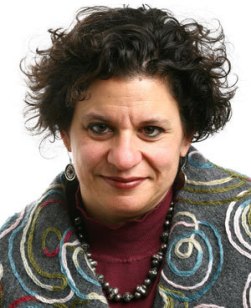
The most recent person to be chosen for this powerful post at arguably the most influential newspaper in the United States is Jodi Rudoren. She takes the place of Ethan Bronner, who was preceded by Steven Erlanger, who was preceded by James Bennet, who was preceded by Deborah Sontag. All, according to an Israeli report, are Jewish.
Most Americans — particularly those who would object to only white reporters covering racial issues or only male reporters covering gender issues — are reluctant to discuss the potential bias in such a profoundly un-diverse system, having been conditioned to fear that such discussion would be “anti-Semitic” or would open the commentator to this extremely damaging accusation.
In Israel, however, it is considered appropriate to discuss the Jewish roots of American politicians and journalists since Israel was created specifically to be “the Jewish state,” Jews have elevated status in it, and the vast majority of Israeli land is officially owned by “world Jewry” (although some individuals have publicly opted out).
An article on the Jerusalem Post website, a major Israeli newspaper, focuses on this aspect. The article, “Judaism at the New York Times”, reports that “all New York Times’ bureau chiefs for at least the last fifteen years have been Jewish.”
The article’s author, Ashley Rindsberg, notes that “the Times doesn’t consistently send Russian Americans to its Moscow bureau… or Mexican Americans to lead its Mexico City bureau…” and asks, “Why does the New York Times consistently send Jewish journalists to head their central office in the Jewish State?”
Rindsberg, who like many conservative Israelis considers the Times’ reporting anti-Israel, provides a somewhat convoluted answer. The Times’ Jewish owners, Rindsberg posits, are uncomfortable with their Jewish identity. Therefore, he claims, they “would just as soon as not have reporters who could be identified for their Jewishness. And to prove it, they send Jews to the Jewish State to report in a most un-Jewish way.”
The Times’ history of pro-Israel coverage
Despite Rindsberg’s view of the Times, analysis shows its coverage to be consistently pro-Israel. A 2005 study found that the Times reported on Israeli deaths at rates up to seven times greater than its reports on Palestinian deaths, even though Palestinian deaths occurred first and in far greater numbers.
A 2007 study of the Times’ coverage of various international reports on human rights violations by Israelis and by Palestinians found that the Times covered reports condemning Israeli human rights violations at a rate only one-twentieth the rate that it covered reports condemning Palestinian human rights violations. The investigation found that during the study period there had been 76 reports by humanitarian agencies condemning Israel for abuses and four condemning Palestinians for abuses. The Times carried two stories on each side.
In its early years the Times specifically avoided assigning Jewish reporters to cover Israel out of concern that such journalists would have an inherent conflict of interest. This policy was reversed in 1979 after Abe Rosenthal became the paper’s executive editor and explicitly decided to choose Jewish journalists for the position.
While his first attempt failed (he had thought his choice, David Shipler, was Jewish), the Columbia Journalism Review reports that most of the journalists who succeeded Shipler, beginning with Thomas Friedman, have been of Jewish ethnicity. The article notes that “for a century [the Times] has served, in effect, as the hometown paper of American Jewry.”

Former NY Times executive editor Max Frankel, who was an editor at the Times from 1972 through 2000, admitted in his memoirs: “I was much more deeply devoted to Israel than I dared to assert … Fortified by my knowledge of Israel and my friendships there, I myself wrote most of our Middle East commentaries. As more Arab than Jewish readers recognized, I wrote them from a pro-Israel perspective.”
An article by star reporter and author Grace Halsell describes her firsthand experience with pro-Israel bias at the Times in the early 1980s.
Halsell had written books about the plight of Native Americans, African Americans, and undocumented Mexican workers. She was a great favorite of New York Times matriarch Iphigene Ochs Sulzberger, whose father had acquired the Times in 1896, whose husband and then son had run it next, and whose grandson is now in charge.
When Halsell next wrote a powerful book describing the Palestinian plight, she incurred Mrs. Suzberger’s displeasure and was quickly dropped by the Times. Halsell writes: “I had little concept that from being buoyed so high I could be dropped so suddenly when I discovered—from her point of view—the ‘wrong’ underdog.”
In her article Halsell quotes a revealing statement by an Israeli journalist following Israel’s 1996 shelling of a U.N. base in Lebanon that killed more than 100 civilians sheltering in it: “We believe with absolute certitude that right now, with the White House in our hands, the Senate in our hands and The New York Times in our hands, the lives of others do not count the same way as our own.”
Since 1984 New York Times bureau chiefs have lived in a house that was acquired for the Times by then Jerusalem Bureau Chief Thomas Friedman (now the Times’ lead foreign policy columnist). The building originally belonged to a Palestinian family forced out in Israel’s 1947-49 founding war. Israel afterward prevented the family from returning and reclaiming their home. Therefore, Times’ bureau chiefs are in the strange position of living in a home that was stolen from Palestinians (acquiring property by violent conquest is illegal in today’s world).
Recent Situation: Bronner, Kershner, & Khader Adnan
 Rudoren’s predecessor as Jerusalem bureau chief, Ethan Bronner, has a son who enlisted in the Israeli military. When this conflict with impartiality was exposed, even the Times’ own ombudsman suggested that journalistic ethics required that Bronner be moved to a different beat. Yet, Times then-editor Bill Keller insisted that this gave Bronner “special sophistication” and kept him in his position.
Bronner’s colleague at the bureau has been Isabel Kershner, who will apparently be staying on. J.J. Goldberg, editor of the Forward, writes: “Isabel Kershner immigrated to Israel from her native England as a young woman and spent a couple of decades in Israeli journalism and Jewish education before joining the Times a few years ago. By now she’s thoroughly Israeli (and, for full disclosure, a friend).”
While pro-Israel Zealots vehemently attack Bronner and Kershner when they cover Palestinian victimization, the truth is that they overlook a great many instances. For example, a 33-year-old Palestinian father of two young girls (another child is on the way) was on a hunger strike that lasted for 66 days. He was was near death when he reportedly decided to end it on Feb 21.
The young man, Khader Adnan, was protesting his imprisonment by Israel – he was never charged with a crime – and the beatings and humiliations he endured from Israeli interrogators. There was an extended international campaign about him that grew even more urgent when doctors began warning after 45 days that he was at risk of death. Eventually, there was so much pressure world wide (including by UN Special Rapporteur Richard Falk and EU Foreign Policy Chief Catherine Ashton) that Israel announced it would release Adnan at the end of his “sentence.”
Yet, Bronner and Kershner – and Times columnists who frequently bemoan the alleged lack of a Palestinian Gandhi – did not publish a single story on Adnan until the 66th (and last) day of his hunger strike – after the Washington Post had finally carried a report two days before. The Times’ headline was the very bland, “Hearing for Palestinian on Hunger Strike Is Set.

While Adnan’s is the longest Palestinian hunger strike on record, through the years there have been hundreds of hunger strikes by multitudes of Palestinians in Israeli prisons; the Times almost never reports on them. It’s revealing to compare their numerous stories on the Israeli tank gunner captured by Palestinians, Gilad Shalit, to the sparsity of their reporting on Adnan and others.
Overall, the thousands of Palestinian prisoners held by Israel seem largely to have been invisible to Times’ reporters. While there have been gruesome reports of their torture for decades, there is little indication that Bronner or Kershner have investigated this or made much, if any, effort to visit Palestinians in Israeli prisons.
Who is Jodi Rudoren?
Now that Bronner’s four-year term has come to an end (he says he initiated the transfer himself and was not pushed out over conflict of interest), it is not clear what went into new editor Jill Abramson’s decision to choose Rudoren for this powerful position.
A cum laude graduate from Yale, Rudoren’s journalistic experience appears to be limited to domestic subjects. Most recently she had been head of the Times’ Education bureau. She speaks what she calls “functional Hebrew” but no Arabic. It’s unknown how much time, if any, she has spent in Israel, whether she has family there, or whether she has family members in the Israeli military.
When Rudoren received a tweet by Palestinian-American author Ali Abunimah, who noted that she would be moving into stolen Palestinian property, she responded: “Hey there. Would love to chat sometime. About things other than the house. My friend Kareem Fahim [a New York Times associate] says good things.”
This friendly but somewhat flip response to a serious subject has caused Israel zealots to attack her. The Atlantic’s Jeffrey Goldberg somewhat hysterically equated Abunimah, an author known for his intellectual analysis, with Israeli Jewish supremacists known for their violence.
Goldberg suggested that Rudoren should have “twinned” her tweet to Abunimah by reaching out to Kahanists — a group listed by both Israel and the U.S. as terrorists. Goldberg should be pleased to learn that Rudoren said she had done just that, telling the Jerusalem Post, “One of the people I followed before reaching out to Abunimah was David Ha’ivri.”
Ha’ivri is an extremist settler rabbi who was involved with Jewish Defense League founder Meir Kahane’s Kach terror group, celebrated the assassination of former Prime Minister Yitzhak Rabin when he had begun to make peace with Palestinians, and was convicted some years ago for desecrating a mosque.
Abunimah, on the other hand, has written a book called “One Country: A Bold Proposal to End the Israeli-Palestinian Impasse,” in which he describes how Israelis and Palestinians can live together in peace.
Rudoren’s knowledge of Hebrew may have been bolstered by her summertime attendance at Camp Yavneh, a Jewish camp in New Hampshire that has an Israeli flag at the top of its website and boasts of its “strong Israeli programming.” It features a six-weeks “summer in Israel” program, though it’s unknown whether Rudoren attended this.
The camp website states that the current boys’ head counselor “grew up in Gush Etzion, Israel, and has served as a Lieutenant Commander in the Israeli Army in charge of 150 soldiers in the Givatti Brigade.” Another counselor is a resident of the Israeli settlement of Efrat, which, like all Israeli settlements, is built on confiscated Palestinian land and is illegal under international law.
Despite an upbringing that appears to have included considerable immersion in Zionist mythology, indications are that Rudoren may be working to widen her view. She raves about a book by Peter Beinart called “The Crisis of Zionism” and retweeted a message by blogger Sami Kishawi. It’s interesting to note that the Times’ only other female Jerusalem bureau chief, Deborah Sontag, often provided exemplary coverage; her term seems to have ended early.
Tweeting like a J-Street official?
Jeffrey Goldberg – who moved to Israel, became an Israeli citizen, joined the Israeli army, and worked as a prison guard at one of Israel’s most brutal prisons – assures readers that Rudoren is still within the pro-Israel fold, commenting, “I don’t know Rudoren… I do know her sister, from synagogue, mainly, and I don’t think Jodi is some sort of anti-Israel activist…”
Goldberg is concerned, however, that she is tweeting “as if she’s a J Street official.” For Goldberg this veers dangerously toward anti-Israelism.
In reality, however, J Street is a pro-Israel organization whose positions are dictated by what is good for Israel. Its founder has just published a book entitled “A New Voice for Israel.” If Goldberg’s assessment of Rudoren is accurate, then it appears that once again the Times has a person at the helm of its reporting on Israelis and Palestinians for whom Israelis are “family.” Quite possibly, literally.
Rudoren may be intending to cover the region accurately and with fairness. To do so, however, it appears that she will need to overcome enormous ingrained bias, relentless and vitriolic objections of the organized pro-Israel community (quite likely including friends and family), and pressure by many powerful Times advertisers and colleagues.
On top of this, unless she chooses a different lifestyle than her predecessors’, she will be living in Israel, her children will go to Israeli schools, and her home will be one of the thousands confiscated from Palestinians who are now living and suffering largely out of sight, their daily humiliations and victimization for the most part invisible.
These winds may be so strong that even when Rudoren believes she has stood upright against them, an outside view may show her tilted far over in the Israeli direction, her reporting on Israel-Palestine, to paraphrase Dorothy Parker, covering the gamut from A to C.
Let us hope that this doesn’t occur.
Let us hope Rudoren understands that good reporting does not equate a false narrative with a factual one; that she will not be, in Abunimah’s words, yet “another New York Times reporter for whom Palestinians are just bit players in someone else’s drama.”
Let us hope she understands that living in stolen property is not a good base from which to report honestly; that “balance” achieved by under-reporting Palestinian suffering while exaggerating that of Israelis is not balance, it is distortion. Let us hope, most of all, that she does not view some human beings as more important than others, but instead views all, regardless of their religion or ethnicity, as family.
~
Alison Weir is executive director of If Americans Knew and president of the Council for the National Interest. She can be reached at contact@ifamericanslknew.org.
Bombing Iran: A Real Headache for Israel
By Steve Rendall – FAIR – 02/21/2012
Bombing Iran could be a real strain for Israel, reports Elisabeth Bumiller in the New York Times (“Iran Raid Seen as a Huge Task for Israeli Jets,” 2/19/12). No one’s sure they can pull it off, what with the logistics involved:
Should Israel decide to launch a strike on Iran, its pilots would have to fly more than 1,000 miles across unfriendly airspace, refuel in the air en route, fight off Iran’s air defenses, attack multiple underground sites simultaneously–and use at least 100 planes.
Everyone apparently agrees on the task in front of Israel, as Bumiller puts it: “Given that Israel would want to strike Iran’s four major nuclear sites….” Killing Iranians and spreading radioactive material over their countryside isn’t an issue for the Times, where Iran seems to exist only as an obstacle to Israeli strategic interests.
But, Bumiller reports, the job could exceed Israel’s offensive capabilities, raising the question of whether the U.S. might be “sucked into finishing the job.” A job she’s not altogether unexcited about:
Should the United States get involved–or decide to strike on its own–military analysts said that the Pentagon had the ability to launch big strikes with bombers, stealth aircraft and cruise missiles, followed up by drones that could carry out damage assessments to help direct further strikes. Unlike Israel, the United States has plenty of refueling capability. Bombers could fly from Al Udeid air base in Qatar, Diego Garcia in the Indian Ocean or bases in Britain and the United States.
Perhaps the most telling line in Bumiller’s cold, skewed accounting of the potential risks of an attack on Iran is in her peculiar notion of what would constitute a state of war:
Iran could also strike back with missiles that could hit Israel, opening a new war in the Middle East, though some Israeli officials have argued that the consequences would be worse if Iran were to gain a nuclear weapon.
War would ensue the instant Iran responded to being bombed? This is not only bizarre wording, it ignores the low-intensity war that has been waged against Iran over the past few years, including explosions at nuclear facilities, the assassination of its scientists and the arming of insurgent groups in Iran’s border areas.
The massacre of 1929 and the War of Narratives
21 February 2012 | International Solidarity Movement, West Bank
If you ask an Israeli settler in or around Al-Khalil (Hebron) what calls them to live on contested land, most will speak to a religious connection to the city and the Cave of the Machpelach (“patriarchs”), where Jews, Muslims, and Christians come to revere the biblical figures believed to be buried there. A series of signs posted nearby along Shuhada Street, the once-main road and market district now closed to Palestinians, tell a story of Hebronite Jewish habitation dating from biblical times, brought to a sharp and bloody end with a 1929 pogrom, which resulted in the deaths of 67 Jewish residents and the displacement of the survivors. Citing this narrative, many of today’s settlers justify their occupation of the old city as a rebirth and continuation of this community, a story echoed in publications distributed by the Gutnick Center (a Jewish cultural center) and soldier-escorted weekly tours through the Palestinian market. The problem with this narrative is that no one, not even the survivors’ descendants, agrees on it.

On Monday, February 20th, the Jerusalem Post published an article presenting the conflict between the survivors’ descendants as a microcosm for Jewish public opinion, some of whom support the settlements and a growing number who oppose Hebron’s especially active settler community, one which Yair Keidan calls “a loaded bomb that can blow up peace altogether.” Both sides have signed petitions to the Israeli government, asking variously to maintain, evacuate, and/or halt settlement activity, and both groups claim a right to the legacy of their parent community.
“You can’t bring back the dead,” said Ya’acov Castel, a survivor from 1929, “but there are people living here now who are carrying out the dream of the Jews who lived here for hundreds of years.” Yona Rochlin, whose family went back many generations in pre-1929 Hebron, argues the opposite—pointing out that the majority of settlers are US immigrants, who have settled in a foreign city unfamiliar with the customs, language, or neighborly habits of the people they claim as spiritual forebears. Unlike the predominantly Sephardi and Mizrahi (Spanish/North African and Middle Eastern respectively) Jewish minority that coexisted with a Muslim majority for five centuries, she says that today’s settlers “came to the city to take revenge for the 1929 massacre and their main idea was to drive out the Arabs and turn Hebron into a Jewish city.”
Hebronite settlers have many claims to fame, including the first West Bank settlement Kiryat Arba (founded 1968, pop. 7200) and the only settlements within the bounds of a Palestinian city—Avraham Avinu, Beit Hadassah, and Beit Romano, which lie at the heart of the Old City and fall under Israeli military control. They are also known to be among the most violent and hardline, with many claiming allegiance to the Kahanist, Gush Emunim, and other extremist Jewish political and religious sects. Particularly infamous Kahanists include Baruch Marzel, founder of the Jewish National Front, and Baruch Goldstein, who in 1994 massacred 29 and injured over 150 Muslims at prayer in the Mosque al-Ibrahimi. Today Goldstein, who was killed during the attack, is venerated as a hero and martyr—and his tomb in Kiryat Arba continues to draw extremist pilgrims, even though his shrine was removed in 1999.
Rochlin, a politically active parent and child of conservative Jewish parents, in 1996 coauthored an open letter to the Israeli government, “Message from the original Jewish community of Hebron: Evacuate settlers,” which stated, “[Hebronite settlers] are alien to the culture and way of life of the Hebron Jews, who in the course of generations created a heritage of peace between peoples and understanding between faiths.” She sees evidence of this tradition in the fact that Muslim neighbors intervened to save her family and over 400 more when the Jewish community was attacked in 1929. Who exactly did the killing, and from where, is uncertain—but there is surprisingly little disagreement over the 19+ Palestinian families that sheltered and defended Jews. Although some Palestinian community members invited their neighbors to stay or return, by 1936 the British Mandate had relocated the remaining Jews to Jerusalem, Tel Aviv and elsewhere.
Curiously, although the Israeli Jews’ narratives tell radically different stories, many area Palestinians also know a great deal about the pogrom and mourn the loss of friends and neighbors. For Muhammad, head of the Abu Aisha family who live in the famed ‘caged house’ on Tel Rumeida, where their home is surrounded by settlement homes, it is a matter of family pride that his father is named among the Palestinians to save Jewish residents. Nonetheless, the Abu Aisha family struggles with daily harassment at the hands of settlers, who occupy land all around the home. Hajj Yussef, one of the few surviving Palestinians who responded in 1929, talks about “our Palestinian Jews,” who dressed and spoke like non-Jewish neighbors. To Yussef, like the children of his refugee neighbors, the obstacle to peace in Hebron lies not in difference but attitude and actions: “I have no problem living with the Jews, like we lived many years ago. But today’s settlers are not Palestinian Jews, they came here from abroad. And I have a problem if the Jews live in my country as occupiers and settlers.”
Open Shuhada Street, the international campaign to end Israeli Apartheid in Al-Khalil/Hebron will continue February 20th through 25th, with actions and cultural events in Khalil and around the world. Each day, we will cover a different aspect of the Occupation’s effects on Shuhada Street and the city generally.
Continue to follow www.palsolidarity.org throughout the week for more stories and analysis.
Related articles
- Settlers Install New Outpost Near Hebron (alethonews.wordpress.com)
- International Solidarity Movement volunteers encounter settler attack and sexual harassment in Hebron (alethonews.wordpress.com)
- Soldiers raid community center, arrest local activist (alethonews.wordpress.com)
- Under Attack – the Golani Brigade’s war on the Palestinian population of Al-Khalil/Hebron (alethonews.wordpress.com)
- Israeli demolition ‘displaces 120′ in Hebron village (alethonews.wordpress.com)
- This Week in History: The second Hebron massacre (altahrir.wordpress.com)
- Hebron: Occupation and Sterilization (alethonews.wordpress.com)
- Settlers torch cars in Beit Ummar (alethonews.wordpress.com)
- An exclusive corner of Hebron (arunwithaview.wordpress.com)
PA: Khader Adnan to end strike
Ma’an – 21/02/2012
RAMALLAH – The Palestinian Authority minister of prisoners affairs said Tuesday that Israel intends to release hunger striking prisoner Khader Adnan after his current administrative detention term.
In return, Adnan agreed to end his strike, according to Issa Qaraqe, the prisoners minister. The term will end April 17, he said.
Adnan has not confirmed he intends to end the hunger strike, but prisoners rights group Addameer said one of Adnan’s lawyers negotiated a deal with the Israeli military prosecutor freeing him on April 17 instead of in May 8.
He also received guarantees the term will not be extended, the group said.
Addameer lawyer Samer Samaan is “actively working to gain permission to visit Khader to confirm whether or not he will continue with his hunger strike,” the rights group said in a statement.
“Addameer’s main concern remains Khader’s health … Whether or not Khader continues his hunger strike, he must receive proper arrangements for observing his health condition,” the group said.
Israel’s Justice Ministry confirmed the deal to end the strike.
“There is a deal. (Khader Adnan) will stop his hunger strike. They will not extend his administrative detention and he will be free on April 17,” an Israeli Justice Ministry spokeswoman told Reuters.
A High Court of Justice session was originally scheduled for Tuesday, but it was canceled upon the announcement of an agreement.
Related articles
- Raymond McCartney, former Irish hunger striker in message of support to Khader Adnan (alethonews.wordpress.com)
- Valiance in the Face of Cruelty (alethonews.wordpress.com)
- Former Irish hunger striker’s message for Khader Adnan, a Palestinian prisoner 55 days on hunger strike (alethonews.wordpress.com)
‘Media War Launched by Foreign Sides to Aggravate Situation in Syria’
SANA | February 21, 2012
MOSCOW – Chairman of the Syrian-Russian Friendship Association, Alexander Dzasokhov, stressed on Monday that a wide-range media war was launched against Syria a year ago, pointing out that foreign sides are destabilizing the situation in Syria.
In an interview with Russia 24 channel, Dzasokhov said that the situation in Syria is complicated, but a solution to the crisis is possible, considering the new constitution of Syria and the referendum on it on February 26, 2012 is ‘an important event’.
He added that the new constitution does not mention a one-party regime, and it includes other forms of parliamentary activities and several other articles consistent with the international standards of the democratic state.
Dzasokhov asserted Russia’s calls for solving the Syrian crisis without foreign interference, adding that Russia considers Syria a “pivotal country” in the Middle East, and it is committed to its sovereignty and stability.
He noted that millions of the Syrian people took to the streets to express their support to the Syrian leadership and commitment to the national unity, but Arab and European media are ignoring that and trying to fabricate the reality of the situation in Syria.
IN MEMORIAM: LIBYAN AIRLINES FLIGHT 114
Mathaba.net
At 10:30 a.m. on 21 February 1973, Libyan Arab Airlines Flight 114 took off on its regularly-scheduled flight from Tripoli to Cairo.
The plane, a Boeing 727, was being piloted by a French crew under a contractual arrangement between Air France and the Libyan national airline. After a brief stop at the city of Benghazi in eastern Libya, Flight 114 continued en route to Cairo with 113 persons on board.
As the airliner flew over northern Egypt on its approach to Cairo, it suddenly encountered a blinding sandstorm which forced the crew to switch to instrument control because the geographic features which ordinarily served as landmarks could not be discerned in the swirling tempest. A short time later, the pilot discovered that he had made a navigational error because of a compass malfunction: the plane had missed an air traffic beacon, and he could not ascertain its current location. He radioed the Cairo air control tower with an urgent plea for assistance. The Egyptian flight controllers radioed back, giving him the information necessary to correct the plane’s course and warning that it appeared that the plane might have strayed over the Sinai peninsula, which at that time was occupied by Israeli forces.
The pilot immediately corrected the course, and LN 114 was heading back to Cairo when the crew noticed two military jets approaching. The crew members expressed relief, for they believed that the jets were Egyptian fighters sent to escort their plane to safety at the Cairo airport. Such, however, proved not to be the case: the two jets were in fact Israeli Phantoms, and, before the pilot of LN 114 had been able to make out the “Star of David” markings on their wings, they had directed three bursts of cannon fire into the Boeing 727, blasting it from the sky.
Flight 114 smashed into the Sinai desert only one minute’s flying time from Egyptian-controlled territory, killing 106 men, women and children aboard.
At first, Israel attempted to deny its culpability for the tragedy. However, after 24 February when the Boeing’s “black box” which had recorded the pilot’s conversations with the Cairo control tower was recovered, such denial was no longer possible. The Israeli government then did a volte-face and revealed that LN 114 had been shot down with the personal authorization of Dado Elazar, the Israeli Chief of Staff. Commenting on the decision to blow up the civilian airliner, Golda Meir, then Prime Minister of Israel, showered Elazar with praise, and exulted, “I want to tell you that I don’t just appreciate you, I admire you!”
The United Nations failed to take any action against Israel for its destruction of the Libyan passenger plane, and when the 30 member nations of the International Civil Aviation Organization voted to censure Israel for the attack, the U.S. abstained.

Israel student society attacks peaceful Palestine protest with water bombs at London School of Economics
By Asa Winstanley – The Electronic Intifada – 02/20/2012
A student street theatre put on by the Palestine Society at the London School of Economics was attacked by members of the Israel Society today.
Part of Israeli Apartheid Week, the peaceful mock checkpoint was attacked with water bombs, knocking down some of the set. LSE Palestine Society member Jen Izaakson said they shouted “Hamas” and “death to Israel” as they threw the water bombs.
With breathtaking hypocrisy, the Israel Society later put out a statement demanding a “full apology” and “dialogue”, claiming the street theatre had been “provocative”.
But Izaakson told EI the attack had only increased the Palestine Society’s “resolve to do more stuff this week” promising the checkpoint stunt would be extended from one day to five in response. “People did get hurt” by the water bomb attack, she said.
Reality of Israeli apartheid for Palestinians
The “checkpoint” had been set up to illustrate to LSE students the kind of restrictions Palestinians in the West Bank regularly face at Israeli checkpoints. Palestinians in the West Bank are stopped and detained at Israeli checkpoints every day, while (often armed) Israeli settlers living in the same area sail through them unmolested.
LSE Jewish Society President Jay Stoll seemed perfectly aware of this reality. He claimed on twitter to have responded to the checkpoint that “I’m Israeli and don’t need” an ID.
Although the students’ union blamed unnamed “organised individuals” Izaakson said she recognized the attackers as “prominent members” of the Israel Society.
In a statement, the Palestine Society said: “Students from LSESU Palestine Society re-enacted an Israeli checkpoint on Houghton Street, as the start of Israeli Apartheid Week. The re-enactment was to show the suffering Palestinians face on a daily basis, trying to live their lives. All students which took part, had pre-agreed to take part in the re-enactment and students who did not wish to be involved were not forced to take part. The re-enactment passed peacefully for two hours, with students responding incredibly positively to the action… We as a society call on management to continue to protect our right to peaceful protest on LSE’s campus.”
Rafeef Ziyadeh, a spokesperson for the London organizing committee of Israeli Apartheid Week told EI: “This is typical of the usual intimidation from Zionist groups. It’s not going stop this year’s Israeli Apartheid Week, which is set to be the biggest one yet. We call on London students to come out and attend our week of events and not let Israel’s apologists provoke or intimidate them.”
The LSE Students’ Union released a statement saying: “Whilst peacefully re-enacting an Israeli checkpoint and talking to students about the issue, a small group of organised individuals ran towards members of the LSESU Palestine Society and threw water bombs which hit several students and knocked over property of the Palestine Society… The safety and welfare of students is of the utmost importance and the Union will be investigating the matter immediately in conjunction with the School.”
Israeli Hasbara minister worried about sucesses of Israeli Apartheid Week
Coming on the first day of Israeli Apartheid Week, this seems to be an attempt to draw pro-Palestinian students into violence, and attention away from the week’s events that seek to highlight the realities of Israeli apartheid in occupied Palestine.
A report in the Jerusalem Post yesterday said that Israel’s Hasbara (propaganda) minister Yuli Edelstein had dispatched Israeli settlers and other “Faces of Israel” to London and other cities where Israeli Apartheid Week was taking place to “answer to the attempts to de-legitimize Israel”.
Israeli Apartheid Week is taking place on university campuses around the world this month. The London event is on this week, with the biggest event set for Wednesday. You can read more about it on this Facebook page.
Related articles
- [Dublin, Israeli Apartheid Week 2012] Boycott Israeli Goods demo (seachranaidhe1.wordpress.com)
- Paris university pulls plug on “Israeli apartheid” talk (alethonews.wordpress.com)
- [Galway, IAW] Iyad Burnat: Non-violent resistance to Israeli Apartheid (seachranaidhe1.wordpress.com)
- [Limerick, IAW] Iyad Burnat: Non-violent resistance to Israeli Apartheid (seachranaidhe1.wordpress.com)
- Events (coalitionforpalestine.org)
UK to spy on all online communications
Press TV – February 19, 2012
The British government is to exert more control over the public by storing the details of British people’s communications including every phone call, text message and email.
The British government will order phone companies and broadband providers to record the details of all phone calls, text messages, and emails and restore the data for one year, reported the Telegraph on Saturday.
Britain’s new spy plans will also target social networking websites such as Facebook and Twitter as the details of direct messages communicated between the users are to be recorded.
The change in the social media has been a concern for the British government at times of crisis such as the unprecedented unrest which swept across the country in August last year.
Exerting more control over British public’s communication via social media is a preventative measure taken by the British government to spy on people and limit their access to the means of communication.
The Telegraph revealed that Britain’s Home Office has been engaged in negotiations with internet providers for two months.
The spy plans have been drawn up by the country’s intelligence agencies MI5 and MI6 in collaboration with the GCHQ, Britain’s secretive agency of intelligence experts.
Big Brother Watch, a campaign group defending individual privacy and civil liberties, described the British government’s decision as “shameful” saying, “Britain is already one of the most spied on countries off-line,” online spying on the British public would be another invasion on their privacy.
Father, Mother, Their Two Children Injured In Israeli Strike On Gaza
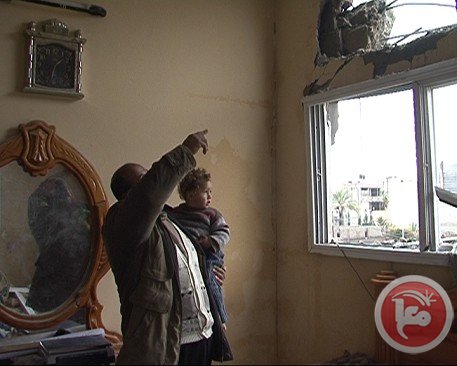
The Zaharna family inspect damage to their home. (MaanImages)
By Saed Bannoura | IMEMC & Agencies | February 19, 2012
Palestinian medical sources in the Gaza Strip reported, on Sunday at dawn, that a father, mother and their two children, were wounded when the Israeli army bombarded their home in Gaza City. Two Palestinians were wounded in an earlier strike on Gaza.
The sources stated that the Israeli Air Force fired at least one missile at the house of Ahmad Az-Zaharna, in Gaza’s At-Tuffah neighborhood, wounding the father, Ahmad, in addition to his wife and their two children. They were all moved to the Ash-Shifa Hospital in Gaza city.
Furthermore, the army bombarded an area east of Gaza city leading to excessive damage but no injuries.
The area is claimed to be a training center for the Al-Qassam brigades, the armed wing of the Hamas movement.
On Saturday at night, Israeli war-jets fired a number of missiles at a blacksmith workshop in Gaza leading to two injuries among the civilian population.
Eyewitnesses said that the Air Force fired two missiles into the workshop that belong to Ashour family; the workshop is part of the home of the family an issue that led to the injury of two family members, their injuries were described as mild-to-moderate.
Related articles
- Medics: Two wounded in Israeli helicopter strikes in Gaza (altahrir.wordpress.com)
- Israeli forces killed 19 Palestinian children in Gaza in 2011 (alethonews.wordpress.com)
Featured Video

No Threat Can Force Iran’s Surrender /Trita Parsi & Lt Cl Daniel Davis
or go to
Aletho News Archives – Video-Images
From the Archives
What is the Israeli Lobby in Australia Doing in Interfaith Dialogue?
By Ali Kazak | Dissident Voice | October 11, 2015
For years Israel and its lobby around the world have been trying to normalise their relations with Arabs and Muslims without solving the Palestine Question.
One of the methods they resorted to in the last few years is using human rights and community organizations such as interfaith dialogue and Multiculturalism to achieve this objective and to: isolate the Palestinians, marginalise the Palestine question, end Israel’s isolation, and prevent criticism of Israel, knowing that these organisations will be the first to stand against Israel’s violations, racial and religious discrimination.
The group responsible for this task in Australia is The Australia/Israel & Jewish Affairs Council (AIJAC); its Director of International & Community Affairs, Jeremy Jones is in charge of lobbying religious community organizations, specifically Muslims and Christians. Consequently he convened the Faith Communities for Reconciliation, founding participant in the Australian Partnership of Religious Organisations and the Australian National Dialogue of Christians, Muslims & Jews.
AIJAC is a private political propaganda group. It is recognised as the main Israeli lobby in Australia. It coordinates its activities and works intimately with the Israeli embassy in Canberra and different institutions in Israel. It is privately funded by some Jewish businessmen. It monitors closely Australian politicians, the media, ethnic and religious groups, (especially Arabs and Muslims), unions and academics on their stands towards Israel and the Palestine question. … continue
Blog Roll
 Aletho News
- Envoy warns UN on Trump’s threat to ‘obliterate’ Iran’s civilian infrastructure
- The Larak Corridor: Iran’s Rial Gate With No US, No Israel, and No Way Around
- ‘Economic terrorism’: Steel facilities hit again in US-Israeli strike
- ‘War Crime’: Iran condemns attacks on Arak, Ardakan nuclear sites
- Two-thirds of Americans want quick end to Iran war even if goals unmet
- Trump to Give “Important Update on Iran” Wednesday in Prime-Time Speech
- Theodore Postol: Iran’s Missiles & Drones Were Underestimated
- Iran To Target Military Industrial-Tech Complex That Facilitated Gaza Genocide
- Collapsing Empire: The Resistance Disarms ‘Israel’
- Suicide Should Not Be a Government Service
- If Americans Knew
- Israel wants US to bomb more of Iran’s civilian structures (113,000 is not enough) – Not a ceasefire Day 173
- Ann Coulter Rips Into Fox News for Iran War Coverage
- Joe Kent Urges Americans To Call White House and Congress To Object To Sending Troops Into Iran
- DNC Resolution to Reject AIPAC Funding Puts Democratic Leaders in the Hot Seat
- Swedish foundation to build 400 schools as over 650,000 Gaza children remain without education for 2 years
- Israeli army admits photshopping image of slain Lebanese journalist
- This is how Israel is systematically killing health workers under the cover of war in Lebanon
- Carrying life under fire: Israeli invasion of Lebanon leaves pregnant women facing deadly risks
- Champagne all around for the new death penalty (for Palestinians) law – Not a ceasefire Day 172
- Why are Palestinian books struggling to be seen on Amazon?
- No Tricks Zone
- New Study Finds Warming Saves Lives…Cold Temperatures 12 Times More Deadly Than Excess Heat
- German Science Blog Accuses PIK Climate Institute Of Hallucinating Climate Tipping Points
- Devastating Assessment Of Comirnaty Vaccine By Former Senior Pfizer Europe Toxicologist
- New Study: CO2 Is ‘Effectively Negligible’ As An Explanatory Climate Change Factor Since 2000
- Former Pfizer Toxicologist Dr. Helmut Sterz Tells Bundestag Hearing Pfizer Vaccine Should Have Never Been Approved
- Energy Expert: Germany’s Nuclear Phaseout Was A “500 Billion Euro Mistake”
- New Research: South Australia’s Mid-Holocene Sea Surface Temperatures Were 4°C Warmer Than Today
- Storing Green Energy To Last Germany 10 Days Would Require A 60-Million Tonne Battery
- New Studies: UK Sea Levels Were 4 Meters Higher Than Today During The Mid-Holocene
- Destructive Green New Deal: German Energy And Metal Group Warns Of Drastic Crisis
 Aletho News