Is Obama more Zionist Than Dubya Bush
By Yousef | Permission To Narrate | March 2012
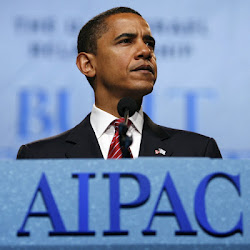 Remember last year when there was a great deal of commotion about President Barack Obama’s reference to the 1967 lines being used as the basis of negotiated land swaps between Israel and Palestine?
It was hard to forget. Obama’s political foes and even some of his friends accused him of throwing Israel under the bus. Netanyahu used the opportunity to slam Obama for this and stated that “Israel will not return to the indefensible boundaries of 1967”. In fact, when he said this before Congress they gave him one of 29 standing ovations.
As Republican candidates vie for the party’s nomination, they have not shied from using this issue to attack Obama as well, following Netanyahu’s lead.
But, successive administrations have stated the same thing time and again about the US position which is in line with UN Security Council Resolution 242. Most reasonable observers knew at the time that Obama’s statements where in no way a major shift in policy.
Or was it?
If it was, Jeffery Goldberg, for one, didn’t notice. He wrote, in a post titled ‘Did Obama Say Something so Different than Bush?‘ (emphasis mine):
In 2005, Geoge W. Bush stated that it is “unrealistic to expect that the outcome of final status negotiations will be a full and complete return to the armistice lines of 1949” (the 1967 boundaries of Israel, in other words). Today, Barack Obama said that he believes “the borders of Israel and Palestine should be based on the 1967 lines with mutually agreed swaps, so that secure and recognized borders are established for both states
Seems straightforward enough. The immediate predecessor to Obama, George W. Bush, talked about the 1949 Armistice line which Goldberg tells us equals the 1967 line. So essentially, Bush and Obama had the same position, right? Here is an excerpt from President Bush’s speech in the Rose Garden in 2005 (emphasis mine):
Any final status agreement must be reached between the two parties, and changes to the 1949 Armistice lines must be mutually agreed to. A viable two-state solution must ensure contiguity of the West Bank, and a state of scattered territories will not work. There must also be meaningful linkages between the West Bank and Gaza. This is the position of the United States today, it will be the position of the United States at the time of final status negotiations.
If we go by Goldberg’s translation, 1949 Armistice lines = 1967 lines. This formula is not just the Goldberg standard. Here is the New York Times on this issue (emphasis mine):
Those commitments came in a letter from President George W. Bush which stated, among other things that “it is unrealistic to expect that the outcome of final status negotiations will be a full and complete return to the armistice lines of 1949,” another way of describing the 1967 boundaries.
To be sure, NPR checked with Glenn Kessler, author of the Washington Post’s “Fact Checker” column to, well, check the facts:
President BARACK OBAMA: We believe the borders of Israel and Palestine should be based on the 1967 lines with mutually agreed swaps.
CONAN: And Glenn, is that a substantial change from what presidents have said before?
Mr. KESSLER: Yes, it is. I mean, in the context of diplomacy, what President Obama said that was different was that he actually referenced 1967, the 1967 lines, the de-facto border that had basically existed since the end of the 1948 war of independence.
CONAN: So if he had said the armistice lines of 1948, would that have been different?
Mr. KESSLER: No, what I did is I researched and looked at what all previous presidents had said, and actually they never said anything about lines one way or the other.
I’m not sure what kind of research Glenn did to miss the statement by President Bush buried deep down in this dusty archive. But its not just the fact the Bush made reference to the 1949 armistice line that contrasts with Kessler’s statements. He seems to be saying, like the New York Times, Jeffery Goldberg and even some Palestinians that the 1949 Armistice Line = the 1967 line.
Well, to be perfectly accurate, we are all wrong. The 1949 armistice line is not the same as the 1967 line. Here is why, check out the map of Gaza below (enlarge). The red line you see is the actual armistice line from 1949. The blue line is what we see on maps today which often is referred to as the Green Line or the 1967 line. So what happened to all the area, some 200km2, in purple?
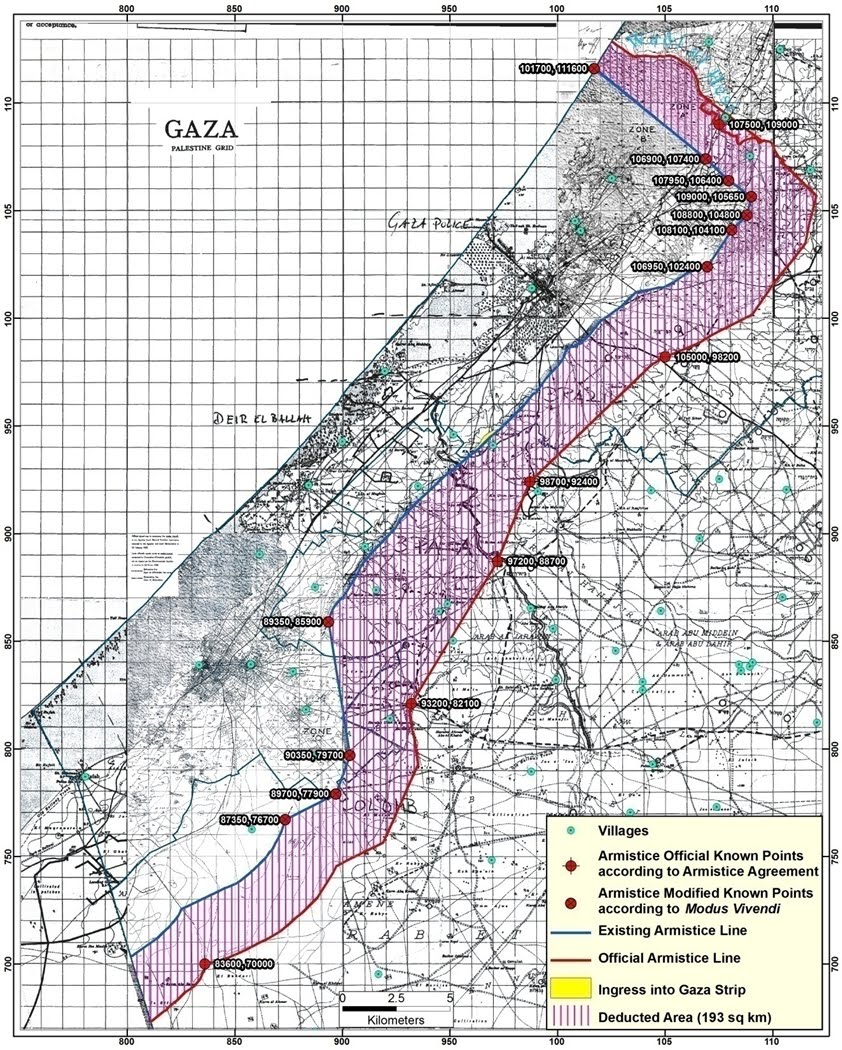 Essentially, the Israelis just took it. The blue line is actually the 1950 modus videndi line. This was an agreement between Egypt, which filled the vacuum of power in Gaza at the time, and the Israelis that established a temporary buffer zone (the purple area) on the Arab side of the actual armistice line. The agreement divides the territory up into areas A,B and C and resulted in a permanent Israeli land grab. (Why does this sound so familiar?) Dr. Salman Abu Sitta, an outstanding Palestinian historical geographer, made a great presentation about this, the Nakba, and other Israel land grabs here at the Palestine Center.
There are areas other than Gaza where the lines diverge. This ironically includes the villages in the triangle area in the north eastern part of the West Bank which Israel was not supposed to enter and today, for reasons of ‘demographic threat’ probably wishes it never had. I’d encourage you to watch the whole presentation.
President Obama actually visited this purple area grabbed by the Israelis in the map above. President George W. Bush, despite all the damage his policies did in the region, clearly chose to use the language of the 1949 armistice line over the 1967 lines for a reason. By doing this, Bush actually signified the correct dividing line on which negotiations should be based. By reversing from the Bush language of “1949 armistice lines” to 1967 borders, Obama actually supported a Zionist land grab.
I wonder what his right-wing detractors have to say about that?
In sum, this is just another example of how, over time Zionist expansionism has taken more and more of Palestine, constantly changing the starting point and re-leveraging their negotiating position. It also goes to show you that over time, the temporary becomes permanent and a lie told often enough becomes truth. (At least we have the internet to set things straight.)
Is it any wonder why the Palestinians want a complete stop to any such expansion before even thinking of negotiations?
Related article
3 Comments »
Leave a reply to 5 dancing shlomos Cancel reply
Featured Video

Lessons Learned from Thirty Years CT Heart Scans and Coronary Calcium Scores: The Role of Vitamin D
or go to
Aletho News Archives – Video-Images
From the Archives
How GMO seeds and “RoundUp” are driving US policy in Venezuela
By Whitney Webb | MintPress News | May 6, 2019
CARACAS, VENEZUELA — As the political crisis in Venezuela has unfolded, much has been said about the Trump administration’s clear interest in the privatization and exploitation of Venezuela’s oil reserves, the largest in the world, by American oil giants like Chevron and ExxonMobil.
Yet the influence of another notorious American company, Monsanto — now a subsidiary of Bayer — has gone largely unmentioned.
While numerous other Latin American nations have become a “free for all” for the biotech company and its affiliates, Venezuela has been one of the few countries to fight Monsanto and other international agrochemical giants and win. However, since that victory — which was won under Chavista rule — the U.S.-backed Venezuelan opposition has been working to undo it. … continue
Blog Roll
Recent Comments
loongtip on UK believes it can seize any t… loongtip on Pirates of the Caribbean loongtip on Australian festival boycotted… loongtip on Kiev seeks to ban Russian musi… seversonebcfb985d9 on Somaliland and the ‘Grea… John Edward Kendrick on Kidnapped By the Washington… aletho on Somaliland and the ‘Grea… John Edward Kendrick on Somaliland and the ‘Grea… aletho on Donald Trump, and Most America… John Edward Kendrick on Donald Trump, and Most America… aletho on The US Has Invaded Venezuela t… John Edward Kendrick on The US Has Invaded Venezuela t…


 Aletho News
- President Karol Nawrocki Vetoes Poland’s EU Digital Services Act Enforcement Bill, Citing Censorship Concerns
- Australian festival boycotted for excluding Palestinian writer
- Palestinian surgeon Ghassan Abu Sittah defeats pro-Israel lawfare in landmark GMC ruling
- Satellite images reveal extensive bulldozing of rubble in Beit Hanun amid signs of broader plans
- Is a New Saudi-Led Axis Forming against the UAE & Israel?
- UAE begins ‘hurried evacuation’ from Somali air base: Report
- The Only Way For America To ‘Help’ Iran Is To Lift the Crushing Sanctions
- Did the U.S. achieve a regime change in Venezuela?
- UK believes it can seize any tanker under Russia sanctions – BBC
- Why America’s Oil Giants Aren’t Eager to Invest in Venezuela in Wake of Maduro’s Abduction
- If Americans Knew
- More death: in Gaza, West Bank, Israeli prison – Not a ceasefire Day 94
- The Israeli Influence Operation Aiming to Install Reza Pahlavi as Shah of Iran
- Avoidable tragedy: another infant dies from cold – Not a ceasefire Day 93
- Israel is quietly erasing Palestinian refugee camps from existence in the West Bank
- The “Zionist tint” to the Maduro abduction, if not operational, then normative
- Press association condemns Israel’s continued ban on media access to Gaza
- Israeli Indifference to Palestinian Suffering Is Fertile Ground for the Growth of Sadism
- Surge in premature births, congenital defects, cancer deaths in Gaza – Not a ceasefire Day 92
- 35,000 ‘Partially or Completely’ Deaf in Gaza Due to Israeli Bombings – Le Monde
- By suspending 37 aid organizations is Israel pushing toward a final expulsion?
- No Tricks Zone
- New Study: Greenland Was 3-7°C Warmer And Far Less Glaciated Than Today 6000-8000 Years Ago
- German Media Report That Current Frigid Weather Can Be Explained By Arctic Warming!
- Berlin Blackout Shows Germany’s $5 Trillion Green Scheme Is “Left-Green Ideological Pipe Dream”
- Modeling Error In Estimating How Clouds Affect Climate Is 8700% Larger Than Alleged CO2 Forcing
- Berlin’s Terror-Blackout Enters 4th Day As Tens Of Thousands Suffer In Cold Without Heat!
- Expect Soon Another PIK Paper Claiming Warming Leads To Cold Snaps Over Europe
- New Study: Human CO2 Emissions Responsible For 1.57% Of Global Temperature Change Since 1750
- Welcome To 2026: Europe Laying Groundwork For Climate Science Censorship!
- New Study Finds A Higher Rate Of Global Warming From 1899-1940 Than From 1983-2024
- Meteorologist Dr. Ryan Maue Warns “Germany Won’t Make It” If Winter Turns Severe
 Aletho News
Could you provide some more maps- or better yet- links to maps that can be viewed larger?
I don’t really understand what the difference is between the 1949 and 1967 map lines are- unless you are implying that the areas under Israelli control in 67 are somehow what is meant? True- 1967 israel controlled part of the sinai, part of syria (golan heights), and the west bank and parts of Gaza- the last 3 of which are the ones they still control or jointly control. But in terms of Israels actual borders- as opposed to including areas they control- I see no real difference between 1949 and 1967?
The major difference in maps is the UN partition plan of 1947 vs anything since then.
LikeLike
Comparing Obama to Bush43 is a cat box I refuse to stick my nose in. I have had cats that always went outside and did it in secret and buried it. Bush 43 and Obama use far less discretion.
LikeLike
there were times during his beg at the aipac grovel when the vice president for israel(mantiq al tayer) couldnt eye his master face to face. his eyes closed or nealy closed.
the weak servant before his master
LikeLike