Marching Toward Syria with Eyes Cast Towards Iran
By Ben Schreiner | Dissident Voice | March 7th, 2012
While all the incessant warmongering directed toward Iran at the annual AIPAC policy conference in Washington was grabbing the headlines, the momentum for Western intervention into Syria continued to steadily build. All those neo-con “real men,” it appears, just might prefer to go to Tehran via Damascus.
Taking to the Senate floor on Monday, Arizona Senator John McCain, one of the first supporters of arming the Free Syrian Army, upped the ante by calling for a U.S.-led air campaign against Syrian military targets. McCain deemed such an escalation necessary to establish “humanitarian corridors.”
“The United States should lead an international effort to protect key population centers in Syria, especially in the north, through airstrikes on Assad’s forces,” the intervention-hungry McCain declared.
And as the Washington Post reported in late February, Obama administration officials have made it clear that “additional measures” might still be considered in order to oust Assad. That favored refrain of all options being on the table appears to be in effect in regards to Syria.
Indeed, for according to CNN, the Pentagon has already composed “detailed plans” for military action inside Syria. As the network reported, the Pentagon has especially focused on securing Syrian chemical weapons sites, with one scenario in particular calling “for tens of thousands of troops to potentially be used for guarding the installations.”
Although, according to a December email recently published by Wikileaks from the U.S. global intelligence firm Stratfor (known as a private C.I.A.), special operations forces from the U.S., U.K., France, Jordan, and Turkey are already on the ground in Syria. And as the email states, these forces are actively “training the Free Syrian Army.” Additional measures indeed!
Not wanting to be left behind in any march on Syria, the U.S. corporate media has largely begun to join the ranks of the recently ascendant intervention hawks.
In an editorial on Friday, the New York Times, although ruling out military force, called for providing greater tactical assistance to the Free Syrian Army. As the paper wrote: “The United States and its allies should consider providing the rebels with communications equipment, intelligence and nonlethal training.” Of course, a mission providing such tactical support would ultimately transform into more explicit military involvement.
Meanwhile, the Washington Post also editorialized on Friday for a more credible threat of force against Assad. As the paper wrote:
The Obama administration’s public arguments against the use of force in Syria are simply encouraging a rogue regime to believe it can act with impunity. Until he is faced with a credible threat of force, from the opposition or outsider powers, Mr. Assad’s slaughter will go on.
The Christian Science Monitor has likewise called for the U.S. to help “forcefully” end Assad’s rule.
Of course, the driving force behind such intense Western interest in Syria is Iran. Let there be no doubt, the ouster of Assad is not driven by some great humanitarian impulse, or “responsibility to protect.” Nor does the bloodletting and slaughter inside the country disturb U.S. elites. After all, the U.S. had no qualms with laying siege to Fallujah. Rather, all the contrived moralizing is being utilized in an attempt to garner support for imposing Syrian “regime change,” which would deal a strategic defeat to Tehran. It’s all nothing more than realpolitik. The Syrian people and their revolution are being cynically recruited as means to imperial ends, and thus would be wise to resist all foreign intervention.
For instance, when the Atlantic’s Jeffery Goldberg stated in a recent interview with President Obama, “But it would seem to me that one way to weaken and further isolate Iran is to remove or help remove Iran’s only Arab ally,” the president responded, “Absolutely.”
Similarly, former Mossad chief Efraim Halevy has argued, “The current standoff in Syria presents a rare chance to rid the world of the Iranian menace to international security and well-being.”
It’s target Iran, albeit on a Syrian battlefield. Therefore, that anti-Iran propaganda machine that is the U.S. media revs up.
Writing in the Washington Post, stenographers Joby Warrick and Liz Sly reported over the weekend that:
U.S. officials say they see Iran’s hand in the increasingly brutal crackdown on opposition strongholds in Syria, including evidence of Iranian military and intelligence support for government troops accused of mass executions and other atrocities in the past week.
The Post’s report was, of course, based solely on three anonymous U.S. officials. And as Warrick and Sly even admit in their piece, “such accounts are generally difficult to verify independently.” Thus they don’t.
On Monday, though, a similar piece of propaganda appeared at CNN. Penned by CNN Pentagon correspondent Barbara Starr, it also reports of Iranian infiltration into Syria, although Starr only relies on two anonymous U.S. officials. What hay a seasoned propagandist can make with such limited sources!
Yet amidst this mounting drive for Western intervention into Syria, President Obama spoke on Tuesday in an apparent attempt to tamp down all such notions, going so far as to call military intervention a “mistake.” As the president went on to state, “the notion that the way to solve every one of these problems is to deploy our military, that hasn’t been true in the past and it won’t be true now.”
Such reassurances aside, actions do, as the president himself implored in his AIPAC speech over the weekend, speak louder than words. And so while the president publicly posits that military intervention would be a mistake, his military readies for intervention into Syria, while continuing its larger ongoing build-up in the region.
The march towards Syria with eyes cast towards Iran continues on. For as Albeit Einstein once remarked, “You cannot simultaneously prevent and prepare for war.”
Ben Schreiner is a freelance writer living in Salem, Oregon. He may be reached at: bnschreiner@gmail.com.
Related articles
- Israel’s No.1 asset in the Senate calls for airstrikes against Syria (alethonews.wordpress.com)
Eric Holder Tortures the Constitution
A Black Agenda Radio commentary by Glen Ford | March 7, 2012
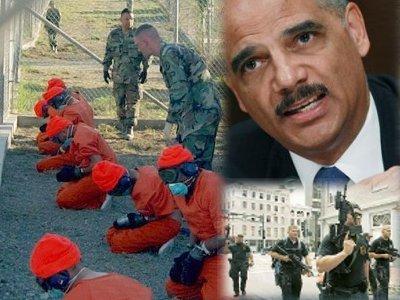
U.S. Attorney General Eric Holder this week attempted to explain how the U.S. Constitution allows the American president to be a law unto himself – to be judge, jury and executioner. Those are the powers that President Obama claims are inherent in his office: the right to kill at will, based on evidence only he is fit to examine and assess. This is a system of law without courts, without evidence that either the public or the condemned person has a right to see, or to contest. One man, with the power of life and death over any inhabitant of the planet, including citizens of the United States.
They used to call such people kings. But even the English kings of old – at least since the signing of the Magna Carta 800 years ago – were compelled to recognize the principle that free men could only be punished based on the law of the land. The United States Constitution is rooted in the principle of due process of law, with the courts as final arbiters of whether the law has been served.
With the passage of preventive detention without trail or charge, and President Obama’s claim to have sole power to target any human being for death, the rule of law has been eviscerated, abolished by presidential decree and congressional acquiescence. A pillar of civilization has been toppled, but most people in the United States appear not to have noticed.
It turns out that due process of law is not what we thought it was, these last two centuries. Attorney General Holder defended the president’s authority to summarily execute, without sanction of the courts, or formal charges, or even evidence of crime, persons designated by him as enemies of the United States. You can’t get more king-like than that. Holder acted as if he’d found a previously undetected loophole in the Constitution. “‘Due process’ and ‘judicial process,’” he said, “are not one and the same, particularly when it comes to national security.” According to Holder, “The Constitution guarantees due process,” but it does not guarantee judicial process. In other words, the U.S. Constitution does not guarantee people access to the courts, even if they are targeted for execution. If that were true, it would be a worthless Constitution, but the U.S. Supreme Court has convincingly ruled, in a 2004 case, that citizens who are detained as enemy combatants have a right to confront the government on the facts of the matter “before a neutral decision maker” – that is, before a court of some kind. Certainly, such rights would apply to someone the president wants killed.
Ah, but this is war, says Eric Holder, and different rules apply. We could ask the rhetorical question: When does this war end? But Obama is clearly claiming to have rights that are inherent in the president’s national security powers. War is…whatever he says it is. Or, whatever President Romney or President Santorum say it is.
The Attorney General ultimately justifies the trashing of the Constitution on national security grounds. We have reached our national “hour of danger,” he says.
Holder is right about that. The danger is upon us, and it emanates from the White House. There’s a name for the danger: it’s called fascism, which happens when militarists and the worst capitalists get together and abolish due process and the rule of law – which the First Black President of the United States has already done.
BAR executive editor Glen Ford can be contacted at Glen.Ford@BlackAgendaReport.com.
Related articles
- Obama’s Kill Policy (jonathanturley.org)
- Eric Holder: U.S. Government Can Kill U.S. Citizens if the Threat is Serious and Capture “isn’t feasible” (reason.com)
- Holder’s Regressive Defense of Targeted Killings (dissenter.firedoglake.com)
CNN fake Syria news busted
“I don’t know how they got it, this is all private, we should have, this has all been deleted, we have to delete all this stuff” – Danny
SyriansWorldwide | March 1, 2012
Video: Classic war propaganda – complete with staged-gunfire off camera and the intrepid actor “Danny” relaxed and joking before getting into character to give a hysterical “casualty report” to his co-star, CNN’s Anderson Cooper – just one of many he regularly gives to Western media networks.
Obama Can Do More on Oil Prices
By Ralph Nader | March 6, 2012
Gasoline and heating oil prices are ratcheting up. In California, some motorists are paying over $5 per gallon. President Obama declared that “there is no quick fix” for this problem. Meanwhile, the hapless but howling Republicans are blaming him for the fuel surge as if he is a price control czar.
Indeed, President Obama has some proper power to cool off retail petroleum prices. David Stockman, President Ronald Reagan’s Budget Director, said it plainly on CNN last week, “Stop beating the war drums right now [against Iran], and Obama could do that, and he could say the neocons are history.” Having done his stint on Wall Street, Stockman knows that war talk by the war hawks inside and outside of our government is just what the speculators on the New York Mercantile Exchange want to hear as they bid up the price. Your gasoline prices are not charging up due to strains between supply and demand. Speculation, with those notorious derivatives and swaps, is what is poking larger holes in your fuel budget, according to Securities and Exchange Commission enforcement lawyers. The too-big-to-fail Wall Street gamblers – Goldman Sachs, JP Morgan Chase, Bank of America, Merrill Lynch, and Morgan Stanley – are at it again.
Dr. Mark Cooper of the Consumer Federation of America documented that speculation added $600 to the average family’s gasoline expenditures in 2011. Earlier, the head of Exxon/Mobil estimated that speculation was responsible for over $40 per barrel in price increase at a time when oil was more than $100 per barrel.
Last June, the Commodity Futures Trading Commission (CFTC) Chairman, Gary Gensler, declared in New York City that “huge inflows of speculative money create a self-fulfilling prophecy that drives up commodity prices.”
Mr. Gensler and the CFTC received more legislated authority to police these Wall Street gamblers, but key members of Congress refused to give him a budget to, in his words, “be a more effective cop on the beat,” at a time of sharply-increasing trading volume. Congressional campaign budgets are being swelled by campaign contributions from those very Wall Street gamblers. This is called “cash-register politics.” Meanwhile, you the people pay and pay at the pump and wonder why no one is doing anything about it.
But an inadequate budget only explains part of Mr. Gensler’s problems. He is continually undermined by other CFTC Commissioners who do not want real enforcement action. He also seems to be wearing down under the pressure.
Back in the 1970s, a sudden increase in gasoline prices – even a few cents – led to an uproar among consumers and demands for regulation, price controls and other government action. Now that the New York Mercantile Exchange, with its big banking and hedge fund speculators loading up on fat profits and bonuses is right here in the U.S., officials are throwing up their hands saying “there are no quick fixes.”
Yet by the constant Israeli-Obama-Hillary Clinton-Congressional-AIPAC belligerent talk about Iran developing a capability to produce nuclear weapons is provoking Tehran’s warnings about the Straits of Hormuz, and the oil price speculators are having a field day with your gas dollars.
Senator Bernie Sanders (I-Vt.) regularly demands that that Obama’s regulators impose limits on oil speculations. He asserts that the “skyrocketing price of gas and oil has nothing to do with the fundamentals of supply and demand.” Even Goldman Sachs analyst, David Greely, claimed Wall Street speculation in the futures market is driving up oil prices.
In response to such clamorings, President Obama announced in April 2011 a new inter-agency working group to combat fraud. Don’t hold your breath waiting for any action here.
So why doesn’t President Obama invite the various industries such as the trucking and airline companies that are hurt by spiraling oil prices, together with consumer groups, motorist organizations, such as AAA and Better World Society, and the relevant government agencies to generate the pressure on Congress and the recalcitrant members of the CFTC to stop fronting for the Wall Street casino giants?
Mr. Obama and Energy Secretary Chu keep saying that there is enough oil in world markets and that speculatively-driven higher oil prices are undermining the U.S. economic recovery. Yet Mr. Obama seems unwilling to fully use his administration’s existing authority to crack down on the surging speculation.
There is much more action possible under current statutory authority for the regulators to use and earn their salaries. They need to hear louder rumblings from the people. While the people need, whenever possible and safe, to walk short distances instead of drive there, if only to stiffen their determination to fight back in more than one way.
Israeli settlement waste ‘poisoning Palestinians’
Ma’an – 06/03/2012

NABLUS – Sewage from Israeli settlements near Salfit in the northern West Bank is flowing into nearby Palestinian communities and causing serious disease, a health ministry official said Tuesday.
Speaking at an environmental conference in Salfit, the head of Salfit’s ministry of health office said the situation had become “intolerable” for communities affected by disease from the sewage, including cases of cholera.
Waste from factories in an industrial zone inside an Israeli settlement is threatening Salfit’s agriculture, the Salfit governor said.
Barqan settlement, near Salfit’s Qana Valley, has the largest industrial complex of the Israeli settlements in the West Bank, Gov. Isam Abu Bakr said.
He warned that the dumping of waste in 11 sites surrounding Salfit had become a major cause of cancer in the area.
All Israeli settlements built in the occupied West Bank and East Jerusalem are illegal under international law.
Related articles
- Israel to Take Over Land near Salfit (altahrir.wordpress.com)
No Nuclear Nirvana
By ROBERT ALVAREZ | CounterPunch | March 6, 2012
Is the nuclear drought over?
When the Nuclear Regulatory Commission (NRC) recently approved two new nuclear reactors near Augusta, Georgia, the first such decision in 32 years, there was plenty of hoopla.
It marked a “clarion call to the world,” declared Marvin S. Fertel, president of the Nuclear Energy Institute. “Nuclear energy is a critical part of President Obama’s all-of-the-above energy strategy,” declared Energy Secretary Chu, who traveled in February to the Vogtle site where Westinghouse plans to build two new reactors.
But it’s too soon for nuclear boosters to pop their champagne corks. Japan’s Fukushima disaster continues to unfold nearly a year after the deadly earthquake and tsunami unleashed what’s shaping up to be the worst nuclear disaster ever. Meanwhile, a raft of worldwide reactor closures, cancellations, and postponements is still playing out. The global investment bank UBS estimates that some 30 reactors in several countries are at risk of closure, including at least two in highly pro-nuclear France.
And Siemens AG, one of the world’s largest builders of nuclear power plants, has already dumped its nuclear business.
Recently, Standard and Poor’s (S&P) credit rating agency announced that without blanket financing from consumers and taxpayers, the prospects of an American nuclear renaissance are “faint.” It doesn’t help that the nuclear price tag has nearly doubled in the past five years. Currently reactors are estimated to cost about $6 to $10 billion to build. The glut of cheap natural gas makes it even less attractive for us to nuke out.
How expensive is the bill that S&P thinks private lenders will shun?
Replacing the nation’s existing fleet of 104 reactors, which are all slated for closure by 2056, could cost about $1.4 trillion. Oh, and add another $500 billion to boost the generating capacity by 50 percent to make a meaningful impact on reducing carbon emissions. (Nuclear power advocates are touting it as a means of slowing climate change.) We’d need to fire up at least one new reactor every month, or even more often, for the next several decades.
Dream on.
Meanwhile, Japan — which has the world’s third-largest nuclear reactor fleet — has cancelled all new nuclear reactor projects. All but two of its 54 plants are shut down. Plus the risk of yet another highly destructive earthquake occurring even closer to the Fukushima reactors has increased, according to the European Geosciences Union.
This is particularly worrisome for Daiichi’s structurally damaged spent fuel pool at Reactor No. 4, which sits 100 feet above ground, exposed to the elements. Drainage of water from this pool resulting from another quake could trigger a catastrophic radiological fire involving about eight times more radioactive cesium than was released at Chernobyl.
Ironically, the NRC’s decision to license those two reactors has thrown a lifeline to Japan’s flagging nuclear power industry (along with an $8.3-billion U.S. taxpayer loan guarantee). Toshiba Corp. owns 87 percent of Westinghouse, which is slated to build the new reactors. Since U.S.-based nuclear power vendors disappeared years ago, all of the proposed reactors in this country are to be made by Japanese firms — Toshiba, Mitsubishi, and Hitachi — or Areva, which is mostly owned by the French government. According to the Energy Department, “major equipment would not be manufactured by U.S. facilities.”
For Southern Co., which would operate the Vogtle reactors, the NRC’s approval is just the beginning of a financial and political gauntlet it must run through. Over the strenuous objections of consumers and businesses, energy customers will shoulder the costs of financing and constructing this $17-billion project, even if the reactors are abandoned before completion. If things don’t turn out, U.S. taxpayers will also be on the hook for an $8.3-billion loan guarantee that the Energy Department has approved.
The Congressional Budget Office and the Government Accountability Office estimate that nuclear loan guarantees have a 50/50 chance of default.
Nearly four decades after the Three Mile Island accident, nuclear power remains expensive, dangerous, and too radioactive for Wall Street. The industry won’t grow unless the U.S. government props it up and the public bears the risks.
ROBERT ALVAREZ, an Institute for Policy Studies senior scholar, served as senior policy adviser to the Energy Department’s secretary from 1993 to 1999. www.ips-dc.org
Related articles
- The Demonic Reality of Fukushima (alethonews.wordpress.com)
- We May Yet Lose Tokyo (and Alaska and Georgia) (alethonews.wordpress.com)
- Japan disaster snarls US nuke plant plans (bottomline.msnbc.msn.com)
The Syrian Mirage
From the Alawite Fantasy to the Surrealism of the UN
By PIERRE PICCININ | March 06, 2012
More than a year after civil unrest broke out and plunged part of Syria into the chaos of the ‘Arab Spring’, the Baath government remains firmly in control and the majority of the country is calm; almost untouched by an opposition which is scattered and confined to the cities of Homs and Hama, as well as a few towns on the Turkish and Lebanese border. The main reported cases of unrest are linked to regular attacks from Salafist bands which are of an extremely violent nature and more importantly, the Free Syrian Army. The latter counts amid its ranks numerous Qataris and Libyans, all whom have been trained in the art of urban guerilla warfare by the French army in refugee camps, which provide perfect bases from which to operate and orchestrate attacks.
How can one explain the resilience of this regime? A regime which is more or less in complete control despite facing what is usually described as a “revolutionary populist uprising”? One which is determined to overthrow the “Alawite dictatorship” from the political and economic realms of Syrian society, the so-called privilege of the Alawi, a community which accounts for no more than about 10% of the population?
Perhaps it is because the reality does not correspond to this over simplified equation.
Indeed, the communitarian and religious Syrian patchwork is far from closing ranks on the Alawi population. Moreover, this group, do not in fact monopolize the political landscape.
Therefore, even back in the 1980s, when Hafez Al-Assad, father of the incumbent president, Bashir, and author of the “Alawi coup d’état”, succumbed to serious health issues, he had designed a directorate of six members to run the Syrian government – All six were Sunnis.
Furthermore, all the prime ministers who have served in Bashir Al-Assad’s government have been Sunnis. Similarly key positions including the Ministers of Defence, Finance and Oil and the heads of the numerous police corps and the secret service do not depend on the Alawi community. The Druze, Christian, Shiite and Kurd minorities also benefit from governmental representation.
This would explain why the opposition is a fractious minority whose support base lies outside Syria’s borders rather than at the heart of the population.
In these circumstances it is understandable that Russia (and China), treading carefully in order to preserve her last card in the Middle East, resolutely opposes the pressure to sign up to the latest United Nations Security Council resolution. This would undoubtedly lead Syria into a scenario similar to Libya, where tens of thousands of civilians would perish as during the destruction of Sirte (and Russia has asked for there to be a UN commission to investigate these Atlantic war crimes).
The most striking element in this whole situation is that the UN has neither the right nor the objective, to decide the nature of a sovereign government, less still the identity of its head of state; meaning that the text proposed to the Security Council by the Arab league, calling for the departure of President Bashir Al-Assad, a text supported by Qatar with substantial French backing, is directly opposed to the basic principles of international law and completely surreal.
Furthermore, if the Baath regime is dictatorial and brutal, so are numerous factions of the opposition: an opposition which is seriously divided and made up of groups with conflicting objectives, none of which necessarily represent the Syrian population; for on the one hand there are the radical Islamic factions, who massacre their opponents and commit atrocities against the military (kidnappings, mutilations, decapitations…) but also civilians who refuse to support their objectives. This is why Russia has demanded that any UN resolution must be applied not only to the government forces but to all factions resorting to violence, including those supported by foreign states, specifically France and Qatar.
It would therefore seem that from an Alawite fantasy to the surrealism of the United Nations, Syria as depicted by the mass media certainly bears very little resemblance to the reality of the actual situation.
Pierre Piccinin is a professor of political science at the Ecole Européen de Bruxelles I.
Related articles
- Israel’s No.1 asset in the Senate calls for airstrikes against Syria (alethonews.wordpress.com)
Featured Video
The Source of America’s Wars – Kristol Clear
or go to
Aletho News Archives – Video-Images
From the Archives
Is Israel to blame for the Iraq War?
American Goy | March 10, 2008
I am so tired of this old canard that “Israel had nothing to do with USA’s war with Iraq – in fact, it officially advised America against it”.
Bullshit. … continue
Blog Roll
 Aletho News
- Alberta Bill Would Fine Political Deepfakes $10,000 Without Satire Exemptions
- Iran declares ‘historic victory’ over US, says enemy forced to accept its proposal
- Trump Claims Ceasefire, Reopening of Strait of Hormuz Agreement with Iran
- Israeli tank fire killed UN peacekeeper in Lebanon, UNIFIL investigation finds
- Russia, China block Bahrain-sponsored UN resolution on Strait of Hormuz
- The US-Israeli War on Science is an Assault on our Future
- Trump’s Promise to Bomb Iran ‘Like Never Before’ Faces Brutal Logistics — Expert
- Germany seeks to restrict stays abroad for men of fighting age – Berliner Zeitung
- Evidence points to Ukraine being behind TurkStream attempted sabotage, but that should come as no surprise
- Sri Lanka secures supplies of Russia oil – minister
- If Americans Knew
- Thousands dead and neighborhoods razed to the ground: Aid agencies fear southern Lebanon is becoming the new Gaza
- The war the US is fighting for Israel could cost trillions
- ‘Cigarette Burns, Nail Wounds’: Toddler Tortured in Gaza to Coerce Father
- Trump Says US Sent ‘a Lot of Guns’ to Protesters in Iran
- Israeli forces destroy 17 UN peacekeeper cameras in south Lebanon
- US-Israeli strikes ‘completely destroy’ synagogue in Tehran
- Archbishop for US Military Says Iran War Is Unjust Under Catholic Teaching
- Iranian leaders’ Open Letters to the American People
- Trump says Iranians appreciate bombs, WHO warns of nuclear risks – Daily Update
- U.N. experts demand Israel release prominent Gaza doctor after reports of ‘severe torture’
- No Tricks Zone
- An Inconvenient Tree: Uncovered In Alps… Europe Much Warmer Than Today 6000 Years Ago
- New Study Reports A 60% Slowdown In Greenland’s Ice Loss Rate In The Last Decade
- Low Intensity Tornado Wrecks Major Solar Farm, Creating A Potential Toxic Dump
- New Study Finds Warming Saves Lives…Cold Temperatures 12 Times More Deadly Than Excess Heat
- German Science Blog Accuses PIK Climate Institute Of Hallucinating Climate Tipping Points
- Devastating Assessment Of Comirnaty Vaccine By Former Senior Pfizer Europe Toxicologist
- New Study: CO2 Is ‘Effectively Negligible’ As An Explanatory Climate Change Factor Since 2000
- Former Pfizer Toxicologist Dr. Helmut Sterz Tells Bundestag Hearing Pfizer Vaccine Should Have Never Been Approved
- Energy Expert: Germany’s Nuclear Phaseout Was A “500 Billion Euro Mistake”
- New Research: South Australia’s Mid-Holocene Sea Surface Temperatures Were 4°C Warmer Than Today
 Aletho News