Canada’s Shameful Scapegoating of Omar Khadr
By Andy Worthington | 28.4.12

Last week, the Canadian government received a formal request for the return of Omar Khadr from Guantánamo Bay. Julie Carmichael, an aide to Public Safety Minister Vic Toews, told the Globe and Mail, “The government of Canada has just received a completed application for the transfer of prisoner Omar Ahmed Khadr. A decision will be made on this file in accordance with Canadian law.”
Khadr, who was seized at the age of 15 after a firefight in Afghanistan in July 2002, accepted a plea deal in his war crimes trial at Guantánamo in October 2010, on the basis that he would serve an eight-year sentence, but with only one year to be served in Guantánamo.
However, as the Globe and Mail described it, the government of Stephen Harper “has been reluctant to accept Mr. Khadr,” and “diplomatic wrangling over his transfer has persisted.” Despite this, as I noted last month, the US government has been putting pressure on the Canadian government, because US officials need other prisoners to be reassured that, if they accept plea deals in exchange for providing evidence against other prisoners, the terms of those plea deals will be honored.
Playing this down, and also playing down Canada’s own responsibility towards Khadr, a Canadian official explained, “The United States basically asked Canada for a diplomatic favor and Canada previously agreed to look at a request of this nature favorably. The US needs to get rid of this guy for their own reasons.” The source added that the Americans were “bending over backwards” to ensure Khadr’s return, and would have to “bend their way around a number of their own rules” to make that happen, and also suggested that Vic Toews had “little choice but to accept Mr. Khadr’s return, which would happen at US expense.”
All of the above was economical with the truth, because Canada’s involvement in accepting the return of Khadr was obviously discussed at the time of the plea deal, and the talk of doing favors is, therefore, designed only to make the Canadian government appear tough.
This is nothing new, as the Canadian government has persistently ignored Khadr’s rights, abandoning him at the age of 15, when officials were supposed to call for his rehabilitation as part of the Optional Protocol to the UN Convention on the Rights of the Child on the involvement of children in armed conflict, to which both Canada and the US are signatories. Moreover, the Canadian government has done nothing to prevent the kind of racism that has involved a regular outpouring of hostility towards Khadr. This is so out of control that numerous Canadian citizens have decided that it is appropriate to talk of not allowing Khadr to return to Canada, even though he was born in Canada and is a Canadian citizen.
Typical of this was a poll conducted last week on CBC News’s “Your Community Blog,” which asked the question, “Should Omar Khadr be allowed to return to Canada?” as though there was a legal option to prevent his return, when there is not. Fortunately, 53 percent of those who voted said yes, compared to 43 percent who said no, although that is still an alarmingly large minority of Canadian citizens who don’t understand what nationality and citizenship mean, and who also don’t seem to believe that a prison sentence — and any notion of punishment — should be finite.
These voices include journalist and Sun TV host Ezra Levant, who has written an entire hate-filled book about the alleged threat posed by Khadr, but whose approach is “so obsessional that it sometimes seems like a manifestation of clinical mental illness,” as another journalist, Jonathan Kay, recently explained.
Moreover, last Thursday, as the Toronto Sun explained in a news report, Vic Toews conceded that the government would not block Khadr’s return. Some commentators had speculated that the government “was considering using a clause in the International Transfer of Offenders Act to keep … Khadr out of Canada on national security grounds.”
Toews explained, “Under the International Transfer of Offenders Act, he is a Canadian citizen. He is also a Canadian citizen under the Charter which entitles him to come back to Canada, eventually.” He added, “The issue is when does he come back to Canada? That’s a determination I have to make and I haven’t made any decision in that respect yet.”
A decision is expected soon, but in the meantime opponents of Khadr’s return should also reflect that, under Canadian law, he will be “eligible for parole next year after completing one-third of his sentence, and statutory release after completing two-thirds.” Toews pointed out that “it would be up to the National Parole Board to decide when to integrate Khadr back into society.” The Toronto Sun also pointed out that the government was “bracing for a multimillion-dollar lawsuit,” based on the fallout from a Canadian Supreme Court ruling in 2010 — conveniently ignored by the government — which stated unambiguously that Khadr’s rights were violated in US custody.
In defense of Khadr — and providing some necessary humility — the Toronto Star ran an editorial last Thursday, pointing out that “the abuse he has suffered with the complicity of Prime Minister Stephen Harper’s government and that of its Liberal predecessors has shamed Canada,” adding, “His expected return from Guantánamo Bay, while welcome, does us no great credit either.”
Seeing through the official line about Canada doing the US a favour, the Star noted, “Such is the shabby close to an infamous case in which Ottawa refused to go to bat for one of our own,” and delivered the following verdict on Khadr’s US ordeal:
US President Barack Obama once declared Gitmo a “legal black hole” predicated on a “dangerously flawed legal approach” that “compromised our core values.” Khadr finally buckled to that ugly system in 2010 and surrendered the guilty plea to murder and war crimes that it was designed to elicit. His plea bargain was a “hellish decision” to preclude trial in a sham court and the risk of a life sentence.
The Star also reminded readers that Khadr “was pushed to fight in Afghanistan by his al-Qaida-linked father,” and that US officials “threatened him with gang rape, denied him counsel, deprived him of sleep, and set a precedent by charging him with war crimes as a juvenile.” Also noting that he had “spent far more time behind bars than he would have in Canada, had he been convicted here in a credible court of murder as a young offender,” the Star concluded its pertinent editorial by stating:
[A]s Canada’s allies successfully lobbied to free their nationals from Gitmo, the Harper government wilfully neglected Khadr. It never forcefully protested his mistreatment, criticized his prosecution, or asked for leniency. It took the obtuse view that justice was taking its course. It washed its hands of a young Canadian, leaving him to his fate. It failed a citizen, and disgraced itself.
It is rare, at Guantánamo, for another government to have behaved as appallingly as the US, but in Khadr’s case it has long been clear, to anyone capable of viewing it objectively, that the Canadian government has matched America’s abuse towards Khadr every step of the way, and it is time for this disgraceful situation to be brought to an end.
~
Andy Worthington is the author of The Guantánamo Files: The Stories of the 774 Detainees in America’s Illegal Prison (published by Pluto Press, distributed by Macmillan in the US, and available from Amazon — click on the following for the US and the UK) and of two other books: Stonehenge: Celebration and Subversion and The Battle of the Beanfield.
Related articles
NATO: Killing with impunity
M. D. Nalapat | Pakistan Observer | April 29, 2012
Justice K John Mathew of the Lok Adalat (Peoples Court) of Kochi in Kerala has computed the value of a human life at Rs 1 crore. That is the money paid by Italian authorities to the next of kin of each of the two fishermen who had been shot dead months ago by Italian marines. Although the victims were in waters where there had been no pirate trouble, and in a small fishing boat rather than in a much larger pirate ship, and all but one of them had been visibly asleep on deck when the attack took place, the other having died when he awoke to the sound of shots and raised his head, the Italians have claimed that the shootings were justified as “the suspicion was that these were pirates about to attack” the Enrico Lexie, an Italian tanker. Why pirates about to attack a huge ship would be fast asleep on deck, besides being visibly unarmed, has not been explained by the Italian navy, which was angry that two of its men were arrested just for shooting two innocents from India. After all, if NATO personnel were to be arrested for killing innocent civilians, tens of thousands would now be in jail for the murder of hundreds of thousands in Iraq, Afghanistan, Libya and elsewhere. To join NATO is to get an invisible 007 badge which confers the right to kill without any fear of punishment.
Admirers of Italy in India (and there is at least one prominent political family in India, one very close to the Bhuttos, that speaks only Italian when they are with each other) ensured that the lawyer for the central government sought to excuse the two Italian marines from being prosecuted by saying that the shooting took place “outside the territorial waters of India”, an untruth. If such an argument is to be accepted, should any person wish to conduct an assassination, all that needs to be done is to lure the victim beyond Indian waters and kill him or her there. According to the government lawyer, Harish Rawal, this would mean that Indian courts would automatically have zero jurisdiction over the case. The intense effort to free the two Italians may ensure that they be allowed to return to their country by next month, if the Kerala High Court accepts Rawal’s arguments. Such an outcome would mean that India would de facto have joined Afghanistan, Iraq and other locations where NATO personnel cannot be held to account by local courts, but must be sent back, usually to be freed even after committing rape and murder. Incidentally, the two Italians who killed the fishermen were first placed in a luxurious guest house accommodation and later moved to a special cell in a Trivandrum jail, where they are allowed to dress and move about as they please, and get specially-prepared meals served to them. Part of the benefits of working in NATO.
Justice Mathew ought to have decreed that at the least, the Italian government should pay Rs 5 crores for each of the dead fishermen. These days, even a middle-sized apartment in a big city costs Rs 1 crore to buy. Bringing up a family on that capital would be very difficult. Hence the fact that at the least, Justice Mathew ought to have awarded Rs 5 crores to each of the two “NATO widows”. That sum would still be much less than what was demanded of the Libyan government (and got) by European governments after the Lockerbie air disaster. It is unfortunate that authorities in India seem comfortable with a situation where the price of a human life in India is placed at a level far below that of a life in any of the NATO member-states, barring perhaps Turkey, which the EU does not accept as European enough to join the grouping. Justice Mathew is following in the path of then Chief Justice of the Supreme Court, R S Pathak, who decreed that the tens of thousands killed and disabled by the 1984 Bhopal gas disaster were collectively worth only around $400 million, when in fact a much more reasonable value would have been $4 billion, at the least. The only way to teach NATO that India is still an independent country would be to set a figure for compensation that is similar to what citizens of the alliance themselves claim when a loved one is killed.
India is a democracy where the top priority of the government is the protection of the reputation and assets of the ruling branch of the Nehru family, which interestingly has much more contact with the Italian side of the family than with the Indian. While relatives from Italy come at frequent intervals to enjoy the gracious hospitality of Sonia Gandhi at her government-provided fortress, such a privilege is almost never extended to the Indian relatives,most of whom meet her – if at all – only during special occasions such as weddings,that too in public locations. Officials who know that if their identities get revealed will face severe punishment claim that Sonia Gandhi’s Italian relatives have interceded “several times” in the matter of the arrested Italian marines,and that they themselves and their illustrious sister have been “regularly contacted” by Italian authorities to ensure an early release of the two NATO personnel.We do not know if such claims are correct. However,what is clear is that the Government of India has gone the extra ten thousand miles in accommodating the wishes of the Italian side.There have also been reports that the Vatican in Rome has interceded with prominent Indian politicians to secure an early release of the two marines. Again,such a report is difficult to accept.Why would the Vatican get involved in a muder case,just because the alleged perpetrators are Italian?
The world is a much less secure place because of the James Bond-style 007 privileges given to NATO personnel in action. A human being is a human being, and just because she or he is Afghan, Indian or Iraqi does not mean that a murder should be ignored by the international human rights brigade, the way such killings are at present. In Libya, to take just this example, several thousand civilian lives were lost in NATO military action, besides much more as a result of the ongoing rampage of those armed, funded and trained by NATO to kill their fellow citizens. There is no longer any security for life or property for Libya, and yet neither BBC nor CNN nor Al Jazeera refer to the country at all in their broadcasts, having moved on to the next target, Syria. Here too, armed gangs have sprouted up so that it is no longer safe to go about in some parts of the country. Countries across the world that have lost lives as a consequence of NATO action need to come together and shame the UN into conducting an investigation into the matter, rather than ignoring it because the headquarters of that venerable institution is dominated by members of NATO,whose license to kill with impunity needs to be taken away before more tens of thousands of innocents perish in bombs, bullets and missiles.
As for the two Italian marines who killed innocent fishermen off the Kerala coast, the chances are that the power of NATO will ensure their escape from justice. They will not be the first NATO personnel to get away with murder. Interestingly, those such as Bradley Manning who sought to expose such crimes are now in prison rather than celebrated for their ethics and courage. But why blame NATO? When governments crawl before the alliance, who can blame them for continuing to regard themselves as above international law and morality?
—The writer is Vice-Chair, Manipal Advanced Research Group, UNESCO Peace Chair & Professor of Geopolitics, Manipal University, Haryana State, India.
Related articles
British supermarket chain to boycott all settlement trade
Boycott Israel Network | April 28, 2012
Palestine human rights campaigners today welcomed news that the UK’s fifth biggest food retailer, The Co-operative Group, will “no longer engage with any supplier of produce known to be sourcing from the Israeli settlements”.
The Co-op’s decision, notified to campaigners in a statement, will immediately impact four suppliers, Agrexco, Arava Export Growers, Adafresh and Mehadrin, Israel’s largest agricultural export company. Mehadrin sources produce from illegal settlements, including Beqa’ot in the Occupied Jordan Valley. During interviews with researchers, Palestinian workers in the settlement said they earn as little as €11 per day. Grapes and dates packaged in the settlement were all labelled ‘Produce of Israel’.
Mehadrin’s role in providing water to settlement farms and its relationship with Israeli state water company Mekorot makes the company additionally complicit with Israel’s discriminatory water policies. Other companies may be affected by the Co-op’s new policy if they are shown to be sourcing produce from Israel’s settlements in the Occupied Territories.
Hilary Smith, Co-op member and Boycott Israel Network (BIN) agricultural trade campaign co-ordinator, said “we welcome this important decision by the Co-op to take steps toward fully realising their policy of support for human rights and ethical trading. The Co-op has taken the lead internationally in this historic decision to hold corporations to account for complicity in Israel’s violations of Palestinian human rights. We strongly urge other retailers to follow suit and take similar action”.
The announcement by the Co-op came just before their Regional AGMs, due to take place over the next two weeks, and where motions on this issue have been submitted for discussion. For months Co-op members have been highlighting their concerns about trade with complicit companies through co-ordinated letter-writing and discussions with local offices.
A spokesperson from the Palestinian Union of Agricultural Work Committees, which works to improve the conditions of Palestinian agricultural communities, said:
“Israeli agricultural export companies like Mehadrin profit from and are directly involved in the ongoing colonisation of occupied Palestinian land and theft of our water. Trade with such companies constitutes a major form of support for Israel’s apartheid regime over the Palestinian people, so we warmly welcome this principled decision by the Co-Operative. Other European supermarkets must now take similar steps to end their complicity with Israeli violations of international law. The movement for boycotts, divestment and sanctions (BDS) against Israel until it complies with international law is proving to be a truly effective form of action in support of Palestinian rights”.
Campaigners say that this widening of the Co-op’s human rights and trade policy represents a victory for the BDS campaign, called for in 2005 by over 170 Palestinian civil society organisations. Actions across Europe to highlight the issue of complicit agricultural trade companies have included co-ordinated popular boycotts, pickets of supermarkets, lobbying and blockades of company premises.
Last year Agrexco, formerly Israel’s largest agricultural goods exporter, was ordered into liquidation after posting record losses and failing to pay its creditors. Shir Hever, Israeli economist and commentator who researches the economic aspects of the Israeli occupation of the Palestinian territories, said that one factor was “the fact that Agrexco has been the target of an international boycott campaign, in protest at its role in repressing Palestinians”.
All other major supermarkets in the UK continue to trade with the companies that are now barred under the Co-op’s human rights and trade policy.
Related articles
- Minnesota Battle Over Israeli Bonds (alethonews.wordpress.com)
- Not A Happy 64th B’day Israel! (middleeastatemporal.wordpress.com)
- Japanese Distributer Ends Contract With AHAVA (alethonews.wordpress.com)
Occupy and Tea Party Members Meet in Minnesota
By Michael Cavlan RN | Dissident Voice | April 28th, 2012
April 11th there was an amazing event at the University Club in St Paul, Minnesota. Occupy Minnesota sat down at a table and had a discussion with the Minnesota Tea Party.
Before we get into how it went, an explanation on how it transpired is in order. Members of the Minnesota Tea Party were attempting to contact the Occupy Minnesota Movement. However, since we had been booted out of the “People’s Plaza” outside of Minneapolis City Hall in December by the “liberal progressive” Minneapolis City Council, we had become difficult to locate. It must be noted here that this “progressive” City Council had passed Resolutions in support of Occupy — right before they initiated their crackdown on us.
The Tea Party folks had tried to locate a number of individuals but without any luck. Since I had been quite public in organizing the Street Medics, including having my phone number in public, they then called me with a proposal — a debate between Occupy and The Tea Party regarding the role of government. I quickly contacted my Occupy contacts, and we came up with three people ready, willing and able to participate.
Coleen Rowley, former FBI Whistleblower and Time’s 2002 Person of the Year; Scott Hargarten, who had organized the anti-ALEC Rally at the State Capitol; and myself. We agreed that we would all take the standard statement that depicts any true Occupy event. None of us spoke for Occupy. Instead we all were individuals who worked within the Occupy Movement. After all there had been no GA to solidify our position nor to give us “authority” to speak on behalf of the Occupy Movement. We made this statement before we started to speak.
As a side note, the Tea Party folks had initially advertised my participation as being a US Senate candidate. I contacted them and told them to stop. I explained that I refused to speak at any Occupy events as a Senate candidate, as a matter of principle; that electoral politics should be kept separate from the Occupy Movement as a matter of policy. I told them that their continuation of this advertising was a deal breaker for my participation. They agreed and changed their fliers and Facebook site.
We arrived at the University Club in St Paul. Very nice and very elegant it must be noted. The debate had been sponsored by the Caux Round Table, a business group aligned with The Tea Party Movement.
We met our “opponents” who were Marianne Stebbins, the Minnesota Ron Paul coordinator; Walter Hudson of North Star Tea Party Patriots; and a gentleman whose name I cannot remember who was a Republican party official.
We started off the discussion. We all agreed to have a Tea Party person speak, then an Occupy and so on. Marianne, the Ron Paul person, started first and gave a very eloquent speech.
I was chosen next. As is my style, I gave a very passionate speech about Occupy and the complete bi-partisan betrayal of the Constitution and Bill of Rights. I noted that elected officials from both parties were colluding in this, all while pretending to hate each other. I mentioned the NDAA passage and what this meant. I also pointed out how both political parties were run by elites who marginalized and demonized voices of dissent from within their ranks, and I noted that all kinds of preconceived notions about each other were being shred asunder by this meeting. I laughed and stated that, “See, we Occupy are not just a bunch of dirty, smelly hippies smelling of patcholi oil and not wanting to work, and we see that the Tea Party people here are not a bunch of crazy people.”
I noted the media attempts to marginalize us all, and pointed out the idea of what can be called the “false left-right ideals” that are in place to keep us separated and divided. In a classic case of divide and conquer. I talked about being a left wing supporter of the Ron Paul Campaign For Liberty. I also noted that the Tea Party had been co-opted by the Republican Party establishment and that Occupy was fighting to make sure we were not similarly co-opted. As I talked I noticed many heads nodding in agreement. In fact, the only one that was not was the Republican.
After I finished, I was hit with a plethora of questions and comments. Marianne, the Ron Paul person, looked at me with astonishment and stated, “Oh my God, I never hear of ‘liberals’ speak about the Constitution, and I agree with everything you just said.” I pointed out to her that my views are, in fact, very common but people who think like myself are never given space on the “progressive” media like MSNBC, which are filled with nothing but people talking Democratic Party talking points.
The next person speaking was Walter Hudson of the North Star Tea Party Patriots. He talked about the Tea Party, how it came about and confirmed how the Tea Party was indeed co-opted. He voiced his frustration at that.
Scott Hargarten spoke next. He talked about the complete corruption going on in the government and how it was his opinion that the Occupy Movement sprang in response to that corruption and from the complete unresponsiveness of the government to the People.
The Republican Party operative spoke next. It was actually kind of funny. He tried to talk Republican Party talking points, went on about how, “You have to make a choice. There comes a time for that” and other variations on this theme. It was obvious that they were falling on deaf ears.
Coleen Rowley spoke last, and she spoke about her experiences as an FBI Agent and Whistleblower. Then she talked about just how much the government was indeed dismantling the very basic premise of the Constitution and Bill of Rights, together with looting our Treasury and its ties to continued wars. She also pointed out the bi-partisan complicity in all of this.
After this there was a time for questions. They came fast and furious. The questions were thought-provoking and profound. We all sat around and discussed where we were in the USA today. I remember clearly one point where the Republican guy was trying to make a point. Marianne leapt to a response. She stated, “Oh, hell, no! I am done with this lesser evil nonsense. I am so done with that!”
The entire event can be encapsulated by that event right there.
The poor old Republican was simply outgunned. It was a beautiful and fascinating event. We knew there were things that we all disagreed on. That was implicit and understood, but we also realized there were a lot of basic principles that bound us together.
The divide and conquer has just begun. Now to the meat of the matter. If we had gone in there with a “lesser evil” and “we have to support Obama and the Dems” framing, this entire conversation would have ended up like a Fox News or MSNBC shout fest. Instead it turned into quite something else. The whole time I thought of Chris Hedges and his book Death Of The Liberal Class.
It was a thing of beauty.
Namaste.
Michael Cavlan, an American citizen raised in a Catholic housing project in Northern Ireland, is a decades-long activist for true democracy, anti-war, Social Justice and Media Accountability. Michael is a candidate for the US Semate 2012, Minnesota Open Progressives.
Palestine…. A Moment of Reflection
To Save Palestine is to Save the World
By Nahida | Uprooted Palestinians | April 28, 2012
I often pondered as to why the name Holy Land was given to Palestine?
What is it about this land that justifies or legitimizes such a description when in fact that land, through myriad of foreign invasions has witnessed some of the cruelest, most barbaric, most unholy, most immoral human behaviour?
My latest visit to my Home-Land Palestine was a heartrending experience with shocking reality; a roller-coaster, a volcano of paradoxical emotions, an extraordinary visual and sensual intensive course, with daily, if not hourly, spiritual lessons.
While the visit itself did not last more than ten days, I however travelled through time, standing on the terrace of my grandparents, I saw what was, what is and what could be.
As I stood on that old terrace of my grandfather’s house, facing the remains of the village of Lifta on one side and the construction of the Jewish colony Givat Shaul with its hideous buildings and eerie cemetery on the other, what I saw was indescribable: a vivid screen shot of two extremes of human existence and endeavour, a visual manifestation of a bizarre reality of two paradoxical worlds narrating the tragedy of what had happened and is still happening to Palestine and the world:
In the horizon, there before my eyes, was written the truth in plain indisputable language.
With poignant Lifta on my left I saw the past: organic, natural, native, rooted, sustainable, gentle, green, alive, flowing, timeless, tender, harmonious, modest, and exquisitely beautiful.

With Givat Shaul on my right I saw the present, violently constructed on the ruins of Deir Yassin by the Jewish-Zionist occupiers; artificial, implanted, pompous, forced, disconnected, rootless, harsh, malignant, cancerous, dead, offensive, aggressive, predatory, foreign, ruthless, and hideous beyond words.
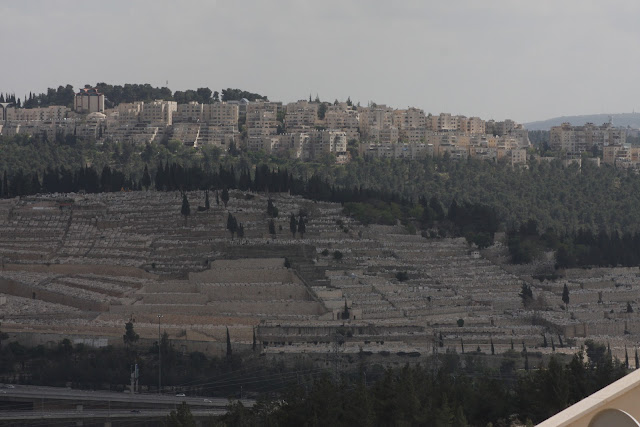
On the terrace of my grandfather’s I saw a Civilization that lived by fostering life VS a Devilization that can only exist by destroying life.
On the terrace of my grandfather I saw a culture of Life being momentarily oppressed by a culture of Death.
On the terrace of my grandfather I understood that for us Palestinians if we are to make it into the future, all we need to do is to vehemently reject the poisonous glitter of the occupiers with all its multifaceted deception: where slavery is sugar-coated with slogans as “modern banking systems”, “global trade”, “free loans”, “buy now pay later” and “economic growth”.
On the terrace of my grandfather I understood that whatever we do we must vehemently oppose any attempt that aims to lure us to “learn” from or mimic the occupier in any shape or form:
Not in the way they run their society, where the selfish concept of “I” and “my interest” are promoted and admired while the foundation of civil human interaction and the altruistic concepts of “we” and the “communal interest” are frowned upon, despised and discouraged as irrelevant backwardness;
Not in the way they conduct business by the use of usury enriching the rich few and impoverishing the masses of poor;
Not in the way they use aggressive agriculture, under the veil of “increasing productivity” they kill the land with chemicals and over-irrigation and destroy the future with GMO sterile seedless uncontrollable crops, they farm animals in the most cruel conditions. Under the veil of modernity they inject seeds of death and un-sustainability, bleeding the land dry of its richness and natural resources;
Not in the way they model their pyramidic hierarchical systems of which millions who languish at the bottom are crushed by a handful who climb to the top.
Not in the way they build colonies brutally carving out the heart of our beautiful landscape, savagely slicing through our precious hills and butchering our millennia-old meadows and mountains only to replace it with prison boxes and creepy tombstones.

On the terrace of my grandfather I saw that a culture of death by its very nature is not sustainable, and cannot possibly survive let alone give birth to life.

On the terrace of my grandfather I saw the manifestation of an exemplary, sustainable, organic, cohesive, open and hospitable civilization, a World Heritage that learned how to peacefully and lovingly coexist and thrive with its neighbours, surroundings and environment.
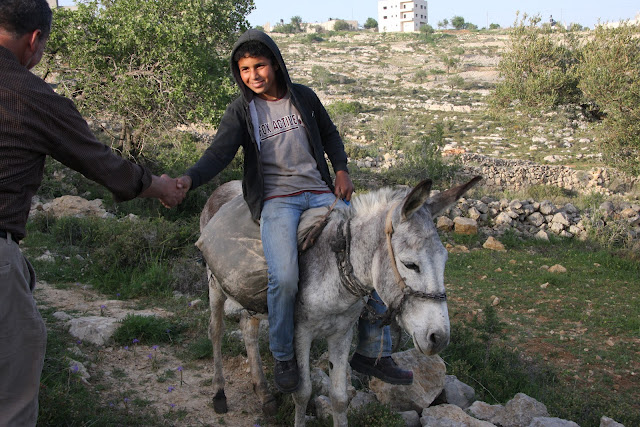
On the terrace of my grandfather, I understood why and how a land can become Holy and from where the sanctity of this cherished Land emerged.
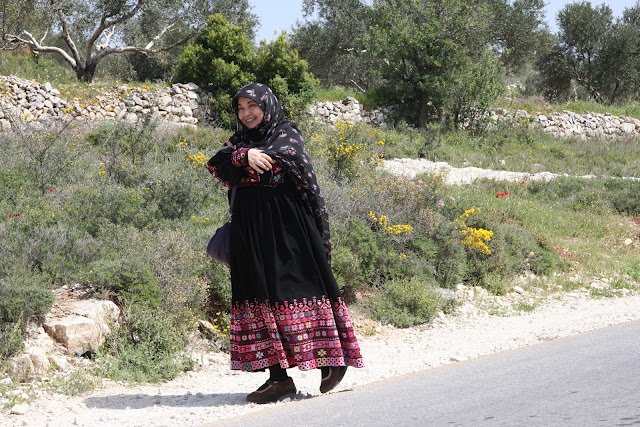
On the terrace of my grandfather I saw the hands of thousands upon thousands of men women and children tenderly attending the land, lovingly removing the stones from its fields and pathways, where in return I saw the stones write poetry of love and thankfulness with its poppies, daisies and bluebells.

On the terrace of my grandfather, I saw the attentive hearts of my people singing melodies of affection and adoration as they tenderly depicted their poetic verses in sublime harmony with their environment. Their little hand-picked stones thoughtfully arranged, perfectly in tune with the landscape around. Sensitively, compassionately and to the best of human endeavour, mimicking in fine details the Divine-artwork, without causing injury or harm to whatever lays in the way. Out of stones, rocks, flowers and trees they have created a timeless panorama of breathtaking beauty.
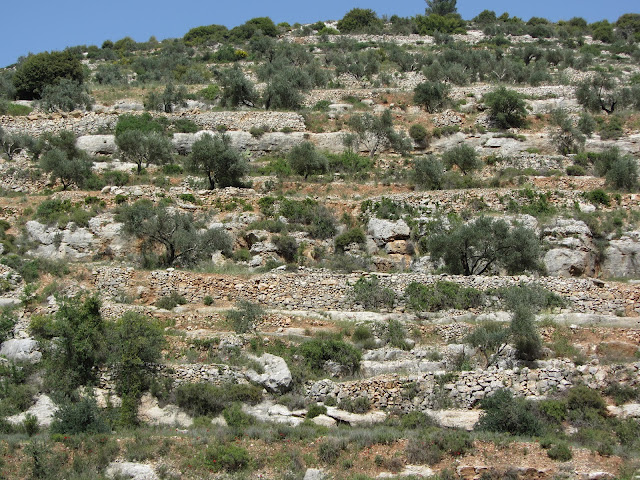
On the terrace of my grandfather, I saw the hands of generations of my ancestors patiently caressing its sleepy hills and artistically painting the landscape with the brush of pure love, swathing it with Holiness and Sacredness, preserving its Divine-given authenticity and protecting life that dwells on it.
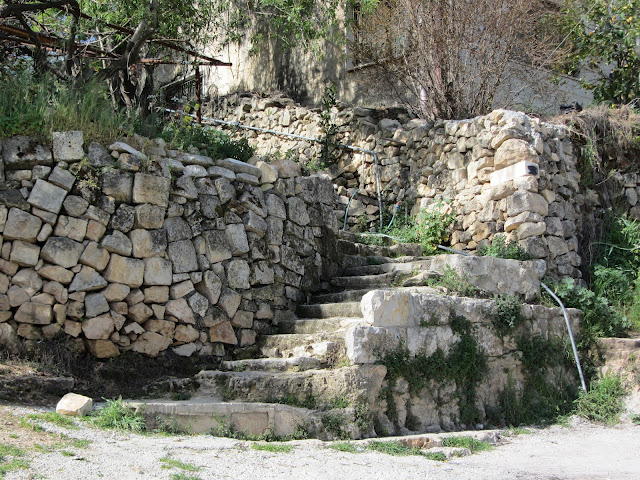
On the terrace of my grandfather I saw breathing homes with flowery grassy roofs, I saw homes with eyes, homes with hearts, homes that smile and weep, homes that rejoice meeting her loved ones and that mourn those whom have been lost.
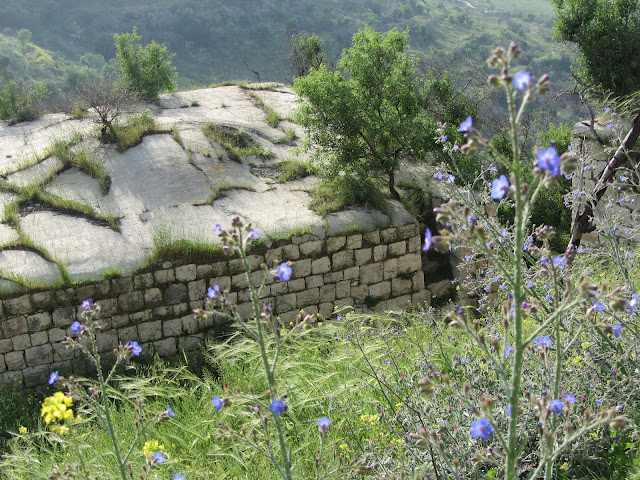
On the terrace of my grandfather I saw homes that welcome its dwellers with hugs and kisses and put its children to sleep by tales of love, magical bedtime stories and singing prophetic lullabies.

On the terrace of my grandfather, I finally understood the meaning of the name Holy Land, Blessed Land, Sacred Land and why that name was bestowed on our Palestine.

On the terrace of my grandfather, I saw Love of Life, Love of Land and Love of Humanity beautifully and supremely intertwined with spirituality, religiously protecting all that is around, thus creating a Holy Land, with excruciating beauty and dazzling glory, a Sacred Landscape, a Majestic Prayer and a Soul-Capturing Sanctuary with infinite charm and mesmerizing grace.

On the terrace of my grandfather, I saw how is it possible for humanity to be saved, to survive and thrive by saving and following the example of Palestine.

On the terrace of my grandfather I understood that the day of their demise is a stone throw away and the day of our Liberation is not far anymore.
On the terrace of my grandfather I realised that stopping and reversing the destruction of this land, and its inevitable Full Liberation, is not only necessary and urgent from the standpoint of Justice. Palestine is far more.
Palestine and its ominously peaceful and sustainable model is NOT a mere nostalgic ideal, but the most perfect source of inspiration and blueprint to design a futuristic, yet solidly rooted and time tested society, in which human interaction, environmental intervention, timeless architecture, agriculture, ethical commercial exchange and spiritual quest are the peak of human achievement. They are not incompatible with contemporary technology and population growth, they are the safeguards and KEY to a sustainable, peaceful and brighter future.
Whether some like it or not, in order to rescue this Sacred World Heritage, it will need a difficult surgery: the removal of the invading death culture that has shown its colossal failure to integrate the Land and its People.
Beauty and Humanity shall prevail.
I warmly invite the world along with my fellow Palestinians to rediscover and embrace our Palestinian culture of Life following the flowering footsteps of the Prophets of this Holy Land, Palestine.

Related articles
- Palestinians: The Forgotten People (alethonews.wordpress.com)
- Deir Yassin: No passing over history (altahrir.wordpress.com)
Ralph Nader Calls for the Postmaster General to Resign
The Nader Page | April 26, 2012
Consumer Advocate Ralph Nader today called for Postmaster General Donahoe’s resignation. Several consumer non-profits joined him in this letter, including Public Citizen, Consumer Action, the Gray Panthers, and Essential Information. The Postmaster General Donahoe is “actively presiding over the demise of one of our country’s greatest founding institutions,” said Nader.
In December 2011, Congressman DeFazio called for the Obama administration to fire Postmaster General Donahoe. From the House floor he said, “This guy, this so-called postmaster general, should be fired because of a lack of any imagination or initiative…He’s proposing the death knell for the great United States Postal Service.”
In his letter, Nader drew attention to the fact that, if the U.S. Postal Service was not required by Congress to prepay retiree health benefits of the next 75 years by 2012, nearly 80 percent of the USPS’s deficit would be eliminated. Nader stated that this is “an imposition unheard of in either the corporate world or by any other government agency.” He continued by pointing out that the federal government even owes the U.S. Postal Service $80 billion in overpayments that the USPS has made to two retirement funds, the Civil Service Retirement System and the Federal Employees Retirement System.
Yet, Nader notes, the Postmaster General remains virtually silent on these issues. Instead, he says, the Postmaster General makes “the case for shutting rural post offices, slashing 150,000 postal employees’ jobs, ending Saturday delivery, and extending delivery dates as if they do not produce a spiral of decline and loss of customers who will not come back.”
“In a phrase, you are not up to the job!” Nader concludes.
A full copy of the letter can be found here.
For More Information Contact:
Ralph Nader or Jeff Musto
202-387-8034
Ex-CIA Officer Defends Destruction of Torture Videos
By Noel Brinkerhoff and David Wallechinsky | AllGov | April 27, 2012
In his memoir coming out this month, the Central Intelligence Agency officer who ordered the destruction of the CIA’s torture tapes defends his actions, saying he was erasing “some ugly visuals.”
Jose A. Rodriguez Jr., the former director of the CIA’s secretive interrogation and detention program during the George W. Bush administration, had 92 tapes destroyed in 2005 after the media exposed the controversial program targeting ‘al-Qaeda’ and other ‘suspected terrorists.’
“I wasn’t going to sit around another three years waiting for people to get up the courage,” Rodriguez wrote in his book, Hard Measures.
He adds that he was “just getting rid of some ugly visuals.” Rodriguez was concerned with protecting the identities of the agents who could be seen in the videos and with the negative effect on the reputation of the CIA if the truth came out. He continues to seem clueless about the intent of the United States Constitution.
He even went so far as to write that “I cannot tell you how disgusted my former colleagues and I felt to hear ourselves labeled ‘torturers’ by the president of the United States.” The irony of torturers being upset at being called torturers seems to have escaped Rodriguez.
Made at a secret CIA prison in Thailand, the tapes showed the waterboarding of ‘terrorists’ Abu Zubaydah and Abd al-Nashiri.
President Barack Obama ordered an investigation of the program and the tapes. But the U.S. Department of Justice decided to not pursue charges against Rodriguez or any other CIA agent.
Related articles
- Crime boasting for profit (salon.com)
Glenn Greenwald:
… Destruction of these tapes was so controversial because it seemed so obviously illegal. At the time the destruction order was issued, numerous federal courts — as well as the 9/11 Commission — had ordered the U.S. Government to preserve and disclose all evidence relating to interrogations of Al Qaeda and 9/11 suspects. Purposely destroying evidence relevant to legal proceedings is called “obstruction of justice.” Destroying evidence which courts and binding tribunals (such as the 9/11 Commission) have ordered to be preserved is called “contempt of court.” There are many people who have been harshly punished, including some sitting right now in prison, for committing those crimes in far less flagrant ways than was done here. In fact, so glaring was the lawbreaking that the co-Chairmen of the 9/11 Commission — the mild-mannered, consummate establishmentarians Lee Hamilton and Thomas Kean — wrote a New York Times Op-Ed pointedly accusing the CIA of “obstruction” (“Those who knew about those videotapes — and did not tell us about them — obstructed our investigation”). …
Scottish TUC delegates join Palestine freedom struggle – unanimously!
Scottish PSC | April 25, 2012
 The delegates to the Annual Conference of the Scottish Trades Union Congress (STUC), the umbrella group for every trade union in Scotland, today voted unanimously and repeatedly against Israeli apartheid. The 450 delegates voted to:
- campaign to expose the role of the racist JNF (Jewish National Fund) in the Israeli apartheid system
- support the participants in the Welcome to Palestine initiative who tried to travel peacefully to Palestine via Tel Aviv Airport
- fully support the Palestinian-Brazilian call for the World Social Forum-Free Palestine in Brazil in November
- support the Palestinian hunger strikers and the work of Addameer, the Palestinian prisoner support organisation.
Congress delegates congratulated the students for their work organising Israeli Apartheid Week 2012 events, who initiated action in support of the Palestinian prisoners on hunger strike and called for support for the Scottish demonstration this Saturday 28th April in Edinburgh.
These decisions of the Scottish TUC in support of the Palestinian freedom struggle, by a union confederation representing half a million organised workers in every sector of the economy, will be widely seen as a continuation of the international solidarity the STUC also provided to the liberation struggle in South Africa. Glasgow, Scotland’s biggest city, named a city centre street after Mandela in 1986 while he was still on Robben Island. How long till there is a Palestine Square or Palestine Street in our major cities?
The full text of the resolutions – all passed unanimously – is given below.
The Jewish National Fund
That this Congress notes that the Jewish National Fund acquisition and control of land in Israel and the occupied territories actively discriminates against Palestinians.
Congress calls on the General Council to:
- endorse the international call for action against the Jewish National Fund;
- campaign to expose the role of the Jewish National Fund in the oppression of Palestinians; and
- campaign to have the charitable status of the Jewish National Fund revoked.
(Mover: Midlothian TUC)
Emergency Motion – Palestine
Congress:
- notes that despite prisoner releases, over 4,600 Palestinian political prisoners remain in detention, including 203 children.
- applauds the steadfastness of 1,200 Palestinian political prisoners who began an open-ended hunger strike on 17 April to protest against ‘administrative detention’, where detainees are held without charge or trial for up to six months and which can be renewed repeatedly.
- congratulates the student Palestine solidarity network for organising the biggest ever ‘Israeli Apartheid Week’ of educational and solidarity events and for their mobilisation across Scotland in support of Palestinian political prisoners.
- believes that the engagement of students, trade unionists and others with Palestinian civil society can only strengthen the current human-rights based approach to Palestinian self-determination and is essential to building a future of peace and democracy in the Middle East.
- therefore welcomes the January call by the Palestinian National Committee and the Brazilian National preparatory committee for the 2012 ‘World Social Forum: Free Palestine’ to be held at Porto Alegre, Brazil in November. Conference believes that this “Global Meeting of Solidarity with Palestine” will underline the strength and diversity of the support for the Palestinian call for justice.
- therefore instructs the General Council to:
- Support the work of Addameer, Prisoner Support and Human Rights Association, by distributing information and updates to affiliates and by supporting appeals for action where appropriate;
- Endorse the Scottish demonstration, called by students in support Palestinian political prisoners and the hunger strikers, taking place in Edinburgh on Saturday 28th April;
- Endorse the WSF Free Palestine as part of the internationalist activities promoted by the STUC and fully support the appeal from the Secretariat of the Palestinian National Committee for the World Social Forum “Free Palestine” to mobilise the Scottish trade union movement towards WSF Free Palestine.
(Mover: Dundee Trades Union Council)
Emergency Motion – ‘Welcome to Palestine 2012′
This Congress notes that there is no way into the Occupied Palestinian territories except through Israeli controlled airports or checkpoints.
Congress applauds the ‘Welcome to Palestine 2012′ initiative which highlighted Israel’s oppressive and abhorrent policy of restricting free and unopposed movement to, from and within the Occupied Palestinian Territories.
Congress condemns:
- the actions of the Israeli government in blacklisting activists from around the world and denying them access to the Palestinian territories.
- the detention of those activists who reached Tel Aviv wishing to visit Bethlehem at the invitation of the Mayor in order to attend the launch of an educational project to build new schools.
- Congress asks the General Council to call upon the Israeli government:
- to allow unrestricted passage to and from the Occupied Palestinian Territories for those wishing to visit.
- to end the continued, illegal siege by air, land and sea of the Palestinian Territories.
(Mover: Midlothian TUC)
Palestine
That this Congress applauds the successful delivery of humanitarian aid by the Scottish FBU to the Nablus Municipality Fire Department. Congress calls for continued trade union support for Palestinian projects, and for the exploration of a Scottish Trade Union Palestinian Support Group, and report back to Congress in 2013 any progress on this matter.
(Mover: Fire Brigades Union)
President’s Address to Congress (Mike Kirby, UNISON):
“There is a growing apartheid elsewhere, in Palestine. There have been many changes since my first official visit with Bill Speirs, Eddie Reilly and Malcolm Burns in 2001, during the Second Intifada. We were challenged by different militia, as we were escorted throughout the Occupied Lands by PGFTU, our hosts. On leaving, at the last stop at Jerusalem, we met members of the British Press Corps, who challenged us that we had only visited one place, met with one people. Eddie Reilly’s reply still pertains “We met many Israelis on our travels in Palestine. They were all armed and wearing uniforms.” Order may have been restored in many parts under the control of democratically elected representation of Fatah, democratically elected Hamas, and other political organisations. But that order is still enforced by a circle of unlawful Occupation, and the Apartheid Wall divides communities from their lands and work, and families are split apart.” Read full President’s address
Related articles
- Israel student society attacks peaceful Palestine protest with water bombs at London School of Economics (alethonews.wordpress.com)
- Apartheid is a crime, not an analogy (alethonews.wordpress.com)
- National Demonstration: March for the Hunger Strikers – March for Palestine (altahrir.wordpress.com)
- Ex-Palestinian prisoner: captivity in Israel, living in graves (alethonews.wordpress.com)
Why Palestinian prisoners are on hunger strike
MEMO | 26 April 2012
 1.1 – The issue of Palestinian prisoners is one of the worst consequences of the Israeli occupation. Since 1967, over 700,000 Palestinians, 20% of the population of the occupied West Bank and Gaza Strip have been detained. This number represents approximately 40% of the total male Palestinian population in the occupied territories.
1.2 – Today, there are about 6,000 prisoners in 17 Israeli jails and detention centres. They include six women and more than 200 minors.
1.3 – 330 Palestinians are being held in administrative detention with no formal charges having been brought against them in a court of law. 28 elected members of the parliament, and three former ministers fall within this category.
1.4 – Israel is currently holding all these Palestinian prisoners far away from their homes, and outside of the occupied territory. This constitutes a clear violation of the Fourth Geneva Convention relative to the Protection of Civilian Persons in Time of War. Article 76 of the Convention states:
“Protected persons accused of offences shall be detained in the occupied country, and if convicted they shall serve their sentences therein.”
Article 49 also states:
“Individual or mass forcible transfers, as well as deportations of protected persons from occupied territory to the territory of the Occupying Power or to that of any other country, occupied or not, are prohibited, regardless of their motive.”
1.5 – Article 32 specifically prohibits “murder, torture, corporal punishments, mutilation and … any other measures of brutality whether applied by civilian or military agents”. Since 1967, 202 Palestinians prisoners have died while being tortured in Israeli jails.
1.6 – Israel routinely tries Palestinians before military courts, none of which meet the most basic standards of international law; particularly the laws relating to the treatment of prisoners of war and people under occupation.
1.7 – In light of the above, there are now calls for the prosecution of Israeli officials at an international tribunal.
Related articles
- 1,600 Palestinian prisoners begin open-ended hunger strike in Israeli jails (alethonews.wordpress.com)
- Ex-Palestinian prisoner: captivity in Israel, living in graves (alethonews.wordpress.com)
- Detention of Palestinian political prisoners (alethonews.wordpress.com)
- 4 hurt in Ramallah protest to support detainees (altahrir.wordpress.com)
- Scottish TUC delegates join Palestine freedom struggle – unanimously! | #PalHunger (occupiedpalestine.wordpress.com)
Featured Video

Meet The Ellisons: Zionists, Technocrats, Moguls
or go to
Aletho News Archives – Video-Images
Frlom the Archives
With apparently fabricated nuclear documents, Netanyahu pushed the US towards war with Iran
By Gareth Porter | The Grayzone | April 29, 2020
President Donald Trump scrapped the nuclear deal with Iran and continued to risk war with Iran based on Israeli Prime Minister Benjamin Netanyahu’s claim to have proven definitively that Iran was determined to manufacture nuclear weapons. Netanyahu not only spun Trump but much of the corporate media as well, duping them with the public unveiling of what he claimed was the entire secret Iranian “nuclear archive.”
In early April 2018, Netanyahu briefed Trump privately on the supposed Iranian nuclear archive and secured his promise to leave the Joint Comprehensive Plan of Action (JCPOA). That April 30, Netanyahu took the briefing to the public in a characteristically dramatic live performance in which he claimed Israel’s Mossad intelligence services had stolen Iran’s entire nuclear archive from Tehran. “You may well know that Iran’s leaders repeatedly deny ever pursuing nuclear weapons…” Netanyahu declared. “Well, tonight, I’m here to tell you one thing: Iran lied. Big time.”
However, an investigation of the supposed Iranian nuclear documents by The Grayzone reveals them to be the product of an Israeli disinformation operation that helped trigger the most serious threat of war since the conflict with Iran began nearly four decades ago. This investigation found multiple indications that the story of Mossad’s heist of 50,000 pages of secret nuclear files from Tehran was very likely an elaborate fiction and that the documents were fabricated by the Mossad itself. … continue
Blog Roll
 Aletho News
- Meet The Ellisons: Zionists, Technocrats, Moguls
- US failures in Iran reveal Russia is key to South Korea’s strategic security
- ‘All ports in Persian Gulf will be legitimate targets if Iranian ports are attacked’
- 40 Years of Endless War, Data Point by Data Point
- Department of War Using Palantir AI to Pick Targets in Iran
- American bases do not protect – they attack the peoples of the Persian Gulf
- ‘We’ve Obliterated Their Missiles’
- Syrian president vows ‘absolute support’ to disarm Hezbollah
- Ukraine attacking Russian gas pipeline to stop deliveries to Europe – Defense Ministry
- ‘Heinous crime’: Iran denounces Israeli assassination of 4 Iranian diplomats in Lebanon
- If Americans Knew
- Israeli strategic plans to “remake the Middle East” from the 1950s and since
- Honoring Gaza’s women who refused to let the world look away
- 97% of victims of war on Iran are Iranian, 98% of victims in war on Gaza are Gazans – Not a ceasefire Day 152
- Early Iran strikes cost $5.6 billion in munitions, Pentagon estimates
- Israel Decided the War, But Trump’s America Fights and Pays the Bill
- Conscientious Objector Group: Phone ‘Ringing Off Hook’ As Huge Mobilization Underway
- U.S. support for Israel continues to plummet, despite media’s best efforts
- Threats and missiles fly, death tolls soar in Iran, Lebanon, Gaza – Not a ceasefire Day 151
- Lebanon: Israel’s White Phosphorous Use Risks Civilian Harm
- Corporate Media Go All Out To Support The US-Israeli War On Iran
- No Tricks Zone
- Destructive Green New Deal: German Energy And Metal Group Warns Of Drastic Crisis
- New Study Documents A 20-Year Pause In Arctic Sea Ice Decline – Driven By Internal Variability
- Wake-up Call: Survey Shows Majority Of Germans Now Favor Postponing Climate Targets!
- Televised! Leading German Political Candidate Tells Schoolchildren CO2 Makes Sun Hotter!
- New Study: A Century Warming Of 1.1°C Is ‘Commonplace’ And ‘Not Unusual’ During This Interglacial
- New Study: ‘Internal Noise’ And Volcanic Forcing Can Trigger 10-15°C Warming Within Decades
- Glaciers Worldwide Are Suddendly Surging, Experts Blame Warming!
- Surprising Discovery: Sahara Is Greening…Billions Of Trees Where Once Thought To Be Barren
- New Research Reaffirms Clouds, Aerosols, And Surface Solar Radiation Are ‘Driving The Climate System’
- Germany: Electric Car Catches Fire At Charging Station, Sets Off Local “Inferno”, Widespread Damage
 Aletho News