Russia: US anti-Iran sanctions against international law
Press TV – May 29, 2012
Russian Foreign Ministry Spokesman Alexander Lukashevich has criticized the US sanctions against Iran as violating international law, noting that Russia opposes such measures.
“Regarding the US unilateral sanctions against Iran, which have been enforced during the past 20 years over concerns about Tehran’s nuclear energy program, I should say that Russia does not agree with the transnational nature of these sanctions,” Lukashevich said on Tuesday.
“Moreover, we believe that these sanctions are in contradiction to international law,” he added.
On May 21, the US Senate unanimously approved a bill to extend sanctions against countries or companies that have dealings with the National Iranian Oil Company and the National Iranian Tanker Company, another attempt to restrict Iran from selling its crude oil abroad.
“The United States is abusing its position in the global financial structure and the status of dollar as the international currency, thus slapping economic and financial sanctions against Iran and forcing other countries to engage themselves in this regard,” the Russian foreign ministry spokesman pointed out.
Lukashevich further noted that Moscow has invariably expressed opposition to “excessive pressure” on Iran over its nuclear energy program.
“On all occasions and levels, we have proclaimed our opposition to [applying] excessive pressure on Iran and pointed out that such an approach will push Iran’s nuclear energy program toward a stalemate,” Lukashevich explained.
The United States and the European Union have imposed tough financial sanctions as well as oil embargoes against Iran since the beginning of 2012, claiming that the country’s nuclear energy program includes a military component.
Tehran refutes such allegations, noting that frequent inspections by the International Atomic Energy Agency have never found any diversion in Iran’s nuclear energy program toward military purposes.
Related articles
- Israel’s Netanyahu Seeks Tougher Nuclear Demands on Iran – Bloomberg (bloomberg.com)
- China criticises Iran nuclear sanctions ahead of Ahmadinejad visit (guardian.co.uk)
- Israel Warns ‘Iran Six’ Against Concessions To Tehran – eurasiareview.com (eurasiareview.com)
Hebron: Israeli settlers occupy Palestinian home
May 30, 2012 | International Solidarity Movement, West Bank
On Wednesday, May 23, a group of Israeli settlers forcefully occupied the home of a Palestinian family near the illegal Tel Rumeida colony in the Palestinian city of Hebron. In an incident that lasted 3 hours, settlers forced their way into the house and began physically and verbally abusing the family. The family was evacuated by Israeli soldiers. The settlers then blocked the entrance, preventing the family from entering the premises.
At 6p.m., Muhammed Toma Aburmeli was working in his shop in Tel Rumeida when he received a call from his distressed wife requesting that he come home immediately. As he returned home he saw his wife and young children standing near checkpoint Gilbert, with his home surrounded by Israeli soldiers. Looking closer at the entrance of his home, Muhammed saw a large group of young Israeli settlers standing outside his doorstep and preventing the family from entering.
At approximately 5:30 p.m., Muhammed’s wife, Merfat Muhammed Aburmeli, and 4 children, the eldest only 8 years old, were inside their new home located on the same road as the illegal Tel Rumeida settlement. The family was preparing to move furniture into the house. As the preparations were underway a group of 15 to 20 settlers no older than the age of 16 stormed into the house.
The settlers immediately confronted the frightened family, insulting them and demanding that they leave the home. The young settlers repeatedly claimed that the land is theirs and that the Palestinian family has no right to live here. As well as the verbal barrage, the settlers began to violently push Muhammed’s wife and her children.
The harassment lasted 10 minutes before Israeli soldiers intervened. Checkpoint Gilbert is only 3 metres from the house so this can be considered a slow response on behalf of the soldiers.
Israeli military arrived and the settlers continued to abuse the family. The first thing the soldiers did was evacuate the Aburmeli family, rather than force the settlers to leave. The family was then ordered by the military not to return to their house until the settlers were gone.
The Israeli soldiers requested that the settlers leave. The young Israeli settlers ignored the request and ran through the house causing damage. Ten minutes passed before soldiers resorted to physical means to force them out of the home. The settlers showed resistance, shoving soldiers as they dragged them out.
After evacuating the premises, soldiers locked the house’s door. The young settlers then blocked the entrance to the home from the outside. The Israeli military made no effort to disperse the group and instead soldiers surrounded the house.
When Muhammed arrived at the scene he asked the soldiers what was happening. The soldiers shrugged off his question and instead demanded that he show identification. After handing back his ID card, he too was told to go stand with his family and wait for the soldiers to diffuse the situation.
Soldiers made no efforts to remove the settlers, and Muhammed and his family were left standing outside and waiting for almost 3 hours before the settlers began to leave by themselves at 8:30 p.m.
Muhammed, Merfat, and their young children returned to their home. They say that what is upsetting is not only the behaviour of the illegal Israeli settlers, but the incompetent reaction of the Israeli army. This harassment, however, is not a new ordeal for the Aburmeli family. Only one day before, settlers damaged a window of their home by hitting it with sticks. In their last home, located nearby, settlers similarly blocked the entrance on more than one occasion.
Families living near the illegal Tel Rumeida settlement, which occupied a section of houses and roads in downtown Hebron, have long been the subject of abuse and discrimination coming from both the settlers and Israeli policies. Currently, only 2 Palestinian families remain living in what is now the Israeli settlement.
These 2 families are not permitted visitors, even family members, because all other Palestinians are prevented by Israeli soldiers from entering. These families in particular face abuse by the Israeli settlers on a regular basis. It can be difficult for the families even just to walk without being pelted by stones or being subject to insults.
Muhammed fears that incidents such as these will continue to occur, but says that no matter what happens he will never leave his home because he, as well as other Palestinians, has a right to live in freedom, peace, and dignity in his own land, and illegal settlers can not force them to leave. He finishes by saying, “if they wish to do worse, then let them, because we will not leave. As the olive tree will continue to live here, we Palestinians will continue to live here.”
Related articles
- Two Palestinians arrested as Israeli settlers forcefully enter their property (alethonews.wordpress.com)
- Bethlehem: 18 year old Palestinian stabbed (alethonews.wordpress.com)
- Israeli settler shoots Palestinian in West Bank (theuglytruth.wordpress.com)
- Israeli settlers injure three Palestinians, uproot dozens of olive trees in two separate incidents (alethonews.wordpress.com)
- Israeli Soldiers Invade Homes In Hebron, Jewish Settlers Attack Young Man (alethonews.wordpress.com)
- Jewish settlers shoot Palestinians as Israeli soldiers stand idle (altahrir.wordpress.com)
- (Again) Israeli settler shoots Palestinian in West Bank (occupiedpalestine.wordpress.com)
- Israeli settlers storm into Palestinian home, occupy residence (alethonews.wordpress.com)
Qatari spy chief held at Cairo Airport with bags of cash
Press TV – May 30, 2012
A new report says the Qatari intelligence chief was held by security forces at the Cairo Airport while carrying bags of cash a few days before the first round of Egypt’s presidential election.
The incident occurred on Saturday night when the Qatari ambassador to Cairo, who had appeared at the airport to receive a guest, attempted to get large baggage passed through without allowing inspection on it, citing the exigencies of a “diplomatic mission.”
The security forces at the Cairo Airport, though, insisted that the baggage be inspected since the matter had not been coordinated with the Egyptian Foreign Ministry.
When the bags were inspected, millions of dollars were found in them. Upon the disclosure, the Qatari ambassador had to disclose the identity of his guest, which had until then not been provided to the security forces.
The individual was identified as the Qatari intelligence chief, Ahmed Zaif, who had personally delivered the cash.
The incident is now widely believed to be an attempt on the part of Qatar to interfere in Egypt’s presidential election. The large number of votes announced to have been cast in favor of presidential hopeful Ahmad Shafiq implicate that huge campaign expenses, mostly allocated by Saudi Arabia and Egypt, have been spent to secure Shafiq’s victory in the election.
Mustafa al-Qanimi, a member of the Muslim Brotherhood party, said in an interview recently that the election results have left no doubt that a huge sum of money has been spent in the course of the election with the aim of securing Shafiq’s victory.
Thousands of people took to the streets of the capital, Cairo, after the electoral commission confirmed that the Muslim Brotherhood’s Mohamed Mursi and former Egyptian Premier Ahmed Shafiq will face off in the country’s presidential runoff next month.
Revolutionaries in more than ten cities and governorates took to the streets, protesting the result and demanding Shafiq’s exclusion from the election. They also demanded the application of his political isolation, as the ex-premier was a prominent figure of the country’s deposed ruler, Hosni Mubarak.
Related articles
Egypt prevents aid convoy to Gaza
Palestine Information Center – 29/05/2012
AMMAN, GAZA — European activists have condemned the Egyptian rejection to implement the obtained regulatory approvals in order to reach the Gaza Strip through the Sinai Peninsula.
The General Coordinator of the convoy “right of return”, Kevin Aovindan, stated, in a press conference held in trade unions headquarters in Amman yesterday, that the lack of clarity and the contrast in Egyptian officials’ positions prevented the arrival of the convoy to Gaza through the Egyptian borders.
Aovindan said that the President of the convoy, the British MP George Galloway was in Cairo until May 15, and he left after he had got the Egyptian official approval for the passage of the convoy to the Gaza Strip through Rafah crossing, however Egypt reneged on its approvals.
He added that “the participants in the convoy have spent over 3 weeks in Aqaba to get from the Egyptian authorities the permission to cross into Egypt and then to enter Gaza.
Aovindan said, regarding the aid collected by the convoy, “it will be sent to Gaza through the Jordanian Hashemite Charity Organization in coordination with the Jordanian Professional Associations”.
Meanwhile, the Palestinian government in Gaza has received new commitments from its Egyptian counterpart to allow Qatari fuel to enter the besieged Gaza Strip during the next few days, after contacts between the Palestinian, Qatari, and Egyptian authorities.
The Palestinian foreign minister, Mahmoud Awad, said there are new Egyptian promises to facilitate the passage of Qatari fuel to the only power station in the Gaza Strip, according to Al-Arab newspaper.
The need for the Qatari fuel is increasing these days to operate the power station in Gaza and to alleviate the crisis in the electrical sector for more than four months.
Awad said that the Egyptian government had told them that the full procedures required to start pumping fuel into Gaza are completed, hoping that it will reach Gaza the next few days.
“In the last communications with various parties, we were told that the shipment will arrive in the coming few days,” Awad said, adding that there is no logical reason for the delay.
He called on the Egyptian authorities to press on the occupation to increase the quantity of fuel which will enter daily to Gaza in order not to drag the transport process to operate the power station to relieve the suffering of the Palestinian citizens in Gaza.
The Palestinian foreign minister pointed out that Qatar has borne the full cost of storing and transporting fuel to the Gaza Strip, thanking the Qatari government and the Qatari Emir Sheikh Hamad bin Khalifa Al-Thani for their support for the Gaza strip and their role in transporting the fuel to Gaza.
Awad has praised the Qatari role in solving crisis in Gaza, stressing that the Palestinian people, who defend the dignity of the ummah, will never forget the Qatari position that was always behind them.
Israel’s Herzliya Center Sneaks Into Lebanon
By Sabah Ayoub | Al Akhbar | May 30, 2012
When a civil society activist in Tripoli (Lebanon) received an email invitation to participate in an all-expenses-paid Israeli-Arab dialogue in London, he was surprised to see that it came from a foreign journalist he had assisted as a fixer. One of the parties hosting the event is none other than the Israeli Interdisciplinary Center Herzliya.
Rami (not his real name) is an activist from Tripoli, who works in Palestinian camps and with civil society organizations in northern Lebanon. A few days ago, he received an email inviting him to participate in an “Arab-Israeli” dialogue on “understanding and peace.”
The dialogue, organized by the International Center for the Study of Radicalism and Political Violence (ICSR) in London, will span four months with all expenses paid.
Rami’s shock was twofold. He was initially provoked by the title and content of the invitation. But then he was surprised to see that it was forwarded to him from a foreign journalist he had worked with as a translator during the Bab el-Tabbaneh-Jabal Mohsen clashes a few months ago.
“It was strange because she knows me and knows my principles, my position against the occupation, and my support for the resistance and the Palestinians. We spoke about this several times,” he says, looking surprised.
The Dutch journalist tried to encourage Rami in the accompanying email. “She said she had worked in the host center and considers me a perfect candidate to participate in the activity,” he explains.
A few hours later, Rami received a call from another friend and civil society activist in Tripoli. His friend told him that he received a similar “strange” invitation to the same conference from the same journalist.
As many activists in Beirut, Tripoli, and other areas with media attention in Lebanon, Rami and his friend moonlight as translators and fixers for foreign journalists who travel to the country. These young men and women are providing a service for foreign correspondents and assisting them in performing their jobs.
But it seems that some correspondents are relaying “useful” information about their assistants and are “classifying” them according to several criteria, in order to contact them “as needed.” The “need” is neither “innocent” nor journalistic or personal. It is a purely political assignment, such as what happened with Rami and his friend.
After viewing the email sent by the Dutch journalist to the activist from Tripoli and the attached invitation, Al-Akhbar investigated the identity of the hosts and their objectives. Apparently, Israel and the lobby that serves its interests around the world have identified “human targets” for recruitment. They use some journalists, with or without their knowledge, to get to their “targets” in what could be identified as hard to reach areas for direct recruitment.
Based on ICSR’s invitation letter, the declared target audience are “young leaders – typically from government, business, academia, and the media – who occupy positions from which they can shape politics and public opinion in Israel and the Arab world.”
The “Arab-Israeli dialogue” is part of an ICSR fellowship supported by the Atkin Foundation. The duration is four months in King’s College London and participants will subsequently become members of the center’s team.
“For the forthcoming intake, in addition to Israelis, we are looking for applicants from Egypt, Israel, Jordan, Lebanon, Palestine, and Syria only,” the invitation says.
To apply for the fellowship, the candidate must answer the two following questions: “How will the fellowship impact your career and future personal development?” and, “In your opinion, what methods will have a positive impact on the Arab-Israeli conflict?”
Some might see this fellowship as a friendly opportunity to start a dialogue on peace and solving the Arab-Israeli conflict. Others, might innocently feel that they could send a positive signal to the Israeli “other” so they can perhaps build a better future together.
But a quick glance at ICSR’s partners and sponsors leaves no doubt about the identity of the center or the aims of its activities or scholarships, under a university-academic veil.
The London-based center claims to be a “unique partnership” including five equal stakeholders: King’s College London, Georgetown University (Washington, DC), University of Pennsylvania, the Regional Center for Conflict Prevention (Amman), and Israel’s Interdisciplinary Center Herzliya (IDC Herzliya), whose main principles and goals are rooted in Zionism. IDC Herzliya seeks “to train a future Israeli leadership…while maintaining a Zionist philosophy…and striving to strengthen the State of Israel” and organizes the annual Herzliya conference.
ICSR declares that its goals range between “conflict resolution,” “diplomacy,” “strategy,” “counter-terrorism,” and “security,” according to its website. The center considers the Atkin fellowship as one of its main activities through which it can contribute to “create networks of moderate leadership among young leaders on both sides of the [Arab-Israeli] conflict.”
The center’s staff includes Jordanians, Egyptians, Lebanese, and Israelis from various professional and scientific backgrounds. They are teachers, engineers, civil society activists, media workers, rights activists, and experts on Islamic movements and al-Qaeda.
One of them is a Lebanese activist called Sarah Kilany, a Lebanese American University (LAU) graduate. She is introduced as a civil society activist from Lebanon who previously worked with a women’s organization in Lebanon. She also participated in monitoring parliamentary elections with the Lebanese Association for Democratic Elections (LADE) before joining ICSR a few months ago.
Today, Sarah’s research focuses on “Palestinian refugees in Lebanon and the role of civil society in finding a solution to their socio-economic situation.”
The question remains how many Lebanese will take the bait and help IDC Herzliya and its big name partners build a Middle East with “a politically neutral environment” to “strengthen the State of Israel.”
Featured Video
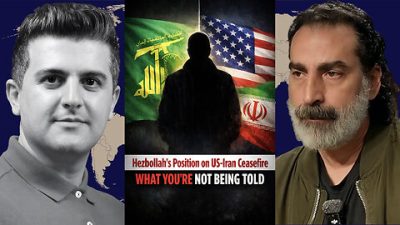
Laith Marouf: Hezbollah’s position on US-Iran ceasefire
or go to
Aletho News Archives – Video-Images
From the Archives
Is Israel to blame for the Iraq War?
American Goy | March 10, 2008
I am so tired of this old canard that “Israel had nothing to do with USA’s war with Iraq – in fact, it officially advised America against it”.
Bullshit. … continue
Blog Roll
 Aletho News
- Laith Marouf: Hezbollah’s position on US-Iran ceasefire: What you’re not being told
- Israel’s priority lies in destroying chances of peace between Iran, US: Ex-UN nuclear chief
- Ceasefire for all or for none: Iran shuts Hormuz over Lebanon attacks
- Strait of Hormuz is Iran’s ‘nuclear weapon’ that forced US retreat: Medvedev
- Energy crisis will last for months – Kremlin envoy
- Europe’s quiet role in the war on Iran
- Forty days that shook the Empire: How Iran turned the tables on US and prevailed
- Netanyahu unilaterally declares Lebanon outside of ceasefire deal
- Israeli leaders: ‘Not a single goal’ achieved in war with Iran
- What on earth just happened? Trump, Iran, and the unlikely ceasefire
- If Americans Knew
- Gazans face a triple crisis: severe shortages of water and bread, healthcare in tatters
- NY Times reports how Netanyahu took the US into Iran War
- A sigh of relief over Iran, but Gaza and Lebanon in dire straits – Daily Update
- Thousands dead and neighborhoods razed to the ground: Aid agencies fear southern Lebanon is becoming the new Gaza
- The war the US is fighting for Israel could cost trillions
- ‘Cigarette Burns, Nail Wounds’: Toddler Tortured in Gaza to Coerce Father
- Trump Says US Sent ‘a Lot of Guns’ to Protesters in Iran
- Israeli forces destroy 17 UN peacekeeper cameras in south Lebanon
- US-Israeli strikes ‘completely destroy’ synagogue in Tehran
- Archbishop for US Military Says Iran War Is Unjust Under Catholic Teaching
- No Tricks Zone
- An Inconvenient Tree: Uncovered In Alps… Europe Much Warmer Than Today 6000 Years Ago
- New Study Reports A 60% Slowdown In Greenland’s Ice Loss Rate In The Last Decade
- Low Intensity Tornado Wrecks Major Solar Farm, Creating A Potential Toxic Dump
- New Study Finds Warming Saves Lives…Cold Temperatures 12 Times More Deadly Than Excess Heat
- German Science Blog Accuses PIK Climate Institute Of Hallucinating Climate Tipping Points
- Devastating Assessment Of Comirnaty Vaccine By Former Senior Pfizer Europe Toxicologist
- New Study: CO2 Is ‘Effectively Negligible’ As An Explanatory Climate Change Factor Since 2000
- Former Pfizer Toxicologist Dr. Helmut Sterz Tells Bundestag Hearing Pfizer Vaccine Should Have Never Been Approved
- Energy Expert: Germany’s Nuclear Phaseout Was A “500 Billion Euro Mistake”
- New Research: South Australia’s Mid-Holocene Sea Surface Temperatures Were 4°C Warmer Than Today
 Aletho News