15,000 American forces stationed in Kuwait: Senate account
Press TV – June 20, 2012

A US Senate report indicates that the United States has now nearly 15,000 troops in three bases across Kuwait- – triple the average number of American forces in the Middle Eastern country before the US-led invasion of Iraq in 2003.
The Senate Foreign Relations Committee released the report on Tuesday, considering how to promote the US interests in the Persian Gulf region after the American forces left Iraq last year.
According to the report, having the military bases throughout the region is a “lily pad” model to allow for a rapid escalation of military forces.
The Kuwaiti bases “offer the United States major staging hubs, training ranges, and logistical support for regional operations,” the report said, adding, the “US forces also operate Patriot missile batteries in Kuwait, which are vital to theater missile defense.”
US Secretary of Defense Leon Panetta has recently said there are roughly 40,000 American troops in the area to respond to the region’s possible conflicts.
The American forces have also been stationed in Qatar, the United Arab Emirates and Bahrain.
Pentagon spokesman Capt. John Kirby had said, “The secretary (of defense) has been very clear that while we do this shift in focus to the Asia-Pacific, that the Central Command area of responsibility will still remain a high priority.”
Top Ten Things That Have and Haven’t Changed In the Era of Obama
By Bruce A. Dixon | BAR | June 20, 2012
Black America’s median household wealth, compared to that of whites, has sharply declined under Barack Obama. That’s a change. Just not a good one.
This is a consequence of the foreclosure epidemic which began in 2007 and 2008 and has always been concentrated in black and poor neighborhoods. But the Obama administration has allowed the foreclosure wave to continue without any letup during its first three and a half years, rejecting demands for foreclosure moratoriums or other measures which would make it easier for large numbers of families to remain in their homes. Where the ratio of white to black household wealth four years ago was around 11 to one, today it is greater than 20 to 1.
African Americans still make up 12 or 13% of the nation’s population, remain more than 40% of its locked down and locked up, No change there at all…
Latinos, who make up another 13%, are about 30% of the nation’s prisoners and rising, a slight change, but distinctly for the worse. So seven of every ten US prisoners are from the one quarter of the nation that is black or brown, and that percentage is rising.
The fifty-year war on drugs continues. No change for the better at all there.
Like every president since Nixon, Barack Obama has thwarted states that wanted to decriminalize small amounts of drugs, refuses to treat drug use as a medical problem rather than a police one. Like its predecessors, the Obama administration has expanded the frontiers of the drug war into places like Mexico and Colombia, where the US demand for illegal drugs has given birth to vast industries which may be among the largest and most lucrative, and certainly the most deadly, in those countries.
“Too big to fail” banksters and other financial criminals are still above the law. No change here either.
Not a single person responsible for crashing the economy in 2007 has seen the inside of a prison. It’s just not going to happen. Wall Street insiders give as much, and often more to Democrats than they do to Republicans. So the Obama administration has protected banks and lenders and their co-conspirators from prosecution, and shoveled more than ten trillion more at banksters, including those based outside the US, than the Bush-Cheney gang ever did.
It’s worth remembering that when Bush could not pass his own bailout bill six weeks before the 2008 election, he called Barack Obama into town to spend the week on the phone with Congressional Democrats getting them to switch their votes. So the only change here has been the party in charge.
Although governments will create trillions of new dollars to give to banksters and borrow it back from them at interest in the name of “fixing the economy”, it still won’t create millions of jobs for the unemployed. No change:
In the 1930s, the federal government addressed the Depression by creating hundreds of thousands of jobs out of thin air. They built roads and subways, parks, recreational facilities, dams and bridges. They did theater and historical research like tracking down and interviewing the last living survivors of slavery. It was called the WPA, or Works Progress Administration, under the administration of Democrat Franklin D. Roosevelt.
The White House could do the same today, creating millions of new jobs, repairing and rebuilding infrastructure, building high speed rail, refitting millions of homes for energy efficiency. But Barack Obama disdains the heritage of his own Democratic party. He sounds more like Hoover than FDR today when he says that it’s the exclusive role of the private sector to create jobs.
It’s still almost impossible to organize a union and fight for your own rights on the job anywhere in the US. No change:
There are laws against firing workers who try, but employers are unafraid to break those laws, while working people are very much afraid to lose their jobs. Candidate Obama did promise to put on his comfortable shoes and walk a picket line. Maybe he just lied. President Obama has frozen the wages and pensions of government workers, and endorsed the traditionally Republican idea that public employee and private pensions and health plans cause economic distress to employes and the economy.
The bipartisan corporate-funded drive to “reform” education by breaking teachers unions, turning teachers into Wal-Mart style temps, hi-stakes testing, dissolving public schools and replacing them by privately owned charter schools, exempt from public accountability continues apace. No change there at all.
Bush’s Secretary of Education called teachers unions “terrorist organizations.” Obama’s Secretary of Education declared that Katrina was the best thing that could have happened to public education in New Orleans.
If anything, the Obama administration’s Race To The Top program pushed the envelope further than Republicans would have been able to without sustained resistance. It required states to compete for available federal education funds based upon how many teachers they can fire, how many public schools they can close, how many so-called “merit pay” schemes and similar atrocities they can inflict. Just as only a vicious warmonger like Nixon could have made the first presidential trip to China, only a black Democrat could have successfully pushed the education policy envelope this far in the anti-democratic directions of charters and educational privatization. If anything, Obama’s heinous education policies provide an even further rightward step-off point for Republicans like Mitt Romney. It didn’t have to be that way.
US troops are in more than 140 countries worldwide, and the US, with under 5% of the world’s people, spends more on the military than the other 95% of humanity combined. Not much change there.
On the other hand, in the first weeks of his administration, President Obama received a Nobel Peace Prize. So the pan-European elite, which feared and despised George Bush, loves Obama. That’s a kind of change they call a distinction without a difference.
The Afghan war drags on, apparently indefinitely. A hundred thousand US-paid mercenaries remain in Iraq, and the war there too is far from over. On the other hand, Barack Obama has been able to use cruise missiles and drones to kill black and brown civilians including children in Yemen, Somalia and Pakistan, among other places. US military forces took part in the invasion and overthrow of the African nation of Libya, and the White House has openly rather than covertly sent unknown numbers of US special forces into nobody knows how many countries of Central Africa. A Bush administration doing this would have been greeted with nationwide street demonstrations. But a black Democrat gets a near automatic pass. Is this what the real “race card” looks like?
A US president still orders torture, murder, indefinite imprisonment without trial, and lets corporations that commit crimes abetting those of government employees completely off the hook. But there has been a change here.
When the Bush-Cheney gang did all this stuff, they did it as scofflaws. The Obama Administration has rammed through legislation in Congress and asked for court decisions to cloak most of the previously illegal torture, murder, kidnapping, warrantless spying and similar crimes with thin veneers of legality. This is the all-important difference between having an MBA as president as opposed to a professor of constitutional law.
Black politics, at one time heavily influenced by what Martin Luther King called opposition to the triple evils of racism, militarism, and economic injustice, has shrunken and shriveled under the influence of a new class of corporate funded black political leaders like Corey Booker and Barack Obama. Deep, real and significant change here.
Black politics ain’t about fighting for decent housing or jobs any more. It’s not about diverting resources from the war machine to uplifting the downtrodden. It’s not about funding education or working for the end of the prison state. It’s certainly not about defying unjust laws in the pursuit of just ends, as the Freedom Movement once routinely did.
People forget that King was murdered in Memphis in the middle of a sanitation workers strike in which the National Guard had been called out to patrol the city, and students had stayed home from high school for days to participate in illegal mass actions.
21st century black politics is about electing black politicians, no more and no less. That, and observing Black History Month.
This is far from an exhaustive list, of course.
We could have mentioned the fact that big oil, big agribusiness, big insurance, and big pharma all continue to get whatever they ask for. We might have pointed out that local and state fiscal crises are constantly being provoked, to which the solutions are always “public private partnerships” a standard euphemism for privatizations of public assets like roads, waterworks, generation facilities and public services like payroll, parking and fleet management. We could have pointed out that medical costs are still factors in a majority of personal bankruptcies, and the FCC has essentially abandoned any pretense of regulating the cable and broadcast industries, preferring to simply lease out or auction off the electromagnetic spectrum and leave it all to the “free market”.
Some things have changed over the last four years, and some haven’t. One thing that seems never to change, as long as our choices are restricted to the two corporate parties, is that while you can squint hard enough to make distinctions between Republicans and Democrats, there are few important differences.
Bruce A. Dixon is managing editor at Black Agenda Report. He lives and works in Marietta GA, and is a state committee member of the Georgia Green Party. Contact him at bruce.dixon(at)blackagendareport.com.
The Future Direction of Egypt’s Revolution
By ESAM AL-AMIN | CounterPunch | June 19, 2012
Against all odds the Muslim Brotherhood’s (MB) candidate, Dr. Muhammad Mursi won Egypt’s first presidential election since the ouster of dictator Hosni Mubarak… but barely. Although the official results will not be announced until Thursday, the final tally shows that Mursi received 13.3 million votes (52 percent) while Mubarak’s last prime minister and the candidate of the military and the regime remnants, Gen. Ahmad Shafiq, garnered 12.4 million votes (48 percent).
It should never have been that close. Countless people wonder how a popular revolution that united millions of Egyptians against a corrupt regime and earned the world’s admiration, could have resulted in that same loathed regime on the brink of reclaiming power after little more than a year. Of course, the direct answer to this question is the ominous role played by the Supreme Council of the Armed Forces (SCAF), which took control of the country after Mubarak’s downfall, as well as the institutions of Egypt’s deep security state.
Their tactics included the direct manipulations of the elections process, the inexplicably favorable decisions by the Mubarak-era Presidential Elections Commission, the use of state media as well as private media outlets controlled by Mubarak-era corrupt businessmen to frighten the public about the specter of an impending theocracy, the clever ability to play the pro-revolution groups against each other, and the SCAF-appointed government’s deliberate disruption of the daily lives of ordinary Egyptians through the constriction of key staples and a lack of security in the street. Soon the public associated the revolution with instability, shortages and chaos. Dejected, many wished for the days of the old regime.
Throughout last year and aided by the Muslim Brotherhood’s missteps and behind-the-scenes dalliances with the generals, SCAF was able to create acute alienation and sow real mistrust between the MB, the country’s largest organized movement, and the rest of the pro-revolution and youth groups. By the end of March 2012, SCAF felt so emboldened by the success of its plan that it began to openly challenge and threaten the now alienated MB, despite the fact that the group was by that time firmly in charge of both chambers of parliament.
By the end of the first round of the presidential elections, SCAF succeeded in propelling its preferred candidate to second place behind the MB candidate. Ironically, both sides calculated that their chances of capturing the presidency would be greatly enhanced if they faced each other. The military’s candidate believed that he would then reinvent the old regime by presenting to the confused and frightened public with the stark choices between the civil state represented by himself and a menacing religious state epitomized by his opponent. On the other hand, the MB believed that its best chance would be to face a candidate from the loathed Mubarak era so as to force the pro-revolution groups to support its candidate despite the ill feelings generated towards the Islamic group (especially when it abandoned the youth groups during their confrontations with SCAF during much of last year).
After the first round of the presidential elections, the pro-revolution groups garnered almost 15 million votes (with Mursi receiving 5.8 million). On the other hand, Mubarak-era affiliated candidates received 8 million votes (led by Shafiq’s 5.5 million votes.) But the two major (though defeated) candidates supported by the pro-revolution groups in the first round were Hamdein Sabahi and Dr. Abdel Moneim Abol Fotouh, receiving 4.8M and 4.1M votes respectively.
Although Abol Fotouh promptly threw his support behind Mursi, citing the threat to the revolution if the military man won, Sabahi asked his supporters to invalidate their votes or boycott the elections, hoping to create a dynamic where both candidates could somehow lose in the court of public opinion. This would set the stage for his comeback as the pro-revolution and pro-civil state candidate. Quietly, SCAF’s candidate hoped that enough of Sabahi’s supporters would boycott the elections or invalidate their votes so that the numerical advantage of the pro-revolution groups would be neutralized.
As the military’s scheme was in full force relying on media offensive, bribes, and scare tactics, several polls conducted by state-sponsored institutions confirmed to SCAF that Shafiq had the momentum. The support of the military and the institutions of the deep state became even bolder, so much so that many political analysts thought the elections were practically over. To push this sentiment of inevitability, SCAF threw caution to the wind and committed a major error in judgment. In fact, it might have actually cost Shafiq the election.
Since the standoff between SCAF and the MB in March, it was widely known that SCAF could push for the dissolution of the elected parliament at any time in order to check the MB’s rise to power. The argument advanced by many pro-revolution groups that had reservations in supporting Mursi was that they did not want the MB to have unchecked control over both branches of government, the legislative and the executive. So when the High Constitutional Court dissolved the parliament two days before the elections, this brazen act of disregard for the electoral will of the Egyptian people actually backfired. A major segment of the Egyptian electorate, who intended to boycott or invalidate their votes, were so infuriated that they decided to vote for Mursi even if they initially did not intend to cast a vote at all (in the final count, less than 1 percent of the electorate invalidated their votes by checking both names on the ballot). Had a half million people out of over 25 million votes cast flipped their votes, the military’s candidate would have won.)
Last winter, in a moment of candor President Jimmy Carter said after meeting with SCAF’s leaders that the military had no intention of relinquishing power. In recent weeks it became quite clear what that observation meant. First, SCAF would utilize the instruments of power of the deep state to install its candidate. If such a scheme did not materialize, SCAF had a back-up plan. In such a case, it would not only take several actions that strip the real powers of the elected president (if he comes from the revolutionary camp), but also usurp all the legislative and executive powers from the newly empowered groups.
Many political figures including former presidential candidate Abol Fotouh called SCAF’s blatant acts “a soft military coup d’état.” Here are a few examples of the power grab measures taken by SCAF in a matter of days:
1) On June 14, SCAF sent the army to occupy the parliamentary building in anticipation of the dissolution of parliament by the High Court. Within days it issued its own decree to dissolve the parliament and reclaimed all legislative powers to itself. Typically when the parliament is dissolved, the president would be granted temporary legislative powers, to be reviewed later by the parliament when it is reconstituted.
2) On the same day the Justice Minister made a mockery of the repealed martial laws by effectively restoring the emergency laws and empowering the military and security agencies to arrest and detain anyone indefinitely, as well as to try in military courts any person deemed a threat to public order.
3) Within two hours of the closing of the polls on June 17, SCAF unilaterally issued a sweeping amended constitutional declaration that effectively transferred much of the presidential powers to itself. For example, it stripped the president of his role as commander-in-chief of the armed forces and gave it to SCAF’s top general, Field Marshall Hussein Tantawi. It prevented the president from promoting or dismissing any military personnel. It also granted itself veto power over any decision by the president related to any military matter including the declaration of war or any domestic use of the armed forces.
Now instead of the military working under the country’s president, the new declaration places the democratically elected president under the thumb of the military. It must be noted that such incredible measures are not dissimilar to the infamous and disastrous 1997 Turkish military coup d’état against the late Prime Minister Necmttin Erbakan.
4) SCAF stripped the president and the executive branch from any matters related to the state budget. It even declared its own budget secret and not subject to any accountability while providing itself total immunity.
5) Further, SCAF imposed its will on the new president by effectively retaining for itself the appointment of the most senior cabinet positions such as defense, foreign, and interior ministries, police, finance, justice, and intelligence.
6) SCAF also started the process of dissolving the one-hundred member constitution-writing committee, appointed delicately by the parliament last week from across all the spectrum of Egyptian political and civil society. In the new constitutional declaration, SCAF gave itself the right to reappoint the one-hundred committee members in a direct violation of the constitutional amendments passed by the people in the March 2011 referendum.
Moreover, if that committee refused to give the military its coveted special status in the new constitution, SCAF claimed a veto power over any articles written in the draft. If the committee then overrides SCAF’s veto, the declaration empowers Mubarak’s appointed judges in the High Court to decide the dispute between the two parties, in an incredible attempt to impose the military’s dictates on the country.
7) One day after the elections, as it became apparent that SCAF’s candidate was defeated, SCAF issued another decree that revived the National Defense Council (NDC), a body that has been dormant since the late 1980s. The function of this council is to make decisions on all strategic, defense, and national security matters. In another affront to the first-ever civilian (not to mention democratically elected) president, the NDC’s members comprise eleven generals (all from SCAF) and only five civilians, including the president. It decides all matters by a majority vote, thus tying the hands of the president regardless of where he stands on a particular issue.
8) Not content with its sweeping power grab, SCAF’s head, Tantawi, then issued another decree appointing one of his assistants, another military general, as the chief of staff of the new elected president to act as the eyes and ears of SCAF over the new president before he even took office. In the eyes of the military the new (read puppet) president would not even be allowed to appoint his own chief of staff.
As expected this wholesale usurpation of power by the military was universally condemned not only by the new elected president, the MB, and the rest of the revolutionary groups, but also by most civil society groups and public figures. Meanwhile, counting on a business as usual with the MB, SCAF has quietly started another tactic to pressure the MB into submission. It revived a court case seeking the dissolution of the MB, declaring it an illegal group and confiscating its assets. A decision on the matter is expected soon.
One of the reasons that SCAF hopes to get its way this time is because it relies on its experience during the last year of making behind-the-scenes deals with the MB. In fact, just a week before the elections, MB deputy leader and strongman Khairat El-Shater met with senior SCAF leaders, offering them a deal that would have granted the military generals many (but not all) of their requests in return for an accommodation of the MB candidate. SCAF’s response was cold and aloof, believing that their candidate was a shoe-in in the elections without the need to compromise. Little did El-Shater know, they were in fact preparing not only to defeat the Islamic candidate but also to dissolve the Muslim Brotherhood-led parliament.
But after the dissolution of parliament and the anticipated disbanding of the constitution-writing committee, as well as the usurpation of legislative and executive powers by SCAF, the MB decided to re-join the other pro-revolution and civil society groups in challenging the military’s suffocating control over the country, taking to the streets in massive numbers in all of this week.
This showdown between SCAF and the deep state on one hand, and the pro-revolution forces (newly empowered by the defeat of the military’s candidate) promises to engulf the country for the days and weeks ahead. If the Islamic parties led by the MB and the other pro-revolution supporters led by the youth groups, as well as many respected judges across the country such as Judge Husam El-Gheryani (head of the Supreme Judiciary Council as well as the chairman of the constitution-writing committee) join together and take a firm stand against the military, then it might be very difficult for SCAF to have its way.
The demands of the revolutionary groups should be clear: the return of the military to its barracks without any interference of the political or civilian affairs of the state. SCAF must immediately rescind its unconstitutional declaration usurping the legislative and executive powers from the democratically elected parliament and president. It should also cease all efforts to dissolve the constitution-writing committee and allow the political process as negotiated by all various political parties to take place. It should finally halt its behind-the-scenes manipulation of the judiciary to interfere in political matters.
The pro-revolution forces have fortunately dodged a bullet by defeating the military’s candidate. But the struggle to reclaim their revolution must continue to persist. This time all pro-revolution and pro-democracy groups must realize that they will have to swim or drown together as they face the last battle to dismantle the military and security state. No more making behind-closed-doors deals or giving the benefit of the doubt in a tacit understanding between the military and some political groups. The MB must realize that it gained more than 7.5M votes (for a total of 13.3M) from the pro-revolution forces in the second round, after reaching its peak in the first round with 5.8M votes. It must show respect and offer real partnership to these groups.
Hall of fame baseball player Yogi Berra once said, “In theory there is no difference between theory and practice. But in practice there is.” In theory, pro-revolution supporters should put all their disagreements aside and unite until their remarkable revolution prevails as all counter-revolutionary elements within the state are purged and all the obstacles to its ultimate success are eradicated. It is indeed prudent to think that all such groups could set aside their differences (whether perceived or real) once they realize how hard and to what extent their opponents are determined to break their spirit for real change.
Revolutions are ultimately about the simultaneous act of a great number of people who decide to stand up for the greater good of society over self-interest. Such selfless conduct is often accompanied with the willingness to sacrifice whatever it takes to fulfill the genuine desire for public good and human progress.
Esam Al-Amin can be contacted at alamin1919@gmail.com
Related articles
- The True Face of Egypt’s Military (alethonews.wordpress.com)
The MV Alead : A high seas drama
Penny For Your Thoughts | June 19, 2012
The MV Alead. The ship supposedly filled with “attack helicopters”.
This ship originated in Kaliningrad, Russia was purported to have been reportedly stopped dead in it’s tracks, unable to provide Syria with helicopters because the ships insurance was cancelled and the ship is heading home to Russia.
Do you notice the words “purported” “reportedly” and “allegedly”?
Nothing concrete. Why?
Here is my take on this story.
The whole sorry tale has been promoted to bolster Hilary’s claim of “Russia sending attack helicopters.” She made the claim last week , I covered that here. The State department admitted she had ‘put a spin’ on the story.
“She put a little spin on it to put the Russians in a difficult position”
And the boat from Kaliningrad bolstered the narrative for the main stream media audience.
The Guardian makes clear that this narrative bolstered the bogus claims that spewed forth from Hilary Clinton’s vile mouth.
“British officials were aghast last week when Clinton first revealed news of the delivery.. But failed to mention they were refurbished.”
Refurbished? Or non-existent?
Look at the language in the stories! Even from William Hague and I quote.
“I am pleased that the ship that was reported to be carrying arms to Syria has turned back apparently towards Russia,” British Foreign Secretary William Hague told the House of Commons
Reported and apparently? Come on. With all the surveillance ongoing? Not credible.
William Hague should know this with certainty. He doesn’t. Because the story is bogus.
Here is what Russia said about the ship-
The warship was taking part in the Kiel Week festival in Germany and was not heading to the Mediterranean sea, the Russian Defense Ministry said, adding that the vessel would return to its base after the German voyage, with no plan to visit Tartous.
Reports on the alleged visit were full of loopholes, and the only correct element in the reports is that “the Kaliningrad really belongs to the Baltic Fleet,” a ministry spokesman said.
On June 15/12 Russia made clear there were no helicopters being returned to Syria at that time
“As regards helicopters, planned repairs of (helicopters) delivered to Syria many years ago were conducted earlier”
I would take this to mean, repairs were done previously and helicopters returned as was likely contracted at the time. The sole benefactor of the drama on the high seas was the NATO war machine in their demonization campaign of Syria and Russia.
Amnesty’s Shilling for US Wars
By Ann Wright and Coleen Rowley | Consortium News | June 18, 2012
The new Executive Director of Amnesty International USA – Suzanne Nossel – is a recent U.S. government insider. So it’s a safe bet that AI’s decision to seize upon a topic that dovetailed with American foreign policy interests, “women’s rights in Afghanistan,” at the NATO Conference last month in Chicago came directly from her.
Nossel was hired by AI in January 2012. In her early career, Nossel worked for Ambassador Richard Holbrooke under the Clinton Administration at the United Nations. Most recently, she served as Deputy Assistant Secretary for International Organizations at the U.S. Department of State, where she was responsible for multilateral human rights, humanitarian affairs, women’s issues, public diplomacy, press and congressional relations.
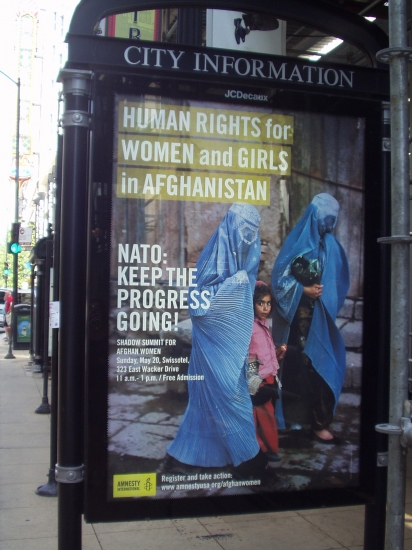
Amnesty International’s “NATO: Keep the Progress Going” poster at a Chicago bus stop.
She also played a leading role in U.S. engagement at the U.N. Human Rights Council (where her views about the original Goldstone Report on behalf of Palestinian women did not quite rise to the same level of concerns for the women in countries that U.S.-NATO has attacked militarily).
Nossel would have worked for and with Hillary Clinton, Madeleine Albright, Samantha Power and Susan Rice, and undoubtedly helped them successfully implement their “Right to Protect (R2P)” – otherwise known as “humanitarian intervention” – as well as the newly created “Atrocity Prevention Board.”
This cornerstone of President Barack Obama’s foreign policy (which has served mainly to rationalize the launching of war on Libya) is now being hauled out to call for U.S.-NATO military intervention in Syria.
“Smart Power” = smart wars?
In fact, Nossel is herself credited as having coined the term “Smart Power,” which embraces the United States ’ use of military power as well as other forms of “soft power,” an approach which Secretary of State Hillary Clinton announced at her confirmation as the new basis of State Department policy.
An excerpt from Nossel’s 2004 paper on “Smart Power” published in the Council on Foreign Relations’ Foreign Affairs magazine sounds a lot like Samantha Power’s (and also traces back to Madeleine Albright’s) theories:
“To advance from a nuanced dissent to a compelling vision, progressive policymakers should turn to the great mainstay of twentieth-century U.S. foreign policy: liberal internationalism, which posits that a global system of stable liberal democracies would be less prone to war.
“Washington, the theory goes, should thus offer assertive leadership — diplomatic, economic, and not least, military [our emphasis] — to advance a broad array of goals: self-determination, human rights, free trade, the rule of law, economic development, and the quarantine and elimination of dictators and weapons of mass destruction (WMD).”
Perhaps the AI’s hiring of a State Department shill as executive director of its U.S. affiliate was merely coincidental to how/why its “NATO Shadow Summit ” so closely mimicked the CIA’s latest propaganda assault, but….
The “CIA Red Cell,” a group of analysts assigned to think “outside the box” to anticipate emerging challenges, was right to worry in March 2010 when the State Department’s Bureau of Intelligence and Research (INR) found that 80 percent of French and German citizens were opposed to continued deployment of their countries’ militaries in the U.S.-NATO war in Afghanistan.
Even though public apathy had, up to that point, enabled French and German politicians to “ignore their voters” and steadily increase their governments’ troop contributions to Afghanistan, the CIA’s newly-created think tank was concerned that a forecast increase in NATO casualties in the upcoming “bloody summer … could become a tipping point in converting passive opposition into active calls for immediate withdrawal.”
In a “confidential” memo, the “Red Cell” wrote: “The Afghanistan mission’s low public salience has allowed French and German leaders to disregard popular opposition and steadily increase their troop contributions to the International Security Assistance Force (ISAF). Berlin and Paris currently maintain the third and fourth highest ISAF troop levels, despite the opposition of 80 percent of German and French respondents to increased ISAF deployments, according to INR polling in fall 2009.
“Public Apathy Enables Leaders To Ignore Voters …
“Only a fraction (0.1-1.3 percent) of French and German respondents identified ‘Afghanistan’ as the most urgent issue facing their nation in an open-ended question, according to the same polling. These publics ranked ‘stabilizing Afghanistan’ as among the lowest priorities for US and European leaders, according to polls by the German Marshall Fund (GMF) over the past two years.
“According to INR polling in the fall of 2009, the view that the Afghanistan mission is a waste of resources and ‘not our problem’ was cited as the most common reason for opposing ISAF by German respondents and was the second most common reason by French respondents. But the ‘not our problem’ sentiment also suggests that, so for, sending troops to Afghanistan is not yet on most voters’ radar.
“But Casualties Could Precipitate Backlash
“If some forecasts of a bloody summer in Afghanistan come to pass, passive French and German dislike of their troop presence could turn into active and politically potent hostility. The tone of previous debate suggests that a spike in French or German casualties or in Afghan civilian casualties could become a tipping point in converting passive opposition into active calls for immediate withdrawal.”
The CIA “Special Memorandum” went a step further, inviting “a CIA expert on strategic communication and analysts following public opinion” to suggest “information campaigns” that State Department polls showed likely to sway Western Europeans.
The “Red Cell” memo was quickly leaked, however, furnishing a remarkable window into how U.S. government propaganda is designed to work upon NATO citizenry to maintain public support for the euphemistically titled “International Security Assistance Force” (ISAF) waging war on Afghans. Here are some of the CIA propaganda expert’s suggestions:
“Messaging that dramatizes the potential adverse consequences of an ISAF defeat for Afghan civilians could leverage French (and other European) guilt for abandoning them. The prospect of the Taliban rolling back hard-won progress on girls’ education could provoke French indignation, become a rallying point for France’s largely secular public, and give voters a reason to support a good and necessary cause despite casualties. …
“Outreach initiatives that create media opportunities for Afghan women to share their stories with French, German, and other European women could help to overcome pervasive skepticism among women in Western Europe toward the ISAF mission. … Media events that feature testimonials by Afghan women would probably be most effective if broadcast on programs that have large and disproportionately female audiences.”
‘NATO: Keep the Progress Going!’
Amnesty International struck similar themes in announcements posted online as well as billboard advertisements on Chicago bus stops, telling “NATO: Keep the Progress Going!” beckoned us to find out more on Sunday, May 20, 2012, the day thousands of activists marched in Chicago in protest of NATO’s wars.
The billboard seemed to answer a recent Huffington Post article, “Afghanistan: The First Feminist War?”
“The feminist victory may be complete in America, but on the international stage it’s not doing so well with three quarters of the world’s women still under often-severe male domination. Afghanistan is an extreme case in point in what might be termed the first feminist war … a war that now may not be won even if Hillary Clinton dons a flack jacket and shoulders an M16 on the front lines. Still, since the Bush Administration to the present America‘s top foreign policy office has been held by women … women who have promised not to desert their Afghan sisters.”
Our curiosity was further piqued because we consider ourselves to be women’s rights and human rights proponents and also due to our own prior federal careers in intelligence and military. (Colonel Wright is retired from the State Department/US military and Rowley is from the FBI.)
So along with a few other anti-war activists, we packed into a taxi to head to the Chicago hotel where Amnesty International’s “Shadow Summit” featuring former Secretary of State Madeleine Albright and other female foreign relations officials was being held. We happened to carry our “NATO bombs are not humanitarian”; “NATO Kills Girls” and anti-drone bombing posters that we had with us for the march later that day.
As we arrived, an official-looking black car dropped off Melanne Verveer, U.S. Ambassador-at-Large for Global Women’s Issues, who was to be a main speaker (on the first panel, along with former Secretary Albright; U.S. Rep. Jan Schakowsky, D-Illinois; and Afifa Azim, General Director and Co-Founder, Afghan Women’s Network; along with Moderator Gayle Tzemach Lemmon, Deputy Director of the Council on Foreign Relations’ Women and Foreign Policy Program).
Verveer cast a cold glance at us and would not answer Ann Wright’s questions as she scurried into the hotel with her aides surrounding her and us following behind. At first the hotel security guards tried to turn us away but we reminded the registration desk the Summit was advertised as “Free Admissions” and that some of us were members of Amnesty International.
So they let us register and attend as long as we promised to leave our signs outside and not disrupt the speakers. The hotel conference room was about half full. We stayed long enough to hear the opening remarks and the moderator’s first questions of Albright and the other speakers on the first panel.
All generally linked the protection and participation of Afghan women in government as well as the progress made in educating Afghan women to the eventual peace and security of the country as envisioned by the new strategic “partnership” agreement that Obama had just signed with Afghan President Hamid Karzai.
Ms. Verveer said Afghan women do not want to be seen as “victims” but are now rightfully nervous about their future. When we saw that audience participation was going to be limited to questions selected from the small note cards being collected, we departed, missing the second panel as well as kite-flying for women’s rights.
We noted, even in that short time, however, how easy it was for these U.S. government officials to use the “good and necessary cause” of women’s rights to get the audience into the palm of their collective hand — just as the CIA’s “strategic communication” expert predicted!
Secretary Albright?
Not everyone was hoodwinked however. Even before the “Summit” was held, Amnesty realized it had a PR problem as a result of its billboard advertisement touting progress in Afghanistan. An Amnesty official tried to put forth a rather lame defense blaming an accidental poor choice of wording.
But many readers (and AI members) posted critical comments and questions, including concerns about Albright’s involvement given her infamous defense of Iraqi sanctions in the 1990s, which were estimated to have caused the deaths of a half million Iraqi children, with the comment “we think the price is worth it.”
Under the blogger’s explanation: “We Get It / Human Rights Now,” there were comments like these:
“Could someone from AI please explain why Madeleine Albright was invited to participate in this event? We (and especially those of us who are familiar with AI) should all be able to understand that the wording on the poster was a genuine, albeit damaging, mistake. But why Ms. Albright?”
“The posters are pro-NATO and play into prevailing tropes about so called ‘humanitarian intervention’ via ‘think of the women & children’ imagery. The posters & the forum that includes Albright are neither slight slips nor without context. AI is copping heat because they have miss-stepped dramatically. There is NOTHING subtle about either the imagery nor the message!
“It is not a case of ‘oh sorry we didn’t realize it it could be interpreted that way!’ They used pro Nato imagery & slogans ahead of & during a controversial summit that has thousands protesting in the streets. Tell me again how that is not taking sides?
“They asked a notorious apologist for mass murder of children to speak on the right of women and children… tell me again: how is that not taking sides. So it is absolutely reasonable for past supporters (and board members like myself) to be asking how it is that Amnesty USA so lost its bearings they could make a critical SERIES of errors like this?”
Of course the defensive AI blog author never answered the numerous questions asking why Amnesty had chosen Madeleine Albright as their main speaker. So we will venture an answer that probably lies in the fact that all of the powerful feminist-war hawks who have risen to become Secretary of State (or are waiting in the wings) are now taking their lead from the ruthless Grand Dame who paved the way for them, Madeleine Albright — (see Coleen Rowley’s recent articles: “Obama’s New ‘Atrocity Prevention Board’: Reasons for Skepticism” and “Militarization of the Mothers: You’ve Come a Long Way, Baby, from Mother’s Day for Peace”).
It’s also possible the highest ranks of the feminist wing of military interventionism (i.e. Madeleine Albright, Condi Rice, Hillary Clinton, Susan Rice, Samantha Power, et al) are so passionate and hubristic about the nobility of their goal and “Amercan exceptionalism” that some have simply succumbed to a kind of almost religious (blind faith) type fervor.
The Road to Hell
Nossel’s and Albright’s theories are flawed in many ways but suffice it to say that democracies are actually not less prone to war. A long list of “democracies” – including Nazi Germany, the Roman Empire, the United Kingdom, France and the United States itself – disprove this assertion.
In any event, the U.S. has been terribly hypocritical in its support of “democracies” in foreign countries, often toppling or attempting to topple them (i.e. Iran’s Mossadeqh, Guatemala’s Arbenz, Chile’s Allende) in order to gain easier control of a foreign country through an allied dictatorship.
No one is going to argue that the goals of humanitarianism, preventing atrocities and furthering women’s rights around the world are not “good and necessary” (in the words of the CIA strategic communications expert). We would go so far as to say these ARE truly noble causes!
Testimonials about human rights’ abuse are often true and fundamentalist regimes’ treatment of women seems to vary only in degrees of horrible. But while it’s true that many women lack rights in Afghanistan, some would argue that it’s conveniently true. And that the best lies are always based on a certain amount of truth.
The devil, however, lies in the details of promoting equality and accomplishing humanitarianism. Most importantly the ends, even noble ends, never justify wrongful means. In fact, when people such as Samantha Power decide to bomb the village Libya, to save it, it will backfire on a pragmatic level.
It must be realized that it is the nobility of the U.S.-NATO’s motivation that – as CIA propaganda department has advised – should be relied upon to convince otherwise good-hearted people (especially women) to support (or at least tolerate) war and military occupation (now known to encompass the worst of war crimes, massacres of women and children, torture, cutting off body parts of those killed, as well as increasing mental illness, self-destructive behavior and suicides among U.S. soldiers and the corresponding cover-ups of all such horrible means).
In the decades after Vietnam, a number of military scholars identified declining American public support for that war as the main factor responsible for the U.S. “losing” Vietnam. One lesson learned and quickly implemented was to get rid of the military draft and put the wars on a credit card so fewer citizens would pay attention.
Some control also had to be gained over the type of free media (that led to trusted TV anchor Walter Cronkite broadcasting his public souring on the Vietnam War). A whole series of war propaganda systems, from planting retired generals as “talking heads” on TV to the assistant to Defense Secretary Donald Rumsfeld deciding to “embed the media,” have worked pretty well to maintain the necessary level of war momentum in mainstream media and amongst public opinion.
But now, with American polls approaching the same problematic levels as those in Europe cited by the “CIA Red Cell,” we suddenly see major human rights organizations like Amnesty International (as well as others) applauding Obama’s (and the feminist war-hawks’) “Atrocity Prevention Board.”
Such sleight of hand seems to work to work even better amongst political partisans. By the way, it should be noted that Congress may allow these Pentagon propagandists to target American citizens through the National Defense Authorization Act of 2013. Should we connect the dots?
There are some clear lines where the laudable need to further human rights should not be twisted into justifying harsh economic sanctions that kill hundreds of thousands of children or, even worse, “shock and awe” aerial bombing that takes the lives of the women and children the “humanitarian” propagandists say they want to help.
Madeleine Albright’s response about the deaths of a half million children on 60 Minutes, that “the price was worth it,” illustrates the quintessential falsity of what ethicists call “act utilitarianism” or concocting fictional happy outcomes to justify the terrible wrongful means.
It also seems that a human rights NGO, in this case Amnesty International, which had gained a solid reputation and hence the trust of those it has helped through the years, will be jeopardized in aligning itself with the U.S. Secretary of State and NATO.
This is exactly how the Nobel Peace Prize got corrupted, aligning itself with the U.S. Secretary of State and NATO, which is why Nobel laureate Mairead Maguire withdrew from the Nobel Peace forum held in Chicago during NATO.
Good NGOs and non-profits that want to maintain the trust in their humanitarian work tend to be very careful to maintain their independence from any government, let alone any war-making government. When NGOs, even good ones, become entwined with the U.S./NATO war machine, don’t they risk losing their independent credibility?
~
Ann Wright is a 29-year U.S. Army/Army Reserve Colonel and a 16-year U.S. diplomat who served in Nicaragua, Grenada, Somalia, Uzbekistan, Kyrgyzstan, Sierra Leone, Micronesia, Afghanistan and Mongolia. She resigned in 2003 in opposition to the Iraq war. She returned to Afghanistan in 2007 and 2010 on fact-finding missions.
Coleen Rowley, a FBI special agent for almost 24 years, was legal counsel to the FBI Field Office in Minneapolis from 1990 to 2003. She wrote a “whistleblower” memo in May 2002 and testified to the Senate Judiciary on some of the FBI’s pre-9/11 failures. She retired at the end of 2004, and now writes and speaks on ethical decision-making and balancing civil liberties with the need for effective investigation.
Related articles
Susiya: Another Casualty of Israeli Occupation?
By Patrick O. Strickland | Palestine Chronicle | June 18, 2012
Last week Israeli military forces delivered demolition orders to the residents of Susiya, a small village in the South Hebron Hills. The villagers were told that they have illegally erected over fifty buildings without the permission of the Israeli Defense Force.
The demolition order came a few short days after Regavim, a right-wing NGO dominated by Israeli settlers, filed a petition in Israel’s High Court, requesting that a building freeze be imposed on Susiya.
The village is situated, much to the dismay of its inhabitants, in Area C of the West Bank, the land which was designated for full Israeli administration after the Oslo Accords. It is nearly against the fence of a particularly hostile Israeli settlement, which is also named Susiya. Yatta, a much larger Palestinian village, is less than a kilometer, though there are several Israeli military outposts on the path there.
Allotted only three days to appeal, it appears that Susiya will be destroyed. The village’s legal representative intends to take the matter to Israel’s High Court.
The “illegal buildings” they have erected, in actuality, are tents which were hastily constructed from cinderblocks and rain tarps. For, this will be the sixth–not the first–time that Susiya will be demolished by the IDF. The village–which consists of Bedouins, cave-dwellers, and Palestinians who were displaced from the Negev Desert in the 1948 war–was razed in 1985, 1991, 1997, and twice in 2001.
Each time Susiya is destroyed, the neighboring settlement further usurps the land that legally belongs to its Palestinian owners. The villagers refuse to leave, and each time the village is crumbled, they resurrect it.
The villagers have been regular targets of attacks from the settlers next door. Their water wells have been poisoned on several occasions. Their sheep, on which they depend for butter and milk as their sole source of income, have frequently been slaughtered by their zealous neighbors. Settler attacks are generally treated with legal impunity, and this is to say nothing of the Israeli military’s repeated destruction of Susiya’s caves, in which Susiya’s residents have historically lived.
When I visited the village last fall, Nasser Nawajeh, a resident of Susiya and longtime activist, spoke of one occasion in which the IDF used a bulldozer to collapse his family’s water well. Under Israeli martial law, Palestinians in Area C of the West Bank are not allowed to dig deeper than three feet without a permit. After the well was destroyed, he recalled, they stuffed mangled car parts into its base in order to discourage them from rebuilding it.
In recent years, international activists and left-wing Israeli NGOs have helped draw attention to Susiya’s abysmal situation. Breaking the Silence, an organization of former IDF soldiers who have decided to speak out against the occupation, brings a regular tour of internationals to meet with the Nawajeh family in Susiya. Rabbis for Human Rights has also tried to raise awareness inside Israel of the struggle that Susiya faces at the hands of military occupation and continued settlement expansion.
Nonetheless, many international efforts to aid the residents of Susiya have been shortsighted and concerned more with the appearance of having helped, rather than fixing the roots of the problems. Little has been done, for instance, to help the villagers obtain water for their sheep. The Nawajeh family, because their wells are repeatedly destroyed, are expected to buy water from Yatta, which costs three times the price of water inside Israel, not including transportation fees.
The plight of Susiya is indicative of the larger dialectic of the Israeli-Palestinian conflict. Israeli officials will continue to accuse the Palestinians of being unprepared for peace negotiations, while its military and settlement enterprise employ the force of arms to wrangle the West Bank from its native inhabitants. Western governments and the international community will continue to portray the situation in an absurd light: a fragile democracy attempting to quell restive “terrorists.”
However, Susiya’s struggle is of another stripe. The villagers, possessing none of the violent and fanatical traits of the settlers that so often attack them, are committed to living on their land. None of the colonial arguments to the contrary will persuade them otherwise.
Susiya, though facing another impeding annihilation, refuses to be the next casualty of Israel’s suffocating 45-year military occupation of the West Bank and the Gaza Strip.
“We’ve been kicked displaced and kicked off our land five times,” Nasser Nawajeh told me. “We’re not leaving again.”
– Patrick O. Strickland is a freelance writer living and traveling on both sides of the ‘Green Line’ in Israel and the Palestinian territories. He is a weekly Israel-Palestine correspondent for Bikya Masr and writes regular dispatches on his blog, http://www.patrickostrickland.com.
Related articles
- Israeli forces order Hebron village demolished after settler case (alethonews.wordpress.com)
- Jewish Extremists Burn Mosque Near Jerusalem (alethonews.wordpress.com)
Russia denies planning war games in Syria
Voice of Russia | June 19, 2012
Russia has denied reports in media that it allegedly planned joint military exercises with China and Iran on Syrian territory.
‘This is absurd’, Mr. Igor Dygalo, aide to Russia’s Navy commander said.
Earlier this week the Dubai-based Al Arabiya TV channel reported that Russia, China and Iran were planning joint exercises, the largest in the Middle East, comprising some 90,000 ground, naval and air forces, as well as 400 aircraft, 1,000 tanks and Russian submarines, destroyers and an aircraft carrier.
The report said that Egypt had allowed 12 Chinese navy ships to go through the Suez Canal to arrive in Syria.
This false report also claimed that Syria was going to test its anti-ship missiles and air defense system.
Obama Regime: Federal Agents Should Be Allowed To Hold Guns To The Heads Of Children
Ninth Circuit to DEA: Putting a Gun to an 11-Year-Old’s Head Is Not OK
By Mike Riggs | Reason | June 18, 2012
At 7 a.m. on January 20, 2007, DEA agents battered down the door to Thomas and Rosalie Avina’s mobile home in Seeley, California, in search of suspected drug trafficker Louis Alvarez. Thomas Avina met the agents in his living room and told them they were making a mistake. Shouting “Don’t you fucking move,” the agents forced Thomas Avina to the floor at gunpoint, and handcuffed him and his wife, who had been lying on a couch in the living room. As the officers made their way to the back of the house, where the Avina’s 11-year-old and 14-year-old daughters were sleeping, Rosalie Avina screamed, “Don’t hurt my babies. Don’t hurt my babies.”
The agents entered the 14-year-old girl’s room first, shouting “Get down on the fucking ground.” The girl, who was lying on her bed, rolled onto the floor, where the agents handcuffed her. Next they went to the 11-year-old’s room. The girl was sleeping. Agents woke her up by shouting “Get down on the fucking ground.” The girl’s eyes shot open, but she was, according to her own testimony, “frozen in fear.” So the agents dragged her onto the floor. While one agent handcuffed her, another held a gun to her head.
Moments later the two daughters were carried into the living room and placed next to their parents on the floor while DEA agents ransacked their home. After 30 minutes, the agents removed the children’s handcuffs. After two hours, the agents realized they had the wrong house—the product of a sloppy license plate transcription—and left.
In 2008, the Avinas—mom, dad, and both daughters—filed a federal suit against the DEA for excessive use of force, assault, and battery in the U.S. District Court for the Southern District of California. That court ruled in favor of the DEA, and the Avinas appealed. Last week, the family got justice.
While the Ninth Circuit Court of Appeals defended the agents’ rough treatment of Thomas and Rosalie, it also declared that yanking the Avina children of their beds and putting guns to their heads did, in fact, constitute the “intentional infliction of emotional distress.” (Read the Obama administration’s defense of the DEA agents.)
“A jury could find that the agents pointed their guns at the head of an eleven-year-old girl, ‘like they were going to shoot [her],’ while she lay on the floor in handcuffs, and that it was excessive for them to do so,” reads the Ninth Circuit’s decision, which was filed June 12. “Similarly, a jury could find that the agents’ decision to force the two girls to lie face down on the floor with their hands cuffed behind their backs was unreasonable.”
More from the decision:
Under our case law, an issue of material fact exists as to whether the actions of the agents were excessive in light of the ages of B.S.A. (age eleven) and B.F.A. (age fourteen) and the limited threat they posed. See Tekle, 511 F.3d 839 (holding that officers were not entitled to summary judgment on excessive force claim where officers pointed guns at an eleven-year-old boy’s head during the arrest of the boy’s father); Motley v. Parks, 432 F.3d 1072, 1089 (9th Cir. 2005) (en banc) (holding that officer’s act of pointing a gun at an infant during the search of a gang member’s house was objectively unreasonable); see also McDonald ex rel. McDonald v. Haskins, 966 F.2d 292, 294-95 (7th Cir. 1992) (holding that officer’s act of pointing his gun at a nine-year-old’s head during the search of home was excessive use of force). Accordingly, we reverse the district court’s grant of summary judgment in favor of the United States on B.F.A.’s and B.S.A.’s claims for assault and battery.
In a footnote, the court wrote:
Although there is evidence that the agents released the girls from their handcuffs once they realized how young they were, there is also evidence that the agents knew, prior to entering the girls’ bedrooms, that the girls were children. Rosalie testified that, as the agents were heading towards the girls’ rooms, she screamed at the agents several times, “Don’t hurt my babies.” Moreover, one of the agents testified at his deposition that, when he first saw one of the girls (presumably the older of the two girls), she appeared to be “12 [or] 13 years old.”
The ruling concludes:
Viewing the evidence in the light most favorable to the Avinas, a rational trier of fact could find that agents engaged in “extreme or outrageous” conduct when the agents: (1) pointed their guns at the head of eleven-year-old B.S.A. “like they were going to shoot [her]” while B.S.A. was lying on the floor in handcuffs; (2) forced eleven-year-old B.S.A. and fourteen-year-old B.F.A. to lie face down on the floor with their hands cuffed behind their backs; (3) left B.S.A. and B.F.A. in handcuffs for half an hour; and (4) yelled at eleven-year-old B.S.A. and fourteen-year-old B.F.A. to “[g]et down on the f[uck]ing ground.” See Tekle, 511 F.3d at 856 (holding that officers were not entitled to summary judgment on claim for intentional infliction of emotional distress where officers pointed guns at eleven-year old’s head during the arrest of the eleven-year-old’s father); see also id. at 859 (Fisher, J., concurring). Accordingly, we reverse the district court’s grant of summary judgment in favor of the United States on B.F.A.’s and B.S.A.’s claims for intentional infliction of emotional distress.
As a side note: While this raid was conducted under President George W. Bush, the deputy administrator of the DEA at that time was Michele Leonhart. She is now the administrator of the DEA, thanks to an appointment by President Barack Obama. Furthermore, the Obama Administration could have declined to defend the DEA in this case. Instead, Obama’s Justice Department has decided to make the case that federal agents should be allowed to hold guns to the heads of children.
Related articles
- DEA Embroiled In Prostitution Scandal (huffingtonpost.com)
- The DEA and the Massacre in the Moskitia (alethonews.wordpress.com)
- Here’s How the Obama Administration Defended DEA Agents Who Put a Gun to a Little Girl’s Head (reason.com)
Island of Impunity: Puerto Rico’s Outlaw Police Force
ACLU | June 19, 2012
A report released by the ACLU in June 2012 concludes that the Puerto Rico Police Department is plagued by a culture of unrestrained abuse and impunity. The PRPD – which, with over 17,000 officers, is the second-largest police department in the U.S – is charged with policing the Commonwealth of Puerto Rico.
After a comprehensive six-month investigation of policing practices in Puerto Rico, building on eight years of work by the ACLU of Puerto Rico documenting cases of police brutality, the ACLU has concluded that the PRPD commits serious and rampant abuses in violation Puerto Ricans’ constitutional and human rights, including:
- Use of excessive and lethal force against civilians, especially in poor and Black neighborhoods and Dominican communities, often resulting in serious injury and death. Read More»
- Violent suppression of peaceful protestors using batons, rubber bullets, and a toxic form of tear gas that was phased out by mainland U.S. police departments in the 1960’s. Read More»
- Failure to protect victims of domestic violence and to investigate reported crimes of domestic violence, rape, and other gender-based crimes. Read More»
The ACLU’s research shows that these abuses do not represent isolated incidents or aberrant behavior by a few rogue officers, but that such police brutality is pervasive and systemic, island-wide and ongoing. In fact, our research has found that the PRPD’s disciplinary, investigatory, and reporting systems prevent accountability. Read more»
The report offers numerous detailed recommendations, including:
- The Justice Department should enter into a court-enforceable and court-monitored agreement with the PRPD.
- The PRPD should develop and implement policies on the use of force, improved training, the investigation of civilian complaints of police abuse, and the discipline of officers.
- Puerto Rico’s legislature should create an independent and effective oversight body to monitor the PRPD. Read more»
The ACLU’s report comes nine months after the release of a scathing U.S. Justice Department report on the PRPD, which found a pattern and practice of constitutional violations by the department, including widespread use of excessive force. The Justice Department investigation, the findings of which were long-delayed, focused on 2004 to 2008. The ACLU’s report focuses on incidents from 2007 through May 2012.

Read and download the ACLU’s report: “Island of Impunity”
Download the full report » (PDF)
Read the Executive Summary » (PDF)
Descargar el resumen ejecutivo del informe en español » (PDF)
See also:
Slideshow: Police Brutality and Unjustified Use of Lethal Force in Puerto Rico
Related articles
Federal judge dismisses lawsuit over US medical experiments in Guatemala
By Rebecca DiLeonardo | JURIST | June 14, 2012
A judge for the US District Court for the District of Columbia [official website] on Wednesday dismissed [opinion, PDF] a lawsuit filed by seven Guatemalans who alleged that they had been the subject of non-consensual human medical experimentation by the US Public Health Service (PHS) [official websites]. In its decision, the court found that under the Federal Tort Claims Act (FTCA) [text] the US government is specifically exempt from liability for torts that occur outside of the US. Because the plaintiffs sued government officials who were acting in the capacity of their positions, the claim is automatically converted to a claim against the US government, and the court is bound by the FTCA. In his decision, Judge Reggie Walton acknowledged that “the Guatemala Study is a deeply troubling chapter in our Nation’s history,” but concluded that the court had no authority to provide relief. He suggested that the victims seek a remedy through political means. The Guatemalan government had reportedly requested that the US government provide out-of-court settlements [AP report] before the lawsuit was filed, but the US did not respond.
The victims filed a class action lawsuit [JURIST report] in March 2011. The suit was brought on behalf of all individuals who were subjected to experimentation in Guatemala or were infected to be used as vehicles to infect test subjects for the venereal disease experiments. The complaint alleges that the PHS conducted the human medical experiments in Guatemala to test whether penicillin could also be used as a prophylaxis immediately following exposure to the syphilis bacteria. The plaintiffs sought relief under the Alien Tort Statute [28 USC § 1350], the Fifth Amendment and the Eighth Amendment [materials]. Evidence of the PHS program [report] was discovered by Professor Susan Reverby [academic profile]. US President Barack Obama apologized [BBC report] to Guatemalan President Alvaro Colom for the testing. Reverby’s study shows that the PHS infected more than 700 people in Guatemala with syphilis and gonorrhea. The patients were prisoners and people suffering from mental health problems and were unaware they were being tested.
Featured Video

No Threat Can Force Iran’s Surrender /Trita Parsi & Lt Cl Daniel Davis
or go to
Aletho News Archives – Video-Images
From the Archives
What is the Israeli Lobby in Australia Doing in Interfaith Dialogue?
By Ali Kazak | Dissident Voice | October 11, 2015
For years Israel and its lobby around the world have been trying to normalise their relations with Arabs and Muslims without solving the Palestine Question.
One of the methods they resorted to in the last few years is using human rights and community organizations such as interfaith dialogue and Multiculturalism to achieve this objective and to: isolate the Palestinians, marginalise the Palestine question, end Israel’s isolation, and prevent criticism of Israel, knowing that these organisations will be the first to stand against Israel’s violations, racial and religious discrimination.
The group responsible for this task in Australia is The Australia/Israel & Jewish Affairs Council (AIJAC); its Director of International & Community Affairs, Jeremy Jones is in charge of lobbying religious community organizations, specifically Muslims and Christians. Consequently he convened the Faith Communities for Reconciliation, founding participant in the Australian Partnership of Religious Organisations and the Australian National Dialogue of Christians, Muslims & Jews.
AIJAC is a private political propaganda group. It is recognised as the main Israeli lobby in Australia. It coordinates its activities and works intimately with the Israeli embassy in Canberra and different institutions in Israel. It is privately funded by some Jewish businessmen. It monitors closely Australian politicians, the media, ethnic and religious groups, (especially Arabs and Muslims), unions and academics on their stands towards Israel and the Palestine question. … continue
Blog Roll
 Aletho News
- The war of liberation of the Arab and Islamic peoples expands across the Gulf
- Envoy warns UN on Trump’s threat to ‘obliterate’ Iran’s civilian infrastructure
- The Larak Corridor: Iran’s Rial Gate With No US, No Israel, and No Way Around
- ‘Economic terrorism’: Steel facilities hit again in US-Israeli strike
- ‘War Crime’: Iran condemns attacks on Arak, Ardakan nuclear sites
- Two-thirds of Americans want quick end to Iran war even if goals unmet
- Trump to Give “Important Update on Iran” Wednesday in Prime-Time Speech
- Theodore Postol: Iran’s Missiles & Drones Were Underestimated
- Iran To Target Military Industrial-Tech Complex That Facilitated Gaza Genocide
- Collapsing Empire: The Resistance Disarms ‘Israel’
- If Americans Knew
- Israel wants US to bomb more of Iran’s civilian structures (113,000 is not enough) – Not a ceasefire Day 173
- Ann Coulter Rips Into Fox News for Iran War Coverage
- Joe Kent Urges Americans To Call White House and Congress To Object To Sending Troops Into Iran
- DNC Resolution to Reject AIPAC Funding Puts Democratic Leaders in the Hot Seat
- Swedish foundation to build 400 schools as over 650,000 Gaza children remain without education for 2 years
- Israeli army admits photshopping image of slain Lebanese journalist
- This is how Israel is systematically killing health workers under the cover of war in Lebanon
- Carrying life under fire: Israeli invasion of Lebanon leaves pregnant women facing deadly risks
- Champagne all around for the new death penalty (for Palestinians) law – Not a ceasefire Day 172
- Why are Palestinian books struggling to be seen on Amazon?
- No Tricks Zone
- New Study Finds Warming Saves Lives…Cold Temperatures 12 Times More Deadly Than Excess Heat
- German Science Blog Accuses PIK Climate Institute Of Hallucinating Climate Tipping Points
- Devastating Assessment Of Comirnaty Vaccine By Former Senior Pfizer Europe Toxicologist
- New Study: CO2 Is ‘Effectively Negligible’ As An Explanatory Climate Change Factor Since 2000
- Former Pfizer Toxicologist Dr. Helmut Sterz Tells Bundestag Hearing Pfizer Vaccine Should Have Never Been Approved
- Energy Expert: Germany’s Nuclear Phaseout Was A “500 Billion Euro Mistake”
- New Research: South Australia’s Mid-Holocene Sea Surface Temperatures Were 4°C Warmer Than Today
- Storing Green Energy To Last Germany 10 Days Would Require A 60-Million Tonne Battery
- New Studies: UK Sea Levels Were 4 Meters Higher Than Today During The Mid-Holocene
- Destructive Green New Deal: German Energy And Metal Group Warns Of Drastic Crisis
 Aletho News