Qatari in Egypt: Buying Foreign Policy
By Mohammad Khawly | Al Akhbar | September 11, 2012
Cairo – Qatar’s recent announcement that it plans to invest $18 billion in Egypt following President Mohammed Mursi’s controversial statements on Syria may herald a new era in Egyptian-Qatari relations, observers say.
Qatari Prime Minister Hamad bin Jassem announced the proposed investments at a joint press conference with Egyptian Prime Minister Hisham Kandil on September 6. This new wave of investment comes on the heels of a $2 billion Qatari loan to the Egyptian state, the first installment of which was deposited at the Central Bank of Egypt on August 23.
The announcement came just a week after Mursi made headlines at the Non-Aligned Movement summit in Tehran when he announced his full support for the Syrian revolution against what he called an “oppressive regime.”
At the opening session of the council of Arab ministers last Wednesday, Mursi reiterated his call for the regime leadership to step down.
“Now is the time for change,” Mursi said, addressing the Syrian regime. “There is no room for arrogance or presumptuousness. Do not listen to those voices tempting you to stay, for you will not remain for long.”
Many in the region see a link between Egypt’s unyielding stance on Syria and the recent spike in Qatari investments in Egypt. Whether this influx of Gulf money was the goal behind Cairo’s posturing or rather the loan and investments were a result of Mursi’s anti-Syrian position, which has broad support at home, no one can say. At least some factions in Egypt, including the Hazemoun movement linked to former Salafi presidential candidate Hazem Abu Ismail, view the Syrian uprising through a religious, sectarian lens as a jihad against an “infidel” Alawi army.
The investments involve $8 billion in major projects in Sharq al-Tafria, East Port Said, and another $10 billion will be spent on a gigantic tourism project on the northern coast including a marina for luxury yachts.
The projects are expected to provide job opportunities for thousands of workers, but some worry such projects could become a tool in the hands of the Qatari regime and a means of leverage in any future dispute.
Al-Akhbar spoke to the founder of the Ibn Khaldun Center for Development Studies Saad Eddin Ibrahim, who is familiar with Qatari politics.
In his opinion, Qatar wants Egypt’s support on political issues, particularly when it comes to internal Gulf disputes with Bahrain and Saudi Arabia, as well as other Arab countries.
Qatar is a small country that needs strong allies, said Ibrahim, but its relationships with its direct neighbors – Iran, Saudi Arabia, and Iraq – are fraught with difficulties. An ally in Egypt would not covet Qatari resources, making it a safe and powerful friend. In addition to increasing its political clout, Qatar also sees Egypt as a ripe investment opportunity.
Related articles
- Qatar to invest $18bn in Egypt over next 5 years (alethonews.wordpress.com)
- Egyptian president heads to China for investment talks (alethonews.wordpress.com)
Honduras: “Model Cities” Project Set to Begin?
Weekly News Update on the Americas | September 11, 2012
Honduran National Congress president Juan Orlando Hernández announced on Sept. 4 that the government’s Commission for the Promotion of Public-Private Alliances (COALIANZA) had signed an agreement for the first of three “model city” projects–semi-autonomous regions mandated under a 2010 constitutional amendment [see World War 4 Report 6/9/12]. COLIANZA claims the project, which still needs approval from the Congress, will create 5,000 direct and indirect jobs this year, 15,000 jobs in 2013, 30,000 in 2014, and 45,000 in 2015.
The project is likely to be located near Puerto Cortés or Puerto Castilla on the Atlantic coast, or in Choluteca department on the country’s narrow Pacific coast. “It should be noted that these model cities will be established in depopulated areas of Honduras,” Hernández told the media. “It does not imply the displacement of people or social groups.” The Honduras Culture and Politics blog noted: “None of these regions is completely vacant. Reading between the lines, what Hernández is saying is that there are no large cooperatives or powerful landowners in these regions, groups that might vocally protest the expropriation of the land on which they live and work.”
The main funding for the “model city” is coming from an unidentified Canadian company. Other funders include a US company identified as the “NKG Group” or “MKG Group,” and a start-up called Future Cities Development Corporation. Both companies seem to have rightwing libertarian orientations. A leading executive at NKG Group, Michael Strong, appears to be associated with Whole Foods CEO John Mackey; a Michael Strong is listed with Mackey as a co-founder of FLOW, an organization dedicated to “liberating the entrepreneurial spirit for good.” One of Future Cities Development Corporation’s founders is Patri Friedman, the grandson of University of Chicago economist and neoliberal theorist Milton Friedman. (Honduras Culture and Politics 9/5/12)
Some 14 groups or individuals–including campesino organizations and the Honduran Black Fraternal Organization (OFRANEH)—filed a legal challenge to the “model cities” law on Sept. 7, citing a motion filed in October 2011 by Oscar Cruz, a former government attorney for constitutional issues. Xiomara Castro de Zelaya, the presidential candidate of the leftist Freedom and Refoundation (LIBRE) party and the wife of former president José Manuel (“Mel”) Zelaya Rosales (2006-2009), issued a statement denouncing the law as “incompatible with the concept of sovereignty, independence and equality of opportunity for national and foreign investment.” She warned people who start these projects that “they are exposing themselves to the loss of their investments.”
LIBRE was formed in June 2011 by the National Popular Resistance Front (FNRP), a coalition of unions and grassroots organizations that led the resistance to the June 2009 military coup that removed former president Zelaya from office.
The project has even received criticism from Paul Romer, the New York University professor whose “charter cities” concept is the basis for the Honduran “model cities” law. Romer reportedly may quit the Honduran transparency commission he was chairing because he feels he hasn’t been give sufficient information and authority to carry out his responsibilities. (Honduras Culture and Politics 9/7/12; Xiomara Castro de Zelaya statement 9/7/12 via Vos el Soberano)
Related articles
Media hype 9/11, ignore 1m Iraqi victims: Ahmadinejad
Press TV – September 11, 2012
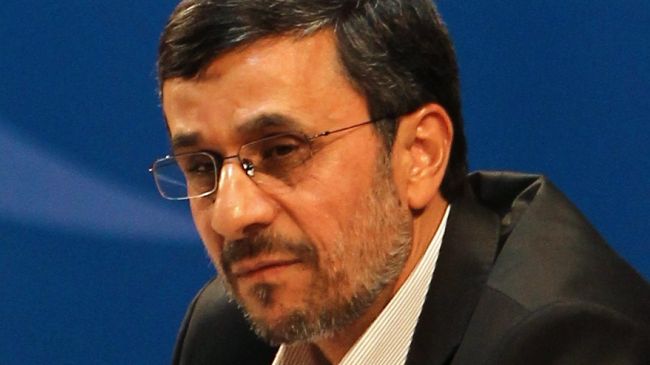 Iran’s President Mahmoud Ahmadinejad has criticized Western media for creating hype over the September 11 attacks and ignoring more than one million victims of the US wars in Iraq and Afghanistan.
“The materialistic view of Zionists has destroyed the sacredness of media and today media no longer regulate the relations among humans, but have turned into a means of domination and gaining power,” Ahmadinejad said on Monday.
The Iranian chief executive stated that a major part of the events surrounding the September 11 attacks was merely a “media operation”, adding, “Today American forces would not be in Afghanistan, Iraq and the Persian Gulf, if it was not for the media coverage of this incident.”
Why have the media that provoked public sentiments and emotions during the September 11 incident, remained silent regarding more than one million victims that have been killed in the aftermath of the attack?, he asked.
On September 11, 2001, a series of coordinated attacks were carried out in the United States leaving almost 3,000 people dead.
The US, under the administration of former President George W. Bush, invaded Afghanistan in 2001 after claiming that the 9/11 attacks were carried out by members of al-Qaeda harbored by the then Taliban regime in Afghanistan.
The US also attacked Iraq in 2003 claiming that the Middle Eastern country was in possession of weapons of mass destruction. Washington’s wars in Iraq and Afghanistan have claimed the lives of more than a million people.
Multinational investors and union rights: Strikes and sackings continue
By Jano Charbel – Al Akhbar – 10/09/2012
Business executives representing nearly 50 US companies are in Egypt this week, the latest of a series of international trade delegations to visit the country. Foreign investors are a vital part of the current administration’s economic strategy — the hope is that they will provide the jobs and capital to lift the country from its economic malaise.
But labor activists Egypt Independent spoke to have drawn attention to multinational corporations’ patchy records on union rights. Cadbury, Schlumberger, Pirelli, Henkel-Persil and Suzuki, among others, are accused of union busting and punitive sackings.
These violations are not out of step with the general trend in the private sector here, but they raise questions about the commitment of corporations headquartered in countries with nominal trade union freedoms to preserve those freedoms in their international operations. They also raise questions about the government’s willingness to turn a blind eye to workers’ rights, when investment is at stake.
Cadbury
The confectionery giant Cadbury, a subsidiary of the Kraft Foods conglomerate, has been reaping in hundreds of millions of pounds worth of profits since its establishment in the country in 1992.
Located in 10th of Ramadan City and in Hanovil, Alexandria, Cadbury Egypt employs more than 1,500 people. Despite resistance from the administrative board, Cadbury workers managed to establish their independent trade union on 28 April.
Led by their union, these workers launched a two-day strike on 27 July during which they demanded the 15 percent wage increase decreed for the public sector by President Mohamed Morsy on 1 July.
On 8 August, five of nine trade union leaders in the company were dismissed by Cadbury Egypt on charges of instigating unrest within the company.
Mohamed Hassan, president of the union in Alexandria, says that last year, the union was able to generate profits for the company amounting to LE267 million.
“Nevertheless, the administrative board sacked us for demanding our rightfully earned pay raises.”
He argued that the company’s managing director, Gawad Abaza, “doesn’t want a workers union in the company or anybody else to hold him accountable for our exploitation and the violation of our most basic labor rights.”
Depending on experience and seniority in the company, workers at Cadbury Egypt earn between LE1,500 — LE6,000 per month (US$250 — $1,000), well above the national average. Hassan claims that “administrative board members earn a monthly average of LE15,000 ($2,500), while Abaza earns a large percentage of the profits each month.”
Hassan says Cadbury Egypt’s board dismissed them without first resorting to negotiations with the Manpower Ministry, in violation of labor laws.
“We ourselves engaged in negotiations with the Manpower Ministry’s bureau in Alexandria for 21 days,” Hassan says. “We strive to take our case to the labor courts.”
Hassan pointed out that similar union-busting actions have recently been undertaken by Cadbury in Tunisia.
Late last month, the five unionists dismissed by Cadbury Egypt received letters of support and solidarity from the Swiss-based International Union of Food Workers. Similarly, Kraft workers from various other countries also sent letters of support, demanding their reinstatement.
Schlumberger
Established in France and headquartered in Texas, Schlumberger is the world’s largest oil field services company and employs some 115,000 people in 85 countries.
Schlumberger Egypt directly employs about 1,000 well-paid workers and professionals in 10 different sites across the country. Schlumberger Egypt’s profits in 2011 amounted to an estimated $30 million. On average, an Egyptian engineer might earn LE9,000 per month ($1,500) working at the company, while a manual worker at an oil rig might earn LE5,000 ($833) per month.
However, this company apparently does not respect the right to organize. Against the administration’s will, employees there established their first union committee in May 2011.
The administrative board responded by punitively sacking four workers from the company between June and July 2011, including three unionists and one union organizer.
Mohamed Abdel Rahman, secretary general of the Schlumberger Egypt Workers Union, says the company’s France branch sought to compensate them for their dismissals.
“Yet we don’t want monetary compensation,” he says. “We demand our jobs back and we demand the right to organize within the company.”
Abdel Rahman, one of the unionists who were sacked, says Schlumberger officials from France and the US visited Egypt last week to investigate the dispute.
He also says the unionists filed a complaint to the Manpower Ministry last year.
“Ministry officials told us that we did not violate any laws and that we were in the right,” Abdel Rahman says, adding that he and the other unionists who were fired had lodged a legal appeal before the Labor Court in September last year. Their next court hearing has been adjourned to 12 September.
Similarly to the Cadbury Egypt unionists who had been fired, those who had been fired from Schlumberger Egypt have received letters of solidarity from the International Federation of Chemical, Energy, Mine and General Workers Union and its affiliated unions in Canada and Norway.
The unions demanded that Schlumberger Egypt reinstate the four unionists and refrain from union busting.
Other multinationals
Headquartered in Dusseldorf, Germany, industrial giant Henkel-Persil — which produces detergents, cosmetic and beauty care products, and adhesive technologies — operates in 75 countries worldwide, with a labor force of some 47,000.
According to its website, Henkel employs 830 workers at its detergent production plants in Port Said. Media reports say Henkel Egypt generated profits of LE1.2 billion in 2011.
Workers at the company launched a strike on 28 August. Hundreds of workers demanded full-time contracts, increased wages, healthcare facilities and parity with Henkel workers in other countries, in terms of incomes, bonuses, profit sharing and paid holidays.
Like Henkel Egypt’s workers, Heinz Egypt’s 400 workers launched protests at their company in 6th of October City last month. Workers at this condiment company demanded an increase in their meager wages, full-time contracts for full-time work, periodic bonuses and profit-sharing payments, among other demands.
Suzuki Motor Corporation, managed by the Seoudi Group in Egypt, has also been involved in union busting. Workers at this company in 6th of October City established an independent union in June 2011, against the will of Seoudi Group.
According to a report issued by the Egyptian Center for Economic and Social Rights, five unionists and three other workers were dismissed from Suzuki Egypt between June and October 2011. These workers have not yet been reinstated.
The Italian global rubber and tires giant Pirelli dismissed five unionists from its company in Alexandria in July, after some 2,000 workers at the company went on strike the previous month. However, the Italian multinational company agreed to reinstate the five unionists and offered other concessions following intervention from the IndustriALL Global Union and Egypt’s General Trade Union of Chemical Workers.
The state of investment
Fatma Ramadan, executive board member of the Egyptian Federation of Independent Trade Unions, argues that “both corporations and the Egyptian state are responsible for increasing labor violations.”
Many workers at multinational companies, she continued, “earn only between LE600 to LE1,000 (about $100–166) per month, rarely more.”
Ramadan says about 130 laborers, primarily union organizers and strike leaders, have been punitively fired since the 25 January revolution for striking or organizing within their workplaces — private and public, domestically and internationally owned.
Tallal Shokr, a secretary of the Center for Trade Union and Workers’ Services and the Egyptian Democratic Labor Congress, puts the number at 155.
Trade union rights are generally better protected in public sector companies, Shokr says, and protected worst of all in the “free zones” designed to attract investment, where regulation is largely suspended. He thinks the petroleum sector is among the most aggressive in dealing with its workers.
“Under the pretext of attracting investment, foreign or domestic, all labor violations are legitimized,” Shokr says. “Investors know that the state won’t hold them accountable for violations of labor standards.”
Related articles
- British workers join Turkish Airlines showdown (morningstaronline.co.uk)
- Assault on Colombian Trade Unions Continues Unabated (ipsnews.net)
- Solidarity action for sacked Turkish aviation workers (itfglobal.org)
Iran Coverage Offers Confusion Over Clarity
By Peter Hart – FAIR – 09/10/2012

On NBC‘s Meet the Press (9/9/12), Republican presidential candidate Mitt Romney and host David Gregory had a discussion about the failures of the Obama administration’s foreign policy that included this:
ROMNEY: The president has not drawn us further away from a nuclear Iran. And in fact Iran is closer to having a weapon, closer to having nuclear capability, than when he took office. This is the greatest failure, in my opinion, of his foreign policy. He ran for office saying he was going to meet with Ahmadinejad. He was going to meet with Castro, Kim Jong Il. All the world’s worst actors, without precondition, he’d meet with them in his first year.
GREGORY: President Bush said that he would stop Iran from going nuclear. So did President Obama. Neither one were able to achieve that. Correct?
ROMNEY: President Obama had a policy of engagement with Ahmadinejad. That policy has not worked and we’re closer to a nuclear weapon as a result of that.
Set aside the talk about the U.S. having a “policy of engagement” with Iran–we have a policy of sanctions. The real question is what Gregory is talking about when he talks about Iran “going nuclear,” and how Bush and Obama failed “to achieve that.”
In this context, “going nuclear” would seem to refer to producing a nuclear weapon, which nobody claims Iran has done. Gregory has mislead viewers on this before: “Iran: Will talks push that country to give up its nuclear weapons program?” he declared a few years back (10/4/09).
There is as yet no evidence that Iran is pursuing a nuclear weapon. What we know now is that the country has a nuclear energy program, and some countries demand to know more about that program, based on the theory that Iran is hiding something. Perhaps they are, but no evidence to that effect exists.
But it is common for media to start the Iran conversation based on the assumption that there’s a weapon being built. You could see that in Bill Keller’s column in the New York Times today (9/10/12). “Negotiations aimed at preventing the dreaded Persian Bomb have resumed their desultory course,” he explained to readers–before posing what I think Keller believes is a provocative question: “Can we live with a nuclear Iran?”
Keller believes his column is adding something novel to the debate over Iran:
The prevailing view now is that a nuclear Iran cannot be safely contained. On this point both President Obama and Mitt Romney agree.
Keller then goes on: “Let’s assume, for starters, that Iran’s theocrats are determined to acquire nuclear weapons.” The rest of the column consists mostly of a “theoretical exercise” where Keller ends up opposing pre-emptive war in favor of allowing Iran to enrich uranium so long as it doesn’t pursue a weapons program. Then we could “gradually relaxes sanctions and brings this wayward country into the community of more-or-less civilized nations.”
It’s a strange argument, given that Iran says that’s what it’s doing, and the inspectors that are supposed to monitor Iran’s nuclear program are already reporting that there is no evidence any of the country’s uranium is being diverted for a weapons program. It sure doesn’t seem as if sanctions relief is right around the corner.
A truly novel media approach that Keller–or any other columnist–might want to try: Assume, for the sake of novelty, that Iran is not pursuing a weapons program. Then take every fact of the Iran showdown–the sanctions, the threats from various Israeli government officials that a military attack could be imminent–and try to reconcile them with the assumption that Iran is not developing the weapons that are the focus of so much controversy.
It’s much more difficult to rationalize U.S. policy if one explores this “theoretical exercise.” Which is likely why pundits like Keller go a different route.
Israel demolished 467 buildings and displaced 700 Palestinians in 2012
Palestine Information Center – 08/09/2012
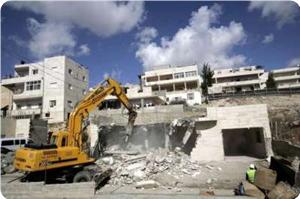 RAMALLAH — The Israeli occupation forces (IOF) demolished 10 Palestinian-owned structures in Area C of the West Bank this week, including five residential structures, displacing 32 Palestinians, including 14 children, according to a weekly report issued by the UN office for the coordination of humanitarian affairs (OCHA).
In a report covering the Israeli violations from august 29 to September 4, OCHA noted that Israel has demolished since the start of the current year 467 residential buildings and displaced 702 Palestinians during the same period.
During the reporting week, 17 Palestinians, including four children, were injured by the IOF, mostly during protests.
The settlers also carried out a number of attacks on Palestinian citizens and their property in the West Bank. Their attacks included racist slurs, arson attacks on agricultural lands and cars, throwing stones at vehicles.
Related articles
- Israeli Court Approves Well Destruction In Bethlehem (alethonews.wordpress.com)
- The ABCs of Israeli demolitions in Occupied Palestine – by IRIN (occupiedpalestine.wordpress.com)
- Israel orders demolition of eight Palestinian villages for military training sites (alethonews.wordpress.com)
Hebron man walks down street for first time in years
September 10, 2012 | International Solidarity Movement, West Bank
 Hashem Azzeh in front of the graffiti on his door
Photos: EA Phelie Maguire
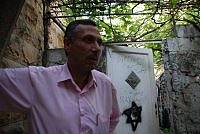
On Sunday 9th September, Hashem Azzeh walked down the street outside his house for the first time in years.
Hashem lives with his artist wife Nasreen and their four children (14, 9, 4 and 2 years old) on a hillside in the Tel Rumeida district of Hebron. The street outside Hashem’s house is barred to Palestinians and overseas visitors, with an army checkpoint at the end of the street to enforce the ban. To reach their house, the family have to go via a treacherous back route, clambering over walls and around other properties on the way.
Despite all the harassment and violence, Hashem remains determined to stay in his house, and today said he wanted ‘an adventure’. Hashem and five ISM volunteers from the UK, Italy and the USA clambered up from the house to the street, then walked the 200 or so metres to the checkpoint at the end of the street. The Israeli soldier at the checkpoint appeared astonished to see Hashem and international volunteers come along the street from the ‘wrong’ direction and immediately started radioing for back-up. When the soldier asked Hashem why he was walking on the street, Hashem replied, ‘I am walking to my house’.
Hashem’s family have faced years of harassment from residents of the illegal Israeli settlement on the hillside just above their house. The settlement happens to be home to some of the most fanatical settlers in Hebron, including American-born extremist Baruch Marzel.
Over the years, Hashem’s family have faced attacks on their property by settlers, with Israeli soldiers standing alongside doing nothing to intervene. Settlers have also poisoned his water supply, and killed his olive trees, fruit trees and vines. When Hashem installed his own water tank, the settlers shot it full of holes in yet another attack.
As well as attacks on their property, the family have faced regular physical violence. Hashem’s nephew had his teeth knocked out by rocks, and his brother was also smashed in the face with rock and suffered damage to his teeth and nose. Nasreen has had two miscarriages. An ISM activist, 77 year old Australian academic Mary Baxter, also faced violence in the past, when accompanying Hashem’s children to school in 2005. She and the children were attacked, and Mary had four bones in her back broken and is now disabled as a result.
Related articles
- Soldiers Physically Attack Palestinian Youth In Hebron (alethonews.wordpress.com)
- Hebron: Over 30 detained (alethonews.wordpress.com)
- Hebron: settler illegally enters Palestinian home (occupiedpalestine.wordpress.com)
- Hebron: Palestinian streets closed for Israeli settlers (alethonews.wordpress.com)
- French activist injured as Israeli troops attack Hebron (alethonews.wordpress.com)
- Jewish Settler’s Vehicle Rams Child in Hebron Hit and Run (alethonews.wordpress.com)
- Hebron: Settlers gas attack Palestinians, victim arrested and refused aid (occupiedpalestine.wordpress.com)
- Soldiers Kidnap Girl, Her 12-Year-Old Brother In Hebron (imemc.org)
Three injured from tear gas after settlers raid in Qusra
September 10, 2012 | International Solidarity Movement, West Bank
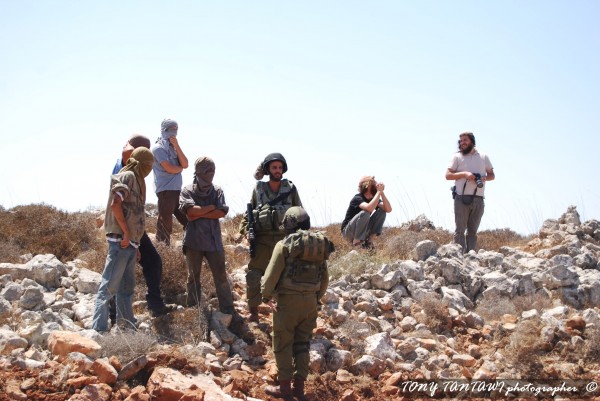
Settlers together with Israeli soldiers in Qusra. Picture from Tantawi Aljiniral
Three people were treated for injuries related to tear gas after an attack by illegal settlers in the village of Qusra near Nablus on Saturday night. The attack comes roughly a year after Qusra resident Issam Kamel Odeh, 33, died from Israeli gunfire after settlers invaded the village in September of 2011.
Shortly before six in the evening Saturday, five settlers came onto the land of Akram Taysir Daoud at the edge of Qusra village. Soon after, they began beating the man’s wife and yelling obscenities at his mother. Additional raiders arrived until there were a total of fourteen settlers on the land.
In an attempt to get help, Akram Taysir called the mayor of the town. The mayor alerted the people of the village to come to the farm, and then called both the local District Coordination Offices to report the attack.
The invading settlers sealed a well on the property with a large stone.
Israeli soldiers arrived at the village thirty minutes later. According to Abdel Ahrim, a resident who observed the event, soldiers began firing tear gas shortly after their arrival. Abdel Ahrim stated that soldiers fired 30 total tear gas bombs. Thirteen of these were fired directly into the house of Abdul Majid Towfeek, a resident of Qusra.
Abbdel Ahrim reported that the commanding officer told the mayor that if any of the villagers followed the soldiers over the hill, he would burn the village down.
Soldiers fired three times before leaving the immediate area of the conflagration.
According to Red Crescent workers, three people were treated for injuries related to tear gas, two for inhalation, and one for an injury he received when a canister hit him in the ankle.
This is the second invasion by settlers on the village of Qusra in as many days. Yesterday, settlers from the nearby illegal development of Aish Coddish came onto land belonging to the residents of Qusra village.
Photos of that incident show that they were armed with an M16 rifle.
At that time, officials from the occupation forces told the mayor of the town that the only recourse for the farmer involved was to go to the local Israeli-administered court and file a complaint against the settlers. This type of legal appeal requires the petitioner to either hold an Israeli identification card, or to hire a lawyer who holds an Israeli ID to file the complaint.
Related articles
- #PHOTOS | Settlers and soldiers attack village near Nablus, injuring 5. Torched trees. Killed sheep (occupiedpalestine.wordpress.com)
- Kufr Qaddoum: Israel fires at peaceful protest, man injured in head (alethonews.wordpress.com)
- With Protection from IDF Israeli Settlers Attack Unarmed Palestinians And Force Them Off their Land (windowintopalestine.blogspot.com)
Yemen’s Revolution Far From Accomplished
By Noon Arabia | Al Akhbar | September 10, 2012
Most Western headlines about Yemen lately have focused on the “al-Qaeda threat” and “US drone strikes on suspected militants.” Unfortunately, neither give much credence to the real challenges facing Yemenis since former President Ali Abdullah Saleh transferred his powers to his Vice President Abd-Rabbu Mansour Hadi on 27 February 2012 through a Gulf-brokered transitional plan.
The Gulf initiative was widely rejected among Yemenis as it did not fulfill the democratic demands of the revolution. The deal was more of an attempt to salvage the regime, yet some argue that it was the only option available. Sam Waddah, a Yemeni blogger, points out that “Yemenis in their revolution were not just up against Saleh and his regime, but also against the international community where major regional and international powers including the United States and Saudi Arabia backed Saleh up to the last minute.”
The initiative was viewed as an attempt by Saudi Arabia to subvert Yemen’s revolution and stop it from spilling across the border. The US worked behind the scenes and strongly backed the initiative after finding in President Hadi a suitable successor who would support their drone campaign in Yemen. US drone strikes have only intensified since Hadi assumed power and are causing popular outrage towards both the US and the Yemeni government as civilian death tolls mount.
Yemen’s 2011 revolution demanded an overall change in the economic, political, social and military spheres. Among the main demands of the 10-month revolution were the change of the regime, an end to Saleh’s corrupt family rule and the reconstruction of the army. According to the Gulf transitional plan, begrudgingly signed by Saleh on 23 November 2011, President Hadi will serve for an interim two-year period in which his main tasks will be the reconstruction of the military, conducting a national dialogue, drafting a new constitution and preparing for the 2014 elections.
Six months on, Hadi and his interim government are still facing many challenges impeding the achievement of these goals. Among these challenges are the weekly, if not daily, suicide attacks and car bombs allegedly by al-Qaeda, the assassinations and assassination attempts of military and political figures, the continuous attacks on the power grids and gas pipelines allegedly by tribes in Mareb, the Hirak separatist movement in the South, the Houthi rebels in the North, the deteriorating humanitarian conditions, and catastrophic food and refugee crises gripping the country. However, thwarting Hadi’s attempts to advance on any of these fronts is former president Saleh himself.
Those who are not following Yemen closely might be amazed to know that Saleh still lives in Yemen’s capital Sanaa and has awarded himself the title of “leader” to replace the lost title of “president.” He still heads the General People’s Congress (GPC), the former ruling party that is a 50 percent partner in the current National Unity Government, and is thus constantly disturbing the transitional process through loyalist supporters. His family members still hold key military positions. Ahmed Saleh, the son of the former dictator, remains the leader of the Republican Guards and Yahya, Saleh’s nephew is still the head of the Central Security Force. Yemen is paying dearly for the Gulf plan, which did not ban Saleh or his family from participating in the country’s political and military spheres.
The Saleh family still plays a prominent role despite some efforts by Hadi to remove some members and loyalists from the military and governmental posts. Some argue that Hadi lacks the power or the will to remove the two men close to Saleh entirely from their posts. “The fact that these two forces [Republican Guards and Central Security] were the reason behind almost all the blood spilt in the revolution and yet their leaders are still reigning is beyond me,” says Luai Ahmed, an 18-year-old Yemeni student and activist.
In a blatant sign of defiance to Hadi’s decision to reconstruct the military, the pro-Saleh Republican Guards troops besieged the Ministry of Defense on 14 August, while the president was out of the country, killing five people and wounding nine others. In late July a group of policemen and tribesmen loyal to Saleh occupied the Ministry of the Interior and looted its contents, killing 15 people. According to a local report, Hadi himself has already survived six assassination attempts in only seven months in office.
Yemen is often touted as an Arab Spring success story that has deposed its dictator, but reality is Yemenis are still suffering from political instability, violence, electricity and water cuts, inflation, unemployment, and food shortages, all of which have only intensified in the aftermath of the revolution.
“The fact that people are more aware of their rights and the corrupt deals the previous government made, forces them to escalate their demands and put pressure on the government,” said Shatha al-Harazi, a political and human rights journalist.
Many Yemenis do not feel that substantial change has been achieved since the ouster of Saleh. The state has lost control over some areas of Yemen, and the military is divided and on constant standby for any possible confrontation. They feel the intense power struggle between the old regime and the current one. A Yemeni journalist who asked not to be named describes the situation in Yemen as dire and chaotic. “The likelihood of a successful transition is up in the air and similarly the possibility of a potential civil war or armed conflict is also there.”
UN Envoy to Yemen Jamal Bin Omar stated that non-military sanctions under Chapter VII of the UN Security Council Charter will be imposed against any official who attempts to hinder the political settlement, including the freezing of assets and a travel ban. However, the empty threats by Hadi and the UN, repeated ad nauseum, have not deterred Saleh and his loyalists from seeking to undermine Hadi’s power and hinder the implementation of the Gulf plan which ousted him from power.
Unless Saleh’s family is truly dismissed from positions of power and international sanctions are immediately imposed on them, Yemen will continue to suffer from political instability and insecurity.
Noon Arabia is a Yemeni blogger, wishing to write under a pseudonym for personal and security reasons
Related articles
- US dispatches troops, military hardware to Yemen (alethonews.wordpress.com)
- Yemen: Patronage stalls Yemen’s transition (ionglobaltrends.com)
Featured Video

Meet The Ellisons: Zionists, Technocrats, Moguls
or go to
Aletho News Archives – Video-Images
Frlom the Archives
The Doctrine of ‘Superior People’: The Bond between Israel and World Zionism
By James Petras :: 09.04.2015
Introduction
The single greatest feat of Israel and its overseas missions has not been material success, or the military conquest of millions of unarmed Palestinians, it has been ideological – the widespread acceptance in the US of a doctrine that claims ‘Jews are a superior people.’
Apart from small extremist rightwing sects who exhibit visceral anti-Semitism and denigrate everything Jewish, there are very few academics and politicians willing to question this supremacist doctrine. On the contrary, there is an incurable tendency to advance oneself by accepting and embellishing on it.
For example, in August 2015, US Vice-President Joseph Biden attributed ‘special genius’ to Jews, slavish flattery that embarrassed even New York’s liberal Jewish intellectuals.
Israel’s dominant role in formulating US Middle East policy is largely a product of its success at recruiting, socializing and motivating overseas Jews to act as an organized force to intervene in US politics and push Israel’s agenda.
What motivates American Jews, who have been raised and educated in the US to serve Israel? After all, these are individuals who have prospered, achieved high status and occupy the highest positions of prestige and responsibility. Why would they parrot the policies of Israel and follow the dictates of Israeli leaders (a foreign regime), serving its violent colonial, racist agenda?
What binds a majority of highly educated and privileged Jews to the most rabidly rightwing Israeli regime in history – a relationship they actually celebrate?
What turns comfortable, prosperous American Jews into vindictive bullies, willing and able to blackmail, threaten and punish any dissident voices among their Gentile and Jewish compatriots who have dared to criticize Israel?
What prevents many intelligent, liberal and progressive Jews from openly questioning Israel’s agenda, and especially confronting the role of Zionist zealots who serve as Tel Aviv’s fifth column against the interest of the United States?
There are numerous historical and personal factors that can and should be taken into account to understand this phenomenon.
In this essay I am going to focus on one – the ideology that ‘Jews are a superior people’. The notion that Jews, either through some genetic, biologic, cultural, historical, familial and/or upbringing, have special qualities allowing them to achieve at a uniquely higher level than the ‘inferior’ non-Jews.
We will proceed by sketching the main outline of the Jewish supremacist ideology and then advance our critique.
We will conclude by evaluating the negative consequences of this ideology and propose a democratic alternative. … continue
Blog Roll
 Aletho News
- Meet The Ellisons: Zionists, Technocrats, Moguls
- US failures in Iran reveal Russia is key to South Korea’s strategic security
- ‘All ports in Persian Gulf will be legitimate targets if Iranian ports are attacked’
- 40 Years of Endless War, Data Point by Data Point
- Department of War Using Palantir AI to Pick Targets in Iran
- American bases do not protect – they attack the peoples of the Persian Gulf
- ‘We’ve Obliterated Their Missiles’
- Syrian president vows ‘absolute support’ to disarm Hezbollah
- Ukraine attacking Russian gas pipeline to stop deliveries to Europe – Defense Ministry
- ‘Heinous crime’: Iran denounces Israeli assassination of 4 Iranian diplomats in Lebanon
- If Americans Knew
- Israeli strategic plans to “remake the Middle East” from the 1950s and since
- Honoring Gaza’s women who refused to let the world look away
- 97% of victims of war on Iran are Iranian, 98% of victims in war on Gaza are Gazans – Not a ceasefire Day 152
- Early Iran strikes cost $5.6 billion in munitions, Pentagon estimates
- Israel Decided the War, But Trump’s America Fights and Pays the Bill
- Conscientious Objector Group: Phone ‘Ringing Off Hook’ As Huge Mobilization Underway
- U.S. support for Israel continues to plummet, despite media’s best efforts
- Threats and missiles fly, death tolls soar in Iran, Lebanon, Gaza – Not a ceasefire Day 151
- Lebanon: Israel’s White Phosphorous Use Risks Civilian Harm
- Corporate Media Go All Out To Support The US-Israeli War On Iran
- No Tricks Zone
- Destructive Green New Deal: German Energy And Metal Group Warns Of Drastic Crisis
- New Study Documents A 20-Year Pause In Arctic Sea Ice Decline – Driven By Internal Variability
- Wake-up Call: Survey Shows Majority Of Germans Now Favor Postponing Climate Targets!
- Televised! Leading German Political Candidate Tells Schoolchildren CO2 Makes Sun Hotter!
- New Study: A Century Warming Of 1.1°C Is ‘Commonplace’ And ‘Not Unusual’ During This Interglacial
- New Study: ‘Internal Noise’ And Volcanic Forcing Can Trigger 10-15°C Warming Within Decades
- Glaciers Worldwide Are Suddendly Surging, Experts Blame Warming!
- Surprising Discovery: Sahara Is Greening…Billions Of Trees Where Once Thought To Be Barren
- New Research Reaffirms Clouds, Aerosols, And Surface Solar Radiation Are ‘Driving The Climate System’
- Germany: Electric Car Catches Fire At Charging Station, Sets Off Local “Inferno”, Widespread Damage
 Aletho News