FBI Uses Portable Device to Track Cell Phone Users
By Matt Bewig | AllGov | January 14, 2013
Even on dry land, Americans should fear the stingray. Not the flat cartilaginous fishes related to sharks, but the secret government surveillance device that not only tracks suspected criminals but also intercepts the private information of law-abiding citizens who happen to be nearby. Now, because of a Freedom of Information Act (FOIA) request and lawsuit brought by the Electronic Privacy Information Center (EPIC) against the FBI, the government is slowly releasing thousands of relevant documents that are already raising alarms among privacy and civil liberties advocates.
The stingray came to public notice in 2011 when the FBI used a “cell-site simulator” to track down a suspect. This portable device, also called an “IMSI catcher” or a “stingray,” sends out a signal that fools nearby wireless phones into connecting with a fake network. It can then capture all sorts of personal data from all of those phones, including location data that can then be used to track a person’s movements in real time. A stingray can be handheld or mounted on a motor vehicle or an unmanned surveillance drone.
As the FBI has admitted to EPIC, because the stingray fools all nearby wireless phones into connecting with its bogus network and uploading private data to it, its use would constitute a “search and seizure” under the Fourth Amendment to the Constitution and thus require a warrant. However, because the FBI argues that wireless phone users have no reasonable expectation to privacy, the agency says it does not need a warrant. The Supreme Court has not yet ruled on the privacy of cell phone calls.
In addition to (probably) violating the constitution, the use of stingrays is also prohibited by federal law. Although heavily redacted, the files reluctantly released by the FBI reveal snippets of internal Justice Department discussions of how to justify use of the stingray as compliant with the provisions of the Communications Act that prohibit “interference” with communication signals like those of wireless phones.
These documents demonstrate, according to EPIC attorney Alan Butler, that “there are clearly concerns, even within the agency, that the use of Stingray technology might be inconsistent with current regulations. I don’t know how the DOJ justifies the use of Stingrays given the limitations of the Communications Act prohibition.”
Nor is it just the FBI. According to a recent report, local police are “quietly” using stingrays in Los Angeles, Miami, Fort Worth, and Gilbert, Arizona. And likely other places, as well.
Related articles
Preplanned Mali invasion reveals France’s neo-colonialistic agenda
By Finian Cunningham | Press TV | January 14, 2013
The speed and extent with which French warplanes have been deployed over the weekend in the West African country, Mali, point to a well-honed plan for intervention by the former colonial power.
Indeed, such is the careful choreography of this salient military development that one could say that the French have finally given themselves a green light to execute a plan they had been pushing over several months. That plan is nothing less than the neocolonial re-conquest of its former colony in the strategically important West African region.
Within hours of the Malian government requesting military support to counter an advance by rebels from the northern territory, French warplanes began carrying out air strikes on Friday. The attack sorties have reportedly been conducted for at least three consecutive days. Media reports said that French Mirage and Rafale fighter jets had struck across a wide belt of the remote Sahelian country, from Gao and Kidal in the northeast, near the border with Algeria, to the western town of Lere, close to Mauritania.
The warplanes were dispatched from France and also reportedly from Chad. The French government claimed that it had been granted over-flight permission by Algeria. Both North African neighboring countries are also former French colonies.
The air strikes by the French jets on at least six widely dispersed target areas within Mali cover an operational distance of nearly 2,000 kilometers, from east to west. This level of co-ordination indicates several weeks of planning and belies the appearance that the French government was responding in an impromptu fashion to a sudden call for assistance from the Paris-aligned Malian authorities.
In addition, over the weekend some 500 French troops arrived in the southern Malian capital of Bamako and the strategic town of Mopti, which is situated near the rebel-held northern territory.
The dramatic French intervention has all the hallmarks of a meticulous plan that was on a hair-trigger for action. The taking over by rebels last Thursday of the town of Konna, 45 kilometers from Mopti, near the de facto north-south frontier, and the subsequent alarm call from the Malian government in Bamako can therefore be seen as merely a green light for the detailed French plan to swing into action.
Furthermore, the French government has received swift support from other European countries and the United States. Britain has sent RAF CI7 cargo planes from a base in East England to Paris in order to help with French supply of troops, helicopters, trucks other heavy equipment. Washington has said it will provide logistics and communications. Both American and French surveillance drones have been operational in Mali and adjacent countries for months now.
France’s Foreign Minister Laurent Fabius was quick to hail the weekend air strikes a success in halting Malian “terrorists.” Fabius said the French military involvement would be for a “matter of weeks.” However, the extensive mobilization of troops and warplanes and the geopolitical backdrop to the development suggest otherwise. Perhaps mindful of this, Fabius was keen to emphasize that the Mali intervention would not turn out to be “another Afghanistan.”
Officially, Paris, London and Washington have up to now been pushing for an African-led intervention force to take the military lead in assisting the Malian government to quash a separatist rebellion in the northern half of the country. The northern region was taken over last April by Tuareg rebels in league with Islamist militia belonging to Ansar Dine and the Movement for Unity and Jihad in West Africa. The rebels have managed to consolidate their control over the vast and largely desert region around the main city of Timbuktu. Northern Mali covers an area the size of France and is sparsely populated with less than two million people.
West African states, including Nigeria, Senegal, Burkina Faso, Benin and Niger, are charged with assembling an intervention force at the behest of the Western powers. Last month, the United Nations Security Council gave final approval for the West African military mission to shore up the shaky government that is based in Bamako in the far south of the country, thousands of kilometers from the upper northern region.
Following the Security Council vote, diplomats at the UN and in West African capitals were talking about the combined African mission of some 3,500 troops being deployed much later this year, in September at the earliest. This was a view held by Romano Prodi, the UN’s top envoy to Mali, which was reported only days before the French military intervention.
The abrupt side-stepping of the African forces points up the real agenda of the Western powers and France in particular. What we are seeing now, with the rapid, large-scale French deployment, is the true neocolonial nature of this agenda. All the previous talk by Paris, London and Washington on the importance of intervention having “an African face” can be seen as cynical cover for direct Western action.
Only three months ago, President Francois Hollande vowed to French media that there would be “no French boots on the ground” in Mali. Evidently, official calculations have changed.
France and its Western allies have been assiduously taking up the international security threat allegedly posed by the rebels in Mali. Much is being made of alleged links between the Islamist militants and Al Qaeda in the Maghreb. President Hollande has repeatedly warned that French and European security is at risk if the rebels in Mali strengthen their control.
A spokesman for British Prime Minister David Cameron said at the weekend: “Both leaders [Cameron and Hollande] agreed that the situation in Mali poses a real threat to international security given the terrorist activity there.”
American politicians, military chiefs and media have also been waxing lyrical for months on how Mali represents the globe’s new “terror central” and that Western governments must act decisively to defeat the danger.
However, the precise nature of this “Islamist threat” from Mali is never spelled out or evidenced. We are expected to accept the word of Paris, London and Washington – the rogue states that have and are conducting illegal wars in Afghanistan, Iraq, Libya and Syria.
What we do know, however, is that the half century post-colonial borders of Mali are an alien imposition on nomadic peoples in the northern region – cultures that date backed thousands of years. Their rebellion against a remote and up to now indifferent colonialist-appointed administration in Bamako is probably a just cause. The French and its Western allies are therefore maligning an internal dispute within Mali with another specious “war on terror” narrative and in that way these powers are giving themselves a mandate to meddle in that country.
France being the former colonial master and with decades of covert military assets in the region is the “natural” choice among the Western powers to lead a neo-imperialist adventure in this strategically important region.
Mali has abundant riches in natural resources of metals and minerals. It is a major source of gold and uranium, as well as iron, copper, tin and manganese, and also versatile minerals such as phosphates, salt and limestone.
Moreover, the West Africa region has awesome potential for agriculture and oil. The Gulf of Guinea off Ghana and Nigeria is earmarked to become a leading oil and gas supply region to world markets in the coming years.
Military intervention by France and the other Western powers in Mali – under the guise of “defeating terrorism” – is a bridgehead for Western capital and corporations, not only into a resource-rich country, but into a large chunk of the entire African continent. In 2011, NATO’s bombardment of Libya and French subversion of elections in Cote D’Ivoire marked a new beginning of Western neo-imperialism in Africa.
US justice system rife with intimidation: Dead activist’s family
Press TV – January 14, 2013
The US justice system is “rife with intimidation and prosecutorial overreach,” says the family of American activist Aaron Swartz, who was an outspoken critic of the US government and was recently found dead in his apartment.
“Aaron’s death is not simply a personal tragedy. It is the product of a criminal justice system rife with intimidation and prosecutorial overreach,” said Swartz’s family in a statement.
Since Friday, when the activist and computer prodigy was found dead in his New York apartment, internet activists have also blamed the US Attorney’s office.
Before his death, Swartz openly criticized the US and the Israeli regime for launching joint cyber attacks against Iran.
The blogger was also vocal in criticizing Obama’s “kill list,” a list of individuals who are suspected of terrorism by the US and are listed for targeted killing after final approval by the US president himself.
Swartz was also critical of the monopoly of information and believed that information should be available to everyone for the benefit of the society.
The US Attorney’s office in Massachusetts accused the 26-year-old of downloading millions of academic journal articles from the online service JSTOR by using Massachusetts Institute of Technology (MIT)’s computer network in 2010, to make such articles available to the public.
Even though, Swartz handed over his hard drives and the charges against him were dropped by the JSTOR, US Attorneys Carmen Ortiz and Steve Heymann, with the support of MIT, continued to pursue the activist’s prosecution.
According to the statement by the activist’s family, officials were demanding heavy penalties of more than 30 years in prison and up to USD 1.0 million in fines for Swartz, “to punish an alleged crime that had no victims.”
The activist’s death comes weeks before he was due in court.
A petition presented to the White House “for overreach in the case of Aaron Swartz” has been set up to remove US Attorney Ortiz and it has already gained almost 10,000 signatures.
Major victory for President Morales: UN accepts “coca leaf chewing” in Bolivia
MercoPress | January 14th 2013
Bolivia will again belong to the 1961 Single Convention on Narcotic Drugs after its bid to rejoin with a reservation that it does not accept the treaty’s requirement that “coca leaf chewing must be banned” was successful Friday. Opponents needed one-third of the 184 signatory countries to object, but fell far, far short despite objections by the US and the International Narcotics Control Board.
Bolivian president Evo Morales celebrated the decision as a moral victory for his people and the centuries’ old culture based on the ‘acullicu’. “It’s not easy to change international legislation, particularly when 25 years ago they had decided to eliminate the coca leaf and with it, our culture”, said Morales who added that the coca leaf has been “criminalized, demonized, condemned world wide. Consumers have been described as narcotics-dependents and farmers narcotics traders”.
Of the 61 countries needed to veto the initiative only 15 turned out led by the US and UK, plus other European countries, Canada, Japan and Mexico.
“The objecting countries’ emphasis on procedural arguments is hypocritical. In the end this is not about the legitimacy of the procedure Bolivia has used, it is not even really about coca chewing,” according to Martin Jelsma, coordinator of the Transnational Institute’s Drugs and Democracy program. “What this really is about is the fear to acknowledge that the current treaty framework is inconsistent, out-of-date, and needs reform.”
The Institute noted that Bolivia’s success can be an example for other regional countries where traditional use of the coca leaf is permitted, including Argentina, Colombia, and Peru, to challenge the Single Convention on coca. It also called for the World Health Organization to undertake a review of coca’s classification as a Schedule I drug under the Convention.
“Those who would desperately try to safeguard the global drug control system by making it immune to any type of modernization are fighting a losing battle,” according to John Walsh, director of the Washington Office on Latin America drug policy program.
“Far from undermining the system, Bolivia has given the world a promising example that it is possible to correct historic errors and to adapt old drug control dogmas to today’s new realities.”
“I can’t stress enough how big this is. Once again, the United States snapped its fingers and told the rest of the world to get in line and oppose Bolivia’s move. But this time, while the UK joined them, most of the rest of the world just said “no, thanks.”
However it’s a largely symbolic victory, as this UN commission lacks the power to regulate coca leaf consumption in Bolivia in the first place. But the UN declaration has been welcomed by the Bolivian government, which is planning to invite the country’s coca growers to massive coca-chewing events in the cities of La Paz and Cochabamba.
The coca leaf is the base material for cocaine. But for centuries indigenous people in the Andean mountains have chewed this leaf in its natural form to gain energy and decrease hunger. Some groups in the region also consider the coca leaf to be a sacred plant, and use it regularly for social and religious rituals.
Evo Morales, who is himself a former coca grower, has championed the decriminalization of the leaf since he came into office in 2006, chewing coca in international forums, praising its nutritional qualities, and even asking Sean Penn to be his global ambassador for the coca leaf. A special clause in the 2009 Bolivian constitution refers to the matter.
But the UN’s decision to tolerate coca leaf chewing in Bolivia was not well taken by US diplomats, who claim that most of Bolivia’s coca crops are being used for cocaine production, and not for traditional chewing.
“We oppose Bolivia’s reservation and continue to believe it will lead to a greater supply of cocaine,” a senior US State Department official was quoted.
”While we recognize Bolivia’s capacity and willingness to undertake some successful counter-narcotics activities, especially in terms of coca eradication, we estimate that much of the coca legally grown in Bolivia is sold to drug traffickers, leading to the conclusion that social control of coca (allowing some legal growing) is not achieving the desired results,” the official said in a statement.
Most member states did not object to Bolivia’s readmission into the antinarcotics group or to the new statute which says that chewing, and growing the coca leaf, is fine within Bolivia. The non-objectors included Colombia and Peru which are the world’s two biggest cocaine producers and also have very large crops of the coca leaf.
Some diplomatic representatives in La Paz had a hard time explaining why the vote of the fifteen on the US initiative. British ambassador Ross Denny said the decision was a bad example since it opens the door for other countries to present objections and thus weakening the UN Narcotics Convention. He added that the UK fears that the return of Bolivia on that condition could mean a greater production of coca leaves that end up with the narcotics trade.
But President Morales made a passionate defence of the ‘acullicu’ and the Andes highlands culture of chewing coca leaves and mentioned Harvard University and the World Health Organization papers supporting such consumption. “It’s good for human health and benefits those suffering from diabetes.
The official re-entry of Bolivia to the convention is scheduled for February 10 and is a milestone in the Bolivian government campaign to defend the ‘acullicu’ which has seen President Morales and his Foreign minister David Choquehuanca, both indigenous Aymaras, lobby around the world in support of the coca leaf chewing tradition.
Related articles
- Bolivia slams US over ‘irrefutable evidence’ of meddling (alethonews.wordpress.com)
Hugo Chavez: Why Does He Hate Us?
By Peter Hart | FAIR | January 11, 2013
If there’s one thing media want you to know about Venezuelan president Hugo Chavez, it’s that he doesn’t like the United States. On the PBS NewsHour (1/10/13), Ray Suarez told viewers that Chavez
antagonized Washington, it seemed, whenever he could, forging friendships with Iran’s Mahmoud Abbas (sic), Syria’s embattled Bashar al-Assad, and he formed an especially close bond with Cuban Presidents Fidel and Raul Castro.
 On the CBS Evening News (1/8/13), Scott Pelley said:
“Chavez has made a career out of bashing the United States and allied himself with Iran and Syria.”
While it’s hard to say Chavez has made a “career” out of U.S.-bashing–he does have, after all, a full-time job as president of Venezuela–you, too, might be excused for harboring some hard feelings towards a government that helped to try to overthrow your own. Which may be why U.S. reports rarely bring up the 2002 coup attempt–and when they do, treat Washington’s involvement in it as another nutty Chavez conspiracy theory.
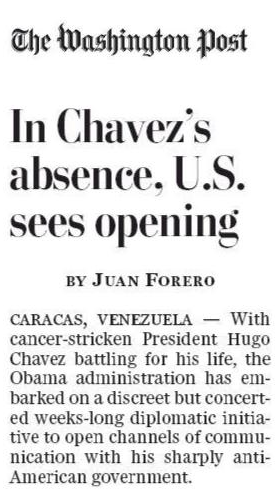
Here’s Juan Forero in the Washington Post (1/10/13):
A central ideological pillar of Chavez’s rule over 14 years has been to oppose Republican and Democratic administrations in Washington, which he accuses of trying to destabilize his government.
“I think they really believe it, that we are out there at some level to do them ill,” said Charles Shapiro, president of the Institute of the Americas, a think tank in San Diego.
As ambassador to Venezuela from 2002 to 2004, Shapiro met with Chavez and other high- ranking officials, including [Vice President Nicolas] Maduro. But the relationship began to fall apart, with Chavez accusing the United States of supporting a coup that briefly ousted him from power. U.S. officials have long denied the charge.
Shapiro recalled how Maduro made what he called unsubstantiated accusations about CIA activity in Venezuela, without ever approaching the embassy with a complaint. He said that as time went by, the United States became a useful foil for Chavez and most Venezuelan officials withdrew contact.
“A sure way to ruin your career, to become a backbencher, was to become too friendly with the U.S. Embassy,” Shapiro said.
So Venezuela has a strange political culture where being friendly with the U.S. government gets you in trouble.
The Post airs Chavez’s charge–and then the U.S. denial. But the United States had all sorts of contact with the coup plotters before they made their move against Chavez in 2002. According to the State Department (7/02):
It is clear that NED [National Endowment for Democracy], Department of Defense (DOD) and other U.S. assistance programs provided training, institution building and other support to individuals and organizations understood to be actively involved in the brief ouster of the Chavez government.
And the CIA, as was reported by Forero himself (New York Times, 12/3/04), knew of the coup plotting.
The Central Intelligence Agency was aware that dissident military officers and opposition figures in Venezuela were planning a coup against President Hugo Chávez in 2002, newly declassified intelligence documents show. But immediately after the overthrow, the Bush administration blamed Mr. Chávez, a left-leaning populist, for his own downfall and denied knowing about the threats.
Scott Wilson, who was the Washington Post foreign editor at the time, told Oliver Stone for his film South of the Border:
Yes, the United States was hosting people involved in the coup before it happened. There was involvement of U.S.-sponsored NGOs in training some of the people that were involved in the coup. And in the immediate aftermath of the coup, the United States government said that it was a resignation, not a coup, effectively recognizing the government that took office very briefly until President Chavez returned.
And we know that the United States made quick efforts to have the coup government recognized as legitimate. The Bush government, immediately after the coup, blamed it on Chavez. And some of the coup plotters met with officials at the U.S. embassy in Caracas before they acted.
But the important thing for readers to know, according to Wilson’s successors at the Washington Post, is that U.S. officials deny they supported anything.
Israeli occupation authorities halt entry of West Bankers to 1948 occupied Palestine
Palestine Information Center – 13/01/2013
AL-KHALIL — The Israeli occupation authorities have stopped issuing permits for Palestinian West Bankers to enter occupied Jerusalem or 1948 occupied Palestine, sources in the Palestinian liaison office said Saturday.
They noted that no permits were issued for more than a month except for patients, adding that the ban started after the UN accepted Palestine as a non-member observer state.
An official at the chamber of commerce and industry in Al-Khalil affirmed the news saying that 1800 permits were tabled with the Israeli civil administration but no response was made to any of them.
He said that the arbitrary measure obstructed economic and commercial life for the Palestinians, adding that officials at the Israeli administration told them that the reason was the admission of Palestine at the UN.
Related article
- IOF arrests 320 Palestinian workers within ten days (occupiedpalestine.wordpress.com)
Israeli Soldiers Attack, Evict, Bab Al-Shams, Arrest Dozens
By Saed Bannoura | IMEMC News | January 13, 2013
On Saturday at dawn thousands of Israeli soldiers and policemen attacked the Bab Al-Shams Palestinian village, installed east of in occupied East Jerusalem, and forcibly removed dozens of activists loading them into buses.
The soldiers dragged several activists onto the ground, attacked reporters and journalists and declared the area a closed military zone, several injuries were reported.
The Israeli decision to evacuate the village came, on Saturday, through a direct order issued by Israeli Prime Minister, Benjamin Netanyahu, and his right-wing fundamentalist cabinet.
Israeli daily, Haaretz, reported that by midnight Saturday, the order was signed by Osnat Mandel, head of the Israeli High Court division of the Justice Ministry, under the claim that “the people and the tents must be removed due to security considerations”.
The Israeli Police said that the eviction order, issued by the court, prohibits the army from removing the tents, but orders the removal of the people staying there.
Also, the so-called Israeli Civil Administration Office, run by the occupation in the West bank, claimed that the Palestinian tent village “was installed on state land”.
But four Bedouin families living in the area confirmed that they own the land, and even showed deeds proving ownership.
Dr. Mustafa Barghouthi, secretary-general of the Palestinian National Initiative, who was also at the Palestinian village, stated that hundreds of Israeli soldiers invaded the village after surrounding it, and attacked the nonviolent activists camped there, and started kidnapping them.
The soldiers violently attacked the residents, including journalists, elderly and women, and dragged several residents onto the ground.
The soldiers repeatedly interrupted the work of local reporters, flashing their lights onto the camera, and pushing the reporters away, and dragged dozens of activists into buses that were brought by the army to the area.
On Saturday evening, Israeli Prime Minister, Benjamin Netanyahu, ordered the army “to remove the Palestinians and their supporters from the Palestinian outpost” that was installed on privately-owned Palestinian lands to send a message to Israel and the entire world that this land is the land of Palestine, and the Palestinian people have the right to inhabit it.
The army installed dozens of roadblocks around the area to prevent Palestinian traffic and surrounded the Bab Al-Shams camp where around 200 activists installed around 20 tents declaring the Bab Al-Shams Palestinian village, in the area where Israel illegally declared it intends to build thousands of homes for Jewish settlers, east of occupied east Jerusalem.
The Israeli decision to build the illegal settlements in the occupied state of Palestine came after the Palestinians managed to obtain an observer state status at the UN – General Assembly.
The Israeli decision was met with international condemnation, but the settler-led government of Benjamin Netanyahu, approved the illegal settlement project.
The so-called E1 settlement project aims at linking the Maale Adumim illegal settlement, where 35,000 reside, with occupied East Jerusalem, thus illegally confiscating Palestinian lands and blocking geographical continuity in the occupied West Bank.
This illegal Israeli project would divide the West Bank into two parts, and would completely isolate it from occupied East Jerusalem, an issue that would prevent the establishment of a viable Palestinian state.
Abdullah Abu Rahma, a Palestinian nonviolent activist from the West Bank village on Bil’in, who was also detained when the army attacked and evicted Bab Al-Shams, stated that this village is on private Palestinian land, and that the Palestinians are not invading anybody’s property, as they are establishing a village in the land of Palestine.
“We tied our hands, chained ourselves with each other to prevent the soldiers from removing us”, Abu Rahma said, “The Soldiers violently attacked us, beat us, and injured at least 10”
He added that there will be more nonviolent activities, and that the struggle for Bab Al-Shams, the nonviolent struggle for the liberation of Palestine will continue as the Palestinians are practicing their internationally-guaranteed right.
It is worth mentioning that the Palestine TV was live streaming from Bab Al-Shams, and the army repeatedly tried to interrupt the stream, pushing the reporters, and using large flashlight, pointing them against the camera to disrupt the images.

Wounded Journalist Hafeth Ibrahim
Related articles
- Palestinians Establish a new Village, Bab Alshams, in Area E1 (alethonews.wordpress.com)
Sicily blocks construction of US defense satellite base
Gazzetta del Sud | January 11, 2013
Palermo The region of Sicily on Friday moved to suspend US defense plans to construct a satellite communications system on the Italian island after activists blocked construction crews. The move, announced by Sicily Governor Rosario Crocetta, came after protestors blocked trucks and cranes overnight in the town of Niscemi and later clashed with police near an American military base.
Builders at the site, which is part of a global satellite defense network called the Mobile User Objective System (MUOS), had allegedly rushed construction in recent days, according to the Sicily governor. “The regional government finds this sudden rush to complete the project truly extraordinary,” said Crocetta. Opponents to the project say it will be an environmental nuisance and threatens world peace. Other bases participating in MUOS are in Australia, Hawaii and Virginia.
The hardest thing: Palestinian parents speak of their children killed by Israeli bombings
By Eva Bartlett | In Gaza | January 12, 2013


During the Nov 2012 Israeli attacks on Gaza, 182 Palestinians were killed, according to the World Health Organization’s Dec 2012 report, among whom 47 were children, including 16 under 5 years old. Another 1399 Palestinians were injured, most of them with multiple injuries.
It is only four years after Israel’s last major assault on Gaza, which killed over 1450 including those who died of their injuries, and injured over 5000. Then there are the random Israeli attacks throughout the years, leaving injured suffering even years later.
And there were the under-reported attacks in the week preceding the Nov 14 attacks: the Nov 8 killing of 13 year old Ahmed Abu Daqqa as he played football, the Nov 10 killing of Mohammed Harara (16) and Ahmed Harara (17) as they played football, the subsequent killings of Ahmed Al- Dirdissawi (18) and Matar Abu al-‘Ata (19) when they rushed to the scene of the Harara killings (source: PCHR).
Every December and January, I remember the victims of the 2008-2009 massacre, particularly some of the harder incidents of burning to death from white phosphorous bombing, or point blank shootings of loved ones. All ages suffered, although we tend to pick up on the children. Somehow their murders, their maimings, their imprisonment strikes us more.
Two cases from the November 2012 attacks struck me and stay with me: the killing of 4 year old Reham as she stood a few metres from the door of her Nusseirat camp home, outside of which an Israeli bomb exploded…and the murder of Nader, 14, killed by a precision drone missile as he walked to get food for his siblings… just two hours before the ceasefire.
Below are follow-up photos, the families and loved ones of Reham and Nader. Allah yerhamhum (Allah, God, bless them).

Mourning area for Reham Nabaheen, killed by an Israeli bombing outside her Nusseirat camp home.

Abu Reham looks to where the Israeli bomb struck, the shrapnel of which blasted into his home and struck his daughter in the temple, killing her.


Um Reham sits with other women, mourning her daughter.

Fatoum, Reham’s neighbour and close friend, stopped speaking after her friend’s killing. Also four years old, she is in shock from knowing her friend is dead. Abu Reham: “I love her like I loved my daughter.”

Roa’a, Reham’s infant cousin. Reham used to play with her and bring her treats.
In the days following Reham’s murder, we visit the family in the simple Nusseirat home. Beside a mourning room set up to receive family and friends, a portrait of the girl I’d only until then seen dead in the morgue.
The home is barebones simple, the old Palestinian style of home and courtyard reconstructed with refugee camp means: cheap cement, toxic asbestos roof, chipped paint, thin walls and doors, sparse decor…no frills. A single olive tree grows in one side of the courtyard.
Um Reham sits amongst female relatives and although her daughter was killed only a few days earlier, is strong and tells me of the day. We’d seen her at al-Aqsa hospital in Deir al Balah on Nov 21, after the shelling. Further back from where the explosion hit, Um Reham was still wounded in her face by flying shrapnel. Her other two sons suffered only minor injuries.
“We’d gone to my sister’s home in Bureij, at the beginning of the attacks. There was so much bombing in Nusseirat, we were afraid to stay here, our kids were terrified. On the last day, we heard there would soon be a cease-fire and wanted to come home. I wanted to do laundry, to change my kids clothing. My sister told me to leave Reham with her, but I said no, I couldn’t leave my daughter behind.
After we’d returned to Nusseirat, we realized the bombing was still very heavy here. We were going to return to Bureij…“
Abu Reham, who we’d seen at the hospital morgue leaning over his daughter’s lifeless body, sobbing and kissing her, stoically continues explaining what happened that day.
Although Nusseirat was still being hammered, at the moment of the Israeli shelling which killed his daughter, it was relatively calm, he says.
“There was no visible danger, our neighbour across street was sitting on a chair by his doorway just minutes before the bombing. He left to go see something at a neighbour’s home…if he had not left, he would have been killed.“
He points out the two narrow courtyard doors to the street where a pocket in the asphalt speaks to the earlier bombing.
“It was around 4pm, one of the doors was closed, we were getting the kids ready to go back to Bureij. I’d brought out some cookies, and Reham went to get them out of the bag. She was reaching into the bag when the bomb struck. She was near the door, the shrapnel went right into her head. She died soon after, there was blood all over.
The sound of drones was insane then, it could’ve been a drone strike.”
“Tank,” his brother says, “it was a tank shell.”
The brother holds a girl.
“This is my daughter, Roa’a, she’s a year and a half old. Reham used to play with her every afternoon, she’d bring Roa’a chips and snacks… Reham used to always take care of her.”
A neighbour daughter comes over with his daughter, Fatoum (Fatema), 4 years old as Reham was. She is chubby cheeked and lovely, but unsmiling and won’t say a word.
“She came to play with Reham every day. A four year old shouldn’t have to know what death is, that her friend has been killed. She said to me, ‘my friend is dead, my friend died.’“
Abu Reham, whose daughter is just days dead, is worried about Fatoum who fell ill after learning Reham was dead.
“I love her like a daughter. Every child who loved my daughter, I love them like my own child (breaks down crying). I went to the cemetery, saw children from the area there, they had brought flowers and were tending Reham’s grave. They told me ‘we will visit her, even if your family moves, we’ll continue to visit her.’“

Nader Abu Mghaseeb, 14, killed by precision Israeli drone bombing as he went to get food for his siblings.

Abu Nader tells how his son was killed by an Israeli bombing

When Nader’s siblings awoke the morning after his murder, they asked for him, only to learn he’d been killed.

Abu Nader points to the hole in the road where the Israeli bomb which killed his son struck.

Shrapnel markings from the Israeli bombing which killed his son.

Light of the small shop to which Nader was headed when murdered by the Israeli bombing.

When killed, Nader was en route to the store to buy food for his siblings.

Pieces of the Israeli precision drone bomb which targeted Nader.

Pieces of the Israeli precision drone bomb which targeted Nader.

Pieces of the Israeli precision drone bomb which targeted Nader.

Pieces of the Israeli precision drone bomb which targeted Nader.

Nader’s watch and the memory chip from his cell phone, which he had with him when targeted by the Israeli bomb.
On the eastern outskirts of Deir al Balah, central Gaza, we go to the home of the 14 year old whose mutilated body set me sobbing when I saw it in al-Aqsa hospital on Nov 21. The family has a number of olive trees, from which they exist. Their simple home, just over a kilometre from the border and surrounded by trees on a small plot of land, is a little oasis in the over-crowded Strip. But for Abu Nader, it is now hell.
“I look at his jeans, I remember him. I look at the house, I remember him. I look there, look there, wherever I look, I’m reminded of Nader.
I hate this house, this area. I hate life now. I started to hate life when my son was killed.
You don’t stay in a place if your dear one is no longer there.”
We’re sitting in the small, nylon-walled tent behind his home, drinking bitter coffee and listening as Abu Nader tells us how his son was killed. Nader’s six younger siblings, for whom he’d been going to get food when killed, sit beside their father. When we walked into the tent, Abu Nader ran to one corner to grab a small vial of cologne, which he rolled onto the backs of our hands. Nader’s favourite.
“I had lit a fire and we were sitting like this. Sitting like this exactly. Nader asked if I had money, said he wanted to go to the shop to get food for dinner. I didn’t want him to go, but he said the ceasefire would start in a couple of hours, he’d be okay.
There was nothing to eat in the house. These kids need to eat, we’d had nothing in the house for 5 days.
Nader told me to warm the bread over the fire. He said he’d get some yogurt, some canned meat, anything so that all the kids could eat. One of his younger brothers went with Nader, but halfway there Nader told his brother to go back home. His brother kept saying he wanted to go with Nader, but Nader insisted he go back home, told him to wait for him at home.
His brother came back here and said to me, ‘Dad, Nader told me to come back here. He wouldn’t let me go with him to the store’. While he was telling me this, we heard a loud explosion.
My wife said that the explosion was very close to here. She told me to call Nader’s cellphone to see where he was. I called Nader but he cellphone was off. I kept trying to call him, and I ran to the street to try to find Nader.
I kept running until I reached the mosque. From the mosque I saw the light of the store.
And it was night, dark, about fifteen minutes after the evening prayer.
I was looking at the store and waiting for my son to come out of it, and didn’t see that my son was on the ground near me. There was blood all over the street. I thought it was water.
They fired a missile right at him.
When I saw him, I knelt down and grabbed him. There was no one around. I tried to pick him up but couldn’t. He was dead weight, heavy, I couldn’t pick him up on my own. And his legs were shredded, falling apart.
I started screaming, for anyone to hear and help me pick up my son and take him to the hospital.
No one heard me.
I left Nader and screamed to the houses around me, then came back to Nader, but no one heard me.
I sat next to him for a minute, panicking, didn’t know what to do.
I ran to another house to yell for help, but no one heard me.
I came back and wrapped my arms around him, put my head on his head. And I woke up in the hospital.
They killed him in a horrible way. They shot the missile right at him.
In the morning, one of Nader’s brothers came to me and said, ‘Nader’s bed is empty. Where is Nader?’
I told him, the Israeli army killed him.
We are all traumatized.
I’m not angry because Allah chose to take Nader. Allah gives and Allah takes. The hardest thing is that I saw how Nader died. In pieces. How can I live seeing my son cut into pieces? He was a child. He went to get food for his siblings.”
Abu Nader, a wiry frame and the weathered face of a farmer, repeatedly breaks into sobs as he re-tells the story of Nader’s killing.
He takes out a bag of the shrapnel bits he collected from the bomb which killed Nader, a collection of circular, square and jagged pieces, some with serial numbers inscribed, some with the wiring and chips of a precisely-fired missile. He also shows us Nader’s wristwatch, something I’d honed in on at the hospital, looking away from Nader’s shredded legs and noting the watch, a bright plastic stopwatch the kind most teens love.
We walk through the darkness of the unlit village, the only lights being the mosque near which Nader was killed and the shop to which he’d been headed. Abu Nader shows us the hole in the road where the missile hit, points out shrapnel marks… The same tormented pointing out of details that Abu Reham performed.
He points out the mosque, which Nader prayed at devoutly. Nader’s mother later reiterates, “he was such a good boy, didn’t talk back to his parents, was excellent in school.”
At the small shop Nader never made it to that day, the shop owner shakes his head in regret, echoes the words of Nader’s parents about the boy’s character. Abu Nader pulls hummus, processed meat and yogurt from the fridge, waving it at us… this is why Nader was killed, because he’d wanted to bring these things to his family.
Two children, of 47 in the Nov 2012 Israeli attacks alone, killed in brutal ways their parents can never forget, on the afternoon of the impending cease-fire. Zionist aggressors know no bounds.
Related articles
- PCHR Weekly Report: 7 wounded, including 3 children, by Israeli troops this week (occupiedpalestine.wordpress.com)
- Gaza: Palestinian farmer ‘killed by Israeli gunfire’ (altahrir.wordpress.com)
- 49th Violation of Truce Agreement: Israeli military invades and leveled land in north Gaza (occupiedpalestine.wordpress.com)
Featured Video
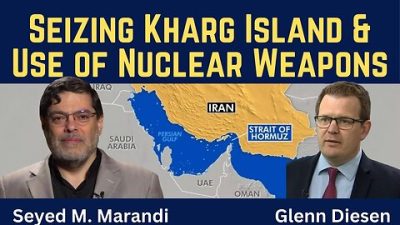
Marandi: Threat of Seizing Kharg Island & the Use of Nuclear Weapons
or go to
Aletho News Archives – Video-Images
Frlom the Archives
Provoking a Path to Persia
The Saban Center’s prescient paper on war with Iran
By Maidhc Ó Cathail | October 20, 2011
In June 2009, the Saban Center for Middle East Policy published “Which Path to Persia?—Options for a New American Strategy toward Iran.” Writing in a tone strikingly reminiscent of the Project for a New American Century’s infamous pre-9/11 paper “Rebuilding America’s Defenses,” the six co-authors noted that, “It seems highly unlikely that the United States would mount an invasion without any provocation or other buildup.” For a think tank specifically established by media mogul Haim Saban to protect Israel, this could prove to be a formidable obstacle impeding their desired march—of U.S. troops—to Tehran.
“In fact, if the United States were to decide that to garner greater international support, galvanize U.S. domestic support, and/or provide a legal justification for an invasion, it would be best to wait for an Iranian provocation, then the time frame for an invasion might stretch out indefinitely,” Saban’s think-tankers ruefully observed.
“With only one real exception, since the 1978 revolution, the Islamic Republic has never willingly provoked an American military response, although it certainly has taken actions that could have done so if Washington had been looking for a fight. Thus it is not impossible that Tehran might take some action that would justify an American invasion. And it is certainly the case that if Washington sought such a provocation, it could take actions that might make it more likely that Tehran would do so (although being too obvious about this could nullify the provocation). However, since it would be up to Iran to make the provocative move, which Iran has been wary of doing most times in the past, the United States would never know for sure when it would get the requisite Iranian provocation. In fact, it might never come at all.”
Seemingly undeterred by Iran’s frustrating unwillingness to provide the requisite provocation, the analysts continued to examine this option… continue
Blog Roll
 Aletho News
- Ukrainian Embassy in Beirut sheltering top Mossad agent
- Palestinian family displaced after settlers violently attack them in Humsa, Jordan Valley
- The EU never learns – except for the wrong lessons
- Iran attacks on UAE leaves RSF militia high and dry
- Hosting Washington’s war: Bahrain faces the consequences
- The US fell for its own Iran propaganda
- Seyed M. Marandi: Threat of Seizing Kharg Island & the Use of Nuclear Weapons
- Is there even an off ramp?
- Michael von der Schulenburg: Europe’s Self-Defeating Iran War Policy
- Sorry, The New Republic, Climate Change Isn’t Causing Somali Migration. Blame Civil Strife and Poverty.
- If Americans Knew
- ‘Of Course’: IDF Drops Case Against Soldiers Accused of Raping Palestinian Prisoner
- Don’t Fall for the Regime Change Talk. Israel Is ‘Mowing the Lawn’ in Iran
- Will Israel and the US wreck the Gulf States along with Iran?
- US so far burned through ‘years’ of munitions in Iran war: Report
- How the Israeli Tail Wags the American Dog
- Outdated intel likely led to deadly U.S. strike on Iranian elementary school, sources say
- Pentagon insider says high U.S official Douglas Feith reported to Netanyahu
- In fond memory of Walid Khalidi, the historian of Palestine
- 6 more Americans killed, as Israel ‘mows the lawn’ in Iran – Not a ceasefire Day 154
- Are we on the precipice of World War III?
- No Tricks Zone
- New Studies: UK Sea Levels Were 4 Meters Higher Than Today During The Mid-Holocene
- Destructive Green New Deal: German Energy And Metal Group Warns Of Drastic Crisis
- New Study Documents A 20-Year Pause In Arctic Sea Ice Decline – Driven By Internal Variability
- Wake-up Call: Survey Shows Majority Of Germans Now Favor Postponing Climate Targets!
- Televised! Leading German Political Candidate Tells Schoolchildren CO2 Makes Sun Hotter!
- New Study: A Century Warming Of 1.1°C Is ‘Commonplace’ And ‘Not Unusual’ During This Interglacial
- New Study: ‘Internal Noise’ And Volcanic Forcing Can Trigger 10-15°C Warming Within Decades
- Glaciers Worldwide Are Suddendly Surging, Experts Blame Warming!
- Surprising Discovery: Sahara Is Greening…Billions Of Trees Where Once Thought To Be Barren
- New Research Reaffirms Clouds, Aerosols, And Surface Solar Radiation Are ‘Driving The Climate System’
 Aletho News