NYT’ Steven Davidoff Doesn’t Consider the Successful 300 Years of Financial Transactions Taxes In London
CEPR Beat the Press | February 26, 2013
Steven Davidoff really doesn’t like financial transactions taxes (FTT) but is not honest enough to acknowledge this fact. Instead he tells readers that proponents of a tax haven’t thought about its consequences and uncritically repeats every piece of nonsense produced by the financial industry to attack the idea.
In the course of a 1300 word essay we get assessments of the tax from Credit Suisse, Blackrock, and the Partnership for the City of New York, which is effectively the New York City Chamber of Commerce. All of these accounts are presented uncritically, as though the purveyors of this information had no interest other than conveying the truth. We are also told that the New York Stock Exchange “threatened to jump across the Hudson River to New Jersey” in reaction to a plan to increase the city’s stock tax in the 1966 (interesting image). Davidoff apparently never heard of businesses making threats to extract concessions from governments.
The NYT running a column like Davidoff’s is like the Iowa City Press Citizen running a column on a plan to cut back farm subsidies where the views of the state’s leading wheat and corn farmers are presented as unquestioned truth, along with a study from the corn growers trade organization. I suspect that the Press Citizen has higher standards.
Meanwhile when it comes to the proponents of the tax, Davidoff lectures:
“advocates of this neat idea conveniently ignore the century of less-than-successful experience with this tax, including New York State’s own failed attempt.”
This comment is more than a little bizarre. Davidoff writes as though proponents of the tax are completely ignorant of economics and have not done research into the history of financial transaction taxes.
Contrary to this assessment, the proponents of the tax include some of the world’s most prominent economists. Furthermore, there is extensive research on the history of financial transactions taxes. Much of it can be found right here on the European Commission’s (EC) website.
Contrary to Davidoff’s bizarre comment, implying the New York tax is a rare example of a government implementing such taxes, nearly all financial markets operated with financial transactions taxes for long periods of time (more than 300 years in the case of London’s market). Most of the world’s major financial centers, including London, Switzerland, Hong Kong and Singapore, still have financial transactions taxes on their stock exchanges. Perhaps Davidoff should be lecturing these governments on how their taxes really don’t work.
As far as the substance, Davidoff tells us that research shows that the tax will increase rather than decrease volatility. There are two different notions of volatility at play here. One is the volatility associated with normal price fluctuations over the course of a day or week. This is likely to be increased by a tax since it will increase the costs for arbitragers to enter a market. That means that we may see somewhat larger divergences between prices than would otherwise be the case. This could mean that the gap in the price of oil between two markets may rise to 0.4 percent rather than 0.3 percent before arbitragers whittle it down again.
Proponents of FTTs are probably not much concerned about this sort of volatility. The economic consequences are likely close to zero. Furthermore, since the levels of taxation being debated would just raise transactions costs back to where they were 10-15 years ago, it is difficult to believe that the effects could be too severe. (We did have very liquid capital markets in the 1990s.)
The type of volatility that more likely concerns proponents of FTTs are the sharp movements that are not driven by fundamentals, such as the 1987 crash and the flash crash in the spring of 2011. While it is difficult to prove that a FTT will reduce the likelihood of such sharp movements, it is worth noting that such events did not occur in the 50s, 60s, and 70s, when trading costs were much higher than in the last three decades.
As far as the incidence of the tax, Davidoff gives us the assessment of Blackrock:
“that if the financial transaction tax were set at 0.1 percent per trade, an investor putting $10,000 in its global equity fund would lose more than $2,300 in expected returns over a 10-year period. This amount would rise to $15,000 if the money were invested in a more actively managed European fund.”
Incredibly, Blackrock assumes that its trading does not in any way respond to the tax. If this were true then Blackrock’s funds would quickly go out of business since their cost would be far higher than others in the industry. There have been a range of trading elasticities estimated by various studies (see the EC research), with most estimates close to -1.0. (None are near zero.) If the elasticity is near -1 then trading volume would decline by roughly the same amount that the tax increases trading costs.
This means that if the tax doubled trading costs, then trading volume would be roughly cut in half. That means that if Blackrock’s fund managers responded as the research suggests, then they would cut back the number of trades by enough so that the non-tax trading costs for their $10,000 account would fall by roughly $2,300 over the course of a decade or $15,000 in the case of its more actively managed European fund. This would be revenue lost to Blackrock, not to its clients.
In this respect it is worth noting that the sharp decline in trading costs over the last four decades has not been associated with higher returns to investors, but rather to a more than proportionate increase in trading volume. This has caused the total amount spent on trading financial assets to rise sharply relative to the size of the economy. These trading costs are money out of investors’ pockets and a drain on the economy.
Davidoff’s effort to claim that the tax could not raise any revenue approaches the bizarre. He tells readers:
“In Britain, for example, where the financial transaction tax has fluctuated from half a percent to 2 percent, the tax has raised significantly less revenue than one might expect, about £3 billion a year. The reason is that investors who trade regularly in Britain use options to avoid the tax, which applies only to trading in stock. The result may be that the tax pushes investors into more risky securities in their efforts to avoid it.”
First, it is worth noting that £3 billion comes to 0.2 percent of UK’s GDP. (The UK had raised almost 0.3 percent of GDP from this tax before the 2008 crash [Table 2].) This would be the equivalent of almost $400 billion over the 10-year budget horizon in the United States. That is almost 3 times as much as President Obama has proposed to save by cutting the Social Security cost of living adjustment. In other words, in the current budget debates it would be regarded as real money.
Second, the decision to not tax derivatives like options is a political one made by governments that have been closely allied with the financial industry. The tax being put in place by 11 countries in the European Union would tax options and other derivatives. In the 1980s Japan had a broadly based tax that was imposed on a wide range of financial assets including options. This tax raised an amount of revenue that was close to 1.0 percent of its GDP. This would amount to $2 trillion over the 10-year budget horizon in the United States.
At one point Davidoff tells readers:
“As for seeking revenue gains to solve budget problems, if the tax is too small, it will have no effect.”
Huh? The Securities and Exchange Commission imposes a tax of 0.002 percent on stock trades in the United States. This tax raises roughly $1.2 billion to finance its budget. Is Davidoff suggesting that the SEC should get rid of this tax because it is not really raising money?
As I said, Davidoff doesn’t like FTTs, that’s pretty clear from reading this piece even though he tells us:
“This is not to say that a financial transaction tax by itself is such a terrible idea.”
He has a case built with non-sequitors (one example of the horror of FTTs is that traders fled a tax imposed by Sweden in the 1980s and instead did their trades in London, which also had a tax). And he ignores all sorts of evidence that FTTs can and do raise large amounts of revenue without disrupting capital markets. This piece lets us know where Davidoff stands on FTTs, it doesn’t provide much information on the merits of the policy.
Related articles
- Economist: Financial Transactions Tax Would Bring in Hundreds of Billions a Year (voicerussia.com)
- 5 Reasons Why The U.S. Needs A Financial Transactions Tax (thinkprogress.org)
Drone ‘Nightmare Scenario’ Now Has A Name: ARGUS
By Jay Stanley | ACLU | February 21, 2013
The PBS series NOVA, “Rise of the Drones,” recently aired a segment detailing the capabilities of a powerful aerial surveillance system known as ARGUS-IS, which is basically a super-high, 1.8 gigapixel resolution camera that can be mounted on a drone. As demonstrated in this clip, the system is capable of high-resolution monitoring and recording of an entire city. (The clip was written about in DefenseTech and in Slate.)
In the clip, the developer explains how the technology (which he also refers to with the apt name “Wide Area Persistent Stare”) is “equivalent to having up to a hundred Predators look at an area the size of a medium-sized city at once.”
ARGUS produces a high-resolution video image that covers 15 square miles. It’s all streamed to the ground and stored, and operators can zoom in upon any small area and watch the footage of that spot. Essentially, it is an animated, aerial version of the gigapixel cameras that got some attention for super-high resolution photographs created at Obama’s first inauguration and at a Vancouver Canucks fan gathering.
At first I didn’t think too much about this video because it seemed to be an utterly expected continuation of existing trends in camera power. But since it was brought to my attention, this technology keeps coming back up in my conversations with colleagues and in my thoughts. I think that’s because it is such a concrete embodiment of the “nightmare scenario” for drones, or at least several core elements of it.
First, it’s the culmination of the trend towards ever-more-pervasive surveillance cameras in American life. We’ve been objecting to that trend for years, and many of our public spaces are now under 24/7 video surveillance—often by cameras owned and operated by the police. But even in our most pessimistic moments, I don’t think we thought that every street, empty lot, garden, and field would be subject to video monitoring anytime soon. But that is precisely what this technology could enable. We’ve speculated about self-organizing swarms of drones being used to blanket entire cities with surveillance, but this technology makes it clear that nothing that complicated is required.
Second and more significantly to me, this technology also makes real a key threat that drones pose to privacy that we’ve talked about: the ability to do location tracking. The video shows cars and pedestrians near Quantico, Virginia automatically tagged with colored boxes, which follow them as they move around. As the technology’s developer told NOVA,
Everything that is a moving object is being automatically tracked. The colored boxes represent that the computer has recognized the moving objects. You can see individuals crossing the street, you can see individuals walking in parking lots.
The surveillance potential of such a tracking algorithm attached to such powerful cameras is worth pausing to think about. To identify someone there’s no need for face or license-plate recognition (which may be impractical from above anyhow), cell phone tracking, gait recognition, or what have you. Even knowing where a little green square starts and finishes its day can reveal a lot, because it turns out that even relatively rough location information about a person will often identify them uniquely. For example, according to this study, just knowing the zip code (actually census tract, which is basically equivalent) of where you work, and where you live, will uniquely identify 5% of the population, and for half of Americans will place them in a group of 21 people or fewer. If you know the “census blocks” where somebody works and lives (an area roughly the size of a block in a city, but much larger in rural areas), the accuracy is much higher, with at least half the population being uniquely identified.
However, ARGUS-type tracking could be used to get more precise data than that—in many cases, to determine a vehicle’s home address, which pretty much reveals who you are if you’re in a single-family home, and narrows it down pretty well even if you’re in a large apartment building. (Academic papers have been written on inferring home address from location data sets.) Add work address and I expect that would nail virtually everybody. And of course lodged in the data set would be not just where a particular vehicle starts and finishes its day, but all the places it stopped in between—potentially revealing, as we so often point out, an array of information about a person such as their political, religious, and sexual activities.
True, such tracking using ARGUS would be disrupted whenever a subject disappears from aerial view. For example, pedestrians who travel by subway or bus or walk under foliage, or vehicles entering tunnels, would be harder to track. But even there, datamining large data sets collected over time could probably reveal a lot of things about people’s daily patterns and I would bet could eventually be used to identify a surprisingly large number of them. I expect that ARGUS would be used (if it’s not already) to generate a database consisting of location tracks of moving vehicles or pedestrians beginning in one place and ending in another. Think of them as little strings on a map. Some of these strings would stretch from a person’s home to their work, with stops in between, while others might be fragments, interrupted by a tunnel or other obstruction. But even the fragments, when the dimension of time is added to the equation, could probably be correlated together.
Of course low-lying clouds or fog might also interfere with aerial tracking, though imaging technologies already in existence could probably be deployed to see through them.
NOVA was not allowed to show images of the ARGUS censor, and stated that part of the program remained classified, including whether it has yet been deployed. (Though, we know it has been deployed domestically at least once, over Virginia as shown on NOVA. I’m going to assume it has not been deployed domestically in any more routine manner.) But, it is good that the Air Force allowed NOVA to see its capabilities. I’d like to think it’s because as Americans, Air Force officials have respect for our country’s values and democratic processes and don’t want to let such powerful and potentially privacy-invasive tools to be created in secret. It could also be, however, because the Air Force needs private-sector help in figuring out how to analyze the oceans of data the device can collect (5,000 hours of high-def video per day).
Either way, it’s important for the public to be aware of the kinds of technologies that are out there so that it can better decide how drones should be regulated.
Related articles
Supreme Court Dismisses Challenge to FISA Amendments Act; EFF’s Lawsuit Over NSA Warrantless Wiretapping Remains
By Cindy Cohn and Trevor Timm | EFF | February 27, 2013
Yesterday, the Supreme Court sadly dismissed the ACLU’s case, Clapper v. Amnesty International, which challenged the FISA Amendments Act (FAA)—the unconstitutional law that allows the government to wiretap Americans communcating with people overseas. Under the FAA, the government can conduct this surveillance without naming individuals and without a traditional probable cause warrant, as the Fourth Amendment requires.
The court didn’t address the constitutionality of the FAA itself, but instead ruled that the plaintiffs—a group of lawyers, journalists, and human rights advocates who regularly communicate with likely “targets” of FAA wiretapping—couldn’t prove the surveillance was “certainly impending,” so therefore didn’t have the “standing” necessary to sue. In other words, since the Americans did not have definitive proof that they were being surveilled under the FAA—a fact the government nearly always keeps secret—they cannot challenge the constitutionality of the statute.
EFF’s Warrantless Wiretapping Case, Jewel v. NSA, Is Not Affected by Clapper
It’s shameful that the courts again have cut off another avenue for accountability regarding the NSA’s warrantless and unconstitutional surveillance activities. But as disappointing as the Clapper decision is, the good news is the decision likely won’t adversely affect our Jewel v. NSA lawsuit, which we argued in district court in December of 2012. Indeed, the Clapper decision makes the Jewel case one of the last remaining hopes for a court ruling on the legality of the warrantless surveillance of Americans, now conducted for over a decade.
The Ninth Circuit has already ruled that the Jewel plaintiffs have standing under settled law. The court’s decision is based on solid ground because we have presented the court with evidence that dragnet warrantless surveillance has already occurred, through testimony and documents from AT&T and NSA whistleblowers. In fact, the court specifically differentiated the two cases in its Jewel opinion: “Jewel has much stronger allegations of concrete and particularized injury than did the plaintiffs in Amnesty International. Whereas they anticipated or projected future government conduct, Jewel’s complaint alleges past incidents of actual government interception of her electronic communications.”
Clapper v. Amnesty’s Catch-22
Nonetheless, the Supreme Court’s requirement in Clapper that a future harm must be “certainly impending” to allow a case to go forward is very troubling, especially in the context of cases involving secret surveillance.
As Justice Stephen Breyer’s dissent points out, future conduct can never be predict anything with 100% certainty, and if certainty was a requirement for standing, then virtually no cases would ever reach conclusion. Justice Breyer runs through dozens of cases where standing has been found for plaintiffs in situations where plaintiffs had a reasonable fear of harm, and in many of those cases, the plaintiffs were much less certain than the lawyers, human rights workers and journalist in Clapper.
Breyer summed absurdity of the “certainly impending” standard by saying, “One can, of course, always imagine some special circumstance that negates a virtual likelihood, no matter how strong. But the same is true about most, if not all, ordinary inferences about future events. Perhaps, despite pouring rain, the streets will remain dry (due to the presence of a special chemical).”
This standard is especially problematic when the harm is illegal surveillance conducted via secret government programs. Unlike physical searches of the home, communications surveillance is by its nature hidden from the people affected, and national security surveillance is rarely made public or used in domestic criminal prosecutions. Thus, under the Supreme Court’s rule, regardless of whether its surveillance was legal or constitutional, the government can deny standing to a victim of illegal surveillance just by never revealing its illegal actions to the person affected. Essentially, one can’t challenge the government’s surveillance unless the government agrees.
Indeed, in arguing that its ruling does not mean that government surveillance under the FAA can never be reviewed by the courts, the Court could only point to situations in which the government intentionally revealed its surveillance.1
Allowing the Executive broad unfettered powers to “turn the Constitution on and off at will,” is exactly what the Supreme Court refused to do in Boumediene v. Bush, but what it appears to have allowed here.
It’s not even clear that the majority even understands the real scope of the FAA. In the opinion’s first sentence, Justice Alito refers to “individuals” that can be warrantlessly surveilled, but as we’ve explained many times, and the dissent notes, one of the most odious parts of the law is that it allows the government to get one court order for groups or categories of people—potentially thousands of people can be affected at a time.
The Shrinking Ranks of Warrantless Wiretapping Cases
This is the second ruling in the past year in which the government has convinced the court to dismiss challenges to the NSA warrantless wiretapping program on technical grounds, when there is ample evidence of wrongdoing. In 2012, the Ninth Circuit reluctantly dismissed the Al-Haramain case on “sovereign immunity” grounds despite a lower court ruling the government had violated the Fourth Amendment. The court reasoned that because of a glitch in the language of FISA statute, the plaintiffs had to sue individuals in the government in their personal capacities and couldn’t sue government agencies themselves or government officials in their official capacities.
We look forward to the district court in Jewel v. NSA determining that our case can move forward, and that the government can, once and for all, be held to account for the NSA’s unlawful and unconstitutional warrantless wiretapping program.
- 1. The court also noted that a provision of the FAA allows a service provider, presumably in a fit of patriotic fervor and a willingness to pay expensive attorneys for its customers, challenges the government on its own, in secret. Yet even under this provision, the victim of the surveillance is unable to seek judicial review.
Related article
Palestinian assailed by Israeli women, stripped of hijab
Al-Akhbar | February 27, 2013
 A Palestinian woman waiting at a light rail station in Jerusalem on Monday was attacked and stripped of her headscarf by religious Jewish women, Israeli newspaper Ma’ariv reported Tuesday.
According to bystanders, a young Jewish woman punched the Palestinian suddenly as she was passing by the station. A friend of the assailant began aiding her in beating the Palestinian, pushing her against the wall, and ultimately ripping off her headscarf.
The Palestinian was accompanied by an old man who tried to push the attackers away to no avail.
The event occurred at about three o’clock in the afternoon. It is unclear whether the incident involved only the two assailants mentioned in witness accounts, or a larger group shown in the photo.
“There were about 100 Orthodox and yeshiva students who disembarked the tramway and spotted an Arab woman accompanied by an older man,” a witness, who photographed the event, told Ma’ariv.
“It developed into arguing and yelling, and I don’t know what the content was that everyone jumped on her.”
According to the witness, an activist named Dorit Jordan Dotan, a municipality security officer passively watched the event and seemed to be smiling. Many residents also stood by.
“The entire time, the guard stood and smiled and did not even try to break up the fight,” a witness said.
Dotan confirmed that the incident took place at the station where a group of young people had just arrived from the train, but seemed to downplay the event by suggesting the attackers were intoxicated.
“Young people drink a lot of wine for Purim. Screams were heard everywhere. A woman tried to fight [the Jewish students] but they yelled at her not to dare touch the Jews and continued to beat [the Arab woman],” Dotan said.
Following publication in Ma’ariv, police launched an investigation into the case.
“It’s a shame that the Arab whore didn’t die”
On the day the report was published, Israeli police officer Ariel Shapiro re-posted the article on his Facebook page and issued a chilling endorsement: “Very good,” wrote Shpiro “It’s a shame that the Arab whore didn’t die.”

Screenshot of Shapiro’s Facebook page along with the offending status message
The message was publicized by Palestinian Member of Knesset Ahmad Tibi.
Israeli army and police officers have come under fire in recent weeks for showcasing dehumanizing images of and slogans about Palestinians. The most famous of these is an Instagram photo of Mor Ostrovski, 20, showing the crosshairs of a rifle being aimed at the head of a Palestinian boy.
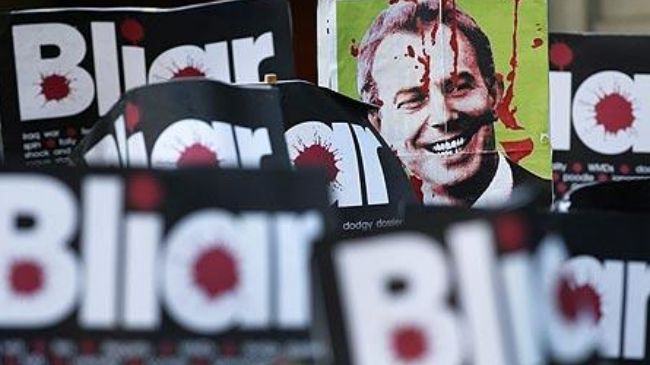
Blair desperately tries to justify Iraq war
Press TV – February 27, 2013
Former British Prime Minister Tony Blair, who is globally discredited for his war crimes, has tried to defend his decision to invade Iraq in 2003, claiming the country is a “safer place” after the execution of dictator Saddam Hussein.
In an interview on BBC2’s Newsnight marking the tenth anniversary of UK armed forces joining a US-led invasion of Iraq, he said despite the death toll among both British troops and Iraqi civilians being “very, very high”, the decision to wage a war against the Arab country was the right one.
He also conceded people are still “very abusive” to him years after the war on Iraq, adding that he had given up trying to “persuade people it was the right decision”.
Being asked if he minded being called a “liar” and “war criminal”, former leader of Britain’s Labour party said it did not matter whether the controversy about Iraq had “taken a toll on” him.
Moreover, he admitted that life in Iraq today was not what he had hoped for 10 years ago.
His comments come as hundreds of thousands were killed and injured in illegal interventions, and hundreds of thousands more were made refugees between 1997 and 2007, under Blair’s premiership.
Meanwhile, according to a recent Guardian/ICM poll a decade after the invasion of Iraq, the majority of Britons believe that the war “sold on a false prospectus delivered little but bloodshed.”
In 2003, the US and Britain invaded Iraq in blatant violation of international law and under the pretext of finding weapons of mass destruction (WMD) allegedly stockpiled by the former Iraqi ruler. However, no WMD were ever discovered in Iraq.
More than one million Iraqis were killed as a result of the invasion and subsequent occupation of the country, according to the California-based investigative organization Project Censored.
Related article
- Guardian readers: Iraq war was not justified (guardian.co.uk)
Jordan: A Limited Strategic Shift
By Elie Chalhoub | Al-Akhbar | February 27, 2013
Jordanian King Abdullah II’s recent visit to Moscow crowned a series of steps that Amman has been taking over the past few months, signalling a shift away from its traditional allies like Washington and Israel.
Until recently, Jordan was in the warm embrace of oil-rich Gulf Arab countries that, prepared to admit the Hashemite kingdom into their Gulf Cooperation Council (GCC), would then shower it with billions in aid.
This is while Amman offered the services of its security and intelligence forces, coordinating closely with both Washington and Tel Aviv in a variety of areas, not least of which the unfolding crisis in Syria.
According to informed sources, last July 2012, Amman hosted a gathering of security officials from the US, Qatar, and Israel, who recommended setting up training camps for Syrian opposition fighters near the Jordanian city of Irbid.
US Secretary of Defense Leon Panetta admitted as much when he acknowledged in October 2012 that dozens of American soldiers were deployed along the Jordanian-Syrian border, explaining that “these units are tasked with establishing a base in Jordan and to assist the Syrian refugees and Jordanian armed forces to confront the dangers stemming from Syria’s chemical weapons.”
In the last few months Amman has begun to reassess its alliances in light of the Syrian crisis, perhaps embarking on a process of strategic realignment, moving closer to Iraq and Russia, at the expense of its traditional allies.
The prospective threat posed by the powerful Jordanian Muslim Brotherhood and the more radical Islamist currents prompted the army and intelligence to convince the palace not to go along with Washington’s plan.
Amman even went so far as to completely close its border with Syria, preventing fighters and weapons from crossing it.
This came at a high cost for Jordan, as Saudi Arabia and Qatar – who were mobilizing all the forces they could muster against the Bashar al-Assad regime – to halt their support for the kingdom, causing a serious economic crisis in the country.
Iraq quickly moved in to try to fill the void and revive its once close ties with Jordan. An official visit to Amman by Iraqi Prime Minister Nouri al-Maliki at the end of 2012 led to the signing of several lucrative deals that would see cheap Iraqi oil once again flowing to Jordan.
As for Jordan’s relationship with Iran, “that’s a tough one for us,” says a high-level Jordanian security official, pointing out that the realignment underway may go far, “but it has its limits, for there are lines that cannot be crossed, and Iran lies outside these boundaries.”
In light of all this, King Abdullah II’s visit to Moscow on Tuesday, February 19 cannot in any way be seen simply as a routine call.
For its part, Jordan is seeking a counterbalance to US influence, for fear that Washington is preparing to force Amman into accepting a confederation with the Palestinians as a solution to the Arab-Israeli conflict.
Russia, on the other hand, sees this as an opportunity to bring Amman into its orbit, particularly on the Syrian question, where Moscow is in the process of pushing for a settlement.
Jordan’s diplomatic support in the Arab arena and the valuable intelligence it can provide on the Syrian opposition make it a critical resource for the Russians.
EU report slams Israeli settlements, calls for economic sanctions
RT | February 27, 2013
An internal report by the European Union has come down hard on Israel’s decision to continue settlement construction in occupied East Jerusalem, threatening to end economic projects that involve the Jewish settlements.
The harshly worded 15-page report provides recommendations to the 27 member-states for responding to Israel’s activities in the occupied territories – which the document described as “systematic, deliberate and provocative” – and endorses a strategy that aims at “making it impossible for Jerusalem to become the capital of two states.”
Seven of the report’s 10 recommendations propose slapping tough economic sanctions on organizations directly involved in construction projects in the Jewish settlements, Israeli daily Haaretz reported. The report also called on the EU’s 27 member-states to “prevent, discourage and raise awareness” about doing business with companies that work in the disputed settlement zones.
It advised EU states to work to ensure that products exported from the settlements not receive an unfair advantage through “preferential tariffs,” and to give consumers an opportunity to make an “informed choice” through clear labeling of products’ origins.
The report advocated “closer supervision” of technological research and development programs between the EU and Israel. The measures would work to ensure that “no research grants, scholarships or other technological investments assist settlements, either directly or indirectly,” or be provided to agencies working in the settlements.
Haaretz, which obtained a copy of the report, called the sanctions “particularly severe” compared to earlier EU reports.
The annual report, compiled by EU consuls in Jerusalem and Ramallah, does not require member-states to implement the measures – the document’s recommendations serve as a guidepost for individual EU states in dealing with the ongoing Israeli-Palestinian conflict.
In December, several EU countries, including the UK, France and Sweden, summoned their Israeli ambassadors to voice disapproval of the ongoing construction projects.
The report expressed frustration with Israel for its late-November announcement of new settlement construction projects, shortly after the UN General Assembly voted to recognize Palestine as a non-member observer state – a move strongly condemned by Israel and the US.
The implementation of the Israeli government’s so-called E-1 project “would effectively divide the West Bank into separate northern and southern parts,” the report explained, adding that it would also “prevent Palestinians in East Jerusalem from further urban development and cut off East Jerusalem from the rest of the West Bank.”
Israel is “systematically undermining the Palestinian presence” in East Jerusalem through controversial strategies, including “restrictive zoning and planning, demolitions and evacuations, discriminatory access to religious sites, an inequitable education policy, difficult access to health care, the inadequate provision of resources,” the report said. … Full article
‘No shot, no ticket’: Ethiopians decry Israeli birth control policies
RT | February 27, 2013
Ethiopian women have told RT that Israeli medics forced them to take the controversial Depo-Provera birth control vaccination without explaining the severe side effects of the drug, which can leave a woman unable to become pregnant for up to two years.
The birth control vaccination was reportedly a requirement for the women to immigrate to Israel: “They told me if you don’t take the shot, we won’t give you a ticket, so I took the shot, but I didn’t know that it would prevent pregnancies. I didn’t know,” one woman told RT correspondent Paula Slier.
The gruesome side effects of Depo-Provera are so severe that the drug is not recommended for most patients.
“We are talking about a contraception that has heavy medical and mental effects – period irregularities, vaginal bleeding, osteoporosis, alongside mental side effects like depression, mood swings, rage and more,” said Sharon Eliyahu-Chai of the Association for Civil Rights in Israel.
At least six organizations – such as Tebeka, an Ethiopian legal aid group – now aim to take the matter to court over alleged human rights violations.
Last month, the Israeli Health Ministry’s director general ordered gynecologists to cease administration of the drugs, bowing to public pressure after accusations that they had been forcing the birth control injections on Ethiopian women without their consent.
Israeli officials have denied that the birth control program was part of a plan to reduce the Ethiopian birthrate. The scandal has worn on, with the organizations involved all pinning blame on one another.
For more, watch Paula Slier’s report from Israel.
Related article
- Israelis admit pushing long-term contraceptives on Ethiopian women (alethonews.wordpress.com)
Chávez Haters Not “Limited by Truth, Reality or Common Sense”
By Dan Beeton | CEPR Americas Blog | February 26, 2013
A new op-ed in the Guardian by Ricardo Hausmann portrays a dystopian fictional Venezuela, one in which the Venezuelan government has run the economy into the ground despite abundant oil wealth, but yet its charismatic president continues to be re-elected through some sort of sinister trickery.
Sound familiar? It should: it’s the same tired story repeated in the U.S. and U.K. media almost every day, but in this case Hausmann was apparently given free rein to present his own set of “facts.” It isn’t surprising that Hausmann would write something so divorced from reality; he went to elaborate lengths to invent a conspiracy theory about supposed fraud in Venezuela’s 2004 recall referendum by relying on fake exit polls. An independent panel of statisticians selected by the Carter Center determined that Hausmann and his colleague Roberto Rigobón had in fact found no evidence of fraud. [PDF]
But let’s get back to Hausmann’s latest Guardian piece, starting with the economy. Hausmann writes, “Since 1999, the year [Chávez] took over the presidency, Venezuela has had the lowest average GDP growth rate and the highest inflation of any Latin American country except Haiti.”
The source for this “lowest average GDP growth rate” to which Hausmann links is a highly opinionated BBC article which in turn quotes a colleague of Hausmann’s from the Center for International Development at Harvard University who has a Bachelor of Arts degree in economics. Had Hausmann consulted official government data, or growth numbers for the region from the IMF, he would have found a very different set of facts.
In fact, Brazil, Mexico, El Salvador, Guatemala, Jamaica, Nicaragua, Paraguay, Uruguay, and other countries all had lower average GDP growth than did Venezuela since 1999, according to IMF data.
Hausmann’s next sentence reads: “[Venezuela] has also seen a fivefold increase in assassinations to arguably the highest murder rate in the world.”
Why does Hausmann want to “argue” the case for Venezuela having the “highest murder rate” in the world? Because the U.N. keeps track of such figures, and at 91 per hundred thousand, post-coup Honduras’ homicide rate is about twice as high as Venezuela’s; El Salvador’s is also much higher.
Hausmann then makes the usual claims about Chávez “eliminat[ing] checks and balances” and describes – without providing any evidence – “a very large civilian army of political activists that are handsomely compensated by the state for their party work.” Such distortions of Venezuela’s democracy belittle both the many elections in which voters have overwhelmingly chosen pro-Chávez legislators and state and local officials, and the bottom-up nature of much of the transformative processes occurring in Venezuela. Hausmann then claims that Chávez “dominate[s] the airwaves,” even though Venezuelan state television has a 5.4 percent audience share while more than 94 percent of the TV seen by Venezuelans is not pro-government.
As Hausmann himself writes, “in choosing your narrative, be creative. Don’t be limited by truth, reality or common sense. …Whenever you fail, blame a conspiracy.” Hausmann has provided an excellent demonstration of the former with his Guardian op-ed, just as his post-recall referendum fantasy stories were a great example of the latter.
Related articles
- World Bank and IMF Forecasts Follow Predictable Pattern for Haiti, Venezuela
- There is an alternative: what Venezuela can teach us about the banking sector
- Venezuela’s Economy Grows by 5.5 Percent in 2012
- Economic BS in Rich Countries is Reinforced by BS about Venezuela
- The Achievements of Hugo Chavez
- Venezuela Among the Most Positive Countries, Gallup Says
US Dairy Industry Wants to Put Aspartame in Milk
By NICK MCCANN | Courthouse News Service | February 21, 2013
WASHINGTON – Dairy industry groups have asked the Food and Drug Administration to be able to put artificial sweeteners in milk, and not change the label, claiming that it is so consumers can “more easily identify its overall nutritional value”.
The Food and Drug Administration is asking for data related to those sweeteners.
The International Dairy Foods Association (IDFA) and the National Milk Producers Federation (NMPF) filed a petition in 2009 requesting that the FDA amend its standard of identity for milk.
The petition asked the agency to allow the use of “any safe and suitable” sweetener for milk and asked to amend the standards of identity for 17 other milk and cream products.
Those products include sweetened condensed milk, whipping cream, yogurt and eggnog, which the groups say should be allowed to have “safe and suitable” sweeteners.
The groups request that the FDA “allow optional characterizing flavoring ingredients used in milk (e.g. chocolate flavoring added to milk) to be sweetened with any safe and suitable sweetener – including non-nutritive sweeteners such as aspartame.”
FDA regulations currently only allow milk products to contain “nutritive sweeteners” (those with calories) which the agency generally recognizes as safe.
The groups say the amendments “would promote more healthful eating practices and reduce childhood obesity by providing for lower-calorie flavored milk products.”
“They state that lower-calorie flavored milk would particularly benefit school children who, according to IDFA and NMPF, are more inclined to drink flavored milk than unflavored milk at school,” the FDA wrote in its notice.
The groups also say they would help with programs that aim to improve nutrition in school meals and argue that the proposed amendments would promote “honesty and fair dealing in the marketplace,” the FDA wrote.
The agency published a notice of the petition on Wednesday requesting comments, data, and information about the proposed amendment to the identity of milk products. The comments are due by May 21.
LIBOR: Viewing the Biggest Financial Crime in History
By DARWIN BOND-GRAHAM | CounterPunch | February 26, 2013
It’s been five years since a few academics and journalists began to dig up evidence that something was wrong with the London Inter-Bank Offered Rate, or LIBOR (pronounced appropriately as “lie-bore.”) The data that curious researchers were compiling couldn’t be explained using the prevailing definition of what LIBOR supposedly was: a trustworthy interest rate that accurately gauged the market price of borrowed US dollars held overseas by the world’s biggest banks. Instead, their findings pointed toward something other than an idealized neoliberal market, influenced only by impersonal supply and demand forces. Many began to realize that the data could easily be explained if the banks were rigging the LIBOR rate in their favor. Strange discrepancies in LIBOR’s correlation to other rates, and to the economic fundamentals of the bank companies responsible for formulating the rate, showed something seriously amiss, but it made sense if the banks were cheating.
The motives of the banks have been clear from the beginning. A few banks that dominate the marketplace for derivatives stand to make billions if LIBOR moves in their favor on particular days when contractual payments between them and their customers come due. They therefore suppressed the rates in order to skim billions of dollars off derivatives and investments. Later these same banks suppressed LIBOR rates to create the illusion that their balance sheets were robust during the financial crisis. This also allowed them further rounds of money-siphoning from their unwitting derivatives customers.
Until recently LIBOR rates have been set by a panel of banks that are members of the British Bankers Association (BBA). The BBA is a private industry group established almost 100 years ago to lobby for the financial industry in one of its global hubs, London. The BBA really came into power in the mid-1980s with the creation of LIBOR. LIBOR was created to further integrate the giant global money market in US dollars held in overseas banks or holding companies, and therefore unregulated by the US Federal Reserve. Called “Eurodollars,” because they originally were dollar savings accumulated in European banks, especially banks in London, these funds quickly became a de facto global currency. LIBOR began as a way for the banks to standardize investment products for these vast pools of American dollars flowing through Europe, and later Japan, the Middle East, and Latin America. By the 1990s LIBOR had become such an important set of interest rates, and US dollars held overseas had becomes such an important source of credit for US consumers, that LIBOR became the key global interest rate around which many financial products were pegged. As LIBOR became more and more important to the globalization of finance, it accrued a sort of official, trusty gloss; nearly everyone assumed that LIBOR was a market rate reflecting competition. Instead, LIBOR has probably all along been a fudged rate, determined less by vast market forces and invisible hands, and more by the vulgar self-interest and power of the elite banks that set LIBOR rates.
Last year government investigations into this globe-spanning crime —rightly called the biggest financial scam in all of history— led to multi-billion dollar fines against Barclays, the Royal Bank of Scotland, and UBS, the 7th, 8th, and 20th largest banks in the world, respectively. Criminal investigations spearheaded by US, UK, Japanese, Canadian, Swiss, and Singaporean authorities are ongoing and aimed at other banks such as Citigroup, JP Morgan, Bank of America, and other “too big to fail” institutions. More details of the crime will be forthcoming as e-mails, internal documents, phone tapes, text messages, and other evidence, is made public, and as the banks are forced to pay significant fines, and sign plea agreements.
While this scandal might seem worlds away, concerning complex financial concepts and obscure money market instruments dealt by bankers out of skyscraper offices in the City of London, the importance of uncovering the complete truth about the LIBOR rigging conspiracy cannot be overstated for local communities across the United States, especially here in California.
Why? First, LIBOR has been used since the 1990s to determine cash flows on interest rate swaps that local governments have purchased from banks to insure themselves against wild swings in variable interest rates owed on billions of municipal debt. Messing with LIBOR messes with the payments due on these instruments.
Second, LIBOR has also been used as a main interest rate of reference for an array of investment products that yield a variable return, dipping and rising in concert with LIBOR. Local and state governments have used these investment products, called “municipal derivatives reinvestment products” to temporarily park public funds, while pension systems and government enterprises like utilities use them make investments. Governments and public agencies earn LIBOR rate returns on their dollars invested in numerous kinds of municipal derivatives, so if LIBOR is illegally fixed downward, they earn less income.
Through both of these forms of exposure, local governments have potentially been harmed by LIBOR-fixing perpetrated by the banks, often times the very same banks that have sold them swaps or municipal derivatives investment products.
California is fast emerging as a center of investigation and litigation into the LIBOR-fixing conspiracy. California is the largest single municipal debt market in the United States, and one of the largest in the world. Last year alone the state of California and its cities, counties, school districts, and other public entities issued $65.7 billion in total public debt. Because of California’s regressive tax structure and chronic budget crises, the state’s multitude of governments have been among the most aggressive in issuing variable rate debt hedged with interest rate swaps.
The Golden State’s local governments have also been the largest purchasers of municipal derivatives contracts from banks because streams of tax and fee revenues often don’t match up with the dates that payments to public employees and contractors come due. Collusive suppression of LIBOR rates by the 16-member panel who were trusted to provide accurate quotes could mean that California local governments have paid untold millions to their interest rate swap counterparties (the banks) that should otherwise have remained in budgets and used to fund school construction, bus lines, street paving, water and sewerage services, etc.
In the 1990s and 2000s local governments across California increasingly issued bonds with variable rates. Investment bank underwriters and municipal debt advisers from the private sector encouraged variable rate bond financing because it promised lower interest rates for California’s cash-strapped municipalities. To hedge against the risk that variable rates might explode, as they did in the 1980s, the banks sold interest rate swaps to local governments. The swaps effectively converted floating rate debt into a fixed rate. Under a typical swap contract the bank seller agrees to pay a floating rate designed to mimic the variable rate interest on the bond debt, and in return the local government agrees to pay a fixed rate. I’ve written elsewhere about how this deal blew up and created a financial injustice when variable interest rates plummeted during and after the Financial Crisis, but the LIBOR rigging conspiracy adds to these harms. The US government bailed out the banks and assisted them in taking “toxic” derivatives assets off their hands, but stood idly by while cities, counties, and public agencies suffered without aid during the Financial Crisis, allowing derivatives instruments on the public’s books to blow up and drain budgets. At this very moment the banks perpetrated an illegal scam to suck even more money from the public via further depression of LIBOR.
Barclays, RBS, UBS, and other banks worked together to suppress LIBOR below even the depths to which it sank after 2008. A number of lawsuits filed by various cities, counties, and public agencies in California asserts the banks did this to skim off an unknown, but very large, amount of money from their public victims, and also to bolster their own balance sheets during the crisis. By suppressing LIBOR the banks ensured that the net difference between the variable rates they owed, and the fixed rates the public was paying on swaps, was wider than it would otherwise have been. This net difference meant that the public owed the banks higher amounts when the interest rate swap payments came due (usually twice a year).
For San Francisco this could mean that millions have been stolen from the capital budget of its Airport. SFO currently has seven interest rate swaps it has purchased to convert variable rate bond debt into synthetic fixed rates. The airport’s counterparties on its swaps included JP Morgan Chase, Merrill Lynch (owned by Bank of America), and Goldman Sachs. Each of these banks likely benefited from conspiratorial suppression of LIBOR, even if it was by just a few basis points (hundredths of a percent). JP Morgan Chase and Merrill’s parent Bank of America are both members of the panel that sets LIBOR, and are both believed to have played a role in the conspiracy.
San Francisco’s pension system may have also been raided by the banks through its speculative investments in swaps. According to the most recent audit of the San Francisco Retirement System’s portfolio, the city’s pension system holds two interest rate swaps on its books with a notional value of $15 million. In prior years, SFERs held other swaps. In 2010, the Retirement System’s audit showed three interest rate swaps with a total notional value of $41 million. Over the last two years these swaps drained $5.3 million from the pension system, and some of these losses might have been due to the downward manipulation of LIBOR. Also on the Retirement System’s books are other investments in bank loans, options, and other securities that might have been impacted by the LIBOR fraud.
San Francisco’s LIBOR damages are probably small in comparison to other local governments and public agencies. The East Bay Municipal Utility District has already filed a lawsuit in federal court alleging damages from bank rigging of LIBOR. The water district’s complaint, filed in January of 2013, alleges that LIBOR suppression drained potentially millions, again from interest rate swap agreements with some of the very banks that sit on the LIBOR-panel: Citibank, JP Morgan Chase, and Bank of America. East Bay MUD lists nine interest rate swaps potentially affected by LIBOR rigging in its lawsuit.
East Bay MUD’s swaps had a total notional amount of $481 million in 2012, according to the utility’s most recent financial report. Downward manipulation of LIBOR by just 10 to 50 basis points (1/10th to 1/2 of a percent) could have drained between $481,000 to $2,400,000 through East Bay MUD’s swap payments every six months. Over a few years, say the conspiracy’s 2007-2010 time-frame alleged in EBMUD’s lawsuit, this would add up to millions of dollars stolen by the banks.
The cities of Richmond, San Diego, and Riverside, and the County of San Mateo, are other California governments that have now filed lawsuits against the banks responsible for setting LIBOR. All of these lawsuits have been consolidated into a larger class action case currently being heard in the U.S. District Court, Southern District of New York, before Judge Naomi Buchwald. There are now about two dozen LIBOR manipulation lawsuits that have been filed and consolidated in New York. The lead case is the City of Baltimore and the New Britain Firefighters’ and Police Benefit Fund lawsuit against the 16-bank LIBOR panel, filed in April of 2012.
More California cities, counties, and public agencies are expected to file their own lawsuits soon, however. CalPERS, which has numerous investments that fluctuate in value and yield with LIBOR, is also said to be investigating its own exposure to rate rigging.
Darwin Bond-Graham is a sociologist and author who lives and works in Oakland, CA. He is a contributor to Hopeless: Barack Obama and the Politics of Illusion.
Related articles
- California Cities Sue Banks Over Libor Rates, Law Firm Says (bloomberg.com)
- Rabobank Faces Libor-Rigging Fine of $440 Million Plus (bloomberg.com)
- The Royal Bank of scot-free (morningstaronline.co.uk)
Boycotting Israel Galloway-style
By Stuart Littlewood | Dissident Voice | February 26th, 2013
A big fuss blew up last week when British MP George Galloway, invited to Oxford University to debate the motion “Israel should withdraw immediately from the West Bank”, walked out of the chamber when he heard that the student opposing the motion was an Israeli.
American readers may remember Galloway, who came over in 2005 and delivered a master-class in how to give a Senate Inquisition sub-committee a good spanking.
At Oxford, something Eylon Aslan-Levy said prompted Galloway to ask, “Are you an Israeli?”
“Yes,” came the reply.
“I don’t debate with Israelis. I have been misled, sorry,” said Galloway putting on his coat. “I don’t recognise Israel and I don’t debate with Israelis,” he added and left.
The following message then appeared on Galloway’s Facebook: “The reason is simple: no recognition, no normalisation. Just boycott, divestment and sanctions, until the apartheid state is defeated. I never debate with Israelis nor speak to their media. If they want to speak about Palestine – the address is the PLO.”
The PLO, of course, is recognized as the sole legitimate representative of the Palestinian people.
Galloway’s point was that BDS (boycott, divestment and sanctions), in his terms, means “no purchase of Israeli goods or services, no normal contacts with individuals or organisations in Israel who support the existence of the racist Apartheid creed of Zionism. That’s what I mean by boycott. That’s what I do. Israelis who are outside of and against the system of Zionism are comrades of mine… My opponent at Oxford University did not meet this test.”
Aslan-Levy is reported to have told The Guardian that Israel’s withdrawal should not be immediate but “in the context of a negotiated peace treaty, which would recognise both Israeli and Palestinian states”. According to the Daily Mail he also said: ‘”To refuse to talk to someone just because of their nationality is pure racism, and totally unacceptable for a Member of Parliament.”
A lot of people have criticised Galloway for his behaviour in this matter. However, anyone arguing against an immediate end to the brutal and illegal 65 year-old occupation and offering silly excuses for prolonging the misery – like more lopsided ‘negotiations’ when international law and UN resolutions have already spoken – deserves to feel the cold blast of boycott, Galloway-style.
The attacks on Galloway seem to come mainly from people in the BDS movement itself who are supposedly on the same side. Press reports mention cries of “racism”. But notice that Galloway said he doesn’t debate with Israelis, not Jews. Others may not wish to debate with North Koreans or Afghan tribesmen. Our own foreign secretary apparently has no intention of chatting with his Iranian opposite number while turning the sanctions screw on the Iranian people. Obama when he visits the Holy Land to pay homage to Netanyahu won’t drop in on Haniyeh in Gaza to discuss football.
And it is pretty rich for a national of a racist state to call anyone else a racist.
The Palestinian BDS National Committee (BNC), which claims to set the guidelines for the boycott, divestment and sanctions movement, says it does not call for a boycott of individuals because she or he happens to be Israeli or because they express certain views, but adds: “Of course, any individual is free to decide who they do and do not engage with.”
OK, so why is Galloway getting flak?
Featured Video
Daniel Davis: China & Russia Will Defend Iran
or go to
Aletho News Archives – Video-Images
From the Archives
Sugar: Killing us Sweetly
Staggering Health Consequences of Sugar on Health of Americans
By Dr. Gary Null | Global Research | February 3, 2014
In September 2013, a bombshell report from Credit Suisse’s Research Institute brought into sharp focus the staggering health consequences of sugar on the health of Americans. The group revealed that approximately “30%–40% of healthcare expenditures in the USA go to help address issues that are closely tied to the excess consumption of sugar.”[1]The figures suggest that our national addiction to sugar runs us an incredible $1 trillion in healthcare costs each year. The Credit Suisse report highlighted several health conditions including coronary heart diseases, type II diabetes and metabolic syndrome, which numerous studies have linked to excessive sugar intake.[2]
Just a year earlier in 2012, a report by Dr. Sanjay Gupta appearing on 60 Minutes featured the work of Dr. Robert Lustig, an endocrinologist from California who gained national attention after a lecture he gave titled “Sugar: The Bitter Truth” went viral in 2009. Lustig’s research has investigated the connection between sugar consumption and the poor health of the American people. He has published twelve articles in peer-reviewed journals identifying sugar as a major factor in the epidemic of degenerative disease that now afflicts our country. The data compiled by Lustig clearly show how excessive sugar consumption plays a key role in the development of many types of cancer, obesity, type II diabetes, hypertension, and heart disease. His research has led him to conclude that 75% of all diseases in America today are brought on by the American lifestyle and are entirely preventable.[3]
Until the airing of this program, no one in the “official” world acknowledged anything wrong with sugar, here is a sampling of some the latest research available to them if they chose to look… continue
Blog Roll
 Aletho News
- Lebanon: Between sovereignty and the mirage of normalization
- Ukraine Given $43Bln in Proceeds From Russian Assets Frozen by G7 Since 2024 – Estimates
- The military is babying F-35s to hide their true cost to taxpayers
- Ukrainian military analyst praises use of drones against ‘Russian-Hungarian-Slovak friendship’
- Von der Leyen warns Hungary: We have ways of making you talk
- EU manipulating polls in bid to oust Orban – German opposition leader
- Daniel Davis: China & Russia Will Defend Iran
- The US’ self-directed ‘China nuclear threat’ will only be a waste of effort: Global Times editorial
- Female Iranian academic sentenced to 4 years in prison in France over protesting Israel’s genocide in Gaza
- US university cancels Palestine conference citing sanctions concerns
- If Americans Knew
- Israeli leaders want to buy global legitimacy – Not a ceasefire Day 140
- Israel warns of a Ramadan escalation — while doing everything to provoke one
- Democrats Should Release Their 2024 Election Autopsy – and Stop the Gaza Denial
- Israel responsible for 2/3 of press killings worldwide – Not a ceasefire Day 139
- Are the Jews indigenous to Palestine?
- AIPAC Wants to Kill a Bill that would Ensure Israel Complies with Ceasefire
- Former Israeli PM, in Epstein Files, Dreamed of Israeli Eugenics and Pretty Converts
- Israeli settlers join ‘safari’ tour of Palestinian prisoners
- Flooding in Gaza amid rumors of war; fire in West Bank – Not a ceasefire Day 138
- Fourteen Countries Condemn Huckabee’s Support for Israel Taking Over Most of the Middle East
- No Tricks Zone
- Surprising Discovery: Sahara Is Greening…Billions Of Trees Where Once Thought To Be Barren
- New Research Reaffirms Clouds, Aerosols, And Surface Solar Radiation Are ‘Driving The Climate System’
- Germany: Electric Car Catches Fire At Charging Station, Sets Off Local “Inferno”, Widespread Damage
- New Study: Canada’s New Brunswick Was 1°C Warmer Than Today During The Medieval Warm Period
- Coal Power Back In Trend As Globe Tries To Keep Pace With Growing Demand For Power
- New Study: A 4°C Warmer Beaufort Sea Had ‘No Sea Ice’ 11,700 – 8200 Years Ago
- Unfudging The Data: Dutch Meteorological Institute Reinstates Early 20th Centruy Heat Waves It Had Erased Earlier
- German Gas Crisis…Chancellor Merz Allegedly Bans Gas Debate Ahead of Elections!
- Pollen Reconstructions Show The Last Glacial’s Warming Events Were Global, 10x Greater Than Modern
- Germany’s Natural Gas Storage Level Dwindles To Just 28%… Increasingly Critical
 Aletho News