Reporting Ahead of Ecuadorean Elections Fits a Familiar Narrative
By Dan Beeton | CEPR Americas Blog | February 17, 2013
International media reporting ahead of Ecuador’s elections today has sounded familiar themes, understating the achievements of the Rafael Correa government and attributing Ecuador’s recent economic and social progress to “luck” or happenstance, and high oil prices. Correa is depicted as an enemy of press freedom, despite the fact that Ecuadorean media is uncensored and the majority of it opposes the government; and despite his granting of political asylum to Julian Assange. He is also depicted as a member of Latin America’s “bad left” who has ambitions of regional leadership should “bad left” leader Hugo Chávez succumb to illness or otherwise be unable to continue in office.
A common theme in press accounts is that the Correa administration’s social programs are “funded by the country’s oil proceeds.” While some reporting has gone deeper and noted that “Correa has taken on big business and media groups, imposing new contracts on oil companies and renegotiating the country’s debt while touting his poverty reduction efforts,” others have not. “High prices for oil exports resulted in higher revenues which the government invested in social programs and public infrastructure,” the Christian Science Monitor reported in a Friday article. The New York Times’ William Neuman presented a contradictory picture of the economic importance of Ecuador’s petroleum sector, writing that “Ecuador is the smallest oil producer in the Organization of the Petroleum Exporting Countries, yet oil sales account for about half of the country’s income from exports and about a third of all tax revenues, according to the United States Energy Information Administration,” just before stating in the next paragraph that “Mr. Correa has taken advantage of high oil prices to put money into social programs, earning him immense popularity, especially among the country’s poor.”
Petroleum exports have been important to Ecuador’s economy for a long time; this did not suddenly come about with Correa. While Correa was favored by high oil prices during most of his six years in office, the collapse of oil prices in 2008 was a major blow to the economy. Also, an important change during Correa’s first term has been the Ecuadorean government’s relationship with foreign oil companies. Correa notably has driven a much harder bargain than his predecessors, “imposing a windfall profits tax for concessions made to companies for the exploitation of domestic natural resources” that “raised over $500 million for the government in 2010,” as our latest paper notes. A raft of financial and regulatory reforms have also put a considerable amount of revenue in the government’s coffers, contributing to the increase from 27 percent of GDP in 2006 to more than 40 percent in 2012. Stimulus spending – 5 percent of GDP in 2009 – boosted the economy and allowed Ecuador to get through the global recession with minimal damage, losing only about 1.3 percent of GDP during three quarters of recession, despite being one of the hardest hit countries in the hemisphere by external shocks. Non-petroleum sectors such as construction, commerce and services have also been important drivers of growth in recent years, including in 2011, when Ecuador had some of the highest real GDP growth in the region at 7.8 percent, second only to Argentina in South America.
As we have pointed out, this additional revenue has in turn allowed the Correa government to ramp up social spending in ways that are significantly improving Ecuadoreans’ living standards. While much news coverage has reported that state spending has boosted Correa’s popularity and may explain his huge lead (some 20 – 50 percentage points, according to polls) over his opponents coming into the election, some reporting has characterized this – as with last year’s election coverage of Venezuela’s state spending– as a form of vote-buying. “Public policies and subsidies are needed to temporarily keep certain sectors content,” the Christian Science Monitor quotes an analyst as saying. “[T]hey also give him votes.” The Associated Press described this as state “largesse,” a term that Merriam-Webster’s dictionary defines as “liberal giving (as of money) to or as if to an inferior; also: something so given.” The media seems at times to forget that the purpose of economic development is to raise peoples’ living standards.
The New York Times presented Ecuador’s recent economic progress by using a passive voice: “[Correa] has governed during a period of relative prosperity,” which not only understates the impact of the Correa administration’s policies but also the challenges presented over the past several years – most notably the global recession, which collapsed not only oil prices but remittances, on which Ecuador was also heavily dependent.
Some reporting has understated some of the ways in which the government’s policies have impacted Ecuadoreans’ lives. For example, the Associated Press reported that “The bulk of [Correa’s] backers are poor and lower-middle class Ecuadoreans who in 2010 represented 37 and 40 percent, respectively, of the country’s population according to the World Bank.” Bloomberg’s Nathan Gill, meanwhile, wrote:
As the head of a nation where about one in three of its 15.4 million citizens live in poverty, Correa defaulted on $3.2 billion of bonds in 2008 and pushed through laws nationalizing the country’s oil reserves during his first two terms in office. While the moves provided short-term gains, the 49-year-old Correa, an ally of Venezuela’s Hugo Chavez, is now paying the cost with stagnant crude output and declines in private investment needed to boost slumping growth.
In fact, as we noted in our new paper, “The national poverty rate fell to 27.3 percent as of December 2012, 27 percent below its level in 2006,” (before Correa came to office). (The New York Times’ Neuman noted this accomplishment: “In a country of 14.6 million people, about 28 percent lived in poverty in 2011, down from 37 percent in 2006, the year before Mr. Correa took office, according to World Bank data.”)
Nor are Ecuador’s recent gains “short term,” as Gill described them. The data shows sustained progress on reducing unemployment and poverty, for example.
Other common themes include that Correa has clamped down on freedom of press. Such statements are often ironically followed by mention of Correa’s granting of political asylum to Wikileaks founder Julian Assange, such as in the Christian Science Monitor sub-header “President Correa has been criticized internationally for limiting press freedoms and granting Julian Assange asylum in Ecuador’s London embassy.” Readers of AFP might be led to believe Assange was granted asylum in order to “irritat[e] the United States …after the anti-privacy group released tens of thousands of secret US military and diplomatic reports.”
Press coverage has emphasized that Correa is “an ally of Venezuela’s Hugo Chavez,” rather than a friend or “ally” of Brazilian President Dilma Rousseff, for example. This meme positions Correa as “part of a group of leftist presidents in the region that include Mr. Chávez in Venezuela and Evo Morales in Bolivia,” also known as the “bad left” in Washington policy circles and among media commentators. (Brazil has always been considered part of the “good left,” despite the Brazilian government’s longstanding support for Chávez, Morales and other “bad left” leaders and opposition to various U.S. government projects and policies.)
Another theme has been whether Correa seeks to be – or has the potential to be – a “successor” to the “ailing” Hugo Chávez in a “regional leadership role.” The New York Times’ Neuman wrote on Friday that “[A new four-year term] may also give Mr. Correa a chance to raise his international profile. With the ailing president of Venezuela, Hugo Chávez, sidelined by cancer, Mr. Correa is arguably the most vocal leftist leader in the region.” No evidence for Correa’s supposed regional leadership ambitions is presented, other than that “He made international headlines last year when he defied Britain by granting asylum to Julian Assange, the founder of WikiLeaks.”
Related article
- Ecuador’s Correa breezes to 2nd re-election (businessweek.com)
Correa wins re-election by a landslide
MercoPress | February 18, 2013
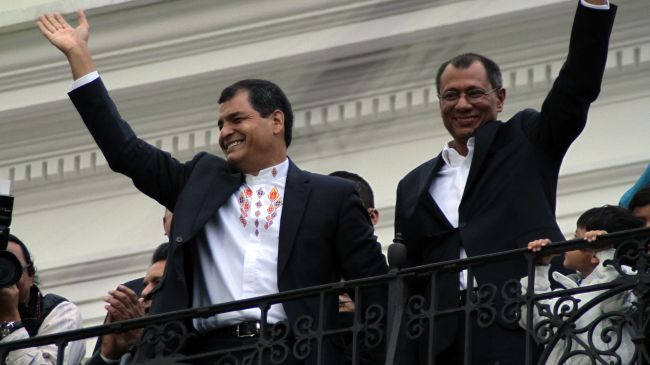
President Rafael Correa swept to a re-election victory on Sunday promising to strengthen state control over Ecuador’s economy and continue using booming oil revenues to build roads, hospitals and schools in rural areas and shanty towns.
Correa won 58% of the votes compared with 24% for runner-up Guillermo Lasso, according to preliminary results released by the electoral authority based on almost 40% of the votes counted. Correa was so confident of his victory that he appeared on state TV less than an hour after polls closed.
“Nobody can stop this revolution,” a jubilant Correa told supporters from the balcony of the Carondelet presidential palace, after claiming victory. He added “we are making history; we are building our own homeland which is Ecuador and the great homeland which is Latin America.“
The populist US-trained economist took power in 2007 and has won strong support among the majority of the population of the country which is poor.
Correa, 49, may now be in line to become Latin America’s main anti-American voice and de facto leader of the ALBA bloc of populist governments as Venezuelan President Hugo Chavez has been silenced during his battle with cancer. Correa said he dedicated his victory to Chavez.
The principal challenge in Correa’s new four-year term will be wooing investors needed to boost stagnant oil production and spur the mining industry. A 3.2 billion dollars debt default in 2008 and aggressive oil contract negotiations scared many off.
Critics view Correa as an authoritarian leader who has curbed media freedom and appointed aides to top posts in the judiciary.
But the fractured opposition failed to make a consolidated challenge. It fielded seven candidates, making it easy for Correa, and he is now on track for a decade in office.
That is rare stability in a country where three presidents were pushed from office by coups or street protests in the decade before Correa took power in 2007. He is already the longest-serving president in Ecuador since the return to democracy in the 1970s following a military dictatorship.
Correa’s success has hinged in part on high oil prices that allowed for liberal state spending, including boosting cash handouts to 2 million people, and spurred solid economic growth.
He has promised to diversify the economy away from its dependence on oil, in part by bringing in new investment for the mining sector. Despite promising reserves of gold and copper, mining operations have barely gotten off the ground.
In a news conference on Sunday after polls closed, Correa played down the need for more foreign investment. He insisted the ultimate goal was to ensure economic growth rather than ”mortgaging“ the country to bring in cash from abroad.
”We welcome foreign investment, and we’re already getting plenty of it,“ Correa said. ”Ecuador is one of the most successful economies in Latin America.”
Ecuadorans also chose a new Congress on Sunday.
The ruling Alianza Pais party was expected to win a majority in the legislature, which would let Correa push ahead with controversial reforms, including a media law and changes to mining legislation, without having to negotiate with rivals.
The results of the vote for Congress are not expected to be known for several days.
Related articles
Obama Regime Refuses to Investigate Alleged DEA Killing of Women and Child in Honduras
By Noel Brinkerhoff | AllGov | February 17, 2013
 Democrats on Capitol Hill want the Obama administration to investigate the deaths of four civilians in Honduras last year during an anti-cocaine raid involving U.S. law enforcement agents. But administration officials have balked at the request.
On May 11, 2012, four villagers in a boat on the River Patuca, two pregnant women, a 21-year-old man and a 14-year-old boy, were killed when local police entered the town of Ahuas in northeastern Honduras to conduct a counternarcotics operation. Another four boat passengers were injured by gunfire. It was later learned that members of the U.S. Drug Enforcement Administration (DEA) participated in the raid, which raised questions of whether Americans were responsible for the killings.
The Honduran government investigated the incident and concluded the DEA was not at fault for the deaths.
But 58 House Democrats were not satisfied with the probe, which they called “deeply flawed” in a letter to Secretary of State John Kerry and Attorney General Eric Holder Jr. calling for the U.S. to conduct its own examination.
Officials with the State Department and the Department of Justice said their agencies have no intention of reopening the matter, according to The Washington Times.
More:
Government Won’t Probe of DEA Raid in Honduras (by Guy Taylor, Washington Times)
Collateral Damage of a Drug War (Center for Economic and Policy Research) (pdf)
Related articles
Venezuelan arms maker to continue Iran trade despite US bans
Press TV – February 17, 2013
Venezuelan officials say the state-owned weapons manufacturer, CAVIM, will keep on trading with Iran in defiance of the US sanctions imposed on the company, Press TV reports.
“We think that it is logical for Venezuela to have trade and economic relations with all countries in the world. We are exercising our sovereignty,” Venezuelan Envoy to international rights bodies German Saltron said.
“We feel it is an abuse of power that the United States’ government is trying to block Iran from trading with other countries,” he added.
On February 11, the US State Department imposed sanctions on CAVIM allegedly for violating the so-called Iran Nonproliferation Act of 2000, which aims to prevent Tehran from acquiring weapons of mass destruction.
According to the US State Department website, sanctions on the Venezuelan weapons manufacturer will be in place until February 2015.
The US, the Israeli regime and some of their allies have repeatedly accused Iran of seeking to produce an atomic bomb under the cover of its nuclear energy program, a claim Iran has categorically rejected.
In 2011, Washington imposed sanctions on Venezuela’s state-owned giant oil company, PDVSA, for having oil deals with Iran’s energy industry and as part of its campaign to tighten sanctions on the Islamic Republic over its nuclear energy program.
Under the sanctions, PDVSA is denied US government contracts and banned from Washington’s export financing.
The administration of President Barack Obama is alleging that Iran is using its close economic relationship with Socialist President Hugo Chavez’s government to establish a military presence in Latin America.
In December 2012, the US president enacted a law “aimed at countering Tehran’s alleged influence in Latin America.”
Strategically dubbed as ‘Countering Iran in the Western Hemisphere Act of 2012’, the act calls for the State Department to develop a plan within 180 days to “address Iran’s growing hostile presence and activity.”
However, Iran and Venezuela have continued to expand their trade ties despite these sanctions.
More than 100 bilateral agreements have been signed between the two countries over the past decade, while last year Iranian firms signed a USD2.5 billion contract to build 17,000 houses for underprivileged people in Venezuela.
The Islamic Republic has been seeking to expand relations with Latin American countries over the past years, describing the endeavor as one of its major foreign policy strategies.
Iran’s growing popularity in Latin America has raised major concerns in Washington, which regards the region as its strategic backyard and traditional sphere of influence.
Related articles
- Venezuela wants best of relations with the US based on ‘mutual absolute respect’ (alethonews.wordpress.com)
- US probes Swiss medicine giant for trade with Iran (alethonews.wordpress.com)
Stranded in Shuhada: Hebron’s Qurtuba school
By Salam Muharam – Ma’an – 15/02/2013
HEBRON — Children and teachers at Qurtuba school in Hebron say getting to class past Israeli soldiers and settlers is like navigating a minefield every day.
The school, for children aged 7 to 16, is adjacent to the illegal Jewish settlement of Beit Hadassah in the center of the West Bank city.
Israeli forces fenced off the school’s stairs with barbed wire in 2002. Now the only route to the school is a muddy path up a steep hill.
Some pupils live beside the school, but have to walk two kilometers around a circuit to reach the entrance, Najah Abu Munshar, a teacher in the school told Ma’an.
Across the street from the school, “Gas the Arabs” has been scrawled on a door. Next to the school gates, a mural of a girl holding a book, painted by a French activist, has been covered by racist graffiti. A gallery in a school corridor shows photos of Israeli soldiers and settlers assaulting students.
International volunteers escort children to and from school as a protective measure, but pupils and teachers are still frequently harassed and assaulted on their way to the school, which has been vandalized and set on fire.
“School students start their day by crossing the checkpoint of Shuhada street. I can only describe daily life at Qurtuba school as suffering and struggle,” school principal Noura Nasser told Ma’an.
Teachers must also pass an Israeli checkpoint and metal detectors to get to work, and Israeli soldiers decide whether to let them pass each day.
Pupil Yasmeen Ghareb, 12, says settlers have assaulted her and her siblings. “Sometimes they say bad words to me, and sometimes they throw fluids at me on my way to school.”

Yasmeen Ghareb stands in front of a checkpoint on her way to school
(MaanImages/Salam Muharam)
Other students told Ma’an that settlers have attacked them with stones, water and rotten vegetables.
Najah Abu Munshar has taught at Qurtaba school for 15 years. “The settlers used to let their dogs attack the students, and when settlers attack a student, I try my best to calm him or her down, and if he or she has any wounds, I provide first aid,” she told Ma’an.
The Ministry of Education hired a psychological counselor for the school, to work with children suffering psychological trauma which often manifests as bed wetting, Nasser, the school principal, told Ma’an. “The school focuses on the extracurricular activities and days of joy.”
Nasser said settler attacks were usually heightened during periods of political instability.
A grid of walls, fences and checkpoints divides Jewish settlers and Palestinians who live in close proximity to each other in Hebron, which was divided into two sections in the 1997 Hebron Agreement.
The Palestinian Authority controls the larger area, while Israeli forces control the city center, including the old market, the Ibrahimi Mosque and the historic Old City.
Qurtaba school lies on Shuhada street, a once-bustling thoroughfare and now a shuttered ghost town, with a military checkpoint restricting Palestinians’ access to this part of the city.
Israel started restricting access to Shuhada street after an Israeli settler Baruch Goldstein broke into the Ibrahimi Mosque and shot dead 29 Palestinians.
During the second intifada, Israel closed the street to traffic and many traders were not even able to collect their goods before their shops were welded shut.
Palestinian families who remained on Shuhada street must climb through side doors and across rooftops to get to their homes.
Waed Zeidan al-Sharabati, a 9-year-old pupil at Qurtuba school who lives on Shuhada street, recounted to Ma’an how settlers assaulted her and her cousin in 2011 when they were harvesting almonds nearby.
“They threw stones on us… The settler kidnapped my cousin, and I called the neighbor to come check the situation. My neighbor talked to the settlers, and after a long argument, my cousin was returned. One settler threw a stone on my leg. They tried to take me another time, but I escaped to my neighbor’s wife, and she hid my inside her home, and closed the door.”
“I got used to it, and at the beginning I used to be scared, but now I am not scared of them,” she told Ma’an.

Ward al-Sharabati, 9, lives on Shuhada street, a hub of settler violence in the West Bank
(MaanImages/Salam Muharam)
Related articles
- Local activist detained in Hebron (alethonews.wordpress.com)
- Israeli occupation forces kill woman near Hebron (alethonews.wordpress.com)
- Israeli army dogs attack elderly Palestinian, two-year-old child injured in the head in Jewish settlers’ attack (alethonews.wordpress.com)
- Israel detains Palestinian cartoonist, family says (alethonews.wordpress.com)
Message from Samer el Issawi, day 209 hunger strike
February 16, 2013
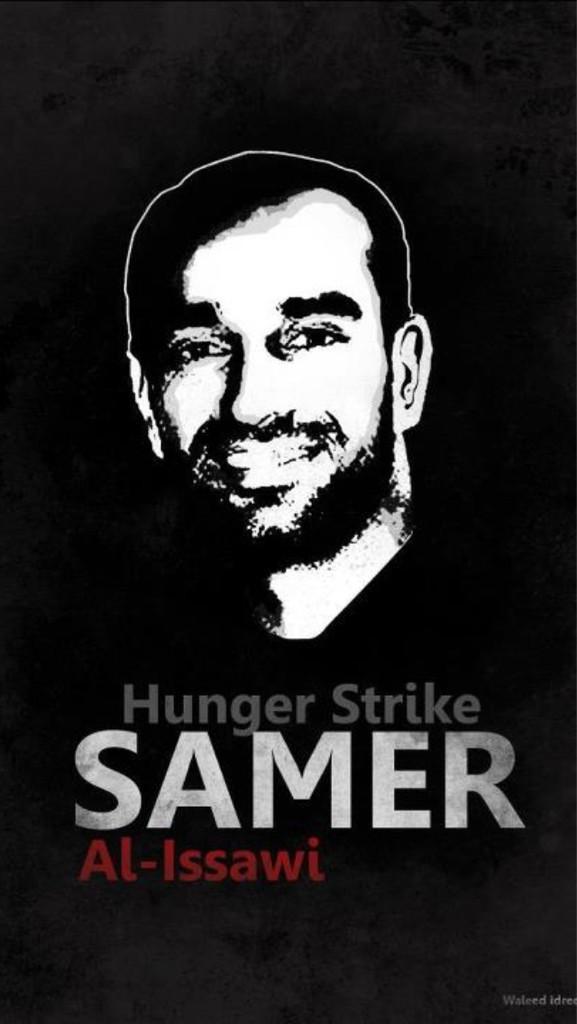 “I turn with admiration to the masses of our heroic Palestinian people, to our Palestinian leadership, to all forces, parties and national institutions. I salute them for standing by our fight to defend our right to freedom and dignity.
I draw my strength from my people, from all the free people in the world, from friends and the families of the prisoners who continue day and night chanting for freedom and an end to the occupation.
My health has deteriorated dramatically and I’m hung between life and death. My weak body is collapsing but still able to be patient and continue the confrontation. My message is that I will continue until the end, until the last drop of water in my body, until martyrdom. Martyrdom is an honor for me in this battle. My martyrdom is my remaining bomb in the confrontation with the tyrants and the jailers, in the face of the racist policy of the occupation that humiliates our people and exercises against us all means of oppression and repression.
I say to my people: I’m stronger than the occupation army and its racist laws. I, Samer al-Issawi, son of Jerusalem, send you my last will that, in case I fell as a martyr, you will carry my soul as a cry for all the prisoners, man and women, cry for freedom, emancipation and salvation from the nightmare of prisons and their harsh darkness.
My battle is not only for individual freedom. The battle waged by me and by my heroic colleagues, Tariq, Ayman and Ja’affar, is everyone’s battle, the battle of the Palestinian people against the occupation and its prisons. Our goal is to be free and sovereign in our liberated state and in our blessed Jerusalem.
The weak and strained beats of my heart derive their steadfastness from you, the great people. My eyes, which started to lose their sight, draws light from your solidarity and your support of me. My weak voice takes its strength from your voice that is louder than the warden’s voice and higher than the walls.
I’m one of your sons, among thousands of your sons who are prisoners, still languishing steadfast in the prisons, waiting for an end to be brought to their plight, their pains and the suffering of their families.
The doctors told me I became exposed to stroke because of the disorder of my heartbeats, the shortage of sugar and the drop in blood pressure. My body is full of cold and I can’t sleep because of the continued pain. But despite the extreme fatigue and chronic headaches, as I move on my chair, I’m trying to summon all my resources to continue on the road till its end. There is no going back, only in my victory, because I’m the owner of Right and my detention is invalid and illegal.
Do not be afraid for my heart if it will stop, don’t be afraid for my hands if they will be paralyzed. I am still alive now and tomorrow and after death, because Jerusalem is moving in my blood, in my devotion and my faith.”
**Via Rona Merrill, Neta Golan
Related article
- Shireen Al-Issawi: PA did not take prisoners’ issue to the UN (alethonews.wordpress.com)
Israel detains Palestinian cartoonist, family says
Ma’an – 16/02/2013
 JENIN – Israeli authorities on Saturday detained a Palestinian cartoonist on his way back to the West Bank from Jordan, according to his family.
Muhammad Abdul-Ghani Sabanah, 30, was detained at the Allenby Bridge crossing between Jordan and the West Bank, his brother Tamir told Ma’an, adding that Sabanah was in Jordan for a meeting.
He said that on his way back, Israeli troops detained Sabanah, who is from the Jenin town of Qabatia, without giving any explanation.
Sabanah’s cartoons are widespread in the Arab world. He is well-known for his criticism through his cartoons, which focus mainly on the Palestinian people’s problems and the Palestinian-Israeli conflict.
He works as a public information officer at the Arab American University in Jenin.
Related articles
- Israeli army dogs attack elderly Palestinian, two-year-old child injured in the head in Jewish settlers’ attack (alethonews.wordpress.com)
- EU demands rights for Palestinian hunger strikers (altahrir.wordpress.com)
Academy Awards for the Promotion of Torture?
By Dave Clennon | Dissident Voice | February 16th, 2013
I’m a member of Hollywood’s Motion Picture Academy. At the risk of being expelled, for disclosing my intentions, I will not be voting for Zero Dark Thirty — in ANY Academy Awards category.
Everyone who contributes skill and energy to a motion picture — including actors — shares responsibility for the impressions the picture makes and the ideas it expresses. If I had played the role that was offered to me on Fox’s 24 (Season 7), I would have been guilty of promoting torture, and I couldn’t have evaded my own responsibility by blaming the writers and directors.
So Jessica Chastain won’t get my vote for Best Actress. With her beauty and her tough-but-vulnerable posturing, she almost succeeds in making extreme brutality look weirdly heroic.
There’s plenty of “Oscar buzz” around Zero Dark Thirty. Several associations of film critics have awarded it their highest honors. I have watched the film (2hrs, 37min). Although torture is an appalling crime under any circumstances, Zero never acknowledges that torture is immoral and criminal. It does portray torture as getting results. The name of Osama Bin Laden’s courier is revealed (in the movie) by a “detainee,” Ammar, who has endured prolonged and horrifying torture.
The two lead interrogators, both white, are not torturing Ammar at the moment he gives up the name (Abu Ahmed), but he is still utterly depleted from at least 96 hours of sleep-deprivation, and he knows they will torture him again, if he resists. “Y’know, I can … hang you back up to the ceiling,” says chief interrogator Dan.
The “moral” of this particular screen story? Torture sometimes works. Not always. Later, the female interrogator (and Zero’s heroine Maya [Chastain]), supervises
the “enhanced interrogation” of another detainee, Faraj. These are some of the enhancements we see her employ: first, a thick brown liquid is poured into a funnel which has been pushed into Faraj’s mouth and rammed part-way down his throat; then Maya supervises his beating and near-drowning (aka waterboarding); he gasps for air, gags, shudders and chokes.
Director Kathryn Bigelow then shows Chastain in a clean, well-lighted restroom, looking pretty, but tired and frustrated; Bigelow does not give us a view of Faraj after HIS ordeal. Next we see Maya complaining to her mentor Dan that Faraj hasn’t cracked. “You want to take a run at him?” she asks, smiling hopefully.)
In minute 45 of Zero, we learn that Faraj has “gone south.” Maya’s relentless, merciless torture has finally killed her detainee. She is now a murderer. So, for the next hour and 45 minutes, we’re rooting for a gorgeous, murdering thug to track down a charismatic, murdering jihadist.
If, in fact, torture is a crime (a mortal sin, if you will) — a signal of a nation’s descent into depravity — then it doesn’t matter whether it “works” or not. Zero Dark Thirty clearly condones torture. Not a single character involved in “The Greatest Manhunt in History” expresses any regret about the CIA’s use of torture. Maya/Chastain gets her man (code named “Geronimo”!) and that’s all that counts. The end justifies the vicious means.
Individuals and groups protesting the easy tolerance of torture in Zero Dark Thirty have been dismissed by some commentators as having “a political agenda.” The grievous problem presented by torture is NOT political. It’s moral. And it’s criminal. Decent people of the left, the right, and the center would all judge the torture in Zero Dark Thirty as immoral and criminal.
If the deeply racist landmark film Birth of a Nation were released today, would we vote to honor it? Would we give an award to Leni Riefenstahl’s brilliant pro-Nazi documentary, Triumph of the Will? Hundreds of millions around the world watch the Oscars, we’re told. Are we going to show the world that we Americans STILL approve of torture?
After Jessica Chastain won Zero Dark Thirty’s only Golden Globe Award, it occurred to me that she is the new face of American torture — as Kiefer Sutherland was, for several years. If the Academy votes her an Oscar, it wouldn’t be surprising if the world community concluded that the U.S.A. still tolerates this vicious, criminal behavior.
Sometimes, it’s not just a movie. And acting in it isn’t just a job. It’s a moral choice.
Dave Clennon can be reached at djjc123@earthlink.net.
Related articles
- Oscar-nominated Palestinian director detained at LAX
- Hollywood’s Imperial Propaganda
- Abe Lincoln, Racist Fascist?
- Hollywood myths harming the whole world: Ken O’Keefe
- Academy Awards for the Promotion of Torture?
- Oscar Prints the Legend: Argo’s Upcoming Academy Award and the Failure of Truth
- Hollywood Snubs Best Film as ‘Zero Dark Thirty’ Odds Fade – Bloomberg
The Drug Trade and the Increasing Militarization of the Caribbean
By Kevin Edmonds | The Other Side of Paradise | February 8, 2013
Given the current controversy surrounding the extent of the U.S. drone program and targeted killings, it is important to revisit that in the summer of 2012, the U.S. Customs and Border Protection Agency announced that unmanned drones would begin patrolling Caribbean airspace as an expansion of the Caribbean Basin Security Initiative (CBSI). This is only one aspect of how the War on Drugs in the Caribbean is increasingly looking like the War on Terror.
The U.S.–Caribbean border is the often ignored “Third Border,” which the Department of Homeland Security has referred to as an “open door for drug traffickers and terrorists.” A recent study by the National Defence University has stated that “the region’s nexus to the United States uniquely positions it in the proximate U.S. geopolitical and strategic sphere. Thus, there is an incentive, if not an urgency, for the United States to proactively pursue security capacity-building measures in the Caribbean region.”
While the drones are unarmed for the time being, they will be primarily used to locate drug traffickers operating fishing boats, fast boats, and semi-submarines and would relay information to the Coast Guard, Navy or Caribbean authorities to carry out the interception and arrests. It has been revealed that the drones will be operating out of bases in Corpus Christi, Texas, Cocoa Beach, Florida and potentially the Dominican Republic and Puerto Rico.
The shift towards the use of drones in the region is largely based off of an unconvincing pilot program carried out over 18 months in the Bahamas, in which “During more than 1,260 hours in the air off the southeastern coast of Florida, the Guardian (drones) assisted in only a handful of large-scale busts.” That said, the Caribbean governments increased militarization in the region when they implemented the never-ending War on Drugs without any public consultation or debate. This erosion of regional sovereignty may be a slippery slope to a dangerous future in which Caribbean nationals may very well find themselves on kill lists instead of facing a trial.
Such a conclusion is not baseless, as a November 2012 report by the U.S. House Committee on Homeland Security recommended that Latin American drug cartels be classified as terrorist organizations “so there is increased ability to counter their threat to national security.” Furthermore, in 2009, the U.S. Military drew criticism for placing 50 suspected Afghani drug traffickers on a “kill list” as part of their ongoing efforts to cut off finance stream of the Taliban. The controversy arose due to the fact that drug traffickers (generally classified as civilians) had now been placed into the same legal category as the Taliban “insurgents” and thus became legitimate targets.
This is especially important in light of how the extradition of Jamaican kingpin Christopher “Dudus” Coke was handled. In September 2009, the United States requested his extradition to face drug trafficking charges, but Jamaican Prime Minister Bruce Golding blocked the request due to his deep political connections with Coke. It was only after months of intense pressure that Golding caved in May 2010. Jamaican Police and the Jamaican Defense Forces led the bloody operation to arrest Coke, which resulted in the deaths of more than 70 civilians—the vast majority of which were unarmed.
The resulting scandal led to the downfall of Golding as Prime Minister but highlighted the power that drug traffickers and gang leaders have had in Jamaican government and politics. It has since been reinforced that the operation was “assisted by the U.S. government and carried out, to a large degree, at its behest.” Information has emerged which reveals that a U.S. spy plane participated in the raid of Coke’s stronghold of Tivoli Gardens, and a Freedom of Information Act action has recently been levied against the Drug Enforcement Agency (DEA) by a group of law students to reveal the extent of U.S. involvement.
To prevent such explosive outcomes in the future, there has been a call for closer integration between Caribbean police forces and the U.S. DEA in a clear escalation of the War on Drugs. A September 2012 Senate Report revealed that Jamaica has been floated as a target for a Sensitive Investigative Unit, which consists of a highly trained police that collaborate with the DEA. A similar program exists in Kandahar, where U.S. and British troops have created and participated in a task force made up of Afghan police officers and U.S. DEA agents to disrupt the drug trade and investigate corrupt Afghan officials.
According to a seemingly benign Department of Homeland Security (DHS) press release announcing the drone program, the “DHS is partnering with Caribbean nations to enhance border security in the region through the Caribbean Basin Security Initiative (CBSI) . . . . The DHS is conducting border security training in conjunction with CBSI to increase partner nation capacity to secure their borders.” The problem with such statements is that there is always more shady business going on behind the scenes. Given the direction of U.S. policy in the region, it will only be a matter of time until the War on Drugs becomes eerily similar to the War on Terror.
Related article
Double Standards for Prisoners Vanished In Israel

By Yahya Dbouk | Al-Akhbar | February 15, 2013
The case of Ben Zygier, known as “Prisoner X,” has opened the door to questions about the possibility of Israel secretly detaining other prisoners and abductees.
Zygier, a Jewish-Australian citizen, died in an Israeli prison two years ago, in a case Israel went to extreme lengths to cover up, imposing media gag orders.
This is not the first time Israel has hidden information related to the whereabouts and conditions of prisoners. Consider, for example, reports of the three Iranian diplomats kidnapped by the Lebanese Forces during the Israeli invasion of Lebanon in 1982, who were reportedly moved to prisons in occupied Palestine.
Then consider the case of Lebanese prisoner Yahya Skaf. In addition to a wealth of reporting on his case, testimonies by other detainees all aver that he is still alive and being held in an Israeli prison. It’s a claim that Tel Aviv denies, maintaining that it lost Skaf’s body.
In the same vein, reports from various sources assert that Iranian General Mohammed Reza Asgari, who was kidnapped in Turkey in 2007, is being held in Israel.
Until recently, the global norm was to accept that Israel is a state where the rule of law is paramount. Any reports that questioned Israel’s democratic credentials were considered prejudiced or even anti-Semitic.
Yet if Tel Aviv was able to conceal the truth about Zygier for so long – the fact that he had committed suicide more than two years ago – then it’s entirely fathomable that Israel is withholding the truth about other prisoners like Skaf, Asgari, and the above-mentioned Iranian diplomats.
The answer is now clear and backed up by damning evidence: Israel has both the capability and the willingness to engage in such acts.
A simple hypothetical exercise. Let’s say the kidnapping, detention, and subsequent suicide of the Australian Prisoner X had happened to another detainee of a different nationality. How would the global media reaction differ? Would it have been as fervent as with the Australian Prisoner X?
Just look to the cases of the Lebanese and Iranian detainees, specifically with the three Iranian diplomats and General Asgari. Iran repeatedly declared that it had evidence as to their whereabouts, and the Iranian press reported extensively on the matter. Yet Israeli denials were enough to refute the Iranian account. Western and Israeli reports did not stop there, and Iran was even mocked as a source of fabricated news.
The same applies to cases involving Lebanese citizens, such as Skaf. Israel cannot possibly deny it has him, and that he had entered occupied Palestine. For one thing, Tel Aviv’s claims about Skaf and his lost body make little sense. If he had been a citizen of Australia, or other nations of similar stature, Israel’s account would have differed.
Israeli assertions that Tel Aviv had kept the Australian government in the loop on Prisoner X created more – not less – ramifications. Indeed, Israel is not only able to hide the facts and detain people in secret, but also to involve Western governments in the cover-up.
Featured Video
Chinese jet fuel and the myth of energy independence
or go to
Aletho News Archives – Video-Images
From the Archives
The Dirty Little Secret behind the “Global Terrorism Index”
The Omission of Israeli Terrorism in the Occupied Palestinian Territories
By Karin Brothers | Global Research | December 6, 2014
… The Israeli settlements — all of which are illegal – have been identified as a major impediment to peace. The refusal of a major “global” terrorism report to name the Israeli settlers as one of the groups most responsible for terrorism not only misrepresents a major source of regional violence but exposes the Global Terrorism Index as a propaganda tool that supports a U.S. agenda.
In recent years, governments have been attempting to thwart terrorism by blocking supportive fund-raising. When it comes to Israeli settlements, however, the US and Canada actually encourage fund-raising by giving organizations (such as Christian Friends of Israeli Communities (CFOIC) and the Jewish National Fund) financial support in the form of donor tax-deductions.
Charities which provide funds for the Israeli settlements should be regarded as terror-financing organizations. They should not only lose their tax-deductible status, but they should be banned because they support the violation of international humanitarian law. The terror-financing laws that are being strictly enforced for Muslim charities should be applied to Christian and Jewish charities as well. … Read full article
Blog Roll
 Aletho News
- Chinese jet fuel and the myth of energy independence
- Ukraine Sea Drone Fired From Libya Hit Russian Tanker in Mediterranean
- IRGC: Iranian forces launched no attacks during ceasefire hours
- Trump Administration Moves To Automate U.S. Military Draft Registration
- Spain orders reopening of Tehran embassy, condemns Israel’s carpet bombing of Lebanon
- Israel faces ‘unsustainable’ strategic crisis following 40-day war against Iran: Analyst
- Iran restricts Hormuz access to 15 vessels per day under ceasefire terms: Report
- The ‘Opposition Party’ Has Done Nothing to Stop the Iran War and Much to Goad Trump Into Continuing It
- Moscow backs Tehran on status of Lebanon in US-Iran deal
- How UK Regulator Ofcom Quietly Bypassed International Law to Police American Speech
- If Americans Knew
- Amnesty: Urgent – Protect Lebanese civilians from brutal escalation in Israeli attacks
- Is The War Against Iran Over?
- Inside the Israeli army’s propaganda wing
- Hundreds of Gaza Amputees Stranded in Legal Limbo
- The gallows law: Israel moves toward executing Palestinian children
- Tucker Carlson: The Path to Peace requires ending ‘special alliance’ with Israel
- This is ceasefire? Israel’s biggest massacre yet in Lebanon, another journalist killed in Gaza – Daily Update
- Tucker Carlson on Israel: This Is the Behavior of an Ally? Really?
- Gazans face a triple crisis: severe shortages of water and bread, healthcare in tatters
- NY Times reports how Netanyahu took the US into Iran War
- No Tricks Zone
- An Inconvenient Tree: Uncovered In Alps… Europe Much Warmer Than Today 6000 Years Ago
- New Study Reports A 60% Slowdown In Greenland’s Ice Loss Rate In The Last Decade
- Low Intensity Tornado Wrecks Major Solar Farm, Creating A Potential Toxic Dump
- New Study Finds Warming Saves Lives…Cold Temperatures 12 Times More Deadly Than Excess Heat
- German Science Blog Accuses PIK Climate Institute Of Hallucinating Climate Tipping Points
- Devastating Assessment Of Comirnaty Vaccine By Former Senior Pfizer Europe Toxicologist
- New Study: CO2 Is ‘Effectively Negligible’ As An Explanatory Climate Change Factor Since 2000
- Former Pfizer Toxicologist Dr. Helmut Sterz Tells Bundestag Hearing Pfizer Vaccine Should Have Never Been Approved
- Energy Expert: Germany’s Nuclear Phaseout Was A “500 Billion Euro Mistake”
- New Research: South Australia’s Mid-Holocene Sea Surface Temperatures Were 4°C Warmer Than Today
 Aletho News