How Europe’s Fight with Google Over Privacy Ignores Real Privacy
By Alfredo Lopez | This Can’t Be Happening | April 10, 2013
Last week the governments of France, Germany, Italy, the Netherlands, Spain, and the United Kingdom fired a warning shot at Google and it appears they’re reloading the gun with real ammunition.
This past December, about a year after the Internet behemoth announced a new privacy policy, a working group of representatives from these countries called the policy grossly abusive of people’s privacy and said Google had four months to bring itself into compliance with European law. Google dismissed the ultimatum: “Our privacy policy,” it said, “respects European law and allows us to create simpler, more effective services.” The European countries response was that they will take actions, based on their national laws and in coodination with each other, by the Fall.
These government/corporation tiffs are frequent and their rhetorical fire normally turns into quickly dissipated smoke. This one could be different. It comes at a time when the world’s powerful are trying to decide how much privacy we people will have and what the term privacy actually means, and this squabble’s outcome will affect that and, of course, our freedom. That alone makes it worth watching.
But there’s something deeper here that transcends this conflict. Privacy is, in fact, a core component of democracy and any infringement on complete privacy is an obscene attack on the possibility of having a free and democratic society. As important as the outcome of this show-down might be, the most important and frightening development is that it’s taking place at all.
The political shoot-out began a year ago when Google announced that it was unifying about 60 privacy policy agreements, covering its myriad services, into one big one. The company explained that lumping together these “agreements” (the things you’re asked to read before pressing the “I Accept” button on a website) was a matter of efficiency and transparency. There’s a logic to that: how many privacy policies have you read on the Internet? One would assume that if you don’t read one, you can hardly be expected to read 60.
That, however, is a corporate shell game. Google made this move not to make our reading easier but to make gathering information about us more efficient. Google is a marketing company and nothing makes a marketing company more powerful and valuable to advertisers than having pertinent information on hundreds of millions of people all over the world. Its privacy policy is fitted to that purpose. It says that, once you sign up and begin using these services as an identified user, you give up that right of refusal. So, because people don’t read that privacy policy, they don’t realize that it effectively eliminates their privacy.
For a very long time, Google has known who uses each of its services and how, but now it knows which combination of services you use and how they interact with each other in your daily life. It also knows cities or towns of residence (and, in many cases, addresses) of its registered users, the IP addresses of their computers, their names (and often the names of their family members and friends), what they do on the Internet every day, what they buy and consider buying and, for those using Gmail, who they write to and what they write. It can hone in a your specific physical location with Goodgle Maps and will store that info if you map it. In fact, all this info is stored on Google’s databases with members’ tacit approval and Google’s complete understanding of what all this means.
“If you have something that you don’t want anyone to know, maybe you shouldn’t be doing it in the first place,” Google CEO Eric Schmidt said in 2009. “If you really need that kind of privacy, the reality is that search engines — including Google — do retain this information for some time and it’s important, for example, that we are all subject in the United States to the Patriot Act and it is possible that all that information could be made available to the authorities.”
The information Google holds rivals and in some cases surpasses the information most governments have on their own citizens. So when Google released this new policy which permits it to combine that information and use it for evaluation, marketing and advertising, these governments commissioned France’s CNIL to investigate.
That selection, in itself, is striking. The CNIL is an independent, government-supported authority that specializes in data privacy law enforcement. France has among the strongest data collection restrictions in the world and, while CNIL has often been criticized by advocates for being too sheepish in its advocacy, data protection “sheepishness” in France would be considered ferocity in many other countries.
Like a trained bulldog, CNIL investigated all the Google data policies for nine months and then presented its report. It was devastating, accusing Google of policies and mechanisms that effectively violate privacy laws in most European countries. Based on that report, 24 of the EU’s 27 data regulators wrote Google a letter last December proposing about a dozen changes: among them that Google shouldn’t collect information on users without their consent, combine information from different services without additional consent or use the data it collects for advertising.
The four months passed. “Google did not provide any precise and effective answers,” CNIL said last week. “In this context, the EU data protection authorities are committed to act and continue their investigations. Therefore, they propose to set up a working group, led by the CNIL, in order to coordinate their reaction, which should take place before summer.”
In the diplomatic jargon of international regulation, those are fighting words. “Coordinate their reaction” is something the European Union’s countries seldom do (witness their financial crisis) and they almost never make threats around technology. Action against Google in Europe could affect the company’s relationship with one of its largest markets and a critical marketing link in the world-wide chain that is the Internet. Google could be crippled. That’s what that statement threatens.
But let’s not kid ourselves. A capitalist government, like those in Europe, has a system to protect and, to do the protecting, its police agencies routinely use data collected on the Internet about its citizens. As Google’s Schmidt put it in 2010: “In a world of asynchronous threats it is too dangerous for there not to be some way to identify you. We need a [verified] name service for people. Governments will demand it.”
So the issue here isn’t really how to protect people’s privacy; it’s how to balance the various approaches to impinging on it. Google says it needs information about you to match its marketing to what you buy; governments say they need information about you to monitor and control what you do the rest of the time. They’re trying to work out how these two approaches to information gathering can co-exist and not conflict with each other.
If, for example, a particular policy draws too much public attention to this issue or provokes a large lawsuit or gets people asking why their government isn’t — or is — doing something, that’s a problem. The government will then find its own privacy policies in the spotlight. That’s only one way this balance can become unbalanced, but in any case balance is the issue being disputed. There is really no debate about whether or not you have a right to privacy on the Internet. As far as both sides are concerned, you don’t, and both sides are most pleased if you’re not paying much attention to that fact.
It’s persistently perplexing how little most people care about this issue. Even many of the most politically conscious will often just shrug and say “there’s nothing that can be done about it”. After decades of increasing surveillance (oiled by a government-encouraged paranoia about terrorism) we expect the powerful of our society to know everything about us and, apparently, most of us can live with that. Some of us appear to think we can’t live without it.
But that battering of our democratic consciousness has not only lowered our guard against violations of our privacy; it has actually fostered a distorted understanding of what privacy actually is. Or better put: it’s convinced many of us that a small part of the privacy debate is the entire debate.
For purposes of the Internet, privacy is your ability to communicate with other people excluding anyone you want from that conversation and your ability to say what you want to those people (and listen to what they have to say) excluding people you don’t want listening.
Sure, what you say to your family or which websites you visit or what you consider buying on the Internet should, in a sane society, be your business and taking a snapshot of all this is a horrible personal violation. But the more dangerous violation is that, in establishing the means to eavesdrop on your life and honing the ability to store and analyze that information, powerful forces are systematically limiting what the Internet can be about.
What humanity created as a tool of freedom and, in many cases, struggle has been taken over by corporations and governments wielding lawsuits, imprisonment and largely unnoticed anti-freedom laws to pervert its original intent.
“When the Internet began… it was seen largely as a non-commercial oasis,” free-speech advocate and writer Robert McChesney told Democracy Now in a recent interview. “It was a place where people could go and be equal and be empowered as citizens to take on concentrated economic and political power, to battle propaganda… And there was no surveillance. People could do what they wanted and not be tracked.
“What’s been taking place… is that on a number of different fronts, extraordinarily large, monopolistic corporations have emerged: AT&T, Verizon, Comcast, at the access level; Google, Facebook, Apple, Amazon, at the application and use level. And these firms have changed the nature of the Internet dramatically… (and) they work closely with the government and the national security state and the military. They really walk hand in hand collecting this information, monitoring people, in ways that by all democratic theory are inimical to a free society.”
“Privacy” isn’t primarily individual and privacy laws aren’t in place only to address individual activities. In fact, you can’t be individually private on the Internet because then you wouldn’t be using the Internet. The privacy laws are there to make sure people can function in our exercise of free speech, exchange of information and association. They are, and always have been, a way to protect us from government inquiry and inquisition. Those laws that say a cop can’t just walk into your house and search it without a warrant or question you and those with you or keep close tabs on everything you do and who you do it with — those are privacy laws. They protect our collaborative activity from
government repression.
That collaborative activity is what the Internet has deepened and broadened. It lets us communicate with people all over the world involved in activities emanating from issues and concerns similar to ours. It lets people who are fighting for their rights in a country where such activity can get you jailed or killed talk to people world-wide who can support them. It permits coordination of struggles going on in vastly different environments in far-away countries. It cuts through our media’s lies about other countries with solid truth we learn from people in those countries. It helps unify us and helps us support each other in a rapid, almost immediate, way.
It’s what humanity needs and it’s the reason why the Internet now reaches two billion people.
But if the privacy is taken away, if a government or a corporation can read your email or follow you around as you visit and use websites, your use of the Internet for its most important political purpose becomes stored information that can be used to oppose and repress you.
Privacy, viewed that way, is the litmus test of a free environment. In that context, Google is a monster and the governments that are challenging it on such restricted grounds aren’t much better.
Yes, the progressive response to the European initiative on Google privacy should be to encourage it but with an understanding of its pitfalls and a loud outcry about them. Even if Europe has its way, the outcome will still be an erosion of our privacy and a further empowerment of those who would, in some situations, repress our movements for change.
So right now, those of us who are truly concerned about the future of this society and the world, need to place Internet privacy among our most prominent issues.
FBI Sued for Info on Supersnooping Program
By RYAN ABBOTT | Courthouse News | April 10, 2013
WASHINGTON – The FBI refuses to provide information on a massive biometric identification database that can identify noncriminal civilians through iris scans, DNA, and facial and voice recognition, a watchdog claims in court.
The Electronic Privacy Information Center, or EPIC, sued the FBI in Federal Court, claiming that the bureau identified more than 7,000 pages of responsive records, but won’t release them.
EPIC claims the FBI began posting details on its website about its biometric identification system, known as Next Generation Identification (NGI), in 2009.
“When completed, the NGI system will be the largest biometric database in the world,” EPIC says in its complaint. “The vast majority of records contained in the NGI database will be of U.S. citizens.”
EPIC claims the NGI system will be able to identify people through fingerprints, iris scans, DNA profiles, voice identification profiles, palm prints and photographs, and will through facial recognition.
“The NGI database will include photographic images of millions of individuals who are neither criminals nor suspects,” the complaint states.
The Department of Homeland Security has spent “hundreds of millions of dollars” into the system, and wants to integrate it into state and local surveillance systems that may use other surveillance technology, giving the government the capability of real-time matching of live feeds from surveillance cameras, EPIC claims.
There are an estimated 30 million surveillance cameras in the United States, but not all of them will be used for law enforcement purposes, EPIC says in the complaint.
It claims private entities will also have access to the system.
EPIC claims the Orwellian system already is up and running in New York City, where police have been scanning irises of arrestees since 2010 and using a handheld device that “allows officers patrolling the streets to scan irises and faces of individuals and match them against biometric databases.”
At least 11 other states participate in the program: Arizona, Hawaii, Kansas, Maryland, Michigan, Missouri, Nebraska, New Mexico, Ohio, South Carolina and Tennessee, according to the complaint.
EPIC claims it submitted two FOIA request in 2012, seeking records on the FBI’s contracts with private contractors Lockheed Martin, IBM, Accenture, BAE Systems Information Technology, Global Science & Technology, Innovation Management & Technology Services, Platinum Solutions, the National Center for State Courts, and any other entities involved with the program.
The FBI said it found 7,380 pages of potentially responsive records but has failed to disclose a single agency record, the complaint states.
EPIC wants to see the records, and wants its FOIA fees waived.
It is represented by house counsel Ginger McCall.
Related article
Israeli soldier shoots disabled man in Hebron
Ma’an – 11/04/2013
HEBRON – Israeli forces on Thursday shot and injured a disabled Palestinian man in the southern West Bank city of Hebron in an act the Israeli army described as defensive.
Motaz Faraj Ibedo, who was already confined to a wheelchair after a shooting two years earlier, was critically injured and transferred to an Israeli hospital for treatment, the Palestinian Prisoners Society said in a statement.
An Israeli army spokeswoman confirmed that a Palestinian man was hospitalized after being shot during an arrest operation. She said a soldier fired at the man when he tried to steal a weapon.
She said he threw objects including a gas can at soldiers. Two were injured, she said.
Amjad al-Najjar, the director of the PPS office in Hebron, denounced the arrest raid targeting a man who is already unable to walk without assistance.
Al-Najjar said that the Israeli authorities were responsible for Ibedo’s life. He called on the Israeli side to allow the man’s family and lawyer to visit him in custody.
An army spokeswoman denied Ibedo was under arrest and said he was still undergoing treatment in hospital.
Ibedo has been unable to walk on his own since he was shot in 2011 with a so-called dum dum bullet to the abdomen, which ruptured several internal organs and left him permanently disabled.
Since that incident, which Ibedo said happened while he was already in custody, he has not been able to walk due to a paralyzed left leg.
Related articles
- Israeli forces kill woman near Hebron (maannews.net)
- Army Kidnaps Three Palestinians In Hebron (imemc.org)
In memory of Tom Hurndall, shot in the head by Israeli sniper 10 years ago today
International Solidarity Movement | April 11, 2013
 Occupied Palestine – The International Solidarity Movement today remembers Tom Hurndall, ISM volunteer who 10 years ago on 11th April 2003 was shot in the head by an Israeli sniper.
The Israeli army were invading the city of Rafah, in the Gaza Strip when Tom and other ISM volunteers saw a group of children in a street where snipers were firing. Witnesses say that bullets were shot around the children, who were paralysed by fear and unable to move – Tom pulled one child to safety, but as he was returning for a second, he was shot in the head by a sniper.
He went into a coma and died nine months later on 13th January 2004. He was 22 years old. Today, on the day he was shot, we pay tribute to Tom’s bravery. Our thoughts are with his family and friends. We continue to stand in solidarity with the Palestinian people, as we think Tom would have wished.
“What do I want from this life? What makes you happy is not enough. All the things that satisfy our instincts only satisfy the animal in us. I want to be proud of myself. I want more. I want to look up to myself and when I die, I want to smile because of the things I have done, not cry for the things I haven’t done.” – Tom Hurndall
Spanish police to shield politicians’ residences from home eviction victims
MercoPress | April 10, 2013
Spanish police will erect barriers around politicians’ residences to shield them from protests over the growing number of home evictions and to call for changes to mortgage laws.
The Interior Ministry said it ordered police to keep demonstrators at a distance after protests outside the houses of senior members of the governing People’s Party, including the Madrid home of Deputy Prime Minister Soraya Saenz de Santamaría.
Property foreclosures rose nearly fourfold in the four years since 2008 compared to the previous four-year period, court data shows. Last year, foreclosure cases opened by the courts increased 18% from 2011 to nearly 92,000 as the country suffered its second recession in five years and one in four workers were unemployed.
Around 200 people descended on Sáenz de Santamaría’s home on Friday, including several victims of evictions who related their stories to the crowd using megaphones.
Protest groups, coordinated by the Platform for Mortgage Victims (PAH in Spanish), argue their demonstrations are peaceful, though officials, including Prime Minister Mariano Rajoy, have condemned what they call “acts of intimidation.”
PAH wants changes to Spain’s mortgage laws, which allow little margin for struggling homeowners to negotiate with banks than in other countries. Nor can mortgages be eliminated by personal bankruptcy.
The People’s Party infuriated campaigners by amending a bill to ease mortgage regulations on Monday, removing a measure calling for such debts to be cancelled once houses are repossessed.
Hundreds of banner-waving protesters demonstrated at People’s Party headquarters all over the country on Monday evening after it emerged parliament would not debate the measure in an open session. The bill was triggered automatically after 1.5 million people signed a petition.
Related article
Obama to cut nonproliferation budget in favor of new nukes
Press TV – April 11, 2013
US President Barack Obama has reportedly requested more funding to further upgrade American nuclear weapons at the cost of reduced spending on nuclear nonproliferation measures, which it demands from other nations.
The Obama administration’s funding request for continued modernization of its atomic arsenal has reportedly been included in its 2014 federal budget proposal that was released on Wednesday, according to a report in US-based Foreign Policy magazine.
The Obama administration’s plan to further “modernize” American nuclear weapons comes nearly four years after the US president received the Noble Peace Prize in 2009 for the promotion of “nuclear non-proliferation.”
Despite massive cuts in public spending and even some Defense Department programs, under the new budget proposal, funding for US Energy Department’s nuclear arms-related programs would increase by nearly seven percent or about USD500 million, according to the report, which cited American officials that spoke on the condition of anonymity.
The current budget for such programs reportedly stands at more than USD7 billion.
The Energy Department’s nonproliferation programs, however, would be slashed by about 20 percent, or nearly USD460 million, under the new budget plan, according to the report. Its current annual budget stands at almost USD2.5 billion.
The proposed funding would reportedly cover the continuing upgrade of older American atomic warheads as well as the construction of a uranium processing plant in the State of Tennessee.
The so-called modernization program for aging US nuclear weapons is part of a deal between the Obama administration and Congress as part of the ‘New START’ (Strategic Arms Reduction Treaty) agreement with Russia, its major rival in maintaining massive numbers of atomic weapons.
According to the pact, both nuclear powers should slash their atomic warheads to 1,500 by 2018.
US lawmakers reportedly agreed to support the reduction of the quantity of the country’s atomic warheads if the ones remaining active are upgraded.
The only category of the US Energy Department’s nonproliferation activities that would receive increased funding is its research and development division. It is intended to finance the development of a satellite-based nuclear detonation sensor, according to the Foreign Policy report.
This is while the Energy Department’s nuclear weapon programs was reportedly hindered by mismanagement and overspending issues, prompting the department to ask the Pentagon to cover cost overruns for its W76 warhead upgrade operations, though it only received three billion of the seven billion dollars it had requested.
Meanwhile, the Obama administration’s 2014 budget proposal is reportedly billions of dollars higher than the spending caps mandated by the 2011 Budget Control Act. It is, therefore, expected to face strong opposition from congressional members. The White House and US lawmakers have been battling for the past two years over budgetary issues, and are yet to reach a common ground.
Related video
Related articles
- Proponents of ‘first strike’ nuclear war against Iran rob billions from their own citizens (rt.com)
- US to upgrade nuke arsenal while cutting nonproliferation efforts – report (rt.com)
- Nonproliferation in a time of austerity (thebulletin.org)
- Israel hinders efforts aimed at nuke-free Middle East: Iran (alethonews.wordpress.com)
On Thatcher, What’s the Difference Between PBS & Fox News?
By Peter Hart | FAIR | April 9, 2013
Former British Prime Minister Margaret Thatcher’s death yesterday brought waves of mostly flattering coverage of the divisive right-wing leader. It was striking to see the parallels between the way Thatcher was covered on the PBS NewsHour and Fox News Channel‘s most popular show, the O’Reilly Factor. Though some people like to think that PBS and Fox couldn’t be further apart, they were basically singing the same tune.
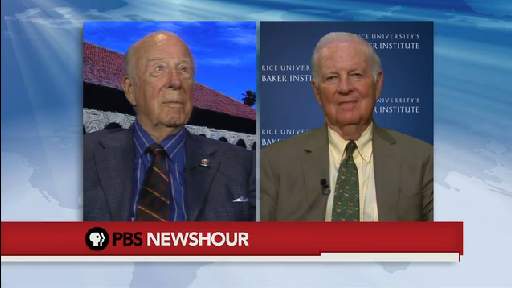
The main Thatcher segment on the PBS newscast was a discussion with two former Republican secretaries of State, George Shultz and James Baker. Of course, both were big fans of Thatcher’s foreign policy (which was closely aligned with their own priorities during the Reagan and George H.W. Bush years). It was more than that, too; as Baker put it, Thatcher “emphasized the private sector and got rid of the oppressive influence of the trade unions.” And Shultz explained that Thatcher “was a very attractive woman. So you were certainly aware of that.”
PBS had one other guest: former Conservative Canadian Prime Minister Kim Campbell, who cheered both Thatcher’s defeat of unions but also her humanity: “It’s kind of touching to be reminded of what a lovely woman she was.”
On the O’Reilly show, the host paid tribute to Thatcher’s leadership, contrasting it with Barack Obama’s tenure. As O’Reilly declared:
Her accomplishments are many, but she was always a very controversial figure in her own country and here in America, because the British press and the American media are liberal and always have been.

Later in the show, he was joined by conservatives Brit Hume and Bernard Goldberg; ironically, the latter segment focused on the alleged hostility to Thatcher in the mainstream media. So the guest line-ups were more alike than different. But so was some of the reporting. On Fox, Thatcher rescued Britain from the clutches of an oppressive union movement, and the record speaks for itself. As O’Reilly put it:
In Britain, 13 percent unemployment…. That’s a catastrophe, 13 percent, all right. When she leaves office eight years later, 5.8 percent unemployment. But if the unemployment rate drops 7 percent, which means all those millions of people are working under this woman, give her some credit.
And he put it a different way:
In 1982, about two and a half years into her term, unemployment in Great Britain was 13 percent. It’s chaos, absolute chaos there. When she left office in 1990, she was the longest serving prime minister in British history. It was at 5.8 percent.
On PBS, meanwhile, reporter Margaret Warner declared that Thatcher “brought a free market revolution to Britain, lowering taxes and privatizing state industries…. Britain’s economy rebounded from her tough medicine.”
Neither report gives viewers a good sense of Thatcher’s economic policy. (The wording in the PBS segment about rebounding from medicine is difficult to comprehend.) The Guardian compiled a list of economic indicators during Thatcher’s tenure; the short story is that inequality increased, and so did poverty–from 13.4 percent in 1979 to 22.2 percent in 1990.
O’Reilly is correct that unemployment dropped during part of Thatcher’s time in office; it also skyrocketed the first two years. When she left office in 1990, it was, according to the Guardian‘s figures, higher than when she took office. If that’s the record, then one would imagine it would be reflected somewhere–perhaps not at Fox News, for ideological reasons. But PBS is supposed to be about giving us the views that we’re not getting from the commercial media.
Related articles
New Documents Suggest IRS Reads Emails Without a Warrant
By Nathan Freed Wessler | ACLU | April 10, 2013
Everyone knows the IRS is our nation’s tax collector, but it is also a law enforcement organization tasked with investigating criminal violations of the tax laws. New documents released to the ACLU under the Freedom of Information Act reveal that the IRS Criminal Tax Division has long taken the position that the IRS can read your emails without a warrant—a practice that one appeals court has said violates the Fourth Amendment (and we think most Americans would agree).
Last year, the ACLU sent a FOIA request to the IRS seeking records regarding whether it gets a warrant before reading people’s email, text messages and other private electronic communications. The IRS has now responded by sending us 247 pages of records describing the policies and practices of its criminal investigative arm when seeking the contents of emails and other electronic communications.
So does the IRS always get a warrant? Unfortunately, while the documents we have obtained do not answer this question point blank, they suggest otherwise. This question is too important for the IRS not to be completely forthright with the American public. The IRS should tell the public whether it always gets a warrant to access email and other private communications in the course of criminal investigations. And if the agency does not get a warrant, it should change its policy to always require one.
The IRS and Email: Reading Between the Lines
The federal law that governs law enforcement access to emails, the Electronic Communications Privacy Act (ECPA), is hopelessly outdated. It draws a distinction between email that is stored on an email provider’s server for 180 days or less, and email that is older or has been opened. The former requires a warrant; the latter does not. Luckily, the Fourth Amendment still protects against unreasonable searches by the government. Accordingly, in 2010 the Sixth Circuit Court of Appeals decided in United States v. Warshak that the government must obtain a probable cause warrant before compelling email providers to turn over messages.
However, the IRS hasn’t told the public whether it is following Warshak everywhere in the country, or only within the Sixth Circuit.
The documents the ACLU obtained make clear that, before Warshak, it was the policy of the IRS to read people’s email without getting a warrant. Not only that, but the IRS believed that the Fourth Amendment did not apply to email at all. A 2009 “Search Warrant Handbook” from the IRS Criminal Tax Division’s Office of Chief Counsel baldly asserts that “the Fourth Amendment does not protect communications held in electronic storage, such as email messages stored on a server, because internet users do not have a reasonable expectation of privacy in such communications.” Again in 2010, a presentation by the IRS Office of Chief Counsel asserts that the “4th Amendment Does Not Protect Emails Stored on Server” and there is “No Privacy Expectation” in those emails.
Other older documents corroborate that the IRS did not get warrants across the board. For example, the 2009 edition of the Internal Revenue Manual (the official compilation of IRS policies and procedures) explains that “the government may obtain the contents of electronic communication that has been in storage for more than 180 days” without a warrant.
Then came Warshak, decided on December 14, 2010. The key question our FOIA request seeks to answer is whether the IRS’s policy changed after Warshak, which should have put the agency on notice that the Fourth Amendment does in fact protect the contents of emails. The first indication of the IRS’s position, from an email exchange in mid-January 2011, does not bode well. In an email titled “US v. Warshak,” an employee of the IRS Criminal Investigation unit asks two lawyers in the IRS Criminal Tax Division whether Warshak will have any effect on the IRS’s work. A Special Counsel in the Criminal Tax Division replies: “I have not heard anything related to this opinion. We have always taken the position that a warrant is necessary when retrieving e-mails that are less than 180 days old.” But that’s just the ECPA standard. The real question is whether the IRS is obtaining warrants for emails more than 180 days old. Shortly after Warshak, apparently it still was not.
The IRS had an opportunity to officially reconsider its position when it issued edits to the Internal Revenue Manual in March 2011. But its policy stayed the same: the Manual explained that under ECPA, “Investigators can obtain everything in an account except for unopened e-mail or voice mail stored with a provider for 180 days or less using a [relevant-and-material-standard] court order” instead of a warrant. Again, no suggestion that the Fourth Amendment might require more.
The first indication that the IRS was considering the effect of Warshak came in an October 2011 IRS Chief Counsel Advice memorandum available on the IRS website but not provided in response to our FOIA request. An IRS employee sought guidance about whether it is proper to use an administrative summons, instead of a warrant, to obtain emails that are more than 180 days old. (The emails in question were located on an internet service provider’s (ISP) server somewhere in the territory covered by the Ninth Circuit Court of Appeals). The memo summarized the holding of Warshak and advised that “as a practical matter it would not be sensible” to seek older emails without a warrant. This is good advice, but the memo’s reasoning leaves much to be desired. The memo explained that Warshak applies only in the Sixth Circuit but that, because the ISP had informed the IRS that it did not intend to voluntarily comply with an administrative summons for emails, there was not “any reasonable possibility that the Service will be able to obtain the contents of this customer’s emails . . . without protracted litigation, if at all.” Any investigative leads contained in the emails would therefore be “stale” by the time the litigation could be concluded, making attempted warrantless access not worthwhile.
The memo misses another chance to declare that agents should obtain a warrant for emails because the Fourth Amendment requires it. Instead, the memo’s advice (which may not be used as precedent and is not binding in other IRS criminal investigations) is limited to situations in the Ninth Circuit where an ISP intends to challenge warrantless requests for emails. The IRS shouldn’t obey the Fourth Amendment only when it faces the inconvenience of protracted litigation; it should recognize that the Fourth Amendment requires warrants for the contents of emails at all times.
Finally, to the present: has the IRS’s position changed this tax season? Apparently not. The current version of the Internal Revenue Manual, available on the IRS website, continues to explain that no warrant is required for emails that are stored by an ISP for more than 180 days. Apparently the agency believes nothing of consequence has changed since ECPA was enacted in 1986, or the now-outdated Surveillance Handbook was published in 1994.
The IRS Owes the American Public an Explanation—and a Warrant Requirement
Let’s hope you never end up on the wrong end of an IRS criminal tax investigation. But if you do, you should be able to trust that the IRS will obey the Fourth Amendment when it seeks the contents of your private emails. Until now, that hasn’t been the case. The IRS should let the American public know whether it obtains warrants across the board when accessing people’s email. And even more important, the IRS should formally amend its policies to require its agents to obtain warrants when seeking the contents of emails, without regard to their age.
(We also sent FOIA requests to the FBI and other components of the Department of Justice—we will be receiving records from those offices in the coming weeks).
Related articles
- Like rest of the feds, the IRS can get your e-mails with no problem (arstechnica.com)
- When a Secretive Stingray Cell Phone Tracking “Warrant” Isn’t a Warrant (alethonews.wordpress.com)
Capriles Attacks Venezuelan Electoral Council, Refuses to Sign Document
Venezuelanalysis | April 9th 2013
Merida – Tonight rightwing candidate Henrique Capriles said that he will not sign a National Electoral Council (CNE) document to guarantee that he would recognise the results of the 14 April presidential elections.
The document, requested by the government and written by the CNE, called ‘Commitment with Democracy’ was signed by pro-Chavez candidate Nicolas Maduro, as well three other candidates. Candidate Reina Sequera didn’t sign the document today because she wasn’t in Caracas. A similar document was signed by all candidates, including Capriles, for the 7 October presidential elections in July last year.
Instead, a representative for Capriles’ campaign, Carlos Vecchio, handed in a different document signed by Capriles, where he committed to “respect the popular will” but demanded that the interim president Nicolas Maduro “cease his abuse of the use of public resources to promote his candidature”.
In the document he also accused Maduro of “intimidating public servants” and “taking advantage of the needs of the poor… in order to bribe them with the delivery, or not, of social missions, and in that way, obtain their votes”.
He called the CNE “negligent” and warned that “we will be vigilant before…any alteration that is attempted on the electoral results”. Further he suggested that the electoral power is biased towards the government.
The move by Capriles follows weeks of opposition and private Venezuelan media attacks on the CNE, as well as a small protest in Caracas calling for “fairness and transparency” in the elections.
US Assistant Secretary of State, Roberta Jackson, also said last month that it would be “difficult” to have “open, fair and transparent elections” in Venezuela.
Maduro signed the CNE document while at a workers’ rally, saying, “I’m going to sign it in name of peace for the country, and respect for the people. This signature is worth my own life. I’ll respect the results that the people decide on 14 April. I swear it before God, I swear it before the people, and I swear it on the memory of Hugo Chavez”.
The CNE completed its auditing process today, where all aspects related to the voting act were verified. Assessors from the Central University of Venezuela, technical experts from all candidates’ campaign teams, and the electoral mission of the Union of South American Nations (UNASUR) were all present.
CNE president Tibisay Lucena announced that the electoral system is “safe and ironclad” and said the council had not found the irregularity denounced by the opposition serious, where a member of the governing United Socialist Party allegedly had the code to the electoral machines.
“The code is a general one, not only do the CNE technicians know it, but also over 90 contracted personnel… that is, it is not a code that implies infringement of electoral security”.
She also highlighted that participation in elections has grown progressively in Venezuela, which “is proof of the enormous credibility of the [electoral] organism”. 81% of registered voters voted last October.
46,000 voting machines are being sent to voting centres such as schools, which as of Wednesday will be closed and protected by soldiers as part of the Republic Plan. 80,000 CNE assistants have been trained to operate the machines.
Related articles
- Presidential Candidate Henrique Capriles: Leading to Nowhere (alethonews.wordpress.com)
- Maduro Counters Campaign to Discredit Venezuelan Electoral System (alethonews.wordpress.com)
- Opposition Intensifies Campaign against Venezuelan Electoral System (alethonews.wordpress.com)
- Venezuela’s Maduro leads latest poll before election (alethonews.wordpress.com)
The Ironic Lady: Margaret Thatcher, Supposed Champion of ‘Freedom and Democracy’, and Her Dictator Friends
By Nima Shirazi | Wide Asleep in America | April 8, 2013
Margaret Thatcher died Monday, April 8, 2013, at the age of 87. While there is no dearth of hagiographic profiles of the former British Prime Minister in the mainstream press and scathing vitriol elsewhere, it should be remembered that, throughout her career, Thatcher was a staunch supporter of many of the world’s most brutal regimes, propping up and arming war criminals and dictators in service to Western imperialism, anti-Communism and neoliberal hegemony.
Throughout the 1980s, Thatcher’s government backed Iraq during its war against Iran, funneling weapons and equipment to Saddam Hussein in contravention of both international law and British policy, all the way up until Saddam’s invasion of Kuwait. She even sent Christmas cards to both Saddam and Libyan leader Muammar Qaddafi in 1981.
But that’s just the tip of the iceberg. Here’s a review of some of her other pals…

The Shah of Iran and Margaret Thatcher, 1978

In April 1978, prior to her ascension to Prime Minister, Thatcher visited the Shah of Iran, Mohammad Reza Pahlavi, in Tehran where she praised him as “one of the world’s most far-sighted statesmen, whose experience is unrivaled.”
Despite the popular protests against the Shah occurring across Iran with increasing frequency, Thatcher said of her host, “No other world leader has given his country more dynamic leadership. He is leading Iran through a twentieth century renaissance.” Exactly one month before her visit, street protests in over 55 Iranian cities resulted in the killing of more than 100 civilians, when police opened fire on the crowds.
Iran “holds a key strategic position in the defence of the Western World,” Thatcher continued, “Her strength and resolve are vital to our future.” She added, “Iran has been the West’s most resolute and stalwart ally in this crucial region.”
Upon his overthrow the following February, the Shah expressed his desire to seek asylum in England at his lavish country estate in Surrey. While the British government at the time wound up secretly helping the Shah make his way from Morocco to the Bahamas, it rejected his request to enter the UK.
Thatcher, who became Prime Minister soon thereafter, respected the decision of her predecessor for political reasons, but was “deeply unhappy” that Britain could not offer sanctuary to Pahlavi, whom she called a “firm and helpful friend.”
A longtime supporter of the Egyptian dictatorship of Hosni Mubarak, Thatcher once received a memo from the UK Foreign Office referring to Mubarak as “no intellectual but… always friendly and cheerful,” noting that while “apt to express simplistic views, he has become an experienced and accomplished political operator.” The brief continued, “His affable exterior evidently conceals a degree of ruthlessness since it seems likely that he has conducted some successful political infighting to maintain his position” having “succeeded in ousting or at least surviving all other prominent figures in the government or armed forces.”
“Nevertheless his reputation is free of any taint of corruption or malpractice and he is not thought to have made many enemies,” the memo said of Mubarak, adding that he was “eager to improve relations with the Royal Air Force and to buy British [military] equipment.”
Thatcher was only too happy to oblige.
Over the years of her leadership, Thatcher routinely commended Mubarak for his “courage” and “strength.” In 1985, at a banquet in Cairo, she said she “admire[d] particularly, Mr. President, the leadership which you personally… have shown.” Five years later, while hosting Mubarak and his wife at No. 10 Downing Street, Thatcher declared, “You are among our very favourite visitors because we all know you as particularly good and close friends of this country, as we are of Egypt,” and once again expressed her admiration for the Egyptian president, this time for his “incredible energy.”
“You are as full of beans as ever,” she said. Unfortunately for the Egyptian people over the next 11 years, thanks largely to American and British largesse, she was right.
Thatcher was a steadfast defender of Augusto Pinochet, whose unspeakably brutal dictatorship of torture and repression terrorized Chile from 1973 to 1990. She visited Pinochet in 1999 during his house arrest in England, saying that her country “owed” him “a great debt” of gratitude for his help during the 1982 Falklands War.
Without any sense of irony, Thatcher added, “I’m also very much aware that it is you who brought democracy to Chile.”
Never one to mention his appalling human rights record, Thatcher expressed her “outrage at the callous and unjust treatment” of Pinochet during a speech that October at the Conservative Party Conference, called him “this country’s only political prisoner,” and hailed him as Britain’s “staunch, true friend in our time of need” and “who stopped the communists taking Chile.”
The next year, upon his release and return to Chile, for which she fought tirelessly, Thatcher sent Pinochet a silver Armada dish as a gift, condemned his detention in England as “a great injustice” and wished the deposed dictator and his family “all good wishes for a peaceful and secure future.”
When Pinochet died six years later, Thatcher said she was “deeply saddened” by his passing.
Subsequently, Robin Harris, a former official in Thatcher’s administration, wrote in The Telegraph that Thatcher “took a positive view of Pinochet’s 17 years in power” and “would not have spoken up for him if she had believed him a monster. She could not judge the merits of every allegation. But, clearly, the legal case against him was weak and the motivation of those involved suspect.”
Harris similarly praised Pinochet for “[leaving] behind a stable democracy,” concluding that “Margaret Thatcher has nothing to be ashamed of in defending Augusto Pinochet, when others refused to do so” and that Pinochet “was lucky to find such a champion.”
In March 1987, King Fahd of Saudi Arabia, visited Thatcher. Beforehand, Thatcher said in an interview, “Relations between Saudi Arabia and Britain are excellent. We have common interests in peace and stability in the Middle East. The Al Yamamah Project for the sale of Tornado and other aircraft to Saudi Arabia has done much to focus Saudi attention on Britain and British attention on Saudi Arabia.”
The Al Yamamah arms deal, signed a year and a half earlier, was “the biggest export transaction in British history, estimated by a British Aerospace executive in 2005 to be worth £83 billion in past and future sales to Saudi Arabia of military hardware including aircraft ranging from Tornado fighters and Hawk trainer jets to Eurofighter Typhoons,” in addition to a wide range of arms, naval vessels, radar, spare parts, and a pilot-training program.
The deal was largely the result of Thatcher’s own lobbying initiative on behalf of the British defense industry and weapons manufacturers and, ever since its signing, allegations of corruption, fraud and bribery have abounded.
In 1993, in a speech to a Chatham House Conference on Saudi Arabia after leaving office, Thatcher maintained that “[o]ne of Al Yamamah’s achievements has been the training and equipping of the Royal Saudi Air Force by Britain. Both training and aircraft were put to the test of wartime combat far sooner than anyone expected. As we now know, both the aircraft and their RSAF pilots performed superbly in Operation Desert Storm.” She continued, “The Al Yamamah programme has continued steadily since the conflict. When this year’s new order of a further 48 Tornado aircraft for the RSAF has been executed it will be safe to say that Saudi Arabia will have one of the strongest and most effective Air Forces in the world.”
Beyond this, Thatcher described the kingdom as “a peace loving nation” and a “modern miracle,” touting its “domestic achievements” and the “stable framework” and “solid rock of a well established and respected monarchy.”
“We are strong partners in trade and defence. We share great strategic interests,” she said.
Regarding Saudi Arabia’s human rights record, Thatcher was silent. “I have no intention of meddling in that country’s internal affairs,” she insisted. “It is one of my firmest beliefs that although there are certain basic standards and goals we should expect from every member of the international community, the precise pace and approach must reflect different societies’ cultural, social, economic and historical backgrounds. And Saudi Arabia, in particular, is a complex society which Westerners do not often fully comprehend.”
Again, without even the slightest hint of irony, Thatcher – in the very same speech – noted, “It is the surest signal to other dictators that the West lacks the resolve to defend justice. We have yet to see its full consequences — our lack of effective action will return to haunt us.” She was talking about Bosnia.
While Thatcher maintained throughout her political that she “loathe[d] apartheid and everything connected with it,” she referred to Nelson Mandela and the African National Congress, as “a typical terrorist organization” and refused, alongside Ronald Reagan, to back sanctions against the Apartheid regime in South Africa. “In my view, isolation will lead only to an increasingly negative and intransigent attitude in the part of white South African,” she said in December 1977.
In 1984, Thatcher invited South African Prime Minister P.W. Botha to visit London, the first such visit in 23 years, sparking understandable outrage in the anti-Apartheid movement. The next year, the Associated Press reported that she “rejected demands by the opposition Labor Party that she meet with Oliver Tambo, leader of the African National Congress guerrilla movement, who is visiting Britain…on grounds he espouses violence.”
“I do not accept that apartheid is the root of violence… nor do most other people,” Thatcher insisted and, during a speech before Parliament, stated that Botha’s “South African government has taken more steps to start dismantling apartheid than any of their predecessors.”
“I can see little point in sanctions creating more unemployment in this country only to create more unemployment in South Africa… It seems to me a ridiculous policy that would not work,” she added.
Five years later, during the last gasps of Apartheid, Thatcher was still opposing sanctions. In 2006, Tory leader (and now British Prime Minister) David Cameron apologized for Thatcher’s actions.
In response to her death today, Oliver Tambo’s son Dali told the press, “My gut reaction now is what it was at the time when she said my father was the leader of a terrorist organisation. I don’t think she ever got it that every day she opposed sanctions, more people were dying, and that the best thing for the assets she wanted to protect was democracy,” adding, “It’s a shame that we could never call her one of the champions of the liberation struggle. Normally we say that when one of us goes, the ANC ancestors will meet them at the pearly gates and give them a standing ovation. I think it’s quite likely that when Margaret Thatcher reaches the pearly gates, the ANC will boycott the occasion.”
In the midst of the bloody Indonesian occupation of East Timor, Thatcher visited genocidal Indonesian dictator General Suharto, praised Indonesia’s “agricultural and industrial development” and, although East Timorese had been killed, starved, disappeared and herded into “resettlement camps” as part of Suharto’s “encirclement and annihilation” campaign, dismissed allegations of human rights abuses, explaining that East Timor was none of Britain’s business and that Suharto himself has “assured me that the International Red Cross not only had access to East Timor, but was very welcome there.”
She told the press, “Trade brings us together and identifies our interests, and I am sure that trade between Indonesia and Britain will increase as a result of the very friendly and warm atmosphere created by my visit here. We are clearly the best of friends and there is no sounder basis on which to construct future collaboration.”
In 2008, veteran journalist John Pilger recalled that Thatcher referred to Suharto as, “One of our very best and most valuable friends,” and how, “[f]or three decades the south-east Asian department of the Foreign Office worked tirelessly to minimise the crimes of Suharto’s gestapo, known as Kopassus, who gunned down people with British-supplied Heckler & Koch machine guns from British-supplied Tactica ‘riot control’ vehicles.”
“A Foreign Office speciality was smearing witnesses to the bombing of East Timorese villages by British-supplied Hawk aircraft – until Robin Cook was forced to admit it was true. Almost a billion pounds in export credit guarantees financed the sale of the Hawks, paid for by the British taxpayer while the arms industry reaped the profit,” Pilger adds.
With this kind of record, it is clear that Thatcher’s constantly pledged support for “freedom and democracy” was really a violent, imperial campaign waged for free markets and domination.
Related article
‘Irreparable’ safety issues: All US nuclear reactors should be taken out of commission
RT | April 9, 2013
All 104 nuclear reactors currently operational in the US have irreparable safety issues and should be taken out of commission and replaced, former chairman of the US Nuclear Regulatory Commission, Gregory B. Jaczko said.
The comments, made during the Carnegie International Nuclear Policy Conference, are “highly unusual” for a current or former member of the safety commission, according to The New York Times. Asked why he had suddenly decided to make the remarks, Jaczko implied that he had only recently arrived at these conclusions following the serious aftermath of Japan’s tsunami-stricken Fukushima Daichii nuclear facility.
“I was just thinking about the issues more, and watching as the industry and the regulators and the whole nuclear safety community continues to try to figure out how to address these very, very difficult problems,” which were made more evident by the 2011 Fukushima nuclear accident in Japan, he said. “Continuing to put Band-Aid on Band-Aid is not going to fix the problem.”
According to the former chairman, US reactors that received permission from the nuclear commission to operate for an additional 20 years past their initial 40-year licenses would not likely last long. He further rejected the commission’s proposal for a second 20-year extension, which would leave some American nuclear reactors operating for some 80 years.
Jaczko’s comments are quite significant as the US faces a mass retirement of its reactors and nuclear policy largely revolves around maintaining existing facilities, rather than attempting to go through the politically hazardous process of financing and breaking ground on new plants.
Though the US maintains a massive naval nuclear program, all of the country’s current civilian reactors began construction in 1974 or earlier, and a serious incident at Three Mile Island in 1979, along with an economic recession, essentially caused new projects to be scrapped.
A modest revival of enthusiasm for nuclear power emerged in the early part of the last decade, leading to the construction of four reactors at existing facilities within the last three years, slated to be completed by 2020. Despite the lack of new projects, the US is still the world’s biggest producer of nuclear power, which represents 19% of its total electrical output.
Fittingly, Jaczko’s comments came during a panel discussion of the Fukushima incident, which has brought greater attention to aging US reactors – some of which were quite similar to the General Electric-designed models overwhelmed by the earthquake and subsequent tsunami in 2011.
In response to those comments, Marvin S. Fertel, president and chief executive of the Nuclear Energy Institute, told the Times that the country’s nuclear power grid has, is, and will operate safely.
“US nuclear energy facilities are operating safely,” said Fertel. “That was the case prior to Greg Jaczko’s tenure as Nuclear Regulatory Commission chairman. It was the case during his tenure as NRC chairman, as acknowledged by the NRC’s special Fukushima response task force and evidenced by a multitude of safety and performance indicators. It is still the case today.”
Since the first nuclear reactor went operational in the US, there have been very few fatal incidents at nuclear power facilities, though there were a number of high profile stories written over the inherent dangers of large nuclear reactors during the mid-1970s. One of the most recent incidents at a US reactor was in April of 2013, when an employee was killed at the Arkansas Nuclear One plant while moving part of a generator.
Jaczko served as chairman of the nuclear regulatory agency since 2009, and according to the Times resigned in 2012 following conflicts with colleagues. He was seen as an outlying vote on a number of safety issues, and had advocated for more stringent safety improvements during his tenure.
Related articles
Featured Video

Prof. Ted Postol: Iran Already Achieved Nuclear Deterrence Against Israel
or go to
Aletho News Archives – Video-Images
From the Archives
How the occupied mentality syndrome works
Saudi Arabia on the American chessboard – Part 3
By B. J. Sabri | American Herald Tribune | June 27, 2016
Read part 2: “The occupied mentality Syndrome“
Previously I argued whether Saudi Arabia’s repeated involvements in U.S. interventions and wars stem from free national will or in response to a specific condition. For starters, in Saudi Arabia there is no national will. In Saudi Arabia, the national will is the will of the Al Saud clan. Still, when a major Arab state allies itself with a superpower that committed unspeakable crimes against humanity in almost every Arab country, then something is wrong. This fact alone should compel us to examine the U.S.-Saudi relation for one exceptional reason. As a result of the U.S.-Saudi wars, hundreds of thousands of people in Afghanistan, Iraq, Iran, Libya, Syria, Yemen, and Somalia have lost their lives. Millions became displaced in their own homelands. And millions more rendered refugees.
Attributing the Saudi policies to the bonds of “partnership” with the U.S. is frivolous. There are no bonds between these two thugs except those of business, military deals, secret plots, and wars. Proving this point, bonds such as these have no space for the American and Saudi peoples to share significant cultural or societal exchanges. If partnership is not the reason for the Saudi contribution to the U.S. strategy of empire and imperialism, then another reason must exist.
This leads to three possibilities. … continue
Blog Roll
 Aletho News
- “Davos Can Really Replace the UN”
- NIAID/NIH and USDA Fund Bioengineered Chimeric Influenza Viruses Built Using Pandemic H1N1 Components: Journal ‘Science Advances’
- Hezbollah hits Israeli warship off Lebanon’s coast, sets it aflame
- Iran slams US strikes on B1 bridge, Mahshahr petrochemical plants as ‘blatant acts of state terrorism’
- In letter to UN chief, Araghchi warns of dire consequences of US-Israeli attacks on Iran’s nuclear facilities
- Why the CIA conspiracy to invade Iran with Kurdish militias failed
- Why Are Upbeat US Claims About Mission to Rescue Pilot ‘Highly Questionable’?
- Aircraft destroyed during US ‘rescue’ of downed F-15 pilot cost more than $100 million each
- Washington University removes professor who condemned US-Israeli war on Iran
- Russia Warns of Retaliation as UK Authorizes Seizure of Vessels
- If Americans Knew
- In Iran, Israel-US take aim at “reason, research, and freedom of thought” – Daily Update
- US loses planes over Iran, Israel downgrades Lebanon war goals – Daily Update
- Israel Is Blocking Palestinians from Easter at Church Where Jesus Resurrected
- Plot to assassinate Palestinian activist follows harassment campaign promoted by Zionist groups and elected officials
- Prominent New York synagogue hosts presentation on why U.S. Jews should support the ethnic cleansing of Gaza
- Tapper vs. Piker: Is the CNN Anchor Auditioning for David Ellison?
- Shouldn’t Democrats Be Able to Condemn Genocide?
- Israel-US kill negotiators, destroy civilian structures, but Iran’s military capabilities still largely intact – Daily Update
- ‘War crime’: Global condemnation as Israeli ministers celebrate death penalty law targeting Palestinian prisoners
- 7 Ways Israel Is Turning Lebanon Into Gaza
- No Tricks Zone
- An Inconvenient Tree: Uncovered In Alps… Europe Much Warmer Than Today 6000 Years Ago
- New Study Reports A 60% Slowdown In Greenland’s Ice Loss Rate In The Last Decade
- Low Intensity Tornado Wrecks Major Solar Farm, Creating A Potential Toxic Dump
- New Study Finds Warming Saves Lives…Cold Temperatures 12 Times More Deadly Than Excess Heat
- German Science Blog Accuses PIK Climate Institute Of Hallucinating Climate Tipping Points
- Devastating Assessment Of Comirnaty Vaccine By Former Senior Pfizer Europe Toxicologist
- New Study: CO2 Is ‘Effectively Negligible’ As An Explanatory Climate Change Factor Since 2000
- Former Pfizer Toxicologist Dr. Helmut Sterz Tells Bundestag Hearing Pfizer Vaccine Should Have Never Been Approved
- Energy Expert: Germany’s Nuclear Phaseout Was A “500 Billion Euro Mistake”
- New Research: South Australia’s Mid-Holocene Sea Surface Temperatures Were 4°C Warmer Than Today
 Aletho News