In Search of Their Roots: The Mapuche and Modern Society
By Aigul Safiullina | The Argentina Independent | April 29, 2013
Around five hours after leaving Bariloche our bus suddenly stops in the middle of nowhere. “Leleque. La comunidad,” the driver announces. “We’ve arrived muchacha”. Outside, fields stretch towards mountains and the eye struggles to fix on the horizon. There is nothing resembling a town or even village outside the bus, only a tiny improvised wooden gate and a sign on a huge white canvas that says: “Comunidad Santa Rosa. Territorio Mapuche recuperado” (Santa Rosa community, Recovered Mapuche territory).

A sign on the fence reads: ‘Santa Rosa community. Recovered Mapuche territory.’ (Photo: Fabio D’Errico)
Here, in a forgotten place, lost in the very heart of Patagonia, we have arrived at the point of a now globally-famous conflict: Santa Rosa de Leleque, where the indigenous Mapuche community is engaged in a long struggle to reclaim land they say is rightfully theirs from one of the world’s most recognisable clothing brands.
The Benetton Case
When we arrive, Santa Rosa de Leleque is bustling with people, as it has been for the last six years. Not only is this is the week of Kamaruko, the main religious festival of the Mapuches, but it is also the anniversary of the recovery of this stretch of land by the Curiñanco – Rúa Nahuelquir family and 30 other community members on 14th February, 2007.
“They’ve been evicting us from our land for many years, using physical power and law of those who had invaded our territories,” Rosa Rúa Nahuelquir leaves her kitchen utilities for a while as she talks. “But we know we are stronger, because the truth is on our side and we will stand for it, no matter what it costs us.”

Dancing and celebrating around the fire. (Photo: Fabio D’Errico)
Atilio Curiñanco y Rosa Rúa Nahuelquir first entered the territory now called Santa Rosa de Leleque in August 2002. They planned to return to their ancestral land and start a new life after long years of working in the factories of Texcom and Frigorífico in nearby Esquel. And so began a long legal struggle with the global corporation Benetton Group over 535 hectares of remote land in the province of Chubut, Argentina.
The Curiñanco – Rúa Nahuelquir family claims the territory as part of that which originally belonged to their ancestors before the colonisation of Patagonia in the 19th century. Benetton Group, meanwhile, insists on the land certificate issued in 1991, when the corporation purchased over 900,000 hectares from the British company The Argentine Southern Land Company Limited (CTSA).
Atilio Curiñanco recalls: “We presented a written statement at the police station of Esquel after consulting with the Autarkic Institute for Colonisation and Rural Development (IAC), which verbally confirmed that the space was public and abandoned for many years.” According to Curiñanco, many other campesinos from nearby territories used the space to gather wood it was all dusty and windy and required a lot of work to make the piece of land productive. However, only a few days after they had entered the territory, local police made inquiries about the “land usurpation” and soon returned with a legal claim by CTSA.
In October of that year, the Curiñanco – Rúa Nahuelquir family was forcefully evicted from Leleque, having all their belongings either confiscated or destroyed. In 2004, the family travelled to Italy to meet Luciano Benetton, who offered around 2,500 hectares of the land to all indigenous communities in the region as a donation. “We obviously refused the offer, as Benetton wasn’t eligible to donate something he didn’t own,” Rosa Nahuelquir says, indignantly.
Benetton later proposed a donation of the same amount of land to the Argentine government who could distribute it among indigenous communities. In 2005, the government of the province of Chubut also refused the offer, announcing that the 2,500 hectares were unproductive and saying it would not enter into any conflict with the inhabitants of the territory.
In February 2007, the couple came back to Leleque with 30 other community members and began to build a house. CTSA immediately accused them of damaging the territory, though the penal court found the claim illegitimate. In the five years since, the family has faced many more legal claims from CTSA with charges for property destruction and eviction orders, the latest coming in February this year. The family has repeatedly rejected these claims, based on their need to cultivate plants, raise domestic animals, and build basic living conditions to survive. “How could I let my family die from hunger because of someone else’s cruel decision?” Curiñanco asks rhetorically.

Mapuche vs Benetton. (Photo: Fabio D’Errico)
Mapuche in Argentine
The ‘Mapuche vs Benetton’ case has attracted a lot of attention from global and local human rights organisations, the media, political parties, fixing an unflattering spotlight on a range of problems – from land conflicts to racism and equality.
The Argentine state included indigenous rights in the Constitution only in 1994, when it recognised “the legal capacity of these communities to the possession and property of land that they have traditionally occupied.” Yet those who have tried to exercise this right face long legal battles against powerful foes. Benetton is just one in a long list of corporations and celebrities engaged in land conflicts with the Mapuches – others include Levi Strauss & Co, Grupo Loma Negra, Jane Fonda, Ted Turner, Emanuel Ginóbili, Marcelo Tinelli, Lopez Rey and many others.
In the 2013 annual report issued by The Observatory of Human Rights of Indigenous peoples (ODHPI), investigators say about 347 Mapuches are currently involved in lawsuits related to the land conflicts just in the province of Neuquen. “They [the government] make us feel as foreigners in this country, but at the same time they give out all lands to the foreigners!” claims Ruben Curricoy, a Mapuche activist from Bariloche. The ODHPI report, which focuses on Neuquen, Rio Negro and Chubut this year, adds: “Territorial dispossession continues to be the main obstacle for indigenous people to survive and develop in Patagonia as autonomous population.”
To understand the power and complexity of today’s land struggles in Patagonia, it is important to remember the history of Argentina and the treatment of indigenous people. You need go no further than Argentina’s $100-bill for a reminder of the infamous ‘desert campaign’ run by president Julio Argentino Roca in 1878 – 1885, which empowered Argentina as a leading agricultural country via the genocide of indigenous people who were evicted from their lands and killed. Back then, those families that invested in the campaign were handsomely rewarded, as one family descendant, who preferred not be named, recalls: “A beneficiary would be asked to look forward and take all the land that his eye was able to capture. And believe me, some people used to have a very good vision.”
Curricoy is quick to give other historic examples: “The government talks about 30,000 disappeared people during the dictatorship period. It’s not true. They only count disappeared huincas (a ‘white person’ in the Mapusungun language), while our people were dying in much higher numbers. I admire the fight of Madres de Plaza de Mayo, however, I can’t imagine an indigenous mother being heard by society. Only because she is not as white as a huinca.”

Indigenous people from all over Argentina marched to and in Buenos Aires to proclaim their heritage and be heard by the government during the Bicentennial celebrations (Photo: Beatrice Murch)
Even with recent advances, many in the Mapuche community still feel as though they are misunderstood. Curricoy remembers a visit to the Casa Rosada during the country’s bicentenary celebrations in 2010, when President Cristina Fernandez de Kirchner made a joke about the use of modern facilities after one of the delegate’s cell phone rang. “That was a turning point and made it clear that indigenous people were still excluded from this country really,” says Curricoy.
In another recent example, when three Mapuche communities in Neuquen were attacked by ten unidentified people, mainstream media barely covered the event.
The ODHPI report concludes: “the government bodies that are supposed to respond to the legal claims of indigenous people don’t perform their work” and in some cases even contradict the law. The report emphasises on the overall support that the government shows to private companies, speculating in such industries as exploitation of natural resources, tourism, and construction at the cost of indigenous people. In addition, the recent reforms to the Civil Code, proposed by the government, “will provoke more evictions and prosecutions for land usurpation” according to the ODHPI report.
Communitarian vs Private Property
With the provinces in desperate need of foreign investments and incomes, it is hard to imagine local governments supporting those who have no intention to exploit the land for commercial interests, like the Mapuche community, whose whole philosophy is built on protection of mapu, the land.

Atilio Curiñanco digs his land in Patagonia. (Photo: Fabio D’Errico)
Sharing is one of the fundamental values among the Mapuche – in the Mapusungun language there are no such words as ‘no’ and ‘property’ – and this further complicates the land conflicts involving Mapuch communities. “We don’t have land certificates, because the ones we need don’t exist,” explains Ruben Curricoy. “We were offered individual deeds, which imply higher taxes and a lot of restrictions. Moreover, individual forms of property go against our philosophy of a communitarian form of life.”
According to the Mapuches, a ‘communitarian property certificate’ would include all members of the community and prevent selling of the land. Every member in this type of property has the same rights and opportunities to use the land. As the leadership style among Mapuches is horizontal, no one would have special privileges in decision-making and distribution.
“However, it is sad to see so many villages that can’t grow territorially with the population growth, so our future generations basically don’t have land to live and work on. And how would they, when on the left you have one owner and on the right another one?” Curricoy shakes his head.
The Struggle for Identity
For Gustavo Macayo, former lawyer of the Curiñanco – Rúa Nahuelquir family, the Benetton case is especially important in creating awareness of the Mapuche struggle. “This case has placed the whole situation with the foreign land ownership into a very important point and opened so many profound questions of Argentine society, questions that had never been asked.” Moreover, according to Macayo, those historical, ethical and juridical questions had always been hidden and silenced before the legal studies around the case of Leleque came into light.
“The problem goes outside of the small territory of Leleque. It includes at least three provinces in the south, where the Mapuche population counts on big numbers and is becoming aware of their land rights,” adds Macayo.
Curiñanco hopes the notoriety of his family’s case has also helped some younger generations rediscover their ethnicity. While many in Buenos Aires would probably be surprised that the ‘People of the Earth’ use cell phones, drive cars, watch TV, speak Spanish among themselves, and do most activities considered ‘normal’ for Westerners, some differences between the cultures remain very obvious.
Emmanuel Maripi from Comodoro Rivadavia is 21 and has diverse roots that include European and indigenous ancestors. He discovered he was Mapuche when he turned 18, and since then has started learning deeper about the culture of his grandparents and practicing traditional customs. This year’s Kamaruko was his first one and, a musician, he learnt a few Mapuche’ songs to perform them at the festival. “I live my life in the city in the same way as any other person of my age,” Emmanuel shares during a break between performances. “I study, work, hang out with my friends, take part and organise events related to music. At the same time, I see that a big part of my identity belongs to Mapuche society, and now I always try to find some time to spend close to the nature and understand better who I am as a Mapuche.”
“However, we also see other examples, when our people give up or even criticise us,” Curiñanco says sadly. “Some of them even don’t consider themselves Mapuches and feel ashamed of their roots.

Atilio Curiñanco holds the mate as he discusses the plight of the Mapuche in Patagonia. (Photo: Fabio D’Errico)
“Many of them live in the cities where they are marginalised pretty quickly, and bring the fame to the whole ethnicity as criminalised and dangerous,” Curricoy joins the conversation and brings examples of big cities like Buenos Aires, Bariloche that count with a large number of Mapuche’ descendants.
Conversely, those that visit the Mapuche community in Leleque are always welcomed. “We’ve got visitors from all the parts of the world,” señora Rosa Rúa Nahuelquir recalls, “journalists, human rights defenders, artists, and a lot of policemen.” At this last word, she smiles ironically. “Our doors are open to everyone, regardless if the person is Mapuche or huinca and we never know if we can trust all these visitors. But we do anyway. We never learn from our mistakes…”
She is right. In eight days we spent in Santa Rosa de Leleque, each day was highlighted with an external visit. Every person was received warmly and invited to share meals, mate and conversations with the inhabitants.
Some visitors become lifelong friends, like Florencia Santucho, director of Argentina’s Independent Film Festival for Human Rights. Santucho has supported Curiñanco – Rúa Nahuelquir family since 2003. Nine years ago she produced a documentary called MariciWeu that narrates the story of the Curiñanco – Rúa Nahuelquir family and raises questions regarding their human rights’ violations. Not only she is perceived as a friend in this community, but also as one more Mapuche who continuously learns and incorporates parts of their culture in her own life.
“When you understand the Mapuche vision of the world you won’t have any more questions,” Santucho assures. “Recovering the land is a part of the ‘cosmovision’, which allows Mapuches to gain power in other aspects of their identity. Talking about Atilio Curiñanco, she shares: “He used to be a very timid person who never spoke a lot and didn´t seem confident at all. Now, I observe him as the person with a decent and firm position, and I am sure it comes thanks to his struggle for the land, for identity and connection with the Earth. Ñoque Mapu (Mother Earth) sees that and rewards with even more power.”
Where Civilisations Collide
“The powerful always have more rights, but we have different values that don’t fit into the western way of life,” Curiñanco looks at the Ruta 40 in only few metres from his house. “Some people consider us backward for our views and principles, but having another was of thinking doesn’t mean you shall destroy it with rules that go against our vision.”

The newest house under the stars. (Photo: Fabio D’Errico)
Leleque now symbolises a spot, where two civilizations clash with their fundamental differences. On the one side is the owner of a big corporation with a network of over 6,500 stores, a total income of 2 billion euro a year, and over 900,000 hectares of Patagonian lands. On the other side is the Mapuche community, which believes in a communitarian type of lifestyle and simple, self-sustaining living.
“In the last ten years we’ve observed how Benetton was trying to avoid this case and show it as something small and less important. And I believe they will keep with that strategy,” Macayo speaks about the future of the case. “The Mapuches will do all they can to bring more problems to the surface, starting with the essential one – colonisation.”
Meanwhile, the Curiñanco – Rúa Nahuelquir family deals with another criminal suit filed by CTSA, who have now targeted INAI, an institution that works with indigenous people, and provides the legal support to the Mapuche family. At the moment Supreme Court is in charge of it, which might take two or three more years due to the complexity of the issue.
“We will obviously continue the fight, as there is no way back,” Curiñanco firms his position. His eyes sparkle and his voice gets stronger. “This is our land and we are responsible for it. It has given so much to us that it would be a crime not to take care of it…”
As we talk, on the other side of the room little Rosita, a granddaughter in the Curiñanco – Rúa Nahuelquir family, is learning some basic Italian words from Fabio, an Italian photographer who arrived in Leleque with his personal project. She absorbs the new language rapidly, and soon they are speaking basic Italian and then switch to Spanish and even teaches some Mapusungun in terutnr. It’s a small scene that depicts a wider hope that dialogue is always possible between our civilisations, even though it requires a lot of will from both sides.
Spy, or pay up: FBI-backed bill would fine US firms for refusing wiretaps
RT | April 29, 2013
A US government task force is drafting FBI-backed legislation that would penalize companies like Google and Facebook for refusing to comply with wiretap orders, media report.
In the new legislation being drafted by US law enforcement officials, refusal to cooperate with the FBI could cost a tech company tens of thousands of dollars in fines, the Washington Post quoted anonymous sources as saying.
The fined company would be given 90 days to comply with wiretap orders. If the organization is unable or unwilling to turn over the communications requested by the wiretap, the penalty sum would double every day.
“We don’t have the ability to go to court and say, ‘We need a court order to effectuate the intercept.’ Other countries have that. Most people assume that’s what you’re getting when you go to a court,” FBI general counsel Andrew Weissmann told the Washington Post.
If passed in Congress and signed by President Obama, the bill could become a provision of the 1968 Wiretap Act, which require companies to develop mechanisms for obtaining information requested by government investigators.
However, many companies maintain that their resistance to this and similar measures has nothing to do with an unwillingness to help investigators. Google began encrypting its email service following a major hacking attack in 2010; developing wiretap technology could make it and other companies vulnerable, creating “a way for someone to silently go in and activate a wiretap,” said Susan Landau, a former engineer at Sun Microsystems.
The proposed expansion of wiretaps into the digital frontier is the latest in a series of US government efforts to monitor online communications.
The recent Boston Marathon bombings were used by some members of Congress as a reason to push through the highly controversial Cyber Intelligence Sharing and Protect Act (CISPA), which was passed by the lower house. If CISPA is signed into law, telecommunication companies will be encouraged to share Internet data with the Departments of Homeland Security and Justice concerning national security purposes.
Tech companies, including giants like Facebook and Microsoft, have objected fiercely to the bill, citing customers’ privacy concerns. The bill is currently shelved in the Senate following President Obama’s threat to veto CISPA due to a lack of personal privacy provisions.
Earlier in April, the FBI requested an additional $41 million from the federal government for the recording and analysis of Internet communication.
The Electronic Privacy Information Center also recently obtained over 1,000 pages of documents proving that the Pentagon has secretly eavesdropped on Internet traffic for several years.
“Senior Obama administration officials have secretly authorized the interception of communications carried on portions of networks operated by AT&T and other Internet service providers, a practice that might otherwise be illegal under federal wiretapping laws,” CNET reporter Declan McCullagh wrote.
Related article
- Obama administration bypasses CISPA by secretly allowing Internet surveillance (alethonews.wordpress.com)
Obama Expands Wiretap Authority to Cover Finance, Healthcare and Other Industries
By Matt Bewig | AllGov | April 29, 2013
When one conspires to violate federal law, it helps to have a government agency or two as one’s co-conspirators when law enforcement comes poking around, as telecom giant AT&T and others learned recently when the Defense Department (DOD) and the Department of Homeland Security (DHS) successfully pressured the Justice Department (DOJ) to agree secretly not to prosecute blatantly illegal wiretaps conducted by AT&T and other Internet service providers at the request of the agencies.
Although some press reports have termed this an authorization of activity that would otherwise be illegal, this is a misnomer. The executive branch lacks the power to retroactively declare criminal conduct to be lawful, but it can choose to ignore it by waiving prosecution pursuant to “prosecutorial discretion.”
Although the secret DOJ prosecution waiver initially applied to a cyber-security pilot project—the DIB Cyber Pilot—that allowed the military to monitor defense contractors’ Internet links, the program has since been renamed Enhanced Cybersecurity Services and is being expanded by President Obama to allow the government to snoop on the private networks of all companies operating in “critical infrastructure sectors,” including energy, healthcare, and finance starting June 12.
“The Justice Department is helping private companies evade federal wiretap laws,” warned Marc Rotenberg, executive director of the Electronic Privacy Information Center, which obtained more than 1,000 pages of government documents relating to the issue via a Freedom of Information Act request. “Alarm bells should be going off.”
The wiretap law referenced by Rotenberg is the Wiretap Act, codified at 18 USC 2511, which makes it a crime for a network operator to intercept communications carried on its networks unless the monitoring is a “necessary incident” to providing the service or it occurs with a user’s “lawful consent.” Since neither of those exceptions applied, DOD and DHS pressed DOJ attorneys to agree not to prosecute what were clearly prosecutable offenses by issuing an unknown number of “2511 letters,” which are normally used by DOJ to tell a company that its conduct fit within one of the lawful exceptions to the Act.
The purported “retroactive authorization” is similar to the “retroactive immunity” given the telecoms by Congress for their participation in illegal wiretapping and eavesdropping between 2001 and 2006. Likewise, former DHS official Paul Rosenzweig compared the case of the “2511 letters” to the CIA asking the Justice Department for legal memos justifying torture a decade ago. “If you think of it poorly, it’s a CYA [“cover your ass] function,” Rosenzweig says. “If you think well of it, it’s an effort to secure advance authorization for an action that may not be clearly legal.” Or may be clearly illegal.
In any event, Obama’s own expansion by mid-June of the snooping “to all critical infrastructure sectors,” defined as companies providing services whose disruption would harm national economic security or “national public health or safety” will proceed.
Related articles
- Obama administration bypasses CISPA by secretly allowing Internet surveillance (alethonews.wordpress.com)
- To Ease Internet Snooping, Feds Promise To Ignore Privacy Violations (reason.com)
‘UK, France barring UN Syria inspection’
Press TV – April 29, 2013
Syrian Ambassador to the United Nations Bashar al-Jaafari says Britain and France are trying to undermine Damascus’s official request from the United Nation to investigate chemical weapons use in Aleppo.
Al-Jaafari said in an interview with the Lebanese NBN TV channel that the western governments seek to repeat the Iraqi scenario in Syria through questioning its sovereignty by opening its borders to undisciplined inspections by the UN under the pretext of chemical weapons use.
Al-Jaffari said the western sides do not want an investigation to take place suggesting they know full well that the anti-government militants used chemical agents in the town of Khan al-Asal, near Aleppo, and elsewhere.
The Syrian official said the comparison with Iraq is pretty clear as the UN also sent an inspection team to the country to examine weapons of mass destruction claims, but Iraq was occupied despite the fact that the inspection team did not find any WMDs.
He also rejected claims by Britain and France that chemical weapons were used in Homs four months before the Khan al-Asal incident saying they would have reported it earlier if any such attack ever existed.
The Syrian Foreign Ministry has written to the UN Secretary General Ban Ki Moon calling on the body to explain the details of a likely inspection in Khan al-Asal.
However, Britain and France have demanded the team to be also sent to other areas of the country to investigate the use of chemical weapons.
The request has been rejected by the Syrian government that says inspectors cannot have unlimited access to all regions of the country without coordination with Damascus.
The Syrian government has also called for an independent inspection of Khan al-Asal saying Damascus and the UN could discuss the details on other alleged chemical weapons uses separately, though the UN has so far refused to do so.
Related articles
- Russia accuses UN of politicizing approach to chemical weapons in Syria (voicerussia.com)
- Bashar Al-Jaafari: “West Raising Chemical Weapons Issue Part of Pressure Campaign” (syrianfreepress.wordpress.com)
Pro-Israeli US lawmakers urge bombing Syria air bases, arming militants, invasion
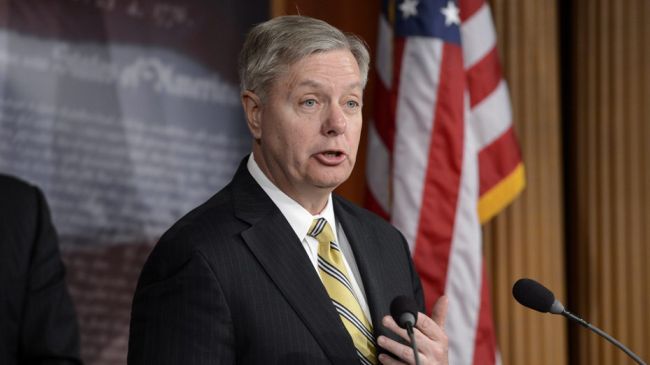
US Senator Lindsey Graham (R) South Carolina (file photo)
Press TV – April 29, 2013
Top US Republican lawmakers have again called for further American actions against Syria, including the bombing of its air bases, leading a multi-nation invasion of the country and sending lethal weapons to anti-Damascus militant gangs.
Fervently pro-Israeli Senators John McCain of Arizona and Lindsey Graham of South Carolina further cited widely challenged claims by the Israeli regime of chemical weapons use in Syria to urge swift Washington action to “secure” chemical arms arsenals in the Arab country in efforts to prevent al-Qaeda-linked militants from gaining access to such weapons, US press reports said on Sunday and Monday.
The two lawmakers, however, did not explain how American forces would secure the alleged cache of Syrian chemical weaponry.
Graham went as far as warning that if the US does not intervene in Syria the next terrorist bombing in American soil will include chemical agents.
“The chemical weapons (in Syria)… are going to be compromised and fall into wrong hands and the next bomb that goes off in America may not have nails and glasses in it,” said Graham during a televised interview with major US network CBS on Sunday.
The senior member of US Senate’s Armed Services Committee also expressed serious concerns about the potential fall of Jordan’s dictator King Abdullah II if Washington did not intervene quickly enough to stop the growing flow of Syrian refugees into his country.
Describing the Jordanian ruler as “a moderating influence and a good [US] ally,” Graham predicted that his regime will fall if the “flood” of Syrian refugees into Jordan continued.
He also predicted a US war with Iran if the Obama administration does not intervene in Syria on the grounds that Tehran would doubt Washington’s resolve in taking action against their nuclear energy program.
The American senator went on to urge the US military to “bomb Syrian air bases with cruise missiles in a bid to “neutralize” the government’s air advantage over the foreign-backed militant gangs and turn the “tide of battle pretty quickly” in favor of the anti-Damascus insurgents.
Moreover, Senator McCain said the US should move into Syria as part of an “international force” to secure the country’s chemical weapons, but did not elaborate on how such international military force would be established and which countries would be involved.
Syria has been faced with a foreign-sponsored armed insurgency since 2011. Thousands of people in the country, including a large number of security forces, have been killed in the unrest with many foreign nationals infiltrating the key Arab state in a bid to destabilize the government of President Bashar al-Assad.
Related article
- Israeli lawmaker urges intervention in Syria (foxnews.com)
Israel demolishes West Bank homes, water wells
Al-Akhbar | April 29, 2013
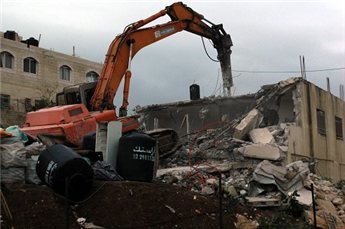
Israeli forces on Monday demolished Palestinian homes and water wells in East Jerusalem and the West Bank, as settlers confiscated land near Hebron to build a new outpost, local media reported.
In occupied East Jerusalem, Israeli forces razed two apartments in the Tur neighborhood after several attempts by the owners to reverse the demolition order failed.
The authorities evicted 24 members of the Ghaith family, including five children and an elderly woman, from the two apartments ahead of the demolition, Rushi Ghaith, one of the owners, told Palestinian news agency Ma’an.
The apartments were scheduled for demolition in December but the family secured a court-ordered injunction to stop it from going ahead, Ghaith said.
The Ghaith family lawyer said they had successfully stalled attempts to raze the apartments since September 2004, when Israeli authorities handed down the demolition notice because the home was built without a licensing permit. The family’s case to reverse the demolition order is ongoing.
Ghaith said the family has been fined 80,000 Israeli shekels (about $22,000) since the case began.
Meanwhile Israeli soldiers demolished water wells south of Hebron in al-Fawar refugee camp, as settlers from the nearby Ma’oun settlement seized land west of Yatta in preparation for the establishment of new outposts.
Abdul Hadi Hantash, an expert on settlement policies in the southern West Bank, said that the Ma’oun settlers seized land of one of the hills southwest of their original outpost.
Hantash told reporters that the wells the soldiers destroyed were used for agricultural purposes and irrigation.
He added that the continued confiscation of land and demolition of Palestinian structures, including the bulldozing of homes and uprooting of trees, are part of the Israeli government’s illegal settlement expansion program.
Israeli demolitions of Palestinian homes and other structures in the occupied West Bank occur almost daily under the pretext of building without a permit.
According to the United Nations, 33 percent of all Palestinian homes in East Jerusalem lack Israeli-issued building permits, which are difficult to obtain, potentially placing at least 93,100 residents at risk of displacement.
Roughly 94 percent of Palestinian applications for building permits are rejected, according to the Israeli Committee Against House Demolitions.
The group estimates that Israeli authorities have demolished about 27,000 Palestinian structures in the West Bank since 1967.
(Ma’an, Wafa, Al-Akhbar)
Related articles
- Palestinian monastery loses court battle over apartheid wall (alethonews.wordpress.com)
- We want to live in dignity (alethonews.wordpress.com)
- Israeli settlers use six times more water than Palestinians – new report (realisticbird.wordpress.com)
Venezuela’s Electoral Council Says Capriles Lacks Proof of Fraud
By Chris Carlson | Venezuelanalysis | April 28, 2013
Maracaibo – Venezuela’s National Electoral Council (CNE) announced yesterday that they would not approve Henrique Capriles’ additional demands for the auditing of the April 14 elections, and explained that he lacks any proof of fraud.
The announcement was made on Saturday night via a televised statement by CNE President Tibisay Lucena.
Lucena explained that the expanded audit process would be carried out as planned, but the additional demands that the Capriles campaign have made in recent days would not be included.
“It is important to note that the political parties already audited the electoral process at each stage, certifying the integrity and correct functioning of the system,” said Lucena.
“Representatives from each party signed off on each one, as can be seen in the documents on the CNE website…there were a total of 18 auditing processes, but now they are being silenced and ignored in an attempt to discredit the electoral process,” she said.
Venezuela’s electoral process includes extensive auditing throughout the entire process, including audits of the computer software, electoral rolls, machine functioning, finger ink, data transmission and vote tallying, with the presence of representatives from all political parties.
However, Capriles requested an additional audit after the elections on April 14th, stating that there had been irregularities and that the election was “stolen”.
After Capriles’ request for an additional audit was approved by the CNE last week, his campaign began to demand a more extensive audit, including a revision of the electoral rolls, which were already audited before the election.
“We announced the decision for an additional audit and Capriles publicly accepted. But in later statements he and his spokespeople said it was not enough, and that a different kind of audit was necessary,” said Lucena.
“They began demanding things that had already been audited by their own representatives, such as the electoral rolls, as the signed documents from those audits clearly show,” she said.
Lucena went on to explain that the Capriles campaign had the right to formally challenge the election before Venezuela’s Supreme Court. However, they would have to show proof that fraud occurred, something she said was lacking among the evidenced submitted by the Capriles campaign.
“[Capriles’ evidence] does not constitute any proof of how votes were affected, nor how the results could have been affected without it showing up in the vote tallies that were audited in each voting center by party representatives,” she said.
Lucena gave several examples from the evidence submitted by Capriles in which no concrete information was provided so that the CNE could investigate.
Apparently, much of the evidence was presented in the same basic format that Capriles used during a press conference last week, in which very general claims were simply printed on sheets of paper.
Lucena said without more specific information there was no way that they could be independently verified, nor could it be confirmed if anyone’s vote was actually affected.
“The documents submitted by Capriles last week do not state clearly and precisely the incidents in which the rules were broken. They do not give the specific voting centers, who was involved, nor what possible damage could have occurred as a result,” she said.
Lucena went on to explain that the additional audit of the remaining 46 percent of ballot boxes will proceed as planned and will begin on May 6th.
Capriles’ Response
Henrique Capriles responded on Sunday to the CNE’s announcement with further criticism of the electoral body.
“It’s impossible for Mrs. Tibisay to do anything against the orders of her political party, the PSUV. The nation would find out the truth!” he wrote via Twitter.
He also said that he would continue to challenge the election results inside Venezuela, and internationally as well.
“Soon we will have new elections. Every day we are stronger!” he continued.
On Saturday, Capriles affirmed in an interview that he would continue the process before Venezuela’s Supreme Court, and then in international institutions if needed.
“We think Venezuela’s Supreme Court has been converted into a court of the government, but we must exhaust all the institutions before taking it before international institutions,” he said.
Venezuelan Ambassador to the United Kingdom Samuel Moncada said that this stance by the opposition is very similar to the situation before the 2002 coup attempt in Venezuela.
“They are going to say that the CNE ignored them, and so did the Supreme Court, and they are going to take it to the Organization of American States (OAS), but after all the legal mechanisms are exhausted they will try the illegal ones, like calling for a general strike,” he said.
“They will take all legal forms to the limit, like they did in 2002, and try to take the movement to its limit so that the Armed Forces will intervene,” he said.
Related articles
- Venezuelan Government Accuses Capriles of Making “Impossible” Demands (alethonews.wordpress.com)
- Venezuela’s Electoral Council Approves Audit of 100 Percent of Votes (alethonews.wordpress.com)
- Canadian organizations condemn post-election violence in Venezuela (venezuelanalysis.com)
- Capriles Attacks Venezuelan Electoral Council, Refuses to Sign Document (alethonews.wordpress.com)
- Capriles Falsifies Evidence in Order to Claim Fraud in Venezuela’s Elections (alethonews.wordpress.com)
- Maduro Wins Venezuelan Presidential Election with 50.66 Percent of the Vote (alethonews.wordpress.com)
Canada’s slavish obedience to US, Israel
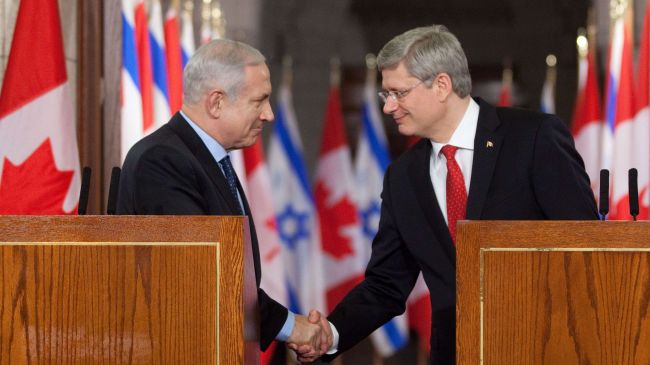
This picture shows Canada’s Prime Minister Stephen Harper (R) and Israeli Prime Minister Benjamin Netanyahu shaking hands after a joint press conference on Parliament Hill, Ottawa, March 2, 2012.
Press TV – April 28, 2013
The world is taking note of the ruling Conservatives’ shameful betrayal of Canada’s once admirable reputation as a fair country, sincerely working on the world stage to improve the lot of the disadvantaged and suffering.
In the UN Human Rights Council’s Universal Periodic Review, Canada was criticized to such an extent that the Council decided to send the Special Rapporteur on the Rights of Indigenous Peoples, and representatives of the Committee on the Elimination of Discrimination Against Women and the Inter-American Commission on Human Rights, to investigate.
Minister of Foreign Affairs spokesman Joseph Lavoie dismissed complaints by
*China of “widespread racial discrimination”,
*Iran of “child sexual exploitation and trafficking, the right to food, discriminatory law and regulation against indigenous people and minority groups including Muslim, Arab and African communities”,
*Pakistan of “increased poverty and unemployment rate among immigrant communities”,
*Egypt of “racial profiling in law-enforcement action”, and
*Cuba of “racism and xenophobia” in Canada,
insisting that “Canada has a track record of being a human rights leader, at home and around the world.”
The visits come at an awkward moment for the Conservatives, as it makes a public display of victimizing Muslims as part of a campaign to ram through the “Combating Terrorism Act” (Bill S-7), which gives the state extraordinary powers to detain suspects without any charges and without any legal protections for up to a year.
This sorry state of Canadian political life is the fruit of the Conservatives’ slavish obedience to every US whim, and of its decision to abandon any pretense of an independent foreign policy, making all decisions in consultation with Israeli advisers under the public security cooperation “partnership” signed in 2008 by Canada and Israel to “protect their respective countries’ population, assets and interests from common threats”. Israel security agents now officially assist Canada’s security services, the RCMP and CSIS, in profiling Canadian citizens who are Muslims and monitoring individuals and/or organizations in Canada involved in supporting the rights of Palestinians and other such nefarious activities. Even the usually timid UN is appalled.
The past two weeks of public spectacle could be lifted from a perverse Alice-in-Wonderland scenario. The latest claim to have uncovered a dastardly scheme by Muslim furriners plotting to explode weapons of mass destruction came just a week after the now legendary Boston bombing. Both incidents were dramatically unfolded to a gullible public as classic ‘good vs evil’, though neither holds water.
Canadian authorities boasted Monday afternoon that, working in concert with the FBI and other US national security agencies, they had broken up a terrorist conspiracy involving an “Iranian-based al-Qaeda cell”. The announcement, made at an RCMP press conference, came out of the blue, just days after the Boston bombing, and a few days after the House of Commons agenda was changed to debate final reading of the draconian anti-terrorism legislation.
On cue, US Ambassador to Canada David Jacobson hailed the action as “the result of extensive cross-border cooperation” showing “that we face serious and real threats.” The men were arrested in a Hollywoodesque fashion–Chiheb Esseghaier while eating at McDonald’s in Montreal’s main train station; Raed Jason, by scores of police armed with rifles and accompanied by search-dogs at his workplace in the Toronto borough of North York. They were charged with conspiracy to bomb a New York-bound Via passenger train, though the RCMP conceded that there had never been an imminent threat of an attack or even a definite plan, that Esseghaier and Jaser have been under police radar since last August (based on a year-old tip from an imam), and that their alleged crimes date back to last year.
The reason for their delayed and then sudden arrest is beyond a doubt the notorious Bill S-7, a bill that was forced on Canada by Big Brother in post-911 2001, and which was not renewed in 2007 thanks to Liberal opposition (they originally passed it and then had enough sense to oppose it). The Conservative government suddenly changed the House of Commons agenda as US authorities placed Boston under martial law. The Canadian copycat arrests clearly are intended to add a Canadian pretext for proceeding with Bill S-7, while showing that “We are all Americans now.”
This episode calls to mind the terrorist scare in 2006, when the RCMP staged the dramatic arrest of 18 young Muslims, whom they accused of preparing extensive terrorist attacks, including blowing up the parliament buildings. During the trial, it emerged that the “Toronto 18” was riddled with police agents, one providing the arms instruction at a “terrorist training camp” while another providing harmless bomb-making ingredients. Nevertheless, eleven were convicted and most given lengthy prison terms.
When Esseghaier, a Tunisian-born Montreal PhD student in nanotechnology, told the judge, “These conclusions are being reached based on facts that are nothing but words and appearances,” he was told to shut up, and the hearing was shut down. Jaser’s lawyer John Norris said his client was “in a state of shock and disbelief” and “intends to defend himself vigorously”. Norris took exception to the police’s attempt to present his client as a non-Canadian, noting that the Palestinian refugee has lived with his family in Canada for the past twenty years.
Is it just possible that UN Human Rights Council members read the ‘news’, are appalled, and are genuinely concerned about what’s happening to human rights in Canada?
Canadians’ plight is bad enough, but this recent orchestration of Islamophobia has another angle, just as appalling. The RCMP assertion that these damn furriners acted under the “direction and guidance” of “al-Qaeda elements located in Iran” is a blatant falsehood, as Iran (like Iraq before the US invasion) is probably the most anti-al-Qaeda country in the world. The fundamentalist al-Qaeda delights in killing Shia, was (and is?) supported by the US and financed by Canada’s enlightened Saudi oil-millionaire allies. So it’s not just a question of stripping Canadians of their rights, but of adding toxic fuel to the US-Israeli fires intended to launch war against peaceful (pro-Palestinian) Iran.
The RCMP admitted that they had no evidence of Iranian government involvement, but still… (nudge, nudge, wink, wink). When Canada broke off diplomatic relations with Tehran last autumn, Foreign Minister John Baird labeled Iran “the most significant threat to global peace and security in the world today”. All Iranian Foreign Ministry spokesman Ramin Mehmanparast had to do was to point to the hypocrisy and cynicism of Canada’s government backing the campaign to overthrow the Syrian government -a campaign in which some of insurgents are openly aligned with al-Qaeda: “The same [al-Qaeda] current is killing people in Syria while enjoying Canada’s support.”
And what about the latest hit on the American 911 funny bone? Tamerlan Tsarnaev was under surveillance for four years by the FBI, who were asked by the Russian government to arrest him in 2010 (which they did not do). They do admit to interviewing him in 2011 and sifting through his computer files, but, remarkably for someone allegedly radicalized by the internet, they found nothing of concern. It’s not clear why Russia let him go to visit his parents in the center of terrorism (Dagestan) in Russia in 2012, where purportedly he received some form of terror training or further Islamist indoctrination. Nor how he managed to attend a workshop next door in hostile Georgia organized by the “Fund of the Caucasus” (which works with the US rightwing thinktank the Jamestown Foundation) focused on destabilizing the Caucasus region.
Were both the FBI and the Russian FSB asleep? Was Tamerlan an FBI operative? Was he set up to do the bombing, or did he go AWOL on the FBI? Is this Chechen connection intended to frighten Russia into acquiescing to US-Israeli plans for Syria? “This [official] scenario is simply impossible in the real world,” writes former UK Ambassador Craig Murray. In an interview with Russia Today, Tamerlan’s mother said, “‘They were set up, the FBI followed them for years.” Is this international intrigue-intended to scare both Russia and Iran into abandoning the beleaguered Syrian government -really what Canadian domestic human rights and foreign policy should be based on? Why should we trust Ambassador Jacobson’s blah-blah about “serious threats”?
Canadians are left with security forces eager to show they are doing something, a craven government intent on passing a draconian bill to take away freedoms, and a foreign policy based on a US-Israel obsession with finding some spark to ignite the latest war craze -attack Iran. The supposed pretext -Iran’s nuclear energy program- is after all wearing a tad thin. Peter Osborne in the Telegraph explained how the West has turned down one serious offer after another by Iran (two in 2005 alone), and argues that it is western rather than Iranian intransigence that prevents a deal being struck today. So if no one believes the cry of “Wolf!” on that boondoggle, then the next best thing is “al-Qaeda”. Hell, Bush got away with it against Iraq in 2003; maybe it will work again.
Iran poses only an ideological threat -telling the truth to the US-Israeli tyrant and inspiring Arab Springs.
As for being killed by a bona fide terrorist, the odds are 1 in 20 million, while every year, 4,600 Americans are killed in workplace-related accidents, and more than 30,000 are killed by gun violence. Every 28 hours a black person is killed by police, security guards or vigilantes. On Boston Marathon Day, six Pakistanis died in a drone strike, while scores were killed in car bombs in Iraq. I won’t even begin to recount the daily horrors inflicted by the US in Afghanistan.
Not that these latter crimes against humanity -committed by us- justify retributive violence in any religion, especially Islam. “You shall not be treacherous, you shall not deceive, you shall not mutilate, you shall not kill children.” But the fact that we in the West are unconcerned with preventing senseless deaths at home, and are unaware or don’t care about the murders committed daily in our name abroad, does not bode well for the future. Only when we stop perpetrating violence will violence against us end.
HYPOTHESIS – Full Movie HD
Published on September 11, 2012
A Documentary about Steven E. Jones, a BYU physics professor who made startling discoveries about the 9/11 terrorist attacks.
Buy the DVD Here with many extras:
http://www.hypothesisfilm.com/index.p…
Featured Video
US JET SHOT DOWN OVER IRAN /Lt Col Daniel Davis & Nima Alkhorshid
or go to
Aletho News Archives – Video-Images
From the Archives
Experts Warned For Years That A War With Iran Would Happen This Way
By Caitlin Johnstone | April 3, 2026
… It’s so wild how we keep seeing reports that Iran’s retaliation caught the US off guard. For all the years I’ve been paying attention to this issue I’ve been reading experts and analysts saying if the US attacks Iran, Iran can close the Strait of Hormuz and strike US bases and the energy infrastructure of US allies in the region.
A few examples:
A 2006 Oxford Research Group paper titled “Iran: Consequences of a War” warned that Iran has numerous options at its disposal in the event of a US attack, and that the “most significant of these would be any possible retaliatory Iranian action to affect the transport of oil and liquefied natural gas through the Straits of Hormuz,” adding that stopping Iran from doing this “would be difficult if not impossible to achieve, leading to a fear of attack which alone would have a formidable impact on oil markets.”
A 2007 Cato Institute paper titled “The Iraq War and Iranian Power” warns that “Iran possesses the largest ballistic-missile inventory in the Persian Gulf — missiles which can reach Israel, Saudi Arabia and US military bases in Iraq,” and that “experts argue Iran could also use the ’oil weapon’: blocking the 34km-wide Strait of Hormuz and conducting submarine and anti-ship missile attacks against ports and oil facilities in Saudi Arabia, Kuwait and other Gulf Cooperation Council states.”
A 2012 NPR article titled “Can Iran Close The World’s Most Important Oil Route?” features then-chairman of the Joint Chiefs of Staff acknowledging that Iran absolutely can block the Strait of Hormuz, saying Tehran has “invested in capabilities” which specifically enable them to do so.
A paper from the Columbia Center on Global Energy Policy and the Center for a New American Security titled “IN DIRE STRAITS? IMPLICATIONS OF US-IRAN TENSIONS FOR THE GLOBAL OIL MARKET” warns of a potential scenario “that includes damage to Gulf oil infrastructure and a temporary closure of the Strait of Hormuz.”
These weren’t a bunch of keffiyeh-wearing peaceniks making these assessments, they were deeply entrenched swamp monsters entirely loyal to the US empire. They opposed war with Iran not because it would be an evil act of unforgivable mass murder, but because it would be bad for the imperial power structure. … Full article
Blog Roll
 Aletho News
- US dismantling international law in its war against Iran while claiming ‘false’ victory: Legal scholar
- One martyr, 5 injuries in US attack on Iraqi border crossing with Iran
- ‘This war is Israel’s war’: World facing ‘security breakdown’, says Qalibaf
- IRGC decries attack on US embassy in Riyadh, says executed by ‘Israel’
- Iran blasts EU hypocrisy as EU invokes international law over Hormuz
- There is no military solution to Strait of Hormuz
- NATO’s structural collapse – the outcome of deviation from reality
- Poll finds world views China better than US
- One Of America’s Leading Neo-Cons Has Turned Against The Iran War And Israel
- Attack in the Bosphorus exposes NATO weaknesses and tensions among allies
- If Americans Knew
- US loses planes over Iran, Israel downgrades Lebanon war goals – Daily Update
- Israel Is Blocking Palestinians from Easter at Church Where Jesus Resurrected
- Plot to assassinate Palestinian activist follows harassment campaign promoted by Zionist groups and elected officials
- Prominent New York synagogue hosts presentation on why U.S. Jews should support the ethnic cleansing of Gaza
- Tapper vs. Piker: Is the CNN Anchor Auditioning for David Ellison?
- Shouldn’t Democrats Be Able to Condemn Genocide?
- Israel-US kill negotiators, destroy civilian structures, but Iran’s military capabilities still largely intact – Daily Update
- ‘War crime’: Global condemnation as Israeli ministers celebrate death penalty law targeting Palestinian prisoners
- 7 Ways Israel Is Turning Lebanon Into Gaza
- World’s Leading Football Bodies Under Fire Over Israel Policies
- No Tricks Zone
- New Study Reports A 60% Slowdown In Greenland’s Ice Loss Rate In The Last Decade
- Low Intensity Tornado Wrecks Major Solar Farm, Creating A Potential Toxic Dump
- New Study Finds Warming Saves Lives…Cold Temperatures 12 Times More Deadly Than Excess Heat
- German Science Blog Accuses PIK Climate Institute Of Hallucinating Climate Tipping Points
- Devastating Assessment Of Comirnaty Vaccine By Former Senior Pfizer Europe Toxicologist
- New Study: CO2 Is ‘Effectively Negligible’ As An Explanatory Climate Change Factor Since 2000
- Former Pfizer Toxicologist Dr. Helmut Sterz Tells Bundestag Hearing Pfizer Vaccine Should Have Never Been Approved
- Energy Expert: Germany’s Nuclear Phaseout Was A “500 Billion Euro Mistake”
- New Research: South Australia’s Mid-Holocene Sea Surface Temperatures Were 4°C Warmer Than Today
- Storing Green Energy To Last Germany 10 Days Would Require A 60-Million Tonne Battery
 Aletho News