Still Getting Gitmo Wrong
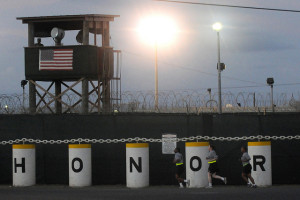
Guantanamo (Joshua Nistas/US Army)
By Peter Hart| FAIR | May 25, 2013
President Barack Obama’s address yesterday on U.S. terror strategies got a lot of attention for supposedly charting a new course in America’s longest war. But some of the facts were mangled along the way.
On CBS Evening News (5/23/13), reporter Major Garrett stated that
Obama urged Congress to close the military prison in Guantanamo Bay, Cuba. To that end, he will seek permission to send 86 of the 166 jailed terror suspects already cleared for release to other countries.
Those 86 prisoners have not been, and will not be, charged with any crime whatsoever; they are not “terror suspects.” Garrett’s statement was all the more awkward considering that it came right before CBS played a clip of Obama saying this:
Imagine a future, 10 years from now, or 20 years from now–when the United States of America is still holding people who have been charged with no crime on a piece of land that is not a part of our country.
To refer to “people who have been charged with no crime” as “terror suspects” is simply Orwellian. Garrett went on to say:
An intelligence report in January, Scott, found that fewer than 5 percent of those detainees released since 2009 have rejoined the fight.
That is indeed the language used in the government’s accounting of former Guantanamo detainees–and the definition of “re-enagaging” has been narrowed considerably since the Bush years. Reporters have taken some of this Pentagon propaganda on this issue at face value in the past, which should be all the more reason to continue to be skeptical. If someone has been imprisoned without charge or trial for a number of years, can one plausibly claim that they have “returned” to committing crimes that they were never charged with in the first place?
It’s not just CBS. In the New York Times (5/24/13), Peter Baker writes:
Mr. Obama said he was lifting a moratorium he imposed on sending detainees to Yemen, where a new president has inspired more faith in the White House that he would not allow recidivism.
Again, these are prisoners cleared for release because they cannot be charged with any crimes. It is bizarre to seriously discuss the threat that they might go back to committing crimes there’s no apparent evidence that they’ve ever taken part in.
Sanctifying nuclear hazards
By Praful Bidwai | The News | May 25, 2013
The disconnect between nuclear power realities and the Indian establishment’s perceptions is complete. Nuclear power has been in worldwide decline for more than a decade. The number of operating reactors peaked in 2002 at 444, but has fallen to under 380. Their output peaked in 2004, and has since decreased annually by two percent or more.
Nuclear energy’s contribution to global electrical generation has declined from its sixteen percent peak to barely eleven percent. Its share in global primary energy supply has fallen to a marginal four percent and of final energy consumption to a minuscule two percent. By contrast, renewable sources [primarily hydro-power] account for 16 percent of global primary energy.
The sixty-year-old nuclear power technology is exhausted. It has seen no major innovation recently, partly because it has been in severe retreat for a quarter-century in its heartland – western Europe, North America and Japan, which host two-thirds of the world’s nuclear fleet.
The US – which has the world’s largest number of reactors – has not installed a single new reactor since 1973. In western Europe, no reactor has been commissioned since Chernobyl (1986). And Japan now runs only two of the 54 reactors it operated before Fukushima.
Exorbitantly expensive nuclear power has failed the market test and globally lost over one trillion dollars in subsidies, abandoned projects, cash losses, etc. No bank will finance reactors; no insurance company will cover them.
Nuclear power evokes fear and loathing everywhere because of its grave public hazards, including exposure to cancer-causing radiation, potential for catastrophic accidents, and the problem of storing highly radioactive wastes for thousands of years, to which science has found no solution. These hazards are magnified by secrecy, technocratic domination and collusion between operators, regulators and governments.
Fukushima is likely to prove the last chapter in the global nuclear power story. When they retire, most of the world’s 160-odd reactors which are 30 or 40 years old won’t be replaced with new ones.
Indian policymakers are totally blind to this. Driven by irrationality, the domestic nuclear lobby, and relentless pressure from foreign reactor manufacturers and governments (to whom Prime Minister Manmohan Singh promised lucrative contracts for backing the US-India nuclear deal), they are pursuing their fantasy of a 12-fold expansion in India’s nuclear capacity by 2032.
They are oblivious of the Indian Department of Atomic Energy’s appalling record. The DAE, argues physicist-analyst MV Ramana, derives its power from the Bomb and the promise of abundant power. It hasn’t delivered even ten percent of the promise – eg 43,500 MW by 1980. It has never completed a project on time, or typically without a 300 percent cost overrun. It has so far installed just 4,780 MW in nuclear capacity – under 2.5 percent of India’s current total.
The official nuclear fantasy now extends to two Russian-supplied reactors being built at Kudankulam in Tamil Nadu, against which the local people have waged a resolute, two decades-long, peaceful struggle. This gathered great momentum after the Fukushima meltdown began in March 2011.
The government has viciously maligned and savagely repressed the movement with arbitrary arrests, FIRs against more than 200,000 people, and charging thousands with sedition, waging war on the state, and attempt to murder. It betrayed its promise not to implement the project until people’s safety concerns are fully allayed.
Meanwhile, evidence piled up that Kudankulam’s operator, Nuclear Power Corporation of India Ltd (NPCIL), violated numerous safety regulations and missed some 20 officially announced commencement deadlines because of serious engineering problems, including supply of sub-standard equipment by Russian company ZiO-Podolsk whose CEO has been jailed for fraud.
Exasperated, an environmental group moved a writ petition seeking the Indian Supreme Court’s intervention in implementing safety norms and enforcing accountability. The petition showed that Kudankulam lacks proper environmental and coastal zone regulation clearances, that the NPCIL has breached norms stipulated by the Atomic Energy Regulatory Board (AERB), and that it has no plans for hazardous spent-fuel storage.
The court pronounced judgement on May 6, clearing the plant’s commissioning while declaring it safe. The verdict trivialises safety concerns, declares nuclear energy indispensable for India’s progress, legitimises the malfunctioning nuclear establishment as infallible, and propounds a perverse notion of the public interest which runs against the constitutionally guaranteed right to life.
The verdict will go down as an anti-people, anti-environment black mark in Indian jurisprudence. Its greatest failure lies in dogmatically denying that nuclear power poses certain unique hazards. Even a conservative, but thoughtful, judgement would have acknowledged this and explored ways of minimising the hazards while boosting transparency and public confidence. This verdict doesn’t.
It declares nuclear power unproblematically safe, and says the Kudankulam reactors satisfy all environmental and safety criteria, based on the say-so of the AERB, DAE and NPCIL – all interested parties! It refuses to recognise the fact that the AERB is not independent, but a subordinate agency of the DAE, to whose secretary (also the Atomic Energy Commission chairman) it reports. The NPCIL is a wholly owned DAE subsidiary.
The AERB has no personnel, equipment or budget of its own. Recently, it was gravely indicted by the comptroller and auditor general of India for failing to fulfil its mandate to evolve and enforce safety standards. Former AERB chairman A Gopalakrishnan calls it a “toothless poodle”. But the verdict uncritically accepts the AERB’s certification of the Kudankulam reactors as safe, ignoring the gross conflict-of-interest involved.
The judgement simply bypasses numerous site-specific issues, including vulnerability to tsunamis, a history of volcanic activity and geological instability, and absence of an independent freshwater source, which is absolutely critical to all reactors.
The verdict ignores the NPCIL’s brazen violations of the AERB’s reactor-siting norms – viz, there must be “zero population” within a 1.5-kilometre radius of a reactor, and a maximum of 20,000 people within a further five- kilometre radius. But at least 5,000 people live within a 1.5- kilometre distance, including over 2,000 in a new rehabilitation colony with 450 tenements, which is less than 800 metres away. By NPCIL’s own admission, 24,000 people live within a five-kilometre radius, according to the 2001 census. Their number must be much greater in 2013. This too is ignored.
According to another norm, no fuel should be loaded in a reactor until a full emergency evacuation drill is conducted in a 16- kilometre radius. This never happened. The judgement ignores this, and also the fact that the plant lacks proper coastal zone regulation and environmental clearances. Equally ignored is the NPCIL’s non-compliance with the seventeen recommendations made by a special safety committee post-Fukushima.
The verdict dismisses people’s safety apprehensions, heightened after Fukushima, as a mere “emotional reaction”. It declares radiation exposure as a “minor inconvenience” which must be subordinated to the “larger public interest” of promoting nuclear power, which is indispensable to growth and will “uphold the right to life in a larger sense”.
The judgement’s worst part is the vile assertion dismissing “apprehension” about hazards, “however legitimate”: “Nobody on this earth can predict what would happen in future and to a larger extent we have to leave it to the destiny (sic)”. That is, the public must live with unacceptable hazards.
The verdict’s sole positive feature is its order to lift all false cases against the protesters. It otherwise lacks reason or logic, and is suffused with fatalism, irrationality and moral misjudgement.
The writer, a former newspaper editor, is a researcher and peace and human-rights activist based in Delhi.Email: prafulbidwai1@yahoo.co.in
Myanmar imposes two-child limit on Rohingya Muslims
Press TV – May 25, 2013
Officials in Myanmar’s western state of Rakhine have placed a two-child limit for Muslim Rohingya couples in a gross violation of fundamental human rights and amid accusations of ethnic cleansing against the community.
Local authorities said on Saturday that the new measure will be exercised in the townships of Buthidaung and Maundaw, where about 95 percent of the population are Muslim.
Rakhine state spokesman, Win Myaing, said the measure was enacted a week ago, and was meant to stem population growth in the Muslim community.
Human rights groups say the policy makes Myanmar the only country in the world to impose such a restriction on a religious group.
They also warn that the new move will serve to fan the flames of sectarian violence in Myanmar.
Human Rights Watch has accused Rakhine authorities of fomenting an organized campaign of “ethnic cleansing” against the Rohingya Muslims.
Thousands of Rohingyas are deprived of citizenship rights due to the policy of discrimination that has denied them the right of citizenship and made them vulnerable to acts of violence and persecution, expulsion, and displacement.
The Myanmar government has so far refused to extricate the stateless Rohingyas in Rakhine state from their citizenship limbo, despite international pressure to give them a legal status.
The extremists frequently attack Rohingyas and have set fire to their homes in several villages in Rakhine. Myanmar Army forces allegedly provided the fanatics containers of petrol for torching the houses of Muslim villagers, who are then forced to flee.
Hundreds of Rohingyas are believed to have been killed and thousands displaced in recent attacks by extremists, who call themselves Buddhists.
Rohingyas are said to be Muslim descendants of Persian, Turkish, Bengali, and Pathan origin, who migrated to Myanmar as early as the 8th century.
Another 7-year old girl injured in Jewish settler hit and run vehicular assault
IMEMC & Agencies | May 26, 2013
Sunday May 26 2013; Palestinian medical sources in Hebron, in the southern part of the occupied West Bank, have reported that a 7-year old child was injured after being rammed by a settler’s vehicle in the city.
The sources said that Bayan Kamel Shatat, 7, suffered moderate injuries and was moved to the Hebron governmental hospital.
Rateb Jabour, coordinator of the Popular Committee Against the Wall and Settlements in Hebron, said that the child is a first grade student, and that she was returning home from school. The settler fled the scene after the incident.
On Wednesday May 22, a 9-year-old child was seriously injured after being rammed by a settler’s car in the As-Salayma neighborhood, east of the Ibrahimi Mosque, in Hebron city.
On the same day, a 16-year-old child identified as Marwan Zakariyya ‘As’ous, suffered serious injuries and was moved to the Rafidia Hospital, after being rammed by a settler’s car at the Beta Junction, south of Nablus.
On May 14, Hanin Bassem Al-Ja’bary, 7, was injured after a settler rammed her with his vehicle close to the Ibrahimi Mosque, in the Old City of Hebron. The settler fled the scene.
There have been numerous similar incidents in Hebron and other parts of the West Bank, and despite repeated claims filed to the Israeli Police, no actual and effective measure were taken against the assailants.
Related articles
- Jewish settlers injure children in two separate vehicular assaults (alethonews.wordpress.com)
- Three Palestinian children arrested after attack by Jewish settler children – Swedish activist also arrested (alethonews.wordpress.com)
- Witnesses: Settlers open fire at Palestinian homes in Hebron village (altahrir.wordpress.com)
- Jewish terror state Kidnapped 28 Children In The first Half Of May, Dozens Injured (uprootedpalestinians.blogspot.com)
Canadian prime minister makes promises amid deepening scandal
Press TV – May 26, 2013
Canadian Prime Minister Stephen Harper has promised to toughen the expense rules of the Senate of Canada following a scandal that led to the resignation of his chief of staff.
Harper also called for the prevention of any loops in the law on Tuesday morning before leaving for South America.
“I don’t think any of you are going to be very surprised to hear that I’m not happy. I’m very upset about some conduct we have witnessed, the conduct of some parliamentarians and the conduct of my own office,” Harper said, referring to the scandal.
On May 19, Nigel Wright, Harper’s chief of staff, announced resignation after it was revealed on May 14 that he had secretly given a check of 90,000 Canadian dollars (about USD 87,000) to conservative Senator Mike Duffy apparently for the purpose of helping him repay housing expenses.
Wright said in a statement that he had decided to quit “in light of the controversy surrounding my handling of matters involving Senator Duffy.”
Duffy and another senator, Pamela Wallin, resigned from the Conservative Party on Thursday and on Friday respectively. Wallin is involved in a controversy regarding her travel expenses. The Canadian senator awaits the outcome of an audit into her own travel expenses, which is claimed to have been USD 321,000 since September 2010.
Related articles
IMF chief escapes indictment in corruption case
PressTVGlobalNews · May 25, 2013
The Court of Justice of the Republic (CJR) has not pressed criminal charges against International Monetary Fund (IMF) chief Christine Lagarde after days of investigation into a corruption case, Press TV reports.
Lagarde walked out of the court after two days of court hearings looking into her involvement in fraud and misappropriation of public funds.
The French court was probing Lagarde’s handling of a dispute in 2007 that resulted in a 400 million-euro (USD 515 million) payment to former politician and controversial business figure, Bernard Tapie.
On Friday, the former finance minister was given the status “assisting witness”. This means she will be regarded as a witness in future related questioning.
The IMF chief was France’s finance minister under the government of former French President Nicolas Sarkozy.
Reports indicate Sarkozy had promised Tapie benefits if he agreed to become a major funder in his 2007 presidential election campaign.
Some say the court’s decision is an unfair one.
“Christine Lagarde’s behavior in this affair is unacceptable, because she allowed one of France’s biggest businessmen to bypass traditional public justice and gave him a private arbitration… her decision greatly favored Mr. Tapie,” Copernic Fondation’s Pierre Khalfa said.
In 2007, Lagarde asked a panel of judges to arbitrate in a row between Tapie and the partly state-owned Credit Lyonnais over his sale of sports group Adidas in 1993.
She has been accused of “numerous anomalies and irregularities.”
The criminal charges are regarded as the second straight scandal for an IMF chief since Lagarde succeeded Dominique Strauss-Kahn, who quit over allegations of an assault on a hotel maid in New York.
Follow our Facebook on: https://www.facebook.com/PRESSTV
Follow our Twitter on: http://twitter.com/presstv
Follow our Tumblr on: http://presstvchannel.tumblr.com
Related articles
- France investigates IMF chief over 2007 payout (alethonews.wordpress.com)
- Prosecutors grill IMF chief (morningstaronline.co.uk)
Featured Video

No Threat Can Force Iran’s Surrender /Trita Parsi & Lt Cl Daniel Davis
or go to
Aletho News Archives – Video-Images
From the Archives
An Expert Military Analysis of War with China
Actually, None is Necessary
By Fred Reed • Unz Review • December 13, 2020
The Correlation of Armed Forces: U.S. goods and services trade with China totaled an estimated $634.8 billion in 2019. Exports were $163.0 billion; imports were $471.8 billion. The U.S. goods and services trade deficit with China was $308.8 billion in 2019. Trade in services with China (exports and imports) totaled an estimated $76.7 billion in 2019. Services exports were $56.5 billion; services imports were $20.1 billion. The U.S. services trade surplus with China was $36.4 billion in 2019.
There is talk within the Washingtoniat of a possible war with China. Steve Bannon, who apparently was dropped on his head as a child, actually favors such a war. We hear the usual shoo-the-boobs alarm about how the Chinese are doing something terrible and we must gird our loins and American values and show them what for, bow wow, woof. The danger is that the current game of who-blinks-first in Asian waters might actually provoke a shooting war. You know the kind of thing: One warship refuses to get out of the way of another, a collision ensues, some retard lieutenant who signed up on waivers opens fire, and we’re off and running. It is not a good idea to let children play with matches.
The said war is discussed either in emotional terms by idiots or in purely naval terms by those familiar with such things, so we hear of the First Island Chain and the Second Island Chain and whose missiles against the other’s missiles and so on. This would be appropriate if we were fighting World War Two again. Which we aren’t. Let’s take a quick-and-dirty look at how such a war might go.
To begin the war, America would overestimate itself and underestimate China. This is doctrine in the Pentagon. … continue
Blog Roll
 Aletho News
- Theodore Postol: Iran’s Missiles & Drones Were Underestimated
- Iran To Target Military Industrial-Tech Complex That Facilitated Gaza Genocide
- Collapsing Empire: The Resistance Disarms ‘Israel’
- Suicide Should Not Be a Government Service
- Rethinking America’s greatest threat: Iran vs. Israel-Firsters
- Iran accuses adversaries of false flags to strain Turkey ties
- Poland rules out sending Patriot missiles to US/Israel amid war on Iran
- Tehran approves new Hormuz plan with major restrictions
- No Threat Can Force Iran’s Surrender /Trita Parsi & Lt Cl Daniel Davis
- UK’s New Pandemic Plan Would Turn Big Tech Into a Mass Location Tracking Network
- If Americans Knew
- Ann Coulter Rips Into Fox News for Iran War Coverage, Compares to False Rigged 2020 Election Reporting
- Joe Kent Urges Americans To Call White House and Congress To Object To Sending Troops Into Iran
- DNC Resolution to Reject AIPAC Funding Puts Democratic Leaders in the Hot Seat
- Swedish foundation to build 400 schools as over 650,000 Gaza children remain without education for 2 years
- Israeli army admits photshopping image of slain Lebanese journalist
- This is how Israel is systematically killing health workers under the cover of war in Lebanon
- Carrying life under fire: Israeli invasion of Lebanon leaves pregnant women facing deadly risks
- Champagne all around for the new death penalty (for Palestinians) law – Not a ceasefire Day 172
- Why are Palestinian books struggling to be seen on Amazon?
- The Line Between Affinity and Conspiracy
- No Tricks Zone
- New Study Finds Warming Saves Lives…Cold Temperatures 12 Times More Deadly Than Excess Heat
- German Science Blog Accuses PIK Climate Institute Of Hallucinating Climate Tipping Points
- Devastating Assessment Of Comirnaty Vaccine By Former Senior Pfizer Europe Toxicologist
- New Study: CO2 Is ‘Effectively Negligible’ As An Explanatory Climate Change Factor Since 2000
- Former Pfizer Toxicologist Dr. Helmut Sterz Tells Bundestag Hearing Pfizer Vaccine Should Have Never Been Approved
- Energy Expert: Germany’s Nuclear Phaseout Was A “500 Billion Euro Mistake”
- New Research: South Australia’s Mid-Holocene Sea Surface Temperatures Were 4°C Warmer Than Today
- Storing Green Energy To Last Germany 10 Days Would Require A 60-Million Tonne Battery
- New Studies: UK Sea Levels Were 4 Meters Higher Than Today During The Mid-Holocene
- Destructive Green New Deal: German Energy And Metal Group Warns Of Drastic Crisis
 Aletho News