During Israel’s latest onslaught against the Gaza Strip in November 2012, a major conference was held in Tel Aviv: the 2nd Israel HLS International Conference. Among the most prominent sponsors of the homeland security event were two of Israel’s largest weapons companies, Elbit Systems and Israel Aerospace Industries (IAI), both of which cooperate closely with the Israeli military. But the conference also had another grandiosely advertised partner: the European Commission.
As is often the case, this undisguised cooperation between the EU and Israeli military companies went fully unchallenged – let alone noticed – in the European media. Not even the rather conspicuous fact that the EU-sponsored conference occurred simultaneously with Israel’s devastating Gaza assault in which Israel used the equipment of both Elbit and IAI.
The same inability, or unwillingness, by the European media to report such collaboration, let alone deplore it, manifested itself even more prominently in January 2009. A day after Israel’s 22-day long assault on the Gaza Strip, the leaders of six European states, including the UK, France, and Italy, arrived in Israel for a gala dinner, voicing their support for Israel. The dinner was hosted by Israel’s then-prime minister Ehud Olmert. The European leaders vowed, of all things, to stop the flow of arms to Hamas. Meanwhile, the Israeli strikes on Gaza would kill 926 civilians.
As a trading and co-sponsoring partner, Elbit is among the most disagreeable of all the Israeli military companies. Being at the very core of Israel’s breaches of international law, Elbit is deeply involved in Israel’s drone programs that have targeted and killed scores of civilians, including children. The former president and chief executive of Elbit proclaimed that the company is “the backbone” of Israel’s drone operations. Elbit also provides surveillance equipment to the illegal wall Israel has built in the West Bank. Besides being an instrumental partner of the Israeli air force, it also sells equipment to the Israeli navy.
The EU also funnels funds to Elbit through allocating EU-taxpayers’ money to the company under the umbrella of scientific research. Indeed, another barely publicized yet lucrative form of EU-Israeli cooperation that directly benefits Israel’s private military sector are scientific research subsidies. David Cronin, who has put together a pioneering compendium on the EU’s complicity in Israel’s illegalities, estimates that by the year 2013, Israel will have received EU research grants for more than €500 million. Israel currently takes part in over 800 schemes with European universities and corporations.
The massive EU-Israel bilateral trade remains one of the least talked about, yet among the most crucial enablers of Israel’s ever-continuing breaches of international law.
The EU is Israel’s main trading partner with a total annual trade of approximately €30 billion (€29.7 billion in 2012). The volume of the trade is more than ten times that of the US foreign aid to Israel. While it is reasonable to assume that US-Israeli relations will remain intact in the coming years, the EU has the required economical leverage and legal means to exert unprecedented pressure on Israel, compelling it to abide by international law.
According to a 2003 European Commission poll, 60 percent of the EU citizenry sees Israel as the greatest threat to world peace. In this respect, European public opinion is more informed than that in the US. Another factor that makes it feasible for EU to alter its policy towards Israel is that the EU-Israel Association Agreement that governs all trade and cooperation between the EU and Israel states that “[r]elations between the Parties, as well as all the provisions of the Agreement itself, shall be based on respect for human rights and democratic principles.”
Hence, whereas a drastic shift in the US-Israeli relations remains an unlikely scenario, the EU has both the informed public opinion required for, and a no-brainer legal case demanding, relatively swift and highly momentous changes.
As of now, however, the EU is both a major client for Israel’s occupation-powered, export-oriented and multi-billion military manufacturing and homeland security sector as well as a major exporter of military equipment to Israel.
Besides the military and homeland security imports from Israel, the EU also continues to violate its own regulations on arms exports. The EU Code of Conduct on Arms Exports states that the EU is “DETERMINED [sic] to prevent the export of equipment which might be used for internal repression or international aggression or contribute to regional instability.”
How determined exactly has the EU been in its adherence to this provision? Based on the criteria set out by the EU in the above regulation, Israel is an illegitimate country for arms exports. After all, in addition to violating a whole list of UN resolutions, Israel has been and remains exceptionally committed to violating international law.
Although Israel is an invalid trading partner according to the EU Code of Conduct regulations, the value of licenses granted by the EU over the past decade for arms exports to Israel amounts to billions of Euros.
Whereas 18 of 27 EU member states export military equipment to Israel, the bulk of the total EU exports originate from the major EU states: Italy, France, Germany and the UK, according to Amnesty International’s “Fuelling conflict: Foreign arms supplies to Israel/Gaza.”
In terms of violating EU arms exports regulations, Italy has the most abominable track record. Italy’s biggest defense contractor, Finmeccanica, announced in July 2012, that it had won and signed a $1 billion (€752 million) deal with Israel. Finmeccanica will provide training jets to the Israeli air force, which repeatedly carries out egregious attacks against Palestinian and Lebanese civilians and infrastructure.
Out of the total €752 million deal, the most sizable part belongs to Finmeccanica’s subsidiary Alenia Aermacchi which provides 30 M-346 advanced trainer aircraft to the Israeli air force. It is reported that the Italian government played a major role in brokering the contract.
Another EU member state that carries out large-scale military trade with Israel is France. Between 2003 and 2008, France exported more than €521 million worth of weaponry to Israel.
An Amnesty International report from February 2009 revealed that electrical components made in France were found in the rubble of buildings destroyed by the Israeli military during the 2008-2009 Gaza massacre. The components were installed in Hellfire AGM missiles manufactured by the US company Hellfire Systems, a joint venture of Lockheed Martin and Boeing. France also exported specialized equipment for reconnaissance, such as laser systems, to Israel.
Another major arms exporter to Israel is Germany. Germany sold major conventional weaponry to Israel for more than €580 million between 1996 and 2000, including Dolphin Class Submarines, which are assumed to be capable of launching nuclear warheads. In 2000 alone, German weapons trade with Israel was worth more than €130 million. Germany exported torpedoes, armored cars, and parts for the Israeli Merkava tanks used in occupied Palestine.
The UK also exports considerable amounts of military equipment to Israel. In 2009, after Israel had destroyed the Gaza Strip, the UK authorities granted export licenses for electronic warfare equipment, naval radars, and sniper rifles to Israel. In 2009, the then-Foreign and Commonwealth Secretary David Miliband revealed that the Israeli equipment used in Israel’s murderous and destructive assault against Gaza “almost certainly” contained components that had been delivered by the UK.
In recent years, the UK government has annually licensed arms exports directly to Israel for between €12 million and €36 million. In 2008, UK authorities granted military export licenses for more than €34 million.
Besides these major European powers, one state enjoys exceptional clout as a strict adherent to international law, but has excelled at conducting arms trade with Israel, namely Finland. The total value of the Finnish-Israeli arms trade is €200 million.
In addition to the fact the Finland has conducted more military trade with Israel than a number of much bigger EU member states, what sets Finland apart from all the other arms trading partners of Israel is the severity of domestic criticism the trade has elicited.
A petition signed by more than 250 Finnish dignitaries from the arts, academia, and politics is a telling indicator of the wave of criticism arising from the military trade between Israel and Finland. Among those calling for an immediate discontinuation of all forms of military trade with Israel are the foreign minister Erkki Tuomioja and world-renowned expert on international law Martti Koskenniemi.
It merits emphasis that the continuation and, often the mere existence, of the trade has arguably had no support in the Finnish mainstream media.
As the 2003 European Commission poll already revealed, the ever-continuing business-as-usual attitude by the EU to Israel’s actions fully contradicts union public opinion. The freezing of the EU-Israel Association Agreement and the seizing of all weapons exports from the EU to Israel – both actions required by EU provisions – could force Israel to finally recognize and respect the rights of the Palestinians.
May 13, 2013
Posted by aletho |
Ethnic Cleansing, Racism, Zionism, Illegal Occupation, Solidarity and Activism, War Crimes | Elbit, Elbit Systems, European Commission, European Union, Israel |
Leave a comment
It has been hailed as the first conviction for genocide of a former head of state in his own country, and certainly the first of a former Latin American strongman. Former Guatemalan dictator Efrain Rios Montt was convicted by a Guatemalan court on Friday for his participation in crimes against the Mayans during his rule in 1982 and 1983. His sentences were steep: 50 years for genocide and 30 for crimes against humanity.
As ever with genocide, evidence of an intentioned plan to destroy a race had to be shown. The three-judge panel led by Yassmin Barrios was satisfied that the definition had been made out, finding that there had been a clear and systematic plan to exterminate the Ixil people. Prosecutors allege that up to 1,700 of the Ixil Maya were killed, in addition to torture, rape and the destruction of villages. The acts had occurred as part of a policy of clearing the countryside of Marxist guerrillas and sympathisers.
The heart of the defence by Rios Montt was that, as a political leader, he could not be held accountable for military matters conducted in a rural province some few hours northwest of the Guatemalan capital. “I never authorised it, I never signed, I never proposed, I never ordered that race, ethnicity or religion to be attacked. I never did it!” In this, he was echoing the sentiments of the Japanese General Tomoyuki Yamashita, who was found constructively guilty for having not stopped the massacres that took place in the Philippines.
Yamashita did have a point, and one picked up by the dissenting judges of the U.S. Supreme Court. To hold such a figure to account in circumstances of military emergency, when contact lines were severed, and the army was fighting for its survival, was a tall order. There was little evidence that those troops had acted under his orders. But Rios Montt could hardly claim to have been Yamashita and, according to the judges, “was aware of everything that was happening, and did not stop it, despite having the power to stop it.”
The trial proved a thorough affair, featuring extensive use of forensics, the examination of mass graves and the DNA of skeletons therein. It was grim but important work, and constituted but a small part of what was a civil war of mass murder. Between 1960 and 1996, Guatemala saw conflict that claimed the lives of more than 200,000 people. Prior to that, a U.S.-sponsored overthrow of the democratically elected Jacobo Arbenz Guzman ensured that the country would be doomed to decades of bloody instability.
It is often argued that trials do not provide a means of genuine restorative healing to parties or societies. Rios Montt will not be seen as a criminal by conservatives who feel he performed a sterling job in ensuring that the country did not fall into the clutches of left wing revolutionaries. The Cold War subtext here was that he was, if anything, heroic in holding the fort.
Besides, the current Guatemalan president, Otto Perez Molina, refuses to accept that genocide ever took place. This may not be surprising given that Molina’s name came up in trial testimony, in which a former soldier claimed he had ordered executions while serving in the military of the Rios Montt regime. “When I say that Guatemala has seen no genocide, I repeat it now after this ruling. Today’s ruling is not final… the decision will not be final until the moment they run out of appeals.”
There will also be consternation that the atrocities of the government, rather than those of the rebels, have featured prominently. That the former feature, however, is due to the sheer disproportionate role played by the rulers and paramilitary allies. The 1999 report by the country’s truth and reconciliation commission claimed that the government’s role in the atrocities, along with its allies, was a hefty 93 per cent.
The soiled hands of this incident are many. They did not start or stop with Rios Montt. Will the individuals who also cast money and material the way of such regimes be held to account? A case against the higher-ups, and those complicit beyond the borders of the country may well be in the offing, though that will take time. The edifice of accountability is gradually being built. International law, as ever, takes steps not so much in strides as in awkward stumbles, but when it does reach important junctions, effects are felt. What happens with the appeal will be telling.
Binoy Kampmark can be reached at: bkampmark@gmail.com.
May 13, 2013
Posted by aletho |
Ethnic Cleansing, Racism, Zionism, War Crimes | Efraín Ríos Montt, Guatemala, Ixil people, Otto Pérez Molina, Rios Montt |
Leave a comment
President Barack Obama is currently blocking the release—or allowing the CIA to block the release—of a comprehensive Senate report on the use of torture by the George W. Bush administration CIA that is said to conclude that torture was not an effective or reliable method of interrogation and that the agency repeatedly misled the White House, the Justice Department, and Congress about its interrogation efforts.
Initiated by Senate Intelligence Committee Chair Sen. Jay Rockefeller (D-West Virginia) and continued by Sen. Dianne Feinstein (D-California) when she succeeded him in 2009, the Senate torture probe entailed about six years of work and the review of 6 million pages of documents. In December 2012, the committee voted out the report on a mostly party line vote. Since that time, the report has been stuck in limbo at the CIA, with Director John Brennan refusing to state when his review will be complete, and reports indicating that the agency intends to write a rebuttal and oppose public release of the report.
Although the report validates anti-torture positions taken by Democrats, including President Obama, during the Bush years, Obama may be delaying its release over concerns about shedding negative light on his own, related, anti-terror policies that offend human rights, such as the continued use of torture at Guantánamo Bay or the predator drone assassination program. Further, the deep involvement of Obama’s hand-picked CIA Director, John Brennan, in the Bush-era torture and kidnapping programs may call Obama’s judgment about Brennan into question.
On the issue of torture at Guantánamo, the Obama White House claimed in 2009 that the President had canceled all Bush-era legal memos purporting to justify the use of “enhanced interrogation” techniques not authorized by the Army Field Manual. The President did not, however, cancel an April 13, 2006, memo regarding the 2006 revision of the Army Field Manual and its controversial Appendix M on interrogation. That memo justifies the use of isolation, sleep deprivation, and forms of sensory deprivation that have been denounced as torture or abuse by a number of human rights and legal groups—and which sparked the ongoing hunger strike at Guantánamo.
Obama may be concerned about the impact release of the report might have on his predator drone targeted assassination program. In 2009, the Obama administration successfully persuaded the Second Circuit Court of Appeals in New York to overrule a trial judge’s ruling ordering release of a September 17, 2001, presidential directive that established a wide range of anti-terror efforts, including the use of torture. Why Obama went to such great lengths to keep the directive secret may have been revealed by the appeals court opinion, which stated that “the withheld information pertains to intelligence activities unrelated to the discontinued [torture] program,” including targeted killings of suspected al-Qaeda operatives.
May 13, 2013
Posted by aletho |
Civil Liberties, Deception, Progressive Hypocrite, Subjugation - Torture | Central Intelligence Agency, CIA, Guantánamo Bay, Human rights, John Brennan, Obama, United States Senate Select Committee on Intelligence |
Leave a comment
On Wednesday, 8 May 2013, Israel held its annual Jerusalem Day celebration, commemorating its annexation of East Jerusalem and the Old City during the 1967 Six-Day War.
Israeli settlers marched through East Jerusalem neighborhoods carrying Israeli flags and singing, celebrating and asserting their control of what is internationally recognized as the capital of any viable future Palestinian state.
Settlers marching in and out of the Damascus Gate, located directly alongside the largest Palestinian shopping center in the city, were met with a pro-Palestine counter-demonstration.
Hundreds of Israeli police were on the scene to put down the Palestinian counter-demonstration. Israeli police detained upwards of 18 individuals and beat dozens of others. Among the detainees were minors as well as several photographers.


(All photos by Dylan Collins)
May 13, 2013
Posted by aletho |
Ethnic Cleansing, Racism, Zionism, Illegal Occupation, Subjugation - Torture, Timeless or most popular | Damascus Gate, Human rights, Israel Police, Jerusalem, Jerusalem Day, Palestine, Zionism |
Leave a comment
The Middle East is treading water these days. Two years of rhetoric about ousting dictators, revolution, freedom, honor, dignity, and democracy – without result – has people on edge, their disillusionment now demanding an outlet.
There are no outlets though. Sensing the fast-growing disenchantment with undelivered promises, even the “bright new leaders” are tightening the reins and demanding compliance.
These new heads of state simply can’t deliver the goods for one main reason: they are just as caught up in global and regional power contests as were their predecessors. Nothing has changed with these uprisings – nothing.
Except now the stakes are higher than before. A recession-bound West, the fast-rising BRICS and their respective regional allies are locked in a competition to consolidate power and influence in this important region before it finds its bearings.
The relatively new influencers on the Arab scene like Qatar and Turkey have recognized this as a unique opportunity to slip into region-wide leadership roles. For the entrenched old hands – Washington, Riyadh, Paris, London – a race is on to prevent the region from shrugging off their decades-long dominance and embracing the anti-imperialism of the Resistance Axis.
The result has been an onslaught of interventions. Every tool in the arsenal has come out to play. Money, espionage, propaganda, weapons, assassination and that old colonial trick: divide-and-rule.
The main game is still the old battle of the blocs, Iran versus the United States, with everyone else filing in line behind their team. There have been a few surprises thrown into the mix: the newcomers like Turkey and Qatar have moved over to the US side; the BRICS, however, have lent their considerable clout to team Iran. Iraq has moved behind the latter formation and Hamas still doesn’t know where to stand so it straddles the two.
This is not a game for the faint-hearted, and it permeates every major social, economic, and political decision in the region today. Want a new electrical plant outside Cairo, Beirut, or Kirkuk? Good luck choosing a national supplier who doesn’t offend. IMF loan? Allowing over-flights or passage for ships? Inking a trade deal? Formulating a new constitution? Scheduling a football match?
Mideast states are now paralyzed and polarized over such things, and governance has come to a standstill. But in this paralysis lies a dangerous volatility: a backlash in the brewing, a pressure cooker about to blow.
The Backlash Against Neo-Islamists
After decades of oppression and marginalization by pro-West, secular dictatorships, the Muslim Brotherhood (Ikhwan) and similar Islamist parties have catapulted to power and prominence in several states. Quite counter-intuitively, however, these Islamist governments appear to have lined up behind the US bloc, eager to please, or at least placate, the very powers that colluded in their oppression.
It is an unnatural marriage, and the longer this union endures, the more estranged Islamist parties will become from their domestic constituencies – in much the same way as their autocratic predecessors.
There is volatility in this balancing act between the two blocs, as groups like Hamas have come to discover. But for the new Islamist powerhouses in “post-revolution” states, yet another volatile contest is being played out to their detriment, this time on an entirely regional level: Qatar versus Saudi Arabia – or Sunni versus Sunni.
For years the Ikhwanists have been backed by the Qatari arrivistes, who are a thorn in the side of the other, larger Wahhabi state in the Arab world, Saudi Arabia. The Saudis, for their own part, are throwing dollars and clout behind Salafists in all the countries where they intend to counter the influence of the Ikhwan and similar parties.
But Qatar and Saudi Arabia are now aggressively exporting their very personal competition to other Arab states – Libya, Egypt, Syria, Tunisia, Palestine – creating what I believe will evolve into a ferocious backlash among local populations, even as they reap the rewards of direct financial investment from these two Gulf states.
This competition has drawn in others like the UAE, Jordan, and Kuwait, appalled at the Qatari push to Ikhwanize the region. And it has turned the Arab League positively cannibalistic, devouring the sovereignty and territorial integrity of states like Libya, Syria, and Palestine that it once pledged to protect.
Qatar finds support from AKP-led Turkey in this fight, but the two are a cause for concern in the United States, which secretly suspects that Ikhwanists are harder to control than Saudi-backed Salafists. Much of this fear is because that lynchpin of all US foreign policy calculations, the state of Israel, borders Ikhwan-heavy Egypt, Gaza, and Jordan – none of which have yet sufficiently proven their loyalty to the idea of Israel’s regional hegemony.
But the biggest victim of the Saudi-Qatari competition to influence the direction of political Sunnism is likely to be political Islam itself.
The rise of political Islam – once an inevitable byproduct of democratization – arrived too hard, too fast; too aggressively championed, organized, and weaponized by Qatar and Saudi Arabia. Now, not only have the mentors lost credibility and support, but so have many of their political protégés in Yemen, Egypt, Tunisia, Libya, Syria, and Palestine.
Volatility? We haven’t even started.
What yesterday’s global powerbrokers seek from the incoming class of political Islamists is the maintenance of the status quo, including, among other things, embracing Israel and rejecting Iran. But an open pledge of allegiance to Israel is impossible for the Ikhwan and similar parties – their very legitimacy comes in part from denouncing the legitimacy of the Zionist experiment in Palestine.
Nothing tested their limits as dangerously as last November’s eight days of rocket-volley between Gaza and Israel. Each passing day drove home the fact that, despite their standard rhetoric to domestic and regional constituencies, Islamist heads of state in Turkey, Egypt, and Qatar were rendered paralyzed – and mute – as the Israeli army pounded Gaza.
Instead, it was firepower, training and strategic planning by Iran, Hezbollah, and Syria that propped up defiant Palestinians through those dark hours. The unexpected arsenal of rockets that countered Israeli aggression came from Hamas’ Qassam Brigades, Palestinian Islamic Jihad (PIJ), and other smaller resistance groups, who became the heroes of that conflict.
Not one missile, bullet, or slogan came from the three new Qatari, Turkish, and Egyptian “Sunni kings” vying for power on the coattails of the Arab uprisings.
Had the battle gone on for another week or two, the entire Middle East might have been reconfigured in its aftermath. Never have the Israelis so quickly signed a ceasefire agreement.
The global battle of the blocs and the inter-regional Sunni power struggle crossed paths in that Gaza battle. In it, the US bloc and political Islam exposed their vulnerabilities. Both groups are currently upholding – against a tidal wave of popular sentiment – systems, values, and institutions that were supposed to be swept away by honor-and-dignity revolts. Any incident that highlights this fact can serve as a springboard for a backlash against the interests of the West and its Islamist allies in the region.
The Backlash Against Sectarianism
Shia versus Sunni. Christianity versus Islam. Vilifying the “other” is common in conflict, especially when there exists some historic animosity or tension between sects, nationalities, and communities.
But since the onset of the Arab uprisings there has been a concerted effort to escalate the Shia-Sunni divide and link it wholesale to an Iranian-Arab one.
With the loss of its dictators in Tunisia and Egypt, Washington wasted no time in formulating a divide-and-rule strategy to preserve its regional interests. The US military’s Central Command (CENTCOM) for the Middle East jump-started the task by initiating a secret exercise to divide Arabs and Iranians in March 2011.
Gulf-backed media channels dove headfirst into exaggerating the threat from Iran, while hardline clerics issued increasingly belligerent fatwas against the Shia. Against this backdrop, Shia civilians began to be targeted with violence throughout the region – with very little outcry or objection from the international community, so successfully have they been conflated with a “threatening” Iran and Hezbollah.
But as Christians began to be targeted, assaulted, and killed in Egypt and Syria, the issue of sectarianism exploded beyond the old, more common storylines, and has made avoidance of this subject impossible.
Dragging the sordid issue of sectarianism – which is invariably accompanied by extremism – into the light has had an interesting effect on regional discourse: most Arabs don’t want to be part of it in much the same way they rejected al-Qaeda a decade ago.
A recent Pew Research Center poll of Muslims worldwide reveals, among other things, that 85 percent of Muslims in the Middle East and North Africa view religious freedom for people of other faiths to be “a good thing.” A majority of Muslims are “somewhat or very concerned” about Islamic religious extremism, while a minority of Muslims view Shia-Sunni tensions to be a problem at all. The poll indicates that religious strife remains a major cause for concern among Muslims in many MENA states, and that perceived hostilities between Muslims and Christians are on the high side in Egypt, but low in Lebanon, another country that has experienced these hostilities.
But even as sectarian tensions flare in various countries, the headlines do not tell the whole story. Many Arabs are rejecting these divisions, some of which is attributable to the shocking new level of violence now associated with sectarianism:
From Egypt to Kuwait, Bahrain to Syria, young Arabs are hearing – many for the first time – about women being raped because of their sect; about the cutting of heads, the hacking of limbs, the burning of bodies. This is not yesterday’s segregation of sects; this is the stuff of horror movies and genocidal sprees.
The backlash here has already begun. As violent sectarianism rises, so too does the realization that there is another discourse on the rise besides Shia versus Sunni or Muslim versus Christian.
Simply put, there is a new paradigm forming in the region that didn’t exist when it was just Iraq suffering the consequences of violent sectarian carnage: Today, throughout the Middle East, “sectarian” Shia, Sunni, Muslims, and Christians are increasingly facing down “anti-sectarian” Shia, Sunni, Muslims, and Christians. The re-framing of this issue is crucial in undermining sectarian strife. It offers millions an alternative communal identity to the one that always forces them to “defend sect first.”
Interestingly, one communal identity they are tending to embrace is a national identity, i.e., “I am Bahraini, not Shia or Sunni.”
In Bahrain, despite efforts to paint a two-year popular uprising as an “Iranian project” pitting the majority Shia population against a minority Sunni government, Bahrainis hoist their national flag at every opportunity to defy the negative sectarian characterizations of their “national” democratization project.
In Lebanon, where sectarianism is boiling in reaction to events in neighboring Syria, each incident has so far been thwarted by inter-sect efforts on a national level, and a growing desire among the population to empower the “national” army.
In Syria, widespread revulsion against what has to be the most violent manifestation of sectarianism in the region has morphed into a new language to define the conflict there: Instead of being pro or anti-government/opposition, many Syrians are now underlining their allegiance to Syria first. Despite the international media’s partiality toward framing the Syrian conflict as a sectarian one, many pro-government and pro-opposition figures tend to reject this characterization outright. This is certainly notable among pro-government Syrians, many of whom have undergone a hasty conversion from political apathy to intense nationalism in a short time, and who reject being defined as “pro-Assad.”
“It is too limiting,” says one staunchly secular Syrian about that definition. “This is about my country and keeping it whole – it is not about a person or a government,” says another, an observant Sunni who backs her national army’s efforts to weed out mostly Islamist rebels.
The irony is that the very “sectarianism” encouraged by competing Islamists and their allies in pursuit of political objectives in the region may have spawned the backlash to hasten their demise. Nationalism has long been the enemy of political Islam in the Middle East, and nationalism can once more bury it.
Throughout the Arab world, minority sects and non-sectarian groups are being thrust together to protect against the more zealous elements of political Islam, giving form to important civil coalitions that will form the backbone of new grassroots opposition movements in these countries – previously a position held almost exclusively by Islamists.
The backlashes are here, now. They will target all the interventionists clinging on to the status quo, and those keeping progress at bay. They may grow incrementally and tentatively – or they may explode onto a national or regional stage one fine day. “More of the same” will only hasten their arrival.
And it’s okay. These “backlashes” will be the revolutions you thought we already had.
Sharmine Narwani is a commentary writer and political analyst covering the Middle East. You can follow Sharmine on twitter @snarwani.
May 13, 2013
Posted by aletho |
Ethnic Cleansing, Racism, Zionism, Solidarity and Activism, Timeless or most popular | Iran, Israel, Qatar, Saudi Arabia, Syria, Turkey, United States |
Leave a comment
UK spy technology was used against British citizen in Bahrain, new evidence filed in a UK high court has claimed. Activists are calling for a judicial review of the UK’s failure to hold firms accountable for sales of spy software to repressive regimes.
The evidence submitted contains a witness statement from Bahraini activist and writer Ala’a Shehabi, 30. She has both Bahraini and British citizenship, and is one of the founding members of Bahrain Watch, an independent research and advocacy organization set up following a security crackdown in the country in February 2011.
Shebabi became one of the targets of the FinSpy malware emails, developed by UK firm Gamma International, the Guardian reported.
The activist claimed she received four phishing emails from what appeared to be authentic email accounts after being released after detention.
The FinSpy software reportedly allows for surveillance of emails, social media messaging and Skype calls, and can retrieve files saved on an infected computer’s hard drive. It also can remotely operate microphones and cameras on computers and mobile phones.
“I have real concerns about the Bahraini regime having effective unfettered access to my computer, reading my emails and monitoring my calls. Not only is this a gross invasion of my privacy, I am concerned that it could put in danger from the Bahraini authorities myself, my family members and other activists,” the paper quoted Shehabi as saying.
In her witness statement, she claims that the first infected email was supposedly from Kahil Marzou, the deputy head of Bahrain’s main opposition party. Other emails purported to have come from an Al Jazeera journalist.
“It upset me a lot, scared me and made me feel quite paranoid. I am very concerned that it appears that a product of a British company,” she stressed.
The campaign group Privacy International (PI) in November reported that Gamma International is selling surveillance technology without a proper license. The technology sold is being used by 25 countries to spy on activists, who are later targeted by repressive regimes – a situation that “amounts to criminal conduct” on the part of the tech firms, the activist group said in an 186-page report it sent to Her Majesty’s Revenue and Customs (HMRC).
In the spring and summer of 2012, Bahraini activists, including Shehabi, received emails containing malware. After the University of Toronto’s CitizenLab investigated the case, it found evidence connecting the malware to FinSpy.
With this new witness statement, privacy rights groups are seeking to force the UK government to review exports of surveillance technology. The activists are pushing for a judicial review of the government’s apparent failure to investigate whether the sale of technology to repressive regimes is a breach of export-license controls.
In April, Privacy International filed an application for judicial review of HMRC over its role in allowing the export of advanced surveillance technology used by repressive regimes worldwide – including Bahrain – to spy on dissidents.
Privacy International’s lawsuit is over the government’s refusal to disclose whether it investigated UK-based Gamma International (GI). GI’s FinSpy software has allegedly been used by some two dozen countries worldwide.
“In the wrong hands, today’s surveillance technologies can have devastating effects, and the public, especially victims targeted by this surveillance, have a right to know what the UK government is doing about it,” said Eric King, head of research at Privacy International.
Gamma International, an Anglo-German company registered in the British Virgin Islands, denied reports it had sold to oppressive regimes, and maintained that it complies with export controls.
The UK’s Department for Business, Innovation and Skills advised Gamma International that FinSpy products have been controlled by EU legislation since 2000 and “require a license” in order to be sold outside the EU. This would require the tech firm to disclose the names of export customers.
Bahrain’s human rights violations
Bahrain’s human rights situation is “critical in the wake of the brutal crackdown on pro-democracy protesters that erupted in February 2011,” Human Rights Watch reported in December.
Police regularly use violence to disperse crowds of protesters, while Bahrainis, led by the country’s Shia Muslim majority, are continuing to protest, demanding greater rights and freedoms from the ruling Sunni minority.
More than 80 people have died in unrest since the pro-democracy protests begun in the February 2011 uprising, with thousands arrested and imprisoned and severe violence reportedly employed during the course of the arrests. Physical and psychological torture of prisoners to sign false confessions has also been reported.
New laws were passed in Bahrain in April making it illegal to insult the country’s king and national symbols, charges that carry five-year jail sentences.
May 12, 2013
Posted by aletho |
Civil Liberties, Full Spectrum Dominance, Subjugation - Torture | Bahrain, FinFisher, FinSpy, Gamma International, Human rights, Privacy International, UK |
Leave a comment
The following timeline describes just a few of the hundreds of atrocities and crimes committed by the CIA. (1)
CIA operations follow the same recurring script. First, American business interests abroad are threatened by a popular or democratically elected leader. The people support their leader because he intends to conduct land reform, strengthen unions, redistribute wealth, nationalize foreign-owned industry, and regulate business to protect workers, consumers and the environment. So, on behalf of American business, and often with their help, the CIA mobilizes the opposition. First it identifies right-wing groups within the country (usually the military), and offers them a deal: “We’ll put you in power if you maintain a favorable business climate for us.” The Agency then hires, trains and works with them to overthrow the existing government (usually a democracy). It uses every trick in the book: propaganda, stuffed ballot boxes, purchased elections, extortion, blackmail, sexual intrigue, false stories about opponents in the local media, infiltration and disruption of opposing political parties, kidnapping, beating, torture, intimidation, economic sabotage, death squads and even assassination. These efforts culminate in a military coup, which installs a right-wing dictator. The CIA trains the dictator’s security apparatus to crack down on the traditional enemies of big business, using interrogation, torture and murder. The victims are said to be “communists,” but almost always they are just peasants, liberals, moderates, labor union leaders, political opponents and advocates of free speech and democracy. Widespread human rights abuses follow.
This scenario has been repeated so many times that the CIA actually teaches it in a special school, the notorious “School of the Americas.” (It opened in Panama but later moved to Fort Benning, Georgia.) Critics have nicknamed it the “School of the Dictators” and “School of the Assassins.” Here, the CIA trains Latin American military officers how to conduct coups, including the use of interrogation, torture and murder.
The Association for Responsible Dissent estimates that by 1987, 6 million people had died as a result of CIA covert operations. (2) Former State Department official William Blum correctly calls this an “American Holocaust.”
The CIA justifies these actions as part of its war against communism. But most coups do not involve a communist threat. Unlucky nations are targeted for a wide variety of reasons: not only threats to American business interests abroad, but also liberal or even moderate social reforms, political instability, the unwillingness of a leader to carry out Washington’s dictates, and declarations of neutrality in the Cold War. Indeed, nothing has infuriated CIA Directors quite like a nation’s desire to stay out of the Cold War.
The ironic thing about all this intervention is that it frequently fails to achieve American objectives. Often the newly installed dictator grows comfortable with the security apparatus the CIA has built for him. He becomes an expert at running a police state. And because the dictator knows he cannot be overthrown, he becomes independent and defiant of Washington’s will. The CIA then finds it cannot overthrow him, because the police and military are under the dictator’s control, afraid to cooperate with American spies for fear of torture and execution. The only two options for the U.S at this point are impotence or war. Examples of this “boomerang effect” include the Shah of Iran, General Noriega and Saddam Hussein. The boomerang effect also explains why the CIA has proven highly successful at overthrowing democracies, but a wretched failure at overthrowing dictatorships.
The following timeline should confirm that the CIA as we know it should be abolished and replaced by a true information-gathering and analysis organization. The CIA cannot be reformed — it is institutionally and culturally corrupt.
1929
The culture we lost — Secretary of State Henry Stimson refuses to endorse a code-breaking operation, saying, “Gentlemen do not read each other’s mail.”
1941
COI created — In preparation for World War II, President Roosevelt creates the Office of Coordinator of Information (COI). General William “Wild Bill” Donovan heads the new intelligence service.
1942
OSS created — Roosevelt restructures COI into something more suitable for covert action, the Office of Strategic Services (OSS). Donovan recruits so many of the nation’s rich and powerful that eventually people joke that “OSS” stands for “Oh, so social!” or “Oh, such snobs!”
1943
Italy — Donovan recruits the Catholic Church in Rome to be the center of Anglo-American spy operations in Fascist Italy. This would prove to be one of America’s most enduring intelligence alliances in the Cold War.
1945
OSS is abolished — The remaining American information agencies cease covert actions and return to harmless information gathering and analysis.
Operation PAPERCLIP – While other American agencies are hunting down Nazi war criminals for arrest, the U.S. intelligence community is smuggling them into America, unpunished, for their use against the Soviets. The most important of these is Reinhard Gehlen, Hitler’s master spy who had built up an intelligence network in the Soviet Union. With full U.S. blessing, he creates the “Gehlen Organization,” a band of refugee Nazi spies who reactivate their networks in Russia. These include SS intelligence officers Alfred Six and Emil Augsburg (who massacred Jews in the Holocaust), Klaus Barbie (the “Butcher of Lyon”), Otto von Bolschwing (the Holocaust mastermind who worked with Eichmann) and SS Colonel Otto Skorzeny (a personal friend of Hitler’s). The Gehlen Organization supplies the U.S. with its only intelligence on the Soviet Union for the next ten years, serving as a bridge between the abolishment of the OSS and the creation of the CIA. However, much of the “intelligence” the former Nazis provide is bogus. Gehlen inflates Soviet military capabilities at a time when Russia is still rebuilding its devastated society, in order to inflate his own importance to the Americans (who might otherwise punish him). In 1948, Gehlen almost convinces the Americans that war is imminent, and the West should make a preemptive strike. In the 50s he produces a fictitious “missile gap.” To make matters worse, the Russians have thoroughly penetrated the Gehlen Organization with double agents, undermining the very American security that Gehlen was supposed to protect.
1947
Greece — President Truman requests military aid to Greece to support right-wing forces fighting communist rebels. For the rest of the Cold War, Washington and the CIA will back notorious Greek leaders with deplorable human rights records.
CIA created — President Truman signs the National Security Act of 1947, creating the Central Intelligence Agency and National Security Council. The CIA is accountable to the president through the NSC — there is no democratic or congressional oversight. Its charter allows the CIA to “perform such other functions and duties… as the National Security Council may from time to time direct.” This loophole opens the door to covert action and dirty tricks.
1948
Covert-action wing created — The CIA recreates a covert action wing, innocuously called the Office of Policy Coordination, led by Wall Street lawyer Frank Wisner. According to its secret charter, its responsibilities include “propaganda, economic warfare, preventive direct action, including sabotage, antisabotage, demolition and evacuation procedures; subversion against hostile states, including assistance to underground resistance groups, and support of indigenous anti-communist elements in threatened countries of the free world.”
Italy — The CIA corrupts democratic elections in Italy, where Italian communists threaten to win the elections. The CIA buys votes, broadcasts propaganda, threatens and beats up opposition leaders, and infiltrates and disrupts their organizations. It works — the communists are defeated.
1949
Radio Free Europe — The CIA creates its first major propaganda outlet, Radio Free Europe. Over the next several decades, its broadcasts are so blatantly false that for a time it is considered illegal to publish transcripts of them in the U.S.
Late 40s
Operation MOCKINGBIRD — The CIA begins recruiting American news organizations and journalists to become spies and disseminators of propaganda. The effort is headed by Frank Wisner, Allan Dulles, Richard Helms and Philip Graham. Graham is publisher of The Washington Post, which becomes a major CIA player. Eventually, the CIA’s media assets will include ABC, NBC, CBS, Time, Newsweek, Associated Press, United Press International, Reuters, Hearst Newspapers, Scripps-Howard, Copley News Service and more. By the CIA’s own admission, at least 25 organizations and 400 journalists will become CIA assets.
1953
Iran – CIA overthrows the democratically elected Mohammed Mossadegh in a military coup, after he threatened to nationalize British oil. The CIA replaces him with a dictator, the Shah of Iran, whose secret police, SAVAK, is as brutal as the Gestapo.
Operation MK-ULTRA — Inspired by North Korea’s brainwashing program, the CIA begins experiments on mind control. The most notorious part of this project involves giving LSD and other drugs to American subjects without their knowledge or against their will, causing several to commit suicide. However, the operation involves far more than this. Funded in part by the Rockefeller and Ford foundations, research includes propaganda, brainwashing, public relations, advertising, hypnosis, and other forms of suggestion.
1954
Guatemala — CIA overthrows the democratically elected Jacob Arbenz in a military coup. Arbenz has threatened to nationalize the Rockefeller-owned United Fruit Company, in which CIA Director Allen Dulles also owns stock. Arbenz is replaced with a series of right-wing dictators whose bloodthirsty policies will kill over 100,000 Guatemalans in the next 40 years.
1954-1958
North Vietnam — CIA officer Edward Lansdale spends four years trying to overthrow the communist government of North Vietnam, using all the usual dirty tricks. The CIA also attempts to legitimize a tyrannical puppet regime in South Vietnam, headed by Ngo Dinh Diem. These efforts fail to win the hearts and minds of the South Vietnamese because the Diem government is opposed to true democracy, land reform and poverty reduction measures. The CIA’s continuing failure results in escalating American intervention, culminating in the Vietnam War.
1956
Hungary — Radio Free Europe incites Hungary to revolt by broadcasting Khruschev’s Secret Speech, in which he denounced Stalin. It also hints that American aid will help the Hungarians fight. This aid fails to materialize as Hungarians launch a doomed armed revolt, which only invites a major Soviet invasion. The conflict kills 7,000 Soviets and 30,000 Hungarians.
1957-1973
Laos — The CIA carries out approximately one coup per year trying to nullify Laos’ democratic elections. The problem is the Pathet Lao, a leftist group with enough popular support to be a member of any coalition government. In the late 50s, the CIA even creates an “Armee Clandestine” of Asian mercenaries to attack the Pathet Lao. After the CIA’s army suffers numerous defeats, the U.S. starts bombing, dropping more bombs on Laos than all the U.S. bombs dropped in World War II. A quarter of all Laotians will eventually become refugees, many living in caves.
1959
Haiti — The U.S. military helps “Papa Doc” Duvalier become dictator of Haiti. He creates his own private police force, the “Tonton Macoutes,” who terrorize the population with machetes. They will kill over 100,000 during the Duvalier family reign. The U.S. does not protest their dismal human rights record.
1961
The Bay of Pigs — The CIA sends 1,500 Cuban exiles to invade Castro’s Cuba. But “Operation Mongoose” fails, due to poor planning, security and backing. The planners had imagined that the invasion will spark a popular uprising against Castro -– which never happens. A promised American air strike also never occurs. This is the CIA’s first public setback, causing President Kennedy to fire CIA Director Allen Dulles.
Dominican Republic — The CIA assassinates Rafael Trujillo, a murderous dictator Washington has supported since 1930. Trujillo’s business interests have grown so large (about 60 percent of the economy) that they have begun competing with American business interests.
Ecuador — The CIA-backed military forces the democratically elected President Jose Velasco to resign. Vice President Carlos Arosemana replaces him; the CIA fills the now vacant vice presidency with its own man.
Congo (Zaire) — The CIA assassinates the democratically elected Patrice Lumumba. However, public support for Lumumba’s politics runs so high that the CIA cannot clearly install his opponents in power. Four years of political turmoil follow.
1963
Dominican Republic — The CIA overthrows the democratically elected Juan Bosch in a military coup. The CIA installs a repressive, right-wing junta.
Ecuador — A CIA-backed military coup overthrows President Arosemana, whose independent (not socialist) policies have become unacceptable to Washington. A military junta assumes command, cancels the 1964 elections, and begins abusing human rights.
1964
Brazil — A CIA-backed military coup overthrows the democratically elected government of Joao Goulart. The junta that replaces it will, in the next two decades, become one of the most bloodthirsty in history. General Castelo Branco will create Latin America’s first death squads, or bands of secret police who hunt down “communists” for torture, interrogation and murder. Often these “communists” are no more than Branco’s political opponents. Later it is revealed that the CIA trains the death squads.
1965
Indonesia — The CIA overthrows the democratically elected Sukarno with a military coup. The CIA has been trying to eliminate Sukarno since 1957, using everything from attempted assassination to sexual intrigue, for nothing more than his declaring neutrality in the Cold War. His successor, General Suharto, will massacre between 500,000 to 1 million civilians accused of being “communist.” The CIA supplies the names of countless suspects.
Dominican Republic — A popular rebellion breaks out, promising to reinstall Juan Bosch as the country’s elected leader. The revolution is crushed when U.S. Marines land to uphold the military regime by force. The CIA directs everything behind the scenes.
Greece — With the CIA’s backing, the king removes George Papandreous as prime minister. Papandreous has failed to vigorously support U.S. interests in Greece.
Congo (Zaire) — A CIA-backed military coup installs Mobutu Sese Seko as dictator. The hated and repressive Mobutu exploits his desperately poor country for billions.
1966
The Ramparts Affair — The radical magazine Ramparts begins a series of unprecedented anti-CIA articles. Among their scoops: the CIA has paid the University of Michigan $25 million dollars to hire “professors” to train South Vietnamese students in covert police methods. MIT and other universities have received similar payments. Ramparts also reveals that the National Students’ Association is a CIA front. Students are sometimes recruited through blackmail and bribery, including draft deferments.
1967
Greece — A CIA-backed military coup overthrows the government two days before the elections. The favorite to win was George Papandreous, the liberal candidate. During the next six years, the “reign of the colonels” — backed by the CIA — will usher in the widespread use of torture and murder against political opponents. When a Greek ambassador objects to President Johnson about U.S. plans for Cypress, Johnson tells him: “Fuck your parliament and your constitution.”
Operation PHEONIX — The CIA helps South Vietnamese agents identify and then murder alleged Viet Cong leaders operating in South Vietnamese villages. According to a 1971 congressional report, this operation killed about 20,000 “Viet Cong.”
1968
Operation CHAOS — The CIA has been illegally spying on American citizens since 1959, but with Operation CHAOS, President Johnson dramatically boosts the effort. CIA agents go undercover as student radicals to spy on and disrupt campus organizations protesting the Vietnam War. They are searching for Russian instigators, which they never find. CHAOS will eventually spy on 7,000 individuals and 1,000 organizations.
Bolivia — A CIA-organized military operation captures legendary guerilla Che Guevara. The CIA wants to keep him alive for interrogation, but the Bolivian government executes him to prevent worldwide calls for clemency.
1969
Uruguay — The notorious CIA torturer Dan Mitrione arrives in Uruguay, a country torn with political strife. Whereas right-wing forces previously used torture only as a last resort, Mitrione convinces them to use it as a routine, widespread practice. “The precise pain, in the precise place, in the precise amount, for the desired effect,” is his motto. The torture techniques he teaches to the death squads rival the Nazis’. He eventually becomes so feared that revolutionaries will kidnap and murder him a year later.
1970
Cambodia — The CIA overthrows Prince Sahounek, who is highly popular among Cambodians for keeping them out of the Vietnam War. He is replaced by CIA puppet Lon Nol, who immediately throws Cambodian troops into battle. This unpopular move strengthens once minor opposition parties like the Khmer Rouge, which achieves power in 1975 and massacres millions of its own people.
1971
Bolivia — After half a decade of CIA-inspired political turmoil, a CIA-backed military coup overthrows the leftist President Juan Torres. In the next two years, dictator Hugo Banzer will have over 2,000 political opponents arrested without trial, then tortured, raped and executed.
Haiti — “Papa Doc” Duvalier dies, leaving his 19-year old son “Baby Doc” Duvalier the dictator of Haiti. His son continues his bloody reign with full knowledge of the CIA.
1972
The Case-Zablocki Act — Congress passes an act requiring congressional review of executive agreements. In theory, this should make CIA operations more accountable. In fact, it is only marginally effective.
Cambodia — Congress votes to cut off CIA funds for its secret war in Cambodia.
Wagergate Break-in — President Nixon sends in a team of burglars to wiretap Democratic offices at Watergate. The team members have extensive CIA histories, including James McCord, E. Howard Hunt and five of the Cuban burglars. They work for the Committee to Reelect the President (CREEP), which does dirty work like disrupting Democratic campaigns and laundering Nixon’s illegal campaign contributions. CREEP’s activities are funded and organized by another CIA front, the Mullen Company.
1973
Chile — The CIA overthrows and assassinates Salvador Allende, Latin America’s first democratically elected socialist leader. The problems begin when Allende nationalizes American-owned firms in Chile. ITT offers the CIA $1 million for a coup (reportedly refused). The CIA replaces Allende with General Augusto Pinochet, who will torture and murder thousands of his own countrymen in a crackdown on labor leaders and the political left.
CIA begins internal investigations — William Colby, the Deputy Director for Operations, orders all CIA personnel to report any and all illegal activities they know about. This information is later reported to Congress.
Watergate Scandal — The CIA’s main collaborating newspaper in America, The Washington Post, reports Nixon’s crimes long before any other newspaper takes up the subject. The two reporters, Woodward and Bernstein, make almost no mention of the CIA’s many fingerprints all over the scandal. It is later revealed that Woodward was a Naval intelligence briefer to the White House, and knows many important intelligence figures, including General Alexander Haig. His main source, “Deep Throat,” is probably one of those.
CIA Director Helms Fired — President Nixon fires CIA Director Richard Helms for failing to help cover up the Watergate scandal. Helms and Nixon have always disliked each other. The new CIA director is William Colby, who is relatively more open to CIA reform.
1974
CHAOS exposed — Pulitzer prize winning journalist Seymour Hersh publishes a story about Operation CHAOS, the domestic surveillance and infiltration of anti-war and civil rights groups in the U.S. The story sparks national outrage.
Angleton fired — Congress holds hearings on the illegal domestic spying efforts of James Jesus Angleton, the CIA’s chief of counterintelligence. His efforts included mail-opening campaigns and secret surveillance of war protesters. The hearings result in his dismissal from the CIA.
House clears CIA in Watergate — The House of Representatives clears the CIA of any complicity in Nixon’s Watergate break-in.
The Hughes Ryan Act — Congress passes an amendment requiring the president to report nonintelligence CIA operations to the relevant congressional committees in a timely fashion.
1975
Australia — The CIA helps topple the democratically elected, left-leaning government of Prime Minister Edward Whitlam. The CIA does this by giving an ultimatum to its Governor-General, John Kerr. Kerr, a longtime CIA collaborator, exercises his constitutional right to dissolve the Whitlam government. The Governor-General is a largely ceremonial position appointed by the Queen; the Prime Minister is democratically elected. The use of this archaic and never-used law stuns the nation.
Angola — Eager to demonstrate American military resolve after its defeat in Vietnam, Henry Kissinger launches a CIA-backed war in Angola. Contrary to Kissinger’s assertions, Angola is a country of little strategic importance and not seriously threatened by communism. The CIA backs the brutal leader of UNITAS, Jonas Savimbi. This polarizes Angolan politics and drives his opponents into the arms of Cuba and the Soviet Union for survival. Congress will cut off funds in 1976, but the CIA is able to run the war off the books until 1984, when funding is legalized again. This entirely pointless war kills over 300,000 Angolans.
“The CIA and the Cult of Intelligence” — Victor Marchetti and John Marks publish this whistle-blowing history of CIA crimes and abuses. Marchetti has spent 14 years in the CIA, eventually becoming an executive assistant to the Deputy Director of Intelligence. Marks has spent five years as an intelligence official in the State Department.
“Inside the Company” — Philip Agee publishes a diary of his life inside the CIA. Agee has worked in covert operations in Latin America during the 60s, and details the crimes in which he took part.
Congress investigates CIA wrong-doing — Public outrage compels Congress to hold hearings on CIA crimes. Senator Frank Church heads the Senate investigation (“The Church Committee”), and Representative Otis Pike heads the House investigation. (Despite a 98 percent incumbency reelection rate, both Church and Pike are defeated in the next elections.) The investigations lead to a number of reforms intended to increase the CIA’s accountability to Congress, including the creation of a standing Senate committee on intelligence. However, the reforms prove ineffective, as the Iran/Contra scandal will show. It turns out the CIA can control, deal with or sidestep Congress with ease.
The Rockefeller Commission — In an attempt to reduce the damage done by the Church Committee, President Ford creates the “Rockefeller Commission” to whitewash CIA history and propose toothless reforms. The commission’s namesake, Vice President Nelson Rockefeller, is himself a major CIA figure. Five of the commission’s eight members are also members of the Council on Foreign Relations, a CIA-dominated organization.
1979
Iran — The CIA fails to predict the fall of the Shah of Iran, a longtime CIA puppet, and the rise of Muslim fundamentalists who are furious at the CIA’s backing of SAVAK, the Shah’s bloodthirsty secret police. In revenge, the Muslims take 52 Americans hostage in the U.S. embassy in Tehran.
Afghanistan — The Soviets invade Afghanistan. The CIA immediately begins supplying arms to any faction willing to fight the occupying Soviets. Such indiscriminate arming means that when the Soviets leave Afghanistan, civil war will erupt. Also, fanatical Muslim extremists now possess state-of-the-art weaponry. One of these is Sheik Abdel Rahman, who will become involved in the World Trade Center bombing in New York.
El Salvador — An idealistic group of young military officers, repulsed by the massacre of the poor, overthrows the right-wing government. However, the U.S. compels the inexperienced officers to include many of the old guard in key positions in their new government. Soon, things are back to “normal” — the military government is repressing and killing poor civilian protesters. Many of the young military and civilian reformers, finding themselves powerless, resign in disgust.
Nicaragua — Anastasios Samoza II, the CIA-backed dictator, falls. The Marxist Sandinistas take over government, and they are initially popular because of their commitment to land and anti-poverty reform. Samoza had a murderous and hated personal army called the National Guard. Remnants of the Guard will become the Contras, who fight a CIA-backed guerilla war against the Sandinista government throughout the 1980s.
1980
El Salvador — The Archbishop of San Salvador, Oscar Romero, pleads with President Carter “Christian to Christian” to stop aiding the military government slaughtering his people. Carter refuses. Shortly afterwards, right-wing leader Roberto D’Aubuisson has Romero shot through the heart while saying Mass. The country soon dissolves into civil war, with the peasants in the hills fighting against the military government. The CIA and U.S. Armed Forces supply the government with overwhelming military and intelligence superiority. CIA-trained death squads roam the countryside, committing atrocities like that of El Mazote in 1982, where they massacre between 700 and 1000 men, women and children. By 1992, some 63,000 Salvadorans will be killed.
1981
Iran/Contra Begins — The CIA begins selling arms to Iran at high prices, using the profits to arm the Contras fighting the Sandinista government in Nicaragua. President Reagan vows that the Sandinistas will be “pressured” until “they say ‘uncle.’” The CIA’s Freedom Fighter’s Manual disbursed to the Contras includes instruction on economic sabotage, propaganda, extortion, bribery, blackmail, interrogation, torture, murder and political assassination.
1983
Honduras — The CIA gives Honduran military officers the Human Resource Exploitation Training Manual – 1983, which teaches how to torture people. Honduras’ notorious “Battalion 316” then uses these techniques, with the CIA’s full knowledge, on thousands of leftist dissidents. At least 184 are murdered.
1984
The Boland Amendment — The last of a series of Boland Amendments is passed. These amendments have reduced CIA aid to the Contras; the last one cuts it off completely. However, CIA Director William Casey is already prepared to “hand off” the operation to Colonel Oliver North, who illegally continues supplying the Contras through the CIA’s informal, secret, and self-financing network. This includes “humanitarian aid” donated by Adolph Coors and William Simon, and military aid funded by Iranian arms sales.
1986
Eugene Hasenfus — Nicaragua shoots down a C-123 transport plane carrying military supplies to the Contras. The lone survivor, Eugene Hasenfus, turns out to be a CIA employee, as are the two dead pilots. The airplane belongs to Southern Air Transport, a CIA front. The incident makes a mockery of President Reagan’s claims that the CIA is not illegally arming the Contras.
Iran/Contra Scandal — Although the details have long been known, the Iran/Contra scandal finally captures the media’s attention in 1986. Congress holds hearings, and several key figures (like Oliver North) lie under oath to protect the intelligence community. CIA Director William Casey dies of brain cancer before Congress can question him. All reforms enacted by Congress after the scandal are purely cosmetic.
Haiti — Rising popular revolt in Haiti means that “Baby Doc” Duvalier will remain “President for Life” only if he has a short one. The U.S., which hates instability in a puppet country, flies the despotic Duvalier to the South of France for a comfortable retirement. The CIA then rigs the upcoming elections in favor of another right-wing military strongman. However, violence keeps the country in political turmoil for another four years. The CIA tries to strengthen the military by creating the National Intelligence Service (SIN), which suppresses popular revolt through torture and assassination.
1989
Panama — The U.S. invades Panama to overthrow a dictator of its own making, General Manuel Noriega. Noriega has been on the CIA’s payroll since 1966, and has been transporting drugs with the CIA’s knowledge since 1972. By the late 80s, Noriega’s growing independence and intransigence have angered Washington… so out he goes.
1990
Haiti — Competing against 10 comparatively wealthy candidates, leftist priest Jean-Bertrand Aristide captures 68 percent of the vote. After only eight months in power, however, the CIA-backed military deposes him. More military dictators brutalize the country, as thousands of Haitian refugees escape the turmoil in barely seaworthy boats. As popular opinion calls for Aristide’s return, the CIA begins a disinformation campaign painting the courageous priest as mentally unstable.
1991
The Gulf War — The U.S. liberates Kuwait from Iraq. But Iraq’s dictator, Saddam Hussein, is another creature of the CIA. With U.S. encouragement, Hussein invaded Iran in 1980. During this costly eight-year war, the CIA built up Hussein’s forces with sophisticated arms, intelligence, training and financial backing. This cemented Hussein’s power at home, allowing him to crush the many internal rebellions that erupted from time to time, sometimes with poison gas. It also gave him all the military might he needed to conduct further adventurism — in Kuwait, for example.
The Fall of the Soviet Union — The CIA fails to predict this most important event of the Cold War. This suggests that it has been so busy undermining governments that it hasn’t been doing its primary job: gathering and analyzing information. The fall of the Soviet Union also robs the CIA of its reason for existence: fighting communism. This leads some to accuse the CIA of intentionally failing to predict the downfall of the Soviet Union. Curiously, the intelligence community’s budget is not significantly reduced after the demise of communism.
1992
Economic Espionage — In the years following the end of the Cold War, the CIA is increasingly used for economic espionage. This involves stealing the technological secrets of competing foreign companies and giving them to American ones. Given the CIA’s clear preference for dirty tricks over mere information gathering, the possibility of serious criminal behavior is very great indeed.
1993
Haiti — The chaos in Haiti grows so bad that President Clinton has no choice but to remove the Haitian military dictator, Raoul Cedras, on threat of U.S. invasion. The U.S. occupiers do not arrest Haiti’s military leaders for crimes against humanity, but instead ensure their safety and rich retirements. Aristide is returned to power only after being forced to accept an agenda favorable to the country’s ruling class.
EPILOGUE
In a speech before the CIA celebrating its 50th anniversary, President Clinton said: “By necessity, the American people will never know the full story of your courage.”
Clinton’s is a common defense of the CIA: namely, the American people should stop criticizing the CIA because they don’t know what it really does. This, of course, is the heart of the problem in the first place. An agency that is above criticism is also above moral behavior and reform. Its secrecy and lack of accountability allows its corruption to grow unchecked.
Furthermore, Clinton’s statement is simply untrue. The history of the agency is growing painfully clear, especially with the declassification of historical CIA documents. We may not know the details of specific operations, but we do know, quite well, the general behavior of the CIA. These facts began emerging nearly two decades ago at an ever-quickening pace. Today we have a remarkably accurate and consistent picture, repeated in country after country, and verified from countless different directions.
The CIA’s response to this growing knowledge and criticism follows a typical historical pattern. (Indeed, there are remarkable parallels to the Medieval Church’s fight against the Scientific Revolution.) The first journalists and writers to reveal the CIA’s criminal behavior were harassed and censored if they were American writers, and tortured and murdered if they were foreigners. (See Philip Agee’s On the Run for an example of early harassment.) However, over the last two decades the tide of evidence has become overwhelming, and the CIA has found that it does not have enough fingers to plug every hole in the dike. This is especially true in the age of the Internet, where information flows freely among millions of people. Since censorship is impossible, the Agency must now defend itself with apologetics. Clinton’s “Americans will never know” defense is a prime example.
Another common apologetic is that “the world is filled with unsavory characters, and we must deal with them if we are to protect American interests at all.” There are two things wrong with this. First, it ignores the fact that the CIA has regularly spurned alliances with defenders of democracy, free speech and human rights, preferring the company of military dictators and tyrants. The CIA had moral options available to them, but did not take them.
Second, this argument begs several questions. The first is: “Which American interests?” The CIA has courted right-wing dictators because they allow wealthy Americans to exploit the country’s cheap labor and resources. But poor and middle-class Americans pay the price whenever they fight the wars that stem from CIA actions, from Vietnam to the Gulf War to Panama. The second begged question is: “Why should American interests come at the expense of other peoples’ human rights?”
Endnotes:
1. All history concerning CIA intervention in foreign countries is summarized from William Blum’s encyclopedic work, Killing Hope: U.S. Military and CIA Interventions since World War II (Monroe, Maine: Common Courage Press, 1995). Sources for domestic CIA operations come from Jonathan Vankin and John Whalen’s The 60 Greatest Conspiracies of All Time (Secaucus, N.J.: Citadel Press, 1997).
2. Coleman McCarthy, “The Consequences of Covert Tactics” Washington Post, December 13, 1987.
May 12, 2013
Posted by aletho |
Civil Liberties, Deception, Timeless or most popular, War Crimes | Central Intelligence Agency, CIA, Human rights, National Security Act of 1947, Office of Strategic Services, Reinhard Gehlen, United States |
Leave a comment
JERUSALEM – Patriarchs and heads of Christian churches in Jerusalem on Sunday released a joint statement denouncing attacks by Israeli police officers on worshipers and pilgrims during Holy Saturday at the Church of Holy Sepulcher.
Signatories of the statement highlighted that they saw “awful scenes of the brutal treatment to clerics, average people and pilgrims in Jerusalem during Holy Saturday.”
They added: “A day of joy was turned into a day of severe sadness and pain for several of our faithful brothers who were mistreated by a number of Israeli police officers at the gates of the Old City of Jerusalem leading to the Church of the Holy Sepulcher.”
It is unacceptable, according to the statement, that clergymen and average people “get beaten brutally and indiscriminately and be denied access to their churches under the pretext of keeping order.”
The statement urged the Israeli government to denounce the violence that police practiced against worshipers and clergymen.
The patriarchs and heads of churches also denied claims of those who blamed the churches for what happened during the Holy week in Jerusalem. “These claims are counter to what happened in reality, and all heads of churches condemn the Israeli procedures and violations of the Christians’ rights,” the statement said.
The statement was signed by heads of all recognized churches in the Holy Land including the Roman Orthodox Church, the Latin Church, the Armenian Orthodox Church, the Custodian of the Holy Land, the Coptic Orthodox Church, the Syriac Orthodox Church, the Ethiopian Church, the Roman Catholic Church, the Maronite Church, the Episcopal Church, the Lutheran Church, the Syriac Catholic Church, and the Armenian Catholic Church.
May 12, 2013
Posted by aletho |
Civil Liberties, Ethnic Cleansing, Racism, Zionism, Illegal Occupation, Subjugation - Torture | Church of Holy Sepulchre, Eastern Orthodox Church, Episcopal Church, Holy Saturday, Human rights, Israel, Jerusalem, Lutheran Church, Maronite Church, Roman Catholic Church, Syriac Catholic Church, Syriac Orthodox Church, Zionism |
Leave a comment
By once again blowing the chance to close a nuclear deal with Iran, the U.S. and its western partners have set themselves up for escalating the conflict with the Islamic republic
The most recent round of nuclear talks between the P5+1 were, by any meaningful measure, a failure. Even as she sought to put the best face possible on the non-outcome in Almaty, Kazakhstan last month, European Union Foreign Policy Chief Catherine Ashton had to acknowledge that western members of the P5+1 and Iran “remain far apart on substance.”
Western officials blame the failure either on the Islamic Republic’s upcoming presidential election or on that old fallback, Iranian “intransigence.” In reality, talks failed because America and its western partners remain unwilling to recognise Iran’s right to enrich uranium under international safeguards.
U.S. strategic culture
As a sovereign state, Iran is entitled to enrich, if it chooses; as a party to the Nuclear Non-Proliferation Treaty (NPT), it is entitled to do so under safeguards. The NPT explicitly recognises signatories’ “inalienable right” to use nuclear technology for peaceful purposes. That this inalienable right includes the right to enrich is clear from the NPT itself, its negotiating history, and decades of state practice, with at least a dozen non-weapons state parties having developed safeguarded fuel-cycle infrastructures potentially able to support weapons programmes.
If Washington recognised Iran’s right to enrich, a nuclear deal with Tehran could be reached in a matter of weeks. As long as Washington refuses to acknowledge Tehran’s nuclear rights, no substantial agreement will be possible.
Yet the Obama administration is no closer than its processor to accepting safeguarded enrichment in Iran. This is partly due to pressure from various allies — Israel, Saudi Arabia, Britain, France — and their American supporters, who expect Washington somehow to defy legal principle along with political reality and compel Tehran to surrender its indigenous fuel-cycle capabilities.
But the real reason for U.S. obstinacy is that recognising Iran’s nuclear rights would mean accepting the Islamic Republic as a legitimate entity representing legitimate national interests. No American administration since the Iranian Revolution — not even that of Barack Hussein Obama — has been willing to do this.
Washington’s unwillingness is grounded in some unattractive, but fundamental, aspects of American strategic culture: difficulty in coming to terms with independent power centres (whether globally or in vital regions like the Middle East); hostility to non-liberal states, unless they subordinate their foreign policies to U.S. preferences (as Egypt did under Sadat and Mubarak); and an unreflective but deeply rooted sense that U.S.-backed norms, legal rules, and transnational decision-making processes are meant to constrain others, not America itself.
Because these attitudes are so fundamental, it is unlikely that Obama will invest the political capital required to bring America’s Iran policy in line with strategic reality before his presidency ends. And so the controversy over Iran’s nuclear activities will grind on.
Earlier years
The world has experienced such diplomatic stasis before. In 2003-2005, Britain, France, and Germany worked (ostensibly) to prepare a nuclear settlement with Tehran; Iran suspended enrichment for nearly two years to encourage diplomatic progress. The initiative failed because the George W. Bush administration refused to join the talks unless Tehran was willing to abandon pursuit of indigenous fuel-cycle capabilities.
In 2009-2010, efforts to negotiate the exchange of most of Iran’s then-stockpile of enriched uranium for fuel for the Tehran Research Reactor collapsed for similar reasons. In the May 2010 Tehran Declaration brokered by Brazil and Turkey, Iran accepted all of Washington’s terms for a fuel swap, yet the Obama administration rejected the Declaration because it openly recognised Iran’s right to enrich. Three years later, the administration is once again undermining chances for diplomatic success with its inflexibility regarding Iran’s nuclear rights.
The world has also seen what happens when America and its European partners demonstrate such bad faith in nuclear diplomacy with Tehran — Iran expands its nuclear infrastructure and capabilities. When Iran broke its nearly two-year suspension of enrichment in 2005, it could run less than a thousand centrifuges; today, it has installed 12,000 centrifuges, more than 9,000 of which process uranium gas to produce enriched uranium. In February 2010, Iran began enriching uranium to the near-20 per cent level needed to fuel the Tehran Research Reactor (TRR) after the U.S. and its partners refused to sell the fuel; Iran consistently offered to suspend near-20 per cent enrichment if it could obtain an adequate fuel supply for the TRR. After the Obama administration torpedoed the Tehran Declaration, Iran accelerated its production of near-20 per cent uranium and began indigenously manufacturing fuel plates for the TRR.
With America and its European partners once again blowing an opening to accept Tehran’s nuclear rights and close a nuclear deal, we are likely to see another surge of expansion in Iran’s nuclear infrastructure. Certainly, Iran will continue enriching, at the three to four per cent level needed for power reactors and at the near-20 per cent level needed for the TRR, and installing more efficient second-generation centrifuges. Iran also appears to be on track to commission a heavy water reactor at Arak next year.
Although the International Atomic Energy Agency (IAEA) consistently certifies that no nuclear materials have been diverted from Iran’s safeguarded nuclear facilities, all of these steps will be cited by Israel, the pro-Israel lobby in Washington, and other constituencies in the U.S. hankering for military action as evidence that time for diplomacy with Tehran has run out. Additionally, it is possible that the Islamic Republic will find legitimate reasons to begin enriching above the 20 per cent level. While such higher-level enrichment would be done under IAEA safeguards, this would also be interpreted in the U.S. and Israel as provocative Iranian “escalation.”
Pressure on Obama
Obama would prefer to avoid another U.S.-initiated war in the Middle East. But his unwillingness to revive America’s deteriorating regional position through serious nuclear diplomacy with Tehran will increase pressure on him to order U.S. military strikes on Iranian nuclear facilities before the end of his presidency.
Rather than openly abandon the delusion of U.S. hegemony in the Middle East, Obama will try to placate more hawkish elements by escalating America’s ongoing “dirty war” against the Islamic Republic — including economic warfare against civilians, threatening secondary sanctions against third countries in violation of U.S. WTO commitments, cyber-attacks, and support for groups doing things inside Iran that Washington elsewhere condemns as “terrorism,” stoking sectarian tensions, and fuelling further violence in Syria to prevent Tehran from “winning” there. But that, too, will only further destabilise the Middle East and bring American and Iran ever closer to the brink of overt confrontation.
Flynt Leverett and Hillary Mann Leverett are authors of Going to Tehran: Why the United States Must Come to Terms with the Islamic Republic of Iran, New York: Metropolitan, 2013. They teach international relations, he at Penn State, she at American University.
May 12, 2013
Posted by aletho |
Progressive Hypocrite, Timeless or most popular, Wars for Israel | Flynt Leverett, International Atomic Energy Agency, Iran, Israel, Middle East, Nuclear Non-Proliferation Treaty, United States |
Leave a comment

UKIP leader Nigel Farage
The UK Independence Party has gone from being a joke in the British political landscape to the fourth – or even third – best-supported party after their gains in the recent local elections, where they won a quarter of seats they had sent out a candidate to seize.
Here is a review on the newly-emerging far-right party, which has been repeatedly accused of racism, anti-Islamic bias and lobbying in favor of the Zionists in the British establishments and internationally.
UKIP has been a pro-Israeli regime propagandist and has been lobbying for an end to what it claims to be a despicable anti-Semitism in European history.
The party considers the regime as a victim versus the Palestinian and Middle Eastern resistance movements and considers the Israeli regime’s frequent aggressions against Palestinian civilians in line with Tel Aviv’s right to defend itself.
The party also frowns on the idea of punishing the regime through sanctions or cancellation of trade ties for disproportionate use of force against Palestinians and war crimes in the Gaza Strip, including the 2008 Gaza War in which the regime massacred over 1,000 Palestinians.
The party has also claimed that “Israel has maintained an impeccable human rights record” and has set up a “Friends of Israel” fan club in a bid to secure “true friendship” with Tel Aviv.
This is while, the party’s secretary Michael Zuckerman has boasted of “tremendous support for Israel within UKIP”.
In return for its efforts, UKIP leader Nigel Farage has earned the title of “a good friend of Israel” from Zionist media.
On the other hand, UKIP is understandably an outspoken enemy of Iran, against which it is prepared to use “military means”, and its Commons Norwich North once candidate Glen Tingle has said Britain “should blow them [Iran] up”.
UKIP European Parliament member Gerard Batten has also leveled accusations of terrorism and non-civilian nuclear work against Iran, labeling the country as “barbaric, pro-terrorist and anti-Semitic”.
UKIP has also pledged to provide strategic military support to any party that enters a conflict with Iran over its nuclear program, if the party comes to lead the British government.
This is while, Farage almost u-turned on that attitude in an interview in October 2012 saying Britain needs to sit down and talk with Iran over its nuclear program.
Farage has criticized the Iraq war, because of the waste of money and British soldiers’ lives to destabilize a Middle Eastern country, and also, because the invasion served Iran by removing Iraq’s former dictator Saddam, who had fought an imposed war against Iran between 1980 and 1988.
In the same interview on Iran, he also went on to describe the military campaigns in Afghanistan and Iraq as achieving absolutely “nothing”.
UKIP has been probably most notorious in its Islamophobic attitudes.
Back in May 2012, a candidate for UKIP compared Islam’s holy book Qur’an to Adolf Hitler’s political manifesto Mein Kampf, saying Muslims are “Fascist”.
This comes as Fascism has been the word used by UKIP opponents to describe its political creed especially after UKIP parliament candidate Steve Moxon embraced Norwegian mass-murderer Andres Breivik as a sensible and “convincing” anti-Islam “scholar”.
Meanwhile, UKIP’s former leader Lord Pearson notoriously invited Dutch MP Geert Wilders to the House of Lords to show his sacrilegious anti-Islam film to the British peers while the party’s 2011 candidate for Leicester South parliamentary by-election, Abhijit Pandya, once labeled Islam as “morally flawed and degenerate”.
Farage, himself, was one of the lead campaigners in 2010 for imposing a ban on the Islamic veil, known as burqa, also dismissing the application of Islamic Sharia Law in British major cities as “most certainly … not desirable”, though he has recently tried to distance himself from such comments, considering future expediency.
While the UKIP’s direct attacks on Islam have decreased recently in a bid to appeal to more British voters, the party’s continued Islamophobic approach was exposed by the militant English Defense League back in April after the EDL revealed on Facebook that they enjoy a mutual stance with UKIP on hatred of Islam.
EDL leader Tommy Robinson also explicitly said in an interview on April 4 that he supports UKIP and would vote for them, laying bare UKIP’s true anti-Islam nature.
And finally on Falklands, there is nothing to choose between UKIP and other major British political parties as they welcomed the result of the recent Falklands Islands referendum, with deputy party leader Paul Nuttal saying it led to a “resounding” result that “should surely put an end to Argentina’s frankly arrogant and unfounded claims” over the South Pacific territory.
May 12, 2013
Posted by aletho |
Ethnic Cleansing, Racism, Zionism, Islamophobia, Wars for Israel | Nigel Farage, UK, UK Independence Party, UKIP, Zionism |
Leave a comment
On May 13, 2013, Washington-based media museum, Newseum, will honor 84 journalists killed in line of duty in various countries in 2012. The list includes two cameramen, Hussam Salama and Mahmoud Al-Kumi, from Hamas-owned Al-Aqsa TV, who were killed by an Israeli air-strike while driving through Gaza City’s Nasser area inside a car clearly marked “TV” in November 2012.
On May 10, the Zionist embassy in Washington DC demanded that Newseum management remove Hussam Salama and Mahmoud Al-Kumi’s names from the honor list saying they’re members of Gaza-ruling Hamas, which Israel and the US have designated as a terrorist group.
The Simon Wiesenthal Center’s Rabbi Abraham Cooper, criticized Newseum saying: “Duct Tape on car with the letters TV does not a journalist make. A shameful decision based on a falsehood that besmirches the true heroes of journalism who died while pursuing their mission of seeking and reporting the Truth.”
“What would the legitimate martyred journalists like Daniel Pearl say as their heroism and humanity is debased and degraded?” Cooper asked.
Daniel Pearl, a US-Israeli Jewish citizen and Wall Street Journal reporter was kidnapped and killed in Pakistan allegedly working for Israeli Mossad. The Center itself is named after the so-called the “Father of Holocaust” Simon Weisenthal (1908-2005) who is described by Israeli historian, Tom Segev, as a fame-seeking myth-maker and an Israeli Mossad agent.
The Washington Free Beacon (May 10, 2013), a pro-Israel Jewish website quoted an adviser to a large Washington DC Jewish organization, saying: “They couldn’t have been legitimate journalists killed in the line of duty because they weren’t working for a legitimate media outlet. They were working for a designated terrorist organization that has a propaganda shop.“
On Friday, the Foundation for the Defense of Democracies (FDD), a Jewish-Israeli advocacy group, said it’s boycotting Newseum. “I will put a call to the CEO of the Newseum first thing tomorrow morning. I’m hoping he’ll tell me there’s been a misunderstanding – or a re-thinking once it became clear that these ‘journalists’ were members of designated terrorist organizations,” Cliff May, the Zionist Jewish president of the FDD, said in an email to BuzzFeed, a Jewish website.
Despite Israeli protest, Jonathan Thomson, spokesman for the Newseum said the two cameramen, who were killed by an Israeli air-strike, would remain on its roll of slain reporters. “Hussam Salama and Mahmoud Al-Kumi were cameramen in a car clearly marked “TV”. The Committee to Protect Journalists, Reporters Without Borders and The World Association of Newspapers and News Publishers all consider these men journalists killed in the line duty,” said the Newseum spokesperson.
The dedication ceremony will take place at the Journalist Memorial Gallery. The keynote speaker will be Jewish Richard Engel, chief foreign correspondent for NBC News. Last year, while on assignment in Syria – he along with other members of his crew were kidnapped by USrael-funded anti-Assad rebels and held hostage for five days. NBC identified the kidnappers as members of the Ahrar al-Sham brigade, an anti-Assad Wahabi militant group.
May 11, 2013
Posted by aletho |
Ethnic Cleansing, Racism, Zionism, Full Spectrum Dominance, War Crimes | Al-Aqsa TV, Daniel Pearl, Hussam Salama, Mahmoud Al-Kumi, Newseum, Simon Wiesenthal Center |
Leave a comment
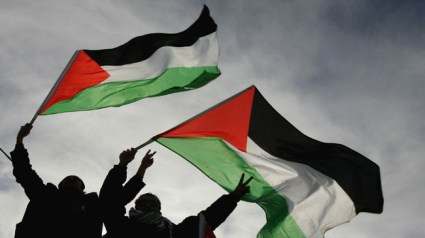
Pro-Palestine campaigners from across Britain are to stage a protest in London later this week on Nakba Day, marking the 65th anniversary of evicting Palestinians from their homes by Israelis.
The demonstration is planned to be held at 1 p.m. across Downing Street on Wednesday May 15 in coordination with international rallies around the world.
The Ireland Palestine Solidarity Campaign (IPSC) will be also hosting a series of Nakba Week events between 11 and 17 May, including a speaking tour by Palestinian rights activist Mousa Abu Maria in Belfast, Cork, Limerick and Dublin.
Another protest rally dubbed “End the ongoing Nakba-Palestine’s catastrophe” and organized by Palestine Solidarity Campaign (PSC), will be held outside the British Parliament on May 18.
Palestinians refer to the May 15, 1948, occupation of Palestine as the “Nakba Day,” which means the Day of Catastrophe in Arabic, to mark the expulsion of more than 700,000 Palestinians from their homeland almost 65 years ago.
Israeli forces have wiped nearly 500 Palestinian villages and towns off the map, leaving an estimated total of 4.7 million Palestinian refugees hoping for an eventual return to their homeland more than six decades later.
On May 13 last year, Palestinians commemorated Nakba Day outside Downing Street in London, carrying placards reading, “free Palestine,” “end ethnic cleansing in Jerusalem,” and “end the siege on Gaza.”
May 11, 2013
Posted by aletho |
Ethnic Cleansing, Racism, Zionism, Illegal Occupation, Solidarity and Activism | Nakba Day, Palestine, Press TV, Zionism |
Leave a comment


 Aletho News
 Aletho News