Israeli Occupation Forces Kidnap The Grand Mufti Of Jerusalem

By Saed Bannoura | IMEMC & Agencies | May 08, 2013
Israeli soldiers kidnapped the Grand Mufti of Jerusalem and the Holy Land, Sheikh Mohammad Hussein, after surrounding his home and breaking into it Wednesday.
Local sources reported that the army invaded As-Suwwana neighborhood, in Jabal Al-Mokabbir in occupied East Jerusalem, and broke into the home of the Mufti before kidnapping him.
Sheikh Hussein asked to follow the soldiers by car to the Al-Maskobiyya Police Station and interrogation facility in the city, but they refused and placed him in one of their vehicles.
In related news, the army kidnapped Engineer Mustafa Abu Zahra, head of a committee in charge of maintaining Islamic graveyards in Jerusalem.
Furthermore, Israeli police officers were heavily deployed at the gates of the Al-Aqsa Mosque in Jerusalem, interrogated dozens of worshipers while inspecting their ID Cards, withheld their ID cards and informed them that they will get their ID’s back once they leave the mosque area.
In addition, a number of settlers invaded the Al-Aqsa Mosque yard through the Al-Magharba Gate accompanied by dozens of soldiers and police officers.
On Tuesday evening, the Israeli Police handed orders to Palestinian shop owners in the Old City ordering them not to display their products in front of their shops on Wednesday evening in order to allow the settlers to march through the city and its markets while marking the so-called “Jerusalem Day”.
The “Jerusalem Day” is a an Israeli “national holiday” that started in June 1967 after the Israeli forces occupied East Jerusalem, and the rest of Palestine following the six-day war. In 1982, the Israeli Knesset passed a “legislation” considering Jerusalem “complete and united” as the eternal capital of Israel.
Related article
- Grand Mufti of Jerusalem detained (gulfnews.com)
Expanding Security State
By affinis – Corrente – 05/06/2013
A few days ago, I noticed this piece at FDL: “’Homeland Security’ Spending Overtakes New Deal”
TomDispatch: this country has spent a jaw-dropping $791 billion on ‘homeland security’ since 9/11. To give you a sense of just how big that is, Washington spent an inflation-adjusted $500 billion on the entire New Deal.
Two indicators of the expanding security state that caught my attention in the last few days:
1. Glenn Greenwald: “Are all telephone calls recorded and accessible to the US government?”
2. A massive lockdown in the Madison WI area (where I live).
A fugitive, Paris Poe, whom the FBI wanted for parole violation and questioning in a murder investigation, was spotted at a hotel in a Madison, WI suburb. Poe had previously been imprisoned for armed robbery. A large area encompassing much of Vernona, Fitchburg, and part of Madison, WI was then essentially locked down and swarmed with SWAT teams in a day-long manhunt.
Reverse 911 calls were made to all landlines (about 30,000 homes) asking residents to lock their doors and remain inside. Police asked all the businesses in their area to close and lock their doors. All six schools in the area were placed on lockdown and surrounded by police. In Verona, no-one could enter or exit the schools. In some classrooms, children were told to crouch under their desks for hours. In some schools, children were herded into the gym. Children were prohibited from using the bathroom, since that would involve leaving their rooms, and were told to urinate in buckets. Parents could not pick up their children since entry or exit was prohibited. Once the lockdown was ended, parents were required to present ID to take their children home. During the escalating panic, it was stated that Poe was on the FBI’s most wanted list, but he was not.
Late in the day, Poe was arrested far outside the locked down area. He was apparently unarmed, faces no charges in WI, and will be transported back to IL. News stories here, here, here, here, here, here, here, and here.
Does anyone else see something wrong with this picture?
Automated License Plate Readers Threaten Our Privacy
By Jennifer Lynch and Peter Bibring | EFF | May 6, 2013
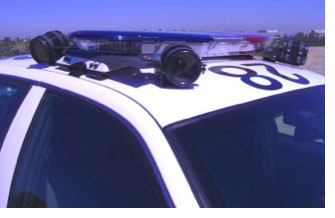 Law enforcement agencies are increasingly using sophisticated cameras, called “automated license plate readers” or ALPR, to scan and record the license plates of millions of cars across the country. These cameras, mounted on top of patrol cars and on city streets, can scan up to 1,800 license plate per minute, day or night, allowing one squad car to record more than 14,000 plates during the course of a single shift.
Photographing a single license plate one time on a public city street may not seem problematic, but when that data is put into a database, combined with other scans of that same plate on other city streets, and stored forever, it can become very revealing. Information about your location over time can show not only where you live and work, but your political and religious beliefs, your social and sexual habits, your visits to the doctor, and your associations with others. And, according to recent research reported in Nature, it’s possible to identify 95% of individuals with as few as four randomly selected geospatial datapoints (location + time), making location data the ultimate biometric identifier.
To better gauge the real threat to privacy posed by ALPR, EFF and the ACLU of Southern California asked LAPD and LASD for information on their systems, including their policies on retaining and sharing information and all the license plate data each department collected over the course of a single week in 2012. After both agencies refused to release most of the records we asked for, we sued. We hope to get access to this data, both to show just how much data the agencies are collecting and how revealing it can be.
ALPRs are often touted as an easy way to find stolen cars — the system checks a scanned plate against a database of stolen or wanted cars and can instantly identify a hit, allowing officers to set up a sting to recover the car and catch the thief. But even when there’s no match in the database and no reason to think a car is stolen or involved in a crime, police keep the data. According to the LA Weekly, LAPD and LASD together already have collected more than 160 million “data points” (license plates plus time, date, and exact location) in the greater LA area—that’s more than 20 hits for each of the more than 7 million vehicles registered in L.A. County. That’s a ton of data, but it’s not all — law enforcement officers also have access to private databases containing hundreds of millions of plates and their coordinates collected by “repo” men.
Law enforcement agencies claim that ALPR systems are no different from an officer recording license plate, time and location information by hand. They also argue the data doesn’t warrant any privacy protections because we drive our cars around in public. However, as five justices of the Supreme Court recognized last year in US v. Jones, a case involving GPS tracking, the ease of data collection and the low cost of data storage make technological surveillance solutions such as GPS or ALPR very different from techniques used in the past.
Police are open about their desire to record the movements of every car in case it might one day prove valuable. In 2008, LAPD Police Chief Charlie Beck (then the agency’s chief of detectives) told GovTech Magazine that ALPRs have “unlimited potential” as an investigative tool. “It’s always going to be great for the black-and-white to be driving down the street and find stolen cars rolling around . . . . But the real value comes from the long-term investigative uses of being able to track vehicles—where they’ve been and what they’ve been doing—and tie that to crimes that have occurred or that will occur.” But amassing data on the movements of law-abiding residents poses a real threat to privacy, while the benefit to public safety is speculative, at best.
In light of privacy concerns, states including Maine, New Jersey, and Virginia have limited the use of ALPRs, and New Hampshire has banned them outright. Even the International Association of Chiefs of Police has issued a report recognizing that “recording driving habits” could raise First Amendment concerns because cameras could record “vehicles parked at addiction-counseling meetings, doctors’ offices, health clinics, or even staging areas for political protests.”
But even if ALPRs are permitted, there are still common-sense limits that can allow the public safety benefits of ALPRs while preventing the wholesale tracking of every resident’s movements. Police can and should treat location information from ALPRs like other sensitive information — they should retain it no longer than necessary to determine if it might be relevant to a crime, and should get a warrant to keep it any longer. They should limit who can access it and who they can share it with. And they should put oversight in place to ensure these limits are followed.
Unfortunately, efforts to impose reasonable limits on ALPR tracking in California have failed so far. Last year, legislation that would have limited private and law enforcement retention of ALPR data to 60 days—a limit currently in effect for the California Highway Patrol — and restricted sharing between law enforcement and private companies failed after vigorous opposition from law enforcement. In California, law enforcement agencies remain free to set their own policies on the use and retention of ALPR data, or to have no policy at all.
Some have asked why we would seek public disclosure of the actual license plate data collected by the police—location-based data that we think is private. But we asked specifically for a narrow slice of data — just a week’s worth — to demonstrate how invasive the technology is. Having the data will allow us to see how frequently some plates have been scanned; where and when, specifically, the cops are scanning plates; and just how many plates can be collected in a large metropolitan area over the course of a single week. Actual data will reveal whether ALPRs are deployed primarily in particular areas of Los Angeles and whether some communities might therefore be much more heavily tracked than others. If this data is too private to give a week’s worth to the public to help inform us how the technology is being used, then isn’t it too private to let the police amass years’ worth of data without a warrant?
After the Boston Marathon bombings, many have argued that the government should take advantage of surveillance technology to collect more data rather than less. But we should not so readily give up the very freedoms that terrorists seek to destroy. We should recognize just how revealing ALPR data is and not be afraid to push our police and legislators for sensible limits to protect our basic right to privacy.
Documents
EFF and ACLU-SC’s legal Complaint
LA Sheriff’s Department ALPR Powerpoint Presentation
LA Sheriff’s Department – Automated License Plate Reader System Information
LAPD – Automated License Plate Reader User Guide
LA Sheriff’s Department – Field Operations Directive
UK in damages talks with torture victims
Press TV – May 7, 2013
Britain is negotiating out-of-the-court settlements to compensate thousands of Kenyans severely mistreated under British colonial rule during the 1950s Mau Mau uprising.
According to a letter sent to lawyers representing some of the claimants, the Foreign Office has changed its mind on appealing last October’s High Court ruling that gave victims the green light to sue the government, The Guardian reported.
“The parties are currently exploring the possibility of settling the claims brought by our clients,” Dan Leader, a partner with the Leigh Day law firm told the paper.
“Clearly, given the ongoing negotiations, we can’t comment further.” He added.
The Foreign Office has refused to comment on the issue, but admitted the victims suffered “pain and grievance” during the bloody events of the Emergency period in Kenya.
Three victims won the case to sue the government at the High Court last year.
The trio’s lawyers said one of them was castrated, antoher severely tortured and the third subjected to appalling sexual abuse in detention camps during the Mau Mau rebellion.
There was also a fourth claimant Susan Ngondi who has died since legal proceedings began.
The British government has admitted to British forces’ torturing of detainees at the time following disclosure of a vast archive of colonial-era documents which the Foreign Office had kept secret for decades.
Related article
- Britain to pay out to Mau Mau victims (morningstaronline.co.uk)
Turkmenistan continues search for investment in TAPI
bne | May 6, 2013
Turkmenistan is persevering with efforts to persuade an international oil major to join the Turkmenistan-Afghanistan-Pakistan-India (TAPI) gas pipeline project, according to reports in India, despite being unwilling to give up a stake in its gas fields to potential investors.
A series of road shows in New York, London and Singapore in the autumn, aimed at attracting international oil and gas companies to the project, ended in failure, even though companies including Chevron, Exxon Mobil, BP, BG Group, RWE and Petronas attended. That disappointment flew in the face of claims from Turkmen officials that they had all expressed an interest in the project, which carry gas from the secretive Central Asian state via Afghanistan to the Indian sub-continent.
Ashgabat’s refusal to allow participating companies to take a stake in the Turkmen hydrocarbons fields that would fill the pipeline has been cited as the main reason for the flop, although the continuing instability in Afghanistan is another factor.
India’s Economic Times cites an unnamed Indian government official as saying that, as the four participating countries prepare for a meeting on May 15, Turkmen officials continue trying to persuade an unnamed international oil major to take part. “Our understanding is that [Turkmenistan is] quietly working with international oil companies to work a way around the question of upstream stake,” the official said.
However, he also noted that the ban on sales of stakes in Turkmen fields to foreign buyers remains a sticking point. “They have told us that they have passed a law after the Chinese were given a stake and this now does not allow them to give a stake to anybody else in the gas fields,” the official said. It’s unclear to which deal he was exactly referring.
Ashgabat is secretive over its agreements in the oil and gas sector. In 2007, China’s CNPC was given the right to develop the Bagtyyarlyk gas field, which supplies the Central Asia-China (CAC) gas pipeline exporting to China. However, the level of access Bejing enjoys to the Galkynysh (previously South Yolotan) gas field remains unknown after the Chinese State Development Bank pledged $4.1bn to help develop it in 2010. On the one hand, it’s thought Turkmenistan may have signed over a stake. Other speculation suggests Ashgabat has offered no more than a firm commitment that CAC is filled.
Either way, India is clearly pushing for a similar level of security. It has been pushing for an equity stake in the massive Galkynysh for itself, to ensure supply issues do not compromise the massive financial commitment needed to build TAPI. Indian officials say that since CNPC has been given access to upstream assets in Turkmenistan, India’s state owned GAIL should have the same privilege.
At the same time, the four states participating in TAPI have maintain that they aim to start construction of the pipeline, which has support from the Asian Development Bank, by the end of 2013. However, on top of the jockeying between themselves, they are trying to drum up support from international oil companies to invest in the project, which may cost as much as $12bn.
Agreements on the price of gas exports to Afghanistan, India and Pakistan have already been signed. In September, the four participating governments agreed to proposal from Turkmenistan to set up a company with shared capital of $20m to carry out a feasibility study and design the pipeline.
Lack of evidence, FBI admission of error not enough to halt execution
RT | May 7, 2013
Mississippi is still scheduled to execute a convicted murderer Tuesday despite a lack of physical evidence tying him to the crime and a new admission from the Department of Justice that the forensic investigation was severely flawed.
Willie Jerome Manning, a 44-year-old African-American man, has been in prison for almost 20 years after being convicted for the 1992 kidnapping and murder of Jon Steckler and Tiffany Miller, two white college students in Mississippi. Manning was convicted based on the testimony of a jailhouse informant who implicated two men before Manning and has since recanted his claim altogether. Police also found Manning trying to sell items that formerly belonged to Steckler, at which time he claimed he acquired the property from someone he didn’t know.
Most importantly, though, according to law professor Dov Fox’s column at The Huffington Post, was testimony from Chester Blythe, an FBI agent, that a black man’s hair was found in Miller’s car. But DNA and fingerprints at the scene did not implicate Manning, and the FBI came forward last week to withdraw “testimony containing erroneous statements regarding microscopic hair comparison analysis was used in this case.”
Blythe testified that he could tell with “a relatively high degree of certainty” that the hair found at the crime scene “came from an individual of the black race.”
Last week’s announcement also admitted the witness was not credible because his claims “exceeded the limits of science” available in the mid-1990s. The Justice Department said it was an “error for an examiner to testify that he can determine the questioned hairs were from an individual of a particular group.”
It’s the first time federal officials have admitted to such a flaw in the FBI’s analysis technique. They’ve additionally offered to test Manning’s DNA to remove any reasonable doubt once and for all that he perpetrated the crime.
Despite the gravity of the Justice Department’s revelation, the Mississippi Supreme Court ruled in a 5-4 decision to deny Manning a stay of execution.
“Our examination anew of the record reveals that conclusive, overwhelming evidence of guilt was presented to the jury,” wrote Presiding Justice Michael K. Randolph for the majority.
Fingerprints thought to belong to the killer found in one of the cars owned by a victim did not match Manning and have never been checked in the government’s database.
Mississippi Supreme Court Justice James W. Kitchens, writing in dissent, pushed for more testing, warning against the possibility that “the investigation of these horrible crimes will remain incomplete.
“The victims’ families and the public at large deserve to know whether another, or an additional, perpetrator was involved,” he wrote. “Interests far beyond Manning’s are at stake, and whatever potential harm the denial seeks to avert is surely outweighed by the benefits of ensuring justice.”
However, there could be some blowback from prosecutors. “The bottom line is when you start looking at these things, there’s always something else you can do and it never ends,” said Oktibbeha County District Attorney Forrest R. Allgood.
The decision now rests in the hands of Mississippi Governor Phil Bryant, who can grant a stay of execution or administer a lethal injection. His decision is expected to come Tuesday morning.
Militants capture UN peacekeepers in Golan Heights
Press TV – May 7, 2013
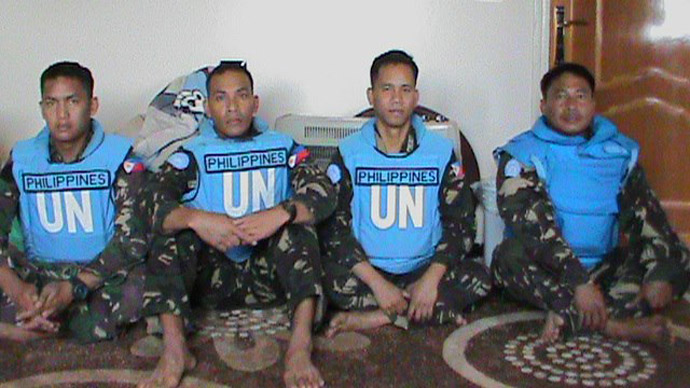
Militants fighting against the Syrian government have abducted a group of UN peacekeepers monitoring the ceasefire line between Syria and the Israeli-occupied Golan Heights.
According to Reuter’s news agency, a militant group operating in Syria issued a statement on Tuesday saying it was holding the four peacekeepers.
The statement said the peacekeepers were being held for their own safety because of clashes in the separation zone between Syria and the Israeli-occupied heights.
A picture accompanying the statement shows four peacekeepers wearing light-blue UN flak jackets marked “Philippines.”
It is the second time that foreign-backed militants fighting against the government of President Bashar al-Assad seize UN troops in the Syrian side of the Golan Heights.
In March, anti-Syria militants detained 21 Filipino peacekeepers in the same region. They were released after three days.
Syria has been experiencing unrest since March 2011. Many people, including large numbers of security personnel, have been killed in the violence.
Damascus says the chaos is being orchestrated from outside the country, and there are reports that a very large number of the insurgents are foreign nationals.
Several international human rights organizations have accused foreign-sponsored militants of committing war crimes.
A Dangerous Delusion
By David Morrison (Author), Peter Oborne (Author) – April 18, 2013
 Description:
In 2013 it is possible that Israel, backed by the United States, will launch an attack on Iran. This would be a catastrophic event, risking war, bloodshed and global economic collapse.
In this passionate, but rationally argued essay, the authors attempt to avert a potential global catastrophe by showing that the grounds for war do not exist, that there are no Iranian nuclear weapons, and that Iran would happily come to the table and strike a deal. They argue that the military threats aimed by the West against Iran contravene international law, and argue that Iran is a civilised country and a legitimate power across the Middle East.
For years Peter Oborne and David Morrison have, in their respective fields, examined the actions of our political classes and found them wanting. Now they have joined forces to make a poweful case against military action. In the wake of the Iraq war, will the politicians listen?
A Dangerous Delusion is available on Amazon here. Morrison’s earlier writing on Iran is at http://www.david-morrison.org.uk/iran/.
Related article
NYT on Chemical Weapons and War in Syria
By Michael McGehee | NYTX | May 6, 2013
“We have been very clear to the Assad regime but also to other players on the ground that a red line for us is, we start seeing a whole bunch of weapons moving around or being utilized.” — Obama Threatens Force Against Syria, The New York Times, August 21, 2012
When President Obama spoke these words last August he might have dug himself a hole twice as deep as the one he was in last week.
As four NYT journalists reported on Sunday’s front page article “Off-the-Cuff Obama Line Put U.S. in Bind on Syria”: “Confronted with evidence that chemical weapons have been used in Syria, President Obama now finds himself in a geopolitical box, his credibility at stake with frustratingly few good options.”
If there will be any effort to hold Mr. Obama’s feet to the fire the heat just got hotter.
Buried on page A9 of Monday’s edition of “the paper of record” was a statement by Carla del Ponte, a United Nations human rights investigator looking into the claims that chemical weapons were used in Syria:
The United Nations independent commission of inquiry on Syria has not yet seen evidence of government forces using chemical weapons, which are banned under international law, said Carla Del Ponte, a commission member.
“Our investigators have been in neighboring countries interviewing victims, doctors and field hospitals,” Ms. Del Ponte said in an interview with Swiss-Italian television. “According to their report of last week, which I have seen, there are strong, concrete suspicions but not yet incontrovertible proof of the use of sarin gas, from the way the victims were treated.”
“This was use on the part of the opposition, the rebels, not by the government authorities,” she added, speaking in Italian.
Question: Will President Obama hold the rebels accountable for crossing his red line?
In his own words he did say that he has “been very clear to the Assad regime but also to other players on the ground” [emphasis added] that the use of chemical weapons is a red line that even the Times saw last summer as a threat of force.
The question is not likely to be answered in the affirmative. This is the politics of war. For more than two years the rebels have been carrying out terrorist bombings, grisly executions, and other assorted attacks that would likely have had Washington and its allies foaming at the mouths were it the Assad regime who was the perpetrator.
Washington has failed to join the Syrian government in their own War on Terror, even though al Qaeda is active in the country. And it just goes to show as one more example: when al Qaeda is used as a boogeyman for war we should not take the pretext seriously, as in the case of Mali. If al Qaeda is on the same side as Uncle Sam, as they were in Afghanistan in the 1980s, the Balkans in the 1990s, Libya in 2011, and now Syria, then there will be no drone attacks on the terrorists.
And now we see al Qaeda-linked terrorists suspected of using chemical weapons. Don’t look for the U.S. to come to the defense of the Syrian government.
Already we can see the change of attitude reflected at The New York Times.
Not two weeks ago, on April 26, 2013, it was front page news at the NYT that “White House Says It Believes Syria Has Used Chemical Arms.”
From that moment the story became a sensation. It fit well into the parameters of the propaganda system. An official enemy who we are actively trying to overthrow may have used chemical weapons and provided a clear pretext for force. Here comes the march to war.
But when UN investigators looked into the matter and reported that “Syrian Rebels May Have Used Sarin,” the story fell from grace and was pushed to page A9.
This differential treatment signals the death of the “red line” story, which is too bad because it would have been interesting to see The New York Times, or anyone in the mainstream media, investigate how Syrian rebels could have gotten a hold of sarin, especially considering a former Bush official has openly considered the idea of Israel being behind the attack.
The differential treatment may possibly throw a wrench in the drive to war . . . for now. Because, also on page A9 of Monday’s edition of The New York Times is “Attacks on Syria Fuel Debate Over U.S.-Led Airstrikes,” a report of an Israeli attack in Syria:
WASHINGTON — The apparent ease with which Israel struck missile sites and, by Syrian accounts, a major military research center near Damascus in recent days has stoked debate in Washington about whether American-led airstrikes are the logical next step to cripple President Bashar al-Assad’s ability to counter the rebel forces or use chemical weapons.
That option was already being debated in secret by the United States, Britain and France in the days leading to the Israeli strikes, according to American and foreign officials involved in the discussions. On Sunday, Senator John McCain, who has long advocated a much deeper American role in the Syrian civil war, argued that the Israeli attacks, at least one of which appears to have been launched from outside Syrian airspace, weakens the argument that Syria’s air defense system would be a major challenge.
“The Israelis seem to be able to penetrate it fairly easily,” Mr. McCain said on “Fox News Sunday.”
While attacks in Syria might be easier than previously suspected, the justifications for war received a setback. But if history is any guide this is only a minor and temporary one.
Featured Video
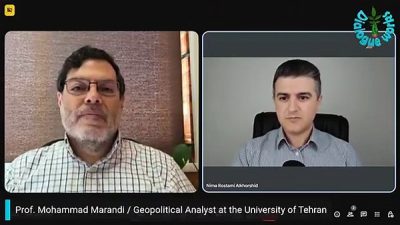
Seyed M. Marandi: U.S. Military DIVIDED? Iran’s Secret Defense EXPOSED
or go to
Aletho News Archives – Video-Images
From the Archives
‘Israel sees Iran as obstacle to its policies’

Press TV – August 25, 2017
Prime Minister Benjamin Netanyahu has said that Israel felt threatened by Iran’s growing influence in the Middle East. Netanyahu expressed his Iranophobic view in a meeting with Russian President Vladimir Putin in Russia’s Black Sea resort of Sochi on Wednesday. Press TV has asked Scott Rickard, former American intelligence linguist from Tampa, Florida, and Brent Budowsky, a columnist at The Hill from Washington, to give their thoughts on the issue.
Rickard said Tel Aviv is concerned about the fact that the regime could not carry out its old project to spread sectarian divisions and pave the way for dismemberment of the countries in the Middle East region because of the Iranian-led resistance against Israeli policies, not only in the occupied territories of Palestine but also in the whole region.
“Iran is not a threat to Israel whatsoever. The threat that Israel sees is the fact that their Oded Yinon Plan is being put to a hold by Iran,” the intelligence linguist said on Thursday night.
“They (the Israelis) look at Iran as a threat only because they have no influence on their governments and Iran is autonomous and is not under the Zionist influence,” he added.
Since the victory of the Islamic Republic of Iran in 1979, Tehran has been critical of Israel’s policies in the region, whereas “no leaders [of other states] even dared to speak out against Zionism,” Rickard argued. … continue
Blog Roll
 Aletho News
- Alberta Bill Would Fine Political Deepfakes $10,000 Without Satire Exemptions
- Iran declares ‘historic victory’ over US, says enemy forced to accept its proposal
- Trump Claims Ceasefire, Reopening of Strait of Hormuz Agreement with Iran
- Israeli tank fire killed UN peacekeeper in Lebanon, UNIFIL investigation finds
- Russia, China block Bahrain-sponsored UN resolution on Strait of Hormuz
- The US-Israeli War on Science is an Assault on our Future
- Trump’s Promise to Bomb Iran ‘Like Never Before’ Faces Brutal Logistics — Expert
- Germany seeks to restrict stays abroad for men of fighting age – Berliner Zeitung
- Evidence points to Ukraine being behind TurkStream attempted sabotage, but that should come as no surprise
- Sri Lanka secures supplies of Russia oil – minister
- If Americans Knew
- Thousands dead and neighborhoods razed to the ground: Aid agencies fear southern Lebanon is becoming the new Gaza
- The war the US is fighting for Israel could cost trillions
- ‘Cigarette Burns, Nail Wounds’: Toddler Tortured in Gaza to Coerce Father
- Trump Says US Sent ‘a Lot of Guns’ to Protesters in Iran
- Israeli forces destroy 17 UN peacekeeper cameras in south Lebanon
- US-Israeli strikes ‘completely destroy’ synagogue in Tehran
- Archbishop for US Military Says Iran War Is Unjust Under Catholic Teaching
- Iranian leaders’ Open Letters to the American People
- Trump says Iranians appreciate bombs, WHO warns of nuclear risks – Daily Update
- U.N. experts demand Israel release prominent Gaza doctor after reports of ‘severe torture’
- No Tricks Zone
- An Inconvenient Tree: Uncovered In Alps… Europe Much Warmer Than Today 6000 Years Ago
- New Study Reports A 60% Slowdown In Greenland’s Ice Loss Rate In The Last Decade
- Low Intensity Tornado Wrecks Major Solar Farm, Creating A Potential Toxic Dump
- New Study Finds Warming Saves Lives…Cold Temperatures 12 Times More Deadly Than Excess Heat
- German Science Blog Accuses PIK Climate Institute Of Hallucinating Climate Tipping Points
- Devastating Assessment Of Comirnaty Vaccine By Former Senior Pfizer Europe Toxicologist
- New Study: CO2 Is ‘Effectively Negligible’ As An Explanatory Climate Change Factor Since 2000
- Former Pfizer Toxicologist Dr. Helmut Sterz Tells Bundestag Hearing Pfizer Vaccine Should Have Never Been Approved
- Energy Expert: Germany’s Nuclear Phaseout Was A “500 Billion Euro Mistake”
- New Research: South Australia’s Mid-Holocene Sea Surface Temperatures Were 4°C Warmer Than Today
 Aletho News