Israel considering looser regulations for soldiers in West Bank
Al-Akhbar | May 23, 2013
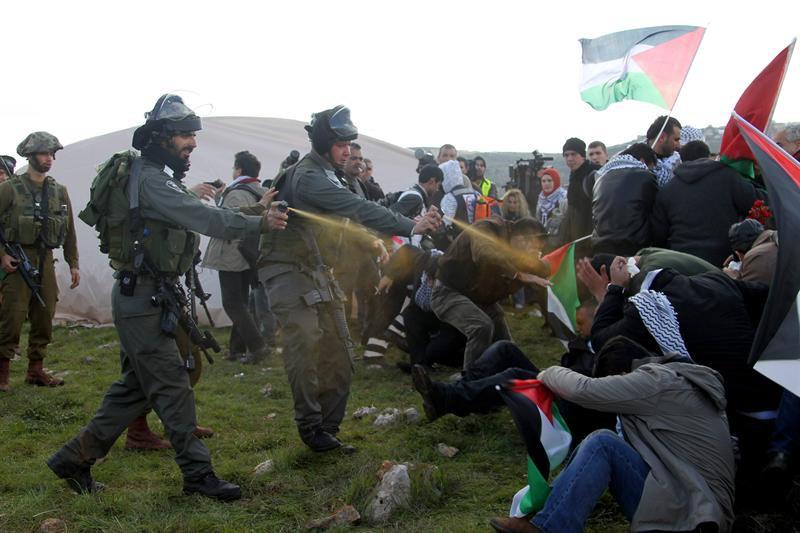
Israeli military commanders and parliament members argued Wednesday in favor of changing regulations for soldiers operating in the West Bank in front of a Knesset committee, claiming that the rules governing their actions against Palestinians were too restrictive.
According to the Israeli daily Maariv, three reserve commanders – Amram Mitzna, Danny Yatom and Uzi Dayan – spoke during a Knesset security committee meeting, saying that Israel should address a situation deemed dangerous by Israeli soldiers and field commanders.
Knesset member Moshe Feiglin said Israeli forces felt “impotent” when facing Palestinian demonstrations because of regulations restricting their possible response, Maariv reported.
Deputy Defense Minister Danny Danon spoke of increasing incidents of soldier injuries, adding that the Israeli army needed to do everything it could to reverse the trend.
Nissim Zeev, a Knesset member and member of the ultra-Orthodox political party Shas, said that “there is nowhere else in the world where soldiers in a situation of confronting the enemy are powerless.”
Zeev described the situation in the West Bank as one of “asymmetrical warfare” in which he claimed the well-armed Israeli troops were disadvantaged when faced against Palestinian protesters.
Israeli occupation forces routinely use an arsenal of live bullets, rubber-coated steel bullets, tear gas and skunk water against Palestinians, even during peaceful demonstrations. Palestinians protesters typically respond by throwing rocks and occasional molotov cocktails.
Wednesday’s session was attended by the chief of Israeli forces’ central command, along with heads of West Bank Jewish settlement councils and chief security officers.
According to Maariv, the security committee will hold a closed-door meeting to be attended by the Israeli minister of defense, Moshe Yaalon. The participants will address possible means to “restore Israeli forces’ deterrence and dignity in the West Bank” and give Israeli soldiers more leeway in their dealings with Palestinians.
Since January 2009, Israeli forces have killed 59 Palestinians – including 14 youths aged 18 and under – in the occupied West Bank, while Israeli settlers have killed five, according to Israeli human rights NGO B’Tselem.
In January, 15-year-old Salih al-Amarin from the Azza refugee camp near Bethlehem, was shot in the head and killed during a protest, and a week earlier, Samir Ahmed Abdul-Rahim,17, was shot four times and killed by Israeli soldiers in Budrus, near Ramallah.
In April, Amer Nassar, 17, and Naji al-Balbisi,19, were shot and killed by Israeli soldiers during clashes in Tulkarem.
On Tuesday, Israeli soldiers shot 12-year old Atta Sharadeh in the chest while he was walking with school friends near Ramallah. Sharadeh was in sent to the hospital in critical condition.
(Al-Akhbar, Ma’an)
Related articles
Israel prepared to launch war on Syria: Israeli commander
Press TV – May 23, 2013
An Israeli military commander says Tel Aviv is prepared to carry out an attack on Syria if the government of Syrian President Bashar al-Assad collapses.
On Wednesday, Israeli Major General Amir Eshel said the Tel Aviv regime might launch a sudden war on Syria should Damascus fall.
“We have to be ready for any scenario, at a few hours’ notice,” Eshel stated.
He also said that the Israeli regime would even prepare for a “protracted” war with a “post-Assad Syria.”
The recent Israeli threat is seen as part of the Western-backed efforts to set up the scene for a military intervention in Syria.
The Tel Aviv regime has already carried out three air strikes on Syria.
On May 5, Syria said the Israeli regime had carried out an airstrike targeting a research center in a suburb of Damascus, following heavy losses inflicted upon al-Qaeda-affiliated groups by the Syrian army. According to Syrian media reports, the strike hit the Jamraya Research Center. The Jamraya facility had been targeted in another Israeli airstrike in January.
The May 5 Israeli aggression was Tel Aviv’s second strike on Syria in three days.
Turmoil has gripped Syria for over two years, and many people, including large numbers of Syrian soldiers and security personnel, have been killed in the foreign-sponsored militancy.
Western powers and their regional allies including the Israeli regime, Turkey, Saudi Arabia and Qatar are partners in supporting the militant groups in Syria.
Related article
The Government Wants A Backdoor Into Your Online Communications
By Mark M. Jaycox and Seth Schoen | EFF | May 22, 2013
According to the New York Times, President Obama is “on the verge of backing” a proposal by the FBI to introduce legislation dramatically expanding the reach of the Communications Assistance for Law Enforcement Act, or CALEA. CALEA forces telephone companies to provide backdoors to the government so that it can spy on users after obtaining court approval, and was expanded in 2006 to reach Internet technologies like VoIP. The new proposal reportedly allows the FBI to listen in on any conversation online, regardless of the technology used, by mandating engineers build “backdoors” into communications software. We urge EFF supporters to tell the administration now to stop this proposal, provisionally called CALEA II.
The rumored proposal is a tremendous blow to security and privacy and is based on the FBI’s complaint that it is “Going Dark,” or unable to listen in on Internet users’ communications. But the FBI has offered few concrete examples and no significant numbers of situations where it has been stymied by communications technology like encryption. To the contrary, with the growth of digital communications, the FBI has an unprecedented level of access to our communications and personal data; access which it regularly uses. In an age where the government claims to want to beef up Internet security, any backdoors into our communications makes our infrastructure weaker.
Backdoors also take away developers’ right to innovate and users’ right to protect their privacy and First Amendment-protected anonymity of speech with the technologies of their choice. The FBI’s dream of an Internet where it can listen to anything, even with a court order, is wrong and inconsistent with our values. One should be able to have a private conversation online, just as one can have a private conversation in person.
The White House is currently debating whether or not to introduce the bill. Here’s why it shouldn’t:
There’s Little Darkness: Few Investigations Have Been Thwarted
The starting point for new legislation should be a real, serious, and well-documented need. Despite the FBI’s rhetoric, there are few concrete examples of the FBI’s purported need to expand its already efficient all-seeing eye. Current law requires annual reporting by the Department of Justice (DOJ) regarding the use of the government’s wiretapping powers; the report includes statistics on how often Federal law enforcement has been impeded in a court-authorized investigation by encryption or has been unable to access communications. These statistics show that this has happened only rarely. In its most recent report—from 2010—DOJ reported that encryption had only been encountered all of 12 times.
Did the encryption stop the investigation, or even prevent the wiretappers from figuring out what was being said? No. The report admits that in all of these instances, police were able to obtain the plain text of communications. Previous years’ numbers are similar. Aside from government reports, in 2012 telecommunications companies also revealed that a very low percentage of law enforcement requests for user information were rejected. In AT&T’s case, only 965 out of over 250,000 requests for user information were rejected. Overall, the available public statistics don’t appear to support the FBI’s claims about its inability to access communications.
Law Enforcement Already Has Unprecedented Access
Any requested expansion of FBI surveillance authority has to consider the overall ability of law enforcement to investigate crimes. What the FBI doesn’t mention when pushing new backdoors into our communications is that now, due to the shift to digital communications, law enforcement has an unprecedented level of access to, and knowledge of, the public’s communications, relationships, transactions, whereabouts, and movements. Law enforcement now can gain 24/7 monitoring of most people’s movements using cell phone location data. But that’s just the beginning. A glance at the Wall Street Journal‘s multi-year What They Know project shows some of the treasure troves of data that are being maintained about all of us. By accessing these databases and by using new electronic surveillance technologies law enforcement already has visibility into almost every aspect of our online and offline lives—capabilities beyond the wildest dreams of police officers just a few decades ago.
Indeed, former White House Chief Counselor for Privacy Peter Swire and Kenesa Ahmad argued persuasively in 2011 that, overall, “today [is] a golden age for surveillance“—regardless of whether law enforcement is assured of automatic access to each and every kind of communication, and regardless of whether individuals sometimes succeed in using privacy technologies to protect themselves against some kinds of surveillance.
First, there’s information obtained from cell phones. In July 2012, the New York Times reported that federal, state, and local law enforcement officials had requested all kinds of cell phone data—including mappings of suspects’ locations—a staggering 1.3 million times in the previous year. Cell phone companies can create what amounts to detailed maps of our locations and turn them over to law enforcement. Even without asking for cell phone providers’ direct assistance, law enforcement has considerable ability to use mobile devices to track us. Federal and state law enforcement have made extensive use of IMSI catchers (also popularly called “stingrays,” after the brand name of one such device). These devices can act as a fake cell phone tower, observing all devices in a certain area to find a cell phone’s location in real-time, and perhaps even intercept phone calls and texts.
Laws compelling companies to divulge user information accompany these techniques. For instance, National Security Letters, served on communications service providers like phone companies and ISPs, allow the FBI to secretly demand stored data about ordinary Americans’ private communications and Internet activity without any meaningful oversight or prior judicial review. And Section 215 of the PATRIOT Act allows for secret court orders to collect “tangible things” that could be relevant to a government investigation. The list of possible “tangible things” the government can obtain is seemingly limitless, and could include everything from driver’s license records to Internet browsing patterns. The FBI has even broken into individuals’ computers to collect data from inside the computers themselves. More backdoors aren’t needed.
Backdoors Make Us Weaker and More Vulnerable
CALEA II will force companies with messaging services—from Google to Twitter to video game developers—to insert backdoors into their platforms. But backdoors only make us weaker and more vulnerable. It’s ironic that CALEA II may be proposed only months after Congress pushed “cybersecurity” legislation to protect our networks. The notion of mandating backdoors in software is the antithesis of online security, which is why some academics have called it a “ticking time bomb.”
A proposal to expand backdoors into communications software ensures that online hackers, communications company insiders, and nation-states have a direct entrance to attack—and steal from—companies and government agencies. In one notorious example, someone exploited backdoors in a Greek phone company’s systems and recorded sensitive conversations involving the Prime Minister. Wiretapping backdoors even affect national security. In 2012, Wired revealed the NSA’s discovery and concern that every telephone switch for sale to the Department of Defense had security vulnerabilities due to the legally-mandated wiretap implementation. If politicians are serious about online security, they will not make these security blunders even worse by bringing more sensitive communication technologies under CALEA’s scope.
Just last week, an ad hoc group of twenty renowned computer security experts issued a report explaining their consensus that CALEA II proposals could seriously harm computer security. These experts said that a requirement to weaken security with deliberate backdoors “amounts to developing for our adversaries capabilities that they may not have the competence, access or resources to develop on their own.”
And now the Washington Post has reported that intruders, allegedly working on behalf of the Chinese government, broke into Google’s existing surveillance systems. (In this case, the report says that the intruders learned who was targeted by these systems, rather than accessing the contents of the targets’ accounts or communications—but it’s easy to see that wiretap contents would ultimately represent an even bigger target, and a bigger prize. Even more exciting would be the prospect of remotely activating new wiretaps against victims of an intruder’s choice.)
Internet Users Have the Right to Secure Communications
Expanding CALEA is not only a tremendous risk for our online security; it’s a slap in the face of Internet users who want to protect themselves online by choosing privacy-protecting software to shield their communications. Ordinary individuals, businesses, and journalists want and often need state-of-the art software to protect their communications in an era of pervasive spying by commercial rivals, criminals, and governments around the world. The government’s rhetoric takes us back to the early 1990s when US law enforcement spoke openly of banning secure encryption software to keep it out of the public’s hands. EFF and others had to fight—including in the Federal courts—to establish the principle that publishing and using encryption tools is an essential matter of individual freedom and protected by the First Amendment.
Once those “crypto wars” were over, the US government seemed to accept the right of Americans to secure communications and abandon the idea of forcing innovators to dumb down these technologies. We turned our concerns to foreign governments, several of whom were trying to ban communications tools for being “too private.” (For instance, the Associated Press reported five countries threatened to ban BlackBerry services in 2010 because the services protected user privacy too well.) Americans, including the US State Department, began supporting the development and distribution of secure communications tools to foreign rights activists who need them. Now this battle may be coming home.
Even with these tools, most Americans can protect only a tiny fraction of the trail of data we leave behind electronically as we live our lives. But we still have the right to choose them and try our best to keep our private communications private.
CALEA Must Not Come Back
The government should place any proposal to expand CALEA on hold. There is little evidence the FBI is actually “going dark,” especially when balanced with all the new information they have access to about our communications. And backdoors make everyone weaker. In a time when “cybersecurity” is supposed to be a top priority in Washington, the FBI is pushing a scheme that directly undermines everyone’s online security and interferes with both innovation and the freedom of users to choose the technologies that best protect them. Tell the White House now to stop the proposal in its tracks.
‘Never in his life’: Father of Tsarnaev’s friend questions FBI slaying of son
RT | May 22, 2013
An FBI agent shot Tamerlan Tsarnaev-linked triple murder suspect Ibragim Todashev in Florida, allegedly after the suspect attacked him with a knife. But Todashev’s father Abdulbaki told RT he strongly doubted his son could attack the agent first.
Following reports that a Chechen man Ibragim Todashev, suspected in a 2011 triple murder in Massachusetts alongside the elder Tsarnaev and questioned about the Boston bombings previously, was shot by an FBI agent during interrogation in Orlando, Florida, RT had a phone conversation with the suspect’s father.
The elder Todashev described his son as “a very calm” man, who wouldn’t become aggressive for no reason.
“Never in his life would he attack anyone unprovoked,” Abdulbaki Todashev stressed.
Abdulbaki, who lives in Grozny, Chechnya, said he was not contacted by anyone from the US, and his only sources about Ibragim’s fate were neighbors citing media agencies.
Having heard the reports that Ibragim was questioned by a group of people, including several policemen, Abdulbaki also said he does not believe he would rush to engage in a one-sided fight.
He explained that his 27-year-old son studied in the Russian city of Saratov, and later in Grozny, but decided to give up his education and move to the US after going on a student internship there.
Ibragim decided to leave for Florida because he “liked America,” Abdulbaki explained, adding he never got to know what occupation, if any, his son had in the US, other than practicing sports.
Abdulbaki said they were not acquainted with the Tsarnaev family at home in Chechnya. Ibragim knew Tamerlan Tsarnaev only because they went to the same gym when he stayed in Boston, he added.
Ibragim “couldn’t take part” in the Boston Marathon bombings as he was undergoing a surgical operation on his tendons in Florida days before the bombings and “had to learn how to walk again,” the father said.
Todashev’s friend Kushen Taramov said he and Ibragim had been interrogated about the bombings earlier this week.
But reports said that on Wednesday the investigators were questioning Todashev over his alleged role in an unsolved 2011 triple homicide in Waltham, Massachusetts, which the bombing suspects Tamerlan and Dzhokhar Tsarnaev have been implicated in, and that he was ready to sign a confession.
Todashev allegedly took out a knife and attacked the FBI agent questioning him, but was shot to death.
Taramov said Ibragim was going to fly back home to Chechnya, but the FBI insisted that he postpone his trip for “one last” interview. Abdulbaki also knew that his son was flying to Grozny on May 24.
Related articles
- This story is true; the facts have been fabricated to keep the false flag flying
- FBI’s Track Record On Creating Terrorism Destroys The Official Boston Marathon Bombing Narrative
- Boston Bombing investigation will mirror the Oklahoma City Bombing cover-up
- Israeli police head to US to aid in Boston Marathon bombing investigation
- Industry: biometrics business valued at $10 billion by 2018
- Rahm Emanuel Stresses Value Of Surviellance Cameras In Probe Of Boston Bombings
- Expanding Security State
Venezuelan President Meets with Private Television Stations

President Maduro (second from left) in a meeting with Venevision representatives (agencies)
By Tamara Pearson | Venezuelanalysis | May 21, 2013
Merida – Yesterday Venezuelan president Nicolas Maduro met with representatives of private television stations Venevision and Televen. Together they discussed the media’s role in maintaining an environment of “peace, tolerance and living together”.
Last Wednesday Maduro called on the two stations to form an “alliance for life” and to stop “promoting disloyalty, betrayal, and drug-trafficking”.
After the meeting Venevision said in a formal statement that they had discussed a communication campaign called “Zero Violence”, which would contribute to the “movement for peace and life” and reducing violence in Venezuela.
Venevision is Venezuela’s largest television network, and is available over cable, free terrestrial, and in the United States through Univision. Until 2005 it opposed Hugo Chavez, but from then on its coverage has been more even-handed. It is owned by one of Venezuela’s richest citizens, Gustavo Cisneros, and includes a variety of programming, from news, to children’s shows, music, and movies.
Televen has the second highest audience, after Venevision, and focuses on soap operas, sports, and talk shows. Camero Comunicaciones owns half of it, and Cadena Capriles owns the other half. It has a smaller proportion of nationally produced shows than Venevision.
According to Maduro, Televen’s representatives also agreed to the proposal to reinforce values “for peace and life”. He said they agreed to increase national production of series and documentaries, in order to “support our artists… and promote national values”.
After the two meetings, Vice-president Jorge Arreaza also stated that they had agreed to work together on a “new model of television… where content supporting peace and stability is generated”.
Maduro also announced yesterday that he would meet with the new owners of opposition news station Globovision, saying “I don’t know them but I’m going to meet with them”. He said they had requested the meeting with him, but so far there are no further details.
Honduras: Three Farmers Killed During Land Eviction
Agencia Púlsar | May 22, 2013
In the north of Honduras, in the community of San Manuel Cortés, three peasants were killed and two others wounded on Friday, when they tried to enter the lands that were expropriated last year by the Instituto Nacional Agrario (National Agrarian Institute). Valentín Caravantes, Celso Ruiz y Celedonio Avelar, who died at the scene, were members of the Farmers’ Movement of San Manuel Cortés (MOCSAM), located about 200kms from the capital.
The men entered the land because they obtained an order from the Court of Criminal Appeals, which stated that the evictions carried out in February 2012 against MOCSAM were illegal, reports the National Popular Resistance Front of Honduras (FNRP). “Security guards from the Honduran Sugar Company (CAHSA) fired at the three farmers,” FNRP added.
Brothers Aníbal and Adolfo Melgar were also seriously injured in the shooting and were immediately taken to a hospital in the municipality of San Pedro Sula.
For three years now MOCSAM has been demanding more than 3,000 acres of land which is currently possessed by the CAHSA company and exceeds 250 acres, the maximum a person or a firm can own in Valle de Sula under the country’s agrarian law.
The incident is the latest in a long series of clashes, which have ended up with many deaths over the past few years. In February, more than 1,000 peasants took back land after being expelled by British/South African beverages multinational SAB Miller in August 2012. And earlier this year, in March, the ongoing conflict between farmers and the Honduran government has resulted in the eviction of over 1,500 people from their land in the south of the country.
Related articles
- The New York Times on Venezuela and Honduras: A Case of Journalistic Misconduct
- Senator Menendez Meets with President Lobo to Discuss U.S. Funding for Honduras
- Honduras: Terror in the Aguán
- Will the World Bank Stop Investing in Campesino Assassinations?
- Killings Continue in Bajo Aguán as New Report Documents Abuses by U.S.-Trained Honduran Special Forces Unit
- Honduras: Murdered Lawyer’s Brother Killed in Aguán
- Step by Step: Honduras Walk for Dignity and Sovereignty
- World Bank Must End Support for Honduran Palm Oil Company Implicated in Murder
US government admits to killing four American citizens with drones
RT | May 22, 2013
United States Attorney General Eric Holder has informed Congress that four American citizens have been killed in Yemen and Pakistan by US drones since 2009.
It has been widely reported but rarely acknowledged in Washington that three US citizens — Samir Khan, Anwar al-Awlaki and his teenage son, Abdulrahman al-Awlaki — were executed in Yemen by missile-equipped drones in 2011. With Holder’s latest admission, however, a fourth American — Jude Kenan Mohammed — has also been officially named as another casualty in America’s continuing drone war.
“Since 2009, the United States, in the conduct of US counterterrorism operations against al-Qaeda and its associated forces outside of areas of active hostilities, has specifically targeted and killed one US citizen, Anwar al-Awlaki,” the letter reads in part. “The United States is further aware of three other US citizens who have been killed in such US counterterrorism operations over that same time period,” Holder said before naming the other victims.
“These individuals were not specifically targeted by the United States,” the attorney general wrote.
The news of the admission broke Wednesday afternoon when New York Times reporter Charlie Savage published the letter sent from Holder to congressional leaders in a clear attempt to counter critics who have challenged the White House for falling short of US President Barack Obama’s campaign plans of utmost transparency. Upon a growing number of executive branch scandals worsened by the Department of Justice’s recently disclosed investigation of Associated Press journalists, Holder wrote that coming clean is an effort to include the American public in a discussion all too often conducted in the shadows cast by the US intelligence community.
“The administration is determined to continue these extensive outreach efforts to communicate with the American people,” continued Holder. “To this end, the president has directed me to disclose certain information that until now has been properly classified. You and other members of your committee have on numerous occasions expressed a particular interest in the administration’s use of lethal force against US citizens. In light of this face, I am writing to disclose to you certain information about the number of US citizens who have been killed by US counterterrorism operations outside of areas of active hostilities.”
The letter, dated Wednesday, May 22, was addressed to Sen. Patrick Leahy (D-Vermont) and the Senate Judiciary Committee.
Drone strikes have become a signature counterterrorism tool used by the Obama administration and his predecessor, President George W. Bush, and have been attributed with killing roughly 5,000 persons abroad, according to Sen. Lindsey Graham (R-South Carolina). But under the covert and protective umbrella of the Central Intelligence Agency, little has been formally acknowledged from Washington as to the details of these strikes.
As part of the vaguely defined ‘War on Terror,’ the US has reportedly waged drone strikes outside of Afghanistan where the Taliban once harbored al-Qaeda. In recent years, those strikes have targeted towns in neighboring Pakistan, as well as Yemen, Somalia and perhaps elsewhere.
But despite growing criticism over escalating use of drones, the president and his office has remained adamant about defending the operations.
“It’s important for everybody to understand that this thing is kept on a very tight leash,” Obama said last January, adding that his administration does not conduct “a whole bunch of strikes willy-nilly.”
Others have argued quite the opposite, though, and have opposed these drone strikes over the lack of due process involved and the habit of accidently executing civilians in the strikes. When researchers at Stanford University and New York University published their ‘Living Under Drones’ report last September, they found that roughly 2 percent of drone casualties are of top militant leaders. The Pakistani Interior Minister has said that around 80 percent of drone deaths in his country were suffered by civilians.
Earlier this year, Sen. Rand Paul (R-Kentucky) led a marathon filibuster on the floor of Congress to oppose the CIA’s drone program and demand the administration explain to elected lawmakers why the use of unmanned aerial vehicles is warranted in executing suspects, often killing innocent civilians as a result.
Of particular concern, Paul said, was whether or not the Obama administration would use the 2011 Yemen strike as justification to kill American citizens within the US. For 13 hours, he demanded the White House respond.
“I rise today to begin to filibuster John Brennan’s nomination for the CIA,” Sen. Paul said. “I will speak until I can no longer speak. I will speak as long as it takes, until the alarm is sounded from coast to coast that our Constitution is important, that your rights to trial by jury are precious, that no American should be killed by a drone on American soil without first being charged with a crime, without first being found to be guilty by a court.”
One day after the filibuster, both Attorney General Holder and White House Press Secretary Jay Carney reached out to Sen. Paul to say the president lacks the authority to issue such a strike within the US. With this week’s letter, however, Holder admits that at least four Americans have met their demise due to US drones. He also explains why the administration felt justified in using UAVs to execute its own people.
“Al-Awlaki repeatedly made clear his intent to attack US persons and his hope that these attacks would take American lives,” wrote Holder. “Based on this information, high-level US government officials appropriately concluded that al-Awlaki posed a continuing and imminent threat of violent attack against the United States.”
Later, Holder says the decision to strike al-Awlaki was “not taken lightly” and was first put into plan in early 2010. Additionally, Holder said the plan was “subjected to exceptionally rigorous interagency legal review” and that Justice Department lawyers and attorneys for other agencies agreed that it was the appropriate action to take.
According to Holder, the senior al-Awlaki and Mr. Khan were killed in the same September 2011 drone strike in Yemen. The following month, 16-year-old Abdulrahman Anwar Al-Awlaki was killed in a strike in the same country. Mohammed, a North Carolina resident born in 1988, was killed by a drone likely in November 2011 within a tribal area of Pakistan. Mohammed was indicted by a federal grand jury in 2009 for conspiracy to provide material support to terrorists and conspiracy to murder, kidnap, maim and injure persons in a foreign country, and was considered armed and dangerous by the Federal Bureau of Investigation. Both Khan and the older al-Awlaki were suspected members of al-Qaeda and were affiliated with the group’s magazine, Inspire.
Last February, friends of Mohammad told a North Carolina newspaper that they believed he was dead.
“Farhan Mohammed says he heard in November that his friend was killed in a drone strike,” Raleigh’s WRAL News reported in 2012. “Jude Mohammad’s pregnant wife was hysterical about her husband’s death and called her mother-in-law in the Triangle to break the news, according to Sabra. The US government hasn’t confirmed Mohammad’s death, but the people who knew him in North Carolina say it’s probably true.”
Holder declined to explain why either Mohammad or the teenage al-Awlaki were killed. President Obama is expected to discuss America’s drone program at an address in Washington on Thursday.
Related article
- Obama to address drones, Gitmo in defense policy speech (thehill.com)
Body of tortured Afghan unearthed near former US Special Forces base – report
RT | May 22, 2013
Afghan officials have reportedly found the footless body of a local man who went missing a half-year ago. The corpse was unearthed near the former A-Team US Special Forces base – where detainees were tortured and killed, locals claim.
Authorities alleged that the grisly discovery is directly connected to Zakaria Kandahari, a notorious wartime collaborator who Afghan officials believe has US citizenship.
Kandahari reportedly led a death squad that terrorized locals in Wardak Province, using the A-Team base in Nerkh District, a one-hour drive from Kabul, as a permanent residence.
The mutilated body was discovered by ditch diggers about 200 yards from the perimeter of Nerkh base in Wardak Province, the New York Times reported. The base was previously occupied by the A-Team US Special Forces unit, which withdrew in March. Rhe Nerkh base compound is currently occupied by Afghan Special Forces.
According to district governor Mohammad Hanif Hanafi, the corpse was found packed in a military-style black body bag. The victim was identified as Sayid Mohammad, a local resident who was allegedly seen being taken to an US base in November 2012.
This is not the first time that the partial remains and clothing of a missing person have been found near Nerkh base, Afghan officials said. A dismembered body was previously found in a garbage container just outside the US base.
An anonymous Afghan investigator for the Defense Ministry told the NYT that he has a list of names of 17 people who went missing in Nerkh District in Wardak Province between November and December 2012, when Kandahari’s squad conducted operations such as detaining suspects and bringing them to the US Special Forces base.
The seized persons were reportedly never seen alive again. Nine of their bodies, including that of Sayid Mohammad, were found; the other eight remain missing.
The torture squad
The recently unearthed victim was the same man previously seen in a classified video recording made last year. US officials familiar with the matter said it depicts Mohammad being repeatedly kicked by the chief interpreter at the Nerkh base – Kandahari.
Kandahari is on Afghanistan’s most-wanted list for prisoner abuse, torture and murder. Kabul claimed the US sheltered Kandahari; the US Army has denied the accusations.
The US Army has not denied that Kandahari was previously on their payroll, but maintains that the torture video was made after he parted with the A-Team to operate a rogue Afghan unit, and that he is not a US citizen. The US Military described Kandahari as a “freelance interpreter” who joined the American Special Forces voluntarily and lived at their base out of gratitude.
Over the past year, Kandahari and his henchmen have been seen throughout Wardak Province wearing NATO uniforms while riding on quad bikes in search of alleged insurgents.
Precious hangman
Last March, hundreds of Afghans – watched by a considerable number of armed riot police – marched to parliament in Kabul, demanding the withdrawal of US Special Forces from Wardak Province. The demonstrators were infuriated by reports of civilians being tortured and killed; Kandahari’s name first went public amid these demonstrations.

APTN video still
Following the protests, Afghan authorities demanded the US deliver the alleged criminal to Kabul. The US refused to turn over Kandahari to Afghan authorities.
US Military authorities claimed that Kandahari had escaped, and that they knew nothing about his whereabouts. In response, an infuriated President Hamid Karzai demanded that the US Special Operations forces leave Wardak. A compromise was later reached, and only the infamous A-Team base was removed.
An unidentified Afghan investigator told the New York Times that “there is no question” that Kandahari was directly involved in torture and murder, but asks, “Who recruited him, gave him his salary, his weapons? Who kept him under their protection?”
The official also expressed doubts that Kandahari could have left the base on his own, since “He was such a criminal that he could not stay one hour outside the base by himself.”
US Military officials reported that they conducted thorough investigations into the disappearances and murders “of at least 15 people” in Wardak Province, none of which revealed evidence that American soldiers were involved in such crimes. However, the results of these investigations have not been made public.
The treatment of Afghans by US troops and their collaborators has been a perpetual stumbling block for US-Afghan relations; the ‘steal and kill’ case of Kandahari could well be the final straw in the 11-plus years of the Afghan War.
‘Afghan govt can’t be trusted, pursuing own interest in any situation’
The governments in both Washington and Kabul should be answerable to the Afghan people over the alleged torture, believes Daoud Sultanzoy, political analyst and former Afghan MP. He described the incident involving the mutilated body of a man as “gruesome.”
However, “the history behind this that goes as far as back to 2002 or even late 2001,” he told RT. At that time, the “then Interior Minister of the Afghan interim government was keeping a private prison run by a former special forces guy, working as a freelancer for the minister.”
“There is more than one side to all these stories and they have to be investigated,” believes Sultanzoy.
Human rights organizations are staying pretty quiet on all this, which is “very suspicious.”
The Afghan government though is taking advantage of the situation, pursuing their own interests, the analyst stated. Therefore, their position on the issue “cannot be trusted,” he believes.
“We have to rely on independent sources. The Afghan justice system has to be so reliable that they can do an investigation independent from any political influence and the influence of the military as well,” Sultanzoy pointed out.
“The US military has to show it is transparent at least in cases of human rights abuses,” the expert added. They will eventually have to act and provide answers to questions regarding the allegations of torture, he concluded.
Iran Khodro to launch car assembly line in Iraq
Mehr News Agency | May 22, 2013
TEHRAN – Iranian car maker Iran Khodro will establish an assembly line with the capacity of 30,000 units per year in the Iraqi city of Iskandariya by the next month.
Preliminary agreements were made three years ago, IRNA quoted Iran Khodro deputy director for exports Abdol’azim Sa’dian as saying.
Iran Khodro has been exporting its products to Iraq for about a decade, he said.
Iran plans to manufacture at least three million cars by 2025 and export some one million sets, Iranian Industry, Mines and Trade Minister Mehdi Ghazanfari has said.
Iranian car manufacturers produced 1.648 million cars in 2011, ranking the country 13th in the world, according to a report by the International Organization of Motor Vehicle Manufacturers.
Meanwhile, Iran imported over 44,000 cars, worth more than $1 billion, during the past Iranian calendar year, which ended on March 20.
The United Arab Emirates, South Korea, and Kuwait were the main sources of exporting cars to Iran.
Israel renews administrative detention of 11 Palestinians
MEMO | May 21, 2013
Al-Tadamun human rights organisation said on Tuesday that the Israeli occupation has renewed the administrative detention of 11 Palestinians, including a former hunger striker and two Palestinian lawmakers.
The administrative detention order against Samer al-Barq, 39, from Jayous village in Qalqilya was renewed for six months. Al-Barq went on a hunger strike in April 2012 for 120 days. On November 23, 2012, he ended his hunger strike after he was promised he would be released and deported to Egypt.
With the renewal of the order against al-Barq’s, Al-Tadamun advocate, Osama Maqboul, accused the Israeli occupation of breaching pledges of release and deportation. Others whose administrative detention orders have been renewed include members of the Palestinian Legislative Council, Mahmoud al-Ramahi and Basim al-Za’areer. Both were detained at November, 2012.
The Israeli occupation renewed the administrative detention of another eight Palestinians from various cities and villages across the occupied West Bank. Many Palestinian prisoners have recently gone on hunger strike in protest against administrative detention which is a military detention order issued on no apparent basis.
Meanwhile, the Palestinian prisoner from Gaza, Ashraf al-Sabbah, announced the beginning of his hunger strike in protest at the poor health conditions he must endure as a result of the Israeli prison services’ refusal to give him proper medication.
Related articles
- Call to Action: Join Addameer’s Global End Administrative Detention Campaign! (occupiedpalestine.wordpress.com)
- Administrative detainees to start a hunger strike at the beginning of June (ramyabdeljabbar.wordpress.com)
Brazil: 30,000 People Displaced for Sports Events
Weekly News Update on the Americas | May 19, 2013
A total of 3,099 families have been removed from their homes in Rio de Janeiro and another 7,843 have been threatened with removal as part of Brazil’s preparations for hosting the 2014 World Cup and the 2016 Olympic Games, according to a study released on May 15 by the Popular Committee of the World Cup and the Olympics. The group estimates that 30,000 people have been affected, based on the average number of people in the households. The study, “Mega-Events and Human Rights Violations in Rio de Janeiro,” was produced with the collaboration of the impacted communities, the Institute for Urban and Regional Research and Planning (Ippur) and other groups, including the nongovernmental organization (NGO) Global Justice.
The city government initially offered 18,000 reais (about US$8,872) for each home. Residents said this wasn’t enough even to buy the land for a new house. The city finally agreed to pay 40,000 reais (US$19,735), which residents said would pay for a two-bedroom house in the hills. “What we’re seeing is an urban restructuring project without any participation of society,” said Orlando Alves dos Santos Junior, an urban planning professor and one of the coordinators of the May 15 study. “In fact, what’s going on under this pretext [of preparation for the sports events] is a serious urban intervention, on the basis of the real estate industry. The presence of inhabitants from the poorest classes has become an obstacle to be removed from the path.” (Adital (Brazil) 5/17/13 from Canal Ibase (Brazilian Institute of Social and Economic Analyses))
NYT’s Apologia for Syrian Rebel War Crimes?
By Michael McGehee · NYTX · May 21, 2013
On May 15, 2013 The New York Times published “Islamist Rebels Execute Pro-Government Fighters in Raqqa” under their “Watching Syria’s War” section. The page shows a grisly video of three blindfolded men being executed by apparent members of Islamic State of Iraq and al-Sham, an al Qaeda-linked group from Iraq now operating in Syria.
The first peculiar thing on the NYT page is that the foreign group and its link to al-Qaeda is not mentioned beyond the statement that, “A video posted online on Tuesday claims to show rebels from the Islamic State in Iraq and Syria executing three government army officers in retaliation for recent mass killings in Baniyas and Homs said to have been committed by government forces.”
Then there is the claim that the group was “executing three government army officers,” or “Pro-Government fighters.”
The first question that emerges comes from their own admission: “We do not know the identity of the three men executed in this video.”
Then how does the “paper of record” know they were “government army officers”?
Two of the men are dressed in civilian clothing and the third man dressed in what looks to be camouflage.
What about the “judgment” the man reads before they are executed?
The NYT page doesn’t provide any translation, though it is readily available online, as with these two slightly different translations here and here. Selections from the “judgement,” reviewed below, suggest a different possible reason for their execution.
The men are never identified as soldiers, or government officers of any kind. The only reference to them is their religious sect: Nusayri/Alawite. And when the judgment is read the rebels do not attribute the crimes they are seeking revenge for to three blindfolded men, but to the Syrian government in general.
The man reading the judgement says in the first link above: “As a response from us to these crimes . . . We intend to get closer to Allah with these Nusayri (Alawite) villains…”
And in the second version: “our answer to their crimes committed, and in revenge to the Free women of Banyas and Homs . . . [is] to get closer to God Almighty, with those coward Alawites.”
Rather than looking like an execution of “fighters,” the judgment gives the impression that the men are being executed for their religious beliefs; that three Alawite men were rounded up and killed as some kind of religious offering.
Readers of The New York Times should be asking how the Times can claim the men executed were “Pro-Government Fighters,” or “government army officers,” when they themselves admit that they “do not know the identity of the three men executed in this video,” and when the “judgment” read aloud identifies the three men in civilian clothing simply by their religious sect.
Readers should also ask why, regardless of whether the men were military officers or civilians, they did not bother to mention the execution was a blatant war crime. Because considering the baseless claims and particular omissions it looks like the NYT is playing apologia for the rebels.
Related articles
- New York Times, sarin and skepticism
- NYT Runs Editorial Demanding Cuts in Social Security and Medicare in News Section
- Mainstream Media in America and Britain Repeat the Same Mistakes in Covering Iran That They Made on Iraq
- What the NYT Doesn’t Say About Washington’s Syrian Peace Plan
- The New York Times on Venezuela and Honduras: A Case of Journalistic Misconduct
- NYT on Chemical Weapons and War in Syria
Featured Video
Bombing Iran Back Into the Stone Age /Lt Col Daniel Davis & Jim Jatras
or go to
Aletho News Archives – Video-Images
From the Archives
The Occupied Mentality Syndrome
Saudi Arabia on the American chessboard – Part 2
By B. J. Sabri | American Herald Tribune | April 19, 2016
Since the Korean War, but particularly since the Iranian Revolution of 1979 until today, the United States has been steadily escalating its military presence in the Persian Gulf. Taking advantage of many colossal events of the past 36 years, [1] the hyper-empire has institutionalized its massive presence on land and sea, and expanded its objectives to include the unambiguous physical control of the area, as well as the clear understanding that local Arab governments should abide by them. The pretext is always the same: in “defense” of the national interests and security of the United States. From observing how the United States has been interacting with the governments of the region, and by judging from the size of its expeditionary force, we could reach a basic conclusion. The United States is occupying, de facto, the entire Arabian Peninsula. (Yemen, devastated by Saudi and American jets is yet to be conquered. Oman? Britain returned not as colonial ruler but as a soft occupying power.)
Under this articulation, Saudi Arabia, Qatar, Kuwait, and the United Arab Emirates are virtually occupied countries. If we compare this type of occupation to the mandate and protectorate regimes of the past, the results might be identical—the nations affected by it lose sovereignty. When Arab governments comply with the objectives of a foreign power that station military forces on their national milieu, then that power controls them in multiple ways including how they react to policy deliberations and what decisions they intend to take on specific issues. A good method to verify the concept of effective occupation is this: take notice of what the United States says and wants, and then compare it to what the gulf rulers do in response. (I shall discuss this detail at some point in the upcoming parts.)
If the presence of US forces or other means of political pressure are a factor in Saudi Arabia’s interventionist Arab wars, then we need to debate this issue. However, from the history of resistance to colonialism, we learnt: if a powerful state imposes its order on a nation by military means or other forms of coercion, and if this nation does not resist that imposition, then a mental subordination to the powerful state will ensue. This is especially true in the case of Saudi Arabia. One single event, 9/11, has transformed it from a US “ally” into an instant political hostage of the American Empire. … continue
Blog Roll
 Aletho News
- Brazilian Congressman seeks to bar Israeli military personnel from entering Brazil
- Official reveals evidence of Arab states’ involvement in US-Israeli war on Iran
- His Majesty’s head-chopper: Syria’s MI6-backed president bows to King Charles
- Forced to backtrack: ‘Israel’ drops Hezbollah disarmament goal
- Britain’s Lebanon surveillance network: A digital map for war
- Bahrain faces scrutiny for opposition crackdown after detainee killed
- Hegseth’s Pentagon Purge Designed to Prevent a Mutiny: Karen Kwiatkowski
- Greek shipping firms secretly transporting oil, weapons to Israel
- UN vote on Hormuz force delayed as Iran issues warning
- Trump and the debris of Iran war
- If Americans Knew
- Israel-US kill negotiators, destroy civilian structures, but Iran’s military capabilities still largely intact – Daily Update
- ‘War crime’: Global condemnation as Israeli ministers celebrate death penalty law targeting Palestinian prisoners
- 7 Ways Israel Is Turning Lebanon Into Gaza
- World’s Leading Football Bodies Under Fire Over Israel Policies
- Experts warn of possible use of nukes against Iran
- Israeli invasion of Lebanon could be worse than 1982, warn European officials
- Passover: Liberation and collective punishment
- Trump says the quiet part out loud: (Israel’s) war on Iran > Americans’ health – Daily Update
- Gaza families reunite years after babies evacuated amid Israel’s war
- International Rescue Committee warns Gaza’s children face grave protection risks
- No Tricks Zone
- Low Intensity Tornado Wrecks Major Solar Farm, Creating A Potential Toxic Dump
- New Study Finds Warming Saves Lives…Cold Temperatures 12 Times More Deadly Than Excess Heat
- German Science Blog Accuses PIK Climate Institute Of Hallucinating Climate Tipping Points
- Devastating Assessment Of Comirnaty Vaccine By Former Senior Pfizer Europe Toxicologist
- New Study: CO2 Is ‘Effectively Negligible’ As An Explanatory Climate Change Factor Since 2000
- Former Pfizer Toxicologist Dr. Helmut Sterz Tells Bundestag Hearing Pfizer Vaccine Should Have Never Been Approved
- Energy Expert: Germany’s Nuclear Phaseout Was A “500 Billion Euro Mistake”
- New Research: South Australia’s Mid-Holocene Sea Surface Temperatures Were 4°C Warmer Than Today
- Storing Green Energy To Last Germany 10 Days Would Require A 60-Million Tonne Battery
- New Studies: UK Sea Levels Were 4 Meters Higher Than Today During The Mid-Holocene
 Aletho News