Should Israel Be Boycotted?
By Lawrence Davidson | Consortium News | June 27, 2013
Ido Aharoni, Israel’s Consul General for New York and also “the founding head of Israel’s brand-management team and the originator of the Brand Israel movement,” recently wrote an op-ed in the New York Post (June 19, 2013). In it he took to task the famous American novelist Alice Walker for her promotion of a cultural boycott of Israel.
Aharoni explains that, just like most countries in the world, Israel tries to promote “an attractive image” of itself – a sort of Israeli version of “I love New York.” He asks, since, “no other country has ever been criticized for engaging in this common practice of courting tourists and businesses” why does Walker try to interfere with Israel’s branding campaign?
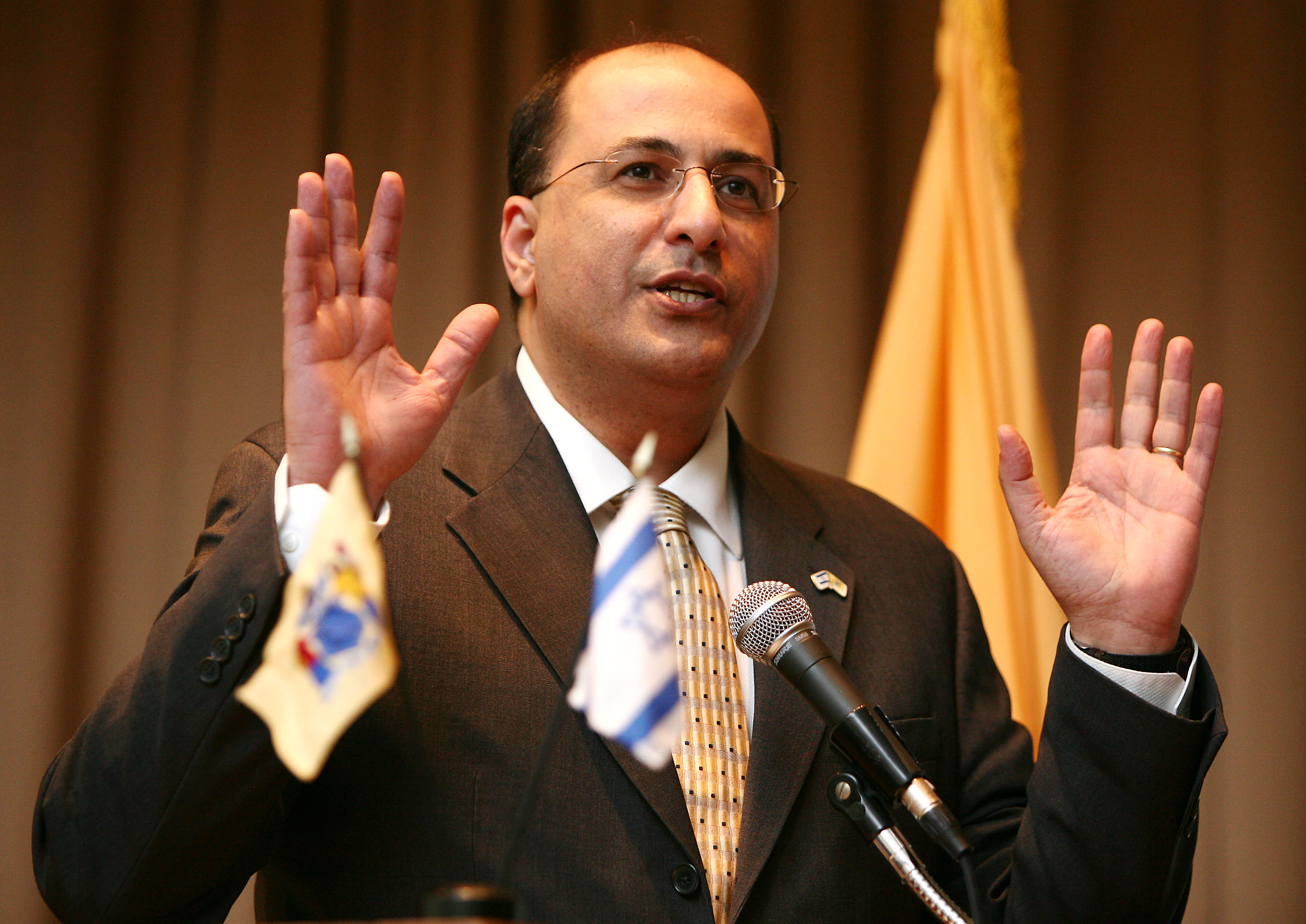
Israel’s Consul General for New York, Ido Aharoni.
Aharoni knows full well why Walker does so. However, for him the racism and oppression Walker sees institutionalized in Israeli society is not a good reason for a boycott. Aharoni asserts that “Israel, like many places on Earth, experiences a variety of issues and challenges. . . . Israel should not be viewed through the prism of its problems, nor should any other country.” On the other hand, Aharoni wants to know why Walker is not boycotting Syria?
The question of why Americans should boycott Israel, in particular, when so many other governments and societies in the world are oppressive and brutal, is an important one. And there is indeed a good answer to it:
The fact that Zionist influence spreads far beyond Israel’s area of dominion and now influences many of the policy-making institutions of western governments, and particularly that of the United States, makes it imperative that Israel’s oppressive behavior be singled out as a high priority case for boycott.
In other words, unlike other oppressive and brutal governments, the Israelis and their supporters directly influence (one might say corrupt) the policymakers of many Western nations and this often makes their governments (most specifically the U.S.) accomplices in Israel’s abusive policies. This being so, prioritizing Israel for boycott is not hypocrisy but rather necessity.
~
Lawrence Davidson is a history professor at West Chester University in Pennsylvania. He is the author of Foreign Policy Inc.: Privatizing America’s National Interest; America’s Palestine: Popular and Official Perceptions from Balfour to Israeli Statehood; and Islamic Fundamentalism.
Ecuador snubs US trade ‘blackmail’ over Snowden, offers human rights training
RT | June 28, 2013
Ecuador renounced trade benefits which the US threatened to revoke over the Latin American country’s consideration of harboring NSA leaker Edward Snowden. It offered $23 million a year to fund human rights education for Americans instead.
The government of leftist President Rafael Correa came up with an angry response on Thursday after an influential US senator said he would use his leverage over trade issues to cut preferential treatment of Ecuadoran goods at the US market, should Ecuador grant political asylum to Snowden.
“Ecuador will not accept pressures or threats from anyone, and it does not traffic in its values or allow them to be subjugated to mercantile interests,” government spokesman Fernando Alvarado said at a news conference.
He added that Ecuador is willing to allocate $23 million annually, an equivalent of the sum that it gained from the benefits, to fund human rights training in the US. It will “avoid violations of privacy, torture and other actions that are denigrating to humanity,” Alvarado said.
US Senator Robert Menendez, who heads the Foreign Relations Committee in the Senate, said this week that Ecuador risks losing the benefits it enjoys under two trade programs because of its stance on the NSA whistleblower.
“Our government will not reward countries for bad behavior,” he said.
The US is Ecuador’s prime trade partner, with over 40 percent of exports going to the US market.
Both programs were due to expire by the end of next month and were subject to congressional review. Before the Snowden debacle arose, the US legislature was expected to scrap one of them while renewing another one.
Snowden has applied for political asylum, hoping to find protection from American prosecutors, who charged him with espionage over his leaking of classified documents on US surveillance programs.
He is currently thought to be staying in the transit zone of a Moscow airport. He became stranded in the Russian capital after arriving from Hong Kong, because the US annulled his travel passport as part of its effort to get him to American soil for trial.
What will Obama do?
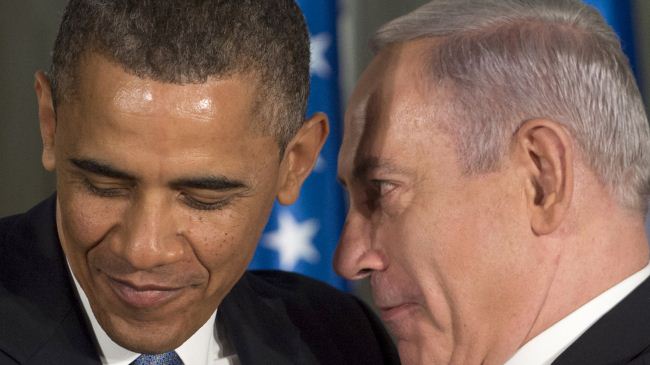
President Obama’s actions are unlikely to stray outside the parameters the Israel lobby is willing to accept. But there is a growing movement that is challenging the lobby’s stronghold on U.S. politics.
By Alison Weir | Palestine News | Spring 2013
Whenever a US president begins a term of office many people round the world are curious about what policies he may pursue on Israel-Palestine. They wonder if he will once again call on Israel to reduce its settlement activities as almost every president has done at least once.
Will he condemn Israeli aggression, or only Palestinian rockets? Will he push a “peace process” in which virtually all the American mediators are Israel partisans[1] or will a few non-Zionists be permitted to play a role?
As Barack Obama began his second term as president, these questions came up again. But these are the wrong questions. Instead, to predict what he will do, one only needs to ask what the Israel lobby is likely to require.
The president won’t always do what the lobby demands – on rare occasions he may deviate a bit from its dictates– but a large percentage of the time he will dutifully do what the lobbyists command.
In other words, in order accurately to analyse American policies in the Middle East, to predict how they will change or not and to develop effective ways to revamp them in the directions that are so urgently needed for humanitarian relief and real peace, it is essential to understand the decisive role the Israel lobby plays in the United States.
Presidents and politicians from both major parties have long been extremely aware of this lobby. It may greatly improve or impede their chances of winning an election, of passing legislation, of receiving positive press coverage, of, quite simply, going on to bigger and better things.
Through the years the lobby for Israel has been a decisive factor in the defeat of Republicans Paul Findley, Pete McCloskey (at one time a Presidential contender) and Charles Percy (another Presidential contender) and Democrats Adlai Stevenson, William Fulbright, Earl Hilliard, Cynthia McKinney and quite likely many more.[2]
Politicians from both parties attend the annual convention of its major lobbying arm, the American Israel Public Affairs Committee (AIPAC) and pledge their loyalty to this foreign country. President Barack Obama, whose early and major backing came from members of the Israel lobby[3], gave his first post-nomination speech at the AIPAC convention.
Yet, despite the lobby’s inordinate power, most Americans are only minimally aware of it. For decades surveys have shown that the large majority of Americans don’t wish to take sides on Israel-Palestine, a reflection of a public that is uninformed about how much of our tax money goes to Israel and how decisively our government is, indeed, taking a side.
This widespread lack of awareness about the role of the Israel lobby in determining American policies is particularly startling given that the movement on behalf of Israel has been active in the United States for over 100 years and that it played a significant role in Israel’s creation.[4]
By the 1920s it was able successfully to promote its policies over those recommended by the US State Department; by the 1940s it had added Pentagon policies to those it could overrule and both presidential candidates Harry Truman and Thomas Dewey were currying its favour[5]; by 1967 it was able to push its cover story on Israel’s lethal attack on the US naval ship Liberty over opposition by high ranking admirals, the director of the CIA and the Secretary of State[6]; and by 1977 the head of AIPAC could state with accuracy: “We have never lost on a major issue.”[7]
Half a century ago the Senate Foreign Relations Committee investigating lobbying activities found an illicit cycle in which the Israel lobby succeeded in procuring money for Israel, some of this was then secretly funneled back into these groups, which then used this money to lobby for still more American tax dollars to Israel.
The hearings concluded that Israel operated “one of the most effective networks of foreign influence” in the United States.[8] Yet, since the media reported on this so little, most Americans are unaware of these extremely grave findings.
The term “Israel lobby” fails to do justice to the extraordinary scope and composition of this special interest group. Below is a small sampling of the American organisations that work on behalf of Israel. Virtually all have multi-million dollar budgets; a few have endowments in the hundreds of million dollars and most of them are funded by tax-deductible donations:
- The American Israel Public Affairs Committee (AIPAC): $100 million endowment, [9] $60 million annual revenues.[10]
- The Washington Institute for Near East Policy (WINEP): $23.5 million net assets. $9.4 million annual revenues.
- International Fellowship of Christians and Jews (aka Stand for Israel): $100 million annual revenues.[14]
- Friends of the Israeli Defense Forces (FIDF): $80 million net assets,[16] $60 million annual revenues.[17]
- Hadassah (Women’s Zionist Organization of America): $400 million net assets, $100 million annual revenues.
- Jewish Community Relations Councils, in cities all over U.S.: Boston annual revenues $2.5 million; Louisville annual revenues $7-10 million; Detroit $734,000, New York $4.5 million, etc.[23]
- JINSA Jewish Institute for National Security Affairs: $3 million annual revenues.
In addition to these nonprofit organisations, there are dozens of political action committees (PACs) that donate to political candidates on the basis of their positions on Israel. Most of these disguise their purpose by using such deceptive names as “Northern Californians for Good Government,” “National Action Committee,” “American Principles,” etc.
While other issue-based PACs almost always announce their focus publicly[31], in 2012 only two of the pro-Israel PACs made any reference to Israel in their names.[32] While US media frequently discuss the gun rights lobby, the largely uncovered pro-Israel PACs gave almost twice as much money to candidates – and the donations went to both parties.[33]
In addition, there are numerous individuals who play an extremely important role in the Israel lobbying effort. Two examples are political campaign mega-donors Haim Saban and Sheldon Adelson. Saban donated $12.3 million to the Democratic Party in 2002 alone and has contributed millions more to pro-Israel organisations.

Adelson, a billionaire casino magnate, set a new record in political donations by giving $70 million in the 2012 elections, nearly triple the previous highest amount. He also funds such pro-Israel organisations as Birthright Israel which takes thousands of young Jewish Americans on recruiting visits to Israel.
In other cases, it is individuals with a different kind of power – the power to affect which information reaches the American public and which does not. One example is Eric Weider, whose Weider History Group publishes eleven history magazines in the United States, the largest history magazine publisher in America (and, according to its website, the world).[34]
Given this reality, President Obama’s actions are unlikely to stray outside the parameters the Israel lobby is willing to accept. While the media are making a great deal over the very mild apology Israel made to Turkey for having murdered nine of its citizens, crediting Obama with this alleged break-through, none of the news reports seem to mention that Israel has largely failed to apologise to the US for the death of 19-year-old dual American Turkish citizen, Furgan Dogan, who was killed with five bullets, one to his face at point blank range.[35]
It is also relevant to note that an AIPAC-drafted letter signed by 76 out of 100 Senators was sent to President Obama on the eve of his visit to Israel in March.[36]
Congressional actions can also be expected to remain within what the Israel lobby directs, though here, too, there may be rare occasions where the lobby seems to have lost – such as the confirmation of Chuck Hagel for Secretary of Defence.
However, the alleged triumph that some pro-Palestinian writers are proclaiming for Hagel’s appointment is a bit overblown. Before he was allowed to take his position, he was made to grovel humiliatingly before his Congressional interrogators, retract acceptable statements he had made earlier in his life and all but swear devotion to Israel (like all top government officials seemingly must do).
This degrading spectacle surely made it clear to Hagel that he better watch his step in the future and made it even clearer to ambitious Americans of all ages that they must be extremely careful about any statements they make about Israel and its lobby if they are to achieve their political ambitions.
Despite the power of the lobby, however, the situation is not as bleak as the above may suggest. There is a highly diverse movement in the US that opposes this lobby and it is steadily growing.
The Left, which for decades was largely silent on Israeli abuses of human rights, has finally become active on the issue. Similarly, both traditional conservatives and libertarians frequently oppose aid to Israel and this opposition is becoming more outspoken. While this stance is often motivated by fiscal considerations, in many cases it is also fuelled by outrage at Israeli cruelty and by genuine empathy with Palestinians.
The money being mobilised on this side is only a small fraction of the other and some of the groups within this movement could arguably be considered simply a more reasonable and compassionate arm of the Israel lobby in that their advocacy is often framed according to what “is good for Israel” while failing to address the inherent injustice of an ethnic state imposed on a multicultural region.
Nevertheless, there is no doubt that the opposition to current US policies is growing increasingly important. The tide may not yet have turned but it is certainly in the slowing phase that must come first.
To use another oft-quoted and particularly apt metaphor, lobbies thrive in the dark. More and more people in the US and elsewhere are shining light on this one, steadily reducing its power.
While there are numerous deeply significant issues, an increasing number of individuals are deciding to focus on this one, the core issue of the Middle East and the cause of war after war, including the current “war on terror” and demonisation of Muslims.
To use the framing posed by journalist Glenn Greenwald, an expanding number of people are refusing to prioritise domestic issues over the killing of Arab and Muslim children on the other side of the world.
Therefore, despite the enormous power of the Israel lobby in the US, this growing movement is quite likely to overcome the obstacles confronting it and to join history’s other successful movements against oppression.
The main question is how long this will take, and how many more massacres, and possibly wars, will occur in the interim.
[1] Even Aaron David Miller admitted they acted as “Israel’s lawyer” – Miller, Aaron David. “Israel’s Lawyer.” Washington Post 23 May 2005, posted by Matt Miller Opinion Writer. Online at http://www.washingtonpost.com/wp-dyn/content/article/2005/05/22/AR2005052200883.html
[2] Findley, Paul. They Dare to Speak Out: People and Institutions Confront Israel’s Lobby. Westport, CT: Lawrence Hill, 1985. Online at http://archive.org/stream/They-Dare-To-Speak-Out-Paul-Findley/They_Dare_to_Speak_Out_Paul_Findley_djvu.txt and Mearsheimer, John J., and Stephen M. Walt. The Israel Lobby and U.S. Foreign Policy. New York: Farrar, Straus and Giroux, 2007.
[3] Yearwood, Pauline Dubkin. “Obama and the Jews.” Chicago Jewish News 24 Oct. 2008.
Online at http://www.chicagojewishnews.com/story.htm?sid=212226&id=252218
[4] Weir, Alison. “Against Our Better Judgment: The Hidden History of How the United States Was Used to Create Israel.” IfAmericansKnew.org. 2012. Web. http://ifamericansknew.org/us_ints/history.html
[5] Weir, “Against Our Better Judgment”
[6] http://www.ussliberty.org/supporters.htm
[7] The Power Peddlers, by Russell Warren Howe and Sarah Hays Trott, Doubleday, p. 292.
http://ifamericansknew.org/us_ints/history.html
[8] Smith, Grant. “Where Did AIPAC Come From?” Antiwar.com. N.p., 09 Oct. 2007. Web. http://antiwar.com/orig/gsmith.php?articleid=11727 and Neff, Donald. “Ulbright Called for U.S. Defense Pact With Israel But Was Labeled Anti-Semite.” Washington Report on Middle East Affairs August-September (1997): 96. Online at http://www.wrmea.org/wrmea-archives/188-washington-report-archives-1994-1999/august-september-1997/2677-middle-east-history-it-happened-in-august-.html
[9] http://www.nytimes.com/2008/04/25/washington/25lobby.html?_r=1
In 2009, the Economist reported: “AIPAC has an annual budget of around $60m, more than 275 employees, an endowment of over $130m and a new $80m headquarters building on Capitol Hill.” http://www.economist.com/node/14753768
[10] http://firststreetresearch.cqpress.com/2012/03/08/aipac-still-commands-attention-among-movers-and-shakers/
[11] http://www.charitynavigator.org/index.cfm?bay=search.summary&orgid=3265
[12] http://www.charitynavigator.org/index.cfm?bay=search.summary&orgid=10657
[13] http://www.charitynavigator.org/index.cfm?bay=search.summary&orgid=10657
[14] http://www.charitynavigator.org/index.cfm?bay=search.summary&orgid=3889
[15] http://www.theisraelproject.org/site/apps/nlnet/content3.aspx?c=ewJXKcOUJlIaG&b=7717007&ct=11735981#.UbKK4uuhU0o
[16] http://www.charitynavigator.org/index.cfm?bay=search.summary&orgid=3734
[17] http://www.charitynavigator.org/index.cfm?bay=search.summary&orgid=3734
[18] http://www.charitynavigator.org/index.cfm?bay=search.summary&orgid=7699
[19] http://www.charitynavigator.org/index.cfm?bay=search.summary&orgid=7699
[20] http://www.faqs.org/tax-exempt/CA/Shimon-Ben-Joseph-Foundation-Dba-Jim-Joseph-Foundation.html
[21] http://207.153.189.83/EINS/133252800/133252800_2010_07b9bf0d.PDF
[22] http://www.jewishfederations.org/about-us.aspx
[23] http://www.jewishlouisville.org/images/JCL/Financials/annual_report_2011-12.pdf
http://www.charitynavigator.org/index.cfm?bay=search.summary&orgid=10095
http://jcrcny.org/images/00_media/about/jcrc-ny2011form990.pdf
[24] http://www.charitynavigator.org/index.cfm?bay=search.summary&orgid=4540
[25] http://www.politico.com/static/PPM152_100828_centerforsecuritypolicy.html
[26] https://bulk.resource.org/irs.gov/eo/2011_09_EO/26-4392915_990_201012.pdf
[27] http://www.charitynavigator.org/index.cfm?bay=search.summary&orgid=8188
[28] http://www.charitynavigator.org/index.cfm?bay=search.summary&orgid=11247
[29] https://bulk.resource.org/irs.gov/eo/2011_02_EO/16-1616489_990_200912.pdf
[30] http://www.charitynavigator.org/index.cfm?bay=search.summary&orgid=5429
[31] http://www.opensecrets.org/pacs/industry.php?txt=Q11&cycle=2012 and http://www.opensecrets.org/pacs/industry.php?txt=Q13&cycle=2012
[32] http://www.opensecrets.org/pacs/industry.php?txt=Q05&cycle=2012
[33] http://www.opensecrets.org/pacs/sector.php?cycle=2012&txt=Q05
[34] Weir, Alison. “The Empire Behind World’s Largest History Magazine Chain: How American History Magazine Censored Palestine.” CounterPunch Dec. 6, 2012. Online at http://ifamericansknew.org/media/weider.html
[35] Lynch, Colum. “U.N. Panel Endorses Report Accusing Israel of Executions aboard Aid Flotilla.” Washington Post 30 Sept. 2010, A Section. Online at http://www.washingtonpost.com/wp-dyn/content/article/2010/09/29/AR2010092907110.html?wprss=rss_print/asection
[36] “Did Your Favorite Progressive Senator Sign AIPAC Letter To Obama Telling Him To Stand Up For Occupation? Here Is The List.” MJ Rosenberg, Mar. 2013. Online at http://mjayrosenberg.com/2013/03/19/did-your-favorite-progressive-senator-sign-aipac-letter-to-obama-telling-him-to-stand-up-for-occupation-here-is-the-list/
Alison Weir is the President of the Council for the National Interest (CNI) and Executive Director of If Americans Knew.
Related articles
- How AIPAC Rules (alethonews.wordpress.com)
- Israel Lobby Dominates Congress, Media Covers it Up (alethonews.wordpress.com)
- Organ trafficking & Israel – A message from Alison Weir (gilad.co.uk)
‘They have two roads on our land already, why do they need a third…?’
International Solidarity Movement | June 27, 2013
Hebron, Occupied Palestine – In the Wadi al-Hussein area of Hebron, Israeli occupation forces have started to build a new road ‘for military purposes’. The route of the road is from the illegal settlement of Kiryat Arba towards the city centre, directly across Palestinian-owned land.
A military order has decreed the construction of this road, four metres wide and more than two hundred metres long, cutting through fields of olive and fruit trees owned by the Palestinian families living there. The stipulation on the width of the road has already been broken, with the route that has been cut by bulldozers being six metres wide in places.
In contrast to the military order to build a road, Palestinian landowners have been denied the right to build on their own land. Despite gaining approval from the Palestinian Authority, the Israeli authorities (who have the final say on civil matters in area H2 of Hebron) have refused permission to build a new house. Landowners also point out that there are two existing roads from Kiryat Arba built on Palestinian land for Israeli-use only, and ask why a third is required.
When occupation forces attempted to build this road initially, landowners and others tried to stop construction by sitting down in front of bulldozers, but this non-violent protest was met with arrests, fines and imprisonment, and by the bulldozer dumping a load of earth on top of them.
Landowners complain that Israel insists on applying those aspects of the Hebron accords that benefit settlers, while ignoring those aspects covering the rights of the majority Palestinian population. Using military orders to steal land is a tactic long-used by Israel. Land seized this way then later typically becomes part of the ever-expanding settlement project. All Israeli settlements are illegal under international law, which bans the transfer of the occupier’s population into the land under occupation.
Related articles
- Jewish settlers setting up tent and planning road on Palestinian owned land in Al Khalil (alethonews.wordpress.com)
- Settlers building illegal road on Palestinian land in Hebron (palsolidarity.org)
- Susiya resists mass demolition orders (alethonews.wordpress.com)
- Settlers Attack Palestinians In Hebron (imemc.org)
- New road connects Israeli settlement with the Ibrahimi Mosque (ramyabdeljabbar.wordpress.com)
Susiya resists mass demolition orders
“We will not give up; to give up is to die”
International Solidarity Movement | June 27, 2013
Susiya, Occupied Palestine – Today, June 27, 2013, the Israeli Civil Administration served thirty-four demolition orders in the Susiya village, which is in Area C and surrounded by the Israeli colony of Suseya. Due to previous demolition orders, every existing structure in the village is now threatened with destruction if they do not obtain permits by July 17.
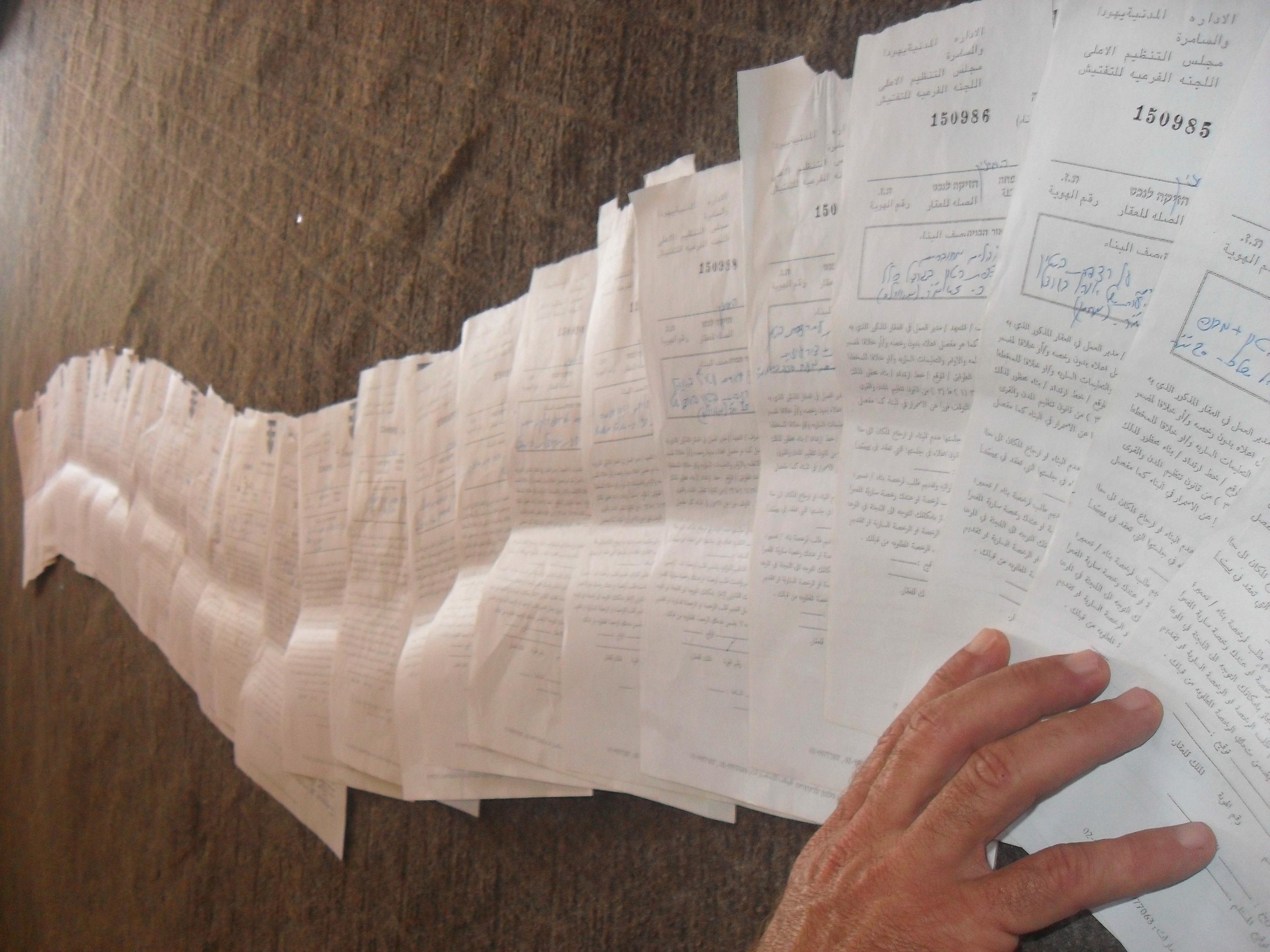
Original copies of all the demolition orders served today (Photo by ISM)
The residents of Susiya include more than thirty families, who were all evacuated from their homes in the old Susiya village and forced to relocate 200 meters to the southeast, in 1986. Susiya residents collaborate with the nearby villages in Masafer Yatta, a closed military “firing zone,” also in Area C and threatened with demolition. On July 15, a hearing will decide whether all the villages in Masafer Yatta can be evacuated by the military. Hafez Huraini, leader of the South Hebron Hills Popular Committee and himself a refugee from 1948, emphasizes that the villagers in Susiya are targeted simply for existing, so everything they do from grazing sheep to visiting family members in the nearby city of Yatta draws violence from the Israeli military and the local settlers.
Susiya has faced six mass demolitions since the establishment of the Israeli Suseya colony in 1983. The last wave of demolitions in 2011 repeatedly displaced 37 people including 20 children [1]. Residents of Susiya, most of whom rely on subsistence agriculture, are subject to some of the worst living conditions in the West Bank. Their houses were destroyed by Israeli forces and they now live in tents and shelters, paying more than five times the price nearby villages pay for water and consuming less than 1/3 of the WHO standard per capita [2]. Settlers have violently denied Susiya residents access to over 300 hectares of their land, including 23 water cisterns. Documented cases of settler violence include beatings, verbal harassment and destruction of property. Settlers then annex parts of the land by exploiting the Palestinian owners’ inability to access their land.
Of over 120 complaints that have been filed based on monitoring from Rabbis for Human Rights, regarding settler attacks and damage to property, around 95 percent have been closed with no action taken. In 2010, when 55 Susiya residents petitioned the High Court to be granted access to their land, the State responded that it intended to map land ownership of the area. Since then they have only closed to settlers 13% of the land Palestinians have been denied access to, reversing only one incursion [3].
Susiya has been the site of creative non-violent resistance for years, resistance that is continually met with brutality. Events have included marches, picnics on land likely to be confiscated, and Palestinian “outposts.” This coming Saturday Susiya will be part of a festival in the South Hebron Hills aimed at raising awareness about the situation of Masafer Yatta residents and stress their right to remain on their land [4]. In the words of Hafez Huraini, coordinator of the South Hebron Hills Popular Committee, “We will not give up.”
Sources:
[1] Strickland, Patrick O. “Palestine’s Front Line: The Struggle for Susiya.” Palestine Note RSS. N.p., n.d. Web. 27 June 2013.
[2] “Susiya: At Imminent Risk of Forced Displacement.” Susiya: At Imminent Risk of Forced Displacement – OCHA Factsheet (30 March 2012). N.p., Mar. 2012. Web. 27 June 2013.
[3] “South Hebron Hills.” Khirbet Susiya. N.p., 01 Jan. 2013. Web. 27 June 2013.
[4] Al Mufaqarah. “Al Mufaqarah R-Exist.” Weblog post. Al Mufaqarah RExist. N.p., 24 June 2013. Web. 27 June 2013.
Related articles
- The occupation plans to expand settlement of Susiya in al-Khalil (occupiedpalestine.wordpress.com)
- Jewish settlers setting up tent and planning road on Palestinian owned land in Al Khalil (alethonews.wordpress.com)
- Settler dogs attack Palestinian villagers near Hebron (occupiedpalestine.wordpress.com)
Related video
- From Al-Araqib to Susiya (palestinefreedomnow.wordpress.com)
‘Vitoria!’ Mass protests force Brazil congress to reject ‘bill of discontent’
RT | June 26, 2013
Brazil’s legislative body has thrown out a proposed constitutional amendment, which was a key grievance of protesters across the country. The government is also planning to introduce a range of political reforms to appease demonstrators.
In what in being seen as a victory for people power, the measure was defeated on Tuesday by Congress by 430 votes to nine; with the Rio Times saying the protests were “largely fueled by social media and citizen journalists.”
The amendment, known as PEC 37, would have limited the power of state prosecutors to investigate crimes.
The protesters had argued that PEC 37 might have opened the way to more corruption; a problem which is endemic in Brazil.
Brazil ranks 69 out of 174 countries on the 2012 Transparency International index, a score that indicates significant problems with corruption.
The defeat of PEC 37 will keep public prosecutors at the forefront of the fight against corruption. If the amendment had become law, it would have granted power to carry out criminal investigations exclusively to the police.
Critics to the bill argued that it would have prevented prosecutors from conducting fair, impartial and effective criminal investigations, particularly into organized crime and corruption, in which the police themselves have been embroiled. In December last year 63 police officers were arrested after a yearlong bribery investigation.
The police in Brazil are amongst the most corrupt in the world and have been mired in recent years in a number of corruption scandals.
Congress also voted Tuesday to funnel all revenue and royalties from newly-discovered oil fields off the Brazilian coast into education and health.
The new fields are among the largest finds in recent years and, once fully operational, are expected to produce tens of billions of barrels of oil; although they are located deep on the ocean floor and extracting the oil will require expensive new technology and carries huge risks.
Protestors also voiced their anger at other issues, which they say the government is mishandling, including soaring levels of corruption, poor public services and the huge cost of staging the 2014 World Cup and 2016 Summer Olympics, both to be held in Brazil.
The government, though, has promised a range of initiatives, which they say will combat corruption and improve public services.
A referendum proposing political reform is meant to address campaign financing and political representation, and the government says a vote may take place as soon as September 7.
A controversial plan to bring in foreign doctors to reverse a shortfall in the country is being pushed through despite the objections of Brazilian medical practitioners and an increase in public transport fares in many cities has also been scrapped. The President of the Senate, Renan Calheiros, has even proposed free transport for students.
Yet it is still unclear whether or not these hasty political concessions are having an impact. Protests are due to continue in the city of Belo Horizonte Wednesday, with tens of thousands of people expected to take part.
In a security nightmare for police, the demonstration will take place at the same time as the semifinal of the Confederation Cup between Brazil and Uruguay. One protest group has said it plans to protest outside the national team’s hotel.
Last Saturday there were violent clashes in Belo Horizonte during another protest and President Rousseff has warned against a repeat of violence.
Afghan party slams US permanent military base plan
Press TV – June 27, 2013
The Islamic Movement of Afghanistan Party has strongly condemned the United States for planning to set up permanent military bases in the war-ravaged country beyond 2014.
Mohammad Mukhtar Mufleh, the party’s leader, released a statement on Thursday warning that things will get worse should the US sets up its bases in Afghanistan,
He also heaped scorn on the US-led forces for committing unforgivable crimes against Afghan women and children since invading the country in 2001.
Thousands of Afghan civilians, including a large number women and children, have been killed during night raids by foreign forces and CIA-run assassination drone strikes.
The increasing number of casualties in Afghanistan has caused widespread anger against the US and other NATO member states, undermining public support for the Afghan war.
Civilian casualties have long been a source of friction between the Afghan government and US-led foreign forces, and have dramatically increased anti-US sentiments in Afghanistan.
The United States and its allies invaded Afghanistan in 2001 as part of Washington’s so-called war on terror. The offensive removed the Taliban from power, but after more than 11 years, insecurity remains across the country.
In May, Afghan President Hamid Karzai said his government was ready to let the US set up nine bases across Afghanistan after most foreign troops withdraw in 2014.
However, the Afghan government recently sought explanation from Washington about the ongoing US-led controversial peace talks with the Taliban militants in Qatar,
The Kabul government has also suspended strategic talks with Washington to discuss the nature of US presence after beyond 2014.
President Karzai has announced that his government will not join any US negotiations with the Taliban unless the talks are led by the Afghans.
South Africa: Obama Docket
Muslim Lawyers Association Press Release | June 26, 2013
Lawyers will continue to pursue the case against Obama in the courts
Johannesburg, South Africa – The Muslim Lawyers Association (MLA) brought an application to court on Tuesday, 25 June 2013, to charge US President Barack Obama with a number of crimes, before he enters South Africa on Friday, 28 June 2013.
The North Gauteng High Court today found that the merits of the matter could not be heard as it was not deemed to be sufficiently ‘urgent’. This is despite the imminent arrival of Obama in South Africa this week. However, the (MLA) will continue to pursue the matter through the ordinary course of the courts.
Given the sheer magnitude, gravity, extent and degree of these crimes, as well as the unrelenting vigour with which the Obama Administration continues to commit them, the MLA intends to pursue the review application in accordance with the normal court time periods applicable.
“It is regrettable for the court not to have adjudicated on the merits of the ‘Obama Docket’ at an expedient time when Obama’s visit to the Republic is imminent”, states MLA spokesperson, Attorney Yousha Tayob.
The Obama Docket contains:
– evidence of indiscriminate killing of civilians by the use of USA military drones
– a public acknowledgment by Obama that he authorised the extra judicial assassinations of US citizens and that civilians have been killed by drone attacks authorised by him
– evidence of the continued incarceration without trial of persons detained at Guantanamo Bay and other US detention facilities, and
– evidence that the United States has engaged in rendition programmes contrary
to the prescripts of the norms and standards of International Law.
“South Africa has adopted and ratified the Rome Statute into our law and is therefore obliged to fulfil both its domestic and international responsibilities”, adds Tayob.
The MLA remains undeterred in its resolve to pursue all legal avenues to expose the past and ongoing War Crimes, Crimes against Humanity and Genocide committed by Obama and his administration and is committed to have him brought before a South African court of law or the International Criminal Court to answer the allegations contained in the ‘Obama Docket’.
For more information on the Obama Docket and its contents, or for interviews with an MLA representative, call Attorney Yousha Tayob, + 27 82 926 5408 or email at info@mlajhb.com or visit the MLA website at http:// http://www.mlajhb.com
Related article
- Obama faces protests in South Africa (alethonews.wordpress.com)
New Jersey hospital deports unconscious stroke victim
RT | June 26, 2013
A US hospital deported an unconscious stroke victim after noticing that the patient was an undocumented immigrant from Poland. Polish health officials are furious that the man was “dumped on their doorstep” before the transfer was approved.
“Imagine being carted around like a sack of potatoes,” Polish Consul General Ewa Junczyk-Ziomecka told New York Daily News, describing the incident in which 69-year old Wladyslaw Haniszewski was unconsciously deported to his homeland.
Haniszewski, who suffers from a blood disease, lived in Perth Amboy, N.J., for 30 years. He recently lost his job, apartment, and health insurance, and was forced to move into a homeless shelter, the Daily News reports.
After the man suffered a dangerous stroke, a friend named Jerzy Jedra took him to the New Jersey hospital for treatment. When officials at the Robert Wood Johnson University Hospital noticed that the patient had no health insurance and lived in the US without documentation, they sent the comatose man to Poland. US hospitals are legally required to provide emergency care to anyone who needs it, but are allowed to deport stabilized undocumented immigrants.
But in order to deport someone, a US hospital must first get consent from either the patient, a family member, or a court guardian. Officials at the Polish consulate claim that no one was contacted, and that Haniszewski’s family was never informed that the man was deported.
Meanwhile, Haniszewski was left at the doorstep of a hospital in Boleslawiec, Poland. The facility is now being forced to take care of the man’s medical payments, which have cost “a few hundred dollars” a day, the hospital’s deputy director told TVN.
Junczyk-Ziomecka, who works at the Polish consulate in New York City, said she was trying to help the comatose man, only to realize last week that he was gone. Polish officials are furious about the deportation, especially since the 69-year-old patient was not in a healthy state to sign off on the transfer.
“Behind our backs they transported the unconscious man to Poland,” she told TVN, noting that she was most furious about the hospital’s decision to dump the man at the facility. “I cannot imagine such a situation that the decision about transporting an unconscious person could be made without agreement. Between the two institutions must be a contract, there must be documents. You cannot simply leave a patient at the door and drive away.”
At least 800 people have been deported from US hospitals without consent over the past six years in 15 states, the Associated Press reported in April. Medical repatriation has become increasingly common, but AP suggests that the actual number of such hospital deportations is much higher than figures show. Some health advocates are afraid that repatriations will occur more frequently after major components of Obamacare are implemented in 2014, since the US government will reduce its payments to hospitals that care for large numbers of uninsured patients.
Shena Erlington, director of the Health Justice Program, told the Daily News that although hospitals may face the burden of paying for uninsured patients, medical care providers should not have the ability to deport patients.
“It’s an incredibly disturbing case,” Lori Nessel, director of the Center for Social Justice at Seton Hall University School of Law, said about the Haniszewski repatriation. “This kind of action seems clearly illegal and also not ethical, but it’s hard to bring forth a legal action.”
The New Jersey hospital denies any wrongdoing and claims that the patient was informed of his discharge and care plan. The patient is awake, but unable to speak or communicate with doctors.
Turkey takes steps to monitor Twitter content, users
Al-Akhbar | June 27, 2013
Turkey said on Wednesday it had asked Twitter to set up a representative office inside the country, which could give it a tighter rein over the micro-blogging site it has accused of helping stir weeks of anti-government protests.
While mainstream Turkish media largely ignored the protests during the early days of the unrest, social networking sites such as Twitter and Facebook emerged as the main outlets for Turks opposed to the government.
Transport and Communications Minister Binali Yildirim told reporters on Wednesday that without a corporate presence in the country, the Turkish government could not quickly reach Twitter officials with orders to take down content or with requests for user data.
“When information is requested, we want to see someone in Turkey who can provide this … there needs to be an interlocutor we can put our grievance to and who can correct an error if there is one,” he said.
“We have told all social media that … if you operate in Turkey you must comply with Turkish law,” Yildirim said.
Twitter declined to respond to the government request on Wednesday, but a person familiar with the company’s thinking said it had no current plans to open an office in that country.
Turkey successfully pressured Google Inc into opening an office there last October after blocking YouTube, a Google subsidiary, from Turkish Internet users for two years.
While Ankara had no problems with Facebook, which had been working with Turkish authorities for a while and had representatives inside Turkey, Yildirim said it had not seen a “positive approach” from Twitter after Turkey issued the “necessary warnings” to the site.
“Twitter will probably comply, too. Otherwise this is a situation that cannot be sustained,” he said, without elaborating, but he stressed the aim was not to limit social media.
An official at the ministry, who asked not to be named, said the government had asked Twitter to reveal the identities of users who posted messages deemed insulting to the government or prime minister, or that flouted people’s personal rights.
It was not immediately clear whether Twitter had responded.
Facebook said in a statement that it had not provided user data to Turkish authorities in response to government requests over the protests and said it was concerned about proposals Internet companies may have to provide data more frequently.
In the midst of some of the country’s worst political upheaval in years, Turkish Prime Minister Tayyip Erdogan has described sites like Twitter as a “scourge,” although senior members of his party are regular users. He has said such websites were used to spread lies about the government with the aim of terrorizing society.
Police detained several dozen people suspected of inciting unrest on social media during the protests, according to local reports.
Speaking at the Brookings Institution in Washington, D. C., Twitter’s Chief Executive Dick Costolo said on Wednesday that he had been observing the developments in Turkey, but he emphasized that Twitter had played a hands-off role in the political debate.
“We don’t say, ‘Well, if you believe this, you can’t use our platform for that,'” Costolo said. “You can use our platform to say what you believe, and that’s what the people of Turkey … are using the platform for. The platform itself doesn’t have any perspective on these things.”
Turkey’s interior minister had previously said the government was working on new regulations that would target so-called “provocateurs” on social media but there have been few details on what the laws would entail.
One source with knowledge of the matter said the justice ministry had proposed a regulation whereby any Turk wishing to open a Twitter account would have to enter their national identification number, but this had been rejected by the transport ministry as being technically unfeasible.
Turkish users have increasingly turned to encryption software to thwart any ramp up in censorship of the Internet.
Last year, Twitter introduced a feature called “Country Withheld Content” that allows it to narrowly censor tweets considered illegal in a specific country, and it caused some concern among users.
Twitter implemented the feature for the first time in October in response to a request by German authorities, blocking messages in Germany by a right-wing group banned by police.
(Reuters, Al-Akhbar)
Related article
- Turkey announces plans ‘for gas’ and cyber security in face of Gezi protests (alethonews.wordpress.com)
Featured Video

Michael von der Schulenburg: Europe’s Self-Defeating Iran War Policy
or go to
Aletho News Archives – Video-Images
Frlom the Archives
Who Rules America?
The Power Elite in the Time of Trump
By James Petras | Axis of Logic | September 6, 2017
Introduction
In the last few months, several competing political, economic and military sectors – linked to distinct ideological and ethnic groups – have clearly emerged at the centers of power.
We can identify some of the key competing and interlocking directorates of the power elite:
- Free marketers, with the ubiquitous presence of the ‘Israel First’ crowd.
- National capitalists, linked to rightwing ideologues.
- Generals, linked to the national security and the Pentagon apparatus, as well as defense industry.
- Business elites, linked to global capital.
This essay attempts to define the power wielders and evaluate their range of power and its impact. … continue
Blog Roll
 Aletho News
- Michael von der Schulenburg: Europe’s Self-Defeating Iran War Policy
- Sorry, The New Republic, Climate Change Isn’t Causing Somali Migration. Blame Civil Strife and Poverty.
- Expert Guts Claims That HPV Vaccine Reduces Cancer Risk
- No evidence Russia sabotaged Baltic cables – Finnish intel
- The Strategic Folly of a (Serious) US Ground Invasion of Iran
- US-Israeli war of aggression on Iran meant to reshape region: Omani FM
- Iran Does Not Consider Israel Party to Talks to Need Mediators With It – Ambassador
- Macron’s aircraft carrier and warplanes to the Persian Gulf is a dangerous vanity project
- Meet The Ellisons: Zionists, Technocrats, Moguls
- US failures in Iran reveal Russia is key to South Korea’s strategic security
- If Americans Knew
- Are we on the precipice of World War III?
- ‘Catastrophic,’ Says UNICEF: 1,100+ Children Killed or Wounded in Mideast Since US-Israel Launched Iran War
- The Unbelievable Madness of Our War With Iran
- World Council of Churches calls on govts to hold Israel accountable for violations of intl law
- How to end the war on Iran that costs US taxpayers $1M per minute – Not a ceasefire Day 153
- Israeli strategic plans to “remake the Middle East” from the 1950s and since
- Honoring Gaza’s women who refused to let the world look away
- 97% of victims of war on Iran are Iranian, 98% of victims in war on Gaza are Gazans – Not a ceasefire Day 152
- Early Iran strikes cost $5.6 billion in munitions, Pentagon estimates
- Israel Decided the War, But Trump’s America Fights and Pays the Bill
- No Tricks Zone
- Destructive Green New Deal: German Energy And Metal Group Warns Of Drastic Crisis
- New Study Documents A 20-Year Pause In Arctic Sea Ice Decline – Driven By Internal Variability
- Wake-up Call: Survey Shows Majority Of Germans Now Favor Postponing Climate Targets!
- Televised! Leading German Political Candidate Tells Schoolchildren CO2 Makes Sun Hotter!
- New Study: A Century Warming Of 1.1°C Is ‘Commonplace’ And ‘Not Unusual’ During This Interglacial
- New Study: ‘Internal Noise’ And Volcanic Forcing Can Trigger 10-15°C Warming Within Decades
- Glaciers Worldwide Are Suddendly Surging, Experts Blame Warming!
- Surprising Discovery: Sahara Is Greening…Billions Of Trees Where Once Thought To Be Barren
- New Research Reaffirms Clouds, Aerosols, And Surface Solar Radiation Are ‘Driving The Climate System’
- Germany: Electric Car Catches Fire At Charging Station, Sets Off Local “Inferno”, Widespread Damage
 Aletho News