Bulgarian scholars call for end to plutocracy
Press TV – June 24, 2013
Sixty prominent Bulgarian intellectuals have issued a special declaration against ‘plutocracy’ in the country, calling for an end to rule by the wealthy and a return to democracy.
The so-called charter for disbanding the plutocratic model of the Bulgarian state was issued on Sunday amid the ongoing protests by Bulgarians to oust the three-week-old government.
“The protests of tens of thousands of people across the country were motivated by the desperate concern about the state system in Bulgaria. Beyond doubt, we are in a deep crisis of the social contract and a total discreditation of the state institutions,” the declaration read.
The protests began on June 14 after the appointment of controversial and inexperienced media mogul Delyan Peevski as chief of Bulgaria’s National Security Agency (DANS).
The declaration called Peevski’s career and public image “a synthesis of all pathological processes that led to the current degrading and seemingly dead-end situation.”
“The Peevski case laid bare the growing seizure of the political system, media, justice, security and banking sectors by a network of hidden dependencies that does not respect the rule of law and separation of powers, empties the institutions from democratic legitimacy and substitutes public interest [with] corruption and moral degradation,” the declaration stated.
The new Socialist-backed Prime Minister Plamen Oresharski withdrew Peevski’s nomination immediately after the protests erupted.
However, the move failed to appease both the protesters and President Rosen Plevneliev, who said he had lost confidence in the government and demanded an immediate review of the controversial appointment.
In addition, the declaration addressed a number of other instances over the past years that proved “the adhesion of oligarchy and power,” urging the public to launch a process to clearly define the problems in the functioning of Bulgaria’s democracy and to draft reforms to abolish them.
It also listed some of the most striking problems, including alienated institutions, easily swayed by corruption, nepotism and weakened judiciary, police and media.
The sixty scholars behind the declaration include lawyers, journalists, political analysts, sociologists and human rights activists.
Russia Offers Iran New Replacement for S-300 – Paper
RIA Novosti | June 22, 2013
MOSCOW – Moscow made a new attempt to dodge a $4-billion lawsuit from Tehran over a failed deal to supply S-300 missile systems by offering another type of air defense system to Iran, Kommersant daily said Saturday.
The new offer on the table is Antei-2500, aka S-300VM, or SA-23 Gladiator in NATO nomenclature, the newspaper said, citing unnamed sources in the Russian arms trade industry. The missile defense system can simultaneously destroy up to 24 aircraft within the range a range of 200 kilometers or intercept up to 16 ballistic missiles.
The deal can be formalized during the visit of outgoing Iranian President Mahmoud Ahmadinejad to Moscow on July 1, an unnamed Iranian diplomat told Kommersant.
Iran was initially interested in the S-300 missile complexes, signing in 2007 a contract worth $800 million for five missile defense systems of this make.
But the deal was scrapped in 2010 by then-Russian President Dmitry Medvedev, who was unilaterally expanding on sanctions against Iran imposed by the UN Security Council.
Iran filed a $4-billion lawsuit against Russia in the international arbitration court in Geneva, which is currently pending review.
Moscow has struggled to have the lawsuit dropped, including by offering the Tor anti-aircraft systems as replacement, media reported earlier this month, adding that the offer was rejected by Tehran.
The Antei-2500, however, may be a better solution. The system does not formally fall under the existing sanctions against Iran while still being useful for the Middle Eastern country, which wants to have protection against a possible missile strike by its enemy Israel, Kommersant said.
While the S-300 was developed for the use by missile defense forces, the Antei-2500 was specifically tailored for the needs of ground forces, which could also be an advantage for Iran, known for its large land force.
Russia is already exporting the Antei-2500, having delivered two missile systems to Venezuela earlier this year. India and Turkey were also named as potential buyers, though no deals were formalized so far.
New Snowden leak reveals US hacked Chinese cell companies, accessed millions of sms – report
RT | June 23, 2013
US government has been hacking Chinese mobile operator networks to intercept millions of text messages, as well as the operator of region’s fibre optic cable network, South China Morning Post writes citing Edward Snowden.
More information on National Security Agency activity in China and Hong Kong has been revealed by SCMP on Sunday, shedding light on statements Snowden made in an interview on June 12.
“The NSA does all kinds of things like hack Chinese cell phone companies to steal all of your SMS data,” Snowden was quoted as saying on the SCMP website.
In a series of reports the paper claims Snowden has provided proof of extensive US hacking activity in the region.
The former CIA technician and NSA contractor reportedly provided to the paper the documents detailing specific attacks on computers over a four-year period, including internet protocol (IP) addresses, dates of attacks and whether a computer was still being monitored remotely. SCMP however did not reveal any supporting documents.
The US government has been accused of a security breach at the Hong Kong headquarters of the operator of the largest regional fibre optic cable network operator, Pacnet. Back in 2009, the company’s computers were hacked by the NSA but since then the operation has been shut down, according to the documents the paper claims to have seen.
Pacnet’s network spans across Hong Kong, China, Korea, Japan, Taiwan, the Philippines and Singapore and provides connections to 16 data centers for telecom companies, corporations and governments across the region.
The whistleblower has also allegedly revealed the US had viewed millions of text messages by hacking Chinese mobile phone companies. That is a significant claim since the Chinese sent almost billion text messages in 2012 and China Mobile is the world’s largest mobile network carrier.
In his very first leak to the media, Snowden had already exposed the scale of the American government spying operation on its domestic mobile network operators. He later revealed that the US and the UK possessed technology to access the Blackberry phones of delegates at two G20 summit meetings in London in 2009.
In a third article, SCMP claims that the US on a regular basis has been attacking the servers at Tsinghua University, one of country’s biggest research institutions. The whistleblower said that information obtained pointed to hacking activities, because it contained such details as external and internal IP addresses in the University’s network, which could only have been retrieved by a security breach.
Tsinghua University is host to one of Chinas’ six major backbone networks, the China Education and Research Network (CERNET) containing data about millions of Chinese citizens.
Bush’s Foiled NSA Blackmail Scheme
By Dennis J Bernstein | Consortium News | June 21, 2013
In early 2003, as the U.S. and British governments were seeking international acquiescence to their aggressive war on Iraq, an unexpected cog thrown into the propaganda machine was the disclosure that the National Security Agency was spying on UN Security Council members in search of blackmail material.
The revelation received little attention in the mainstream U.S. news media, which was almost fully on board the pro-war bandwagon, but the disclosure received wide international attention and stopped the blackmail scheme. U.S. President George W. Bush and British Prime Minister Tony Blair were forced to abandon a UN resolution and invade Iraq with a ragtag “coalition of the willing.”

Former British Prime Minister Tony Blair.
Several months later, the identity of the leaker was revealed, a young woman named Katharine Gun who worked as a linguist at the NSA’s UK counterpart, British Government Communications Headquarters. Gun lost her job and was charged under British secrecy laws, but the case was dropped because the court would have required the Blair government to disclose that it also had twisted the arms of legal advisers to extract an opinion endorsing the invasion.
Now, a decade later, Edward Snowden, a young American systems analyst working for the NSA, has leaked documents revealing a global surveillance network and prompted another international debate – about government spying vs. personal privacy. Katharine Gun joined Pacifica’s “Flashpoints” host Dennis J Bernstein to discuss both cases.
DB: What exactly was your position when you decided to leak a certain document?
KG: My title was linguist analyst. I was a Mandarin Chinese speaker. We translated interceptions and produced reports for the various customers of GCHQ, which are normally the Foreign Office or MI-5 and MI-6.
DB: Can you explain the document you released and the significance of the timing?
KG: It was released at the end of January 2003, just before the invasion of Iraq. I saw an email that had been sent from the NSA to GCHQ. It was a request for GCHQ to help the NSA intercept the communications of six nations that sat on the Security Council at that time. It was to intercept their domestic and office telecoms in order to obtain all the information we could about the delegates, which the U.S. could then use to achieve goals favorable to U.S. interests. They called for the whole gamut of information, which made me think they would potentially use the information to blackmail or bribe the U.N. delegates.
DB: This bugging took place at the United Nations?
KG: Presumably, yes. Or it could involve the United Nations headquarters or also their domestic residence.
DB: The idea was to get the necessary information one way or the other to influence the key members to support the U.S. quest for war in Iraq?
KG: Yes. At the time, if you were not working for the intelligence services or the foreign offices of the U.S. or U.K. you would probably assume that the goal of [President George W.] Bush and [Prime Minister Tony] Blair at that time was to work diplomatically to reach a solution. But we now know, after several leaks over the years about the run-up to the war in Iraq, that war was the agenda all along. When I saw the email it made me think, “This is evidence that war is the agenda.” That’s why I decided the public needed to know.
DB: GCHQ is the British Government Communications Headquarters, the equivalent to the NSA [National Security Agency]. You were working there in the lead-up to the Iraq War. Can you remind us what governments were bugged?
KG: Six nations, smallish countries: Angola, Cameroon, and Pakistan, I think. Mexico was mentioned, and possibly Chile as well. They were countries that are generally not known for their big powerful positions at the U.N.
DB: What went through your mind leading up to the decision to leak this information? This big decision changed history a bit. How did you make this courageous decision that also changed your own life?
KG: I was very concerned. I had informed myself about the realities of Iraq and the situation there because I grew up during the first Gulf War and the following years of sanctions. It was in the back of my mind that Iraq was a country that was virtually destroyed, and that the people were living in impoverished conditions. It made me think that another attack on them would not be fair and justified because there was nothing about Iraq that was a threat to either the U.S. or the U.K.
So when I saw the email and realized what was going on behind closed doors was an attempt to get the U.N. to authorize what would then have become a pre-emptive strike on a country, I thought the public should know about this because it angered me.
DB: What happened after you made this information available? What happened with your position? Were you intimidated, attacked?
KG: Initially I tried to remain anonymous, but when I realized the information revealed in the newspaper at the time was identifiable to GCHQ, I decided I didn’t want to lead a double life at GCHQ and pretend I had nothing to do with it. I confided to my line-manager and said it was my leak. Then I was arrested under suspicion of breaking the Official Secrets Act, questioned, and released on bail for eight months.
In November 2003, much to our surprise, they decided to charge me, despite having waited so long. After discussions with my legal team, which included Liberty, an organization very similar to the U.S. ACLU, we decided I would plead non-guilty, because I personally felt that although I did the act, I didn’t feel guilt, because I didn’t feel I had done anything wrong. Our defense would have been to establish the defense of necessity, which is not yet tested in a court of law. My legal team then asked for all the legal advice leading up the war, and at that point, the prosecution decided to drop all charges against me.
DB: What do you think made them decide to prosecute you, and what information made them drop the charges? Were they trying to backpedal? Were they trying to make sure no other folks in positions like you would do it again?
KG: It’s speculation on my part because obviously they haven’t disclosed. I suspect one of the reasons they charged me was to make an example of my actions to try to deter people from it. On the other hand, when they dropped the charges, I suspect there may have been a variety of reasons. When we asked for the legal advice from the then-Attorney General, at that time his legal advice had not been fully disclosed.
During the run-up to the war, Blair asked for legal advice, obviously. The first draft was about 13 pages long. The language was very cautious – it didn’t say there was a definite reason for war. There were many legal terms of caution, but at some point Blair was told the legal advice was not good enough. He needed a watertight case. The Attorney General then re-drafted his advice, and condensed it to a single page that was then issued to the House of Commons.
That is what persuaded all the MPs in the House of Commons to vote for Britain’s involvement in the war. Eventually information came out, not from myself, but from other means and it became apparent that the legal advice had not been at all watertight to start with.
DB: Daniel Ellsberg said your most important and courageous leak is the only one made in time to avert an imminent possible war. Was your desire to avert war?
KG: Yes, I was hoping the British ministers would see the truth and question the actions of Blair and the secret negotiations he was having with Bush at the time. I wanted more transparency on the issue. I wanted people to question what was going on and to generally challenge this bandwagon for a preemptive strike against a country that was already very impoverished and no threat to anybody whatsoever.
DB: Did you ever hear from folks who based on your revelations, learned they were bugged?
KG: No.
DB: So there were no thank yous coming across from that part of the world?
KG: No. At the time of the leak, my name didn’t come out. Eight months later my name was made public.
DB: Did it change your life?
KG: I lost my job. The secure, full-time, long-term employment was no longer possible. That has made an impact, primarily financially, on my life and my family’s life.
DB: We are now seeing extraordinary NSA leaks from Edward Snowden in the British Guardian. What are your thoughts on this?
KG: I think Snowden is probably is a lot more clued-up than I was at the time. My leak was a single issue. Snowden has had a long period of time working within the U.S. intelligence services. He’s obviously a very technically savvy professional. I admire him for taking this tremendous step, which he thought out very carefully and methodically. He has made some very good points. These kinds of issues should be in the public domain because it involves innocent members of the public. We, the public, should be able to have a measure of a say in these matters.
DB: We hear that people like you, who were leaking before the war, and Snowden now, are putting people’s lives in jeopardy, endangering the people. We hear that secrecy is necessary to prevent terrorist attacks, and that many have been prevented by this kind of secrecy, investigation, wiretapping and bugging that’s going on now.
KG: There is absolutely no evidence that my leaks in any way endangered anybody else.
DB: But you were accused of that.
KG: Yes, they love to throw accusations around, there’s no doubt about that. But in my case, the majority of views supported my actions. In Snowden’s case, people who have a fair and just understanding of the issues at-large are supportive of his actions, as they would be of Private Manning, who is currently on trial.
DB: Did you lose any friends or associates, over this?
KG: Ironically, not really. Many of my friends and colleagues from GCHQ have also left GCHQ, partly to progress in their professions. They didn’t see much chance for their linguistic skills progressing much further within GCHQ and I continue to be in touch with them.
DB: If you had it all to do over again, would you?
KG: That’s a difficult question. Now I’m married and have a child. I would hope that I would still do it, but perhaps I would be more savvy about how I did it. Snowden was very clued-up and seems to know exactly what he should be doing – how to stay safe and keep out of the way of being unjustly arrested and tried without due process of law.
DB: Your language skills. Are you using them now?
KG: Not now. I’m only fluent in Mandarin Chinese. I speak some Japanese and am now trying to learn Turkish.
DB: That may in handy in the next decade or so. Thank you for talking to us.
~
Dennis J Bernstein is a host of “Flashpoints” on the Pacifica radio network and the author of Special Ed: Voices from a Hidden Classroom. You can access the audio archives at www.flashpoints.net.
Related articles
- A British Precursor to Snowden Case (consortiumnews.com)
- British spy agency has access to global communications, shares info with NSA (alethonews.wordpress.com)
Spying on the World From Domestic Soil
By Katitza Rodriguez | EFF | June 21, 2013
The world is still reeling from the series of revelations about NSA and FBI surveillance. Over the past two weeks the emerging details paint a picture of pervasive, cross-border spying programs of unprecedented reach and scope: the U.S. has now admitted using domestic networks to spy on Internet users both domestically and worldwide. The people now know that foreign intelligence can spy on their communications if they travel through U.S. networks or are stored in U.S. servers.
While international public outrage has justifiably decried the scope and reach of these revelations, carte blanche foreign intelligence surveillance powers over foreigners are far from new. In the U.S., foreign intelligence has always had nearly limitless legal capacity to surveil foreigners because domestic laws and protections simply don’t reach that surveillance activity.
This legal framework, with no protection for foreigners and little oversight besides, has been exacerbated by the growth in individuals now living their lives online, who conduct their most intimate communications in cloud services that are hosted in the U.S. and across different jurisdictions. To make matters worse, the vast amount of Internet traffic globally is routed through the U.S. Last but not least, logistical barriers to powerful, mass surveillance have lowered and the application of existing legal principles in new technological contexts has become unclear and shrouded in secrecy, especially in a extra-territorial surveillance context. The US government’s FISA powers, which in 2008 opened the door to broad surveillance of communications where one side is an American and the other side is a foreigner, represent just an example of an increasing state capacity to conduct nearly limitless invasive extra-territorial surveillance from domestic soil.
International Backlash
On June 18, Germans rallied at a well-known Berlin Wall crossing point called Checkpoint Charlie. Under the motto: “Yes We Scan!” German activists protested against PRISM and NSA surveillance in response to President Barack Obama’s Berlin visit. Pictures of the rally show protest signs claiming that the Obama administration has become “Stasi 2.0” with the quote “All your data belong to us”.
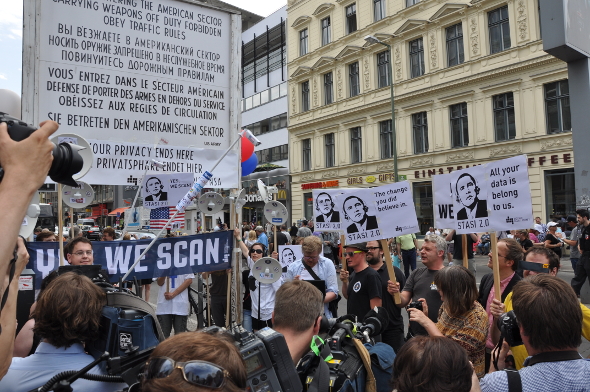
The Stasi 2.0 campaign was originally designed in 2007 to fight Germany’s mandatory data-retention law, a law implementing an EU Directive that force ISPs and telecom providers to continuously collect and store records documenting the online activities of millions of ordinary Europeans. Roughly 34,000 citizens filed a lawsuit against the mandatory data retention in protest. The campaign was successful and in March 2010 a German court declared the law unconstitutional and ordered the deletion of the collected data. Now, the Stasi 2.0 campaign has shifted focus on calling upon their government to protect them against overreach scope of NSA foreign surveillance practices, Sandra Mamitzsch from Digitale Gesellschaft told EFF.
Germany has also increased its capacity to conduct sweeping and invasive extra-territorial surveillance from its domestic soil. As we noted, the German government has leveraged its ability to remotely compromise computer systems in order to spy on its citizens. The government has used commercial malware to hack private data. While there has been no confirmation that Germany is deploying these investigative techniques against persons outside German territories, extra-territorial surveillance is feasible because infection occurs via email and other Internet transmissions.
Campaigns against the NSA spying overreach are now being planned for July 6 all around Australia. Australians can get involved here: http://ourprivacy.org.au/
Micheal Vonn, policy director at the B.C. Civil Liberties Association in Canada, told to the Global News in Canada: “[w]e fully intend to get some pointed questions to the Canadian government about knowledge, complicity, alliance with this program. And whether, in fact, very, very quietly, the Canadian security establishment has been harvesting the fruits of this program for some time.”
EFF is demanding Internet companies to join our cause and protect the privacy of their international customers calling on Congress to create a committee to uncover the truth about the NSA alarming allegations. You can take action here. Current foreign intelligence surveillance targetting foreigners must be challenged to ensure strong human rights safeguards, transparency and accountability across the world. A global dialogue on extra-territorial foreign intelligence surveillance among all nations is much needed.
EFF will continue blogging about the impact of the NSA leaks on Internet users abroad in our Spies Without Borders series. Next, we will examine what implications the government’s use of these FISA powers has for Internet users abroad, with an eye to other jurisdictions and the requirements of international law.
This is the 5th article of our Spies Without Borders series. The series are looking into how the information disclosed in the NSA leaks affect Internet users around the world whose private information is stored in U.S. servers, or whose data travels across U.S. networks.
Image: Digitale Gesellschaft, licensed under a Creative Commons BY SA 3.0 license.
Related article
Regime Change for Canada
By Greg Felton | June 23, 2013
In the wee hours of June 17, 1972, a security guard at the Watergate Hotel found some door latches taped over to prevent them from locking. He removed the tape but later found it had been replaced. He called Washington D.C. police, who proceeded to catch five “burglars” conducting an illegal surveillance operation inside the office of the Democratic National Committee. As it happened, the name of President Richard Nixon’s White House security consultant E. Howard Hunt was in the address book of two of the burglars.
Ultimately, the burglars along with two White House functionaries, were convicted of conspiracy, burglary, and violation of federal wiretapping laws. On Aug. 9, 1974, Nixon resigned the presidency to avoid inevitable impeachment, but not for the break-in itself. He faced impeachment for his attempt to cover it up.
From this event 41 years ago this month, “Watergate” entered the language as a metonymy for “self-destructive illegal act of political hubris”. Now, Canada’s reigning autocrat Stephen Harper has created his own “Watergate” nightmare by trying to cover up a Senate spending scandal.
It all started when the glabrous Sen. Mike Duffy got caught claiming $90,172 in illegitimate living expenses, much of which was incurred during the last election campaign. In the grand fiscal scheme of things the amount was rather minor; not so minor was the image of a senator, a Harper-appointed senator, causing scorn and shame to rain on Harper and his imperious reign.
Harper runs the country like his personal fiefdom, dictating policy like, well, a dictator, which means that anything that might shed a critical light on his hyper-centralized, unconstitutional despotism cannot be tolerated. Therefore, instead of admitting Duffy’s venial impropriety and throwing him under the bus, Harper, like Nixon, thought he could cover it up, such is the hubris that infects those who think themselves invulnerable and above the law.
Harper might not have been aware of Duffy’s illegitimate expense claims, just as there was no conclusive evidence that Nixon ordered the Watergate break in, which turned out to be largely the doing of White House counsel John Dean. Yet for reasons of ego, paranoia or both, both leaders felt threatened and proceeded to obstruct justice.
What Harper and his minions did to disguise Duffy’s dubious declarations is no less criminal than what Nixon and his staff did to cover up the Watergate break in. From the following it will be clear that Harper must be charged under Section 119 of the Criminal Code of Canada. If the rule of law is still operable in Canada, Harper, like Nixon, must face impeachment.
|
CRIMINAL CODE OF CANADA
CORRUPTION AND DISOBEDIENCE |
||
| (a) being the holder of a judicial office, or being a member of Parliament or of the legislature of a province, directly or indirectly, corruptly accepts, obtains, agrees to accept or attempts to obtain, for themselves or another person, any money, valuable consideration, office, place or employment in respect of anything done or omitted or to be done or omitted by them in their official capacity, or |
||
| (b) directly or indirectly, corruptly gives or offers to a person mentioned in paragraph (a), or to anyone for the benefit of that person, any money, valuable consideration, office, place or employment in respect of anything done or omitted or to be done or omitted by that person in their official capacity. (Emphases mine) |
Even though impeachment in the U.S and Canada are constitutionally different matters, a comparison between the Watergate cover up and the Duffy scandal is apt and instructive.
Nixon
As a result of the break-in, the public learned that Nixon secretly taped all conversations in the oval office. Citing executive privilege, Nixon steadfastly refused to turn over any tapes to the Senate Watergate Committee. That privilege ended on July 24, 1974, when the Supreme Court ruled unanimously that Nixon had to surrender the tapes. One tape, dated June 23, 1972—a mere six days after the break-in—showed Nixon and his aide H.R. “Bob” Haldeman discussing how to obstruct the FBI investigation into the burglary to prevent the money trail being traced back to the Committee to Re-elect the President (CREEP).
This admission of obstruction became known as “the smoking gun” that led to one of the three articles of impeachment. It proved that Nixon not only lied when he claimed not to know anything about the break in, but that he had obstructed justice from the outset. The consistent lying led the clamour for his resignation, and the proof of obstruction forced it.
Harper
1) On Feb. 17, 2013, nine days after the Senate initiates an outside audit of three senators’ expenses, Stephen Harper declares in the House of Commons that Sen. Mike Duffy met the residency requirements to be a senator from Prince Edward Island. Five days later, Duffy reports that he and his wife would voluntarily repay living expenses claimed against their primary residence in Ottawa. The repayment makes no sense if the residency claim were valid as Harper claimed.
Clearly Harper misled the House, which is defined as Contempt of Parliament, and for that he can be censured. By convention any minister found guilty of misleading the House resigns although Harper could continue in office even if censured since censure does not amount to a vote of non-confidence.
2) Not only did Harper mislead Parliament, but his senators obstructed justice and sanitized a critical report. First, the Senate reported on May 7 that Duffy violated “very clear [and] unambiguous” residency rules. The next day, two Harperites on The Senate Committee on Internal Economy forced a rewrite to remove condemnation of Duffy and to claim (absurdly) that the Senate’s long-standing residency rules are “unclear.” One key senator, Carolyn Stewart-Olsen, is a former press secretary to Harper and was his political advisor for more than 10 years, so a conflict-of-interest investigation into her conduct is also in order.
Nixon
This deliberate excision of key information reminds us somewhat of the infamous missing 18.5 minutes from one of the Nixon tapes. Nixon’s secretary, Rose Mary Woods, claimed that she was stretching to reach something one day and her leg “accidentally” erased part of an incriminating tape. John Dean, remembers that it was the day he told Nixon the burglars wanted hush money:
| “The president said, ‘Well, how much will it cost?’ and I said, ‘It’s gonna cost $1 million.’ And the president said to me, ‘Well, John, I know where we can get that.’ As soon as I left the office, he went in to see Rose Mary and ask her if she had any money. It got picked up on the taping machine.” |
Harper
Payment of hush money to obstruct justice and protect the government leader, or at least the appearance thereof, can also be seen in the Duffy scandal. On March 26 Deloitte received a letter from Duffy’s lawyer stating that the expenses had been repaid and that Duffy would no longer co-operate with the audit into his finances. He later stated (May 14) that he took out a loan to repay the debt. However, on May 17, Harper’s office admitted that Harper’s chief of staff Nigel Wright cut Duffy a personal cheque for the full amount, calling it a “personal gift”. Harper denies any knowledge of the cheque, even though his office knows of, and confirms, its existence.
The ineptitude is mind boggling:
1) Duffy’s own government, in effect, calls him a liar.
2) No rational explanation exists for Wright going out-of-pocket to the tune of $90,000-odd to bail out someone he barely knew. What was his motive? Wright’s actions do make sense if Harper wanted to use him to provide a clandestine, untraceable way to pay off Duffy’s debt as a quid pro quo for Duffy’s refusal to continue co-operating with the audit, which would, among other things, expose Harper’s lie in the House. In fact this is what happened.
During a withering attack during Question Period on May 28, NDP Leader Thomas Mulcair grilled Harper on an e-mail from Duffy stating that after being paid $90,000 Duffy stayed silent on orders of the prime minister’s office. Mulcair asked Harper to tell the House who told Duffy to remain silent. Harper begged ignorance, claiming he wasn’t privy to the e-mail, though this strains credulity to the breaking point.
Nixon
An embarrassing cheque and sacrificed subordinates also featured in the Watergate scandal. On the June 23 tape, we learn that a $25,000 cashier’s cheque from a Nixon campaign donor wound up in the bank account of Watergate burglar Bernard Barker:
| Haldeman: “They’ve traced it to a name, but they haven’t gotten to the guy yet.” Nixon: “Who is it? Is it somebody here?” Haldeman: “Ken Dahlberg.” Nixon: “Who the hell is Ken Dahlberg?” Haldeman: “He’s a—he gave $25,000 in Minnesota and the check went directly in to this guy Barker.… It’s directly traceable, and there’s some more through some Texas people in—that went to the Mexican bank which they can also trace through the Mexican bank.” |
Nixon then hatched a cover story to obscure the provenance of the cheque.
| Nixon: “…when you open that scab there’s a hell of a lot of things and then ‘we just feel that this would be very detrimental to have this thing go any further, that this involves these Cubans, and Hunt, and a lot of hanky-panky that we have nothing to do with ourselves.’…” |
Ten months later, on April 30, 1973, top White House staffers Haldeman and John Ehrlichman, and Attorney General Richard Kleindienst resign over the scandal. Dean is fired. Yet, these removals did not stop the probe into Nixon’s role.
Harper
In addition to Nigel Wright, further political corpses can be expected to pile up as the RCMP investigate the matter, an investigation that must lead to Harper. When this happens, Duffy, Stewart-Olsen and other minions will be fired or expected to fall on their swords to shield their boss. In Duffy’s case, this is virtually inevitable, given that his repeated prevarications about the cancellation of his debt make him an irredeemable liability. Such removals, though, would not save Harper.
The original scandal is now secondary to the larger issue of Harper’s misleading Parliament and obstructing justice, which must inevitably lead to a criminal investigation.
The Smoking Gun
Just as the June 23, 1972, tape shattered Nixon’s claims of ignorance of the break in, Nigel Wright’s cheque is the “smoking gun” that should bring down Harper.
• The cheque itself proves that Harper lied to Parliament on Feb. 17.
• The cheque implicates Harper’s office in a cover up.
• The cheque implicates Harper’s office in the obstruction of an outside forensic audit.
• The cheque amounts to a de facto bribe because Duffy’s silence, as revealed by Mulcair, appears to be bought.
On March 21, 1973, Dean told Nixon that the cover up was a cancer close to the presidency that was compounding itself. In the prime minister’s office a similar cancer is compounding itself. Whereas the U.S. Senate went through lengthy hearings to vote to impeach Nixon, the governor-general could impeach Harper in an instant.
Under the Constitution, the governor-general, as head of state, appoints the prime minister to form a government, and as such can just as quickly fire him. Despite the fact that the office is largely ceremonial, it still retains residual constitutional powers inherited from Great Britain that give the governor-general the right to dismiss a sitting prime minister, even if that should trigger an election.
Donald Johnston, Canada’s current governor-general, has a constitutional and moral duty to impeach Harper and end the cancer of corruption. He must be compelled to do so. The integrity of our system of government depends upon it.
For a select chronology of Stephen Harper’s Watergate, click here.
Upcoming nuclear arms reduction treaties must involve all countries that have atomic weapons at their disposal – Lavrov
RIA Novosti | June 22, 2013
MOSCOW – Any upcoming treaties on nuclear arms reductions will have to involve all countries that have atomic weapons at their disposal, Russian Foreign Minister Sergei Lavrov said Saturday.
Lavrov was commenting on US President Barack Obama’s proposal from earlier this week to slash US and Russian nuclear arsenals by one third from the limit imposed by the bilateral New START treaty in 2010.
The New START limits deployed nuclear warheads to 1,500 per country, though the actual slashing of nuclear arsenals is still ongoing.
Moving beyond the New START will make nuclear arsenals of the United States and Russia comparable to those of other countries with nuclear weapons, Lavrov said.
“This means that further moves possibly proposed for reduction of actual strategic offensive arms will have to be reviewed in a multilateral format,” Lavrov said on Rossia-1 television.
“And I’m talking not just official nuclear powers, but all countries that possess nuclear weapons,” the minister said.
In addition to the United States and Russia the list of confirmed nuclear powers currently includes Britain, China, France, India, Pakistan and North Korea. Israel is often accused of possessing nuclear weapons, and Iran of developing them, but neither confirmed the allegations.
The number of atomic weapons at the disposal of nuclear powers other than Russia and the United States is considered to be between 100 and 300 per country, according to the Federation of American Scientists.
Lavrov also said that Russia will be taking into account US plans for a missile defense shield in Europe when deciding on further nuclear arms reduction. He added that Obama acknowledged the “necessity” of this approach.
Russia has argued for years against the US missile defense shield plans, insisting that it could disrupt the strategic parity between the two former Cold War rivals.
Related articles
Possible new leak at Hanford site, higher radioactivity levels detected
RT | June 22, 2013
A tank containing highly radioactive waste may be leaking into the soil at the Hanford Nuclear Reservation (the US’s most contaminated nuclear site) in Washington state, employees have told media.
State and federal officials are investigating reports that workers detected elevated radioactivity levels under tank AY-102 during a routine inspection on Thursday.
According to technician Mike Geffre, who works for contractor Washington River Protection Solutions, an inspection was made of a pit under the tank. Its water samples had an 800,000-count of radioactivity and a high dose rate, which means that workers must reduce time spent in the area.
“Anything above a 500 count is considered contaminated and would have to be disposed of as nuclear waste,” Geffre explained. “Plus, the amount of material we’ve seen from the leak is very small, which means it’s a very strong radioactive isotope.”
If the waste escapes the tank and gets into the soil, it may reach groundwater and potentially the Columbia River.
“This is really, really bad. They are going to pollute the ground and the groundwater with some of the nastiest stuff, and they don’t have a solution for it,” Tom Carpenter, executive director of the Seattle-based advocacy group Hanford Challenge, a watchdog group that conducts environmental sampling to monitor for radioactive and chemical contamination, told AP.
There are 177 tanks holding up to 56 million gallons of waste, 149 of which are single-shell. Six of those tanks were discovered in February to be leaking at a rate of about 1,000 gallons annually.
AY-102 is one of Hanford’s 28 tanks with two walls, which was installed when single-shell tanks began leaking and some of the most radioactive liquid in those tanks was pumped into the sturdier double-shell tanks. The tanks are now beyond their intended life span.
Two radionuclides comprise much of the radioactivity in Hanford’s tanks: cesium-137 and strontium-90. While both take hundreds of years to decay, exposure to either can increase the risk of cancer.
Officials say that leaking tanks pose no immediate threat to the environment or public health, with the closest communities being several miles away.
“These last few months just seem like one body blow after another,” said Ken Niles of Oregon’s Energy Department. “It’s true this is not an immediate risk, but it’s one more thing to deal with among many at Hanford.”
“The Energy Department has been actively monitoring double-shell tank AY-102 since it was discovered to have a slow leak from the primary tank,” the department said in a statement. “Workers detected an increased level of contamination during a routine removal of water and survey of the leak detection pit.”
Additional testing is expected to take several days, though the state will demand an accelerated plan to deal with all the waste at Hanford, said Washington Governor Jay Inslee, adding that the potential leak “raises very troubling questions.”
An engineering analysis team will conduct additional sampling and video inspection to determine the source of the contamination, Spokeswoman Lori Gamache said.
The Energy Department announced last year that AY-102 was leaking between its two walls, but gave reassurances then that no waste had escaped. However, Seattle’s KING5 television station has reported that the cleanup contractor and the department knew a year earlier that the tank was leaking.
At the height of World War II, the federal government created Hanford as part of a secret project to create the atomic bomb. The site ultimately produced plutonium for the world’s first atomic blast and for one of the two atomic bombs dropped on Japan; it continued production through the Cold War.
These days, it has a reputation as the nation’s most contaminated nuclear site, with a cleanup expected to take several decades. It costs up to US$2 billion annually and has already set taxpayers back US$40 billion, with US$115 billion more expected to be needed.
The biggest challenge thus far has been removing highly radioactive waste from the 177 aging underground tanks and constructing a plant to treat that waste, which will be encased in glass-like logs for permanent disposal. Workers designing and building the unique plant have encountered numerous technical problems, however, as well as delays and rising costs. The plant is unlikely to begin operating before 2019, far beyond the original 2011 deadline.
Related articles
- The first ever double-shell tank to have leaked at Hanford may be in far worse condition than anyone imagined. (familysurvivalprotocol.com)
- Hanford tank with worst radioactive waste may be leaking (komonews.com)
- Worst Hanford tank may be leaking into soil (king5.com)
Four Injured, Palestine TV Reporters Kidnapped In Kufur Qaddoum
By Saed Bannoura | IMEMC | June 22, 2013
The Popular Committee Against the Wall and Settlements in Kufur Qaddoum village, near the northern West Bank city of Qalqilia, reported Friday that dozens of Israeli soldiers attacked the weekly nonviolent protest, wounding four residents, and kidnapped reporters of the official Palestine TV.
The Committee said that the soldiers violently attacked and beat reporter Ahmad Shawar and cameraman Bashar Nazzal, working for the Palestinian TV, confiscated their cameras, and threw the rest of their equipment in the trash.
An Israeli army spokesperson claimed that the kidnapped journalists “attacked the soldiers”, and that they have been transferred to an interrogation facility.
Morad Shteiwy, coordinator of the Popular Committee in the village, has reported that the army surrounded the village since early morning hours Friday, and invaded it in an attempt to prevent the residents from holding their weekly protest against the illegal Annexation Wall and settlements.
“The large number of soldiers deployed in the village could not prevent the determined residents from holding their protest”, Shteiwy said, “the soldiers violently attacked the protesters and fired dozens of gas bombs, concussion grenades, and rubber-coated metal bullets”.
He further said that resident Aqel Mahmoud Shteiwy, 25, was shot with a rubber-coated bullet in his hand, and that one of his fingers was amputated, and added that resident Yousef Mustafa Shteiwy, 21, was shot in the chest, Bassam Ayyoub Shteiwy, 26, was shot in the back and Bashar Mahmoud Shteiwy, 22, was shot in the abdomen.
Also on Friday, soldiers used tear gas, chemical water and rubber-coated steel bullets to attack the weekly protests at the villages of Bil’in and Ni’lin, near the central West Bank city of Ramallah, where residents and their international and Israeli supporters, managed to reach the wall; two protesters were injured and many were treated for the effects of tear gas inhalation.
In Bil’in, gas bombs fired by Israeli troops caused a fire that damaged olive trees owned by local farmers. Soldiers also fired tear gas at residents who tried to put out the fire.
At the nearby village of al Nabi Saleh, Israeli soldiers attacked the villagers and their supporters before leaving the village.
Dozens of soldiers stormed the village and fired gas bombs into resident’s homes. Many were treated for the effects of tear gas inhalation.
In al Ma’sara village, near Bethlehem, dozens of soldiers stopped the villagers and their supporters at the village entrance and then forced them back, using rifle-buts and batons to push people back, no injuries were reported.
Related articles
US officials arrive in Qatar for peace talks with Taliban
Press TV – June 22, 2013
The US special representative on Afghanistan and Pakistan has arrived in Qatari capital city of Doha to hold controversial peace talks with the Taliban militants.
James Dobbins, the US envoy in charge of nascent dialogue with the group, arrived in Doha on Saturday after the militants opened an office in the Persian Gulf Arab monarchy.
The US officials said Dobbins will also take part in meetings between Secretary of State John Kerry and Qatari leaders scheduled for later Saturday. The discussions will lay the ground for a full-scale dialogue with the militant group.
President Barack Obama’s administration has supported peace talks with the Taliban after the US-led forces lost ground against the militants in recent months across Afghanistan.
Senior Pakistani officials have welcomed the dialogue between Taliban and the United States in Doha, but the Afghan government has expressed serious concerns about the ongoing US-led peace process with Taliban militants in Qatar.
On Thursday, Afghan Foreign Ministry released a statement expressing Kabul’s anger and frustration at the opening of Taliban office in Qatar.
“The manner in which the office was established was in clear breach of the principles and terms of references agreed with us by the US government,” the statement read.
Senior officials in Kabul say the move contradicts the US security guarantees, noting that the Taliban militants will be able to use the office to raise funds for their campaign in Afghanistan.
The Kabul government has suspended strategic talks with Washington to discuss the nature of US presence after foreign troops withdraw in 2014.
President Hamid Karzai has also announced that his government will not join any US negotiations with the Taliban unless the talks are led by the Afghans.
Meanwhile, Afghanistan’s High Peace Council stated that none of its members will travel to Qatar to sit at talks with the Taliban.
The council has been making efforts to initiate dialogue with discontented Afghans and militants who have engaged in warfare with the US-led forces and Kabul’s Western-backed government.
The United States and its allies invaded Afghanistan in 2001 as part of Washington’s so-called war on terror. The offensive removed the Taliban from power, but after more than 11 years, insecurity remains across the country.
Featured Video

Michael von der Schulenburg: Europe’s Self-Defeating Iran War Policy
or go to
Aletho News Archives – Video-Images
Frlom the Archives
Who Rules America?
The Power Elite in the Time of Trump
By James Petras | Axis of Logic | September 6, 2017
Introduction
In the last few months, several competing political, economic and military sectors – linked to distinct ideological and ethnic groups – have clearly emerged at the centers of power.
We can identify some of the key competing and interlocking directorates of the power elite:
- Free marketers, with the ubiquitous presence of the ‘Israel First’ crowd.
- National capitalists, linked to rightwing ideologues.
- Generals, linked to the national security and the Pentagon apparatus, as well as defense industry.
- Business elites, linked to global capital.
This essay attempts to define the power wielders and evaluate their range of power and its impact. … continue
Blog Roll
 Aletho News
- Michael von der Schulenburg: Europe’s Self-Defeating Iran War Policy
- Sorry, The New Republic, Climate Change Isn’t Causing Somali Migration. Blame Civil Strife and Poverty.
- Expert Guts Claims That HPV Vaccine Reduces Cancer Risk
- No evidence Russia sabotaged Baltic cables – Finnish intel
- The Strategic Folly of a (Serious) US Ground Invasion of Iran
- US-Israeli war of aggression on Iran meant to reshape region: Omani FM
- Iran Does Not Consider Israel Party to Talks to Need Mediators With It – Ambassador
- Macron’s aircraft carrier and warplanes to the Persian Gulf is a dangerous vanity project
- Meet The Ellisons: Zionists, Technocrats, Moguls
- US failures in Iran reveal Russia is key to South Korea’s strategic security
- If Americans Knew
- Are we on the precipice of World War III?
- ‘Catastrophic,’ Says UNICEF: 1,100+ Children Killed or Wounded in Mideast Since US-Israel Launched Iran War
- The Unbelievable Madness of Our War With Iran
- World Council of Churches calls on govts to hold Israel accountable for violations of intl law
- How to end the war on Iran that costs US taxpayers $1M per minute – Not a ceasefire Day 153
- Israeli strategic plans to “remake the Middle East” from the 1950s and since
- Honoring Gaza’s women who refused to let the world look away
- 97% of victims of war on Iran are Iranian, 98% of victims in war on Gaza are Gazans – Not a ceasefire Day 152
- Early Iran strikes cost $5.6 billion in munitions, Pentagon estimates
- Israel Decided the War, But Trump’s America Fights and Pays the Bill
- No Tricks Zone
- New Studies: UK Sea Levels Were 4 Meters Higher Than Today During The Mid-Holocene
- Destructive Green New Deal: German Energy And Metal Group Warns Of Drastic Crisis
- New Study Documents A 20-Year Pause In Arctic Sea Ice Decline – Driven By Internal Variability
- Wake-up Call: Survey Shows Majority Of Germans Now Favor Postponing Climate Targets!
- Televised! Leading German Political Candidate Tells Schoolchildren CO2 Makes Sun Hotter!
- New Study: A Century Warming Of 1.1°C Is ‘Commonplace’ And ‘Not Unusual’ During This Interglacial
- New Study: ‘Internal Noise’ And Volcanic Forcing Can Trigger 10-15°C Warming Within Decades
- Glaciers Worldwide Are Suddendly Surging, Experts Blame Warming!
- Surprising Discovery: Sahara Is Greening…Billions Of Trees Where Once Thought To Be Barren
- New Research Reaffirms Clouds, Aerosols, And Surface Solar Radiation Are ‘Driving The Climate System’
 Aletho News