Canada pledges $100m in aid to Jordan
Press TV – June 18, 2013
Canada has vowed to provide Jordan with an additional USD 100 million in aid amid ongoing crisis in the Arab country’s neighboring Syria.
Canada Foreign Minister John Baird said in a statement on Monday that Ottawa offered another USD 98.4 million to the Jordan’s government to help the kingdom cope with the influx of Syrian refugees.
The aid followed Baird’s visit to Jordan on Sunday and his meeting with Jordanian Foreign Minister Nasser Judeh over the Syria unrest.
Ottawa’s move came after Pentagon said on Saturday that the US will keep its F-16 jets and patriot missile batteries in Jordan after the joint military exercises with the kingdom this month.
This is while reports say that US government was preparing to impose a no-fly zone over Syria.
On June 14, Obama ordered his administration to provide the militants with weapons, a day after the US claimed that the Syrian government has used chemical weapons against the militants and thus crossed Washington’s “red line.” Damascus has rejected the allegation as “lies.”
The delivery of the weapons, which include assault rifles, shoulder-fired rocket-propelled grenades and antitank missiles, would be carried out through the CIA, reports say.
Last week, a US defense official also stated that Washington would keep a unit of US Marines on amphibious ships off the Red Sea coast after consultations with Jordan.
The US-based Wall Street Journal had earlier reported that the no-fly zone could be implemented from Jordan.
Gaza Government: “We Never Prevented Muslim Students From Attending Christian Schools”
By Saed Bannoura | IMEMC & Agencies | June 18, 2013
The Palestinian Ministry of Education, under the Hamas-led government in the Gaza Strip, denied reports claiming that the Islamic Resistance Movement (Hamas) and its government ever prevented Muslim students from attending Christian schools in the coastal region.
The Ministry issued a press release [Monday June 17 2013] stating that such a claimed decision was never made, and that students have the right to choose any school they deem fit.
The statement came after an Israeli news agency claimed that Hamas is preventing Muslim students from attending Christian school in Gaza.
An official at the Ministry of Education in Gaza stated that the government supports all schools, including Christian schools, and does not differentiate between them.
The official added that Christian schools in Gaza are an important aspect of the social fabric, and that all Christians in Gaza are an integral part of the Palestinian society.
“What the Israeli agency claimed it’s a baseless lie”, he said, “a lie that aims at creating tension between Muslims and Christians in the Gaza Strip”.
Police Arrest over 100, Raid Media Offices in Turkey
Al-Manar | June 18, 2013
Turkish police detained dozens of people at their homes and raided two media offices on Tuesday in a coordinated operation across the country to clamp down on nearly three weeks of mass anti-government unrest, AFP reported.
Officers raided the homes of around 90 members of the Socialist Party of the Oppressed (ESP), a small leftist group that has been active in Istanbul’s Gezi Park protest at the centre of the nationwide protest movement, the Istanbul bar association said.
Police also searched the offices of the Atilim daily and the Etkin news agency, local media outlets linked to the ESP group, the NTV and CNN-Turk television stations reported.
NTV said 30 people were arrested in the capital Ankara and another 13 in the northwestern city of Eskisehir in a police swoop targeting 21 provinces overall.
Brazil sees largest protests in decades as unrest hits second week
RT | June 17, 2013
Mass protests continued throughout Brazil on Monday, with hundreds of thousands of demonstrators converging in Sao Paulo, Rio de Janeiro, Belo Horizonte, the capital of Brasilia and other cities.
Protests initially began last week following a government announcement of an increase in public transportation costs, which brought out students and young workers and led to more than 250 arrests.
According to reports by Brazilian media such as Jornal do Dia, the initially peaceful demonstrations last week became heated, and led to clashes with Brazil’s riot police that left at least 100 injured in the major cities of Brasilia, Sao Paulo, Rio de Janeiro and Belo Horizonte.
Though the protests initially began following the announcement of bus fare increases, they have evolved to include a wide range of groups that have grown dissatisfied over everything from government corruption and income inequality, as well as to outrage over the police’s harsh response to protesters last week.
In a sign that public dissatisfaction was still simmering, soccer fans booed president Dilma Rousseff on Monday during the opening of a two-week tournament at a stadium in the capital Brasilia. The heckling only intensified when the president of the global soccer body, FIFA, reprimanded the crowed for failing to show the president “respect.”
Though Rousseff was able to ride on her predecessor’s popularity, Brazil’s economic growth has slowed considerably since she took over from Luiz Inacio Lula da Silva, who is widely credited with lifting 40 million Brazilians out of poverty. Brazil’s economy has posted its worst two-year performance in over a decade, and inflation rose to 6.5 per cent in May.
At least 20,000 Brazilians were expected to demonstrate in Sao Paulo on Monday, with organizers placing the figure closer to 30,000.
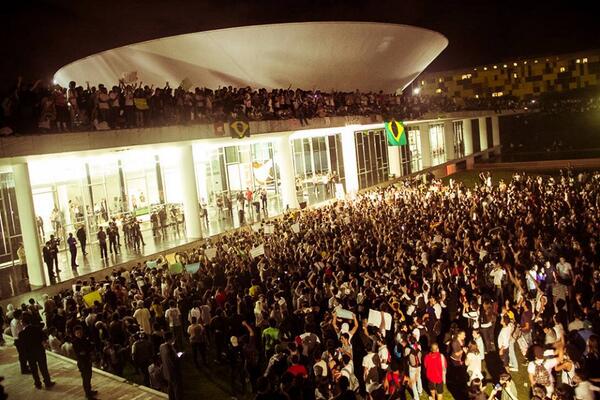
Protesters climb atop the capitol building in Brazil. #ChangeBrazil pic.twitter.com/Tb6CblQ5T0
Related articles
Constitutionally Illiterate Michael Bloomberg Doesn’t Want the DOJ Monitoring His Stop-and-Frisk “Military”
By Mike Riggs | Reason | June 14, 2013
In November 2011, New York Mayor Michael Bloomberg told an audience at MIT, “I don’t listen to Washington very much, which is something they’re not thrilled about.” He didn’t listen because he didn’t have to. “I have my own army in the NYPD, which is the seventh biggest army in the world,” Bloomberg bragged.
That boast–crude and alarming as it was–sort of just hung in the air, slowly losing its stench. Yesterday, Bloomberg revived it, this time while announcing that he didn’t want the Justice Department overseeing the NYPD in the event a federal judge deems stop-and-frisk unconstitutional.
The U.S. Department of Justice filed papers Wednesday saying that if a federal judge ruled the NYPD’s practices unconstitutional, then the DOJ would strongly endorse the use of a monitor to oversee changes at the department.
The mayor, however, said that the police department needs a clear line of authority. “No military organization or paramilitary runs where you have confusion in the command structure. You just cannot have that. Lives are on the line,” he said in a question-and-answer session with reporters.
Emphasis mine. The NYPD is not a “military organization” or an “army,” much less Bloomberg’s “own army.” Nor is the NYPD a “paramilitary organization”–that would require the department to change its core function to supporting an actual military. The NYPD is a police department. New York, New York is a city, not a sovereign nation. The 14th Amendment says Bloomberg and his police are required to respect the Fourth Amendment. This is basic stuff. You’d think Bloomberg would know it.
As for his claim that federal supervision of a police department that regularly violates the constitutional rights of New Yorkers “would create confusion in the command structure”? New York cops say there’s plenty of that already, thanks to their union working with commanding officers to create confusing and possibly illegal quotas for stopping, frisking, and arresting minority residents. In the event that a federal court deems stop-and-frisk unconstitutional, there will be that much more confusion at the NYPD. Bringing in an outside body–one tasked with making sure the department respects the constitutional rights of New Yorkers–would provide the department with a much needed moral compass.
The Most Contaminated Land in the Middle East
By Gilad Atzmon | June 17, 2013
Ynet reported today that Haifa District Court judge rules that there is no causal link between Kishon River’s pollution and the illness of more than 70 Israeli Navy seal divers, despite expert claims that ‘exposure to one molecule’ could lead to illness.
For more than 25 years, the Israeli elite Navy seals used to dive and train in the Kishon River in the Haifa Bay, apparently, the most polluted river in Israel. Authorities were warned about the lethal concentrations of cancerous substances in the river for years.
The Haifa District Court ruled Monday that there is no causal link between the pollution in the Kishon River and the illness of 70 former Navy commandos.
The divers’ suit was filed against the Haifa Municipality, Haifa Chemicals, oil refineries, and the Haifa Region Association of Towns, claiming they are responsible for the pollution and toxic waste in the river, including arsenic, nickel, chromium, cadmium, lead and benzene.
Seemingly it took 2000 years for the Jews to come back to their so-called ‘promised land’ but just a few years to pollute the rivers and contaminate the land.
An Insight Into Palestinian Resilience in Gaza
Cold Nights in an Indifferent World
By SARAH MARUSEK | CounterPunch | June 17, 2013
In the eyes of many Westerners, Gaza is a dangerous and war torn place. Even activists, including myself, often imagine Gaza primarily as a place of suffering, and one that has unfairly come to eclipse the affliction of all of Palestine. But while Israel’s wars of aggression against the people of Gaza, as well as its brutal siege, have cost many lives and inflicted countless casualties, Gaza today is a remarkably calm, protected and beautiful place where everyday lives go on, despite the continued suffering of its people. Indeed, Gaza is a place where the heart and soul flourish even if the body is ailing; where people and community are so alive and resilient that it rekindles one’s hope in humanity.
I only know this now because I traveled to Gaza earlier this month to participate in the second annual Global March to Jerusalem (GMJ) on Friday, 7th June 2013, when thousands of Palestinians and international activists mobilized in peaceful demonstrations around the world to draw attention to Israel’s continued violations against Jerusalem and its people. Although Israeli police violently suppressed GMJ demonstrations in Jerusalem and throughout the West Bank, peaceful mass demonstrations did successfully take place in Gaza and the neighboring countries of Jordan and Egypt, as well as in Tunisia, Mauritania, Morocco, Yemen, Malaysia, and Turkey. In addition, there were demonstrations in solidarity with the GMJ all around the world, including several major cities across Europe and North America.
On Friday, 7th June I was fortunate enough to join Palestinians and a group of international activists in a peaceful mass rally in Beit Hanoun, the nearest point possible to Jerusalem in Gaza. Many thousands attended the rally, and during my address I promised to carry their voices back home with me to the US in order to communicate their struggle to live under the footprint of a racist occupying power that my government funds and arms. Of course, the few days I spent in Gaza are hardly enough to fulfill this promise. There are too many voices that I was not able to hear, both because there was not enough time and because of my identity as an American woman. But I am hoping that what I can offer begins to communicate the complex life stories of a people resisting against horrific injustices, while at the same time encouraging other Westerners to travel to Gaza in order to do the same.
My entry into Gaza was made possible by the Miles of Smiles convoy organized by the International Committee for Breaking the Siege on Gaza (ICBSG). While there have been many international convoys entering Gaza in recent years, all of which bring much needed aid to the besieged people of Gaza, the Miles of Smiles convoy offers something unique by focusing on development aid. The first Miles of Smiles convoy reached Gaza in November 2009, and since then the ICBSG has successfully organized twenty additional convoys into Gaza. Our convoy included activists from Jordan, Egypt, Tunisia, Libya, Yemen, Saudi Arabia, Bahrain, Malaysia, South Africa, the UK, and the USA.
Miles of Smiles works closely with Partners for Peace and Development for Palestinians (PPDP) to sponsor projects that empower Palestinians to develop the means to live dignified lives on their own terms. The PPDP is a UK-based organization that works with a dedicated team of Palestinian employees and volunteers in Gaza to offer interest-free loans and small grants to Palestinians, helping them to establish family businesses and development projects. One example of this is a small bakery that we visited during the first night we spent in Gaza, which thanks to a PPDP loan generates employment for an entire family.
PPDP’s Palestinian employees and volunteers in Gaza coordinated our program, which included many different activities that allowed us access to a diverse array of Palestinian voices and experiences. For example, our second day in Gaza we met with the children and spouses of Palestinians who are currently imprisoned by the occupation authorities, often without any formal charges ever being brought against them. And even when Palestinians are tried, it is in military courts – an apartheid system of justice that separates Palestinian children from their fathers, mothers, brothers, and sisters.
Earlier that day we also visited a government hospital that specializes in caring for children. We asked one of the doctors there what the needs of the hospital are, and his answer was a lack of resources – a problem that more international activists could easily help alleviate if the US and Europe did not impose such draconian penalties for working with Hamas, the ruling party of the government in Gaza that Israel and its Western allies label as a terrorist organization because of its resistance activities against the occupation. The doctor explained to us that they have many doctors, in fact too many to employ. Even during Israel’s recent war against Gaza in November of last year they had a sea of volunteers to help. However the hospital still needed equipment and medication to meet the needs of their patients. Indeed according to the human rights organization B’Tselem, Israeli forces killed 167 Palestinians during last November’s military operation, at least 87 of them civilians and more than one third under the age of 18. As we visited some of the sick children I felt so helpless and angry because as an American I am unable to contribute anything to the important work of this hospital, which saves innocent children’s lives. Fortunately, those in Arab countries are able to donate without fear of prosecution, and their contributions help keep the hospital running.
On our fourth day we visited Islamic University, the best university in Gaza (there are seven in total) and ranked among the top 250 universities around the world. Founded in 1978, the university’s campus is modern and beautiful, servicing around 20,000 students each year. The university offers many degrees across the arts and sciences, with Islamic values guiding the behavior of the students as well as the curriculum, which is in line with international scientific standards. But even this university has suffered unjustly under the occupation. During Israel’s December 2008 war against Gaza, occupation forces destroyed 74 of the university’s laboratories, as well as a library, a collective punishment against the entire population. Lest anybody think that this was collateral damage, Israel deliberately bombed the university in six separate air strikes. When I think of violent acts that would terrorize me as a teacher and a scholar, this ranks among the worst. And yet this terrorism is exactly what my government is uncritically supporting.
During our time in Gaza, we also met with Prime Minister Ismael Haniyeh, and distributed aid to orphans as well as to needy families thanks to the generosity of our Libyan delegation (as well as my own friends and colleagues who kindly donated money so that I could distribute toys to children). But most of us will never really know what it is like to live under a violent occupation. What it is like to be cruelly besieged by your neighbor and demonized by Western countries for fighting back. We spoke to some graduates of Islamic University who are involved in the Gaza student community, to try and learn more about their own experiences.
One member of the convoy, an American filmmaker of Pakistani origin, remarked how surprising it was that the Palestinians working with us were not more angry. One young man responded that, in fact, they are very angry, but that they still have to live. He explained that he holds his pain and suffering deep inside himself, as do other Palestinians in Gaza. It has to be contained for fear that if expressed it could destroy their lives. And even though he spoke these words calmly and quietly, the inner anguish distorted his face and the grief filled his wide eyes. He told us that he lost seven friends in the last war against his people. On his way to sit his university exams he also saw bombs destroy the buildings around him. His exams were postponed. But what really made the suffering intolerable was getting through the cold nights during that war.
I can only conclude that this coldness is symbolic of a world where an occupying power can terrorize and ethnically cleanse a native population with impunity. Because if there were any warmth left in our hearts, then we would all be doing everything that we possibly could do to stop Israel’s crimes against the Palestinian people. Convoys like Miles for Smiles help, as do solidarity activities like the GMJ, but considering the extent of their suffering, the Palestinians deserve more from all of us.
Sarah Marusek is a member of the International Executive Committee of the Global March to Jerusalem.
Related articles
- Palestinian farmer injured by Israeli army fire (alethonews.wordpress.com)
- Mass protest aims to focus attention on Jerusalem (palsolidarity.org)
Palestinian farmer injured by Israeli army fire
By Rosa Schiano | International Solidarity Movement | June 17, 2013
Gaza, Occupied Palestine – Friday afternoon, June 14, 2013, Muhareb Abu Omar, a Palestinian farmer aged 48, was wounded by Israeli army fire in the Deir El Balah, in the center of the Gaza Strip.
Omar was irrigating his land in the village of Wadi As-Salqa, 600 meters from the barrier that separates Israel from the Gaza Strip.
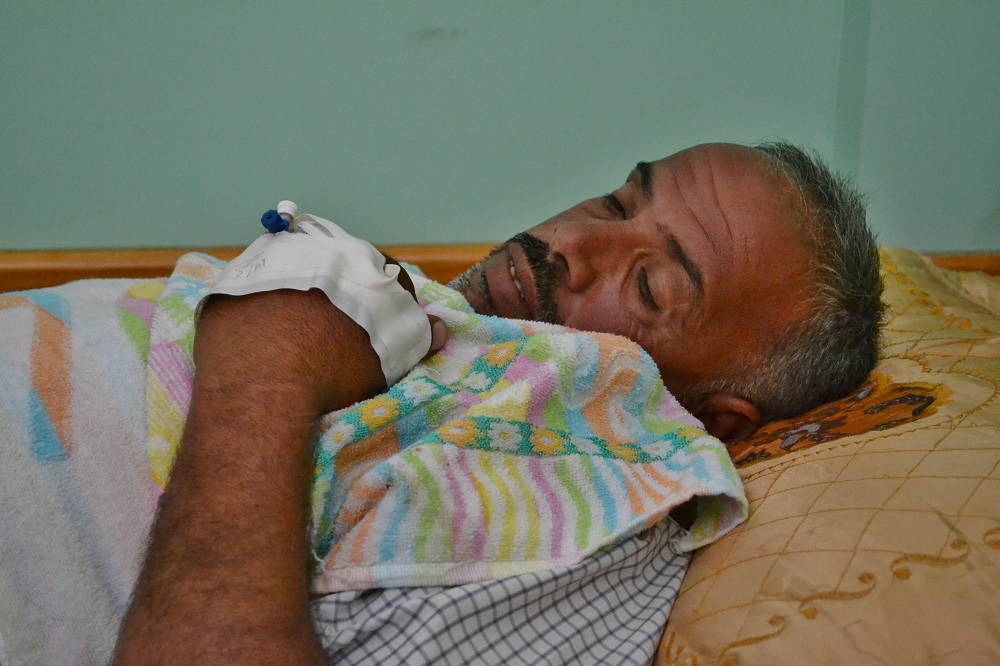
Muhareb Abu Omar, 48 (Photo: Rosa Schiano)
Omar reported that Israeli jeeps moved along the border while he was working. Suddenly, after about 10 minutes into the job, at approximately 19:30, a bullet struck him in the right leg. The soldiers probably shot from a jeep hummer.
Omar was alone on his land while other farmers were working in adjacent lands.
“I didn’t hear any firing, the soldiers used silent bullets. Suddenly I found myself wounded. I ran for 50 yards, then I crashed and I cried to my cousins that I was wounded”, said Omar. His cousins transported him to Al Aqsa Martyrs hospital.
Omar’s family is composed of 14 members: Omar, his wife, 8 sons and 4 daughters. Five of his sons work with him on the family land. The whole family depends on the production on this land.
Two of his sons, Nedal and Tareq, reported that Omar was reported to have an intermediate wound in the right tibia.
Dr. Saleman Al Attar, Department of Orthopaedics of Aqsa Martyrs hospital, reported that the general conditions of Omar are good. “The wound shot from a firearm always creates complications. The bullet hit the right thigh and there is the presence of fragments”, said Dr. Al Attar. In the emergency room, the doctors performed a cleansing of the wound, firstly a debridement followed by bandaging. After 3 days or 72 hours, Omar will be subjected to a further removal of devitalized tissue.
The doctors will not remove the bullet. “It is dangerous to remove the bullet as it is located in the neurovascular, where there are the arteries,” said Dr. Al Attar.
The wound is closed. The patient will then be given antibiotics and analgesics for about 4 weeks.
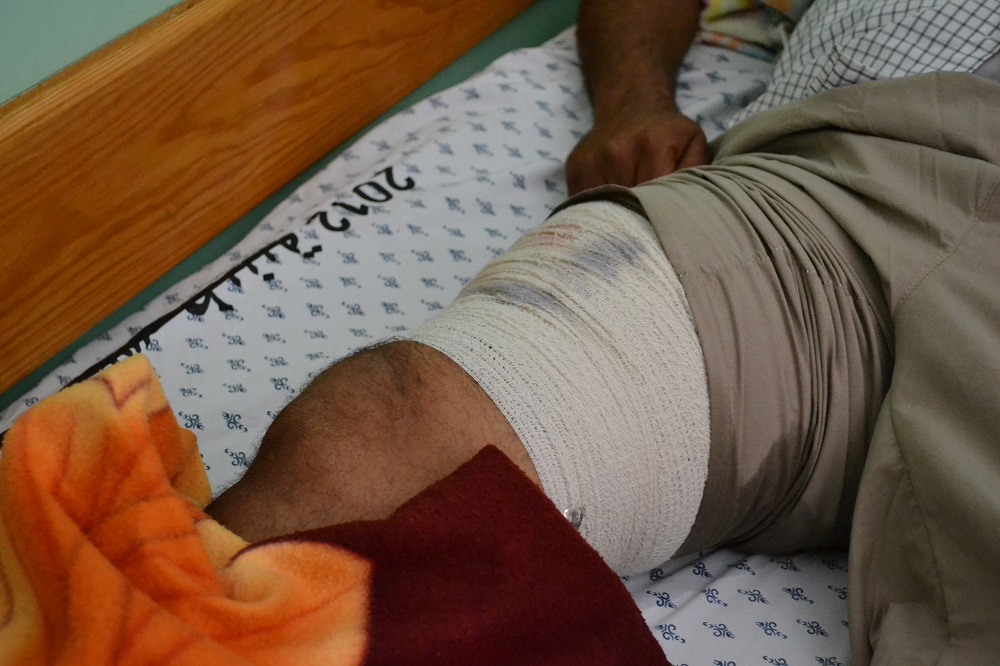
(Photo by Rosa Schiano)
Dr. Al Attar stressed the psychological effect on patients who are aware of the a bullet still inside the body. “The patient will always have the impression of experiencing pain in the area where the bullet is, even if the pain is not real. There are social workers who can provide psychological support for this. Every Palestinian suffering since birth suffers some psychological problems”, concluded Dr. Al Attar.
During the last military offensive of November 2012, the al-Aqsa hospital has received many victims. “The hospital was full, we were trying to save those who were in better condition while others were dying patients in serious condition,” said Dr. Al Attar.
The arrangements for the cease-fire of 21 November 2012 established that the Israeli military forces should “refrain from hitting residents in areas along the border” and “cease hostilities in the Gaza Strip by land, by sea and by air, including raids and targeted killings.”
However, Israeli military attacks by land and sea have followed from the day after the ceasefire, and Israeli warplanes are flying over the sky constantly in the Gaza Strip. These attacks against the civilian population of Gaza continue to occur amidst international silence.
Israeli man assaults 2 Palestinian women in Jerusalem
Ma’an – 17/06/2013
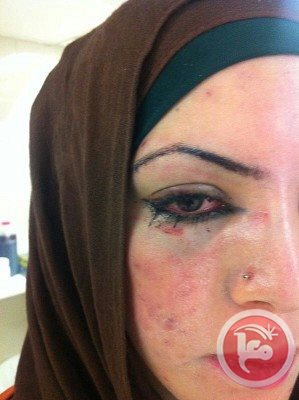 JERUSALEM – Two Palestinian women are pressing charges against an Israeli man after being assaulted in Jerusalem on Friday.
Layali al-Sayyad, 23, and Anwar Abu Rmooz, 21, told Ma’an that they were attacked by an Israeli man in his twenties while buying a ticket for the Jerusalem Light Rail near the central bus station in West Jerusalem.
The man reportedly asked the women in both Arabic and Hebrew whether he could help them, before swearing at them and punching al-Sayyad in the face, causing her to pass out.
The man then attacked Abu Rmooz and assaulted a member of the light rail security staff before Israeli police arrived at the scene and arrested him, al-Sayyad said.
Both women, who are from the al-Tur neighborhood, suffered a broken nose and bruising to their eyes and face.
An Israeli police spokesperson could not be reached for comment.
In February, a group of Jewish women attacked a Palestinian woman while she was waiting at a light rail station in Jerusalem, beating her severely.
The women asked if she was Arab before spitting on her and physically attacking her.
Weeks later, a group of Jewish youths in Tel Aviv assaulted a Palestinian cleaner after asking whether he was Arab. A co-worker of the man said it was a “lynching, plain and simple,” according to Israeli media.
Related article
- Settlers burn 300 olive trees near Nablus, Israeli army obstructs firefighters (occupiedpalestine.wordpress.com)
Brazilian police clash with Confederations Cup protesters
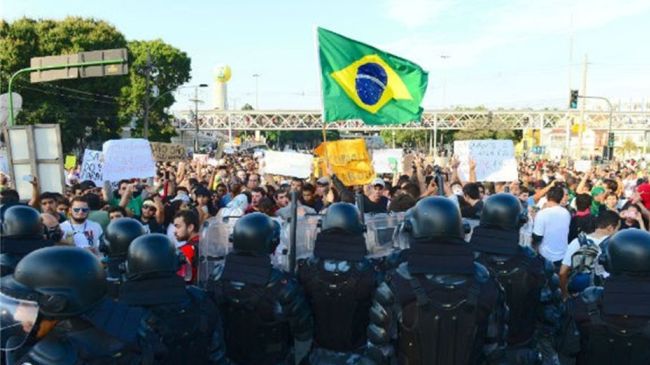
Brazilian police block protesters from entering Maracana soccer stadium in Rio on June 16, 2013
Press TV – June 17, 2013
Brazilian police have fired tear gas and rubber bullets to disperse a crowd of about 3,000 people protesting outside Rio de Janeiro’s Maracana stadium before a Confederation Cup soccer game.
The rally took place on Sunday in protest against the vast sums of public money spent on the organization of the tournament.
The protesters also opposed the huge cost of preparations to host next year’s World Cup, which is expected to reach USD 15 billion (about 11 billion euros).
“I don’t care about the World Cup – I want health and education!” shouted the protesters.
Initially, police stood in line as a barricade outside of the stadium.
However, as the crowd of protesters tried to pass the blockade riot police charged towards the group.
On June 15, police clashed with protesters in a similar demonstration during the opening of the Confederations Cup in the capital, Brasilia.
The clashes ended with 39 people injured after police fired tear gas and rubber bullets to disperse the crowd.
Related articles
Turkish Unions Protest Erdogan Crackdown, Announce Strike
Al-Manar | June 17, 2013
Two of Turkey’s main trade unions started a nationwide strike on Monday after police cleared protests from Istanbul protest park.
The KESK and DISK trade unions, who together represent hundreds of thousands of workers, called a one-day stoppage to object to the police violence against anti-government protesters, and said they planned to hold demos in the late afternoon.
“Our demand is for police violence to end immediately,” KESK spokesman Baki Cinar told AFP, adding that the unions would be joined by striking engineers, dentists and doctors.
Turkish Interior Minister Muammer Guler condemned the stoppage as “illegal” and warned strikers not to take to the streets, as Prime Minister Recep Tayyip Erdogan defended his crackdown on Gezi Park, the epicenter of the protest movement.
Riot police were still firing volleys of tear gas and water at pockets of demonstrators in Istanbul and the capital Ankara early on Monday, after a weekend of clashes sparked by the eviction of protesters occupying Gezi Park.
Nearly 600 people were arrested in the scuffles on Sunday alone, according to the Ankara and Istanbul bar associations.
The weekend violence has intensified a crisis that poses the biggest challenge yet to Erdogan’s decade-long rule.
At a rally of more than 100,000 supporters of his ruling Justice and Development Party (AKP) on Sunday, the premier insisted it was his “duty” to order police to storm Gezi Park after protesters defied his warnings to clear out.
“I said we were at an end. That it was unbearable. Yesterday the operation was carried out and it was cleaned up,” a combative Erdogan told a sea of flag-waving loyalists. “It was my duty as prime minister.”
Erdogan’s words were met with roaring approval from the audience, the largest crowd to assemble since the crisis began. Many chanted: “The people are here, where are the looters?”, using Erdogan’s description of the demonstrators.
At the same time, riot police were fighting running battles with thousands of protesters determined to regroup after being ousted from Gezi Park and the adjoining Taksim Square, a mere 10 kilometers (six miles) away from the AKP rally.
Turkey’s political turmoil first began when a peaceful sit-in to save Gezi Park’s 600 trees from being razed prompted a brutal police response on May 31, spiralling into countrywide demonstrations against Erdogan.
The crisis has claimed four lives and injured nearly 7,500 people so far, according to the Turkish Medical Association.
Featured Video
The First Pyrrhic Victory of the Vietnam War
or go to
Aletho News Archives – Video-Images
Frlom the Archives
The 52 Major Jewish American Organizations and Israel Celebrate Passover with the Slaughter of 25 Muslim, Christian and Secular Palestinians
By James Petras • Unz Review • April 8, 2018
Introduction
As of April 7, nearly three thousand unarmed Christian, Muslim and secular Palestinians have been wounded, over three dozen are in critical condition and at least twenty-five unarmed protestors, including children have been assassinated by hundreds of Israeli snipers and heavily armed troops shooting tank shells into crowds of civilians protesting their decades of incarceration by the racist Israeli state.
The Israeli government praised the ‘restraint and morality’ of the IDF, as did the fifty-two Major Jewish American Organizations (MJAO) who largely control the US Congress. These grotesque massacres began during the Christian Holy Week on Good Friday and Easter, coinciding with the Jewish Passover. The self-righteous officials of the MJAO and their relatives and friends broke matzos at joyful Seders as the blood of Palestinians soaked into ground at the fence containing the largest open-air prison camp in history, Gaza.
While tribal loyalties bonded the Israeli and Jewish American leaders, the politicians of the Western oligarchic electoral regimes refrained from criticizing the shocking display of brute force and even defended Israel’s cold blood mass killings of Palestinian civilians in their Gaza prison.
This paper will discuss and analyze the reasons for Israel’s willing Western accomplices and the centrality of its fifth column in the United States. … continue
Blog Roll
 Aletho News
- Unpacking glaring contradictions in US-Zionist justifications for war against Iran
- Iranian model of warfare bleeds US dry while Persian Gulf states watch and learn: Analyst
- IRGC orders ‘defeated’ US to evacuate industrial facilities in region
- Hegseth’s call for ‘no mercy’ to Iranians deemed war crime
- Iran War Exposes Limits of US Military Power – Journalist
- Even The Neo-Cons Admit The Iran War Is Failing
- Inside the Caucasus Drone Corridor Fueling Tensions With Iran
- ‘Not our war’: Trump’s naval coalition to reopen Strait of Hormuz dead in the water
- Iran declares support centers for USS Gerald R. Ford legitimate targets
- Moscow issues warning over Trump’s Golden Dome plan
- If Americans Knew
- ‘I Liked the House’: When Israeli Soldiers Turn Palestinian Homes into Barracks
- ‘They Were All I Had’: Lebanese Father Buries Parents, 4 Daughters Killed by Israeli Bombing
- Israel and its supporters are causing attacks on Jewish institutions. Case in point: Michigan synagogue tragedy.
- These are the casualties and cost of the war in Iran 2 weeks into the conflict
- Chicago Teachers Union accuses AIPAC of swaying elections with ‘dark money’
- Predictions of another 9/11, amid Israel-US killing spree – Not a ceasefire Day 157
- As US-Israel war on Iran rages, Gaza faces massive dust storm – Not a ceasefire Day 156
- No let-up in attacks on Gaza as Israel takes on Iran, Lebanon – Not a ceasefire Day 155
- ‘Of Course’: IDF Drops Case Against Soldiers Accused of Raping Palestinian Prisoner
- Don’t Fall for the Regime Change Talk. Israel Is ‘Mowing the Lawn’ in Iran
- No Tricks Zone
- Storing Green Energy To Last Germany 10 Days Would Require A 60-Million Tonne Battery
- New Studies: UK Sea Levels Were 4 Meters Higher Than Today During The Mid-Holocene
- Destructive Green New Deal: German Energy And Metal Group Warns Of Drastic Crisis
- New Study Documents A 20-Year Pause In Arctic Sea Ice Decline – Driven By Internal Variability
- Wake-up Call: Survey Shows Majority Of Germans Now Favor Postponing Climate Targets!
- Televised! Leading German Political Candidate Tells Schoolchildren CO2 Makes Sun Hotter!
- New Study: A Century Warming Of 1.1°C Is ‘Commonplace’ And ‘Not Unusual’ During This Interglacial
- New Study: ‘Internal Noise’ And Volcanic Forcing Can Trigger 10-15°C Warming Within Decades
- Glaciers Worldwide Are Suddendly Surging, Experts Blame Warming!
- Surprising Discovery: Sahara Is Greening…Billions Of Trees Where Once Thought To Be Barren
 Aletho News