Obama Visits Mandela’s Old Cell, But Won’t Free His Own Political Prisoners
A Black Agenda Radio commentary by Glen Ford | July 3, 2013
President Barack Obama, a man of infinite cynicism, made a great show of going on pilgrimage to Nelson Mandela’s old prison cell on Robben Island, where the future first Black president of South Africa spent 18 of his 27 years of incarceration. With his wife and daughters in tow, Obama said he was “humbled to stand where men of such courage faced down injustice and refused to yield…. No shackles or cells can match the strength of the human spirit,” said the chief executive of the unchallenged superpower of mass incarceration, a nation whose population comprises only 5 percent of humanity, but is home to fully one-quarter of the Earth’s prison inmates.
True sociopaths, like the commander-in-chief who updates his Kill List every Tuesday, have no sense of shame, much less irony. Obama feigns awe at Mandela’s suffering and sacrifice in the prisons of apartheid South Africa, yet presides over a regime that, on any given day, holds 80,000 inmates in the excruciating torture of solitary confinement. During Nelson Mandela’s nearly three decades of imprisonment by the white regime, he spent a total of only about one week in solitary confinement. The rest of the time, despite often harsh treatment, backbreaking labor, and unhealthy conditions, Mandela and other political prisoners at Robben Island and other South African jails were typically housed together. Indeed, Mandela and his incarcerated comrades called the prisons their “university,” where they taught each other to become the future authorities over their jailers.
Racist South Africa’s treatment of Mandela and his co-revolutionists was downright benign and enlightened, compared to fate of U.S. prisoners who are deemed a threat to the prevailing order. At U.S. high security facilities, the slightest evidence that an inmate is of a political bent of mind is cause for him to be condemned to a solitary existence for decades – a social death alien to the human species. At California’s Pelican Bay and the state prison at Corcoran, thousands of inmates are held in isolation, 80 of them for more than 20 years, the very definition of barbarism. Yet, Obama journeys across oceans and continents to stand for a photo op in the cell of a prisoner whose ordeal was nowhere near as horrific as the standard fare for political prisoners in his own country.
On his trip to South Africa, Obama proclaimed that “the world is grateful for the heroes of Robben Island.” And, that’s certainly true, although it was a U.S. intelligence agent who lured Nelson Mandela into a trap in 1962 that ultimately led to his capture and imprisonment. Obama has no sympathy, however, for political prisoners of any race in his own country. Former Black Panther Herman Wallace is thought to be the longest-serving prisoner in solitary confinement in the United States, having spent 40 years alone in a cell in Louisiana’s notorious Angola Prison. Obama could free him at any time, but of course, he won’t. He could emancipate Black Panther captive Russell Maroon Shoatz, who has spent nearly 30 years in solitary, or Republic of New Africa political prisoner Mutulu Shakur or any and all of the scores of other aging political prisoners – people whose dedication to human freedom is no less than Mandela’s, yet have been subjected to far worse treatment at American hands. Instead, Obama has doubled the bounty on Shakur’s comrade and sister, Assata, in exile in Cuba. She might even be on Obama’s Kill List – which is the real and authentic legacy of this country’s First Black President.
Glen Ford can be contacted at Glen.Ford@BlackAgendaReport.com.
Related article
- Obama Falsely Asserts He Is Mandela Follower (alethonews.wordpress.com)
‘Restore the Fourth’: Reddit, Mozilla, thousands of people set for July 4 NSA spying protest
RT | July 3, 2013
Thousands of websites will launch a July 4 online protest against the NSA surveillance programs. Reddit, WordPress, and Mozilla will take part in the ‘Restore the Fourth’ campaign online, while live protests take place in cities across the US.
‘Restore the Fourth’ is aimed at restoring the fundamentals of the Fourth Amendment – the part of the Bill of Rights which protects citizens against unlawful searches and seizures. Participants will display an online banner which reads, “This 4th of July, we stand by the 4th Amendment and against the U.S. government’s surveillance of internet users.”
The campaign, which was spawned on Reddit, has the support of several privacy and press freedom advocacy organizations, including Mozilla, Free Press, the Electronic Frontier Foundation, the Freedom of the Press Foundation, and ColorOfChange.org.
The rally was largely organized by Fight for the Future – another non-profit agency which fights against internet censorship. The organization’s co-founder, Tiffiniy Cheng, said in a statement that “the NSA programs that have been exposed are blatantly unconstitutional, and have a detrimental effect on free speech and freedom of press worldwide.” The rally is expected to be Fight for the Future’s largest online mobilization since its actions against the Stop Online Piracy Act (SOPA).
But the protest doesn’t stop online. Organizers are planning live protests in dozens of US cities, including New York, Philadelphia, Boston, Washington, D.C., Los Angeles, San Francisco, Houston, and Atlanta. Doug MacArthur, a member of Restore the Fourth’s national board and moderator on Reddit’s r/news, expects between 10,000 and 20,000 people to take part in the protests in the nation’s larger cities.
MacArthur stressed the need for the protest, largely because mainstream media is failing to adequately cover the NSA leaks and what that means for everyday citizens.
“I think if you are on social media right now and political blogs, this might seem like it’s an issue that’s all over the political blogs. But if you turn on CNN or Fox or MSNBC, you’ll see that a lot of the more mainstream channels aren’t covering this as much as you might be assuming. So I really think it’s important we get more citizens aware of this issue,” he said, as quoted by Mashable.
Free Press CEO and President Craig Aaron echoed MacArthur’s sentiments. “We need to bring these government and corporate activities into the light of day, and the only way that will happen is if millions more people get involved and demand accountability, demand change, demand the truth,” he said in a Tuesday press conference.
However, it’s not just internet activists getting involved in the fight – one Hollywood celebrity has been very vocal in expressing his views on the NSA’s surveillance practices.
“How long do we expect rational people to accept using terrorism to justify and excuse endless executive and state power?” actor John Cusack said during a press conference announcing the protests. “Why are so many in our government, our press, our intellectual class afraid of an informed public?”
Cusack, who is a board member of the Freedom of the Press Foundation, complained that many of those defending the NSA surveillance programs are focusing on supposed character flaws of former NSA contractor Edward Snowden instead of questioning the program’s legality.
Harvey Anderson, senior vice president of business and legal affairs at Mozilla, agrees with Cusack. He said in a statement that the spotlight on Snowden is a “big distraction to avoid focusing on the invasions that have actually been occurring.” The lack of transparency about the surveillance programs “undermines the openness of the internet,” he added.
There has been a massive outcry against the surveillance practices since former NSA contractor Edward Snowden leaked sensitive information in May. In just three weeks, StopWatching.us has collected more than 531,000 signatures from people calling for Congress to fully disclose details about the NSA surveillance programs.
Snowden is currently held up in the international transit zone of Moscow’s Sheremetyevo airport. He is unable to travel as his passport is invalid. Washington has issued an extradition order against Snowden, calling for international cooperation in returning him to American soil.
The whistleblower has so far made asylum requests for more than a dozen countries, with ten nations already denying him refuge. Venezuela says it will consider Snowden’s request when it is received.
Related article
Who Is An Objective Journalist?
By Ann Robertson and Bill Leumer | Worker’s Compass | July 2, 2013
In a recent New York Times article article David Carr questioned whether someone could be both a journalist and an activist, a question that was prompted by the role of Glenn Greenwald, a writer for The Guardian and a political activist, in reporting on Edward Snowden’s National Security Agency leaks.
As Carr put it, “The question of who is a journalist and who is an activist and whether they can be one and the same continues to roar along, most recently in the instance of Glenn Greenwald’s reporting for The Guardian on the secrets revealed by Edward J. Snowden.” Carr also framed the question as “a fight between objectivity and subjectivity.”
Carr initially seemed to concede that one and the same person could be both an activist and a journalist, even though the activists are “driven by an agenda.” In fact, the title of his article conveyed exactly that point: “Journalism, Even When It’s Tilted.” And, as Carr noted, this is an important concession since journalists are afforded special legal protections in the case of reporting leaks. Mr. Greenwald needs this protection because there are some government officials who would like to see him prosecuted.
However, towards the end of his article Carr began to raise caveats. Activism, he concluded, does not prevent someone from being a journalist; it rather tends to make them bad journalists: “But I think activism – which is admittedly accompanied by the kind of determination that can prompt discovery – can also impair vision.” And he added: “…the tendentiousness of ideology creates its own narrative.” In other words, activism can on rare occasions be helpful in unearthing the truth, but usually it is a barrier.
But perhaps Mr. Carr has failed to grasp the larger picture, possibly due to his own unspoken commitments. Everyone falls into one of two categories. There are those who basically have resigned themselves to established society, perhaps because of ideological compatibility, a strong strain of pragmatism, or a conviction that attempts to change society are entirely futile. Then there are others who are critical and are prepared to embark on a campaign to try to change what they find objectionable. Neither of these groups has a monopoly on objectivity; both positions rest on a set of fundamental values that can be rationally supported. And both involve a kind of activism: one aims at changing society while the other aims at refraining from changing it.
Yet there is a superficial difference between the two: those who want to change society do stand out. Unlike Mr. Carr, they do not seamlessly blend in with the surrounding social institutions and the values embodied in them. Accordingly, they might seem as if they have an agenda that uniquely distinguishes them, but that is only from the perspective of people like Mr. Carr, whose agenda ties him to the status quo but who has not sufficiently reflected on his own social commitments and therefore is unable to acknowledge them. No one, in other words, is exempt from having an “agenda.”
This point was graphically illustrated when “Meet the Press” host David Gregory pointedly asked Greenwald why he should not be charged with a crime for divulging Edward Snowden’s leaks. Here Gregory stood smugly on the side of those who wield power and was quick to demonstrate this point by his tendentious question, perhaps with the thought in mind of winning a promotion, which is a rampant form of another kind of activism.
To his credit, Carr elicited Greenwald’s response to the counterposing of activism and journalism, and this was Greenwald’s response: “It is not a matter of being an activist or a journalist; it’s a false dichotomy. It is a matter of being honest or dishonest. All activists are not journalists, but all real journalists are activists. Journalism has a value, a purpose – to serve as a check on power.” And Greenwald added: “I have seen all sorts of so-called objective journalists who have all kinds of assumptions in every sentence they write. Rather than serve as an adversary of government, they want to bolster the credibility of those in power. That is a classic case of a certain kind of activism.”
Greenwald’s rejection of the purported dichotomy between activism and journalism is, of course, entirely correct. Everyone is an activist of one kind or another. The distinction should rather be drawn between those who are conscious activists and those who, like Mr. Carr and Mr. Gregory, are unconscious activists. Those who fail to reflect on their own commitments are sometimes the most vicious.
Ann Robertson and Bill Leumer may be reached at sanfrancisco@workerscompass.org
Turkish court cancels plan to redevelop Istanbul’s Taksim Square
Press TV – July 3, 2013
A Turkish court has blocked a redevelopment project for Istanbul’s Taksim Square after the country was rocked by four weeks of anti-government protests.
The court ruling is seen as a big blow to Prime Minister Recep Tayyip Erdogan, who had strongly backed the project, but is also seen as a victory for the opposition that has been staging nationwide rallies against it.
Istanbul has been the epicenter of anti-government demonstrations since May 31, when the police broke up a sit-in staged at Taksim Square to protest against the redevelopment plan which involved the demolition of Gezi Park.
The Turkish protesters said Gezi Park, which is a traditional gathering point for rallies and demonstrations as well as a popular tourist destination, is one of Istanbul’s last public green spaces.
The protests soon spread to other cities across the country and turned into calls for the resignation of the Turkish prime minister.
Several people have been killed in the violent crackdown on peaceful protesters, who Erdogan has described as foreign-backed extremists and terrorists.
Last week, Turkish artists, journalists, and authors placed full-page advertisements in several newspapers, asking Erdogan to stop using divisive language.
On June 24, Erdogan praised the “legendary heroism” of police forces in quelling anti-government protests.
The Turkish prime minister has faced international condemnation for his handling of the crisis. Turkish police have been also strongly criticized for using excessive force against the peaceful protests.
Related article
- Turkey will consider protesters staying at Taksim terrorists, official says (alethonews.wordpress.com)
The Evolving Story of the Death of Father Murad
By Richard Edmondson | War and Peace | July 3, 2013
Conflicting news reports have been coming out on the death of Father Francois Murad. Initially it was reported by a number of sources, including a press release from the Vatican, that the priest had been beheaded. Today, however, reports are saying that no, this was incorrect, that he was only shot dead, and that the video purporting to show his beheading was an old video. Here is how The Telegraph is reporting the matter:
The footage, said to show Father Francois Murad, 49, as the victim in a brutal summary execution by foreign jihadists is likely to be an older video that bares no relation to the death of the Catholic priest.
Father Murad “died when he was shot inside his church” in the northern Syrian Christian village of Ghassaniyeh on June 23, three separate local sources, who did not wish to be named, told the Telegraph.
Claims that Father Murad was one of two men to be decapitated by a foreign jihadist group went viral, with outrage expressed in blogs and articles worldwide.
The story goes on to describe the contents of the video, noting that it is “too grainy to be able to confirm the identity of either of the victims as Father Francois,” while offering quotes of clarification from Human Rights Watch as well as Holy Land Custos Pierbattista Pizzabala. The latter is quoted as saying, “Islamists attacked the monastery, ransacking it and destroying everything. When Father Francois tried to resist, defending the nuns, rebels shot him.”
According to the HRW spokesperson, the video “looks like it may have been filmed” several months ago, well before Murad’s death, and that the confusion may have arisen due to its appearance “around the same time that the news came out that Father Francois had been killed.”
All of this quite naturally raises some questions. Descriptions of the video, found at both LiveLeak and YouTube, specifically said the two men shown being beheaded were Christians and that Murad was one of them. Who made this video available to the public and what was their motive?
The conflict in Syria is becoming more and more like a house of mirrors—something noted in a report by journalist Patrick Cockburn published Sunday in The Independent and headlined, “Foreign Media Portrayals of the Conflict in Syria are Dangerously Inaccurate.” Cockburn writes:
Every time I come to Syria I am struck by how different the situation is on the ground from the way it is pictured in the outside world. The foreign media reporting of the Syrian conflict is surely as inaccurate and misleading as anything we have seen since the start of the First World War. I can’t think of any other war or crisis I have covered in which propagandistic, biased or second-hand sources have been so readily accepted by journalists as providers of objective facts.
Slogans replace policies: the rebels are pictured as white hats and the government supporters as black hats; given more weapons, the opposition can supposedly win a decisive victory; put under enough military pressure, President Bashar al-Assad will agree to negotiations for which a pre-condition is capitulation by his side in the conflict. One of the many drawbacks of the demonising rhetoric indulged in by the incoming US National Security Adviser Susan Rice, and William Hague, is that it rules out serious negotiations and compromise with the powers-that-be in Damascus. And since Assad controls most of Syria, Rice and Hague have devised a recipe for endless war while pretending humanitarian concern for the Syrian people.
In the midst of all this confusion and pretense over humanitarian concerns comes a report from the Hudson Institute highlighting the horrendous toll the conflict has taken on Syria’s Christian population. The report documents, among other things, deaths of priests, though here again there is some suspicious timing. On June 25, two days after the murder of Father Murad, a pair of congressional subcommittees held a joint hearing on the issue of “Religious Minorities in Syria: Caught in the Middle.” This is the subject of the Hudson Institute’s report, or more specifically the report focuses on the testimony given at the hearing by one of the institute’s chief researchers on the plight of Syria’s Christians.
Such a report becomes all the more remarkable when you consider that the Hudson Institute basically could be thought of as a neocon think tank. Its senior vice president is Lewis “Scooter” Libby, while Douglas Feith is listed as a senior fellow. Is there not something strange about a report documenting rebel atrocities against Syrian Christians being released by such an organization? Doesn’t Israel want to see Assad overthrown, and haven’t the Zionist media been feeding us the spin of the rebels, as Cockburn puts it, wearing the “white hats”? What gives?
I’ll have more on this report in an upcoming post, hopefully in a day or two.
Related articles
- Catholic Online Muddles Story of Priest’s Beheading (alethonews.wordpress.com)
- Vatican confirms horror beheading of Catholic priest by Syrian rebels (independent.ie)
Bolivia’s Morales Dissed and Pissed as France, Portugal, and Austria Violate Diplomatic Immunity
By Dave Lindorff | This Can’t Be Happening | July 3, 2013
Those of us who have been saying that the US has become a weak, or at least more ordinary power among many in the world because of its military failures in Iraq and Afghanistan, and because of its economic decline, will have to recalibrate our analysis after watching the pathetic behavior of the leaders of Russia, Germany and France under pressure from the Obama administration not to allow Edward Snowden to gain asylum in those countries or even to escape his purgatory in Moscow’s Sheremetyevo Airport.
Last night, in an astonishing display of fawning obedience to the demands of US leaders, France and Germany first announced that they would not grant asylum to Snowden, despite broad popular support by French and German people for such an offer of aid to the embattled whistleblower. Then, France and Portugal abruptly refused to allow a Bolivian aircraft carrying the country’s president, Evo Morales, from a state visit with Russia’s Vladimir Putin, to land for refueling in their countries, saying that they were concerned he might be flying Snowden to asylum in Bolivia.
Although Spain said eventually it would allow the Morales plane to refuel in the Canary Islands, it did not have enough fuel to get there and had to be diverted to Vienna, where, astonishingly, it was then searched like a drug-smuggling flight over Bolivian protests. Snowden was not aboard. A furious Morales immediately blamed the US Department of State for the whole incident — a charge that no one has disputed, though of course the US is refusing to comment.
Aircraft carrying national leaders have absolute diplomatic immunity under international law and moreover, Bolivia would have the absolute right to grant Snowden amnesty, and to bring him to its territory, whether or not he had a valid passport. As the leader of a sovereign nation, Morales has every right to carry anyone he wants on his plane with him back to his country.
Bolivian President Evo Morales, forced under US pressure to land in Vienna to have his returning plane searched for Snowden, calls the blocking of his flight from Russia to Bolivia a “kidnapping,” and “act of aggression” and an “offense against all the whole Latin region.”
That France, Portugal and Austria would so violate such basic diplomatic rules suggests that the US (which of course has long demonstrated that it views diplomatic rules and international law as applying only to others, but not itself) has some powerful leverage to exert behind the scenes. The more so because this whole incident makes leaders like French President Francois Hollande, who only the day before had suggested his country might consider Snowden’s asylum appeal, look foolish, and because this aggressive and hostile action taken against the leader of a sovereign nation makes France, as well as Portugal and Italy, look pathetic and ridiculous at a time that public sentiment across Europe is solidly in support of Snowden. (An activist friend in Germany reports that sentiment there in support of Snowden and even of granting him asylum is “probably at about 80%,” and that is probably also true in France.)
This latest incident, which has incredibly not been protested either by Russia’s Putin, from whose country the disrupted flight originated, and who was Morales’ official host, also exposes Putin and Russia as being under America’s thumb. Who could have imagined Putin allowing a meeting of leaders in his own country to be so shamed by US intervention involving diversion and impoundment of a foreign leader’s return flight home without a loud protest and even some counter action. At a minimum the US ambassador should have been called in to be tongue-lashed by the Russian president. Yet even Russian state television station RT-TV, in its report on the halting of Morales’ plane and the unprecedented search of a state leader’s plane in Austria, carried no comment from Putin or the Russian government on the insult and outrage.
Has the US, with its incomprehensibly massive spy network, just demonstrated that it now has a power greater than its nuclear arsenal: a dossier perhaps on almost every leader in the world with which it is able to blackmail even the likes of Hollande, Merkel and Putin? It is hard to come up with another explanation for the way this incident played out.
We will have to see now whether Morales, a popular leader from an impoverished indigenous background who is clearly no coward and who is probably too clean to be blackmailed, will make good on his assertion made in Moscow that Snowden would be welcome in Bolivia. Russia could recover a modicum of its self-respect by flying him there on a Russian plane to avoid similar US-orchestrated interference. Venezuela’s new president, Nicolás Maduro, who has also spoken favorably of granting asylum status to the National Security Agency whistleblower, should also step up at this point. Since he is still in Russia, he could offer to bring Snowden back home with him, and dare the nations of Europe to try and stop him.
Europeans are pissed off already at the US, in the wake of National Security Agency leaker Snowden’s latest revelation that the US was aggressively spying on its European allies, both at their and the European Union’s embassies in Washington, and in Europe itself, gleaning not information about terrorism, but inside-track knowledge about trade negotiation positions and other areas of disagreement or negotiation.
Leaders in Germany, France, Italy, and other European countries are demanding that the US cease its spying on them, and give a “full accounting” of the spying that it has been engaging in. But given the steady stream of lies coming from the NSA, the Obama Administration, Secretary of State John Kerry, and other American sources, why should they believe anything they are being told? Most Europeans understand now that all this bluster from their leaders is just that: bluster.
Europe’s leaders have shown themselves to their own people to be sell-outs in the pocket of the US. As several commenters on the website of the German magazine Der Spiegel, which last week ran a cover expose about the NSA spying program directed against European leaders, have written, Germany’s and France’s leaders have sold out their countries and people by caving in to US demands. As one person wrote: “Our government has sold us out and is beyond help.”
To be sure there was a wave of tough talk only days earlier, with, for example, Martin Schulz, the president of the European parliament, saying that the NSA is like the Soviet-era KGB, and with leaders of countries like Ireland and Norway saying that they might consider amnesty for Snowden, but only if he could reach their soil first — a ludicrous requirement, since there is no international law requiring such silliness. Any country can grant asylum to any person it wishes, wherever that person may be at the moment. They cannot offer protection, of course, except in an embassy or in-country, but that’s different from just offering a grant of amnesty. Indeed, the mere fact that the US has cancelled Snowden’s passport doesn’t mean his passport cannot be respected as a travel document by another country. How, in fact, when you think about it, would a country know that a person’s passport had been “cancelled” unless the issuing nation had issued some kind of news release about it as the US did in Snowden’s case? There’s no international registry of global passports. Those records are held closely by each country and in fact are supposed to be secure. Bolivia, Venezuela, Ecuador, Norway, Ireland or any other country that had said at any point that it would be willing to accept Snowden, could stamp their visa on his passport and accept him on their planes. (Even the US Passport Office accepts an old, expired passport as an identity document when one is applying for a new one.)
After this abject display of rank servitude in the interest of the US Imperium by some of Europe’s most powerful nations, if little Bolivia and/or Venezuela don’t step up and show Europe how sovereign nations are supposed to act, it will be up to the people of Europe and Latin America to act.
Already, Latin nations seem to be rallying, with protests across the continent, and with Argentina’s President Cristina Fernández de Kirchner, Ecuador’s President Rafael Correa, and Cuba’s retired leader Fidel Castro expressing anger at the diversion of the Morales plane. An “urgent” Latin American leadership meeting is planned over the crisis, and if it is not just talk, this could indicate that the US may have overstepped in insulting a region that has been growing increasingly assertive about resisting US diktats.
Certainly, following the latest revelations in the Guardian, Der Spiegel, and elsewhere showing that the NSA has been vacuuming up data on millions of Europeans, and with former NSA and CIA director Michael Hayden stating publicly that the Fourth Amendment to the US Constitution — the one that at least used to protect Americans’ right to privacy and from government search and seizure — “is not an international treaty,” the anger among Europeans at US spying is swelling too, and with it, support for the embattled whistleblower Snowden.
We can only hope that the revelations of outrageous US intelligence abuses and violation of Europeans’ privacy rights will continue, that the rage against the US among ordinary European citizens will grow. We can only hope that with that growing rage, a desire to stick it to the US by protecting Snowden will grow too, until some European leader finally sees it as a popular or necessary move to offer him asylum.
This latest abomination in the treatment of Bolivia and its leader, which has shamed France, Portugal, Austria, Italy and Russia, will be a great test of how angry the peoples of those countries are about their leaders’ servile behavior towards the US.
Of course, we in the US should be the most outraged of all, but sadly, there is probably even less chance that a majority Americans will get angry at all this than that Europeans will.
Related article
PCHR slams immunity for Israel army chief on UK visit
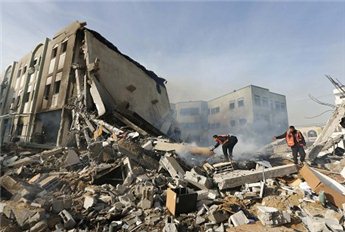
Aftermath of an Israeli air strike on the building of Hamas’ Ministry of Interior in Gaza City Nov. 16, 2012
Ma’an – 03/07/2013
BETHLEHEM – The Palestinian Center for Human Rights on Tuesday condemned a decision by the United Kingdom to grant immunity to Israel’s army chief while visiting the country.
Lt. General Benny Gantz, Chief of Staff of the Israeli Defense Forces, arrived in the UK on Tuesday, in the first visit of an Israeli army chief since 1998.
The UK government granted Gantz’s trip the status of Special Mission, thus granting him immunity from the UK’s criminal justice system, PCHR said.
Hickman & Rose Solicitors, who represent the victims of General Gantz’s actions together with PCHR, said the decision “sends the dangerous message that political considerations will be placed ahead of the rule of law.”
“Credible evidence exists indicating Mr. Gantz’s involvement in the commission of war crimes: these allegations should be investigated and, if appropriate, Mr. Gantz should be prosecuted,” PCHR said.
“He should not be pre-emptively granted immunity by the UK Government, circumventing normal criminal justice procedures.”
Lt. General Gantz is suspected of involvement in the commission of war crimes, particularly with respect to his role in the November 2012 assault on the Gaza Strip, codenamed Operation Pillar of Defense, PCHR says.
A week earlier, the UK government also applied Special Mission status to the visit of Major General Doron Almog, a retired army official suspected of war crimes, granting him immunity from Britain’s criminal justice system.
Mr. Almog canceled his scheduled UK visit at the last minute for unknown reasons.
In 2005, a British court issued an arrest warrant for Major General Doron Almog in relation to the destruction of 59 Palestinian homes in Rafah refugee camp in 2002 as part of a sustained policy of house demolitions in Gaza, PCHR said.
British police were preparing to arrest Almog on suspicion of war crimes after he and his wife flew to the United Kingdom in 2005, but he refused to leave his plane at Heathrow airport following a tip-off about the arrest warrant and was allowed to return to Israel.
The decision to grant immunity to both Israeli officials “sends the clear message that Israel can commit war crimes in the Gaza Strip with impunity,” PCHR said.
There is a risk, the group said, that Special Missions will be used to protect allies of the government and undermine the “basic principle of equal application of the law and the UK’s international legal obligation to seek out and prosecute suspected war criminals.”
‘Act of aggression’: Bolivia to file UN complaint over airspace blockade
RT | July 3, 2013
‘An act of aggression and violation of international law’ is how Bolivia’s UN envoy described Austria’s decision to search the Bolivian presidential jet for NSA leaker Edward Snowden. The envoy has pledged to make an official complaint to the UN.
Read the full story on the presidential plane grounding and follow RT’s live updates on NSA whistleblower Edward Snowden.
Envoy Sacha Llorentty Soliz told press in New York that he had no doubt the decision to search the plane originated from the US.
Austrian authorities grounded Bolivian President Evo Morales’ plane in Vienna early on Wednesday morning due to suspicions that NSA whistleblower Edward Snowden was on board. Morales refuted speculation that Snowden had stowed away on the plane and allowed authorities to conduct a search.
“Our colleagues from the airport had a look and can give assurances that no one is on board who is not a Bolivian citizen,” Austrian Deputy Chancellor Michael Spindelegger told press, saying rumors that Snowden might be on board were untrue.
The move to detain the presidential plane triggered a wave of furious rhetoric from Latin American leaders who alleged it had been “kidnapped by imperialism.”
Morales called on the countries who had cancelled air permits for the presidential flight to explain their decision.
“The governments of France, Spain and Portugal must explain to the world the reasons behind this delay,” said Morales, adding that these actions were indicative of the “repressive policies” of some EU countries.
“This is an excuse to try and frighten, intimidate and punish me. An excuse to try and gag us in the fight against the dominant economic powers,” said Morales.
Morales finally flew out of Vienna on Wednesday morning after being detained for over 12 hours in the airport. He will stop of in the Canary Islands to refuel before flying on to La Paz, the capital of Bolivia.
Israel Targets “Hezbollah Cells” in Nigeria
Al-Akhbar | July 2, 2013
In mid-May, Mustafa Fawwaz, a 49-year-old Lebanese living in northern Nigeria, was headed to the Amigo Mall, a property he co-owns with his brother Fawzi. Hours later, police stormed his supermarket and placed him under arrest.
A few days later, 48-year-old Lebanese Ahmad Tahini was arrested at Nigeria’s Kano International Airport before his flight departed to Beirut. On May 26, the police arrested 51-year-old Talal Rawda at his home, in addition to another Lebanese Hussein Noureddine.
The Nigerian police claimed these four men were part of a “Hezbollah cell,” evidence of which was a weapons depot located inside a house in Kano.
After 40 days of detention, Noureddine was released. The court accused the three remaining Lebanese men of committing “terror-related crimes” and “providing direct assistance to a terrorist group.” The indictment stated: “You confessed that you belong to the armed wing of Hezbollah, which is an international terrorist organization. You have therefore committed a crime.”
Trumped-up Charges
The main charge that led to the men’s arrest linked them to a questionable weapons cache. But the weapons found by police were old and rusting, having clearly been stored in inappropriate conditions.
A source close to the defendants said that the house where the weapons were found was originally owned by a former army general who was active in the Nigerian civil war – 40 years ago. He denies that the men are linked in any way to the weapons or any armed activity.
The three Lebanese men have been charged with terrorism by virtue of their membership in Hezbollah even though the Nigerian government does not consider the party a terrorist organization. This is the lawyer’s defense for the upcoming July 8 court date when he’ll ask the court to drop all charges.
As usual, Israel is connected to this debacle. An Israeli security official told a Western newspaper, “The security cell that was arrested is part of a Shia terror campaign targeting the West and Israel.” It is interesting that the Israeli official did not limit his accusations to Hezbollah but rather included the entire Shia sect.
Yet perhaps the strongest evidence of Israeli meddling in the investigation came from a source close to the detainees who claimed that a Mossad team was allowed to interrogate and investigate the defendants.
Israeli Objectives
Israel has always paid special attention to Nigeria, having signed several trade and industrial agreements with the African country. Yet since 2006, visits by Israeli presidents and security officials to Nigeria focused on signing security agreements and finalizing weapons deals. Nigeria specialists say that the Mossad’s close relations with Nigerian security agencies is not concealed in any way.
Israel hopes to accomplish several goals with these accusations. It seeks to pressure international, and especially European, public opinion to list Hezbollah, or at least its so-called armed wing, as a terrorist group. Another aim is to create fissures in Hezbollah by falsely accusing Lebanese businessmen and shutting down their businesses.
The US and Israel have different ways of targeting Lebanese in Africa. While the US treasury department accuses Lebanese of supporting terrorist organizations, Israel colludes with African security agencies to fabricate charges.
Featured Video
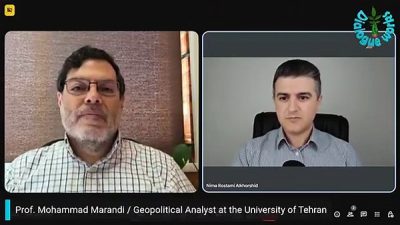
Seyed M. Marandi: U.S. Military DIVIDED? Iran’s Secret Defense EXPOSED
or go to
Aletho News Archives – Video-Images
From the Archives
‘Israel sees Iran as obstacle to its policies’
Press TV – August 25, 2017
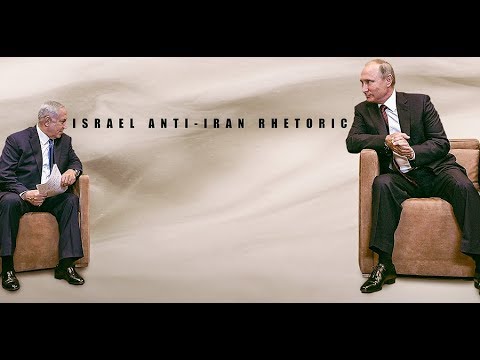
Prime Minister Benjamin Netanyahu has said that Israel felt threatened by Iran’s growing influence in the Middle East. Netanyahu expressed his Iranophobic view in a meeting with Russian President Vladimir Putin in Russia’s Black Sea resort of Sochi on Wednesday. Press TV has asked Scott Rickard, former American intelligence linguist from Tampa, Florida, and Brent Budowsky, a columnist at The Hill from Washington, to give their thoughts on the issue.
Rickard said Tel Aviv is concerned about the fact that the regime could not carry out its old project to spread sectarian divisions and pave the way for dismemberment of the countries in the Middle East region because of the Iranian-led resistance against Israeli policies, not only in the occupied territories of Palestine but also in the whole region.
“Iran is not a threat to Israel whatsoever. The threat that Israel sees is the fact that their Oded Yinon Plan is being put to a hold by Iran,” the intelligence linguist said on Thursday night.
“They (the Israelis) look at Iran as a threat only because they have no influence on their governments and Iran is autonomous and is not under the Zionist influence,” he added.
Since the victory of the Islamic Republic of Iran in 1979, Tehran has been critical of Israel’s policies in the region, whereas “no leaders [of other states] even dared to speak out against Zionism,” Rickard argued. … continue
Blog Roll
 Aletho News
- Sri Lanka secures supplies of Russia oil – minister
- Nations across Asia strike direct deals with Iran for Hormuz passage
- IRGC commander declares ‘new phase’ of reprisal attacks against aggressors
- Israel’s air defenses overwhelmed by cluster-warhead Iranian missiles: Reports
- Striking Iran’s Infrastructure Would Have Little Military Impact – Report
- What’s Behind U.S./Israeli Strikes On Iranian Pistachio Factories?
- Seyed M. Marandi: U.S. Military DIVIDED? Iran’s Secret Defense EXPOSED
- How I fell foul of the BBC thought police
- The End of NATO
- 37 days of war on Iran cost US staggering $42bln, tracker shows
- If Americans Knew
- Trump says Iranians appreciate bombs, WHO warns of nuclear risks – Daily Update
- U.N. experts demand Israel release prominent Gaza doctor after reports of ‘severe torture’
- Israel’s Latest Genocide Is Against the Shias of Lebanon. Why Is the World Silent?
- How Eliot Cohen’s influence over U.S. war-making paved the way for Trump’s war crimes in Iran
- Israelis don’t pay for the weapons we ‘sell’ to them — US taxpayers do
- While Distancing from AIPAC, Most 2028 Democratic Hopefuls Are Still Embracing Israel
- A brief history of the Israeli nuclear program, the open secret at the heart of the Iran war
- Israeli Settlers Killed a Palestinian Farmer on His Own Land, in Front of His Father. Yes, Again
- The US-Israeli War on Science is an Assault on our Future
- 100+ International Law Experts Say US Strikes on Iran Violate UN Charter, Could Be War Crimes
- No Tricks Zone
- An Inconvenient Tree: Uncovered In Alps… Europe Much Warmer Than Today 6000 Years Ago
- New Study Reports A 60% Slowdown In Greenland’s Ice Loss Rate In The Last Decade
- Low Intensity Tornado Wrecks Major Solar Farm, Creating A Potential Toxic Dump
- New Study Finds Warming Saves Lives…Cold Temperatures 12 Times More Deadly Than Excess Heat
- German Science Blog Accuses PIK Climate Institute Of Hallucinating Climate Tipping Points
- Devastating Assessment Of Comirnaty Vaccine By Former Senior Pfizer Europe Toxicologist
- New Study: CO2 Is ‘Effectively Negligible’ As An Explanatory Climate Change Factor Since 2000
- Former Pfizer Toxicologist Dr. Helmut Sterz Tells Bundestag Hearing Pfizer Vaccine Should Have Never Been Approved
- Energy Expert: Germany’s Nuclear Phaseout Was A “500 Billion Euro Mistake”
- New Research: South Australia’s Mid-Holocene Sea Surface Temperatures Were 4°C Warmer Than Today
 Aletho News