‘No War With Syria’ rallies happening this Saturday August 31, worldwide
The following notice has been posted all over the internet, please help to pass the word along.
Here’s the plan of action to oppose the illegal and unconstitutional war with Syria:
We are launching a global rally on Saturday August 31st in every city and town in the world.
Here’s how you get involved
 Go to the FB search bar and search for ‘No War With Syria Rally (your city)’.
Join the event, invite ALL of your friends to join it as well, then get involved with the locals that are already in the event page to help them any way you can.
If there is no event page made for your location yet, please make one. Here’s how:
-Simply click on your event tab from your FB homepage.
-Click create an event.
-Name the event ‘No War With Syria Rally (your city)’.
-make sure you set the privacy to public so other people can find it when they search for it.
-Pick a central and relevant location and start time for your area (please make it on Saturday August 31st).
-Invite ALL of your friends and encourage everyone else to invite their friends as well and do whatever else you can to let people know about the rally.
-Try to get some volunteers together to make banners to do some canvassing on Friday the night before your rally. Make signs.
-Pass out flyers in the days leading up to your rally.
-Contact other activist groups in your area for help.
-contact local media and let them know about your rally. Focus on independent journalists in your area.
-Set up a hashtag for your march and use it on FB, Twitter, and Instagram.
-The rest is up to your discretion to handle locally.
The time to change the world and stop the war is now. Share this information with anyone and everyone you know, thousands of innocent lives depend on it.
Court Rejects KBR’s Attempt to Avoid Trial for Human Trafficking
By Steven Watt | ACLU | August 26, 2013
A federal court in Texas struck a blow last week to contractor KBR’s attempt to thwart efforts to hold it accountable for labor trafficking in Iraq. After a review of the evidence, the court ordered that a case charging the former Halliburton subsidiary with human trafficking and forced labor proceed to trial.
The case, Ramchandra Adhikari v. Daoud & Partners, is brought by 12 Nepali men under the Trafficking Victims Protection Act (TVPA) against KBR and its Jordanian subcontractor, Daoud & Partners, for their participation in the trafficking and forced labor scheme. The ACLU and Yale Law School’s Allard K. Lowenstein International Human Rights Law clinic filed an amicus brief in support of the men.
As part of the scheme, the men were duped into working on U.S. military bases in Iraq after being falsely promised lucrative employment in hotels and restaurants in relatively safe countries in the Middle East. En route to the military base – on a dangerous highway with no security – the convoy in which the men were traveling, along with dozens of others in identical predicaments, was attacked by Iraqi insurgents. Eleven of the men in the convoy were later executed, their deaths broadcast on television. The survivor made it to the base but was refused permission to return home for another 15 months.
As the ACLU has documented in Victims of Complacency, while the fate of the men may be unique, the scheme of which they were a part was sadly all too common at the time. Since 2003, similar labor trafficking schemes resulted in thousands of foreign workers (known as Third Country Nationals or “TCNs”) being hired to work on U.S. government contracts in Iraq, Afghanistan, and elsewhere.
In an attempt to avoid accountability, KBR sought the dismissal of the case, arguing that the 12 Nepali men had not been subjected to labor trafficking and that regardless, it is shielded from liability under the TVPA. The judge rejected this argument, correctly ruling that the evidence presented:
[S]hows that each man was deceived about his promised job; each man was promised a hotel-related job in Jordan; each man’s family took on significant debt in order to pay recruitment fees; when the men arrived in Jordan, they were subject to threats and harm; their passports were confiscated; and the men were locked into a compound and threatened.
The case can now proceed to trial, bringing the families of the 11 victims, along with the one survivor, an important step closer to holding their traffickers accountable. It is our hope that this trial, along with new regulations against the trafficking and forced labor of persons serving under government contracts, will help end modern-day slavery on government overseas contracts once and for all.
Palestinian schools in Jerusalem offered money to switch to Israeli curriculum

Al-Akhbar | August 28, 2013
Several Palestinian schools in Jerusalem will incorporate Israeli educational material in their curriculum after receiving financial incentives from Israeli officials, Ma’an news agency reported on Wednesday.
An education official told Ma’an that the Israeli municipality in Jerusalem had offered increased salaries for teachers and principals who implement Israeli course material in the classes, bringing an estimated $550 for each student enrolled in schools agreeing to the switch.
Some Palestinian and Israeli school principals and teachers met in Tel Aviv last week to discuss the change, the official added.
Jerusalem’s director of education Samir Jibril said at least five Palestinian schools in Jerusalem will switch from Palestinian Authority to Israeli education plans at certain grade levels.
“This step is very dangerous and touches the awareness of Palestinians in Jerusalem in an effort to brainwash them and control them, especially young generations,” a teacher identifying only as Jibril told Ma’an.
The Israeli curriculum purportedly includes maps marking the West Bank as part of Israel and identifying territories by their Jewish Biblical names.
The history material also identifies Jerusalem as the capital of Israel despite the fact that the United Nations and most states do not recognize Israel’s claim on the city.
The apartheid wall in the West Bank is also referred to as Israel’s security fence, and Israel is described as a bastion of human rights and democracy.
Another section depicts a conversation between Arab students who praise Israel’s development of Palestinian cities and decide to sing the Israeli national anthem.
(Al-Akhbar, Ma’an)
The Guardian of What?: The Media and War Propaganda
By Jeremy Salt | Palestine Chronicle | August 28, 2013
If there is any comfort in how the Guardian has been reporting the Middle East, especially Libya and Syria, it is that many of its readers, judging from their remarks in ‘Comment is Free’, do not appear to believe or trust it.
The Guardian sells itself as the global beacon of liberal opinion. It is liberal on social issues and alongside the chatterers, it has some excellent political correspondents and commentators, notably Gary Younge and Seamas Milne. As liberals themselves, its readers around the world must think they are on safe ground when quoting from the Guardian but if so, where the Middle East is concerned, they are deluding themselves.
Throughout the crisis in Syria the Guardian has been not so much reporting the conflict as running a propaganda campaign against the government in Damascus, to the benefit of the armed Islamist groups and the outside governments sponsoring them. The wellsprings of its ‘reporting’ have been the unsubstantiated claims of ‘activists’ no matter how wild and improbable. Without any evidence it is now accusing the Syrian government of being responsible for the alleged nerve gas/chemical weapons attack in the Ghouta district around Damascus. The far greater likelihood that the armed groups were responsible for this atrocity scarcely rates a mention. Building on the unsubstantiated claim that it was the Syrian military, Martin Chulov argues in favor of another one, that it was Bashir’s brother Maher who was personally responsible (the same accusation is being made by the Israeli intelligence propaganda outlet Debkafile, from which Chulov may well have taken his lead). This is how propaganda works. Once set in motion it just needs a push to keep it rolling.
Buttressing its editorial and reports, Fawaz Gerges is given space to claim that it is up to the Syrian government to prove that it was not responsible for this atrocity. This is nonsense: if the Syrian government was not responsible for this atrocity, how can it prove what it did not do, especially when anything it says will be dismissed out of hand by the mainstream media and the governments arming, financing and training the ‘rebels’? The onus of proof lies on those making the accusations, and so far neither the Guardian nor the anti-Assad campaigning Kim Sengupta of the Independent (where Robert Fisk has provided balance with some reports giving the perspective of the Syrian government) nor William Hague nor anyone else making this accusation has produced a scrap of evidence that this attack was carried out by the Syrian military.
Probability points in the direction of the armed groups. The ‘rebels’ are known to have acquired stocks of sarin. They used a chemical weapons compound in their home-made missile attack on a military outpost at Khan al Assal in March that killed dozens of soldiers and civilians. (1) In May this year Carla del Ponte, a member of the UN Independent Commission of Inquiry on Syria said investigators had evidence that the ‘rebels’ had used sarin gas. (2) In May also Turkish police seized sarin gas along with hand guns, grenades, ammunition and unspecified ‘documents’ from apartments where Jabhat al Nusra members were living in Adana and Mersin. (3) Early in June the Syrian military seized two barrels of sarin gas from a ‘rebel’ hideout in Hama. (4)
On top of all this the armed groups have filmed themselves experimenting with chemical weapons on rabbits. As they have slaughtered thousands of civilians in the most barbaric fashion there is no argument that moral considerations would prevent them from taking this further atrocious step – and it is they who have every reason to take it. They are being ground down across the country and at this stage only direct military intervention is going to save them and save the project to destroy the Syrian government. It is a measure of the desperation of their outside sponsors that Bandar bin Sultan, Saudi Arabia’s intelligence chief, was recently in Moscow with an offer from his government to buy $15 billion worth of Russian arms if Russia would just allow the passage of a UN Security Council resolution authorizing a military attack on Syria. Putin said no, and what a coincidence it is that a short time later there is a mass atrocity that gives the western-led collective the pretext it wants to attack Syria without a UNSC resolution behind them.
Clearing positions held by the armed groups a few days after the apparent nerve gas/chemical weapons attack, Syrian soldiers found stocks of chemicals, gas masks, syringes and anti-neurotoxin drugs in tunnels at Jobar, one of the three districts on the outskirts of Damascus, along with Ain Tarma and Zamalka, targeted in the attack. Several soldiers were taken to hospital in critical condition. The official Syrian news agency English-language news site, SANA ran photos of cylinders of chemicals and other material, including syringes, produced by the ‘Qatar-German Company for Pharmaceutical Industries’. There is no company of this name but there is a company called Qatar-German Medical Devices whose QG logo can be seen on a box found in the tunnel marked ‘Flow I.V. Cannula’. The army also found a basement stocked with quantities of chemical agents manufactured in Saudi Arabia and a number of European countries. The material included equipment for making chemical weapons and anti-neurotoxins in case the armed men poisoned themselves.
The discovery of this material was followed by the Medecins Sans Frontieres statement that three of the hospitals it supports in the Damascus governorate had received 3,600 patients displaying neuro-toxic symptoms in three hours on the morning of August 21, of which number 355 had died. While MSF cannot say who was responsible for this atrocity, its statement highlights the complete improbability of the Syrian government carrying out a mass chemical weapons/nerve gas attack on civilians in suburbs only a few kilometers from the center of Damascus, shortly after the arrival of UN chemical weapons inspectors and indeed only several kilometers from where they were staying, killing or wounding thousands and filling its own hospitals with the victims. At face value the accusation is ludicrous, yet such is the propaganda whipped up against the Syrian government over the past three years that some people will believe it to be capable of anything.
Not only do the armed groups, their backers and the media salesmen of their pitch, including the Guardian, want the world to believe that the Syrian government was responsible for this atrocity, they want the world to believe that Bashar is stupid, indeed so stupid that he would have ordered this attack within three days of the arrival of the UN chemical weapons inspectors. This canard is reminiscent of the accusation that the Syrian government arranged the assassination of Rafiq Hariri in 2005. The killing was a master stroke used as a lever to get the remaining Syrian troops out of Lebanon, and to blacken Syria’s name internationally. By the time all the four suspects had been freed and Syria cleared by the UN tribunal of any responsibility the media had moved on. It is a long time since it has shown any interest in who killed Hariri. Like the Hariri killing the first question to be asked in the wake of this latest atrocity is ‘who benefits?’ In both cases the answers are clear: in the first, Israel, the US and their proxies in Lebanon; in the second, the armed groups and the outside governments supporting them, including, of course, Israel, which is now leading the charge for a direct military attack on Syria.
By disseminating the deceit and lies put out by Libyan and then Syrian ‘rebels’ and ‘activists’, Al Jazeera ruined its reputation. The Guardian has run the same line as this mouthpiece of the government of Qatar yet remains protected by its mystique as a beacon of liberal opinion. Many of its readers are clearly confused when all they have to do is see that the emperor has no clothes: far from being the guardian of liberal opinion, this newspaper is the guardian of western, gulf and Israeli interests in the Middle East against Iran, Syria and Hezbollah. Its correspondents are still writing seriously and positively about a Palestinian ‘peace process’ that is a grotesque sham. Israel is playing with the Palestinians, as a cat plays with a mouse. It has Abbas in its pocket and by abandoning Syria and embracing Muhammad Morsi and the deposed ruler of Qatar, Ismail Haniyeh and Khalid Misha’al have found themselves without any backers. Not since its foundation has Israel enjoyed such a good run. If only the governments in Tehran and Damascus could be destroyed and Hezbollah extinguished life would be perfect.
The Guardian has never even attempted to provide balanced coverage of what is going on in Syria. There has been no counterweight – no antidote – to the anti-Assad and pro-rebel reporting and comment of Ian Black and Martin Chulov. The techniques will be familiar to all but the most inert readers. The paper runs headlines which are not justified in the text. The claims of ‘activists’ are given prominence and the claims of the Syrian government minimized, without there ever being any doubt about what the Guardian wants its readers to believe. It has downplayed or ignored the evidence of terrible atrocities by the armed groups (such as the massacres this August of hundreds of villagers in the Lattakia governorate (5) , of more than 100 people in Khan al Assal (6) and the massacre by Jabhat al Nusra of an estimated 450 Kurdish women and children around the Syrian-Turkish border town of Tal Abyad). (7) It has printed the wildest claims without any attempt to substantiate them, such as the allegation by a London-based ‘activist’ that the Syrian government was packing detainees into shipping containers and dumping them at sea. It has allowed ‘activists’ to shift the blame for car and suicide bombings on to the government even when it is government institutions that have been bombed and government employees who have been the victims. It has expected its readers to believe that the Syrian government is exploding bombs in densely populated residential areas in the middle of its own cities. It relies on the so-called Syrian Observatory for Human Rights when it must know that it is a completely tainted source. The only explanation for this can be that this one-man band is saying what the Guardian wants to hear and what it wants its readers to believe.
The strategy of the armed groups has been to destroy infrastructure and terrorize the civilian population. This they have largely succeeded in doing. Syrians are pouring out of the country to get away from them. In the name of a twisted pseudo-revolution these armed men are supported by a collective of foreign governments. The line of the moment following the alleged chemical weapon/nerve gas attack is that ‘all red lines have been crossed’ when these governments crossed all red lines in international law long ago by financing and arming groups such as the brigades of the Free Syrian Army and Jabhat al Nusra. International law prohibits armed intervention in other countries and the use of mercenaries. International law forbids the application of economic sanctions against member states of the UN yet in all these categories the collective bent on the destruction of the Syrian government has shown complete contempt for international law. Of course this is merely standard procedure. International law is for other people, not the ‘international community’ as represented by the UK, France and the US [or Israel] and nowhere have they treated international law with more contempt than in the Middle East.
These governments are making the most strenuous effort in the history of the modern Middle East to destroy an Arab government. The reason has been clear from the beginning: Syria is Iran’s strongest regional ally and is being targeted as a second best option to targeting Iran itself. The takfiris inside Syria, demeaning Islam with their shouts of ‘Allahu Akbar’ every time they cut a throat, are doing the work of governments that have done nothing but damage to the Middle East for the past century. The prime losers are the Syrian people. About 100,000 have been killed in this conflict and much of their country’s infrastructure has been deliberately torn to shreds. The chief regional beneficiaries are Israel and Saudi Arabia, holding hands under the table. The destruction of the Syrian government would be an unparalleled strategic triumph for Israel and the ‘west’, which is why Russia and China have not budged in their position that it is the Syrian people who must decide their own future and not outside governments and armed gangs and why Russia in particular will be planning its riposte should Barack Obama be talked into launching a Cruise missile strike.
The Guardian’s propaganda cover for the Syrian ‘rebels’ follows its support for the Libyan ‘rebels’ against another dictator. The protest movement in Benghazi was seized upon by Britain, France and the US as the opportunity to intervene and destroy the government in Tripoli. There was no countrywide movement against Muammar al Qadhafi and the ‘rebels’ could not have advanced a yard beyond the city limits of Benghazi without the cover of NATO missiles. Qadhafi was brought down after a seven month blitz by the air forces of three of the most powerful militaries in the world and eventually murdered after several previous attempts to murder him by missile strike had failed, while killing members of his family. Thousands of innocent Libyans were killed during this prolonged aerial assault. This neo-imperialist adventure was fully underwritten by the mainstream media. None of the war crimes committed by NATO forces or ‘rebels’ on the ground had the same impact on editorials and ‘reporting’ as the claims that the Libyan leader was bombing his own people from the air, using black mercenaries and distributing Viagra to his troops. These sensational allegations were later shown to be lies, but by this time they had served their purpose in setting up Qadhafi as someone who deserved to be killed (rather than put on trial, embarrassing in the process Blair, Sarkozy and others who benefitted from Libyan money and oil concessions). With Libya out of the way the same western governments and the same mainstream media flapped on like vultures to Syria and another supposed dictator, leaving the Libyans to clean up the mess they had created as best as they could.
Having shed the shackles of balanced journalism in Libya and Syria, the Guardian is now defending media ethics and responsibility in the Edward Snowden- Glenn Greenwald affair. Greenwald has been revealing secrets from Snowden’s store of official documents. David Miranda, his partner, was detained for nine hours by British intelligence while in transit through London. If the purpose was to shut Greenwald up by putting pressure on his relationship, his scarcely repressed fury is an indication that it will not work. Alan Rusbridger, the Guardian’s editor-in-chief, had been having private conversations with British intelligence and only decided to take action, by destroying material the Guardian had on hard drives, when threatened with legal action. This was a significant exercise of the power of the surveillance state which had to be challenged, but how much more significant is media support for mass death and destruction delivered to Syria by groups of men financed, armed and trained by outside governments?
The Guardian does not actually call for war. It leaves that to other people. It merely sets the stage. It runs an editorial based on the assumption that this chemical weapons attack was the work of the Syrian government. The possibility that the armed groups might have done it is not even taken into account. It observes that ‘choosing between bad options is even more complex [supporting armed groups responsible for one atrocity after another is obviously not considered a bad option] … this paper has resisted the calls for military intervention in Syria [as if there is not already military intervention in Syria] … but we do appear to be coming ever closer to a tipping point with difficult judgments ahead.’ Without calling for war itself, this beacon of liberal opinion then quotes with approval the arch conservative William Hague, who talks of civilized values while pushing for a war that would bury them in further great mounds of bodies.
Behind the mask of asinine geniality Hague is a warmonger. He has wanted ‘intervention’ in Syria – a war kicked off with the declaration of a no-fly zone and now possibly a Cruise missile strike – for years and now sees it in his grasp. The Guardian should have been on to his smiling duplicity and double-speak like a terrier on to a rat. Instead it is joining the chorus line for war. That is the reality behind its own double-speak. The Syrian government agreed to allow UN inspectors into the districts targeted in this apparent nerve gas/chemical weapons attack but as soon they approached these districts, they were shot at by snipers. If it can be proven that it is the armed groups that carried out this attack it is a safe bet that we will hear no more talk of red lines being crossed. Obama said he would not take a decision until he had proof but now we are being told by an unnamed US official that the on the spot inquiry is too little and, not even a week after the event, too late. The British media is talking of a military attack being launched within days.
The US media is much more reserved: after all, their country is being pushed into the front line by governments that would never have the guts to attack by themselves but will only run in from behind once the US takes the lead. Obama is still holding back and has the intelligence and sense not to fall for this if, unfortunately, not necessarily the strength of character to resist the pressure being applied to him. Britain, France and Israel want to strike now, while the propaganda is running hot and strong and before the UN inspectors ruin their rush to war by concluding that this attack around Damascus either was or might have been the work of the armed groups.
This will not be Libya. This never was Libya. This will not begin and end with a few Cruise missiles fired at Syria from warships in the eastern Mediterranean. This may well spark a major war involving Turkey, Iran, Israel, Hezbollah and Russia for which those pushing for war must be held responsible right now and not just afterwards. If the decision is taken the Guardian will wring its hands about the horrors of war but it will still justify it on humanitarian grounds and the ‘responsibility to protect’. Amidst the smoke and carnage, the question of who fired the chemical weapons around Damascus will soon be forgotten.
– Jeremy Salt is an associate professor of Middle Eastern history and politics at Bilkent University in Ankara, Turkey.
Notes:
1. See ‘Russia’s UN envoy says Syria rebels used chemical weapons’, Los Angeles Times,July 9,2013, reporting the statement by Russian UN ambassador Vitaly Churkin that armed groups had used sarin gas in the attack at Khan Assal on March 15, killing 26 people, including 16 military personnel, and wounding 86.
2. See ‘UN’s Del Ponte says evidence Syrian rebels ‘used sarin’. BBC News Middle East, May 6, 2013.
3. See ‘Adana’da El Kaide operasonyu:12 gozalti ( Al Qaida operation at Adana: 12 arrested), Zaman, May 28, 2013.
4. ‘Syrian army seized sarin cylinders from militants in Hama’, Press TV, June 2, 2013.
5. See ‘Massacre in Latakia, August 2013. A documentary report on Al Nusra massacre in Lattakia’, Sham Times, August 8, 2013. Translated by Australians for Reconciliation in Syria.
6. See ‘UN rights chief calls for investigation into Syrian massacre’, Reuters.com., reporting on the ‘apparent’ massacre ‘carried out by Syrian opposition forces in the town’.
7. See ‘Defend the Kurds in Syria from massacre and ethnic cleansing’, Kurdistan Times, August 8,2013, reporting the massacre of 120 children and 330 women by Jabhat al Nusra at Tal Abyad on August 5. While the numbers have not been independently verified, the massacre triggered off an exodus of tens of thousands of Syrian Kurds into northern Iraq. Syrian Kurds have given details of massacres of Kurds carried out by Jabhat al Nusra across northern Syria.
Obama’s Looming War of Aggression in Syria and the Pathologies of America’s Iran Debate
By Flynt Leverett and Hillary Mann Leverett | Going to Tehran | August 27th, 2013

As the Obama administration manufactures its “case” for military aggression against Syria in the coming days or weeks, we want to highlight an interview that Hillary did with Zeinab al-Saffar when we were in Beirut earlier this summer; the interview is now available on Al Mayadeen’s Web site, see here. Hillary’s account of how the United States self-servingly demonizes non-Western countries that get in its way seems highly applicable to the current discussion—it hardly merits the label “debate”—about attacking something in Syria, ostensibly because of claims that the Syrian government used chemical weapons against civilians last week in Ghouta, an eastern suburb of Damascus. The frame for such demonization, Hillary notes, is inevitably driven by and bound up with
“the United States’ way of going to war. The United States doesn’t go to war, it says, to protect its interests. The United States says it’s going to war to ‘liberate’ peoples—whether they’re liberating people in Cuba, Vietnam, Iraq, and prospectively Iran. And the way the American people is conditioned to accept it (and, essentially, world opinion as well) is that American experts put out a narrative about these various countries—whether it’s Cuba, Vietnam, Iraq, or now Iran—they put out a narrative about how repressive that society is, how illegitimate its government is in terms of its domestic politics, and how irrational it is in its foreign policy. We’ve seen this in country after country that the United States has invaded or tried to invade to overthrow its government.”
Of course, no one anticipates that President Obama is about to order a U.S.-led invasion of Syria. But, since Obama’s foolish declaration in August 2011 that Syrian President Bashar al-Assad “must go,” the United States has been committed to the Syrian government’s overthrow. And the demonization of Syria’s government as repressive, illegitimate, and irrational has proceeded apace, exactly along the lines described by Hillary. Now the demonization focuses on unsubstantiated allegations of the Syrian government’s use of chemical weapons as a justification for the United States to use military force against it—just as concocted claims about Saddam Husayn’s weapons of mass destruction were central to building the case for invading Iraq in 2003.
Make no mistake, U.S. military action against Syria will be fragrantly illegal (not that President Obama’s senior advisors, most members of Congress, or much of the American public will care). Nevertheless, the Obama administration is gearing up for precisely such action—and for entirely self-generated reasons. It was Obama who declared that Assad “must go.” It was Obama who declared that chemical weapons use was a “red line.” It was Obama who put himself in a position where he can’t entertain the possibility that Syrian oppositionists used chemical weapons, because that would destroy his administration’s Syria policy. And because Obama took these ill-considered and illegal positions, he must now use American military power to preserve his “credibility.”
Obama took these positions, the “credibility” of which he must now defend by engaging in overt aggression, in no small part because American foreign policy elites believe that bringing down the Assad government will undermine the Islamic Republic of Iran. In her interview for Al Mayadeen, Hillary discusses the evolution of our own thinking about the Islamic Republic, how America should engage it, and what are the real obstacles to a more realistic and effective American posture toward Tehran.
In particular, she charts the progress from our earlier advocacy of a U.S.-Iranian “grand bargain” (whereby America would “talk Iran into agreeing with American positions on Hizballah, on the nuclear issue, on the Palestinian issue, on a range of things”) to our recognition that “something much more profound and deep” is required—that the United States needs “to come to terms with and accept” a fiercely independent Islamic Republic, in much the same way that President Richard Nixon and Henry Kissinger came to terms with and accepted the People’s Republic of China in the early 1970s. She also recounts the attacks we have faced—first from the right, when we were criticizing President George W. Bush’s handling of Iran policy, followed by much of the left, when we began making the same criticisms of Obama’s posture toward Iran. In this context, Hillary argues that our biggest offense has been to challenge the deeply held American myth “that Iranians were demanding to be liberated by the United States, but not liberated by an American tank, but by the great American ideas and great American values, that everyone wants, deep in their heart, to be secular liberals…if you questioned that in the United States, as we did, you really were vilified.”
Our experience strongly suggests that the biggest obstacles to genuine revision of U.S. policy toward the Islamic Republic are some fundamental aspects of American political culture. As Hillary points out, “to accept an Islamist political order, [the United States] would have to give up the pursuit of hegemony, the pursuit of dominance. This idea that we can use the excuse of what’s called American exceptionalism—that the United States is a unique force for good in the world—to invade other countries to ‘liberate’ them, we’d have to give that up, because we’d have to recognize that there is some legitimacy to other political orders, particularly ones that are Islamist. And that’s especially relevant in the Middle East that is so important in geostrategic terms.”
The problem, though, is that “hegemony may be nice in theory—if you could get it, if you could rule the world, that might be a nice idea for some Americans in theory—but you cannot get it in the Middle East, because you are up against Islam. You cannot do it; you cannot defeat that. For the United States to have any strategic influence in this vital part of the world, we argue in our book, we have to come to terms with that—just as we could not defeat one billion people in China who wanted to have their independence. It’s a very similar situation.”
But it seems that United States is not yet ready to come to terms with this reality. And so, in another vain attempt to get at the Islamic Republic of Iran, America is about to engage in illegal aggression against one of the Middle East’s most avowedly secular governments—a government that, like the Islamic Republic, actually fights the kind of violent (and anti-American), al Qaida-affiliated extremism that some U.S. “allies” work so hard to promote.
Related article
Russian rocket engine export ban could halt US space program
RT | August 27, 2013
Russia’s Security Council is reportedly considering a ban on supplying the US with powerful RD-180 rocket engines for military communications satellites as Russia focuses on building its own new space launch center, Vostochny, in the Far East.
A ban on the rockets supply to the US heavy booster, Atlas V, which delivers weighty military communications satellites and deep space exploration vehicles into orbit, could put a stop to NASA’s space programs – not just military satellites.
An unnamed representative of Russia’s Federal Space Agency told the Izvestia newspaper that the Security Council is reconsidering the role of Russia’s space industry in the American space exploration program, particularly the 2012 contract on delivering to the US heavy-duty RD-180 rocket engines.
Previously, Moscow has not objected to the fact that America’s Atlas V boosters rigged with Russian rocket engines deliver advanced space armament systems into orbit. If a ban is put in place, however, engine delivery to the US would probably stop altogether, starting from 2015.
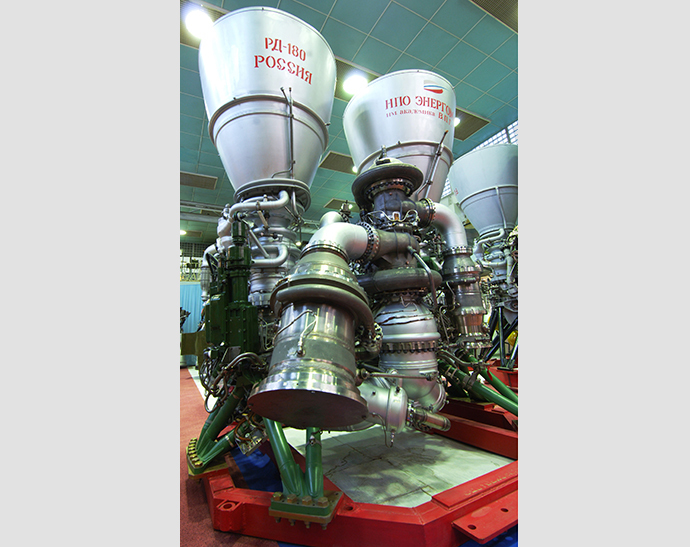
RD-180 rocket engine used in the first stages of American rockets Atlas-3 and Atlas-5. (RIA Novosti / Sergey Pyatakov)
Over the last decade, most of NASA’s Atlas V heavy rocket launches, performed by the United Launch Alliance (a Boeing/Lockheed Martin joint venture), were carried out using Russian RD-180 dual-nozzle rocket engines, a legacy of the Soviet Buran space shuttle program and its unparalleled rocket booster Energia, which could put 100 tons of spacecraft or satellites into orbit.
Military payloads
It is widely believed that many Atlas V launches have a military payload. Such Lockheed Martin-designed military spacecraft include the Advanced Extremely High Frequency (AEHF) series of communications satellites launched for Air Force Space Command, the mysterious super-secret Palladium at Night communication platform designed for the US Navy’s Ultra-High Frequency (UFO) Follow-On program and most certainly all three launches of Boeing’s X-37 unmanned demonstrator spacecraft. These are only a part of the military space missions undertaken by Atlas V rockets, boosted by RD-180 engines
A ban could also affect the US’s non-military space exploration launches, which are also highly dependent on the Atlas V rocket and RD-180 engines. The most famous and challenging among them are NASA’s New Horizons spacecraft mission, now traveling to Pluto and the Kuiper Belt (launched in 2006), and the Curiosity Mars rover (launched in 2011) currently operating on the Red Planet
A number of experts told Izvestia that termination of the rocket engine contract would not be a good idea commercially for NPO Energomash, which produces the rockets, because at the moment it makes RD-180 engines exclusively for the US space industry. The rockets typically take Energomash 16 months to produce.
If production of the RD-180 engine is stopped, the enterprise would have to find other contracts to keep the production line and experienced staff busy.
“In my opinion, stopping the export of rocket engines to the US is stupid, as we would suffer financial and reputational losses,” Ivan Moiseyev, scientific head of the Space Policy Institute, told Izvestia. “The US would not suffer much and would definitely continue with military space launches, while Russia would have to stop production of the RD-180, because no one else needs the RD-180 engine.”
However, many space experts believe that the US would find it difficult to quickly replace the Russian rockets. Also, Energomash could find other orders soon. Russia plans to start space launches from its new, multibillion-dollar Vostochny cosmodrome in the Far East in 2015. Vostochny will host a heavy rocket class launch pad, which means the producer of the world’s most powerful rocket engines will be kept busy for many years to come.
The RD-180 is equivalent to half of the Soviet-era Energia booster, the most powerful liquid rocket engine ever made by man. With 20 million horsepower output, the Soviet-era RD-170 was about 5 percent more powerful, yet 1.5 times smaller, than American’s F-1 first stage rocket engine made for the Saturn V booster of the Apollo lunar program.
Reportedly, when the Energia booster with the Buran space shuttle was launched in November 1988, the massive concrete bays paving the Baikonur cosmodrome in Kazakhstan were flying around like dry leaves, due to the immense power coming from the four RD-170 engines, which blasted the 2,400-ton rocket booster into space.
In the post-Soviet era, Russian-US rocket engine cooperation started back in 1996, when America’s General Dynamics Company bought exclusive rights for use of RD-180 in the US, later selling it to Lockheed Martin for its Atlas rocket program. NPO Energomash, the producer of unique engines based in Moscow’s suburb Khimki, signed a contract for production of 50 RD-180 engines and an option for the production of another 51 units.
A specially created joint venture, RD-AMROSS, between NPO Energomash and Pratt & Whitney Rocketdyne, has already delivered 63 engines to the US worth $11-15 million apiece, reportedly 40 of them have already been used. In December 2012, a new contract was signed to deliver another 31 engines. But this contract is now being reconsidered by Russia’s Security Council, according to Izvestia.
Rocket engines: space at stake
The RD-AMROSS joint venture has always been controversial for Russia’s military.
In 2011 Russia’s Audit Chamber announced that the RD-180 rocket engines delivered to the US according to the 1996 contract were sold for only a half of their real production value. The total loss in 2008-09 reached 880 million rubles (about $30 million) or 68 percent of all financial losses of NPO Energomash at the time, the Audit Chamber said.
In an interview, the general director of RKK Energia Corporation, Vitaly Lopota, estimated that at the time of the RD-180 first launch in the late 1980s, USSR was “at least” 50 years ahead of America’s liquid fuel rocket engine technology.
In the 1990s Russia agreed not only to sell unique engines to the US, but also provided the Americans with full documentation on the engine’s design specifications. But the US space industry opted to buy ready made engines instead of trying to make them on their own, because of the technological and material engineering gap between the two countries’ space industries.
And today the situation appears to be pretty much the same.
In December 2012, the head of Roskosmos, the Russian Federal Space Agency, Vladimir Popovkin, commented to Izvestia on the engines: “Americans are buying RD-180 engines and are negotiating to buy promising new RD-193 engines, because they’ve learned that we’re making a quality product, the best liquid-fueled rocket engines in the world. For them it’s easier to buy than to make up with us, [while] for us it is important to ensure the development of the NPO Energomash enterprise.”
In June 2013, the US Federal Trade Commission launched an antitrust investigation into United Launch Alliance, which was accused of “monopolizing” the rocket engine market and thus barring its direct rival, Orbital Sciences Corporation, from obtaining RD-180 engines for its Antares rocket booster to break into the lucrative market for US government rocket launches.
Experts say that the fact that Orbital Sciences Corporation is battling for the RD-180 could only mean that the company has so far failed to acquire anything similar on either the American, or the international space industry market.
Orbital Sciences’ Antares rocket is powered by Aerojet AJ-26 engines, which are actually Soviet NK-33 engines produced for the super-heavy N-1 rocket booster of USSR lunar program. Orbital Sciences once managed to buy 43 NK-33 engines stored for decades in Russian space corporation’s depots, and then adopted them for their needs. Now Orbital Sciences would like to restart production of the NK-33, but Energomash announced that this engine is out of production for the time being. In this situation, Orbital Sciences is taking ULA to court for the right to buy Russia’s RD-180 rocket engines.
SpaceNews reported earlier this month that NASA’s internal agency audit is warning that the Orion deep-space manned spacecraft program faces a “difficult budget environment” that ultimately could cause delays and cost increases. The Orion capsule could be launched with various rockets, including ULA’s Atlas V and Space Exploration Technologies’ Falcon 9.
In spring this year, Amazon founder and space enthusiast Jeff Bezos, owner of the Blue Origin space exploration start-up, financed a successful expedition recovering two F-1 engines for Apollo project’s Saturn V rocket from the Atlantic sea bed near Florida’s Kennedy Space Center. Bezos said that his fascination with space began back in 1969 with the Apollo program, when he saw astronaut Neil Armstrong walk on the Moon.
The rocket engines still remain property of NASA and the US government, and Bezos has promised have NASA put them on display at a museum in Seattle as “testament to the Apollo program.”
Honduras: Congress Resurrects Military Police Force
Weekly News Update on the Americas | August 25, 2013
Honduras’ National Congress voted on Aug. 21 to approve a law creating the Military Police of Public Order (PMOP), a new 5,000-member police unit composed of army reservists under the control of the military. This will be in addition to a 4,500-member “community police” force that the government is forming, according to an Aug. 12 announcement by Security Minister Arturo Corrales. Although he called the move a “change of course,” Corrales failed to explain the difference between the community police, which is to be operative by September, and the existing national police force.
The government’s plan to raise the number of police agents by 9,500 is clearly meant to respond to the dramatic increase in crime in Honduras; according to the United Nations, the country now has an annual murder rate of 84 for every 100,000 people, the highest in the world. Police corruption is a major problem, and police agents have been convicted of high-profile crimes [see Update #1187]. The current police force had 14,472 agents on the payroll as of May, but in a new police scandal, only 9,350 agents could be found at work during July.
The police changes come as candidates prepare for Nov. 24 general elections, which will choose a new president, the 128 members of Congress, the 20 representatives to the Central American Parliament (PARLACEN), and local mayors [Update #1162]. The main force behind the new military police is Juan Orlando Hernández, who has resigned from his post as president of the National Congress to run as the presidential candidate of the center-right National Party (PN)—the party of current president Porfirio (“Pepe”) Lobo Sosa, who has governed Honduras since January 2010 without being able to contain the crime wave.
Human rights activists strongly oppose the proposed military police unit. “In no part of the world have the soldiers resolved security problems,” Omar Rivera, who directs the Alliance for Peace and Justice (APJ), a coalition of civil society, organizations, told the French wire service AFP. He added that a serious fight against crime would require a fight against impunity. Bertha Oliva, the coordinator of the Committee of Relatives of Disappeared Detainees in Honduras (COFADEH), called the creation of the new force “a step backwards in the demilitarization of society and the democratization of the country.” “The soldiers in the streets have only left more death and mourning, because they aren’t prepared for being guarantors of security,” she said. The national police were removed from the military and put under civilian control in 1997. Death squads operated by the military and the police were implicated in the killings of 184 government opponents in the 1980s.
Critics also asked how the government would be able to pay for two new police units that would double the current number of active agents. José Simón Azcona, a legislative deputy from the centrist Liberal Party (PL) who supported the measure, suggested that the US would pay. The US government “offered collaboration… under the previous administration” for the conversion of four military battalions into police units, he said. (It is unclear whether he was referring to a previous administration in Honduras or in the US.) (El Nuevo Diario (Nicaragua) 8/12/13 from ACAN-EFE; Honduras Culture and Politics 8/22/13; El Heraldo (Tegucigalpa) 8/22/13; La Nación (Costa Rica) 8/23/13 from AFP, EFE; Prensa Latina 8/24/13)
Related articles
- Honduras: Expanding Palm Oil Empires In The Name Of ‘Green Energy’ And “Sustainable Development” (alethonews.wordpress.com)
- Honduras: Army Kills Indigenous Leader at Dam Protest (alethonews.wordpress.com)
- Honduran Union Leader Faces Death Threats (alethonews.wordpress.com)
Western logic on Syria: ‘We need to bomb it to save it’
RT | August 27, 2013
The military buildup in the Mediterranean indicates that Assad’s opponents intend to militarily intervene in Syria under cover of ‘humanitarian intervention’, a disingenuous narrative that could not be further from the truth.
Pictures and videos that have surfaced following the alleged use of chemical agents in the eastern suburbs of Damascus are profoundly disturbing and a thorough and substantial investigation into what took place there is absolutely essential. However, it is conversely disturbing that those Western governments who have staunchly supported anti-government militants are using this opportunity to legitimize the use of force against the government in Damascus.
The United States, Britain, and France are unwavering in their assertions that the Assad government and the Syrian Arab army were the perpetrators of the chemical weapon attack, despite no evidence to substantiate these claims. These governments seem to be sure that Damascus is guilty on the basis of it preventing a UN investigation team from visiting the site, and when investigators eventually did reach the area, it didn’t matter to them because they argued that the Syrian government had destroyed all evidence of wrongdoing.
Assad’s opponents have constructed a deeply cynical and hysterical political narrative that Western leaders are now parroting in unison.
There are several reasons why Damascus showed hesitation in allowing UN inspectors to access the site, the most apparent being that this attack allegedly took place in rebel-held strongholds on the outskirts of the capital, and that the security of the UN team could not be guaranteed if rebels attacked them or launched more chemical weapons during their visit.
Syrian rebels have demonstrated their hostility to UN forces on previous occasions; anti-government groups kidnapped 21 UN peacekeepers in the Golan Heights in March, and another four peacekeepers later in May. That the UN convoy was fired upon by unidentified snipers is hardly surprising in that it is another stunt in a series of moves to escalate the situation to provoke an international response.
The UN team eventually made it to the site to collect evidence and, contrary to Western assertions, the UN claimed that it was still possible for the team of experts to gather necessary evidence despite the time elapsed since the alleged attack.
Who benefits from using chemical weapons?
The narrative that the Assad government used chemical weapons, specifically while a UN team was in Damascus to investigate previous uses of chemical weapons, is tactically and politically illogical and in no way serves the interests of the Syrian government.
These attacks transparently serve the interests of anti-government militias who have long called for NATO intervention, as well as the Syrian political opposition who are now refusing to take part in any planned Geneva negotiations. Furthermore, allegations that the regime used chemical weapons benefits the international opponents of Assad, who have materially and financially aided and armed non-state actors and foreign fighters on an unprecedented scale.
Above all, the use of chemical weapons benefits the arms industry, as four US warships with ballistic missiles are moving into position in the eastern Mediterranean Sea, ready to shower Damascus with Tomahawk cruise missiles – all under the auspices of protecting civilians. Lockheed Martin’s stock prices have dramatically shot up since news of the chemical weapons attack.
There are numerous revelations that would suggest that anti-government militias have access to these weapons and are in fact guilty of using them. Carla Del Ponte, head of a UN commission of inquiry that looked into the use of chemical weapons in northern Syria in late March suggested that the evidence was stronger to implicate anti-government militants in using chemical weapons, not the Syrian government.
In May, Turkish police found cylinders of sarin nerve gas in the homes of Syrian militants from the Al-Qaeda-linked Al-Nusra Front who were detained in the south near Syria’s northern border. In July, Russian experts submitted reports to the UN detailing how the missiles used in previous chemical weapon attacks were crude and not factory made, and that the chemical components found were not consistent with what the Syrian military has.
The Syrian military has just recently discovered chemical weapons in a rebel tunnel in the Jobar suburb of Damascus, including shells, gasmasks manufactured in the United States, chemical substances of Saudi Arabian origin. Arabic language reports also indicate that a former high-ranking Saudi Arabian member of Al-Nusra Front claimed that the group possessed chemical weapons in a tweet.
NATO intervention replicating the Kosovo model?
The speeches and statements from John Kerry, Laurent Fabius, or William Hague all imply that military action will be taken against Damascus despite lacking a legal basis of action. If ‘humanitarian intervention’ were to be undertaken, it would need approval from the UNSC in the form of a resolution, but such a resolution would not be passed because countries such as Russia believe that this kind of intervention would be used as a pretext to remove the legal government of Syria, as it has been used in the recent past in the former Yugoslavia, Iraq and Libya – all with undeniable abuses of force that have resulted in substantial civilian casualties.
Reports indicate that Obama’s team is now studying the NATO mission in Kosovo as a “possible blueprint for acting without a mandate from the United Nations.” It is ominous, alarming and bizarre how NATO’s intervention in the former Yugoslavia could be used a positive reference point for anything. NATO rained down bombs for 78 straight days, effectively smashing civilian infrastructure in Serbia and Montenegro while hospitals, schools, and public utilities were damaged beyond repair, killing over 1,200 civilians and injuring 4,500 more.
Despite Obama’s cautious tone in recent interviews, all indications point to military intervention already being decided. Carla Del Ponte’s assessment was whitewashed, and any other evidence provided by the UN that does not fit conveniently into the Western narrative will be suppressed – the US position is that it is already “too late” for any evidence to be credible.
The huge military buildup of US and British ships and warplanes in the Mediterranean comes while the Pentagon is reportedly making the initial preparations for a cruise missile attack on Syrian government forces.
The intransigence and cynical duplicity of Assad’s opponents is unparalleled, and their media outlets are complicit in pulling the heart strings of their audiences while offering a totally one-sided perspective in support of R2P, the ‘right to protect.’
The US, Britain, and France see themselves as righteous protectors, and rationality and evidence will not be enough to break their dangerous and ridiculous delusions; these states are the vanguards of militant corporatism and have demonstrated that they seek only their private economic and geopolitical objectives in the region.
Those countries that represent a balanced approach to this crisis should not stand idly by while the West ‘comes to the aid’ of the Syrian people with cruise missiles and airstrikes – they should not allow intervention under ‘humanitarian’ auspices to harm civilians and topple the legal authorities in Damascus.
Related articles
- Hysteria around chemical attack suits those who want military intervention in Syria – Lavrov (rt.com)
- Russia ‘regrets’ US decision to shelve Syria talks (alethonews.wordpress.com)
Tony Blair says UK and US should intervene in Syria
Press TV – August 27, 2013
Former British Prime Minister Tony Blair has called on London and Washington to go to war in Syria to end what he claimed to be attacks on civilians “not seen since the dark days of Saddam”.
“People wince at the thought of intervention. But contemplate the future consequence of inaction and shudder,” said Blair who took Britain to the war in Iraq based on fabricated claims that Saddam had ready-to-launch weapons of mass destruction.
“Western policy is at a crossroads: commentary or action …. After the long and painful campaigns in Iraq and Afghanistan, I understand every impulse to stay clear of the turmoil …. But we have collectively to understand the consequences of wringing our hands instead of putting them to work,” he wrote in an article for The Times on Tuesday.
Blair’s comments come as there are serious qualms that the claims, led by Britain, the US and France, of Syrian government having carried out the chemical attack that allegedly killed hundreds of people on Wednesday are nothing but another deception to justify war, as was the case in Iraq.
British Prime Minister David Cameron and US President Barack Obama have been rattling sabers since Wednesday, saying they should intervene to end what Washington described as a “moral obscenity”.
However, Britain and its western allies have so far offered no evidence to support their claims against the government of Syrian President Bashar al-Asad.
The Conservative British PM will also have a hard time to persuade MPs to start a war after he was forced to promise to put any military action in Syria to parliamentary vote earlier this year after 82 Conservatives MPs signed a letter to demand such a process.
The opposition Labour party has also demanded the coalition government to ask for MPs’ approval before taking any military action.
Cameron has indicated he will consult the parliament with his office saying he could recall the parliament from a summer recess before it ends on Monday to discuss the situation in Syria.
Related article
Featured Video
American Military Failure in Afghanistan
or go to
Aletho News Archives – Video-Images
Frlom the Archives
Iran War: United States Military Versus Israel Firsters
By James Petras | November 27, 2007
Why must Jewish organizations be and be seen as the loudest drum-beaters of all? Why can we not bring ourselves to say that military intervention is not on the table at all? Why not stash it under the table, out of sight and mount instead a diplomatic assault? – Leonard Fein, Forward
Introduction
As the White House and Congress escalate their economic sanctions and military threats against Iran, top military commanders and Pentagon officials have launched a counter-offensive, opposing a new Middle East War. While some commentators and journalists, like Chris Hedges (Truthdig, November 13, 2007), privy to this high stakes inter-elite conflict, attribute this to a White House cabal led by Vice President Cheney, a more stringent and accurate assessment puts the Zionist Power Configuration (ZPC) in the center of the Iran war debate.
There is a great deal riding in this conflict – the future of the American empire as well as the balance of power in the Middle East. Equally important is the future of the US military and our already heavily constrained democratic freedoms. The outcome of the continuous and deepening confrontation between top US military officials and the Israel Firsters over US foreign policy in the Middle East has raised fundamental questions over self-determination, colonization, civilian primacy and military political intervention, empire or republic. These and related issues are far from being of academic interest only; they concern the future of the United States. … continue
Blog Roll
 Aletho News
- Hezbollah Returns: It Didn’t Start a War, It Is Ending One
- EU states seek ‘talks’ with Iran for access to Strait of Hormuz: Report
- Trump on Hormuz: “Others must take care of it” after US falters
- Who Is closer to collapse?
- A War that Backfired: Why the US-Israeli Campaign Is Strengthening Iran
- How Zionist Control Is Hurting US Interests
- Iran warns it may target US missile launch sites in UAE cities
- American Military Failure in Afghanistan
- Friendly Skies of Georgia: Are Israeli-Linked Drones Launching False Flags from Georgian Territory?
- The Three Big Lies about Mammography Screening
- If Americans Knew
- No let-up in attacks on Gaza as Israel takes on Iran, Lebanon – Not a ceasefire Day 155
- ‘Of Course’: IDF Drops Case Against Soldiers Accused of Raping Palestinian Prisoner
- Don’t Fall for the Regime Change Talk. Israel Is ‘Mowing the Lawn’ in Iran
- Will Israel and the US wreck the Gulf States along with Iran?
- US so far burned through ‘years’ of munitions in Iran war: Report
- How the Israeli Tail Wags the American Dog
- Outdated intel likely led to deadly U.S. strike on Iranian elementary school, sources say
- Pentagon insider says high U.S official Douglas Feith reported to Netanyahu
- In fond memory of Walid Khalidi, the historian of Palestine
- 6 more Americans killed, as Israel ‘mows the lawn’ in Iran – Not a ceasefire Day 154
- No Tricks Zone
- Storing Green Energy To Last Germany 10 Days Would Require A 60-Million Tonne Battery
- New Studies: UK Sea Levels Were 4 Meters Higher Than Today During The Mid-Holocene
- Destructive Green New Deal: German Energy And Metal Group Warns Of Drastic Crisis
- New Study Documents A 20-Year Pause In Arctic Sea Ice Decline – Driven By Internal Variability
- Wake-up Call: Survey Shows Majority Of Germans Now Favor Postponing Climate Targets!
- Televised! Leading German Political Candidate Tells Schoolchildren CO2 Makes Sun Hotter!
- New Study: A Century Warming Of 1.1°C Is ‘Commonplace’ And ‘Not Unusual’ During This Interglacial
- New Study: ‘Internal Noise’ And Volcanic Forcing Can Trigger 10-15°C Warming Within Decades
- Glaciers Worldwide Are Suddendly Surging, Experts Blame Warming!
- Surprising Discovery: Sahara Is Greening…Billions Of Trees Where Once Thought To Be Barren
 Aletho News