NY Times Doesn’t Think That NSA Sharing Raw Communications With Israel Is Newsworthy
By Mike Masnick | Techdirt | September 16, 2013
Last week, we were among those who wrote about the latest revelations via the Guardian about how the NSA was sharing raw communications it had collected with Israeli intelligence. This is a big story for any number of reasons, but apparently the NY Times doesn’t think so. When Public Editor Margaret Sullivan asked why, the managing editor basically said the story wasn’t newsworthy:
He told me that The Times had chosen not to follow the story because its level of significance did not demand it.
“I didn’t think it was a significant or surprising story,” he said. “I think the more energy we put into chasing the small ones, the less time we have to break our own. Not to mention cover the turmoil in Syria.”
So, I asked him, by e-mail, was this essentially a question of reporting resources? After all, The Times could have published an article written by a wire service, like Reuters or The Associated Press.
“I’d say resources and news judgment,” he responded.
The resources issue is one I can understand totally. Here at Techdirt, we probably cover about one quarter to one third the number of stories we’d like to (which is also why I have about a thousand open tabs of stories I’m “hoping” to get to one of these days). But to claim that it’s not “significant” or “surprising” or somehow newsworthy is pretty crazy. This is a major part of the story — where the NSA keeps insisting that it is exceptionally careful with the data it collects, yet here it is handing off a ton of communications, including those of Americans, off to a foreign intelligence agency with basically no oversight. If the NY Times doesn’t think that’s newsworthy, the NY Times needs to recalibrate its newsworthy scale.
Related article
Theatre Program Launched in Venezuelan Schools to Create “Culture of Peace”
By Tamara Pearson | Venezuelanalysis | September 17, 2013
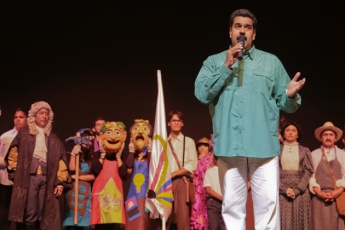
President Maduro at the Teresa Carreno Theatre in Caracas launching the Children’s and Youth Theatre Movement (Prensa Presidencial)
Merida – Yesterday the school program titled the “Cesar Rengifo” Children’s and Youth Theatre Movement was kicked off, as students returned to class for the new school year.
The program is being run initially in 135 Bolivarian schools in Caracas, and will gradually be expanded around the rest of the country.
Classes include body language, literature, oral narration, musical appreciation, acting, lighting, and theatre music.
“The idea is to awaken sensitivity, responsibility, and critical and creative thought in children, through theatre,” said the program’s coordinator, Pedro Lander.
Lander explained that actors, directors, theatrical designers, voice teachers, and playwrights have been called on to teach in the schools. He said that Cesar Rengifo’s plays will be used, as well as other local and international ones.
Cesar Rengifo, a playwright, poet, painter, and journalist, was born in Caracas on 14 May 1915, and died on 2 November 1980. He founded the theatre group Mascaras (Masks), was director of Cultural Extension of the University of the Andes, and he won a range of national prizes for his plays. His plays and paintings focused on life in Venezuela, petroleum, and the oppression of marginalised people and the working class.
Children will watch plays in the Teresa Carreño Theatre as part of their initiation into the subject.
“Today a movement is being started which will make history and will contribute to…achieving a peaceful country. A country of peace is a country which takes on the culture of life, the values of life, the love of life, and respect, as its fundamental values,” President Nicolas Maduro said at the official launch of the program yesterday in Caracas.
Related article
- Venezuelan School Year Begins with Free Books and Laptops (venezuelanalysis.com)
Venezuelan School Year Begins with Free Books and Laptops
By Ewan Robertson | Venezuelanalysis | September 16, 2013
Mérida – Around eight million pre and primary school children began the new Venezuelan school year today, with the government announcing the distribution of free textbooks and laptops to educational centres.
This year the government will distribute 35 million textbooks to state primary and high schools from its Bicentenary Collection, which covers the national curriculum. This marks an increase from last year when 30.75 million books were distributed under the system, and 12 million in 2011.
Venezuelan president Nicolas Maduro lauded the government’s preparations for the school year, stating on Saturday that policies were designed to provide “quality” education to all.
“To begin classes on Monday and take children to school, we’re going to begin handing out 35 million textbooks so that classes start with the best quality,” he said at an official event.
The government is also planning to distribute 5 million copies of the National Constitution to schools this term in order to raise awareness of the constitution’s contents and promote the values defended in its articles.
“This [Bolivarian] revolution can only be made if we fill it with love every day, if the passion of loves moves us; the purest love for our children, our parents…for our grandchildren, love for [late Venezuelan president Hugo] Chavez,” Maduro declared.
In the Venezuelan constitution, passed in a national referendum in 1999, education is described as “a human right and fundamental social duty; democratic, free, and obligatory” (Article 102). In practice education in Venezuela is free including at university level, while private educational institutions also exist.
The government will also distribute 650,000 free “Canaima” laptops to children from 1st to 6th grade this school term. A further 1.4 million will be handed out in 2014, bringing the total distributed since 2008 to 4 million.
Assembled in Venezuela, the Canaima laptops are manufactured as part of a cooperation agreement with Portugal.
Further, under the government social program “A Drop of Love for My School”, repairs were made to 1000 educational centres over the summer holidays.
The authorities of opposition controlled municipalities in the central state of Miranda also reported to have realised repairs to some schools in their areas in preparation for the new term.
Along with the distribution of materials and renovations to infrastructure, the Maduro government is launching a new children’s theatre scheme this school year. School pupils will experience a range of classes such as acting, lighting, oral narration, and music under the program, which is named after 20th century Venezuelan dramatist Cesar Rengifo.
Related article
- Theatre Program Launched in Venezuelan Schools to Create “Culture of Peace” (venezuelanalysis.com)
The Mysterious Death of a UN Hero
By Lisa Pease | Consortium News | September 16, 2013
Fifty-two years ago, just after midnight on Sept. 18, 1961, the plane carrying UN Secretary-General Dag Hammarskjöld and 15 others went down in a plane crash over Northern Rhodesia (now Zambia). All 16 died, but the facts of the crash were provocatively mysterious.
There have been three investigations into the crash: an initial civil aviation Board of Inquiry, a Rhodesian Commission of Inquiry, and a UN Commission in 1962. Not one of them could definitively answer why the plane crashed or whether a deliberate act had been responsible.

United Nations Secretary-General Dag Hammarskjold.
While a few authors have looked into and written about the strange facts of the crash in the years since the last official inquiry in 1962, none did a more thorough reinvestigation than Dr. Susan Williams, a Senior Fellow at the Institute of Commonwealth Studies at the University of London, whose book Who Killed Hammarskjöld? was released in 2011, 50 years after the crash.
Her presentation of the evidence was so powerful it launched a new UN commission to determine whether the UN should reopen its initial investigation. “It is a fact,” the current Commission wrote in its report, “that none of these inquiries was conducted to the standard to which a modern inquiry into a fatal event would be conducted….”
The Commission was formed by Lord Lea of Crondall, who assembled a group of volunteer jurists, solicitors and others from the Netherlands, South Africa, Sweden and elsewhere to tabulate and review the evidence the Commission collected from past investigations, Williams’s book, and independent witnesses, such as myself.
I was one of the 28 witnesses (and one of only three Americans) who provided testimony to the Commission, based on information gathered in the course of my research into the assassinations of the Sixties.
“It is legitimate to ask whether an inquiry such as this, a full half-century after the events with which it is concerned, can achieve anything except possibly to feed speculation and conspiracy theories surrounding the crash,” the most recent Commission wrote in its report.
“Our answer, and the reason why we have been willing to give our time and effort to the task, is first that knowledge is always better than ignorance, and secondly that the passage of time, far from obscuring facts, can sometimes bring them to light.”
The Congo Crisis
The report summarized the historical situation Hammarskjöld was faced with in 1961. In June of 1960, under pressure from forces in the Congo as well as from the United Nations, Belgium had relinquished its claim to the Congo, a move which brought Patrice Lumumba to power.
Lumumba faced a near civil war in his country immediately. The military mutinied, the Belgians stepped back in to protect Belgian settlers, and local leader Moise Tshombe declared Katanga, a mineral-rich province, an independent state.
As the Commission’s report noted, “Katanga contained the majority of the Congo’s known mineral resources. These included the world’s richest uranium and four fifths of the West’s cobalt supply. Katanga’s minerals were mined principally by a Belgian company, the Union Minière du Haut Katanga, which immediately recognised and began paying royalties to the secessionist government in Elisabethville. One result of this was that Moise Tshombe’s regime was well funded. Another was that, so long as Katanga remained independent of the Congo, there was no risk that the assets of Union Minière would be expropriated.”
The U.S. government feared that Katanga’s rich uranium reserves would fall under Soviet control if the nationalist movement that brought Lumumba to power succeeded in unifying the country. Indeed, rebuffed by Western interests, Lumumba did reach out to the Soviets for help, a move that caused CIA Director Allen Dulles to initiate CIA plans for Lumumba’s assassination. Lumumba was ultimately captured and killed by forces of Joseph Mobutu, whom Andrew Tully called “the CIA’s man” in the Congo just days before President Kennedy’s inauguration.
On the southern border of Katanga lay Northern Rhodesia, where Hammarskjöld’s plane would eventually go down, Sir Roy Welensky, a British politician, ruled as prime minister. Welensky, too, pushed for an independent Katanga. Along with the resources, there was also the fear that an integrated Congo and Katanga could lead to the end of apartheid in Rhodesia which might spread to its larger and more prosperous neighbor South Africa.
The British situation was divided, with the Under-Secretary of State for Foreign Affairs, Lord Landsdowne, backing the UN’s efforts at preserving a unified Congo, while the British High Commissioner to the Rhodesian Foundation, Lord Alport, was upset with the UN’s meddling, saying African issues were “better left to Europeans with experience in that part of the world.”
Similarly, U.S. policy appeared split in 1961. Allen Dulles and possibly President Dwight D. Eisenhower had worked to kill Lumumba just before President John F. Kennedy took office. But President Kennedy had been a supporter of Lumumba and fully backed the UN’s efforts in the Congo.
As the report notes, “There is evidence … of a cleft in policy between the US Administration and the US Central Intelligence Agency. While the policy of the Administration was to support the UN, the CIA may have been providing materiel to Katanga.”
So British, Belgian and American interests that weren’t always representative of their official heads of state had designs on Katanga, its politics and its resources. What stood in their way? The UN, under the firm leadership of Dag Hammarskjöld.
The UN forces had been unsuccessful in unifying the Congo, so Hammarskjöld and his team flew to Leopoldville on Sept. 13, 1961. Hammarskjöld planned to meet Tshombe to discuss aid, contingent on a ceasefire, and the two decided to meet on Sept. 18 in Ndola in Northern Rhodesia (now Zambia).
On Sept. 17, the last day of Hammarskjöld’s life, Neil Ritchie, an MI6 officer, went to pick up Tshombe and the British consul in Katanga, Denzil Dunnett. He found them in the company of a high-level Union Minière employee.
That night, Hammarskjöld embarked on the Albertina, a DC6 plane, and flew from Leopoldville to Ndola, where he was to arrive shortly after midnight. Lord Landsdowne, the British leader opposing a unified Congo, flew separately, although the report goes out of its way to say there was nothing sinister in them flying in separate planes and that this was “diplomatically and politically appropriate.”
A large group of diplomats, Africans, journalists and at least three mercenaries waited for Hammarskjöld’s plane at the Ndola airport. The Commission found the presence of mercenaries there strange as a police inspector was on duty specifically “to ensure nobody was at the airport who had no good reason to be there.”
The Crash
Hammarskjöld’s plane deliberately circumvented Katanga, fearing interception. The pilot radioed Ndola 25 minutes before midnight with an estimate that the plane was about 45 minutes from landing. At 12:10 a.m., the pilot notified the Ndola airport “Your lights in sight” and requested confirmation of the air pressure reading (QNH). “Roger QNH 1021mb, report reaching 6000 feet,” the airport replied. “Roger 1021,” the Albertina responded. That was the last communication received from Hammarskjöld’s plane. It crashed within minutes.
The Commission found the airport gave the plane correct information, that there was no indication the plane’s altimeter had been tampered with, that the landing gear had been lowered into the proper position and locked, and that the wing flaps had been correctly set. In other words, pilot error — the verdict of the initial Rhodesian inquiry into Dag Hammarskjöld’s death in 1962 — did not seem to be the likely cause.
At the crash site, several of the crash victims had bullets in their bodies. In addition, the Commission found “evidence from more than one source…that holes resembling bullet-holes were observed in the burnt-out fuselage.”
The Commission’s two aviation experts concluded the most likely cause of the crash seemed to be a “controlled flight into terrain,” meaning, no in-air explosion. This suggests someone deliberately or mistakenly drove the plane right into the ground. However, the report notes, this does not rule out some form of sabotage that could have distracted or injured the pilots, preventing a successful landing.
And the Commission noted contradictory evidence from a few eyewitnesses who claimed they saw the plane explode in mid-air. Another eyewitness, a member of the flight crew, found alive but badly burned, told a police inspector that the plane “blew up” and that “There was a lot of small explosions all around.”
The Commission interviewed African eyewitnesses who had feared coming forward years ago. One of them described seeing the plane on fire before it hit the ground. Another described seeing a “ball of fire coming on top of the plane.” Still another described a “flame … on top of the plane … like a ball of fire.”
Several witnesses saw a second plane near the one that crashed. One witness saw a second, smaller plane following a larger one, and told the Commission, “I saw that the fire came from the small plane…” And another witness also recalled seeing two planes in the sky with the larger one on fire. A third witness noted that he saw a flash of flame from one plane strike another. Several witnesses reported two smaller planes following a larger one just before the larger one caught fire.
A Swedish flight instructor described in 1994 how he had heard dialog via a short-wave radio the night of the crash. He recalled hearing the following from an airport control tower at the time of the crash: “He’s approaching the airport. He’s turning. He’s leveling. Another plane is approaching from behind — what is that?”
In one of the more bizarre elements of the case, Hammarskjöld’s body was not burnt, yet the other victims of the crash were severely burnt. The Commission concluded the most likely explanation, though not the sole one, was that Hammarskjöld’s body had been thrown from the plane before it caught fire.
And even more strangely, the commission found the evidence “strongly suggests” that someone moved Hammarskjöld’s body after the crash and stuck a playing card in his collar before the photographs of his body were taken. (The card “or something like it” was plainly visible “in the photographs taken of the body on a stretcher at the site.”)
Given the proximity of the plane to the airport, the Commission had a hard time explaining the nine-hour delay between the time of the crash and the Rhodesian authorities’ acknowledgement of its discovery of the wreckage.
While the Commission found a “substantial amount of evidence” that Hammarskjöld’s body had been “found and tampered with well before the afternoon of 18 September and possibly very shortly after the crash,” they also stated the evidence was “no more consistent with hostile persons assuring themselves that he was dead than with bystanders, or possibly looters, examining his body.” But the Commission also noted that “The failure to summon or send help, however, remains an issue.”
The Commission tried very hard to find the autopsy X-rays, as there were reports that a bullet hole had been found in Hammarskjöld’s head. But the X-rays appear lost forever.
Was Hammarskjöld deliberately assassinated?
Former President Harry S. Truman was convinced Hammarskjöld had been murdered. A Sept. 20, 1961 New York Times article quoted Truman as having told reporters, “Dag Hammarskjöld was on the point of getting something done when they killed him. Notice that I said ‘When they killed him.’”
Years later, when the CIA was revealed to have been engaged in assassination plots, reporter Daniel Schorr speculated that the CIA may have been involved in Hammarskjöld’s death.
The report references the report of David Doyle, the chief of the CIA’s Elizabethville base in Katanga who wrote in a memoir how three armed Fouga planes were being delivered to Katanga “in direct violation” of U.S. policy. Doyle doubted this was an official CIA operation, since he had not been notified of the delivery.
Bronson Tweedy, the head of the CIA’s Africa division, questioned Doyle about the possibility of a CIA operation to interfere with Hammarskjöld’s plane. The report notes that this could indicate a lack of CIA involvement in Hammarskjöld’s death, “unless, conceivably, Tweedy was simply trying to find out how much Doyle knew.”
It is the essence of CIA operations that they are highly compartmentalized and often kept secret between people even within the Agency itself. Meaning, Allen Dulles or someone high up the chain could easily have ordered a single operator to take out Hammarskjöld’s plane without using any official CIA channels. Indeed, that is what one would expect were so sensitive an operation as the assassination of a UN head contemplated.
After Lumumba’s death, in early 1961, the UN passed resolution 161, which urged the immediate removal of Belgian forces and “other foreign military and paramilitary personnel and political advisors not under the United Nations Command, and mercenaries” from the Congo.
Confession from a CIA operative
When I heard such a commission was forming, I reached out to Lord Lea of Crondall to offer some evidence of my own. John Armstrong, a fellow researcher into the JFK assassination, had forwarded me a series of Church Committee files and correspondence to and from a CIA operative named Roland “Bud” Culligan.
Culligan claimed the CIA had set him up on a phony bank fraud charge, and his way out of jail appears to have been to offer the Church Committee information on CIA assassinations (which he called “executive actions” or “E.A.’s”). Culligan was asked to list some “E.A.’s” that he had been involved in. Culligan mentioned, among high-profile others, Dag Hammarskjöld.
“Damn it, I did not want the job,” Culligan wrote to his legal adviser at Yale Law School. Culligan described the plane and the route, he named his CIA handler and his contact on the ground in Libya, and he described how he shot Hammarskjöld’s plane, which subsequently crashed.
As I testified, and as the Commission quoted in its report: “You will see from the correspondence that Culligan’s material was referred to an Attorney General, a Senator, and ultimately, the Senate investigation of the CIA’s activities at home and abroad that became known as the Church Committee after its leader, Senator Frank Church. Clearly, others in high places had reasons to believe Culligan’s assertions were worthy of further investigation.”
Culligan’s claims fit neatly with a broadcast allegedly heard by Navy Cmdr. Charles Southall, another Commission witness. The morning before the crash, Charles Southall, a naval pilot and intelligence officer, was stationed at the NSA’s facility in Cyprus.
At about 9 p.m. that night, Southall reported he was called at home by the communications watch officer and told to get down to the listening post because “something interesting” was going to happen that night. Southall described hearing a recording shortly after midnight in which a cool pilot’s voice said, “I see a transport plane coming low. All the lights are on. I’m going to make a run on it. Yes, it’s the Transair DC6. It’s the plane.”
Southall heard what sounded like cannon fire, then: “I’ve hit it. There are flames. It’s going down. It’s crashing.” Given that Cyprus was in the same time zone as Ndola, the Commission concluded it was possible that Southall had indeed heard a recording from Ndola. Southall was certain that what he heard indicated a deliberate act.
Bullets
Several witnesses described seeing bullet holes in the plane before it burnt. The report described one witness’s account that the fuselage was “’riddled with bullet-holes’ which appeared to have been made by a machine-gun.”
This account was disputed by AP journalist Errol Friedmann, however, who claimed no bullet holes were present. However, bullets were definitely found embedded in the bodies of several of the plane crash victims, which tends to give the former claim more credence.
The same journalist Friedmann also noted to a fellow journalist that the day after the crash, in a hotel, he had heard a couple of Belgian pilots who had perhaps had too much to drink discussing the crash. One of the pilots claimed he had been in contact with Hammarskjöld’s plane and had “buzzed” it, forcing the pilot of the Albertina to take evasive action. When the pilot buzzed the plane a second time, he forced it towards the ground.
A third-party account allegedly from a Belgian pilot named Beukels was investigated with some skepticism by the Commission. Beukels allegedly gave an account to a French Diplomat named Claude de Kemoularia, who evidently first relayed Beukels’s account to UN diplomat George Ivan Smith in 1980 (not long after Culligan’s 1975 account, I would note).
Smith’s source, however, appeared to be a transcript, about which the Commission noted “the literary quality of the narrative suggests an editorial hand, probably that of one or both of the two intermediaries.” Allegedly, Beukels fired what he meant to be warning shots which then hit the tail of the plane.
While Beukels’s alleged narrative matched several known facts, the Commission wisely noted, “there was little in Beukels’s narrative, as reported, that could not have been ascertained from press coverage and the three inquiries, elaborated by his experience as a pilot.” The Commission wrote of other elements which invited skepticism of this account, but did concede it’s possible this account was self-serving, designed to excuse a deliberate shooting down by Beukels.
The Commission’s recommendation
While the Commission had no desire to place blame for the crash, the report states: “There is persuasive evidence that the aircraft was subjected to some form of attack or threat as it circled to land at Ndola, which was by then widely known to be its destination,” adding “we … consider that the possibility that the plane was in fact forced into its descent by some form of hostile action is supported by sufficient evidence to merit further inquiry.”
The key evidence that the Commission thinks could prove or disprove a deliberate act would be the Ndola airport’s radio traffic that night. The Commission reported “it is highly likely that the entirety of the local and regional Ndola radio traffic on the night of 17-18 September 1961 was tracked and recorded by the NSA, and possibly also by the CIA.”
The Commission filed a Freedom of Information request for any such evidence with the National Archives but did not appear hopeful that such records would be released unless pressure was brought to bear.
In its discussion of Culligan, the Commission felt there were no leads there that could be pursued. But if any of Culligan’s many conversations with his legal adviser was captured on tape, and if tapes of the radio traffic cited above could be obtained, a voice match could be sought.
Based on its year-long investigation, the Commission stated that the UN “would be justified” in reopening its initial 1962 inquiry in light of the new evidence “about an event of global significance with deserves the attention both of history and of justice.”
[Regarding President Eisenhower’s possible role in ordering the assassination of Lumumba, Robert Johnson, a National Security Council staff member, told the Church Committee he heard Eisenhower give an order that Lumumba be killed. He remembered being shocked to hear this. Under questioning, however, Johnson allowed that may have been a mistaken impression, that perhaps Eisenhower was referring to Lumumba’s political, not physical, removal.]
Lisa Pease is a writer who has examined issues ranging from the Kennedy assassination to voting irregularities in recent U.S. elections.
Related article
- UN Asks for NSA Help in Reopening Investigation of 1961 Death of UN Secretary General Dag Hammarskjöld (alethonews.wordpress.com)
Lavrov: Russia convinced Syria chemical attack a “provocation”
A-Akhbar | September 17, 2013
Russia remains convinced that the August 21 poison gas attack in Syria was a provocation by rebel forces and says a report by UN inspectors does not answer all of its questions about the attack, Foreign Minister Sergei Lavrov said on Tuesday.
Speaking at a press conference alongside French Foreign Minister Laurent Fabius a day after UN inspectors confirmed the use of the nerve agent sarin, Lavrov took a different view to France and other Western states which say they believe that Syrian government forces were behind the attack.
“We have the most serious basis to believe that this was a provocation,” Lavrov said.
The foreign ministers said that they had the same aim of ending the bloodshed, but disagreed on the methods to get there.
Fabius said there was a “difference in the approach on the methods.”
(Reuters, AFP)
Related article
Palestinian teen ‘executed’ by Israeli forces in Jenin
By Saed Bannoura | IMEMC & Agencies | September 17, 2013
Palestinian medical sources have reported that a Palestinian youth was shot and killed by Israeli soldiers invading his home in the Jenin refugee camp, in the northern West Bank city of Jenin on Tuesday. Dozens of residents have been injured during ensuing clashes, and one was kidnapped.
The Maan News Agency has reported that a large Israeli military force invaded that camp, during late night hours, and that the soldiers broke into and violently searched dozens of homes.
The invasion led to clashes with local youths who hurled stones and empty bottles at the invading forces.
Medical sources said that resident Islam Husam Toubasy, 19, was shot by rounds of live ammunition fired at him by the invasion soldiers who broke into his home after detonating its door.
His family told Maan that, immediately after invading their property, the soldiers headed to the rooftop where Islam sleeps in his room, and shot him in the foot before dragging him onto the ground, taking him out of his home while he was heavily bleeding.
His brother, Kamal, stated that after the soldiers shot and injured Islam, and dragged him out of the home, undercover soldiers of the Israeli army shot him again, the Palestinian News & Info Agency (WAFA) has reported.
The army then moved him to the Al Khodeira hospital, inside the 1948 territories, where he died due to the massive bleeding he suffered as a result of his injury.
The family said that the soldiers forced them in one room, and that they saw Islam bleeding and unconscious before the soldiers took him away. The soldiers did not allow the family to help their son.
Army then withdrew from the camp, but re-invaded it, and the city of Jenin, in the morning, leading to clashes with dozens of local youths.
Eyewitnesses said that at least twenty armored Israeli military vehicles, and a military ambulance, invaded the area, leading to clashes with dozens of students heading to their school.
The soldiers fired more rounds of live ammunition, gas bombs and concussion grenades at the residents leading to several injuries.
One of the wounded, Nael Ghazzawy, 13, was shot by a live round in his leg while standing at the balcony of his home.
Soldiers also kidnapped a resident identified as Mohammad Bassam Al-Fayed, 21, and took him to an unknown destination.
It is worth mentioning that, in 2006, undercover soldiers of the Israeli army, shot and killed Ahmad, the brother of Islam, and demolished his home. Their brother Sa’id, is a political prisoner held by Israel after being sentenced to 32 years imprisonment by a military court.
Earlier on Tuesday, Israeli soldiers invaded various Palestinian communities in different parts of the occupied West Bank, and kidnapped at least nine Palestinians.
On Monday, Israeli soldiers kidnapped at least fifteen Palestinians, including a legislator, in different parts of the occupied West Bank.
The invasions are part of daily violations carried out by the army against the Palestinians and their property in different parts of occupied Palestine.
Related article
The settlers
By Melanie Ward | September 12, 2013
“They consider us as the enemy. These are extreme settlers.”
Hishem, a Palestinian, sits with us in the shade of an olive tree in front of his home in Wadi al Hussein, Hebron. His children are playing on the hill behind us, and directly behind them stands the vast Israeli settlement of Kiryat Arba. There, a man – a settler – is standing on his balcony watching us.

Hishem’s children play in the shadow of Israeli settlement Kiryat Arba
It is hard to know where to start when trying to explain the settlers of Hebron. They are at the heart of the problems here. One of my first encounters with them was on my second proper day of work, when I was walking down Shuhada Street and found myself on the wrong end of an egg thrown by a little settler boy of 7 or 8 years old. One of the local shopkeepers, Munir, has now nicknamed me ‘Umm Baydah’ or ‘Mother Egg’, for being the first of my group to be hit by one. He said “now you are a Palestinian”, and told me to start a tally count.
You might think, what kind of parents give their children things to throw at people walking down the street? But eggs are the least of it. Hishem’s extended family has been attacked, had their windows smashed, their homes set on fire and even been shot by their settler neighbours.
The settlers of Hebron are a religiously motivated group of Israeli Jews who occupy four areas, known as settlements, in the centre of H2 (Israel-controlled), Hebron, and two settlements in the Wadi where Hishem lives. They are known for their willingness to use violence, harassment and intimidation against those they perceive to be standing in the way of them achieving their goals, which are primarily to rid the city of Palestinians. The settlers never refer to Palestinians, always to Arabs because they deny that there was ever such a place as Palestine or such a people as the Palestinians. They say that the Palestinians should leave and go to one of “their own” Arab countries.

Graffiti on the outside wall of Cordoba School in H2 says “Gas the Arabs”
All settlements, including those in East Jerusalem, are illegal under international law. Every country in the world recognises this except Israel. From some of my stories so far, it might seem like there is one set of rules for Israelis and one for Palestinians. That’s because there actually is. In the West Bank the Israeli authorities enforce Israeli civil law on settlers, but military law on Palestinians.
The settlers believe in Eretz Israel – greater Israel – that Israel should permanently encompass the Palestinian territory of East Jerusalem, the Gaza Strip and the West Bank. These are the areas currently occupied and/ or controlled by the Israeli army. Some settlers believe that Israel’s borders should stretch even further afield than this into other countries. Their beliefs contradict all international understandings of where Israel’s borders should be.
These are the nuts and bolts of the daily battle being played out in H2. Everything is about who owns what, who can walk or drive where, even who can stand where. Hebron is the only city in the West Bank to have Israeli settlers living in its centre. The city is of religious significance because it is where Abraham and his sons and their wives lived, and are buried. It is the second holiest site for Jews, the fourth holiest site for Muslims, and is also of significance to Christians.
The settlers believe that they are doing God’s work in ridding Hebron of Palestinians, and dream of turning it into a Jewish city. But I don’t know of any God that would approve of their behaviour. Ironically, there tends to be most trouble on Friday nights and Saturdays – the Jewish Sabbath. One of my jobs is to be present whilst hundreds of settlers walk from Kiryat Arba through a Palestinian neighbourhood to pray at the synagogue on a Friday night. Dozens of extra soldiers are bussed in to protect them but some of the settlers carry their own rifles too. I find it quite bizarre, and certainly one of the least holy sights I have ever seen.

Armed settlers flanked by the Israeli army go to pray in Hebron on the Jewish Sabbath
On the Sabbath last week, a colleague from another international organisation saw a group of teenage settler girls spitting at a group of Palestinian girls on Shuhada Street. Again, not so holy. I met Nadar, Noocha and their family, who showed me their windows which were smashed by settlers. They live next to the synagogue in Hebron. A Palestinian I meet called Hani tells me he does not believe that the settlers follow the true Jewish faith.

Me with Meyar, Nadar and Noocha’s 4 year old daughter. Their windows have been smashed by settlers
The settlers seem to be willing to do almost anything to achieve their aims. This short film clip, from Israeli human rights organisation BT’Selem, first shows one of the settlers explaining things for herself, and then some of her actions. At least watch the first 2 minutes if you can – I’m pretty sure you’ll be shocked.
You might have noticed the solider standing by whilst the settler abuses her neighbour and then the solider pushing the Palestinian woman, rather than dealing with the settler children attacking her home. Palestinians often report that soldiers do nothing whilst settlers are on the attack. I have already seen for myself the close relations between many settlers and soldiers, with settlers bringing food and drinks to soldiers throughout the day, and even settler children playing in military watch points whilst soldiers are on duty there.
In March this year, the United Nations High Commissioner for Human Rights said,
“settler violence continues to be perpetrated with impunity… Israel needs to hold perpetrators accountable. While investigations are not opened into most incidents of settler violence, between 2005 and 2011, only 9 per cent of the investigations opened resulted in an indictment.”
Hani, Reema and their family live just past the caged house in that BT’Selem film clip, by the settlement of Tel Rumeida. They have to walk past the settlement and through the yard of an Israeli army base to get to their house. They can’t take a car to their house. They have been harassed and attacked by their neighbours many times. The settlers have even tried to burn down their home, and have come in the night to smash it up. About a month ago, they tried to burn down the family’s 300 olive trees for the ninth time, scorching the land, and making some of it impossible to harvest this year. Burning and chopping down olive trees is a common tactic of settlers across the West Bank.

Hani and Reema’s scorched olive trees, burnt by settlers a few weeks ago for the ninth time
“Aren’t you frightened?” I ask Reema and she replies, “At the start we were frightened but now we are used to it.”
One of our duties on the Sabbath is to spend time sitting on the roof of the Abu Shamsiya family’s home in H2. The flat roof of the family’s home backs onto Shuhada Street, and has a small Israeli army watchtower on it which does not appear to be used at present. From the roof you can look out across the city of Hebron, and down onto the family’s terrace below. The terrace has a cage around it to try and stop the family being struck by objects thrown by settlers on the roof. In the past, these objects have included eggs (they seem to be a favourite) and stones, and settlers have even urinated on them.

The Abu Shamsiya family’s terrace from their roof, where settlers come and attack them
So the reason for our presence is to deter settlers from coming onto the roof. The first time I sat there, we prevented three settler groups from coming onto the roof. A teenage boy in one of them had a rifle slung across his person. On Tuesday, we were unable to prevent one settler coming onto the family’s roof when we were there. He pointed at the view of the Palestinian city, “This is Israel” he said. ”It’s Palestine” I said. “Lo” (no) he said. Another group that my colleague saw gestured at the view of the Palestinian city and said “All of this will be Jewish”.
Virtually every Palestinian home in H2 has a kind of cage across the windows to try to guard against settler attacks. It is hard to get used to seeing children waving and shouting hello to us from behind these cages.

Children in H2 wave to us from behind the cage placed there to protect them from settlers
On Monday last week when I was doing the lunchtime school run (accompanying Palestinian children to Cordoba School down Shuhada Street) about 150 settlers, most of them teenagers, arrived apparently on some kind of tour. Remember – they can go anywhere in H2 but the Palestinians are very restricted as to where they can even walk. The settlers were congregating at the bottom of the school steps. When it came time for the kids to go home from school, many of them were scared to go down the stairs because of the settlers. I walked up and down the steps with them, to try to make them feel more secure, and it seemed to give them confidence to be able to get home. Although the truth is that I had no way of knowing whether the settlers would cause trouble. Luckily, the worst they did was to stare at us all, and shout and throw things at the feet of my male colleague who arrived to help me.
Not all Israeli settlers are religious extremists like those in Hebron. Some, who live in settlements in Palestinian East Jerusalem for example, are economically motivated. They are attracted by the housing subsidies that the Israeli government provides in many settlements.
Wherever they are located though, there is no doubt that the settlers and settlement expansion, are a major barrier to peace between Israel and Palestine.
Hani and his son have both spent time in prison for retaliating when settlers have attacked them. But Hani tells me that he now believes in non-violent resistance because it gets more positive results. He says it helps him to separate hatred for a policy from hatred for a people, and believes that it can help those in other countries, especially Jews, to see what is happening here.

Non-violent resistance at the Youth Against Settlements project: “They can pull out our trees but we will always plant more”
You might ask, how do the Palestinians put up with this? Why don’t they give up? How can they carry on living where they do, facing such violence and harassment on a daily basis? I asked a few of the people I met whether they would ever think of leaving,
“At the end of the day, it’s our right to our land,” says Hani.
“We are here, and we will stay here. This is our land.” says Hishem.
“We will stay here in a tent if we have to, we will not leave,” says another.
Many of them could not afford to go elsewhere, and where would they go anyway? Over 60% of the West Bank is directly under Israeli control. And many of them, like Hishem’s family, have already been refugees once from the time that the State of Israel was created. And why should they leave? As international law confirms, this IS their land.
But there is another reason, one which is about the Palestinians as a people.
The truth is that they must not leave if the dream of having a Palestinian state is ever to be realised. The settlers and the soldiers must not succeed in cleansing Hebron – or anywhere else in the West Bank – of Palestinians.
I hope that my presence here, and that of my EAPPI colleagues, somehow helps to make it a tiny bit easier for them to stay. One man tells me, “When settlers see people like you they are less likely to cause problems, especially on a Friday and Saturday.” And Hani says, “Before, we were alone as Palestinians with the Israelis but because of the internationals – people like you – we have witnesses to the violence of the settlers. This makes things a bit better for us.”
Just knowing that makes being here worthwhile.
Related articles
- Four young boys arrested and beaten in Hebron (alethonews.wordpress.com)
- Soldiers assault a twelve-year-old Palestinian while settlers invade family rooftop in Hebron (alethonews.wordpress.com)
- “Shabbat shalom” – no peace for Palestinians in Hebron this Saturday (alethonews.wordpress.com)
- Yom Kippur – Illegal Israeli settlers attack Palestinian farmer attempting to harvest almonds (alethonews.wordpress.com)
- Israeli settlers torch Hebron family’s property for eighth time (alethonews.wordpress.com)
The NSA Is Also Grabbing Millions Of Credit Card Records
By Tim Cushing | Techdirt | September 16, 2013
In addition to everything else it’s collecting, the NSA also has millions of international credit card transactions stashed away in its databases, according to documents viewed by Spiegel.
The information from the American foreign intelligence agency, acquired by former NSA contractor and whistleblower Edward Snowden, show that the spying is conducted by a branch called “Follow the Money” (FTM). The collected information then flows into the NSA’s own financial databank, called “Tracfin,” which in 2011 contained 180 million records. Some 84 percent of the data is from credit card transactions.
On one hand, what the NSA is doing is exactly what the NSA should be doing: tracing the money flow of terrorist organizations.
Their aim was to gain access to transactions by VISA customers in Europe, the Middle East and Africa, according to one presentation. The goal was to “collect, parse and ingest transactional data for priority credit card associations, focusing on priority geographic regions.”
This is part of the Terrorist Finance Tracking Program, which was set up shortly after the 9/11 attacks and gave the US government access to the SWIFT (Society for Worldwide Interbank Financial Telecommunication) database. This, in and of itself, is not news, having been exposed in 2006. Documents uncovered then showed the program had been in place since 2002, with permission extended to the CIA and the Treasury Dept. as part of Bush’s “Global War on Terror.”
What is new, however, is the fact that the NSA is targeting transactions from major credit card companies, like VISA. This has quite a bit more potential for misuse than SWIFT, which records only banking transactions. VISA responded to this new information with the same quasi-denial we’ve seen from several other companies whose links to the NSA have been exposed.
“We are not aware of any unauthorized access to our network. Visa takes data security seriously and, in response to any attempted intrusion, we would pursue all available remedies to the fullest extent of the law. Further, its Visa’s policy to only provide transaction information in response to a subpoena or other valid legal process.”
Of course, this isn’t “unauthorized” access, not when gathered with a court order or subpoena. But this isn’t as tightly controlled as the spokesperson makes it appear. If pursuing data for “counterterrorism” purposes, the NSA is allowed to skirt the protections of the Right to Financial Privacy Act, thanks to an amendment in the PATRIOT Act. But even with these legal options, it appears the NSA would still rather pursue this in an extralegal fashion in order to circumvent the warrant process.
NSA analysts at an internal conference that year described in detail how they had apparently successfully searched through the US company’s complex transaction network for tapping possibilities.
Whatever’s happening now appears to be the NSA grabbing more data simply because it can. It’s not as if it didn’t already have access copious amounts of financial data, thanks to the government’s fully legal (and fully public) collection of bulk financial records through SWIFT.
Remember: in addition to stealing the data, Treasury also gets it via a now-public agreement. The former CEO of SWIFT Leonard Schrank and former Homeland Security Czar, Juan Zarate actually boasted in July, in response to the earliest Edward Snowden revelations, about how laudable Treasury’s consensual access to the data was.
“The use of the data was legal, limited, targeted, overseen and audited. The program set a gold standard for how to protect the confidential data provided to the government. Treasury legally gained access to large amounts of Swift’s financial-messaging data (which is the banking equivalent of telephone metadata) and eventually explained it to the public at home and abroad.
It could remain a model for how to limit the government’s use of mass amounts of data in a world where access to information is necessary to ensure our security while also protecting privacy and civil liberties.”
Never mind that by the time they wrote this, an EU audit had showed the protections were illusory, in part because the details of actual queries were oral (and therefore the queries weren’t auditable), in part because Treasury was getting bulk data. But there was a legitimate way to get data pertaining to the claimed primary threat at hand, terrorism. And now we know NSA also stole data.
Even when the government has an advantageous agreement to collect bulk data with little oversight, its agencies can’t help but exploit this even further. The collection via “oral queries” is another indicator of these agencies’ (FBI, NSA, CIA) unwillingness to follow even the most minimal of rules. (See also the administration’s 2010 ruling that made the FBI’s warrantless wiretapping legal, which occurred after the agency’s process had slid from issuing tons of National Security Letters to simply calling up the telcos and requesting records.)
The untargeted collection of financial data has raised concerns from those on the “collection” side.
[E]ven intelligence agency employees are somewhat concerned about spying on the world finance system, according to one document from the UK’s intelligence agency GCHQ concerning the legal perspectives on “financial data” and the agency’s own cooperations with the NSA in this area. The collection, storage and sharing of politically sensitive data is a deep invasion of privacy, and involved “bulk data” full of “rich personal information,” much of which “is not about our targets,” the document says.
When even the spies are concerned about about how much data their spy programs are netting, that’s a pretty good sign a bulk records collections effort has gone too far. And it has deeper implications than simply a massive amount of privacy violations. As Marcy Wheeler points out, even the then-Fed chairman Alan Greenspan expressed his concerns about the breadth of the SWIFT collections.
If the world’s financiers were to find out how their sensitive internal data was being used, he acknowledged, it could hurt the stability of the global banking systems.
That’s a scary thought, considering the “global banking system” isn’t all that stable to begin with. A lack of targeting will leave the NSA open to more accusations of economic espionage, something clearly not related to its supposed “national security” agenda.
Related article
UK new forced conscription bill: a look
Press TV – September 16, 2013
The British government has launched a new debate on reintroducing mandatory National Service, or conscription, for the 18 to 26-year-olds, 50 years after the last conscripted British soldier ended his service.
The bill was tabled by Conservative MP Philip Hollobone, who said the service can inspire young people with “self-respect, personal reliance, discipline and behavior.”
The legislation was introduced to the parliament for debate on June 24, which is considered its first reading though no debate took place at that stage.
MPs are expected to hold a second reading debate on the bill on February 28, 2014.
The bill predicts the introduction of a year-long charitable or military service that could involve care for the elderly or the disabled, work for the emergency services or service in the armed forces with a necessary “residential element” that requires participants to live away from their homes.
“Every individual who has attained the age of 18 years, and who has not attained the age of 26 years, shall be liable to serve one year of national service at some point between these years unless exempt,” the bill reads.
“Regulations shall provide that the scheme must extend the scope of the National Citizen Service and include the following elements,” it adds.
The bill, if voted into law, makes it a criminal offense to skip National Service.
The reference in the text of the proposed law to the National Citizen Service (NCS), which was introduced by Prime Minister David Cameron for the 16 and 17-year-olds in 2010, raises suspicion that the Conservative-Liberal Democrat coalition government has been planning to reintroduce the long-forgotten National Service early after taking office.
NCS is now in full swing in England and offers voluntary short-time tours for individuals to take part in team projects away from home to help their community.
London first introduced conscription during the First World War in 1916, which lasted until 1919.
Another forced service was launched in 1939 at the beginning of the Second World War, continuing until 1960, with the last conscripted soldiers ending their service in 1963.
The recruitment was named War Service or Military Service during the wars and National Service, as formulated by the National Service Act 1948, between 1948 and 1960.
The second national service period that started in 1939 lasted beyond the World War II (1939-1945) partly because of Britain’s involvement in the Korean War of the 1950’s.
That could be adequate precedence for the British public to fear a decade of military adventurism, including the wars in Afghanistan, Iraq and Libya – not to mention the saber-rattling against Syria — has triggered the renewed call for a national service.
Indeed, the public opposition to the bill emerged from the very onset after an e-petition was launched demanding the government to “stop the National Service Bill 2013-2014”. The petition has already collected over 27,000 signatures.
It rejects the mandatory service as “unacceptable”, calling on the government to reject the bill “in its entirety” and “reassure us that non voluntary service and any residential or military style training, or service, will always be a freedom of choice”.
Under the Coalition agreement any e-petition attracting more than 100,000 signatures becomes eligible for a Commons debate.
The public concern over the new initiative has been clearly reflected in the e-petition.
“We do not want our children and grandchildren to fight and die in wars, or in training that they or we have no control over,” the petition says.
There are also concerns that the forced conscription is against the idea of a free society as compulsory recruits will have to spend a year in service with minimum wage at the end of their high school or college, when they could rather start a job or begin university education in anticipation of a difficult future amid Britain’s economic woes.
Related articles
Featured Video
Theodore Postol: Iran’s Missiles & Drones Were Underestimated
or go to
Aletho News Archives – Video-Images
From the Archives
What is the Israeli Lobby in Australia Doing in Interfaith Dialogue?
By Ali Kazak | Dissident Voice | October 11, 2015
For years Israel and its lobby around the world have been trying to normalise their relations with Arabs and Muslims without solving the Palestine Question.
One of the methods they resorted to in the last few years is using human rights and community organizations such as interfaith dialogue and Multiculturalism to achieve this objective and to: isolate the Palestinians, marginalise the Palestine question, end Israel’s isolation, and prevent criticism of Israel, knowing that these organisations will be the first to stand against Israel’s violations, racial and religious discrimination.
The group responsible for this task in Australia is The Australia/Israel & Jewish Affairs Council (AIJAC); its Director of International & Community Affairs, Jeremy Jones is in charge of lobbying religious community organizations, specifically Muslims and Christians. Consequently he convened the Faith Communities for Reconciliation, founding participant in the Australian Partnership of Religious Organisations and the Australian National Dialogue of Christians, Muslims & Jews.
AIJAC is a private political propaganda group. It is recognised as the main Israeli lobby in Australia. It coordinates its activities and works intimately with the Israeli embassy in Canberra and different institutions in Israel. It is privately funded by some Jewish businessmen. It monitors closely Australian politicians, the media, ethnic and religious groups, (especially Arabs and Muslims), unions and academics on their stands towards Israel and the Palestine question. … continue
Blog Roll
 Aletho News
- The killing of three Indonesian soldiers in Lebanon should remind Jakarta that Israel does not want peace
- Defeated and delusional: Netanyahu’s remarks reveal $80bn war failure, says analyst
- Iran’s friends are about to make life much more difficult for Israel and the US
- The war of liberation of the Arab and Islamic peoples expands across the Gulf
- Envoy warns UN on Trump’s threat to ‘obliterate’ Iran’s civilian infrastructure
- The Larak Corridor: Iran’s Rial Gate With No US, No Israel, and No Way Around
- ‘Economic terrorism’: Steel facilities hit again in US-Israeli strike
- ‘War Crime’: Iran condemns attacks on Arak, Ardakan nuclear sites
- Two-thirds of Americans want quick end to Iran war even if goals unmet
- Trump to Give “Important Update on Iran” Wednesday in Prime-Time Speech
- If Americans Knew
- Israel wants US to bomb more of Iran’s civilian structures (113,000 is not enough) – Not a ceasefire Day 173
- Ann Coulter Rips Into Fox News for Iran War Coverage
- Joe Kent Urges Americans To Call White House and Congress To Object To Sending Troops Into Iran
- DNC Resolution to Reject AIPAC Funding Puts Democratic Leaders in the Hot Seat
- Swedish foundation to build 400 schools as over 650,000 Gaza children remain without education for 2 years
- Israeli army admits photshopping image of slain Lebanese journalist
- This is how Israel is systematically killing health workers under the cover of war in Lebanon
- Carrying life under fire: Israeli invasion of Lebanon leaves pregnant women facing deadly risks
- Champagne all around for the new death penalty (for Palestinians) law – Not a ceasefire Day 172
- Why are Palestinian books struggling to be seen on Amazon?
- No Tricks Zone
- New Study Finds Warming Saves Lives…Cold Temperatures 12 Times More Deadly Than Excess Heat
- German Science Blog Accuses PIK Climate Institute Of Hallucinating Climate Tipping Points
- Devastating Assessment Of Comirnaty Vaccine By Former Senior Pfizer Europe Toxicologist
- New Study: CO2 Is ‘Effectively Negligible’ As An Explanatory Climate Change Factor Since 2000
- Former Pfizer Toxicologist Dr. Helmut Sterz Tells Bundestag Hearing Pfizer Vaccine Should Have Never Been Approved
- Energy Expert: Germany’s Nuclear Phaseout Was A “500 Billion Euro Mistake”
- New Research: South Australia’s Mid-Holocene Sea Surface Temperatures Were 4°C Warmer Than Today
- Storing Green Energy To Last Germany 10 Days Would Require A 60-Million Tonne Battery
- New Studies: UK Sea Levels Were 4 Meters Higher Than Today During The Mid-Holocene
- Destructive Green New Deal: German Energy And Metal Group Warns Of Drastic Crisis
 Aletho News