US to test nukes on same day UN holds nuke disarmament meeting
Press TV – September 20, 2013
The United States is planning to test nuclear missiles next week on the same day that heads of states and foreign ministers from around the world are to hold a high-level meeting on nuclear disarmament at the United Nations headquarters in New York.
The US has scheduled two test launches for its nuclear-capable Intercontinental Ballistic Missiles (ICBMs) on September 22 and September 26.
The first nuclear missile will be launched one day after the International Day of Peace and the second one is expected to be launched on the same day the UN’s high-level meeting on nuclear disarmament will take place in New York.
“Instead of honoring the significance of these dates and working in good faith to achieve nuclear disarmament, the United States has chosen to schedule two tests of its Minuteman III Intercontinental Ballistic Missile on September 22 and September 26,” Rick Wayman of the Nuclear Age Peace Foundation told the Daily Times.
“We are disappointed that a test launch is scheduled for the same day as the High-Level Meeting on nuclear disarmament at the UN in New York,” Wayman said.
“These missiles are designed to carry nuclear warheads capable of killing thousands of times more people than the chemical weapons used in Syria,” he pointed out.
Washington has accused the government of Syrian President Bashar al-Assad of using chemical weapons in an attack near capital Damascus on August 21.
Damascus has categorically rejected the allegations and even Obama’s top aide, White House chief of staff Denis McDonough, admitted that Washington’s claims were based on a “common-sense test” not any “irrefutable” evidence.
Meanwhile, Russia has said it has evidence which shows militant groups operating in Syria staged the August 21 attack to incriminate the Syrian government.
As Washington plans to go ahead with its plans to test nuclear missiles next week, UN spokesperson Farhan Haq cited the UN Secretary General’s statement on the issue which said, “We should all remember the terrible toll of nuclear tests.”
The US is the only country in the world that has used atomic bombs in war. US atomic bombs were dropped on Hiroshima and Nagasaki in Japan in August 1945.
Last year in September, it was reported that the US government was planning to undertake the costliest modernization of its nuclear arsenal in history.
Obama’s Grotesque Hypocrisy over Cluster Munitions
By Dave Lindorff | This Can’t be Happening | September 19, 2013
Syrian civilians and children should count themselves lucky that mass opposition in the US, the UK and much of the rest of the world to the idea of a US bombing blitz aimed at punishing the Syrian government for allegedly using Sarin gas in an attack on a Damascus neighborhood forced the US to back off and accept a Russian deal to get rid of Syria’s chemical weapons.
Had the US attacked, primarily with a two- or three-day barrage of Tomahawk missiles, many of those rockets would likely have carried warheads containing BLU-97 cluster munitions, according to the United States Campaign to Ban Cluster Munitions — cluster bombs that would have assuredly killed or maimed many Syrian children.
This news should come as no surprise. The US made heavy use of deadly body-shredding cluster munitions in its invasion of Iraq in 2003 and during the subsequent bloody war and occupation there, as well as in its invasion of Afghanistan in 2001. Some 30 tons of cluster bombs were dropped or fired into urban neighborhoods of Iraq during the first few weeks alone of the 2003 US invasion of that country. Another 250,000 antipersonnel bomblets were dropped or fired into Afghani neighborhoods during the 2001-2002 US invasion of that country.
The US Campaign to Ban Cluster Munitions notes that the last documented US use of cluster munitions was in 2009. The organization writes that was:
“…in Yemen, when one or more Tomahawk cruise missiles loaded with BLU-97 bomblets struck the hamlet of al-Majala in the southern Abyan province. The strike killed at least 41 civilians and at least four more civilians were killed and 13 wounded by unexploded bomblets after the attack. Four years later, the site of the attack remains contaminated by cluster munition remnants.”
In fact, cluster weapons, whether bombs dropped from planes, warheads fired by missiles, or shells fired by cannons or tanks, are among the deadliest and most untargetable weapons devised by man, holding the distinction of being particularly lethal to civilians and children. They work by having a larger bomb, warhead or shell deliver a payload of smaller “bomblets” to a target (each Tomahawk cluster warhead contains 166 of the lethal bomblets). These casings burst open, releasing the small devices, either on the ground, or lowered by little parachutes. Many burst on impact, sending small deadly spinning flechettes out in all directions to tear the flesh off of bones, maiming and killing anyone in the vicinity, while others routinely fail to explode, and then lie around, sometimes for years, until someone steps on one, or a child picks it up to see what it is. (Unexploded BLU-97s look like cardboard drink containers and are bright orange.)”’
I remember a visit to Laos in 1995. It had been over two decades since the US had been relentlessly bombing that small peasant country day and night, primarily with anti-personnel bombs, and the country seemed to have returned to its tranquil past. But walking around the sleepy capital city of Vientiane, I was puzzled at seeing a surprising number of young children of varying ages hobbling around on crutches with one and sometimes parts of two legs missing, or arms missing, often with faces disfigured. I asked a Lao official why there were so many such kids, and he explained they were victims of the “bombis” — small fragmentation bomblets dropped by US forces in the secret war on Laos that had not exploded, and that remained buried in farmers’ fields until found or inadvertently disturbed by peasants or, more often, children working or playing. (The US has refused to help locate and clear these relics of war, claiming, ridiculously, that the Communist Laotian government is still secretly holding captured US soldiers–a position that the then US ambassador shamefacedly admitted to me was nonsense, but that was dictated by right-wingers holding onto the myth of long-suffering MIAs “abandoned” in Southeast Asia.)
When President Obama went on national television on Tuesday, Sept. 10, and passionately evoked images of suffering Syrian children dying on hospital floors from a Sarin attack in Damascus, he might have looked sincere to some, but most of those US viewers probably didn’t realize that as commander in chief, he was asking them to support a bombardment of Syria which would have likely included thousands of similar bomblets that he surely knows would inevitably end up, over time, killing far more children in far more horrible ways than the Sarin attack that was his casus belli.
According to experts, 98% of the victims of cluster bombs are civilians, not soldiers (as horrible as the deaths or maiming of even soldier-targets are from these insidious weapons). And 40% of the victims are children.
Since 2008, there has been a UN Convention against the use of cluster weapons. It has been signed by 112 nations, 83 of which have ratified it. The US is a key holdout, along with China, Israel, Pakistan and Russia. The US in fact, not content to simply not sign the convention, is arguing strenuously against the treaty, claiming that its bomblets, at least by 2018, will boast a 1% failure rate, and thus supposedly would not pose the danger of leaving unexploded, attractive or interesting-looking bomblets scattered around the landscape for months or years, waiting to be picked up by curious children. It’s an absurdly low failure rate the government is claiming, and is also wholly unprovable. (At least the US is consistent; it also refuses to sign a Convention banning landmines, which kill many civilians in the same way as antipersonnel bomblets.) Critics of the cluster munitions, like the US Campaign to Ban Cluster Weapons, say the failure rate of current US weapons like the BLU-97, the most common cluster anti-personnel device used by US forces, is closer to 30%. Besides, as demonstrated by the Yemen Tomahawk attack, a lot of the killing and maiming of civilians and children by cluster weapons happens when the bomblets explode as planned and “on target.”
Talk about brazen hypocrisy! A child killed or injured by Sarin gas is an atrocity, to be sure. But so is a child whose body is turned into chopped meat, or who is painfully rendered limbless by an exploding BLU-97 weapon. Worse yet, the US has had the audacity to accuse the Syrian government of an atrocity for allegedly using cluster weapons, voting earlier this year in the UN to condemn Syria for use of a weapon which the US used liberally in its wars against Iraq and Afghanistan, and in massive amounts in Indochina, and which it stockpiles and continues to design for more lethality and destructiveness for future use by American forces, including in Syria. (The US also sells these horrific weapons of child destruction to its “allies,” including countries ruled by dictators, like Saudi Arabia, which notably is known to be supplying arms to Syrian rebels.)
Of course, Americans themselves can be hypocritical about this stuff. Much horror was expressed after the Boston Marathon bombing over the use of BB pellets in the home-made pressure cooker bombs alleged to have been used, which killed several and lacerated the bodies of others. “How could people be so evil,” many asked. And yet the US provides its military with weapons that are far more efficient at shredding bodies, using taxpayer money, and has done so for decades, with few Americans expressing outrage, even at the carnage the weapons cause among children. Some 270 million cluster bombs were dropped on Indochina between 1964-73, 80 million of which failed to explode and remain to pose a threat to civilians today.
Textron Defense Systems, the maker of the most widely used cluster bomb in the US arsenal, which contains the BLU-97 bomblets, and which is being sold by the US to Saudi Arabia and other “allies,” offers this marketing motto for its deadly product: “Clear victory, Clear battlefield.” Given that most of the “battlefields” these days are urban areas, not classic battle fronts, the “clear battlefield” concept bodes ill for civilians and children.
Obama would be standing on stronger ground in demanding that Syria’s government eliminate its stocks of poison gas, if the US would sign onto the UN’s 2008 Convention on Cluster Munitions. His call for Americans to stand against the use of poison gas weapons by the Syrian government would not ring so hollow if he ordered the US military to destroy its massive stockpiles of cluster weapons, and vowed never to use them again.
Related articles
- US shipping thousands of cluster bombs to Saudis (counterpsyops.com)
Iran urges restructuring of IAEA
Press TV – September 20, 2013
Iran’s Ambassador to the International Atomic Energy Agency (IAEA) Reza Najafi has called for the restructuring of the UN nuclear agency.
Addressing the 57th regular session of the IAEA General Conference in the Austrian capital of Vienna on Thursday, the Iranian envoy called for an increase in the number of the members of the agency’s Board of Governors as well as a revision of the make-up of the permanent seats at the UN body.
“While the General Conference consists of all member states and the Board of Governors has a limited [number of] members, there is no appropriate balance between the powers and duties of these two bodies, and the decisions made at the General Conference are mainly subject to the approval or prior recommendations of the Board of Governors,” Najafi said.
It is necessary to discuss the issue of striking a balance between the prerogatives and responsibilities of the two bodies, he stressed.
The Iranian ambassador proposed the formation of a consultative group comprising all members to discuss the above-mentioned proposals and make appropriate recommendations in that regard.
A number of other envoys to the IAEA including those from Cuba, Venezuela, Pakistan, Algeria, Ecuador, Nicaragua, Egypt and Lebanon expressed support for Iran’s proposals.
Bolivia plans legal action against Obama over ‘crimes against humanity’
Press TV – September 20, 2013
Bolivia’s President Evo Morales plans to file legal action against the US president for crimes against humanity, condemning Washington’s intimidation tactics after it denied Venezuelan presidential jet entry into US airspace.
“I would like to announce that we are preparing a lawsuit against [US President] Barack Obama to condemn him for crimes against humanity,” President Morales announced at a Thursday press conference in the Bolivian city of Santa Cruz, RT reports.
He further described the American president as a “criminal” who willingly violates international law.
“The US cannot be allowed to continue with its policy of intimidation and blockading presidential flights,” Morales stated.
He added that Bolivia intends to prepare legal action against the US president and file the lawsuit at the International Court.
President Morales has called for an emergency meeting of the Community of Latin American and Caribbean States (CELAC) to confer about the US action, which has been slammed by Venezuela as “an act of intimidation by North American imperialism.”
Additionally, the Bolivian president has implied that the CELAC members should recall their ambassadors from Washington in an effort to convey a strong message to the Obama Administration.
According to the report, Morales further wants to urge member nations of the Bolivarian Alliance for the Americas to boycott the next meeting of the United Nations in New York.
Members of the Alliance include Antigua and Barbuda, Cuba, Dominica, Ecuador, Nicaragua, Venezuela and Saint Lucia.
The anti-US measures called by the Bolivian president comes just months after Morales’s presidential aircraft was denied entry into several Western European countries, forcing it to land in Austria.
The May 2013 incident was widely described as a US-led effort out of a false suspicion that American spy agency whistleblower Edward Snowden may be onboard the aircraft.
At the time Bolivia was among a few countries that offered political asylum to Snowden, a US fugitive and former contract employee of American spy agencies, CIA and NSA, who leaked documents showing massive US electronic spying operations around the globe, including its European and Latin American allies.
Several Latin American heads of state joined Bolivia to censure the illegal move by the European countries, including Italy, France and Spain, which led to their official apologies.
Related article
Venezuelan President Denied Travel through US Airspace
RT | September 19, 2013
Venezuelan Foreign Minister Elias Jaua told media that an aircraft carrying President Nicolas Maduro was denied a path over Puerto Rico’s airspace.
President Maduro’s flight, which was to depart for China, was forced to find an alternate flight path according to Jaua, who denounced the act as “an act of aggression.”
“We have received the information from American officials that we have been denied travel over its airspace,” Jaua said, speaking to reporters during an official meeting with his South African counterpart.
“We denounce this as yet another aggression on the part of North American imperialism against the government of the Bolivarian Republic,” he added.
“No one can deny airspace to a plane carrying a president on an international state visit.”
There is “no valid argument” for denying travel through American airspace, Jaua said, adding that he expected the US to rectify the situation.
President Maduro was due to arrive in Beijing this weekend for bilateral talks with the Chinese government. Jaua was adamant that the Venezuelan leader would reach his destination, regardless of any perceived interference.
Though the US has yet to issue an official response, the latest incident will likely add to already strained relations between the two countries.
In July, the Venezuelan president announced that his government was halting attempts to improve relations with the US. The move was in response to comments made by the newly appointed US Ambassador to the UN, Samantha Power, who told a Senate committee that her new role would include challenging the “crackdown on civil society” abroad, including in Venezuela.
Relations under former President Chavez had been acrimonious, as he had long held suspicions that the US had actively intervened on behalf of an attempted coup in 2002. Since his election in April, President Maduro has often made pointed criticisms at alleged US interference in Venezuelan affairs.
Bolivian President Evo Morales, whose own plane was grounded this summer allegedly due to suspicions by US authorities that the aircraft was transporting whistleblower Edward Snowden, said that ALBA bloc nations should consider a boycott of the upcoming UN General Assembly in New York as a response.
“We cannot accept that the US carries on with politics of intimidation and the prohibition of flights by presidents,” said Morales, adding that the latest incident “demonstrates the country’s predisposition to humiliate other governments” and commit crimes against other nations.
Dispute over visas ahead of UN summit
The Venezuelan President also spoke of attempts by the US to set “conditions” on a visa issued to General Wilmer Barrientos, one of Maduro’s ministers who is slated to attend meetings during the UN General Assembly next week.
“They want to put conditions, if we decide to go to New York… They don’t want to give a visa to my minister,” said Maduro. “Do we want to go as tourists? We’re going to the United Nations. You’re obligated to give visas to all the delegation.”
Appearing via the television network TeleSUR on Thursday, Maduro indicated that he had directed his foreign minister, Elías Jaua, and Venezuela’s Ambassador to the UN, Samuel Moncada, to “activate all mechanisms” in reference to the visa dispute.
“US, you are not the UN’s owner. The UN will have to move out of New York,” remarked Maduro.
He warned that if he has to take “measures” against the government of the US, he would be prepared to take “the most drastic measures necessary” to ensure Venezuelan sovereignty.
The coming crisis of climate science?
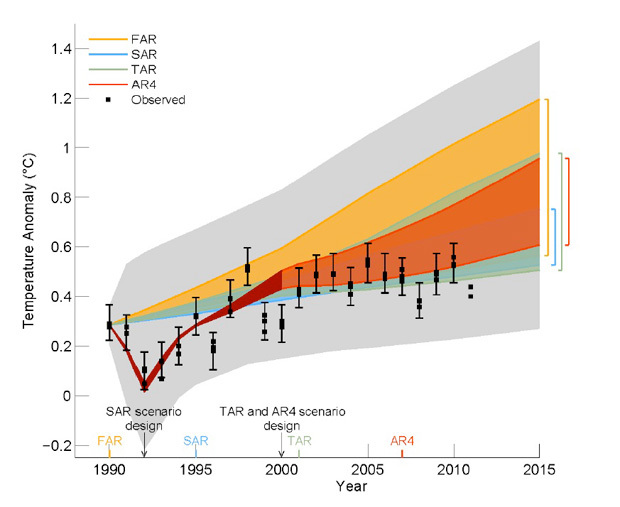
Figure 1.4 from Chapter 1 of a draft of the Fifth Assessment Report from the Intergovernmental Panel on Climate Change. Initials represent the First Assessment Report (FAR) in 1990, the Second (SAR) in 1995. Shaded banks show range of predictions from each of the four climate models used for all four reports since 1990. The last report, AR4, was issued in 2007. The black squares, shown with uncertainty bars, measure the observed average surface temperatures over the same interval. The range of model runs is indicated by the vertical bars. The light grey area above and below is not part of the model prediction ranges.
By Reiner Grundmann | September 19, 2013
With the fifth assessment report soon to be released by the IPCC the pre-publication buzz is well underway. A while ago unauthorised drafts circulated in the blogosphere and now the official leaks have found their way into news editing rooms. A central question picked up by most commentators is the ‘pause in global warming’, the ‘stagnation’, or the ‘hiatus’.
An anomaly presents itself for climate science in that model projections about future temperature increases do not concur with actual temperature observations. As expected, comments align with the agendas of the commentators, depending if one wants to defend the official modelling output or criticise it. These agendas are closely linked to policy options and the question if a lower observed temperature trend provides justification for political action on greenhouse gas emissions.
On this blog Hans von Storch expressed optimism as regards the ability of climate science to deal with this anomaly: ‘Eventually, we need to evaluate the different suggestions, but that will need time. No doubt that the scientific community will achieve this.’ Others are quick to pronounce climate science bunk. David Rose wrote in the Daily Mail ‘A leaked copy of the world’s most authoritative climate study reveals scientific forecasts of imminent doom were drastically wrong.’ Hayley Dixon in The Telegraph put it less blatant but still succinct in her opening sentence: ‘A leaked draft of a report by the UN Intergovernmental Panel on Climate Change is understood to concede that the computer predictions for global warming and the effects of carbon emissions have been proved to be inaccurate.’
Of course, both papers are on the political right and often skeptical about efforts to curb greenhouse gas emissions. It seems as if this topic is inconvenient for the left leaning papers who support action on climate mitigation. The Guardian so far is silent on the issue and prefers to write about new record lows of Arctic Ice coverage. When it looked last at this issue, Fiona Harvey bolstered the heat uptake by the oceans as explanation for the pause in global warming, thus doing away with a potential anomaly. At the same time she claims that climate scientists point out ‘that the trend is still upwards, and that the current temperature rises are well within the expected range.’ A quick glance at the graph above shows this is an illusion (the grey upper and lower bands are not part of the model prediction range).
Both the Mail and Telegraph quote Myles Allen (Oxford University) who tries to put the IPCC and its work into perspective. Says Allen: ‘we need to look very carefully about what the IPCC does in future… It is a complete fantasy to think that you can compile an infallible or approximately infallible report, that is just not how science works. It is not a bible, it is a scientific review, an assessment of the literature. Frankly both sides are seriously confused on how science works – the critics of the IPCC and the environmentalists who credit the IPCC as if it is the gospel.’
The Mail quotes Judy Curry (Georgia Institute of Technology) saying it makes ‘no sense that the IPCC was claiming that its confidence in its forecasts and conclusions has increased. For example, in the new report, the IPCC says it is ‘extremely likely’ – 95 per cent certain – that human influence caused more than half the temperature rises from 1951 to 2010, up from ‘very confident’ – 90 per cent certain – in 2007. Prof Curry said: ‘This is incomprehensible to me’ – adding that the IPCC projections are ‘overconfident’, especially given the report’s admitted areas of doubt.’
Both Allen and Curry call for a radical reform of the IPCC with Curry being more specific: ‘The consensus-seeking process used by the IPCC creates and amplifies biases in the science. It should be abandoned in favour of a more traditional review that presents arguments for and against – which would better support scientific progress, and be more useful for policy makers.’
Meanwhile in the Financial Post, Ross McKitrick wrote: ‘As the gap between models and reality has grown wider, so has the number of mainstream scientists gingerly raising the possibility that climate models may soon need a bit of a re-think. A recent study by some well-known German climate modellers put the probability that models can currently be reconciled with observations at less than 2%, and they said that if we see another five years without a large warming, the probability will drop to zero.’ (this seems to be a reference to the paper by Hans von Storch and Eduardo Zorita recently presented here on Klimazwiebel).
McKitrick goes on: ‘Judging by the drafts circulated this year, [the IPCC] is in full denial mode. Its own figure reveals a discrepancy between models and observations, yet its discussion says something entirely different. On page 9 of Chapter 1 it explains where the numbers come from, it talks about the various challenges faced by models, and then it sums up the graph as follows: “In summary, the globally-averaged surface temperatures are well within the uncertainty range of all previous IPCC projections, and generally are in the middle of the scenario ranges.” Later, in Chapter 9, it states with “very high confidence” that models can correctly simulate global surface temperature trends.’
McKitrick then makes a link between a ‘failed science’ and a ‘costly policy’: ‘since we are on the verge of seeing the emergence of data that could rock the foundations of mainstream climatology, this is obviously no time for entering into costly and permanent climate policy commitments based on failed model forecasts. The real message of the science is: Hold on a bit longer, information is coming soon that could radically change our understanding of this issue.’
This is where the crux of the matter lies. While it is indeed highly problematic to tie costly policies to flawed model forecasts the prospects of climatology are perhaps worth considering.
I chose as title for this blog post ‘The coming Crisis of Climate Science?’ The question mark is intentional and important. It could well be that in the coming year global surface temperatures pick up as expected. Existing models would be vindicated, end of story. The question is: how many more years should climatologists wait for this ‘renormalization’? It appears that mood is shifting towards alternative models and explanations. The timing of the fifth assessment report falls into this critical juncture where a lot of momentum has built up in favour of the current modelling practices which now prove so elusive. While the IPCC tries to make last minute rhetorical adjustments in order to accommodate anomalies, some of its participants, looking beyond, already indicate that this institution may have run its course. But even if the IPCC was reformed or dissolved, we still would have these questions in front of us:
How convincing is the climate science? How important should it be for climate policies? Do we need to implement climate policies, and if so, what should they be?
I can envisage an irony of history where climatology enters a period of crisis and looses its central place in public discourse about climate change, thus opening up discursive spaces for pragmatic options to deal with the problem.
Update: Global mean surface temperatures continued their sideways trajectory for the entire year of 2013 and October 2013 Arctic ice volume increased 50% from October 2012. – (Aletho News)
Related article
Venezuela and Mercosur Discuss Mechanisms to Prevent US Government Spying
By Tamara Pearson | Venezuelanalysis | September 18, 2013
Merida – Yesterday the Venezuelan government proposed to the Common Market of the South (Mercosur) that it adopt mechanisms to prevent the United States from spying on its countries.
The proposal follows revelations by Brazilian press in July that the US National Security Agency (NSA) monitors internet traffic in Latin America, specially targeting Venezuela, Colombia, Mexico, and Brazil, and also had a network of 16 US spy bases to monitor emails and phone calls in Brazil, Mexico, Ecuador, Argentina, Venezuela, Colombia, Bolivia, Egypt, India, Iran, Turkey, China, Russia, and France.
Mercosur held its I Meeting of Authorities and Experts in Information Security and Telecommunications in Caracas yesterday in response to the spying. Delegations from Argentina, Brazil, Bolivia, and Uruguay were present, as well a team of experts from Venezuela.
Venezuela’s foreign minister Elias Jaua said that Mercosur would form a commission to formulate public policies to counter the US interference. He also said the commission will look at guaranteeing technological independence.
“Governments, companies, and citizens were violated by the United States spying,” Jaua said, arguing that therefore the meeting needed to discuss “the formulation of public policies and mechanisms that allow our heads of state and our governments to fulfil their mandates, which have been violated… because many of them have been victims of spying carried out by the United States government”.
Yesterday’s meeting also discussed creating a Centre of Security Management of Mercosur, promoting public domain software, protection of information as a human right, and creating international and regional norms and regulations for internet security.
The meeting was a follow-up from a decision made by Mercosur in its head of state summit on 12 of July to reject US spying.
Yesterday Jaua also publically expressed his support for Brazilian President Dilma Roussef’s decision to cancel her visit to the United States. She cancelled the 23 October meeting in rejection of US spying, specifically on her own conversations and on the state company Petrobras.
The US government argued in a statement yesterday that it wished to “move beyond the issue [of spying] as a source of tension in our bilateral relationship” and hoped to meet in the future on a “mutually agreed” date.
Previously the US has argued that its program of message interception was aimed at combating “terrorism”, but the Brazilian government alleged that the spying on Petrobras was done for “strategic interests”.
Related articles
Military Training Amid Villages in South Hebron Hills
CPTnet | September 19, 2013
During their most recent weekly visit to villages in the South Hebron Hills, CPTers witnessed a large group of Israeli soldiers in the area and heard an artillery training activity. Every week, Christian Peacemaker Teams, along with other internationals, provides a presence in an area, home to twelve villages, that the Israeli military has designated as Firing Zone 918—a closed military zone for training maneuvers.
On Sunday, 15 September, CPTers witnessed soldiers and a military vehicle near the village of Halaweh and two helicopter flyovers as children studied and played at the school in Al Fakheit. They heard several other helicopters flying nearby during the night. On the morning of 16 September, CPTers heard what seemed to be bomb detonation and machine gun fire. Later in the morning, when they visited the village of Jinba, residents confirmed that the Israeli military had conducted infantry training exercises nearby from about 6:00 to 8:00 a.m. that morning.
During their visit to Jinba village, CPTers learned that the Israeli authorities had stopped employees of World Vision as they were driving from Jinba to Al Fakheit and confiscated their car on 11 September. According to a United Nations employee, soldiers said they would not return the car for at least sixty days.
The area has been relatively quiet since May – with no training activities seen or heard, though helicopter flyovers continued even during this “quiet” time and settler violence and a military raid occurred in July. Here is a video of an Israeli military helicopter harrassing the village of Al Fakheit:
On their way into the area, CPTers also witnessed the digging of a new cistern. The Israeli government issued a stop work order on the cistern saying it is in a “nature reserve” (as well as the firing zone.) Nevertheless, the work continues.
The area is currently the subject of a court case in the Israeli Supreme Court. Eight of the twelve villages, where about 1,000 people live, are under eviction orders. Many structures within those villages also have demolition orders. When the case came to court on 2 September, the judicial panel proposed mediation. The case will again come before the court on 2 October. The military exercises CPTers witnessed were the first since the 2 September court date.
The U.N.’s 2012 Humanitarian Impact of Israeli-declared “Firing Zone” in the West Bank Factsheet reports that in addition to restriction on grazing livestock (the livelihood of many inhabitants of the area),
residents of firing zones face a range of other difficulties including the confiscation of property, settler violence, harassment by soldiers, access and movement restrictions and/or water scarcity. Combined, these conditions contribute to a coercive environment that creates pressure on Palestinian communities to leave these areas… International law also prohibits the destruction or confiscation of private or public property, unless for reasons of military necessity, as well as the forced displacement or transfer of civilians.”
Related articles
- Soldiers Demolish Northern Plains Village (imemc.org)
- Israeli forces seize tents in demolished village (altahrir.wordpress.com)
Featured Video
Theodore Postol: Iran’s Missiles & Drones Were Underestimated
or go to
Aletho News Archives – Video-Images
From the Archives
What is the Israeli Lobby in Australia Doing in Interfaith Dialogue?
By Ali Kazak | Dissident Voice | October 11, 2015
For years Israel and its lobby around the world have been trying to normalise their relations with Arabs and Muslims without solving the Palestine Question.
One of the methods they resorted to in the last few years is using human rights and community organizations such as interfaith dialogue and Multiculturalism to achieve this objective and to: isolate the Palestinians, marginalise the Palestine question, end Israel’s isolation, and prevent criticism of Israel, knowing that these organisations will be the first to stand against Israel’s violations, racial and religious discrimination.
The group responsible for this task in Australia is The Australia/Israel & Jewish Affairs Council (AIJAC); its Director of International & Community Affairs, Jeremy Jones is in charge of lobbying religious community organizations, specifically Muslims and Christians. Consequently he convened the Faith Communities for Reconciliation, founding participant in the Australian Partnership of Religious Organisations and the Australian National Dialogue of Christians, Muslims & Jews.
AIJAC is a private political propaganda group. It is recognised as the main Israeli lobby in Australia. It coordinates its activities and works intimately with the Israeli embassy in Canberra and different institutions in Israel. It is privately funded by some Jewish businessmen. It monitors closely Australian politicians, the media, ethnic and religious groups, (especially Arabs and Muslims), unions and academics on their stands towards Israel and the Palestine question. … continue
Blog Roll
 Aletho News
- Iran’s friends are about to make life much more difficult for Israel and the US
- The war of liberation of the Arab and Islamic peoples expands across the Gulf
- Envoy warns UN on Trump’s threat to ‘obliterate’ Iran’s civilian infrastructure
- The Larak Corridor: Iran’s Rial Gate With No US, No Israel, and No Way Around
- ‘Economic terrorism’: Steel facilities hit again in US-Israeli strike
- ‘War Crime’: Iran condemns attacks on Arak, Ardakan nuclear sites
- Two-thirds of Americans want quick end to Iran war even if goals unmet
- Trump to Give “Important Update on Iran” Wednesday in Prime-Time Speech
- Theodore Postol: Iran’s Missiles & Drones Were Underestimated
- Iran To Target Military Industrial-Tech Complex That Facilitated Gaza Genocide
- If Americans Knew
- Israel wants US to bomb more of Iran’s civilian structures (113,000 is not enough) – Not a ceasefire Day 173
- Ann Coulter Rips Into Fox News for Iran War Coverage
- Joe Kent Urges Americans To Call White House and Congress To Object To Sending Troops Into Iran
- DNC Resolution to Reject AIPAC Funding Puts Democratic Leaders in the Hot Seat
- Swedish foundation to build 400 schools as over 650,000 Gaza children remain without education for 2 years
- Israeli army admits photshopping image of slain Lebanese journalist
- This is how Israel is systematically killing health workers under the cover of war in Lebanon
- Carrying life under fire: Israeli invasion of Lebanon leaves pregnant women facing deadly risks
- Champagne all around for the new death penalty (for Palestinians) law – Not a ceasefire Day 172
- Why are Palestinian books struggling to be seen on Amazon?
- No Tricks Zone
- New Study Finds Warming Saves Lives…Cold Temperatures 12 Times More Deadly Than Excess Heat
- German Science Blog Accuses PIK Climate Institute Of Hallucinating Climate Tipping Points
- Devastating Assessment Of Comirnaty Vaccine By Former Senior Pfizer Europe Toxicologist
- New Study: CO2 Is ‘Effectively Negligible’ As An Explanatory Climate Change Factor Since 2000
- Former Pfizer Toxicologist Dr. Helmut Sterz Tells Bundestag Hearing Pfizer Vaccine Should Have Never Been Approved
- Energy Expert: Germany’s Nuclear Phaseout Was A “500 Billion Euro Mistake”
- New Research: South Australia’s Mid-Holocene Sea Surface Temperatures Were 4°C Warmer Than Today
- Storing Green Energy To Last Germany 10 Days Would Require A 60-Million Tonne Battery
- New Studies: UK Sea Levels Were 4 Meters Higher Than Today During The Mid-Holocene
- Destructive Green New Deal: German Energy And Metal Group Warns Of Drastic Crisis
 Aletho News