Russia begins weapons shipments to Iraq
Itar-Tass | October 17, 2013
MOSCOW – Russia has begun shipping military hardware to Iraq, Ali al-Musawi, advisor of the Iraqi Prime Minister told Russia Today on Thursday.
The official noted that the contract “entails primarily weapon shipments to combat terrorism.” The advisor clarified that Russia will provide “helicopters which were proven to be effective during anti-terrorist operations. Special hardware to combat terrorists will also be supplied.”
Ali al-Musawi noted that “Iraq does not possess offensive weapons, as it does not hatch any plans for expansion. Bagdad only strives for securing its own sovereignty, defense of its wealth and fight against terrorism.”
Iraq will receive 40 helicopters
The $4.2 billion contract was signed in 2012. In early 2013 reports on its annulment surfaced; however, Anatoly Isaykin, Director General of Rosoboronexport, announced at a press conference in February that the contract was not annulled; rather, it hasn’t come into force yet.
The agreement entails providing Iraq with 40 attack helicopters Mi-35 and Mi-28 “Night Hunter”. The first team of Iraq specialists has concluded Mi-35 flight training in the Russian Center for Military Aviation in Torzhok.
Previously Russia wrote off Iraq’s debt in exchange to expected large-scale purchases of Russian military hardware.
Traditional ties
Iraq purchased most of its military hardware in the USSR and Russia. During the Soviet era around $30.5 billion were spent on Russian arms throughout 30 years. Former deals include around 1000 planes and 350 helicopters as well as AA systems, land transport and watercraft.
Resumption of export of Russian hardware to Iraq is explained by the Iraqi armed forces being used to Russian weapons as well as diversification of suppliers – after Saddam Hussein’s regime toppled, Bagdad started purchasing weapons from the United States. Baghdad and Washington have made arms deals with the total price of over $12 billion.
Related article
- Iraq intends to buy Russian armored vehicles (iraqinews.com)
Awkwardest and Most Authoritative Ever Comments on Drones
By David Swanson | War is a Crime | October 17, 2013
The comments come from Malala and the U.N. respectively.
President Obama invited Malala Yousafzai, a 16-year-old Pakistani advocate for girls’ education, to meet with his family. And she promptly explained that what he is doing works against her agenda and fuels terrorism.
Malala is a victim of violence in Pakistan, having been attacked by religious fanatics opposed to her work. But Obama may not have expected her to speak up against other forms of violence in her country.
Malala recounted: “I also expressed my concerns that drone attacks are fueling terrorism. Innocent victims are killed in these acts, and they lead to resentment among the Pakistani people. If we refocus efforts on education, it will make a big impact.”
President Obama may also have not expected most people to notice or care. The corporate media have virtually ignored this part of a widely-reported meeting.
It’s up to us to surprise everyone with the depth of our interest and concern. Almost 100,000 have thus far signed a petition to ban weaponized drones, soon to be delivered to the U.N., the I.C.C., the State Department, the White House, Congress, and embassies.
The United Nations has released a report on “armed drones and the right to life” (PDF). The report begins by noting that, as of now, weaponized drones are legal:
“Although drones are not illegal weapons, they can make it easier for States to deploy deadly and targeted force on the territories of other States. As such, they risk undermining the protection of life in the immediate and longer terms. If the right to life is to be secured, it is imperative that the limitations posed by international law on the use of force are not weakened by broad justifications of drone strikes.”
Drones, the U.N. Special Rapporteur reports, risk making war the normal state of affairs:
“Peace should be the norm, yet such scenarios risk making its derogation the rule by privileging force over long-term peaceful alternatives. . . . Given that drones greatly reduce or eliminate the number of casualties on the side using them, the domestic constraints — political and otherwise — may be less restrictive than with the deployment of other types of armed force. This effect is enhanced by the relative ease with which the details about drone targeting can be withheld from the public eye and the potentially restraining influence of public concern. Such dynamics call for a heightened level of vigilance by the international community concerning the use of drones.”
The U.N. Charter and this report seek to make war an exceptional state of affairs. This is a very difficult, and a morally depraved thing to attempt with an institution that deserves total abolition. War does not work as a tool with which to eliminate war. But, even within that framework, the U.N. finds that drones create extra-legal war:
“An outer layer of protection for the right to life is the prohibition on the resort to force by one State against another, again subject to a narrowly construed set of exceptions. The protection of State sovereignty and of territorial integrity, which onoccasion presents a barrier to the protection of human rights, here can constitute an important component of the protection of people against deadly force, especially with the advent of armed drones.”
The strongest excuse for war is the claim of defense against an actual attack. The next best thing is to pretend an attack is imminent. The Obama Administration has famously redefined “imminent” to mean eventual or theoretical — that is, they’ve stripped the word of all meaning. (See the “white paper” PDF.) The U.N. doesn’t buy it:
“The view that mere past involvement in planning attacks is sufficient to render an individual targetable even where there is no evidence of a specific and immediate attack distorts the requirements established in international human rights law.”
U.S. lawyers at Congressional hearings have tended to maintain that drone killing is legal if and only if it’s part of a war. The U.N. report also distinguishes between two supposedly different standards of law depending on whether a drone murder is separate from or part of a war. Disappointingly, the U.N. believes that some drone strikes can be legal and others not:
“Insofar as the term ‘signature strikes’ refers to targeting without sufficient information to make the necessary determination, it is clearly unlawful. . . . Where one drone attack is followed up by another in order to target those who are wounded and hors de combat or medical personnel, it constitutes a war crime in armed conflict and a violation of the right to life, whether or not in armed conflict. Strikes on others confirmed to be civilians who are directly participating in hostilities or having a continuous combat function at the time of the follow-up strike could be lawful if the other international humanitarian law rules are respected.”
The complex mumbo-jumbo of multiple legal standards for multiple scenarios, complete with calculations of necessity and distinction and proportionality and collateral damage, mars this report and any attempt to create enforceable action out of it. But the report does, tentatively, find one little category of drone murders illegal that encompasses many, if not all, U.S. drone murders — namely, those where the victim might have been captured rather than killed:
“Recent debates have asked whether international humanitarian law requires that a party to an armed conflict under certain circumstances consider the capture of an otherwise lawful target (i.e. a combatant in the traditional sense or a civilian directly participating in hostilities) rather than targeting with force. In its Interpretive Guidance, ICRC states that it would defy basic notions of humanity to kill an adversary or to refrain from giving him or her an opportunity to surrender where there manifestly is no necessity for the use of lethal force.”
Pathetically, the report finds that if a government is going to pretend that murdering someone abroad is “self-defense” the action must be reported to the U.N. — thereby making it sooooo much better.
A second UN report (PDF) goes further, citing findings that U.S. drones have killed hundreds of civilians, but failing to call for prosecutions of these crimes. That is to say, the first report, above, which does not list specific U.S. drone murders of civilians, discusses the need for prosecutions. But this second report just asks for “a detailed public explanation.”
The fact that an insane killing spree is counter-productive, as pointed out to Obama by Malala, in case he hadn’t heard all his own experts, is not enough to end the madness. Ultimately we must recognize the illegality of all killing and all war. In the meantime, prior to the U.N.’s debate on this on the 25th, we can add our names to the growing movement to ban weaponized drones at http://BanWeaponizedDrones.org.
Related article
Drone strikes threaten global security: UN report
Press TV – October 18, 2013
A new UN report warns that the use of armed drones threatens global security and encourages more states to acquire unmanned weapons.
The report, which has been submitted to UN General Assembly by Christof Heyns — the organization’s special rapporteur on extrajudicial killings, summary or arbitrary executions — called for states that operate armed drones to be more transparent and publicly disclose how they use them, The Guardian reported on Thursday.
“The expansive use of armed drones by the first states to acquire them, if not challenged, can do structural damage to the cornerstones of international security and set precedents that undermine the protection of life across the globe in the longer term,” the report said.
“The use of drones by states to exercise essentially a global policing function to counter potential threats presents a danger to the protection of life, because the tools of domestic policing (such as capture) are not available, and the more permissive targeting framework of the laws of war is often used instead,” it pointed out.
The report also called for international laws to be respected rather than ignored.
“The view that mere past involvement in planning attacks is sufficient to render an individual targetable, even where there is no evidence of a specific and immediate attack, distorts the requirements established in international human rights law,” stated the report.
Countries cannot consent “to the violation of their obligations under international humanitarian law or international human rights law,” it added.
Heyns noted that “drones come from the sky but leave the heavy footprint of war on the communities they target.”
“The claims that drones are more precise in targeting cannot be accepted uncritically, not least because terms such as ‘terrorist’ or ‘militant’ are sometimes used to describe people who are in truth protected civilians,” he said.
The report is the first of two major papers on drone strikes due to be debated at the UN General Assembly on October25. The second, by Ben Emmerson, special rapporteur on counter-terrorism, will be published next week.
Although no state is identified in the report, the comments are clearly directed at the legal problems raised by the US program of aerial attacks against what it describes as militants in other countries.
Emmerson said that drone strikes have killed far more civilians than US officials have publicly acknowledged.
He said on Thursday that at least 400 in Pakistan and as many as 58 in Yemen have been killed by the CIA drone strikes, and censured the US for failing to aid the investigation by disclosing its own figures.
The report was welcomed by the London-based human rights group Reprieve, which represents several civilian victims of drone strikes in Pakistan and Yemen.
“This report rightly states that the US’s secretive drone war is a danger not only to innocent civilians on the ground but also to international security as a whole.
“The CIA’s campaign must be brought out of the shadows: we need to see real accountability for the hundreds of civilians who have been killed – and justice for their relatives. Among Reprieve’s clients are young Pakistani children who saw their grandmother killed in front of them – the CIA must not be allowed to continue to smear these people as ‘terrorists’,” said its legal director, Kat Craig.
Washington uses assassination drones in several countries, claiming that they target “terrorists”. According to witnesses, however, the attacks have mostly led to massive civilian casualties.
US may free up frozen Iranian assets: Official
Press TV – October 18, 2013
The US is considering a proposal to unfreeze billions of dollars of Iranian assets to reciprocate Iran’s confidence-building measures over its nuclear energy program, a senior administration official says.
The administration of US President Barack Obama is weighing the possibility of easing sanctions against Iran in the wake of the recent promising talks between Tehran and six major world powers in Geneva, The New York Times website on Thursday quoted an unnamed source as saying.
The official said the proposed plan, under which Washington could free up Iran’s frozen overseas assets in installments, would “avoid the political and diplomatic risks” of repealing the international sanctions on Tehran over its nuclear energy program.
The move, still under discussion by the White House and the State Department, would also give President Obama the flexibility to respond to Iran’s proposals made during the recent Geneva talks without unraveling the sanctions, the official added.
Iran and the five permanent members of the UN Security Council – the United States, China, Russia, France and Britain – plus Germany held two days of negotiations over Tehran’s nuclear energy program behind closed doors in the Swiss city of Geneva on October 15-16.
Both sides sounded an upbeat mood following the meetings, where Iran tabled its proposals to end the nuclear standoff, and agreed to meet again in Geneva on November 7-8.
The United States, Israel and some of their allies claim that Iran is pursuing non-civilian objectives in its nuclear energy program, with the US and the European Union using the allegation as a pretext to impose illegal sanctions on Iran.
Iran categorically rejects the allegation, arguing that as a signatory to the Non-Proliferation Treaty and a member of the International Atomic Energy Agency (IAEA), it has the right to use nuclear technology for peaceful purposes.
Why the Draft Never Stopped a War
 It was the Vietnamese Who Stopped the US War Machine

By JONATHAN CARP | CounterPunch | October 17, 2013
In 2011 I sat on a panel discussion at King’s Books in Tacoma, Washington, on the subject of the effect of the wars in Iraq and Afghanistan on soldiers and their families. My prepared remarks were a discussion of the impact of repeated deployments on the families I saw on the labor and delivery floor where I worked, but during the discussion after I was startled to hear a forceful call for the re-reinstatement of the draft from one of my fellow panelists- a call that met with widespread cheers from the audience.
Since then I’ve seen many, many more calls for a draft from ostensibly anti-interventionist voices, most recently in Andrew Bacevich’s latest book. The underlying premise of these calls, sometimes made explicit and sometimes not, is that a draft would stop America’s lust for war and foreign interventions because it would force the burdens of war to be spread more equally. The draft has been damned, and rightly so, for being a form of slavery and at times a particularly murderous one at that, but even those who might get the vapors at the idea of seeing American solders as slaves cannot deny the simple historical fact that the draft has never, ever- not once- stopped or slowed or in any way inhibited the conduct of a war.
The first American war fought with conscription was the first American war, the Revolution, and it was fought all the way to its conclusion. The next war fought with conscripts, the Civil War, claimed more American lives than any other and while the draft helped provoke some riots, most notably a draft protest turned anti-black pogrom in New York City, that war too was fought all the way to the bloody finish. The First and Second World Wars as well were fought largely with draftees and fought to the bitter end, in the latter case with the immolation of two major cities by a hideous new weapon delivered by aircraft in part manned by draftees.
Korea and especially Vietnam form what the pro-draft lobby thinks of as the lynchpin of their case. The conventional narrative of resistance to the war in Vietnam is of Middle America tiring of seeing its sons’ lives destroyed by Westmoreland’s war of attrition and rising up, of LBJ allegedly saying “If I’ve lost Cronkite, I’ve lost Middle America.” Supposedly the marches in the streets somehow persuaded the American government to leave Vietnam. What this narrative leaves out is what actually stopped the American war in Vietnam–the Vietnamese.
The American Revolution, the Civil War, the World Wars- for the American government, these were all victorious wars. Victory is very popular; victorious wars, however obviously aggressive or absurdly unjust, rarely generate any significant resistance. But in Vietnam, America was not winning. America was losing, and badly. Middle America was in the streets against Vietnam, it is true, but they weren’t there because Johnny was coming home in a box. They were there because Johnny was losing.
The pro-draft narrative of domestic resistance to the Vietnam War is at heart a racist, imperialist narrative, denying the Vietnamese their place as actors in their own history, giving pride of place to white Americans holding signs in the street over Vietnamese peasants giving their lives to drive out yet another imperialist power coming to lord over their country. What stopped the Vietnam War was not a college kid with a sign; it was a rice farmer with an AK-47. Americans only get upset about draftees dying when they are dying in a losing war, and credit for resistance to such wars goes not to Americans at home but to the victims of the American government abroad.
The idea that if only everyone had to share the burden, war would be less popular seems intuitive and appealing, but history reveals it to be deluded. Victory makes wars popular, and defeat makes them unpopular. To try to stop the war machine from inside the imperial center, we must do whatever we can to gum up its works, be it counter-recruiting, supporting GI resistance, spreading awareness about the costs of militarism, tax resistance, or anything else that might help. And while we might debate their ultimate aims as Communists in Vietnam or Islamic radicals in Iraq, we must always remember that the people who do the most to stop the war machine are the people who take up arms against it.
Jonathan Carp is a member of Iraq Veterans Against the War and a nurse. He lives in Tacoma, WA.
Kicking the can: Budget deal will not solve Washington’s problems
RT | October 18, 2013
Despite a deal to lift the debt ceiling and end the government shutdown, the United States is far from a respite, as it won’t address the underlying, internal issues that have usurped its power in the world, economics professor Rodney Shakespeare told RT.
RT: The default is averted. That’s good news, isn’t it?
Rodney Shakespeare: Nothing has been averted. Instead, there’s going to be some sort of meeting between the Democrats and the Republicans, who are two sides of the same coin. And there are three subjects, which they’ll refuse to discuss. The first is the out of control military budget, which ought to be cut to one tenth of what it is at the moment to bring it in line with comparable nations. The second thing is that the system works by exporting jobs. They’ve exported the jobs to about 56,000 enterprises over the last 11 years. That’s five million jobs – and each job creates another three. That’s roughly 15 million jobs which aren’t coming back. And the third thing, which they aren’t going to discuss at this ‘wonderful’ meeting between the Democrats and the Republicans – they will not discuss the core of the issue, which is a corrupt banking system, whose center is the Federal Reserve. Instead, what they’ll do is they’ll blame everything on the poor. So, you see, nothing has been put off. Nothing has been solved. Nothing has been addressed. The situation goes on and ultimately it’s going to result in the final collapse of the dollar. But that may be a year or two off at the moment.
RT: It’s only a temporary fix for the US debt ceiling. But what happens when America is on the verge of running out of cash again?
RS: The same thing is going to happen as is happening at this moment, except that another two or three months will have passed, in which they’ve failed to address the underlying issues and their vanity and the essence of the corruption of the system will not have been addressed. So, you’re going to find at some point that they’ll then…the world will wake up to the overall level of the American debt, which is now just at the point when it becomes unrepairable. And when that happens, you’ll get a sudden, irrevocable slide in the dollar. So, they’ll kick the can down the road for a bit.
RT: It may also be difficult for the rest of the world to understand why there had to be so much last-minute drama in Washington, DC before they reached an agreement. A domestic squabble that held the rest of the world to economic ransom – can the global community afford to risk that again?
RS: The world community should continue doing what it’s quietly doing at the moment: starting to organize it in ways which are separate [from] and outside the West. They should do it in their banking agreements. I’m pleased to say that the BRICs are creating on optic fiber cable, so that the banking can be done away from the West. They should do it by creating different national and central banks, which put out interest-free money. They should make agreements among themselves, particularly among the non-allied nations. This should be political agreements and financial agreements. They must accept that the West now…its economic powers have declined; its political powers have declined. And as of America’s moral authority? Forget it! They are putting out a poisonous depleted uranium. They’re attacking. They’re assassinating. They have no moral authority whatsoever. Everybody else should get on with organizing themselves away from the pariah states, which are now the US, Israel, Saudi Arabia, with their poodles, which are the UK and France. I say to the rest of the world: Get on with it. Organize yourselves and give up this corrupt, out-of-date system, which no longer is providing adequate leadership.
Related article
- RT: Losing faith: Global financiers look to de-Americanize (jhaines6.wordpress.com)
The Crying of Flight 655: The Washington Post and the White-Washing of a War Crime
By Nima Shirazi | Wide Asleep in America | October 16, 2013
Here’s how Washington Post foreign affairs blogger Max Fisher tells the story – virtually unknown here in the United States – of the downing of Iran Air Flight 655, which occurred 25 years ago during the Iran-Iraq War:
Toward the end of the war, on July 3, 1988, a U.S. Navy ship called the Vincennes was exchanging fire with small Iranian ships in the Persian Gulf. The U.S. Navy kept ships there, and still does, to protect oil trade routes. As the American and Iranian ships skirmished, Iran Air Flight 655 took off from nearby Bandar Abbas International Airport, bound for Dubai. The airport was used by both civilian and military aircraft. The Vincennes mistook the lumbering Airbus A300 civilian airliner for a much smaller and faster F-14 fighter jet, perhaps in the heat of battle or perhaps because the flight allegedly did not identify itself. It fired two surface-to-air missiles, killing all 290 passengers and crew members on board.
Fisher – who based his post on a new TIME magazine piece noting a number of valid Iranian grievances with the West – writes that the “horrible incident” helped cement Iranian enmity toward the United States government, but intimates that the whole episode was just a random mistake, an innocent fluke, albeit with tragic and long-lingering consequences. To this end, he quotes notorious war propagandist Kenneth Pollack of the Brookings Institute’s Saban Center, presumably because Pollack was the most egregious serial fabricator Fisher could find with a quick Google search of “Iran Air Flight 655” and “accident.”
Quoting from Pollack’s 2004 compendium of conventional wisdom and glaring inaccuracies, “The Persian Puzzle,” Fisher adds, “The shoot-down of Iran Air flight 655 was an accident, but that is not how it was seen in Tehran. The Iranian government assumed that the attack had been purposeful… Tehran convinced itself that Washington was trying to signal that the United States had decided to openly enter the war on Iraq’s side.”
Fisher recounts this story in order to explain why Iranian officials and diplomats might not view their American counterparts as trustworthy interlocutors when it comes to diplomacy over its nuclear program. He writes, “If Iran believes that the United States is so committed to its destruction that it would willingly shoot down a plane full of Iranian civilians, then Tehran has every incentive to assume we’re lying in negotiations.”
Yet, both Pollack’s explanation and Fisher’s insinuation grossly decontextualize and sanitize the American role in the later stage of the Iran-Iraq War in general, and the destruction of Flight 655 in particular. To claim that – in mid-1988, no less – Tehran had to somehow “convince itself” that the Reagan administration was merely attempting to enter the war as a combatant, in aggressive and lethal support of Saddam Hussein’s Iraq, is bizarre. Iran didn’t have to invent such a scenario; it was already an established fact.
Beyond training Iraqi troops, providing intelligence and shipping arms to Iraq, and facilitating the use of chemical weapons against Iranian civilians, by 1987 the U.S. military was also helping Iraq “carry out long-range strikes against key Iranian targets, using U.S. ships as navigational aids,” according to Barry Lando in his book, “Web of Deceit: The History of Western Complicity in Iraq, from Churchill to Kennedy to George W. Bush.”
As one senior U.S. officer told ABC’s Nightline, “We became forward air controllers for the Iraqi Air Force.”
In July 1987, the CIA began a reconnaissance program, code-named Eager Glacier, that, as reported by John Barry in Newsweek some years later, “sent spy planes and helicopters flying over Iranian bases… Navy SEALs, manning Mark III patrol boats, were stationed on two giant floating barges, and special operations helicopter units first the Little Birds of the army’s Delta Task Force 160, later joined by the specially built gunship Warriors of Task Force 118–roamed the gulf by night.”
The purpose of this kind of American firepower in the Persian Gulf was clear. Lando writes, “Their mission was to destroy any Iranian gunboats they could find. Other small, swift American vessels, posing as commercial ships, lured Iranian naval vessels into international waters to attack them. The Americans often claimed they attacked the Iranian ships only after the Iranians first menaced neutral ships plying the Gulf. In some cases however, the neutral ships which the Americans claimed to be defending didn’t even exist.”
By August 1987, the U.S. Navy was conducting direct military attacks on Iranian aircraft and sea vessels. In early August, the Financial Times reported that “a carrier-borne F-14 Tomcat fighter unleashed two missiles at an Iranian jet spotted on its radar which had flown too close for comfort to an unarmed US surveillance aircraft.” On September 23 of that year, the Washington Post reported, “U.S. Navy commandos yesterday boarded and captured the Iranian navy ship that was attacked by American helicopters Monday in the Persian Gulf,” killing three Iranian sailors. An additional 26 Iranian crew members were detained. The same day, “the U.S. frigate involved in the attack fired warning shots at an Iranian hovercraft as it sped toward U.S. warships gathered near the disabled Iranian vessel, officials said.”
A few weeks later, in early October, three Iranian ships were sunk by the U.S. Navy; later that month the Americans attacked two Iranian oil platforms. In April 1988, not only did a U.S. warship fire missiles at Iranian jets over the Persian Gulf, but two more oil platforms were destroyed and at least six Iranian ships were either crippled or sunk by American naval forces.
Fifteen years after these events, the International Criminal Court determined that “the actions of the United States of America against Iranian oil platforms on 19 October 1987 (Operation Nimble Archer) and 18 April 1988 (Operation Praying Mantis) cannot be justified as measures necessary to protect the essential security interests of the United States of America.”
Then, on July 3, 1998, shortly after taking off from Bandar Abbas, the Dubai-bound Iran Air Flight 655 was blown out of the sky on the orders of U.S. Navy Commander William C. Rogers III of the USS Vincennes, a Ticonderoga class AEGIS guided missile cruiser. The two surface-to-missiles fired at the Iranian Airbus A300B2, a commercial flight that traveled along the same route every morning, obliterated the aircraft in broad daylight, killing all 290 civilians on aboard, including 66 children under the age of 12.
U.S. government white-washing was swift.
In a statement issued soon after the attack, U.S. President Ronald Reagan called the incident “a terrible human tragedy,” but justified it as “a proper defensive action by the U.S.S. Vincennes” after “the aircraft failed to heed repeated warnings.”
Reporting on the downing of Iran Air Flight 655 an Associated Press report claimed on July 3, 1988 that the “Pentagon said U.S. Navy forces in the gulf sank two Iranian patrol boats and downed an F-14 fighter jet in the Strait of Hormuz on Sunday during an exchange of fire.” Iran disputed this version of events, insisting that plane attacked had been a civilian airliner and that nearly 300 civilians on board had been killed in the assault. AP noted, “U.S. Navy officials in the gulf denied the Iranian claim.”
In reaction to Iranian statements, President Reagan reportedly quipped, “Well, I don’t go by what the Iranians say, ever.”
Following the attack on Flight 655, Admiral William J. Crowe Jr., Chairman of the Joint Chiefs of Staff, outlined what he called the “threatening flight profile” of the airplane the U.S. Navy ship had blown up. He told reporters that the Iranian plane had been “outside the prescribed commercial air corridor,” that it “headed directly for Vincennes,” that “there were electronic indications on Vincennes that led it to believe that the aircraft was an F-14” and that the plane was “decreasing in altitude as it neared the ship.”
Crowe also maintained that the Vincennes, which, according to the Washington Post at the time, “was equipped with the most sophisticated radar and electronic battle gear in the Navy’s surface arsenal,” was “outside of Iranian territorial waters” when it fired at the Iranian aircraft.
“We do have some eyewitness reports that saw the vague shape of the aircraft when the missile hit,” Crowe told reporters, “and it looked like it disintegrated.” He also defended Commander Rogers’ actions as “logical”, saying, “The commanding officer conducted himself with circumspection and, considering the information that was available to him, followed his authorities and acted with good judgment at a very trying period and under very trying circumstances.”
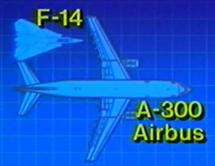
The official story was that the crew of the Vincennes mistook the massive, lumbering Airbus for a small, supersonic F-14 Tomcat making attack maneuvers.
The following day, July 4, Reagan issued a report to Congress in which he stated the USS Vincennes had been “operating in international waters of the Persian Gulf” and that following “indications that approximately a dozen Iranian small boats were congregating to attack merchant shipping, the Vincennes sent a Mark III Lamps Helicopter on investigative patrol in international airspace to assess the situation.” The helicopter, Reagan claimed, was fired upon and returned to the ship.
Reagan further declared, “The actions of U.S. forces in response to being attacked by Iranian small boats were taken in accordance with our inherent right of self-defense.” These actions included the downing of Flight 655, which, he said, was “believed to be a hostile Iranian military aircraft.”
In a press briefing on the White House lawn the same day, Reagan claimed that the Iranian airliner had been “lowering its altitude,” indicating an aggressive posture, at the time it was shot down.
The next day, the New York Times editorialized that “while horrifying, it was nonetheless an accident,” concluding, “The onus for avoiding such accidents in the future rests on civilian aircraft: avoid combat zones, fly high, acknowledge warnings.”
At the time, a report by Norman Solomon in Extra! revealed how the U.S. “government’s public relations spin quickly became the mass media’s: A tragic mishap had occurred in the Persian Gulf, amid puzzling behavior of the passenger jet. Blaming the victim was standard fare, as reporters focused on the plight of U.S.S. Vincennes commander Capt. Will Rodgers III, whose picture appeared on tabloid covers (7/5/88) with bold headlines: “Captain’s Anguish” (Newsday) and “Captain’s Agony” (New York Post).”
Naturally, if the Iranian military had blown up a Pan Am flight taking off from Dubai, protestations of self-defense probably wouldn’t find many sympathetic ears in the United States; fewer still would empathize with the personal trauma of murderer who gave the order.
Ten days later, on July 13, 1988, Assistant Secretary of State Richard S. Williamson continued to insist that the Vincennes was “at the time of the incident, in international waters.” The next day, speaking in defense of American actions before the United Nations Security Council, Vice President George H.W. Bush declared, “One thing is clear, and that is that the USS Vincennes acted in self-defense.”
Iran’s allegations that the warship was far too technologically advanced to make such a catastrophic mistake were dismissed by the American government. When questioned about the incident, Bush announced, “I will never apologize for the United States of America, ever. I don’t care what the facts are!”
Nearly all of these claims made by U.S. military and government officials about why Flight 655 was fired upon were lies, and the subsequent investigation was effectively one big cover-up, reports in Newsweek and by Nightline later revealed.
There had been no merchant vessel in distress and no helicopter was ever dispatched from the Vincennes, let alone fired upon. The warnings by Vincennes radio operators had not been broadcast to air traffic control frequencies. There had been no visual confirmation of an approaching or attacking aircraft. Iran Air Flight 655 – with its nearly 300 passengers aboard – was well within its flight corridor, flying comfortably at 12,000 feet and steadily climbing. It had been in the air less than seven minutes. At the time it was hit, it was gradually turning away from where the Vincennes was located. It would have landed in Dubai about twenty minutes later. As John Barry reported in 1992:
Captain [Mohsen] Rezaian of Iran Air was calmly reporting to Bandar Abbas that he had reached his first checkpoint crossing the gulf. He heard none of the Vincennes’s warnings. His four radio bands were taken up with air-control chatter. “Have a nice day,” the tower radioed. “Thank you, good day,” replied the pilot. Thirty seconds later, the first missile blew the left wing off his aircraft.
There were other American naval vessels in the area at the time, none of which mistook the Iranian commercial airliner for a jet fighter, but were unable to act quickly enough to save Flight 655. “A few miles away, on the bridge of the Montgomery, crewmen gaped as a large wing of a commercial airliner, with an engine pod still attached, plummeted into the sea,” Barry reported. “Aboard the USS Sides, 19 miles away, Captain [David] Carlson was told that his top radar man reckoned the plane had been a commercial airliner. Carlson almost vomited, he said later.”
Vincennes commander Rogers was himself known to other naval officers as especially trigger-happy. Captain Carlson, who commanded the Sides, a frigate in the same Surface Action Group as the Vincennes, later said that the Flight 655 disaster “marked the horrifying climax to Rogers’ aggressiveness.”
According to the subsequent government review of the downing of Flight 665, and particularly its Aegis targeting system and the “complex network of radar and computers” onboard the Vincennes, TIME magazine reported that “blame fell not on the machines but on the men who were operating them.”
Nevertheless, not a single member of the crew of the Vincennes received official reprimand or opprobrium from the U.S. Navy or government. Moreover, in what can only be described as an act of staggering hubris, following the end of their deployment in 1989, all crew members aboard the Vincennes were awarded combat-action ribbons, while both Commander Rogers and Lieutenant Commander Scott Lustig, the ship’s tactical coordinator for air warfare, were specifically granted the Navy’s Legion of Merit medal for “meritorious service” and “heroic achievement.”
Rogers was honored “for exceptionally meritorious conduct in the performance of outstanding service as commanding officer… from April 1987 to May 1989,” while Lustig received his citation for his “ability to maintain his poise and confidence under fire,” enabling him to “quickly and precisely complete the firing procedure.”
Iran’s only act of retaliation or retribution for the downing of Flight 655 was bringing forth a legal case for responsibility and restitution. The International Court of Justice awarded the victims of the attack $61 million in compensation for unwarranted loss of life. The U.S government has still never officially apologized to the Iranian people for this heinous crime.
Last year, the Iranian Foreign Ministry Iranian Foreign Ministry issued a statement in commemoration of the tragedy. “This inhumane crime is clear proof of the innocence of the Iranian nation,” it read, “and (provides) clear evidence that the United States is not committed to any international legal and ethical principles and norms, and (it) will remain in the historical memory of the Iranian nation.”
The Washington Post‘s Max Fisher concludes his column, writing, “Americans might not know about Flight 655. But Iranians surely do — they can hardly forget about it.”
While he – and TIME’s Michael Crowley – should be commended for reminding (or informing) their readership about the events of July 3, 1988 and its implications today, they should also remember that telling only part of the story – and allowing American aggression, dishonesty and denial to be dismissed uncritically as an “accident” – does a great disservice to the truth.
The 290 innocent victims deserve better.
Featured Video

No Threat Can Force Iran’s Surrender /Trita Parsi & Lt Cl Daniel Davis
or go to
Aletho News Archives – Video-Images
From the Archives
An Expert Military Analysis of War with China
Actually, None is Necessary
By Fred Reed • Unz Review • December 13, 2020
The Correlation of Armed Forces: U.S. goods and services trade with China totaled an estimated $634.8 billion in 2019. Exports were $163.0 billion; imports were $471.8 billion. The U.S. goods and services trade deficit with China was $308.8 billion in 2019. Trade in services with China (exports and imports) totaled an estimated $76.7 billion in 2019. Services exports were $56.5 billion; services imports were $20.1 billion. The U.S. services trade surplus with China was $36.4 billion in 2019.
There is talk within the Washingtoniat of a possible war with China. Steve Bannon, who apparently was dropped on his head as a child, actually favors such a war. We hear the usual shoo-the-boobs alarm about how the Chinese are doing something terrible and we must gird our loins and American values and show them what for, bow wow, woof. The danger is that the current game of who-blinks-first in Asian waters might actually provoke a shooting war. You know the kind of thing: One warship refuses to get out of the way of another, a collision ensues, some retard lieutenant who signed up on waivers opens fire, and we’re off and running. It is not a good idea to let children play with matches.
The said war is discussed either in emotional terms by idiots or in purely naval terms by those familiar with such things, so we hear of the First Island Chain and the Second Island Chain and whose missiles against the other’s missiles and so on. This would be appropriate if we were fighting World War Two again. Which we aren’t. Let’s take a quick-and-dirty look at how such a war might go.
To begin the war, America would overestimate itself and underestimate China. This is doctrine in the Pentagon. … continue
Blog Roll
 Aletho News
- Iran To Target Military Industrial-Tech Complex That Facilitated Gaza Genocide
- Collapsing Empire: The Resistance Disarms ‘Israel’
- Suicide Should Not Be a Government Service
- Rethinking America’s greatest threat: Iran vs. Israel-Firsters
- Iran accuses adversaries of false flags to strain Turkey ties
- Poland rules out sending Patriot missiles to US/Israel amid war on Iran
- Tehran approves new Hormuz plan with major restrictions
- No Threat Can Force Iran’s Surrender /Trita Parsi & Lt Cl Daniel Davis
- UK’s New Pandemic Plan Would Turn Big Tech Into a Mass Location Tracking Network
- Growing insecurity, soaring prices fuel protests in north as regime bans evacuation: Sources
- If Americans Knew
- Ann Coulter Rips Into Fox News for Iran War Coverage, Compares to False Rigged 2020 Election Reporting
- Joe Kent Urges Americans To Call White House and Congress To Object To Sending Troops Into Iran
- DNC Resolution to Reject AIPAC Funding Puts Democratic Leaders in the Hot Seat
- Swedish foundation to build 400 schools as over 650,000 Gaza children remain without education for 2 years
- Israeli army admits photshopping image of slain Lebanese journalist
- This is how Israel is systematically killing health workers under the cover of war in Lebanon
- Carrying life under fire: Israeli invasion of Lebanon leaves pregnant women facing deadly risks
- Champagne all around for the new death penalty (for Palestinians) law – Not a ceasefire Day 172
- Why are Palestinian books struggling to be seen on Amazon?
- The Line Between Affinity and Conspiracy
- No Tricks Zone
- New Study Finds Warming Saves Lives…Cold Temperatures 12 Times More Deadly Than Excess Heat
- German Science Blog Accuses PIK Climate Institute Of Hallucinating Climate Tipping Points
- Devastating Assessment Of Comirnaty Vaccine By Former Senior Pfizer Europe Toxicologist
- New Study: CO2 Is ‘Effectively Negligible’ As An Explanatory Climate Change Factor Since 2000
- Former Pfizer Toxicologist Dr. Helmut Sterz Tells Bundestag Hearing Pfizer Vaccine Should Have Never Been Approved
- Energy Expert: Germany’s Nuclear Phaseout Was A “500 Billion Euro Mistake”
- New Research: South Australia’s Mid-Holocene Sea Surface Temperatures Were 4°C Warmer Than Today
- Storing Green Energy To Last Germany 10 Days Would Require A 60-Million Tonne Battery
- New Studies: UK Sea Levels Were 4 Meters Higher Than Today During The Mid-Holocene
- Destructive Green New Deal: German Energy And Metal Group Warns Of Drastic Crisis
 Aletho News