Territorial Domination in the West Bank
Sam Mayfield | October 2, 2009
Settlement expansion in the Occupied Territories of Palestine is about more than constructing houses for Jewish settlers. Palestinian farmland is being turned into industrial space. Illegal outposts on Palestinian land are protected by Israeli military. Roads, if Palestinians are allowed to drive on them, are often blocked without warning.
I toured Illegal settlements and outposts in the West Bank with Dror Etkes.
EU-US historic trade deal: ‘Putting the corporation above the nation’
RT | November 11, 2013
The successful adoption of the EU-US trade agreement promises both parties massive gains of up to $159 billion, but the profits could come at the expense of the everyday consumer, who could see the quality of their products diminish as a result.
Over 50 US officials are in Brussels to negotiate the Transatlantic Trade and Investment Partnership (TTIP), which, if signed, will create the world’s largest free-trade area, which has also been dubbed an “economic NATO”. Officials meeting in Brussels this week will hammer out details to reduce trade limiting regulations.
The new round of talks will focus on reducing trade barriers on investment, energy, services, and raw materials, and key agreements will be announced Friday.
‘Non-tariff barriers’ increase the cost of business, whether it’s adjusting the voltage on an electronic device, changing a car’s exhaust system to comply with local environmental regulations or a difference in opinion of which chemicals are “harmful” or “hazardous” in the respective territories.
By limiting health, safety and environmental regulations in order to boost trade, the US and EU are “putting the corporation above the nation,” Glyn Moody, journalist and author, told RT in an on-air interview.
“That’s a very big assumption. People may not want to have their food less safe or environment polluted for the sake of more money,” Moody told RT.
Moody also warns the trade agreement could behoove giant corporations like Monsanto, who could use the new ‘de-regulation’ to sue the EU for billions of dollars if they refuse to import GMO products
The EU says the TTIP could bring annual benefits of $159 billion (€119 billion) to its 28 member states. This breaks down to an extra $730 (€545) in disposable income for a family of four in Europe and an extra $875 (€655) per family in the US, according to a March 2013 study on “Reducing Transatlantic Barriers to Trade and Investment”.
There would be fewer constraints and companies will benefit, but “the public will pay in terms of regulation reduced protection and that is never calculated in these trade agreements, it’s always about the bottom lines of the big companies,” Moody said.
The week-long round of negotiations were originally scheduled for October but postponed due to the US government shutdown.
On December 16-20 officials will meet in Washington DC for another round of talks. The first round was held in Washington in July after the G8 Summit in Northern Ireland.
The Perks
The trade flow of goods and services between the two blocs reached about $2.7 billion per day in 2012, according to the US Office of Trade and Commerce. Total trade in 2012 was $647 billion.
The agreement could boost employment on both sides of “the pond”, as increasing exports usually creates more jobs.
The European Commission has brazenly promised the deal could boost gross domestic product in the dilapidated EU by 1 percent.
Auto trade will especially benefit from jettisoning regulations. Turnover between the US and Germany could double if the trade agreement makes more umbrella standards- for example, if a car is crash-tested in America, it need not be again tested in Europe.
North America is an important destination for Foreign Direct investment, and is home to about one third of European foreign direct investment. Investment activity between the EU and US suffered after the financial crisis in 2008, and both sides will also try to find a balance on trade regulation to save big bucks.
Broken trust
Limited trust over the fall out of the NSA spying scandal may also put a hamper on negotiations between the trade giants.
The feasibility of the deal came under question after NSA whistleblower Edward Snowden leaked information showing the extent of espionage on allies abroad. France announced the wanted to temporarily postpone the talks over snooping, but they proceeded as planned.
The spying row shouldn’t affect US-EU trade talks, US Secretary of State John Kerry said as the trade partnership is “really separate from any other issues”. The US hasn’t provided any guarantees it will curb spying on its allies.
Sen. Graham: Israel ‘apoplectic’ about US approach on Iran
Press TV – November 11, 2013
US Senator Lindsey Graham has warned about a possible easing of economic sanctions against Iran, saying Israel is “apoplectic” about the Obama administration’s approach.
Graham, a hawkish Republican from South Carolina who has repeatedly called for military strikes on Iran, said Sunday that lifting sanctions would send the wrong message to Israel and other US allies in the region.
“The Israelis are apoplectic about what we’re doing,” he said on CNN’s “State of the Union.” “I’ve never been more worried about the Obama administration’s approach to the Middle East than I am now.”
The White House offered a “very modest sanctions relief” as Iran and the six major world powers– the US, Britain France, China, Russia and Germany– engaged in talks over Iran’s nuclear energy program in Geneva, Switzerland over the weekend.
The talks ended inconclusively on Sunday when France rejected a list of demands on Iran, saying they were too generous to result in an easing of sanctions. More negotiating sessions are scheduled for November 20.
Sen. Graham said the sanctions should be kept in place, and coupled with the threat of military force, to compel Iran to stop its uranium enrichment activities.
“If it ends with anything less, the world will regret this,” Graham said. “My fear is that we’re going to end up creating a North Korea kind of situation in the Middle East.”
Senate leaders showed bipartisan support Sunday for tougher sanctions on Iran.
Senator Robert Menendez, chairman of the Senate Foreign Relations Committee and a key architect of anti-Iran sanctions, called on Congress to consider new economic sanctions against Iran.
“I think that the possibility of moving ahead with new sanctions, including wording it in such a way that if there is a deal that is acceptable that those sanctions could cease upon such a deal, is possible,” Menendez said Sunday on ABC’s “This Week.”
The US lawmakers’ outburst happened after Israeli Prime Minister Benjamin Netanyahu denounced a possible agreement with Iran as a “historic blunder.”
There is no Palestinian issue for Syrian rebels
By Nadezhda Kevorkova | RT | November 10, 2013
The Palestinian issue has been uniting all Muslims for 65 years. Syrian rebels succeeded in their mission – they made the world forget about the Palestinian issue.
The militants pulled Palestinians out of refugee camps; they are killing them or using these people as human shields. And the media are silent about it, while the Syrian opposition keeps screaming about the “oppressive Assad regime.”
It’s been a year since Syrian rebels raided the largest Palestinian refugee camp in Syria – Yarmouk, near Damascus. Up until recently it was the duty of Israeli soldiers to persecute Palestinians, now this is done by Syrian rebels with their Muslim slogans. The media are not saying anything about it.
What is the life of Palestinians like, now that the Syrian conflict made them refugees again?
‘Nobody is helping us – neither Europe, nor the UN’
Abu-Badr, head of Beirut’s Bourj al-Barajneh refugee camp People’s Committee, gathered representatives of all Palestinian parties. They all keep regular contacts with camps in Syria.
A year after Palestinian camps and Palestinians were attacked, the heads of these organizations are saying that the Syrian war is a staged conflict, and its goal is to distract everybody from the Palestinian problem.
A total of 760,000 Palestinian refugees lived in Syria before the war, and about 550,000 in Lebanon. Palestinians had equal rights in Syria, and virtually no rights in Lebanon. For example, they were not allowed to work in 72 professional capacities.
Abu-Badr says, “There are over 1,000 Palestinian families from Syria in our camp. Nobody is helping us – not Europe, not the UN. The Red Cross came twice. The refugees are renting housing on their own.”
To rent a place to live is a big problem for a Palestinian, especially at the camp. And to pay rent, they have to find a job, which is extremely difficult in Lebanon.
He says that according to the authorities, there are about 120,000 Palestinian refugees from Syria living south of Tripoli. So every tenth refugee is a Palestinian.
Turkey and Jordan don’t accept Palestinians.
Kafar is a young mother of two. She used to live in Syria’s Yarmouk with her family. Now she is struggling to survive in Bourj al-Barajneh in Lebanon.
She fled Yarmouk at the end of 2012, when the rebels took over the camp and made it their foothold to carry out attacks on Damascus.
Yarmouk is one of the largest Palestinian camps in Syria. Before the war it had 150,000 residents, which was almost one-quarter of all Palestinian refugees in Syria. The camp is very close to the Damascus city limits, and there were subdivisions where regular Syrians lived.
Refugee camps are extraterritorial places. Police and army are not allowed there, the residents don’t have citizenship, they don’t vote and don’t serve in the army. Camps are self-governed by representatives of all Palestinian political parties. Unlike all other countries, Syria allowed refugees to leave camps and enjoy all rights and freedoms.
A Syrian family named Lakud brought the fighters to Yarmouk. Palestinians didn’t support the rebels then, and they are not supporting them now. Some parts of the camp are still controlled by the opposition.
A human shield for militants
Kafar recalls: “The entire camp left in a snap back then, when armed militants entered it. They were inside, shooting bullets into the air – they always act the same way. They ordered the residents to leave having placed their orders on different websites and having sent emails. Nobody stayed there.”
In December 2012, some started trying to come back. There are even a few families that decided to stay in the camp, hoping it would get better soon. Kafar says all the houses have been looted – they have taken everything, including electrical wires.
She says the militants were shooting those Palestinians who went out to take part in demonstrations. They wouldn’t let people return to their homes, but in case they did come back home, they couldn’t leave their houses again.
“If the militants went away, we would come back. Sometimes we can contact those inside the camp. They tell us about the blockade – they feel like they live in a cage, they lack food. There is no escape – they are kept as a human shield for the militants,” Kafar says.
She tells us about her relative who went to find her children, but ended up as a hostage in the camp.
“The militants won’t let you come in, but if one has entered – he would be kept there by force. They have established checkpoints. They deprive the people of food and beat the women who try to sneak inside, bringing something to their relatives to eat,” Kafar says.
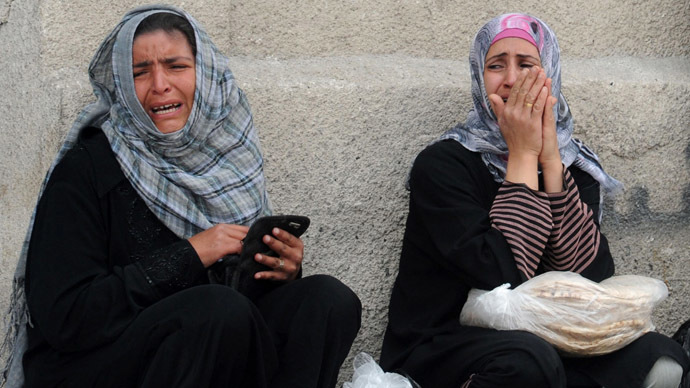
A handout picture released by the Syrian Arab News Agency (SANA) on May 15, 2013, shows protestors crying after unidentified armed groups opened fire on demonstrators as they marched in the Syrian capital Damascus in support of the right to return of Palestinian refugees who fled their homes or were expelled during various conflicts. (AFP/SANA)
Hitting a woman in public is considered absolutely unlawful among Muslims. But Kafar says that the militants in Yarmouk have their own vision of everything.
“We are not afraid of war, but they won’t even feed the people. The al-Nusra militants are tall, wear long beards and look like foreigners. Probably, there are Syrians among them but none of my relatives have ever seen one,” Kafar says.
One blanket for five
Palestinians from Syria in Lebanon are in even more dire straits.
“They humiliate us – we are constantly being insulted,” the woman tells us.
She is showing us around her tiny apartment with two rooms and a kitchen. The ceiling leaks when it rains.
“The rent is $300. If I don’t find money by Sunday, we’ll have to leave for Syria.”
Apart from the rent, they pay $70 for water.
Her father-in-law was killed. Her mother-in-law returned to Syria and now lives with their relatives there.
“I’ll go to Syria and wait there until I can come back home. Staying here is humiliating,” Kafar says.
Her husband takes up any job he can, be it a laborer, carrier or loader.
They have no warm clothes – all their belongings were stolen in Yarmouk. This family doesn’t belong to any group. They got help from different organizations such as Hamas, the Popular Front or some voluntary organizations. But it can hardly be called help – it is more like a mere pittance.
“They gave us one blanket for five people. But we are living creatures,” Kafar says, showing us a thin grey synthetic blanket. She thinks it looks like a cloth that is used to wrap a dead body when burying it.
The family has no money to buy food. They sometimes receive help from neighbors, who share their food with them. I saw them bring some bread and crisps.
‘In Syria, Palestinians are treated better than brothers’
Kafar complains about how the refugee work is organized.
“They distribute some humanitarian aid, but the process is humiliating to us every step of the way. There is fighting in Syria, but Palestinians are respected there. And here they call us Syrian dogs.”
“We had a good life under Assad, not lacking anything. We will go back and live in Syria, even if we have to live in tents. Syrians treat us as equal, they help us,” says Kafar.
In the last year they received help twice – from Hamas and from people from Qatar – about $300 per family, which is less than one dollar a day. But not everybody gets even these payments. There are lists of those who suffer the most in these camps.
She tells us how the process of distributing this aid works.
“A family gets a check for $150 from Qatar. But there wasn’t enough for everybody on the list. So people are humiliated even more. The place where these checks are given is near Beirut, you have to take a taxi to get there and spend half of the money on the ride. They give food stamps for certain food items, which can only be bought in one supermarket. And this store is also far away.”
“You can’t buy meat with these food stamps. Do they think children can go for a year without meat?” the woman asks.
“We are convinced that Syria will welcome us back. They loved us there, treated us like brothers, even better than brothers. We lived better than Syrians themselves,” Kafar says.
She knows that the Lebanese have closed the border for Palestinian refugees. So they can’t go anywhere.
“They accepted us in Syria. When we lost everything, they took care of us. They asked us what we needed. Six blankets? Food? They gave us everything. They didn’t blame us, even though life was difficult for everyone.”
She thinks her family made a mistake when it moved to Lebanon. “We were told life would be good here. Now we regret the decision.”
Her husband came six months earlier, he thought they would be safe here while there is fighting.
‘There is no Palestinian issue for Syrian rebels’
“We Palestinians have played no part in Syria’s distress. We didn’t participate in street protests, and our people did not join the rebels,” says Kafar. She admits to having heard that some Palestinians have, in fact, taken up arms against the Syrian government. But she is certain that is a rare exception.
“Those people must have been seduced by money, or befuddled with drugs, and with false promises. Only the poorest and the most destitute of the Palestinians have gone to fight for money, and it took them 18 months to get that desperate.
“Such people have nothing to eat, so they join the rebels hoping to make some money to sustain their families, and then desert at the first opportunity.”
“We cannot admit to supporting the regime, for fear of being killed on the spot. Those rebels do not consider the Palestinian issue to be of primary importance. There is no Palestinian issue for the rebels at all,” says Kafar.
Every night, the inhabitants of Bourj al-Barajneh go to sleep fearing that al-Nusra militants may descend on the Palestinian refugee camp and start asserting their rule, the way they did at Yarmouk. There is talk that al-Nusra men were spotted recently inside Nahr al-Barrid, another Palestinian camp. Since then, the People’s Committee instituted vigilante patrols across the entire camp.
“Our people control every in and out,” Kafar tells us. “They keep watch at night to make sure no strangers come upon us as we sleep. That’s how it happened in Yarmouk.”
The Syrian army has also set up checkpoints guarding the entrance to each camp.
‘They butchered a family to make the others serve as a human shield’
Yarmouk was not the only Palestinian camp captured and cleared of refugees by insurgents. Moreover, no one can assess the number of Palestinians killed in the process.
A Palestinian woman named Gusun was forced to flee camp Duma near Damascus on September 23, 2012, together with her husband, their three kids, and her husband’s brother.
“There were plenty of olive groves next to our camp. We lived in peace for a long time, until the fighting drew close to our camp. Then, rebels started taking shelter in our camp, hiding in our houses during firefights, and shooting through our windows. And we found ourselves between the hammer and the anvil. So one day, we slipped out at five in the morning and ran away through the olive grove,” Gursun tells me.
“The rebels had killed many people in our camp unflinchingly. They butchered a married couple who were my husband’s kin – they cut their throats, so that the other Palestinians would stay in the camp and serve as their human shield, while the government was commanding us to flee.”
Gusun went back to check on Duma some four months ago.
“I found my home thoroughly looted, its roof smashed,” she recalls. “And the FSA and al-Nusra are still entrenched in the camp.”
“Once their men spotted me at Duma, they came up and questioned me to make sure I was from that camp. They let me go, but they kept watching me. Later, when I went out to a grocery store, I noticed a car tailing me. Then I got scared and ran away from the camp,” says Gusun.
“The rebels I saw were tall and fair-skinned. There are some who don’t speak Arabic, and there are some who do. People have also told me there are black rebels, but I have never seen one. Some rebels wear black vests, some wear masks, some wear short pants, and others wear normal trousers. There are many fair-skinned men among them, those are foreigners.
“When we walked around the camp, we would try not to look them in the face, for fear that they might do us harm,” Gusun says.
‘Palestinians, get out of Syria’
The world’s mainstream media, who have closely followed the insurgency and its war on Assad, have proven squeamish when it comes to covering the way rebels treat Palestinians. In the spring of 2011, they would refute news reports that opposition activists wave Israeli flags and chant anti-Palestinian slogans at their rallies.
This stands to reason: two years ago, the Palestinian issue was still the No. 1 concern for the Muslim world, and an anti-Palestinian stance would have done serious harm to the rebels’ reputation. All the more so as Egyptian revolutionaries at Tahrir Square had been pronouncedly pro-Palestinian, despising Hosni Mubarak for his support for the Israeli blockade of the Gaza Strip.
The women at Bourj al-Barajneh are perplexed at the world’s ignorance of how Syrian insurgents really feel about Palestinians.
“At the onset of the revolution, slogans were like, ‘Carrots belong with carrots and cabbage with cabbage, and this is no land for Palestinians’,” says Gusun, who is shocked that no media have ever reported that the Syrian rebels had initially been against the Palestinians.
“Under these slogans, the armed rebels marched along the streets, angered by the local Palestinians’ reluctance to turn against the regime,” says Gusun.
“In about a year and a half, some Palestinians were in this way or another made to join the rebels. But that didn’t change much the rebels’ opinion of the Palestinians,” remarks Gusun, adding that even now the Palestinians on the side of the rebels are few and far between.
She can’t understand the reason why the Lebanese are treating Palestinians like that. After all, Syria did give shelter to 1 million Lebanese and Palestinian refugees after the 2006 Israeli attack.
“During the 2006 war we welcomed the Palestinians like family. But now we are being treated as outsiders.”
At that time, all the refugees from Lebanon found home, food and clothes straight on arrival.
Gusun was lucky to have found a job, and so was her husband. “I had to work as a cleaning lady. I’d never done anything like that before. But we had to survive somehow. The UN gives only $30 once every four months.’
It was crucial for the sponsors of the anti-Syrian campaign to shift the focus of one and a half billion Muslims from Palestine to the war against Assad. And their mission almost succeeded.
The issue of Palestine used to bring everyone together: Communists and atheists, the Sunni and the Shia, Christians and Muslims, left- and right-wingers, anti-globalists and nationalists. Now the war in Syria has torn them all apart.
Fast forward two years, there are no more rallies against the occupation of Jerusalem, no ships trying to break through the Gaza Strip and the West Bank blockade. In the meantime, this blockade has grown even tougher after the military coup in Egypt, with the abuse of Palestinians in the West Bank escalating into ethnic cleansing.
The sponsors of the war repeatedly tried to get Palestinians to back intervention into Syria. But their efforts failed: from Hamas to the Palestinian Islamic Jihad to the Popular Front to Fatah, not a single Palestinian organization has ever supported the campaign.
Nadezhda Kevorkova is a war correspondent who has covered the events of the Arab Spring, military and religious conflicts around the world, and the anti-globalization movement.
Greece intercepts mystery ship with 20,000 Kalashnikovs on board
RT | November 10, 2013
The Greek Coastguard has intercepted a Sierra Leone-flagged cargo ship with around 20,000 Kalashnikov assault rifles on board. The intended destination of the vessel, halted near the Imia islets in the eastern Aegean, remains unknown.
The cargo ship Nour M, intercepted on Thursday night, was taken to the island of Symi the following morning under the escort of Coastguard vessels, where it was soon thereafter led to the island of Rhodes.
The vessel’s Turkish captain and seven crew members, two of whom were Turkish and five of whom were Indian, were placed under arrest, coastguard sources told the Athens-Macedonian News Agency (ANA-MPA).
The cargo was both larger than that declared on the ship’s manifest, and the ship did not have the proper UN documents to deliver cargo to a conflict zone. The Greek Coastguard issued a statement saying attempts to catalogue the firearms and munitions on board were ongoing.
“The exact destination of the arms and ammunition has yet to be verified,” the coastguard statement read. Apart from the large quantity of firearms, the ship was also allegedly carrying a “large” quantity of explosives. A probe determined the ship had previously been used for drug trafficking.
Sources told ANA-MPA that the vessel had set sail from Ukraine, although the ship’s final destination remains unclear. Although the ports of Tartus in Syria and Tripoli in Libya had both been declared as destination ports to marine traffic systems, the Turkish Mediterranean port city of Iskenderun was declared as the destination port by the ship’s captain.
Ukraine’s Foreign Ministry said they are attempting to determine if the Nour departed from the country.
Maritime expert Mikhail Voitenko told Ukraine’s Vesti that the ship likely picked up its cargo in Istanbul.
“I think it was there for no other purpose than to get the weapons. It is also strange that it took the ship two weeks to get from Nikolaev [Ukraine] to Greece when the trip takes a maximum of five days. What it was doing and where it was doing it at the time: that is the question.”
Voitenko said the vessel was likely detained as the result of a tip-off.
“That we have this ship sailing through the Black Sea is strange, but through Greek [territorial] waters it went in a straight line, so police had no reason to detain the ship,” he said.
US Lawmakers Lobby for Right-wing and US Intervention in Honduran, Salvadoran Elections
CISPES | November 8, 2013
On Saturday, October 16, US Congressmen Matt Salmon (R-AZ) and Albio Sires (D-NJ) from the House’s Foreign Affairs Western Hemisphere subcommittee wrote a letter to Secretary of State John Kerry using vague, fear-mongering rhetoric to delegitimize a potential left-wing victory in the upcoming presidential elections in Honduras and El Salvador, where the left candidates are leading in the polls. Explicitly denigrating two of the three leading Salvadoran candidates, Salmon and Sires exposed themselves as mouthpieces for the right-wing Nationalist Republican Alliance (ARENA) party, which has mounted an escalating smear campaign against its opposition in both El Salvador and the US.
In the letter—which was then republished in El Salvador—the congressional duo question the “democratic credentials” of both Honduran presidential candidate Xiomara Castro de Zelaya, wife of former President Manuel Zelaya ousted in the 2009 US-backed coup d’état, and Salvador Sánchez Cerén, the leftist candidate for the Farabundo Martí National Liberation Front (FMLN) in El Salvador, accusing them of being allies of late Venezuelan president Hugo Chávez. The congressmen also call out Salvadoran right-wing UNITY coalition candidate Tony Saca as corrupt, clearly demonstrating their preference for ARENA—the only other leading party in the race. In a particularly troubling gesture, they call for “heightened security to ensure that all candidates abide by the democratic rules of the game,” and tacitly request greater participation of the National Democratic Institute (NDI) and the International Republican Institute (IRI)— US institutions notorious for undermining democratic elections in the region.
This is not the duo’s first effort to intervene in the democratic process in El Salvador. In April, Salmon and Sires published a letter implying—falsely—that $300 million in US development aid from the Millennium Challenge Corporation was at risk because the US-backed Public-Private Partnership Law had not yet been approved by the Salvadoran legislature. Now, in questioning the democratic legitimacy of both Xiomara Castro and Sánchez Cerén, Sires and Salmon are setting the stage to delegitimize any leftist electoral victory from the US, and throwing their weight behind the ARENA party in El Salvador.
This is the same tactic recently employed by ultra-conservative lobbyist Otto Reich in his public comments against the FMLN, and was promptly followed by the November 4 publication of an article in the Spanish-language edition of the Miami Herald interviewing several ARENA party leaders claiming that Saca had made an agreement with the FMLN to divide the right-wing and bring socialism to El Salvador. The stakes are high in the upcoming presidential elections in Honduras and El Salvador, and ARENA and its allies are hard at work prevent any electoral outcome that conflicts with their vast economic interests in the region.
Related article
… The electoral contest takes place in the context of a Salvadoran social movement to end the impunity of war criminals who have thus far escaped justice due to a 1993 amnesty law whose constitutionality is now under examination by the Supreme Court of El Salvador. The issue has become especially intense since October 1, 2013, when the Catholic Archdiocese of San Salvador shut down the most important human rights archives in the country, Tutela Legal, and dismissed the employees, placing the very documents that would be used in war crimes tribunals at risk of being compromised. [3] These actions have provoked international solidarity with the thousands of Salvadorans, including those in the Salvadoran diaspora, who are at work recuperating the historical memory of the country and seeking justice for the more than 70,000 citizens killed during the war as well as the survivors of torture and other war crimes. …
Join Palestinians on November 30th to protest against the Prawer plan
Prawer Won’t Pass Campaign | November 10, 2013
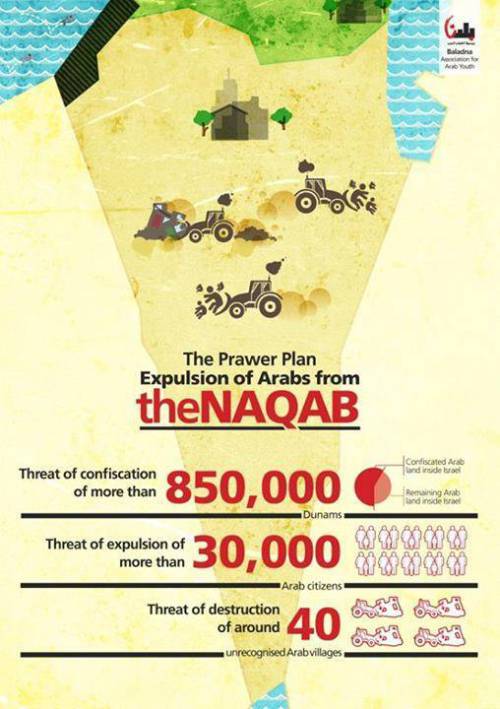 Occupied Palestine – On the 24th of June, the Israeli Knesset approved the Prawer-Begin plan, which if implemented will result in the destruction of more than 35 unrecognized villages in Al-Naqab and the forced expulsion and confinement of more than 70,000 Palestinian Bedouins. The Prawer plan is the largest Israeli land-grab since 1948. It epitomizes the nature of Israel’s policy; Israeli-Jewish demographic expansion and Palestinian-Arab demographic containment.
The International community has repeatedly called on Israel to halt the implementation of the Prawer Plan due to its discriminatory nature and the severe infringement it causes on the rights of Palestinian Bedouins in Al-Naqab. The UN committee on the elimination of Racial Discrimination called on Israel to withdraw the proposed legislation of the Prawer Plan. Also, in 2012, the European Parliament passed a resolution calling on Israel to stop the Prawer plan and its policies of forced displacement and dispossession.
Injustice, humiliation and forced displacement are a recurring theme in Palestine’s history. This is lesson that we as a group of youth take to the heart. We will oppose, resist and work against the continuous assault that our communities, across Palestine face. Therefore, we launched the “Prawer will not pass” campaign with an eye to preventing this plan to be yet another chapter in Palestine’s long and tragic history.
Opposing the Prawer Plan is to oppose ethnic cleansing, displacement and confinement in the 21st century.
Join us by organizing marches, protests, sending letters to those with positions of influence in your country or community, by doing whatever you can, in order to force Israel to stop the Prawer plan.
Join us on the 30th of November in saying “Prawer shall not Pass”.
For more information, please contact:
Email: PrawerWontPass@gmail.com
Israel orders destruction of village olive grove in retaliation for kids alleged stone throwing at soldiers
By Celine Hagbard | IMEMC News | November 10, 2013
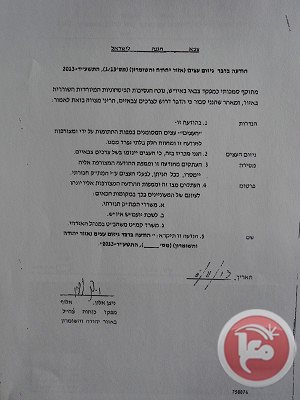 The Israeli military has issued demolition orders for hundreds of Palestinian olive trees in the village of Yabad, in the northern West Bank, following threats that if kids kept throwing stones at soldiers, the army would destroy the village’s olive trees.
The village is located west of Jenin, in the northern part of the West Bank, and depends largely on the annual olive harvest for its income.
According to local sources, the military placed notices in Hebrew and Arabic on trees throughout the main olive grove in town, saying that they will be uprooted by military order.
Over a million olive trees have been uprooted by the Israeli occupation forces since 2000, and the destruction continues to take place on a regular basis. The destruction of olive trees, both by Israeli settlers and the Israeli military, is concentrated during the olive harvest season of October and November each year, when hundreds of thousands of Palestinian farmers head to their groves to harvest their olives for that year.
The mayor of the village of Yabad told the Ma’an News Agency that a few days before these military orders were issued, the soldiers had come into town and told the villagers that if kids in the town kept throwing stones at the soldiers when they invade the town, the army would come back and cut down all the olive trees in town.
Related article
- Palestinian villagers face attacks during olive harvest (letthesilencering.wordpress.com)
Israel to lobby US against possible Iran nuclear deal

Press TV – November 10, 2013
As the prospect of a nuclear deal between Iran and the group of six major world powers grows stronger, Israel strives to lobby the US Congress to prevent any possible agreement.
“Before the talks resume, we will lobby dozens of members of the US Congress to whom I will personally explain during a visit beginning on Tuesday that Israel’s security is in jeopardy,” Israeli’s Economy Minister Naftali Bennett said on Sunday.
The remarks come after Iran and the five permanent members of the UN Security Council – Britain, France, China, Russia and the US – plus Germany concluded three days of intense negotiations over Tehran’s nuclear energy program early on Sunday.
Iran and the six world powers have agreed to continue negotiations on November 20 in Geneva, Switzerland.
Although an agreement was not reached in the nuclear negotiations, both sides said significant progress had been made and expressed optimism about the prospect of achieving a deal.
British Foreign Secretary William Hague said in an interview with the BBC later on Sunday that, “On the question of will it happen (a deal will be reached) in the next few weeks, there is a good chance of that.”
“A deal is on the table and it can be done. But it is a formidably difficult negotiation, I can’t say exactly when it will conclude,” he added.
Israeli ministers, however, have voiced strong opposition to any possible deal between Iran and the world powers, with Minister of Military Affairs Moshe Ya’alon describing an agreement with Iran as a historic mistake.
Israeli Prime Minister Benjamin Netanyahu also rejected a possible nuclear agreement with Iran as “a very bad deal” before meeting US Secretary of State John Kerry on Friday in Tel Aviv.
Netanyahu’s office had also launched a Twitter campaign against the Islamic Republic in which several photographs including the one of the Iranian students marking the 34th anniversary of the 1979 takeover of the former US embassy in Tehran were shown. The images were re-tweeted by a few Israeli officials.
Related articles
Time to Ignore Netanyahu the Rejectionist
By Ludwig Watzal | Palestine Chronicle | November 10, 2013
Benyamin Netanyahu’s hyperventilated fury didn’t surprise anybody. Even before the first outlines of a possible long-term agreement between Iran and the West on Iran’s nuclear program were publicized, Israel’s Prime Minister categorically rejected any such agreement. This irrational behavior disqualifies him as a serious partner to other heads of state. His extremism goes even so far as to promote further sanctions against Iran. Netanyahu wants Iran to capitulate and abolish its entire nuclear industry. He announced that Israel does not feel bound by the agreement. Netanyahu arrogates Israel the right to override decisions by UN Security Council members.
That Western leaders should consult the leader of a tiny country before they act shows the imagined power they attribute to Netanyahu. To seek advice from Netanyahu shows how intimidated Western politicians are. By now, they should be aware of his hostility to peace, be it with Iran or the Palestinians. How submissively the United States acts, is shown by the phone call between Obama and Netanyahu and by Secretary of State Kerry’s visit to Jerusalem, as if they needed Netanyahu’s blessing for the negotiations with Iran. The best political strategy would be to ignore him.
What infuriated Netanyahu and made him go wild was John Kerry’s statement made in Bethlehem: “We consider now and have always considered the settlements to be illegitimate.” The US has finally returned to its erstwhile stance that all Israeli settlements are contrary to international law, after they have gone astray under Bill Clinton and George W. Bush junior. Netanyahu appears increasingly isolated with regard to the Iran deal. He appears willing to do anything to derail a possible agreement between the US and Iran. His last weapons are the political bull terriers of the American Israeli Public Affairs Committee, better known as AIPAC, and their supporters in the US Congress. But Netanyahu is increasingly a political nuisance, not only for the Obama administration but also for other powers. For the last 25 years it has been his mantra to warn that a nuclear armed Iran is just around the corner.
Netanyahu and the war party in the US will do everything in their power to prevent an agreement between Iran and the West. Netanyahu exerts not only great influence on the US Congress via AIPAC, but does so personally, as his last speech before both Houses in May 2012 has shown, during which US lawmakers outdid themselves in celebrating his reactionary speech. AIPAC could try to arrange again another such ridiculous circus. That doesn’t mean that Netanyahu would make it this time, knowing that he would jeopardize the recently improved relations with the Obama administration.
The political charade, which Netanyahu performs, has nothing to do with the imaginary Iranian nuclear threat. The Israeli political establishment knows this and fears that it would lose its hegemony over the entire Middle East and Northern Africa if Iran would go nuclear. The late Israel Shahak has pointed out in his book “Open Secrets. Israeli Nuclear and Foreign Policies”, that Israel’s main goal is to maintain its hegemony from India to Mauritania.
The political interests of the Western powers and Israel are not the same. The West has suffered heavy economic losses by bowing to Israeli interests; especially US soldier had to pay a high price in Iraq. Netanyahu can perhaps bamboozle the U.S. government again, but Israel’s relationship with Europe is on a downward slide. Europe, and especially Germany, can look back on an enduring friendship with Iran. This friendship should not be damaged by unregenerate politicians. Germany would do well to normalize its relations and reestablish its traditionally excellent relations with Iran, regardless of the outcome of the US-Iran negotiations.
By now, the US and the other Western countries should have understood that Netanyahu as well as former Israeli governments have been torpedoing every chance for a peace agreement with the Palestinians, because their colonial hunger for land has not yet been satisfied. The so-called peace negotiations, which are once again taking place, is likely to go nowhere because the Netanyahu government is not willing to make any real concessions that fall short of total surrender by the Palestinians.
Related article
US, France playing good cop-bad cop in Iran talks
RT | November 9, 2013
America and France are playing ‘good cop-bad cop’ in the P5 + 1 talks with Iran over its nuclear program, so that Washington’s position would sound more reasonable, Robert Harneis, a journalist and political analyst has told RT.
Six major world powers and Iran are holding negotiations in Geneva over Tehran’s highly-disputed nuclear program.
RT: France seems to be the most skeptical of the negotiating nations about the outcome of the talks. What’s behind its skepticism?
Robert Harneis: It is always a little difficult to understand the position of the French here. They seem to take an extreme position all the time. There are a number of reasons for this. The first is that they are playing ‘good cop-bad cop’ with the Americans. Obama is suddenly being much more reasonable in his attitude with the Iranians, and the French are out there on the flank saying “Oh, you mustn’t agree too easily, Israel must be protected,” and so on. In a sense that’s, if you like, playing the game of the Americans so that they can sound more reasonable, the French sound more unreasonable.
There is another factor, which is that everybody knows the enormous pressure of the Israeli lobby in America. It’s not quite so well-known that it’s pretty considerable in France as well.
RT: The French Foreign Minister said Israel’s position must be taken into consideration. Why such concern for Israel when even Washington called Netanyahu’s condemnation of the deal ‘premature’?
RH: Yes, it’s interesting, isn’t it, that Mr. Netanyahu has said that the deal had been concluded. Everybody else is saying it hasn’t. At any rate, the position of the French, I think, is to say things that the Americans don’t want to say at the moment. I think that’s at the bottom of it, because frankly this posturing by the French President and the French Foreign Minister makes France look pretty ridiculous on the domestic front. There is a great deal of mockery of Laurent Fabius and his very aggressive statements internally in France.
RT: We’re used to the US being one of Tehran’s harshest opponents. Do you feel that Washington’s stance is genuinely changing?
RH: Well, one would like to hope – let’s put it this way – that this is a real diplomatic revolution. The Americans ever since 1979, when the embassy drama took place in Iran, have had this slightly ridiculous, slightly vengeful obsession about dealing with the Iranian nuclear threat.
As far as anybody can tell and as far as the American security services themselves say, there is no Iranian nuclear threat. The Israelis, on the other hand, have 300 nuclear weapons. So the situation is a trifle absurd as it often is with western foreign policies.
And there are signs Obama is trying to put American foreign policy on a more sensible track. Why not have sensible relations with Iran – this is being asked in the US after all. For years, with the threat of the Soviet Union, they had no difficulty negotiating with [Mikhail] Gorbachev and men a lot more difficult than him. So, why can’t we negotiate with Iranians? Why do we have to take this ridiculous attitude that they cannot have what France, Britain, the US have – which is nuclear protection. And the Iranians say they don’t want it anyway.
So, it’s a difficult one to quite work out. But it could be that there is a real revolution taking place and the Americans are going to change their stance because they need to do business with Iran really.
RT: Finally, what are your personal predictions? Will the sides involved manage to overcome their disagreements and strike a deal in the near future?
RH: Well, if I had to take my reputation as profit on the line, I would say that there is going to be a deal. Because they are, after all, talking only about a six-month deal, as far as we can understand it. A suspended sentence, so to speak. With the problems of gas pipelines from Iran to Europe, which Europe needs badly for its Nabucco pipeline – which has no gas without the Iranians – I think there is a very strong probability. And they’d just love to get in there and have all the contracts for rebuilding Iran. So, I hope it’s a real revolution.
Featured Video

Rewriting the risk? Inside the government’s vaccine safety messaging
or go to
Aletho News Archives – Video-Images
Book Review
“Davos Can Really Replace the UN”
Inside the book that maps the architecture behind global governance — from the Epstein files to the Pact for the Future
Lies are Unbekoming | April 1, 2026
On June 13, 2019, the United Nations and the World Economic Forum signed a partnership deal to “accelerate the implementation of the 2030 Agenda for Sustainable Development.” That same evening, WEF president Börge Brende — Norway’s former Foreign Minister — had dinner with Jeffrey Epstein at Epstein’s Manhattan townhouse. The Epstein files, released January 2026, contain an exchange between the two from the previous year. Epstein to Brende: “Davos can really replace the UN. C21, cyber, crypto . genetics… intl coordination.” Brende back to Epstein: “Exactly — we need a new global architecture. World Economic Forum (Davos) is uniquely positioned — public private.”
The next day, the UN General Assembly adopted the framework for restructuring global governance.
That sequence — the partnership signing, the Epstein dinner, the candid admission about replacing the UN with a public-private architecture, and then the formal adoption — opens Jacob Nordangård’s The Digital World Brain. Pages two and three. Footnoted to the UN resolution number, the Epstein files, and the General Assembly record.
I keep coming back to it because it captures what this book does that almost nothing else in the independent research space manages. I’ve followed Jacob’s work for years now and interviewed him about his research. Each book peels back another layer of the same institutional architecture, and each time I think he’s reached the limit of what can be documented, the next one goes further. Nordangård doesn’t speculate. He doesn’t editorialize much. He lays institutional actions next to each other in chronological order and lets the pattern announce itself. … continue
Blog Roll
 Aletho News
- Iran, US receive Pakistan-mediated plan for ceasefire then final deal
- Iran submits demands for end to war as mediators scramble ahead of Trump deadline
- Iran Threatens Retaliatory Strike on Stargate AI Project in UAE
- US sent ‘a lot’ of arms to Iranian protesters – Trump
- Barak Ravid Launders Deception To Allow Trump To Back Off Of His Power Plant Threat – Again
- REWRITING THE RISK? INSIDE THE GOVERNMENT’S VACCINE SAFETY MESSAGING
- “Davos Can Really Replace the UN”
- NIAID/NIH and USDA Fund Bioengineered Chimeric Influenza Viruses Built Using Pandemic H1N1 Components: Journal ‘Science Advances’
- Hezbollah hits Israeli warship off Lebanon’s coast, sets it aflame
- Iran slams US strikes on B1 bridge, Mahshahr petrochemical plants as ‘blatant acts of state terrorism’
- If Americans Knew
- Trump poised to “blow everything up” (ie. commit war crimes) in Iran – Daily Update
- In Iran, Israel-US take aim at “reason, research, and freedom of thought” – Daily Update
- US loses planes over Iran, Israel downgrades Lebanon war goals – Daily Update
- Israel Is Blocking Palestinians from Easter at Church Where Jesus Resurrected
- Plot to assassinate Palestinian activist follows harassment campaign promoted by Zionist groups and elected officials
- Prominent New York synagogue hosts presentation on why U.S. Jews should support the ethnic cleansing of Gaza
- Tapper vs. Piker: Is the CNN Anchor Auditioning for David Ellison?
- Shouldn’t Democrats Be Able to Condemn Genocide?
- Israel-US kill negotiators, destroy civilian structures, but Iran’s military capabilities still largely intact – Daily Update
- ‘War crime’: Global condemnation as Israeli ministers celebrate death penalty law targeting Palestinian prisoners
- No Tricks Zone
- An Inconvenient Tree: Uncovered In Alps… Europe Much Warmer Than Today 6000 Years Ago
- New Study Reports A 60% Slowdown In Greenland’s Ice Loss Rate In The Last Decade
- Low Intensity Tornado Wrecks Major Solar Farm, Creating A Potential Toxic Dump
- New Study Finds Warming Saves Lives…Cold Temperatures 12 Times More Deadly Than Excess Heat
- German Science Blog Accuses PIK Climate Institute Of Hallucinating Climate Tipping Points
- Devastating Assessment Of Comirnaty Vaccine By Former Senior Pfizer Europe Toxicologist
- New Study: CO2 Is ‘Effectively Negligible’ As An Explanatory Climate Change Factor Since 2000
- Former Pfizer Toxicologist Dr. Helmut Sterz Tells Bundestag Hearing Pfizer Vaccine Should Have Never Been Approved
- Energy Expert: Germany’s Nuclear Phaseout Was A “500 Billion Euro Mistake”
- New Research: South Australia’s Mid-Holocene Sea Surface Temperatures Were 4°C Warmer Than Today
 Aletho News