The War of Narratives: Bringing Truth to Middle East Crisis
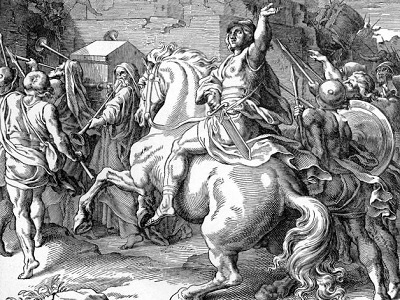
If Joshua did not conquer Jericho, was there any conquest?
By Dan Lieberman | Palestine Chronicle | November 27, 2013
The Narrative Challenge
The war of narratives shaped as a “slam dunk” win for the Palestinian people, and had the potential to change the lineup of forces in the struggle for a just solution to the Middle East crisis. After all, unlike the Zionists, the Palestinians are a singular people, speak a common language, have common customs, and lived a shared history. They inhabited the area for centuries, if not for millennia, and tilled and watered the land to which they had legal title. Western nations restructured the Middle East, denied the Palestinians a country, and placed them in a British Mandate. Refusal to agree to surrendering any of their lands to the UN Partition Plan led to the catastrophe in 1948 (Al-Nakba), which left them stateless and subject to Israeli occupation and oppression. As a community, the Palestinians are now headed toward destruction. Can they prevent that destruction by winning the war of narratives?
A Palestinian Negligence
Despite their more compelling narrative, the Palestinians have been unable to successfully articulate their experiences or implement a powerful rebuttal to Israel’s narrations, and Israel has prevailed in the war of narratives, a feat that defies the possible. Adding to the failure is the perplexing manner by which Palestinian institutions and persons unknowingly validate portions of the Zionist narrative and its falsifications of history. As an example, this excerpt appears on the website of the Palestine center, the foremost Palestinian “think tank” in Washington, DC:
The Canaanites were the earliest known inhabitants of Palestine. They became urbanized and lived in city-states, one of which was Jericho. Thus Jericho is considered to be one of the oldest continuously inhabited cities on earth.
“The Israelites, a confederation of Hebrew tribes, defeated the Canaanites, but found the struggle with the Philistines more difficult. The Philistines had established an independent state on the southern coast of Palestine and controlled the Canaanite town of Jerusalem. The Philistines were superior in military organization to the Israelites [and] severely defeated them about 1050 BCE.
“David, Israel’s king, united the Hebrew tribes and eventually defeated the Philistines. The three groups assimilated with each other over the years. The unity of Israelite tribes enabled David to establish a large independent state, with its capital at Jerusalem. However, that did not last long as that state split into two: Israel in the north and Judea in the south.
Unknowingly, The Palestine Center has published a dubious biblical history, which Israel’s propagandists use to advantage. History and archaeology contest the presentation:
(1) Jericho, one of the earliest cities, no longer existed at the time of the later Canaanites (it eventually recovered), which means it was not continually inhabited, and there was no Jericho for Joshua, and probably no conquest by a Joshua of other tribes.
(2) The Exodus, Conquest and lives of David and Solomon are myths. If a David and/or Solomon existed, they were minor chieftains and not leaders with a capital in Jerusalem.
Exodus and Lack of Proof
Although the ancient Egyptians kept meticulous records, no manuscripts, drawings or documents describe Hebrew slaves in Egypt or an exodus. Besides, Egypt was not, as Rome, a slave state and only kept foreigners captured in war as slaves. If they wandered 40 years in the desert, would not the 100,000 plus Hebrews have left some traces for future collaboration – pottery shards, implements, shreds of garments, or weapons? If they had the latter, which they needed for conquest, how were they obtained or forged? Lastly, because the earliest examples of written Hebrew date from the 10th century B.C. would not the Hebrews, after being captive in Egypt for centuries, have spoken and written a Middle Egyptian language? What language did they speak?
Did Joshua Assault Jericho?
Archaeologist Kathleen Kenyon, in her book Digging up Jericho: The Results of the Jericho Excavations, 1952-1956, Praeger, New York, estimated the city was destroyed before 1550 BC, 150 years prior to Joshua’s supposed arrival, and remained dormant until the 11th century B.C. Radiocarbon tests by Hendrink J. Burns, Tell es-Sultan (Jericho): Radiocarbon results of short-lived cereal and multiyear charcoal samples from the end of the middle Bronze age, Jacob Blaustein, Institute for Desert Research, Ben-Gurion University of the Negev, confirmed Ms. Kenyon’s conclusions.
Jericho: Was There any Conquest?
The most definitive rebuttal to biblical history before the 9th century B.C. comes from recognized Tel Aviv University archaeologists Israel Finkelstein and Neil Asher Silberman, who documented their explorations in The Bible Unearthed : Archaeology’s New Vision of Ancient Israel and the Origin of Its Sacred Texts, Simon & Schuster, 2002.
Their archaeological diggings demonstrated that “the Israelites were simply Canaanites who developed into a distinct culture. Recent surveys of long-term settlement patterns in the Israelite heartlands show no sign of violent invasion or even peaceful infiltration, but rather a sudden demographic transformation about 1200 BCE in which villages appear.”
Finkelstein and Silberman continue with discoveries, which “suggest that Jerusalem was sparsely populated and only a village during the time of David and of Solomon. During the time of Solomon, the northern kingdom of Israel had an insignificant existence, too poor to be able to pay for a vast army, and with too little bureaucracy to be able to administer a kingdom, certainly not an empire.” It was not until the eighth century B.C., 200 years after David, that Jerusalem began to grow.
Control of Jerusalem
Jerusalem’s status is furiously debated in “balanced” discussions. Israel demands total control of a “united city,” which it claims is essential to its heritage, and Palestinians are willing to defer to Jerusalem becoming a shared city. In these “balanced” meetings, the Palestinians cannot gain the offensive, and are unable to obtain a reply to a simple question: Why are Jews allowed to settle in East Jerusalem and reclaim a few dubious properties, while Palestinians are not allowed to settle in West Jerusalem and regain multitudes of usurped properties?
Examine the Holy Basin. The Holy Basin contains well-marked Christian and Muslim institutions and holy places that have had historical placement for more than a millennium – Church of the Holy Sepulcher, Al Asqua Mosque, Dome of the Rock, and Mosque of Omar.
Although Hebrews had major presence in Jerusalem during the centuries of biblical Jerusalem, which included rule by several kingdoms and control by the Hasmonean dynasties, their control and major presence were interrupted between the kingdom and dynasty and became insignificant after 70 A.D. Commentary has enabled the more than two thousand years of lack of control and presence to seem as if they never happened, and that today is only a short interval from the ancient years of King Hezekiah. Centuries of Christian and Crusader rule and more than one thousand years of Muslim rule are less noted, and their tremendous constructions and creations in Jerusalem are downplayed. The Christian and Muslim everythings become nothing and a minor Hebrew something becomes everything. Myth replaces reality. Ethereal spirituality replaces physical presence.
Some remains of Jewish dwellings, burial grounds and ritual baths can be found, but few, if any, major Jewish monuments, buildings or institutions from the Biblical era exist within the “Old City” of today’s Jerusalem. The oft cited Western Wall is the supporting wall for Herod’s platform and is not directly related to the Second Temple. No remains of that Temple have been located.
The Western Wall, which erroneously entered the vernacular as the Wailing Wall by someone during the 19th century, is considered to be close to the “holiest of the holies,” the most revered site in Judaism. According to historian Karen Armstrong, in her book Jerusalem, Ballantine Books; April 29, 1997, Jews did not pray at this part of the Western Wall until the Mamluks in the 15th century allowed them to move their congregations from a dangerous Mount of Olives and pray daily at the Wall. At that time, she estimates that there may have been no more than 70 Jewish families in Jerusalem.
This portion of the Western Wall lacks absolute proof of its being close to the “holiest of the holies,” and therefore has religious significance by default – there is no other readily apparent religious construction from the ancient Hebrew’s Jerusalem. Or, is it significant because Israel wants control of part of the wall that surrounds the Temple Mount/Haram al Sharif, a site it hopes to control one day?
In an attempt to connect ancient Israel to present day Jerusalem, Israeli authorities apply spurious labels to Holy Basin landmarks.
• Neither King David’s Tower nor King David’s Citadel relate to the time of King David.
• Neither the Pools of Solomon nor the Stables of Solomon relate to the time or life of King Solomon.
• Absalom’s Tomb is an obvious Greek sculptured edifice and therefore cannot be the tomb of David’s son.
Why should anyone acquiesce to Israel’s demand for incorporating all of a Jerusalem that has no ancient religious institution standing? The answer is conditioning – the constant repetitions of “If I forsake thee Jerusalem,” and “Jerusalem is indivisible” – internalization of a dubious argument and done for covert reasons.
Israel is a physically small and new country with an eager population and big ambitions. It needs more prestige and wants to be viewed as a power broker on the world stage. To gain those perspectives, Israel needs a capital city that commands respect, contains ancient traditions and is recognized as one of the world’s most important and leading municipalities. To assure the objectives, there can be only one Jerusalem and it must be the one that contains the Holy City. A united Jerusalem with a single tourist and business authority is worth a lot of Shekels.
It is distressing to witness “balanced” discussions characterize Jewish identity in Jerusalem as the same, if not of greater intensity, than that of the Palestinians (Muslim and Christian), not have this “balance’ politely refuted, and be tacitly approved by audiences.
And not only is Jewish identity in Jerusalem questioned; modern Judaism’s roots also deserve to be questioned.
Modern Judaism and the Holy Land
In a posted interview on Nov 18, 2008 of an American PBS program Archeology of the Hebrew Bible, William Dever, Professor Emeritus at the University of Arizona, who has investigated the archeology of the ancient Near East for more than 30 years, exclaimed, “This is awkward for some people, the notion that Israelite religion was not exclusively monotheistic. But we know now that it wasn’t. Monotheism was a late development. Not until the Babylonian Exile and beyond does Israelite and Judean religion—Judaism—become monotheistic.”
The last sentence is significant.
After the prophets returned from Babylonian exile, possibly influenced by Zoroastrianism, a religion whose God of good and light fought evil and dark, the Hebrews became Jews, instilled with a change in belief from monolatry, exclusive worship of one God without excluding foreigners to worship other Gods, to monotheism, exclusive worship of one universal God. David Danzig in an article Evidence for Survivals of Mesopotamian Civilization in the Babylonian Talmud: clarifies the reason: “The concept of a single God whom all nations would eventually worship evolved among a conquered and exiled people no longer assured of their divinely protected status.”
Many Jews remained in the regions of their exile. Later, hundreds of thousands of Jews arrived in Mesopotamia and Persia during the Persian Parthian and Sassasian Empires, (248 B.C. to 641 A.D.) In this area, schools of Judaism flourished, eventually codifying the oral and written laws and producing the Babylonian Talmud, which, rather then the Jerusalem Talmud, became the central text of Rabbinic Judaism and the basis for all Jewish law. In Iraq and Persia, from 500 B.C. and through the Middle Ages, the Jews from Judah shed themselves from the restraints of arid lands and a controlling priestly class, achieved almost total male literacy, developed intellectual prowess, and by 650 A.D., had changed their occupations from artisans, and struggling farmers to those of agriculturists, merchants, and traders, many becoming wealthy from the silk trade.
The biblical “Exodus” story did not free the Jews. Just the opposite, it has been used to keep Jews in perpetual bondage to a spurious history and to promote an attitude of constant victim hood, while distracting them from realizing they might also play a role in the injustices done to others.
The Jewish exodus from their birth lands to Babylonia and Persia (and throughout the Roman Empire), during the centuries before the destruction of the Second Temple in 70 A.D. and several centuries after its occurrence, freed the Jews from a pastoral life, arid conditions, and restricted economics. The already weakened and dispersed Israelite tribes completely disintegrated, and the Hebrews lost a place in an ongoing history. As in the hypothesis of punctured equilibrium, where new species suddenly arise to replace a dying species, new communities of Mesopotamian Jews, knowledgeable and worldly, quickly appeared in the Fertile Crescent. In that region, which soon housed the three great Jewish universities of Surah, Pumbadita and Nehardea, the legacy and heritage of modern Jews and Judaism are best expressed. In The Chosen Few: How Education Shaped Jewish History, 70-1492, winner of the 2012 National Jewish Book Award in Scholarship, by Maristella Botticini, Zvi Eckstein, Princeton University press, 2012, the authors claim that “Judaism reached its Golden Age in 800 -1200 A.D. During that time, Mesopotamia and Persia contained 75% of world Jewry with the rest in North Africa and Western Europe.”
Battle between Dead and Dying
The World War II Holocaust, which cost the lives of several million Jews, is firmly established in the Israeli conscience and its history is continually circulated throughout the world. The Palestinian catastrophe, Al-Nakba, hides in the shadows of the World War II onslaught. Why is it not more revealed?
Because the Zionist movement to Palestine started decades before World War II and almost all refugees from the conflagration had been relocated before establishment of the state of Israel, the relationship between the state of Israel and the European Holocaust is tenuous. Nevertheless, Israel makes full use of the Jewish tragedy to secure sympathy, periodically reminding the world of previous era horrors, repeating them daily to its children, as if they are being threatened, and convincing a world they need to define their own security in order to prevent the next genocidal attack against them.
The Palestinians have not been alert in changing the direction of the dispute, still regarding it as a conflict between them and the Israelis, when it is now only a crisis for them. The initial disputes between the Zionists and the Palestinians erupted into a conflict. After Israel achieved military victory in 1967, the conflict essentially ended; the Palestinian allies had been defeated and the Palestinians were subjected to Israeli occupation. From then on it has been a growing crisis, which could lead to total destruction of the Palestinian community. This is not semantics; it focuses on the real problem and prevents resources and attention from being diverted to useless activities. As a matter of fact, the attacks on the Palestine community resemble the UN definition of genocide:
Article II: In the present Convention, genocide means any of the following acts committed with intent to destroy, in whole or in part, a national, ethnical, racial or religious group, as such:
(a) Killing members of the group;
(b) Causing serious bodily or mental harm to members of the group;
(c) Deliberately inflicting on the group conditions of life calculated to bring about its physical destruction in whole or in part;
(d) Imposing measures intended to prevent births within the group;
(e) Forcibly transferring children of the group to another group.
Israeli forces have been continuously guilty of the first four acts. Without assistance from international organizations, Arab countries, philanthropies, individuals and private fund raisers, all of whom have supplied the Palestinians with food, energy, training, funds, education and resources that counter Israeli oppression, the precarious plight of the Palestinians would have reached a critical level a long time ago.
Genocide is not necessarily broadcasted; it can be silent and stealth – breaking bones and imprisoning males to deny children of working fathers, preventing expansion of food, water and housing supplies so a population is economically deprived and exists at subsistence levels, confining families to limited areas to stifle education, knowledge and community interaction, restricting travel so that people are not able to contact others and learn the new tools and mechanisms for adaptation to a modern world, planting harassment and sowing fear to create psychological disturbances. Recipients of these policies applied by the Israeli government in the West Bank and Gaza have no recourse to reply, except to leave the area or suffer until death.
The World War II Holocaust is over, the dead cannot be reclaimed and yet their lives are continually discussed. In Palestine, the destruction continues, lives can be reclaimed and yet the threat to their existence is insufficiently discussed. The crisis started with Al-Nakba and the Palestinians have not been able to make the world react to the seriousness of the growing catastrophe.
War of Narratives
What have Jews accomplished by in-gathering and becoming citizens of the state of Israel? They have bolstered a spurious interpretation of history, and identified themselves with twelve tribes who established some states and administration, but apparently vanished from history and left little imprint of having been a strong or extensive civilization for a long period of time. By incorporating biblical history into its ‘reason to be,’ Israel has exalted Joshua the warrior, guilty of nine genocides, David, a bandit, suspected murderer of those who barred his route to kingship, and philanderer who coveted the wives of others, and Solomon, who used forced labor and exorbitant taxes to build huge construction projects (For this, Moses took them out of Egypt?), and kept a harem of 700 wives. Evidently, the Israelis intend to accomplish in real life what a mythical Joshua and his Israelites accomplished – conquer the city of Jericho, lay the entire West Bank to waste and “let the people be hewers of wood and water carriers in the service of the whole assembly.”
It seems strange that Jews embrace the dubious connection with wandering tribes and errant kings and reject the well established memories of their most precious epochs and proud moments of history – their centuries of sojourn in Mesopotamia and Persia. Readily absorbing the new wisdom they encountered after their exodus to ancient Iraq and Persia, the Jews compiled the Talmud, and moved rapidly into achieving almost total male literacy, obtaining economic advancement, and becoming leaders for progress and modernity. Hopefully, Jews who absorb actual history will awaken other Jews to the destructive impulses generating from Israel, which prevents them from recognizing the roots of modern Judaism and instead reverts them to become atavistic and reactionary relics of the ancient Hebrew world.
The Palestinians have found themselves thrust in an unenviable role with specific challenges – expose the contrived narrative of the Israelis and impress the world with their narrative of continuous transitory life as Canaanites, or possibly Hebrews, to Christians, to Muslims, to Arabs, to citizens of the Ottoman Empire and finally to suffering the Al-Nakba, which started their route to being oppressed. Despite decades of mental, physical and emotional fatigue, they owe this task to themselves, to their communities in Diasporas, to Jews who don’t want to be involved in the injustices, to a Middle East that suffers from the expansion of the crisis, and to a world that might soon face a related catastrophe. They owe it and should show it.
Related articles
Probing US intentions in nuclear agreement with Iran
By Kaveh Afrasiabi | Press TV | November 27, 2013
Last Saturday, the ink on the historic “interim agreement” signed in Geneva had not dried yet when the early signs of trouble with the deal and its roadmap for a comprehensive final agreement emerged in the form of US Secretary of State’s explicit denial that the deal had recognized Iran’s right to enrich uranium.
Since then, John Kerry has repeated this claim, flatly contradicted by his Iranian counterpart, Mohammad Javad Zarif, on a half dozen occasions, thus raising questions regarding US’s sincerity.
Not only that, within hours of the late night breakthrough in Geneva, the White House published a “fact sheet” about the content of the agreement, which has now been contested by Iran’s Foreign Ministry as inaccurate, misleading and “one-sided interpretation.” As expected, there is absolutely no reference in this “fact-sheet” to Iran’s nuclear rights, including the right to enrich uranium, an important step in manufacturing fuel for the country’s reactors, which is enshrined in the articles of Non-Proliferation Treaty (NPT).
Indeed, one of the main problems with the US’s approach toward the Iran nuclear issue is, and always has been, its complete obliviousness toward and lack of respect for Iran’s inalienable nuclear rights, which are the centerpieces of Iran’s negotiation strategy.
Little wonder, then, that US President Barack Obama in his post-Geneva outreach to the Israeli Prime Minister Benjamin Netanyahu has reportedly emphasized the “shared goals” vis-à-vis Iran’s nuclear program, namely, the dismantling of Iran’s “nuclear weapons capability” that stems from its uranium enrichment program.
Israel has now dispatched a technical team to Washington to coordinate the US’s effort with respect to the final status agreement with Iran. This will probably mean even less of a “tactical difference” between US and Israel in the coming months with respect to Iran.
There is now even a shared US and Israeli linguistic (and policy) emphasis on “dismantling” the Iranian nuclear program. The word “dismantle” has seeped in the public statements of John Kerry, in contrast to his earlier hints at respecting Iran’s right to enrich uranium, e.g. in Financial Times in 2009.
Case in point, in his interview with ABC network on November 24th, Kerry stated, “While we are negotiating for the dismantling, they will not grow their program.” This echoed Kerry’s earlier admission, on November 10, 2013, that the US “is aiming to get Tehran to halt further nuclear development as a first step toward a complete dismantling of the program.”
By all indications, the US is pursuing this objective through a phased “roll back strategy,” whereby the Iranian nuclear energy program would be targeted for a gradual dismantling, in light of the statement by Tony Blinken, the US Deputy National Security Adviser, that “if we could have gotten an entire freeze of their program right away in one fell swoop, we would have done that.” This recalls Kerry’s other interview, with CBS’s Face the Nation on November 24, when he responded to the question of whether the agreement calls for the dismantling of some of Iran’s programs by saying “Not yet. That’s correct. Not yet. But you don’t get everything at first step. You have to go down the process here.”
The interim agreement is thus viewed by the US as a milestone in achieving the initial objectives of this “roll-back” strategy – by destroying Iran’s 20-percent enriched uranium, halting the completion of Arak heavy water reactor and the installation of new centrifuges, freezing the number of centrifuges and imposing a low-ceiling on enrichment – according to Kerry “3.5 percent,” even though the agreement specifically says 5 percent, and subjecting Iran’s program to unprecedented intrusive inspection, including “a number of facilities we have never been in before,” to paraphrase Kerry.
Since collecting information on Iran’s nuclear energy program is a must for the “roll-back” strategy, the US hopes that the implementation of the interim agreement will prove vital, given the American persistence on keeping the “military option on the table.” Equally important is “reversing key aspects of the Iranian program” via this deal, which Kerry has been fond of repeating since co-signing the deal in Geneva.
As for the agreement’s concluding statements that refer to Iran’s enrichment program in a final agreement, Kerry has put the emphasis on the sentence that subjects this to “mutual agreement.” In other words, Iran’s NPT right is now threatened with a contractual atrophy that subjects this right to the prerogatives of a select few governments and thus shrinks and compromises it.
The full text of that important paragraph is as follows: “Involve a mutually defined enrichment program with mutually agreed parameters consistent with practical needs, with agreed limits on scope and level of enrichment activities, capacity, where it is carried out, and stocks of enriched uranium, for a period to be agreed upon.”
In addition, Kerry has repeatedly turned attention to the agreement’s reference to the UN sanctions resolutions on Iran, which call for the suspension of Iran’s enrichment and reprocessing activities. In other words, as far as the US is concerned, the inclusion of the passage on UN resolutions is yet another stab at Iran’s defense of its right to enrich.
Notwithstanding the above-said, there is very little doubt that the US’s intention of the “first step” interim agreement is to downgrade the Iranian nuclear energy program and move steadily along the path of complete dismantling and dispossession of Iran’s nuclear fuel cycle.
Another point: the agreement places some of Iran’s centrifuges in standby, i.e. spinning without enriching, which can be hazardous to the equipment after a while, causing equipment decay and failure. Both the standby and shut down options have clear consequences for the physical condition of the centrifuges, which is why it is important not to extend this agreement beyond the six months. On this account alone, the US will likely drag its feet on a final deal, hoping that Iranian centrifuge program will increasingly suffer as a result of a lengthy state of ‘limbo.’
Consequently, it is important from Iran’s vantage to correctly tabulate what a “win” for the other side entails, and whether or not the “win-win” is balanced and evenly distributed, rather than triggering a process whereby the other side’s “win” would accumulate over time at Iran’s expense. In that case, it would simply culminate in a “lose-win,” to the detriment of Iran’s interests.
Of course, this is not even to mention the “psychological warfare” behind the White House “fact-sheets” hoopla about allowing the release of measly 4.2 billion of Iran’s oil proceeds in the next six months, while keeping the rest in an escrow. Clearly, the US’s intention is to weaken not only Iran’s resolve but also the spirit of resistance and national dignity, as part and parcel of its nuclear “roll-back.”
Yet, despite all the US’s clever “smart power” maneuvers mentioned above, what is rather remarkable about Iran’s counter-strategy, based on deft, skillful negotiation strategy, is how those maneuvers are neutralized and a broader anti-sanctions, pro-Iran momentum has been generated that is bound to grow stronger and introduce greater fissures between US and its Western partners, who happen to have greater vested economic interests with Iran. And this is precisely why Iran’s “win” in this stage of the nuclear game is irrefutable.
Activist Group Issues Statement on Mother Agnes and the Campaign Against Her
By Richard Edmondson | Fig Trees and Vineyards | November 26, 2013
The Solidarity Collective, a group of activists endeavoring to promote greater unity among the various alignments and groupings that make up the political left, has released a statement on the smear campaign being waged against Mother Agnes Mariam of the Cross. Taken to task in the statement are leftwing journalists Jeremy Scahill and Owen Jones over their threat to back out of a London antiwar conference this weekend should they have to share a platform with Mother Agnes. Calling their “no platform” position “totally unacceptable,” the Collective deplores the attacks upon the Syrian nun and says it fully supports her right to be heard.
“We fully support the brave move by the London Catholic Worker group based at Guiseppe Conlon House who have invited Mother Agnes to a meeting during their retreat,” the statement reads. “It is only when we are fully informed on the Syrian conflict by those who live daily with the consequences that we will be be in a position to make decisions.”
Back in early September, when a US attack on Syria appeared imminent, I published an article entitled US Jews Back War on Syria But ‘Downplay’ Israel Angle. At that time AIPAC, the ADL, and the Conference of Presidents of Major American Jewish Organizations had all issued statements supporting a military strike on Syria, but as I noted—and as a Jewish media outlet also noted—none of the statements mentioned Israel. It was as if Israel’s role in all this were being deliberately downplayed. I posted that article on September 5. One day later, on September 6, RT published an interview with Mother Agnes in which she discussed her belief that videos uploaded to the Internet in the immediate wake of the August 21 chemical weapons attack in Syria had been fabricated. Three days after that, on September 9, came the formal release of the ISTEAMS report providing convincing evidence this was indeed the case.
Just as it has been clear for a long time that prominent Jews would like to see the US go to war in Syria, so also has it been obvious to me for a while now that the attacks on Mother Agnes are Zionist motivated. And apparently this is growing obvious to others as well. The Solidarity Collective’s statement in fact discusses the role played by one Zionist in particular:
A marvellous smear campaign as designed by Michael D Weiss has done much to further the cause of promoting her [Mother Agnes] as an Assad apologist and all round devious character. Incidentally some of the highlights of his CV are as follows: former director of Zionist pressure group Just Journalism whose stated concerns included ‘how Israel and Middle East issues are reported in UK media’, former fellow at Neo-Conservative war lobby think-tank Henry Jackson Society, he is a lead rebel advocate with Now Lebanon and also the author of proposals for US intervention for the Syrian opposition.
Weiss’ loathsome attack on Mother Agnes, in which he refers to her sarcastically as a “humble, pot-smoking emissary of God,” can be found here.
A little bit more from the Solidarity Collective’s statement is also instructive:
Much of the slander is sustained by her self proclaimed mission to provide what she believes are the true narratives of the conflict which are routinely, she says, misrepresented in global media. One such incident is the August 21st 2013 chemical attack in Damascus. The accepted truth as ‘assessed’ by the US government is that the attack was carried out by the Assad Regime. There was a threat of mass-resignation of CIA workers who refused to have their names attached to the document published pertaining to this ‘fact’. Mother Agnes as well as some credible impartial sources insist that it is much more likely that this was a rebel attack.
You can access the full statement here. A few days ago I wrote an article in which I commented that Mother Agnes “has considerably undermined the Western narrative on events in Syria,” and that obviously this has “upset a lot of plans and made a lot of people mad.” Judging from the timing of the events of early September, as I related above, this would seem to be the case.
Related articles
Iran: White House gave false details of nuclear agreement
RT | November 27, 2013
Tehran has strongly rejected Washington’s interpretation of the long-awaited interim nuclear agreement reached by the P5+1 nations in Geneva, as Iran’s Foreign Ministry labeled the factsheet released by the US a “one-sided interpretation.”
The agreement, reached over the weekend in Geneva, outlines a framework for continued negotiations with Tehran, including a deal which is yet to be finalized. However, Iran now claims that the American factsheet, posted a few hours after the deal was announced on the website of the White House, has omitted some key points and is misleading the public by adjusting the language of the original agreement.
A spokeswoman for Iran’s Foreign Ministry, Marziyeh Afkham, came out with the following statement published by the Fars news agency on Tuesday:
“What has been released by the website of the White House as a factsheet is a one-sided interpretation of the agreed text in Geneva and some of the explanations and words in the sheet contradict the text of the Joint Plan of Action [the title of the Iran-powers deal], and this factsheet has unfortunately been translated and released in the name of the Geneva agreement by certain media, which is not true.”
The spokeswoman gave no further details.
Iran, together with the P5+1 nations – the five permanent members of the UN Security Council and Germany – agreed on Sunday that the former will curb a substantial portion of its nuclear activities for a period of six months, which will be spent finalizing the conditions of the deal.
In light of the recent crippling economic sanctions against Iran, Western parties agreed to lift some, including those on gold, precious minerals, the auto sector and petrochemical exports. According to the American factsheet, this is a potential $1.5 billion in revenue for Iran. Additionally, it could also be getting an additional $4.2 billion in oil revenues.
Furthermore, “$400 million in governmental tuition assistance [may also be] transferred from restricted Iranian funds directly to recognized educational institutions in third countries to defray the tuition costs of Iranian students,” DC officials told the Washington Free Beacon, which reported on the story.
However, a key aspect in Iran’s nuclear program – its ability to enrich uranium – was claimed by the Foreign Ministry to differ in nature from the US interpretation.
Some key points from Tehran’s version, which was published by Fars, are as follows:
“This comprehensive solution would enable Iran to fully enjoy its right to nuclear energy for peaceful purposes under the relevant articles of the NPT in conformity with its obligations therein.”
“This comprehensive solution would involve a mutually defined enrichment program with practical limits and transparency measures to ensure the peaceful nature of the program,” it also says.
And finally, the draft stipulates that “this comprehensive solution would constitute an integrated whole where nothing is agreed until everything is agreed.”
Afkham went on to explain that the above Joint Plan of Action, which is four pages in length, includes terminology chosen in collaboration by all the parties to the Geneva agreement. The spokeswoman added that the accuracy and choice of words is the precise reason the P5+1 agreement took such time to finalize, with particular emphasis given to the importance of its phrasing by Tehran.
Early Sunday morning, however, saw the release of a markedly different text, prompting the Iranian Foreign Ministry to release what is says is the real version of the agreement.
The Washington Free Beacon spoke to White House officials, who said that the “P5+1 and Iran are working on what the timeframe is” adding that the final details of the draft agreement are still being ironed out. They declined to elaborate on what this means.
One thing that remains certain is while those details are being worked out, Iran retains the right to continue enriching uranium. Its right to do so has been the hottest subject of debate and is what landed it in hot water with the US, leading to Western sanctions.
Israeli leader Benyamin Netanyahu called the agreement a flat-out “mistake,” while US President Barack Obama, despite welcoming the deal, said the toughest sanctions will remain in place, while other offers listed in the agreement could easily be retracted.
The Arab-Israeli Conflict: Too Complicated For Our Beautiful Minds
By LAWRENCE Of Cyberia | December 28, 2008
There are so many words written about the “root causes” of the Arab-Israeli conflict, you might think the underlying issue is difficult to understand. But you’d be wrong. For all the mythology that interested parties want to wrap this conflict in, it’s really not difficult at all to understand the confrontation that has been going on in Palestine for more than a century now. All you have to do is try to imagine that what happened to Palestine happened instead here in the U.S. Then ask yourself, “What would Americans do in this position?”. And at that point, you find it miraculously stops being difficult to understand.
The problem with this approach is that American Exceptionalism has left us barely able to imagine being in other people’s shoes. So we explain the world to ourselves through ridiculous platitudes like we’re good and they’re evil, that actually explain nothing and leave us as confused as when we started. We just don’t do empathy very well.
But let’s try anyway. Let’s try imagining that what has been going on in Palestine for the last 100 years is going on instead here in the U.S., right now.
According to Wikipedia, Jewish Americans currently comprise about 2.5% of the population of the United States. Imagine that tomorrow morning some well-financed and politically connected Zionists in Europe will announce to you – the American people – they are going to build a “Jewish state”. Americans aren’t known for being overly-curious about what goes on in the rest of the world, so probably wouldn’t really care one way or another about what Zionists in Europe are up to. In fact, you might well just shrug your shoulders and say “well, good luck with that”, right up until the moment they tell you that they’re going to build it … here, in the United States.
After picking yourself up off the floor, you might point out to them that the U.S. is already populated thank you very much, and that 97.5% of that population happens not to be Jewish. And that those 97.5% are going to be very strongly opposed to the suggestion that a minority, sectarian state – which automatically excludes them from equal citizenship solely because they don’t have a Jewish mom – should be forcibly imposed on them.
At first, your Zionist interlocutors might respond with some really bizarre justifications for what they’re proposing to do to you. They tell you that Canada is right next door, and suggest you should leave your home and go and live there instead. They tell you that Canadians speak English, just like Americans; and Canada was settled by the British, just like the U.S., so you’d really be just as much at home there as in the U.S. And Canada’s huge, there’s plenty of room for you to relocate there!
Then, when they can tell you’re not really buying these arguments about why you should vacate the only home you’ve ever had and live instead in some place you’ve never been to in the frozen north, they tell you it really doesn’t matter what you think as you’re not going to be consulted anyway. They have powerful foreign allies and enough firepower to create the “Jewish state” in America whether you like it or not, and so they do… by expelling about half of the U.S population to Canada and inviting Jewish immigrants to live in their vacated homes, and by disenfranchising most of those indigenous Americans who stubbornly remain.
Imagine if that happened here. And imagine if it went on happening for 100 years, because the sheer persistence of the remaining non-Jewish population meant that their numbers had to be constantly culled in order to maintain the sectarian regime’s preferred “demographic balance”. What do you think those 97.5% of Americans who are excluded from equal citizenship just because they have the “wrong” ethnic-religious background are going to think of the sectarian regime that can exist in their homeland only through their own continuing dispossession? What do you think they might do? What do you think this sectarian state in America will end up looking like?
I know exactly what it would look like. It would look just like this:
An injured Palestinian is helped from the rubble following an Israeli missile strike in Rafah, southern Gaza Strip, Saturday, Dec. 27, 2008. (Hatem Omar, AP)
Religious Jews from the volunteer ZAKA organization collect body parts at the blood-stained scene of a Palestinian suicide bombing February 4, 2008 in the southerm Israeli town of Dimona. (David Silverman/Getty Images)
A sectarian state of America, existing in a land where many different kinds of people live, but granting the full benefits of citizenship to only one of them, would look just like this, and no American would find it difficult to understand why. If the great Zionist experiment were happening at our expense, we would not find this conflict to be complicated, nor would we be inventing silly stories about alleged ontological defects in non-Jewish Americans to explain why so many people are dead, why our conflict is seemingly endless, and why our homeland looks like a moonscape. If this were happening to us, we would understand perfectly well that it is absurd to establish a “Jewish state” in a land where 2.5% of the population is Jewish, and to expect that the disenfranchised 97.5% is going to be just fine with that.
And now, welcome to Palestine.
The analogy I’ve just outlined isn’t as far-fetched as you might assume. When the first Zionist settlers arrived in Palestine, they claimed they were settling “a land without a people for a people without a land”. But that wasn’t true. And we know it wasn’t true (quite apart from the testimony of the people who lived there) because starting in 1876, the Ottoman Empire compiled annual counts of the population in its subject provinces, including Palestine.
The Ottomans counted their subjects in order to tax them, and in order to conscript them. The really interesting thing is that under the Ottoman Turks your tax rate and your liability for military service were linked to your religion. Jewish and Christian subjects paid extra taxes, but their sons were exempt from military service. Muslim subjects didn’t pay the extra taxes, but their sons were liable for mandatory service in the army. So population counts in Palestine during the late Ottoman Empire didn’t record just the number of people there, they also recorded their religion. Which, for the purpose of countering Zionist mythology, is remarkably helpful.
So, let’s have a look at the official statistics of the Ottoman government, to see what the “empty land” of Palestine really looked like when the first Zionist settlers arrived there to pioneer their Jewish state. The information I’m posting is from The Population of Palestine: Population Statistics of the Late Ottoman Period and The Mandate (Ch 1, Table 1.4D) by Prof Justin McCarthy (Columbia University Press, 1990):
The year of the first aliya was 1299 (Muslim calendar), or 1881/2 of the Common Era. And you can see at a glance that despite what you’ve been told, Palestine at that time was very far from being a land without a people. In fact, there were 462,465 people living in Palestine: 403,795 Muslims; 43,659 Christians; 15,011 Jews. In other words, Zionists were settling in a land where the pre-existing population was just 3.3 per cent Jewish, where a “Jewish state” could not possibly be established and maintained without the dispossession and disenfranchisement of those 96.7 per cent of the population that happen to have the “wrong” ethnic-religious origin, and where that dispossession would have to continue generation upon generation because of the majority population’s ability to replenish itself through its high birthrate.
And suddenly, my comparison with the U.S., with its tiny Jewish minority of 2.5%, and the question of how most Americans would react to the imposition of a minority, sectarian state in their midst, doesn’t seem so far-fetched after all.
Despite the endless propaganda we are subjected to, about Palestinians (and Arabs and Muslims) being people who are “not like us”, whose values are inimical to our own, and with whom we are condemned to be engaged in an endless clash of civilizations, the conflict in Palestine is actually rooted in the fact that Palestinians are exactly like us.
Palestinians do not accept that equal citizenship in their own homeland should be denied them because of their ethnic/religious background, any more than Americans would accept ethnic justifications for denying them equal citizenship in the United States. Palestinians do not accept that a population that is 96.7% Muslim and Christian should be ethnically cleansed to make way for a sectarian Jewish state, any more than we would accept that the 97.5% of Americans who happen to be not-Jewish should be ethnically cleansed to make way for a Jewish state here. In short, Palestinians reject and resist Zionism because they do not accept being treated in ways that we, likewise, would never accept for ourselves.
This is not difficult to understand. And yet we wrap the Arab-Israeli conflict in complex, ontological constructs about “The Arab Mind”, about “Islamofascists” who “hate us for our freedoms”, and about mindless, irrational anti-Semites who hate Israel just because it’s Jewish and not because the overwhelmingly non-Jewish population there has to be destroyed in order to make it, and keep it, Jewish. Complicated existential explanations to hide the simple fact that the Palestinians are doing exactly what we would be doing if we found ourselves in their situation.
I understand that if you’re a Zionist you have a vested interest in not understanding all this, and in persuading others that it’s really very complicated. But for the rest of us, really, how difficult is this to grasp?
How NSA Mass Surveillance is Hurting the US Economy
By Trevor Timm | EFF | November 25, 2013
Privacy may not be the only casualty of the National Security Agency’s massive surveillance program. Major sectors of the US economy are reporting financial damage as the recent revelations shake consumer confidence and US trade partners distance themselves from companies that may have been compromised by the NSA or, worse, are secretly collaborating with the spy agency. Members of Congress, especially those who champion America’s competitiveness in the global marketplace, should take note and rein in the NSA now if they want to stem the damage.
The Wall Street Journal recently reported that AT&T’s desired acquisition of the European company Vodafone is in danger due to the company’s well-documented involvement in the NSA’s data-collection programs. European officials said the telecommunications giant would face “intense scrutiny” in its bid to purchase a major cell phone carrier. The Journal went on to say:
“Resistance to such a deal, voiced by officials in interviews across Europe, suggests the impact of the NSA affair could extend beyond the diplomatic sphere and damage US economic interests in key markets.”
In September, analysts at Cisco Systems reported that the fallout “reached another level,” when the National Institute of Standards and Technology (NIST) told companies not to use cryptographic standards that may have been undermined by the NSA’s BULLRUN program. The Cisco analysts said that if cryptography was compromised “it would be a critical blow to trust required across the Internet and the security community.”
This forecast was proven true in mid-November, when Cisco reported a 12 percent slump in its sales in the developing world due to the NSA revelations. As the Financial Times reported, new orders fell by 25 percent in Brazil and 30 percent in Russia and Cisco predicts its overall sales could drop by as much 10 percent this quarter. Cisco executives were quoted saying the NSA’s activities have created “a level of uncertainty or concern” that will have a deleterious impact on a wide-range of tech companies.
It is hard for civil libertarians to shed tears over AT&T losing business because of NSA spying, considering the company allowed the NSA to directly tap into its fiber optic cables to copy vast amounts of innocent Americans’ Internet traffic. AT&T was also recently revealed as having partnered with both the DEA and the CIA on separate mass surveillance programs. It is also hard to feel sorry for Cisco, which stands accused of helping China spy on dissidents and religious minorities. But the fact that the spying is hurting these major companies is indicative of the size of the problem.
This summer, European Parliament’s civil liberties committee was presented with a proposal to require every American website to place surveillance notices to EU citizens in order to force the US government to reverse course:
“The users should be made aware that the data may be subject to surveillance (under FISA 702) by the US government for any purpose which furthers US foreign policy. A consent requirement will raise EU citizen awareness and favour growth of services solely within EU jurisdiction. This will thus have economic impact on US business and increase pressure on the US government to reach a settlement.” [emphasis ours]
Meanwhile, Telenor, Norway’s largest telecom provider has reportedly halted its plans to move its customers to a US-based cloud provider. Brazil seems to be moving ahead to create its own email service and require US companies locate an office there if they wish to do business with Brazilian customers.
Laws like this mean that companies like Google “could be barred from doing business in one of the world’s most significant markets,” according to Google’s director for law enforcement and information security at Google, Richard Selgado. Google has been warning of this as far back as July, when in FISA court documents it argued that the continued secrecy surrounding government surveillance demands would harm its business.
Many commentators have been warning about the economic ramifications for months. Princeton technologist Ed Felten, who previously at the Federal Trade Commission, best explained why the NSA revelations could end up hurting US businesses:
“This is going to put US companies at a competitive disadvantage, because people will believe that U.S. companies lack the ability to protect their customers—and people will suspect that U.S. companies may feel compelled to lie to their customers about security.”
The fallout may worsen. One study released shortly after the first Edward Snowden leaks said the economy would lose $22 to $35 billion in the next three years. Another study by Forrester said the $35 billion estimate was too low and pegged the real loss figure around $180 billion for the US tech industry by 2016.
Much of the economic problem stems for the US government’s view that it’s open season when it comes to spying on non-U.S. persons. As Mark Zuckerberg said in September, the government’s position is“don’t worry, we’re not spying on any Americans. Wonderful, that’s really helpful for companies trying to work with people around the world.” Google’s Chief Legal Officer David Drummond echoed this sentiment last week, saying:
“The justification has been couched as ‘Don’t worry. We’re only snooping on foreigners.’ For a company like ours, where most of our business and most of our users are non-American, that’s not very helpful.”
Members of Congress who care about the US economy should take note: the companies losing their competitive edge due to NSA surveillance are mainstream economic drivers. Just as their constituents are paying attention, so are the customers who vote with their dollars. As Sen. Ron Wyden remarked last month, “If a foreign enemy was doing this much damage to the economy, people would be in the streets with pitchforks.”
U.S. Officials Hint at Reservations on Final Nuclear Deal
By Gareth Porter | IPS | November 26, 2013
WASHINGTON – The “first step” agreement between Iran and the United States that was sealed in Geneva over the weekend is supposed to lead to the negotiation of a “comprehensive settlement” of the nuclear issue over the next six months, though the latter has gotten little attention.
But within hours of the agreement, there are already indications from senior U.S. officials that the Barack Obama administration is not fully committed to the conclusion of a final pact, under which economic sanctions would be completely lifted.
The administration has apparently developed reservations about such an “end state” agreement despite concessions by the government of President Hassan Rouhani that were more far-reaching than could have been anticipated a few months ago.
In fact the Rouhani government’s moves to reassure the West may have spurred hopes on the part of senior officials of the Obama administration that the United States can achieve its minimum aims in reducing Iran’s breakout capacity without giving up its trump cards—the harsh sanctions on Iran’s oil expert and banking sectors.
The signs of uncertain U.S. commitment to the “end state” agreement came in a background press briefing by unidentified senior U.S. officials in Geneva via teleconference late Saturday night. The officials repeatedly suggested that it was a question of “whether” there could be an “end state” agreement rather than how it could be achieved.
“What we are going to explore with the Iranians and our P5+1 partners over the next six months,” said one of the officials, “is whether there can be an agreed upon comprehensive solution that assures us that the Iranian programme is peaceful.”
The same official prefaced that remark by stating, “In terms of the ‘end state’, we do not recognise a right for Iran to enrich uranium.”
Later in the briefing, a senior official repeated the same point in slightly different words. “What the next six months will determine is whether there can be an agreement that… gives us assurance that the Iranian programme is peaceful.”
Three more times during the briefing the unnamed officials referred to the negotiation of the “comprehensive solution” outlined in the deal agreed to Sunday morning as an open-ended question rather than an objective of U.S. policy.
“We’ll see whether we can achieve an end state that allows for Iran to have peaceful nuclear energy,” said one of the officials.
Those carefully formulated statements in the background briefing do not reflect difficulties in identifying what arrangements would provide the necessary assurances of a peaceful nuclear programme. Secretary of State John Kerry declared at a press appearance in Geneva, “Folks, it is not hard to prove peaceful intention if that’s what you want to do.”
The background briefing suggested that in next six months, Iran would have to “deal with” U.N. Security Council resolutions, which call for Iran to suspend all enrichment activities as well as all work on its heavy reactor in Arak.
Similarly, the unnamed officials said Iran “must come into compliance with its obligations under the NPT and its obligations to the IAEA [International Atomic Energy Agency].”
Those statements appeared to suggest that the administration would be insisting on a complete end to all enrichment, at least temporarily, and an end to all work on Arak.
The actual text of the agreement reached on Sunday states, however, that both the six powers of the P5+1 and Iran “will be responsible for conclusion and implementation of mutual near-term measures,” apparently referring to the measures necessary to bring Security Council consideration of the Iran nuclear issue to a conclusion.
The Obama administration has yet to release an official text of the “first step” agreement, although the official Iran Fars new agency released a text over the weekend.
Iran has demonstrated its determination to achieve such an agreement by effectively freezing and even partially reversing its nuclear programme while giving the IAEA daily access to Iran’s enrichment sites.
The Washington Post story on Sunday cited Western officials in Geneva as saying that the Iranian concessions “not only halt Iran’s nuclear advances but also make it virtually impossible for Tehran to build a nuclear weapon without being detected.”
But since the early secret contacts with Iran in August and September, the Obama administration has been revising its negotiating calculus in light of the apparent Iranian eagerness to get a deal.
In mid-October, Bloomberg’s Jeffrey Goldberg reported that the White House and State and Treasury departments were interested in an idea first proposed in early October by Mark Dubowitz, the executive director of the Foundation for the Defense of Democracies, who had lobbied the Obama administration successfully for the sanctions aimed at cutting Iranian oil export revenues.
The Dubowitz proposal was to allow Iran access to some of its own money that was sitting in frozen accounts abroad in return for “verified concessions” that would reduce Iranian nuclear capabilities.
Meanwhile the United States and other powers would maintain the entire structure of the sanctions regime, at least in the interim period, without any change, Goldberg reported, “barring something like total capitulation” by Iran.
The scheme would give greater rewards for dismantling all but a limited number of safeguards than for lesser concessions, according to Goldberg’s report, based on information from “several officials”.
And if Iran refused, the plan would call for even more punishing sanctions against Iran’s natural gas sector.
That was essentially the policy that the Obama administration adopted in the negotiations in Geneva. In the first step agreement, Iran agreed to stop all enrichment to 20 percent, reduce the existing 20 percent-enriched stockpile to zero, convert all low enriched uranium to a form that cannot be enriched to higher level and allow IAEA inspectors daily access to enrichment sites.
In return for concessions representing many of its key negotiating chips, Iran got no relief from sanctions and less than seven billion dollars in benefits, according to the official U.S. estimate.
But the Iranian concessions will hold only for six months, and Iran has made such far-reaching concessions before in negotiations on a preliminary that anticipated a later comprehensive agreement and then resumed the activities it had suspended.
In the Paris Agreement of Nov. 15, 2004 with the foreign ministers of the UK, Germany, France, Iran agreed “on a voluntary basis, to continue and extend an existing suspension of enrichment to include all enrichment related and reprocessing activities”.
That meant that Iran was giving up all work on the manufacture, assembly, installation and testing of centrifuges or their components. Supreme Leader Ayatollah Ali Khamenei was under the impression it was an open-ended suspension and initially opposed it.
Khamenei relented only after Hassan Rouhani, then the chief nuclear policy coordinator and now president, and other officials, assured him that it was a temporary measure that would endure only until an agreement was reached that legitimised Iran’s enrichment or the determination that the Europeans were not serious, according to Ambassador Hossein Mousavian’s nuclear memoirs.
After the Europeans refused to negotiate on an Iranian proposal for a comprehensive settlement in March 2005 that would have provided assurances against enrichment to weapons grade, Khamenei pulled the plug on the talks, and Iran ended its suspension of enrichment-related activities.
The United States had long depended on its dominant military power to wage “coercive diplomacy” with Tehran, with threat of an attack on Iran as its trump card. But during the George W. Bush administration, that threat begn to lose its credibility as it became clear that the U.S. military was opposed to war with Iran over its nuclear programme.
Obama administration officials are now acting as though they believe the sanctions represent a diplomatic trump card that is far more effective than the “military option” that had been lost.
Some news stories on the “first step” agreement have referred to the possibility that the negotiations on the final settlement could stall, and the status quo might continue. But the remarks by senior U.S. officials suggest the administration may be hoping for precisely such an outcome.
Gareth Porter, an investigative historian and journalist specialising in U.S. national security policy, received the UK-based Gellhorn Prize for journalism for 2011 for articles on the U.S. war in Afghanistan.
10 More Years in Afghanistan
By David Swanson | War is a Crime | November 25, 2013
When Barack Obama became president, there were 32,000 U.S. troops in Afghanistan. He escalated to over 100,000 troops, plus contractors. Now there are 47,000 troops these five years later. Measured in financial cost, or death and destruction, Afghanistan is more President Obama’s war than President Bush’s. Now the White House is trying to keep troops in Afghanistan until “2024 and beyond.”
Afghan President Hamid Karzai is refusing to sign the deal. Here is his list of concerns. He’d like the U.S. to stop killing civilians and stop kicking in people’s doors at night. He’d like the U.S. to engage in peace negotiations. He’d like innocent Afghan prisoners freed from Guantanamo. And he’d like the U.S. not to sabotage the April 2014 Afghan elections. Whatever we think of Karzai’s legacy — my own appraisal is unprintable — these are perfectly reasonable demands.
Iran and Pakistan oppose keeping nine major U.S. military bases in Afghanistan, some of them on the borders of their nations, until the end of time. U.S. officials threaten war on Iran with great regularity, the new agreement notwithstanding. U.S. missiles already hit Pakistan in a steady stream. These two nations’ concerns seem as reasonable as Karzai’s.
The U.S. public has been telling pollsters we want all U.S. troops out of Afghanistan “as soon as possible” for years and years. We’re spending $10 million per hour making ourselves less safe and more hated. The chief cause of death for U.S. troops in this mad operation is suicide.
When the U.S. troops left Iraq, it remained a living hell, as Libya is now too. But the disaster that Iraq is does not approach what it was during the occupation. Much less has Iraq grown dramatically worse post-occupation, as we were warned for years by those advocating continued warfare.
Humanitarian aid to Afghanistan — or to the entire world, for that matter, including our own country — would cost a fraction of what we spend on wars and war preparations, and would make us the most beloved nation on earth. I bet we’d favor that course if asked. We were asked on Syria, and we told pollsters we favored aid, not missiles.
We stopped the missiles. Congress members in both houses and parties said they heard from more people, more passionately, and more one-sidedly than ever before. But we didn’t stop the guns that we opposed even more than the missiles in polls. The CIA shipped the guns to the fighters without asking us or the Congress. And Syrians didn’t get the aid that we favored.
We aren’t asked about the drone strikes. We aren’t asked about most military operations. And we aren’t being asked about Afghanistan. Nor is Congress asserting its power to decide. This state of affairs suggests that we haven’t learned our lesson from the Syrian Missile Crisis. Fewer than one percent of us flooded Congress and the media with our voices, and we had a tremendous impact. The lesson we should learn is that we can do that again and again with each new war proposal.
What if two percent of us called, emailed, visited, protested, rallied, spoke-out, educated, and non-violently resisted 10 more years in Afghanistan? We’d have invented a new disease. They’d replace the Vietnam Syndrome with the Afghanistan Syndrome. Politicians would conclude that the U.S. public was just not going to stand for any more wars. Only reluctantly would they try to sneak the next one past us.
Or we could sit back and keep quiet while a Nobel Peace Prize winner drags a war he’s “ending” out for another decade, establishing that there’s very little in the way of warmaking outrages that we won’t allow them to roll right over us.
Kennedy’s assassination is the coup d’état that dare not speak its name
By Greg Felton | November 24, 2013
For an event that changed the course of world history, the 50th anniversary of the assassination of President John F. Kennedy passed with barely a ripple. It featured the same sort of superficial solemnity and obligatory rehashing of canonical texts one expects at a religious observance.
At Easter, the clergy do not expect faithful Christians to question the absurdity of the Resurrection as they hearken unto ritualistic stories and watch the umpteenth depiction of the Crucifixion. The ritual is a time to reinforce official belief, not stimulate thoughtful discussion.
So it came to pass that the 50th commemoration of the Kennedy assassination was, like all the others, an exercise in a manipulative ritual designed solely to allow people to expiate their grief and honour a martyred saint. It consisted of the veneration of official iconography, hearkening unto personal testimonies, and paying homage to the absurdities of the Warren Commission, which concluded that Kennedy was killed from behind by a single bullet fired from the rifle of Lee Harvey Oswald.
Criticism of the report and expressions of alternative explanations are still anathematized like a religious heresy even though a dedicated subculture of journalists, servicemen and scholars have successfully proven that the commission’s report is a hamfisted cover-up. To refute the one-bullet theory, for example, all one has to do is watch the famous Zapruder film to see that a bullet struck Kennedy in the forehead, snapping his head back and causing a gaping exit wound in the back of his skull. Ballistically speaking, this could not have been caused by a sniper shooting from behind.
The disconnect between official dogma and reality over these 50 years has had the (perhaps intended) effect of trivializing the assassination, turning it into a cliché so that we have become deaf to its true political importance.
Who rerouted the motorcade at the last minute to make it slow down at Dealey Plaza so that the assassin or assassins could get a clear shot? Who stood to benefit the most from his assassination? Certainly not Oswald. A lot of theorists point to the CIA, the Israelis, or Vice-President Lyndon Johnson. Others say the military did it. Perhaps it was all of them and others. (For an excellent list, see “16 Mind-Blowing Facts About Who Really Killed JFK” by Carl Gibson of Reader Supported News.)
Ironically, the persecution and marginalization of heretics may offer the best clues because as Voltaire wrote: “To learn who rules over you, simply find out who you are not allowed to criticize.” An examination of two policy areas before and after the assassination gives us a good idea who really killed Kennedy and why.
Vietnam
From the outset, Kennedy had to fight an insurrection within his administration from the Joint Chiefs of Staff and the CIA, which were looking for any excuse to start a war. During the Cuban Missile Crisis of October 1962, when medium-range ballistic missiles were spotted in Cuba, Kennedy faced almost unanimous opposition to a non-military response. Air Force Chief of Staff Curtis LeMay, the most outspoken belligerent, typified the contempt Kennedy faced: “This blockade and political action, I see leading into war. I don’t see any other solution for it. It will lead right into war. This is almost as bad as the appeasement at Munich.”
In the end, a naval blockade and a missile trade off convinced Khrushchev to pull the missiles out, thus sparing the world the spectre of nuclear war, but despite this success Kennedy’s refusal to be stampeded into nuclear war further alienated the military-industrial complex, as President Eisenhower called it, which thought such a war inevitable and necessary. It was Kennedy’s enlightened Vietnam policy, though, that sent the warmongers over the edge and points to a motive for assassination.
In a lengthy piece to Rolling Stone, Robert Kennedy Jr, gave a candid account of that policy:
On September 2nd, 1963, in a televised interview, JFK told the American people he didn’t want to get drawn into Vietnam. ‘In the final analysis, it is their war,’ he said. ‘They are the ones who have to win or lose it. We can help them, we can give them equipment. We can send our men out there as advisers, but they have to win it, the people of Vietnam.’
Exactly one month later, Kennedy told a National Security Council meeting that there would be a partial withdrawal of 1,000 military personnel by the end of 1963 and a complete withdrawal by the end of 1965, regardless of the military circumstances. The thought of pulling out of Vietnam sent the warmongers into a frothing rage. As RFK Jr. further recounts:
Journalist Richard Starnes, filing from Vietnam, gave a stark assessment in The Washington Daily News of the CIA’s unrestrained thirst for power in Vietnam. Starnes quoted high-level U.S. officials horrified by the CIA’s role in escalating the conflict. They described an insubordinate, out-of-control agency, which one top official called a ‘malignancy.’ He doubted that ‘even the White House could control it any longer.’ Another warned, ‘If the United States ever experiences a [coup], it will come from the CIA and not from the Pentagon.’ Added another, ‘[Members of the CIA] represent tremendous power and total unaccountability to anyone.’
That coup was the assassination. Four days afterwards, Lyndon Johnson, promulgated National Security Action Memorandum 273, which authorized covert operations against North Vietnam, and these in turn would lead to the fraudulent Gulf of Tonkin Resolution, which led to the widening of the war that was known to be lost before it started.
Israel
JFK abhorred nuclear weapons, and wanted to rid the world of them. He was determined to conclude a peace treaty with Soviet leader Nikita Khrushchev, with whom he had been keeping a secret correspondence, and to implement a unilateral test ban. Most significantly, JFK refused to sell Israel nuclear weapons and demanded that Israel’s nuclear facility at Dimona be completely open for inspection. On July 5, 1963, Kennedy wrote a letter to Prime Minister Levi Eshkol (né Shkol’nik) to that effect.
The request was contemptuously ignored; four months later Kennedy was dead. Johnson proceeded to turn Kennedy’s rational policy on its head and put the U.S. on the long humiliating road to becoming Israel’s bitch. As historian Laurent Guyénot wrote:
Johnson increased [aid to Israel] from 40 million [dollars] to 71 million and to 130 million the following year. While the Kennedy administration had authorized the sale of a limited number of defensive missile batteries to Israel, under Johnson more than 70% of the aid was earmarked for military equipment, including 250 tanks and 48 Skyhawk offensive aircraft. Military aid to Israel reached 92 million in 1966, more than the total of all previous years combined.
Regarding nuclear matters, Johnson turned a blind eye to Dimona and allowed Mossad agents to begin stealing 269 kg of enriched uranium from the Numec nuclear facility in Apollo, Pennsylvania.
Johnson’s support for Israel would lead to an overt act of treason on June 8, 1967, when he abetted Israel’s premeditated 75-minute assault on the intelligence-gathering ship USS Liberty that included torpedoes, rockets, napalm and 30mm gunfire fire, even at life rafts. Thirty-four servicemen died and 172 were wounded. Presidential speechwriter Grace Halsell explains the familiar motive for why Johnson sucked up to Israel:
In 1967, President Johnson felt he needed all the support he could get to ‘win’ in Vietnam. Many American Jews were liberals outspokenly opposed to the war there. Johnson was told if he gave all out support to Israel… influential Jewish Americans would stop opposing his Vietnam policies. In a memo to the president, [speechwriter Ben] Wattenberg… said flatly that if the president came out with strong support for Israel, he would win American Jewish support for the war in Vietnam. Many American Jewish leaders are ‘doves’ on Vietnam, Wattenberg wrote, but ‘hawks’ on a war with Arab states.
No investigation of the attack has ever been carried out and the lame cover story offered up by Israel—mistaken identity—is still endorsed by official Washington.
Israel also had a political motive to kill Kennedy because of his Middle East policy. He was determined to uphold international law in Occupied Palestine, and so the U.S. delegation to the UN called for the implementation of UNGA Resolution 194, by which Israel, as part of the terms of its admission to the UN, agreed to allow the 800,000 Palestinian refugees expelled from their neighborhoods and villages in 1947-48 to return. That was on Nov. 20, 1963. Kennedy was assassinated two days later.
Summary
No event in living memory altered the course of history as profoundly or as destructively as did the assassination of President John F. Kennedy. When he died, so did the idea of a just, democratic America and a world without the threat of nuclear war. In its place arose a militaristic usurper state that would be directly responsible for a half-century of wanton slaughter, despoliation, stupidity and incompetence.
Our modern corporatist police states are the offspring of the assassination, and the Military-Industrial-Zionist Complex, our political clergy, are waging total war on civilization so that we the people do not become informed, enlightened heretics and seek to reclaim our countries.
It can’t be coincidence that the 9/11 attacks followed the same script as the Kennedy assassination: an attack on American soil, a ludicrous cover story, patsies to take the blame, media propaganda, corrupt legislation to permit war on an industrial scale, a complicit White House, and censorship of dissenters. We know for certaint that warmongers in the government and pro-Israel Jews were involved in that attack. It stands to reason that they were involved in the JFK assassination. No wonder, it got such little respect.
Related articles
Related video
Ukraine Rejects The Brussels Club, Opts For Trade Over Empty Promises
By Daniel McAdams | Ron Paul Institute | November 22, 2013
On Thursday the Ukrainian parliament reject a final set of laws designed to pave the way for Ukraine to join the EU’s “Eastern Partnership” program as an associate EU member. The surprise move cast a shadow on the Eastern Partnership signing ceremony scheduled to take place in Vilnius, Lithuania next week.
With this move, Ukraine has signaled an end to its interest in further formal association with the European Union and a preference for participation in the Customs Union of Belarus, Kazakhstan and Russia.
Perhaps sensing that a relationship with the EU would also involve endless meddling in internal Ukrainian affairs, the last straw for the Ukrainian parliament was a package of Brussels-demanded legislation which would have released from custody former prime minister Yulia “Gas Princess” Timoshenko, serving time on corruption charges.
The Western media marches nearly in lock-step condemning Russia’s role in “bullying” Ukraine into stepping away from the EU agreement. The Western media’s near-universal claim is that Ukraine is missing out on the deal of a century. But as usual there is far more to the story.
As European asset manager Eric Kraus points out, Ukraine opted for a reliable trading partner next door rather than an EU that is neither interested in importing Ukrainian products nor has the financial means to provide support for modernization of Ukraine’s economy. So despite deceptive and biased Western reporting, Ukraine has settled on guaranteed trade rather than empty suggestions of possible aid.
Western media and governments cannot understand why Ukraine would not drop everything to join the Western club, the EU, but as Kraus explains in the above-linked interview:
The EU offers lots of words…what they don’t offer is what Ukraine needs, which is money…. Ukraine is not vital to the EU. It is part of a geopolitical chess game and they’d like to take that piece. But they are not going to spend a lot of money for it. They can’t. They’ve got Portugal, they’ve got Greece, pretty soon they’ve got France.
As a recent RPI report pointed out in detail, Westernized politicians from the former East like Poland’s Radek Sikorski pretend that their countries have benefited from EU membership when in fact it is predominantly the elites in these countries — often with nomenklatura ties — who have done particularly well for themselves while their countries’ economies have disintegrated. Sikorski’s Poland, for example, “enjoys” a 30 percent youth unemployment rate and a population whose only hope for the future is emigration to the UK.
As RPI contributor Christine Stone points out in the above recent report:
Cheap labour and cut-price prostitution will be Ukraine’s major exports if the Polish or Baltic model of European integration is anything to go by. Poland’s main ‘export’ is cash remittances from almost three million migrants scattered across the western EU, especially in Britain. Maybe Foreign Minister Sikorski hopes that Ukraine will replace Poland as the mega-El Salvador of Europe if it accedes to a visa-free association with the EU?
With Ukraine out of the EU’s “Eastern Partnership” program, the association includes just Georgia and Moldova, both economic basket-cases that make even Ukraine look like Switzerland. Good luck with that, Brussels.
Related articles
- Backtracking? Ukraine PM Says Could Sign EU Accord In 2014 (eurasiareview.com)
- EU and Ukraine: What went wrong? (euobserver.com)
- RT: Ukraine refused to ‘sign a suicide note’, sending the EU’s ‘geopolitical project’ onto the rocks (jhaines6.wordpress.com)
Featured Video
Pentagon insider says high US official Douglas Feith reported to Netanyahu
or go to
Aletho News Archives – Video-Images
Frlom the Archives
The Fiction of the Jewish History in Palestine
By Hasan Afif El-Hasan | The Palestine Chronicle | April 8, 2011
Prime Minister Benjamin Netanyahu told NNC Pierce Morgan on March 18, 2011 that he might agree to a Palestinian state through negotiations. And he added, “We will make territorial concessions although it is very painful to do that in our ancestral land.” Netanyahu was not talking about Poland where his ancestors lived. He was talking about Palestine where generations of its indigenous population ancestors lived, cultivated the land and are buried.
By the end of the nineteenth century, Zionism created a new Jewish identity of blood and soil. To mobilize their followers and supporters and appeal to their emotions, the Zionists created myths. Zionism started as a tribal religion without god, but in order to fulfill its function as a unifying force, Zionism required external religious and race symbols, not inner content. Its leaders regarded metaphysical religious belief and purity of race as having value in itself. They created a divine paradisiacal state of merger with the gods. Despite his non-religious ideology, Herzl’s writings were replete with religious references. The Jews should settle in Palestine because, in his words, “the Temple will be visible from long distance, for it is only our ancient faith that has kept us together”.
The Zionists and their supporters have invested tremendous financial and scholarly resources to work within the Hebrew Bible historical narratives to affirm the links between the intrusive Zionist population and the ancient Israelite past, and by doing so assert the right of that population to the land. The political end-game shaped the investigation and the outcome. Tracing the roots of Israel’s ethnic state in biblical antiquity is effectively to silence the indigenous Palestinian claim to the past and therefore to the land. The Biblical scholarship employs a bewildering array of terms for the region: “the Holy Land”, “the Land of the Bible”, “Eretz Israel”, “the Land of Israel”, or “Judah and Samaria.” To the casual reader these names appear interchangeable, but they all imply connection to ancient Israel.
Biblical narratives or poems that cannot be supported by archeology and common sense are treated by the Zionists and their supporters as historical language. … continue
Blog Roll
 Aletho News
- Pentagon insider says high US official Douglas Feith reported to Netanyahu
- The Sludging of Rural America
- Lawyers’ groups demand end to British military bases in Cyprus
- CIA Assessment: The Resistance Cannot Be Crushed
- Hezbollah Returns: It Didn’t Start a War, It Is Ending One
- EU states seek ‘talks’ with Iran for access to Strait of Hormuz: Report
- Trump on Hormuz: “Others must take care of it” after US falters
- Who Is closer to collapse?
- A War that Backfired: Why the US-Israeli Campaign Is Strengthening Iran
- How Zionist Control Is Hurting US Interests
- If Americans Knew
- As US-Israel war on Iran rages, Gaza faces massive dust storm – Not a ceasefire Day 156
- No let-up in attacks on Gaza as Israel takes on Iran, Lebanon – Not a ceasefire Day 155
- ‘Of Course’: IDF Drops Case Against Soldiers Accused of Raping Palestinian Prisoner
- Don’t Fall for the Regime Change Talk. Israel Is ‘Mowing the Lawn’ in Iran
- Will Israel and the US wreck the Gulf States along with Iran?
- US so far burned through ‘years’ of munitions in Iran war: Report
- How the Israeli Tail Wags the American Dog
- Outdated intel likely led to deadly U.S. strike on Iranian elementary school, sources say
- Pentagon insider says high U.S official Douglas Feith reported to Netanyahu
- In fond memory of Walid Khalidi, the historian of Palestine
- No Tricks Zone
- Storing Green Energy To Last Germany 10 Days Would Require A 60-Million Tonne Battery
- New Studies: UK Sea Levels Were 4 Meters Higher Than Today During The Mid-Holocene
- Destructive Green New Deal: German Energy And Metal Group Warns Of Drastic Crisis
- New Study Documents A 20-Year Pause In Arctic Sea Ice Decline – Driven By Internal Variability
- Wake-up Call: Survey Shows Majority Of Germans Now Favor Postponing Climate Targets!
- Televised! Leading German Political Candidate Tells Schoolchildren CO2 Makes Sun Hotter!
- New Study: A Century Warming Of 1.1°C Is ‘Commonplace’ And ‘Not Unusual’ During This Interglacial
- New Study: ‘Internal Noise’ And Volcanic Forcing Can Trigger 10-15°C Warming Within Decades
- Glaciers Worldwide Are Suddendly Surging, Experts Blame Warming!
- Surprising Discovery: Sahara Is Greening…Billions Of Trees Where Once Thought To Be Barren
 Aletho News