Noam Chomsky and ‘Left’ Apologetics for Injustice in Palestine
By Noah Cohen | August 23, 2004
It’s particularly interesting in the case of Palestine to see where US intellectuals and progressives decide that it’s necessary to be “realistic” and where “principled;” where they choose to accept more or less the general media consensus about “the boundaries of acceptable discourse” and where they reject it. In the case of Palestine, people who are generally on record as calling for forthrightness and honesty in the demand for justice in political discourse, who criticize a false “pragmatism” oriented toward the corporate media and academic political consultants and who question generalizing statements about popular consensus, suddenly become believers in pragmatism and the limits of what the discourse will allow. An interview with Noam Chomsky published on Znet under the title “Justice for Palestine?” (Znet, March 30, 2004) is an exemplary contribution to this genre of left apologetics. Since it contains so many of the arguments generally advanced to legitimize some form of continued existence for an Israeli system of colonialism and Apartheid—and to shore up rear-guard support for it among US progressives—it is worth examining in full. In general, the argument rests on two pillars:
(1) Israel’s history of colonial occupation and expansion must be separated from all other colonial histories as a special case and special consideration must be given to Zionist colonial settlers as a historically vulnerable group;
2) Since this “historically vulnerable group” also has massive military power, nuclear weapons, and U.S. military and economic support, calling for an end to the colonial regime is unrealistic; it only hurts the colonized, and should be redirected to more useful activities.
The first is a tortured attempt to meet arguments about justice; the second is an attempt to make them moot by arguments about realism.
These essentially are the two arguments that Chomsky advances against calls for democracy and equal rights for all the people of historic Palestine. In this case, their particular form runs as follows: a democratic Palestine, in all of historic Palestine, with equal rights for everyone would only end up making Jews an oppressed minority (moral argument); such calls are unrealistic in any case, and will only be used by Zionist extremists to further justify their program of ethnic cleansing against Palestinians (pragmatic argument). Palestine is thus not like South Africa morally, where in the discourse against Apartheid the fact that whites were a minority was not supposed to give them the right to maintain special privileges by military force—they were a colonial-settler regime, and special privileges were exactly what the anti-Apartheid movement was opposing. Somehow in the case of the “Jewish state” a colonial-settler minority is supposed to be able to maintain a privileged status by force on land seized through military aggression. Palestine is not like South Africa pragmatically, since calls for an end to the colonial-settler regime are doomed to failure because they will never get sufficient international support to be effective.
As in the famous case of Freud’s “leaky-pot logic” of dreams, one should ask oneself whether these two arguments don’t rather cancel each other out—the first providing the unspoken assumptions and motivations of the second.
2.
Here is how the discussion works in Chomsky’s hands. Asked by interviewers Stephen S. Shalom and Justin Podur how he views the possibility of a “single-state solution, in the form of a democratic, secular state,” he responds as follows:
“There has never been a legitimate proposal for a democratic secular state from any significant Palestinian (or of course Israeli) group. One can debate, abstractly, whether it is ‘desirable.’ But it is completely unrealistic. There is no meaningful international support for it, and within Israel, opposition to it is close to universal. It is understood that this would soon become a Palestinian state with a Jewish minority, and with no guarantee for either democracy or secularism (even if the minority status would be accepted, which it would not). Those who are now calling for a democratic secular state are, in my opinion, in effect providing weapons to the most extreme and violent elements in Israel and the US.”
Reading these comments, one wonders how Chomsky understands the words “legitimate” and “significant.” Do Palestinians ever qualify? Both the PDFLP and the PFLP explicitly proposed a “democratic secular state” in all of historic Palestine as early as 1969, and the foremost official representatives of the larger PLO umbrella organization expressed this goal within the same year. This continued to be the vision of the core left within the PLO for years to come. More importantly, the Palestinian idea of liberation expressed in the PLO charter of 1968 rejected the colonial construction of ethnic and religious division: all the historic people of Palestine, regardless of religion, were considered Palestinians; all were entitled to freedom of worship. The PLO rejected not Jewish people, but colonial settlers and the state created for their exclusive interests. The “democratic, secular state” espoused by a significant portion of the Palestinian movement throughout the 1970s was an implicit concession to the settler community—a generous attempt to include settlers and their descendants in a liberated Palestine, provided that they were willing to renounce special privileges. This generosity was never answered by any significant movement within Israel. Does this Israeli rejection condition then the limits of justice for which Palestinians and their supporters should struggle?
What’s clear is that Israelis will necessarily determine the limits of the discourse for Chomsky; anything that they do not accept is “unrealistic.” Pressed again on the subject, Chomsky becomes even more emphatic:
“The call for a ‘democratic secular state,’ which is not taken seriously by the Israeli public or internationally, is an explicit demand for the destruction of Israel, offering nothing to Israelis beyond the hope of a degree of freedom in an eventual Palestinian state. The propaganda systems in Israel and the US will joyously welcome the proposal if it gains more than even marginal attention, and will labor to give it great publicity, interpreting it as just another demonstration that there is ‘no partner for peace,’ so that the US-Israel have no choice but to establish ‘security’ by caging barbaric Palestinians into a West Bank dungeon while taking over the valuable lands and resources. The most extreme and violent elements in Israel and the US could hope for no greater gift than this proposal.”
This last threat is rather curious. When I visited Palestine in the summer of 2003, the Israelis were in the process of caging Palestinians into a system of open-air prisons in the name of “security,” and were busily annexing their land to settlements, even as representatives of the Palestinian Authority were meeting with Sharon and Bush to discuss the “Road Map to Peace.” None of this required anyone proposing a “democratic, secular state”—since that, according to Chomsky, wasn’t even on the table.
3.
It’s especially disturbing to see Chomsky so consistently placing the limits of activism at the limits of the prevailing discourse—what is “taken seriously” by “the Israeli public” or “the US public” or “internationally”
In his article “The Bounds of Thinkable Thought” (The Progressive, 1986), Chomsky argued that a genuine criticism of U.S. imperial policies in Vietnam had been kept out of the mainstream political debate largely through a process of self-censorship oriented toward the boundaries of acceptable discourse. According to Chomsky, anyone not wishing to be considered “beyond the pale” knew that it was necessary to funnel all opposition to U.S. policy through the discourse of “winability”—not to challenge U.S. goals in Vietnam, but rather to challenge tactics and strategy. The prevailing discourse allowed for two positions:
1) the U.S. was successfully defending democracy in Vietnam, and could win the war by intensifying its military operations;
2) the U.S. was attempting to defend democracy in Vietnam, but its possibilities for success were increasingly poor, and casualties both to U.S. soldiers and to the Vietnamese made the war unsupportable from the perspective of a cost-benefit analysis. According to this model, even those within the mainstream debate who may not have supported the basic assumptions of the discourse—e.g. those who recognized that the U.S. was in Vietnam in order to pursue U.S. regional hegemony, against the interests of the people who lived there—learned to couch their opposition within the acceptable terms. This was done to preserve “credibility” and to serve the pragmatic goal of ending the war.
As Chomsky observed, this means that the basic assumptions at work in U.S. propaganda for its various wars of expansion and domination are never significantly challenged within mainstream debate. This makes it difficult to build a movement that opposes basic policies. Even a limited “pragmatic” victory for the opposition—e.g. success in shifting U.S. policy away from troop deployment in Vietnam—can be effectively absorbed within the overall system of empire. The subsequent writing of history created what was called the “Vietnam syndrome”—narrowly understood as a tactical problem in winning ground wars against guerilla resistance in foreign lands—and George Bush the First was thus able to declare the “syndrome” broken after the intensive aerial bombardment of Iraq and the deliberate massacre of tens of thousands of retreating troops and fleeing civilians on the Basra highway in 1991. By then the “Vietnam syndrome” did not include the deliberate massacre of civilians and other war-crimes, but only significant losses to U.S. forces.
From someone with this analysis regarding Vietnam, it’s all the more distressing to see Chomsky’s repeated insistence on what the discourse will allow in the case of Palestine. To say that one should not speak on behalf of a democratic Palestine with equal rights for everyone because there is no broad support for that position and it will only play into the hands of Israel’s right wing supporters is rather like the equivalent argument continually advanced within certain sectors of the anti-war movement in the case of Vietnam (and still continually advanced today): Talking about U.S. goals in Vietnam as “imperialism”—or worse, speaking of “the right of the Vietnamese people to defend themselves against U.S. invasion”—will only make us all look like a bunch of left-wing fanatics out of touch with the rest of America; that’s exactly what the pro-war crowd wants us to do; we had better confine ourselves to criticizing the “winability” of the war and decrying U.S. casualties.
Now listen to Chomsky on the right of return:
“there is no detectable international support for it, and under the (virtually unimaginable) circumstances that such support would develop, Israel would very likely resort to its ultimate weapon, defying even the boss-man, to prevent it. … In my opinion, it is improper to dangle hopes that will not be realized before the eyes of people suffering in misery and oppression. Rather, constructive efforts should be pursued to mitigate their suffering and deal with their problems in the real world.”
The right of return—a fundamental human right that Palestinian refugees possess both collectively and individually, and that cannot be bargained away on their behalf by anyone—is thus dispensed with in a few sentences referring to prevailing “international support.” Notice the kindly paternalism with which Chomsky refuses to “dangle hopes that will not be realized before the eyes” of the Palestinian people—as if the right of return were something that he, or “we,” could offer or withdraw to an oppressed community that is entirely passive and dependent on his benevolence, and not a right for which the Palestinian refugee community has organized itself in an international struggle. The right of return is not a “hope” which Chomsky can “dangle before the eyes” of Palestinians; it is a right which they possess and which they are actively fighting to realize. He can either support their struggle or fail to support it.
It is a striking fact about the entire interview that Palestinians nowhere occur as a people with historical agency. When Chomsky tells us that a majority of Israelis and US citizens now support a two-state solution, he fails to mention that the very recognition of the existence of the Palestinian people—in the face of half a century of genocidal Israeli attempts to negate their society, their history and their culture—is a direct product of Palestinian resistance against overwhelming military, economic and political odds. It also seems that Chomsky’s assessments of “international support” are very much out of touch with the global opinion on the streets. Wherever one finds masses of people showing serious opposition to U.S. and European systems of empire—whether against imperial wars, or against the instruments of economic conquest—the Palestinian resistance has captured the imagination and sympathy of the global community. “Globalize the Intifada!” is now a rallying cry from Europe to South America.
4.
Against the call for justice and equal rights for everyone—a call that we are being told is at once unjust and too idealistic—Chomsky offers his realistic compromise of justice: a two-state solution based on the Geneva Accords. (That is to say, if only the US would back it—which it just might do if we deluded pro-Palestine activists would devote our energies to that realistic solution.) Here is Chomsky’s calculus of compromise:
“Which compromises should be accepted and which not? There is, and can be, no general formula. Every treaty and other agreement I can think of has been a ‘compromise’ and is unjust. Some are worth accepting, some not. Take Apartheid South Africa. We were all in favor of the end of Apartheid, though it was radically unjust, leaving highly concentrated economic power virtually unchanged, though with some black faces among the dominant white minority. On the other hand, we were all strenuously opposed to the ‘homelands’ (‘Bantustan’) policies of 40 years ago, a different compromise. The closest we can come to a formula—and it is pretty meaningless—is that compromises should be accepted if they are the best possible and can lead the way to something better. That is the criterion we should all try to follow. Sharon’s two-state settlement, leaving Palestinians caged in the Gaza Strip and about half of the West Bank, should not be accepted, because it radically fails the criterion. The Geneva Accords approximates the criterion, and therefore should be accepted, in my opinion.”
It’s notable that Chomsky recognizes, in the case of South Africa, that the compromise ultimately reached falls short of justice: even the official end of Apartheid does not undo the immense inequality in the concentration of wealth and power among white South Africans. In the case of Palestine, “realism” demands that Palestinians strive not even for this much, since Chomsky’s solution is to impose some version of what the anti-Apartheid movement rejected in South Africa 40 years ago: a militarized state “for Jews only” next to a system of demilitarized Bantustans. Make no mistake—in spite of all of Chomsky’s claims, this really is the solution offered by the Geneva Accords.
5.
It’s good that, at least in this case, we know what the “realistic” demand for a two-state solution looks like. In the usual variants of this argument from pragmatism, there is the added wrinkle that the spokesman only believes in a highly idealized, utopian two-state solution, which he can’t quantify exactly with details. It’s usually a two-state solution that isn’t like any of the proposals advanced so far; one that “really gives both sides equal rights” and has them living happily ever after “along side one another” and “in peace.” Here Chomsky at least does give us something specific and historical—a solution based on the Geneva Accords.
What the Geneva Accords are in reality—what they actually are meant to accomplish for Israel—is best expressed by one of their foremost negotiators and spokesmen, Amram Mitzna (the Israeli Labor candidate famous in the US as a candidate for “peace,” and infamous among Palestinians as the man who instituted the bone-crushing policy against Palestinian children during the first Intifada). The following passages are culled from Mitzna’s article on the Geneva Accords published in Haaretz (“They are Afraid of Peace,” October 16, 2003). I quote them here at some length because they demonstrate, better than any discussion I might give, that “negotiation” is here merely a continuation of colonial war by other means:
“If the prime minister decided to implement the Geneva initiative, he would go down in history for confirming the state of Israel as a Jewish and democratic state, by agreement. That would be even more important than the declaration of the state in 1948, since that was unilateral and recognized by only a few other countries at the time.”…
“For three years the prime minister brainwashed the public on the grounds that only force will bring victory.
“He and his colleagues made the public believe that there truly is ‘nobody to talk to,’ that ‘the IDF can win’ and that if we use more force, the Palestinians will break.
“They told the citizens that if we are strong, the terror will end. But the situation only worsened. The assassinations became the government’s only policy and instead of eradicating terror threaten to wipe out all that remains of the country.
“The terror is intensifying, the economy continues to collapse, and society to break down, and the demographic reality threatens the existence of Israel as a Jewish state. But none of that has made the government change course and try a different tack.”…
“…We conducted battles for Jerusalem, the Temple Mount and Gush Etzion. We fought for the permanent borders of the state of Israel, for the very existence of the state and its character, and we reached many achievements.
“For the first time in history, the Palestinians explicitly and officially recognized the state of Israel as the state of the Jewish people forever. They gave up the right of return to the state of Israel and a solid, stable Jewish majority was guaranteed. The Western Wall, the Jewish Quarter and David’s Tower will all remain in our hands.
“The suffocating ring was lifted from over Jerusalem and the entire ring of settlements around it—Givat Ze’ev, old and new Givon, Ma’ale Adumim, Gush Etzion, Neve Yaacov, Pisgat Ze’ev, French Hill, Ramot, Gilo and Armon Hanatziv will be part of the expanded city, forever. None of the settlers in those areas will have to leave their homes.”
Two things are clear from Mitzna’s discussion: 1) the second Intifada has been far more successful than anyone would imagine from the press here in the US, or from Chomsky’s discussion, in threatening the continued existence of Israel as a Jewish state; 2) the Geneva Accords were meant to accomplish by means of negotiation what the Sharon regime has failed to accomplish by means of force—to break the Palestinian resistance, to give full and permanent international legitimacy to ‘48 occupied land, and to increase by one huge bound the amount of ‘67 occupied territory that would belong to this now fully legitimate “Israel.” As Mitzna puts it, it is a matter of trying “a different tack.”
At the same time, the Geneva Accords would be an international treaty giving legal legitimacy to a set of conditions on the ground that set the stage for Israel’s then inevitable ongoing colonial expansion. The agreement would ensure that the “Palestinian state” has no means of defending itself against Israeli aggression and that Israel would maintain the de facto power to invade at any time. The dense settlements around Jerusalem, which contain the highest concentration of settlers in the West Bank, and which effectively cut the West Bank in half, would be conceded as part of “Israel” forever. The only guarantee that Israel would not continue to expand these settlements, build more of them, and re-invade militarily whenever Palestinians attempt to defend themselves from these encroachments is a vague promise that the majority of Israelis “really want to live in peace.” Once again, neither the history of Israel nor the general history of colonial projects is supposed to guide us in assessing the realism of this “realistic” scenario.
A far more realistic assessment of all such treaty negotiations was written during the Oslo process by Norman Finkelstein. Entitled “History’s Verdict: the Cherokee Case,” the article is a sustained comparison between the Zionist project in Palestine and the US colonial-settler project of dispossessing the Cherokee people of all of their native land through a combination of settler encroachment, military assault and treaty negotiations. Within this process, settlers steal land; natives defend themselves; self-defense is widely published as “savagery” or “terrorism”; this propaganda is then used to justify military attacks as acts of “self-defense;” and finally treaty negotiations are employed to enlist a certain number of the indigenous people—either those who are simply exhausted by the sustained military assault, or those who can be bribed into collaborating—to cede more of their land to the settlers with the guarantee that the remaining land will be theirs “in perpetuity.” Perpetuity lasts for about 10 to 20 years, and then the cycle begins again (if it doesn’t simply continue unabated). The treaty negotiations are particularly useful in dividing the colonized within themselves over their possible hopes; stopping resistance struggles under the guise of a negotiated peace; and finally giving a spurious appearance of legitimacy to the entire process.
6.
There is unmistakable racism in the way in which Chomsky evaluates the realism of different scenarios: he tells us that it’s entirely unrealistic to imagine that Jewish people could live safely as a minority in a Palestinian state based on principles of democracy and equal rights. More disturbingly, this concern over the possible fate of Jews as a minority in a Palestinian state is so significant in his mind as to justify opposition to ending an actual situation in which Jewish people live as privileged colonizers on Palestinian land. Here we are supposed to apply the author’s concept of realism. On the other hand, it’s supposed to be realistic, in spite of all proven history to the contrary, for Palestinians to expect that a neighboring Israel, under a two-state solution, will respect their territory even though they have no arms to defend themselves. Or, even more amazing, that the US, under pressure from US citizens, could be expected to protect them. His hope for this rests apparently on the good will of Israelis and US citizens. (Even in the aftermath of decades of genocidal US policies in other countries, and protest movements that have never reached a level capable of stopping a US invasion.) Here idealism is supposed to apply.
In deciding what is realistic, we are supposed to ignore the most obvious historical facts: that Palestine had centuries of religious co-existence before Zionism—a co-existence to which all parties in the history of the Palestinian struggle for liberation have officially committed themselves; that the US, Europe and now Israel have an unbroken history of violating treaties and international agreements (including the highest conventions of international law) respecting territorial integrity—especially the territorial integrity of native peoples—and that this process has generally ended in near total genocide wherever such peoples have put down their arms and ceased to defend themselves.
7.
Chomsky’s concept of “realism” has a striking resemblance to the colonial discourse of “manifest destiny”: Good or bad, right or wrong—so the argument goes—these are the facts on the ground; this is the way of history. In the name of this “realism,” activists and intellectuals in the international community have simultaneously asserted themselves as pro-Palestinian, and yet taken it upon themselves to concede every fundamental right to which the Palestinian people lay claim. In pointing to the Geneva Accords as a legitimate compromise, Chomsky concedes all of the following rights on their behalf:
• the right to reclaim sovereignty over the land stolen from them in 1948;
• the right of refugees even to return to this land;
• the right to reclaim the most densely settled land in the West Bank;
• the right to freedom of movement within the new Palestinian “state” (since the West Bank settlements—to be declared permanently a part of “Israel”—cut that territory into isolated cantons, and these cantons are in turn separated from Gaza);
• the right to full sovereignty over borders and airspace;
• the right to maintain an independent military capable of self-defense;
• the right to full control of resources.
In general, this means that the “best possible compromise,” that promises to “lead to something better,” requires first that Palestinians officially concede all of the material conditions on which the right to self-determination depends. It’s hard to see how these concessions could possibly lead to “something better.”
More importantly for our purposes—however one evaluates the realistic possibilities available to the Palestinian people in their struggle for liberation—it’s impossible to see how anyone in the international community can help their struggle by conceding ground on matters of fundamental principle. Honesty in these matters is our minimum responsibility; if we believe that colonialism, racism and Apartheid are unjust, we should oppose them systematically on principle and fight them with every means at our disposal.
Faced with the apologetics of pragmatism, a friend long active in the struggle against Apartheid in South Africa, and now equally active in the struggle for justice in Palestine, put the matter succinctly: Since when is it the role of solidarity activists from the society of the oppressor to make concessions on behalf of the oppressed?
********************************************************************
See reply to Noah Cohen by Noam Chomsky, August 26, 2004 at:
http://www.zmag.org/content/showarticle.cfm?SectionID=22&ItemID=6110
Then see reply to Noam Chomsky by Noah Cohen here.
Related article
Israeli Navy Chases Fishermen, Confiscates Fishing Equipment in Gaza Waters
Palestinian Center for Human Rights – December 19, 2013
Israeli Naval Forces stationed off Beit Lahi shore, in the northern Gaza Strip, opened fire at Palestinian fishing boats in 4 separate incidents, while sailing between 600 meters and 3 nautical miles. Israeli naval forces also confiscated 24 fishing nets.
The Palestinian Center for Human Rights (PCHR) expresses concern over the continued targeting of fishermen and their livelihoods.
Economic and social rights of fishermen have been violated by the illegal naval blockade imposed by Israeli authorities on the Gaza waters since June 2007.
According to investigations conducted by PCHR, at approximately 10:40 on Wednesday, December 18, Israeli gunboats opened fire at a Palestinian fishing boat that was sailing about 600 meters off al-Wahah shore in Beit Lahia, in the northern Gaza Strip.
Two gunboats surrounded the fishing boat which was boarded by 3 fishermen: Mahmoud ‘Ali ‘Arouq (16); his brother Mohammed (22); and Jom’aah Amin ‘Arouq (24).
Israeli naval forces then ordered the men to stop fishing and give themselves up, but they refused and fled.
The naval forces confiscated 14 fishing nets, a total length of 840 meters.
Mahmoud ‘Ali ‘Arouq (28) said that they left the waters, to the shore, and watched the gunboats, hoping that they would regain their fishing nets.
However, the gunboats confiscated the nets and left the place.
In another incident, at approximately 12:30 yesterday, December 18, Israeli gunboats opened fire at a fishing boat belonging to Khalid ‘Awad al-Kafranah, from Beit Hanoun, in the northern Gaza Strip, while sailing at approximately 1.5 nautical miles off al-Wahah shore in Beit Lahia, also in the northern Gaza Strip. Israeli naval forces then confiscated 10 fishing nets.
In a third incident, at approximately 06:00 on Tuesday, December 17, Israeli gunboats stationed off al-Wahah shore in Beit Lahia, in the northern Gaza Strip, opened fire in the vicinity of Palestinian fishing boats that were sailing approximately 3 nautical miles offshore.
The shooting continued for about 10 minutes, so the fishermen were forced to flee, for fear of being attacked.
In a fourth incident, at approximately 14:10 on Monday, December 16, Israeli gunboats stationed off al-Wahah shore in Beit Lahia, in the northern Gaza Strip, opened fire in the vicinity of Palestinian fishing boats that were sailing at approximately 3 nautical miles offshore.
The shooting continued for about 15 minutes, so the fishermen were also forced to flee, for fear of being attacked.
PCHR condemns the continued Israeli attacks against Palestinian fishermen in the Gaza Strip, and:
1. Calls for the immediate halt of the policy of chasing and arresting Palestinian fishermen, and allowing them to sail and fish freely;
2. Demands compensation for the fishermen, for the physical and material damage caused to them and their property as a result of these violations;
3. Calls upon the international community, including the High Contracting Parties to the Fourth Geneva Convention of 1949, Relative to the Protection of Civilian Persons in Time of War, to immediately intervene and stop the Israeli violations against the Palestinian fishermen and to allow them to sail and fish freely in the Gaza Sea.
**************************************
For more information please e-mail: pchr@pchrgaza.org
Related articles
- Army Kidnaps Two Palestinian Fishermen In Northern Gaza (imemc.org)
- Under Israeli fire, Gaza fishermen plan protest tent to “free the Holy Land sea” (palsolidarity.org)
- Palestinian fisherman injured and his finger amputated as Israeli naval troops fire at fishing boat in Gaza sea (palsolidarity.org)
- Israeli forces attack, detain Gaza fishermen near Beit Lahiya (gazasolidarity.blogspot.com)
Inside Guantanamo
By JOHN LAFORGE | CounterPunch | December 20, 2013
Four more innocents were released from America’s Robben Island this month. Our offshore penal colony at Guantanamo Bay still holds 158 prisoners, 84 of whom have been cleared for release. The men sent home were never charged with a crime and were cleared four years ago.
The releases may give other prisoners a reason for hope if they heard the news. During hunger strikes last spring, some of which lasted over 80 days, the military raided the prison and put 100 strikers in solitary. No one knows how or what information passes to them.
At the time, when 100 of 166 prisoners were refusing food, the ACLU, the Center for Victims of Torture, Human Rights Watch and 17 other civic groups wrote to Pentagon boss Chuck Hagel that force feeding detainees was “cruel, inhuman and degrading” — the treaty definition of torture — and called for its immediate and permanent cessation. Hagel also got a letter from Jeremy Lazarus, the president of the American Medical Association, who charged that doctors helping force-feed prisoners against their will violated “core ethical values of the medical profession.”
From February to June, the White House presided over the torturous force-feeding of at least 21 bound prisoners, a choking and gagging experience in which plastic tubes are shoved through the nostrils and down the throat while one is cinched to a restraint chair.
Cooler Heads Pronounce, but Don’t Yet Prevail
In the midst of the hunger strike, a diverse group of legal scholars, constitutional lawyers and former high ranking government and military officials published a major report that said Guantánamo demonstrates “… the willingness of the United States to detain significant numbers of innocent people … and subject them to serious and prolonged privation and mistreatment, even torture.”
The nonpartisan Constitution Project’s Task Force on Detainee Treatment’s (CPTF) self-titled “most important” finding — made “without reservation” — was that “[I]t is indisputable that the United States engaged in the practice of torture,” and that “[I]t occurred in many instances and across a wide range of theaters.”
The 600-page study, two years in the making, explained “[T]his conclusion is grounded in a thorough and detailed examination of what constitutes torture in many contexts, notably historical and legal. The CPTF examined court cases … in which the United States has leveled the charge of torture against other governments. The United States may not declare a nation guilty of engaging in torture and then exempt itself from being so labeled for similar if not identical conduct.”
The CPTF declared that by authorizing torture, the government “… set aside many of the nation’s venerable values and legal principles.” I wouldn’t use such niceties as “set aside.” Government employees disobeyed, defied, denigrated and mocked the law, particularly the US Torture Statute, the US War Crimes Act and both the Geneva Conventions and the Convention Against Torture which are US law under the Constitution. Obama himself said on April 30 that Guantanamo was “a symbol around the world for an America that flouts the rule of law.” On Sept. 24, 2009, he said, “International law is not an empty promise, and treaties must be enforced.”
Constitutional Review Finds High-Level Culpability
The CPTF’s second major conclusion was that the “highest officials bear some responsibility for allowing — and contributing to the spread of — torture.” This bombshell puts the perpetrators in legal jeopardy considering US treaties governing torture. They hold that if an accused government — in this case the United States — fails to investigate and prosecute the credibly accused, other states or the International Criminal Court may be obligated to do so.
The CPTF noted that during a February 2012 visit to Guantanamo by its staff, the prison commander at the time, Rear Adm. David Woods, “was quick to point out the facility’s motto: ‘Safe, Humane, Legal, Transparent.’” And I am Marie of Romania.
Karen Greenberg, founder of the Center on National Security at Fordham University’s law school, has said of Guantanamo’s hunger strikers, “They can’t tolerate it any more. It is despair…” Ten years of indefinite imprisonment without charges, and often without mail, phone calls or access to attorneys, is so psychologically devastating that the beleaguered inmates would rather have died than drift in oblivion. In May, prisoner Al Madhwani wrote to a federal court “… Obama must be unaware of the unbelievably inhumane conditions at the Guantanamo Bay prison, for otherwise he would surely do something to stop this torture.”
Obama has ignored torture allegations made against Dick Cheney, Donald Rumsfeld, Alberto Gonzales and George Bush — who did prosecutors the favor of publishing an autobiographical confession. When asked if his administration would investigate, Obama said it would be unproductive to “look backwards.” It would also be self-incriminating, since Obama himself has authorized cruel, inhuman and degrading treatment at Guantanamo.
John LaForge is a Co-director of Nukewatch, a nuclear watchdog and environmental justice group in Wisconsin, edits its quarterly newsletter, and writes for PeaceVoice.
Kirk-Menendez-Schumer Wag the Dog Act of 2014
By Jim Lobe | LobeLog | December 18, 2013
Copies of the bill that Sens. Kirk, Menendez, and Schumer hope to introduce in the Senate this week — presumably to be pressed for passage after the Christmas/New Year recess — are circulating today around Washington, and, as predicted, it is clearly designed to sabotage last month’s first-phase deal (the Joint Plan of Action) on Tehran’s nuclear program, as well as prospects for a final agreement. The bill is called the Iran Nuclear Weapon Free Act of 2013, although I would prefer to call it the Wag the Dog Act of 2014, given the implicit discretion it gives to Bibi Netanyahu to commit the U.S. to war with Iran. Its key provisions, as described by the sponsors, are laid out at the end of this post.
A couple of very quick observations about the bill first:
1) Despite its prospective application, it is definitely a sanctions bill and thus violates at least the spirit — if not the letter — of the Joint Plan of Action.
2) It requires that any final agreement include the dismantling of all of Iran’s enrichment capabilities — a condition, which Iran has made clear repeatedly, is a non-starter.
3) As noted below, it expresses a “Sense of Congress” that “America will have Israel’s back if Israel acts in self-defense against Iran’s nuclear weapons program.” (Mind you, not against an actual or imminent attack, but against “Iran’s nuclear weapons program,” which, so far as Israel and the co-sponsors are concerned, Iran already has.) More specifically, the bill states:
…if the Government of Israel is compelled to take military action in legitimate self-defense against Iran’s nuclear weapon program, the United States Government should stand with Israel and provide, in accordance with the law of the United States and the constitutional responsibility of Congress to authorize the use of military force, diplomatic, military, and economic support to the Government of Israel in its defense of its territory, people, and existence…
At least, Congress will have to approve an authorization to use military force (AUMF) before it can actually be employed.
4) As I’ve noted in past posts, the two main co-sponsors of this legislation are also two of the biggest recipients of campaign funding from “pro-Israel” political action committees (PACs) associated with the American Israel Public Affairs Committee (AIPAC) in the U.S. Congress, according to the Center for Responsive Politics’ Open Secrets website. By a wide margin, Kirk was the biggest recipient of pro-Israel PAC money in Congress since 2002; in his most recent campaign (2012), Menendez received more than $340,000 from pro-Israel Pacs, beating out all other Senate candidates. Schumer, a major rainmaker for other Democratic candidates (which poses a very serious challenge to the Obama administration in keeping his party in line on any vote on this bill) ranked fifth in his 2010 race at more than $260,000, far behind Kirk, the year’s winner at nearly $640,000. Let there be no doubt about it: this bill was approved by AIPAC and is thus as close to the position of the Israeli government as its followers here believe will be politically palatable. (Saudi Arabia will also be pleased.)
There will likely be much more meticulous analyses of the Wag the Dog Act of 2014 that will no doubt point up other highly problematic elements, but here’s the summary of the bill that’s circulating on Capitol Hill today:
Iran Nuclear Weapon Free Act of 2013
I. Findings and Sense of Congress. The bill expresses the following key principles:
1) The Government of Iran must not be allowed to develop or maintain nuclear weapon capabilities, and all instruments of power and influence of the United States should remain on the table to prevent the Government of Iran from developing nuclear weapon capabilities;
2) The Government of Iran does not have an absolute or inherent right to enrichment and reprocessing capabilities and technologies under the Nuclear Non-Proliferation Treaty;
3) A violation by Iran of any interim or final agreement with respect to the nuclear program of Iran should result in the immediate imposition of economic sanctions;
4) The United States should continue to enforce sanctions on the Government of Iran and its terrorist proxies for their continuing sponsorship of terrorism, ongoing abuses of human rights, and actions in support of Bashar al-Assad in Syria; and
5) America will have Israel’s back if Israel acts in self-defense against Iran’s nuclear weapons program.
II. New Contingency-Based Sanctions to Protect Against Iranian Deception
The bill does not violate the Joint Plan of Action. New sanctions would only be imposed if Iran violates the interim agreement or does not reach a final agreement regarding its nuclear program. Such deceptive Iranian behavior would be met with the following new sanctions:
A) Sanctions on Condensates, Fuel Oil and other Unfinished Oils from Iran. Requires a significant reduction in the import of all petroleum products extracted, produced or refined in Iran, including lease condensates, fuel oils and other unfinished oils on top of crude oil.
B) Reductions in purchases of Iranian petroleum to de minimis levels. To avoid sanctions, countries must at a minimum reduce their purchases of Iranian-based petroleum products by 30% within one year and further reduce purchases to de minimis levels within two years.
C) Strategic Sector Sanctions on Iran’s Engineering, Mining, and Construction Sectors. Expands business and financial sanctions targeting Iran’s strategic economic sectors to include Iran’s engineering, manufacturing, and mining sectors.
D) Sanctions on Foreign Exchange Transaction by Designated Iranian Actors. Imposes sanctions with respect to transactions in foreign currencies with or for the Central Bank of Iran, a designated financial institution, or a person that is part of a strategic sector of Iran.
E) Sanctions on Countries Illicitly Diverting Goods to Iran. Authorizes sanctions against countries permitting diversion of goods and services to Iran that may be used to make a material contribution to Iran’s development of nuclear, chemical, or biological weapons; ballistic missile or advanced conventional weapons capabilities; support for terrorism; or a strategic sector of Iran.
F) Sanctions on Human Rights Abusers, Sanctions Evaders & Other Illicit Actors. Requires visa denial and asset blocking of those enabling Iran to evade sanctions, as well as senior officials of the Office of the Supreme Leader, the Atomic Energy Organization of Iran, the Islamic Consultative Assembly, the Council of Ministers, Ministries of Defenses and Justice, and others.
III. Suspension of Sanctions – Explaining the Contingencies
A) During the first 180 days of negotiations, the President can suspend the sanctions contained in this bill so long as he certifies to Congress every 30 days that—
- Iran is complying with and transparently, fully, and verifiably implementing the provisions of the Joint Plan of Action and Iran has not breached the terms of or any commitment made pursuant to the Plan;
- any suspension or relief of sanctions provided to Iran pursuant to the Joint Plan of Action are temporary, reversible, and proportionate to the specific and verifiable steps taken by Iran with respect to terminating its illicit nuclear program and related weaponization activities;
- Iran has not directly, or through a proxy, supported, financed, planned or otherwise carried out an act of terrorism against the United States or U.S. persons or property;
- Iran has not conducted a ballistic missile test with a range exceeding 500 km; and
- the suspension of sanctions is vital to the national security of the United States.
B) After these 180 days are up, 2 additional 30 day periods –
- If the President certifies the above and certifies that a final agreement is imminent (and that such agreement will fully and verifiably dismantle Iran’s illicit nuclear infrastructure, including enrichment and reprocessing capabilities and facilities, the heavy water reactor and production plant at Arak, and any nuclear weapon components and technology), sanctions can be delayed for another 30 days;
- Then, if the President certifies the above AND certifies that such a final agreement with Iran is still imminent, sanctions can be delayed for another 30-day period.
C) If after this total period of 240 days there still is no final agreement with Iran as described above, sanctions are re-imposed, but President can waive sanctions for 120 more days. The bill provides the President with four 30-day national security waivers to delay the sanctions – ending at the 1-year mark from the start date of this bill. Sanctions must be re-imposed thereafter.
D) If at any time the President cannot certify the criteria listed above (that is, Iran violates the interim agreement or no final agreement is imminent after 180 days) –
- sanctions waived or suspended under the interim agreement are re-imposed; and
- the new sanctions in this bill must be implemented.
E) If a final agreement with Iran over its nuclear program is reached –
- Subject to a Joint Resolution of Congressional Disapproval, the President may suspend new sanctions for one-year if he certifies to the Congress that a final and verifiable agreement has been reached with Iran that will
- i. dismantle Iran’s nuclear infrastructure, including enrichment and reprocessing capabilities and facilities, the heavy water reactor and production plant at Arak, and any nuclear weapon components and technology, such that Iran is precluded from a nuclear breakout capability and prevented from pursuing both uranium and plutonium pathways to a nuclear weapon;
- ii. bring Iran into compliance with all United Nations Security Council resolutions related to Iran’s nuclear program, including Resolutions 1696 (2006), 1737 (2006), 1747 (2007), 1803 (2008), 1835 (2008), and 1929 (2010), with a view toward bringing to a satisfactory conclusion the Security Council’s consideration of matters relating to Iran’s nuclear program;
- iii. resolve all issues of past and present concern with the International Atomic Energy Agency (IAEA), including possible military dimensions of Iran’s nuclear program;
- iv. permit continuous, around the clock, on-site inspection, verification, and monitoring of all suspect facilities in Iran, including installation and use of any compliance verification equipment requested by the IAEA, so that any effort by Iran to produce a nuclear weapon would be quickly detected; and
- v. require Iran’s full implementation of and compliance with its Safeguards Agreement with the IAEA, including modified Code 3.1 of the Subsidiary Arrangements to the Agreement, ratification and implementation of the Protocol Additional to the Agreement Between Iran and the IAEA for the Application of Safeguards in Connection with the Treaty on the Non-Proliferation of Nuclear Weapons, done at Vienna December 18, 2003 (commonly referred to as the ‘‘Additional Protocol’’), and Iran’s implementation of steps in addition to the Additional Protocol that include IAEA verification of Iran’s centrifuge manufacturing facilities, including raw materials and components, and Iran’s uranium mines and mills.
- If Congress enacts the Joint Resolution of Congressional Disapproval, any sanctions suspended under a final agreement would be re-imposed.
- Additional 1-Year Suspension PeriodsIf Congress does not disapprove, the President must still renew the suspension of sanctions every year by certifying that Iran is complying with the final agreement criteria described above.
IV. Expedited Processing of Religious Minorities Fleeing Iran: Re-authorizes the Lautenberg Amendment, which expired earlier this year, until September 30, 2014.
UPDATE: You can find a copy of the bill, as introduced Thursday, here.
Co-sponsors include:
Kirk Schumer Graham Cardin McCain Casey Rubio Coons Cornyn Blumenthal Ayotte Begich Corker Pryor Collins Landreiu Moran Gillibrand Roberts Warner Johanns Hagan Cruz Donnelly Blunt
The White House and all those who want to save the diplomatic track have their work cut out for them.
Related article
Senate panel approves aid to military governments
Press TV – December 19, 2013
The US Senate Foreign Relations Committee has approved a bill facilitating the provision of aid to countries ruled by post-coup military governments.
The bill would require the US government to determine when a democratically-elected government has been removed by force, Foreign Policy reported on Wednesday.
The Senate Committee passed the Egypt Assistance Reform Act by a 16-1 vote on Wednesday and the key supporters of the bill, Senators Robert Menendez (D-N.J.) and Bob Corker (R-Tenn.), say the congressional legislation would authorize the US administration to maintain ties with strategically important countries like Egypt even after military forces overthrow a democratically-elected government.
“This legislation reaffirms the enduring U.S. commitment to our partnership with the Egyptian government by authorizing continued assistance and endorsing the importance of ongoing cooperation,” said Menendez, the chairman of the Committee.
On July 3, Egypt’s powerful military ousted former Egyptian President Mohammad Morsi who was the country’s first democratically-elected head of state.
The administration of US President Barack Obama refused to call the military-led ouster of Morsi a coup because such acknowledgement would trigger an automatic congressional ban on the US aid to the Egyptian military.
Section 7008 of the Foreign Operations Appropriations Law prohibits aid to countries run by post-coup military governments.
Nevertheless, if the new bill makes it into law, the US government would not find itself in the same situation in the future because it is tasked with making a coup determination.
The bill, which was drafted in consultation with the White House, was criticized by Senator Rand Paul (R-KY) who said, “Instead of holding the Egyptians accountable, this bill will make it easier for the US to send tanks and F-16 fighter jets to a country that suffers endemic violence against political opponents and religious minorities.”
Spinning Iran’s Centrifuges: A Quick Lesson in Alarmism
By Nima Shirazi | Wide Alseep in America | December 14, 2013
On December 12, the Senate Banking, Housing and Urban Affairs Committee held a hearing on last month’s interim nuclear agreement between Iran and the P5+1, which means there was a tremendous amount of ignorant bluster, conventional wisdom, wishful thinking, staggering ignorance, and shameless posturing for lobbyist money on display. In other words, Congress members were speaking about Iran.
While nearly every single word uttered by the Treasury Department’s David Cohen and Undersecretary Wendy Sherman – the State Department’s number three and lead U.S. negotiator in Geneva – and her Senatorial inquisitors could (and should) be fact-checked and debunked, in the interest of time and sanity, I will address only a single statement that cried out for correction (and will maybe get to more at another time).
Midway through the hearing, Senator Bob Corker of Tennessee claimed Iran is “wreaking havoc” in the Middle East, lamented that the United States is “ceding much of Middle Eastern activities to them,” and expressed his frustration with the recent deal and any prospect of alleviating sanctions for fear that Iran may not be seen as a “rogue nation,” but rather “part of the international community.”
Corker further opined that the P5+1 deal has “no sacrifice on their part whatsoever, none. They’re still spinning 19,000 centrifuges every single day.”
This has recently become a canard in mainstream, usually hawkish, discourse on Iran’s nuclear program.
In October, Joel Rubin of the Ploughshares Fund, who is described by Voice of America as an “Iran expert,” said that Iran “does have 19,000 centrifuges spinning.”
Following the release of yet another speculative study by career alarmist David Albright of the Institute for Science and International Security (ISIS) and an error-riddled USA Today article noting that Iran currently has “19,000 centrifuges” installed in its two enrichment facilities, this talking point gained even more traction.
On October 29, neoconservative operative Kenneth Timmerman wrote in The Washington Times that “the [Iranian] regime now has 19,000 centrifuges, including several thousand high-performance, new-generation machines they are still testing,” and has already amassed a stockpile of uranium that, “with further enrichment… is enough for roughly 10 bombs.”
In late November, Sarah Stern – head of the Endowment for Middle East Truth (EMET), an extreme right-wing Zionist messaging organization that proudly describes itself as an “unabashedly pro-Israel and pro-American think tank,” and who serves as an advisor to the creepy propaganda outfit The Clarion Fund – claimed that, for Iran, the interim accord “keeps every one of its 19,000 centrifuges spinning.” A graphic on the EMET website states that, as part of the deal, “Iran gets… 19,000 cylinders spinning enriching uranium.”
On December 1, Senator Jim Inhofe called the deal a “reckless gamble” that, among other things he doesn’t like, “allows [Iran] to keep its nearly 19,000 centrifuges spinning.”
The very next day, KT McFarland, a Fox News contributor and former aide to Henry Kissinger and Ronald Reagan, declared, “It’s just crazy, there are 19,000 centrifuges spinning in Iran, that’s twice as many centrifuges in Iran as there are Starbucks in America.”
Spooky, right? Well, they’re wrong.
According to the most recent assessment – from mid-November – by the International Atomic Energy Agency (IAEA), which conducts routine inspections of its nuclear program, Iran is reported to have installed roughly 19,000 centrifuges in its two enrichment facilities at Natanz and Fordow.
But they’re not all spinning. Not even close.
The IAEA even provided a handy little graph along with its report showing the difference between what Iran has installed and what is actually operational. At most, Iran has about 10,000 operable centrifuges, all of which produce enriched uranium far below levels required for a nuclear weapon.
Furthermore, the IAEA notes, “Not all of the centrifuges fed with UF6[feedstock] may have been working.”
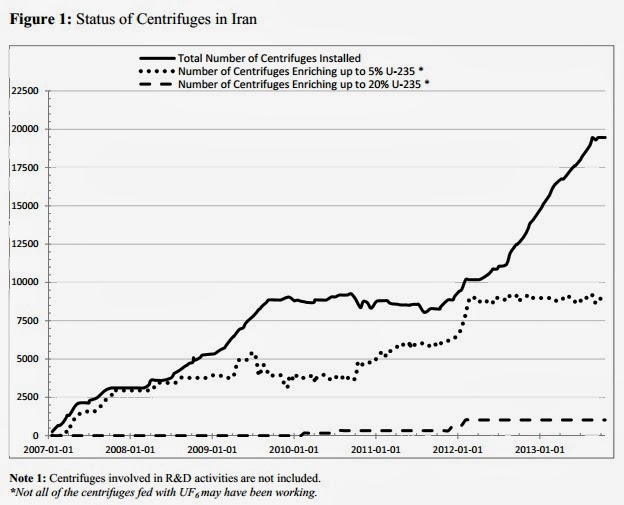
Moreover, Iran’s Natanz facility is designed for a fully operational capacity of 50,000 centrifuges. So far, fewer than 15,500 centrifuges have been installed and fewer than 9,000 are actually functional. Of the 2,710 centrifuges installed at the Fordow site, only about 700 are operational.
Roughly 1,000 second-generation centrifuges have also been installed, but not a single one has yet been used.
So, while Bob Corker and the rest sound pretty serious when they fret about Iran’s 19,000 “spinning” centrifuges, they’re overselling what Iran is actually doing in order to gin up their required hysteria.
What a surprise.
Palestinian media forum condemns NBC plan to produce drama series in Jerusalem
Palestine Information Center – 19/12/2013
GAZA — Palestinian media forum (PMF) has strongly condemned the plan of American TV company (NBC) to film a drama series, in partnership with the occupation municipality, in Silwan in occupied Jerusalem.
PMF said in a statement on Thursday that NBC is preparing to produce and broadcast a drama series in the “City of David”, with the aim of strengthening the Israeli narrative about the city of Jerusalem, which would give legitimacy to Israel’s policies of apartheid, ethnic cleansing and colonization in occupied Jerusalem.
According to Israeli and American media, the NBC network is cooperating with Israeli authorities, film makers and the Keshet Media Group to produce an action series entitled DIG mainly in occupied East Jerusalem, near the Old City.
Most of the filming will take place in the so-called “City of David national park”, which is established on Palestinian property in the neighborhood of Silwan and which is operated by the Israeli settler organization El’ad and the Israeli Nature and Parks Authority.
The PMF asserted that the production of this drama series comes within the framework of the falsification of history and the Judaization of Jerusalem.
The Poor Man’s Sheep
December 18, 2013
Soldiers break into the wrong house at night, go on a rampage – and make off with a woman’s savings from 15 years of work
One night in early September, the members of the Kavajeh family in Tarqumiya were woken by IDF troops breaking into their house. According to the despicable custom of the last few years, some of the soldiers wore ski masks; before our apathetic eyes what used to be the premier line of fashion among criminals has become common military attire.
From this moment on, everything went as per the routine – a routine known to every soldier who has ever served in the occupied territories: the soldiers gathered all the family members in one room, not giving them time to dress properly. They then searched the house, found nothing, and as they left, the head of the family, ‘Issa, heard the soldiers say to one another that they had raided the wrong house. Needless to say, the soldiers did not apologize to the family. The soldiers told them not to leave the house while they were still present.
When the family realized the soldiers were gone, they began to estimate the damage. Here the words of Issa are worth quoting: “We began moving around the house and saw the horror.” The contents of the cupboards had been spilled, and the soldiers had thrown bedding, clothes and equipment onto the floor. The kitchen was the real calamity zone: the soldiers made certain to spill the flour on the floor, mix the sugar, the lentils and the salt together, poured the tahini into the kitchen sink, and, finally, broke the eggs.
Now, certainly some IDF spokesperson, whether an official or a self-appointed one, will manage to find a way to explain why there was a pressing military need behind this wanton destruction of food; we’ll probably find a fool who would explain why there was a need to break the eggs – how do you know what they might have hidden in there? And anyway, why don’t you show us what happened before? And do you know what happened in 1929?
But as the family members finished examining the results of the small green storm that passed mistakenly through their home, the real disaster was discovered: the savings of one of the family members, Thahani, had been stolen. These were two gold bracelets and a gold ring. Thahani had saved the money to buy the jewelry from working in a seamstress shop since 1998.
Fifteen years of savings. Fifteen years of painstakingly gathering, day by day, an ounce of meager pay. A slow collection culminating in 65 grams of gold, each one of them worth 60 Jordanian Dinars, each Dinar the equivalent of about $1.7 USD. Fifteen years of savings left Thahani with some $8,005 USD; a bit more than $385 USD a year, or $1.25 USD a day. This was Tahani’s portion of all her labor. Now it lies in the pocket of a soldier. Perhaps he’ll give them to his lover, who will be grateful and not ask where he got such gold bracelets and such a ring; perhaps they’ll end up in a pawnshop. Perhaps, loyal to the value of comradeship, he already split the loot with other troops in his section.
In the morning, the family complained both to the Red Cross and the Israeli police. This was a futile gesture: good luck finding the looter among dozens of troops, some of whom were hooded and all well-versed in covering for one another. But before the MPCID rushes to close the case claiming it couldn’t find a suspect, one more thing must be said.
Looting is a war crime. It is defined as such in the Fourth Geneva Convention. During wartime, armies often harshly punish looting soldiers, if only because looting is bad for military discipline. At best, looting soldiers have to lie to their commander, which opens the door to more lies; at worst, the commander will take a commission off the loot. Armies who don’t punish looting harshly quickly cease to become armies and turn into militias at best, gangs at worse.
Israel, as is well known, does not have laws against war crimes on its books. This doesn’t mean it doesn’t commit them. And as long as the MPCID does not shake itself up and find the thief, and as long as Israel does not compensate Tahani, it allows a war criminal – not a mere thief, but a war criminal – to roam freely. And since we know nothing of him but the colors of the uniform he wore, he besmirches through his act all those who wear them. And if the IDF wants to remove this stain from its uniform – admittedly, they are spotted with quite a few of them – it had better find the guilty party, and throw the book at him. Hard.
Related article
US tests another nuclear-capable missile
Press TV – December 18, 2013
The United States has test-fired a nuclear-capable inter-continental ballistic missile from an airbase in the state of California.
On Tuesday, a Minuteman 3 intercontinental ballistic missile (ICBM), which is capable of carrying multiple nuclear warheads, was launched from Vandenberg Air Force Base into a 4,200 mile flight over the Pacific to a target on the Kwajalein Atoll in the Marshall Islands.
The US Air Force claims the test-launch program increases Washington’s ability to maintain a strong nuclear deterrent as a key element of its national security and the security of its allies.
“Our Airmen maintain and operate this weapon system year round in some challenging environments, and today’s test is a result of their tireless devotion to this mission,” said Maj. Gen. Jack Weinstein, 20th US Air Force commander, on Tuesday.
The test launch of the nuclear-capable missile, which caused anger in Europe, comes as the US agreed in 2010 to destroy thousands of its nuclear weapons.
Earlier this year on September 26, the US Air Force also tested a nuclear-capable Minuteman 3 ICBM hours before Iranian President Hassan Rouhani told a UN General Assembly meeting on nuclear disarmament that “no nation should possess nuclear weapons.”
On September 21, another nuclear-capable ICBM was launched by the US Air Force just hours after the conclusion of the International Day of Peace.
The US is the only country in the world that has used atomic bombs in war. US atomic bombs were dropped on Hiroshima and Nagasaki in Japan in August 1945.
Last year in September, it was reported that the US government was planning to undertake the costliest modernization of its nuclear arsenal in history. Washington currently has about 5,000 nuclear weapons.
Brazil ditches Boeing jets, grants $4.5 bln contract to Saab
‘NSA ruined it!’
RT | December 18, 2013
Brazil has rejected a contract for Boeing’s F/A-18 fighter jets in favor of the Swedish Saab’s JAS 39 Gripens. The unexpected move to reject the US bid comes amid the global scandal over the NSA’s involvement in economic espionage activities.
The announcement for the purchase of 36 fighters was made Wednesday by Brazilian Defense Minister Celso Amorim and Air Force Commander Junti Saito. The jets will cost US$4.5 billion, well below the estimated market value of around US$7 billion.
Saito said the development of the fighters will occur in conjunction with Embraer and other unspecified companies.
The 12 Mirage aircraft currently in use by the Brazilian Air Force (FAB) will be retired at the end of this year. They were acquired by Brazil in 2005. As it waits for the new fighters, the FAB will use the F5 style, which will stay viable up to 2025.
During a visit in Brasilia last week, French President Francois Hollande was accompanied by an entourage that included the president of Dassault Group, stirring speculation that the French jet manufacturer had the edge over Saab and Boeing.
Competition over which company would win the right to supply Brazil with the fighter jets began in the late 1990s during Fernando Henrique Cardoso’s administration, continued during Luiz Inácio Lula da Silva’s time in office and into current President Rousseff’s term. A FAB report in 2010 indicated a preference in Saab, though then-President Lula leaned toward the cheaper Dassault jet, Rafale.
Boeing was considered to have the inside track to win the contract earlier this year, yet revelations of intrusive surveillance of global officials’ communications, including those of Brazilian President Dilma Rousseff, by the US government’s National Security Agency led to distrust of the American company.
“The NSA problem ruined it for the Americans,” a Brazilian government source told Reuters.
The Chicago-based Boeing’s bid was rejected because of Saab’s better performance and cost of its aircraft as well as “willingness to transfer technology,” defense minister Celso Amorim said, as cited by Bloomberg.
‘Economic espionage’ fallout
Brazil is currently probing reports released by former NSA contractor Edward Snowden that the spy agency monitored the personal communications of President Rousseff and hacked into government ministries to gather information. Among the institutions targeted by NSA espionage were state oil giant Petrobras and the Ministry of Mines and Energy, contradicting claims by Washington that it did not engage in “economic espionage.”
Rousseff lambasted US spying on her country during the UN General Assembly in September, calling it a “breach of international law.” She further warned that the NSA surveillance, revealed since June, threatened freedom of speech and democracy.
“Meddling in such a manner in the lives and affairs of other countries is a breach of international law and as such it is an affront to the principles that should otherwise govern relations among countries, especially among friendly nations,” Rousseff said.
Just before her address at the UN summit, Rousseff canceled a state visit to Washington, scheduled to take place in October, because of indignation over spying revelations. Rousseff has stated she wants an apology from US President Barack Obama.
Snowden has promised to aid Brazil in a probe into the NSA’s spying program in the country.
“A lot of Brazilian senators have asked me to collaborate with their investigations into suspected crimes against Brazilian citizens,” said Snowden, in an open letter published by Brazilian paper Folha de S.Paulo. Snowden hinted in the letter that he may ask Brazil for asylum.
“The American government will continue to limit my ability to speak out until a country grants me permanent political asylum,” wrote Snowden.
The whistleblower is currently under temporary asylum in Russia. Brazil plans to host a global summit on internet governance in April 2014.
Brazil resident Glenn Greenwald, the former Guardian journalist renowned for publishing Snowden’s leaks, criticized on Wednesday European Union governments’ muted response to the revelations about the NSA’s mass surveillance apparatus. He also contradicted Washington’s claim that no economic espionage is involved amid NSA spying.
“What a lot of this spying is about has nothing to do with terrorism and national security. That is the pretext. It is about diplomatic manipulation and economic advantage.”
Related article
Featured Video

Your Enslavement Begins in Gaza: The ‘Board of Peace’
or go to
Aletho News Archives – Video-Images
From the Archives
The US: The Century of Lost Wars
By James Petras | Global Research | September 12, 2018
Introduction
Despite having the biggest military budget in the world, five times larger than the next six countries, the largest number of military bases – over 180 – in the world and the most expensive military industrial complex, the US has failed to win a single war in the 21st century.
In this paper we will enumerate the wars and proceed to analyze why, despite the powerful material basis for wars, it has led to failures. … continue
Blog Roll
 Aletho News
- The US build-up around Iran constitutes strategic war option, not ‘deterrence’
- Iran to US: Sanctions and war failed; try diplomacy and respect
- China supplies Iran with radar, surveillance tech to track US stealth aircraft: Report
- Zelensky rejects territorial concessions to Russia
- German leader of EU’s largest faction sounds the alarm of possibility of right-wing forces coming to power in France, Poland
- Putin: Developing Russia’s nuclear forces ‘absolute priority’
- Hungary Blocks 20th Package of Anti-Russia Sanctions, $106B Loan to Ukraine – Szijjarto
- NATO Must Return to 1997 Borders for Peace in Ukraine – Finnish Politician
- Your Enslavement Begins in Gaza: The ‘Board of Peace’
- Israeli FOIA Data Reveals Massive Heart Injury Spike in Children Immediately After mRNA Shot Rollout
- If Americans Knew
- Average of five Palestinians killed by Israel every day in Gaza since ceasefire – Not a ceasefire Day 136
- Palestinian church leaders admonish Christian Zionist Mike Huckabee – Not a ceasefire Day 135
- Ominous messaging from Trump’s “Board of Peace” – Not a ceasefire Day 134
- ‘Christians Out’: Jerusalem Church Tagged With Hate Graffiti, Police Investigating
- Israeli Settlers Kill American Teen
- ‘We returned from hell’: Palestinian journalists recount torture in Israeli prisons
- No mercy for Gaza in Ramadan – Not a ceasefire Day 133
- The Israeli Government Installed and Maintained Security System at Epstein Apartment
- Tucker Carlson interrogated in Israel, has passport seized after interviewing US ambassador
- 6,000 Amputees in Gaza Face Impossible Recovery amid Israeli War Ultimatum
- No Tricks Zone
- New Research Reaffirms Clouds, Aerosols, And Surface Solar Radiation Are ‘Driving The Climate System’
- Germany: Electric Car Catches Fire At Charging Station, Sets Off Local “Inferno”, Widespread Damage
- New Study: Canada’s New Brunswick Was 1°C Warmer Than Today During The Medieval Warm Period
- Coal Power Back In Trend As Globe Tries To Keep Pace With Growing Demand For Power
- New Study: A 4°C Warmer Beaufort Sea Had ‘No Sea Ice’ 11,700 – 8200 Years Ago
- Unfudging The Data: Dutch Meteorological Institute Reinstates Early 20th Centruy Heat Waves It Had Erased Earlier
- German Gas Crisis…Chancellor Merz Allegedly Bans Gas Debate Ahead of Elections!
- Pollen Reconstructions Show The Last Glacial’s Warming Events Were Global, 10x Greater Than Modern
- Germany’s Natural Gas Storage Level Dwindles To Just 28%… Increasingly Critical
- New Study Rebuts The Assumption That Anthropogenic CO2 Molecules Have ‘Special’ Properties
 Aletho News