Anti-boycott academics demonstrate lack of excuses in supporting Israel
By Dr Sarah Marusek | MEMO | December 16, 2013
In recent days, a group of American scholars have been debating publicly whether or not to boycott Israel. According to the New York Times, the American Studies Association (ASA) will disclose today the results of its members’ vote on a resolution to endorse an academic boycott of Israel that was approved unanimously by the association’s National Council on 4 December. This follows a decision last April by the Association for Asian American Studies to endorse the academic boycott, which only focuses on institutions, so does not include Israeli scholars as long as they do not represent Israeli universities or the government.
Meanwhile, last week the president of Palestine categorically rejected any boycott of Israel. Speaking to reporters in South Africa, President Mahmoud Abbas stated firmly that, “No, we do not support the boycott of Israel,” citing the Palestinian Authority’s relationship with Tel Aviv. Instead, Abbas only supports boycotting products made in illegal settlements.
By confining the Palestinian people to a “we” that only consists of the PA, based in the West Bank, Abbas is symbolically ceding East Jerusalem to the occupiers, since under the Oslo Accords the PA is prohibited from carrying out any activities there. In addition, he is turning his back on those Palestinians in Gaza who are suffering under a draconian Israeli-led siege, a fate far worse than any proposed boycott. He is also abandoning the millions of Palestinian refugees who are being denied their right of return, as upheld by UN resolution 194.
Indeed, by placing the relationship that the PA has with Israel above the daily humiliations the Palestinians are forced to endure under Israel’s military occupation, Abbas has clearly put aside the rights of his own people, reaffirming once again his own illegitimacy (his term of office actually expired in 2009).
With these remarks Abbas has illustrated that he is out of touch not only with the Palestinian people, but also with the international community. The world is increasingly supportive of the boycott of Israel as called for by the Palestinian Campaign for the Academic and Cultural Boycott of Israel (PACBI), launched in Ramallah in 2004 by a group of Palestinian academics and intellectuals, as well as the wider international Boycott, Divestment and Sanctions (BDS) movement, launched by Palestinian civil society in 2005.
Indeed, this week Haaretz cited “new research published by the Molad Centre for Renewal of Democracy”, a progressive Israeli think tank, which “addresses Israel’s standing in the world”. The group’s research findings suggest that “Israel is particularly vulnerable to sanctions and boycotts by Western countries due to the animosity of neighbouring countries, and because 40 per cent of Israel’s Gross National Product is based on exports, primarily to Europe.” The findings, adds Haaretz, also “show that Israeli businessmen, artists and academics are confronting increasing refusal of international agencies and potential partners to collaborate with them.”
But at least Israel still has the support of Abbas, who continues to carry out the charade of a US-brokered “peace process” while Israel carries on building more illegal settlements.
Interestingly, both Abbas and the whole “peace process” share the same framework as those American scholars who have campaigned to reject the ASA resolution to endorse an academic boycott of Israel; this is no coincidence. All those refusing the boycott are employing a “rights-based” framework that seems to recognise the rights of everybody but the Palestinians.
Members of the ASA had until 15 December to decide whether or not to back the boycott resolution; opponents of the boycott have been tireless in making their case against it. Similar to Abbas and the “peace process”, they all end up denying Palestinians their rights, either directly or indirectly.
For example, only two days after the ASA resolution was proposed, the American Association of University Professors (AAUP) called upon ASA members to vote down the motion. In an open letter, the president and vice president of AAUP argue: “In seeking to punish alleged violations of academic freedom elsewhere, such boycotts threaten the academic freedom of American scholars to engage the broadest variety of viewpoints.”
Of course, the “alleged violations” of Palestinians’ academic freedom include the fact that the occupation authorities place unfair bureaucratic obstacles on Palestinian universities, close institutions by military orders, ban textbooks, and prevent Palestinian students and their lecturers from travelling to and from class. During the 2006 aggression against Gaza, Israel deliberately bombed the Islamic University, as well as 18 schools. Despite this, when efforts are proposed to try to redress these injustices, the AAUP says no because it will infringe upon the rights of American scholars.
Although the AAUP letter also reaffirms the association’s “stand in opposition to academic boycotts as a matter of principle”, it gave active support to the boycott against South Africa’s apartheid regime. As David Lloyd, a professor of literature at the University of California, points out, “That movement did call for individual boycotts of South African scholars, cultural workers, and sports persons,” whereas “PACBI’s call is specifically and exclusively institutional.” So it seems pretty clear that the AAUP’s position is not related to the rights of scholars, but only to the rights of American scholars; it is not a principled stand against boycotts per se, but a stand against the boycott of Israel in particular.
To take another example, in an open letter to the president of ASA, Claire B. Potter, a professor of history at The New School, suggests: “Scholars of any nation ought to be free to travel, publish and collaborate across borders; I consider this to be a fundamental human right, and so does the United Nations. We in the American Studies Association cannot defend some of those human rights and disregard others.”
The irony of such a statement is acute. By only granting the right of education to “scholars of any nation” Potter is denying this right to Palestinians, as well as to all stateless persons, whereas the UN insists that “all peoples and all nations” have this right. Thus, her position is actually doing precisely what she warns against – defending the rights of some and disregarding others. Considering America’s history of trampling the rights of Native Americans and African Americans, Potter’s turn of phrase is especially ill-thought.
And although Potter does recognise that there are people who are “suffering under, and threatened by, the exclusions, violence and expulsions that are characteristic of Israel’s occupation of Palestinian lands”, she argues that the proposed boycott would impact on “anti-occupation academics, including Palestinian scholars employed by Israeli institutions.”
While it is nice that Potter is at least trying to think about the rights of Palestinian scholars, a recent Haaretz survey of Israeli research universities “found few Arab scholars in the highest professional level at each university. Hebrew University has two Arab professors at the highest level out of 20 senior faculty members. Ben-Gurion University has 13 Arab professors out of 451, five at the highest level and eight in lower positions. Haifa University has two Arab professors at the highest rung and 10 in lower levels, out of 265 professors.” Tel Aviv University officials said that they have about 25 senior Arab faculty members there. The university boasts a 25:1 ratio of student to faculty, so with 30,000 students this means that it employs around 1,200 professors in total. At “Bar-Ilan University there are two senior Arab faculty members. Ariel University’s 80 professors include not a single Arab.”
Considering that Palestinians comprise around 20 per cent of the Israeli population, and almost 50 per cent of the total population when including the occupied Palestinian territories, these numbers are even more shocking. The opportunities for Palestinian students are almost as limited. According to a special report published by the Washington Report for Middle East Affairs, Palestinians make up just 11.2 per cent of all undergraduates, 6.1 per cent of all master’s students, and only 3.5 per cent of all PhD students.
Thus it seems more than a bit unfair to privilege the rights of a few dozen anti-occupation scholars while ignoring the rights of millions of Palestinians, regardless of their politics.
In yet another example of an American scholar using a “rights based” framework to promote the rights of some over others, Mark Rice, a professor of American Studies at St. John Fisher College, says that he opposes the ASA boycott because “the primary role of a professional academic organisation is to advocate for the needs and concerns of its members within their professional lives.” Again, he too is presenting the argument that the rights of American scholars ought to come first, in this case to enhance our own professional careers, thus perhaps raising the tyranny of “rational choice theory” to a whole new level.
Rice also rejects the boycott because he thinks that ASA members will be “discouraged from pursuing Fulbright research or teaching opportunities in Israeli universities, as Fulbright opportunities typically require explicit affiliation with host institutions. That, to my mind, is a restriction of the academic freedom of individual scholars.”
This seems a reasonable concern. That is, until you look at the countries where Fulbright grants are being offered. During the 2014-2015 academic year Fulbright awards will not be available to scholars wanting to study in: “Algeria, Gaza, Iran, Iraq, Lebanon, Libya, Qatar, Saudi Arabia, Syria, Tunisia, the West Bank, or Yemen.” What Middle East countries are left? Bahrain, Egypt, Israel, Jordan, Kuwait, Morocco, Oman and the United Arab Emirates; all are current allies of the US government. One can only wonder if Rice has anything to say about that.
Of course, there are also American scholars who are adopting a much cruder framework for completely rejecting any boycott of Israel. For example, Larry Summers, the former president of Harvard University and former US Treasury secretary, suggests simply that targeting Israel is “anti-Semitic in effect”. Furthermore, while he insists ardently that boycotts are against the principle of academic freedom, he also hopes that universities will stop funding faculty participation in ASA if the resolution is passed.
Regardless of whether ASA members choose to uphold the boycott or not, what having this public debate highlights more than anything else is that those who continue to support Israeli apartheid and occupation are quickly running out of excuses.
Related article
Yemeni parliament bans US terror drone strikes
Press TV – December 15, 2013
Yemeni MPs have strongly condemned US assassination drone strikes inside the Arab country and the parliament passed a law banning the drone attacks.
“Lawmakers have voted to ban drone strikes in Yemen,” the official Saba news agency reported after the parliament held a session on Sunday.
The legislators stressed “the importance of protecting all citizens from any aggression” and “the importance of preserving the sovereignty of Yemeni air space,” Saba said.
On Thursday, a US drone fired several missiles into a convoy of vehicles traveling to a wedding party in central Yemen, killing at least 17 people.
The strike triggered protests across Yemen. Relatives of the people killed in the attack blocked roads to protest against the deadly incident, calling on the government to adopt measures to halt the drone strikes. They also demanded an official apology as well as compensation.
“If the government fails to stop American planes from… bombing the people of Yemen, then it has no rule over us,” Yemeni tribal chief Ahmad al-Salmani said on Saturday.
Washington has stepped up its assassination drone operations in Yemen over the past few years.
According to the Washington-based think tank the New America Foundation, US drone attacks in the Arab country almost tripled last year, surging from 18 to 53.
US officials claim that the attacks target militants, but local sources say civilians have been the main victims of the non-UN-sanctioned airstrikes — which have also been launched against locations in Afghanistan, Pakistan, and Somalia.
The US has come under fire for increasing its drone attacks in Yemen, where the people have held many demonstrations to condemn the violation of their national sovereignty.
Number recently displaced by flooding in Gaza tops 10,000
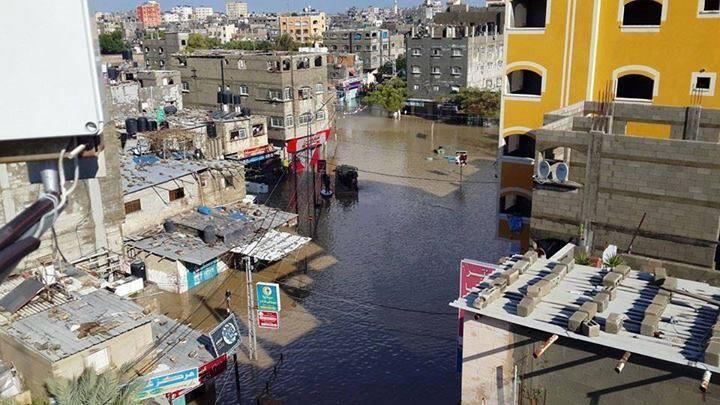
Ma’an | December 15, 2013
BETHLEHEM – Approximately 10,000 people have been forced to flee their homes due to widespread flooding in the Gaza Strip, according to a report released Saturday evening by the United Nations Office for the Coordination of Humanitarian Affairs.
The numbers of displaced dwarf earlier estimates, as they take into account both the thousands who have sought refuge in Gaza shelters as well as those who have sought refuge elsewhere.
Previous estimates released by the Gaza government had measured only those who had sought refuge in official shelters, who at their peak reached above 5,000 but were estimated at around 2,234 on Sunday.
In a comprehensive report on winter storm Alexa’s effects on the Palestinian Territories, OCHA reported that as of Saturday at 9 p.m., 10,000 Gazans had been evacuated from their homes and had gone to either shelters or relatives’ houses.
The areas most devastated by the storm are “North Gaza and Gaza City where over 1,500 houses suffered damage due to water entering houses, damaging furniture and electricity networks.”
An infant died and 100 were injured in storm-related incidents throughout Gaza, the report said. Gaza government officials said on Sunday that two individuals had died, but did not mention any case involving an infant.
Schools throughout Palestine have been closed since Thursday, and according to OCHA 17 schools in Gaza have been converted into shelters, while five other schools have been rendered unusable due to flooding.
The report also discussed the effects of the storm, in conjunction with the Israeli occupation, on herding communities in the West Bank.
“Several herding communities had their structures demolished (by the Israeli authorities) one day before the storm hit, prompting the UN Humanitarian Coordinator to call again for a halt to demolitions due to their humanitarian impact,” the report said.
Additionally, “approximately 30 families living in ten Bedouin communities in the northern Jordan Valley require emergency assistance.”
Meanwhile, the report said farmers across Palestine have been hit with livestock and crop losses, further weighing on levels of food insecurity throughout the territories.
“In the West Bank, preliminary reports of damages to the livestock sector are emerging from Hebron, Bethlehem and Salfit. Bedouin and herding communities seem to be the most affected. Herders are expected to face increasing livestock fatalities and morbidity in the coming weeks.”
In Gaza, over 10 percent of the coastal enclave’s greenhouses and field crops were destroyed or damaged by winter storm Alexa, in addition to 50 animal pens, the report said.
“120,000 chicks and 200 heads of livestock died as a result of the weather.”
The Gaza Strip is currently under a state of emergency due to severe weather conditions caused by a historic storm front moving south across the Levant.
UNRWA spokesperson Chris Gunness said on Saturday that large regions of the Gaza Strip were a “disaster area” and called on the international community to lift the Israeli blockade in order to allow recovery efforts to proceed.
“Any normal community would struggle to recover from this disaster. But a community that has been subjected to one of the longest blockades in human history, whose public health system has been destroyed and where the risk of disease was already rife, must be freed from these man made constraints to deal with the impact of a natural calamity such as this,” he said in a statement sent to Ma’an.
Fuel shortages have caused daily life in the Gaza Strip to grind slowly to a halt since early November, cutting off access to basic necessities for Gaza residents.
Until Sunday, the Gaza Strip had been without a functioning power plant since the beginning of November, when the plant ran out of diesel fuel as a result of the tightening of a seven-year-long blockade imposed on the territory by Israel with Egyptian support.
The power station began operating Sunday after receiving a delivery of diesel that was purchased from Israel by the Palestinian Authority using funds donated by Qatar.
The plant was only reopened in 2012 after it was targeted by an Israeli airstrike in the 2006 assault on the Strip. The power plant generates around 30 percent of the Gaza Strip’s electricity supply, while the rest comes from Israel and Egypt.
Until July of this year, the tunnels to Egypt provided a vital lifeline for the territory amidst the otherwise crippling Israeli blockade. The blockade has been in place since 2006, and it has limited imports and exports and led to a major economic decline and wide-reaching humanitarian crisis.
In 2011 and 2012, however, the situation improved, as the tunnels to Egypt witnessed a brisk trade following the Egyptian Revolution.
Gaza Strip energy officials have blamed Egypt for destroying numerous tunnels linking the Gaza Strip and Egypt in recent months. They also blamed the Fatah-led Palestinian Authority for charging taxes on fuel too high for Hamas authorities to afford.
Related article
“Judges for Egypt” to boycott constitution referendum
MEMO | December 15, 2013
The President of Egypt’s Court of Appeals, Judge Mohamed Awad, has said that he will not participate in the judicial supervision of the referendum on the new constitution. He claims that the document lacks credibility.
Awad, who is also the General Coordinator of Judges for Egypt, said in a statement, “The proposed constitution allows the military to act as masters of the Egyptian people, legitimises military coups and eliminates Egypt’s Islamic identity to establish a secular state.”
The document, he added, denies the Egyptian people their rights to be the source of power in the country. “The proposed constitution is illegal because it has been issued by an illegal commission that did not represent the Egyptian people,” insisted Awad. “The referendum will take place under military rule, which has been renowned for electoral fraud since the 1952 coup.”
Related article
Netanyahu urges more pressure against Iran

Press TV – December 15, 2013
Israel’s Prime Minister Benjamin Netanyahu has called for the escalation of international pressure against Iran over the country’s nuclear energy program.
“As long as we don’t see actions instead of words, the international pressure should continue, and even more than that, it should be strengthened,” Netanyahu said on Sunday.
The remarks were Netanyahu’s first comments after the four-day expert-level nuclear talks between the representatives of Iran and six world powers in Vienna last week.
On Thursday, the US Treasury Department announced new sanctions against a number of companies and individuals for “providing support for” Iran’s nuclear energy program.
On Sunday, Iranian Foreign Minister Mohammad Javad Zarif slammed the US action as “unconstructive and inappropriate” and reaffirmed Iran’s resolve to respond prudently to such measures, while seriously pursuing the nuclear negotiations with the six countries.
The new US sanctions came despite the nuclear deal inked between Iran and the five permanent members of the UN Security Council – Russia, China, France, Britain and the US – plus Germany in the Swiss city of Geneva on November 24.
Following the conclusion of the interim agreement, Netanyahu described the nuclear deal as a “historic mistake.”
Israel, known as the sole possessor of nuclear weapons in the Middle East, has repeatedly accused Iran of pursing non-civilian objectives in its nuclear energy program and threatened to take unilateral military action against the country.
Related article
‘Stop lying’: Uruguay president chides UN official over marijuana law
RT | December 14, 2013
Uruguay’s president has accused the head of the UN’s International Narcotics Control Board (INCB) of lying and double standards, after the official claimed the country did not consult the anti-drug body before legalizing marijuana.
Earlier this week, Uruguay became the first country in the world to legalize both the sale and production of marijuana.
INCB chief Raymond Yans has slammed the “surprising” move, accusing the South American state of legalizing the drug without first discussing it with the UN organization.
Uruguay’s president, Jose Mujica, rejected the criticism on Friday, saying that he’s ready to discuss the law with anyone.
“Tell that old man to stop lying,” Mujica said in an interview with Uruguay’s Canal 4.
“Let him come to Uruguay and meet me whenever he wishes… Anybody can meet and talk to me, and whoever says he couldn’t meet with me tells lies, blatant lies.”
“Because he sits in a comfortable international platform, he believes he can say whatever nonsense,” he added.
Yans has accused Uruguay of “pirate attitudes” for knowingly violating the 1961 Single Convention on Narcotic Drugs, which the South American country is part of.
But Mujica reminded that Yans did not say a word about the US states of Colorado and Washington, which also legalized marijuana.
“Does he have different rules: one for Uruguay and other for the world’s strong countries?” he asked.
First lady Lucia Topolansky, a member of the Uruguayan Senate, has fully backed her husband on the issue.
“Who is this fellow who likes to call names to countries?” she said of Yans. “I think he’s crossed the line, but anyhow I believe that he has had problems with other countries, Sweden, Denmark, Holland and they will be meeting him sometime in March.”
“But to be honest, marijuana is not the heart of life or earthly issues,” Topolansky added.
The law, which allows for a government-controlled marijuana market, was passed by the Uruguayan Senate on Monday.
According to the legislation, those wishing to smoke cannabis recreationally need to register with the authorities and limit their consumption to 40 grams per month.
President Mujica and his supporters argue that regulating marijuana consumption and production will remove profits from criminals and allow less money to be spent on soldiers and police, who are ultimately unable to prevent Uruguayan citizens from using the drug.
ACLU calls for Massachusetts moratorium on controversial license plate readers
ACLU – 12/14/2013
BOSTON — The ACLU of Massachusetts calls for a moratorium on the use of controversial and unregulated license plate scanner technology in all Massachusetts police departments, following a Boston Globe exposé of problems in the Boston Police Department’s program.
The story, published in today’s Globe, shows that contrary to officials’ claims about why departments need the technology, police routinely do not respond to live ‘hits’ alerting them to the location of stolen cars. This suggests that the program is, as the ACLU feared, largely oriented towards compiling vast databases enabling the warrantless tracking of millions of innocent motorists.
In response to these alarming findings, the Boston Police Department announced it would suspend the program, at least until proper oversight and procedures are put into place.
“The Globe’s investigation into the Boston Police Department’s license plate reader program, based largely on a series of public records requests initiated nearly a year ago, confirms that police departments need outside oversight and guidance in order to responsibly use this powerful technology. We applaud the Boston police decision to suspend the program,” said Kade Crockford, director of the Technology for Liberty project at the ACLU of Massachusetts. “In light of these disturbing revelations, no police department in the state should continue to use this technology until the legislature passes the License Plate Privacy Act. We need uniform statewide rules for departments’ use of plate readers.”
Currently the Massachusetts State Police and more than 50 cities and towns deploy license plate scanners, which snap photographs of each license plate they encounter, noting the time, date and location, and run the plate numbers against “hot lists” to identify stolen cars, outstanding warrants and other violations. Today, no license plate reader program in the state is subject to outside regulation.
“The License Plate Privacy Act will establish accountability and public transparency requirements to ensure that the kinds of abuses the Globe uncovered at the Boston Police Department are not happening in other cities and towns,” said Crockford. “Technologies that target ordinary Americans going about their everyday lives create tremendous opportunity for abuse, without keeping us safe. We must ensure that the law keeps pace with these new technologies.”
The License Plate Privacy Act allows departments to use license plate readers to identify cars associated with criminal suspects or crimes, while preventing the government from amassing databases containing the historical travel records of millions of innocent people.
“The Globe’s investigation makes crystal clear that departments cannot police their own use of this complex and powerful tool,” said Crockford. “The legislature must step in to provide some basic rules, as well as checks and balances to make sure license plate readers aren’t used for warrantless tracking of innocent drivers. The Joint Transportation Committee should recommend swift approval of the License Plate Privacy Act, the legislature should pass it, and the Governor should sign it into law.”
Advanced surveillance tools can work to promote public safety while simultaneously respecting the privacy and liberty interests that help our Commonwealth thrive, but in order for that to happen the law needs to catch up with the technology. The License Plate Privacy Act strikes the right balance. Police departments statewide should follow Boston’s lead and immediately halt their use of the technology until the legislature acts.
For more on the License Plate Privacy Act, go to:
https://aclum.org/privacy_agenda#LPA
To take action on this issue, go to:
https://ssl.capwiz.com/aclu/ma/issues/alert/?alertid=63008551&type=ML
For more information about automatic license plate readers, go to:
https://www.aclu.org/alpr
Related articles
US to hold talks with Syrian jihadists in Turkey: rebel source
Al-Akhbar | December 14, 2013
Syrian rebel commanders from the Islamic Front which seized control of bases belonging to Western-backed rebels last week are due to hold talks with US officials in Turkey in coming days, rebel and opposition sources said on Saturday.
The expected contacts between Washington and the jihadist fighters reflect the extent to which the Islamic Front alliance has eclipsed the more moderate Free Syrian Army brigades – which Western and Arab powers tried in vain to build into a force able to topple President Bashar al-Assad.
The talks could also decide the future direction of the Islamic Front, which is engaged in a standoff with yet more radical takfiri fighters from the al-Qaeda-linked Islamic State in Iraq and the Levant (ISIL).
A rebel fighter with the Islamic Front said he expected the talks in Turkey to discuss whether the United States would help arm the front and assign to it responsibility for maintaining order in the rebel-held areas of northern Syria.
He declined to be identified because of the sensitivity of the talks, and gave no further details. Diplomatic sources in Turkey said that America’s Syria envoy Robert Ford was expected in Istanbul soon but his schedule was not yet confirmed.
The Islamic Front, formed by the unification of six major Islamist groups last month, seized control a week ago of weapons stores nominally under the control of the Free Syrian Army’s Supreme Military Command (SMC).
It has since said it was asked to take over the base by the SMC to protect it from attack by ISIL fighters. Whether or not the move was requested, it demonstrated how little power the Western-backed SMC wields in rebel-held Syria.
An SMC rebel commander also said he had been told the Islamic Front would hold talks with US officials in Turkey in the coming days.
The infighting and rivalries among the rebels have undermined their fight against Assad in Syria’s 2-1/2 year civil war.
The conflict has also reduced whole city districts across Syria to rubble, causing tens of billions of dollars of damage, driven 2 million refugees to seek safety abroad and made millions more homeless and vulnerable to a winter storm which has covered the region in snow and biting rain.
The Islamic Front rebel told Reuters that rivalry with the ISIL had already led to a spate of hostage-taking between the two sides, and that the Front’s decision to talk to the Americans had further escalated tension.
Although he described the two Islamist forces as ideologically close, he said ISIL appeared set on confrontation, perhaps encouraged by some of their backers in Saudi Arabia.
“The front has to talk to ISIL via messengers because of the tense situation,” he said. “ISIL sees things in black and white. They are very stubborn.”
“So far the Islamic Front has been restraining itself, having some sort of dialogue with ISIL,” the rebel said. But he said that unless the hostages were released soon “there will be more discussions and a different decision will be taken.”
Contacts with the United States will not be undertaken lightly by the Islamic Front, which includes Salafi groups such as Ahrar al-Sham brigades which are mainly hostile to the West and have rejected US-Russian backed UN peace talks for Syria, due to be held in Switzerland next month.
But their leaders have compared engaging with Washington to the Prophet Mohammad’s temporary and tactical truces with enemy tribes as he built up his power.
The US State Department, asked earlier this month whether it was in contact with Islamist rebels in Syria, said it wanted to work with a range of groups to try to persuade them to be part of the peace negotiations.
Rebels control a large region of northern and eastern Syria but have failed to unite in a single military force, allowing Assad’s army to make some inroads around the northern city of Aleppo in recent weeks.
The army, backed by Lebanese Hezbollah fighters, has also recaptured towns and suburbs around Damascus and along the main highway north from the capital towards the central city of Homs.
Last week’s Islamic Front seizure of the SMC weapons bases led the United States and Britain to suspend non-lethal aid into northern Syria. But the opposition Syrian National Coalition said on Friday that more help, not less, was desperately needed.
“We know that we have a problem, we know that we don’t have the organized military institutions that we want. We know of the challenges of the loose organization of the Free Syrian Army,” Coalition chief of staff Monzer Abkik said in London.
Appealing for international support to restructure the rebel forces, he said the alternative to an overhaul of their military operations was “complete chaos.”
“There are many, many groups fighting the regime and fighting each other and fighting al-Qaeda. It is a complete mess on the ground,” he said.
(Reuters, Al-Akhbar)
Mexico Opens Energy Industry to Foreign Investment
By Diego Cupolo | Upside Down World | December 13, 2013
In a historic move, Mexican congress members have voted to open the state-controlled energy sector to foreign investment for the first time in 75 years. On Thursday, President Enrique Peña Nieto applauded the legislation, which is poised to become the nation’s most significant economic reform since the North Atlantic Free Trade Agreement.
“The energy reform marks a fundamental transformation that will allow us to increase our energy sovereignty and self-sufficiency in Mexico,” Peña Nieto wrote on Twitter Thursday morning. “It will also drive productivity, economic growth and job creation in Mexico.”
The legislation will alter several articles of Mexico’s Constitution, allowing private multinationals to develop the country’s oil and natural gas resources for the first time since 1938, when former President Lazaro Cardenas nationalized the energy industry with the creation of Pemex, or Petróleos Mexicanos.
Though Mexico still owns its natural resources, foreign companies such as Exxon Mobil Corp. and Chevron Corp will be able to search, drill and open gasoline stations under contract with the Mexican state.
The end of the Pemex energy monopoly is expected to bring Mexico an additional $20 billion in foreign investment per year as multinationals race to tap vast deepwater oil reserves in the Gulf of Mexico. According to the U.S. Energy Information Administration, the region is the largest unexplored oil patch outside the Arctic Circle.
Yet in a country where local oil production has long been a source of national pride and is often equated with sovereignty, the reform has been heavily contested by opposition leaders from the Party of Democratic Revolution (PRD), who have said the measure should go before a national referendum.
“We warn all private, national and, above all, transnational businesses and companies that want to come and invest in Mexico and petroleum, in order to expropriate Mexican petroleum, to think again,” said Jesus Zambrano, president of the PRD. “The most probable outcome is that within a year and a half, a recall referendum will reject this change.”
On Thursday, PRD members blocked the entrances to the lower house’s main voting hall to prevent discussion of the bill. Antonio Garcia, a PRD lawmaker, even stripped down to his underwear during to symbolize a nation stripped of its wealth.
Regardless, members from the ruling Institutional Revolutionary Party (PRI) and the conservative National Action Party (PAN), met in an adjacent conference room where they passed the legislation with 353-134 vote. Peña Nieto is expected to sign the bill in February after it has been ratified by state legislatures.
Currently, Mexico is the 10th largest oil producer in the world and proponents of the reform say it could propel the nation into the top five by taking advantage of new extraction and deepwater exploration technologies that Pemex cannot afford.
After peaking in 2004, Mexico’s oil production has declined by 25 percent to 2.5 million barrels a day. During the same period, Pemex has more than doubled operational spending to $20 billion per year, gaining the company a reputation for inefficiency and corruption.
Still, Pemex revenues provide a third of Mexican government’s annual budget and the company’s 160,000 employees face an uncertain future as lawmakers finalize the reform details, which include the removal of all five representatives of Pemex’s worker’s union from the company board.
To put the PRI agenda in perspective, The Financial Times said “energy is the climax of a sweeping agenda of reforms, including telecoms, labor, tax and education, which Enrique Peña Nieto has championed in his first year as president.”
Sources:
El Pais: México cambia su historia energética a contrarreloj – http://internacional.elpais.com/internacional/2013/12/12/actualidad/1386888542_011957.html
Bloomberg: Mexico Passes Oil Bill Seen Luring $20 Billion a Year – http://www.bloomberg.com/news/2013-12-12/mexico-lower-house-passes-oil-overhaul-to-break-state-monopoly.html
New York Times: Mexico’s Pride, Oil, May Be Opened to Outsiders – http://www.nytimes.com/2013/12/13/world/americas/mexico-oil.html?hpw&rref=business
Financial Times: Mexico courts foreign investment with energy reform – http://www.ft.com/intl/cms/s/0/e2242e2c-632e-11e3-886f-00144feabdc0.html#axzz2nIk7FhZe
Wall Street Journal: Mexico Congress Passes Historic Energy Bill – http://online.wsj.com/news/articles/SB10001424052702303932504579254013051981266
Reuters: Mexican Congress passes radical shake-up of oil industry – http://ca.reuters.com/article/businessNews/idCABRE9BB16820131212
Related articles
Featured Video

Your Enslavement Begins in Gaza: The ‘Board of Peace’
or go to
Aletho News Archives – Video-Images
From the Archives
The US: The Century of Lost Wars
By James Petras | Global Research | September 12, 2018
Introduction
Despite having the biggest military budget in the world, five times larger than the next six countries, the largest number of military bases – over 180 – in the world and the most expensive military industrial complex, the US has failed to win a single war in the 21st century.
In this paper we will enumerate the wars and proceed to analyze why, despite the powerful material basis for wars, it has led to failures. … continue
Blog Roll
 Aletho News
- The US build-up around Iran constitutes strategic war option, not ‘deterrence’
- Iran to US: Sanctions and war failed; try diplomacy and respect
- China supplies Iran with radar, surveillance tech to track US stealth aircraft: Report
- Zelensky rejects territorial concessions to Russia
- German leader of EU’s largest faction sounds the alarm of possibility of right-wing forces coming to power in France, Poland
- Putin: Developing Russia’s nuclear forces ‘absolute priority’
- Hungary Blocks 20th Package of Anti-Russia Sanctions, $106B Loan to Ukraine – Szijjarto
- NATO Must Return to 1997 Borders for Peace in Ukraine – Finnish Politician
- Your Enslavement Begins in Gaza: The ‘Board of Peace’
- Israeli FOIA Data Reveals Massive Heart Injury Spike in Children Immediately After mRNA Shot Rollout
- If Americans Knew
- Average of five Palestinians killed by Israel every day in Gaza since ceasefire – Not a ceasefire Day 136
- Palestinian church leaders admonish Christian Zionist Mike Huckabee – Not a ceasefire Day 135
- Ominous messaging from Trump’s “Board of Peace” – Not a ceasefire Day 134
- ‘Christians Out’: Jerusalem Church Tagged With Hate Graffiti, Police Investigating
- Israeli Settlers Kill American Teen
- ‘We returned from hell’: Palestinian journalists recount torture in Israeli prisons
- No mercy for Gaza in Ramadan – Not a ceasefire Day 133
- The Israeli Government Installed and Maintained Security System at Epstein Apartment
- Tucker Carlson interrogated in Israel, has passport seized after interviewing US ambassador
- 6,000 Amputees in Gaza Face Impossible Recovery amid Israeli War Ultimatum
- No Tricks Zone
- New Research Reaffirms Clouds, Aerosols, And Surface Solar Radiation Are ‘Driving The Climate System’
- Germany: Electric Car Catches Fire At Charging Station, Sets Off Local “Inferno”, Widespread Damage
- New Study: Canada’s New Brunswick Was 1°C Warmer Than Today During The Medieval Warm Period
- Coal Power Back In Trend As Globe Tries To Keep Pace With Growing Demand For Power
- New Study: A 4°C Warmer Beaufort Sea Had ‘No Sea Ice’ 11,700 – 8200 Years Ago
- Unfudging The Data: Dutch Meteorological Institute Reinstates Early 20th Centruy Heat Waves It Had Erased Earlier
- German Gas Crisis…Chancellor Merz Allegedly Bans Gas Debate Ahead of Elections!
- Pollen Reconstructions Show The Last Glacial’s Warming Events Were Global, 10x Greater Than Modern
- Germany’s Natural Gas Storage Level Dwindles To Just 28%… Increasingly Critical
- New Study Rebuts The Assumption That Anthropogenic CO2 Molecules Have ‘Special’ Properties
 Aletho News