‘Excuse to throw us out’: Spanish cave dwellers say authorities’ actions ‘unlawful’
RT | December 14, 2013
A rare way of life is under threat in Spain where authorities have renewed attempts to evict dozens of cave-dwelling families from their homes in an ancient settlement in Granada. Residents say “it’s a disgrace”, and are determined to resist eviction.
Throughout the week dozens of activists have been protesting the eviction they deem unlawful and unfair.
The San Miguel cave dwellers say they have been the victims of the authorities, violating their human rights, and evicting people for cynical reasons only.
San Miguel is the site of one of the four main cave neighborhoods in Southern Spain. For over a thousand years, hundreds of caves carved out of the eye-catching hilltop have been home to gypsies and other homeless settlers.
Abandoned in the 1960s, in recent times eight caves have been occupied by squatters, who reclaimed them to turn them into modest and unconventional homes.
However, several years ago the council announced plans to turn the site into a tourist attraction. The Sacramento caveman heritage would include flamenco caves for tourists, a number of “artisan” and souvenir workshops, as well the main landmark – a hotel – which, according to the council, would “respect the harmony of the area”. The caves happen to be located in a lucrative location, affording the best views over the city, which relies on a robust tourism economy.
The authorities aren’t ruling out the possibility of going to court to get an eviction order. According to the cave dwellers, the court in Strasbourg has already ruled that eviction must be suspended until they have been provided with proper accommodation.
On Thursday, Granada’s city council proposed providing social housing to the cave dwellers.
RT’s Lucy Kafanov, reporting from the site, spoke to local residents and activists who told her it’s the third attempt by the authorities to clear cave dwellings in the past six years. Officials have repeatedly claimed that the “hand-made” homes built there are dangerous.
A spokesman for the cave dwellers argues their homes may be lacking fancy furniture but are perfectly habitable. Juan Antonio Parra told RT that should eviction take place this time round, people will band together to resist it.
“We certainly will resist, using every legal means available. Which is more than can be said of the city council, whose actions have been unlawful and underhand all along the way. First, they have no property rights on the caves. Secondly, they never did an expert assessment of the caves’ condition. There have been no cave-ins in any of the caves that the city council proclaimed to be crumbling as far back as three years ago, not even after the heavy rainfall we have had. So we can see their lie for what it is: they just need an excuse to throw us out.”
Parra says that what is happening these days is in fact highly reminiscent of past events.
“This has happened before, the seizures and the evictions: under the Francoist regime, and before that, during the reign of the Catholic kings. These caves have always sheltered Arabs, Gypsies, etc. The past still prevails in this part of Granada, so we believe the authorities will not succeed here.”
Local activist, Antonio Redondo, believes that plans to evict the cave dwellers have nothing to do with worries about comfortable and safe living conditions.
“It is a disgrace. This has nothing to do with concerns for the people. The government cares nothing for the fact that there are some 500 evictions administered in Andalusia every day. Instead, they keep trying to exploit the situation. They insist on eviction rather than carry out an assessment of the caves’ condition, or call a town hall meeting with the cave dwellers in order to explain the makeover plan and offer to relocate the inhabitants. This shows how totally unconcerned they are about these people.”
The government of Andalusia is expected to bring experts to the site to evaluate it. The cave dwellers are also looking for independent architects to confirm that their houses are a safe place to live.
In a bid to resolve the escalating crisis, the activists are planning to establish a co-op tenant council to help sort out property rights.
“After all, these caves belong to the original settlers. That makes the city council complicit of a fraudulent sale scheme, where all of their assets are effectively illegal,” Parra told RT.
“Right now, we are attending various meetings to figure out what our nearest future looks like.”
So far initial plans to convert the caves into a tourist area have been canceled due to the global economic crisis.
Spain, whose banks suffered a severe blow during the financial downturn, is said to be slowly emerging from a deep economic slump. Although Spain’s economy grew 0.1 percent in the July-to-September period, it still has one of the highest unemployment rates in the industrialized world. Earlier this year, the International Monetary Fund predicted that the debt-ridden country is likely to be saddled with unemployment of about 25 percent until up to 2018. Unpopular austerity measures have led to riots across the country.
Who’s Excited About Another Decade in Afghanistan?
By David Swanson | FDL | December 12, 2013
With 196 nations in the world and U.S. troops already in at least 177 of them, there aren’t all that many available to make war against. Yet it looks like both Syria and Iran will be spared any major Western assault for the moment. Could this become a trend? Is peace on the horizon? Are celebrations of Nelson Mandela’s nonviolence sincere?
The glitch in this optimistic little photo-shopped storyline starts with an A and rhymes with Shmafghanistan.
The U.S. public has been telling pollsters we want all U.S. troops out of Afghanistan “as soon as possible” for years now. We’re spending $10 million per hour, and $81 billion in the new annual budget, on an operation that many top officials and experts have said generates hostility toward our country. The chief cause of death for U.S. troops in this operation is suicide.
And now, at long last, we have an important (and usually quite corrupt) politician on our side, responding to public pressure and ready — after 12 years — to shut down Operation Enduring … and Enduring and Enduring.
Oddly, this politician’s name is not President Barack Obama. When Obama became president, there were 32,000 U.S. troops in Afghanistan. He escalated to over 100,000 troops, plus contractors. Now there are 47,000 troops these five years later. Measured in financial cost, or death and destruction, Afghanistan is more President Obama’s war than President Bush’s. Now the White House is trying to keep troops in Afghanistan until “2024 and beyond.”
Sadly, the politician who has taken our side is not in Washington at all. There are a few Congress Members asking for a vote, but most of their colleagues are silent. When Congress faced the question of missiles into Syria, and the question was front-and-center on our televisions, the public spoke clearly. Members of both parties, in both houses of Congress, said they heard from more people, more passionately, and more one-sidedly than ever before.
But on the question of another decade “and beyond” in Afghanistan, the question has not been presented to Congress or the public, and we haven’t yet found the strength to raise it ourselves. Yet someone has managed to place himself on our side, namely Afghan President Hamid Karzai.
Like the Iraqi government before him, Karzai is refusing to agree to an ongoing occupation with U.S. forces immune from prosecution under Afghan laws. Before signing off on an ongoing military presence, Karzai says he would like the U.S. to stop killing civilians and stop kicking in people’s doors at night. He’d like the U.S. to engage in peace negotiations. He’d like Afghan prisoners freed from Guantanamo. (Of the 17 still there, 4 have long since been cleared for release but not released; none has been convicted of any crime.) And he’d like the U.S. not to sabotage the April 2014 Afghan elections.
Whatever we think of Karzai’s legacy — my own appraisal is unprintable — these are remarkably reasonable demands. And at least as far as U.S. public opinion goes, here at long last is a post-invasion ruler actually engaged in spreading democracy.
What about the Afghans? Should we “abandon” them? We told pollsters we wanted to send aid to Syria, not missiles. Humanitarian aid to Afghanistan — or to the entire world, for that matter, including our own country — would cost a fraction of what we spend on wars and war preparations (51.4% of the new federal budget), and could quite easily make us the most beloved nation on earth. I bet we’d favor that course of action if we were asked — or if we manage to both raise the question and answer it.
Related article
Four Kaupthing Banking Executives Sentenced To Prison
By Paul Fontaine – Grapevine – December 12, 2013
In a landmark ruling, Reykjavík District Court sentenced four former executives of Kaupthing Bank to between 3 and 5 1/2 years in prison for financial crimes dating back to 2008.
Vísir reports that former Kaupthing director Hreiðar Már Sigurðsson received the heaviest sentence: five and a half years, minus time already spent in custody. He was also sentenced to pay 33.4 million ISK in legal fees.
Former Kaupthing chairperson – and former Interpol fugitive – Sigurður Einarsson was sentenced to five years, and a total of 14.3 million ISK in legal fees.
Investor Ólafur Ólafsson was sentenced to three and a half years, and 20.6 million ISK in legal fees.
Former director of the Luxemborg branch of Kaupthing Magnús Guðmundsson was sentenced to three years in prison.
In the court’s opinion, the four conspired to conceal the fact that one of the investors in Kaupthing, Mohammad Bin Khalifa Al-Thani, owned his 5.01% stake in the bank thanks to money lent to him by the bank itself.
Investigations into the four go back to the Icelandic bank crash of autumn 2008. In the wake of a report on the contributing causes of the crash from the Special Investigative Commission, the Special Prosecutor’s Office was created. The office targeted many top bank officials from Glitnir and Kaupthing.
Eva Joly, who at one point served as an assistant to the Special Prosecutor, told the Grapevine last year that Iceland should “be proud you invested in these investigations”, while cautioning to have patience – investigations were three years along at the time.
The four are expected to appeal the decision to the Supreme Court. All of their prison sentences are non-probationary.
Paul Krugman’s Ignorant Assessment Of TPP Shows What A Nefarious Proposal It Is
By Mike Masnick | Techdirt | December 13, 2013
… It appears that Krugman has decided to discuss the TPP agreement after many of his readers asked him to weigh in. And his response is basically to dismiss the entire agreement as not really being a big deal one way or the other. The entire crux of his analysis can be summed up as: trade between most of the countries in the negotiations are already quite liberalized, so removing a few more trade barriers is unlikely to have much of a consequence. Therefore, the agreement is no big deal and he doesn’t get why people are so up in arms over it.
On his basic reasoning, he’s correct. There’s little trade benefit to be gained here. In fact, some countries have already realized this. But that’s why the TPP is so nefarious. It’s being pitched as a sort of “free trade deal,” and Krugman analyzes it solely on that basis. That’s exactly what the USTR would like people to think, and it’s part of the reason why they’ve refused to be even the slightest bit transparent about what’s actually in the agreement.
Instead, the TPP has always been a trade liberalization agreement in name only. Sure, there’s some of that in there, but it’s always been about pushing for regulatory change in other countries around the globe, using trade as the club to get countries to pass laws that US companies like. That’s why there’s an “IP chapter” that is entirely about building up barriers to trade in a so-called “free trade” agreement. It’s why a key component of the bill is the corporate sovereignty provisions, frequently called “investor state dispute settlement” (in order to lull you to sleep, rather than get you angry), which allow companies to sue countries if they pass laws that those companies feel undermine their profits (e.g., if they improve patent laws to reject obvious patents — leading angry pharmaceutical companies to demand half a billion dollars in lost “expected profits.”)
Krugman judging the TPP solely on its net impact on trade is exactly what TPP supporters are hoping will happen, so it’s disappointing that he would fall into that trap. Thankfully, economist Dean Baker, who does understand what’s really in TPP, was quick to write up a powerful and detailed response to Krugman that is worth reading.
However it is a misunderstanding to see the TPP as being about trade. This is a deal that focuses on changes in regulatory structures to lock in pro-corporate rules. Using a “trade” agreement provides a mechanism to lock in rules that it would be difficult, if not impossible, to get through the normal political process.
To take a couple of examples, our drug patent policy (that’s patent protection, as in protectionism) is a seething cesspool of corruption. It increases the amount that we pay for drugs by an order of magnitude and leads to endless tales of corruption. Economic theory predicts that when you raise the price of a product 1000 percent or more above the free market price you will get all forms of illegal and unethical activity from companies pursuing patent rents.
Anyhow, the U.S. and European drug companies face a serious threat in the developing world. If these countries don’t enforce patents in the same way as we do, then the drugs that sell for hundreds or thousands of dollars per prescription in the U.S. may sell for $5 or $10 per prescription in the developing world. With drug prices going ever higher, it will be hard to maintain this sort of segmented market. Either people in the U.S. will go to the cheap drugs or the cheap drugs will come here.
For this reason, trade deals like the TPP, in which they hope to eventually incorporate India and other major suppliers of low cost generics, can be very important. The drug companies would like to bring these producers into line and impose high prices everywhere. (Yes, we need to pay for research. And yes, there are far more efficient mechanisms
for financing research than government granted patent monopolies.)
Spain ‘won’t have enough tanks’: Catalonia to vote on independence, defy Madrid
RT | December 13, 2013
The Catalan regional parliament has set November next year for a referendum on the Spanish province’s independence. The government in Madrid blandly said the vote won’t happen, but activists wonder how it might be stopped.
Catalonia’s four pro-independence parties, which hold a majority in the regional parliament, announced Thursday that the rich industrial Spanish province will hold a referendum on whether to gain greater autonomy or even total independence from the country’s central government.
The vote’s preliminary date is November 9, Catalan regional government head Artur Mas said. The people will be asked two questions: “Do you want Catalonia to be a state?” and “Do you want that state to be independent?”
The former question was added for those Catalans who seek to change Spain into a federation, with Catalonia forming part of it. According to a Metroscopia poll in newspaper El Pais last month, 46 percent of Catalans favor separatism versus 42 percent who wish to remain within Spain. The support for greater autonomy, however, is very strong.
Just minutes after the announcement Spanish Justice Minister Alberto Ruiz-Gallardon rejected the idea, saying it would be unconstitutional.
“The vote will not be held,” he said.
Prime Minister Mariano Rajoy spoke out later in the day, saying his government will not allow the Catalan referendum to happen.
“As prime minister I have sworn to uphold the constitution and the law and, because of this, I guarantee that this referendum will not happen,” he stressed. “Any discussion or debate on this is out of the question.”
But in Catalonia pro-independence moods are not withered by Madrid’s rebuke. They say the central government would have few options, if it does want to stop the referendum.
“They will have to show how they are going to prevent a vote from happening,” Elisenda Paluzie, professor of economics at the University of Barcelona, told RT. “What are they going to do? Will they send the police to the polling stations? It’s up to them to show what kind of democracy they support.”
Catalonia, a land with strong cultural roots and its own language, has had strong pro-independence sentiment for decades and shares a painful history with the rest of Spain. It was oppressed during the rule of military dictator Francisco Franco (1939-75), who stripped it of autonomous powers and issued a ban on Catalan language to fight separatist tendencies.
The situation now is different however, and Catalans don’t believe that Madrid would use force to block their independence aspirations.
“If Spanish tanks rumbled into Barcelona, like they did in 1939, there wouldn’t be enough tanks to go around. There wouldn’t be enough soldiers to go around. Spain, being a modern country, has drastically reduced its armed forces,” Miquel Strubell, member of a pro-independence grassroots organization, the Catalan National Assembly, said to RT.
In modern Spain, Catalonia renewed autonomy and currently governs itself in areas like health and education. It has a regional parliament and maintains its own police force. But the calls for independence from Madrid have gained stronger support in the last few years, as Catalans complained that it is being drained of tax money, which is spent in other Spanish regions.
The situation is aggravated by the economic crisis, which forces the Rajoy government to adopt painful austerity policies. But financial considerations are not the prime reason why Catalans seek independence, says Strubell.
“I think most of my colleagues would agree that this isn’t about money. It’s about a much more basic issue of running our own things,” he assured “It’s all been on the cards for years. It all started before 2003, which is well before the economic crisis.”
The referendum in Catalonia will be held less than a month after a similar vote in Scotland, which will hold it on September 18. Joan Maria Pique, a top aide and spokesman for Catalan President Mas, criticized the Spanish government, saying that London agreed to the Scottish vote on self-determination, while Madrid is reluctant to do the same for Catalonia.
“We expect to open negotiations with Madrid. The Spanish state can’t be blind about it,” he said.
Related article
- Spanish government says ‘no’ to Catalonia vote (independent.ie)
Israel ‘opens dams’ flooding Gaza Strip near Deir al Balah
Ma’an – 13/12/2013
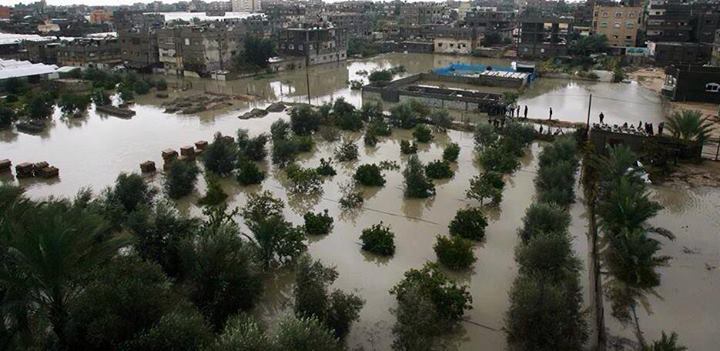
BETHLEHEM – The Gaza Government’s Disaster Response Committee announced late Friday that Israeli authorities had opened up dams just east of the Gaza Strip, flooding numerous residential areas in nearby villages within the coastal territory.
Committee chairman Yasser Shanti said in a press conference that Israeli authorities had opened up dams just to the east of the border with the Gaza Strip earlier in the day.
He warned that residential areas within the Gaza Valley would be flooding within the coming hours.
He said that the move by Israeli authorities would flood areas in Moghraqa and other parts of Deir el-Balah in central Gaza, and he called upon residents of areas near the Gaza Valley to evacuate their homes in preparation for the anticipated flooding.
The Gaza Strip is currently under a state of emergency due to severe weather conditions caused by a historic storm front moving south across the Levant.
Fuel shortages have caused daily life in the Gaza Strip to grind slowly to a halt since early November, as power plants and water pumps are forced to shut down, cutting off access to basic necessities for Gaza residents.
Lack of diesel fuel is a result of the tightening of a seven-year-long blockade imposed on the territory by Israel with Egyptian support.
The Gaza Strip has been under a severe economic blockade imposed by the State of Israel since 2006.
See also:
Israelis open Wadi Salaqa dams, dozens of homes flooded
Palestine Information Center – 16/12/2013
GAZA — Israeli occupation forces opened on Sunday Wadi Sofa dam east of Rafah, south of the Gaza Strip, flooding dozens of Palestinian homes, local sources said.
The IOF opened its dams towards Palestinian houses without any prior warning for the second time since the stormy weather hit the region recently.
Rescue teams have evacuated trapped people from their flooded houses and transferred them to safe places and shelter centers.
Several Israeli earth dams have been established to the east of Gaza Strip, in order to benefit from rainwater and prevent its access to Gaza; however in such cases the Israeli occupation opens its dams toward the Strip to prevent swamping its agriculture lands.
Many residential areas and agricultural lands in Gaza were flooded when the Israeli authorities opened up the dams, which aggravated the population’s suffering. … Full article
Update:
Did Israel Deliberately Flood Gaza?
By Richard Edmondson | Fig Trees and Vineyards | December 17, 2013
It has been reported in the past several days, by Ma’an News and on several websites including this one, that Israel may have opened one or more dams resulting in the severe flooding we have seen in Gaza and further exacerbated conditions already made dire by the onslaught of winter storm Alexa. This at any rate is the charge that has been made by the Gaza government’s Disaster Response Committee and its chairman, Yasser Shanti.
So far I myself have heard no official response from Israel either confirming or denying. However, the following is reported by the Middle East Monitor:
According to Israel’s Yedioth Ahronoth newspaper, the rainfall led to a lot of excess water which couldn’t drain away, so “the Israeli authorities resorted to discharging the excess water into the Gaza Strip.”
I could not find this reported on Ynet’s English website, but it’s possible it was reported in the Hebrew edition. So was a dam released? All we have to go on is the statement by Shanti, accompanied, of course, by the shocking images we have seen of inundated streets, flooded homes, and people paddling in boats. But I did come across this video and thought I would share it. If it turns out that a dam or floodgate of some sort was deliberately released, it apparently would not be without precedent. The following was reported by Press TV in January of 2010—and take special note of what the reporter says regarding the flooding and its coinciding with the one-year anniversary of the close of Israel’s Operation Cast Lead.
If Israel did this in 2010, does it beggar belief they would have done the same thing again this past week? If they did, the question then becomes did they do it out of a) a need to divert flooding from their own communities in Israel, or b) pure malice?
The question of whether a dam was opened or floodwater in some way diverted is addressed in a report on the Gaza flooding published at The Ecologist, an environmental website:
Amid the chaos it is impossible to verify the accusations. The heavy rain has also affected bordering areas of Israel and whether or not dams have been deliberately opened, drainage systems in Sderot and other cities were certainly overwhelmed by the volume of water.
What is certain is that low-lying Gaza, on the coastal plain, lacking functioning drainage and sewage systems, would in any case suffer most severely from the rainfall. Moreover Israel already stands accused of deliberately running down basic sanitation services in Gaza in order to make life unlivable for its residents.
And as Gaza resident Fidaa Abuassi points out: “Unlike their neighbors in Sderot Gaza’s refugees have nowhere to flee when heavy rains flood their 25-mile occupied territory, blockaded by land, air, and sea.”
Even as the floodwaters recede, there may be worse to come. The report warns of what most likely is an “impending health catastrophe” in the making, with a flare up of respiratory and skin diseases brought on by constant exposure to sewage water and lack of medical supplies.
Update #2
No Dams in the Negev? Anatomy of a Hasbara Swarm
Israel joins EU’s atomic research centre
MEMO | December 13, 2013
 Israel has officially become a full member of the European Organisation for Nuclear Research, known as CERN, which owns the world’s largest particle physics laboratory on the French-Swiss border. The organisation’s 20 European member states voted unanimously on Thursday in favour of the decision to accept Israel as a full member of CERN following a two-year probationary period.
Israel is the first non-EU member to join the organisation. The European decision will benefit Israel on both a scientific and economic level, as it allows Israel’s science and technology industry to be eligible to apply for grants and to bid in CERN tenders.
Israel’s Deputy Foreign Minister Zeev Elkin has welcomed the European decision, saying it shows that one can engage in scientific projects with the EU without involving political considerations.
An official ceremony to celebrate Israel’s membership is scheduled to take place within a few weeks in Geneva.
~
See also: After Assassinating Iranian Scientists, Israel is Admitted to CERN
Tuqu’ – a village under siege
Letters from an Occupied People | December 12, 2013
A loud buzz of chainsaws greets our arrival following a call from Tuqu’ – a Palestinian village of about 12,000 people, south of Bethlehem in the West Bank. We find Israeli soldiers overseeing the destruction of row after row of mature olive trees.
The Palestinian farmers remonstrate with the army. They have land ownership documents dating back generations from the Jordanian, British and Ottoman administrations, but their arguments are ignored by the soldiers holding them back at the gunpoint. I notice a woman pleading with soldiers who order her away, but she will not let up.
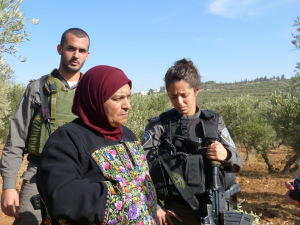
November 25, 2013 Israeli Border Guard weeping as Palestinian trees destroyed_A.Morgan
An Israeli Border Guard, a young woman who speaks Arabic, is called to deal with her. I watch as the young soldier stands listening and silently drops her head, turning her face to wipe away tears.
Finally, the buzzing stops, but it is a temporary reprieve. The Israelis have declared this ‘state land’ and the farmers are given four days to cut down hundreds more trees themselves, or the world’s fourth largest army will return to defend Israel from the olive trees.
‘How can we do this?’ asks one farmer ‘It will be like killing our mothers!’
Israeli military harassment of children in Area C
About three quarters of Tuqu’s land is in Area C*, under full Israeli military control, although this was supposed to transfer to the Palestinian Authority within 5 years of the Oslo Agreement. Tuqu’ has already lost hundreds of hectares to the illegal Israeli settlements of Teqoa, Noqedim and Ma’ale Amos that surround it to the north, south and east.
Our team comes regularly to Tuqu’. It is one of four Bethlehem villages where we accompany children to school as part of a UNICEF ‘Access to Education’ programme. Every day, children of six to 18 must run the gauntlet of armed Israeli soldiers and we have been present when the army has tear-gassed the schools. The soldiers obstruct the school entrances with jeeps, and patrol the footpaths with guns, forcing the frightened children to walk across rough fields or along the busy road.
‘It is emotional harassment’ says the mayor.
Recently we met a 16 year old boy who showed us the X- ray of a bullet still lodged in his back since a recent military incursion into Tuqu’. The mayor also tells us that over 20 children have been arrested in the last three months.
Two weeks before the trees were cut down, Tuqu’s mayor had called us because Israeli settlers, accompanied by soldiers, had begun putting up Israeli flags and tents on Tuqu’ land each afternoon.
One of the Israeli settlers I spoke to – a woman with an American accent – justified what she was doing, saying,
‘It is no different than what the Americans did to the Native Americans’.
Following this we saw the army erecting a series of concrete pillars along the roadside, with two red signs warning Israelis that this was a dangerous Palestinian village.
Soon after that, settlers erected a large marquee and put up provocative posters with a picture of a car being fire-bombed. The Palestinian landowner protested, but the military commander told him the settlers would take the land for two days for a party. There was nothing the farmer could do to stop this, but the village held a peaceful protest, whilst a large Israeli military force guarded the settlers.

November 20, 2013 Nadia Matar, Women in Green at Tuqu’_A.Morgan
The people of Tuqu’ know that this is how it starts; a few tents, some flags, then some caravans – an illegal settlement outpost is born. With Israeli state protection and financial inducements it will soon grow to thousands of settlers. More land theft, house demolitions, movement restrictions and violence against local Palestinians will follow.
Two days after the party, the settlers are back. They include a vigilante group called Women in Green** led by a Belgian-born woman called Nadia Matar. We ask what she thinks about the 16 year old Tuqu’ boy who was shot it the back whilst going to visit his grandfather.
‘ He was probably throwing stones.’ She replies ‘Kids who throw stones should be shot in the head ’.
During a visit to Tuqu’ a week after the tree cutting, we see scores of settlers coming towards the village, many bringing young children. A large number of Israeli soldiers position themselves across the road and fields, aiming their rifles and teargas cannons at Palestinian children coming out with their unarmed parents for another peaceful protest.
The settlers hold a ceremony and light candles. It is Hanukkah, and they tell us they are renaming this area with a new Hebrew name.
Under international law it is illegal for Israel, as an occupying force, to transfer its own population into the occupied Palestinian territories. Despite this, Israel’s massive settlement programme has continued unabated for decades, with thousands more homes being planned during the current Peace talks. With many settlements to the east of Bethlehem and other Palestinian centres, the Israeli strategy seems clear: to expand the eastern settlements westward to join up with Jerusalem, bisecting the West Bank and corralling the Palestinian population into a series of isolated cantons. EAPPI is keeping international agencies informed about these developments in Tuqu’ and a legal challenge is underway, supported by UNOCHA and the Norwegian Refugee Council.
* The Oslo Accords led to the West Bank being divided into Areas A (under Palestinian control), Area B (Palestinian civil government and Israeli military security) and Area C (Completely under Israeli military law). Areas B and C were supposed to be transferred to Area A – full Palestinian control, within 5 years. Instead, 20 years on, Israel has consolidated it’s control over Area C, illegally building hundreds of thousands of settler homes. Area C represents over 60% of the West Bank. It is the only contiguous area and therefore control over Area C is essential for communications. It also includes most of the West Bank’s fertile land and water. Israel prohibits Palestinian construction in Area C. Israeli control over, and settlement building in Area C is a major obstacle to a peaceful solution to the conflict.
** Women in Green is a right wing group that opposes the creation of a Palestinian state and supports Israeli settlement of the West Bank, which it proposes Israel should annex. WiG also opposed Israeli withdrawal from southern Lebanon. Nadia Matar, the Belgian-born leader of WiG claims that the ‘Arabs’ in the ‘Holy Land’ are descended from relatively recent immigrants, and should be ‘transferred’ to neighbouring Arab countries.
Related articles
Saudi Arabia Buys 15,000 U.S. Anti-Tank Missiles for a War It Will Never Fight
Al-Manar | December 13, 2013
No one is expecting a tank invasion of Saudi Arabia anytime soon, but the kingdom just put in a huge order for U.S.-made anti-tank missiles that has Saudi-watchers scratching their heads and wondering whether the deal is related to Riyadh’s support for the Syrian rebels, Foreign Policy reported.
The proposed weapons deal, which the Pentagon notified Congress of in early December, would provide Riyadh with more than 15,000 Raytheon anti-tank missiles at a cost of over $1 billion. According to the International Institute for Strategic Studies’ Military Balance report, Saudi Arabia’s total stockpile this year amounted to slightly more than 4,000 anti-tank missiles. In the past decade, the Pentagon has notified Congress of only one other sale of anti-tank missiles to Saudi Arabia — a 2009 deal that shipped roughly 5,000 missiles to the kingdom.
“It’s a very large number of missiles, including the most advanced version of the TOWs [tube-launched, optically tracked, wire-guided missiles],” said Jeffrey White, a fellow at the Washington Institute for Near East Policy and a former intelligence analyst at the Defense Intelligence Agency. “The problem is: What’s the threat?”
That’s a tough question to answer. A military engagement with Iran, the most immediate potential threat faced by Riyadh, would be largely a naval and air engagement over the Persian Gulf. Saudi Arabia has fought a series of deadly skirmishes with insurgents in northern Yemen over the years, but those groups have no more than a handful of military vehicles. And Iraq, which posed a real threat during Saddam Hussein’s day, is far too consumed by its internal demons and the fallout from the war in Syria to ponder such foreign adventurism.
But one Saudi ally could desperately use anti-tank weapons — the Syrian rebels. In the past, Riyadh has been happy to oblige: It previously purchased anti-tank weapons from Croatia and funneled them to anti-Assad fighters, and it is now training and arming Syrian rebels in Jordan. Charles Lister, a London-based terrorism and insurgency analyst, said that rebels have also received as many as 100 Chinese HJ-8 anti-tank missiles from across the border with Jordan — and indeed, many videos show Syrian rebels using this weapon against Bashar al-Assad’s tanks.
While most of the rebels’ anti-tank weapons were seized from Assad’s armories, Lister also believes that several dozen 9M113 Konkurs missiles, an old Soviet weapon, were provided to Islamist rebels in northern Syria this summer. And when these missiles have found their way to the battlefield, they’ve helped the rebels break through the belts of armor Assad uses to protect strategic areas: “Neutralizing these external defenses has proven key to opening the gates for ground assaults,” Lister said.
The Saudis can’t send U.S. anti-tank missiles directly to the rebels — Washington has strict laws against that. Recipients of U.S. arms are not allowed to transfer weapons to a third party without the explicit approval of the U.S. government, which in the case of Saudi Arabia has not been granted. Given Washington’s heightened concern over radical Islamist forces seizing control over the conflict — which resulted in the suspension of nonlethal aid to Syrian rebels on Dec. 12 — that approval will almost certainly never be given. If Riyadh went ahead and transferred the weapons anyway, it “would be a serious breach of U.S. law,” said Aram Nerguizian, a senior fellow at the Center for Strategic and International Studies, that would “all but certainly lead to a suspension of existing arms sales agreements.” So far, only one American anti-tank missile has been identified in Syria — an older model that Lister speculates may have been sold to Shah-era Iran, transferred to the Assad regime, and then captured by the rebels.
But while the latest American anti-tank weapons might not be showing up in Aleppo anytime soon, that doesn’t mean the deal is totally disconnected from Saudi efforts to arm the Syrian rebels. What may be happening, analysts say, is that the Saudis are sending their stockpiles of anti-tank weapons bought from elsewhere to Syria and are purchasing U.S. missiles to replenish their own stockpiles. “I would speculate that with an order of this size, the Saudis were flushing their current stocks in the direction of the opposition and replacing them with new munitions,” said Charles Freeman, a former U.S. ambassador to Saudi Arabia.
Regardless of how this purchase of anti-tank missiles relates to Syria, it’s undoubtedly part of a larger Saudi arms buildup that has been going on for nearly a decade. From 2004 to 2011, according to a 2012 report by the Congressional Research Service, Riyadh signed $75.7 billion worth of arms transfer agreements — by far the most of any developing nation. The United States was the major benefactor of this Saudi largesse, as the deals bumped up U.S. arms sales to a record $66 billion in 2011 alone.
How the Saudis plan to use many of these weapons is a mystery. And it’s not just the anti-tank missiles whose purpose remains unclear. Riyadh recently bought advanced fighter jets from the United States for a whopping $30 billion — but the Saudis’ lack of pilots and ability to maintain them means that it’s an open question how long they can keep them airborne, said William Hartung, the director of the Arms and Security Project at the Center for International Policy.
But purchasing the weapons, rather than any intent to use them, may be the point for the Saudis. At a time when they are at odds with Washington over the Obama administration’s diplomacy with Iran and nonintervention in Syria, the kingdom’s deep pockets can at least make sure their ties to the Pentagon remain as strong as ever.
“There was a [Washington] lobbyist who used to say, ‘When you buy U.S. weapons, you’re not just buying the weapon — you’re buying a relationship with the United States,'” said Hartung. “I think that’s kind of the concept.”
U.S. to Destroy a Half-Billion Dollars’ Worth of Unused Aircraft in Afghanistan
By Noel Brinkerhoff | AllGov | December 13, 2013
The U.S. military has decided to scrap nearly half a billion dollars worth of aircraft purchased for Afghanistan’s air force because the planes couldn’t handle the climate, among other problems.
A total of 16 cargo planes, the G222 manufactured by Italy’s Finmeccanica, now sit at Kabul International Airport. They were flown only 200 of the 4,500 hours scheduled for flight training by Afghan pilots before the U.S. decided to shut them down.
The Obama administration spent $486 million to purchase the aircraft, which were supposed to comprise 15% of the Afghan Air Force.
“We need answers to this huge waste of U.S. taxpayer money,” John Sopko, the Special Inspector General for Afghanistan Reconstruction who is investigating the matter, said in an email to Bloomberg. “Who made the decision to purchase these planes, and why? We need to get to the bottom of this, and that’s why we’re opening this inquiry.”
A January 31 Pentagon Inspector General report, marked “For Official Use Only,” criticized NATO and U.S. training commands for “hav[ing] not effectively managed the program.”
Lieutenant General Charles Davis, the U.S. Air Force’s top military acquisition official, told Bloomberg: “Just about everything you can think of was wrong for it other than the airplane was built for the size of cargo and mission they needed.”
“Other than that, it didn’t really meet any of the requirements,” he added.
A key problem was that the planes couldn’t handle the heat and dust of Afghanistan’s environment, which caused numerous maintenance troubles and prevented them from flying.
Davis said the Air Force tried to sell the aircraft to another country, but couldn’t locate any buyers. So now they will be dismantled for parts.
The U.S. decided to replace the G222s with American-made C-130H transports for the Afghan Air Force to use. But the replacements won’t be available until 2016.
To Learn More:
- Planes Parked in Weeds in Kabul After $486 Million Spent (by Tony Capaccio, Bloomberg)
- Notification of Special Project: Lessons Learned Review of the G222 (C-27A) Aircraft Program (Office of the Special Inspector General for Afghanistan Reconstruction)
- Fleet of Planes from $486 Million Program for Afghan Security Forces Scheduled to Be Destroyed (by Hanqing Chen, Daily Beast)
- U.S.-Led Military Unit in Afghanistan Lost $230 Million in Spare Parts, Then Spent $138 Million for More (by Noel Brinkerhoff, AllGov)
- U.S. Military Builds $34-Million High-Tech Operations Complex in Afghanistan…and Will Never Use It (by Noel Brinkerhoff and Danny Biederman, AllGov)
- U.S. Military to Shred Thousands of Million-Dollar Armored Vehicles in Afghanistan (by Noel Brinkerhoff, AllGov)
American ‘business’ tourist to Iran was CIA agent
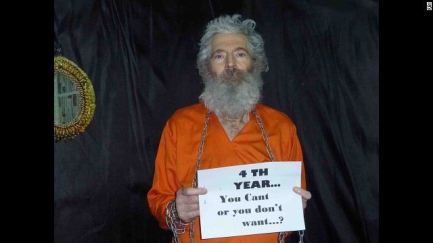
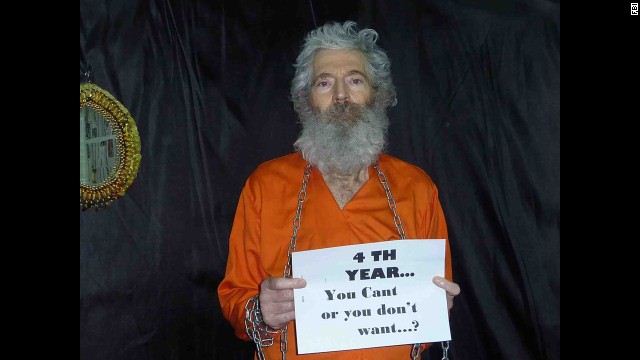
Robert Levinson who went missing in southern Iran in 2007 was working for the CIA
Press T V – December 13, 2013
A recent investigation has found that an American who went missing in southern Iran in 2007 was working for the Central Intelligence Agency in the US.
Retired FBI agent Robert Levinson disappeared on March 9, 2007, during a visit to Iran’s Kish Island in the Persian Gulf.
The US State Department insisted that Levinson was a private citizen who had traveled to Kish on private business.
Nevertheless, more than six years after Levinson’s disappearance, the Associated Press has revealed that he was recruited by the CIA to run unauthorized spying operations.
According to the AP, the CIA paid $2.5 million to Levinson’s family in a bid to pre-empt a revealing lawsuit.
Even after they learned about Levinson’s CIA ties, officials at the White House, the FBI, and the State Department did not change the official story, insisting that he was “a private citizen involved in private business.”
The AP first found about Levinson’s involvement with the CIA’s spying operations in 2010; however, they withheld the story several times at the behest of the US government.
The AP’s revelation is based on documents obtained or reviewed by the New York-based news agency and interviews with a number of current and former officials from the US and other countries, who spoke on condition of anonymity.
The CIA is generally made up of two groups: operatives, who gather intelligence and hire spies, and analysts, who receive strands of intelligence and decode them.
Although Levinson was recruited by a team of CIA analysts and his contract with the CIA, worth about $85,000, required him to write reports for the agency based on his travel and expertise, he started to gather intelligence from the onset instead of writing reports.
In order to keep Levinson’s operations secret, the CIA had instructed him not to mail any packages to the agency’s headquarters in Langley, Virginia, or email documents to US government addresses.
Instead, he had to send the intelligence he had gathered to the private home of a CIA analyst named Anne Jablonski in Virginia and contact Jablonski’s personal email account if he needed any instructions.
Levinson’s whereabouts and captors are not known; however, former US Secretary of State Hillary Clinton said in 2011 that Washington believed he was “being held somewhere in southwest Asia.”
Featured Video

Iran Is Not Our Enemy
or go to
Aletho News Archives – Video-Images
Book Excerpt
“Vaccines Do Not Cause Autism!” The Science is Settled. Right?
ICAN urges the IACC to actually study infant vaccines and autism
 By Aaron Siri | Injecting Freedom | March 16, 2026
On behalf of ICAN, we just sent a copy of chapter 11 of Vaccines, Amen to the newly appointed members of the federal Interagency Autism Coordinating Committee (IACC).
If you haven’t already read this chapter, you can read the whole thing in the attached letter. I trust that after you read it, you’ll see why the statement “vaccines do not cause autism” is a belief, not science!

IACC Public Comment Letter
1.53MB ∙ PDF file
Includes chapter 11 of Vaccines, Amen
Blog Roll
 Aletho News
- Russia condemns Israel’s attack near Bushehr plant, files complaint
- Russia Strongly Condemns Actions Aimed at Harming Health of Iranian Leadership – Kremlin
- Israeli Journalist Demands Tucker Carlson and Candace Owens Be Placed in WWII-Style Internment Camps
- No Liability, No Studies, No Accountability: The Vaccine System Aaron Siri Exposed in Federal Court
- No time for losers: Why the war meant to save Israel may destroy it
- Top US Counterterrorism Official Resigns in Protest of Operation Against Iran
- Just Get Out! Now!
- Unpacking glaring contradictions in US-Zionist justifications for war against Iran
- Iranian model of warfare bleeds US dry while Persian Gulf states watch and learn: Analyst
- IRGC orders ‘defeated’ US to evacuate industrial facilities in region
- If Americans Knew
- Trump’s counterterrorism chief, whose own wife was killed by ISIS, quits over Iran War saying Tehran posed ‘no imminent threat’
- Here’s what US could fund instead of Bibi’s war on Iran
- Israel Killed Over a Dozen Lebanese Paramedics in Three Days, Now Claiming That Ambulances Are “Hezbollah” Targets
- War on Iran: These are the heritage sites devastated by US and Israeli attacks
- Four news stories from Israeli media that illustrate Israeli “justice”
- CIA Prepares Criminal Referral of Tucker Carlson, as Israel and Its Loyalists Demand His Arrest
- Top US counterterror advisor resigns in protest of “war manufactured by Israel” – Not a ceasefire Day 157
- ‘I Liked the House’: When Israeli Soldiers Turn Palestinian Homes into Barracks
- ‘They Were All I Had’: Lebanese Father Buries Parents, 4 Daughters Killed by Israeli Bombing
- Israel and its supporters are causing attacks on Jewish institutions. Case in point: Michigan synagogue tragedy.
- No Tricks Zone
- New Research: South Australia’s Mid-Holocene Sea Surface Temperatures Were 4°C Warmer Than Today
- Storing Green Energy To Last Germany 10 Days Would Require A 60-Million Tonne Battery
- New Studies: UK Sea Levels Were 4 Meters Higher Than Today During The Mid-Holocene
- Destructive Green New Deal: German Energy And Metal Group Warns Of Drastic Crisis
- New Study Documents A 20-Year Pause In Arctic Sea Ice Decline – Driven By Internal Variability
- Wake-up Call: Survey Shows Majority Of Germans Now Favor Postponing Climate Targets!
- Televised! Leading German Political Candidate Tells Schoolchildren CO2 Makes Sun Hotter!
- New Study: A Century Warming Of 1.1°C Is ‘Commonplace’ And ‘Not Unusual’ During This Interglacial
- New Study: ‘Internal Noise’ And Volcanic Forcing Can Trigger 10-15°C Warming Within Decades
- Glaciers Worldwide Are Suddendly Surging, Experts Blame Warming!
 Aletho News