Embarrassing NIST: They Left Out Critical Structural Features of WTC7
By Andrew Mills | RINF Alternative News | January 17, 2014
On December 12, 2013, well known attorney, Dr. William Pepper, sent a letter to the U. S. Department of Commerce Inspector General on behalf of Architects & Engineers for 911 Truth. The letter concerned certain structural feature omissions found in early 2012 in the drawings on which the National Institute of Standards and Technology (NIST) based their conclusions in their 2008 report on the collapse of World Trade Center Building 7 (WTC7) on 9/11. (NIST is one of the agencies under the Department of Commerce.) Dr. Pepper’s letter asked that that the Inspector General investigate and have NIST correct the Report.
As most Americans know, a third building (WTC7) of the WorldTradeCenter complex of buildings collapsed on the same day as the twin towers. WTC 7 was a 47-story skyscraper that housed offices of the CIA, the Secret Service, and the Department of Defense, as well as the NYC Office of Emergency Management’s OperationsCenter. It collapsed at around 5 pm on 9/11. No airplane crashed into it and it experienced only minor fires before it collapsed. It fell straight down, right into its own footprint, and the speed of fall was very close to gravitational free fall. Many people at the time remarked that its collapse closely resembled the collapse of buildings due to intentional demolition.
Of those Americans who know that Building 7 collapsed on 9/11, very few are aware that the government through NIST actually investigated the causes of the building’s collapse. The report by NIST was released to the public in August 2008, nearly seven years after the attacks. The drawings upon which the report was based were released only in 2011 in response to a FOIA request. At the time of the release of the report, many professional engineers and architects had serious misgivings about the report as it basically contended that for the first time in history, the symmetrical, complete collapse of a large, fire protected, steel framed building was said to be fire induced.
As noted in Dr. Pepper’s letter, since the release of the drawings, structural engineers have spent considerable time comparing these drawings to the descriptions of the collapse model provided in the report. Their findings revealed that critical structural features in Building 7 were inexplicably missing from consideration in the Report. These critical features included stiffeners, that provided critical girder support, as well as lateral support beams which supported a beam which allegedly buckled. Only through the omission of any discussion about the stiffeners and the lateral support beams is NIST’s probable collapse sequence possible. It is the unanimous opinion of these structural engineers that with the inclusion of these critical features, NIST’s probable collapse sequence must be ruled out.
As Dr. Pepper’s letter notes, the group of architects and engineers unanimously believe that the NIST Report’s conclusion of collapse due to fire could not have been justified if the stiffeners and the lateral support beams were not omitted. The credibility of NIST and the Department of Commerce requires that they open an investigation into the potential negligence and/or misconduct by the lead investigators of NIST’s Building 7 investigation and that NIST be directed to produce a corrected analysis and report on the collapse of Building 7, this time, by fully taking into account the presence of the stiffeners and the lateral support beams.
After the discovery of these omissions, the group of architects and engineers who discovered them pressed NIST for over a year to get an answer to the question as to why these critical features were omitted from the Report’s discussion and analysis. But they were greeted with silence until October 25, 2013 when a NIST public relations official finally acknowledged that the stiffeners had been omitted, but incredibly, from an engineering standpoint, said they were not necessary to consider.
With the submittal of Dr. Pepper’s letter, which was accompanied by a detailed engineering analysis, NIST has never before been challenged this way, with their own data and information that they themselves have released. They appear to be caught between a rock and a hard place. At the very least they should be forced to release their WTC 7 collapse modeling data. They have not responded to the letter as of yet.
But this is court-room level evidence of impropriety involving the preparation of the WTC 7 report, and will clearly be an embarrassment to NIST. It shows that the demand for a new WTC 7 investigation by those skeptical of the Report’s conclusions was in order all along. Even if nothing else is re-investigated about 9/11, the collapse of Building 7 richly deserves a thorough investigation .
Here is a link to Dr. Pepper’s letter to the Department of Commerce Inspector General:
http://www.journalof911studies.com/resources/2014JanLetterPepper.pdf
Andrew Mills is a groundwater hydrologist employed in an engineering consulting company. He and his wife have six children and 18 grandchildren. He was active in the civil rights movement in the 1950′s and 1960′s.

Rejecting the Rule of Law
The US Now Backs a “Code of Conduct” for Space, Instead of a Legally Binding Treaty to Ban Space Weapons
By ALICE SLATER | CounterPunch | January 17, 2014
The most important lesson one can acquire about US foreign policy is the understanding that our leaders do not mean well. They do not have any noble goals of democracy and freedom and all that jazz. They aim to dominate the world by any means necessary. And as long as an American believes that the intentions are noble and honorable, it’s very difficult to penetrate that wall. That wall surrounds the thinking and blocks any attempt to make them realize the harm being done by US foreign policy.
– William Blum, former member of the US State Department, author of Killing Hope: US Military and CIA Interventions since World War II[i]
More than 5,000 satellites have been launched into orbit since the space age began[ii]. Today, eleven countries have space launch capability, with over sixty countries operating about 1,100 active satellites orbiting the earth providing a constant stream of data and information relied upon for critical civilian communications as well as for military operations by some.[iii] As we grow ever more dependent on the ability of these satellites to perform their essential functions without interruption, there are growing concerns that this useful technology is giving rise to a new battleground in space for the purpose of sabotaging or destroying the vital services our space-based communications now provide.
The US and Russia have been testing anti-satellite technology (ASAT) since the space age began, and have even contemplated using nuclear tipped ballistic missiles to destroy space assets. In 1967, the US and Russia realized it would be in their interest to support the 1967 Outer Space Treaty, which banned the placement of nuclear weapons or other weapons of mass destruction in space, although they failed to ban the use of conventional weapons in space. And in 1972 they agreed to sign the Anti-Ballistic Missile Treaty (ABM) to slow down the space race and the ability to harm each other’s assets in space. Unfortunately, George Bush walked out of the ABM treaty in 2002, and the race to weaponize space was on once again in full force. China is getting into the act too, having launched, in 2007, a device which destroyed one of its aging weather satellites orbiting in space. The US followed suit in 2008, destroying a non-functioning satellite, while both nations denied any military mission for their acts, claiming they were merely trying to destroy outdated satellites that no longer functioned.
With the proliferation of military spacecraft such as imaging and communications satellites and ballistic missile and anti- missiles systems which often pass through outer space, there have been numerous efforts in the UN Committee on Disarmament (CD) to outlaw the weaponization of space through a legally binding treaty. But the United States is having none of it. In the CD, which requires consensus to take action, the US has been the only nation to block every vote to begin negotiations on such a treaty, with Israel generally abstaining in support. Russia and China actually prepared a draft treaty to ban weapons in space in 2008, but the US blocked the proposal, voting against it each year thereafter when it was reintroduced for consideration, saying the proposal was “a diplomatic ploy by the two nations to gain a military advantage”.[iv]
While continuing to block a legally binding treaty to ban weapons in space, the US has recently begun to work with a group of nations in a new initiative that began in the European Union in 2008, proposing a “Code of Conduct for Outer Space Activities“ which would lay out a non-binding set of rules of the road for a safer and more responsible environment in space. Some of its key objectives are to mitigate damage to satellites that could be caused by space debris orbiting the earth, to avoid the potential of destructive collisions, and to manage the crowding of satellites and the saturation of the radio-frequency spectrum, as well as to address direct threats of hostility to assets in space. [v] At first, the US rejected any support for the Code, but has now agreed to participate in drafting a new version based on the third iteration from the European Union. Obama’s Under Secretary of State for Arms Control and International Security, Rose Gottemoeller, acknowledged in 2012 the necessity for a Code to deal with orbital debris and “other irresponsible actions in space”, while at the same time, noting that,
It is important to clarify several points with respect to the code. It is still under development, we would not subscribe to any code unless it protects and enhances our national security, and the code would not be legally binding. [vi]
In addition, the US is insisting on a provision in this third version of the Code of Conduct that, while making a voluntary promise to “refrain from any action which brings about, directly or indirectly, damage, or destruction, of space objects”, qualifies that directive with the language “unless such action is justified”. One justification given for destructive action is “the Charter of the United Nations including the inherent right of individual or collective self-defense”, thus lending legitimacy and codifying the possibility for warfare in space as part of the Code’s established norm. And while the Charter of the United Nations prohibits aggressive action by any nation without Security Council approval unless a nation acts in self-defense, we know there have been numerous occasions where nations have by-passed the Security Council to take aggressive action, often protesting they were acting in self-defense. Instead of banning ASAT development and warfare, this Code justifies such warfare as long as it’s done, individually and collectively, under the guise of “self-defense”. Thus despite lacking the force of law that would be established with a legally binding treaty, this new US version of the Code creates, as the norm it is proposing, a possibility for space warfare.
Our world deserves better!
Alice Slater is NY Director of the Nuclear Age Peace Foundation and serves on the Council of the Global Network Against Weapons and Nuclear Power in Space
Report: Israel increases use of torture in interrogation centers
Palestine Information Center – 17/01/2014
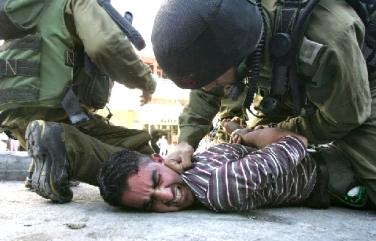 GAZA — The Israeli occupation authority escalated its violation of international laws and human rights conventions in its jails and interrogation centers, human rights report said.
Palestine Center for Prisoners’ Studies revealed that many Palestinian prisoners including women and children have been subjected to torture in Israeli jails and interrogation centers.
Israeli torture techniques include beating, blindfolding, hanging, strip search, Shabh (stress position) where prisoners are made to sit on a small chair with their head hooded and hands tied behind their back, pouring hot or very cold water over the head, according to the report.
The human rights center documented several cases of tortured prisoners who were deprived of sleep and forced into painful positions for long periods in addition to many practices that violate Convention on the Rights of the Child.
The report revealed that Israeli doctors are involved in torture practices against prisoners through submitting false medical files that deny torture crimes before courts.
Related articles
Major Political Donors Have Access to TPP Documents. Everyone Else? Not So Much
By Mike Masnick | Techdirt | January 17, 2014
The good folks over at MapLight have taken a look at the members of the Industry Trade Advisory Committee on Intellectual Property Rights (ITAC-15). As we’ve discussed in the past ITAC 15 is a committee of high powered corporate representatives who are basically the only ones with full access to the text of the intellectual property chapter of the TPP. Those on ITAC 15 are allowed to see the latest text by logging into a system from the comfort of their desks. If Congress wants to see it? No luck. Members of Congress are allowed only to visit the USTR offices, where they’ll be shown a copy of the document in a sealed room. They’re not allowed to bring staff (such as the experts who would understand this stuff). They’re not allowed to take notes or make any copies. Basically, the corporate interests have a lot more oversight over the whole process than Congress does.
So how does one get onto ITAC 15? It’s not easy. Lawyer Andrew Bridges (whose name you might recognize) sought to get onto ITAC 15 as one of the country’s foremost experts on copyright law and its impact on innovation and startups. He was nominated… but denied. But who does get on there? According to MapLight’s analysis, it helps to be a major corporate donor to political campaigns:
- The 18 organizations represented by ITAC-15 gave nearly $24 million to current members of Congress from Jan. 1, 2003 – Dec. 31, 2012.
- AT&T has given more than $8 million to current members of Congress, more than any other organization represented by ITAC-15.
- House Speaker John Boehner, R-Ohio, has received $433,350 from organizations represented by ITAC-15, more than any other member of Congress.
- Democrats in Congress have received $11.4 million from organizations represented by ITAC-15, while Republicans in Congress have received $12.6 million.
- The members of Congress sponsoring fast-track legislation, which would allow the President to block Congress from submitting amendments to the TPP, have received a combined $758,295 from organizations represented by ITAC-15. They include Senate Finance Committee Chairman Max Baucus ($140,601), Senate Finance Committee Ranking Members Orrin Hatch ($178,850), House Ways and Means Committee Chairman David Camp ($216,250), House Ways and Means Subcommittee on Trade Chairman Devin Nunes ($86,000), and House Rules Committee Chairman Pete Sessions ($136,594).
I’m sure that’s all just a coincidence, right? If the USTR was really seeking to convince the world that the TPP isn’t just a corporatist power grab to give political crony’s a leg up against innovators, it’s doing a piss poor job of convincing anyone that’s the case.
Related articles


STL defense dismisses prosecution’s “circumstantial” evidence
Al-Akhbar | January 17, 2014
The defense counsel of four Hezbollah members accused of planning the 2005 assassination of former Lebanese Prime Minister Rafik Hariri dismissed evidence presented by the prosecution over Thursday and Friday as unverifiable “observations.”
Prosecutors offered nothing new during their opening arguments, the defense team said at a press conference Friday evening after the Special Tribunal for Lebanon (STL) went to recess.
“There is nothing new in the presentation the prosecutor presented at the beginning of the trial,” Antoine Korkmaz, one of the defense lawyers for the suspects being tried in absentia, told reporters.
“We have not heard anything about the content of the conversations that the prosecutor claims were made between the defendants,” he added.
“The burden of proof lies with the prosecution,” and so far it has only provided circumstantial evidence that does not prove the suspects were behind the bombing that killed Hariri and 21 others on February 14, 2005.
Nor did the prosecutor explain the motive behind the killing of Rafik Hariri, he added, saying that the billionaire maintained good relations with Hezbollah before his assassination.
“The evidence presented by the prosecutor is only theoretical,” defense lawyer Yasser Hassan added. “We have not seen anything new, and there is no court that could issue convictions on the basis of speculation.”
The defense will present their counter arguments when The Hague-based court resumes on Monday.
Elections in Venezuela and Chile Advance Left Agenda and Latin American Economic Integration
By Roger Burbach | alai | January 7, 2014
The elections in Venezuela and Chile in December provided new momentum for the left-leaning governments in Latin America and the ascent of post-neoliberal policies. Over the past decade and a half, the rise of the left has been inextricably tied to the electoral process. In Venezuela, Bolivia, and Ecuador, under the governments of Hugo Chavez, Evo Morales, and Rafael Correa, the electorate has gone to the polls on an average of once a year, voting on referendums, constituent assemblies as well as elections for national offices.
In late November, it appeared the right might be taking the initiative, as the oligarchy and the conservative political parties in Honduras backed by the United States used repression and the manipulation of balloting to keep control of the presidency. And in Venezuela, it was feared the right would come out on top in the December 8 municipal elections. After Maduro’s narrow victory margin of 1.5% in the presidential elections in April, the opposition went on the offensive, declaring fraud and waging economic war. If the opposition coalition had won in the municipal elections, or even come close in the popular vote, it was poised to mount militant demonstrations to destabilize and topple the Maduro government. But the decisive victory of the United Socialist Party of Venezuela (PSUV) in the municipal elections gave a boost to the presidency of Nicolas Maduro, enabling him to advance the twenty-first century socialism of his predecessor, Hugo Chavez. The PSUV and allied parties won control of 72% of the municipalities and bested the opposition in the popular vote by 54% to 44%.
A class war is going on that is focused on the economy, particularly over who will control the revenue coming from its large petroleum resources that account for over 95% of the country’s exports. With no new electoral challenge until the parliamentary elections in late 2015, Maduro now has the political space to take the initiative in dealing with the country’s economic problems and to pursue a socialist agenda. As Maduro said on the night of the elections, “we are going to deepen the economic offensive to help the working class and protect the middle class….We’re going in with guns blazing, keep an eye out.”
At the other end of the continent, Michele Bachelet one week later won a resounding victory in the Chilean presidential race with 62% of the vote. She has put forth an ambitious package of proposals that would increase corporate taxes from 20% to 25%, dramatically expand access to higher education, improve public health care and overhaul the 1980 Constitution imposed by the dictatorship of Augusto Pinochet. Chile has the highest level of income inequality among the Organization for Economic Cooperation and Development’s 34 member countries. Within her first hundred days, Bachelet has promised to draft legislation to increase tax revenues by about 3 percent of gross domestic product. On election night Bachelet proclaimed: “Chile has looked at itself, has looked at its path, its recent history, its wounds, its feats, its unfinished business and thus Chile has decided it is the time to start deep transformations,” Bachelet proclaimed on election night.” There is no question about it: profits can’t be the motor behind education because education isn’t merchandise and because dreams aren’t a consumer good.”
If these policies are implemented, they would shake the neoliberal paradigm that has been followed by every government since the Pinochet dictatorship, including Bachelet’s during her first presidential term from 2006 to 2010. Like most presidential candidates before they take office, the actual changes may fall far short of what she is promising. But the student uprising and the resurgence of the social movements over the past four years has led to a popular movement in the streets that is unprecedented since the days of Pinochet. Militants on the left have already made it clear they will challenge her from the first day she takes office. According to Reuters, right after the election, hackers posted a message on the education ministry’s website saying: “Ms. President we will take it upon ourselves to make things difficult for you. Next year will be a time of protests.”
The elections in Venezuela and Chile also set the stage for a challenge to the latest U.S.-backed trade initiative, the Trans-Pacific Partnership, which includes a dozen Pacific rim nations. Ever since Chavez became president, Venezuela has led the way in opposing U.S. efforts to dominate hemispheric trade starting with the Free Trade Area of the Americas that George W. Bush launched in April, 2001. The FTAA was dealt a fatal blow at the 4th Summit of the Americas in Argentina in 2005 under the leadership of Chavez, Luiz Inacio Lula da Silva of Brazil, and Nestor Kirchner of Argentina, who advocated Latin American integration without the United States.
With the victory in the municipal elections behind him, Maduro was in a position to play a central roll ten days later in the second summit of ALBA, the Bolivarian Alliance for Our America (ALBA) and PetroCaribe, a bloc of 18 nations receiving oil at concessionary prices. (Five of the members are overlapping.) ALBA, founded in 2004 by Venezuela and Cuba, is based on the principal of “Fair Trade, not Free Trade.” Now including Bolivia, Ecuador, and Nicaragua as well as five more Caribbean nations, they met with the nations of PetroCaribe, a concessionary oil trading arrangement, to put forth a program to create a “special complementary economic zone” between the member countries of both groups to eradicate poverty in the region. Maduro proclaimed the economic zone “is a special plan…in order to continue advancing the food security and sovereignty of our peoples, and to share investments, experiences, and actions that promote [agricultural] development.” The action plan to implement the proposal includes cooperation with the UN Food and Agriculture Organization. An executive committee to coordinate the regional plan is being set up in Ecuador.
Maduro will take the document for the creation of a complementary economic zone to the January 31 meeting of Mercosur in Caracas “to advance in the great zone Mercosur-PetroCaribe-ALBA.” In all these economic and trade endeavors Venezuela plays a strategic geo-economic role. It is Latin America’s largest oil producer, and it is located on the southern flank of the Caribbean Basin and on the northern end of South American continent. Venezuela is already a member of MercoSur along with Brazil, Argentina, Uruguay, and Paraguay, while Chile, Bolivia, Colombia, Guyana, Ecuador, Peru, and Suriname are associate members. As Bolivian president Evo Morales said at the conclusion of the ALBA-PetroCaribe summit, “We should never stop strengthening our integration, the integration of anti-imperialist countries.”
A key question is around the role that Chile, led by Bachelet, will play in the growing movement for Latin American integration. Under Bachelet’s billionaire predecessor, Sebastian Pinera, Chile has been involved in setting up the U.S.-led Trans-Pacific Partnership (TPP), and is a founding member of the Pacific Alliance, a trade and investment group that includes Columbia, Peru, and Mexico. The United States has observer status.
Bachelet has given signs that a pursuit of these trade groupings alone is not in Chile’s interest, and that she intends to breach the Pacific versus the Atlantic/Caribbean divide. Her campaign manifesto stated: “Chile has lost presence in the region, its relations with its neighbors are problematic, a commercial vision has been imposed on our Latin American links.” She is particularly interested in closer relations with Brazil, where she identities with Dilma Rousseff, who also forged her political identity as a young clandestine activist jailed and tortured under a repressive dictatorship. It is notable that in 2008 during her last presidential term, Bachelet convened an emergency session of UNASUR (the Union of South American Nations), to support Evo Morales against a right wing “civic coup” attempt that received direct material support from the U.S. embassy.
It is of course impossible to predict where Bachelet will wind up in the growing continental divide. Her commitment to the Pacific Alliance and to TPP may undermine domestic and international challenges to neoliberalism. The militancy of internal mobilizations to pressure her at every turn is critical. In Venezuela, Maduro faces daunting economic problems as he tries to bring inflation and the black market under control, while dealing with serious corruption problems in and outside of the government. However, the December municipal elections have opened up a space for Maduro to deal with these issues in the coming year, while playing a leadership role in advancing Latin American integration in opposition to U.S. initiatives.
Roger Burbach is the director of the Center for the Study of the Americas, and co-author with Michael Fox and Federico Fuentes of Latin America’s Turbulent Tran
Related article

Theses on Zionism
A Response to Joseph Massad’s “Theses on Zionism”
By HARRY CLARK | CounterPunch | January 17, 2014
This is a response to Joseph Massad’s “Theses on Zionism” in Electronic Intifada on December 9, 2013.
I.
In pre-modern times, Jews lived in separate communities, governed by their religious authorities, with corporate rights and obligations, determined by royal or aristocratic authority. The Enlightenment and emancipation ended the subjugation of west European Jews to Judaic authorities, and to gentile regulation. Jews were admitted, gradually but inevitably, to full citizenship in their states of residence, equal to their fellow citizens. The US was created on a modern, liberal basis, with no trace of pre-modern Jewish status. Anti-semitism existed but liberalism was the prevailing trend before World War I. In modern terms, Jews became a religious minority, or secular citizens. Jews embraced modernity wholeheartedly. Western Jews became some of its leading proponents; east European Jews emigrated by the million from oppressed, traditional societies to the US.
II.
Zionism was a response not only to anti-Semitism but to liberal modernity. Zionism opposed the assimilation and integration of Jews, and held that anti-Semitism was irrevocable and natural. “The Jews comprise a distinctive element among the nations under which they dwell, and as such can neither assimilate nor be readily digested by any nation.” We “must give up contending against these hostile impulses [anti-Semitism].” Resistance is “a waste of time and energy.” “The civil and political emancipation of the Jews is not sufficient to raise them in the estimation of the peoples.” “The proper, the only solution, is in the creation of a Jewish nationality, of a people living upon its own soil, the auto-emancipation of the Jews; their return to the ranks of the nations by the acquisition of a Jewish homeland.” (Leon Pinsker, Auto-emancipation)
III.
Zionism adopted anti-Semitic ideas and tactics and cooperated with anti-Semites practically. Herzl frequented anti-Semitic salons in Paris, and sought Russian czarist support for Zionism with Ottoman Turkey in return for silencing Russian Jewish protest. After the October, 1917 Russian revolution Zionism presented itself to the western powers as Jewish anti-Bolshevism. In the Russian civil war Zionists allied with anti-Semitic White forces who committed pogroms when they lost to the Bolsheviks. In 1933 the Zionist movement broke the promising Jewish-led boycott of Nazi Germany with the Transfer Agreement, which sold German exports through Palestine. Zionism opposed relief for Jews on humanitarian grounds because it detracted from Zionist national aims in Palestine. Zionism was an elite project of national renewal, concerned with “the problems of Judaism, not the problems of Jewry,” in Ahad Ha’am’s words.
IV.
The Zionist claims of a historical Jewish people, attached to the “land of Israel,” and of modern “secular Jewish identity” are utterly untenable. Zionist racialism dates to the proto-Zionism of Moses Hess; the chauvinism of Heinrich Graetz contributed to German anti-Semitism; German Zionism was Jewish Romantic nationalism, embracing Jewish Blut und Boden. Theodor Herzl was steeped in the racism of European colonialism. Nazi and Zionist “race experts” consulted each other in the 1930s. Elmer Berger, an anti-Zionist rabbi, co-authored the 1977 UN resolution on Zionism as a form of racism. “Jewish genetics” tries to build a biological basis for Zionism. Zionism’s fundamental opposition is not Jewish settler vs Arab indigene in Palestine, but Jew vs gentile everywhere. Historian Noel Ignatiev called Zionism Jewish race doctrine.
V.
There is no “progressive Zionism.” The leaders of “cultural Zionism” supported immigration and a Jewish majority. Zionist “culture” is founded on irreducible Jewish difference, separatism, alienation, and anti-gentilism, the counterpart of racialist anti-Semitism. The bi-nationalists wanted Jewish immigration leading to demographic parity and eventually majority, when Jews were a minority. The kibbutz was an instrument of exclusive Ashkenazi Jewish settlement in Palestine, and was inspired by 19th c. German plans to counter a Polish “demographic threat” in the eastern Reich. Hitler might have conquered the Near East; the Judeocide happened because of Nazi Germany, not because there was no Jewish state. Israeli Hebrew ethnicity or nationality, secular and open to all, is the liberal replacement for Zionist Jewish nationality,
VI.
The classical left and liberal traditions descended from the Enlightenment and emancipation rejected Zionism categorically. American Reform Judaism once stated: “We consider ourselves no longer a nation, but a religious community, and, therefore expect neither a return to Palestine, nor… the restoration of any of the laws concerning the Jewish state.” Marxism upheld the international solidarity of the working class, viewed nationalism as reactionary, and Zionism as a colonial movement and tool of imperialism. The Yiddish labor movements in the Russian Empire and their immigrant offshoots also opposed Zionism. The late Israel Shahak referred to the “modern, secular Jewish tradition,” which he traced from Spinoza, who began the remarkable Jewish contribution to modernity. Shahak viewed Zionism as a reaction against emancipation, and a longing for the ghetto.
VII.
Zionism was a marginal cult among western Jews until World War I. The Balfour Declaration and the British conquest of Palestine raised interest but it subsided, reviving only with the advent of Nazism. US Jews supported overwhelmingly the establishment of Israel in 1948, but liberal attitudes prevailed into the early 1960s. The success of liberalism and assimilation led to a “continuity crisis,” an effort to maintain separatism that was fatally supercharged by the June, 1967 war. Organized Jewry became and remains fanatically chauvinist, insular and pro-Israel. “The Holocaust” became an institution and part of Jewish identity, including classic Zionist dogma about irrevocable, murderous anti-Semitism. The organized Jewish communities and the Jewish state have constituted the Zionist Jewish people. The Volk has replaced liberalism as the Jewish social principle; the modern period of Jewish history has ended.
VIII.
The organized Jewish community is the core of US support for Israel, the “Zionocracy,” after the 19th c. “Slaveocracy” that wielded immense power until the Civil War. The Zionocracy has exercised quasi-sovereign influence on US foreign policy since the 1940s, when it secured US support for partition of Palestine and the Jewish state, against overwhelming military and diplomatic opposition. Israel’s “strategic value” during the later Cold War is mostly Zionist public relations. In the 1960s the Zionocracy concealed Israel’s nuclear weapons program, secured arms sales, and US support for Israel in 1967, against warnings by many US officials. The October, 1973 war and resulting oil price increases were the biggest shock to the world economy since 1945. The Carter Administration sought a two-state solution to the Arab-Israeli conflict but the Zionocracy limited Carter’s diplomacy to a separate Egypt-Israel peace. Israel and the Zionocracy then opposed Iraq and supported Iran during their war in 1980s.
IX.
Zionism has been the chief ideological driver of US militarism since the end of the Cold War. The congressional vote for the 1991 Gulf War against Iraq was the closest since the War of 1812, and the Zionocracy may have tipped the scales. The “dual containment” of Iran and Iraq in the 1990s was by and for the Zionocracy, over substantial business opposition. The 9/11 attacks, which led to the US invasions of Afghanistan and Iraq, and the destruction of civil liberties, were directed mainly against US patronage of Israel. The Zionocracy is the main source of Islamophobia in the US. The Jewish neoconservatives were the prime movers in the 2003 US invasion of Iraq. This greatly increased Iranian influence and escalated its antagonism with Saudi Arabia, and led to the present dissolution of Syria. The US has restarted diplomacy with Iran but the Zionocracy has passed overwhelmingly in the House and has majority sponsorship in the Senate for legislation that will destroy the opening and restore the war drive.
X.
Left and liberal Jewish opinion since 1967 has been as völkisch as the mainstream. Israel was not an issue for the Jewish members of the American New Left in the early 1960s, who sought to build a universalist movement. The New Left shattered in the late 1960s over internal differences, including attitudes toward Israel, after the June 1967 war. A “Jewish left” arose, which purported to combine Jewish commitment with social justice, including some criticism of Israel. Today a loose school of Jewish identity politics centered on Noam Chomsky imposes on the left terms of “anti-occupation”, “law and rights,” “solutions,” “progressive Zionism,” “Israel as US strategic asset,” and “anti-anti-Semitism”. This circumscribed critique conceals the US Zionocracy and Zionism itself, in contrast to the classical liberalism of the Enlightenment and emancipation, which rejected Zionism categorically. The modern period of Jewish history has ended on the left also.
XI.
A universalist critique would oppose Zionism, not “the occupation”; recognize Zionism as Jewish racialism, opposing Jew and gentile everywhere; acknowledge Zionism as the ideological driver of genocide and destruction in western Asia, and the source of Jewish chauvinism and separatism
in the US; reject the Zionist idea of “the Jewish people” in whose name the state of Israel and organized Jewry act; condemn the role of US organized Jewry and the Zionocracy as a quasi-sovereign, radicalizing force in US Middle East policy; and defend a secular realm in which we think and act together. It would do this in the name of the people of Jewish background who contributed so much to modernity, from Spinoza onward, whose legacy towers over Zionism. The failure to do this is catastrophic, comparable to the German Communist Party’s disastrous misreading of Hitler and Nazism, which weakened the left and assisted their rise to power, and all that followed.
Harry Clark’s article “The End of Modern Jewish History,” which expands on these issues, will appear in Left Curve, No. 38, forthcoming in April. He may be reached at his web site http://questionofpalestine.net
Related article
Elections in Chile: Confronting the Enduring Legacy of Dictatorship
By Emily Achtenberg | Rebel Currents | January 16, 2014
On Election Day in Chile, students occupied and hung a banner outside front-runner Michelle Bachelet’s campaign headquarters, proclaiming: “Change is not in the Presidential Palace, but in the ‘wide avenues.’” It was a powerful reminder of how student mobilizations have transformed Chile’s political agenda during this election year, at once invoking the past (through the final words of martyred socialist President Salvador Allende), and laying down the gauntlet for an anticipated future when the country might finally move beyond its 20-plus year “transition to democracy.”
The promise of structural reforms to address the deep divide between rich and poor in Chilean society propelled Bachelet and her center-left New Majority coalition to a landslide victory in December over Evelyn Matthei, candidate of the center-right Alliance. While Chile has the highest rate of economic growth among 34 developed countries, it is also the most unequal. Bachelet campaigned on a radical platform of educational, tax, and constitutional reform to redress the injustices of a political and economic system inherited from the dictatorship era, that largely favors the wealthy.
After failing to gain a majority on the first ballot in November (in a field of nine candidates, including seven to the left of center), Bachelet handily won the run-off election with 62% of the vote, the biggest presidential victory in eight decades. Despite this seemingly broad mandate, she now faces formidable obstacles in seeking to deliver on her campaign promises, as Chile’s undemocratic institutions and alienated electorate—both enduring legacies of dictatorship—conspire to discourage change.
Electoral Context
Most of Chile’s problems today have their origin in the anti-democratic structures established by the 17-year dictatorship of Augosto Pinochet and left largely intact by successive democratic governments (of the center-left and center-right) since Chile’s “return to democracy” in 1990. These include a constitution (imposed after a fraudulent referendum conducted under a state of siege) and a set of organic laws that enshrine the power of conservative elite minorities, an electoral system that perpetuates their disproportionate representation, and a deregulated economy affording wide latitude and subsidies to the private sector.
As the intense electoral campaign converged this past fall with the 40th anniversary of the military coup that overthrew Allende, the election seemed to be as much a referendum on Chile’s tormented past as on its future direction. The dramatically contrasting but intertwined family histories of the two presidential candidates—Bachelet’s father, an Allende loyalist general, died under torture in a military school run by Matthei’s father, a member of Pinochet’s junta—kept the past front and center despite the candidates’ efforts to refocus on the future.
In the run-up to the 40th anniversary, Chileans were bombarded with graphic images of the coup, repression, and resistance though previously unseen documentary footage, dramatizations, and debates widely broadcast through the mainstream media. The avalanche appears to have captured the popular imagination, especially among the 60% of Chileans born after the coup (and others who “saw but did not see”). Polls show that only 16% of Chileans now think the coup was justified, down from 36% a decade ago.
Even the most conservative institutions have recently offered at least symbolic gestures of remorse, such as the official closing of a luxury prison resort for high-ranking officials convicted of human rights offenses, the public apology issued by the National Association of Judges, and the National Education Council’s recommendation to substitute the term “dictatorship” for “military government” in school textbooks.
But it is the highly mobilized Chilean student movement that has genuinely challenged Pinochet’s legacy by catalyzing popular demands for institutional reform. Through massive protests and school takeovers beginning in 2011, and continuing to this day (with widespread public support), students have highlighted the inequities of a dictatorship-era educational system that features private sector subsidization, vast discrepancies in the quality of municipally-controlled primary and secondary schools based on social class, and the highest university student cost burden of any developed country. Joined by trade unions and other popular sectors, they have articulated transformative demands that governing political elites (including Bachelet herself, in her first term) have not dared to address during 20 years of democratic transition. These include a return to universal, free, high-quality public education (which students had under Allende), a revival of the public pension and healthcare systems, progressive tax reform to finance social spending, and a refounding of the Chilean state through a new constitutional assembly.
While the student organizations did not endorse a presidential candidate, Bachelet sought and won the support of several prominent ex-student leaders running for Congress on the Communist Party and other splinter left tickets, including popular activist Camila Vallejo. In exchange, the New Majority partially incorporated the students’ demands in its platform, pushing the electoral agenda substantially to the left. For the first time since the return to democracy, the Communist Party joined the center-left political coalition, giving Bachelet the opportunity for a sufficient Congressional mandate to push through her promised reforms.
Electoral Outcomes
The campaign raised high expectations for systemic change, as well as the political cost of failing to deliver. In the end, the New Majority picked up slim majorities in both houses—55% in the Senate and 56% in the House—thanks in part to the election of Vallejo and other student and activist candidates. But the coalition did not achieve the super-majorities required by Pinochet-era laws to reform the educational system (57%), the electoral system (60%), or the constitution (67%).
One reason is the binomial electoral system itself, which awards the losing coalition half the seats in each Congressional district unless the winning one secures more than two-thirds of the votes. This may explain why both the New Majority and the Alliance ended up with similar numbers of deputies despite the lopsided presidential results (in November’s first-round presidential race, when the Congress was also elected, Bachelet nearly doubled her conservative rival’s vote).
A record-low voter turnout, in the first presidential election since a 2012 rule change made voting voluntary, also likely worked against the New Majority’s Congressional aspirations.[1] Only 51% of the voting age population cast ballots in November, with the highest abstention levels reported in the economically-depressed northern and southern regions and among youth. An estimated 60% of those in the 18-34 age group, arguably among the most likely progressive voters, stayed home.

While the voter abstention phenomenon—especially among youth—is certainly not unique to Chile, the sustained level of participation achieved in recent student mobilizations suggests that it is more a function of alienation from traditional politics than apathy. Surely, an electoral system that distorts votes by design and furthers minority vetoes is not conducive to voluntary participation. Melissa Sepulveda, newly elected leader of the University of Chile’s student federation, explained that she would not vote because “the possibility for change isn’t in the Congress.” Chileans, she argues, are disillusioned by the manner of conducting politics since the return to democracy.
With this mixed electoral outcome, New Majority initiatives such as tax, pension, and healthcare reform, which require only a majority vote, should be achievable. Radical educational reform may also be within reach, if independent delegates can provide the critical swing votes. But political and constitutional reforms, if attainable at all, will require bargaining, negotiation, and compromise with more conservative factions, at the risk of alienating progressive popular constituencies.
In a sense, this represents a political victory for the Alliance, which has succeeded in preventing the institutional left from carrying out its proposed reform program unobstructed. The low voter turnout, used by conservatives to question the legitimacy of Bachelet’s reform mandate, may make these issues even more contested. (Bachelet actually received fewer votes in the run-off election than any of her predecessors since 1990, including herself in 2006.)
Within the New Majority coalition itself, there are diverse party factions ranging from Christian Democrats (many of whom originally supported Pinochet) to Communists, with significantly different visions, strategies, and timetables for reform. Internal conflicts are intensified by continuing pressure from the social movements. In the area of education, Bachelet (a member of the Socialist Party) has promised to institute tuition-free public higher education and end state subsidies to for-profit institutions within six years. But students and their elected representatives want to abolish private schools completely, and are impatient for quick results.
A Constitutional Assembly?
A key split has also arisen over the issue of how constitutional reform might be accomplished. While the Christian Democrats and Bachelet support the institutional strategy of “change from within,” relying on the undemocratically-elected Congress to produce a new constitution, students and other popular sectors, supported by the Communist Party, are calling for a constitutional assembly to be convoked by referendum.
Under a grassroots initiative called “Mark Your Vote,” more than 10% of Chilean voters voluntarily marked their ballots “AC” in the December election, to evidence support for this strategy. Given the initial confusion as to whether the marked ballots would be accepted as valid, the difficulties in tallying them, and the requirement that only ballots clearly designated for a presidential candidate would be considered, organizers believe that the results significantly understate the proposal’s appeal. In a recent national opinion poll, 45% of those surveyed expressed support for a constitutional assembly.
As a strategy that offers the possibility of re-engaging a civil society that is profoundly alienated from the consensus model of post-dictatorship duopoly politics, the constitutional assembly is an intriguing option. It could provide an opportunity for Chileans to reconnect with their own deeply democratic traditions, illustrated by the unprecedented levels of political and social awareness and participation achieved through poder popular (popular power), the touchstone of Allende’s Popular Unity government.
Despite the new discourse of remorse evidenced during the 40-year coup anniversary, many Chileans feel that this aspect of their past has been largely excised from official historical memory. Even in the otherwise outstanding Museum of Memory and Human Rights developed by Bachelet in her first term, there is little reference to the participatory institutions of the Allende era (such as workers’ councils and collective neighborhood organizations) that Pinochet systematically destroyed. A revival of this deeply democratic tradition through the constitutional assembly could be an important step in genuinely challenging the legacy of dictatorship.
[1] The same rule change also made voter registration, which had previously been voluntary, automatic. For this reason, it is preferable to measure voter turnout over time as a percentage of the voting age population rather than as a percentage of registered voters, which is distorted by the rule change.
US to Expand Military, Intelligence Presence in Bahrain

Al-Manar | January 17, 2014
The US military plans to establish an intelligence center in Bahrain in a bid to compensate for its dwindling presence in Afghanistan.
A senior US military official told a Senate hearing that the planned espionage center in the Arab state, home to the US Navy’s 5th Fleet, will be an “integral part” of the Pentagon’s post-2014 strategy in Afghanistan, the Washington Post reported on Thursday.
The official, Erin Logan, who oversees the Pentagon’s “counter-narcotics efforts,” claimed during a US Senate hearing on narcotics on Wednesday that the plan is part of Washington’s efforts to “continue fighting” Afghanistan’s “booming drug industry.”
“The center,” she added, “will help fill the gap where space for personnel on the ground in Afghanistan is no longer available.”
The US move to expand its military and intelligence presence in Bahrain comes, however, despite the grave human rights record of the ruling Al Khalifa regime for its brutal crackdown on a popular uprising that has left scores shot and tortured to death and many more injured and prosecuted for taking part and even sympathizing with the continuing anti-regime protests in the country.
The United States has long been suspected by regional countries, particularly Iran and Russia, of promoting the growth of the narcotics trade in Afghanistan ever since American and NATO military forces invaded the country in 2001 under the pretext of fighting terror and bringing stability to Afghanistan.
There have been numerous press accounts over the past years pointing to the involvement of US troops and CIA operatives in Afghanistan’s expanding drug trade that largely finances the al-Qaeda-linked Taliban militants in the country.
The US military aims to establish an intelligence center in the Persian Gulf kingdom of Bahrain in a bid to compensate for its dwindling presence in the war-torn Afghanistan.
Syria hands over plan for Aleppo ceasefire, readies for prisoner exchange
RT | January 17, 2014
The Syrian government is ready to negotiate a ceasefire agreement with opposition forces in the flashpoint city of Aleppo, Foreign Minister Walid Moallem has said. A list of rebel prisoners has also been drawn up in preparation for a proposed exchange.
Damascus has handed Moscow a plan for a ceasefire in the city of Aleppo, Moallem announced at a news conference with his Russian counterpart, Sergey Lavrov, in Moscow on Friday.
“Taking into account the role of the Russian Federation in halting the bloodshed in Syria and our relationship of trust, today I have given Minister Lavrov a ceasefire plan for the city of Aleppo,” he said. Moallem asked Lavrov to coordinate with his contacts in the Syrian opposition in order to ensure the execution of the new plan, adding that if it is successful it could be implemented in other areas of the war-torn country.
“I really hope all sides will keep to the terms of the agreement. If this happens, then we can implement this plan in other cities.”
Moallem asked Lavrov to coordinate with his contacts in the Syria opposition in order to ensure the successful execution of the new plan.
Addressing the issue of the humanitarian crisis in Syria, Moallem said the Syrian government is already working with the UN to deliver aid to “a number of regions.” However, the success of the humanitarian program depends on rebel fighters keeping to their pledge not to open fire on humanitarian convoys, he said.
The UN estimates that over 100,000 people have died since the violence broke out three years ago.
‘Government forces do not target civilians’
Refuting claims the Syrian Army is bombing its own citizens, Moallem said that such allegations “do not reflect the reality of the current situation.” He laid the blame at the feet of terrorist organizations that are being supported by international players.
“According to the constitution, the Syrian government is obligated to protect its citizens and public institutions in Syria. Terrorists and terrorist groups are responsible for these acts of destruction,” said Moallem, adding that “these groups are growing in number because of outside support from known states.”
Lavrov echoed this opinion, calling accusations that Damascus is carrying out strikes on its own citizens “irresponsible.”
“In Syria, civilians are suffering on both sides, but it is totally irresponsible to accuse the government of purposely targeting civilians,” said Lavrov. “To make such accusations, serious proof is required.”
Both foreign ministers said that opposition representation is absolutely essential for the success of the Geneva-2 talks, which are set to kick off next Monday. They believe the conference will pave the way for the creation of a transitional government to bring an end to the three-year conflict.
The Syrian National Coordination Committee, a faction in the domestic Syrian political opposition, decided to boycott this month’s peace conference in Switzerland, UN envoy to Syria Lakhdar Brahimi has said. The Syrian National Coalition – the main political opposition group – is meeting in Istanbul on Friday to decide whether it will attend the Geneva talks.
A New Year Just Like the Old Year
Jennifer Rubin Wants More War
By Philip Giraldi • The Unz Review • January 16, 2014
Israel’s friends frequently claim that critics hold Tel Aviv to a higher standard than they do other countries that have similar or worse records on human rights. Actually the truth is quite the reverse, with Israel frequently able to escape censure for actions that would normally result in the imposition of sanctions by the United Nations Security Council and condemnation by other international bodies. I am of course referring to the continued brutal Israeli occupation of much of what remains of Palestine and the ongoing colonization of land that is being appropriated illegally, activity that is only allowed to continue because of Washington’s willingness to protect Israel no matter what cost to other American interests.
Some of the gyrations that Israel’s supporters engage in would be describable as comic if the consequences of their obfuscation were not so serious. And there is no one better at throwing mud than Jennifer Rubin, the Washington Post’s designated “Right Turn” blogger who is one of those folks who believe that being in love with Israel is a core conservative value. Rubin can hardly write about any current issue without somehow turning the discussion to poor little Israel, or, alternatively, to evil Iran.
On January 5th, Rubin produced what for her might be considered a ruminative piece entitled “What mattered in 2013.” She found “two developments… more significant” than anything else that happened in the past year, namely gay marriage and the continued perfidy of those danged Muslims. Leaving the gay marriage issue aside, Jennifer sees “Iran and its junior partner Syria in ascendancy” while Bashar Al-Assad of Syria “murdered more than 130,000” of his own people and crossed red lines with “near impunity,” a “monstrous event [that] Elliott Abrams tells us, has ramifications far beyond Syria.”
Abrams, a convicted felon and notorious liar but true blue for Israel, believes that inaction in Syria “has been noted in Jerusalem” and will send a signal and encourage Moscow and Beijing to challenge Washington.
Hezbollah meanwhile has “expanded its missile cache” and obtained “a strategic victory” together with Iran and will win in Syria while the US president “thinks up reasons not to act.”
Iran is behind all the instability, benefiting from “advanced centrifuges” and “international acquiescence” it is “on the cusp of obtaining a nuclear arms capability” even as it “pursues terrorism.” Rubin notes that “Sanctions have not dislodged the regime nor caused it to rethink its nuclear arms ambitions” but then goes on to recommend that “Congress can pass sanctions over White House objections and thereby force Iran to capitulate” because “If Congress finds a nuclear-armed Iran horrifying and wants to avoid a Middle East war it will need to pass a final sanctions bill, the last chance to peacefully disarm that mullahs.”
In another blog item posted on the following day, Jennifer is at it again, describing “Middle East bedlam.” She excoriates Secretary of State John Kerry for his eminently sensible suggestion “that Iran might join Syrian peace talks in Geneva” which she describes as “rewarding bad behavior” before stating that Washington has “no will to check Iranian hegemonic ambitions in the region.”
Three hours later, Rubin was at it again explaining how “Iran sanctions opponents [are] desperate,” noting that as of that time 49 senators had signed on to the new Iran bill, which would put an end to talks intended to resolve outstanding issues relating to the Iranian nuclear program. Interestingly, she observes that four “traditionally pro-Israel democrats” had yet to sign, suggesting that she appreciates very well that all the rationalizations about how Iran is a threat to the US are bogus and that it is all about Israel, just as it always is for her.
Rubin observes that the “anti-sanctions crowd remains a gaggle made up of far-left activists, State Department sycophants and reluctant Democratic chairmen dragooned into opposing the measure by the White House.” The lefties, apparently, have been suborned into opposing the measure by a “hit squad and consistently anti-Israel gang” in the progressive media while the “small cadre of ex-State Department and intelligence community hacks” fill out the roster of those who hate American National Security, apparently a subset of American Exceptionalism. Thank God true American heroes like Senators Schumer, Gillibrand, Cardin and Menendez are “showing fortitude on sanctions” and doing what it takes to “dismantle [Iran’s] illegal nuclear weapons program.”
Three days later Rubin again describes how “Obama Iran gambit is unraveling.” She describes the negotiations in Geneva as “a giant stall by Iran to allow it to progress with its nuclear weapons program while getting sanctions relief.” How does she know that? She quotes no less an authority than Mark Dubowitz, a Canadian who claims to be an expert on the Middle East because he lived there but it turns out that he only resided in Israel. He is currently president of the neocon Foundation for Defense of Democracies and heads a staff of 32 dedicated to finding more punishing ways to sanction Iran. Dubowitz claims that “Iran is building an industrial-size nuclear infrastructure that will give it multiple overt and covert pathways to a bomb.” Rubin adds that “either president Obama was snookered or he is snookering us” before quoting Josh Block, a former AIPAC communications director currently heading The Israel Project, who claims that “the ‘interim deal’ is actually just another stalling tactic by Iran… [but] Congress is not fooled. The American people are not fooled. Iran is playing us for the fool.” Block, for what it’s worth, is an Israel Firster who believes that anyone who uses the expression Israel Firster is a “borderline anti-Semite.”
Rubin concludes by warning that “… Congress needs to step forward and exercise leadership. If not, Iran will have gotten the bomb, relief from sanctions, encouragement for its hegemonic ambitions and a nuclear blackmail card. In fact, it’s most of the way there.”
First of all, it is perhaps not surprising that everywhere one turns with Jennifer Rubin Israel comes up, but she lacks the integrity required to appreciate that most of the criticisms she levels against the feckless Arabs and Iranians would apply equally or even more to Israel’s behavior. I sometimes think that it would be a wake-up call for her and her associates if one were able to arrange for all 100 Senators to vote anonymously, without fear of being exposed, on whether or not they really think that Iran threatens the United States. I would bet that an overwhelming number would indicate “no.” But, unfortunately, congress does not vote secretly. A veto proof majority of Senators now appear to be willing to vote for new Iran sanctions, the result of “a massive phone campaign by Concerned Women for America (CWA), a 500,000-member Christian and Zionist conservative group” and by the Emergency Committee for Israel. The White House is correctly warning that voting for new sanctions equates to voting for war.
So the question becomes “Why is the United States inching away from a possible agreement with Iran, a country that has been unfairly designated enemy number one since 1978?” I would suggest that Jennifer Rubin and the hacks (her term) that she assembles to say what she wants to hear have been a major element in pressuring congress and the rest of the media to line up squarely behind Israel, no matter what the issue and no matter what the genuine US interests might be. Rubin proudly reports that former Senator Scott Brown recently e-mailed her “One of the things I miss most [since leaving the Senate] is not being able to fight for Israel.” One has to wonder why any American Senator should be saying anything like that, but the irony apparently eludes Rubin.
And Jennifer is not above repeating over and over again her basic themes: that Iran wants to destroy Israel, that it has a nuclear weapons program, and that its intentions are both aggressive and hegemonic. Unfortunately all of her power points are either flat out false or not demonstrated by available evidence. According to the US intelligence community, Iran abandoned plans for a nuclear weapon in 2003 and does not currently have a program to develop one. Even Israeli intelligence agrees that is so. And Iran has never actually threatened to attack Israel. In fact, it hasn’t attacked anyone since the seventeenth century.
When Rubin launches her diatribes, she assumes that the reader agrees that Iran has a nuclear weapons program and that it is a somehow a threat to the rest of the Middle East as well as to Europe and the United States. She piles surmise upon innuendo while making no real effort to explain how Iran with its miniscule military budget and surrounded by enemies is actually a threat, possibly because it is an impossible case to make. And as for poor beleaguered Israel, with its more than 200 secret nukes and delivery systems, she certainly must know that Iran could be destroyed in a matter of hours if Prime Minister Benjamin Netanyahu should choose to give the order. Given the fact that the breathtakingly belligerent Netanyahu is far nuttier than anyone running around loose in Iran, he is the real threat to peace that comes out of the Middle East, but it is a tale that Jennifer Rubin is unlikely to tell.
Related articles
NSA Metadata Collection: Fourth Amendment Violation
The Jurist | January 15, 2014
JURIST Contributing Editor Marjorie Cohn of the Thomas Jefferson School of Law discusses two recent decisions on the constitutionality of the National Security Agency’s (NSA) metadata collection program …

Edward Snowden, who worked for the National Security Agency (NSA), revealed a secret order of the Foreign Intelligence Surveillance Court (FISC), that requires Verizon to produce on an “ongoing daily basis … all call detail records or ‘telephony metadata’ created by Verizon for communications (i) between the United States and abroad; or (ii) wholly within the United States, including local telephone calls.”
The government has admitted it collects metadata for all of our telephone communications, but says the data collected does not include the content of the calls.
In response to lawsuits challenging the constitutionality of the program, two federal judges issued dueling opinions about whether it violates the Fourth Amendment’s prohibition on unreasonable searches and seizures.
Judge Richard J. Leon, of the US District Court for the District of Columbia, held that the metadata program probably constitutes an unconstitutional search and seizure. Judge William H. Pauley III, of the US District Court for the Southern District of New York, determined that it does not violate the Fourth Amendment.
Leon’s Opinion
Leon wrote, “Because the Government can use daily metadata collection to engage in ‘repetitive surreptitious surveillance of a citizen’s private goings on,’ the ‘program implicates the Fourth Amendment each time a government official monitors it.’” The issue is “whether plaintiffs have a reasonable expectation of privacy that is violated when the Government indiscriminately collects their telephony metadata along with the metadata of hundreds of millions of other citizens without any particularized suspicion of wrongdoing, retains all of that metadata for five years, and then queries, analyzes, and investigates that data without prior judicial approval of the investigative targets. If they do—and a Fourth Amendment search has thus occurred—then the next step of the analysis will be to determine whether such a search is ‘reasonable.’” The first determination is whether a Fourth Amendment “search” has occurred. If so, the second question is whether that search was “reasonable.”
The judicial analyses of both Leon and Pauley turn on their differing interpretations of the 1979 U.S. Supreme Court decision, Smith v. Maryland. In Smith, a robbery victim reported she had received threatening and obscene phone calls from someone who claimed to be the robber. Without obtaining a warrant, the police installed a pen register, which revealed a telephone in the defendant’s home had been used to call the victim. The Supreme Court held that a person has no reasonable expectation of privacy in the numbers dialed from his telephone because he voluntarily transmits them to his phone company.
Leon distinguished Smith from the NSA program, saying that whether a pen register constitutes a “search” is “a far cry from the issue in [the NSA] case.” Leon wrote, “When do present-day circumstances—the evolution of the Government’s surveillance capabilities, citizens’ phone habits, and the relationship between the NSA and telecom companies—become so thoroughly unlike those considered by the Supreme Court thirty-four years ago that a precedent like Smith simply does not apply? The answer, unfortunately for the Government, is now.”
Then Leon cited the 2012 Supreme Court case of United States v. Jones, in which five justices found that law enforcement’s use of a GPS device to track the movements of a vehicle for nearly a month violated a reasonable expectation of privacy. “Significantly,” Leon wrote, “the justices did so without questioning the validity of the Court’s 1983 decision in United States v. Knotts, that the use of a tracking beeper does not constitute a search because ‘[a] person travelling in an automobile on public thoroughfares has no reasonable expectation of privacy in his movements from one place to another.’” Leon contrasted the short-range, short-term tracking device used in Knotts with the constant month-long surveillance achieved with the GPS device attached to Jones’s car.
Unlike the “highly-limited data collection” in Smith, Leon noted, “[t]he NSA telephony metadata program, on the other hand, involves the creation and maintenance of a historical database containing five years’ worth of data. And I might add, there is the very real prospect that the program will go on for as long as America is combating terrorism, which realistically could be forever!” He called the NSA program “effectively a joint intelligence-gathering operation [between telecom companies and] the Government.”
“[T]he almost-Orwellian technology that enables the Government to store and analyze the phone metadata of every telephone user in the United States is unlike anything that could have been conceived in 1979,” Leon exclaimed, calling it “the stuff of science fiction.” He cited Justice Scalia’s opinion in Kyllo v. United States, which held the use of a thermal imaging device, that measures heat waste emanating from a house, constitutes a “search.” Justice Scalia was concerned about increasing invasions of privacy occasioned by developing technology.
Leon wrote, “I cannot imagine a more ‘indiscriminate’ and ‘arbitrary invasion’ than this systematic and high-tech collection and retention of personal data on virtually every single citizen for purposes of querying and analyzing it without prior judicial approval.”
Quoting Justice Sotomayor’s concurrence in Jones, Leon noted the breadth of information our cell phone records reveal, including “familial, political, professional, religious, and sexual associations.”
Having determined that people have a subjective expectation of privacy in their historical record of telephony metadata, Leon turned to whether that subjective expectation is one that society considers “reasonable.” A “search” must ordinarily be based on individualized suspicion of wrongdoing in order to be “reasonable.” One exception is when there are “special needs,” beyond the need for ordinary law enforcement (such as the need to protect children from drugs).
“To my knowledge, however, no court has ever recognized a special need sufficient to justify continuous, daily searches of virtually every American citizen without any particularized suspicion,” Leon wrote. “In effect,” he continued, “the Government urges me to be the first non-FISC judge to sanction such a dragnet.”
Leon stated that fifteen different FISC judges have issued 35 orders authorizing the metadata collection program. But, Leon wrote, FISC Judge Reggie Walton determined the NSA has engaged in “systematic noncompliance” and repeatedly made misrepresentations and inaccurate statements about the program to the FISC judges. And Presiding FISC Judge John Bates noted “a substantial misrepresentation [by the government] regarding the scope of a major collection program.”
Significantly, Leon noted that “the Government does not cite a single instance in which analysis of the NSA’s bulk metadata collection actually stopped an imminent attack, or otherwise aided the Government in achieving any objective that was time-sensitive in nature.”
Pauley’s Opinion
Pauley’s analysis of the Fourth Amendment issue was brief. He explained that prior to the September 11th terrorist attacks, the NSA intercepted seven calls made by hijacker Khalid al-Mihdhar to an al-Qaeda safe house in Yemen. But the overseas signal intelligence capabilities the NSA used could not capture al-Mihdhar’s telephone number identifier; thus, the NSA mistakenly concluded that al-Mihdhar was not in the United States. Pauley wrote: “Telephony metadata would have furnished the missing information and might have permitted the NSA to notify the Federal Bureau of Investigation (FBI) of the fact that al-Mihdhar was calling the Yemeni safe house from inside the United States.”
“If plumbed,” Pauley noted, the telephony metadata program “can reveal a rich profile of every individual as well as a comprehensive record of people’s association with one another.” He noted, “the Government acknowledged that since May 2006, it has collected [telephony metadata] for substantially every telephone call in the United States, including calls between the United States and a foreign country and calls entirely within the United States.”
But, unlike Leon, Pauley found Smith v. Maryland controls the NSA case. He quoted Smith: “Telephone users … typically know that they must convey numerical information to the telephone company; that the telephone company has facilities for recording this information; and that the telephone company does in fact record this information for a variety of legitimate business purposes.” Thus, Pauley wrote, when a person voluntarily gives information to a third party, “he forfeits his right to privacy in the information.”
While Leon’s distinction between Smith and the NSA program turned on the breadth of information collected by the NSA, Pauley opined, “The collection of breathtaking amounts of information unprotected by the Fourth Amendment does not transform that sweep into a Fourth Amendment search.” And whereas Leon’s detailed analysis demonstrated how Jones leads to the result that the NSA program probably violates the Fourth Amendment, Pauley failed to meaningfully distinguish Jones from the NSA case, merely noting that the Jones court did not overrule Smith.
Leon’s decision is the better-reasoned opinion.
Looking Ahead
This issue is headed to the Court of Appeals. From there, it will likely go the Supreme Court. The high court checked and balanced President George W. Bush when he overstepped his legal authority by establishing military commissions that violated due process, and attempted to deny constitutional habeas corpus to Guantanamo detainees. It remains to be seen whether the court will likewise refuse to cower before President Barack Obama’s claim of unfettered executive authority to conduct dragnet surveillance. If the court allows the NSA to continue its metadata collection, we will reside in what can only be characterized as a police state.
Marjorie Cohn is a Professor of Law at Thomas Jefferson School of Law, past president of the National Lawyers Guild, and deputy secretary general of the International Association of Democratic Lawyers. Her next book, Drones and Targeted Killing, will be published in 2014 by University of California Press.
Related article
Featured Video

Iran Is Not Our Enemy
or go to
Aletho News Archives – Video-Images
Book Excerpt
“Vaccines Do Not Cause Autism!” The Science is Settled. Right?
ICAN urges the IACC to actually study infant vaccines and autism
 By Aaron Siri | Injecting Freedom | March 16, 2026
On behalf of ICAN, we just sent a copy of chapter 11 of Vaccines, Amen to the newly appointed members of the federal Interagency Autism Coordinating Committee (IACC).
If you haven’t already read this chapter, you can read the whole thing in the attached letter. I trust that after you read it, you’ll see why the statement “vaccines do not cause autism” is a belief, not science!

IACC Public Comment Letter
1.53MB ∙ PDF file
Includes chapter 11 of Vaccines, Amen
Blog Roll
 Aletho News
- Iran made ‘unexpectedly substantial’ offer during Geneva talks, US envoys ‘dragged’ Trump into war: Report
- Russia condemns Israel’s attack near Bushehr plant, files complaint
- Russia Strongly Condemns Actions Aimed at Harming Health of Iranian Leadership – Kremlin
- Israeli Journalist Demands Tucker Carlson and Candace Owens Be Placed in WWII-Style Internment Camps
- No Liability, No Studies, No Accountability: The Vaccine System Aaron Siri Exposed in Federal Court
- No time for losers: Why the war meant to save Israel may destroy it
- Top US Counterterrorism Official Resigns in Protest of Operation Against Iran
- Just Get Out! Now!
- Unpacking glaring contradictions in US-Zionist justifications for war against Iran
- Iranian model of warfare bleeds US dry while Persian Gulf states watch and learn: Analyst
- If Americans Knew
- Tucker Carlson says ‘neocons’ will try to destroy Joe Kent over resignation
- Lebanon death toll exceeds 900, another assassination in Iran, bombing in Gaza – Not a ceasefire Day 159
- Trump’s counterterrorism chief, whose own wife was killed by ISIS, quits over Iran War saying Tehran posed ‘no imminent threat’
- Here’s what US could fund instead of Bibi’s war on Iran
- Israel Killed Over a Dozen Lebanese Paramedics in Three Days, Now Claiming That Ambulances Are “Hezbollah” Targets
- War on Iran: These are the heritage sites devastated by US and Israeli attacks
- Four news stories from Israeli media that illustrate Israeli “justice”
- CIA Prepares Criminal Referral of Tucker Carlson, as Israel and Its Loyalists Demand His Arrest
- Top US counterterror advisor resigns in protest of “war manufactured by Israel” – Not a ceasefire Day 157
- ‘I Liked the House’: When Israeli Soldiers Turn Palestinian Homes into Barracks
- No Tricks Zone
- Energy Expert: Germany’s Nuclear Phaseout Was A “500 Billion Euro Mistake”
- New Research: South Australia’s Mid-Holocene Sea Surface Temperatures Were 4°C Warmer Than Today
- Storing Green Energy To Last Germany 10 Days Would Require A 60-Million Tonne Battery
- New Studies: UK Sea Levels Were 4 Meters Higher Than Today During The Mid-Holocene
- Destructive Green New Deal: German Energy And Metal Group Warns Of Drastic Crisis
- New Study Documents A 20-Year Pause In Arctic Sea Ice Decline – Driven By Internal Variability
- Wake-up Call: Survey Shows Majority Of Germans Now Favor Postponing Climate Targets!
- Televised! Leading German Political Candidate Tells Schoolchildren CO2 Makes Sun Hotter!
- New Study: A Century Warming Of 1.1°C Is ‘Commonplace’ And ‘Not Unusual’ During This Interglacial
- New Study: ‘Internal Noise’ And Volcanic Forcing Can Trigger 10-15°C Warming Within Decades
 Aletho News