UK taxpayer to bear costs of nuclear leaks, not private firms
RT | February 23, 2014
The private consortium that will manage the decommissioning of the UK’s decaying Magnox nuclear reactors won’t be made to bear financial responsibility in the event of a radioactive incident. Taxpayers will have to pick up the tab instead.
Private contractors will be indemnified by the government, despite concerns that exempting them from financial liability for nuclear incidents could prove a disaster for the taxpayer, the Guardian reports.
Earlier this month the Department for Energy and Climate Change (DECC) presented parliament with a departmental minute concerning an indemnity to be given by the Nuclear Decommissioning Authority (NDA) in relation to the proposed Magnox reactors, built five decades ago. Among the reactors are some of the oldest facilities at Sizewell, Hinkley and Dungeness, which have been supplying electricity to the national grid for 40 years.
The Berkeley site in Gloucestershire, which entered service in 1962, was the first commercial nuclear power station in the UK to be decommissioned. After 27 years of operation, generating enough electricity on a typical day to serve an urban area the size of Bristol, the twin reactor station shut down in 1989. The station is currently undergoing work to decommission the site.
Meanwhile, according to the departmental minute, the prospective Parent Body Organizations (PBOs), selected through a competitive process, “are not prepared to accept liability” for certain nuclear liability claims. It adds that “because of the nature of nuclear activities the maximum figure for the potential liability is impossible to accurately quantify.” But there is allegedly only a “low probability” of a claim against the public purse.
Among the fierce critics of the use of the indemnity is Labour MP Paul Flynn, who says the nuclear debate in Parliament has been passed over by the government.
“There have been major nuclear accidents about every decade since Three Mile Island,” Flynn told the Guardian.
“More are very likely from technical failure, terrorism, human error or natural disaster. If risk is minimal, nuclear sites could be insured commercially.”
“The cost of the Fukushima cleanup and damages ranges from $250bn [£150bn] to $500bn and rising,” the politician noted.
“Nuclear installations are uninsurable in normal commercial terms. Only gullible governments can bear the enormous risk. If operators paid for their own insurance indemnities, their case for economic production of nuclear electricity collapses,” he added.
However, Energy Minister Michael Fallon, in his written statement to parliament, entitled “Contingent liability: indemnification by the nuclear decommissioning authority,” argues that there was “a very strong case” for the indemnity.
“An indemnity is a prerequisite to awarding the contract and securing the benefits of the competition. There is only a very low probability of a claim being brought under the indemnity and our assessment is that the benefits of the NDA contracting with a new PBO outweigh the small risk that the indemnity may be called upon,” the minister asserted earlier in February.

84-Year-Old Pacifist Nun Sentenced to 3 Years in Prison after Exposing Lack of Security at Nuclear Weapons Site
By Noel Brinkerhoff | AllGov | February 23, 2014
Three anti-nuclear protesters, including an elderly Roman Catholic nun, will spend multiple years in prison for breaching security at a key weapons facility previously known as the “Fort Knox of uranium.”
Sister Megan Rice, 84, and two other members of the group Transform Now Plowshares embarrassed the U.S. Department of Energy and its security contractor at the Y-12 Nuclear Complex in Tennessee two years ago.
The three activists managed to enter the top-security grounds and travel all the way to a key building that houses 400 metric tons of highly enriched uranium used in nuclear warheads.
Rice along with Michael Walli, then 64, and Greg Boertje-Obed, then 57, had enough time to paint slogans like “The fruit of justice is peace” and splash bottles of human blood on the bunker wall before private security guards arrived on the scene.
They were convicted last year on two felony counts: damaging government property and obstructing the national defense, a sabotage charge. But they were not sentenced until February 18, 2014.
Rice received a prison term of two years and eleven months, while Walli and Boertje-Obed each got five years and two months because of earlier protest-related arrests.
“Please have no leniency with me,” Rice told the judge prior to her sentencing. “To remain in prison for the rest of my life would be the greatest honor for me.”
U.S. District Judge Amul Thapar asked prosecutors before handing down the sentences what harm the activists caused at Y-12.
Assistant U.S. Attorney Jeff Theodore responded that the defendants “had destroyed the ‘mystique’ of the ‘Fort Knox of uranium.’”
The August 2012 break-in at the complex prompted multiple federal reviews of security procedures, including congressional hearings, a report by the Energy Department’s inspector general (IG), and an independent commission review.
In the wake of the embarrassing episode, the Energy Department set about to test security readiness at nuclear weapons sites across the country. At Y-12, the IG discovered, the security knowledge exam itself was compromised when personnel disseminated it, along with the answers, ahead of time.
To Learn More:
Y-12 Protestors “Destroyed the Mystique” of Nuclear Security (by Lydia Dennett, Project On Government Oversight)
Nun, 84, Sentenced to Nearly 3 Years in Prison for Breaking into Nuclear Weapons Plant (Associated Press)
How the Obama Administration Charged 3 Pacifists with Violent Acts of Sabotage (by Noel Brinkerhoff, AllGov)
The 82-Year-Old Nun Who Breached U.S. High-Security Nuclear Complex (by Matt Bewig, AllGov)
Chávez in The Americas: Increasing Autonomy in Latin America and the Caribbean
By Stephanie Pearce, NACLA
This article originally appeared in the Summer 2013 edition “Chavismo After Chávez: What Was Created? What Remains?”
Countries in the “developing world” have, since the end of formal colonialism, seen their ability to act autonomously systematically constrained by a variety of factors. These include, but are not limited to, macroeconomic policy conditions attached to World Bank and IMF loans, poor terms of trade with the Global North, lack of effective agency in international organizations, and the actions of multinational corporations operating in their territory.
Venezuela’s regionally oriented foreign policy during the Chávez era counteracted each of these dynamics, and in doing so opened up autonomous policy space for other states in Latin America and the Caribbean. The concrete achievements of a number of mechanisms, including counter-trading and credit provision within the PetroCaribe framework, and the recent establishment of a virtual regional currency, the SUCRE, all played a part in this process.
The first crucial action undertaken by Hugo Chávez as Venezuelan President in protecting regional economies was to vociferously oppose the proposed Free Trade Area of the Americas (FTAA) at the third summit of the Americas, held in Quebec in 2000. The proposal represented the perfect consolidation of U.S. economic power, and was designed, in the words of General Colin Powell, to “guarantee control for North American businesses…over the entire hemisphere.”1 After Chávez voiced concerns, the Mercosur countries followed suit, stopping the FTAA conclusively at the subsequent Mar del Plata summit in 2005. If the FTAA had gone ahead, it would have resulted in the substantial economic subordination of Latin America to U.S. corporate interests. Agricultural sectors in particular would have suffered from an influx of low-cost subsidized U.S. products. In addition, areas of the public sphere that had previously avoided commoditization or privatization would have been fair game for trans-national corporations. Under the FTAA, Amanothep Zambrano, ALBA Executive Secretary, told me last August that states would not have been able to “lead any aspect of economic policy, and therefore their political capacity to solve social problems” would have been heavily constrained.
Their shared opposition to these proposals encouraged Cuba and Venezuela to form an alternative regional integration framework, the Bolivarian Alliance for the Peoples of Our America (ALBA) in 2004. This quickly matured from a bilateral socio-centric cooperation agreement to a nascent regional bloc, or alliance, with the addition of Bolivia in 2006. Bolivia’s newly elected president, Evo Morales, brought with him the idea of a “Peoples Trade Treaty” (TCP), which extended the ALBA’s self-identified principles of solidarity, complementarity between economies, and respect for sovereignty, into a 23-point agreement that systematically opposed the tenets of orthodox free trade agreements. The TCP opened the possibility of pursuing economic policies outside of the market fundamentalist approach of the neoliberal era, for example by stating that people’s right to access healthcare should be prioritized above protecting pharmaceuticals’ corporate profitability. In the following three years, membership of the ALBA-TCP grew to nine countries encompassing much of Central and South America as well as the Caribbean.
During this time, the Venezuelan government also constructed PetroCaribe, a framework designed to facilitate the supply of its oil products to neighboring Caribbean states under preferential conditions, which at the time of writing had 18 members. Through these two channels the Venezuelan government has opened up autonomous policy space in the region, to some extent overcoming the constraints identified above. Venezuela has, largely through ALBA and PetroCaribe, become an important source of funding in the region. Oil supply agreements, signed between Venezuela and several members of both frameworks, permit countries to defer payment on set portions of their oil bill and use the capital obtained for government spending. Crucially this capital is obtained without the macroeconomic conditionality and policy prescriptions associated with World Bank or IMF loans. PetroCaribe agreements, for example, state that “member nations of the group are allowed to defer payment of 60% of their oil bills to Venezuela for 25 years, at 1% interest, in addition to a 90-day grace period on all payments, and a two year initial grace period on the credit facility.”2
This credit facility offers an alternative to IFI loans, while maintaining small Caribbean nations’ ability for autonomous decision making, which is considered critical in the post-colonial context. Specifically, credit provision has enabled Jamaica and Antigua to delay recourse to IMF loans, and put them in a better negotiating position so, I was told in August 2011 by Norman Girvan, former Secretary General of the Association of Caribbean States, “they were able to make an easier deal.” Venezuela, under the current administration, has also purchased billions of dollars’ worth of bonds issued by the Argentine government, enabling the country’s early exit from all of its IMF debts and associated policy prescriptions.
As a result of this mechanism, PetroCaribe funding to the Caribbean now exceeds both EU and U.S. aid by a wide margin, with only remittances from the Caribbean diaspora exceeding it in funding to the signatory states.3 For Dominica, Venezuela is now the “single largest creditor…surpassing traditional sources of credit such as regional development banks and the IMF.” Venezuela is owed 27.7% of the country’s total debt, which grew 12.6% in 2011 alone, to $8.8 billion.4 Such figures inevitably raise concerns that the agreement is increasing debt levels in the region and developing dependence on Venezuelan largesse. Barbados’s Prime Minister, Owen Arthur, has stated that his country would not join because he “would not permit the present generation of Barbadians to consume oil now to be paid for by succeeding generations of Barbadians.”5 However, the deferred portion of the bill does not constitute debt in the orthodox sense, as it is kept by the Caribbean partners and can be spent as capital towards any project deemed socio-productive, or saved to accrue interest to offset the bill, as has been the case in Guyana. The domestic opposition sees the PetroCaribe scheme as Chávez “giving away” oil irresponsibly. However, the amount is relatively small and sustainable. Supply to PetroCaribe members, including Cuba, peaked in 2009 at an average of 196.4 thousand barrels daily, which constituted only 7% of total Venezuelan oil exports that year, and operates under market prices in accordance with Venezuela’s OPEC membership.6
Due to a high level of dependence on imports, Venezuela has also been uniquely able to position itself as a regional alternative to North American and European markets. This dynamic has, again, been apparent within both ALBA-TCP and PetroCaribe. In 2008, the PetroCaribe framework was augmented with a “compensatory exchange mechanism” via which oil bills from Venezuela could be offset by the export of domestically produced goods and services. The Venezuelan market is particularly important for Caribbean countries who suffer from poor terms of trade with the North due to dependence on primary commodity exports, the continued use of tariff and non-tariff barriers by developed nations, and the erosion of colonial trade preferences. For example, up to 90% of Guyanese rice exports per annum were going to EU countries when, in 2000, the Overseas Territories (OCT) loophole was closed, resulting, I was told by the Guyanese Ambassador to Venezuela, in a “50-60%” drop in prices. When the compensation mechanism was announced, the then-president of Guyana, Jagdeo Bharrat, actively sought a better deal with Venezuela through the PetroCaribe framework. The resultant export of both rice and unprocessed paddy has seen Venezuela become the single largest importer of Guyanese rice, replacing Portugal.7
In the case of ALBA countries, a strategic reorientation towards intra-regional trade, and particularly export to Venezuela, has reduced dependence on the United States and subsequently its ability to constrain autonomous action. For example, when Bolivia expelled the U.S. ambassador in 2008 following his alleged involvement in separatist actions in the Santa Cruz Department, Washington retaliated by excluding Bolivia from the Andean Trade Promotion and Drug Eradication Agreement (ATPDEA). Bolivia lost its U.S. tariff advantages, which was a particularly painful blow to its textile industry. Chávez immediately offered them a market under “the same or better conditions” that Bolivia had enjoyed with the United States. As a result, says the Bolivian Ambassador to Venezuela, in 2010 Venezuela “imported almost 50 million dollars in textiles alone, or nearly double that which [Bolivia] used to export to the USA” annually.
The purchase agreement was supported by initiatives by both governments to facilitate small and medium sized businesses’ entry into the regional market. A fund was established in the Bank of ALBA to provide short-term interest-free credit to Venezuelan importers in order to purchase Bolivian textiles, paired with a fund in the Bolivian national development bank to provide small textile producers credit to purchase raw materials. This agreement therefore not only minimized the impact that U.S. market sanctions could have over autonomous decision making by the Bolivian government, but also created direct relations between regional producers and consumers.
These patterns are part of a wider renewed focus on South-South trade, both within the region and with extra-hemispheric partners. However, the United States remains the region’s single most important trading partner. The objective is not to be “anti-American,” rather to reduce the U.S. ability to exert controlling influence over its Latin American and Caribbean neighbors by creating alternatives to the dollar in international trade. One way in which this was achieved was through the PetroCaribe mechanism and similar counter-purchase agreements with other regional allies. As direct non-market transactions, they circumvented the use of the dollar, thereby avoiding its automatic privileging in international trade, and avoiding the transaction costs associated with its use.
This concept was extended by the ALBA’s virtual common currency, the Unified Regional System for Economic Compensation (SUCRE). The SUCRE is essentially a series of clearing accounts between Cuba, Bolivia, Venezuela, and Ecuador that allow the countries to trade freely without transaction costs. Accounts are balanced every six months with one hard currency transfer. The value of trade conducted via the SUCRE in its first year of operations, 2010, was just over $8 million. It grew exponentially, to almost 100 times that the following year ($172,905,344).8 Though the SUCRE’s value was originally set against the dollar ($1 to XSU1.25), and it is typically used as the convertible currency to make balancing payments, in the long term the intention is to no longer use the dollar at all. The direct and deliberate countering of U.S. economic hegemony that the SUCRE represents has been of particular importance to Ecuador, whose macroeconomic policy options have been constrained by a prior administration’s decision to dollarize the economy in 2001. In fact, the mechanism was largely designed by Ecuadoran economists, and of the $170 million traded in 2011, $140 million was for Venezuelan purchases from Ecuador (mainly tuna).9
As we have seen, Chávez’s time in office saw an unequivocal reassertion of the state as economic actor throughout the region. This dynamic was particularly felt in the crucial energy sector. In Venezuela, governmental control of the state oil industry was consolidated, while both Bolivia and Argentina nationalized hydrocarbons with investment and technical assistance from Petroleos de Venezuela (PDVSA), via agreements with YPFB and Enarsa, state owned gas and oil companies in Bolivia and Argentina respectively. Even in centrist or center-right Caribbean nations, Venezuelan investment has enabled state-owned oil companies and agencies to supply oil products directly to their population, “to effectively intervene in their markets to minimize retail prices” in the energy sector which had previously been “dominated by foreign companies.”10
Where state energy companies or agencies did not exist prior to PetroCaribe, they have been formed to facilitate the direct import of oil products from PDVSA. These can take the form of joint ventures with the PDVSA subsidiary PDV Caribe. Venezuelan credit and grants have also been used to fund improvements in energy infrastructure; that is namely the capacity of the member countries to store and refine oil, and in turn to generate and distribute energy. Central to this scheme has been investment in the Cienfuegos refinery in Cuba and at the Kingston refinery which now almost exclusively refines Venezuelan crude. The refinery is run by Petrojam Ltd, a mixed state enterprise in which Jamaica Oil Company owns a 51% stake and PDV Caribe 49%. This reassertion of state control over energy resources is seen as a fundamental facet of PetroCaribe’s “new oil geopolitics…at the services of our peoples not at the service of imperialism and big capital.”11
The right and power of multinationals to dictate domestic policy has been systematically undermined, both through a reassertion of the state as economic actor and in the tenets of the TCP which we briefly touched on earlier. This offers a stark contrast to the World Trade Organization’s policies such as Trade Related Intellectual Property Rights (TRIPs), which consistently privilege corporate interests, and/or offer beneficial “loopholes” for developed nations. This has been possible through the creation of new regional forums in Latin America and the Caribbean, in which members’ interests are not subordinate to those of more powerful nations. For example, in the TCP, economic asymmetries between members are recognised and therefore tariff reductions do not have to be reciprocal, disregarding the “most favored nation” principle. In addition, ALBA has no supranationality; it is best described as a framework for cooperation rather than an integration body in the orthodox sense. All programs and agreements are optional, flexible, and voluntary, thereby protecting the national autonomy of members.
Though statist in its organization, ALBA facilitates continual dialogue through presidential and ministerial summits, which have also been attended by international observers. Non-member countries are also represented in the council for social movements, whose proponents include groups such as the Brazilian Landless Workers’ Movement. ALBA proved to be the first in a series of new regional spaces, catalysed by massive rejection of the FTAA proposal—a rejection led by Chávez—and culminating in the formation of the Community of Latin American and Caribbean States (CELAC), which was put together as an alternative to the Organization of American States (OAS), and includes all the countries of the Americas except the United States and Canada. In this way, lessened economic dependence has resulted in increased diplomatic autonomy from the United States.
There are those who argue that Venezuelan projects in the region created new constraints, replaced one set of dependencies with another. But this is not the case. Though he was a catalyst for and investor in regional development, Chávez avoided constructing a position of power or privilege for Venezuela. This is evident in the lack of conditionality attached to credit mechanisms and the fact that the controlling stake of each mixed state enterprise was maintained by the partner country. Though oil wealth put Chávez in a unique position to invest in regional projects, these were not unilaterally devised or constructed; the TCP came from Bolivia, SUCRE is an Ecuadoran concept, and of course ALBA social programs were exported from Cuba. However, these ideas were made a reality by the capacity for rapid implementation that oil largesse afforded. Such apparently altruistic actions led many to question Chávez’s motives. It is important to point out that these frameworks and counter-purchase agreements have also helped reduce Venezuela’s dependence on the United States as a market and refining destination for oil. The volume of Venezuelan oil exported to the United States decreased from 1,500,000 barrels per day in 2008, to 1,166,000 bpd in 2011, a drop of 334,000 barrels per day. This can, in part, be attributed to the diversification of markets in Latin America (190 bpd to PetroCaribe, plus supply agreements with Argentina among others). This is in addition to securing crucial imports without financial outlay, specifically agricultural commodities, which are often then provided to the Venezuelan population at low cost through state owned agencies such as the supermarket chain Mercal.
***
Under the last ten years of Hugo Chávez’s Presidency, Venezuela’s foreign policies resulted in an opening up of autonomous policy space in Latin America and the Caribbean. What was begun in 2004 with the rejection of the proposed FTAA continued into the post-crisis conjuncture, when Chávez was instrumental in creating a new regional financial architecture to limit the power exerted by Washington-based IFIs. PetroCaribe credit provided funds for capital expenditure, without imposing macroeconomic conditionality. In addition, guaranteed oil supplies allowed the small and energy dependent nations that made up its membership to move beyond reactive policies and look to longer term socio-productive investment.
Venezuela’s concurrent strategy of sourcing imports from the region offered primary-commodity-dependent economies some opportunity to diversify their markets and baskets, with better terms of trade than offered by the United States or ex-colonial metropoles in Europe. Chávez also took the bite out of attempted control via market sanctions, as was clearly demonstrated in the Bolivian example.
These regional imports often took the form of non-market exchanges and counter-purchase agreements within PetroCaribe, ALBA, and beyond. Combined, they arguably represented a strategic de-linking from international trade and finance systems, specifically from the U.S. dollar. As such, these frameworks have lessened both the dependence on, and influence of, the United States in the region, protecting countries’ ability to act autonomously and not follow the dictates of Washington. Chávez effectively undermined U.S. economic power by offering alternatives to the hegemony of the dollar, with the SUCRE in particular offering a concerted challenge. Lessened economic dependence in turn allowed for greater diplomatic autonomy from Washington, demonstrated in its strategic exclusion from the newly formed CELAC. The various new regional initiatives provide space to build development strategies and devise economic policies, beyond the constraints of “market-friendly” logic. This allows for a reassertion of the state as an economic actor and service provider, within a culture of regional cooperation. Though the Venezuelan state is not operating outside of capitalism per se, from the initial rejection of the proposed Free Trade Area of the Americas in 2001 the Chávez government demonstrated that there are alternatives beyond the policy prescriptions of the neoliberal era, and what’s more, facilitated their use throughout the region to mutually beneficial ends.
1. Colin Powell cited in Katharine Ainger, “Trading Away the Americas,” New Internationalist, Issue 351, November 1, 2002, available at newint.org
2. “Venezuela: Two Countries Hold Out Against Cheap Loans and Barters,” Countertrade & Offset, 26:15 (2008)7
3. Sir Ronald Sanders, “The Chavez Effect: A life belt for the Caribbean,” Kaieteur news online, July 27, 2008, available at kaieteurnewsonline.com
4. Andrés Rojas Jiménez “Deuda dominicana con PDVSA aumentó durante 201,” El Nacional, February 16, 2012, available at elnacional.com
5. Wendell Mottley, Trinidad and Tobago’s Industrial Policy 1959-2008 Kingston. (Randle, 2008) 157.
6. This data, and all data not otherwise cited, elaborated from PDVSA annual reports, 2009-2011.
7. Guyana Rice Development Board, “Guyana Rice Development Board Annual Report 2010,” 2011.
8. Consejo Monetario Regional del SUCRE, “SUCRE Informe de Gestión 2011,” 2012.
9. Ibid
10. Curtis Williams, “Venezuela Urged to Fast-track Petrocaribe Initiative,” Oil and Gas Journal, 102 (2004):26.
11. Hugo Chávez Frías, Petrocaribe, Towards A New Order in Our America, (Colecciones Discursos, Ministerio de Poder Popular para Comunicación.)
Stephanie Pearce is a doctoral candidate at the School of Politics & International Relations, Queen Mary College, University of London. Her research focuses on the role of countertrade in Venezuela’s “Bolivarian Revolution.”
Read the rest of NACLA’s Summer 2013 issue: “Chavismo After Chávez: What Was Created? What Remains?”
Venezuela: Retired General to be Arrested Following Decapitation of Motorist at Opposition Blockade
Venezuelanalysis | February 22, 2014
Merida– President Maduro has ordered the arrest of retired General Angel Vivas, who promoted the use of wire at blockades in order to “neutralise” people on motorbikes. One government supporter on a motorbike died by such a method last night.
On 20 February Vivas tweeted “In order to neutralise criminal hordes on motorbikes, one must place nylon string or galvanised wire across the street, at a height of 1.2 metres”.
He also tweeted, “to render armoured vehicles of the dictatorship useless, Molotov cocktails should be thrown under the motor, to burn belts and hoses, they become inoperative”.
Other tweeters responded to his tweet about decapitating motorbike riders with further advice for the violent blockades, including suggesting that “a lot of oil be used in the streets, it is good for two things, they fall off, and it can set [things] alight. The collectives are the ones in the vehicles”.
Last night a man died in Caracas when his throat was cut by wire that blockaders had erected. Santiago Enrique Pedroza was 29 years old. According to Minister Miguel Rodriguez, Pedroza “didn’t see the wire”.
“Murderers who put the wire there with the intention of causing the death of human beings have to be put in prison,” Rodriguez stated. He said Venezuela’s criminal investigation body (CICPC) was investigating the case.
This afternoon at a march of Women for Peace, Maduro said that those who had set up the wire had been “identified and will be arrested”.
He also denounced the alleged burning of 40 new Metro buses, and “various Mercal and Pdval trucks that were transporting food”. He further accused violent groups of setting a Bicentenario market on fire in Bolivar state. Mercal, Pdval and Bicentenario are state subsidised food programs.
Related articles
Karzai meets Chinese FM in Kabul
BRICS Post | February 23, 2014
Kabul’s China-policy will not alter, irrespective of the political situation, said Afghan President Hamid Karzai on Saturday.
Karzai was hosting Chinese Foreign Minister Wang Yi who arrived in Afghanistan on Saturday.
Wang said he made the visit in the crucial year of Afghanistan’s transition to underscore the importance of bilateral ties.
“We hope to see a broad-based and inclusive political reconciliation in Afghanistan as soon as possible, and China will play a constructive role to facilitate that,” he said.
“China firmly supports Afghanistan to realize a smooth transition and hopes Afghanistan’s general election will go ahead smoothly as scheduled. China is willing to keep close communication with Afghanistan and work hard to facilitate Afghanistan’s political reconciliation,” he added.
The Afghan government is trying to reassure foreign investors its economy will not sink following the NATO withdrawal. In their meeting on the sidelines of the Sochi opening in Russia earlier this year, Karzai asked Chinese President Xi Jinping to aid the restructuring of the war-torn nation.
During his visit Wang announced China will increase aid to help infrastructure projects, including the construction of school buildings in Kabul University, offering farm machinery and training classes to Afghan technicians.
“The Chinese government encourages and supports capable Chinese enterprises to invest in Afghanistan to strengthen cooperation with the Afghanistan side in trade, energy and other fields,” said Wang.
In 2007, Chinese mining companies announced the single biggest foreign investment in Afghanistan, a whopping $4 billion into developing a copper mine.
Mineral reserves in the country, including copper, gold, iron ore and rare earths, are estimated to be worth $1 trillion.
In a separate meeting with Rangin Dadfar Spanta, Karzai’s national security advisor, Wang stressed on security cooperation even as the Chinese government battles insurgency in the restive region of Xinjiang.
China lauded Afghanistan’s efforts to crack down on the East Turkestan Islamic Movement and other terrorist forces.
“China hopes both sides would continue strengthening such cooperation,” said Wang.
Spanta said as a good neighbor of China, Afghanistan will keep its policy to cooperate with China to fight the “three evil forces, ” including the East Turkestan Islamic Movement.
The US and its allies invaded Afghanistan on October 7, 2001 as part of Washington’s war on terror.
Related articles
Former Pakistani general says US seeks to ruin his country
Press TV – February 23, 2014
Retired Pakistani General Hamid Gul says the United States and its allies are seeking to destroy Pakistan by fueling insecurity in the country.
The former head of Pakistan’s Intelligence Service (ISI) alleged that Washington used the 9/11 attacks on the World Trade Center in New York City as a pretext to invade the neighboring Afghanistan.
The former Pakistani intelligence chief, who was often accused of collaborating with the Taliban militant group in Pakistan and Afghanistan, also stated that the United States has failed in Afghanistan and is now seeking to destroy Pakistan.
General Gul also pointed out that the US military will have to withdraw its troops from Afghanistan and follow the example of the former Soviet Union in accepting defeat after its military occupation of the country in the late 1970s.
The administration of Pakistani Prime Minister Nawaz Sharif has initiated a negotiating process with the pro-Taliban militants in an effort to end the violence in the country.
There are speculations that the negotiations may not succeed as the militants have set tough conditions for the talks.
Pakistan has been gripped by deadly violence since 2001, after Islamabad joined the so-called US war on terror. According to official Pakistani sources, nearly 50,000 people have lost their lives in fatal attacks across the country ever since.
Why Does Ukraine Seem So Much Like Syria?
By Daniel McAdams | Ron Paul Institute | February 19, 2014

In Ukraine, US-backed rebels seize weapons from a military depot and begin firing on police — killing at least ten. The rebel groups occupy and torch government buildings, trade union headquarters, the central post office, and political party headquarters. They occupy local government facilities in other cities and physically attack local authorities. Their goal is to overthrow the elected government.
Reports of rebel reinforcements arriving, with “bulky backpacks near the scene of the latest protests,” are suspiciously reminiscent of the “Internet in a Suitcase” project funded by the US government to provide tools for “activists” in regime-change candidate countries. The US has similarly trained and equipped the Syrian rebels.
US-backed rebels are photographed all over Ukraine with weapons, sometimes photographed shooting at police. In Syria, the US covertly provided the weapons and approved Saudi Arabia, Qatar, and other “friends of Syria” to provide even more. A Russian official has accused the US of arming the Ukrainian opposition.
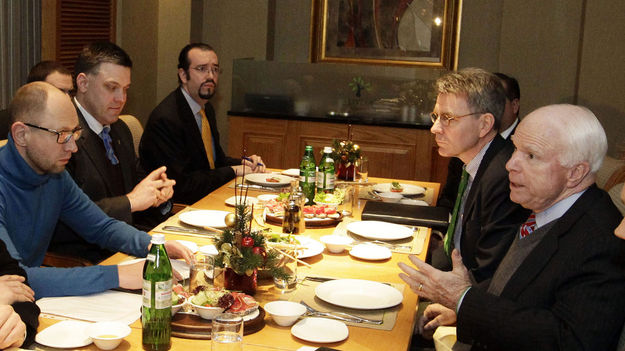
As in Syria, where US Ambassador Robert Ford adopted the rebels from the beginning of the insurrection, US officials have beat a steady path to the Ukrainian rebels to offer their support and assistance. Senator John McCain has even dined with Svoboda Party president Oleh Tyahnybok, shown here in a rather different pose. US Assistant Secretary of State Victoria Nuland was recorded plotting the overthrow and replacement of the Ukrainian government with the US Ambassador to Ukraine, Geoffrey Pyatt.
Pyatt, a man surely devoid of any sense of self-reflection, boldly proclaimed that his recorded plotting to overthrow of the Ukrainian government was merely “helping to build bridges between the government and the opposition.” Of course in a strict sense that is true: he is actively engaged in building a bridge to government power for the Ukrainian opposition.
The Syrian rebels are presented as a moderate group of would-be democrats seeking political reform; Ukrainian rebels are presented as a bunch of pro-Western, pro-EU “peaceful demonstrators.” In both cases the real power on the streets has been radical extremists with whom US officials have had considerable contact.
In Syria, President Assad responded early on to the unrest with offers of compromise, including agreeing to hold a constitutional referendum which put an end to generations of one-party rule. In Ukraine, President Yanukovich granted amnesty to violent protesters, rescinded legislation seen as inhibiting protest, fired his government at the request of the opposition and even offered to name opposition leaders to a new interim government. Each move toward compromise and appeasement of the opposition was met with increased violence and escalating demands on the part of the rebels, most recently in Ukraine after opposition leaders met with US and EU officials at a security conference in Munich.
President Obama sternly warns the Ukrainian government against restoring order: “We expect the Ukrainian government to show restraint, to not resort to violence in dealing with peaceful protesters.” He cryptically hinted at possible US escalation, stating: “We’ll be monitoring very carefully the situation, recognizing that, along with our European partners and the international community, there will be consequences if people step over the line.”
He similarly warned Syrian president Assad against taking action to defend the country against armed rebels fighting for its overthrow.
Another red line drawn? This time on Russia’s doorstep?
Here again is the million dollar question: What would Washington do if rebels intent on overthrowing the Obama regime raided military weapons depots, killed at least ten police officers and wounded dozens of others, set Washington D.C. on fire, occupied key government buildings including the US Capitol complex, and demanded a change in the Constitution favoring their ascendance to power?
Obama warned the Ukraine government to make sure the “Ukrainian military does not step in to resolve issues that could be resolved by civilians.” The US military was called in to quell a far less significant protest in Seattle over the World Trade Organization meeting there in 1999.
The US Capitol area has been on “lockdown” innumerable times over such “threats” as a mentally disturbed woman driving erratically — who was unarmed and shot dead by police.
One need not side with either opposing group in Ukraine to point out the choking hypocrisy of the US position.
But what is truly remarkable are the many similarities between what has been happening in Syria and what is now happening in Ukraine. It almost seems as if the same hand with the same playbook is plotting both regime change operations.
Invasions of the Mind Snatchers
By Nebojsa Malic | Ron Paul Institute | February 19, 2014
 Many empires have risen and fallen over the course of recorded history. All were created by force. Yet all have tried to legitimize that force, by passing laws and seeking to establish some sort of order that would outlive their military supremacy. Some have been more successful at this than others. The Atlantic Empire, on the other hand, is the only example in history of an imperial enterprise destroying its own laws, undermining its own legitimacy in pursuit of power.
Atlantist politicians invoke “democracy” almost as a totem, a sacred idea whose veneration magically bestows legitimacy upon governments and peoples. Thus framed, the totem does not bear closer scrutiny, and even defies definition. It is whatever the Empire says it is.
In actuality, democracy is just one political decision-making process. Politics, like chess or football, is a stand-in for war, designed to ritualize conflict so as to prevent bloodshed. As long as everyone abides by the rules, and accepts the restrictions of the system, that is all fine and good. Democracy has been described as “civil war with ballots instead of bullets.” Once someone decides to cheat, or even rewrite the rules to “I win, you lose,” the ballots lose their meaning. And bullets are the only thing left.
Or are they? Though the Atlantic Empire has not hesitated to use brute force to impose its will (e.g. the 1999 “Kosovo War”), such interventions have always been risky, costly and complicated. In 1999, for example, it took 78 days for the combined might of NATO to win a negotiated armistice with the outnumbered and outgunned Yugoslavia, allowing the Empire to occupy the province of Kosovo, but not the country entire. So the Atlantists turned to other means.
A student organization, “Otpor,” was taken over and turned into a revolutionary force. With millions of dollars in US taxpayer funding, promotional materials, “training” by the National Endowment for Democracy and other government instructors in nearby Hungary, these “activists” ran a media campaign against the Yugoslav president Slobodan Milosevic.
Meanwhile, the U.S. government rounded up some 18 opposition parties, wrote their program, and handpicked the front-man for the presidential elections of September 2000: a mild-mannered translator of the Federalist Papers who was never supposed to have any actual power. That would be reserved for the real leader of the “Democratic Opposition of Serbia” (DOS), whose popular support ran in single digits.
The government was caught between “Otpor” and DOS, appealing to the citizenry not to elect foreign agents. When the results of the election showed that DOS did not win, but may have won enough votes to force a runoff, “Otpor” activists and militia personally loyal to the DOS leader started a riot, burning the ballots at the National Assembly building. When the military and the police refused to intervene, president Milosevic resigned. It later emerged that the head of Yugoslavia’s state security had been a CIA informant for almost a decade, as were several high-ranking generals.
If this scenario sounds familiar, that’s because it is. Having been successfully tested in Serbia, the model was then applied elsewhere: 2003 in Georgia (“Rose Revolution”), 2004 in Ukraine (“Orange Revolution”), 2005 in Kyrgizstan (“Tulip Revolution”) and Lebanon (“Cedar Revolution”). The “Jeans Revolution” in Belarus (2006) failed, as did the “Green Revolution” in Iran (2009) and the “White Revolution” in Russia (2012). In all cases, the supposedly popular revolt followed a pattern straight out of the playbook used in Serbia – even to the clenched-fist symbol used by the “student activists” supposedly organizing the protests.
In early 2011, a series of revolts erupted in North Africa, bearing all the hallmarks of the astroturf “color revolutions”: governments were toppled in Tunisia and Egypt. Fringe protests in Libya and Syria escalated into all-out civil war. Meanwhile, a genuine popular protest in Bahrain was crushed by force; Bahrain is a major U.S. fleet base and a client-state of Saudi Arabia.
In every case, the Western media narrative has been the same: young people everywhere demanding “democracy” and overthrowing the evil regimes oppressing them. And if there is any fault to be found in Washington on EU capitals, it is for “standing idly by” and “not helping enough.”
In mid-2011, some European filmmakers made a documentary called “The Revolution Business”, daring to notice the common thread in the supposedly spontaneous outpourings of street riots demanding democracy throughout the world. They spent a lot of time with Srdja Popovic, former Otpor leader that went on to become a professional revolutionary. Otpor having folded years ago into Serbia’s ruling Democratic Party, Popovic now runs an outfit called CANVAS (Center for Applied NonViolent Action and Strategies), lecturing all over the world and training activists in dozens of countries to replicate the Serbian coup. In that mission he is helped by an instruction booklet written by Gene Sharp, a scholar from Boston.
The tactics and techniques of the revolutionaries have been described in some detail, both in Sharp’s book and by outside observers (such as John Laughland). Suffice to say they are all about exploiting the genuine public sentiment — real discontent where it exists, manufactured where it does not — and using the tricks from their toolbox to nudge it in the desired direction.
They always target the young, known for the excess of zeal and shortage of forethought. Who doesn’t want freedom and democracy – which they envision as the hedonist lifestyle seen on American films and TV. And here are all these “consultants”, teaching them for “free”. Even those who dislike and mistrust the Empire find it hard to argue against such gifts without seeming unduly paranoid.
Between the anvil of internal rebellion and the hammer of the Imperial media and diplomatic assault, the “oppressive regime” usually loses its nerve and folds. The “good democrats” installed in power soon start ruling in the interest of the Empire, and the activists realize the “training and consultation” they received weren’t free after all. The Empire always collects its debts.
Yet the revolutionaries rarely revolt after finding out they’ve been used thus. Even if they somehow overcame the crushingly demoralizing effect of finding out they were the agents of their own subjugation, that very fact destroys their credibility at home. Having supped from the cannibal pot, they are marked forever.
Then there are some who enjoy the taste, and become willing agents of the Empire. Popovic is proud of his revolution-exporting adventures. He gladly points out that the Otpor logo — a stenciled fist — has been used by local franchises from Ukraine to Venezuela. On several occasions, the backdrop to Popovic is an Otpor poster, showing the fist and the motto, “Because I love Serbia.” It is a particularly vicious lie: in the Serbia the Empire had Otpor create, only those who hate it prosper.
Popovic does try to obscure his Imperial connections, claiming that CANVAS is an entirely private organization, funded with Serbian money. Why, then, is its name an English acronym? And where did they get the money, in a country first systematically impoverished by a decade of UN sanctions, then bombed to rubble, and finally looted by the Empire’s “democrats”? So looted, in fact, that rummaging through garbage is close to becoming a major branch of agriculture…
And that is the other thing no one dares mention about the “color revolutions”: the governments they put into power are inevitably lackeys of the Empire, imposing horrifyingly destructive policies at home. Even when the people try to vote them out, the Empire simply bribes the winning politicians into switching sides, as it has done in Serbia in 2008 and 2012. Recent events in Ukraine, following the government’s rejection of an economic suicide offer from the EU, demonstrate that the Empire has become more desperate and less scrupulous about denying reality when doing so suits its interests. The legitimately elected government in Kiev has been demonized as “abolishing democracy,” while the violent protesters – representing fringe leaders micro-managed by U.S. and German diplomats – are extolled as authentic democrats and patriots.
Tracing the pattern of astroturfed “revolutions” over the past decade and a half, one cannot help but notice that they are suffering from diminishing marginal returns. In Serbia, a threat of violence and a lot of smoke and mirrors were sufficient to topple the government that successfully defended against conventional warfare. Eleven years later in Libya, it actually took an open military intervention (“kinetic military action” in Pentagonese) to make the rebels win, while the Syrian rebels are steadily losing the war despite all the aid and propaganda in their favor.
Another pernicious consequence of CANVAS in the governments the Empire decides to dislike is that any legitimate protest against genuinely repressive governments becomes that much less likely. Having seen country after country devastated by “color revolutions”, ruining the future of millions for the sake of a handful of quislings, people around the world are that much more reluctant to take politics into the streets. And with the ballot box increasingly discredited by Empire-backed “democrats” who refused to accept democracy if and when they lose, elections may soon become discredited as well. Leaving what, exactly, as a civilized form of conflict-resolution?
The Empire claims to champion democracy, but the end result of its actions is the exact opposite. There is no world order at work here, new or otherwise. Just chaos.
Andrew Revkin Loses The Plot, Episode XXXVIII
By Willis Eschenbach | Watts Up With That? | February 22, 2014
I went over to Andy Revkin’s site to be entertained by his latest fulminations against “denialists”. Revkin, as you may remember from the Climategate emails, was the main go-to media lapdog for the various unindicted Climategate co-conspirators. His latest post is a bizarre mishmash of allegations, bogus claims, and name-calling. Most appositely, given his history of blind obedience to his oh-so-scientific masters like Phil Jones and Michael Mann, he illustrated it with this graphic which presumably shows Revkin’s response when confronted with actual science:

I was most amused, however, to discover what this man who claims to be reporting on science has to say about the reason for the very existence of his blog:
By 2050 or so, the human population is expected to reach nine billion, essentially adding two Chinas to the number of people alive today. Those billions will be seeking food, water and other resources on a planet where, scientists say, humans are already shaping climate and the web of life. In Dot Earth, which moved from the news side of The Times to the Opinion section in 2010, Andrew C. Revkin examines efforts to balance human affairs with the planet’s limits. Conceived in part with support from a John Simon Guggenheim Fellowship, Dot Earth tracks relevant developments from suburbia to Siberia.
Really? Let’s look at the numbers put up by this charmingly innumerate fellow.
Here’s how the numbers play out. I agree with Revkin, most authorities say the population will top out at about nine billion around 2050. I happen to think they are right, not because they are authorities, but because that’s what my own analysis of the numbers has to say. Hey, color me skeptical, I don’t believe anyone’s numbers.
In any case, here are the FAO numbers for today’s population:
PRESENT GLOBAL POPULATION: 7.24 billion
PRESENT CHINESE POPULATION: 1.40 billion
PRESENT POPULATION PLUS REVKIN’S “TWO CHINAS”: 10.04 billion
So Revkin is only in error by one billion people … but heck, given his historic defense of scientific malfeasance, and his ludicrous claims about “denialists” and “denialism”, that bit of innumeracy pales by comparison.
Despite that, Revkin’s error is not insignificant. From the present population to 9 billion, where the population is likely to stabilize, is an increase of about 1.75 billion. IF Revkin’s claims about two Chinas were correct, the increase would be 2.8 billion. So his error is 2.8/1.75 -1, which means his numbers are 60% too high. A 60% overestimation of the size of the problem that he claims to be deeply concerned about? … bad journalist, no cookies.
Now, for most science reporters, a 60% error in estimating the remaining work to be done on the problem they’ve identified as the most important of all issues, the problem they say is the raison d’etre of their entire blog … well, that kind of a mistake would matter to them. They would hasten to correct an error of that magnitude. For Revkin, however, a 60% error is lost in the noise of the rest of his ludicrous ideas and his endless advocacy for shonky science …
My prediction? He’ll leave the bogus alarmist population claim up there on his blog, simply because a “denialist” pointed out his grade-school arithmetic error, and changing even a jot or a tittle in response to a “denialist” like myself would be an unacceptable admission of fallibility …
My advice?
Don’t get your scientific info from a man who can’t add to ten … particularly when he is nothing but a pathetic PR shill for bogus science and disingenuous scientists …
Obama’s Next Assassination Target
Get email updates: http://stormcloudsgathering.com/scg_u…
Donate: http://StormCloudsGathering.com/donate
Speak out: http://commongroundmovement.com/no-mo…
Sources and transcript: http://stormcloudsgathering.com/the-r…
Follow us on Facebook: http://facebook.com/StormCloudsGathering
Follow us on Twitter: http://twitter.com/collapseupdates
What Happens When You Marry The NSA’s Surveillance Database With Amazon’s Personalized Marketing?
By Glyn Moody | Techdirt | February 21, 2014
By now, most people who shop online are aware of the way in which companies try to tailor their offers based on your previous purchasing and browsing history. Being followed by strangely relevant ads everywhere is bad enough, but what if the government started using the same approach in its communications with you? That’s one of the key ideas explored in an interesting new article by Zeynep Tufekci, strikingly presented on Medium, with the title “Is the Internet good or bad? Yes.”
Tufekci suggests that neither of the two main metaphors regularly wheeled out for today’s global surveillance — George Orwell’s “1984” and Jeremy Bentham’s Panopticon — is right:
To understand the actual — and truly disturbing — power of surveillance, it’s better to turn to a thinker who knows about real prisons: the Italian writer, politician, and philosopher Antonio Gramsci, who was jailed by Mussolini and did most of his work while locked up. Gramsci understood that the most powerful means of control available to a modern capitalist state is not coercion or imprisonment, but the ability to shape the world of ideas.
The question then becomes: how can people’s ideas be shaped so as to control them? Simply bombarding the population with messages only works for a while, until people become jaded and resistant to them. That’s where Edward Snowden’s revelations about “big data surveillance” come in, Tufekci suggests:
Individually tailored, subtle messages are less likely to produce a cynical reaction. Especially so if the data collection that makes these messages possible is unseen. That’s why it’s not only the NSA that goes to great lengths to keep its surveillance hidden. Most Internet firms also try to monitor us surreptitiously.
She’s worried about this approach being used to influence people’s political behavior, and points to a recent study in Nature that explored precisely this area:
By altering a message designed to encourage people to vote so that it came with affirmation from a person’s social network, rather than being impersonal, the researchers had shown that they could persuade more people to participate in an election. Combine such nudges with psychological profiles, drawn from our online data, and a political campaign could achieve a level of manipulation that exceeds that possible via blunt television adverts.
Indeed, Tufekci thinks the process has already begun:
During a break [in a conference called “Data-Crunched Democracy”], I cornered the chief scientist on Obama’s data analytics team, who in a previous job ran data analytics for supermarkets. I asked him if what he does now — marketing politicians the way grocery stores market products on their shelves — ever worried him. It’s not about Obama or Romney, I said. This technology won’t always be used by your team. In the long run, the advantage will go to the highest bidder, the richer campaign.
He shrugged, and retreated to the most common cliché used to deflect the impact of technology: “It’s just a tool,” he said. “You can use it for good; you can use it for bad.”
That’s hardly very comforting, and neither is Tufekci’s concluding thought:
Internet technology lets us peel away layers of divisions and distractions and interact with one another, human to human. At the same time, the powerful are looking at those very interactions, and using them to figure out how to make us more compliant. That’s why surveillance, in the service of seduction, may turn out to be more powerful and scary than the nightmares of Nineteen Eighty-Four.
Follow Glyn Moody @glynmoody on Twitter or identi.ca, and +glynmoody on Google+
NY state steps up surveillance on…kids
New York state authorities are planning to step-up surveillance – this time, on school kids. The program, which is to be launched state-wide, is supposed to gather information on students starting from the age of five. And as RT’s Marina Portnaya reports, the move is finding little support among parents.
Featured Video
Yemen joins the war – Red Sea could be blocked next – Saudi regime at risk
or go to
Aletho News Archives – Video-Images
From the Archives
A superpower and “the world’s sickest warrior state”
By Paul J. Balles | March 8, 2010
Living through five or six major wars has hardened me to what I thought were the extremes of inhuman cruelty and brutality.
Two things made those extremes almost bearable: the brutality always revealed – at least according to the media coverage – the viciousness of the enemy. It was therefore quite understandable when our “brave men and women” pulverized the enemy.
Films of Japanese torturing captive Americans somehow justified holding Japanese Americans in internment camps during World War II; and only a small percentage of Americans found the bombing of Hiroshima and Nagasaki unreasonably vengeful at best, at worst, depraved.
The media giants in America portrayed the North Koreans as barbaric beasts with their captives, quite unlike their southern counterpoints – our allies during the Korean War. No one ever felt the need to explain how the South Koreans were a civilized breed while the North Koreans were absolute savages, at least according to the official line.
In Vietnam, our warriors justifiably (or so the media made us believe) dropped napalm on the North Vietnamese who had the gall to hide in villages and tunnels to ravage our invaders. At least it was accepted practice until some rogue photojournalist filmed a young girl screaming down a Vietnamese road in flames. … continue
Blog Roll
 Aletho News
- America Racing to Strategic Defeat in Iran: Lt Col Daniel Davis
- FTC Warns Visa, Mastercard, PayPal, Stripe Over Political Debanking
- Russian tanker approaches Cuba despite US oil blockade
- Marandi: Yemen joins the war – Red Sea could be blocked next – Saudi regime at risk
- Pro-Palestinian French member of European Parliament denied entry to Canada
- Pakistan to Host US-Iran Talks
- How Indonesia’s tilt toward the US left it stranded in the Strait of Hormuz
- US has no choice but to retreat from Iranian borders: Top commander
- Iran Retaliation Strikes Chemical Plant Near Dimona
- AWACS’ Destruction is a Major Loss for US Military – Ex-DoW Analyst
- If Americans Knew
- Israeli police block Catholic cardinal from entering Church of the Holy Sepulchre on Palm Sunday
- Israel is assassinating journalists again, more than any other nation, anywhere, ever – Not a ceasefire Day 170
- Over 300 US service members wounded, majority have brain injuries – Not a ceasefire Day 169
- Researchers at Human Rights Watch Resign Over Blocked Report on Palestinian Refugee Return
- Jewish Groups Are Backing a War Americans Don’t Want
- Eric Fingerhut Thinks He’s the President of the Jews
- Top Jewish Philanthropists, Rabbis Urge Israeli President to Take Action Against ‘Jewish Extremists’
- Don’t Be Fooled. Zionist Leaders Have Always Wanted to Control Southern Lebanon
- Israel’s widespread use of torture is a core element of its genocide against the Palestinian people
- In Israel’s War on Iran, Many Middle East US Bases Rendered “All But Uninhabitable”
- No Tricks Zone
- New Study Finds Warming Saves Lives…Cold Temperatures 12 Times More Deadly Than Excess Heat
- German Science Blog Accuses PIK Climate Institute Of Hallucinating Climate Tipping Points
- Devastating Assessment Of Comirnaty Vaccine By Former Senior Pfizer Europe Toxicologist
- New Study: CO2 Is ‘Effectively Negligible’ As An Explanatory Climate Change Factor Since 2000
- Former Pfizer Toxicologist Dr. Helmut Sterz Tells Bundestag Hearing Pfizer Vaccine Should Have Never Been Approved
- Energy Expert: Germany’s Nuclear Phaseout Was A “500 Billion Euro Mistake”
- New Research: South Australia’s Mid-Holocene Sea Surface Temperatures Were 4°C Warmer Than Today
- Storing Green Energy To Last Germany 10 Days Would Require A 60-Million Tonne Battery
- New Studies: UK Sea Levels Were 4 Meters Higher Than Today During The Mid-Holocene
- Destructive Green New Deal: German Energy And Metal Group Warns Of Drastic Crisis
 Aletho News