Nuclear Weapons: Hope at Last
By Jim McCluskey | Dissident Voice | February 19, 2014
The US, the UK, Russia, China and France are rebuilding or upgrading their arsenals of nuclear weapons. The other four nuclear states too are ‘improving’ their arsenals. As we discuss the statistics and strategies of ‘nuclear arsenals’ and ‘nuclear deterrence’ it can be hard to keep in mind the reality underlying the abstract discussions. The nine nuclear states have over 10,000 nuclear weapons in their stockpiles. This is enough to wipe out the entire population of the planet many times over together with all other life forms. Is this sane? Has the human race lost its senses? A single United States thermonuclear warhead, designated W88, has an estimated ‘yield’ of 475 kilotons. The ‘yield’ is the destructive power expressed in tons of TNT equivalent. The W88 is over 30 times more destructive than the bomb which wiped out Hiroshima. A single W88 could completely destroy London, Moscow or New York. Each bomb on a major city would kill millions of people; women, children, babies, old people, everyone. The suffering would be indescribable and for many would go on for months and years before death. No emergency services could begin to cope There would be no relief. What sort of people would do such a thing? What kind of human would threaten such an atrocity?
The US government has 5 nuclear submarines on patrol at all times carrying 1000 times the destructive power of the Hiroshima bomb. Is it possible to imagine the degree of paranoia represented by such a standing threat? The UK government has started to spend one hundred billion pounds on rebuilding its Trident fleet of nuclear submarines, each one with the capacity to incinerate over 40 million people. This is being done at a time when many citizens are suffering from inadequate defences against flooding and when the social services are being radically cut back.
The situation is being rendered even more insanely dangerous by the US and Russia which keep 1,800 weapons on high alert atop long-range ballistic missiles that are ready to launch 5 to 15 minutes after receiving an order!
It is ironic that the worst offenders are the five permanent members of the Security’ Council of the United Nations. They have had 69 years to get rid of their nuclear weapons while all that the citizens of the world hear from them are windy speeches around purported good intentions which never come to fruition.
Citizens of the world have simultaneously become aware that the nuclear states do not intend to get rid of their nuclear weapons and that their existence imposes a permanent and intolerable threat to us all. The existence of nuclear weapons means they could be used by accident, by misunderstanding or by malicious intent. How can we ever be sure that some deranged psychopath will not gain power in one of the nuclear states and deceive him/herself into believing that it is in their best interests to make a first strike? How can we ever be sure that some terrorist organisations will not hack into the electronic control systems and carry out the launching themselves? And we now know that even a small nuclear exchange could be a lethal threat to everyone on the planet. In a limited nuclear war between India and Pakistan 20 million people would die from the nuclear blasts, fires, and radioactive fallout. And the fallout would have global consequences that would kill millions of people, disrupt climate patterns, and threaten global agricultural collapse.
Furthermore decent people round the globe know that the existence of nuclear weapons is a brooding evil which undermines the moral integrity of humankind. As the great moral leader Desmond Tutu wrote “Nuclear weapons are an obscenity. They are the very antithesis of humanity”…
The only remedy is an enforced world ban on the existence of nuclear weapons. The other weapons of mass destruction have already been banned. It is the turn of the last and most destructive of them all.
And finally there is hope. The huge burgeoning of awareness in the citizens of the world is bearing fruit.
There are 9 nuclear states and there are 183 non-nuclear states. The security of the non-nuclear states is threatened by the irresponsible and self-focused behaviour of the 9 others. But these 9 are outnumbered by 20 to one. The non-nuclear majority which do not feel the need for a lethal ‘security’ crutch have decided to take the initiative. And rather than focus on the numbers and ‘yields’ of the weapons it was wisely decided to concentrate on the effects on humanity of the use of nuclear weapons. The next logical development, as the nuclear states continue to deny their obligations to shed their arsenals, is for the non-nuclear states to proceed independently to enact a treaty outlawing these weapons internationally. By focusing attention on the humanitarian consequences of their use they are well on their way to doing so.
The first International Conference on the Humanitarian Impact of Nuclear Weapons was held in 2013. Humanity owes a great debt to Norway for this initiative.
This ground-breaking and historic conference was attended by delegates from 127 countries and 70 nongovernmental organizations. The nuclear states were invited but declined to attend. It is not easy to face up to the implications of these arsenals especially if you bear the primary responsibility. India and Pakistan sent observers.
After hearing presentations from a wide range of experts on the various effects of nuclear weapon detonations the conference concluded that “it is unlikely that any state or international body could address the immediate humanitarian emergency caused by a nuclear weapon detonation in an adequate manner and provide sufficient assistance to those affected.” Conference members also agreed that the effects of a nuclear weapon detonation will not be constrained by national borders but will produce significant negative regional and global effects.
Mexico offered to host a follow-up meeting to this conference and such is the vital importance of this approach that other states declared their intention to organise additional events on this subject.
The Second Conference on the Humanitarian Impact of Nuclear Weapons was held in Nayarit, Mexico, on 13 and 14 February 2014. It included delegations representing 146 States, the United Nations, the International Committee of the Red Cross, the Red Cross and Red Crescent movement and civil society organizations.
The powerful summary statement of the conference Chair pointed out that the broad participation of states and civil society reflected the burgeoning awareness that this issue is of the utmost importance to all the peoples of the world. Due to “…proliferation, the vulnerability of nuclear command and control networks to cyber-attacks and to human error and potential access to nuclear weapons by non-state actors, in particularly terrorist groups” the risks are “growing globally”. The risks of “accidental, mistaken, unauthorised or intentional use is growing significantly due to more countries holding weapons on higher levels of combat readiness”. As awareness of the humanitarian impact grows hearts and minds are being changed worldwide. These weapons must be outlawed. “In the past, weapons have been eliminated after they have been outlawed. We believe this is the path to achieve a world without nuclear weapons”. He called for a “legally binding instrument” and declared that the “time has come to initiate a diplomatic process conducive to this goal. Our belief is that this process should comprise a specific time frame, the definition of the most appropriate fora, and a clear and substantive framework, making the humanitarian impact of nuclear weapons the essence of disarmament efforts. It is time to take action.”
The Third Conference on the Humanitarian Impact of Nuclear Weapons will be held in Austria later this year. The movement for an international ban is unstoppable.
The International Campaign Against Nuclear Weapons (ICAN) is a coalition of over 350 organisations in 90 countries. Ray Acheson, in his closing statement on behalf of ICAN to the Second Conference included the words: “The claim by some states that they continue to need these weapons to deter their adversaries has been exposed by the evidence presented at this conference and in Oslo as a reckless and unsanctionable gamble with our future.”
He went on to explain that the use against cities of less than one percent of existing weapons would put billions of lives in jeopardy and have a long lasting detrimental effect on both the planet’s climate and agriculture. He insisted that we must act to get rid of them or they will be used by accident, misunderstanding or malicious intent. Getting rid of them will take courageous leadership by states but such leadership will have the support of civil society. He concluded: “It is time to change the status quo. It is time we ban nuclear weapons.”
So with these and other major forces at work there is an unstoppable movement towards banning these Armageddon machines. The nuclear states have become a sorry sight. Frozen in a realm of outdated thinking which was always inhuman; their leaders frightened and paranoid and prepared to put the survival of humanity in jeopardy simply in order to feel important and powerful as they strut, uncomprehending, on the world stage.
Their brief and nightmarish ascendancy is over. The world has moved on.
~
Jim McCluskey is the author of The Nuclear Threat.
Related article


Colombia: Who Is Really In Charge?
By John I. Laun | Colombia Support Network | February 18, 2014
In the last several days a number of stunning disclosures have surfaced concerning the role of the Colombia military. First, the Colombian news magazine Semana revealed that military intelligence had conducted wire-tapping and surveillance for an operation called Andromeda from a listening post set up in a site disguised as a small restaurant named “Buggly Hacker” located in Galerias, a Bogota commercial district. Among the phone calls tapped and overheard it appears there may have been calls of members of the Colombian Government’s delegation involved in peace talks with the FARC guerrillas, whose delegation’s conversations may likewise have been tapped and overheard. When news broke of this activity, President Juan Manuel Santos declared publicly that these wiretaps (chuzadas, as they are referred to in Colombia) were illegal and had to be investigated at once. The President said publicly that he did not authorize and knew nothing about this activity. But the next day, President Santos declared that the chuzadas had been done legally!
Two things are very clear. First, that the President of Colombia is not aware of what a significant part of his government is doing, and that’s all right with him. And second, that the military are (quite literally) calling the shots in Colombia. It appears obvious that Mr. Santos changed his opinion overnight on the legality of the secret wire-tapping activity by military intelligence because military officers told him he could not call the activity illegal. In other words, they’re in ultimate control of the government in Colombia!
How could Mr. Santos determine that this activity was legal? There are laws which have provided great leeway to military intelligence. But they certainly do not extend to overhearing conversations between Colombian Government representatives and FARC representatives meeting in Havana supposedly aimed at arriving at a broad peace agreement through which the guerrilla war would be ended. Who would speak freely his or her ideas on what a peace agreement should consist of—a necessary part of peace conversations if they are to be productive— if he or she knew a third party was overhearing what was being said? No one. Particularly if the party overhearing the conversations is the Colombian military, which has a long record of abusive conduct, and even has a representative at the peace talks, General Mora. The chuzadas are a serious impediment to frank and open dialogue between the Colombian Government and the FARC. One suspects that former President Alvaro Uribe Velez is likely the recipient of the information gained from the chuzadas, as he utilizes his close relationship with military officers to obtain information with which to undercut the peace talks, which he has publicly opposed. He earlier obtained the coordinates for movement of two FARC leaders as they came out of their bases to go to Havana—secret information he could only have gotten through a leak from a military or governmental source. Of course, President Santos has not moved seriously to investigate this leak. Why? Because he is not in control of the Colombian government.
This has been made clear by events in the last couple of days. Semana, much to their credit, has carried out and now published the results of an extensive investigation of corruption in the Colombian military. The investigation found military officers discussing how to skim off funds for their personal benefit from monies received by the military, the likely source of which was the United States Government. One of the persons involved in the recorded conversations is the current Commander of the Colombian Armed Forces, General Leonardo Barrero. Another article reported how supposedly disgraced General Rito Alejo del Rio, confined to a military installation in Bogota for his support of illegal paramilitary forces during his time as Commander of the Seventeenth Brigade in Carepa, near Apartado, essentially commands the installation, freely making supposedly-prohibited cell phone calls. And other military personnel who misbehaved had been involved in the “false positives” scandal in which military officers ordered the kidnapping of young men, had them killed, and then falsely presented them as guerrillas killed in combat.
The reports by Semana show an astonishing level of corruption in the Colombian military. President Santos has promised an investigation of these activities, of which he says he had no knowledge. Again, we see Mr. Santos as being out of the loop, heading a government he does not control. The conclusion is inescapable that the military controls the government and Mr. Santos is an uninformed bystander. He seems to believe that his job is to hob-nob with representatives of multinational corporations, as he did on a recent visit to Spain, inviting them to invest in Colombia and remove its valuable mineral resources for a pittance. The Colombian people deserve much better than this!
There is another aspect of the military’s current “dance of the millions” which is very troubling. The funds that are being stolen by military personnel are almost certainly provided by the United States government (i.e., U.S. taxpayers) as a part of the bloated budget of funds the U. S. government provides to the Colombian military. An obvious question is: Did the U.S. government personnel, such as the country’s military attache and Ambassador in Colombia, know what has been going on? And, if not, why not? This scandal calls for a full review of the U.S. aid program to Colombia and an immediate freezing of any funds in the aid pipeline. We in the human rights community have long known of the pervasive corruption in the Colombian military, though we did not know of the brazen theft of funds which Semana uncovered. It is high time that President Obama, Secretary of State Kerry and Secretary of Defense Hagel give their undivided attention to the Colombia situation. And the members of Congress should insist upon a thorough investigation, dismissal of those government personnel who overlooked these very serious problems, and prosecution of those who may have collaborated with the Colombian military to their own advantage.
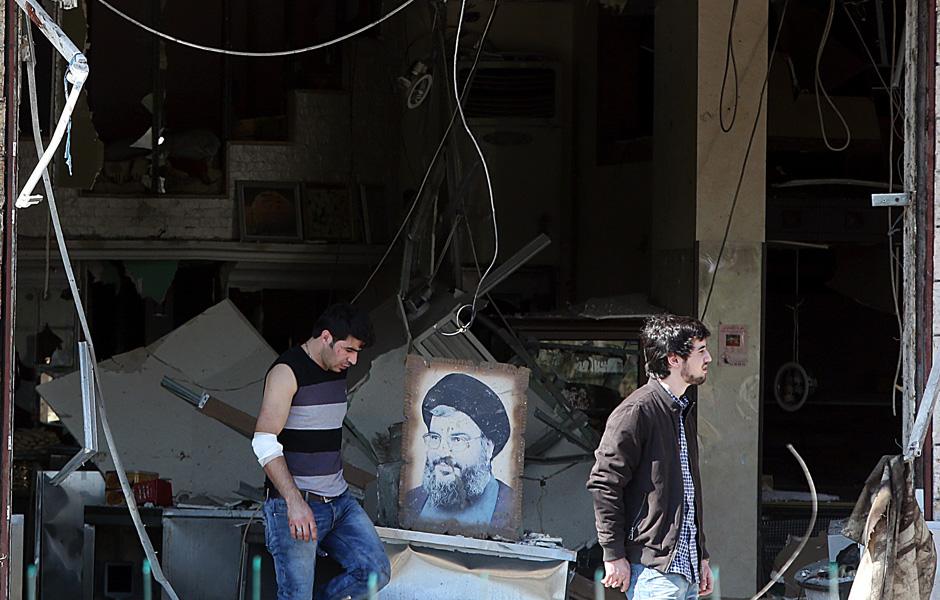
Powerful Bombings Rock Bir Hassan, South Beirut
Al-Manar | February 19, 2014
Two terrorist blasts hit southern Beirut on Wednesday near the Kuwait embassy in Bir Hassan, leaving dozens of martyrs and injured.
Security sources confirm that the bombings were suicide attacks adding that they coincided and that they were targeting the cultural center of the Iranian embassy in Beirut.
The Al-Manar correspondent reported that the first explosion took place near Gondoline sweets which lies in the building of the Iranian cultural center.
The second took place near a restaurant facing an army base.
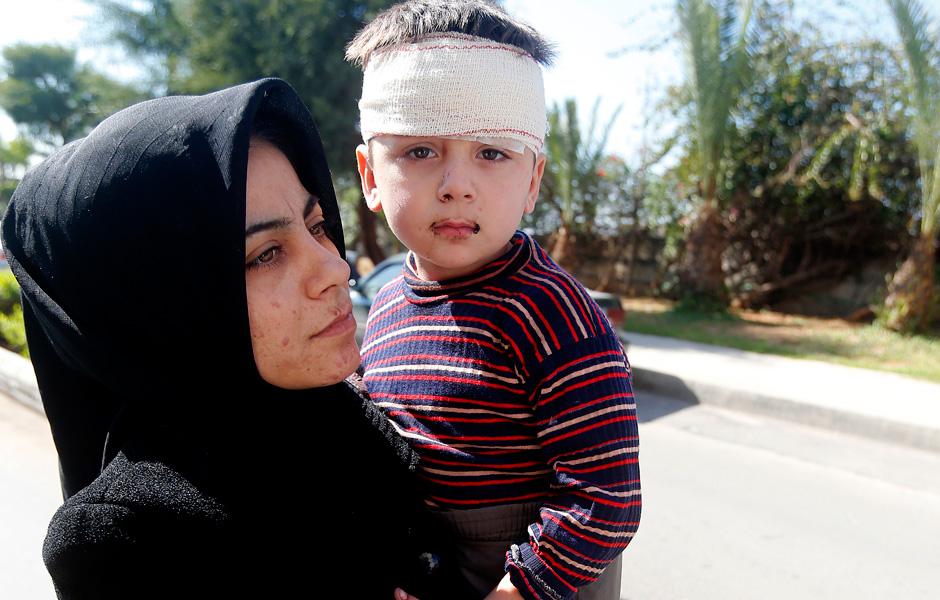 Shortly after the blasts ambulance and Civil Defense vehicles rushed to the scene.
Health minister Wael Abu Faour visited the blast scene and said that the suicide bombings left at least five martyrs and 103 injured.
State Commissioner to the Military Court Judge Saqr Saqr also arrived in blast scene, confirming that the attacks were suicide bombings.
The first blast was carried by a BM X5 4×4 vehicle, rigged with 90 kgs of explosive materials, Saqr said. He noted that the second explosion was carried out by a Mercedes car rigged with 75 kgs of explosive materials.
For its part, the Iranian embassy in Beirut confirmed all staff were safe.
Photo credits – Haytham Moussawi and Marwan Bou Haydar
Ukraine crisis: EU Parliament’s MP urges to impose sanctions on Russia
Voice of Russia | February 19, 2014
A member of the ruling faction in the European Parliament has come up with an initiative to impose sanctions against Russia that he said was supporting Ukraine’s regime. Russia has been in a waiting stance ever since the escalation on Tuesday, when Ukraine’s capital Kiev descended into more chaos.
This came today from Poland’s MEP Jacek Sariush-Volsky of the center-right European People’s Party at a press conference in the EU parliament.
However, a spokesperson with the European Commission ruled out the possibility of sanctions against Russia ahead of the EU foreign chiefs’ meeting on February 20.
Conversely, the spokesman said that the 28 foreign policy heads of EU member countries were going to engage in consultations with Russia in order to clear up all controversies that exist between Moscow and Brussels on the possible outcome of an association deal between Ukraine and the EU.
Russia blames ‘extremists’ for Ukraine crisis, suggests attempted coup
Russia has apportioned all blame for the deteriorating situation in Ukraine on the extremists. This is according to President Putin’s spokesman Dmitry Peskov.
“The president believes that the ongoing situation in Ukraine is the fault of the extremists,” Mr. Peskov said today.
He added Russia wished that its Ukrainian partners would “ensure the settlement of the situation that has taken shape as soon as possible.”
“Moscow strongly condemns violence of radical elements, who in the breach of all agreements previously reached actually used the implementation of the conditions on amnestying previously detained people and returned to violent actions immediately,” Peskov told reporters.
“Besides, their actions can be treated and are treated in Moscow solely as an attempt at a state coup,” Peskov said. “Together with the seizure of state organizations in various cities of Ukraine, the seizure of law enforcement facilities and attempts to seize arms occurs as well,” he said.
Russia biding its time on Ukraine
Moscow is keeping tabs on Ukraine but will not interfere with the crisis for now, President Putin’s spokesman has said Wednesday. Russia has been in a waiting stance ever since the escalation on Tuesday, when Ukraine’s capital Kiev descended into more chaos as death toll rose to 25 people.
“The Kremlin is closely watching the ongoing situation in Ukraine, and we will definitely speak on it a bit later,” Putin’s spokesman Dmitry Peskov said today in an interview with online magazine Slon.
“The idea is not to intervene in the Kiev unrest. We’ve said that many times, the Kremlin will stay true to this stance.”
Militants’ actions in Kiev on Fe 18-19 not spontaneous, but staged – Russian diplomat
Chairman of the Federation Council’s International Affairs Committee Mikhail Margelov believes that militants’ actions on Kiev streets on February 18-19 are not spontaneous, but staged.
The senator noted the common delusion that the so-called Maidan and its battle squad is not stage-managed, it is Cossak outlaws and “national power”. “The very events at Grushevsky Street disproved it: the militants dealt with law enforcers’ attacks too skillfully, refilled armory of shields, casks and clubs, and added cocktail bombs to convert it into napalm. The course of street riots February 18-19 showed that the militants fight in the so-called “Halych format” — it came to gunfire, and there are fatalities on both sides. There is evident organized nature behind the fighting,” Margelov believes.
In addition, he said that “after a fragile truce, the Maidan gains momentum in provinces: in Lvov, Ternopol, Ivano-Frankovsk”. “They not only occupy state offices there, but storm police wards and dismantle Berkut officers,” the Russian senator stated.
Margelov expressed confidence that “debacles and shooting that John Kerry dubbed “fight of the Ukrainian majority for Europe’s democratic future” are fairly staged and managed by experienced specialists in street fighting”. “Klitschko and Yatsenyuk hardly possess such military talents,” he assumed, adding that the job of these politicians is “to compose joint plans with the West to make up an oppositionist government and carry out a constitutional reform, which ought to be followed by western financial aid”.
Chairman of the Federation Council’s International Affairs Committee says it’s early to make any forecasts yet. “It would be a great achievement to stop the street mayhem and start a responsible political dialogue. Still, even this may not consolidate the Ukrainian society. It’s split: I cannot remember a single Ukrainian parliament that hadn’t fistfights,” the senator concluded.
Related article

Ex-US soldier guilty of rape, murder found hanged in prison
Al-Akhbar | February 19, 2014
A former US soldier, sentenced to life imprisonment for the 2006 rape and murder of a 14-year-old Iraqi girl as well as the murder of her parents and six-year-old sister, has been found hanged in his cell.
According to American media reports, prison officials said the death of Steven Dale Green, found hanging in his Arizona cell last week, was currently being investigated as an act of suicide.
Green, 28, was convicted in 2009 for the rape and murder of 14-year-old Abeer Qassim Hamza al-Janabi and the deaths of her father, mother and six-year-old sister in Mahmudiya, more than 30 kilometers south of Baghdad.
He was sentenced to life in prison after a federal jury in Kentucky could not decide whether he should be given the death penalty.
Prosecutors portrayed Green as the ringleader of five soldiers that plotted to invade the home of the family of four in order to rape the girl. They had later bragged about the crime to their peers in the army.
The four other soldiers were taken to military courts. Three of the soldiers pleaded guilty in the attack and the fourth was convicted. They received sentences ranging from five to 100 years.
Green, on the other hand, was tried as a civilian because he was arrested after he was discharged from the army.
Moscow blames radicals for deadly clashes in Ukraine, EU leaders ponder sanctions against government
RT | February 19, 2014
Moscow believes the deadly clashes in Kiev were an attempt at a coup by radicalized protesters. EU leaders have quite an opposite view, calling for sanctions against Ukrainian government officials.
In a statement issued on Wednesday, Russia’s Foreign Ministry described the violence in Ukraine as an attempt at a coup d’etat and a “brown” revolution, accusing European politicians and institutions of “refusing to admit that all of the responsibility for the actions of radical forces in Ukraine rests with the opposition.”
“The Russian side is demanding the leaders on the streets to stop the violence in their country, immediately resume dialogue with the lawful government without threats and ultimatums,” the statement reads.
The Kremlin has also interpreted the violence in Ukraine as a coup attempt. President Putin’s spokesman said that “from the point of view of the Russian leadership”, all of the responsibility for the bloodshed could be laid at the door of “the extremist forces.”
Twenty-six people were killed overnight in the most violent clashes yet to have occurred between security forces and protesters since the opposition took to the streets of Kiev in November 2013. Ten of the casualties are Ukrainian police officers, who died of gunshot wounds, as did the rest of the victims, the Interior Ministry reported.
It added that up to 700 people were injured, more than 70 of those being policemen.
The Ukrainian Health Ministry officially confirmed that a journalist from the local Vesti newspaper, Vyacheslav Veremey, died in Kiev after a gunshot wound.
The Ukrainian Ministry of the Interior believes the casualties in the clashes could have been killed by the radicals, because the police do not use fire arms.
“Taking into consideration the nature of the dead civilians’ wounds and also the nature of the weapons, which have been confiscated, we can assume that these wounds were inflicted by violent protesters,” a statement at the Ministry’s website says. “Police officers and interior troops do not use fire arms. Law enforcers are only using non-lethal weapons.”
Some of the European leaders have not been convinced and have been quick to lay the blame for the violence on the Ukrainian president. The Swedish Foreign Minister said on Twitter that blood was on Yanukovich’s hands.
British Foreign Secretary William Hague was less emotional, but also accused the government of allowing the bloodshed to happen.
Several EU leaders have already spoken of introducing sanctions against the Ukrainian leadership, who they view as responsible for the crisis.
Germany, which previously refused to back Washington’s calls for sanctions against Ukraine’s government, could soon have a change of heart, according to German Foreign Minister Frank-Walter Steinmeier .
“Whoever is responsible for decisions that lead to bloodshed in the center of Kiev or elsewhere in Ukraine will need to consider that Europe’s previous reluctance for personal sanctions must be rethought,” he said, according to AP.
Polish Prime Minister Donald Tusk said on Wednesday he would be pressing European Union leaders to impose sanctions on Ukraine’s government.
“I will today hold talks with the leaders of the biggest EU countries and institutions, and persuade them to impose sanctions – personal and financial,” Tusk told a special session of the Polish parliament, Reuters reports. “I hope that such a stance from Poland will help the EU as a whole in taking fast decisions.”
Belgian Foreign Minister Didier Reynders has also supported sanctions against the Ukrainian government, according to Itar-Tass.
Earlier, US Ambassador to Ukraine Geoffrey R. Pyatt blamed Viktor Yanukovich for the escalation of the crisis.
“From this moment on, the USA holds Yanukovich responsible for everything that happens in Ukraine,” he told the Zerkalo Nedeli newspaper, following a meeting with Foreign Minister Leonid Kozhara.
Moscow believes that this accusatory position of the US could have, in fact, contributed to the escalation of violence Kiev has been witnessing, and, holding the president solely responsible for the crisis, is giving carte blanche to extremist radical forces out on the streets.
The Russian Foreign Ministry said on Tuesday it considered the crisis “a direct result of the permissive policy exercised by those western politicians and European structures, who from the very beginning turned a blind eye to the aggressive actions of the radical forces in Ukraine.”
The right of return is for individuals to decide, not for Abbas to concede
By Ibrahim Hewitt | MEMO | February 19, 2014
Yet again, we hear that President Mahmoud Abbas has more or less conceded the lawful right for Palestinian refugees to return to their homeland. Last year he told Israelis that although he would like to visit his birthplace in Safed, which is now in Israel, he did not expect to live there. Now he has told a group of Israelis visiting Ramallah that he has no wish to “drown the Jewish character” of Israel with returning refugees. This is an astonishing thing for him to say because its implications are so serious.
For a start, let us make it clear that the right to return is an individual right so it is not within the Palestinian Authority leader’s power to concede it on behalf of anyone other than himself. It may be that he was well aware of that when he signalled his own reluctance to return to Safed but his latest statement is worrying for the millions of refugees festering in squalid UN-run camps around the region.
One journalist said that Abbas’s comments “seemed to signal a significant concession on the so-called right of return – the Palestinian demand that several million descendants of 700,000 refugees expelled during Israel’s 1948 war of independence be allowed to go back to their homes.” For the benefit of the Daily Telegraph’s Robert Tait, it should be remembered that the right to return is not a “Palestinian demand”, it is enshrined in UN General Assembly Resolution 194 dated 11 December 1948: “… refugees wishing to return to their homes and live at peace with their neighbours should be permitted to do so at the earliest practicable date…” Israel’s membership in the UN was conditional inter alia on it implementing this resolution, something which, of course, it has never done.
Israel’s unilateral “Declaration of Independence” of 1948 is clear that it was established as “the Jewish State in Palestine”. Among other things, the founding document insists that Israel “will loyally uphold the principles of the United Nations Charter”, among which is a commitment to implement resolutions; Israel has ignored more UN resolutions than it has ever implemented.
This “Jewish State” was recognised implicitly by the Palestine Liberation Organisation (PLO) in 1993 when the former “terrorist” group came in from the cold and recognised Israel’s “right to exist”. That being the case, it must be asked why Benjamin Netanyahu is insisting on Palestinian recognition of the “Jewish character” of Israel as a pre-condition for a peace agreement.
Experience shows that Israel is an expansionist state; it has never declared its borders and has grown exponentially ever since it was created. Indeed, even by then it had morphed itself from the “national home for the Jewish people” in Palestine mentioned in the infamous Balfour Declaration of 1917 to a “Jewish State” by 1948. The land it occupied by the 1949 armistice was greater in area than the allocation of the UN Partition Plan of 1947; this was increased yet again when Israel launched the Six-Day War in 1967 and occupied all of historic Palestine. While not occupying the Gaza Strip physically since 2005, Israel controls its borders, territorial waters and air space; it is an occupation legally and in all but name. As the “negotiations” (a euphemism for Palestinian concessions) drag on for 20 years and counting, Israel creates more facts on the ground, grabbing ever more land for its illegal settlements, settler-only roads, military zones and “nature reserves”. I think that it is fair to say that Israel’s leaders have no intention whatsoever of giving up any land upon which Jews are now living as they push to create “Eretz Israel”, the Greater Israel that is Zionism’s dream.
Recognition of the “Jewish character” of Israel will give it the green light to complete the ethnic cleansing started in 1948, with the 20 per cent of non-Jewish Israeli citizens being “transferred” to the rump statelet of Palestine that may or may not come into being; ideally, from a Zionist perspective, the transfer won’t end there and life will be made so miserable for Palestinians in the West Bank that they will cross into what many Israelis already call the state of Palestine; the rest of us know this as the Hashemite Kingdom of Jordan. This is the “alternative homeland” scenario dreaded by Palestinians who have no wish to leave their historic homeland.
Israel will cite “security” concerns in order to get its way, though, and willing dupes like US Secretary of State John Kerry, ever-ready to do the pro-Israel Lobby’s bidding, will put pressure on the Palestinian Authority to concede even more than it has already. This includes agreement to a strong Israeli military presence in the Jordan Valley, so that an “independent state of Palestine” will be nothing of the sort; it will have an army of occupation on its territory from Day One.
Once Israel is cleared of the “demographic time-bomb” of its Palestinian citizens it can claim, with hand on heart, that it is indeed both Jewish and democratic in nature. Fear of being an obvious apartheid state with a democratic façade is genuine; Jewish students in America are already being coached about how to defend the case for declaring a Jewish state while basically disenfranchising 1-in-5 of Israel’s citizens and implementing a raft of discriminatory laws.
That is why Mahmoud Abbas needs to wake from his stupor and understand that while he is free to give up his own right of return, he has no right whatsoever to concede that right for all Palestinian refugees. Israel and its Western backers will, of course, continue to ignore the UN resolutions in any case and so won’t mind that the legal niceties are chewed up and spat out as long as what Israel wants, Israel gets. But that will never produce a just and lasting peace in the region. Maybe that doesn’t bother the military-industrial complex upon which Israel is so reliant; it certainly won’t bother the neoconservatives running America. Their plans for the Middle East don’t include a state of Palestine; they want to see US-Israeli hegemony at any cost.
More than anything else, Abbas’s ill-advised statements demonstrate the ridiculous nature of the whole peace process, which is producing neither peace nor much of a process at the moment. The one-state solution is being talked about in all sorts of circles these days, as more and more people realise and accept that two-states are a non-starter. If the message can get through to Mahmoud Abbas and his cronies in Ramallah on board the Palestinian Authority gravy train, maybe peace will have a chance after all.
Related articles
Israeli soldiers breach Lebanese border to retrieve crashed spy plane
Al-Akhbar | February 18, 2014
Israeli troops crossed the barrier separating Lebanon from Occupied Palestine on Tuesday, searching for parts of a crashed surveillance plane, the Lebanese National News Agency reported.
The Israelis then fired a shot in the air when a joint patrol by the Lebanese army and UNIFIL passed close by, near the southern Lebanese village of Mays al-Jabal.
The 11 Israeli soldiers were allegedly searching for pieces of an Israeli reconnaissance plane which had crashed inside Lebanon, eyewitnesses told the NNA.
In January, a group of 70 Israeli soldiers also crossed into southern Lebanon to retrieve surveillance equipment, all under the eyes of UNIFIL troops, who are tasked with monitoring breaches at the border.
Israeli drones and warplanes fly over Lebanon on a near-daily basis, violating Lebanese sovereignty despite complaints to the United Nations.
At least 5 dead, scores injured in Ukraine clashes
Press TV – February 18, 2014
At least five anti-government protesters have died and scores of others injured in clashes with police outside the Ukrainian parliament building in central Kiev, opposition sources say.
Five protesters were shot dead near the parliament building during Kiev’s worst clashes for more than three weeks, said Oleh Musiy, a top medic for the protesters.
Reports say over 47 police officers and 150 protesters were also injured in the clashes on Tuesday.
This is while anti-government protesters briefly seized the ruling party headquarters in Kiev on Tuesday.
Violent clashes erupted after opposition lawmakers unsuccessfully attempted to pass constitutional changes stripping President Viktor Yanukovych of some of his powers.
Russia said the policies of Western countries have contributed to the latest clashes between pro-EU protesters and police.
The United States and the European Union have traded accusations with Russia, each side blaming the other of interfering in Ukraine’s internal affairs by attempting to impose their own choices on the country.
The crisis began late last year after President Yanukovych pulled out of a deal with the EU, which could have paved the way for Kiev to join the bloc.
Yanukovych refused to sign the Association Agreement at the third Eastern Partnership Summit in the Lithuanian capital Vilnius on November 29, 2013, after EU leaders called on Ukraine to allow jailed opposition leader Yulia Tymoshenko to travel overseas for medical treatment.
Are Palestinians Allowed to Resist? Part II
By Dina Jadallah-Taschler | Palestine Chronicle | February 28, 2009
There is an abundance of discourse over the means and methods that are pursued and/or justified by the Palestinians in their quest for independence and liberation. In the first part of this essay, I presented the legal, historical, and current context that forms the root of their current predicament. In this segment, I want to address the pros and cons of pursuing an exclusively non-armed struggle both by looking at the uniqueness of Palestinian circumstances and also by comparing it with the Indian National Liberation Movement, which is usually presented in Western narratives as almost exclusively non-violent, and successful, for having (ostensibly) been so.
A Brief History of Palestinian Non-Violent Resistance
Palestinians are continuously asked to not resist. The truth is that whether they resist violently or non-violently, Israeli violence continues unabated. Perhaps the scale, ugliness and the immediacy of the trauma are exaggerated in a massacre like we recently saw in Gaza, but the reality of purposeful eradication persists.
Examples of Palestinian non-violent resistance have existed since the very start of Jewish immigration into Palestine, but were never enough to attain freedom. Ultimately it is an imperative but frequently unstated precondition, that Palestinians accept a permanent subjugated and defeated status, preferably outside of their historic lands. It is otherwise known as the Yigal Allon Plan (1967), a policy actively pursued by even the “Dove” Shimon Peres and entailing the expulsion of Palestinians. The Allon plan formed the basis of Israel’s settlements/colonization. Frequently unacknowledged in mainstream Western coverage is that only after acceptance of defeat and eradication can Israel’s violence (aka “retaliation”) against Palestinians stop.
Unwilling to accept that, and choosing a policy of “sumoud”/steadfastness on the land, Palestinians pursue(d) non-violent resistance as a complimentary and grassroots approach against the occupation. Here are just a few examples of Palestinian non-violent resistance to Israeli aggression: in 1902, villages of al-Shajara, Misha, and Melhamiyya peacefully protested against the takeover of 7000 hectares of agricultural land by the first Zionist settlers; in 1936, Palestinians held a six-month industrial strike protesting the British Mandate’s refusal to grant them self-determination; in 1986, Hannah Siniora and Mubarak ‘Awad (who advocates the power of non-violence and is a self-described disciple of Gandhi; recently deported by Israel) drew a list of civic disobedience activities heavily reliant on boycotting Israeli products and economic self-sufficiency, helping launch the 1987-93 First Intifada; in 1993, the signing of the Oslo Accords and the pursuit of the “settlement” path; and currently, the holding of protests in the villages of Jayyous, Budrus, Bil’in, Ni’lin and Umm Salamonah against the apartheid wall (1: See here). Today, the tradition of non-violence is still practiced and promoted by some secular and independent Palestinian political leaders, like the Palestinian National Initiative led by Mustafa Barghouti. And even Hamas, often presented as the ultimate terrorist organization, upheld a six month ceasefire with Israel but was still subjected to a non-lifting of the suffocating siege of Gaza. (The ceasefire ended on November 4, 2008 when Israel conducted a targeted assassination that killed six Hamas members.)
Needless to say, these facts are rarely, if ever covered in mainstream accounts. Instead the focus is consistently on “terror” and “Israel’s right to defend itself,” ignoring the cumulative suffering of the occupation. As for Israel’s response, it consistently uses overwhelming force, including tear gas, rubber bullets, live ammunition, etc. against protesters and justifies this as “self-defense,” even when protecting illegal settlement colonies.
Which raises the question of the efficacy of non-violent resistance as the sole or primary means of achieving national liberation. While each national liberation struggle is unique, there are certain conditions and methods that may translate across people. One thing that many have in common is that non-violent resistance was not pursued exclusively. This was true of the African National Congress’ anti-apartheid Boycott and Divestment Movement in South Africa, which accompanied armed struggle. It was also true of the struggle for national liberation from British rule in India, a fact usually unmentioned in Western press, which tends to focus on Mahatma Gandhi’s satyagraha / non-violent path to resistance. In doing so, there is a grave disservice done to explaining how Indian independence came to be. There is also a convenient decontextualization of the struggle. And I use “convenient” intentionally, because Gandhi’s model is often held up (by Israel and the West) as the best and “most civilized” one that ought to be emulated by the oppressed Palestinians.
Gandhi in Context: Was the Indian National Liberation Struggle Entirely Non-Violent? The name Gandhi and non-violent resistance (satyagraha) are almost synonymous in most people’s minds. Satyagraha’s aim is not just to defeat the opponent, but aims to convert the adversary as well. And yet there are important nuances and definite progression in Gandhi’s approach to war and colonialism. On the subject of whether it is better to be a coward or to resist violently, he said: “I do believe that, where there is only a choice between cowardice and violence, I would advise violence… I would rather have India resort to arms in order to defend her honour than that she should, in a cowardly manner, become or remain a helpless witness to her own dishonour…” (2: Eds. R. K. Rabhu & U. R. Rao, “Between Cowardice and Violence,” The Mind of Mahatma Gandhi, Ahemadabad, India, 1967, p. 3) He also said: “Though violence is not lawful, when it is offered in self-defence or for the defence of the defenseless, it is an act of bravery far better than cowardly submission. The latter befits neither man nor woman. Under violence, there are many stages and varieties of bravery. Every man must judge this for himself. No other person can or has the right. (3: Ibid, pp. 369-70) Applied to the Palestinian context, this would indicate that Palestinians have the duty to fight back against their own annihilation. However, he would have probably qualified that by saying that non-violence could cause the same changes with lower loss in life.
Historically, too Gandhi’s attitudes to war evolved. While still in South Africa, and in reaction to the Bambatha (Zulu) Rebellion of 1906 against a new British poll-tax, to which Britain responded by declaring a war, Gandhi encouraged the British to recruit Indians. He wanted to advance Indian claims as full citizens of the Empire. He also encouraged Indians to join the war through his columns in Indian Opinion.
Gandhi’s statecraft and thought did not happen in a vacuum. Likewise, India’s independence was not the work of only one man or one concept or one strategy. In fact, India’s nationalist feelings pre-existed Gandhi and the Congress Party, and evidence of it can be found as early as 1857. The first group to call for complete independence was the uncompromisingly secular Ghadar Party, organized in 1913 by Indian immigrants in California. (3: See here) The party actively pursued violent resistance and revolution (rejecting caste as well) and predictably, their actions were labeled as “terrorism” by Britain. Operating mainly in the first two decades of the 20th Century, the Ghadarites were successful in recruiting Indian soldiers in the British Army (in Hong Kong, Singapore, Rangoon, and Basra) and urging them to revolt.
As for Gandhi, once in India, he progressed to advocating non-violent resistance as a “weapon.” His political views on Indian independence evolved as well. Consider that at the age of 45, Gandhi still held some esteem for the British empire, calling it a “spiritual foundation,” in contrast to the views of most Indian revolutionaries. (4: See here) It wasn’t until after the Amritsar Massacre of civilians by British troops in the Punjab, that Gandhi advocated complete self-government maturing into independence (swaraj). In the intervening years there was a constant push and pull between Gandhi’s satyagraha policy and other political personalities and groups pursuing independence — not always non-violently.
A massive wave of revolutionary unrest swept India in 1919. British violent retaliation was unable to quell it. For example, there were more than 200 strikes in the first six months of 1920 alone. And yet in 1921, when Muslim leader Hasrat Mohani wrote a resolution asking for complete independence, Gandhi led the opposition against it and secured its rejection. Likewise, he supported Britain in WWI by trying to recruit Indians for the war effort. He himself volunteered twice for it, in present-day Iraq and in France, reasoning that he “owed” this to the empire in return for military protection. (5: Ibid) This led to deep divisions within the Congress party and also caused a dramatic drop in the popularity of Congress. Young revolutionaries like Rash Behari Bose, Shaheed Bhagat Singh, and revolutionary groups like the Workers and Peasant Party (Kirti Kisan Party) and militant unions like the Bombay textile workers were frequently at odds with Congress. Armed revolutionary groups that emerged in this period included the Hindustan Republican Army and the Hindustan Socialist Republican Army in northern India, as well as the “Revolt Groups” in Bengal (e.g. Chittagong group led by Surya Sen). Working class and union resistance continued throughout the 1930s. Eventually, it was in response to this revolutionary tide, that the Congress Party became less conservative and more supportive of the more militant attitude. As for Gandhi, he returned to advocating non-violent struggle and launched the salt satyagraha (1930-31) and the boycott campaigns. He has been criticized by some for not taking advantage of this revolutionary tide, thereby delaying independence.
Even at the time of World War II, Gandhi prevaricated on non-violence: first offering “non-violent moral support” to the British effort, and only later rescinding that decision when members of the Congress Party objected to the inclusion of India in the war effort without her consultation. In 1939-40, strikes and uprisings in the countryside swelled dramatically. Afterwards, the Congress party was compelled by grassroots pressure to launch the Quit India movement in August of 1942. It is important to note that this period in the struggle was one of extreme violence, mass arrests, and so forth. And yet, Quit India’s success in contributing to independence is controversial. Those arguing that it failed say that it fizzled out after five months (largely due to the army’s loyalty) and didn’t topple the Raj or bring it to the negotiating table for independence. In contrast, those who see it as a success, focus on how it sapped colonial energy and resources and on its success at mobilizing masses of people.(5: See here) Importantly, it inspired the final phase of the fight for independence, which witnessed increasingly militant peasant uprisings, sometimes joined by some of the landlords.
By the end of the war, Britain was indicating that power would be transferred to Indians. Aware that they couldn’t hold on any longer, they instead focused on partitioning India – bringing to mind Israel’s recent attempts to divide Gaza from the West Bank. In the meantime, Congress’ adherence to a policy of non-violence was entirely dependent on the British soldiers – as opposed to the armed Muslim League – and were unable to prevent partition. Thus, Congress’ inherent conservatism with regards to armed struggle hindered its goal of keeping India intact. They failed to build on numerous past instances of Hindu-Muslim cooperation against British colonialism. (Not all members of the Muslim league supported Muslim self-determination: Communist leader Ghaffar Ali opposed it vociferously.)
As is evident from the history recounted above, the agreeable and reasonable- sounding frame of the superiority of peaceful resistance sets up a false dichotomy. Presenting satyagraha as the exemplary approach to liberation is deceptive mainly because India’s independence was not achieved through non-violence alone. Moreover, its historical context and enemy are do not translate well across time and location. Finally, while inspirational and useful on many levels, it is not sufficient as sole guide or solution to achieving Palestinian liberation.
Options for Palestinian Resistance
Fundamentally, all theories of national liberation emanate from the ethical and legal principle that a people have the right to be free from alien occupation and exploitation. Resistance is their inalienable right. Insistence on non-violent resistance can sometimes be counterproductive – as happened with Gandhi’s insistence on it when confronting partition. Relying solely on non-violence subordinates the fundamental moral and ethical goal of independence to all sorts of conditionalities in order to achieve it in the “right” way.
All events so far indicate that non-violent resistance has been of modest benefit to Palestinians, with the important exceptions of tarnishing Israel’s image and moral claims. One could argue that Israel pursued the (sham) Oslo peace process precisely because the First Intifada rendered the population ungovernable. Unfortunately for the Palestinians, the Fateh leadership of the PLO squandered those achievements and marginalized popular input. Since then, pursuit of “settlement” and “negotiation” in the absence of a concomitant armed struggle has produced regressive and contradictory effects. Why is that?
One reason is the nature of the adversary. Zionist and Israeli ideology and statecraft are fundamentally violent, involving ethnic cleansing and relying first and foremost on war as an instrument in achieving Greater (Eretz) Israel. Unlike Great Britain, which had developed a liberal democratic tradition when Indians were struggling for their independence, Israel is essentially a highly militarized, ethnically-based and legally privileged society. It made no difference whatsoever how the Palestinians resisted, whether violently or not. As happened in other Western colonial historical experiences, like the US, Australia, or apartheid South Africa, the settlers use overwhelming force to convince the native populations of their ultimate defeat.
A second important difference is that after World War II, England could no longer hold onto its colonies. This is in sharp contrast to the US-superpower-backed-Israel, which maintains a pronounced military superiority over all its neighbors.
A third difference is that ever since the Jewish Land Agency started buying Palestinian lands from absentee landowners, and continuing after its war-time conquest of land, Israel stipulated that Palestinians cannot lease or be employed on purchased land. As a result, Palestinians are less important to the Israeli economy than India was to Britain. Their marginalization and de-development are intentional and serve to facilitate Israeli expropriation of valuable water, land, and other resources. Moreover, Israel receives significant financial and military “aid” from the United States which also reduces its need to integrate economically with its neighbors. The lack of economic dependency makes non-violent resistance much less effective as a weapon in fighting the occupation. Any economic levers the Palestinians may have had were further diminished (intentionally) via their PA leadership’s dependency on and distribution of foreign “aid.” This had the double effects of corrupting and ensuring the cooptation and cooperation of the leadership, as well as minimizing the size and role of an educated middle class that could lead the struggle – as was the case in India.
A fourth difference is the lack of a charismatic leader like Gandhi. Which brings us right back to the first reason, the nature of the opponent. Israel has a long history of assassinating and / or deporting any potential leader who is incorruptible or charismatic or effective. (6: For a partial list of Palestinian leaders assassinated by Mossad, see here.)
In the final analysis, non-violence is still a worthy means of resistance. Significantly, it enhances growing international perceptions of the brutality of the occupation and builds on the legal consensus and framework of the legitimacy of Palestinian rights, as recurrently affirmed through UN General Assembly annual resolutions and the most recent ruling against the apartheid wall at the International Court of Justice. Non-violent resistance, by being more accessible to ordinary people, additionally creates more sustainable and widespread networks of resistance. At a minimum, it establishes a network of interdependence for the newly liberated society to build on.
But it is not enough. And arguably, it has never been enough, especially in the absence of a more just as opposed to legalistic international relations.
– Dina Jadallah-Taschler is an Arab-American of Palestinian and Egyptian descent, a political science graduate, an artist and a writer. Contact her at: dina.jadallah.taschler@gmail.com.
Related articles
Obama Admin’s TPP Trade Officials Received Hefty Bonuses From Big Banks
By Lee Fang | Republic Report | February 18, 2014
Officials tapped by the Obama administration to lead the Trans-Pacific Partnership trade negotiations have received multimillion dollar bonuses from CitiGroup and Bank of America, financial disclosures obtained by Republic Report show.
Stefan Selig, a Bank of America investment banker nominated to become the Under Secretary for International Trade at the Department of Commerce, received more than $9 million in bonus pay as he was nominated to join the administration in November. The bonus pay came in addition to the $5.1 million in incentive pay awarded to Selig last year.
Michael Froman, the current U.S. Trade Representative, received over $4 million as part of multiple exit payments when he left CitiGroup to join the Obama administration. Froman told Senate Finance Committee members last summer that he donated approximately 75 percent of the $2.25 million bonus he received for his work in 2008 to charity. CitiGroup also gave Froman a $2 million payment in connection to his holdings in two investment funds, which was awarded “in recognition of [Froman’s] service to Citi in various capacities since 1999.”
Many large corporations with a strong incentive to influence public policy award bonuses and other incentive pay to executives if they take jobs within the government. CitiGroup, for instance, provides an executive contract that awards additional retirement pay upon leaving to take a “full time high level position with the U.S. government or regulatory body.” Goldman Sachs, Morgan Stanley, JPMorgan Chase, the Blackstone Group, Fannie Mae, Northern Trust, and Northrop Grumman are among the other firms that offer financial rewards upon retirement for government service.
Froman joined the administration in 2009. Selig is currently awaiting Senate confirmation before he can take his post, which collaborates with the trade officials to support the TPP.
The controversial TPP trade deal has rankled activists for containing provisions that would newly empower corporations to sue governments in ad hoc arbitration tribunals to demand compensation from governments for laws and regulations they claim undermine their business interests. Leaked TPP negotiation documents show the Obama administration is seeking to prevent foreign governments from issuing a broad variety of financial rules designed to stem another bank crisis.
A leaked text of the TPP’s investment chapter shows that the pact would include the controversial investor-state dispute resolution system. A fact-sheet provided by Public Citizen explains how multi-national corporations may use the TPP deal to skirt domestic courts and local laws. The arrangement would allows corporations to go after governments before foreign tribunals to demand compensations for tobacco, prescription drug and environment protections that they claim would undermine their expected future profits. Last year, Senator Elizabeth Warren warned that trade agreements such as the TPP provide “a chance for these banks to get something done quietly out of sight that they could not accomplish in a public place with the cameras rolling and the lights on.”
Others have raised similar alarm.
“Not only do US treaties mandate that all forms of finance move across borders freely and without delay, but deals such as the TPP would allow private investors to directly file claims against governments that regulate them, as opposed to a WTO-like system where nation states (ie the regulators) decide whether claims are brought,” notes Boston University associate professor Kevin Gallagher.
Lebanon: A new political alliance on the horizon?
Al-Akhbar | February 18, 2014
Yesterday, the leader of the Free Patriotic Movement (FPM) MP Michel Aoun announced that he mediated between Hezbollah’s Secretary General, Hassan Nasrallah, and the leader of the Future Movement (FM), former Prime Minister Saad Hariri, which coincided with the restoration of security and political channels of communication between Hezbollah and the FM.
Is Lebanon witnessing a new political scene based on a five-party alliance in the government that can manage a truce, which would in turn allow the election of a new president?
In 2005, the four-party alliance excluded the FPM which had won an unequivocal majority of the Christian vote in the parliamentary elections. The new alliance includes, in addition to Hezbollah and the Amal Movement, the FM, the FPM’s Change and Reform bloc, the Phalange Party and the Progressive Socialist Party. Based on the sectarian considerations governing Lebanese politics, the sectarian representation in this alliance appears to be complete. This five-party alliance seems to have become a reality, as an increasingly positive environment seeps out little by little.
Aoun announced yesterday that he mediated between Hezbollah and the FM, and specifically between Nasrallah and Hariri. In addition, a step was taken in the same direction yesterday, prior to Aoun’s announcement, when the head of Hezbollah’s Liaison and Coordination Unit, Wafiq Safa, visited the new Justice Minister Ashraf Rifi at his apartment in Achrafieh.
The official goal of the meeting was to offer congratulations to Rifi for his ministerial appointment, but the form the meeting took gives it additional significance. In addition to Rifi and Safa, the meeting was attended by the head of the Internal Security Force’s (ISF) Information Branch, Colonel Imad Othman and director of the ISF Operations Room, Colonel Hussam al-Tannoukhi.
According to political sources, Tannoukhi – who is on good terms with the leaders of both Hezbollah and the FM – arranged the meeting which relaunched the security and political communication back channels between the two sides. This back channel had maintained contact between both parties until Rifi’s retirement and the rising political tension between Hezbollah and the FM.
While at Rifi’s home, Safa called the new interior minister, Nohad al-Machnouk, and congratulated him on his new post. Political sources said that this “positive environment comes as a follow-up to the efforts that resulted in the formation of the new government and can be relied upon to carry the government through future political junctures such as the ministerial statement and the presidential elections.”
In a related matter, Aoun confirmed that he met both Hariri and Nasrallah, explaining: “Whoever wants to conduct mediation to bring disparate parties closer together has to talk to everyone, that is why I met both of them.”
When asked if his willingness to accept Rifi as interior minister during consultations on government formation angered Hezbollah, Aoun replied: “I was not present during the distribution of ministries and I am not the prime minister charged with assigning ministers to the various ministries. There was a difference of opinion between Hezbollah and the FM on this issue. To form the government, we suggested a kind of solution based on exchanging posts.”
Regarding concerns over the ministerial appointments of Machnouk and Rifi, especially since the Interior and Justice ministries could facilitate the work of terrorists and takfiris, Aoun argued “this issue is handled by the judiciary and the government as a whole and does not rely on the authority of one or two ministers.”
Akhbar Al-Yawm News Agency revealed that a family dinner was held Thursday evening at Aoun’s home in Rabieh and it included FPM minister Gibran Bassil and the director of the Future Movement’s presidential office, Nader Hariri. The obstacles that were still facing the formation of the government were overcome at this meeting.
In addition, information emerged in the past few days that Bassil traveled to Saudi Arabia last week where he met Saad Hariri.
Featured Video

Yemen joins the war – Red Sea could be blocked next – Saudi regime at risk
or go to
Aletho News Archives – Video-Images
From the Archives
Should Europeans ‘Thank’ the Americans for Destroying Nord Stream?
By Robert Bridge | Strategic Culture Foundation | September 29, 2022
With an investigation continuing into the destruction of the Nord Stream gas pipeline that provided energy supplies to Europe from Russia, there appears to be just one prime suspect, and that should surprise nobody.
Following the sabotage of the Nord Stream 1 and 2 gas pipelines, former Polish Foreign Minister Radoslaw Sikorski already seemed to know the identity of the perpetrator when he tweeted out: “Thank you, USA.”
At first glance, it seemed that Sikorski was speaking sarcastically, berating Washington for carrying out an attack that will have severe repercussions for the people of Europe. After all, how could anyone see any good coming from the termination of Europe’s primary source of gas reserves with winter just around the corner? It was Sikorski’s homeland of Poland, after all, that urged its citizens to collect firewood in the face of dwindling gas reserves.
In fact, the Polish diplomat was speaking one-hundred percent literally… continue
Blog Roll
 Aletho News
- Russian Oil Tanker Arrives in Cuba Amid U.S. Blockade
- America Racing to Strategic Defeat in Iran: Lt Col Daniel Davis
- FTC Warns Visa, Mastercard, PayPal, Stripe Over Political Debanking
- Russian tanker approaches Cuba despite US oil blockade
- Marandi: Yemen joins the war – Red Sea could be blocked next – Saudi regime at risk
- Pro-Palestinian French member of European Parliament denied entry to Canada
- Pakistan to Host US-Iran Talks
- How Indonesia’s tilt toward the US left it stranded in the Strait of Hormuz
- US has no choice but to retreat from Iranian borders: Top commander
- Iran Retaliation Strikes Chemical Plant Near Dimona
- If Americans Knew
- Israeli police block Catholic cardinal from entering Church of the Holy Sepulchre on Palm Sunday
- Israel is assassinating journalists again, more than any other nation, anywhere, ever – Not a ceasefire Day 170
- Over 300 US service members wounded, majority have brain injuries – Not a ceasefire Day 169
- Researchers at Human Rights Watch Resign Over Blocked Report on Palestinian Refugee Return
- Jewish Groups Are Backing a War Americans Don’t Want
- Eric Fingerhut Thinks He’s the President of the Jews
- Top Jewish Philanthropists, Rabbis Urge Israeli President to Take Action Against ‘Jewish Extremists’
- Don’t Be Fooled. Zionist Leaders Have Always Wanted to Control Southern Lebanon
- Israel’s widespread use of torture is a core element of its genocide against the Palestinian people
- In Israel’s War on Iran, Many Middle East US Bases Rendered “All But Uninhabitable”
- No Tricks Zone
- New Study Finds Warming Saves Lives…Cold Temperatures 12 Times More Deadly Than Excess Heat
- German Science Blog Accuses PIK Climate Institute Of Hallucinating Climate Tipping Points
- Devastating Assessment Of Comirnaty Vaccine By Former Senior Pfizer Europe Toxicologist
- New Study: CO2 Is ‘Effectively Negligible’ As An Explanatory Climate Change Factor Since 2000
- Former Pfizer Toxicologist Dr. Helmut Sterz Tells Bundestag Hearing Pfizer Vaccine Should Have Never Been Approved
- Energy Expert: Germany’s Nuclear Phaseout Was A “500 Billion Euro Mistake”
- New Research: South Australia’s Mid-Holocene Sea Surface Temperatures Were 4°C Warmer Than Today
- Storing Green Energy To Last Germany 10 Days Would Require A 60-Million Tonne Battery
- New Studies: UK Sea Levels Were 4 Meters Higher Than Today During The Mid-Holocene
- Destructive Green New Deal: German Energy And Metal Group Warns Of Drastic Crisis
 Aletho News