300 arrested at Montreal protest against police brutality
RT | March 16, 2014
Canadian police surrounded an annual protest against police brutality in Montreal, arresting 288 people before the demonstration had barely started.
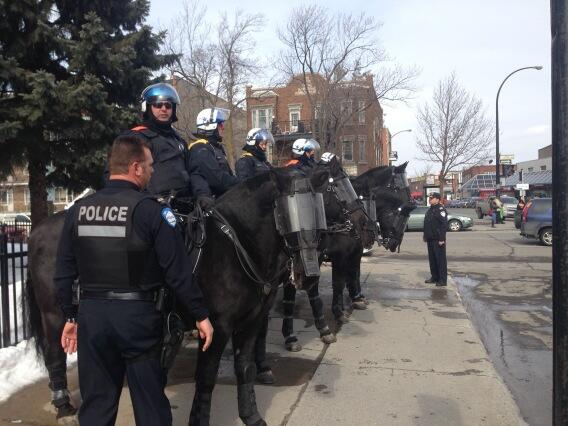 The police claim the protest was illegal as the participants did not warn the authorities of their itinerary.
Montreal’s 18th annual protest against police brutality was cut dramatically short Saturday when police rounded up the participants. Minutes into the demonstration, riot officers converged on Jean-Talon Street and began detaining protesters. According to protesters there was a strong police presence, with police horses, cars and a helicopter on the scene.
“It was a veritable army of police … who occupied the area surrounding the Jean-Talon metro when the protest was to start,” the Collective Opposed to Police Brutality, which organizes the annual protest, said in a written statement issued after the protest.
Police declared the demonstration was illegal and asked the protesters to disperse. However, the activists carried on marching, brandishing banners and chanting slogans, such as “They want us to respect them, but they don’t respect us!”
Riot police then encircled the protesters and began making arrests. The majority of the 288 people who were taken into custody were released shortly afterwards, but four people may be charged under the Criminal Code for assaulting an officer and obstructing the police. Several others could face charges of mischief.
One man sustained injuries to his face during the police intervention and was tended to by paramedics on the site, said officers.
“They refused to share their itinerary, and they refused to give us any details. When we got there, we asked them not to jump onto the street, and they answered by going into the street and yelling at us that they were not cooperating,” police spokesman Ian Lafrenière said. He added that the protest has a bad reputation with the authorities and on previous occasions the demonstrations had descended into violence and rioting.
However, activists had a different version of events and have accused the police of lying about the protesters’ activities.
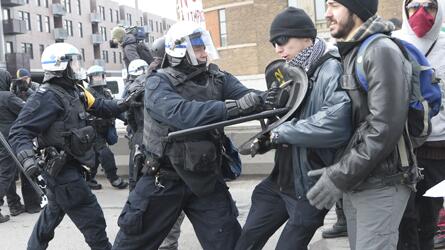 “It looks good in the media — the police can say (all of these) people were arrested, were breaking windows and stuff, but it’s not true. They were doing nothing,” Claudine Lamothe told the Montreal Gazette.
The Collective Opposed to Police Brutality has staged a protest in Montreal every year for the past 18 years. This year they focused their protest on the issue of “social cleansing” where the authorities try to “get rid of people who are deemed unwanted,” the group writes on its website. The group cites an incident in January when an unnamed Montreal police officer threatened to tie a homeless man to a lamppost in temperatures of minus 30 if he did not move along. Following the incident, Lafrenière told the Montreal Gazette that the officer had been reprimanded for his “unacceptable” behavior.
Venezuela: Who You Gonna Believe, the New York Times or Your Lying Eyes?
By Mark Weisbrot | CEPR Americas Blog | March 15, 2014
Today’s report from the New York Times trashes the government for “combative tactics” and “cracking down” on protesters, but if you watch the accompanying video, all you see are protesters attacking police, and the police – without venturing forward, defending themselves with water cannon and tear gas.
One can criticize the decision of the government to block the march from going to hostile territory, but given the continuous presence of violent elements among the protestors, and that Venezuela is a country with a very high homicide rate and many armed civilians, it could have been the prudent thing to do. The government also believes, with some justification, that these protests seek to provoke violence in order to de-legitimize the government. Their stated goal is to overthrow the democratically elected government, and given that the vast majority of the country is against the protests, this really is their only chance of getting anywhere. And the government also knows that the media (both national private and international) will generally blame them for any violence.
In the United States, and especially here in Washington DC, you have to get a permit for marches like this, and they are often denied or re-routed; and if you try to defy this the police will generally beat you and throw you in jail. And these are actually peaceful protests here.
As for the violence so far associated with the protests since they started on February 12, the statistics show that more people have died at the hands of protesters than security forces:
Of the 29 people killed (full details here),
— 3 appear to be protesters allegedly killed by security forces; 1 other was killed by security forces but it’s not clear if he was a protester.
— 3 appear to be protesters allegedly killed by civilians (the opposition always alleges that these civilians are somehow taking orders from the government, but there has not been any evidence linking the government to any killings by armed civilians; and in a country where there are on average more than 65 homicides per day, it is most likely that these armed civilians are acting on their own).
— 11 civilians appear to have died at the hands of protestors: three of them shot, and the rest killed by various barricades or other obstructions (e.g. motorcyclist beheaded by wire allegedly strung by protesters).
— 3 national guard appear to have been killed by protesters
— 1 pro-government activist appears to have been killed by security forces
— 6 have died in circumstances that are too unclear to determine if they were really related to protests, but they are often included in press reports.
At least 14 security officers have been arrested and remain in jail for alleged violence against protesters, including the incidents described above.
Related articles

Crimean govt: Referendum website downed by cyber-attack from US
RT | March 16, 2014
The official website of the Crimean referendum is down due to a cyber-attack that originated from the US, Crimean authorities say.
The exact location from which the website’s servers were attacked was Illinois University, Crimean minister of information and mass communications Dmitry Polonsky told Itar-Tass news agency.
“This place turned out to be the Illinois University at Urbana-Champaign. A massive scanning of the servers took place from there before the attack,” Polonsky said.
The assault started during the night (2300 GMT Saturday). At 1000 GMT Sunday, the referendum2014.ru site still wasn’t functioning.
Polonsky stressed that the referendum website has been “DDoS-attacked regularly since its launch.” The portal with .ua domain was replaced with .ru after several attacks.
The referendum is taking place in Crimea, with the vote reported to be peaceful and with high turnout, according to both international observers and Crimean authorities.
On Friday, major Russian government web resources were attacked with DDoS malware – those included the Russian president’s website, as well as those of the Foreign Ministry and the Central Bank.
Also, state media websites – the Channel One and Russia-24 TV channels – were under attack, reportedly from Kiev. The targeted Russian media said the attacks were linked to their editorial policy in covering Ukraine.
Finally, on the same day, an attempted radio-electronic attack on Russian TV satellites from the territory of Western Ukraine was recorded by the Ministry of Communications.
DDoS is the kind of cyber-attack during which requests are sent to the attacked website from many computers, usually virus-infected.
Syrian forces in “full control” of Yabrud
Al-Akhbar | March 16, 2014
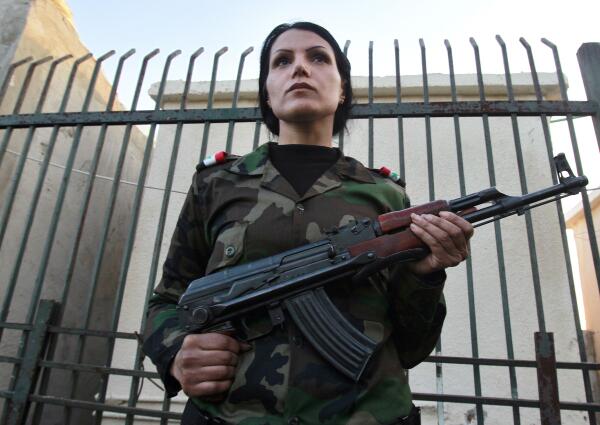 Syrian troops on Sunday seized full control of the rebel bastion Yabrud in the strategic Qalamoun region near the Lebanese border, Syrian state media reported.
“Our brave armed forces have full control over Yabrud in Damascus province and are combing through the town and removing explosive devices placed by terrorists,” state television said, citing a military source.
Capturing Yabrud, the last major rebel bastion near the Lebanese border north of Damascus, would help President Bashar al-Assad secure the land route linking his Mediterranean coastal stronghold with the capital Damascus, and choke off a cross-border rebel supply line from Lebanon.
A military source told Reuters that the rebels had pulled out of Yabrud around dawn, a day after pro-government forces had entered eastern districts of the town and captured several strategic hilltops.
A fighter in Yabrud from al-Nusra Front, al-Qaeda’s official affiliate in Syria, confirmed to Reuters the rebels had decided to pull out and said they were heading towards nearby villages including Hosh Arab, Rankos and Fleita.
He said they did not plan to withdraw across the Lebanese border to Arsal, a crossing point 20 kilometers (13 miles) to the northwest which rebels and refugees have used regularly.
The government has been making incremental gains along the land route as well as around Damascus and Aleppo in the past months, regaining the initiative in a conflict entering its fourth year.
What A Destructive Wall Street Owes Young Americans
By Ralph Nader | March 14, 2014
Wall Street’s big banks and their financial networks that collapsed the U.S. economy in 2008-2009, were saved with huge bailouts by the taxpayers, but these Wall Street Gamblers are still paid huge money and are again creeping toward reckless misbehavior. Their corporate crime wave strip-mined the economy for young workers, threw them on the unemployment rolls and helped make possible a low-wage economy that is draining away their ability to afford basic housing, goods, and services.
Meanwhile, Wall Street is declaring huge bonuses for their executive plutocrats, none of whom have been prosecuted and sent to jail for these systemic devastations of other peoples’ money, the looting of pensions and destruction of jobs.
Just what did they do? Peter Eavis of the New York Times provided a partial summary – “money laundering, market rigging, tax dodging, selling faulty financial products, trampling homeowner rights and rampant risk-taking – these are some of the sins that big banks have committed in recent years.” Mr. Eavis then reported that “regulators are starting to ask: Is there something rotten in bank culture?”
The “rot” had extended long ago to the regulators whose weak laws were worsened by weak enforcement. Veteran observer of corporate criminality, former Texas Secretary of Agriculture and editor of the Hightower Lowdown newsletter, Jim Hightower writes:
“Assume that you ran a business that was found guilty of bribery, forgery, perjury, defrauding homeowners, fleecing investors, swindling consumers, cheating credit card holders, violating U.S. trade laws, and bilking American soldiers. Can you even imagine the punishment you’d get?
How about zero? Nada. Nothing. Zilch. No jail time. Not even a fine. Plus, you get to stay on as boss, you get to keep all the loot you gained from the crime spree, and you even get an $8.5 million pay raise!”
Hightower was referring to Jamie Dimon, the CEO of JPMorgan Chase, “the slick CEO who has fostered a culture of thievery during his years as a top executive at JPMorgan, leading to that shameful litany of crime.”
Shame? Dimon doesn’t know how to spell it. “I am so damn proud of this company. That’s what I think about when I wake up every day” he said in October, 2013.
Millions of young Americans (called Millennials, between ages 18 and 33) should start agitating through demonstrations, demand petitions and put pressure on the bankers and members of Congress. First the plutocrats and their indentured members of Congress should drop their opposition to a transaction tax on Wall Street trading. A fraction of a one percent sales tax on speculation in derivatives and trading in stocks (Businessweek called this “casino capitalism”) could bring in $300 billion a year. That money should go to paying off the student debt which presently exceeds one trillion dollars. Heavy student debt is crushing recent graduates and alarming the housing industry. For example, people currently between the ages of 30 to 34 have a lower percentage of housing ownership than this age group has had in the past half century.
A Wall Street transaction tax was imposed in 1914 and was more than doubled in 1932 to aid recovery from the Great Depression before it was repealed in 1966. But the trading volume then was minuscule compared to now with computer-driven trading velocity. A tiny tax – far less than state sales taxes on necessities – coupled with the current huge volume of trading can free students from this life-misshaping yoke of debt.
Some countries in Europe have a securities transaction tax and they also offer their students tuition-free university education to boot. They don’t tolerate the same level of greed, power and callous indifference to the next generation expressed by the monetized minds of the curled-lipped Wall Street elders that we do.
What about young people who are not students? The Wall Street tax can help them with job-training and placement opportunities, as well as pay for tuition for technical schools to help them grow their skills.
A good many of the thirty million Americans stuck in a wage range lower than the minimum wage in 1968, adjusted for inflation, (between $7.25 and $10.50) are college educated, in their twenties and thirties, and have no health insurance, no paid sick leave and often no full-time jobs.
A youth movement with a laser-beam focus, using traditional forms of demonstration and connecting in person, plus social media must come down on Wall Street with this specific demand. Unfortunately, while Occupy Wall Street started an important discussion about inequality, they did not advance the transaction tax (backed vigorously by the California Nurses Association), when they were encamped near Wall Street and in the eye of the mass media in 2011. A missed opportunity, but not a lost opportunity. Fighting injustice has many chances to recover and roar back.
It is time for, young Americans to act! Push Congress to enact a Wall Street speculation tax to help roll back your student debt and give you additional opportunities that are currently denied to you by the inside bank robbers who never had to face the sheriffs. They owe you.
As William C. Dudley, the eminent president of the Federal Reserve Bank of New York recently said of Wall Street – “I think that they really do have a serious issue with the public.” Yes, penance and future trustworthiness enforced by the rule of law.
nowhere.
Young America, you have nothing to lose but your incessant text messages that go nowhere.
Start empowering yourselves, one by one, and then connect by visiting Robin Hood Tax.
Hypocrisy and the Surveillance Stand-Off
Feinstein and the CIA
By Binoy Kampmark | Dissident Voice | March 15, 2014
Senator Dianne Feinstein’s blistering attack on the CIA’s conduct in searching the computers used by the Senate Select Committee on Intelligence was deemed a remarkable salvo. The search was engendered by the Committee’s official request for a final version of the named “Internal Panetta Review”. The Review had been created for internal use by the CIA as a record of assessing what documents should be turned over to the Committee in connection with its investigation of the torture program. Once the CIA got wind that their precious internal documentation was finding its way into the hands of the committee, the hackers got itchy.
Senator Feinstein herself charged the CIA with violating the Fourth Amendment, the Computer Fraud and Abuse Act, and Executive Order 12333. This raises the first problem. The CFAA is a legislative creation that exempts authorised law enforcement and intelligence activities. Legal commentary from former Chief Counsel for the House Permanent Select Committee for Intelligence, Chris Donesa at Lawfare (March 12) puts the question as whether “the CIA’s investigation and search was in fact ‘lawfully authorised’ or merely a pretext for deliberate efforts to obstruct or interfere with the SSCI investigation.”
The point is valid – after all, the CIA may well have been doing what it is empowered to do – snoop, hack and conduct “counter” intelligence activities, even against a Congressional committee. A gray area exists in the CFAA as to the rights of access set by the owner and operator of the necessary computers. The Washington political establishment have only themselves to blame if that was the case. The demon is merely consuming its creators.
One thing Donesa is willing concede is that the agreement and understanding between the CIA and the SSCI was significant in its violation. In so doing, it has raised questions touching on the separation of powers “and, more importantly, the budget and authorities of any Agency that dares to breach it.” He is concerned, in fact, that the SSCI was also rather cheeky, scurrying off with documents at points befitting the CIA’s own conduct. A subpoena might have been sought, but was conspicuously lacking. Feinstein herself alluded to such behaviour, largely because the CIA had shown form in destroying evidence, notably videotapes.
There have been occasional remarks that the CIA would have been justified in chasing down the source of leaks in the event that a confidential document had found its way into “unauthorised” channels. Sometime in 2010, Feinstein claims that SSCI staff accessed documents connected with the Panetta Review. Feverish speculation is making its way around the intelligence traps as to whether that access was warranted, the result of intentional disclosure by the CIA, or an illicit revelation of a whistleblower.
Given the CIA’s well established reputation for gold medal incompetence, it might very well be that the agency enabled, quite unwittingly, the Committee access to the Review documents. The jury may well be out on that one for some time to come. In either case, be it the whistleblower thesis, or that of unwitting disclosure, the episode has brushed up, if not scraped, a good deal of constitutional gunk. James Madison would not so much be turning as standing up in his grave.
Not all have warmed to Feinstein’s agitated response. A split has developed in Senate ranks. Republicans are concerned, but many would prefer to await the findings of a full investigation into the matter. Senator Lindsey Graham (R-SC) was particularly concerned. “If what they’re saying is true about the CIA this is Richard Nixon stuff. This is dangerous to democracy. Heads should roll. People should go to jail, if it’s true.” Senator Saxby Chambliss (R-Ga.) was less certain. “Right now we don’t know what the facts are” (NPR, March 11).
Neither Feinstein, nor the CIA, can claim much of a high ground in this debate. The SSCI was the subject of a hacking enterprise, a snooping venture that would have been appropriate for the Senator in other cases. In fact, the rationale employed by the CIA was the very one that she has been defending with almost manic determination. If classified documents find their way into certain hands (that is, the likes of Edward Snowden), revealing the extent of state abuse, the messenger is the one at fault.
Given Feinstein’s legislative efforts to shore up the surveillance state, and her inflexible stance in limiting reform to the intelligence community, this would have come as a rude, yet richly deserved rebuke. In Snowden’s own words on the episode, this involved “an elected official [who] does not care at all that the rights of millions of ordinary citizens are violated by our spies” only to be scandalized “when a politician finds out the same thing happens to them.”
Binoy Kampmark was a Commonwealth Scholar at Selwyn College, Cambridge. He lectures at RMIT University, Melbourne and can be reached at: bkampmark@gmail.com.
Against Ukraine War? Obama May Seize Your Assets
By Daniel McAdams | Ron Paul Institute | March 14, 2014
Do you, like 56 percent of the US population, believe that the US should “not get too involved” in the Ukraine situation? Do you think that the US administration putting us on a war footing with Russia is a bad idea? Are you concerned that the new, US-backed leaders of Ukraine — not being elected — might lack democratic legitimacy? Are you tempted to speak out against US policy in Ukraine; are you tempted to criticize the new Ukrainian regime?
Be careful what you say. Be careful what you write. President Obama has just given himself the authority to seize your assets.
According to the president’s recent Executive Order, “Blocking Property of Certain Persons Contributing to the Situation in Ukraine”, the provisions for seizure of property extend to “any United States person.” That means “any United States citizen, permanent resident alien, entity organized under the laws of the United States or any jurisdiction within the United States (including foreign branches), or any person in the United States.”
Declaring a “national emergency” over the planned referendum in Crimea to determine whether or not to join Russia, the US president asserts that asset seizure is possible for any US person “determined by the Secretary of the Treasury, in consultation with the Secretary of State”:
(i) to be responsible for or complicit in, or to have engaged in, directly or indirectly, any of the following:
(A) actions or policies that undermine democratic processes or institutions in Ukraine;
(B) actions or policies that threaten the peace, security, stability, sovereignty, or territorial integrity of Ukraine; or
(C) misappropriation of state assets of Ukraine or of an economically significant entity in Ukraine;
The Executive Order is, as usual, so broadly written that it leaves nearly everything open to interpretation.
For example, what are “direct or indirect…actions or policies that threaten the peace, security, stability, sovereignty, or territorial integrity of Ukraine”? Could that be someone writing an article that takes issue with the US policy that the Crimea referendum is illegal and illegitimate? Could it be standing up in a public meeting and expressing the view that Ukraine would be better off with nationwide referenda to determine whether other regions should become autonomous or joined to neighboring countries? What if a Polish-American appears on a radio or television program suggesting that parts of Poland incorporated into Ukraine after WWII should be returned to Polish authority?
Probably the president will not seize the assets of Americans in the scenarios above. But he says he can.
As the US government moves ever-closer to war with Russia, it is reasonable to expect these attempts to squash dissent and to remove “threats” to the administration’s position. The historical pattern is clear.
Recall Eugene V. Debs sentenced to ten years in prison for his opposition to US involvement in WWI. Recall Japanese-Americans interned in camps during WWII because their loyalty to the United States was deemed suspect.
The stage is being set to silence dissent. It sounds alarmist to read this, agreed.
Probably the president will not use his Executive Order to seize the assets of Americans who disagree with his Ukraine policy. But he says he can.
Where the Money Isn’t Going
By JAMES G. ABOUREZK | June 29, 2009
Wherever I heard that hackneyed phrase, “If you find yourself in a hole, stop digging,” it applies more today than anytime I can remember. What I don’t understand is, when our government has spent billions on bank bailouts (not a good idea) on bailing out the stupidity of the automobile executives (a better idea because it saves jobs for working people), why are members of Congress and the drug and insurance lobbies feeding this fairy tale that we cannot afford single payer health care.
Virtually every industrialized country in the world has a health care system that is paid for by tax revenues, making sure that it is available to everyone. Even Syria, which is not a rich country, sends medical students to medical school, then requires them, upon graduation, to serve in a village clinic at a very low salary. Medical care is provided for every Syrian citizen, although there is a private medical system for those who want to pay.
Neither, we are told, can we afford a national passenger rail system that would do a great deal to decrease pollution, cut down on the use of oil, and that would move people to every part of our country, just like it’s done in Europe and in Japan.
But we can’t afford either of these common sense projects, even though we are digging our financial hole deeper and deeper with other projects that we should bring to a close.
Israel. We are still shoveling money out of the door of our national treasury giving Israel all the money they need to finance their brutal occupation of the Palestinians, plus giving them one of the highest living standards in the world. The last time I checked with the Library of Congress, Israel had drained our treasury (money from American taxpayers) to well over 100 billion dollars.
And what have we received in return? Well, I am currently reading Attack on the Liberty, written by James Scott, a journalist whose father was an ensign on board the Liberty when Israel tried to destroy the U.S. Navy ship during the 1967 Middle East War. Whenever I feel like having my blood boil, I pick up the book and read another chapter describing the deliberate attack on our ship, which killed over 30 American sailors and wounded another 170. As bad as the attack was, the continuing cover up both by Israel and the U.S. government is an ongoing outrage.
Add to that, the unknown number of Israeli spies who are burrowing into our government to learn our secrets. Jonathan Pollard, for example, was paid by Israel to unload what authorities have described as “a truckload of secret documents” to Israel’s agents in this country. The latest episode of Israeli spying is notable for the speed with which the U.S. Justice Department dismissed the charges against the two pro-Israeli spies, despite the finding of guilty and a 12 year sentence to the U.S. official–Larry Franklin–who handed over the documents to the spies.
Other things we can do without include the manned space program. The shuttle program, which costs American taxpayers several billion dollars a year, would look better viewing it from the rear view mirror. Several Nobel laureate scientists, as well as this writer, have advocated an unmanned program for space exploration instead of the much costlier manned program. First of all, the manned program cannot go as far into space as an unmanned program can, and secondly, it is vastly cheaper while being more rewarding. But it’s difficult to stop the bleeding of taxpayers’ money once it starts
We have the same trouble financing our NATO involvement. Now, NATO was designed during the Cold War to protect Europe from the nasty Soviets. Now that the Soviets are no longer around, who does NATO protect? Only the arms manufacturers who benefit from weapons sales both to the U.S. and to NATO members.
I don’t think a lot of explanation is needed for reasons to get the U.S. out of Iraq and Afghanistan. Yes, I include Afghanistan in my exit strategy, mostly for the reason that we shouldn’t need the second kick of a mule to learn to stay away from the mule. We all witnessed the Soviets who were almost destroyed by their adventure in Afghanistan, and we should have learned that American troops are a natural target in places like that country. The only logical conclusion is to get our troops out of there, leaving it to the Taliban and the warlords and the Pakistanis to deal with that quagmire.
Although the pro-Israeli Zionists do not like to hear it, but a lot of our Middle East woes derive from the brutality of the continuing occupation of Palestine by the Israelis. What is unfortunate is that the American press spends its time and its talents trying to avoid discussing what Israel is doing in the Middle East.
I saw NBC’s David Gregory interviewing Bibi Netanyahu on Meet the Press. Discussing Iran, Netanyahu said that true democracies such as Israel would never commit violence against protesters. Gregory let that one go right past him, going on to the next puffball question to Bibi, which again he knocked over the fence. If I recall, it was another bit of hypocrisy meted out by the slick talking Prime Minister.
But that’s the state of our media today. There is 40 times the coverage of Michael Jackson’s heart attack than there was of the slaughter of 1,200 Gazans during Israel’s invasion last year. At times I feel sad about the death of America’s newspapers, but after seeing how they behave, and how they fail in their job of watching the government for the rest of us, maybe it’s for the best to let them all go under. They contribute little more than crossword puzzles and sports scores (which are for the betting public anyway).
We’ve reached the place in the hole we’re digging which might make us think about stopping.
James G. Abourezk is a lawyer practicing in South Dakota. He is a former United States senator and the author of two books, Advise and Dissent, and a co-author of Through Different Eyes. This article also runs in the current issue of Washington Report For Middle East Affairs. Abourezk can be reached at georgepatton45@gmail.com
Source
Why is the CIA Fighting Release of Documents Relating to 4 Planes that Went Missing in 1980?
By Noel Brinkerhoff | AllGov | March 15, 2014
A federal judge has told the Central Intelligence Agency (CIA) and other federal offices to continue looking for records pertaining to the disappearance of four transport planes in 1980.
The case was brought before Judge Colleen Kollar-Kotelly by plaintiff Stephen Whitaker, who has attempted to obtain information about four DC-3 aircraft, one of which was flown by his father, Harold William Whitaker.
Stephen Whitaker filed Freedom of Information Act requests with the CIA, as well as the Department of Defense and the State Department, to learn if they possessed records that might explain what happened to the DC-3s.
The CIA refused to tell Whitaker if its archives held any relevant documents pertaining to his search. The agency cited various exemptions under federal law, including the CIA Act of 1949 (pdf), which allow it to avoid responding to certain FOIA inquiries.
Whitaker argued in his lawsuit that the CIA improperly invoked FOIA Exemption (b) (3) (pdf), which authorizes the agency to keep from revealing information on agency “functions” and “intelligence sources and methods.”
Kollar-Kotelly sided with Whitaker, ruling (pdf) that “the CIA has too broadly applied the CIA Act to withhold information pursuant to Exemption (b) (3).” However, she agreed with two other exemptions cited by the CIA that pertain to attorney-client privilege and the withholding of personnel and medical records.
The plaintiff’s search for information seems to be both personal and more.
He said the plane piloted by his father disappeared somewhere over Spain in October 1980. It had been purchased at auction from the Spanish Air Force and was being flown to Germany to become part of a museum.
A report from Spain’s Civil Aviation Commission on Accidents says the aircraft’s instruments may not have been fully functional, and that the radio may only have been capable of sending messages but not receiving them.
The report added that there was no record of a distress call from the pilot, or co-pilot Lawrence Eckmann, a major in the U.S. Army.
Stephen Whitaker also sought records from the government about Eckmann. The State Department claimed its search turned up nothing on Eckmann. The plaintiff challenged this assertion, and Kollar-Kotelly agreed that Eckmann had been excluded from the search, which was found to be “inadequate and should have been revised….”
The plaintiff seems to suspect that some of the DC-3s he has sought information on were used by the CIA in its covert operations.
His FOIA request to the spy agency asked for any information that would reveal whether “any of these persons or aircraft were later found to be employed or contracted by the CIA for service in Central America or elsewhere.”
The CIA has a long history of using DC-3s that ranges from the Vietnam War to the recent conflict in Libya that ousted the Gaddafi regime.
To Learn More:
Missing-Plane Records From 1980 Dissected (by Kevin Lessmiller, Courthouse News Service)
Stephen Whitaker v. Central Intelligence Agency (U.S. District Court, District of Columbia) (pdf)
Technical Report on the Disappearance of a DOUGLAS DC-3 Aircraft, Registration # ECT-025, on the 3rd of October, 1980, to the North of Palm of Majorca (Civil Aviation Commission on Accidents, Spain) (pdf)
Crimea vote in line with UN charter: Putin to Ban
BRICS Post | March 15, 2014
Ahead of the upcoming referendum in Crimea, Russian President Vladimir Putin told UN Secretary General Ban Ki-moon in a phone conversation on Friday the move was in line with the UN Charter.
Putin and Ban discussed “the situation in Ukraine, including the referendum to be held on March 16,” said a Kremlin statement.
“Putin emphasized that the decision to hold the referendum is in line with the provisions of international law and with the UN Charter,” says the statement.
International observers have arrived in Crimea on Saturday ahead of the controversial referendum.
The Crimean parliament declared independence Tuesday ahead of a popular vote Sunday on seceding from Ukraine and becoming part of Russia.
Authorities in Kiev and international leaders have condemned the referendum as illegitimate and accused Moscow of fomenting unrest in order to annex Crimea.
Ban told reporters in New York later in the day that the situation in Ukraine continues to deteriorate and there was “a great risk of dangerous, downward spiral.”
He also urged Russia and Ukraine not to take “hasty measures” that “may impact the sovereignty, unity and territorial integrity of Ukraine.” The UN chief said that peaceful solution was still an option.
Russia and the West have reached a standoff over the fate of Crimea, which has refused to recognize the legitimacy of the new central government in Kiev following last month’s revolution.
Russia has no plans of a military action in southeastern Ukraine, Russian Foreign Minister Sergei Lavrov said on Friday after talks with his US counterpart John Kerry in London.
“Russia does not and cannot have any plans to invade southeastern Ukraine. There are no reasons that prevent us from showing transparency [on the Ukrainian issue],” he said.
In spite of extensive talks between Kerry and Lavrov, disagreements between Moscow and Washington persist.
“As far as prospective sanctions are concerned… I assure you that our partners are fully aware that sanctions are a counter-productive measure. They will not benefit our mutual business interests or the development of our partnership in general,” Lavrov said.
Writing for The BRICS Post, Alexander Nekrassov, a former Kremlin and government advisor, said too much is at stake to make drastic changes in Russia-US ties, and “too much money is involved in deals and trade to simply ignore everything and turn back on years of tough negotiating and compromise”.
“Despite what is happening in Ukraine, relations between the US and Russia will continue; Exxon Mobile and others will keep on signing deals with the Russian oil giant Rosneft and trade between the two countries will not suffer,” writes Nekrassov.
TBP and Agencies
Venezuelan Community Members Explain Opposition Violence
Hands Off Venezuela | March 11, 2014
On Saturday, March 8, Gisella Rubilar, 47, was shot dead and two other people suffered serious gunshot wounds when they were removing an opposition roadblock which prevented safe passage to their working class and poor neighbourhood of Pie del Tiro, in the Andean capital of Merida, Venezuela. You will not have heard about it in the mass media, but this incident was part of a growing trend of opposition violence against working class and poor neighbourhoods fighting back.
It was after 9 pm on Saturday, March 8. Gisella Rubilar Figueroa came out with a group of people from the working class and poor neighbourhood of Pie del Tiro to clear the road blockade in the intersection of the main Avenida Los Proceres and Lomas de los Vientos in Mérida, Venezuela.
After clearing the debris which blocked the access to Pie del Tiro, they remained on site for while. It was then that they were attacked and shot at by a group of masked young men. Three of those who cleared the opposition barricade had to be hospitalised with gunshot wounds: José Rincón, 51; Javier Osuna Briceño, 39 and Gisella who had been shot in the face and died on Sunday, March 9.
 Gisella was Chilean, 47 and a mother of 4 who was living in Mérida and studying a masters in education at the University of Los Andes (ULA), where both her parents were teachers. She was a supporter and activist of the Bolivarian revolution.
The working class and poor community of Pie del Tiro had been besieged and harassed by opposition roadblocks for nearly a month and every time they themselves or the National Guard cleared the way, the middle class student protesters would block the roads again. This was making it difficult for the overwhelmingly Bolivarian supporting neighbours to leave their community to go to work, to go shopping, to access public transportation.
In a video produced anonymously in Mérida (where journalists have been threatened by opposition thugs for reporting their violent protests) you can see Giselle and other neighbours from Pie del Tiro describe the situation and express their frustration at being besieged and at what they perceive as the lack of action by the government:
The killing of Giselle has been covered by the media in Venezuela and Chile, but has not even been mentioned by the mass media in Spain or any of the English language mass media in the UK and the US. Of course, the story of working class and poor Bolivarian supporters being shot and killed by violent, armed, masked opposition thugs does not fit in the picture of a “repressive regime” attacking “peaceful student protests” which the mass media internationally has been building over the last month.
Further to this killing, two other people were killed by gunshot coming from opposition thugs on Thursday, March 6, in Los Cortijos, in the East of Caracas. Here, a group of middle class opposition protesters had been besieging the state TV channel VTV Canal 8, for nearly a month, harassing the TV station workers as they were going to and coming back from work, throwing molotov cocktails at the channel’s installations, setting burning barricades, and throwing objects. This had also disrupted the activity of motorbike taxi drivers in the whole area.
Opposition supporters had taken to laying steel wire (guayas) across the streets, at 1.20 m of height, to knock down motorbike riders. On February 21, a motorbike taxi rider, Santiago Enrique Pedroza, 29, was beheaded when he collided with one such guaya, in the same part of Caracas. A woman died in Mérida, Delia Elena Lobo Arias, 40, in the same circumstances.
On March 6, a large number of organised motorbike taxi drivers decided to clear the barricades in Los Ruices, the area around VTV TV channel. When they were removing the debris from the road they were attacked by masked young men from the nearby buildings throwing stones, bottles, incendiary bombs and shooting at them with guns. As a result, a young moto-taxi driver, Jose Gregorio Amaris Castillo and a young sergeant of the National Guard, Acnes López Lyon, were shot dead. It is also very unlikely that you have heard of these four killings in the mass media.
The incidents described here, which resulted in the death of two unarmed Bolivarian revolution supporters, one National Guard sergeant, and two others as the direct result of the actions of violent opposition thugs (three shot dead, two as a result of opposition roadblocks) are an indication of what the real situation is in Venezuela right now.
A small minority of violent opposition supporters are out in the streets with the stated aim of overthrowing the democratically elected government and putting an end to the Bolivarian revolution. In many parts of the country, working class and poor neighbourhoods are starting to fight back and removing roadblocks to ensure their right to safe passage. As they do so they are being shot at by armed thugs in the opposition barricades.
How the United States Was Used to Create Israel
A Review of Alison Weir’s “Against Our Better Judgment”
By James Abourezk | CounterPunch | March 14, 2014
Having studied enough American Indian Tribes over the years, I have grown accustomed to creation myths that each Tribe assigns itself as its reason for being. And the definition of “chutzpah” that I’ve been taught is that of a young man on trial for murdering his parents, who throws himself on the mercy of the Court on grounds that he is an orphan.
That, as Alison Weir has made clear, is Israel’s situation. In Against Our Better Judgment, Ms. Weir writes with great clarity how the Zionist movement was able to move politicians, both in America and in England, to legalize a most illegal act–that of stealing an entire nation, and crying foul when those from whom it was stolen complained, then tried to retake the land.
Ms. Weir’s in depth research to expose Zionist actions in earlier times provides a solid basis for her conclusions about creating Israel from a land called Palestine. And she documents the intense lobbying done by Israel’s Zionist creators in order to legalize an action that was clearly illegal.
We are now living with the consequences of that bit of grand theft, i.e., the continuing violence in the Middle East, affecting everything America might want to do in the Middle East. We only recently have witnessed Bibi Netanyahu’s so far failed effort to have America invade and conquer Iran, a country that obviously is too much of a mouthful for Israel to bite off. Suddenly, even Barak Obama recognizes the danger in following Israel’s advice on how to conduct itself in the Middle East. The President tiptoed to the edge of the abyss but backed away when Israel’s trained seals in the U.S. Congress tried to push the nation over the edge.
We saw Congressional supporters of Israel shamefully initiating the dozens of applauses by the Joint Session of Congress when they entertained Prime Minister Netanyahu, who obliged the assembled mass with aggressive applause lines, designed to favor those who have a liking of violence and to show how Israel is “America’s staunchest ally” in the Middle East.
During the 1970s, when I was a member of the U.S. Senate, I was waiting my turn to testify on the Middle East situation before the Senate Foreign Relations Committee. As is the custom, the Administration witness was testifying ahead of me. I do not recall his name, but I felt very sorry for him when New York’s Senator Javits asked from the dais, “Please explain why Israel is our most important ally in the Middle  East.”
The poor fellow did not have an answer. Granted, he was a lower level State Department official, but his lack of an answer was indicative of the lack of a story provided to him by his seniors in the State Department.
So Sen. Javits asked him again, and again, and again, trying to have a statement from some government official which Israel’s Lobby could use in its propaganda campaign to maintain Israel’s lofty position in the American mind. But the State Department official was unable to find an answer, which left Sen. Javits and his cohorts to try some other avenue. The Israel-is-a-vital-ally shibboleth has since been made into an overused slogan by supporters of Israel.
But each time I hear that phrase, “staunchest ally,” I think of the American sailors on the U.S.S. Liberty, who, during the 1967 Israeli-Arab War, died when the Israeli military was order to destroy its “ally’s” intelligence ship. During that act of friendship, America’s staunchest ally killed some 34 American sailors, and wounded another 170.
I also think of Jonathan Pollard, an American employee of our Pentagon, who sold what has been described as “a truckload” of the Pentagon’s secrets to Israel. I say “sold,” because Israel paid Pollard for the secrets, which Israel then traded to the Soviet Union for that country’s relaxation of rules with respect to Jewish emigration from the Soviet Union to Israel.
With Ms. Weir’s well researched history in mind, I am forced to think of the cadre of American journalists who lately have assigned “oil” as the reason for George Bush’s Folly–the invasion of Iraq in 2003. They say nothing of the well known fact that George Bush had a number of Israel’s supporters giving him advice on the issue of Iraq. I’ve lost count of the billions of American dollars that were sucked up by that war, as well as the precious American lives that were lost to satisfy Israel’s agents in the Bush Administration, those who convinced President Bush to do something that Israel wanted, but knowing it was better if “America did it.” President Obama should be applauded for refusing to fall into the same trap with respect to Syria.
This provocative book documents a history that is essential in understanding today’s world. Scholarly, yet readable, it is a must for all Americans. We all need to know what we have spent by coddling Israel and its aggressions, and why the cost has become more than we have bargained for.
James Abourezk is a former U.S. Senator from South Dakota who plunged into the Middle East morass when he saw the cost to our country of Israel’s efforts to connive to have our country do Israel’s dirty work. His memoir, Advise & Dissent, has recently been re-published, along with a new Introduction by Sen. Fred Harris.
Featured Video
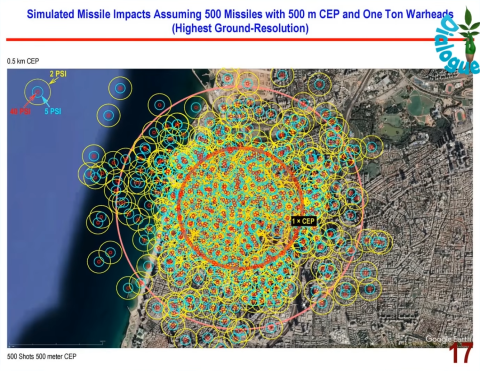
Prof. Ted Postol: US–Iran War? Israel’s Fatal Gamble
or go to
Aletho News Archives – Video-Images
From the Archives
Neocon Max Boot: Legal and illegal aliens need to enlist in the US army and die for Israel
By Jonas E. Alexis | Veterans Today | October 16, 2107
In 1973 Irving Kristol, the godfather of the Neoconservative movement, made a stunning statement which is still relevant to understanding the Israeli influence in US foreign policy. Kristol said:
“Senator McGovern is very sincere when he says that he will try to cut the military budget by 30%. And this is to drive a knife in the heart of Israel… Jews don’t like big military budgets. But it is now an interest of the Jews to have a large and powerful military establishment in the United States…
“American Jews who care about the survival of the state of Israel have to say, no, we don’t want to cut the military budget, it is important to keep that military budget big, so that we can defend Israel.”
Read the statement again very carefully. A big military budget, said Kristol, is only good for Israel, not America or much of the Western World. In other words, precious American soldiers who go to the Middle East to fight so-called terrorism are just working for Israel, not for America.
So, whenever the Neocons use words such as “democracy” or “freedom,” they are essentially conning decent Americans to support Israel’s perpetual wars. … continue
Blog Roll
 Aletho News
- The Only Motive Behind The ‘Imminent’ U.S. War With Iran Is The Zionist Lobby
- Trump eyes 350-acre US military base housing 5,000 troops in Gaza
- Israel Pushing US Toward a Big and Damaging War With Iran – Ex-Pentagon Analyst
- Meet The Liberal Zionist And Ukraine War Supporter Advising AOC On Foreign Policy
- Buck Dancing for Zion: Kenya’s and Nigeria’s Growing Love Affair With Israel
- Israel installed, oversaw security system at Barak-Epstein residence in New York: Report
- ‘Britain’s Index of Repression’ documents 964 incidents of anti-Palestinian crackdown
- Prof. Ted Postol: US–Iran War? Israel’s Fatal Gamble
- UK prosecutors drop aggravated burglary charges against 24 Palestine Action activists
- Unidentified drone downed over Lebanon airbase, US forces block authorities from crash site
- If Americans Knew
- The Lancet: Gaza death toll far higher than reported – Not a ceasefire Day 132
- Compliant aid: Who are the Israel-approved NGOs scaling up in Gaza?
- Why won’t Trump’s “Board of Peace” bring peace? – Not a ceasefire Day 131
- Help end the injustice against Shadi
- Israel’s Favorite American President
- Israel’s “Yellow Line” Is a Death Trap for Palestinians. We Drove Into It.
- Why Israel’s expanding occupation in Syria presents a critical legal test
- Gaza is not a natural disaster. It is the victim of genocide enabled by global inaction
- Netanyahu’s plan to “end” US aid to Israel is to give even more money under a different name
- Israel ceased firing on Gaza for just 15 days of the “ceasefire” – Not a ceasefire Day 130
- No Tricks Zone
- Coal Power Back In Trend As Globe Tries To Keep Pace With Growing Demand For Power
- New Study: A 4°C Warmer Beaufort Sea Had ‘No Sea Ice’ 11,700 – 8200 Years Ago
- Unfudging The Data: Dutch Meteorological Institute Reinstates Early 20th Centruy Heat Waves It Had Erased Earlier
- German Gas Crisis…Chancellor Merz Allegedly Bans Gas Debate Ahead of Elections!
- Pollen Reconstructions Show The Last Glacial’s Warming Events Were Global, 10x Greater Than Modern
- Germany’s Natural Gas Storage Level Dwindles To Just 28%… Increasingly Critical
- New Study Rebuts The Assumption That Anthropogenic CO2 Molecules Have ‘Special’ Properties
- Climate Scientist Who Predicted End Of “Heavy Frost And Snow” Now Refuses Media Inquiries
- Polar Bear Numbers Rising And Health Improving In Areas With The Most Rapid Sea Ice Decline
- One Reason Only For Germany’s Heating Gas Crisis: Its Hardcore-Dumbass Energy Policy
 Aletho News