Kiev, EU sign ‘political provisions’ of association deal
Press TV – March 21, 2014
European Council President Herman Van Rompuy says Ukraine’s interim government has signed the “political” provisions of an association agreement with the EU.
“Signing [the] political part [of the] EU-Ukraine Association Agreement symbolizes [the] importance of relations [and] will to take it further,” Van Rompuy said in message on his Twitter account on Friday.
The 28-nation bloc and the new Ukrainian government signed the core chapters of the Association Agreement on the sidelines of a meeting of EU leaders in Brussels on Thursday.
The document reportedly carries the signatures of Van Rompuy, Ukraine’s interim Prime Minister Arseniy Yatsenyuk, European Commission President Jose Manuel Barroso as well as the heads of the 28-nation bloc.
The association agreement between the EU and Ukraine was initially to be signed last November. However, Ukraine’s then president, Viktor Yanukovych, refrained from signing the deal in favor of closer ties with neighboring Russia.
Yanukovych’s refusal to sign the accord triggered turmoil in the country, with months of unrest that led to the ouster of Yanukovych on February 23. He has travelled to Russia, where he was given sanctuary.
On March 11, Yanukovych said in a public statement that he is still Ukraine’s legitimate president and commander-in-chief. The ousted president also stated that he has never fled his country and promised to return.
Related article


Washington Post’s Anti-Putin ‘Group Think’
By Robert Parry | Consortium News | March 20, 2014
Not since Feb. 6, 2003, the day after Secretary of State Colin Powell wowed the world with his slam-dunk speech “proving” that Iraq was hiding WMD, has the Washington Post’s editorial section shown this unity of “group think.” On Thursday, the Post presented a solid phalanx of denunciations directed at Russian President Vladimir Putin.
Across the two editorial pages, Post writers and columnists stood, shoulder to shoulder, beating their chests about Putin as evil, mad or both. “A dangerous Russian doctrine,” screamed the lead editorial. “An elemental fear” was the headline of a George F. Will column. “Making Russia pay” was the goal of Sen. Marco Rubio’s opinion article. “Putin’s fantasy world” was explored by editorialist Charles Lane.
The one slightly out-of-step pundit was E.J. Dionne Jr. whose column – ”Can Crimea bring us together?” – agreed on Putin’s dastardly behavior but added the discordant note that most Americans weren’t onboard and didn’t want their government to “get too involved” in the dispute over Ukraine and Crimea.
All the other opinion articles marched in lockstep to the theme that Putin was crazy and delusional. The Post’s lead editorial favorably quoted Secretary of State John Kerry as saying that Putin’s speech about the Ukraine crisis “just didn’t jibe with reality.”
This was the same John Kerry, who earlier in the Ukraine crisis, denounced Putin’s intervention in Crimea by declaring that “you just don’t in the 21st Century behave in 19th Century fashion by invading another country on completely trumped-up pretext.” Kerry, of course, voted in 2002 to authorize the U.S. invasion of Iraq in pursuit of hidden WMD stockpiles that didn’t exist.
However, what now should be painfully clear is that since almost no one in Official Washington paid any serious price for following neocon propaganda into the Iraq War a decade ago, the same patterns continue to assert and reassert themselves in other crises a decade or more later, often executed by the same people.
The Washington Post’s editorial page is run by literally the same people who ran it when all those Post’s opinion leaders were standing with the estimable Colin Powell on Feb. 6, 2003, and asserting the existence of Iraq’s WMD as “flat fact.” Fred Hiatt is still the editorial-page editor and Jackson Diehl is still his deputy.
Putin’s Thoughtful Address
Yet, contrary to the Post’s latest “group think,” Putin delivered a rather remarkable, even insightful speech on Tuesday, explaining Russia’s not unreasonable view of recent history. Recognizing the actual U.S. approach to the world – not the fairy-tale one favored by Kerry and the Post – Putin said:
“Like a mirror, the situation in Ukraine reflects what is going on and what has been happening in the world over the past several decades. After the dissolution of bipolarity on the planet [i.e. the collapse of the Soviet Union in 1991], we no longer have stability. Key international institutions are not getting any stronger; on the contrary, in many cases, they are sadly degrading.
“Our western partners, led by the United States of America, prefer not to be guided by international law in their practical policies, but by the rule of the gun. They have come to believe in their exclusivity and exceptionalism, that they can decide the destinies of the world, that only they can ever be right.
“They act as they please: here and there, they use force against sovereign states, building coalitions based on the principle ‘If you are not with us, you are against us.’ To make this aggression look legitimate, they force the necessary resolutions from international organizations, and if for some reason this does not work, they simply ignore the UN Security Council and the UN overall.”
Nothing in that key passage of Putin’s speech is crazy. He is stating the reality of the current era, though one could argue that this U.S. aggressive behavior was occurring during the Cold War as well. Really, since World War II, Washington has been in the business of routinely subverting troublesome governments (including overthrowing democratically elected leaders) and invading countries (that for some reason got in Washington’s way).
It is a challenge to list all the examples of U.S. interventions abroad, both in America’s “backyard” (Guatemala, Cuba, Chile, Nicaragua, Grenada, Haiti, Venezuela, Honduras, etc.) and in far-flung parts of the world (Iran, Vietnam, Laos, Cambodia, Congo, Lebanon, Serbia, Afghanistan, Pakistan, Iraq, Yemen, Somalia, Libya, etc.). These actions – usually outside international law and in violation of those nations’ sovereignty – have continued into the current century and the current administration.
It’s also true that the United States has behaved harshly toward Russia during much of the post-Cold War era, reneging on an understanding with Soviet President Mikhail Gorbachev that his concessions to President George H.W. Bush regarding German reunification and Eastern Europe would not be exploited by the U.S. government.
Yet, the U.S. government and corporate America moved aggressively against Russia in the post-Soviet era, helping to plunder Russia’s resources and pushing the frontlines of NATO right up to Russia’s borders. For all his autocratic faults, Putin has moved to put a stop to these encroachments against Russian national interests.
Offending the Neocons
Putin also has helped President Barack Obama extricate the United States from dangerous situations in Syria and Iran – while the neocons and Washington Post’s editorialists were pounding the drums for more confrontation and war.
And, therein may lie the problem for Putin. He has become a major impediment to the grand neocon vision of “regime change” across the Middle East in any country considered hostile to Israel. That vision was disrupted by the disaster that the American people confronted in the Iraq War, but the vision remains.
Putin also is an obstacle to the even grander vision of global “full-spectrum dominance,” a concept developed by neocons in the two Bush administrations, the theory that the United States should prevent any geopolitical rival from ever emerging again. [See Consortiumnews.com’s “Bush’s Grim Vision.”]
Thus, Putin must be portrayed as unstable and dangerous even though much of his account of the Ukraine crisis fits with what many on-the-ground reporters observed in real time. Indeed, many of the key facts are not in serious dispute despite the distortions and omissions that have permeated the U.S. mainstream press.
For instance, there’s no factual dispute that Viktor Yanukovych was Ukraine’s democratically elected president. Nor is there an argument about him having agreed to a European-negotiated deal on Feb. 21, which included him surrendering much of his power and moving up elections so he could be voted out of office.
After that agreement – and Yanukovych’s order to pull back the police in the face of violent street demonstrations – it was widely reported that neo-Nazi militias spearheaded the Feb. 22 coup d’etat which forced Yanukovych to flee. And no one is credibly saying Ukraine’s constitutional rules were followed when a rump parliament stripped him of the presidency.
Nor is there any serious doubt that the people of Crimea, which has historically been part of Russia, voted overwhelmingly on Sunday to separate from the coup regime now governing Ukraine. The difference between exit polls and the official results was 93 percent in the exit polls and 96 percent in the final tally.
Only in the neocon-dominated and propaganda-soaked U.S. news media is this factual narrative in dispute – and mostly by ignoring or ridiculing it.
American Hypocrisy
However, when Putin politely takes note of these realities, he is deemed by the Washington Post’s editorialists to be a madman. To hammer that point, the Post turned to one of its longtime neocon writers, Charles Lane, known for his skills at bending reality into whatever shape is needed.
In his column, Lane not only denied the reality of modern American interventionism but cleverly accused Putin of doing what Lane was actually doing, twisting the truth.
“Putin presented a legal and historical argument so tendentious and so logically tangled – so unappealing to anyone but Russian nationalists such as those who packed the Kremlin to applaud him – that it seemed intended less to refute contrary arguments than to bury them under a rhetorical avalanche,” Lane wrote.
Lane then suggested that Putin must be delusional. “The biggest problem with this cover story is that Putin may actually believe it,” Lane wrote.
Lane also was offended that – when Putin later spoke to a crowd in Red Square – he concluded his remarks by saying “Long live Russia!” But why that is so objectionable coming from a Russian politician is hard to fathom. President Obama – and other U.S. politicians – routinely close their remarks with the words, “God bless the United States of America!”
But double standards have always been part of Charles Lane’s repertoire, at least since I knew him as a fellow correspondent for Newsweek in the late 1980s. Before Lane arrived at the magazine, Newsweek had distinguished itself with some quality reporting that belied the Reagan administration’s propaganda themes in Central America.
That, however, upset Newsweek’s executive editor Maynard Parker, who was a strong supporter of U.S. interventionism and sympathized with President Ronald Reagan’s aggressive policies in Central America. So, a shake-up was ordered of Newsweek’s Central America staff.
To give Parker the more supportive coverage he wanted, Lane was brought onboard and dispatched to replace experienced reporters in Central America. Lane soon began getting Newsweek’s field coverage in line with Reagan’s propaganda themes.
But I kept messing up the desired harmony by debunking these stories from Washington. This dynamic was unusual since it’s more typical for reporters in the field to challenge the U.S. government’s propaganda while journalists tied to the insular world of Washington tend to be seduced by access and to endorse the official line.
But the situation at Newsweek was reversed. Lane pushed the propaganda themes that he was fed from the U.S. embassies in Central America and I challenged them with my reporting in Washington. The situation led Lane to seek me out during one of his visits to Washington.
We had lunch at Scholl’s cafeteria near Newsweek’s Washington office on Pennsylvania Avenue. As we sat down, Lane turned to me and, rather defensively, accused me of viewing him as “an embassy boy,” i.e. someone who carried propaganda water for the U.S. embassies.
I was a bit nonplussed since I had never exactly put it that way, but it wasn’t far from what I actually thought. I responded by trying to avoid any pejorative phrasing but stressing my concern that we shouldn’t let the Reagan administration get away with misleading the American people – and Newsweek’s readers.
As it turned out, however, I was on the losing side of that debate. Lane had the support of executive editor Parker, who favored an aggressive application of U.S. power abroad and didn’t like his reporters undermining those efforts. Like some other young journalists of that era, Lane either shared that world view or knew what was needed to build his career.
Lane did succeed in making a profitable career for himself. He scored high-profile gigs as the editor of the neocon New Republic (though his tenure was tarnished by the Stephen Glass fabrication scandal) and as a regular guest on Fox News. He’s also found steady employment as an editorialist for the Washington Post.
Now, Lane and other Post columnists have made it clear who Official Washington’s new villain is and who must be loudly hissed: Vladimir Putin.
Related article

Eight Logic Defying Ways Venezuela’s Violent Opposition Is Hopelessly Hypocritical
By Ryan Mallett-Outtrim | Venezuelanalysis | March 20, 2014
Venezuela’s opposition is sending a few mixed messages about violence and freedom. Unlike the moderate opposition (which is laden with its own hypocrisies), the extremist opposition groups are a minority within the wider anti-Maduro movement. Despite an overwhelming majority of the population opposing their violence, the barricaders and other aggressive opposition elements somehow maintain the support of much of the private press, and established opposition parties. They draw sympathy from human rights organisations like Human Rights Watch, which pretends the violent opposition aren’t armed. The State Department likewise appears to have nothing less than unconditional support for violent opposition groups.
It’s hard to believe the opposition protesters oppose violence when they start shooting at people on the street. They want a free media, but they try to lynch journalists. They demand to be let into the political process, but refuse to join peace talks, while exacerbating the scarcity they’re protesting against.
Of the many imaginative ways the opposition has proved itself hopelessly hypocritical, here are the top eight shameless contradictions.
1. Protests against scarcity by blocking supplies
The opposition doesn’t seem to have figured out that there is a very close correlation between the number of delivery trucks they torch, and the number of deliveries that aren’t made.
Just a few hours before writing this article, I passed one such torched truck in Merida, near one of the city’s largest supermarkets. There was a banner hanging off the burned skeleton of the vehicle, with a complaint about food scarcity. Anyone who things it makes sense to protest food scarcity after destroying a delivery truck outside a supermarket probably needs to spend some time in a quiet corner contemplating the dictionary definition of cogent.
Meanwhile in reality, scarcity levels remain high in Venezuela, with many basic consumer products ranging from flour to milk being difficult to reliably obtain. Unsurprisingly, however, blocking roads only makes a bad situation worse. In the opposition stronghold of Merida, even cooking gas deliveries became intermittent in February, as the city’s main thoroughfares are semi-permanently blocked by opposition groups.
2. Protests violence…with more violence
Occasionally, barricades are adorned with posters demanding “no más violencia”. Venezuela is one of the most violent countries in the hemisphere, so it’s no surprise security is a major issue in public discourse. But smashing over US$1 million in public property isn’t exactly a sure-fire way to make people feel safer. Nor is hanging barbed wire over roads to decapitate motorcyclists. In fact, now that there are groups of masked opposition thugs wandering around with guns, explosives and traps like home-made caltrops, it’s harder than ever to feel safe. The MUD has set a reduction in crime as a precondition for peace talks – something which might be difficult to achieve while their supporters keep shooting at people in the streets.
3. Defending media freedom by attacking journalists
Despite the fact that the majority of Venezuela’s media remains privately owned and anti-government in terms of editorial lines, one of the opposition’s favourite complaints is that they have no voice in the mass media. Henrique Capriles himself cited a lack of access to media as his reason for creating his humbly titled online show, CaprilesTV. On 4 March, the opposition held a march demanding “greater media freedom”. The next day, they attacked three journalists from private media outlets. It takes something really special to claim you defend journalists one day, and beat one with a lead pipe the next.
Unfortunately, that’s just the tip of this self-satirising iceberg. The opposition groups have repeatedly lashed out at the media. The majority of attacks have targeted public media outlets such as VTV, which was under a semi-permanent state of siege throughout February 2014. Community media outlets have been vandalised, and Venezuelanalysis journalists have also been attacked. One VA writer had rocks thrown at him when he tried to approach a group, while another was held at gunpoint after she photographed a group attacking public transport.
4. Wants to be listened to, but doesn’t want to listen
The opposition has justified going to the streets by claiming they have been largely ignored by the government. Yet when the Maduro actually invites them to attend peace talks, they boycott them. Perhaps it’s not Maduro that’s doing the ignoring.
5. Opposes the killing of peaceful protesters…by killing more peaceful protesters
Attend any opposition rally and it isn’t hard to find someone out to slam the government for the deaths of opposition protesters. Every death is indeed a tragedy, unless they can’t be martyred. Trying to find anyone at an opposition rally condemning the shooting of Gisela Rubilar isn’t easy. To be fair, though, I have seen one person with a placard condemning her death; but they had the wrong face glued on. Moreover, they didn’t seem interested in entertaining the idea that the opposition group that had fired at people clearing barricades in the area the night before may have been involved in Rubilar’s shooting.
6. Opposes corruption by demanding bribes
One of the opposition’s most salient complaints of the Venezuelan government is its failure to deal with corruption. It’s a reasonable criticism, given that Venezuela scores an abysmal 20/100 in Transparency International’s Corruption Perception Index. However, the opposition hasn’t exactly shown itself to be anything near a credible alternative. Opposition groups are increasingly demanding tolls for anyone to pass their barricades. People who feel emotions generally refer to these tolls as bribes.
Worse still, the opposition’s organisational structure is murkier than a bowl of mondongo on Monday afternoon. Their nationwide campaign of violence is well organised, with logistical support and at least hundreds of people coordinating across the country. However, nobody seems to know who is running barricades, and how. They clearly receive some funding, but nobody knows from where. Corruption festers where there is a lack of democracy and public criticism – and the opposition on the street is open to neither.
7. Calls Maduro a dictator, while acting like a dictatorship
Since February the opposition protests have defined life in Merida. Checking where they are attacking people has become as habitual as watching the weather forecast. It’s hard to believe opposition groups really oppose authoritarianism when they force you to pay tolls to pass their barricades, decide where you can to walk, decide when you can turn your light on in your own home, decide if supplies can reach your neighbourhood and decide you when you’re able to go to work. While the protests were at their worst, businesses figured out that the barricaders like to sleep in; so they started opening in the mornings, and closing before lunchtime. In other words, shops were forced to change their opening hours to suit the sleep patterns of these thugs. If everyone wasn’t being forced to change their routines to accommodate the whims of the barricaders, maybe their claims that they support freedom would carry some weight.
8. Complains Chavismo has ruined Venezuela…demands US intervention
Anyone who signs this petition needs to have a long conversation with someone from Iraq or Afghanistan. Simple.
Fake Jewish Tolerance vs Vile Israeli Aggression
By Gilad Atzmon • August 3, 2009
How many times have we heard about Islam, Muslims and Arabs being slammed for being reactionary on Gay Rights? How many times have we seen political lobbies mobilizing to address Gay Rights issues against Muslim and Arab states and institutions? Interestingly enough, it is actually in the Jewish state where Gays are murdered on the street. Two days ago in Tel Aviv, the Jewish metropolis that insists upon regarding itself as an international Gay capital proved to be a pretty dangerous place for people who happen to be homosexuals.
In fact, the attack on the Gay community in Tel Aviv should not take us by surprise. The Jewish state, in spite of its relentless effort to prove otherwise, is one of the least tolerant places on this planet. It is fuelled by hatred towards others and Otherness. Its politicians are defined particularly by their level of cruelty towards Palestinians.
As much as the Israelis do love to see themselves as being ‘tolerant and liberal’, they hate their neighbors and would implement the most murderous lethal tactics against them. At the end of the day, it shouldn’t take us by a complete surprise that in a country that pours white phosphorous on civilians and starves millions behind barbed wire, some people develop deadly inclinations.
The Jewish state is founded on negation. It hates everything that fails to be Jewish. It hates Arabs, it hates the Palestinians, it hates the Goyim, it hates criticism, it hates Islam, it hates the Pope, it hates Christianity. You name it, they hate it. As it happens, all it takes to hate Gays is for someone out there to think that Gay is not Jewish enough. And in fact it isn’t. It is as non-Jewish as much as democracy and tolerance are totally foreign to the spirit of Jewishness.
A list of prominent Israeli leaders rushed yesterday to promote the fake notion of Jewish tolerance. Amongst them was opposition leader Tzipi Livni who just eight month ago flattened Gaza directly over its inhabitants. “We need to give strength to the child who comes to his parents and says: ‘I am gay,’ or ‘I am a lesbian;’ said Livni. Seemingly, just eight months ago, the same Livni didn’t care much about the hundreds of children that were slaughtered in a criminal war she was enthusiastically pushing for. She appeared to not care much about the thousands of kids who were severely injured and broken for life.
Another Israeli prominent War Criminal, the man who introduced WMDs to the region is no other than President Shimon Peres. “The shocking murder in Tel Aviv last night,” he said, “is the kind of murder that an enlightened and cultured people cannot accept.” The man who prides himself as an enlightened and cultured Jewish ambassador is actually personally responsible for more Palestinian death and carnage than any other living politician.
Prime Minister Benjamin Netanyahu, one of the least tolerant leaders ever also had something to say about tolerance: “we are a democratic and tolerant country and we must respect every person as he is.” I can only wish the Israeli PM would find the courage to listen to his own words next time he evicts Palestinians from their soil and dwellings.
This is really the crux of the matter. Israel is only tolerant symbolically. It is engaged solely in pseudo manifestations of liberalism, it is a ‘kind of’ a democracy, it is ‘kind of’ an open society, it is ‘kind of’ a broadminded society. The more it praises itself for being tolerant and liberal, the more aggression is brewing within. The more open it pretends to be, the more murderous it becomes for real.
This may explain how it is that in such a ‘tolerant society’ 94% of the population supported the slaughter of the Palestinians in the last Israeli campaign in Gaza. This may explain also how it is that in a ‘tolerant’ society, sightseers flocked to the Gaza border to watch their army spreading death en masse.
The repellent duality between fake ‘tolerance’ and vile aggression is the outcome of an unauthentic Jewish fictitious national fantasy. A fantasy that is grounded in mimicking some Western ideologies that are totally foreign to Jewish ideology (religious and secular). Tolerance, democracy and liberalism are foreign to Jewish political precepts which are all racially orientated and supremacist to the bone.
For those who cannot see it yet, Zionist aggression is turning against itself. Israel is imploding.
US Proxy Terror War on Venezuela
By James Petras :: 03.17.2014
Introduction
Protest, dissent and terrorist wars are obviously very distinct forms of expressing opposition and bringing about change. The Obama-Kerry regime claim that the opposition in Venezuela is a “protest movement” a “peaceful democratic opposition” expressing discontent with economic conditions and that the democratically elected Maduro Administration is an ‘authoritarian regime’ violently repressing dissent. Washington claims to play no part in the action of the opposition and that its pronouncements are directed at furthering democratic freedoms.
The overwhelming evidence speaks to the contrary. By every measure, the opposition has engaged in prolonged and extensive violent activity, including terrorist acts, assassinations, arson, destruction of public property including the murder of military officials and civilian supporters of the government. Widely circulated photographs, even in media outlets backing Washington, show opposition activists throwing Molotov cocktails and building barricades for street warfare.
The Obama-Kerry Administration is in total denial of each and every violent act by the opposition; it unconditionally defends the opposition; it forcibly attacks and demonizes each and every effort by the Government to defend the rights of its citizens, uphold the Constitution and enforce law and order. The Obama-Kerry regime’s political intervention, its escalating rhetoric, is designed to incite the opposition to continue and intensify its violent activity to destabilize the country..
Kerry’s vitriolic rhetoric is timed to coincide with the ebb of opposition activity. The purpose is to assure the opposition that Washington stands four-square with open terror warfare. The Obama regime’s propaganda, economic sanctions and channeling of financial and military resources is designed to buttress the declining fortunes of the terror campaign. Kerry- Obama sanctions and propaganda war complements the violent terrorist war internally.
Kerry-Obama Rely on the Big Lie
Kerry’s accusation that the Venezuelan government is launching “a terror campaign” – reverses roles: The Venezuelan government is the target of two months of violent assaults. Caracas is accused of the crimes committed by the US backed proxy opposition: a favorite ploy of totalitarian imperial rulers. Washington is intent on violently overthrowing a democratic government and establishing a satellite regime.
The launch of a proxy terrorist power grab is evident in every aspect of the opposition’s activity. The opposition is authoritarian and not democratic in its demands. Economic and social issues are simply ploys to pursue the overthrow of the government by force and violence. The terrorists’ violent action is designed to weaken and undermine the government – not negotiate and seek agreements on specific sets of issues. Government offers to meet and dialogue are rejected outright. Each government concession is interpreted as “weakness” and is exploited. Molotov cocktail throwing arrestees released from jail by the government return to firebomb buildings and police.
The opposition was given every chance to influence the electorate in Presidential, state and local elections and were defeated. They refused to accept the majority’s electoral choice and launched violent assaults to undermine majority rule. Opposition mayors aid and abet terrorist activity blocking commerce and assaulting local supporters of the national government.
The opposition has accumulated vast stores of arms and munitions suited for an armed uprising. It has organized snipers to assassinate military and police upholding the rule of law and protecting municipal workers and citizens voluntarily engaged in cleaning streets of debris.
In terms of means, goals and ideology the opposition fits the description of an imperial financied terrorist minority directed toward seizing power, destroying majority rule and imposing an autocratic dictatorship, serving as a proxy for US imperial power.
Democratic Politics or Terrorist Putsch?
In the 8 weeks to March 15, 2014, the terrorist opposition perpetrated 500 violent actions throughout the country. At least 68 members of the Venezuelan National Guard have been injured, shot, wounded or killed by Kerry’s “democratic protestors”. On May 13, government officials were attacked by high powered weapons; seven were arrested with arms and explosives. Paramilitary terrorists are openly trained at two or more universities (Carabobo University and UCV in Caracas) where phony claims of “autonomy” are used to shield armories, training bases and sanctuaries for paramilitary gangs and snipers.
Business revenues, salaries and wage losses run in the tens of millions. The sniper fire has curtailed the right of pro-government workers and citizens to shop, work and demonstrate. The terrorists have sown fear and insecurity, primarily in middle class neighborhoods – they dare not enter workers’ barrios.
The government has been extraordinarily tolerant (or excessively conciliatory) with the terrorist gangs considering the scope and depth of violence: as of March 15, of 1,529 arrestees only 105 remain in jail facing judiciary process.
Many concerned democrats and experts on terrorism believe the Maduro government’s restraint has allowed the terrorists time and space to arm, recruit and receive US funds via phony NGO’s, and to prepare for bigger and more destructive acts of terror, such as bombing bridges and assassinating top civilian and military officials. Their assessment of the Maduro governments’ security policy is that it is too focused on the “lowest level” – the bomb throwers – rather than the political networks which reach into the major political parties and business elite who provide financial aid, political cover and ideological justifications for the terror war. Moreover, the “revolving door” judicial system encourages terrorists– since a day in jail is a small price for burning down a community health center or firebombing a Guardsman.
The government in its efforts to secure agreements with a section of the opposition has tied the hands of the security forces in many instances: small contingents of Guardsmen are vulnerable to organized terror gangs protected by highly placed opposition political leaders.
Conclusion
In the past two months over a thousand public buildings have been violently assaulted , mostly firebombed by Kerry’s “democratic and peaceful opposition”. Many of the buildings targeted for firebombing are directly related to the governments’ popular social welfare program. They include centers providing adult educational programs and medical care; banks financing low income micro-economic projects; primary and secondary schools; publically owned supermarkets providing subsidized food and groceries; trucks transporting subsidized goods to working-class neighborhoods; public buses, community radio stations, pro-government media centers and Socialist Party headquarters.
Large scale caches of arms, including automatic rifles and mortars were discovered in an opposition controlled municipality underground parking lot; another cache of 2,000 mortars and other weapons were found in Táchira, a frontier state bordering Colombia and an opposition stronghold. Over half of the 68 National Guardsmen injured were shot by opposition snipers. On March 16 a Captain of the Guard was assassinated by a sniper holed up in a high rise. The assassin was captured-a Chinese mercenary hired by the opposition As part of a para-military hit team
Kerry-Obama’s claim that the protestors are mainly students is belied by the fact that nearly two-thirds (971) of the total arrestees (1,529) are non-students; many self-confessed “subsidized” street fighters.
Kerry’s claim that the US is “not involved”, and the State Departments’ ludicrous effort to ridicule Venezuela’s charges of US intervention (“paranoia”), are refuted by published official documents showing a continuous flow of tens of millions of dollars each year to opposition organizations linked to the terror networks, including $15 million disbursed during the first two months of this year.
Top security experts on externally funded terrorist warfare, reviewing the scope and depth of damage and casualties, urge the government to give greater backing and a bigger role to the armed forces in pacifying the country. Their recommendations include declaring martial law and organizing military sweeps in opposition strongholds to neutralize and disarm the terrorist groups; unlimited detention pending trials for suspected homicide perpetrators and arsonists; military trials for suspects accused of murdering soldiers. Opposition mayors, governors or university officials who offer sanctuaries and provide arms storage facilities would forfeit their impunity. In response to a multitudinous demonstration by civilians and soldiers in support of the Armed Forces and demanding that the Maduro government take firmer measures to end terror, Maduro issued an ultimatum to the terrorists to end their actions or face the full force of the public authorities.
President Maduro also addressed the Kerry-Obama regime, calling on it to stop backing the terrorist opposition by threatening economic sanctions and calling on Washington to join a tri-partite commission, including a top representative from the US, Venezuela and the Union of South American states (UNASUR), to discuss peace and sovereignty. UNASUR declared in favor of Maduro’s proposal for dialogue and his peace initiative. Kerry proceeded with sanctions in support of the terror war by proxy.
Time for political conciliation is running out: The Venezuelan Armed Forces may finally get a chance to end the specter of imperial war by proxy.
Related article
Open letter from Gaza to Neil Young
Dear Neil
We are Palestinian students and youth from the besieged Gaza Strip; we write to you now on a night engulfed by huge explosions ripping through our houses and neighborhoods again, more common than the thunder and hard rain also filling the night air.
And now we hear you plan on playing your inspiring music to a packed house in Hayarkon Park, Tel Aviv, a park built on the ruins of the Palestinian village Al Mirr, a land and people, destroyed and buried amidst unspeakable violence, but not forgotten. The residents of that Palestinian village and hundreds of other villages forcibly emptied by the nascent Israeli army, were either killed or denied return, denied the chance to even visit or commemorate the lives they once had. (1)
While the world turns its back, we hope that you don’t turn yours, that you heed the call of over 170 Palestinian civil society organizations, for boycott, divestment and sanctions against the Israeli regime until it abides by international law and stops denying us the right to live as any other human beings would expect. Just as you didn’t perform in Apartheid South Africa, just as you stood up against racism in the US South, just as you have so admirably supported indigenous rights in Canada against the drilling for Tar Sands, we ask you to support indigenous, displaced people wherever they may be, including we Palestinians. The words of the Native American and Indigenous Studies Association in their recent move to boycott the Israeli regime echo the struggle for indigenous rights in America. (2)
As this letter is penned the sound of more Israeli bombing reverberates around the tight refugee camps and narrow alleys where we live. The camps are in complete darkness as the electricity has been cut. The Israeli siege and previous bombing of our only power-plant has lead to huge fuel shortages, leaving us with just 6 hours of electricity each day. This is just one night, but it is comparable to many other nights in Gaza, many worse nights. We are used to facing the wrath of Israeli Merkhava tanks, drones, shellings, bombs and snipers that have brutally murdered and maimed our people for decades, for the crime of being born Palestinians, the wrong “ethnic group” for the Israeli regime who since it was established has done everything to wipe us off the map.
Listening to music is difficult in these circumstances, despite our passion for it. We have our own big range of music we love to play and Debka dance. But we have few instruments. Israel’s air, land and sea blockade of all our borders has meant for years musical instruments were banned from entry to Gaza.[3] Other items denied to us were coriander, nutmeg, ginger, dried fruit, fresh meat, lentils, pasta, chocolate, fishing rods, cattle, toys, donkey, workbooks and newspapers. Dov Weisglass, an advisor to former Prime Minister Ehud Olmert, explicitly outlined their intentions to collectively punish our population, “The idea is to put the Palestinians on a diet, but not to make them die of hunger”, he announced, in contravention of article 33 of the Geneva Conventions and condemned by all major human rights organizations. (4)
The violence behind Israel’s military occupation of our land is relentless and this week is no different. It began with Israeli border police shooting and killing a 38 year old Palestinian judge Raed Zeitar, the other bus passengers forced to sit and watch as he bled to death. Then 18-year-old Saji Darwish, Humanities student at Birzeit university, was shot in the head in Beitin, near Ramallah. Thousands attended his funeral the following day. Tuesday saw four more murdered in the West Bank and Gaza. On Wednesday Israeli authorities approved the construction of 387 housing units in the illegal settlement of Ramat Shlomo, denying the Palestinian towns of Beit Hanina and Shuafat the possibility to expand. And today a three-month old baby Ahmed Ammar Abu Nahal died of enlarged heart and liver as a result of the closure of Gaza crossings, a closure that has also left our hospitals bereft of medical supplies.
And right now we sit paralyzed in our homes as the bombs fall on us in Gaza. Who knows when the current attacks will end. Permanently etched on our minds are the rivers of blood that ran through the Gaza streets when for over 3 weeks in 2009 over 1400 were killed including over 330 children, with white phosphorous and other chemical weapons used in civilian areas and contaminating our land with a rise in cancers as a result. More recently 170 more were killed in the week-long attacks in late November 2012. How many more sleeping in their beds now will face the same fate in the coming days, weeks and months? The trauma, fear and uncertainty never goes away.
Over two thirds of the Palestinians here in Gaza are UN registered refugees. Over half of us are children. We or our descendants were dispossessed entirely and forcibly removed from our homes. The extent of this ethnic cleansing was such that one in three refugees worldwide is a Palestinian. Expulsions of Palestinians continue today especially in Jerusalem and the West Bank, places that we in Gaza are no longer able to visit. For what crime? The crime of being born Palestinian.
The Israeli regime denies us the freedom to come to enjoy your music, we live our lives surrounded by Navy Gunships along the sea, jeeps and wall tower snipers along the land frontier, and skies filled with the kind of aircraft unleashing yet more devastating attacks tonight. The Gaza Strip has been made an outdoor prison, a reality beyond which most youth can never imagine, because most can never leave.
Others are hearing us and the world is beginning to wake up. Many of your contemporaries are taking a stand including Carlos Santana, Roger Waters, Annie Lennox, Elvis Costello and the late, great Pete Seeger and Gil Scott Heron, who said he wouldn’t play in Israel “until everyone is welcome there”. (5)
As Israeli Apartheid week kicked off in South Africa this week, an event that has taken place in over 150 different locations worldwide, Archbishop Desmond Tutu called for the world to support the Boycott Divestment and Sanctions of Israel, just as many other Anti Apartheid heroes from South Africa have affirmed. Tutu said in his statement on Monday, “I have witnessed the systemic humiliation of Palestinian men, women and children by members of the Israeli security forces. Their humiliation is familiar to all black South Africans who were corralled and harassed and insulted and assaulted by the security forces of the apartheid government.” (6) Long before he died, Nelson Mandela demanded that we should have the self determination of any other people. “We know too well that our freedom is incomplete without the freedom of the Palestinians”, he said.
Will you sing “living with war” to an audience most of which will have served or are serving in the Israeli army that during the day were bombing our families, or manning the hundreds of checkpoints that make simple journeys daily acts of humiliation? While we in Gaza can never return to our homes that lay buried around the areas in which you will be travelling freely, will you sing, “A hundred voices from a hundred lands, need someone to listen. People are dying here and there.”
On the struggle to support First Nations rights in Canada and environmental protection you said: “If you have a conscience, you can`t go through your day without realizing what`s going on, and questioning it, and going, “Is this right?”(7)
This is the question to mull over as here in Gaza a short period of silence has descended after the bombs rained down on us yet again tonight Show the courage to say that this system of violent discrimination and racial segregation is unacceptable in Palestine, just as you showed it to be unacceptable in the American South, unacceptable in Apartheid South Africa and unacceptable for the Indigenous of the Americas.
Stand on the right side of history and stand with us, and don’t entertain apartheid Israel this July.
Palestinian Students’ Campaign for the Academic Boycott of Israel
University Teachers’ Association
References:
(1) http://cosmos.ucc.ie/cs1064/jabowen/IPSC/php/place.php?plid=1985
(3) http://www.gazagateway.org/tag/musical-instruments/
(4) http://www.guardian.co.uk/world/2006/apr/16/israel#sthash.EtPIzrik.dpuf
(6) http://www.haaretz.com/news/diplomacy-defense/1.578872
(7) http://edition.cnn.com/TRANSCRIPTS/0604/18/sbt.01.html
Egyptian army delegation visits Israel
MEMO | March 20, 2014
 A delegation from the Egyptian army and Ministry of Foreign Affairs visited Israel last week against the backdrop of consolidating relations between the two countries following the July 3 military coup.
The Egyptian delegation was hosted by the Israeli army’s Planning Department and the MFA, according to Haaretz.
A senior Israeli official told Haaretz that the Egyptian delegation spent a week in Israel, met Israeli officials, and toured a number of areas.
In the same context, Israeli journalist Barak Ravid said in his latest Haaretz article that Israel urged senior officials in the US Administration and Congress not to cancel the sale of 10 advanced Apache combat helicopters to Egypt, quoting an Israeli official as saying that supplying Egypt with the helicopters “is crucial to Egypt’s fight Against jihadist organizations in the Sinai, and will improve regional security.”
Ravid stressed that security cooperation between Egypt and Israel has been enhanced since June, and that Israel has made huge efforts to support the interim Egyptian government.
Neocons’ Ukraine-Syria-Iran Gambit
By Robert Parry | Consortium News | March 19, 2014
You might think that policymakers with so many bloody fiascos on their résumés as the U.S. neocons, including the catastrophic Iraq War, would admit their incompetence and return home to sell insurance or maybe work in a fast-food restaurant. Anything but directing the geopolitical decisions of the world’s leading superpower.
But Official Washington’s neocons are nothing if not relentless and resilient. They are also well-funded and well-connected. So they won’t do the honorable thing and disappear. They keep hatching new schemes and strategies to keep the world stirred up and to keep their vision of world domination – and particularly “regime change” in the Middle East – alive.
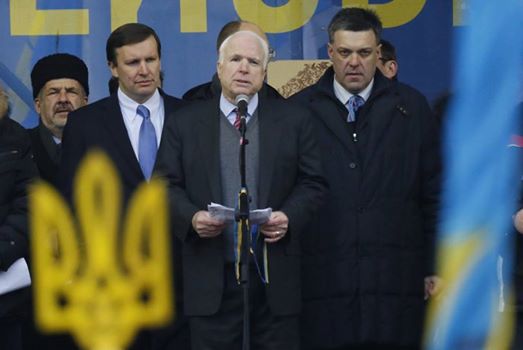
Sen. John McCain appearing with Ukrainian rightists at a rally in Kiev.
Now, the neocons have stoked a confrontation over Ukraine, involving two nuclear-armed states, the United States and Russia. But – even if nuclear weapons don’t come into play – the neocons have succeeded in estranging U.S. President Barack Obama from Russian President Vladimir Putin and sabotaging the pair’s crucial cooperation on Iran and Syria, which may have been the point all along.
Though the Ukraine crisis has roots going back decades, the chronology of the recent uprising — and the neocon interest in it – meshes neatly with neocon fury over Obama and Putin working together to avert a U.S. military strike against Syria last summer and then brokering an interim nuclear agreement with Iran last fall that effectively took a U.S. bombing campaign against Iran off the table.
With those two top Israeli priorities – U.S. military attacks on Syria and Iran – sidetracked, the American neocons began activating their influential media and political networks to counteract the Obama-Putin teamwork. The neocon wedge to splinter Obama away from Putin was driven into Ukraine.
Operating out of neocon enclaves in the U.S. State Department and at U.S.-funded non-governmental organizations, led by the National Endowment for Democracy, neocon operatives targeted Ukraine even before the recent political unrest began shaking apart the country’s fragile ethnic and ideological cohesion.
Last September, as the prospects for a U.S. military strike against Syria were fading thanks to Putin, NED president Carl Gershman, who is something of a neocon paymaster controlling more than $100 million in congressionally approved funding each year, took to the pages of the neocon-flagship Washington Post and wrote that Ukraine was now “the biggest prize.”
But Gershman added that Ukraine was really only an interim step to an even bigger prize, the removal of the strong-willed and independent-minded Putin, who, Gershman added, “may find himself on the losing end not just in the near abroad [i.e. Ukraine] but within Russia itself.” In other words, the new hope was for “regime change” in Kiev and Moscow.
Putin had made himself a major annoyance in Neocon World, particularly with his diplomacy on Syria that defused a crisis over a Sarin attack outside Damascus on Aug. 21, 2013. Despite the attack’s mysterious origins – and the absence of any clear evidence proving the Syrian government’s guilt – the U.S. State Department and the U.S. news media rushed to the judgment that Syrian President Bashar al-Assad did it.
Politicians and pundits baited Obama with claims that Assad had brazenly crossed Obama’s “red line” by using chemical weapons and that U.S. “credibility” now demanded military retaliation. A longtime Israeli/neocon goal, “regime change” in Syria, seemed within reach.
But Putin brokered a deal in which Assad agreed to surrender Syria’s chemical weapons arsenal (even as he continued to deny any role in the Sarin attack). The arrangement was a huge letdown for the neocons and Israeli officials who had been drooling over the prospect that a U.S. bombing campaign would bring Assad to his knees and deliver a strategic blow against Iran, Israel’s current chief enemy.
Putin then further offended the neocons and the Israeli government by helping to facilitate an interim nuclear deal with Iran, making another neocon/Israeli priority, a U.S. war against Iran, less likely.
Putting Putin in Play
So, the troublesome Putin had to be put in play. And, NED’s Gershman was quick to note a key Russian vulnerability, neighboring Ukraine, where a democratically elected but corrupt president, Viktor Yanukovych, was struggling with a terrible economy and weighing whether to accept a European aid offer, which came with many austerity strings attached, or work out a more generous deal with Russia.
There was already a strong U.S.-organized political/media apparatus in place for destabilizing Ukraine’s government. Gershman’s NED had 65 projects operating in the country – training “activists,” supporting “journalists” and organizing business groups, according to its latest report. (NED was created in 1983 to do in relative openness what the CIA had long done in secret, nurture pro-U.S. operatives under the umbrella of “promoting democracy.”)
So, when Yanukovych opted for Russia’s more generous $15 billion aid package, the roof fell in on him. In a speech to Ukrainian business leaders last December, Assistant Secretary of State for European Affairs, Victoria Nuland, a neocon holdover and the wife of prominent neocon Robert Kagan, reminded the group that the U.S. had invested $5 billion in Ukraine’s “European aspirations.”
Then, urged on by Nuland and neocon Sen. John McCain, protests in the capital of Kiev turned increasingly violent with neo-Nazi militias moving to the fore. Unidentified snipers opened fire on protesters and police, touching off fiery clashes that killed some 80 people (including about a dozen police officers).
On Feb. 21, in a desperate attempt to tamp down the violence, Yanukovych signed an agreement brokered by European countries. He agreed to surrender many of his powers, to hold early elections (so he could be voted out of office), and pull back the police. That last step, however, opened the way for the neo-Nazi militias to overrun government buildings and force Yanukovych to flee for his life.
With these modern-day storm troopers controlling key buildings – and brutalizing Yanukovych supporters – a rump Ukrainian parliament voted, in an extra-constitutional fashion, to remove Yanukovych from office. This coup-installed regime, with far-right parties controlling four ministries including defense, received immediate U.S. and European Union recognition as Ukraine’s “legitimate” government.
As remarkable – and newsworthy – as it was that a government on the European continent included Nazis in the executive branch for the first time since World War II, the U.S. news media performed as it did before the Iraq War and during various other international crises. It essentially presented the neocon-preferred narrative and treated the presence of the neo-Nazis as some kind of urban legend.
Virtually across the board, from Fox News to MSNBC, from the Washington Post to the New York Times, the U.S. press corps fell in line, painting Yanukovych and Putin as the “black-hat” villains and the coup regime as the “white-hat” good guys, which required, of course, whiting out the neo-Nazi “brown shirts.”
Neocon Expediency
Some neocon defenders have challenged my reporting that U.S. neocons played a significant role in the Ukrainian putsch. One argument is that the neocons, who regard the U.S.-Israeli bond as inviolable, would not knowingly collaborate with neo-Nazis given the history of the Holocaust (and indeed the role of Ukrainian Nazi collaborators in extermination campaigns against Poles and Jews).
But the neocons have frequently struck alliances of convenience with some of the most unsavory – and indeed anti-Semitic – forces on earth, dating back to the Reagan administration and its collaboration with Latin American “death squad” regimes, including work with the World Anti-Communist League that included not only neo-Nazis but aging real Nazis.
More recently in Syria, U.S. neocons (and Israeli leaders) are so focused on ousting Assad, an ally of hated Iran, that they have cooperated with Saudi Arabia’s Sunni monarchy (known for its gross anti-Semitism). Israeli officials have even expressed a preference for Saudi-backed Sunni extremists winning in Syria if that is the only way to get rid of Assad and hurt his allies in Iran and Lebanon’s Hezbollah.
Last September, Israel’s Ambassador to the United States Michael Oren told the Jerusalem Post that Israel so wanted Assad out and his Iranian backers weakened, that Israel would accept al-Qaeda operatives taking power in Syria.
“The greatest danger to Israel is by the strategic arc that extends from Tehran, to Damascus to Beirut. And we saw the Assad regime as the keystone in that arc,” Oren said in the interview. “We always wanted Bashar Assad to go, we always preferred the bad guys who weren’t backed by Iran to the bad guys who were backed by Iran.”
Oren said that was Israel’s view even if the other “bad guys” were affiliated with al-Qaeda.
Oren, who was Israel’s point man in dealing with Official Washington’s neocons, is considered very close to Israeli Prime Minister Benjamin Netanyahu and reflects his views. For decades, U.S. neocons have supported Netanyahu and his hardline Likud Party, including as strategists on his 1996 campaign for prime minister when neocons such as Richard Perle and Douglas Feith developed the original “regime change” strategy. [For details, see Consortiumnews.com’s “The Mysterious Why of the Iraq War.”]
In other words, Israel and its U.S. neocon supporters have been willing to collaborate with extreme right-wing and even anti-Semitic forces if that advances their key geopolitical goals, such as maneuvering the U.S. government into military confrontations with Syria and Iran.
So, while it may be fair to assume that neocons like Nuland and McCain would have preferred that the Ukraine coup had been spearheaded by militants who weren’t neo-Nazis – or, for that matter, that the Syrian rebels were not so dominated by al-Qaeda-affiliated extremists – the neocons (and their Israeli allies) see these tactical collaborations as sometimes necessary to achieve overarching strategic priorities.
And, since their current strategic necessity is to scuttle the fragile negotiations over Syria and Iran, which otherwise might negate the possibility of U.S. military strikes against those two countries, the Putin-Obama collaboration had to go.
By spurring on the violent overthrow of Ukraine’s elected president, the neocons helped touch off a cascade of events – now including Crimea’s secession from Ukraine and its annexation by Russia – that have raised tensions and provoked Western retaliation against Russia. The crisis also has made the continued Obama-Putin teamwork on Syria and Iran extremely difficult, if not impossible.
Like other neocon-engineered schemes, there will surely be much collateral damage in this latest one. For instance, if the tit-for-tat economic retaliations escalate – and Russian gas supplies are disrupted – Europe’s fragile recovery could be tipped back into recession, with harmful consequences for the U.S. economy, too.
There’s also the certainty that congressional war hawks and neocon pundits will press for increased U.S. military spending and aggressive tactics elsewhere in the world to punish Putin, meaning even less money and attention for domestic programs or deficit reduction. Obama’s “nation-building at home” will be forgotten.
But the neocons have long made it clear that their vision for the world – one of America’s “full-spectrum dominance” and “regime change” in Middle Eastern countries opposed to Israel – overrides all other national priorities. And as long as the neocons face no accountability for the havoc that they wreak, they will continue working Washington’s corridors of power, not selling insurance or flipping hamburgers.
FBI Bust Another Handcrafted ‘Terrorist’ For The Crime Of Thinking About Supporting A Terrorist Organization
By Tim Cushing | Techdirt | March 19, 2014
The FBI’s string of thwarted, self-created terrorist plots continues unabated. Why look for terrorists when you can just craft them yourselves? Digital Fourth has the rundown on the latest “coup” by the agency.
The news this morning is full of the arrest of yet another American on charges of “attempting to provide material support to a foreign terrorist organization.” Nobody’s suggesting that 20-year-old National Guardsman Nicholas Teausant of Acampo, CA is a terrorist, or that he provided any help whatsoever to terrorists, or that he was in contact, ever, with any actual terrorists. But, the media breathlessly report, he’s still facing charges that can put him in jail through to the 2030s.
The more you dig into the story, the more ridiculous it becomes. And Alex Marthews digs in deeply. The propellant (if you will) for this latest thwarted terrorist plot is little more than a campfire story.
Well, seems that he was on a camping trip sometime last year – or maybe not; investigators couldn’t corroborate that the camping trip ever happened – but anyway, afterwards, Teausant is reported to have said to some guy that he had been on a camping trip and had talked with friends about “blowing up the LA subway,” but that they hadn’t done anything because “they” had been “tipped off”.
Unfortunately for Teausant (but fortunately for America!), the “somebody” he relayed his camping conversation to was an FBI agent. Recognizing that Teausant needed a little more prodding to turn against his own nation, the agent connected him with a terrorist tutor of sorts (another FBI agent). This agent/mentor suggested Teausant travel to Canada to further radicalize and then sent more FBI agents to arrest him at the border. Voila, another terrorist attack thwarted.
Teausant is now facing charges of “attempting to provide material support” to a terrorist organization, a crime that seems to be treated just as severely as actually providing material support. As evidence of Teausant’s terrorist proclivities, agents cited posts to his “online photo account” which said such things as desiring to see America’s downfall and “I would love to join Allah’s Army but I don’t know where to start.”
They also cited the following evidence, which exposes the USA’s contradictory and arbitrary determination of who does and does not qualify as a terrorist.
Also, Teausant was apparently trying to figure out how to go to Syria and fight against Bashar al-Assad. This horrifying offense was committed at the same time that the US government was … trying to figure out how to go to Syria and fight against Bashar al-Assad. Last time I checked, Assad was a brutal dictator. But the winds have changed, and now that some of the people fighting against him are Sunni radicals inspired by, but actually repudiated by, al-Qaeda, I guess that makes Assad now a staunch American ally and defender of secular values?
Here’s some more of the government’s evidence.
The complaint said Teausant referred to himself as a convert to Islam but did not give details about when or why he may have done so. He met the informant through a mutual acquaintance, the document said.
Among Teausant’s plans was to appear in videos for the group, without covering his face — to be “the one white devil that leaves their face wide open to the camera,” he was quoted in the complaint as saying…
The complaint also states that Teausant told the informant he has an infant daughter, and had arranged for his mother to get custody of the girl if he disappeared.
At one point, the informant questioned him about whether he was serious about his plans, given that he talked a lot but did not seem to follow through.
So, while there are indications that Teausant could have wandered down the path into Islamic radicalism, at the point he was arrested he had done little more than talk smack around the campfire with some other young men (Teausant is only 20) and talk further smack with undercover agents. But as usual, it looks as though the FBI had to do most of the legwork to convert this person into a potential terrorist. It was the FBI, not Teausant, that arranged to get him an “application” to join a violent Al-Qaeda-linked group. It was the FBI that pushed him towards Canada to further his terrorist education. And it was the FBI that convinced itself that Teausant was enough of threat to lock up for a potential 15 years, even though he had never actually “provided material support” to a terrorist organization.
The FBI now gets to chalk up another win in the “terrorist captured” column despite having done little more than arrest a guy who talked a lot, but wasn’t big on following through. Sure, there’s always a chance Teausant would have done all of this on his own, but rather than sit back and keep an eye on him, the FBI proactively made his moves for him… and arrested him for following the undercover agents’ bidding.
Marthews points out how completely bizarre this is in a land where free speech is considered a right.
In a more sensible legal environment, Teausant would walk free because, let me think now, because we have a First Amendment and he is entitled to say whatever dumb thing he wants to so long as he doesn’t actually harm anyone, and the FBI informant and agent would be being charged with entrapment.
That’s the way it should work, but that’s not the way it does work. The counterterrorism money train comes off the rails if government agencies fail to capture terrorists. So, rather than restrict themselves to investigating terrorist organizations and sniffing out plots, the FBI has chosen to pad the books with ringers. Teausant may have made some poor decisions and said some unwise things, but even the FBI’s preponderance of evidence fails to portray him as much more than a dumb kid with stupider dreams. And rather than allow the events to play out, and possibly expose the FBI’s alleged terrorist sympathizer as an ineffectual pretender, it set him up for a date with the penal system. All the while, the accolades and money keep rolling in, ensuring the FBI’s terrorist manufacturing apparatus will keep humming smoothly.
Related article

Israel ‘destroyed’ Islamic archaeological sites in Silwan dig
Ma’an – 19/03/2014
JERUSALEM – The Israel Antiquities Authority has destroyed several ancient archeological sites and antiquities as a result of a controversial dig in the Palestinian neighborhood of Silwan in East Jerusalem, the Al-Aqsa Foundation for Endowment and Heritage said Tuesday.
The authority recently began the final stage of archaeological excavations at the site, which is located in the Wadi Silweh area only 20 meters from the walls of the Old City, the foundation said in a statement on Tuesday.
As a result of the excavations, several ancient Islamic archeological sites and antiquities have been destroyed, including a cemetery that dated back to the Abbasid caliphate.
Additionally, the dig has damaged relics that date back to the Jebusite Canaanite era in the second millenium BC, the Al-Aqsa foundation alleged.
The excavations are the continuation of an Israeli project to build a biblical park in the area alongside the City of David archaeological park, and will feature a “museum of Jewish history” and a “Jewish national park.”
The excavation site measures around six dunams (1.5 acres) and runs 20 meters deep in some places.
The excavations are connected by a network of tunnels that “the Israeli occupation has been digging under and around Al-Aqsa Mosque,” the statement said, pointing out that the third-holiest site in Islam is located only 100 meters from the site itself.
The foundation said that the Ir David Foundation — commonly known as Elad — is funding the excavations as part of a plan to build a seven-story building which will serve as a Jewish cultural center.
The excavation site is located on what used to be private Palestinian land owned by the Siyam family from Silwan. The land was confiscated by Israeli authorities for the dig.
Israel frequently permits excavations and archaeological digs in East Jerusalem, specifically around the Al-Aqsa mosque and in the Silwan neighborhood, that threaten the structural integrity of Palestinian homes and holy sites in the area.
Critics charge that the digs search for ancient Jewish ruins at the expense of existing homes, and that Israeli archaeologists often ignore and even damage non-Jewish artifacts.
In 1967, Israel demolished the 800-year-old Moroccan Quarter of Jerusalem, displacing 650 Palestinians and destroying numerous mosques, homes, and holy sites, in order to build a plaza in front of the Western Wall.
Israel also evicted around 6,000 Palestinians from nearby areas in order to massively expand the city’s historical Jewish Quarter.
The internationally recognized Palestinian territories of which the West Bank and East Jerusalem form a part have been occupied by the Israeli military since 1967.
Related article
Questions the Media Haven’t Been Asking about Flight MH370
By Doug E. Steil | Aletho News | March 19, 2014
By now, many people following the reports of Flight MH370, the missing Malaysian aircraft, are becoming very suspicious of a cover-up, almost as if though there is no genuine interest in locating the plane, yet going through the superficial motions of at least attempting to do so. Though some officially released information should be considered reliable because elaborate recovery efforts by numerous countries depend on it, for instance the two arcs showing possible 40° locations of the last “ping” with a satellite in geostationary orbit (which would exclude the possibility of the plane having been diverted, say, to the Diego Garcia military base or a variety of other places that have been mentioned), what seems more interesting is the information nobody mentions and the media appear too afraid to ask. For example:
* Why haven’t the corresponding data for previous possible “ping” locations been publicly released, thus constraining the area of the aircraft’s possible location, hence allowing more focus on prioritized search areas?
* Who were those lucky people who had booked that particular flight but did not board (according to initial reports some of them even checked in their luggage) and why has there been no public information about them?
More than seven years ago, in 2006, a publication by the name of Homeland Security News Wire, whose editor in chief studied at Tel Aviv University, ran a brief story about Boeing’s Uninterruptible Auto Pilot System. In the wake of the still missing Boeing 777 aircraft, another publication ran a story, which stated in part:
Perhaps the most unsettling information in regards to the missing Boeing 777 comes from retired 35 year Delta pilot, Field McConnell, who states that since 1995, Boeing Uninterruptible Auto Pilots have been equipped in Boeing planes. This information was apparently not released until March of 2007, following a subsequent lawsuit by McConnell. The modification was reported to the FAA, NTSB and ALPA (airline pilots association). According to McConnell’s documents, Boeing is said to have stated that by end of 2009 all Boeing planes would be fitted with the BUAP – making them impossible to manually hijack within the plane but susceptible to remote control by the military, according the flight veteran.
At least one organization, Voice of Russia, bothered to interview the retired pilot, mentioned above, on this particular topic, but it is obviously not deemed to be sufficiently relevant for general public consumption, as though it were yet another taboo subject, just too “hot” to address.
Aside from such issues as an unauthorized intruder with malicious intent being able to hack the airplane’s avionics and communications system with external piloting commands that override those of the pilots inside the cockpit, the alleged ubiquity of such an autopilot system raises other questions that ought to be addressed; here are just eight:
* Is it only a nation’s military that is authorized to activate the system in an emergency situation?
* Would multiple military organizations be involved in the case of an actual on-board hijacking, say, over Europe?
* Could the military of Malaysia, Vietnam, Thailand, and perhaps even Indonesia and India have been in the loop about the situation involving Flight MH370?
* Would those authorized to intervene be able to actively supersede the malicious commands of an unauthorized commandeering attempt?
* Wouldn’t it make more sense for the airline operating the aircraft to be primarily responsible, through a 24-hour command center on stand-by, with the military of the countries the aircraft is flying over or near at any particular moment?
* Who would be in charge, say, of an aircraft from a European airline flying over international waters far away, on the other side of the world?
* Could the central command in the case of such rare emergencies that require 24-hour stand-by have been contractually delegated to a private security company to deal with, simply for the sake of expediency or cost, just as the security operations at many airports have been delegated to Israeli-run companies?
* Does the software for these remote autopilot systems get customized or at least regularly updated to fix or at least patch up known or possible security leaks?
‘War for Oil’ — The Notion That Will Not Die
By Dr. Stephen J Sniegoski | My Catbird Seat | March 11, 2014
Those who claim that the United States went to war for oil seem to assume that since Iraq has huge reserves of oil, gaining control of that resource must have been the reason that the United States invaded the country. As the most prominent intellectual exponent of that view, Noam Chomsky, has put it:
Of course it was Iraq’s energy resources. It’s not even a question. Iraq’s one of the major oil producers in the world. It has the second largest reserves and it’s right in the heart of the Gulf’s oil-producing region, which U.S. intelligence predicts is going to be two thirds of world resources in coming years. [1]
Operating from that assumption, the proponents of the war-for-oil thesis have endeavored to produce evidence that proves it, at least in their eyes.
I have offered counter-evidence in my book, The Transparent Cabal: The Neoconservative Agenda, War in the Middle East, and the National Interest of Israel, and elsewhere to show that the existing arguments in support of the oil-war thesis just do not provide anything close to compelling proof. [2]
The fact that Iraq has a large amount of oil does not mean that the oil companies would necessarily push for war; instead, they could seek to exploit that oil in peaceful ways.
Indeed, the companies were pushing for an end to sanctions against Iraq. A Business Week article in May 2001, for example, reported that the easing of sanctions on “rogue” states “pits powerful interests such as the pro-Israeli lobby and the U.S. oil industry against each other. And it is sure to preoccupy the Bush Administration and Congress.” [3]
In short, an easing of sanctions supported by the oil companies, which would enable them to have access to Iraq’s oil, would serve to strengthen Saddam and make it more difficult to overthrow his regime, which was the goal of the neocons, a leading element of the Israel lobby.
Moreover, the oil companies were quite fearful of the impact of war on oil production. According to oil analyst Anthony Sampson in December 2002, “Oil companies have had little influence on U.S. policy-making. Most big American companies, including oil companies, do not see a war as good for business, as falling share prices indicate.” [4]
Fareed Mohamedi of PFC Energy, a consulting firm based in Washington, D.C., that advised petroleum firms, stated that “[t]he big oil companies were not enthusiastic about the Iraqi war,” maintaining that “[c]orporations like Exxon-Mobile and Chevron-Texaco want stability, and this is not what Bush is providing in Iraq and the Gulf region.” [5]
Despite the lack of solid evidence, and the existence of contrary evidence, the war-for-oil argument just will not die, for various political, psychological, social, and economic reasons.
It fits the prevalent belief in the rapacious nature of capitalist companies, and it is also a safe view to hold — it is doubtful that anyone ever lost a job or a friend for blaming the oil interests, unless one were actually employed by an oil company. In contrast, the explanation involving the neoconservatives and Israel represents a dangerous taboo.
Given the strong attraction of the oil argument, therefore, it is appropriate to examine a prominent piece of purported evidence used by its adherents. Thus, this article will look at the role of the National Energy Policy Development Group, which President George W. Bush created in his second week in office. The group had as its purpose the creation of a national energy policy for the United States. Chaired by Vice President Dick Cheney — who in the war-for-oil scenario is assumed to be an archetypal oil man — it would be dubbed the Cheney Energy Task Force.
As Cheney’s biographer Barton Gellman points out, the task force became, in many respects, a “creature of Cheney’s worldview.” [6] De-emphasizing conservation and environmental protection, Cheney believed that the United States needed a “near-term boost in domestic energy production,” which had suffered from over-regulation. [7] In short, Cheney’s view on energy production coincided with that of the producers of fossil fuels. And in developing the energy policy, he would consult closely with leading figures in the fossil-fuels industry while giving short shrift to the opinions of environmentalists, with whom he rarely met.
Perhaps because of the biased nature of the sources of his information, but also in line with his expansive view of the executive branch’s prerogatives, Cheney kept the meetings secret, and only as a result of legal efforts was any information about them revealed to the public; and even then it was far from everything. It was that secrecy that the war-for-oil theorists fell upon in order to substantiate their claim that the oil interest played the leading role in bringing about the U.S. attack on Iraq.
To the adherents of the thesis, it seemed apparent that the secrecy meant that something very ominous had been discussed in those meetings that could not be made known to the public, and the most ominous development in the early Bush administration was assumed to be the planning for the attack on Iraq.
Now, there is plenty of evidence that such planning was underway, and in fact had already been made, by the neoconservatives, with whom Cheney was certainly in league and whom he had actually brought into the Bush administration. However, there is no evidence that an attack on Iraq garnered substantial support from the oil industry. Far from pushing for war, industry representatives publicly supported the elimination of sanctions on Iraq (and elsewhere) so that they could have access to oil.
Moreover, they were concerned about any form of instability in the Middle East, fearing that war would disrupt the extraction and transportation of oil. Thus, ex-President George H.W. Bush and his cronies, who according to the oil-war scenario are associated with the war on Iraq, were at least cool to the war.
Brent Scowcroft, for one, was actively opposed. Scowcroft had been the elder Bush’s national security advisor and during the run-up to the 2003 war sat on the board of Pennzoil-Quaker State. [8]
As an aside, let me deal with the implication that the oil companies were advocating war only in secret meetings with high Bush administration officials, with their pro-war views unknown to the media.
That invisible approach is highly unlikely. Any contention that the oil interests primarily work behind the scenes is belied by the fact that they have been quite visible indeed in their public advocacy on many issues: fracking regulations; the termination of restrictions on the export of American-produced crude oil; the Keystone XL pipeline; regulations on refineries; and opposition to limitations on the use of fossil fuels because of “climate change” (anthropogenic global warming). And as mentioned, the oil companies were visible in their public opposition to the existing oil sanctions in 2001. The oil companies have been not only quite vocal in those matters but also far from successful in getting their way.
The war-for-oil theorists’ suggestion that the oil interests could be more successful taking an invisible approach instead of a public one does not seem plausible. The neocons had developed and publicized their Middle East war agenda before 2001; once George W. Bush took office, they openly promoted an attack on Iraq, both in the media and from their key positions in the administration. All of that being so, it is reasonable to believe that it was their efforts that accounted for the U.S. attack. There is no need to posit any undocumented, invisible support from the oil lobby; by the standards of proof in argumentation, the neocon explanation fits the simplicity principle of Occam’s razor. In an example of reverse logic, proponents of the oil thesis deny, ignore, or at least downplay the role of the neocons in bringing about the war on Iraq.
Despite counter-evidence, proponents of the war-for-oil thesis claim to find solid evidence for the coming invasion in the documents produced by the Cheney Energy Task Force. Some war-for-oil proponents, for example, have cited the maps of Iraqi oil fields used by the task force as evidence of plans for how those fields would be divvied up among U.S. companies. As the result of a court order, Judicial Watch, a conservative legal group, obtained a batch of task force-related U.S. Commerce Department papers that included a detailed map of oil fields, terminals, and pipelines, as well as a list titled “Foreign Suitors of Iraqi Oilfield Contracts.” But the papers obtained also included a detailed map of oil fields and pipelines in Saudi Arabia and in the United Arab Emirates, as well as a list of oil and gas development projects in those two countries. The U.S. secretary of commerce said there were also maps of other key oil-producing regions of the world, including Russia, North America, the Middle East, and the Caspian Sea region. It seems quite reasonable that a task force on energy would seek clear knowledge about the key global locations of oil production. [9]
Strategic-Energy-Policy-Challenges-for-the-21st-CenturyIraq is barely mentioned in the final report from the Cheney task force, but it is given more, though still quite limited, attention in a report, “Strategic Energy Policy: Challenges for the 21st Century,” by an Independent Task Force sponsored by the Council on Foreign Relations and the James A.Baker III Institute of Public Policy.
According to the Baker Institute, that task force was “comprised [of] 52 prominent Americans from government, industry, and academia … [and] offered 110 recommendations to the Cheney task force and U.S. Congress regarding steps to build a comprehensive energy policy and national consensus.”
The chairman of the task force was Edward L. Morse, an energy economist and at the time an advisor at Hess Energy Trading Co. During the Carter administration he served as deputy assistant secretary of state for international energy policy, from 1979 to 1981.[10]
Adherents of the oil-war argument have connected the Baker report to the Cheney task force and have interpreted its few references to Iraq as indications of the forthcoming American invasion. [11]
The Baker group urged four “immediate steps”; one such step, labeled “Deter and Manage International Supply Shortfalls,” was in five parts; the Iraq issue was merely one of those five parts. The “immediate steps” were “to be considered in the very short term to assure that appropriate mechanisms are in place to deal with potential supply disruptions and to buffer the economy from adverse impacts of price volatility.” [12]
The recommendation pertaining to Iraq read: “Review policies toward Iraq with the aim to lowering anti-Americanism in the Middle East and elsewhere, and set the groundwork to eventually ease Iraqi oil-field investment restrictions.” The report acknowledged that “Iraq remains a destabilizing influence to U.S. allies in the Middle East, as well as to regional and global order, and to the flow of oil to international markets from the Middle East. Saddam Hussein has also demonstrated a willingness to threaten to use the oil weapon and to use his own export program to manipulate oil markets.” [13]
The report stated that “[t]he United States should conduct an immediate policy review toward Iraq, including military, energy, economic, and political/diplomatic assessments.” [14] The emphasis, however, was not on military action against Iraq but on a sanctions policy toward Iraq that was better-coordinated with other countries, the existing sanctions being perceived as harming the Iraqi people without effectively weakening Saddam’s power and ability to acquire weaponry.
“The United States,” the report thus maintained, “should then develop an integrated strategy with key allies in Europe and Asia and with key countries in the Middle East to restate the goals with respect to Iraqi policy and to restore a cohesive coalition of key allies…. Actions and policies to promote these goals should endeavor to enhance the well-being of the Iraqi people. Sanctions that are not effective should be phased out and replaced with highly focused and enforced sanctions that target the regime’s ability to maintain and acquire weapons of mass destruction. A new plan of action should be developed to use diplomatic and other means to support U.N. Security Council efforts to build a strong arms-control regime to stem the flow of arms and controlled substances into Iraq.” [15]
The Baker report continued: “Once an arms-control program is in place, the United States could consider reducing restrictions on oil investments inside Iraq. Like it or not, Iraqi reserves represent a major asset that can quickly add capacity to world oil markets and inject a more competitive tenor to oil trade.” [16]
The report acknowledged that if a diminution of the sanctions led to an increase in Saddam’s oil revenues, he “could be a greater security threat to U.S. allies in the region if weapons of mass destruction (WMD) sanctions, weapons regimes, and the coalition against him are not strengthened.” Nonetheless, it supported making a change since the continuation of the “oil sanctions is becoming increasingly difficult to implement” and “Saddam Hussein has many means of gaining revenues, and the sanctions regime helps perpetuate his lock on the country’s economy.” [17] A one-sided reading of that passage alone might seem to include war as one alternative to the existing sanctions, but, in fact, the report explicitly prescribed narrowing the scope of sanctions.
The Baker Institute report’s fundamental concern that “energy disruptions could have a potentially enormous impact on the U.S. and world economy, and … affect U.S. national security and foreign policy in dramatic ways” [18] would suggest that the United States not engage in military adventures that could destabilize the region. The U.S. invasion of Iraq certainly did cause such destabilization and explains why the oil interests and the traditional American foreign-policy establishment in general were cool or opposed to the attack on Iraq. [19]
Now, once it had become clear that the United States would attack Iraq, and certainly after it actually had invaded, one may assume that the oil companies would want to take advantage of the situation and jockey for a favored position in postwar Iraq. But that does not somehow prove by itself that the oil interests pushed the country into war. And as it happened, the U.S. government did little to guarantee a favorable position for American oil companies after the war. As I pointed out in The Transparent Cabal, the U.S. government never made plans (much less implemented such plans) to dominate Iraq, to the extent of being able to control Iraq’s oil for its own benefit and that of its oil companies at the expense of the Iraq government and people. To exercise any permanent control of Iraq’s oil reserves, Washington would have had to turn the country into a virtual colony (which would have been very difficult, if not impossible). [20] It was inevitable that an Iraqi government with any type of autonomy would sell oil leases to the highest bidder.
Under the oil argument, the violence and political resistance that sprang up in Iraq during the occupation thwarted the U.S. plan to control oil. The likelihood of such internal violence, however, was fully recognized in a number of pre-invasion government studies. [21] About the only ostensibly knowledgeable group that claimed otherwise was the neocons, and if their expressed view here is accepted as a candid account, it seems necessary to accept also their public pronouncements about establishing democracy and ridding Iraq of WMDs as reasons for the war.
When Iraq began to sell oil leases to foreign companies in 2009, only a very few went to American companies while a disproportionate number went to America’s major rivals, China and Russia. That could hardly be a goal of American foreign policy. One reason given for those countries’ success has been that their companies were government-owned or government-supported, and thus could better afford to incur risk and accept low profits than their American counterparts, which were strictly private. [22] Of course, if the U.S. government really fought a multi-trillion-dollar war for the purpose of gaining control of Iraqi oil for its companies, one would expect it to subsidize any oil leases in Iraq by American companies, the cost of which would pale beside the overall war costs.
In sum, there does not seem to be any real evidence that Washington went to war against Iraq to enhance the profits of the oil industry, or control oil for the United States, nor is there any logical reason to think that would be the case. Nevertheless, as I indicated at the beginning, there are strong political, psychological, social, and economic motivations for maintaining that belief, especially as opposed to the non-P.C. and rather dangerous alternative view to which I adhere — focusing on the role of the pro-Israel neocons. In most cases, those concerns are far more important in determining the prevalence of any view in modern America than logic and evidence, even for that very small minority of the population with high intellectual ability who are actually knowledgeable about the issues.
In fact, such people are often far more affected by concerns involving employment and social status than average Americans, and are thus less open-minded and less willing to alter their views in light of the facts. Whatever their actual personal views, the oil argument provides a safe position for those who want to oppose America’s war policies in the Middle East without endangering themselves by expressing a view that could bring on lethal accusations of anti-Semitism.
However, a false view of reality will not serve to effectively solve problems. If we focus on a false culprit, the neocons and the overall Israel lobby are apt to flourish, and American military adventures are apt to continue in the Middle East.
Notes:
1. Noam Chomsky, interview with Dubai’s Business Channel, “‘Of course, it was all about Iraq’s resources,’” December 2, 2003.
2. Stephen J. Sniegoski, The Transparent Cabal: The Neoconservative Agenda, War in the Middle East, and the National Interest of Israel (Norfolk, Va.: Enigma Editions, 2008), pp. 333-50; Sniegoski, “War on Iraq: Not oil but Israel,” The Last Ditch, October 22, 2004.
3. “Rogue States: Why Washington May Ease Sanctions,” Business Week, May 6, 2001. Quoted in Transparent Cabal, p. 336; quoted in “War on Iraq: Not oil but Israel.”
4. Anthony Sampson, “Oilmen don’t want another Suez,” The Observer, December 21, 2002. Sampson is author of The Seven Sisters(New York: Bantam Books, 1976), which deals with oil companies and the Middle East; quoted in Transparent Cabal, p. 336; quoted in “War on Iraq: Not oil but Israel.”
5. Quoted in Roger Burbach, “The Bush Ideologues vs. Big Oil in Iraq,” CounterPunch, October 3-5, 2003.
6. Barton Gellman, Angler: The Cheney Vice Presidency (New York: Penguin Press, 2008), p. 90.
7. Ibid., p. 91.
8. Transparent Cabal; “War on Iraq: Not oil but Israel,” The Last Ditch, October 22, 2004; “Brent Scowcroft,” Sourcewatch.
9. “Cheney Energy Task Force Documents Detail Iraqi Oil Industry,” Fox News, July 18, 2003; “Cheney Energy Task Force Documents Feature Map of Iraqi Oil Fields,” Judicial Watch, July 17, 2003.
10. James A. Baker III Institute of Public Policy, Energy Forum Policy Research.
11. Ritt Goldstein, “‘Oil War’ Questions Surround Cheney Energy Group”; Michael T. Klare, “The Bush/Cheney Energy Strategy: Implications for U.S. Foreign and Military Policy,” a paper prepared for the second annual meeting of the Association for Study of Peak Oil, Paris, France, May 26-27, 2003; Carol Brightman, Total Insecurity: The Myth of American Omnipotence, London: Verso, 2004, p. 190; Jason Leopold, “Eager to Tap Iraq’s Vast Oil Reserves, Industry Execs Suggested Invasion,” The Public Record, July 1, 2009.
12. “Strategic Energy Policy,” p. 42.
13. Ibid., p. 46.
14. Ibid., p. 46.
15. Ibid., p. 46-47.
16. Ibid., p. 47.
17. Ibid., p. 47.
18. Ibid., p. 2.
19. The traditional foreign-policy establishment’s opposition to the neocon position is brought out throughout The Transparent Cabal, but especially see: pp. 59, 270-73, 291-297, 343-350; Sniegoski, “War on Iraq: Not oil but Israel.”
20. Transparent Cabal, pp. 340-42; “War on Iraq: Not oil but Israel,” The Last Ditch, October 22, 2004.
21. Transparent Cabal, pp. 336-38.
22. Mohammed Abbas, “No boon for U.S. firms in Iraq oil deal auction,” Reuters, August 12, 2009.
Dr. Stephen J. Sniegoski, Ph.D. earned his doctorate in American history,with a focus on American foreign policy, at the University of Maryland. His focus on the neoconservative involvement in American foreign policy antedates September 11, 2001. His first major work on the subject, “The War on Iraq: Conceived in Israel” was published February 10, 2003, more than a month before the American attack. He is the author of “The Transparent Cabal: The Neoconservative Agenda, War in the Middle East, and the National Interest of Israel”.
Featured Video

America Racing to Strategic Defeat in Iran
or go to
Aletho News Archives – Video-Images
From the Archives
Should Europeans ‘Thank’ the Americans for Destroying Nord Stream?
By Robert Bridge | Strategic Culture Foundation | September 29, 2022
With an investigation continuing into the destruction of the Nord Stream gas pipeline that provided energy supplies to Europe from Russia, there appears to be just one prime suspect, and that should surprise nobody.
Following the sabotage of the Nord Stream 1 and 2 gas pipelines, former Polish Foreign Minister Radoslaw Sikorski already seemed to know the identity of the perpetrator when he tweeted out: “Thank you, USA.”
At first glance, it seemed that Sikorski was speaking sarcastically, berating Washington for carrying out an attack that will have severe repercussions for the people of Europe. After all, how could anyone see any good coming from the termination of Europe’s primary source of gas reserves with winter just around the corner? It was Sikorski’s homeland of Poland, after all, that urged its citizens to collect firewood in the face of dwindling gas reserves.
In fact, the Polish diplomat was speaking one-hundred percent literally… continue
Blog Roll
 Aletho News
- UK’s New Pandemic Plan Would Turn Big Tech Into a Mass Location Tracking Network
- Growing insecurity, soaring prices fuel protests in north as regime bans evacuation: Sources
- Iran denies responsibility for ‘depraved’ attack on Kuwait desalination plant
- Bring The Troops Back. End This War Now!
- Can we please stop calling Israel the ‘only democracy in the Middle East’ now?
- US should start removing its troops from Germany, proposes AfD co-leader Chrupalla
- Iran Red Crescent: 600 educational centers attacked in US-Israeli ‘war crimes’
- Russian Oil Tanker Arrives in Cuba Amid U.S. Blockade
- America Racing to Strategic Defeat in Iran: Lt Col Daniel Davis
- FTC Warns Visa, Mastercard, PayPal, Stripe Over Political Debanking
- If Americans Knew
- As Iran targets US military bases, will they be relocated to Israel? Not a ceasefire Day 171
- Will Trump Go Kamikaze?
- Is the University of Florida Shutting Down College Republicans over Israel Criticism?
- Jewish extremist arrested over alleged plot to firebomb Palestinian activist Nerdeen Kiswani’s home
- More than half of Palestinian child detainees have no charges
- The More Murderous Israel Gets, The More We Hear About “Antisemitism”
- Land Day and the Palestinian struggle after 30 months of genocide
- The Iran War Is About Palestine
- Israeli soldiers echo settler ideology, talk of revenge after targeting Palestinians and detaining CNN crew in the West Bank
- Israeli Policies Threaten Future of Christian Schools in Jerusalem
- No Tricks Zone
- New Study Finds Warming Saves Lives…Cold Temperatures 12 Times More Deadly Than Excess Heat
- German Science Blog Accuses PIK Climate Institute Of Hallucinating Climate Tipping Points
- Devastating Assessment Of Comirnaty Vaccine By Former Senior Pfizer Europe Toxicologist
- New Study: CO2 Is ‘Effectively Negligible’ As An Explanatory Climate Change Factor Since 2000
- Former Pfizer Toxicologist Dr. Helmut Sterz Tells Bundestag Hearing Pfizer Vaccine Should Have Never Been Approved
- Energy Expert: Germany’s Nuclear Phaseout Was A “500 Billion Euro Mistake”
- New Research: South Australia’s Mid-Holocene Sea Surface Temperatures Were 4°C Warmer Than Today
- Storing Green Energy To Last Germany 10 Days Would Require A 60-Million Tonne Battery
- New Studies: UK Sea Levels Were 4 Meters Higher Than Today During The Mid-Holocene
- Destructive Green New Deal: German Energy And Metal Group Warns Of Drastic Crisis
 Aletho News