Anti-Iran Hardliners Seek New Excuse
By Paul R. Pillar | Consortium News | April 8, 2014
There exists, right now, a problem with one side’s obligations not being fulfilled as provided for under the preliminary agreement, known as the Joint Plan of Action, that Iran reached with the United States and its negotiating partners (the P5+1) last November. This lack of fulfillment endangers the process of negotiating a final agreement.
It is an understandable source of consternation to the other side, which will increasingly doubt the first side’s ability and willingness to make good on its commitments, including in any final deal. Hardliners on the second side will pounce on any non-fulfillment of the terms of the JPA as a reason to scuttle the whole process.
So is Iran not living up to its commitments under the JPA? Well, we do have hardliners on our own side eager to pounce. In fact, they are so eager that they are trying to pounce even though there isn’t anything to pounce on.
Senators Robert Menendez, D-New Jersey, and Mark Kirk, R-Illinois, who led the recent unsuccessful effort in Congress to impose additional deal-busting sanctions after conclusion of the JPA, have sent a letter to President Barack Obama that bemoans indications of some increased Iranian oil sales and says “If Iran moves forward with this effort to evade U.S. sanctions and violate the terms of oil sanctions relief provided for in the JPA” the United States should in effect renounce its obligation under the JPA to — this is the wording of the JPA — “pause efforts to further reduce Iran’s crude oil sales.”
The senators make it sound as if Iran has some obligation under the agreement to knuckle under to sanctions, don’t they? Otherwise how could Iran “violate” what they are talking about? But Iran has no such obligation.
All the obligations in the preliminary agreement concerning sanctions are obligations of the P5+1 (including that very mild “pause efforts” clause, which does not entail rolling back the existing oil sanctions). All of Iran’s obligations involve restrictions on its nuclear program. According to the International Atomic Energy Agency, Iran so far is in compliance with those obligations.
No, the current problem in implementing the agreement involves another part of the P5+1′s side of the deal, not Iran’s side. Specifically, it involves the unfreezing in installments of a small portion ($4.2 billion out of an estimated $100 billion) of the Iranian money that already was earned from prior oil sales and is sitting in non-Iranian banks.
Iran has been unable to withdraw much of the money that it was supposed to have gained access to by now. It appears the problem is not direct violation of the agreement by the U.S. Treasury or any of the other governments involved. Instead, the banks that are to handle the funds are so deathly afraid of running afoul, however inadvertently, of any continuing sanctions that Treasury is enforcing that they have not made the money move.
The fear is understandable, given how huge and complex the sanctions regime has become and also how huge have been fines that Treasury has levied on transgressors. The marvelous sanctions machine is so powerful that it continues to exude power and have effects even after a switch has been turned off. Treasury needs to do more than just saying “go,” and more than it has done so far to put banks into their comfort zone, for the JPA to be implemented the way it was supposed to be.
Iranian President Hassan Rouhani had a big enough challenge domestically as it was to sell a preliminary agreement that gave the P5+1 most of what it wanted in restricting the nuclear program while getting only modest sanctions relief in return. His selling task is made all the harder when even that modest relief is not properly implemented. And there certainly are hardliners on his side ready to pounce on any such developments.
This issue is a reminder of how an Iranian belief that the West and especially the United States will come through with positive action if Iran makes desired concessions is just as important as (and given how the issue has evolved, has become even more important than) an Iranian belief that it will be hit with still more negative consequences if it does not concede.
The current problem also underscores how much work — political, not just administrative — on the U.S. side remains to be done to prepare for the undoing of sanctions that will be part of any final agreement, and that necessarily will be substantially greater than the minor sanctions relief in the JPA.
Members of Congress are still talking about piling on more sanctions when they ought to be discussing how to take sanctions off the pile. We have already seen how hard it is to redirect the sanctions machine. Aircraft carriers do not turn around on a dime, and neither do sanctions, especially ones as complicated and extensive as the ones on the Iranian pile.
Even if the more optimistic projections of when a deal will be struck in Vienna do not prove true, it is not too soon for Congress and the administration to be working diligently on this and for it to be a subject of public discussion.
What’s Wrong With The National Day Of Prayer?
Americans United for Separation of Church and State
By act of Congress, the first Thursday in May is set aside for the National Day of Prayer (NDP), and this year’s event takes places on May 5. Government officials issue proclamations urging people to gather for prayer, and religious events often take place at the seats of local, state and federal governments. Many of these events are coordinated by a private group, the National Day of Prayer Task Force, which is chaired by Shirley Dobson, wife of Religious Right broadcaster James Dobson.
This year, the National Day of Prayer has been in the news thanks to a recent federal appeals court ruling dismissing a legal challenge to the event. The 7th U.S. Circuit Court of Appeals ruled on April 14, 2011 that the Freedom From Religion Foundation lacks “standing” – the legal right to sue – to block the NDP.
Events are going on across the country this year. But this does not mean the National Day of Prayer is a good idea. Many believe a government-backed call for prayer and religious worship violates the separation of church and state.
Americans United for Separation of Church and State raises the following objections:
Americans don’t need the government to tell them when or how to pray.
Americans have the right to pray for whomever they want and in what manner they like. But we don’t need an officially designated government proclamation to do that. Our people are free to engage in worship whenever they want. Allowing government to set aside certain days for prayer and worship implies that the state has some say over our religious lives when it does not. It is simply not the business of government to advise when, if and how people pray.
The National Day of Prayer has been hijacked by the Religious Right, which uses it to promote religious bigotry.
In recent years, most NDP activities have been coordinated by the “National Day of Prayer Task Force,” an organization based in Colorado Springs and run by Shirley Dobson, wife of Religious Right radio broadcaster James Dobson, founder of Focus on the Family.
The National Day of Prayer has become a vehicle for spreading misinformation about American history and society.
In years past, the Task Force has used the NDP to promote bogus “Christian nation” history and advocate for erroneous claims that fundamentalist Christians are being persecuted in the United States or denied their right to spread their faith.
The National Day of Prayer is not historical.
The NDP is of recent vintage. It was created by Congress in 1952. The scheduling of the event used to change, but it was codified by Congress in 1988 (after pressure from the Religious Right) as the first Thursday in May.
The National Day of Prayer Is Unnecessary.
America does not need an official, government-mandated “National Day of Prayer.” Religious individuals who feel strongly about the country are free to pray for it at any time. They do not need to be directed or encouraged by government.
Other Resources:
Jefferson and Madison on Prayer Proclamations
19th Century Congressman Gulian C. Verplanck criticizes Prayer Proclamations

Why is the US Honoring a Racist Rabbi?
By Alison Wier | CounterPunch | April 7, 2014
If things proceed normally, President Barak Obama will soon proclaim April 11, 2014 “Education and Sharing Day, U.S.A.” Despite the innocuous name, this day honors the memory of a religious leader whose lesser-known teachings help fuel some of the most violent attacks against Palestinians by extremist Israeli settlers and soldiers.
The leader being honored on this day is Rabbi Menachem Mendel Schneerson, charismatic head of a mystical/fundamentalist version of Judaism. Every year since 1978, a Presidential Proclamation, often accompanied by a Congressional Resolution (the 1990 one had 219 sponsors), has declared Schneerson’s birthday an official national day of observance.
Congress first passed a Resolution honoring Schneerson in 1975. Three years later a Joint Congressional Resolution called on President Jimmy Carter to proclaim “Education Day, U.S.A.” on the anniversary of Schneerson’s birth. The idea was to set aside a day to honor both education and the alleged educational work of Schneerson and the religious sect he headed up.
Carter, like Congress, dutifully obeyed the Schneerson-initiated resolution, as has every president since. And some individual states are now enacting their own observances of Schneerson’s birthday, with Minnesota and Alabama leading the way.
Schneerson and his movement are an extremely mixed bag.
Schneerson has been praised widely for a public persona and organization that emphasized “deep compassion and insight,” worked to bring many secular Jews “back” into the fold, created numerous schools around the world, and had offered, in the words of the Jewish Virtual Library, “social-service programs and humanitarian aid to all people, regardless of religious affiliation or background.”
However, there is also a less attractive underside often at odds with such public perceptions. And some of the more extreme parts of Schneerson’s teachings – such as that Jews are a completely different species than non-Jews, and that non-Jews exist only to serve Jews – have been largely hidden, it appears, even from many who consider themselves his followers.
As we will see, such views profoundly impact the lives of Palestinians living – and dying – under Israeli occupation and military invasions.
Who was Rabbi Schneerson?
Schneerson lived from 1902 to 1994 and oversaw the growth of what is now the largest Jewish organization in the world. The religious movement he led is known as “Chabad-Lubavitch,” (sometimes just called “Lubavitch” or “Chabad,” the name of its organizational arm). Schneerson was the seventh and final Lubavitcher “Rebbe” (sacred leader). He is often simply called “the Rebbe.”
Founded in the late 1700s and originally based in the Polish-Russian town of Lubavitch, it is the largest of about a dozen forms of “Hasidism,” a version of Orthodox Judaism connected to mysticism, characterized by devotion to a dynastic leader, and whose adherents often wear distinctive clothing. (Spellings of these terms can vary; Hasid is also written as Hassid, Chasid, etc.)
There is an extreme cult of personality focused on Schneerson himself. Some followers consider him the Messiah, and Schneerson himself reportedly sometimes implied this was true. Some Lubavitch educators consider him divine, making such claims as, “the Rebbe is actually ‘the essence and being [of God] … he is without limits, capable of effecting anything, all-knowing and a proper object of worshipful prostration.”
While many secular Jews and Jews from other denominations disagree with its actions and theology, Chabad-Lubavitch is generally acknowledged to be a powerful force in Jewish life today. According to a 1994 New York Times report, it is “one of the most influential and controversial forces in world Jewry.”
There are approximately 3,600 Chabad institutions in over 1,000 cities in 70 countries, and 200,000 adherents. Up to a million people attend Chabad services at least once a year. Numerous campuses have such centers and the Chabad website states that hundreds of thousands of children attend Chabad summer camps.
According to the Times, Schneerson “presided over a religious empire that reached from the back streets of Brooklyn to the main streets of Israel and by 1990 was taking in an estimated $100 million a year in contributions.
In the U.S., the Times reports, Schneerson’s “‘mitzvah tanks’ – converted campers that are rolling recruiting stations whose purpose is to draw Jews to the Lubavitch way – roamed streets from midtown Manhattan to Crown Heights. And the Lubavitchers’ Brooklyn-based publishing house claimed to be the world’s largest distributor of Jewish books.”
Non-Jewish souls ‘satanic’
While Chabad sometimes openly teaches that “the soul of the Jew is different than the soul of the non-Jew,” Schneerson’s specific teachings on this subject are largely unknown.
Quite likely very few Americans, both Jews and non-Jews, are aware of Schneerson’s teachings about the alleged deep differences between them – and about how these teachings are applied in the West Bank and Gaza.
Let us look at Schneerson’s words, as quoted by two respected Jewish professors, Israel Shahak and Norton Mezvinsky, in their book Jewish Fundamentalism in Israel (text available online here. This book, praised by Noam Chomsky, Edward Said, and many others is essential reading for anyone who truly wishes to understand modern day Israel-Palestine. (Brackets in the quotes below are in the translations by Shahak and Mezvinsky.)
Some of Schneerson’s rarely reported teachings:
“The difference between a Jewish and a non-Jewish person stems from the common expression: “Let us differentiate.” Thus, we do not have a case of profound change in which a person is merely on a superior level. Rather, we have a case of “let us differentiate” between totally different species.”
“This is what needs to be said about the body: the body of a Jewish person is of a totally different quality from the body of [members] of all nations of the world … The difference in the inner quality between Jews and non-Jews is “so great that the bodies should be considered as completely different species.”
“An even greater difference exists in regard to the soul. Two contrary types of soul exist, a non-Jewish soul comes from three satanic spheres, while the Jewish soul stems from holiness.”
“As has been explained, an embryo is called a human being, because it has both body and soul. Thus, the difference between a Jewish and a non-Jewish embryo can be understood.”
“…the general difference between Jews and non-Jews: A Jew was not created
as a means for some [other] purpose; he himself is the purpose, since the substance of all [divine] emanations was created only to serve the Jews.”
“The important things are the Jews, because they do not exist for any [other] aim; they themselves are [the divine] aim.”
“The entire creation [of a non-Jew] exists only for the sake of the Jews.”
Most people don’t know about this aspect of Schneerson’s teaching because, according to Shahak and Mezvinsky, such teachings are intentionally minimized, mistranslated, or
hidden entirely.
For example, the quotes above were translated by the authors from a book of Schneerson’s recorded messages to followers that was published in Israel in 1965. Despite Schneerson’s global importance and the fact that his world headquarters is in the U.S., there has never been an English translation of this volume.
Shahak, an Israeli professor who was a survivor of the Nazi holocaust, writes that this lack of translation of an important work is not unusual, explaining that much critical information about Israel and some forms of Judaism is available only in Hebrew.
He and co-author Mezvinsky, who was a Connecticut Distinguished University Professor who taught at Central Connecticut State University, write, “The great majority of the books on Judaism and Israel, published in English especially, falsify their subject matter.”
According to Shahak and Mezvinsky, “Almost every moderately sophisticated Israeli Jew knows the facts about Israeli Jewish society that are described in this book. These facts, however, are unknown to most interested Jews and non-Jews outside Israel who do not know Hebrew and thus cannot read most of what Israeli Jews write about themselves in Hebrew.”
In Shahak’s earlier book, Jewish Religion, Jewish History, he provides a number of examples. In one, he describes a 1962 book published in Israel in a bilingual edition. The Hebrew text was on one page, with the English translation on the facing page.
Shahak describes one set of facing pages in which the Hebrew text of a major Jewish code of laws contained a command to exterminate Jewish infidels: “It is a duty to exterminate them with one’s own hands.” The English version on the facing page softened it to “It is a duty to take active measures to destroy them.’”
The Hebrew page then went on to name which “infidels” must be exterminated, adding “may the name of the wicked rot.” Among them was Jesus of Nazareth. The facing page with the English translation failed to tell any of this.
“Even more significant,” Shahak reports, “in spite of the wide circulation of this book among scholars in the English-speaking countries, not one of them has, as far as I know, protested against this glaring deception.”
Praised by Said, Chomsky, etc., Shahak is almost unknown today
This pattern of selective omission, it seems, applies to Shahak himself, whose work is largely unknown to Palestine activists today, even though he was considered a major figure in the struggle against Israeli oppression of Palestinians, and his work was praised by diverse writers.
While Shahak was alive, Noam Chomsky called him “an outstanding scholar,” and said he had “remarkable insight and depth of knowledge. His work is informed and penetrating, a contribution of great value.”
Edward Said wrote, “Shahak is a very brave man who should be honored for his services to humanity … One of the most remarkable individuals in the contemporary Middle East.” Said wrote a forward for Shahak’s Jewish History, Jewish Religion.
Catholic New Times said: ‘This is a remarkable book …[It] deserves a wide readership, not only among Jews, but among Christians who seek a fuller understanding both of historical Judaism and of modern-day Israel.”
Jewish Socialist stated: “Anyone who wants to change the Jewish community so that it stops siding with the forces of reaction should read this book.”
The London Review of Books called Shahak’s book “remarkable, powerful, and provocative.”
Yet, very few Americans today know of Shahak’s work and the information it contains.
American tax money & Jewish Extremism in Palestine
If they did, it’s hard to believe that Americans would allow $8.5 million per day of their tax money to be given to Israel, where such teachings underlie a powerful minority that is disproportionately influential in governmental actions.
Nor is it likely that a fully informed American public would allow donations to religious institutions in Israel that teach supremacist, sometimes violent doctrines to be tax-deductible in the U.S.
One organization raised over $10 million tax-deductible dollars in the U.S. in 2011 alone – removing money from the U.S. economy and enabling illegal, aggressive Israeli settlements in Palestine. And some of this money went to benefit individuals convicted of murder – including the murderer of Israeli Prime Minister Yitzhak Rabin.
The New York Times obituary on Schneerson reported that Schneerson was “a major political force in Israel, both in the Knesset and among the electorate,” but failed to describe the nature of his impact.
One of a sprinkling of writers willing to publicly discuss Shahak and Mezvinsky’s findings is Allan Brownfeld, who is less reticent. Brownfeld is editor of the American Council for Judaism’s periodical Issues and contributor to the Washington Report on Middle East Affairs.
In a review of Jewish Fundamentalism in Israel, Brownfeld describes Schneerson’s views on Israel:
“Rabbi Schneerson always supported Israeli wars and opposed any retreat. In 1974 he strongly opposed the Israeli withdrawal from the Suez area. He promised Israel divine favors if it persisted in occupying the land.”
Brownfeld reports that after Schneerson’s death, “[T]housands of his Israeli followers played an important role in the election victory of Binyamin Netanyahu. Among the religious settlers in the occupied territories, the Chabad Hassids constitute one of the most extreme groups. Baruch Goldstein, the mass murderer of Palestinians, was one of them.”
Another such Chabad Hassid is Rabbi Yitzchak Ginsburg (also sometimes written as “Ginzburg” and “Ginsburgh”), who studied under Schneerson in Crown Heights and who heads up a major Chabad institution in the West Bank.
Ginsburg praised Goldstein, the murderer of 29 Palestinians while they were praying, and considers all non-Jews subhuman.
According to author Motti Inbari, Ginsburg “gives prominence to Halachic and Kabbalistic approaches that emphasize the distinction between Jew and non-Jew (Gentile), imposing a clear separation and hierarchy in this respect.”
In his book Jewish Fundamentalism and the Temple Mount: Who Will Build the Third Temple? Inbari states, “[Ginsburg] claims that while the Jews are the Chosen People and were created in God’s image, the Gentiles do not have this status and are effectively considered subhuman.”
Professor Inbari, an Israeli academic who now teaches in the U.S., writes that Ginsburg’s theological approach continues “certain perceptions that were popular in medieval times.”
“For example,” Inbari writes, “the commandment ‘You shall not murder’ does not apply to the killing of a Gentile, since ‘you shall not murder’ relates to the murder of a human, while for him the Gentiles do not constitute humans.”
Inbari reports, “Similarly, Ginzburg stated that, on the theoretical level, if a Jew requires a liver transplant to survive, it would be permissible to seize a Gentile and take their liver forcefully.”
While the mainstream American press almost never reports this kind of information, an April 26, 1996 article in Jewish Week by Lawrence Cohler reported on Ginsburg’s teachings, including their problematic roots in Jewish texts.
Cohler reported that a professor of Bible at Hebrew University in Jerusalem, Rabbi Moshe Greenberg, “called for radically revising Jewish thinking about some Jewish texts on the grounds that scholars such as Rabbi Ginsburgh are far from aberrant in their use of them.”
Cohler quoted Greenberg’s concerns: “‘There’ll be a statement in Talmud… made in circumstances where it’s purely theoretical, because Jews then never had the power to do it,’ he explained. And now, he said, ‘It’s carried over into circumstances where Jews have a state and are empowered.’”
A rabbi associated with Ginsburg coauthored a notorious Israeli book, The King’s Torah, which claims that Jewish law at times permits the killing of non-Jewish infants. American donations to the Chabad school Ginsburg heads up, and that published the above book, are tax-deductible in the U.S. Ginsburg, who endorses the book, teaches classes throughout Israel, the U.S. and France.
Such extremism is opposed by the majority of Israelis, and major Jewish religious authorities condemn it, a Chief Rabbi, for example, stating: “’According to the Torah, every man is created in God’s image.”
Yet, such extremist views continue to exert a powerful influence.
Israeli military manuals echo extremist teachings: “kill even good civilians”
Israeli military manuals sometimes replicate extremist teachings. For example, a booklet authored by a Chief Chaplain stated, “In war, when our forces storm the enemy, they are allowed and even enjoined by the Halakhah to kill even good civilians…” Such teachings by the IDF rabbinate were prominent during Israel’s 2008-9 attack on Gaza that killed 1,400 Gazans, approximately half of them civilians. (The Palestinian resistance killed nine Israelis during this “war.”)
Chicago writer Stephen Lendman has described these teachings, giving a number of examples.
Lendman writes, “In 2007, Israel’s former chief rabbi, Mordechai Elyahu, called for the Israeli army to mass-murder Palestinians:
“If they don’t stop after we kill 100, then we must kill 1000. And if they don’t stop after 1000, then we must kill 10,000. If they still don’t stop we must kill 100,000. Even a million.”
Lendman reports that some extremist Israeli rabbis teach that “the ten commandments don’t apply to non-Jews. So killing them in defending the homeland is acceptable, and according to the chairman of the Jewish Rabbinic Council:
“‘There is no such thing as enemy civilians in war time. The law of our Torah is to have mercy on our soldiers and to save them…. A thousand non-Jewish lives are not worth a Jew’s fingernail.’”
Lendman writes, “Rabbi David Batsri called Arabs ‘a blight, a devil, a disaster…. donkeys, and we have to ask ourselves why God didn’t create them to walk on all fours. Well, the answer is that they are needed to build and clean.’”
Another such rabbi is Manis Friedman, a Chabad-Lubavitch rabbi inspired by Schneerson who served as the simultaneous translator for a series of Schneerson’s talks. (Friedman is currently dean of a Jewish Studies institute in Minnesota.)
A 2009 article in the Israeli newspaper Ha’aretz reports, “Like the best Chabad-Lubavitch rabbis, Manis Friedman has won the hearts of many unaffiliated Jews with his charismatic talks about love and God; it was Friedman who helped lead Bob Dylan into a relationship with Chabad.
“But Friedman, who today travels the country as a Chabad speaker, showed a less warm and cuddly side when he was asked how he thinks Jews should treat their Arab neighbors.”
In Moment magazine’s article, “Ask the Rabbis // How Should Jews Treat Their Arab Neighbors?” Friedman answered:
“I don’t believe in western morality, i.e. don’t kill civilians or children, don’t destroy holy sites, don’t fight during holiday seasons, don’t bomb cemeteries, don’t shoot until they shoot first because it is immoral.
“The only way to fight a moral war is the Jewish way: Destroy their holy sites. Kill men, women and children (and cattle).”
Lendman reports, “Views like these aren’t exceptions. Though a minority, they proliferate throughout Israeli society…”
They also, Lendman notes, work to prevent peace in Israel-Palestine.
Shahak and Mezvinsky note that when the book containing Schneerson’s statements quoted above about Jews and non-Jews was published in Israel, he was allied to the Labor Party and his movement had been provided “many important benefits” from the Israeli government.
In the mid-1970s Schneerson decided that the Labor Party was too moderate and shifted his support to the more right-wing parties in power today. The authors report, “Ariel Sharon was the Rebbe’s favorite Israeli senior politician. Sharon in turn praised the Rebbe publicly and delivered a moving speech about him in the Knesset after the Rebbe’s death.”
Roots in Some Early Texts
Brownfeld decries the fact that few Americans are properly informed about the fundamentalist movement in Israel “and the theology upon which it is based.”
He notes that Jewish Americans, in particular, are often unaware of the “narrow ethnocentrism which is promoted by the movement’s leading rabbis, or of the traditional Jewish sources they are able to call upon in drawing clear distinctions between the moral obligations owed to Jews and non-Jews.”
Teachings that Jews are superior and gentiles inferior were contained in some of the earliest Hassidic texts, including its classic text, “Tanya,” still taught today.
Brownfeld quotes statements by “the revered father of the messianic tendency of Jewish fundamentalism,” Rabbi Kook the Elder, and states that these were derived from earlier texts. [Kook, incidentally, was also an early Zionist, who helped push for the Balfour Declaration in England before moving to Palestine. He was the uncle of Hillel Kook, an agent who went by the name “Peter Bergson” and created front groups in the U.S. for a violent Zionist guerilla group that operated in 1930s and ’40s Palestine.]
Brownfeld quotes Kook: “The difference between a Jewish soul and souls of non-Jews—all of them in all different levels—is greater and deeper than the difference between a human soul and the souls of cattle.”
Brownfeld explains that Kook’s teaching, which he says is followed by leaders of the settler movement in the occupied West Bank, “is based upon the Lurianic Cabbala, the school of Jewish mysticism that dominated Judaism from the late 16th to the early 19th century.”
Shahak and Mezvinsky state, “One of the basic tenets of the Lurianic Cabbala is the absolute superiority of the Jewish soul and body over the non-Jewish soul and body. According to the Lurianic Cabbala, the world was created solely for the sake of Jews; the existence of non-Jews was subsidiary.”
Again, Shahak and Mezvinsky report that this aspect is often covered up in English-language discussions. Scholarly authors of books about Jewish mysticism and the Lurianic Cabbala, they write, have frequently “willfully omitted reference to such ideas.”
Shahak and Mezvinsky write that it is essential to understand these beliefs in order to understand the current situation in the West Bank, where many of the most militant West Bank settlers are motivated by religious ideologies in which every non-Jew is seen as “the earthly embodiment” of Satan, and according to the Halacha (Jewish law), the term ‘human beings’ refers solely to Jews.”
Israeli author and former chief of Israeli military intelligence Yehoshafat Harkabi touches on this in his 1988 book Israel’s Fateful Hour.
Harkabi writes that while such extremist beliefs are not “widely dominant,” the reality is that “nationalistic religious extremists are by no means a lunatic fringe; many are respected men whose words are widely heeded.”
He reports that the campus rabbi of a major Israeli university published an article in the student newspaper entitled “The Commandment of Genocide in the Torah,” in which he implied that those who have a quarrel with Jews “ought to be destroyed, children and all.” Harkabi writes that a book by another rabbi “explained that the killing of a non-Jew is not considered murder.”
Brownfeld writes, “Although messianic fundamentalists constitute a relatively small portion of the Israeli population [most Israeli settlers are motivated by the subsidized lifestyle US tax money to Israel provides], their political influence has been growing. If they have contempt for non-Jews, their hatred for Jews who oppose their views is even greater.”
Brownfeld cites the murder of Israeli Prime Minister Yitzhak Rabin, who had started to make peace with the Palestinians, writing that it was just one “in a long line of murders of Jews who followed a path different from that ordained by rabbinic authorities.” Brownfeld reports that Shahak and Mezvinsky “cite case after case, from the Middle Ages until the 19th century.”
The authors report, “It was usual in some Hasidic circles until the last quarter of the nineteenth century to attack and often to murder Jews who had reform religious tendencies…”
They quote a long article by Israeli writer Rami Rosen, “History of a Denial,” published by Ha’aretz Magazine in 1996. This article, which cannot be found online, at least in English, is also cited in the book Brother Against Brother: Violence and Extremism in Israeli Politics from Altalena to the Rabin Assassination, by Israeli professor Ehud Sprinzak.
In his Ha’aretz article Rosen reported: “A check of main facts of the [Jewish] historiography of the last 1500 years shows that the picture is different from the one previously shown to us. It includes massacres of Christians; mock repetitions of the crucifixion of Jesus that usually took place on Purim; cruel murders within the family; liquidation of informers, often done for religious reasons by secret rabbinical courts, which issued a sentence of ‘pursuer’ and appointed secret executioners; assassinations of adulterous women in synagogues and/or the cutting of their noses by command of the rabbis.”
While Rosen’s article may seem shocking, in reality, it simply shows that members of the Jewish population, like members of Christian, Muslim, Hindu, and diverse other populations, have at times committed atrocities, sometimes allegedly in the name of their religion. The difference, as Shahak and Mezvinsky point out, is that such information is largely covered up in the U.S. Such cover-ups, however, don’t make facts go away. They merely bury them, where they smolder and at times eventually lead to exaggerated perceptions.
U.S. media rarely report that some extremist Israeli settlers are intensely hostile to Christians, and in one instance threatened peace activists who came to the West Bank to participate in nonviolent demonstrations, “We killed Jesus and we’ll kill you, too.” There is also a record of official hostility. For example, a few years ago an Israeli mayor ordered all New Testaments to be rounded up and burned.
Schneerson’s “schools”
While Schneerson is honored on national “Education” days, the reality is that the elementary schools he created often failed to teach children “basic reading, writing, spelling, math, science and history,” according to a graduate.
In his article “National Education Day and the Education I Never Had,” Chaim Levin reports on his experience at the Chabad school “Oholei Torah” (Educational Institute Oholei Menachem) in Crown Heights, New York – the site of Chabad’s world headquarters:
“I have profound respect for the late Rebbe and his legacy. However, I remember very clearly those talks that [Schneerson] gave – the ones we studied every year in elementary school about the unimportance of ‘secular’ (non-religious, formal) education, and the great importance of only studying limmudei kodesh (holy studies). As a result of this attitude, thousands of students were not taught anything other than the Bible throughout our years attending Chabad institutions.”
The goal of such schools, Levin writes, was to produce “schluchim,” missionaries who would promote Chabad all over the world.
Meanwhile, he notes, “Failure to provide basic formal education cripples children within Chabad communities. We cannot ignore the harm done…” Levin writes, “Until this day, Oholei Torah and many other Chabad schools — particularly schools for boys and a few for girls in Crown Heights and in some other places — do not provide basic formal education.”
Education and Sharing Day 2014
In his 2000 article, Brownfeld writes that Shahak and Mezvinsky’s book should be “a wake-up call “to Americans, particularly Jewish supporters of Israel.”
Fourteen years later, however, very few people are aware of these books and their powerful information, and U.S. tax money continues to flow to Israel. The main author, Israel Shahak, is now dead, as is Edward Said; Noam Chomsky rarely, if ever, mentions him; and Shahak’s co-author, Norton Mezvinsky (uncle of Chelsea Clinton’s husband), is a member of a Lubavitch congregation in New York.
In many ways, little seems to have changed since 1994, when Congressmen Charles Schumer, Newt Gingrich, and others introduced legislation to bestow on Schneerson the Congressional Gold Medal. The bill passed both Houses by unanimous consent, honoring Schneerson for his “outstanding and lasting contributions toward improvements in world education, morality, and acts of charity.”
And in two weeks, Americans will be officially called on to observe a day that honors Rabbi Menachem Mendel Schneerson and the Lubavitcher movement.
That is, unless masses of people contact their Congressional representatives to demand a whole new direction: a “National Education and Sharing Day” that honors an individual who values education, and who believes that all people – in the words of the Declaration of Independence – are created equal.
Alison Weir is executive director of If Americans Knew and president of the Council for the National Interest. Her book, Against Our Better Judgment: How the U.S. was used to create Israel, contains additional information on Rabbi Kook’s family connection to American front groups for Israeli terrorists.
Donetsk activists proclaim region’s independence from Ukraine
RT | April 7, 2014
In the eastern Ukrainian city of Donetsk, a group of activists have declared their region independent from Kiev. This comes after protesters stormed a local government building last night.
Mass demonstrations against the country’s new leadership started peacefully on Sunday, but the situation quickly escalated.
Pro-Russian protesters in Donetsk have seized the local power building, including the headquarters of the Security Service of Ukraine and proclaimed the creation of a People’s Republic of Donetsk.
Ukraine’s police and security services have not interfered, although officials in Kiev are threatening punishment for the rioters.
Protesters have erected barricades around the Council building.
Today at 12:20 local time, a session of the people’s Council of Donbass (Donetsk region) took place in the main hall of the Regional Council and unanimously voted on a declaration to form a new independent state: the People’s Republic of Donetsk.
The Council proclaimed itself the only legitimate body in the region until the regions in southeast Ukraine conduct a general referendum, set to take place no later than May 11.
“The Donetsk Republic is to be created within the administrative borders of the Donetsk region. This decision will come into effect after the referendum,” the statement said.
The Council in Donetsk issued an address to Russian President Vladimir Putin, asking for deployment of a temporary peacekeeping force to the region.
“Without support it will be hard for us to stand against the junta in Kiev,” said the address.
“We are addressing Russian President Putin because we can only entrust our security to Russia,” the statement said.
Rallies in support of the federalization of Ukraine continue in a number of cities in southeast Ukraine. Thousands of citizens have joined the protests, demanding the earliest possible federalization of the country.
Ukraine’s Ministry of Interior said that last night unknown persons stormed the Security Service of Ukraine building in the city of Lugansk and seized a weapons warehouse there. During the night’s clashes, nine people were reportedly injured.
In the city of Kharkov protesters erected barricades around the buildings of the city and the regional administrations and the regional headquarters of Security Service of Ukraine.
There were brief clashes between supporters of the federalization of Ukraine and pro-EU demonstrators in downtown Kharkov. Protesters on both sides used fire crackers and stun grenades.
A demonstration against political repression in Ukraine has also been held in the southern regional center of Odessa.
The chiefs of security agencies of Ukraine are reportedly heading to the cities engulfed in protests.
The interim secretary of the National Security and Defense Council of Ukraine, Andrey Parubiy, together with acting head of the Security Service of Ukraine, Valentin Nalivaichenko, are set to visit Lugansk. Interim Deputy Prime Minister Vitaly Yarema will visit Donetsk and acting Interior Minister Arsen Avakov has reportedly already arrived in Kharkov.
The coup-appointed acting president, Aleksandr Turchinov, has threatened that counter-terrorist measures could be taken against those who take up arms against the Kiev authorities, RIA news agency reported. On Thursday, the Ukrainian parliament will tighten laws regarding separatism and could possibly ban certain parties and organizations , Turchinov warned.
“What happened yesterday is the second stage of the special operation of the Russian Federation against Ukraine,” announced Turchinov in an address televised on Monday, sharing that an “anti-crisis command was set up last night” to deal with the crisis, Interfax-Ukraine reported.
Ukraine’s interim Foreign Minister Andrey Deschitsa announced on Monday that if the situation in the eastern regions escalates, the coup-appointed government in Kiev will take “much harsher” measures than those on the reunion of the Crimea with Russia. Deschitsa gave an assurance that members of the government are already working with local authorities.
Livni: Israel will surround Abbas until he surrenders to our terms
MEMO | April 7, 2014
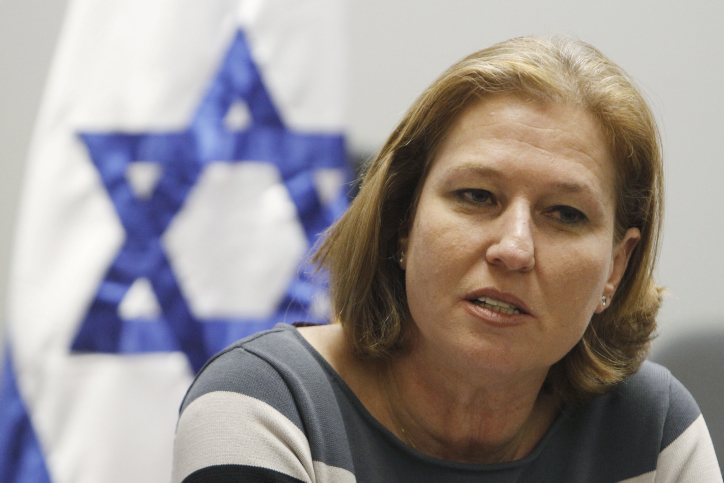 Israel will surround the Palestinian President Mahmoud Abbas until he accepts the Israeli terms and recognises Israel as a Jewish state, Israel’s top negotiator, Justice Minister Tzipi Livni said yesterday.
Livni told Israel’s Channel 10 that Israel will not release Palestinian prisoners who committed violent acts against Israeli citizens. “Israel will not release Palestinian prisoners with blood on their hands,” Livni said.
Livni claimed that several Arab countries have told Israel they will not transfer funds to Abbas pointing out that she had visited friendly Arab countries 11 times in the past 50 days.
“The city of Jerusalem is the capital of the state of Israel and the Arab and Islamic countries do not object to that,” Livni claimed.
Christians: Israel violates Palestinian religious freedoms each Easter
Ma’an – April 6, 2012
BETHLEHEM – A group of Christians from East Jerusalem on Sunday said that Israel’s restrictions on Palestinian mobility resulted in violations of religious freedoms.
The statement, signed “Palestinian Christian Organizations in Occupied East Jerusalem,” complained that Christians are often denied access to the Church of the Holy Sepulchre during the Easter holidays.
Each Easter, checkpoints are erected “at the Gates and in the alley, thus preventing the worshipers from free access to the Via Dolorosa, the Church of the Holy Sepulchre, and the vicinity of the Christian Quarter.”
Israel’s restrictions on Palestinian Christians are a part of larger strategy of Judaization in Jerusalem, the statement said.
“The restrictive measures constitute grave violation on the freedom of worship, and amount to discrimination against Christians because the occupation authorities want to negate Christian presence and create the impression of a Jewish-only city.”
Both Christians and Muslims are often “unable to worship freely and to be with their families and friends” during religious holidays because of Israel’s actions, the statement went on to note.
The organizations called on Christians to make attempts to attend Easter celebrations in Jerusalem despite the countless restrictions.
In a report published in 2012, the US State Department made similar observations.
“Strict closures and curfews imposed by the Israeli government negatively affected residents’ ability to practice their religion at holy sites, including the Church of the Holy Sepulchre and Al-Aqsa Mosque in Jerusalem, as well as the Church of the Nativity in Bethlehem,” the report said.
“The separation barrier significantly impeded Bethlehem-area Christians from reaching the Church of the Holy Sepulchre in Jerusalem and made visits to Christian sites in Bethany (al-Eizariya) and Bethlehem difficult for Palestinian Christians who live on the Jerusalem side of the barrier.”
East Jerusalem, including the historic Old City, was occupied by Israeli forces in 1967 and later annexed in a move not recognized by the international community.
New Federal Indictment Over Iran Sanctions Breach Demonstrates Reach of Nuclear Disinformation

United States Attorney for the District of Massachusetts Carmen Oritz
By Nima Shirazi | Wide Asleep in America | April 6, 2014
A brief news story posted by Reuters at 3pm on Friday afternoon reported that Sihai Cheng, a Chinese national is facing criminal charges brought by the U.S. government for allegedly having conspired to export “pressure transducers,” sensors that translate the application of pressure into electrical signals, to Iran in violation with sanctions that restrict trade of scientific equipment and technology to that country.
Cheng was arrested at Heathrow airport two months ago and the indictment was brought by Boston field offices of the FBI, Department of Homeland Security, Department of Commerce, and the Department of Justice’s Massachusetts District Attorney.
Following the publication of the Reuters report, the news traveled fast with outlets like Bloomberg News, AFP, Telegraph, and BBC all picking it up, and inevitably tying the news to the ongoing international nuclear negotiations taking place between six world powers and Iran.
Pressure transducers have myriad industrial and scientific uses; their use in the translating pressurized gas in centrifuges to an analog electrical signal is but one of these applications. A statement released by the U.S. Attorney’s office declares, “Pressure transducers can be used in gas centrifuges to enrich uranium and produce weapons-grade uranium.”
Unmentioned is the fact that, not only can transducers be used for thousands of other reasons, but also that Iran’s enrichment of uranium is legal, Iran’s enrichment facilities are under strict IAEA monitoring and inspection, and Iran has never even been accused of enriching uranium to weapons-grade levels. It’s like arresting someone over trading light bulbs, which can be used in automobiles, which can be used to run people over.
The prosecution of people accused of breaching the aggressive U.S.-led sanctions regime is nothing new; just last month, Mohammad Reza Nazemzadeh, a prolific and respected medical research scientist in Michigan was inexplicably indicted for trying to send a refurbished coil for an MRI machine to a hospital in Iran. However, certain language used in press reports to describe the indictment of Cheng – in bold below – is curious.
Reuters reported that Cheng had “supplied thousands of parts that have nuclear applications to Eyvaz, a company involved in Iran’s nuclear weapons program, in violation of U.S. sanctions on Iran, federal prosecutors said.”
Bloomberg News used the same formulation:
From November 2005 to 2012, Cheng allegedly supplied thousands of parts that have nuclear applications to Eyvaz, an Iranian company involved in the development and procurement of parts for Iran’s nuclear weapons program.
“Iran’s nuclear weapons program.” Read that again. “Iran’s nuclear weapons program.” The ubiquity of this phrase in the press and political speechifying belies the fact that Iran does not actually have a nuclear weapons program and is thus, not only deliberately deceiving, but patently false.
It should now go without saying that, for years now, the United States intelligence community and its allies have long assessed that Iran is not and never has been in possession of nuclear weapons, is not building nuclear weapons, and its leadership has not made any decision to build nuclear weapons. Iran’s uranium enrichment program is fully safeguarded by the IAEA and no nuclear material has ever been diverted to a military program. Iranian officials have consistently maintained they will never pursue such weapons on religious, strategic, political, moral and legal grounds.
This assessment has been reaffirmed year after year by the U.S. Director of Intelligence James Clapper, most recently in mid-February before the Senate Armed Services Committee. The intelligence has maintained for nearly seven years a high level of confidence that Iran has no nuclear weapons program.
Nevertheless, this phraseology goes frequently unchallenged in the mainstream media – despite repeated appeals by ombudsmen and public editors for more careful and measured writing by their reporters.
The reports of the Cheng case, however, are a bit more revealing. The specific claim referencing an Iranian “nuclear weapons program” did not originate with the Reuters wire service or Bloomberg‘s own cribbed report. In fact, the phrase in its entirety came from the U.S. Attorney’s own press release about the indictment, which was posted Friday by the “Boston Press Release Service,” and has still (as of this writing) not appeared on the website for the U.S. Attorney for the District of Massachusetts.
That the offending phrase – “Iran’s nuclear weapons program” – was literally copied-and-pasted directly from a government statement by professional reporters for major news outlets, without a shred of skepticism, scrutiny or fact-checking, is sadly par for the course in a media landscape wherein the press simply parrot the government line as a matter of policy.
“The indictment alleges that between in or about November 2005 and 2012, Cheng supplied thousands of parts that have nuclear applications, including U.S. origin goods, to Eyvaz, an Iranian company involved in the development and procurement of parts for Iran’s nuclear weapons program,” the release reads.
The government prosecutor responsible for the indictment is Massachusetts’ U.S. Attorney Carmen Ortiz, who herself has a sordid history of overly-aggressive prosecution, in one case leading to the suicide of computer programmer and online activist Aaron Swartz in January 2013.
In this indictment, Ortiz has thus made an assumption about Iranian actions and intentions that directly contradicts the consensus of 16 American intelligence agencies. Furthermore, the prosecution itself is part of the Obama administration’s own economic war on Iran.
Just two weeks after Iran and the P5+1 signed their Joint Plan of Action in late November 2013, the U.S. State and Treasury Departments specifically named Eyvaz Technic Manufacturing Company among companies targeted “for evading international sanctions against Iran and for providing support for Iran’s nuclear program.”
The recent indictment and accompanying press release present a clear indication that the decades-long disinformation campaign about Iran’s nuclear program is far more powerful and sustaining than facts and evidence. And that’s bad news when the propaganda comes straight from the Department of Justice.
Israeli soldiers attack girl’s schools in Salfit

International Solidarity Movement | April 7, 2014
Salfit, Occupied Palestine – Two educational institutions were attacked with tear gas and stun grenades by the Israeli army yesterday morning in Salfit. At least ten female students required medical attention after suffering from excessive tear gas inhalation.
At 12:30 yesterday afternoon, Salfit’s female elementary school was empty. Only a few staff remained, attempting to clean the walls after Israeli soldiers threw tear gas and stun grenades in an attack earlier in the morning. According to the headmistress of the school, the attack took place at approximately 9:30 am. At this time, the classrooms were full of female students between the ages of six and 12-years-old. The soldiers shot the tear gas from the street and it landed in the playground, school corridors and on the roof, with the tear gas itself drifting into the classrooms.
Staff from the school reported that ten young students required medical attention on site; two of them temporarily lost consciousness due to the inhalation of tear gas. When the headmistress was reassured that the Israeli army had left Salfit, at approximately 11:30 am, she began evacuating the girls. Both the school psychologist and headmistress agree that the girls were in shock, many of them crying when the attack began and after were afraid of leaving the school by themselves. The girls were planning for tomorrows’ Childrens’ Day celebration, which has been delayed until next Thursday because of the attack. The school psychologist expects that at least half of the students will not attend the following day after this experience from the Israeli army.
A female secondary school is located just meters away from the elementary school. Fortunately, no one was injured in that institution despite some exposure to the gas, but it did eventually close early as a precaution.
Witnesses reported that Israeli forces have also harassed neighbours to the school who photographed the attack. That is the case with Ahmed Zubuydi, aged 21. He was working in a nearby shop when a military jeep stopped in front of him and interrogated him for 20 minutes. He was asked to show his ID and was thoroughly searched. The commander of the Israeli soldiers began asking personal questions, such as where Ahmed worked, where he studied, and where he spends the money he earns. Ahmed reports that this is not the first time he has been interrogated by the Israeli army.
The headmistress of the girl’s elementary school reported that this is the second time this year that this sort of attack has occurred, with the first taking place in January. The school fears that these attacks may become systematic and will therefore seek training from the Fire Department to help cope with future incidents.
Related articles
- Salfit’s rich agriculture threatened by factory development and settlers’ sewage (palsolidarity.org)
- PHOTOS | Israelis scrawl ‘Death to Arabs’ in Salfit (occupiedpalestine.wordpress.com)
- Soldiers Invade Salfit (imemc.org)
10 Facts About Fluoride
Attorney Michael Connett summarizes 10 basic facts about fluoride that should be considered in any discussion about whether to fluoridate water. To download the flyer that accompanies this video, visit: http://www.fluoridealert.org/uploads/…. To watch Michael debate two advocates of fluoridation, see: http://www.wpsu.org/conversationslive….
‘100% sure Berkut police didn’t shoot people in Kiev’ – ex-Ukrainian interior minister
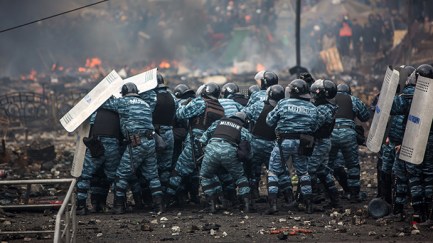
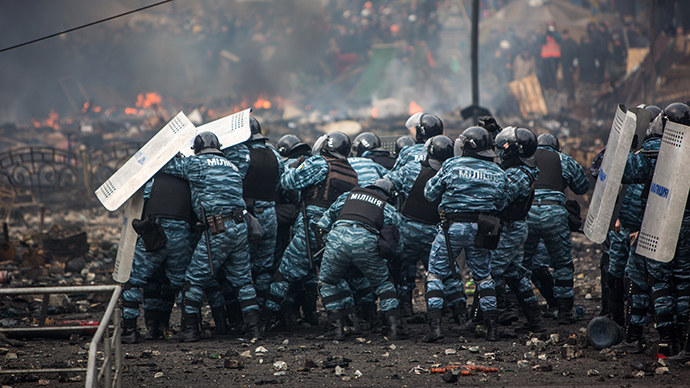
Police officers on Maidan Nezalezhnosti square in Kiev, where clashes began on February 19, 2014 (RIA Novosti / Andrey Stenin)
RT | April 5, 2014
Berkut riot police were targets – not shooters – during the Maidan standoff, ex-Ukrainian Interior Minister Vitaly Zakharchenko said, adding that a fair investigation of the tragic events in Kiev is impossible under the biased, coup-imposed government.
During his interview with Russia’s Channel One, Zakharchenko stressed that he is “100% sure that it wasn’t the police” who used firearms against the people during the February Maidan standoff.
“Berkut riot police were without their service weapons. On February 18 and 1,986 police officers were wounded by gunshots. Fourteen of them died. They were internal troops, military, Berkut, and traffic police, who were shot at their post checkpoint,” he said.
On February 20, Berkut forces and internal troops encountered point shooting in Kiev’s center and “that’s why they actually, began retreating,” the former interior minister explained.
“It’s clear for any reasonable person that if it were the law enforcement officers who opened fire, they would’ve probably been advancing. That would’ve been the reason to use firearms. Meanwhile, they began retreating after the killing of their troops began,” he said.
According to Zakharchenko, the servicemen that were brought to Kiev hospitals had gunshot wounds from 9mm pistols, hunting rifles, buckshots, and smooth-bore weapons.
The ex-minister stressed that the snipers – who fired at both police and demonstrators – were stationed in three buildings, which were under the control of Maidan protestors.
“It was a provocation staged with only one motive – to launch another attack on law enforcement, launch an attack aimed at seizing the governmental buildings and institutes. That’s the logic behind all those events,” he said.
February 20 became the bloodiest day of the Ukrainian coup, with 42 people killed in Kiev.
Zakharchenko believes the self-proclaimed government in Kiev is biased, and is therefore incapable of pursuing a fair investigation of the shootings in country’s capital.
He added that no one is investigating the gunshot wounds received by law enforcement officers during the Maidan standoff.
“Without a nonpartisan international investigation team that would undertake a thorough inquiry into the events that occurred in Ukraine, we won’t get such an objective investigation,” the ex-minister said.
According to Zakharchenko, Western nations – which fully supported the Ukrainian coup – were aware that Maidan radicals had firearms in their possession.
“I had meetings with various international representatives, including the US ambassador to Ukraine, as well as with EU ambassador Jan Tombinski. I repeatedly called them and said that there were firearms at Independence Square,” he said.
The identity of the ‘Maidan snipers’ is a hot topic in Ukraine and abroad. Twelve Berkut officers were detained earlier this week for allegedly being part of the so-called ‘Black Company,’ which was given sniper rifles to provide cover for its retreating comrades on February 20.
Coup-appointed Prime Minister Arseny Yatsenyuk says that ousted President Yanukovich is the one who should answer for the killings of Maidan protesters.
Meanwhile, a phone conversation leaked last month between EU foreign affairs chief Catherine Ashton and Estonian Foreign Minister Urmas Paet contains strong suspicion that the snipers were hired by Maidan leaders.
In his interview, Zakharchenko also criticized the National Guard – the new security force put together by the coup-imposed Ukrainian authorities. The force was created from interior troops and Maidan self-defense forces.
“There is a feeling that they came up with this National Guard in order to create… something like stormtroopers to legalize the militants who don’t want to surrender their weapons, so that they’d carry the real power – thus matching them against the police and the army and restoring order with its own revolutionary forces,” he said.
The National Guard has already recruited 30,000 soldiers, according to Kiev.
RIA Novosti is citing sources in the Ukrainian Defense and Interior Ministries, who say the creation of the National Guard is treated by them as a symbol of distrust from Kiev authorities.
But Zakharchenko has serious doubts about the National Guard’s ability to work effectively.
“Well, I just can’t understand, for example, how they will execute guard duties or how this will look like at all. How can they ensure the rule of law if they were engaged in debacles, if they killed law enforcement officers, attacked them and burned with Molotov cocktails. How much trust will the population have towards those guards? Whom will they be defending?” he said.
Zakharchenko served as Ukraine’s interior minister from November 7, 2011 to February 21, 2014, when parliament removed him from office.
~
5 unanswered questions surrounding Kiev killings
Russia will not import GMO products – PM Medvedev
RT | April 6, 2014
Russia will not import GMO products, the country’s Prime Minister Dmitry Medvedev said, adding that the nation has enough space and resources to produce organic food.
Moscow has no reason to encourage the production of genetically modified products or import them into the country, Medvedev told a congress of deputies from rural settlements on Saturday.
“If the Americans like to eat GMO products, let them eat it then. We don’t need to do that; we have enough space and opportunities to produce organic food,” he said.
The prime minister said he ordered widespread monitoring of the agricultural sector. He added that despite rather strict restrictions, a certain amount of GMO products and seeds have made it to the Russian market.
Earlier, agriculture minister Nikolay Fyodorov also stated that Russia should remain free of genetically modified products.
At the end of February, the Russian parliament asked the government to impose a temporary ban on all genetically altered products in Russia.
The State Duma’s Agriculture Committee supported a ban on the registration and trade of genetically modified organisms. It was suggested that until specialists develop a working system of control over the effects of GMOs on humans and the natural environment, the government should impose a moratorium on the breeding and growth of genetically modified plants, animals, and microorganisms.
Earlier this month, MPs of the parliamentary majority United Russia party, together with the ‘For Sovereignty’ parliamentary group, suggested an amendment of the existing law On Safety and Quality of Alimentary Products, with a norm set for the maximum allowed content of transgenic and genetically modified components.
There is currently no limitation on the trade or production of GMO-containing food in Russia. However, when the percentage of GMO exceeds 0.9 percent, the producer must label such goods and warn consumers. Last autumn, the government passed a resolution allowing the listing of genetically modified plants in the Unified State Register. The resolution will come into force in July.
Related articles
- Duma seeks moratorium on GMO production in Russia (rt.com)
- Total ban on GM food production mulled in Russia (rt.com)
- Russian senators seek ban on GMO-containing foodstuffs (en.itar-tass.com)
Featured Video
American Military Failure in Afghanistan
or go to
Aletho News Archives – Video-Images
Frlom the Archives
The Fiction of the Jewish History in Palestine
By Hasan Afif El-Hasan | The Palestine Chronicle | April 8, 2011
Prime Minister Benjamin Netanyahu told NNC Pierce Morgan on March 18, 2011 that he might agree to a Palestinian state through negotiations. And he added, “We will make territorial concessions although it is very painful to do that in our ancestral land.” Netanyahu was not talking about Poland where his ancestors lived. He was talking about Palestine where generations of its indigenous population ancestors lived, cultivated the land and are buried.
By the end of the nineteenth century, Zionism created a new Jewish identity of blood and soil. To mobilize their followers and supporters and appeal to their emotions, the Zionists created myths. Zionism started as a tribal religion without god, but in order to fulfill its function as a unifying force, Zionism required external religious and race symbols, not inner content. Its leaders regarded metaphysical religious belief and purity of race as having value in itself. They created a divine paradisiacal state of merger with the gods. Despite his non-religious ideology, Herzl’s writings were replete with religious references. The Jews should settle in Palestine because, in his words, “the Temple will be visible from long distance, for it is only our ancient faith that has kept us together”.
The Zionists and their supporters have invested tremendous financial and scholarly resources to work within the Hebrew Bible historical narratives to affirm the links between the intrusive Zionist population and the ancient Israelite past, and by doing so assert the right of that population to the land. The political end-game shaped the investigation and the outcome. Tracing the roots of Israel’s ethnic state in biblical antiquity is effectively to silence the indigenous Palestinian claim to the past and therefore to the land. The Biblical scholarship employs a bewildering array of terms for the region: “the Holy Land”, “the Land of the Bible”, “Eretz Israel”, “the Land of Israel”, or “Judah and Samaria.” To the casual reader these names appear interchangeable, but they all imply connection to ancient Israel.
Biblical narratives or poems that cannot be supported by archeology and common sense are treated by the Zionists and their supporters as historical language. … continue
Blog Roll
 Aletho News
- Hezbollah Returns: It Didn’t Start a War, It Is Ending One
- EU states seek ‘talks’ with Iran for access to Strait of Hormuz: Report
- Trump on Hormuz: “Others must take care of it” after US falters
- Who Is closer to collapse?
- A War that Backfired: Why the US-Israeli Campaign Is Strengthening Iran
- How Zionist Control Is Hurting US Interests
- Iran warns it may target US missile launch sites in UAE cities
- American Military Failure in Afghanistan
- Friendly Skies of Georgia: Are Israeli-Linked Drones Launching False Flags from Georgian Territory?
- The Three Big Lies about Mammography Screening
- If Americans Knew
- No let-up in attacks on Gaza as Israel takes on Iran, Lebanon – Not a ceasefire Day 155
- ‘Of Course’: IDF Drops Case Against Soldiers Accused of Raping Palestinian Prisoner
- Don’t Fall for the Regime Change Talk. Israel Is ‘Mowing the Lawn’ in Iran
- Will Israel and the US wreck the Gulf States along with Iran?
- US so far burned through ‘years’ of munitions in Iran war: Report
- How the Israeli Tail Wags the American Dog
- Outdated intel likely led to deadly U.S. strike on Iranian elementary school, sources say
- Pentagon insider says high U.S official Douglas Feith reported to Netanyahu
- In fond memory of Walid Khalidi, the historian of Palestine
- 6 more Americans killed, as Israel ‘mows the lawn’ in Iran – Not a ceasefire Day 154
- No Tricks Zone
- Storing Green Energy To Last Germany 10 Days Would Require A 60-Million Tonne Battery
- New Studies: UK Sea Levels Were 4 Meters Higher Than Today During The Mid-Holocene
- Destructive Green New Deal: German Energy And Metal Group Warns Of Drastic Crisis
- New Study Documents A 20-Year Pause In Arctic Sea Ice Decline – Driven By Internal Variability
- Wake-up Call: Survey Shows Majority Of Germans Now Favor Postponing Climate Targets!
- Televised! Leading German Political Candidate Tells Schoolchildren CO2 Makes Sun Hotter!
- New Study: A Century Warming Of 1.1°C Is ‘Commonplace’ And ‘Not Unusual’ During This Interglacial
- New Study: ‘Internal Noise’ And Volcanic Forcing Can Trigger 10-15°C Warming Within Decades
- Glaciers Worldwide Are Suddendly Surging, Experts Blame Warming!
- Surprising Discovery: Sahara Is Greening…Billions Of Trees Where Once Thought To Be Barren
 Aletho News