2 southeast Ukrainian regions to hold referendum May 11 as planned
RT | May 8, 2014
The councils of the People’s Republics of two southeastern cities of Donetsk and Lugansk won’t postpone the referendums on their regions’ future as part of Ukraine and will hold them as planned on May, 11, the cities’ anti-government activists said.
“This is not our decision [of the politicians] , this is the decision of people of Donbas region,” said Andrey Purgin, one of the leaders of the self-proclaimed Donetsk People’s Republic, “People of Donbas [Region] got their chance to make a heroic deed and we can’t deprive them from this chance.”
The decision of holding a referendum as scheduled was approved on the council of People’s Republic of Donetsk unanimously.
“People don’t trust Kiev authorities,” Miroslav Rudenko, one of the Donbas self-defense leaders, told Interfax, “Also the reaction of [coup-appointed PM Arseny] Yatsenyuk to the proposal of Russian President [calling for an end to Kiev’s military operation] was inadequate.”
According to another self-defense leader Denis Pushilin, “the region’s people are determined to organize the referendum.”
“There are millions of people who are ready to cast their votes,” he added.
Meanwhile, the council of the People’s Republic of another eastern Ukrainian city, Lugansk, has decided not to postpone the upcoming referendum and to organize it on May 11, said Vasily Nikitin, from the press service which is organizing the referendum.
“The referendum will take place as planned. The ballots have been already arrived at the polling stations,” said Nikitin.
According to him, at the referendum people will be asked if they “support the state independence of People’s Republic of Lugansk.”
He also added that the results of the referendum on the region’s future will be announced Monday.
Leonid Slutsky, the Chairman of the Russia’s State Duma Committee on the Commonwealth of Independent States, said that the refusal of Donetsk and Lugansk regions to postpone the upcoming referendums is their sovereign right.
Russia by proposing to postpone the referendums wanted only to “solve the conflict peacefully and not to allow further escalation of crisis in Ukraine,” he said.
He added that Russia won’t send observers to Donetsk and Lugansk as these referendums are “their internal affair.”
Meanwhile, the Kremlin will analyze the situation on eastern Ukraine’s refusal to postpone the referendum, said President Vladimir Putin’s spokesman, Dmitry Peskov.
He added that Kremlin hasn’t yet received any proposals from the Organization for Security and Cooperation in Europe (OSCE) on Ukraine’s crisis.
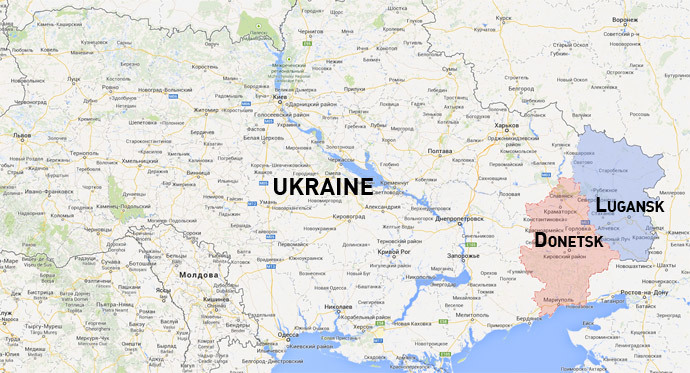
Google Maps
In April, activists in the Donetsk and Lugansk regions, announced they were planning to hold a referendum on their regions’ future as part of Ukraine on Sunday, May 11.
On Wednesday, Russian President Vladimir Putin called on anti-government protesters in southeastern Ukraine to postpone their May 11 federalization referendums.
“We are calling for southeast Ukraine representatives, supporters of federalization of the country, to postpone the May 11 referendum to create the necessary conditions for dialogue,” Putin said at a press conference with OSCE Chairperson-in-Office and Swiss President Didier Burkhalter in Moscow.
Ukraine’s coup-appointed PM Arseny Yatsenyuk criticized Putin’s proposal to postpone the referendum.
“The fact that Russia asks to postpone some referendum? Then we need to inform the Russian president that Ukraine hasn’t planned any referendum on May 11. And if terrorists and separatists, who are supported by Russia, were ordered to postpone what wasn’t planned, then it’s their internal affairs,” he said.
Kiev on Thursday said the military operation in the south-east of Ukraine will continue, regardless of the decision made on the regional referendum.
Earlier Thursday, the head of Ukrainian National Security and Defense Committee, Andrey Parubiy, said that the military operation in the southeast of Ukraine will continue, regardless of the decision made on the Donetsk regional referendum.
“The counter-terrorist operation will continue unhindered, despite the presence of terrorist and insurgent groups in the Donetsk region,” he said.
To Understand Or Not to Understand Putin
By Diana Johnstone | CounterPunch | May 8, 2014
In Germany these days, very many citizens object to the endless Russia-bashing of the NATO-oriented mainstream media. They may point out that the U.S.-backed regime change in Kiev, putting in power an ultra-right transitional government eager to join NATO, posed an urgent threat to preservation of Russia’s only warm water naval base in Crimea. Under the circumstances, and inasmuch as the Crimean population overwhelmingly approved, reinstating Crimea in the Russian federation was a necessary defensive move.
In Germany, anyone who says something like that can be denigrated as a “Putinversteher” (a Putin understander).
That says it all. We are not supposed to understand. We are supposed to hate. The media are there to see to that.
While the West doggedly refuses to understand Putin and Russia, Vladimir Putin, on the other hand, seems to understand things pretty well.
He seems to understand that he and his nation are being systematically lured into a death trap by an enemy which excels in the contemporary art of “communication”. In a war situation, NATO communication means that it doesn’t matter who does what. The only thing that matters is who tells the story. The Western media are telling the story in a way which depends on not understanding Russia, and not understanding Putin. Putin and Russia become fictional villains in the Western version, just the latest reincarnation of Hitler and Nazi Germany.
The horrific massacre in Odessa on May 2 proved this. The photographic evidence, the testimony of numerous eye witnesses, the smoldering bodies and the shouts of the killers are all there to prove what happened. Tents erected to collect signatures in favor of a referendum to introduce a federal system into Ukraine (now a politically divided but totally centralized state) were set on fire by a militia of fascist thugs who attacked the local federalists as “separatists” (accusing them of wanting to “separate” from Ukraine to join Russia, when that is not what they are seeking). The local activists fled into the big trade union building on the square where they were pursued, assaulted, murdered and set on fire by “Ukrainian nationalists”, acting on behalf of the illegitimate Kiev regime supported by the West.
No matter how vicious the assaults, Western media saw no evil, heard no evil, spoke no evil. They deplored a “tragedy” which just sort of happened.
Odessa is proof that whatever happens, the NATO political class, political leaders and media united, have decided on their story and are sticking to it. The nationalists that seized power in Kiev are the good guys, the people being assaulted in Odessa and in Eastern Ukraine are “pro-Russian” and therefore the “bad guys”.
Understanding Putin
So despite everything, let’s try to understand President Putin, which is really not very hard. Behind every conscious action there should be a motive. Let’s look at motives. Today, UK Foreign Secretary William Hague, who certainly gives every sign of never understanding – or wanting to understand – anything, parroted the NATO line that Russia was “trying to orchestrate conflict and provocation” in Ukraine’s east and south.
That makes no sense. Putin has absolutely no motive to want civil war to rage in neighboring Ukraine, and very strong reasons to do all he can to avoid it. It confronts him with a serious dilemma. Ongoing vicious attacks by fanatic nationalists from Western Ukraine on citizens in the east and south of the country can only incite the victimized Russian-speaking Ukrainians to call on Russia for help. But at the same time, Putin must know that those Russophone Ukrainians do not really want to be invaded by Russia. Perhaps they want something impossible. And it is perfectly obvious that any use of Russia’s military force to protect people in Ukraine would let loose an even wilder demonization of Putin as “the new Hitler” who is invading countries “for no reason”. And NATO would use this, as it has already used the reunification of Crimea with Russia, as “proof” that Europe must tighten its alliance, establish military bases throughout Eastern Europe and (above all) spend more money on “defense” (buying US military equipment).
The Western takeover of the Kiev government is clearly a provocation to draw Putin into a trap that certain Western strategists (Zbigniew Brzezinski being the chief theorist) hope will cause Putin’s downfall and plunge Russia into a crisis that can lead to its eventual dismemberment.
Putin can only wish to find a peaceful solution to the Ukrainian mess.
While Washington reverts to Cold War “containment” policy to “isolate” Russia, Putin today held talks in Moscow with Didier Burkhalter, the Swiss president and current chairman of the Organization for Security and Co-operation in Europe (OSCE), in hope of initiating some sort of peaceful mediation.
Putin Pulls Back From False Flag Plan?
On this occasion, Putin announced that he had pulled back Russian forces from the border with Ukraine. He indicated that this was to ease concerns over their positioning, meaning claims that Russia was preparing an invasion. He also advised against holding referendums for greater autonomy in the Russophone areas until “conditions for dialogue” can be created.
However, news reports indicated that this reported military pullback caused new concerns among some Ukrainians, who felt Russia was abandoning them in their hour of need, and among some Russians, who feared the President was backing down under Western pressure.
It is not impossible that the pullback order was linked to a Novosti RIA report dated May 6, which indicated that the Ukrainian secret service was planning an imminent false flag operation in order to accuse Russia of violating the border with Ukraine.
Novosti said it had learned from security circles in Kiev that the Ukrainian secret service SBU had secretly shipped about 200 Russian army uniforms and some 70 forged Russian officer IDs into the Eastern Ukrainian protest stronghold of Donetz, to be used to stage a false attack on Ukrainian border patrols.
Novosti said the reports were unconfirmed, but they could nevertheless be taken seriously by the Russians. “The plan would be to simulate an attack on Ukrainian border troops and to film it for the media”, the report said. In connection with the plan, a dozen or so combatants from the ultranationalist Right Sector were to cross the border and kidnap a Russian soldier in order to present him as “proof” of Russian military incursion. The operation was scheduled for May 8 or 9.
By pulling Russian troops farther away from the border, Putin could hope to make the false flag operation less plausible and perhaps to forestall it.
The whole Ukrainian operation, at least partly directed by Victoria Nuland of the U.S. State Department, has been characterised by false flag operations, most notoriously by the snipers who suddenly spread murder and terror in Maidan square in Kiev, effectively wrecking the internationally sponsored transition agreement. “Pro-West” insurgents accused President Yanukovych of sending the killers and forced a rump parliament to give government power to Ms Nuland’s protégé, Arseniy “Yats” Yatsenyuk. However, there has been plenty of evidence to show that the mysterious snipers were pro-West mercenaries: photographic evidence, followed by the telephone statement by the Polish foreign minister to that effect, and finally by the German television channel ARD whose Monitor documentary concluded that the snipers came from the extreme right anti-Russian groups involved in the Maidan uprising. Indeed, all known evidence points to a fascist false flag operation, and yet Western media and politicians continue to blame everything on Russia.
So whatever he does, Putin now has to realize that he will be deliberately “misunderstood” and misrepresented by Western leaders and media. Over the heads of the American people, over the heads of the Germans, French and other Europeans, a private consensus has obviously been reached among persons we may describe as our own Western “oligarchs” to revive the Cold War in order to provide the West with an “enemy” serious enough to save the military-industrial complex and unite the transatlantic community against the rest of the world.
This is what Russian leaders are obliged to understand. What they need most to save the world from endless and useless conflict is the understanding of all those Americans and Europeans who have never been consulted or informed about this perilous shift in strategy, and who, if they understood, would surely say no.
Diana Johnstone is the author of Fools’ Crusade: Yugoslavia, NATO, and Western Delusions. She can be reached at diana.johnstone@wanadoo.fr
The Kiev Putsch: Rebel Workers Take Power in the East
By James Petras | May 7, 2014
Not since the US and EU took over Eastern Europe, including the Baltic countries, East Germany, Poland, and the Balkans and converted them into military outposts of NATO and economic vassals, have the Western powers moved so aggressively to seize a strategic country, such as the Ukraine, posing an existential threat to Russia.
Up until 2013 the Ukraine was a ‘buffer state’, basically a non-aligned country, with economic ties to both the EU and Russia. Ruled by a regime closely tied to local, European, Israeli and Russian based oligarchs, the political elite was a product of a political upheaval in 2004, (the so-called “Orange Revolution”) funded by the US. Subsequently, for the better part of a decade the Ukraine underwent a failed experiment in Western backed ‘neo-liberal’ economic policies. After nearly two decades of political penetration, the US and EU were deeply entrenched in the political system via long-standing funding of so-called non-governmental organizations (NGOs), political parties and paramilitary groups.
The strategy of the US and EU was to install a pliant regime which would bring Ukraine into the European Common Market and NATO as a subordinate client state. Negotiations between the EU and the Ukraine government proceeded slowly. They eventually faltered because of the onerous conditions demanded by the EU and the more favorable economic concessions and subsidies offered by Russia. Having failed to negotiate the annexation of the Ukraine to the EU, and not willing to await scheduled constitutional elections, the NATO powers activated their well-financed and organized NGOs, client political leaders and armed paramilitary groups to violently overthrow the elected government. The violent putsch succeeded and a US-appointed civilian-military junta took power.
The junta was composed of pliant neo-liberal and chauvinist neo-fascist ‘ministers’. The former were hand-picked by the US, to administer and enforce a new political and economic order, including privatization of public firms and resources, breaking trade and investment ties with Russia, eliminating a treaty allowing the Russian naval base in Crimea and ending military-industrial exports to Russia. The neo-fascists and sectors of the military and police were appointed to ministerial positions in order to violently repress any pro-democracy opposition in the West and East. They oversaw the repression of bilingual speakers (Russian-Ukrainian), institutions and practices – turning the opposition to the US-NATO imposed coup regime into an ethnic opposition. They purged all elected opposition office holders in the West and East and appointed local governors by fiat – essentially creating a martial law regime.
The Strategic Targets of the NATO-Junta
NATOs violent, high-risk seizure of the Ukraine was driven by several strategic military objectives. These included:
1) The ousting of Russia from its military bases in Crimea – turning them into NATO bases facing Russia.
2) The conversion of the Ukraine into a springboard for penetrating Southern Russia and the Caucasus; a forward position to politically manage and support liberal pro-NATO parties and NGOs within Russia.
3) The disruption of key sectors of the Russian military defense industry, linked to the Ukrainian factories, by ending the export of critical engines and parts to Russia.
The Ukraine had long been an important part of the Soviet Union’s military industrial complex. NATO planners behind the putsch were keenly aware that one-third of the Soviet defense industry had remained in the Ukraine after the break-up of the USSR and that forty percent of the Ukraine’s exports to Russia, until recently, consisted of armaments and related machinery. More specifically, the Motor-Sikh plant in Eastern Ukraine manufactured most of the engines for Russian military helicopters including a current contract to supply engines for one thousand attack helicopters. NATO strategists immediately directed their political stooges in Kiev to suspend all military deliveries to Russia, including medium-range air-to air-missiles, inter-continental ballistic missiles, transport planes and space rockets (Financial Times, 4/21/14, p3). US and EU military strategists viewed the Kiev putsch as a way to undermine Russian air, sea and border defenses. President Putin has acknowledged the blow but insists that Russia will be able to substitute domestic production for the critical parts within two years. This means the loss of thousands of skilled factory jobs in Eastern Ukraine.
4. The military encirclement of Russia with forward NATO bases in the Ukraine matching those from the Baltic to the Balkans, from Turkey to the Caucasus and then onward from Georgia into the autonomous Russian Federation.
The US-EU encirclement of Russia is designed to end Russian access to the North Sea, the Black Sea and the Mediterranean. By encircling and confining Russia to an isolated landmass without ‘outlets to the sea’, US-EU empire builders seek to limit Russia’s role as a rival power center and possible counter-weight to its imperial ambitions in the Middle East, North Africa, Southwest Asia and the North Atlantic.
Ukraine Putsch: Integral to Imperial Expansion
The US and EU are intent on destroying independent, nationalist and non-aligned governments throughout the world and converting them into imperial satellites by whatever means are effective. For example, the current NATO-armed mercenary invasion of Syria is directed at overthrowing the nationalist, secular Assad government and establishing a pro-NATO vassal state, regardless of the bloody consequences to the diverse Syrian people. The attack on Syria serves multiple purposes: Eliminating a Russian ally and its Mediterranean naval base; undermining a supporter of Palestine and adversary of Israel; encircling the Islamic Republic of Iran and the powerful militant Hezbollah Party in Lebanon and establishing new military bases on Syrian soil.
The NATO seizure of the Ukraine has a multiplier effect that reaches ‘upward’ toward Russia and ‘downward’ toward the Middle East and consolidates control over its vast oil wealth.
The recent NATO wars against Russian allies or trading partners confirm this prognosis. In Libya, the independent, non-aligned policies of the Gaddafi regime stood out in stark contrast to the servile Western satellites like Morocco, Egypt, and Tunisia. Gaddafi was overthrown and Libya destroyed via a massive NATO air assault. Egypt’s mass popular anti-Mubarak rebellion and emerging democracy were subverted by a military coup and eventually returned the country to the US-Israeli-NATO orbit – under a brutal dictator. Armed incursions by NATO proxy, Israel, against Hamas in Gaza and Hezbollah in Lebanon as well as the US-EU sanctions against Iran are all directed against potential allies or trading partners of Russia.
The US has moved forcefully from encircling Russia via ‘elections and free markets’ in Eastern Europe to relying on military force, death squads, terror and economic sanctions in the Ukraine, the Caucasus, the Middle East and Asia.
Regime Change in Russia: from Global Power to Vassal State
Washington’s strategic objective is to isolate Russia from without, undermine its military capability and erode its economy, in order to strengthen NATO’s political and economic collaborators inside Russia – leading to its further fragmentation and return to the semi-vassal status.
The imperial strategic goal is to place neo-liberal political proxies in power in Moscow, just like the ones who oversaw the pillage and destruction of Russia during the infamous Yeltsin decade. The US-EU power grab in the Ukraine is a big step in that direction.
Evaluating the Encirclement and Conquest Strategy
So far NATO’s seizure of the Ukraine has not moved forward as planned. First of all, the violent seizure of power by overtly pro-NATO elites openly reneging on military treaty agreements with Russia over bases in Crimea, had forced Russia to intervene in support of the local, overwhelmingly ethnic Russian population. Following a free and open referendum, Russia annexed the region and secured its strategic military presence.
While Russia retained its naval presence on the Black Sea … the NATO junta in Kiev unleashed a large-scale military offensive against the pro-democracy, anti-coup Russian-speaking majority in the eastern half of the Ukraine who have been demanding a federal form of government reflecting Ukraine’s cultural diversity. The US-EU promoted a “military response” to mass popular dissent and encouraged the coup-regime to eliminate the civil rights of the Russian speaking majority through neo-Nazi terror and to force the population to accept junta-appointed regional rulers in place of their elected leaders. In response to this repression, popular self-defense committees and local militias quickly sprang up and the Ukrainian army was initially forced back with thousands of soldiers refusing to shoot their own compatriots on behalf of the Western-installed regime in Kiev. For a while, the NATO-backed neo-liberal-neo-fascist coalition junta had to contend with the disintegration of its ‘power base’. At the same time, ‘aid’ from the EU, IMF, and the US failed to compensate for the cut-off of Russian trade and energy subsidies. Under the advise of visiting US CIA Director, Brenner, the Kiev Junta then dispatched its elite ‘special forces’ trained by the CIA and FBI to carry out massacres against pro-democracy civilians and popular militias. They bussed in armed thugs to the diverse city of Odessa who staged an ‘exemplary’ massacre: Burning the city’s major trade union headquarters and slaughtering 41, mostly unarmed civilians who were trapped in the building with its exits blocked by neo-Nazis. The dead included many women and teenagers who had sought shelter from the rampaging neo-Nazis. The survivors were brutally beaten and imprisoned by the ‘police’ who had passively watched while the building burned.
The Coming Collapse of the Putsch-Junta
Obama’s Ukraine power grab and his efforts to isolate Russia have provoked some opposition in the EU. Clearly US sanctions prejudice major European multi-nationals with deep ties in Russia. The US military build-up in Eastern Europe, the Balkans, and the Black Sea raises tensions and threatens a large-scale military conflagration, disrupting major economic contracts. US-EU threats on Russia’s border have increased popular support for President Putin and strengthened the Russian leadership. The strategic power grab in the Ukraine has radicalized and deepened the polarization of Ukrainian politics-between neo-fascist and pro-democracy forces.
While the imperial strategists are extending and escalating their military build-up in Estonia and Poland and pouring arms into the Ukraine, the entire power grab rests on very precarious political and economic foundations- which could collapse within the year – amidst a bloody civil war/inter-ethnic slaughter.
The Ukraine junta has already lost political control of over a third of the country to pro-democracy, anti-coup movements and self-defense militias. By cutting off strategic exports to Russia to serve US military interests, the Ukraine lost one of its most important markets, which cannot be replaced. Under NATO control, Ukraine will have to buy NATO-specified military hardware leading to the closure of its factories geared to the Russian market. The loss of Russian trade is already leading to mass unemployment, especially among skilled industrial workers in the East who may be forced to immigrate to Russia. Ballooning trade deficits and the erosion of state revenues will bring a total economic collapse. As a result of the Kiev junta’s submission to NATO, the Ukraine has lost billions of dollars in subsidized energy from Russia. High energy costs make Ukrainian industries non-competitive in global markets. In order to secure loans from the IMF and the EU, the junta has agreed to eliminate food and energy price subsidies, severely depressing household incomes and plunging pensioners into destitution. Bankruptcies are on the rise, as imports from the EU and elsewhere displace formerly protected local industries.
No new investments are flowing in because of the violence, instability and conflicts between neo-fascists and neo-liberals within he junta. Just to stabilize the day-to-day operations of government, the junta needs a no-interest $30 billion dollar handout – from its NATO patrons, an amount, which is not forthcoming now or in the immediate future.
It is clear that NATO ‘strategists’ who planned the putsch were only thinking about weakening Russia militarily and gave no thought to the political, economic, and social costs of sustaining a puppet regime in Kiev when Ukraine had been so dependent on Russian markets, loans, and subsidized energy. Moreover, they appear to have overlooked the political, industrial, and agricultural dynamics of the predictably hostile Eastern regions of the country. Alternately, Washington strategists may have based their calculations on instigating a Yugoslavia-style break-up accompanied by massive ethnic cleansing amidst population transfers and slaughter. Undeterred by the millions of civilian casualties, Washington considers its policy of dismantling Yugoslavia, Iraq, and Libya to have been great political-military successes.
Ukraine most certainly will enter a prolonged and deep depression, including a precipitous decline in its exports, employment, and output. Possibly, economic collapse will lead to nationwide protests and social unrest: spreading from East to West, from South to North. Social upheavals and mass misery may further undermine the morale of the Ukrainian armed forces. Even now, Kiev can barely afford to feed its soldiers and has to rely on neo-Fascist volunteer militias who may be hard to control. The US-EU are not likely to intervene directly with a Libya-style bombing campaign since they would face a prolonged war on Russia’s border at a time when public opinion in the US is suffering from imperial war exhaustion, and European business interests with links to Russian resource companies are resisting consequential sanctions.
The US-EU putsch has produced a failing regime and a society riven by violent conflicts – spinning into open ethnic violence. What, in fact, has ensued is a system of dual power with contenders cutting across regional boundaries. The Kiev junta lacks the coherence and stability to serve as a reliable NATO military link in the encirclement of Russia. On the contrary, US-EU sanctions, military threats and bellicose rhetoric are forcing Russians to quickly rethink their ‘openness’ to the West. The strategic threats to its national security are leading Russia to review its ties to Western banks and corporations. Russia may have to resort to a policy of expanded industrialization via public investments and import substitution. Russian oligarchs, having lost their overseas holdings, may become less central to Russian economic policy.
What is clear is that the power grab in Kiev will not result in a ‘knife pointed at the heartland of Russia’. The ultimate defeat and overthrow of the Kiev junta can lead to a radicalized self-governing Ukraine, based on the burgeoning democratic movements and rising working class consciousness. This will have to emerge from their struggle against IMF austerity programs and Western asset stripping of Ukraine’s resources and enterprises. The industrial workers of Ukraine who succeed in throwing off the yoke of the western vassals in Kiev have no intention of submitting themselves to the yoke of the Russian oligarchs. Their struggle is for a democratic state, capable of developing an independent economic policy, free of imperial military alliances.
Epilogue:
May Day 2014: Dual Popular Power in the East, Fascism Rising in the West
The predictable falling out between the neo-fascists and neo-liberal partners in the Kiev junta was evidenced by large-scale riots, between rival street gangs and police on May Day. The US-EU strategy envisioned using the neo-fascists as ‘shock troops’ and street fighters in overthrowing the elected regime of Yankovich and later discarding them. As exemplified by the notorious taped conversation between Assistant Secretary of State, Victoria Nuland and the US Ambassador to Kiev, the EU-US strategists promote their own handpicked neo-liberal proxies to represent foreign capital, impose austerity policies and sign treaties for foreign military bases. In contrast, the neo-fascist militias and parties would favor nationalist economic policies, retaining state enterprises and are likely to be hostile to oligarchs, especially those with ‘dual Israeli-Ukraine’ citizenship.
The Kiev junta’s inability to develop an economic strategy, its violent seizure of power and repression of pro-democracy dissidents in the East has led to a situation of ‘dual power’. In many cases, troops sent to repress the pro-democracy movements have abandoned their weapons, abandoned the Kiev junta and joined the self-governing movements in the East.
Apart from its outside backers-the White House, Brussels and IMF – the Kiev junta has been abandoned by its right-wing allies in Kiev for being too subservient to NATO and resisted by the pro-democracy movement in the East for being authoritarian and centralist. The Kiev junta has fallen between two chairs: it lacks legitimacy among most Ukrainians and has lost control of all but a small patch of land occupied by government offices in Kiev and even those are under siege by the neo-fascist right and increasingly from its own disenchanted former supporters.
Let us be absolutely clear, the struggle in the Ukraine is not between the US and Russia, it is between a NATO-imposed junta composed of neo-liberal oligarchs and fascists on one side and the industrial workers and their local militias and democratic councils on the other. The former defends and obeys the IMF and Washington; the latter relies on the productive capacity of local industry and rules by responding to the majority.
Moscow’s roadmap for Ukraine settlement sees mixed response
RT | May 8, 2014
Moscow’s call on pro-federalization protesters in Ukraine to postpone the referendums was welcomed by the West and Kiev, yet they still do not recognize the need to halt the military op in southeast as a prerequisite for national dialogue and elections.
Ukraine presidential hopeful Pyotr Poroshenko (UDAR Party) has welcomed President Vladimir Putin’s statements, saying that the situation significantly improved following the news from Moscow. “We have an appeal to stop an illegal referendum, Russia accepting presidential elections. I think this is great news for stabilizing the situation in eastern Ukraine,” Poroshenko told reporters in Berlin.
On Wednesday, Putin called the presidential election in Ukraine, now scheduled for May 25, “a move in the right direction” adding however it would mean nothing unless all citizens of Ukraine have a full understanding of how their rights would be guaranteed afterwards.
The direct dialogue between Kiev and representatives of the southeastern regions is the “key element” of settling the conflict, Putin said, supported on this by the OSCE Chairperson-in-Office and Swiss President Didier Burkhalter. In order to “create the necessary conditions for this dialogue,” Putin urged rescheduling of the referendum planned by anti-government protesters to determine the future of southeastern Ukraine.
However, for a dialogue to succeed, a ceasefire and halt of any violence should take place by all the military, paramilitary and illegal radical armed groups, Putin added. “Russia urgently appeals to the authorities in Kiev to cease immediately all military and punitive operations in southeast Ukraine,” he said.
Russia is not responsible for the deepening crisis in Ukraine, Putin reiterated, reciting concrete steps it made to de-escalate tensions.
“We have been told that our troops by the Ukrainian border are a concern – we have withdrawn them. They are now not near the border, but at locations where they conduct regular drills at ranges,” he said. “This can be easily verified using modern intelligence techniques, including from space, where everything can be seen.”
“We helped to secure the OSCE military observers’ release and I think also made a contribution to defusing the situation,” he added.
The President of the European Council, Herman Van Rompuy, noted on Wednesday evening that a “genuine national dialogue and the cessation of acts of violence and provocations are essential elements in advancing towards a political solution.”
“I take note of President Putin’s recent statements signalling a willingness to de-escalate the situation, including his call to refrain from holding a referendum in the Eastern part of Ukraine and the stated withdrawal of Russian troops from the borders of Ukraine,” Rompuy said.
The United States however claimed that, although being a step forward, is not enough and Russia should try harder to deescalate tensions in Ukraine.
“It is a helpful step but again there is far more the President Putin and the Russians can do to deescalate the situation and to ensure safe elections,” US State Department spokeswoman Jen Psaki told journalists on Wednesday evening, without elaborating on which other moves she was expecting from Russia.
Shortly afterwords, Ukraine’s foreign ministry issued a statement welcoming the “important role of the OSCE in international efforts aimed at de-escalating the situation”, but adding that Moscow was covering up its “support of terrorist actions against Ukrainian citizens” behind a facade of “good will”.
“A full-scale national dialogue… is an absolute priority of the Government of Ukraine,” the ministry’s statement reads.“However, a dialogue with terrorists is impermissible and inconceivable. Protection of peoples’ lives and elimination of terrorism which undermines any possibility of the dialogue is the goal of the anti-terrorist operation being conducted in certain locations in the east of our country.”
The OSCE was ready to take responsibility for coordinating the “road-map” to resolve the crisis and negotiations with the US and the EU would be taking place soon, Burkhalter said earlier. But Ukraine’s FM stated that discussion of the peaceful settlement in Ukraine “without Ukraine” is “senseless and unacceptable.”
Representatives of the southeast in the meantime said they were ready for negotiations with Kiev and would on Thursday discuss possible rescheduling of the referendum.
But neither those in power in Kiev, nor the United States seem to be interested in accepting any kind of road-map that could bring about peaceful solution to the crisis, Lawrence Freeman of the Executive Intelligence Review magazine told RT.
“You have to keep in mind that the US State Department and in particular Victoria Nuland, who has been behind this coup since the end of last year, these are people who are actually running the show. And they want to force a confrontation. They’ve been lying about the entire situation since February 21-22… have not been telling the truth about who is actually responsible for the confrontations in Kiev and in Eastern Ukraine,” Freeman said.
The road-map proposed by President Putin and the OSCE chief, Freeman believes, is the best way of ”avoiding the confrontation” some would like to have with Russia.
“I think President Putin is actually strategically handling the situation quite well. Because he knows that there are people who would like to use this conflict to escalate to major war. So he is outmaneuvering the actual people behind this,” Freeman said.
If authorities in Kiev are really worried about Ukraine’s future as a country and its territorial integrity, Freeman says they have no other choice but stop their full-scale military operation against the population in the southeast.
“They have to, if they want to have a country,” he said. “They cannot allow neo-Nazis and right-wing fascists to run the country, to be part of security and military operation. If they want to be a country – they can’t do that.”
Putin – Burkhalter talks: an eluding chance for Ukraine
ORIENTAL REVIEW | May 8, 2014
A couple of brief remarks on today’s meeting in Kremlin between Russian President Vladimir Putin and OSCE Chairperson-in-Office Didier Burkhalter:
1. The elaborated framework of the road map for de-escalation in Ukraine consists of four basic provisions: ceasefire, deescalation (withdrawal of troops and disarmament of illegal armed groups), initiation of national reconciliation dialogue and holding elections. The ball is obviously on Kiev’s side. Any further attempt to repress the protest in the South-East will definitely close this narrow window of opportunity.
2. Putin’s request to postpone referenda on independence in Donetsk and Lugansk is an act of good will. Being aware of the public mood in these regions it is very unlikely that the ballot will be held off. People there are counting days to have a legal foundation to get rid of Kiev’s dictate. By the way, such development would undermine traditional Western claims that Putin is manipulating the protests in the South-East of Ukraine.
3. The Russian President emphasized again that “the blame for the crisis… lies with those who organised the coup d’etat in Kiev and have not yet taken the trouble to disarm right-wing radical and nationalist groups.” That means that prior to such disarmament there would be no dialogue and no elections.
4. It was also stressed that the draft new constitution of Ukraine should be discussed during this national reconciliation dialogue and again, prior to the elections.
5. The situation on the ground suggests that this road-map would take at least 6 months to be implemented and require a substantial participation of the legitimate Ukrainian president Victor Yanukovych.
This is the last (and rather unexpected) chance to retain a united federative Ukraine. Taking into account highly contradicting interests of the international centers of power which dominate over the current Kiev administration, it would be almost impossible to keep this narrow window open for this term. But apparently Hope will be the last victim of the ongoing Ukrainian crisis…
U.S. National Climate Assessment Report
By Judith Curry | May 6, 2014
Climate change, once considered a problem for the distant future, has moved firmly into the present. Climate change is already affecting the American people. – U.S. NCADAC
The U.S. National Climate Assessment Report was published Tuesday [link]. I’ve read half of the chapters (at the beginning and end), skimming the ones in the middle.
My main conclusion from reading the report is this: the phrase ‘climate change’ is now officially meaningless. The report effectively implies that there is no climate change other than what is caused by humans, and that extreme weather events are equivalent to climate change. Any increase in adverse impacts from extreme weather events or sea level rise is caused by humans. Possible scenarios of future climate change depend only on emissions scenarios that are translated into warming by climate models that produce far more warming than has recently been observed.
Some of the basic underlying climate science and impacts reported is contradictory to the recent IPCC AR5 reports. Pat Michaels and Chip Knappenberger have written a 134 page critique of a draft of the NCADAC report [link].
Even in the efforts to spin extreme weather events as alarming and caused by humans, Roger Pielke Jr. has tweeted the following quotes from the Report:
- “There has been no universal trend in the overall extent of drought across the continental U.S. since 1900″
- “Other trends in severe storms, including the intensity & frequency of tornadoes, hail, and damaging thunderstorm winds, are uncertain”
- “lack of any clear trend in landfall frequency along the U.S. eastern and Gulf coasts”
- “when averaging over the entire contiguous U.S., there is no overall trend in flood magnitudes”
As a I wrote in a previous post on a draft of the report, the focus should be on the final Chapter 29: Research Agenda, which outlines what we DON’T know. Chapter 28 Adaptation is also pretty good. Chapter 27 Mitigation is also not bad, and can hardly be said to make a strong case for mitigation. Chapter 26 on Decision Support is also ok, with one exception: they assume the only scenarios of future climate are tied to CO2 emissions scenarios.
An interesting feature of the report is Traceable Accounts – for each major conclusion a Traceable Account is given that describes the Key Message Process, Description of evidence base, New information and remaining uncertainties, Assessment of confidence based on evidence. The entertainment value comes in reading the description of very substantial uncertainties, and then seeing ‘very high confidence’. This exercise, while in principle is a good one, in practice only serves to highlight the absurdity of the ‘very high confidence’ levels in this report.
White House
Apparently President Obama is embracing this Report, and the issue of climate change, in a big way, see this WaPo article For President Obama A Renewed Focus On Climate. Motherboard has an interesting article How extreme weather convinced Obama to fight climate change.
In an interesting move, Obama Taps TV Meteorologists to Roll Out New Climate Report, which describes how Obama is giving interviews to some TV weathermen. It will be interesting to see how this strategy plays out, since TV weathermen tend to be pretty skeptical of AGW.
The politics on this are interesting also, see especially these two articles
- White house set to lay out climate risks as it touts U.S. energy boom
- Podesta: Congress can’t stop Obama on global warming
JC reflections
While there is some useful analysis in the report, it is hidden behind a false premise that any change in the 20th century has been caused by AGW. Worse yet is the spin being put on this by the Obama administration. The Washington Post asks the following question: Does National Climate Assessment lack necessary nuance? In a word, YES.
The failure to imagine future extreme events and climate scenarios, other than those that are driven by CO2 emissions and simulated by deficient climate models, has the potential to increase our vulnerability to future climate surprises (see my recent presentation on this Generating possibility distributions of scenarios for regional climate change). As an example, the Report highlights the shrinking of winter ice in the Great Lakes: presently, in May, Lake Superior is 30% covered by ice, which is apparently unprecedented in the historical record.
The big question is whether the big push by the White House on climate change will be able to compete with this new interview with Monica Lewinsky :)
When Our Land is Free, We are Free
By Silas Kpanan’Ayoung Siakor & Jacinta Fay | The Ecologist | May 7, 2014
Right now in Abuja, Nigeria, agribusiness corporations are courting African governments at the Grow Africa Investment Forum to “further accelerate sustainable agricultural growth in Africa”.
That sounds harmless enough, until you know what it really means. Corporate interest in agriculture in Africa has certainly accelerated corporate control of land, seeds and water. But it has done little to support agriculture that will feed the continent.
Rather than support family farming and smallholder agriculture, private sector investment in agriculture has resulted in grabbing land from communities – the land which they farm sustainably and rely on for their survival.
Resisting the corporate bully boys
Communities are resisting this corporate takeover of their land and they are winning. All over Africa people are sending a clear message to their governments: “Stop selling Africa to corporations!” The Jogbahn Clan in Liberia is one such community and here is their story.
The sense of jubilation in Blayahstown, small town in Liberia, is palpable. People come from surrounding villages to join in the celebrations and the town is filled with singing and dancing.
The Jogbahn Clan is celebrating a victory as the President of Liberia has now recognised their right to say no Equatorial Palm Oil (EPO) a British palm oil company grabbing their land.
This is no small feat in a country where over 50% of the land has been given to corporations without the consent of the communities who customarily own the land.
We come from this land – it is ours!
The sense of accomplishment is not lost on Chief Elder Chio Johnson who looks like he hasn’t stopped smiling since he returned from the Clan’s meeting with the President of Liberia – where she committed to support them in protecting their land from being grabbed by EPO.
“Why should a company take away our livelihood?” asked Chio. “We come from this land. Everything our ancestors left us is preserved in the forest, so why should we give up our forest?”
Walking through the forest with Deyeatee Kardor, the Clan’s Chairlady, she picks leaves and describes the different medicines that they can be used for. She recounts how she and her family hid in the forest throughout the Civil War and managed to survive on the plants and fruits growing in the bush.
Though the land bears the scars of the recent past it also represents the Clan’s ancestral home and they would not willingly allow this deep connection to the land to be fractured.
20,000 hectares of community land given away
 “The land gives us everything”, Chio says as he surveys the area; the vegetables, wild palm and sugar cane growing all around. Like other rural communities in Liberia they make their livelihood from the land they manage collectively.
The clan are self-sufficient and manage the land sustainably. For the Clan, to lose their land is to lose everything.
The communities’ resistance began in 2012 when EPO began to expand their plantation onto the community land of eleven towns. The Government of Liberia and EPO had signed a concession agreement allowing the company’s plantation to engulf communities’ land amounting to over 20,000 hectares.
Communities all over Liberia are facing the same threat as their lands are given to companies without their consent. As a result conflict between communities and companies has been widespread.
Police and EPO security intimidation
The Clan organised and came together to resist their land being grabbed. Men, women and youth from the affected towns chose representatives to form a core group to lead the resistance.
They met the company and the government several times to object to the company’s expansion. In spite of this towards the end of 2012 EPO began clearing and planting their land, destroying crops and farmland.
In September 2013 EPO began surveying the communities’ land without their consent. When the communities attempted to stop the survey a paramilitary police unit was deployed into the area, and began to run a campaign of harassment and intimidation by both the police and EPO’s security force.
They drove through villages at night flashing their emergency lights and arrived in villages riding on top of vehicles the same way rebel fighters did during the war.
People were also assaulted during a peaceful march and 17 people suffered arbitrary arrest. The Clan Chief was also suspended from his position by the government because he spoke out against the company.
Divide and rule – this time, it failed
Despite these aggressive tactics the community continued resisting. They lodged a complaint to the Roundtable on Sustainable Palm Oil (RSPO) and presented a petition to the government stating their objections.
“All they have done is try to divide us”, commented Deyeatee. “They offer important people a little money to try to convince them.”
However the community refused to be weakened by division and eventually secured the crucial meeting with the Liberian President Ellen Johnson Sirleaf where she recognised their right to say ‘no’ to the company.
“The struggle has made us stronger than ever before and we’ve learned a lesson to stay united”, said Anthony Johnson, a youth representative.
“The success is so great as it secures my future and the future of my children to come. I will stay on this land and plant crops for my children so future generations can live off the land.”
But for EPO, it’s business as usual
Despite the President’s commitment EPO has still not recognised that the Clan has said no to their operations. They are operating as if things are business as usual and conducting studies of the Clan’s land in preparation for clearing.
But the Clan are not discouraged and they continue their resistance for the hope of a better future.
Land clearance and other preparatory activities would be unlawful, as they do not respect communities’ right to give or withhold their Free Prior and Informed Consent, which is a requirement provided for under both national and international law.
“We want the government to support us to be self-sufficient on our land instead of giving it to a company who will just take the money and go home”, said Garmondeh Benwon, who suffered assault on the march. ”Instead we can keep the money in Liberia and we can live better lives.”
Organise and resist!
Every year, an area five times the land size of Liberia is grabbed from communities around the world. The Jogbahn Clan show that stopping it is possible when communities stand together, mobilise and resist.
The government has recognised their right to say no – and now EPO and KLK, their majority shareholder, must do the same.
It is a privilege to work in solidarity with the Clan and their drive and resilience has been a constant source of inspiration for everyone in SDI / FoE Liberia.
The Clan are preparing to share the lessons of their struggle and give hope to other communities resisting land-grabbing. And as Deyeatee says:
“I am very happy my land is free – because when our land is free, we’re all free.”
Silas Siakor is a campaigner on Community Rights and the founder of the Sustainable Development Institute/Friends of the Earth, Liberia a national civil society organisation promoting the sustainable and just use of Liberia’s natural resources. Silas has received the Goldman Environmental Prize in 2006, the Award for Extraordinary Achievement in Environmental and Human Rights Activism from The Alexander Soros Foundation in 2012 and TIME Magazine chose him as one of the 2008 Heroes of the Environment.
Jacinta Fay is a community worker and campaigner for the Community Rights and Corporate Governance Programme of the Sustainable Development Institute/Friends of the Earth Liberia which supports communities protect their land and resources and challenges corporate and government actions which threaten community rights. She is also Landgrab Campaigner for Friends of the Earth International which works to challenge landgrabbing, defend community territories and protect land rights. She also campaigns on trade justice, reproductive rights and social justice.
Twitter: Join the conversation on Twitter #stopEPO
Petition: Support the Jogbahn Clan to protect their land and resources: Landgrabbing in Liberia: Tell Equatorial Palm Oil NO means NO!
EPO backgrounder: EPO’s majority shareholder is the Malaysian company KLK, widely known to use child labor and other egregious practices. In turn, US-based investment company Dimensional Fund Advisors holds over $12 million in KLK. DFA also holds over $2.5 billion in companies with significant stakes in the palm oil sector. And DFA is partly owned by Arnold Schwarzenegger – who claims to care a great deal about saving forests. DFA also manages money for a wide range of US clients, from cities’ endowments to pension funds.
Putin calls for end to Kiev’s military operation, postponing referendum in E. Ukraine
RT | May 7, 2014
Ukrainian right-wing groups are behind the recent events in the country, Russian President Vladimir Putin said, adding that Kiev has not disarmed them. He also called on anti-Kiev protesters to postpone a May 11 federalization referendum.
“Russia believes that the crisis, which originated in Ukraine and is now actively developing in accordance with the worst-case scenario, is to be blamed on those who organized the coup in Kiev on 22-23 February and still do not care to disarm the right-wing and nationalist elements,” the president said.
Direct dialogue between Kiev and anti-government protesters in southeast Ukraine is key to ending the crisis, Putin said.
It is now essential “to create the necessary conditions for this dialogue,” he added.
This, however, would require rescheduling the referendum, which anti-government activists scheduled on May 11 to determine the fate of southeast Ukraine.
“We are calling for southeast Ukraine representatives, supporters of federalization of the country, to postpone the May 11 referendum to create the necessary conditions for dialogue,” Putin said at a press conference with Organisation for Security and Cooperation in Europe (OSCE) Chairperson-in-Office and Swiss President Didier Burkhalter in Moscow.
In response to Putin’s offer, one of the leaders of the self-proclaimed Donetsk People’s Republic, Denis Pushilin, said the possibility would be discussed Thursday.
“We respect Putin’s position. He is a balanced politician. So we will submit this proposal tomorrow to the people’s council,” he said.
‘Russia withdraws troops from Ukrainian border’
President Vladimir Putin also said that Russia has withdrawn its troops from the Ukrainian border.
“We have been told that our troops on the Ukrainian border are a concern – we have withdrawn them. They are now not on Ukrainian territory, but at locations where they conduct regular drills at ranges,” he said.
Earlier, German Chancellor Angela Merkel suggested holding “roundtable discussions,” a proposal that Moscow fully supports, Putin added.
Moscow and the OSCE agree substantially on the approach to resolving the situation in Ukraine, Putin said, adding that negotiations had made it clear.
“Moscow is interested in a swift resolution of the crisis in Ukraine, taking into consideration the interests of all people of the country,” he said.
OSCE drafting Ukraine road-map
In the coming hours, OSCE will offer a “roadmap” on Ukraine, Burkhalter said.
“Our offer now is the following: literally in the next few hours we would like to offer a road-map for the four signatories of the Geneva agreements,” Burkhalter said, adding that the roadmap lays out “concrete steps” to resolve the Ukrainian crisis.
There are four major points, he said: “These are the ceasefire, the de-escalation of tensions, the dialogue and elections.” Burkhalter added that the roadmap had been discussed earlier in Vienna.
It comes as a “more pragmatic” alternative to the so-called Geneva-2 peace talks on Ukraine, which Burkhalter said for now are not being planned to be held.
Burkhalter also believes that dialogue between Kiev and southeast Ukraine is a “realistic prospect.”
“As for the probability of a national dialogue in Ukraine, I think it’s quite a realistic prospect, because only Ukrainian people need to be involved in determining their own destiny,” he said.
On behalf of OSCE, Burkhalter said that the organization is ready to take responsibility for coordination the “roadmap” and negotiations with the US and the EU will be taking place soon.
Lieberman denounces Palestinian “traitors” over Nakba rally
Al-Akhbar | May 7, 2014
Israeli Foreign Minister Avigdor Lieberman on Wednesday denounced as a “fifth column” thousands of Palestinian citizens of Israel who joined a demonstration calling for the right of return for Palestinian refugees.
Around 10,000 protesters, many waving Palestinian flags, joined a rally inside the 1949 Green Line on Tuesday to remember 530 villages from which some 760,000 people fled or were expelled in the 1948 Nakba.
The rally took place as Israel marked the 66th anniversary of what it describes as its “independence day,” with Lieberman accusing the demonstrators of being traitors.
“Those who marched with flags of the Palestinian Authority demanding that it not give up on the right of return, are a fifth column whose aim is the destruction of Israel,” he told army radio.
He also addressed the demonstration on his Facebook page on Tuesday.
“To those Arabs that took part today in the ‘Nakba Day’ procession and waved Palestinian flags, I suggest that next time they march directly to Ramallah and they stay there,” he wrote.
But he acknowledged that those who joined the Nakba demonstration were only “a minority” among Israel’s Arab minority, who make up just over a fifth of the overall population of 8.2 million.
At the rally, which took place in a small village in the North, the protesters marched under the slogan: “Your ‘independence’ day is our Nakba” — Arabic for catastrophe.
More than 760,000 Palestinians fled or were driven out of their homes by armed Zionist forces when Israel declared itself a state in May 1948. Today, with their descendants, they number an estimated 4.8 million.
Around 160,000 Palestinians stayed in their homes and took Israeli citizenship. Official figures published last week show they now number 1,694,000 people, or 20.7 percent of the population.
Lieberman, a hardliner within the ruling rightwing coalition, is an open proponent transferring densely-populated Palestinian areas inside the Green Line to the control of the Ramallah-based Palestinian Authority in any future peace deal.
(AFP, Al-Akhbar)
US announces opposition to referendum in eastern Ukraine
Press TV – May 7, 2014
The United States has announced its opposition to a planned independence referendum in eastern Ukraine, saying such a move could trigger new sanctions against Russia.
US Secretary of State John Kerry said on Tuesday that the US and its allies “reject” efforts for organizing the referendum set for Sunday, calling the referendum “bogus” and saying “its pursuit will create even more problems in the effort to try to de-escalate the situation.”
Referring to a referendum in the Autonomous Republic of Crimea on March 16 in which nearly 97 percent of the participants voted for independence from Ukraine, Kerry said, “This is really the Crimea playbook all over again.”
Meanwhile, US Assistant Secretary of State for European and Eurasian Affairs Victoria Nuland, who disclosed earlier this year that Washington has “invested” about $5 billion in “promoting democracy” in Ukraine over the past two decades, has said that the independence referendum in eastern Ukraine “will be a trigger” for more sanctions against Moscow.
Pro-Russians are planning their own vote on self-determination in Ukraine’s eastern cities of Donetsk and Luhansk.
Meanwhile, Washington and its Western allies support a May 25 presidential poll that they say can prevent Ukraine from plunging into a civil war.
The US Agency for International Development (USAID), which was recently in the headlines for the covert creation of a text-based social network to stir political unrest in Cuba, has said it will support Ukraine’s media financially so that the pro-Western media outlets can cover the planned presidential election in the country.
USAID officials have said they want to add $1.25 million to the more than $10 million already promised by US government agencies to help bring about the expected election.
Russia has opposed the vote saying holding the election during the current violence would be “unusual” and “absurd.”
Following a military offensive against pro-Russian activists in eastern Ukraine ordered by Ukrainian authorities, nearly 90 people have been killed in less than a week.
According to a report published on Sunday in the German newspaper Bild am Sonntag, dozens of CIA and FBI agents are involved in the offensive against the pro-Russian activists.
Kiev army blocks civilians from leaving Slavyansk – self-defense
RT | May 7, 2014
Ukrainian troops which have encircled Slavyansk are firing their machine guns at any transport that is trying to move out of the city, preventing civilians from leaving, members of the self-defense forces are saying.
“The city is encircled and civilians are not allowed to leave,” a representative of the self-defense forces told Itar-Tass. “Just recently, a family with a young child tried to leave the city by car. As a result, [the troops] opened fired, killing at least 2 people.”
According to the source, the government forces blockade points around the city have seen an influx of “people in black uniforms.”
“We suspect them to be from the Right Sector, but so far we have no concrete evidence,” the source said adding that he has information that “Kiev’s junta” artillery units are being deployed to Slavyansk, in particular, Grad multiple rocket launcher systems.
Commander of the ‘Donetsk Republic’ self-defense forces, Igor Strelkov, confirmed the information saying that Grad batteries have been deployed to the outskirts of the city in addition to an “almost complete tank battalion” of some 30 tanks and a motorized infantry unit of around 20 armored infantry fighting vehicles, as well as a battery of “Akatia”, an artillery unit.
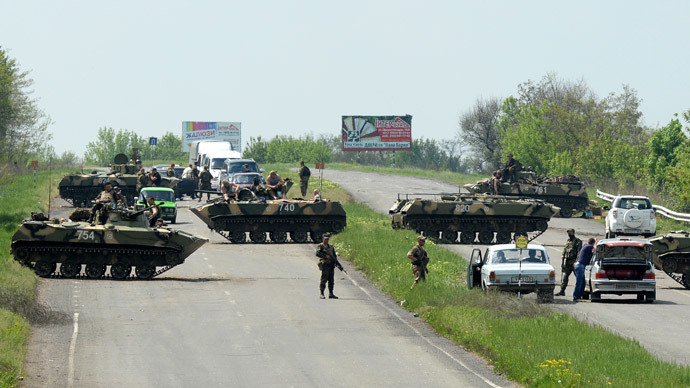
A checkpoint of the Ukrainian Army on the road linking Kramatorsk and Slavyansk.(RIA Novosti / Mikhail Voskresenskiy)
Strelkov says that all the barrels are pointed at Slavyansk, warning that once the assault starts, citizens of Slavyansk “will live badly, but not for long.” He says that volunteers, mostly men in their forties, are continuing to join the ranks of the self-defense pro-federalization forces, to “defend their native city.”
On May 5 several checkpoints came under attack around the city of Slavyansk. Casualties were reported on both sides. Donetsk Health Department reports that at least 8 people died and 16 others injured when the troops started the assault on the city, trying to fight their way in into the center of the city.
With support of armored vehicles, artillery, and the air force the Ukrainian troops encircled Slavyansk but did not retake the city from the pro-federalization forces. Strelkov said that at least 10 of his men died in the last attempt.
“We suffered losses – about 10 people, including civilians, 20-25 people were injured. I do not know the losses of our adversaries; clearly they are smaller than ours, they have armor. Most of our losses came from plainclothes [troops], disguised as civilians,” he said.
The Ukrainian Interior Ministry said four of its troops were killed and some 30 others injured in Slavyansk during Monday’s attack. There were also casualties among the civilian population of the city, the ministry added.
Featured Video
Daniel Davis: U.S. Military Options & War Narrative Collapse
or go to
Aletho News Archives – Video-Images
Book Excerpt
US Axis of Aggression in Gulf
By Finian Cunningham | Strategic Culture Foundation | August 15, 2019
When Washington announced a few weeks ago the formation of a maritime “international coalition” to “protect shipping” in the Persian Gulf, many observers were skeptical. Now skepticism has rightly turned to alarm, as the proposed US-led “coalition” transpires to comprise a grand total of just three nations: the US, Britain and Israel.
The term “coalition” has always been a weasel word used by Washington to give its military operations around the world a veneer of international consensus and moral authority. If the US goes ahead with deploying forces in the Persian Gulf the guise of “coalition” is threadbare. It will be seen for what it is: naked aggression.
Iran promptly warned that if the US, Britain and Israel move on their intention to deploy in the Persian Gulf, it will not hesitate to defend itself from a “clear threat”. … continue
Blog Roll
 Aletho News
- War on Iran to impose trillion-dollar ‘Israel First Tax’ on US citizens: Araghchi
- The State Is Socializing the Cost Of the Iran War
- Seyed M. Marandi: U.S. Attacked World’s Largest Gas Field & Iran Declares Economic War
- Washington’s War on Cuba Is Older Than You Think
- Daniel Davis: U.S. Military Options & War Narrative Collapse
- Protesters call on Brussels university to cut partnership with Israeli defense-linked firm
- Weapons makers cash in on Trump’s Iran war
- Why Trump’s anti-Iran naval coalition in Strait of Hormuz is doomed to fail
- IRGC says regional energy sites linked to US will be reduced to ashes
- Qatar condemns ‘dangerous’ Israeli attack on gas field
- If Americans Knew
- How ignorance, misunderstanding and obfuscation ended Iran nuclear talks
- Israeli media reports grotesque settler attack in West Bank
- UK security adviser attended US-Iran talks and judged deal was within reach
- Tucker Carlson says ‘neocons’ will try to destroy Joe Kent over resignation
- Lebanon death toll exceeds 900, another assassination in Iran, bombing in Gaza – Not a ceasefire Day 159
- Trump’s counterterrorism chief, whose own wife was killed by ISIS, quits over Iran War saying Tehran posed ‘no imminent threat’
- Here’s what US could fund instead of Bibi’s war on Iran
- Israel Killed Over a Dozen Lebanese Paramedics in Three Days, Now Claiming That Ambulances Are “Hezbollah” Targets
- War on Iran: These are the heritage sites devastated by US and Israeli attacks
- Four news stories from Israeli media that illustrate Israeli “justice”
- No Tricks Zone
- Energy Expert: Germany’s Nuclear Phaseout Was A “500 Billion Euro Mistake”
- New Research: South Australia’s Mid-Holocene Sea Surface Temperatures Were 4°C Warmer Than Today
- Storing Green Energy To Last Germany 10 Days Would Require A 60-Million Tonne Battery
- New Studies: UK Sea Levels Were 4 Meters Higher Than Today During The Mid-Holocene
- Destructive Green New Deal: German Energy And Metal Group Warns Of Drastic Crisis
- New Study Documents A 20-Year Pause In Arctic Sea Ice Decline – Driven By Internal Variability
- Wake-up Call: Survey Shows Majority Of Germans Now Favor Postponing Climate Targets!
- Televised! Leading German Political Candidate Tells Schoolchildren CO2 Makes Sun Hotter!
- New Study: A Century Warming Of 1.1°C Is ‘Commonplace’ And ‘Not Unusual’ During This Interglacial
- New Study: ‘Internal Noise’ And Volcanic Forcing Can Trigger 10-15°C Warming Within Decades
 Aletho News