US State Dept. fails to recognize ‘individuals’ detained by Kiev as Russian journalists
RT | May 20, 2014
Washington has failed to condemn the detention of Russian journalists working in Ukraine, instead doubting they were journalists at all and accusing them of smuggling weapons based on a “reports and conversations” on the ground.
The US State Department claims that Russian journalists were in possession of press accreditation that was given to them by the self-proclaimed Donetsk republic, which Ukraine and the US do not recognize.
“The Ukrainian Security Services, according to reports, have detained a number of people who were in possession of fake journalist credentials issued by the non-existent Donetsk People’s Republic,” US State Department spokeswoman Jen Psaki said at a daily press briefing.
Psaki did not specify precisely which journalists she was referring to, but Associated Press reporter Matt Lee at the briefing was asking about the Russian TV crew working for LifeNews who were detained by the Ukrainian Security Forces (SBU) on Sunday.
“Reportedly they were carrying portable aircraft missiles in the trunks of their cars at the time of their detention. So I haven’t looked in your trunk lately but it is unlikely you have those in there. That raises some questions about these individuals and whether they were actually journalists,” Psaki said.
After persistent attempts by Lee to find out whether Psaki had any proof or credible source to back such claims, she acknowledged that these reports were “credible” as considered by a US “team on the ground” which is “in touch with Ukrainian authorities.”
Reports “about these individuals and what they were carrying with them, certainly raises the question as to who they are,” Psaki answered
When again pushed to answer whether the accusations were based on rumors, Psaki hinted that the information comes from Kiev.
“This is from our team on the ground who are certainly in touch with our Ukrainian authorities,” Psaki replied.
When asked about the detention of an RT stringer working on the ground in eastern Ukraine, Graham Phillips, Psaki replied that she was not aware of “specific details” of his arrest yet, but promised to look into that.
Psaki said that the State Department will condemn the move of illegal detention of journalists, however emphasizing that Washington will first of all focus on “continuing to press for the release of the Ukrainian and international journalists who have been detained by Russian separatists.”
On Sunday, two Russian LifeNews journalists, Oleg Sidyakin and Marat Saichenko, were captured by Ukrainian troops near Kramatorsk in the self-proclaimed Donetsk People’s Republic.
Ukrainian authorities claimed on Tuesday that the detained journalists confessed during interrogation to entering the territory of the country without press cards. The crew are now in Kiev but so far have not been charged.
Previously the OSCE urged the Kiev authorities to release the Russian journalists saying that intimidation and obstruction of media is “unacceptable.”
In the meantime, RT has lost contact with the channel’s contributing journalist Graham Phillips who had earlier reported that he had been detained by the National Guard at a check point in Mariupol, eastern Ukraine. The British journalist Phillips may be turned over to the Ukrainian Security Service and sent to Kiev as well, a source told RT
The Russian Foreign Ministry’s commissioner for human rights labeled the harassment of journalists as the obstruction of media that doesn’t support the coup-appointed authorities’ policy.
“This is another step de facto made by Ukrainian authorities to curb the activities of unwanted journalists,” said Konstantin Dolgov. “The journalists who work professionally and show an objective picture, the ugly side of the outrages made by ultra-nationalists, the results of [Kiev’s] punitive operation in the southeast.”
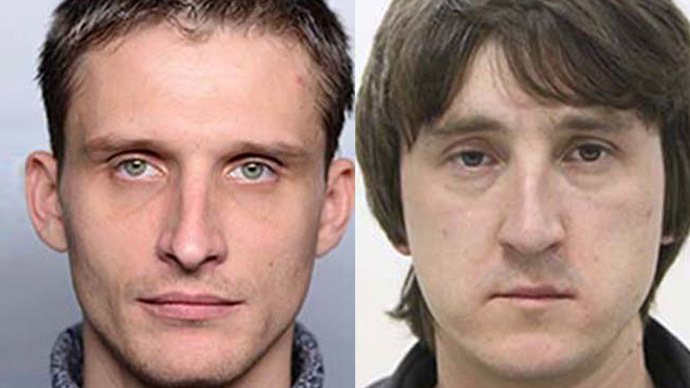
Journalists Oleg Sidyakin and Marat Saichenko. Image from http://www.lifenews.ru
In both cases involving the RT stringer and LifeNews crew, it appears the SBU was responsible in detaining and neutralizing reporting. Dolgov added that Phillips’ arrest followed the “unlawful seizure, detention of Russian journalists,” adding that Moscow is continuing to work for their speedy release.
On Monday, pro-Kiev activists again called to “immediately detain and deport” Phillips, who they believe is “cooperating with terrorists,” according to a message posted on EuroMaidan Kharkov’s Facebook page.
The same day, LifeNews said that journalists held captive by Ukraine’s coup-installed government were reportedly arrested after they released footage showing a UN-marked helicopter used by Kiev’s armed forces engaged in an operation against civilians in the east. A few days prior to the journalists’ arrest on Sunday, the authorities in Kiev issued an order to “find and neutralize” the authors of the video, a LifeNews source in SBU told the channel.
Meanwhile, RT Arabic’s news crew who arrived in Kiev to cover the upcoming May 25 Ukrainian presidential election has not been allowed into the country and was sent back to Moscow under the pretext that they were unable to properly explain the purpose of their visit, despite being accredited by the Ukrainian Central Election Commission.
Britain’s MI5 accused of complicity in torture
Press TV – May 20, 2014
Britain’s domestic spying apparatus MI5 has been accused of complicity in torture.
A Dutch man of Somali origin, Ahmed Diini, accused the British spy agency of questioning him while he was being tortured in an Egyptian prison earlier this year.
Diini said during his eight-month imprisonment in Cairo that he was shackled, hooded, repeatedly beaten, and threatened that his wife would be raped.
The former British resident, who is also a grandson of the deposed Somali dictator Mohamed Siad Barre, claimed that the alleged MI5 agents worked closely with Egyptian security forces, promising him his freedom if he agreed to work for the British intelligence service.
The Dutch man was imprisoned for unknown reasons following the ouster of Egyptian president Mohamed Morsi.
The claim comes as the head of MI5 told lawmakers in November that his officers would never participate in or condone torture, or take part in operations where a suspect is being illegally detained by a foreign state.
This is while the Constitution Project report last year slammed Britain for violating human rights through colluding with the US in the torture and rendition of terror suspects.
The dossier also claims MI5 agents under the last Labour government knew that prisoners were ill-treated at the hands of their captors
For years, Labour ministers denied involvement in rendition. But the report pointed out that the UK had paid out around £10 million to more than a dozen detainees after they were illegally rendered and tortured.
Russian Manipulation of Reactor Fuel Belies U.S. Iran Argument
By Gareth Porter | IPS | May 19 2014
WASHINGTON – In the stalemated talks between the six powers and Iran over the future of the latter’s nuclear programme, the central issue is not so much the technical aspects of the problem but the history of the Middle Eastern country’s relations with foreign suppliers – and especially with the Russians.
The Barack Obama administration has dismissed Iran’s claim that it can’t rely on the Russians or other past suppliers of enriched uranium for its future needs. But the U.S. position ignores a great deal of historical evidence that bolsters the Iranian case that it would be naïve to rely on promises by Russia and others on which it has depended in the past for nuclear fuel.
Both Iran and the P5+1 are citing the phrase “practical needs”, which was used in the Joint Plan of Action agreed to last November, in support of their conflicting positions on the issue of how much enrichment capability Iran should have. Limits on the Iranian programme are supposed to be consistent with such “practical needs”, according to the agreement.
Iran has argued that its “practical needs” include the capability to enrich uranium to make reactor fuel for the Bushehr nuclear power plant as well as future nuclear reactors. Iranian officials have indicated that Iran must be self-sufficient in the future with regard to nuclear fuel for Bushehr, which Russia now provides. It announced in 2008 that another reactor at Darkhovin, which is to be indigenously constructed, had entered the design stage.
Former senior State Department official on proliferation issues Robert Einhorn has transmitted the thinking of the Obama administration about the negotiations in recent months. In a long paper published in late March, he wrote that Iran had “sometimes made the argument that they need to produce enriched uranium indigenously because foreign suppliers could cut off supplies for political or other reasons.”
The Iranians had “even suggested,” Einhorn wrote, “that they could not depend on Russia to be a reliable supplier of enriched fuel.” This Iranian assertion ignores Russia’s defiance of the U.S. and is allies in having built Bushehr and insisting on exempting its completion and fuelling from U.N. Security Council sanctions, according to Einhorn.
Einhorn omits, however, the well-documented history of blatant Russian violations of its contract with Iran on Bushehr – including the provision of nuclear fuel – and its effort to use Iranian dependence on Russian reactor fuel to squeeze Iran on its nuclear policy as well as to obtain political-military concessions from the United States.
Rose Gottemoeller, now Under Secretary of State for Arms Control and International Security, described the dynamics of that Russian policy when she was director of the Carnegie Moscow Center from early 2006 through late 2008. She recounted in a 2008 paper how the Russians began working intensively in 2002 to get Iran to end its uranium enrichment programme.
That brought Russia’s policy aim in regard to Iran’s nuclear programme into line with that of the George W. Bush administration (2001-2009).
Russia negotiated an agreement with Iran in February 2005 to supply enriched uranium fuel for the reactor and to take back all spent fuel. Later in 2005, Moscow offered Iran a joint uranium enrichment venture in Russia under which Iran would send uranium to Russia for enrichment and conversion into fuel elements for future reactors.
But Iran would not gain access to the fuel fabrication technology, which made it unacceptable to Tehran but was strongly supported by the Bush administration.
Bush administration officials then began to dangle the prospect of a bilateral agreement on nuclear cooperation – a “123 Agreement” – before Russia as a means of leveraging a shift in Russian policy toward cutting off nuclear fuel for Bushehr. The Russians agreed to negotiate such a deal, which was understood to be conditional on Russia’s cooperation on the Iran nuclear issue, with particular emphasis on fuel supplies for Bushehr.
The Russians were already using their leverage over Iran’s nuclear programme by slowing down the work as the project approached completion.
A U.S. diplomatic cable dated Jul. 6, 2006 and released by WikiLeaks reported that Russ Clark, an International Atomic Energy Agency (IAEA) nuclear safety official who had spent time studying the Bushehr project, said in a conversation with a U.S. diplomat, “[H]e almost feels sorry for the Iranians because of the way the Russians are ‘jerking them around’.”
Clark said the Russians were “dragging their feet” about completing work on Bushehr and suggested it was for political reasons.
The IAEA official said it was obvious that the Russians were delaying the fuel shipments to Bushehr because of “political considerations,” calculating that, once they delivered the fuel, Russia would lose much of its leverage over Iran.
In late September 2006, the Russians changed the date on which they pledged to provide the reactor fuel to March 2007, in anticipation of completion of the reactor in September, in an agreement between the head of Russia’s state-run company Atomstroyexport, and the vice-president of Iran’s Atomic Energy Organisation.
But in March 2007, the Russians announced that the fuel delivery would be delayed again, claiming Iran had fallen behind on its payments. Iran, however, heatedly denied that claim and accused Moscow of “politicising” the issue.
In fact, Russia, with U.S. encouragement, was “slow rolling out the supply of enriched uranium fuel,” according to Gottemoeller. Moscow was making clear privately, she wrote, that it was holding back on the fuel to pressure Iran on its enrichment policy.
Moscow finally began delivering reactor fuel to Bushehr in December 2007, apparently in response to the Bush administration’s plan to put anti-missile systems into the Czech Republic and Poland. That decision crossed what Moscow had established as a “red line”.
Obama’s election in November 2008, however, opened a new dynamic in U.S.-Russia cooperation on squeezing Iran’s nuclear programme. Within days of Obama’s cancellation of the Bush administration decision to establish anti-missile sites in Central Europe in September 2009, Russian officials leaked to the Moscow newspaper Kommersant that it was withholding its delivery of S-300 surface-to-air missile systems for which it had already contracted with Iran.
Iran needed the missiles to deter U.S. and Israeli air attacks, so the threat to renege on the deal was again aimed at enhancing Russian leverage on Iran to freeze its uranium enrichment programme, while giving Moscow additional influence on U.S. Russian policy as well.
The Russian attempt to exploit Iran’s dependence on Moscow for its reactor fuel for political purposes was not the first time that Iran had learned the lesson that it could not rely on foreign sources of enriched uranium – even when they had legal commitments to provide the fuel for Iran’s nuclear reactor.
After the Islamic revolution against the Shah in 1979, all of the foreign suppliers on which Iran had expected to rely for nuclear fuel for Bushehr and its Tehran Research Reactor reneged on their commitments.
Iran’s permanent representative to the IAEA, Ali Asghar Soltanieh, sent an official communication to IAEA Director General Yukiya Amano on Mar. 1, 2010, stating that specific contracts with U.S., German, French and multinational companies for supply of nuclear fuel had been abruptly terminated under pressure from the U.S. government and its allies.
Soltanieh said they were “examples [of] the root cause of confidence deficit vis-à-vis some Western countries regarding the assurance of nuclear supply.”
The earlier experiences led Iran to decide around 1985 to seek its own indigenous enrichment capability, according to Iranian officials.
The experience with Russia, especially after 2002, hardened Iran’s determination to be self-reliant in nuclear fuel fabrication. The IAEA’s Clark told the U.S. diplomat in mid-2006 that, if the Russians did cut off their supply of fuel for Bushehr, the Iranians were prepared to make the fuel themselves.
It is not clear whether the Obama administration actually believes the official line that Iran should and must rely on Russia for nuclear fuel. But the history surrounding the issue suggests that Iran will not accept the solution on which the U.S. and its allies are now insisting.
~~~
Gareth Porter, an investigative historian and journalist specialising in U.S. national security policy, received the UK-based Gellhorn Prize for journalism for 2011 for articles on the U.S. war in Afghanistan. His new book “Manufactured Crisis: the Untold Story of the Iran Nuclear Scare”, was published Feb. 14.
How the Iran Nuclear Deal May Impact Iran’s Approach in OPEC
Going to Tehran | May 19th, 2014
How the Iran Nuclear Deal May Impact Iran’s Approach in OPEC
by Erfan Ghassempour
Iran is thinking seriously about how to put its crude oil back on the market, and—following the November 2013 Geneva interim agreement on Iran’s nuclear program—is planning for a future when sanctions no longer hamper its oil industry. The country is changing its contracts for the exploration, development, and production of its oil and gas resources to tempt major international oil companies to return to its petroleum sector. Iran’s Petroleum Minister, Bijan Namdar Zanganeh, has expressly invited seven oil giants to invest in Iran after sanctions are lifted.
Iranian ambitions are also reflected in Tehran’s approach to the Organization of Petroleum Exporting Countries (OPEC). At the most recent OPEC meeting, held in December 2013—in the wake of the Geneva nuclear deal—Zanganeh made a powerful impression, warning other members to make room for Iranian crude. One way or another, he declared, Iran plans to increase its oil output to four million barrels per day (bpd), even if prices decrease to twenty dollars per barrel. (Some analysts think that the highest output Iran could achieve in the near-to-medium term after the lifting of sanctions would be 3-3.5 million bpd—but even that would mean a significant increase in Iranian oil exports, which, according to Zanganeh, are now at 1.5 million bpd.)
Iran’s reemergence on the international oil scene comes at a time when developments in other OPEC member states are increasing the likelihood of an appreciable rise in Middle Eastern oil production—e.g., Iraq’s security is improving, and strikes and rebel attacks seem to be ebbing in Libya. Zanganeh argues that, even in this context, Iran’s return to the oil market should have no negative impact on prices. As he told the OPEC Bulletin, over the years other OPEC members had “gone out of the market” for some time, “but when they returned to the market, OPEC knew how to deal with the situation—to create room to maintain the extra capacity, so that these countries can have a good return and for it not to have a bad impact on prices.”
At least on the surface, other OPEC players responded positively to Zanganeh’s message. OPEC’s secretary general, Abdalla el-Badri, welcomed Iran’s return to the market, denying any concern at this prospect. Even Iran’s biggest political and oil rival, in the region, Saudi Arabia (the biggest oil producer in OPEC), welcomed an increase in Iranian production. Saudi Arabia’s Oil Minister, Ali Naimi, told reporters that he did not see a price war on the horizon: “They are welcome, everyone is welcome to put in the market what they can; the market is big and has many variables—when one comes in, another comes out.” Mr. Naimi also stated, “I hope Iran comes back [and] produces all it can.”
Iran is also stepping up its cooperation with Iraq on oil issues. At the December 2013 OPEC meeting, Iraq vigorously defended Iran’s plans to raise oil production, while also making clear that Iraq would remain outside OPEC’s quota system and that other members should decrease their production, if necessary, to make room for both Iran and Iraq. (Iraq’s Deputy Prime Minister for Energy, Hussein al-Shahristani, has announced that his country intends to increase its oil output to nine million bpd by 2020, partly through cooperation with Iran.) Recently, Iraq has been helping Iran to develop new contracts to attract more foreign investment to its oil sector. Baghdad and Tehran have also established a committee to oversee the joint exploitation of fields lying astride the Iranian-Iraqi border. Some analysts think that the two countries are drawing closer to maximize their relative power and influence—on oil-related issues as well as on strategic and political matters—vis-à-vis Saudi Arabia.
As the six-month deadline for the Geneva interim deal approaches, Iran’s determination to produce more crude becomes stronger. If a permanent nuclear deal is reached at the end of six months (that is, on or around July 20), it would mean that sanctions will be lifted and Iran will renew its upstream and downstream activities.
So far, the interim deal has been well implemented. The International Atomic Energy Agency affirms that Iran is fulfilling its commitments; the West has returned some of the Iranian funds that have been frozen in Western banks and has eased some sanctions. None of the parties has been motivated to breach the interim agreement. On the Iranian side, the political and economic atmosphere in Iran suggests that Iranian officials are willing to continue this approach; Supreme Leader Ayatollah Seyed Ali Khamenei has publicly expressed his support for the ongoing nuclear negotiations. On the American side, while some political factions in the United States want President Obama to increase pressure on Iran, this seems more a matter of political posturing than serious action. At this point, there is little appetite in the United States for torpedoing nuclear diplomacy with Iran.
Iran knows that any improvement in its oil industry is dependent on the nuclear talks. As the negotiations progress, Iranian officials are playing a bolder role in the region and in international organizations to which Iran belongs. At the next OPEC meeting in June, Zanganeh is likely to take an even tougher approach than at the previous meeting in December. It seems that other OPEC states are progressively accepting the inevitability of Iran’s return to the international oil scene.
There are two ways in which OPEC can handle prospective increases in Iranian, Iraqi, and Libyan output: other members—especially Saudi Arabia—can decrease production to make room for increased production by others, or the organization can raise its current 30 million bpd production ceiling. Politically as well as economically, much will hinge on what OPEC decides.
Ukrainian MPs call for immediate troop withdrawal from country’s east
RT | May 20, 2014
Ukrainian troops deployed in the country’s east should immediately return to their bases, the country’s parliament said in a memorandum. The freshly-adopted document also urges constitutional reforms based on the decentralization of Kiev’s power.
With 226 votes required to pass the law, the Ukrainian parliament finally adopted the so-called ‘Memorandum of Peace and Consent’, 252 MPs voting in favor. In particular, the document calls “to restore law, order and public safety in the state by stopping bloodshed and bringing to justice those responsible for the killings of civilians during mass protests; to stop the anti-terrorist operation in Ukraine’s southeast and return the soldiers involved in anti-terrorist operations to their places of permanent deployment.”
The document also urges for immediate constitutional reform that will grant more autonomy to regions.
The Verkhovna Rada voted after a debate concerning the wording of the article on the status of the Russian language. An agreement was reached after “constitutional status of the Ukrainian language as the language of state” was confirmed.
The document said that the state “must ensure the rights of minority languages.” The document made a point “to grant the status of the Russian language,” but stopped short from giving it the constitutional status. This resulted in the Communist Party abstaining from the vote.
Communist leader Pyotr Simonenko also blasted the decision to drop the provision granting amnesty to self-defense forces in the east.
MPs from the nationalist Svoboda Party abstained from voting as well, saying they believe the reform will be ineffective.
Further, the reform will provide for the country to drop its non-aligned status, allowing it to join any interstate union through a referendum.
Following the announcement, Russia said that if Ukraine’s authorities plan to implement all the reforms declared in the memorandum then they will finally be responding to Moscow’s calls.
“First, we have to see how it looks on paper. If this is true then it’s the development we have been talking about over the past months,” said Deputy Head of the Russian Foreign Ministry Grigory Karasin, as quoted by RIA Novosti.
Unlawful killing of two Palestinian teens outside Ofer
Al-Akhbar | May 20, 2014
Video footage obtained by a human rights group Monday showed the chilling shooting deaths of two Palestinian children by Israeli occupation forces last Thursday.
Israeli soldiers shot dead teenagers Mohammed Odeh Abu al-Thaher and Nadim Siyam Nawara during a protest coinciding with the 66th anniversary of the Nakba outside Israel’s Ofer prison near the West Bank city of Ramallah.
Israel had claimed it fired rubber bullets during the May 15 protest to disperse the protesters.
But footage released by the Defence for Children International (DCI) captured from a security camera at a nearby house shows the youths, believed to be aged 16 and 17, being shot dead as they calmly walked.
The video shows the first victim walking in the opposite direction of the occupation forces before he is struck by a bullet in the back. Onlookers immediately rushed to his aid.
The second victim is shot in the chest in the same location as he walked slowly. He falls to the ground and struggles to get back up as others assist him and signal for the occupation forces to cease fire.
Both children were unarmed.
“Israeli forces continue to use excessive force and recklessly fire live ammunition and rubber-coated metal bullets on unarmed protesters, including children, killing them with impunity,” Rifat Kassis, executive director of DCI-Palestine, said in a statement.
The report said a third, 15-year-old victim was shot in the back and left lung during the protest and is recovering at a Ramallah hospital.
International human rights groups have repeatedly condemned Israel’s use of deadly force against Palestinian protesters and civilians in the West Bank and Gaza.
Kiev liable for crisis in eastern Ukraine: Analyst
Press TV – May 20, 2014
The Kiev government is actually responsible for the ongoing crisis in eastern Ukraine, a political analyst tells Press TV.
“We can blame the military operation launched by Kiev and this is not just a military operation. It’s not just used military forces of the Ukrainian army; it has also used militias, irregular troops, terrorist units, simple violent hooligans,” Manuel Ochsenreiter, chief editor of news magazine, Zuerst, said in an interview with Press TV on Tuesday.
He held the Kiev government and not Donetsk and Lugansk or even Moscow accountable for the ongoing crisis.
The acting Kiev government has been staging military operations in the eastern and southern regions since mid-April in a bid to root out pro-Moscow demonstrations.
Nearly 130 people have so far been killed during clashes and operations by Ukrainian troops in the east and the south, according to figures from the United Nations.
The commentator further emphasized that the recent referendum in Ukraine’s eastern regions of Donetsk and Lugansk is not responsible for the humanitarian situation as it did not take the social services from the country.
He added that an election or referendum has never changed the direct humanitarian situation of the people on the ground in any time of history, noting that Kiev and the West are likely to use it as an excuse.
“It’s a very cynical interpretation of the situation to say, well, you wanted to be independent, now take starve, don’t find a doctor, now don’t get medicine,” the analyst pointed out.
On May 12, Ukraine’s two eastern regions of Donetsk and Lugansk declared independence following local referendums in which the regions’ residents voted overwhelmingly in favor of independence from Kiev.
~~~
Sanctions ‘sharp knife’ to business in Europe and America – Medvedev
RT | May 20, 2014
Economic sanctions against Russia will only bring the world closer to another Cold War, which is counterproductive and most of all hurts business in Europe and America, Prime Minister Dmitry Medvedev said in an interview with Bloomberg TV.
“Let’s be honest, the sanctions are a sharp knife; European business and American business don’t need them either. The only ones who want sanctions are politicians,” the Prime Minister said in the interview aired May 20.
“Basically we are slowly but surely approaching a second Cold War that nobody needs,” Medvedev said, as he says Russia prefers not to politicize trade and economic sanctions.
The Prime Minister said the degeneration of US-Russia relations were reminiscent of Soviet times during the Cuban missile crisis of Afghanistan war. The US launched sanctions against Russian politicians, which only further exacerbated diplomatic relations.
“You know to put it simply no one is happy about sanctions since they are always a sign of tense relations. We do not support sanctions. Moreover, you may have noticed that we have not commented on them a great deal or responded to them harshly, although we probably could cause some unpleasantness with the countries that are imposing those sanctions, but it’s bad for international economic relations, relations with Europe and the United States. It’s just bad,” Medvedev said.
The US and the EU have tightened sanctions against Russia, but Moscow maintains they are an outdated practice that will only backfire and hurt business and industry on all sides.
“The sanctions have not had a significant effect on us. That doesn’t mean that we are happy about them. Again, sanctions are a dead-end, and, in fact, everyone understands this – everyone, including businesses in Europe and America,” said Medvedev.
The US expanded its sanctions on April 28, which were shortly followed by a copy-paste EU version. All together, the sanctions target dozens of Russian politicians deemed critical in reuniting Crimea with Russia, 6 businessmen believed to be close to Putin’s inner circle, 3 banks and 17 companies.
Retaliatory sanctions
Moscow doesn’t rule out a set of counter sanctions to protect the Russian economy.
“Of course, there is a plan of action depending on how the situation will develop,” Medvedev said.
Retaliatory measures would be reciprocal and similar to those of the West.
“If we talk of a worst case scenario, despite the fact that we object to any sanctions, our package of retaliatory measures not only includes the measures towards a gradual improvement of the situation in our economy, but also measures that might target certain states,” the Prime Minister said.
Medvedev, who himself was responsible for the so-called reset between the US and Russia, said that he was disappointed in President Obama’s politics and that he could have acted with more political finesse.
“Once a new administration comes to power in the United States and a new president takes office after Obama, these sanctions will be forgotten. In the end, nobody stands to win,” Medvedev said.
In the same interview Prime Minister Medvedev discussed the landmark gas deal due to be signed on Tuesday by Gazprom CEO Aleksey Miller and his CNPC counterpart Zhou Jiping in Shanghai.
Ukrainian Police Find Traces of Chloroform at Site of Odessa Fire
RIA Novosti – 19/05/2014
KIEV – Ukrainian investigators have discovered traces of chloroform in garbage and ashes removed from the House of Trade Unions in Odessa, the site of a fire where dozens of activists died on May 2, acting Ukrainian Deputy Interior Minister Vitaliy Sakal said Monday.
“There is an expert conclusion that in the garbage and ashes, where there were already around 30 investigations held on the premises; a like substance of chloroform was discovered. It is used during surgeries, but how it ended up in the Professional Union Building is currently being investigated,” Sakal said during a press conference.
He said that inhaling large amounts of the substance leads to respiratory arrest, which is what happened during the fire, in which 32 people died from an unknown substance, not extreme temperatures.
Clashes in Odessa broke out on May 2, between pro-federalization activists on one side and fans of the Odessa and Kharkiv football teams on the other, joined by Euromaidan activists.
Pro-Kiev radicals joined by Right Sector militia blocked the anti-government protesters in the House of Trade Unions and set the building on fire by hurling Molotov cocktails inside. Those trapped inside had little chance of extinguishing the blaze, as fire hoses in the building were out of order.
Six died of bullet wounds, 32 suffocated, and 10 fell to their death by jumping through the windows of the burning building. Another 214 were injured. According to some information, another 48 are reported to be missing.
No plausible explanation has been offered for the fact that many of those who died did not try to take refuge on upper floors or the roof, prompting rumors that they were poisoned by an unknown chemical.
The Holocaust Religion’s New Offshoot
By Richard Edmondson | Fig Trees and Vineyards | May 18, 2014
To considerable media fanfare, the National September 11 Memorial Museum held a dedication ceremony on Thursday, May 15 and plans to open its doors to the general public this coming Wednesday, May 21.
The new museum pledges itself to “demonstrating the consequences of terrorism on individual lives and its impact on communities at the local, national, and international levels”—and if 9/11 hasn’t already been elevated to the status of a full-blown religion in America, this should do it once and for all.
The new 9/11 religion will be devoted to endlessly remembering the events of 9/11 (“Never forget!”), and its main center of worship will be—where else?—“Ground Zero.” Ah, but the vast majority of the museum is not above ground, but rather below it. This was done so that visitors may “be in the very space where the Twin Towers once stood,” and also “because federal preservation law mandated that those remnants be publicly accessible.”
In some respects you could think of the new religion as an offshoot of the holocaust religion, and should you doubt the analogy, consider that the museum houses a 2,500 square foot repository in which are now stored the unidentified human remains—mostly bags of pulverized bone—of more than a thousand 9/11 victims…or…that no less than the president of the United States, along with the mayor of New York, have pronounced the ground upon which the museum sits to be “sacred.”
“A lot of family members have agreed that this is the right approach,” said Mayor Bill de Blasio, referring to the decision to store human remains on the site. “I’m confident this is being done respectfully after a lot of consultation with family members, and in a way that really dignifies this moment and the sacred ground we’re discussing.”
Consider also that, according to the museum’s website, “The National September 11 Memorial & Museum has partnered with the New York City Department of Education and the New Jersey Commission on Holocaust Education to develop a robust set of 9/11 lessons for K-12 classrooms.” It sounds almost like they’re planning to teach the kids the holocaust and 9/11 in the same lesson.
Built at a cost of $700 million, the museum features two “core” exhibition areas, both underground and located at the “archaeological heart of the World Trade Center site.” The exhibition halls are in proximity to what are known as the “Survivors’ Stairs,” and are packed with exhibits, including “artifacts, photographs, audio and video tapes” and much, much more.
But the possibility that Israel may have been one of the principle perpetrators behind the 9/11 attack doesn’t seem to be in the mix anywhere. At least there’s no mention of it on the official website, so if you do plan to visit the museum (admission $24), I wouldn’t count on seeing any exhibits on the luck of Larry Silverstein, the five dancing Israelis, Urban Moving Systems or its activities as a Mossad front operation, or a vast body of other evidence pointing to Israeli involvement in the attacks.
You will, however, should you show up on May 25—that’s four days after the main opening—get to attend a program entitled “9/11 Conspiracy Theories: Why They Exist and What Role They Play in Society,” featuring talks by Kathryn Olmstead and Michael Barkun. Both are noted academics, and both have authored books on the subject of conspiracy theories.
In fact, the 9/11 religion, as a main tenet of its faith, seems very much devoted to espousing the grandest conspiracy theory of them all—i.e. the official government narrative as determined by the 9/11 Commission, whose executive director, Philip Zelikow, is reportedly an Israeli/US dual citizen.
In that narrative, of course, we have 19 hijackers outwitting the intelligence agencies of the West, winging past NORAD defenses, ramming planes into the Twin Towers and the Pentagon, and accomplishing all this with relatively little flight training. And in case you should happen to forget, the 9/11 Museum seems quite intent on reminding you—these people were Muslims. One of the museum exhibits is to be a film entitled “The Rise of Al Qaeda,” which has set off a controversy (more about which below).
The 9/11 Memorial Museum consists of both the museum itself, as well as the 9/11 Memorial. The latter is located on the grounds above and around the museum, and its prominent features are two cascading reflection pools, each nearly an acre in size, bordering which the names of 9/11 victims are set in bronze.
The director of the museum is Alice Greenwald, while the CEO of the nonprofit overseeing both the museum and the memorial is Joseph Daniels. And then there is Clifford Chanin, who serves as the museum’s education director. Together the trio seems to be heavily involved in the day-to-day administration of the enterprise, and further they seem to be the three officials most often mentioned or quoted by the media.
In addition, all three—Chanin, Greenwald, and Daniels—are listed as having helped host a conference of the Council of American Jewish Museums that took place in March of 2013, while Chanin himself participated in one of the event’s panel discussions—entitled “Handle With Care: Sensitive Issues Surrounding Cultural Property”—along with Gabriel Goldstein, of Yeshiva University Museum, and Richard Freund, of the University of Hartford.
Chanin, by the way has also served as curator of the Legacy of Absence collection for the Illinois Holocaust Museum and Education Center, and reportedly also founded the Legacy Project, described as a nonprofit group “dedicated to documenting contemporary responses—in visual art, literature, film and public debates about memory—to historical traumas around the world.”
As you may imagine, obsessing over the holocaust— “in visual art, literature, film…” etc.—is a central preoccupation of the Legacy Project, but it seems Chanin has carried the same template into his work with the 9/11 Museum. On the official museum website, you can find an artists registry featuring a variety of artwork—from music and poetry to visual arts—with a 9/11 theme, plus information about the artists who created them.
One artist so featured is Lana Sokolov, an Israeli vocalist, choir conductor, and composer, who has a CD out entitled “Jewish Love Songs.” Ms. Sokolov is described as having been “active on the music scenes of Israel, Russia, and the US for the last 17 years,” and you can click here to watch a music video of her 9/11 song, “On That Day.”
Is there a continuum through all this? If Israelis were behind, or had a hand in, the destruction of the Twin Towers, then would it perhaps stand to reason that Israelis would also be behind (and profit from) the construction of the memorial built upon the same spot in their place?
The architect who designed the 9/11 Memorial, including its two pools, is Michael Arad, an Israeli/US dual national who previously served in the Israeli military. Reportedly Arad was chosen on the basis of having entered a competition, held back in 2003, in which contestants were invited to submit their designs for a 9/11 memorial. His design was selected out of a total of 5,201 entries, it was divulged.
“When I was in the Army, the unit I served in, you could never stop,” said Arad, speaking of his time served in the Israeli Army, which was during the first Intifada. “It was a volunteer unit, and there was a fairly high rate of attrition. The people stayed through are the people who were either great at it or the people who just didn’t know how to stop. And I fell into that second category.”
By all counts, Arad has an explosive temper, and he frequently clashed not only with other architects on the project, but also with the Lower Manhattan Development Corporation, the government agency overseeing the task. Especially rocky, it seems, was his relationship with architect Daniel Libeskind, who is also Jewish.
Libeskind drew up what has been referred to as the “ground zero master plan,” and it seems an habitual source of friction between the two men was Arad’s “significant departures,” in his own design for the memorial, from Libeskind’s overall master plan for the entire 16-acre site. (Two other architectural firms also involved in the project were Davis Brody Bond and Snøhetta, and reportedly there was considerable bickering between Arad and the rest).
“I will fight this!” Libeskind reportedly railed at one point. “I am the people’s architect!”
Perhaps the old adage about “two Jews and three opinions” is applicable here. But whatever the case, it seems the national memorial to the events of September 11 has been “hijacked,” in a manner of speaking, apparently in an effort to shape national perceptions—not only as they pertain to the substance and meaning of the tragic episode (tragic for the entire world), but also as to the character and distinctive traits of those purportedly behind the attacks.
As mentioned above, one of the museum exhibits is a film entitled “The Rise of Al Qaeda,” a short documentary—less than seven minutes long—but one over which there has been considerable controversy.
While it has not yet been made available to the general public, the video, narrated by NBC anchor Brian Willams, was screened before an interfaith advisory group, whose members have criticized it as inflammatory toward Muslims.
Their reactions are reported in an April 23, 2014 New York Times article, while two members of the group also registered their concerns in a letter to Greenwald, a letter which can be accessed in PDF form here.
As you know, many members of the Interfaith Advisory Group have expressed reservations about the narrative script for the documentary. Following our group’s request for a second viewing of the documentary and for a meeting with you, we expressed our concerns that, given the content of the video, museum visitors who do not have a very sophisticated understanding of the issues could easily come away equating al-Qaeda with Islam generally. We continue to posit that the video may very well leave viewers with the impression that all Muslims bear some collective guilt or responsibility for the actions of al-Qaeda, or even misinterpret its content to justify bigotry or even violence toward Muslims or those perceived to be Muslim (e.g., Sikhs). Equally troubling is Brian William’s narrative juxtaposed to the English translations. All American sources, news quotations and narrative are recorded in “Media English”, whereas translations from Middle Eastern sources were recorded in English or broken English with a heavy Middle Eastern accent.
The writers of the above are Peter Gudaitis, of New York Disaster Interfaith Services, and the Rev. Chloe Breyer, of the Interfaith Center of New York. According to the Times, they and other members of the group had been invited to take a pre-opening tour of the museum, to walk through and view its exhibits, and for the most part, says the Times, their impressions were favorable—that is, until they saw the film.
“As soon as it was over, everyone was just like, wow, you guys have got to be kidding me,” Gudaitis said.
Objections centered around the film’s use of such words as “Islamist” and “jihadist” without sufficient elaboration, possibly leaving the impression that Muslims in general condone terrorism. It was at this point that Gudaitis and Breyer wrote their letter to Greenwald—and yes, they did receive a reply from museum officials, but according to the Times, it was an unintentional one:
The response from the museum was immediate, though accidental: Clifford Chanin, the education director, inadvertently sent the group an email intended solely for the museum’s senior directors, indicating he was not overly concerned.
“I don’t see this as difficult to respond to, if any response is even needed,” he wrote.
A Muslim member of the interfaith group was so incensed over the matter he resigned from the panel.
“The screening of this film in its present state would greatly offend our local Muslim believers as well as any foreign Muslim visitor to the museum,” said Shiekh Mostafa Elazabawy, imam of Masjid Manhattan. “Unsophisticated visitors who do not understand the difference between Al Qaeda and Muslims may come away with a prejudiced view of Islam, leading to antagonism and even confrontation toward Muslim believers near the site.”
But the film has also been defended by Bernard Haykel, a professor of Near Eastern studies at Princeton University, who supposedly “vetted” the script.
“The critics who are going to say, ‘Let’s not talk about it as an Islamic or Islamist movement,’ could end up not telling the story at all, or diluting it so much that you wonder where Al Qaeda comes from,” said Haykel, whose father is a Lebanese Christian and whose mother is Jewish.
Gudaitis and Breyer, in their letter, suggested some re-editing prior to the museum’s opening, or, should that not be possible, a disclaimer, placed either at the front of the film or in the room where it is shown, reading:
“This video in no way intends to imply that the vast majority of Muslims agree with or support the attacks perpetrated by the members of al-Qaeda. Most Muslim leaders and Muslim organizations worldwide have disavowed the ideology and actions of Al Qaeda. The Museum’s documentation of Al-Qaeda-inspired terrorism should not be mistaken for any implicit or explicit justification for racial, religious or ethnic profiling.”
But their suggestion was rejected. You can go here to watch a video of Chanin interviewed by Megyn Kelly on Fox News and insisting that, “The film will be shown as we’ve developed it.”
The issue of the storage of human remains at the museum has also stirred up a controversy. Museum officials assert that the decision was made in conjunction with the family members of 9/11 victims, and that it was handled respectfully… but not all the families are in agreement on that matter.
On Saturday, May 10, in a ceremony that had all the flavor of a religious rite, the remains were transported from the medical examiner’s office, where they were stored in the past, to the museum, to be housed in the special, 2,500 foot repository. Accompanied by blinking red lights, the procession was a solemn one, with more than 7,900 bags of bones and other remnants of the deceased victims being carried in three large, flag-draped containers.
According to one report, officials have stressed that “the remains will not be part of the museum’s exhibit and that their lost relatives’ bones will not be subjected to ghoulish gawking by strangers.” Nonetheless, the procession was met with a protest by a group of family members, many of them wearing black ribbons tied around their mouths. One of the protesters, Jim Riches, is quoted at length in a report at Voice of Russia.
“He was the hero before 9/11 and he was the hero after 9/11,” said Riches, speaking of his son, a 29-year-old firefighter who died in the attack and whose remains are among those that have yet to be positively identified by DNA sample.
Riches said the families were never polled to find out what they thought about the placement of the remains. He said many families wanted the remains above ground in a place that could be visited at any time, not one that closes at night like the museum will. “People have to pay 24-dollars to go pay their respects; it’s ridiculous”, he said.
Riches called the museum “a cash cow”. He said the nonprofit that runs the museum has paid their top executive and director close to half-a-million dollars a year. He said he thinks it’s “double what people from the National Park Service would bring in to do the same job at other national memorials like Pearl Harbor, Gettysburg and Shankesville.
“These guys are thinking of this as a revenue generating tourist attraction rather than being a memorial to our loved ones that would tell the story of what happened that day. We’re outraged,” he said.
You can also go here to access a website put up by the family members.
The dedication ceremony, held last Thursday, was attended in the main by dignitaries, family members (though presumably not the same ones protesting), and the media. On hand to deliver a speech was Obama, who at one point referred to the museum as a “sacred place of healing and of hope.”
But is it really? What are we to make of this museum, its architectural finesses, and its $700 million aggrandizement of a national tragedy? How do we interpret the stubborn refusal to change the “Rise of Al Qaeda” video or to at least put up the altogether reasonable disclaimer requested by the interfaith group? The museum seems very much to have been built, at least in part, with the intention of buttressing the official 9/11 narrative.
“In the battle for the American mind, reinforcements are often needed to stem the tide of truth,” writes Kenny, of the blog Kenney’s Sideshow, in a post on the museum put up on the day of the dedication ceremony.
And that may be an apt way of looking at it. The official 9/11 narrative is unraveling. Increasing numbers of people all over the world, including here in the US, have come to realize that it simply does not hold water. Perhaps, then, “reinforcements” were put in place, $700 million worth, in an effort to keep the whole artifice from falling apart at the seams.
The events of 9/11 gave birth to something truly monstrous. Nearly 3,000 people lost their lives that day in New York, but it is a number relatively miniscule compared to the millions who perished in the wars which were fought afterward and which still go on to this day. At this point perhaps all one might do is ask the perennial question: Who benefited? The official mission of the 9/11 Memorial Museum, as defined on its website, is to “bear solemn witness” to the attacks, and also to “honor” the victims. Yet I wonder if this man…
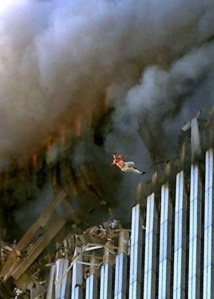
…would feel himself so honored had he known that one day, in his memory, rising up in place of the building from which he plummeted, would arrive what could perhaps be thought of as a festival of the victorious posing itself as a canto to the dead. They say that in such moments as this, captured in the frame above, your whole life passes in front of your eyes. And truly I can only believe that at some point on the way down, free-falling past the office windows one by one, there came over him a sense of heightened consciousness, a moment of consummate awareness, of celestial, perhaps even omniscient realization, when the question mark in his mind turned into… an exclamation point!
The West’s Non-Linear Warfare and the Right for the Rest to Resist
By Andrew Korybko | Oriental Review | May 19, 2014
Nearly two weeks ago, Peter Pomerantsev, writing for Foreign Affairs, published an article about “How Putin Is Reinventing Warfare”. He alleges that Russia is engaging in “non-linear warfare”, strongly alluding that this poses a threat to the West. If one can read between the lines of his biased and subjective approach, he is in actuality describing a very real and objective development – the restoration of Russian power and global standing. His ire is likely due to Russia now being able to deflect international information and media assaults against it and its policies and finally promote the truth. Pomerantsev then goes on a peculiar ranting spiel where he alleges a convoluted metaphor of Russia conspiring to be a “corporate raider”, an exercise in exasperation which will likely only reach those with pre-existing anti-Russian beliefs. It is the end of his article, however, that forms the basis of this response to it. Pomerantsev uses the analogy of the West’s “global village” versus Russia’s “non-linear warfare” to make his final point in throwing mud at Russia. In reality, there is not one “global village”, but rather, many regional civilizational villages that are experiencing Western raids and “non-linear warfare”, and they have finally started to band together to stop the marauders.
The liberal end of history (aka “the global village”) does not exist outside of ideological fantasy, and the world is instead divided into civilizational zones (regional villages) united around certain actors (Russia, China, Islamic pillars, the West). This forms the basis of the running metaphor that will be utilized below to advance the claim of the West waging non-linear warfare against the Rest.
Repeated raids from Western marauders and bandits, whose village is the only one seeking to expand, loot, and plunder, has resulted in parts of the other villages being burnt down. In the past decade, the Islamic village experienced this the worst, with conflagrations decimating its Afghan, Iraqi, Libyan, and now Syrian neighborhoods. Currently, the Eurasian village is having to deal with a fire in Ukraine, one that was purposely set to spread to the Russian core. However, as a result of these repeated raids, the regional villages have formed self-defense forces and are now working together to put out the fires and stop the raiding. Experience has taught them how to successfully resist and defy the Western village. In the real world, the success of international media firms (RT, Press TV, CCTV, Telesur) shows that media and information assaults can in fact be deflected and that perception management and national PR initiatives are not under the sole monopoly of the West.
Pomerantsev’s claims that “(economic) interconnection also means that Russia can get away with aggression” could not be more opposite to the truth. The Western village is actually two large ones, the US and the EU, and the American village grew out of the EU one and now controls its creator. In this case, the suburb controls the center, so to speak. It is the interconnection between the Eurasian (Russian) and EU villages that serves as the real check on further US aggression against the former. When not marauding and raiding, the Western village also tries to infiltrate the others via NGOs and Color Revolutions. Once it flips some members of the village and/or installs its pick as village leader, these turncoat individuals can “open the gates from within”, promote mutiny, and lead to the annexation of the village into the Western-dominated expanding sprawl.
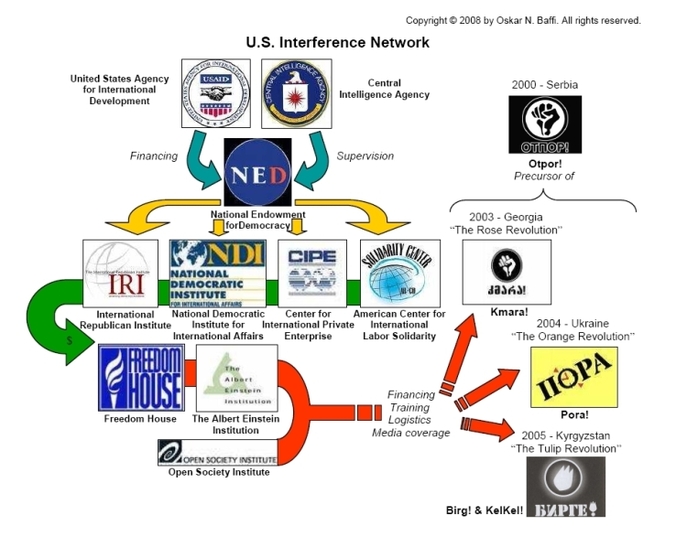
Pulling back from the metaphor, the Brzezinski Doctrine (“The Eurasian Balkans”) is the definition of non-linear warfare and subversive destabilization. It uses NGOs as destabilizing elements within the targeted states, and for this reason, foreign-funded NGOs are required to register as “foreign agents” inside the Russian Federation. Gene Sharp’s writings have also provided pivotal tactical advice in advancing the West’s non-linear warfare strategy. Taking the use of non-state actors even further, the West has a history of promoting militarized proxy groups to carry out its policies. This is most clearly seen in Kosovo, Afghanistan, Iraq, Libya, and Syria, although other countries have also been victims of this underhanded method of war. On the other hand, the West obviously engages in conventional warfare as well. Nowhere is this more evident than in the 2003 Iraq War. Mixing the two methods together is the new trend of American foreign policy. A non-linear campaign of militarized proxy destabilization culminated in a conventional NATO bombing in Libya. After this “success”, the West then turned its sights on Syria, but as a result of adroit Russian foreign policy maneuvers, non-linear warfare was stymied from mutating into its conventional form.
Pomerantsev’s article also uses fear mongering and heavy hype to scare the audience into thinking that Russia is proactively forming some kind of imaginary coalition against the West from within. If there happens to exist an overlap of perceived interests and objectives between Russia and domestic Western actors, it is because both parties arrived at the same conclusions after undergoing the same process – experiencing Western unipolar dominance and discriminatory targeting for two decades. For example, “Euro-scepticism” is also seen in Southeast Asia by the ASEAN members’ reluctance to form an EU-like union. The flower of New Leftism and resistance ideology in South America organically began to bloom in the 2000s, tended over by Hugo Chavez. In a similar fashion, the traditionally conservative societies of India, China, and Africa are just as disgusted as Russia’s by certain Western-centric values, such as the “bearded woman” of Eurovision. In laboratory conditions, the cause (Western dominance) has thus been proven to repeatedly result in similar effects all across the world, thereby confirming the hypothesis that Russia and others arrive at their conclusions on their own. There is no “contradictory kaleidoscope of messages”, as each actor’s resistance and defiance to the West, for various reasons and in differing forms, were a natural development.
To conclude, there are currently multiple civilizational liberation struggles playing out in the Pandora’s Box-setting of Western-led post-modernism. This is not a new page in the old historical story, but an absolutely new edition that is still being written. The Rest, absolutely diverse in their identity and overall mission, are coming together to stop the Western steamroller. They must work together to repel its aggression and safeguard the right to practice their identity and move forward with their historical mission as they individually deem fit. It is the democratic and sovereign choice of each civilization to be able to conduct itself how it pleases, but in order to get to that point, they must be liberated from the terror of the Western threat. These villages do not want to raze the Western one, so to speak, but they understand that the West will raze them if they can’t be annexed. In this manner, they are engaged in a do-or-die struggle, and at no time before in their histories has the situation been more dire. The Rest is slowly coalescing into providing a unified front against the Western menace, hoping to neutralize its raids and incursions so that they can once more go about their civilizational business in constructing and solidifying their societies. If, as Pomerantsev states, Russia and the Rest are anti-Western “raiders”, then yes, the future surely does belong to these resistant and defiant actors.
Andrew Korybko is the American Master’s Degree student at the Moscow State University of International Relations (MGIMO).
Featured Video

Michael von der Schulenburg: Europe’s Self-Defeating Iran War Policy
or go to
Aletho News Archives – Video-Images
Frlom the Archives
Provoking a Path to Persia
The Saban Center’s prescient paper on war with Iran
By Maidhc Ó Cathail | October 20, 2011
In June 2009, the Saban Center for Middle East Policy published “Which Path to Persia?—Options for a New American Strategy toward Iran.” Writing in a tone strikingly reminiscent of the Project for a New American Century’s infamous pre-9/11 paper “Rebuilding America’s Defenses,” the six co-authors noted that, “It seems highly unlikely that the United States would mount an invasion without any provocation or other buildup.” For a think tank specifically established by media mogul Haim Saban to protect Israel, this could prove to be a formidable obstacle impeding their desired march—of U.S. troops—to Tehran.
“In fact, if the United States were to decide that to garner greater international support, galvanize U.S. domestic support, and/or provide a legal justification for an invasion, it would be best to wait for an Iranian provocation, then the time frame for an invasion might stretch out indefinitely,” Saban’s think-tankers ruefully observed.
“With only one real exception, since the 1978 revolution, the Islamic Republic has never willingly provoked an American military response, although it certainly has taken actions that could have done so if Washington had been looking for a fight. Thus it is not impossible that Tehran might take some action that would justify an American invasion. And it is certainly the case that if Washington sought such a provocation, it could take actions that might make it more likely that Tehran would do so (although being too obvious about this could nullify the provocation). However, since it would be up to Iran to make the provocative move, which Iran has been wary of doing most times in the past, the United States would never know for sure when it would get the requisite Iranian provocation. In fact, it might never come at all.”
Seemingly undeterred by Iran’s frustrating unwillingness to provide the requisite provocation, the analysts continued to examine this option… continue
Blog Roll
 Aletho News
- Iran attacks on UAE leaves RSF militia high and dry
- Hosting Washington’s war: Bahrain faces the consequences
- The US fell for its own Iran propaganda
- Seyed M. Marandi: Threat of Seizing Kharg Island & the Use of Nuclear Weapons
- Is there even an off ramp?
- Michael von der Schulenburg: Europe’s Self-Defeating Iran War Policy
- Sorry, The New Republic, Climate Change Isn’t Causing Somali Migration. Blame Civil Strife and Poverty.
- Expert Guts Claims That HPV Vaccine Reduces Cancer Risk
- No evidence Russia sabotaged Baltic cables – Finnish intel
- The Strategic Folly of a (Serious) US Ground Invasion of Iran
- If Americans Knew
- 6 more Americans killed, as Israel ‘mows the lawn’ in Iran – Not a ceasefire Day 154
- Are we on the precipice of World War III?
- ‘Catastrophic,’ Says UNICEF: 1,100+ Children Killed or Wounded in Mideast Since US-Israel Launched Iran War
- The Unbelievable Madness of Our War With Iran
- World Council of Churches calls on govts to hold Israel accountable for violations of intl law
- How to end the war on Iran that costs US taxpayers $1M per minute – Not a ceasefire Day 153
- Israeli strategic plans to “remake the Middle East” from the 1950s and since
- Honoring Gaza’s women who refused to let the world look away
- 97% of victims of war on Iran are Iranian, 98% of victims in war on Gaza are Gazans – Not a ceasefire Day 152
- Early Iran strikes cost $5.6 billion in munitions, Pentagon estimates
- No Tricks Zone
- New Studies: UK Sea Levels Were 4 Meters Higher Than Today During The Mid-Holocene
- Destructive Green New Deal: German Energy And Metal Group Warns Of Drastic Crisis
- New Study Documents A 20-Year Pause In Arctic Sea Ice Decline – Driven By Internal Variability
- Wake-up Call: Survey Shows Majority Of Germans Now Favor Postponing Climate Targets!
- Televised! Leading German Political Candidate Tells Schoolchildren CO2 Makes Sun Hotter!
- New Study: A Century Warming Of 1.1°C Is ‘Commonplace’ And ‘Not Unusual’ During This Interglacial
- New Study: ‘Internal Noise’ And Volcanic Forcing Can Trigger 10-15°C Warming Within Decades
- Glaciers Worldwide Are Suddendly Surging, Experts Blame Warming!
- Surprising Discovery: Sahara Is Greening…Billions Of Trees Where Once Thought To Be Barren
- New Research Reaffirms Clouds, Aerosols, And Surface Solar Radiation Are ‘Driving The Climate System’
 Aletho News